The tale of the oldest animals (The freeing of Mabon mab Modron)

LIAM GUILAR is Poetry Editor of The Brazen Head, and the author of several poetry collections, including the series A Man of Heart, Presentment of Englishry and The Fabled Third (Shearsman), set in post-Roman Britain

This is from a translation of Culhwch and Olwen, ‘the oldest surviving Arthurian tale’ from medieval Welsh prose to modern English Verse. The story tells how Culhwch marries Olwen, the giant’s daughter. However, before he can marry her, he must complete forty tasks for her father. Many are obviously impossible; some merely extremely difficult. The tasks are completed not by Culhwch but by King Arthur and his men. What follows is the second and third task.

The complete translation, How Culhwch won Olwen, a verse translation of the oldest Arthurian tale, will be published by Shearsman in 2026. See
https://www.shearsman.com/store/Liam-Guilar-trans-How-Culhwch-Won-Olwen-p767786031

The translation is based on Culhwch and Olwen. An edition and study of the oldest Arthurian tale, by Rachel Bromwich and D. Simon Evans, (University of Wales Press, 1992)

The tale of the oldest animals (The freeing of Mabon mab Modron)

After they’d told Arthur all that had happened,

he said, ‘Which of these wonders should we seek first?’


‘It’s best to seek Mabon mab Modron

And to find him we need his kinsmen,

Eidoel mab Aer.’


Arthur and his knights arose,

and sought throughout Britain

until they came to the outer walls of Gliwi

where Eidoel was a prisoner.


Gliwi stood on the top of his fort:

‘Arthur, what do you want?

Life’s bad enough on this crag 

without you coming to ruin me.

I have neither wheat nor oats,

nor goods nor pleasure.’


‘I haven’t come to harm you,

I seek your prisoner.’


‘You can have him, although

I never intended to give him up.

And on top of that my help and support.


The men said to Arthur: ‘Lord, go home.

You cannot go with your host,

to seek such a petty thing as this.’

Arthur replied: ‘Gwrhyr the Translator,

It is good for you to go on this quest,

You know all the languages of men,

and some of the animals and birds’.

Eidoel, it is good that you go with my men

to seek Mabon, as he is your cousin.

Kei and Bedwyr, it is my hope

that whatever you seek you will find.

Go on this quest for me.’


They went until they found the Blackbird of Gilgwri.

Gwrhyr asked her: ’For God’s sake,

Do you know anything of Mabon mab Modron,

who was taken from between his mother and the wall,

when he was three nights old?’


The Blackbird replied:

‘I was a young bird

when first I came here

and found this anvil.

It hasn’t been touched

except by my beak,

tapping each evening.

Today you can see

all that’s left is the size

of a nut. God’s

vengeance on me

if I know of this man

you ask me about.

However, I will do

what is proper for

Arthur’s messengers.

There is another

creature God made

before me, and I

will take you to him.’


They went until they found the Stag of Redynure.


‘Stag of Redynure, we are messengers of Arthur,

we know of no animal older than you.

Say if you know anything of Mabon mab Modron,

who was taken from between his mother and the wall

when he was three nights old.’


‘When first I came here,

I had but a single tine

on either side of my head.

There were no trees but a single sapling.

That sapling grew into an oak with a hundred branches.

Then it fell to the earth, and now

there’s nothing of it left but a red stump.

Though I’ve been here from that day to this,

I’ve heard nothing of this man you mention.

But because you are Arthur’s messengers,

I will be your guide to an animal God made before me.’


They came to the place

where they found the Owl of Cwm Kawlwyt.


‘Owl of Cwm Kawlywt these are messengers from Arthur.

Do you know anything of Mabon mab Modron

who was taken from his mother on the third night?’


‘What I do know, I will tell to you.

When first I came here

the great valley you see

was thick with trees.


Then came a race of men

and laid waste the wood.

A second wood grew.

You now see the third.


The roots of my wings

are mere stumps now.

From that day to this


I have heard nothing

of the man you are seeking.

But I will be a guide

for Arthur’s messengers

until you come to the oldest

creature in the world

who has travelled the furthest:

the Eagle of Gwern Abwy.’


Gwyhyr said: ‘Eagle of Gwern Abwy

We have come, as messengers of Arthur,

to ask if you know anything about Mabon mab Modron

who was taken from his mother

when he was three nights old?’


The Eagle replied:


‘I came here


a long time ago


and when I first came here,


I had a stone,

and each evening,

from the top of my stone

I pecked at the stars.


Now it is not a handsbreadth in height.


From that day to this I have been here.


I have heard nothing of this man.


However,


when I was seeking my food in Llyn Llyw,

I sunk my talons into a salmon,

thinking he would feed me for a long time

but he pulled me down into the depths.


It was with difficulty I got away.


What I then did,


with all my kinsmen,


was to launch an attack.


We sought to destroy him.


He sent messengers

to me

to make peace,

then came

to me,

in person,

to have fifty tridents

removed from his back.


Unless he knows something

of the man you mentioned

I don’t know of anyone who does.

However, I will take you to him.’


They came to the place where he was.

The eagle said: ‘Salmon of Llyn Llyw,

I have come to you with Arthur’s messengers,

to ask if you know anything of Mabon mab Modron

who was taken from his mother on the third night.’


‘As much as I know I will tell you.

With every flood tide I go up the river

until I come to the bend

beneath the walls of Kaer Loyw.

Never in my life have I encountered,

such misery as I found there.


So you may believe me,

let one of you climb

on each of my two shoulders.’


Kei and Gwrhyr climbed on his shoulders.

They travelled upstream until they came

to the other side of the wall from the prisoner.

They could hear a-weeping and a-wailing.

Gwrhyr said: ‘What man laments

in this house of stone?’ ‘Alas, man,

I have cause for lamentation.

Mabon mab Modron is the prisoner here.

And no one has ever been imprisoned so cruelly,

neither Llud Silver hand nor Greit mab Eri.’


‘Is there hope of obtaining your freedom,

with gold or silver or worldly goods?

Or will it require assault and fighting?’


‘Whatever you can get of me,

will be got by fighting.’


They returned to Arthur

and told him where Mabon was.

Arthur summoned the fighting men of the island,

and they went to Kaer Loyw.


Kei and Bedwyr went upstream

on the shoulders of the salmon.

While Arthur’s warriors were attacking the fort,

Kei broke the wall, fighting with the men inside,

even when he was carrying the prisoner on his back.


Arthur came home with Mabon a free man.

The watchful Muse

With a Stranger’s Eyes

Jeremy Hooker, Swindon: Shearsman, 2025, 86pps., £10.95

With a Stranger’s Eyes is Jeremy Hooker’s third book of poems since the publication of Selected Poems 1965-2018 (Shearsman 2020) and arguably the best of this later group.[i] The poetry is divided into three sections, with a fourth, short prose ‘Reflections on Two Welsh Words.’ The first two sections record people, places and incidents from his past and present in non-English speaking countries, moving from memories of Holland to Wales, to a final section which looks outwards. The poet moves from being a stranger by nature of nationality and language, to a stranger in the world by reason of being human. The title reflects Hooker’s sense of not belonging. “I am a stranger in the area in which I live, and a stranger to the tragic history of the area. Being a stranger has affected my idea of myself as a poet (p.83).”[ii] This awareness saves the poems from sentimentality and egotism.

If we include 2016’s Ancestral Lines, then these four poetry books are what used to be called ‘a significant and important body of work,’ in their own right, because of the way they explore a maze of writing problems and offer one way out.

Hooker has quoted David Jones’ “one writes with the things at one’s disposal” which seems incontrovertible. However, biography is one of those things, and if biography is what makes writers who they are, then how do they write autobiographically without falling into the trap of producing something that is either private or, perhaps, worse, a lyric poem that begins and ends with the egotistical /I/? Hooker describes the problem: “I distrust the autobiographical impulse with its temptation to egotism and assumptions of finality. […] nostalgia came with a horror of being stuck in an idealised version of the past.” (‘A Note on Autobiographical Poetry,’ Preludes p. 79).”

The danger becomes more pressing for a man in his eighties, who has reached a time in his life when looking back seems inevitable. Ancestral Lines was Hooker’s direct confrontation with the problems of writing autobiographically. In ‘Lyric of Being’ the essay that ends that book, he wrote: “My concept of the poet was that of one who struggled to keep open a channel between self and the world and the living and the dead, as opposed to writing a verse beginning and ending with the self (Ancestral lines p.76).”

Born in 1941, in the south of England, Hooker has acknowledged his earliest literary influence was Richard Jefferies. If Jefferies taught him to pay attention to the world around him, he also gave Hooker his lifelong interest in the idea of ‘Ground’ – a word which has developed in his writing from referring to the significant place for the writer, to the complex relationships that link the individual to community, literature, history and geography. By acknowledging that grounded relationship, the poet can move away from both egotism and sentimentality.

His literary influences include some of the great modernists, particularly T. S. Eliot and David Jones, and his work negotiates the complicated legacy those writers left for those who admired them. Poetry is a serious activity. The poet exists as practitioner of an art that is both contemporary and ancient, both specific to the language spoken and yet open to poetry in all languages. Above all, those writers bequeathed a distrust of the whining Ego and what might loosely be called ‘confessionalism.’ There is an irony here, which should be acknowledged. For so many writers these are not problems. What Hooker is trying to avoid is the only thing they know how to do.

Another irony is that for a man who admires David Jones and George Oppen, he writes like neither of them. Bunting’s praise of Scarlatti describes Hooker’s poems. Initially it might seem strange to link Scarlatti’s sixty-four notes to a bar ripple and rush with Hooker’s uncluttered verse.

It is time to consider how Domenico Scarlatti

condensed so much music into so few bars

with never a crabbed turn or congested cadence

never a boast or a see-here, and stars and lakes

echo him and the copse drums out his measure

snow peaks are lifted up in moonlight and twilight 

and the sun rises on an acknowledged land.

(Basil Bunting, Briggflatts)


But in the verse, there is no pyrotechnical ‘see here,’ no pretence to ‘poetic thoughts’ no one ever had except when trying to write a ‘poetic poem’ – no congested cadence of jumbled syntax, no boastful ‘look at the vocabulary I pillaged from the thesaurus’ or ‘be impressed by my references to things you’ve never heard of.’

In ‘Reflections on Two Welsh Words’, Hooker writes: “In tune with the thinking of modernists such as T. S. Eliot, David Jones, and George Oppen, I conceive of the poem as a made object, a thing that stands apart from the poet, an act in a transpersonal ‘conversation’ (p. 84).”

His poems have a conversational tone that only someone who is tone deaf would call artless. However, art as conversation means more than just tone. He has acknowledged his debt to Martin Buber’s I and Thou.[iii] According to Buber, the destructive tendency is to turn every ‘you’ into an ‘it,’ into something that can be instrumentalised, or used, or packaged – in poetic terms, to see oneself, like a Wordsworth, as the centre of the universe. The challenge, simplifying Buber, is to see and celebrate the other in all its specific otherness AND not lose the /I/ that is interacting with it. [iv]

Hooker achieves a balance between the person writing and the subject of the writing. ‘Rowan Tree’ offers the most straightforward example. From Wales, or the Welsh poetic tradition, he took the idea of poetry as a vehicle for praise. ‘Rowan Tree’ is a song of praise but made new by the poet’s refusal to pretend the tree cares about him.

It pleases me

that you are no thing

of words, but indifferent

to all I say or think.

Yet having contemplated the tree in all its seasonal and historical variations, the poem ends.

Rowan tree

that enchants my days

be to me, if only

in imagination,

an old man’s staff.

Let me stand with you

against Atlantic gales.

Allow me to warm myself

with your leaves’ red glow

against the coming cold.

To write about the tree is to acknowledge what the tree means to the writer. The difficulty is to see the subject not as an extension of self, but as something in relation to self. As he writes about people who were important to him, he preserves their essential strangeness while celebrating what they meant to him. In ‘Gwenallt,’ for example:

But I will not insult the man

with elegy, or lessen his ferocity

with emollient words.

                        Let me see him

as the Jeremiah he was,

                                    prophet

of the death we have dealt a nation,

and the doom we are bringing on our own.                                        

Living and working in Wales exacerbated the problem. Acutely conscious of his strangerhood, in a country whose language he didn’t master, Hooker was an unwilling representative of the race some of the Welsh writers he admired and championed saw justifiably as The Enemy. The pressure of this alterity may not be comfortable for the individual, but it is bracing for the poet. It acts against any tendency to ‘egotism and assumptions of finality.’ It makes nostalgia uncomfortable and reminds the poet of the difference between reality and any ‘idealised version of the past.’

The Welsh poetic tradition also began in commemoration. The poem offers both poet and reader the possibility of learning how to see and different ways of understanding. Hooker’s poems deal with places made memorable by the people he associates with them, or where tragedy happened. The poet commemorates by finding the image to bring events to the reader’s attention and understanding in ways that journalism cannot. In ‘Passing through Aberfan,’ fourteen lines of understatement manage to capture the horror of an event that once reverberated through British culture. ‘On the Road to Senghenydd’ confronts the problem of writing about another, perhaps less well-known disaster.[v]

Do not imagine you can imagine it.

Do not suppose you know

what grief is, or terror, or courage

of men entering an inferno

to rescue their kind. Today

you may think the scene medieval,

like a picture of hell.

But you will know nothing

unless you catch a distant echo

from the very ground, where

a father calls for his son,

and a son cries for his father.

Following Buber’s lead, the poems explore the rich variety of life. There is anger, and sadness, and humour. ‘Haunted House’ begins as any rural ghost story:

Children called it

the haunted house.

It may have been because

an angry man lived here.

But the swerve at the end is both unexpected and highly effective.

Whatever it was, I do not know

why children passed this house

with a tremor of fear.

What I do know are days and nights

when I would have given my life

to feel the touch of a ghostly hand.

It’s easy to confuse ‘serious’ with humourless, but in Hooker’s case that would be a mistake. To be human the poems have to smile occasionally. This is from ‘On the Painting called Peace:’

But the artist’s soul was in it.

It wasn’t his fault

that he was a Victorian.

This is from ‘In Memory of Norman Schwenk:’

An American in Cardiff

you were always a man from Nebraska –

though a follower of Glamorgan cricket,

which in recent years

has been a hopeless pursuit.

I turn a page and read ‘Dialysis: reading Ibn ‘Arabi:’

Love is my creed.

Wherever love’s caravan

turns along the way,

that is my belief.

Briefly, an image

of holiday traffic on the M4

passes through my mind.

One of the ways out of the problem of the ego, is the figure of the man at the window.[vi] Looking outwards has been a common theme in Hooker’s recent books. Poems frame a space for thinking through and in language, inviting the reader to look and think again. As he writes in ‘David Jones at Capel-y-ffin,’

                        And yes, it is true
the universal is revealed
through the particular thing.

‘On Gelligaer Common’ begins: “A wild horse with its hoof trapped/in the rusted springs of a mattress.” If the poem is ‘about’ the weight of history, the way it traps and tangles the present, then the ‘about’ is carried in the images rather than in prose-like argument. Nor does poem or poet have to offer a conclusion or preach. ‘On Gelligaer Common’ ends; “The wounded horse strains to free itself/ but the rusted springs hold.”

Seagulls have been the subject of several memorable Hooker poems, and we come across them again in ‘Man at a Window: six observations:’

Gull, gull,

lover of sea

and rubbish dump

devotee of plough

take me with you,

the observer asks,

                        let me share

a world that is alive,

where sea roughens

with flying spume

under the west wind.

If you live on the coast no poem can make you see seagulls ‘for the first time’. But a poem can colour the way you see them, so the irritating, chip-scavenging noise-makers will never be the same again.

‘Man at a Window: six observations’ ends the book. The sixth poem offers an image that might stand for Hooker and his most recent work. The Man at the Window is alone, separated from what he’s observing, but not trying to conscript what he sees to his own purposes, while celebrating what he sees and what it evokes for him. It begins:

One bright star

solitary, it seems

in the whole night sky.

Not knowing the star’s name it reminds him of

[…] the young poet
who never died, but lives
steadfast,
for the holiness that is love.

You might miss the allusions to Keats; you might think the ‘young poet’ is the poet’s younger self. It could well be, but it’s hard to miss the affirmation of one possible role of poetry. The passage quoted earlier about T.S. Eliot, David Jones and George Oppen continues. “I differ in emphasising its nature as an emotional process. I have finally come to recognize that I am primarily a lyric poem and a love poet.”

Love is a dangerously imprecise word. I’d suggest that for Hooker, ‘love’ is not just the confusion that drives adolescents to attempt poetry but a mature working through of Buber’s ideas about the possibilities of human relationships, and how the self relates to the world’s variety of people, writings, history and places. ‘Love poetry’ describes an open-ended conversation, grounded in what Keats called “the holiness of the Heart’s affections.”[vii]


[i] Word and Stone (2019) and Preludes (2024). In the last five years Hooker has also published a book of essays, and three books of mixed poetry and prose in a genre he has made his own: The Art of Seeing (2020), The Release (2022), Addiction, a Love story (2024) and Presence and Place (2025). All  of them have been published by Shearsman. To do it justice, With a Stranger’s Eyes, should be considered in the context of this group of later work, reaching back to include 2016’s Ancestral Lines. But that requires more words than an essay offers. 

[ii] Unless otherwise stated quotations and page numbers refer to With a Stranger’s Eyes.

[iii] The Austrian-Israeli philosopher Martin Buber (1878-1965) published Ich und Du in 1923, published in English in 1937 as I and Thou – a meditation on human relationships, and a critique of objectification and over-abstraction.

[iv] ‘Simplifying’ here is an extravagant understatement.

[v] In 1913 an explosion at the pit head killed 439 men and boys. It was the worst mining disaster in British history.

[vi] I’ve written about the man at the window in the context of The Release. https://ladygodivaandme.blogspot.com/2022/02/jeremy-hookers-release-part-three-poems.html  I’ve reused the Bunting quote from that essay.

[vii] John Keats, in a letter to Benjamin Bailey dated 22 November 1817.

Verse for today

Barcoo, Queensland, 1906. Image: Wikimedia Commons

The Foal in the Wire

Robbie Coburn, Lothian, 2025, 121 pps.

Set in rural Australia, The Foal in the Wire is a book length narrative of short, individually titled poems.

The story is told by Sam, an adolescent boy. One night he finds a foal caught in a barbed-wire fence. He and his neighbour’s daughter, Julia, save the injured animal. As they help it regain its health, they draw closer together. Sam’s parents’ marriage is falling apart; he’s bullied at school, and Julia’s father is an abusive drunk. Some things are resolved: some can’t be.

Australia has a tradition of narrative poetry that shows how rich and varied the ‘verse novel’ can be. The three best known, Dorothy Porter’s The Monkey’s Mask, Les Murray’s Fredy Neptune, and Alan Wearne’s The Lovemakers, demonstrate different ways a writer could approach ‘narrative verse.’ They are all book-length stories, their lines don’t go all the way to the right margin, and they are marketed as poetry. Their differences are greater than these similarities. Porter’s narrator, Jill, is the literary granddaughter of Raymond Chandler’s Philip Marlowe. Told as a sequence of short, free verse poems, Porter’s lines and images create a modern, laconic private eye. Fredy Neptune is a masterclass in controlled rhythm, and the story, progressing through tightly controlled eight-line stanzas, reads like a picaresque novel. Wearne’s The Lovemakers, with its huge cast of characters, written in a variety of verse forms, reads like nothing and no one else, and at 800 pages is one of the longest verse narratives.

At the same time, staying in Australia, there’s a tradition of verse novels aimed at what is now described as the Young Adult market. Pioneered by writers like Steven Herrick, whose A Place Like This still reads well after thirty years, these books range from Herrick’s teenagers trying to find their place in modern Australia to work as different in both form and content as the dystopian science fiction of Lisa Jacobsen’s The Sunlit Zone.[i]

The Foal in the Wire, aimed at the YA market, sits comfortably in such company. It would make an excellent short story. The question anyone writing narrative poetry is forced to confront, sooner or later, is why not write the story in prose? Part of the answer, as suggested above, is that there is a range of techniques for organising words and creating effects with words which are available to someone writing verse.

Coburn has chosen to make little use of those resources. If organised sound is the essential characteristic of poetry, there’s little poetry in the book. The Foal in the Wire opens:

As I run down the veranda steps
in the dark

I can still hear them screaming
at each other
inside the house.

he doesn’t love her
and she doesn’t love him
but they stay.

Read aloud, I can’t hear a significant difference if the lines were written out as prose: As I run down the veranda steps in the dark, I can still hear them screaming at each other inside the house. he doesn’t love her and she doesn’t love him but they stay.[ii] It is a very popular stye of verse. The internet is awash with poets who write declarative sentences chopped into short lines. Some of them have had astonishing commercial success.[iii] For anyone brought up on this kind of poetry, and that includes many of the current YA market accessing poetry outside of school, Coburn’s style is going to be immediately familiar and comfortable.

In short poems, the style has very little to commend it. It sounds like a clumsy effort to plunk ‘Three Blind Mice’ on a Stradivarius which has recently been used by a virtuoso to play Bach’s Solo Partitas for violin.

However, as Coburn’s poem in The Brazen Head for Spring 2025 suggest, style here is a choice, a balancing of possible loss and gain, and such a plain style has definite advantages when used to write narrative verse. 

No one speaks in poetry but it’s easy to imagine someone telling this story. If Sam were speaking in iambic pentameter or tightly controlled Spenserian stanzas, littering his story with clever literary allusions, he would not sound like a lost teenager in rural Australia.[iv]

The other major advantage is pace. The story moves with the inevitability of a folk tale or a parable. Like a folk tale it can deal with cruelty and loss without romanticising or sensationalising either. 

Like a folk tale there is a characteristic blend of the general and the specific. Small details give the story credibility while there is an absence of details that would identify where and when the story takes place. The Foal in the Wire is located somewhere in rural Australia, on two properties that run horses. There is little to fix when the story happens. Having moved away, Julia writes a letter and sends it through the post. Although she and Sam take the bus to school, they don’t use computers or phones to communicate.[v]

Balanced against this is a careful use of detail making the story believable. Sam sneaking out at night:

“making sure to stay on the clover

lining the sides of the path

to avoid the potholes and depressions

left in the ground by horses.

tells us he’s done this many times. Both children, having watched their fathers, know how to help the foal.

Julia has bought another bottle of formula

and I have a bundle of hay

I gathered

from inside the shed.

dad won’t notice.

whenever hay is lifted

stalks fall from the bale

and gather on the floor. 

Style allows the story to become its own metaphor. The foal is both a particular foal, and a symbol of those who are damaged and survive. None of this needs to be underlined or emphasised. 

It would be a brave writer, especially in a first book, who trusted the reader enough to let the story do all the work. And ‘story’ isn’t everything. The book has a therapeutic potential. It’s offering its readers a realistic message of hope. Coburn occasionally gives those readers a gentle nudge towards the preferred reading as the narrative unfolds but comes close to labouring the point at the end.

The story ends at ‘After’, which concludes:

I want to write down everything

about my brother and Julia and the foal

I am no longer ashamed of who I am

and where I come from.

I can hold on and be anyone.

Two poems follow and both make the same point without adding to the story. The last piece, ‘Wounded Animal’ ends:

Maybe this

scarred and haunted body

is enough–

the wounded animal

is capable of survival.

If this seems to be restating what was already obvious, it is in keeping with the narrator’s character in a book aimed at adolescent readers and dedicated ‘for those who are wounded and surviving.’

There is a contemporary tendency to read poetry through the life of the writer. To claim that the writing is ‘authentic’, ‘raw’[vi] or ‘based on experience’, can set up a defence which frames any criticism as cruel, irrelevant or a personal attack on the writer.[vii]

But as made art, published and offered to strangers, what should matter is the quality of the product. No matter how intense the experience, or the emotion it engenders, once it’s written down and offered to a stranger, it is an unpleasant fact that even trauma is a cliché of life and literature. The more literate the reader, the greater the chance they’ve read versions of this story before. As humans we sympathise with people who suffer, but readers deserve something more for their money than a stranger telling them how bad their life was.

In the wrong hands The Foal in the Wire would be a string of YA Fiction cliches: a family disintegrating after the death of a child, a narrator lost, isolated, contemplating suicide, bullied at school, first love, first sexual experience, a drunk abusive father, some form of reconciliation.

What is therefore most impressive about Coburn’s handling of his material is that at no stage does his book read like a string of clichés. ‘First Time’ is that rare piece of writing, a description of a first sexual encounter that doesn’t sound coy, crude or clinical. It manages to capture the baffling nature of the experience:

like holding a body

and cradling a ghost

at the same time.

Bunting’s injunction: ‘Emotions first – but only facts in the poem’ might be too austere for a modern audience, but Coburn’s book comes close. There is no self-pity, no attempts to exaggerate the horror of the situation and no unrealistic Hollywood ending in which everything is made good and Sam and Julia live happily ever after, running their own shelter for abused horses. 

Whether or not the story is based on lived experience, Coburn’s triumph is to make it believable.


[i] The list of book length narratives could be extended, but these examples give some idea of their variety. Verse novel is no more a genre than prose novel.

[ii] This review was written with an uncorrected proof copy so quotations may vary in the final, published version. In the version I used, sentences within poems consistently begin without a capital letter.

[iii] Why readers buy books containing poems they themselves could have written while they were still at high school is one of life’s mysteries.

[iv] This is not to suggest that there are no literary teenagers in rural Australia. One of the criticisms levelled against Fredy Neptune was that its central character was too eloquent.

[v] There are possible reasons for a lack of phones and computers but their absence adds to the effect.

[vi] Although it seems I’m in the minority, ‘raw’, when applied to writing, is not a compliment. It suggests a lazy chef slapping uncooked food on the diners’ plates and leaving them to do his or her job.

[vii] The other version of this is to dismiss the writing without reading it because ‘everyone knows’ the writer is guilty of unacceptable behaviour, beliefs or opinions. Both popular extremes tend to ignore the actual writing.

Six go in search of a bride

This translation by LIAM GUILAR is from the medieval Welsh prose tale, Culhwch ac Olwen. Having enlisted the help of his cousin, King Arthur, Culhwch and his companions set out from Arthur’s court to find Olwen, the daughter of Ysbaddaden Pencawr (Ysbaddaden Chief Giant)

Six go in search of a bride

And so they travel ‘til they come to a vast plain,

and they see the biggest fort they’d ever seen.

All that day they struggled towards it,

but ‘though they thought they were advancing,

they were no nearer than when they started.


And the second and third day they travelled,

and with difficulty approached the fort.

As they closed the distance, they saw a flock of sheep,

so vast they couldn’t see the ends of it. 

On the top of a mound, a shepherd, dressed in skins,

was guarding it and by his side a shaggy dog

bigger than a horse nine winters old.

He had never lost a lamb much less a full grown sheep.

No troop had ever gone past

without him doing it hurt or harm.

His breath would burn to the ground,

any dead bush or tree on the plain.


Kei said to Gwrhyr Interpreter of Tongues:

‘Go talk to that man.’

‘Me? I promised to go as far as you did,

I didn’t say I’d go any further.

We’ll go together.’


Menw mab Tiergywaed said:

‘Don’t worry about the hound,

I’ll glamour it and you’ll be safe.’


‘It is fine you are, shepherd.’[i]

‘May things be no better for you than they are for me.’

‘God’s truth, you are the chief.’

‘No one can harm me except my wife.’

‘Whose sheep do you guard and whose is that fort?’

‘Stupid men. Everybody knows

that fort belongs to Ysbaddaden Pencawr.’


‘And you, who are you?’


‘Custenhin Amhynwyedic and on account of my wife,

my brother Ysbaddaden Pencawr has ruined me.

And you, who are you?’


‘We are Arthur’s messengers,

come to ask for Olwen.’


‘Oh men, may God protect you.

For all the world don’t do that.

No one ever came on that errand

and left with his life.’


The shepherd arose from the mound.

As he arose, Culhwch gave him a golden ring.

He tried to put it on, but it wouldn’t fit.

He put it in the finger of his glove, went home,

and gave the glove to his wife. 


‘Where did you find this ring

It’s not your usual scavenging.’

‘As I was walking down by the sea side.’

‘A long way from your sheep?’

‘I was looking for seafood.

I saw a fine corpse tossed up by the tide

and found this gold ring on his finger.’

‘Take me there, husband,’ the wife replied.

‘If the sea won’t swallow a dead man’s treasure, 

show me his fine looking corpse.’

‘The dead man will soon be washed to our gates

so be patient a little and linger.’

‘His name, husband, tell me his name?’

‘Culhwch, your nephew, your sister’s son.

He’s come here looking for Olwen.’

‘Bittersweet is your news, husband,

I’ll see my nephew at last:

but that’s a quest no one’s survived.’


Hearing the noise of their approach

she rushed out to greet them.

As she opened her arms to embrace him,

Kei snatched a log from the woodpile

and placed the stake between her hands.

She squeezed it until it was a twisted withy.

‘Ha woman,’ he said, ‘that was an evil loving.

If you’d hugged me like that, no one

would ever make love to me again.’


They were welcomed into the house.

After a while, when all were busy,

she opened a chest beside the hearth,

releasing a youth with curly, golden hair.


‘It‘s a shame to conceal such a lad,’ said Gwrhyr.

‘I know it’s not his crime that’s being punished.’


‘He’s all that I’ve got left,’ she said.

‘I had 23 sons and Ysbaddaden Pencawr

has killed them all.

I’ve no more hope for this one

than I had for his dead brothers.’


‘Be my companion,’ said Kei, 

‘and no one will kill either of us,

unless they kill us both.’


As they continued eating,

the woman asked:

‘What errand brought you here?’


‘We have come to seek Olwen.’


‘For God’s sake, turn back;

before you’re seen

by someone in the fort.’


‘God’s truth, we will not,

until we’ve seen the maiden.

Does she come to a place

where we could see her?’


‘Every Saturday she comes here to wash her hair

and every Saturday she leaves her rings in the bowl.

Neither she nor her servants come back for them.’


‘Will she come if she is sent for?’

‘God knows I will not harm my friend.

I will not betray one who trusts me. 

But if you give me your word

she won’t be harmed, I’ll send for her.’


‘We give it.’

And so they sent for her.


[i] Throughout the story, there are conversations like the one which follows, which sound as though the participants are in a scene from a Beckett play. 

Three translations from Culhwch ac Owen

LIAM GUILAR is the poetry editor of The Brazen Head. These are three of his translations from the medieval Welsh prose tale, Culhwch ac Olwen (i.m. Michael Alexander)

Translating Culhwch ac Olwen

In popular films the sexy treasure hunter/archaeologist

(they conflate the two, much to my trowel wielding friends’ dismay)

who’s fluent in every lost forgotten ancient language,

confronting the inscription on the recently uncovered wall,

or gazing at the long lost rediscovered legendary text,

looks, then translates, without a pause, the symbols

into fluent, idiomatic, contemporary American.


The reality goes more like this:


Kilyd son of Kledon Wledic

Wanted a wife as noble as himself.

Here is the woman he wanted.

Goleudyt daughter of Anlawd Wledic.


So far so good.


After they stayed together What? Gwest Ah, see note.

They spent the night together. Is that too direct?

The verb’s related to the one for copulation.

They came together. After they were married

….bland. After they slept together,

no, the story teller could have used kysgu gan.

The cruder options? No. Not here. What follows?


The country went to pray they ?might have? offspring

And they got a child/boy through the prayers of the country.

And from the hour she captured, caught?

The next word’s definitely ‘pregnant’. Another note.

‘Became pregnant’ though literally ‘caught pregnancy’.

As though it were an illness, perhaps better than ‘fell pregnant’

which evokes abrupt decline, or woman, falling?

Then she went wild/feral. Another note.

‘She went mad’. Mad or wild is somewhere you go to

in this case beyond the civilised boundaries.

She’s gone mad and won’t go near a building.

Wouldn’t enter a building?


And from the time that she was pregnant,

She went wild and wouldn’t enter any building.

And when her time came, she came to her good sense.

You go mad but come to your senses. The payoff’s here, 

the sudden twist estranging your own language.

You go out of your mind as though it were a car,

and you could leave in the car park to return to

when finished being mad and needed it again. Anyway,

what’s next? Pigs!? What? We’re up to line 7, only

one thousand two hundred and thirty eight to go.

May I marry your daughter?

(The giant Ysbaddaden Pencawr knows he will die when Olwen, his beautiful daughter, marries. Understandably, he doesn’t welcome her suitors. But Culhwch has been told that if he doesn’t marry Olwen, he will never marry anyone. He and his six companions set out to ask the giant for her hand in marriage. What isn’t stated but becomes obvious is that the giant can’t be killed until his daughter is married.)

They killed the nine gatekeepers,

and not a man cried out.

They killed their nine huge mastiffs;

not one so much as squealed.

And so they came into the hall.


‘Ysbaddaden Pencawr! Greetings

in the name of God and man!’


‘You, where are you going?’


‘We seek your daughter, Olwen,

for Culhwch son of Kilyd.’


‘Where are those rascal servants?

Where are those ruffians of mine?

Raise up the forks under my eyelids

so I can see my future son in law.’


This they did. ‘Come back tomorrow

I’ll have an answer for you then.’


He had three stone spears beside him,

each tipped with poison.

As they turned to go he seized one

and flung it after them.

Bedwyr caught it and hurled it back,

piercing the giant through his knee cap.


‘Cursed savage son in law!

It will be worse for me when I go downhill.

Like the sting of a gadfly,

the poisoned iron has hurt me.

Cursed be the smith who made it

and the anvil on which it was forged.‘              


They stayed that night at Custennin’s house.

And on the second day, they set out to the hall,

in majesty, with fine combs in their hair.


‘Ysbaddaden Pencawr,

give us your daughter.

In return for her dowry and marriage fee

to you and her two kinswomen.

And if we don’t get her from you;

you’ll get your death from us.’


‘Her four great-grandmothers

and her four great-grandfathers

are still alive. I must consult them.’


‘You do that. We’ll go eat.’


He took the second spear

and hurled it after them.

Menw mab Teirgwaedd

caught it and threw it back.

It pierced the centre of his chest

and sprung out the small of his back.


‘Cursed savage son in law.

The pain of this hard iron

is like the sting of a horse-leech.

Cursed be the forge wherein it was heated.

Now, when I go uphill,

there will be a tightness in my chest,

stomach aches and frequent nausea.’ 


They went to their food.


On the third day they came to the court.

‘Ysbaddaden Pencawr,

stop throwing spears at us.

Do not wish hurt and harm

and death upon yourself.’


‘My eyelids have fallen over my eyeballs –

Where are my servants, raise up the forks

so I may look on my future son in law.’


They arose, and as they rose,

he took the third spear

and hurled it at them. This time,

Culhwch caught it and threw it back,

and as he wished, it pierced the eyeball

went through and out the back of his neck.


‘Cursed savage son in law.

As long as I live the sight in one eye

will be worse than the other.

Whenever I walk in the wind it will water.

I’ll have headaches and giddiness

at the start of each moon.

Cursed be the forge that heated it.

Worse than the bite of a mad dog

is the sting of its poisoned iron.’


Next day they came to the court.

‘Don’t attack us anymore.

You’ll bring hurt and harm

and martyrdom to yourself.

Give us your daughter.’


‘Which one of you was told to seek her?’

‘Me, Culhwch, son of Kilyd.’

‘Come here so I can see you.’

A chair was placed under him,

so they could be face to face.


‘Is it you who seeks my daughter?’

‘I do.’ ‘Give me your word

that you’ll be just?’ ‘I give it.’

‘When you give me what I name,

then you will have my daughter.’

‘Name what you want.’

The Lame Ant

(Ysbaddaden gives Culhwch forty impossible tasks. This poem tells how one of them is achieved. Gwythyr is one of Culhwch’s companions.)

As Gwythyr mab Greidawl

was crossing a mountain,

he heard lamentations:

a most bitter wailing.


Dreadful this noise.

He rushed towards it

drawing his sword,

cutting the anthill

off at the ground

saving the ants from

the blistering flames.


‘God’s blessing and ours upon you,’

they said to him.

‘And that which no man can recover

we will recover for thee.’


These were the ants

who collected the flax,

all the nine hestors

Ysbaddaden demanded.


But one seed was missing.

Until just before sunset.

it was finally brought in

by the last, limping ant.

Forest fantasy

Image: Leonhard Lenz. Wikimedia Commons

Seren of the Wildwood  

Marly Youmans, Wiseblood books, illustrated, hb., 72pps., US$16

LIAM GUILAR is beguiled by a dream of tangled trees

The Wildwood holds the remnants of the past, / Strange ceremonies that the fays still love / To watch – the rituals of demon tribes / Who once played havoc with the universe, / And everything that says the world is not / Exactly what it seems is hidden here, / But also there are paths to blessedness.

So begins Seren of the Wildwood, Marly Youmans’ narrative poem that drifts the reader through a tale that seems both familiar and strange.

Traditional fairy and folk tales have been a resource for many modern writers and film makers. The old story is usually rewritten to correct a perceived ideological bias, or to rationalise the magic, or to make it acceptable to modern audiences, whose ideas of story have been shrunk by mass market films. With notable exceptions, rewriting fails to produce anything that comes close to the originals in their ability to unsettle and entertain. Writers can study archetypes, read the psychoanalytical literature, immerse themselves in Joseph Campbell et al, naturalise Propp’s Morphology, and still produce a story that fails to hold an audience.[i]

The stories Walt Disneyfied are closer to inappropriate dreams that don’t care about your daylight ideology, or your preferred version of the world. They exist in the liminal space between waking and sleeping, recalling a time when the wolves were real and the forest was a dangerous place. Marly Youmans’ story moves bodily into that space, where nothing is quite what it seems, and never quite what it should be, where hope and disappointment are as commonplace as leaves and what we might label cruelty is just the way the world is.

Her poem is not a retelling of a previous story – but is rather a new story, inhabiting old spaces to make them new again. Seren grows up on the edges of the Wildwood, her childhood overshadowed by the death of her brothers, which the story ascribes to her father’s ill-chosen words. Constrained at home by her mother’s care, she is lured into the trees by the promise of friendship and adventure. She meets characters who harm and help her, moving through a dream-like landscape, made real by Youmans’ descriptions, until she finds her way home.

The poem is written in sixty-two stanzas, each consisting of twenty-one lines of unrhymed iambic pentameter ending with a ‘Bob and Wheel’. The Bob is an abrupt two syllable line, the Wheel four short lines rhyming internally. They break the visual and aural monotony even the best blank verse can produce over a long narrative; they can summarise the stanza, comment on it, or provide an opportunity for epigrammatic statement:

[…]Next, a King

Not young but middle-aged his curling beard

Gone steel,

His mind turned lunatic,

His body no ideal

Of grace and charm to prick

Desire: man as ordeal.

The Bob and Wheel, famously used in Gawain and the Green Knight, inevitably evoke medieval precedent, as does the walled garden Seren finds but can’t enter. Although the Wildwood is not the harsh landscape Gawain rides into before returning home, the Knight of Romance rode into the forest to seek adventures because the forest was the place where the normal social rules and expectations did not apply. There is often a didactic element to such stories, but fortunately Youmans avoids the temptation to turn hers into a sermon.

Her poem is full of good lines:

Like some grandfather’s pocket watch wound tight

But then forgotten, Seren moved slower

And slower.

The descriptions of the landscape anchor the fantastic story. In the following quotation Seren is heading towards a river she must cross and discovers a waterfall:

And so she travelled toward the roar of rain

With thunder, apprehensive as she neared

The lip where torrents catapulted free

From stone and merged into a muscular

And sovereign streaming force – the energy

That shocks the trembling pebbles into flight

And grinds the massive boulders into bowls.

Occasionally it is not easy to decide if a line is padded or what might be padding is deliberate stye: ‘It seemed satanic, manic, half insane’, but this is so rare that the fact it’s noticeable is a tribute to all the other lines where it isn’t.  

The poem is rich in images and incidents and packed with a diverse cast of characters, but what does it mean? This is the wrong question. In school we are taught ‘how to read a poem’. For ‘read’, understand ‘analyse’ and the purpose of the analysis is to explain ‘what the poem means’ or, in its most depressing formulation ‘what was the poet was trying to say’. These questions and the approaches they require have little to do with the experience of reading poetry outside the academy.

Stories, poems, and narrative poems especially, can be a way of thinking in and through language, in a non-linear, perhaps non-rational, associative way. The story works for the reader when it activates memory, prior reading, knowledge and experience. The question therefore should be, what does the story do for you while you’re reading it, and afterwards, when a phrase, an incident, or an image remains in your memory.[ii]

Youmans’ poem encourages such a line of thinking; there are numerous allusions to other stories, tying Seren into a network of intertextuality, (at one point she is helped in the story by remembering the stories she has been told), there are images, which evoke a host of medieval precedents, but Youmans avoids the simplification of neat equivalence or the temptation of a tidy conclusion.

In terms of traditional narrative arcs, if you believe in the importance of such things, the story ends abruptly and very little is explained. There are questions left unanswered and threads that were run out but not neatly tied together at the end. The reader is being treated with respect and left alone with the story. It is a book that invites and rewards multiple rereading.

Reading is made easier because the book itself is a beautiful object. Wiseblood books are to be commended on producing such a fine hardback at such a low price. Printed on good quality paper, one stanza to a page, Seren of the Wildwood is illustrated by Clive Hicks-Jenkins. His black and white images complement the tone and mood of the story.


[i] There are obvious exceptions to this generalisation and to be precise everyone who has told these stories has altered them; the Grimms were notorious revisers.

[ii] The undeniable consequence of this line of thinking is that the book that haunts one reader is the same book another reader can’t be bothered to finish, regardless of the reviewer’s praise or condemnation. This seems especially true of narrative poetry. 

Taking Possession

LIAM GUILAR is Poetry Editor of the Brazen Head. His most recent book is A Man of Heart (Shearsman, 2023)

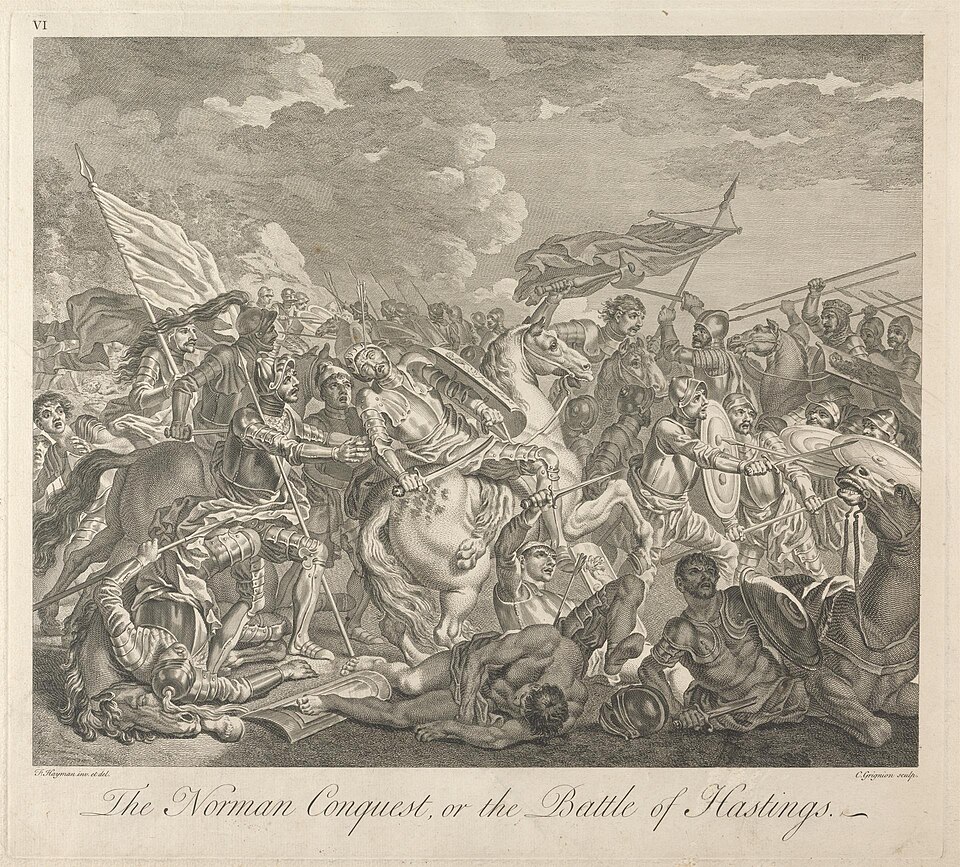
Normans on the great north road

somewhere in England in 1071.[i]

Hubert, lord of these grey riders,

fought at Senlac, and since then

has been useful to the King

His reward, the manor he rides towards,

larger than the home he left in Normandy.


Walter, his seneschal, riding beside him,

fought at Senlac with distinction,

rallied the savaged in the Malfosse .[ii]

Between them, non-armoured, long haired,

Aelfric, an Englishman. Their local guide.

Their translator. He makes them awkward

in ways they’d struggle to define.

If pushed, Walter might reply;

he has no scars: his hands are soft.


The manor is wooden, unfortified.

Too easy to attack and futile to defend.

All this, thinks Hubert, I will change.

After the automatic military appraisal,

the childlike revelation: this is mine.

All mine. A group waits, women, children,

men so old they can’t stand straight.


The lady of the manor steps towards him.

Hubert remembers that in the English time

she could have run this place without a husband.

Now she and it are forfeit to the crown,

the crown bestowed them both on him

and he has come to take possession.

That thought will take a long time growing old.

He examines her the way he will inspect the cattle,

fields, fish weir and the little mill.

Tall, straight, young, blonde: she will do.


‘Where are the men?’ Vague images 

of those long legs, fine hips and breasts

do not make him stupid. ‘Where are the men?’

He has lost friends who were not so cautious,

in this green folded landscape, where the trees

and ditches hide those desperate for revenge.

Aelfric translates the question.


‘Where you should be.’ He ducks his head

til he remembers he rides with the victors

and she’s the one who lost and all her pride

will not avert the fate that rides towards her.


‘Her brothers, father, uncle, nephews died

at Stamford bridge and Senlac hill.

Their tenants and dependants died with them.’[iii] 


The idea that Englishmen are long-haired,

beer swilling, effeminate, will creep

into the Norman mind but not in Hubert’s

even if he lived a long and idle life.

Those longhaired drunkards stood their ground,

all day. Charge after charge breaking

on that obdurate line of shields. 

Anyone who’d seen a horse and rider split

by one swing of an axe would think twice

about disparaging the man who swung it.

But Aelfric swung no axe. That much is obvious.

2

After inspecting the boundaries,

a wary country ride with scouts,

after the inspection of the manor house,

after the welcome meal, Hubert decided

it was time to inspect his human property.

The men at arms were organised.

Guards posted, tasks allotted.

Walter thanked, allowed to leave.


Hubert talking to his Lady through Aelfric

was reminded of those shields.

When he was polite, she seemed insulted.

When he had tried to show an interest

she had seemed offended. He sensed

that what he said was not the words she heard.

She was nobility, understood the world

and what would happen next and so he doubted 

his tame Englishman was being honest.

He would have to learn her language,

some words at least, while she learnt his.

Bed, he thought, could be his classroom.


He stood up, took her hand. She did not move.

‘If you don’t go with him’, said Aelfric 

he’ll strip you for his men at arms.’

It was a stupid lie. This Norman was no fool

who’d break his prize possession out of spite.

Aelfric ignored the look she cut him with.

Once she’d been too proud to notice his existence

now she was this Norman’s mattress

and whatever in his character was broken,

or unfinished, rejoiced at her humiliation.


The curtains closed behind them.

Aelfric edged towards the drapery,

heard the sound of fabric falling,

imagined the pale body emerging.

He heard Hubert’s belt and sword unbuckled 

then set down, heard them move together.

Imagined his hands, heard Hubert grunting,

then making garbled noises like a stricken pig.


A female hand, the curtain parted.

She was naked, radiantly naked,

white flesh tinged pink about the throat.

Aelfric moved. She was majestic,

desire erased the thought that he’d been caught

erased the room, erased his name

and everything except desire

for the body moving closer to him

small hands reaching for his belt.


Who knows a dead man’s final thoughts?

Perhaps he was thinking mine at last,

perhaps he heard her say, ‘You should have died

with all the others’, and perhaps, before the knife

sliced the artery in his throat and geysered blood,

he realised she had spoken flawless Norman-French.


She caught him as he fell, pulling him down

screaming in English, help, help, murder, help.

Walter, sword drawn, running, saw

the Englishman raping the frantic lady

thrashing on the floor, hauled him away

one quick blow striking off the head.


The woman, sobbing, pointing at the curtains.

Behind them Hubert’s naked corpse,

twisted, reaching for the knife stuck in his back.


While the bodies were removed

Walter held the shuddering woman.

The King still owed him for the Malfosse.

Perhaps this manor. He would need a wife.

Hands skilled in settling a skittish mare

gentled the shaking body

aware of its taut lines, soft curves,

its bloody promise. She would do

when he came to take possession.


[i] This date is entirely arbitrary.

[ii] When the English army finally broke and ran at the Battle of Hastings, a small group turned and savaged the pursuing Normans at a place the Normans called The Malfosse.

[iii] Fulford Gate, Stamford bridge, Senlac, the three battles fought by the English in 1066. Many of the victors at Stamford Bridge died at Senlac (Hastings).

Uplifting falling

The Book of Falling

David McCooey, Perth, Western Australia: Upswell Publishing, 2023, 109pps. Aus$24.99

LIAM GUILAR says David McCooey’s poetry is intelligent, skilful, varied – and plain enjoyable

The Book of Falling is David McCooey’s fifth collection of poems, and if nothing else, gives the lie to the invidious myth that people who work on academic writing programmes can’t write.

He’s very good at what he does. His poetry evokes Bunting’s praise of Scarlatti:

It is now time to consider how Domenico Scarlatti

condensed so much music into so few bars

with never a crabbed turn or congested cadence

never a boast or a see-here…

Every well-chosen word in its place, and each word doing the necessary work. In the first four lines of the collection a sense of vague but threatening menace is swiftly evoked:

The unseen night creatures – scaled and feathered

for their occult ceremonies – rasp and call outside

in the dark beyond the half dark that

surrounds this marbled, half lit house

(‘Questions of Travel’)  

Such deft verbal economy is a feature of the wide variety of poems that appear in The Book of Falling and plays against often surprising content. The first three poems are conventional poetic monologues as though the poet were setting out his stall and proving his ability. At the same time the subjects are anything but conventional. Elizabeth Bishop packs to travel; Sylvia Plath looks at her life on her 80th birthday; Marilyn Monroe divines the future and amongst other things, ‘…see[s] who will be forgotten first/ Queen Elizabeth, Molly Bloom, or me.’

These are followed by word play, short sequences about family, a group of satires and elegies, poems about urban life, as well as ‘Three Photo Poems.’ The latter is a new genre to me: three sequences which juxtapose very short texts (one of the sequences is made up of ‘found poems’) and photographs. 

The juxtaposition of pictures, either of the mundane, as in the sequence about bathrooms, or the family photographs which on closer inspection look anything but mundane, with short pieces of text, lead to the second reason you should read the book.

On a first reading you can never tell what’s going to be on the next page. This is a defining characteristic of the other two books of McCooey’s poetry I have read, and unusual in single author collections, where formal and thematic similarities tend to be on almost every page. The variety here is held together by a unified view of the world, a laconic wit, which takes pleasure in the commonplace while recognising how strange it is. Take his ‘Rain Poem’:

And as if someone uttered the trigger word

rain begins without ceremony.

But it’s not ‘driving rain’;

it’s just sitting outside

engine idling over the neighbourhood.

The poem could stop there, but it turns into something more than a pun and a neatly turned image.

It doesn’t give a damn

And then, like a poem ending

you look out the window

and the rain has stopped.

The birds have returned and the wind

has begun its invisible cover-up job.

Many of the poems present the everyday and familiar, but alter the point of view just enough to destabilise the way you’re used to looking at the world – Freud’s Uncanny perhaps, without the baggage attached to that word.

When was the last time you thought about how strange bathrooms are? ‘Bathroom Abstraction #3’ begins: “Windowless bathrooms are the cave of modernity”.

What you encounter as reader is an intelligence moving through time, and recording the variety of experience, taking interest and pleasure in the world – and above all wanting to share it with the reader. There are numerous single author collections where the reader is left feeling his or her presence is not required – or perhaps only required as an anonymous cheerleader who proved their devotion by buying the book.

If a poem can be a space for thinking through and in language, McCooey’s poems invite readers to look without telling them what to think. A short example is ‘Australia’:

Dropping my son at school.

It is ‘Art Day’;

students are to dress up

as their favourite artist.

I see a kid dressed in white.

He has sunscreen on his nose,

And carries a cricket bat.

This is both bemused and amusing, but open to different ways of being read. There is the traditional art community criticism of Australian attitudes towards ‘the arts’ in a sports-mad country – a criticism of the arts community’s failure to penetrate the education system even on a school day ostensibly devoted to ‘Art – or a wry celebration of the artistry of Australian cricketers, who can flog a rock-like ball a long distance with enough balletic grace to suggest cricket is indeed an art form. The poem holds all these possibilities (and others) open for the reader.

And finally – this may be a heretical comment: poetry is a highly sophisticated form of entertainment. It provides unique pleasures. Reading book reviews, it can seem that enjoying poetry is a subversive activity. The reviewer usually makes great claims for its importance, significance, ground-breaking genre-bending, appropriate ideological stance on the burning issues of the day, but rarely admits to having enjoyed reading the book under review. McCooey’s books are skilfully written, varied, thought provoking, and above all enjoyable. You should read them.

A Man of Heart – Chapter 11: Things Fall Apart

LIAM GUILAR is Poetry Editor of The Brazen Head, and the author of several poetry collections including Lady Godiva and Me, From Rough Spun to Close Weave and, most recently, A Man of Heart

This is the last installment of the story of Vortigern. Chapter two onwards can be read on the Brazen Head site. Chapters One and Twelve appeared in Long Poem Magazine. The full story is published by Shearsman UK as A Man of Heart

The story so far. Fifth Century Britain. The legions have gone, leaving the Britons to fend for themselves.  Despite his success in uniting the province and bringing peace, Vortigern’s sons have led a rebellion against him. He now faces three problems: the remnants of his sons’ rebellion, the return of Aurelius and Uther, sons of the deposed King, and Hengist who wants revenge for his brother’s death during the rebellion.

Things Fall Apart

1

In the midnight forest,

in the moonstained tower.

the princess stares towards the morning

while her sleeping lord

dreams of a desperate hunt,

racing, branch whipped,

though the trees. His dogs,

white coats shining, red ears shining,

howling after a milk white stag.

The stag is walking, unconcerned, 

and his sweating horse

cannot close the distance.


Could you feel the moonlight on your skin?

She wanders the circuit of the room,

orbiting the bed, watching the sleeper

twitch, hearing him mutter orders

to the slavering pack

who pay him no attention.


Inside the winter forest of his dream,

the bored stag stops beside the river,

and turns to face the dogs

who cower from his indifference.

He’s standing on the river wall,

with London burning at his back.

The mighty silver river turned to silt.

The child with golden eyes

emerging from the smoke and shadows

holds the coin he’s worn around his neck

since he found it in the mud.


‘I know what lies beyond the ninth wave,’

says the child, ‘I know the age of the wind.

I know why Gwydion sang an eagle from an oak.

Why Math wouldn’t sell his mouse…’

on and on as the child grew older,

the mountains rising, like an insult,

to cut the road that fades into the fields,

the road to Lincoln, overgrown, baffled

by vertical grey stone veined by snow,

barriers of rock and ice blocking the horizon.

He is laughing at the boy, who hasn’t stopped.

‘Do you know why the gods allow humans to suffer?

Why wise men fail and fools succeed?

Why good men die and bad ones prosper?’

‘No,’ said the boy, flicking the coin

so it drifted like an ember in the smoke.

‘I do ,‘ he says, as they watch it settle in the silt

and the dirty waters swirl and cover it.


He wakes, feeling for the coin,

reassured, but it’s a dream within a dream.

‘You did come back?’ ‘Oh foolish man’

she says, ’when will you ever learn?’

He turns to the golden boy.

‘Because there are no gods,

only Fortune and her wheel

and she’s a brutal mistress

destroying all she favours.’

2

All winter Saxons from Thongcaester

and loyal northern tribes

had raided south, while Vortigern

from his own estates,

coordinating every detail,

had harried from the west,

‘til Vortimer’s writ no longer ran

north of Watling street or west of Dere.

They’d kept him bottled up and shaken,

watching his following dissolve.


The plan had been to wait ‘til spring

and then with Hengist sweep him off the map.

Yesterday the news. Keeping his promise,

Hengist had returned and landed fifty ships,

and then the twist: on the southern coast.

Hearing Gloucester had retreated to his own lands,

Hengist’s army was rampaging north and west,

undisciplined, voracious, hunting British heads,

like the Pictish horde that he’d been hired to stop[i].


There was death and destruction

to rival Boudica’s march on London.

Some of Vortigern’s supporters

had been mauled, their lands ransacked.

Another fleet led by Hengist’s sons,

had landed in the north

between the stone wall and the turf.


The Britons had sent a cautious embassy:

‘Your son, my lord is dead.’

‘My son died to me the day that he rebelled.’

He says the words again,

in private, surprised to find

wispy echoes drifting over nothing.

A dull sense of relief?

He will not humiliate his eldest son

destroying the rabble

he could not lead,

nor order his execution

after his inevitable defeat.

Their story is he killed himself,

playing the defeated Roman.

3

The ambassadors shuffle and fidget.

They won’t look him in the eye.

They say ‘He measures us for burial.’

‘Tell Gloucester if he comes to me,

and will submit, I will forgive him.’

It’s not the answer they expected.

They would have served him Adolf

on a golden platter,

stuffed and garnished to his taste.


‘As for the other matter,

I will reply tomorrow morning.

Until then, go, you are messengers,

you are safe, enjoy our hospitality.

Congratulations, gentlemen.

Tell your masters, when you return,

their folly has undone our wisdom.’

4

In the circular room,

at the top of their tower,

he curls against her

watching the rough-hewn stones

liquid in the fire’s light.


The way she moved could turn his world to water.

That nameless place where neck and shoulder meet.

This bewildering encounter with intelligence and affection.

Everything changes, nothing stays the same.

Unless you’re Vortigern the King?


Moonlight picking out a patch of floor.


We were sunlight dancing on water,

dazzling and scattered,

now gathered, still,

carried on a darker

gentle current.


The world can be forgotten.

He could drift along beside her.


But the day will have its answers.


‘If I accept their offer,

become again the ruler

of this fractured,

fractious province,

your father and I

must go to war

as enemies.’


‘How many times?

Your friends are my friends;

your enemies are mine.’

‘We don’t have the numbers

to stand against the force he’s raised.’


‘Adolf has an army.’


‘Adolf’s mob of whining British lords

will be fighting over precedent and office

after Hengist’s warriors strip their corpses

and leave them on the battlefield to rot.’


‘We have allies. They’ve stood by us all winter.

Why would they desert you now?’


‘Fear and Economics.

Fifty ships, a thousand men,

that rabble doesn’t care

for Hengist’s oath.

Without a commissariat,

he can’t feed a horde that size.

They’ll plunder every village

and estate and town

that’s on their route.


No one dares come south

with your brothers

camped between the walls.

Your father rides a tidal wave.

He can point it at his enemy

but it won’t discriminate

between the British lords

who joined in the revolt

and those who fought against it.’


The patch of moonlight fades.


‘He told me a story about your uncle.

Caught in a monster storm,

he turned his ship and surfed

straight down a wave face

three times higher than his mast.’


‘That sounds like him,

howling jubilant defiance at his Gods.’


‘His ship was overwhelmed.

The crew were drowned.

Your uncle swam ashore.

Hengist will crash into Gloucester and his army

and bury them. But The Boys have landed

and there will be a mighty showdown.’

5

Wylaf wers, tawaf wedy[ii]

She finds him on the roof,

staring towards the east.


‘They’re coming like the sunrise,

like a wave bearing down on a straw hut.

We have a month at most.’


Whatever he is trying to say,

she will not help him.

She watches night shapes

assume their daylight forms.

Waiting, knowing

there is cruelty in her silence.


He will not look at her.

‘Go to your father.

He will keep you safe.‘


In a hut ringed with body parts.[iii]


‘Hengist will trade me to the necessary ally.

Slightly soiled, one previous owner,

still worth fifty ships.

I will not become a sex toy for Aurelius.’


‘If you stay; you die.’


‘And you will play the Roman and fall upon your sword,

be Stilicho and go so quietly for the greater good,

dignified and honest in an age devoid of both?’


‘Hush lady…’


‘No. I will not hush!


I will not weep and then be silent!

I will not be the loyal wife

proudly watching as her man

acts with atypical stupidity.


What possible profit is there in your death?

Do you think they’ll tell your story straight after you’re dead?

They cannot, will not, do it when you’re still alive.

What does it matter what they think about you in a thousand years?

If bookish men still scrutinize your life, searching for the truth,

they will not find it. We will be figures dancing

on the limits of their comprehension,

simplified for story’s sake.’


She gestured to the hilltops to the west.

‘Who would bother chasing us?

There will be a place to raise this child.

We can carve ourselves a kingdom,

and if defeat becomes a fact

when there is no escape…’


A golden ampule in her palm.


‘There is enough for two.

We go to sleep: we don’t wake up.’


‘How do you know it works?’


‘Old Mother Gothel gave it to me,

before I sailed for Britain.

I made her prove that it was painless and effective.’


‘Who was Mother Gothel?’


‘You never met her:

she was honest.’


‘We will need bodies.

At least one must be a woman’s.’


‘There is a village in the next valley.

They have not offered us their help.

Anyone we cannot trust must die.’


‘Better dead friends than live enemies?’


‘For now.’

6

Ewch nawr[iv]

‘Go now,’ she said, ‘I set you free.

Go find my father, tell our story,

tell it straight.’ Keredic objects:

‘No lady, I have come this far

and I will stay with you.’


‘Do as I tell you, nithing.

It would sadden me to have you killed.

We cannot hold against an army.

But we will die facing our enemies.

We have been good to you.

Now go!’

7

For the ashes of your fathers, and the temples of whose gods?[v]

Dark rider on the riverbank at dusk;
he can smell how cold the water is,
listening to it hurry past,
a pale stain between the overhanging trees.
A stale moon behind sick clouds.
The flickering army on the other bank,
dead ancestors, mustering against his crossing.


Muttering: Duty, Loyalty, Reputation.


Go forward or go back? Dame Fortune
cranked her wheel to bring him here.


Tell me then,

what purpose does my death serve

at this point in the story?

I have been loyal to my oath of service,

faithful to all that made you great

when those I served were not deserving.


I have done everything I could

as well as I knew how.

Been honest in my dealings

held my office without guilt

I’ve done my duty.

held the line you drew

and seen the selfish,

the short-sighted

and the stupid destroy

everything you built.’


The massed ranks shift and mutter:

Loyalty, Honour, Duty.

8

The Boys

It takes time to land an army.

Mercenaries mostly, survivors of Chalons,[vi]

who fought beside Attila or against him.

Within the walls of Porchester,

in the clattering busyness, the rattle of voices,

the scurry of patrols, the interruptions of messengers,

the herding of the necessary horses,

The Boys wait for the British lords to come in;

for Gloucester and the army he has promised;

for loyal Britons to welcome their return

and for those who find their names on the wrong list;

dragged away and butchered,

their ragged heads raised on the wall,

staring slack mouthed at a desperate future.  


Trying to eat in the organised riot of the camp

at a long table under an awning, with the banners

the ceremonial armour, the purple cloaks,

the servants and all that is necessary to identify kings

to killers in their pay who wouldn’t recognise their faces.

Aurelius, fastidious with his food, was describing

his latest plan for Vortigern. ‘Of all men,

he is surely the most villainous.[vii]

How he will die I have yet to decide

but it will be slow and painful and terrible to behold.’


He’s got him blinded and castrated, flayed and crucified,

then burning when the news arrives to interrupt the catalogue.


According to Gloucester’s messenger,

Adolf had gone, unarmed, to parley

with the Saxons at the great stone ring.

They had drawn their hidden knives,

slaughtering the British lords. Heroically,

alone, Gloucester, had seized a log from a passing carter

and bludgeoned his way to the safety of his town.


‘The fool attempts Imperial diplomacy:

invite your federates to a feast,

wait ‘til they’re drunk,

then slit their throats?

Out thought. Out fought.

And then he ran.’


‘Talking was his only option.

But now we’re down an army.

We can still pick Hengist off,’

says Uther, ‘If we catch him

before he joins the northern horde.’


While they argue,

a man is bundled towards their table.


‘My Lords.’

He is trying to fold himself into nothing,

to become invisible and inaudible

at the centre of their attention.


‘If you bring bad news,

we will not harm you.’


Uther, who doesn’t lie,

often wonders why his brother is so good at it.


‘Merowch the Frank sends you greeting.

The leader of the scouting party?

The man you taxed to find the traitor?

He says, some of his auxiliaries,

over enthusiastic in their loyalty,

torched the tyrant’s fortress.


Soon there was nothing left.

Just cracked stone and charred bones.

They found the villain and his whore

or what was left of them.


As proof, this ancient coin,

the tyrant wore around his neck.’

The British lords are eager to confirm:

‘He’d take it off and stare at it

while making up his mind.’

‘Do you remember, how, before…’

Aurelius isn’t listening.

‘I want to see this tower.’


‘Hengist first,’ says Uther,

‘the tower can wait.

What is this obsession

with yesterday’s man?’


‘He killed…


‘I know who he killed.

But why hound the man who saved your kingdom.

Alive or dead, he’s now irrelevant.’


‘Because I want to see his charred remains.’

He wants to mutilate the bodies.

He’s spent years imagining his revenge.

But he also trusts his brother’s judgement.

‘What do we do with Gorlois?’


Thought is annihilated.

like a rabbit struck by a plunging hawk.


A dirty unkempt boy.

The ragged stinking fact of him

infecting the moment.


‘Greetings,’ he says

and smiles his dreamy smile,

blinking those golden eyes.


‘I am Merlin.

You need me.’


[i] See chapter four

[ii] I will weep and then be silent. See Chapter One.

[iii] As he does in chapter One

[iv] Go now. See Chapter One.

[v] A misquotation from ‘Horatio at the Bridge’ by Thomas Macaulay.

[vi] A battle between The Western Empire and Attila the Hun involving hundreds of thousands of combatants. Fought in 451, in modern France, a year or two after the traditional date for the landing of Hengist and Horsa’s three ships in Britain.

[vii] This sentence is a direct quote from Geoffrey of Monmouth. I’ve reduced the rest of his speech, which is almost a page long in Thorpe’s translation, to the next two lines.

A Man of Heart – The scribe’s story

The story so far. In the 5th century Vortigern’s attempt to hold the imperial province of Britannia together has been defeated, not by external enemies but by British rebels led by Vortimer, his eldest son. Vortimer is a devout Christian and has invited the Pope to send an embassy to restore the Church, and combat the Pelagian heresy. What follows is the second half of Chapter Ten. At Vortimer’s request, the Pope has sent an embassy to Britain to combat heresy, led by Germanus of Auxerre and Lupus of Troyes.[i] The embassy finds Vortimer’s court shrinking, his rebellion a failure. The chapter begins with Vortimer’s death, by poison, then backtracks a few days. Rowena has arrived, seeking instruction in the Christian faith. You can find chapters 2-10a on the Brazen Head. The complete story has been published as A Man of Heart, by Shearsman UK (January 2023).

Lupus offers Rowena instruction in the Christian faith

Why should I love my neighbour

when he wants to rape me?

I do not think you love yours

when he burns your house, kills your friend,

uses your women, serves your children to his dogs.

I do not think you love him then.

You will not turn the other cheek.

You carry your pride like a glass bowl.

Your Jesus was no warrior king

but he said one perfect thing.

I was hungry, and you gave me food.

I was naked and you clothed me.

I was homeless and you sheltered me.

There are stories told amongst my people:

families, without weapons, seeking land

came to these shores. They were hungry,

naked, homeless, and your good Christians

let them scrabble in the waste land,

killed the weak, abused the women,

sold survivors into slavery

then went to church and prayed.

Germanus instructs Rowena in the Christian faith

We drift on a winter sea

in the middle of a hailstorm.

                                                           And your faith protects you?

No, that’s the pagan way.

The whining, selfish child

begging for new toys,

throwing good metal in a bog

to appease the local fog,

as though tree could think

or river grant a wish.

No, faith is the destination

that disciplines the journey.

Cattle are born, eat, shit, fuck and die.

You can live like that. But

reaching for the impossible

is what brings us closer to God.

And the fact of Incarnation,

gives the church the confidence

to lecture bandit kings on the Beatitudes.

                                                            A beautiful impossibility?

She could have smacked his face with less effect.

He had been thinking aloud

not expecting this girl to understand.

Before he could reassure himself

she’d fluked the answer she said;

                                                            Your faith is not a shelter in the storm

                                                            but a way of living through it.

He blinks her into focus

seeing a new species for the first time.

Rowena and Vortimer

She is ice underfoot.

A golden symmetry,

that aches his fingertips

as he resists the need

to reach and touch,

curve, fall and flare.

Stray hair across her cheek,

tightening his throat.

In another version of this story

they are friends and wary allies

helping his father rule the country.

In another version of this story

she is his queen.

                        But she is not smiling.

She scowls, because he is stupid,

because she asked a simple question:

‘Why do you hate my people?’

and his answer was inadequate.

She is ice underfoot.

But then she smiles, and rises

fills the goblet,

‘Leofue freond wæs hæil.

For þine kime ich æm uæin.’[ii]

Lips on the goblet’s rim.

Lips glistening with wine.

Their hands touch lightly,

shocking him.

Her breath on his cheek,

her lips

delirious proximity.

He drinks. ‘Drinc Hail.’

Kisses her on the mouth.

Lingering.

She steps back, smiling.

A child, pleased with herself.

Adolf and Vortimer

They are on the same page

singing to the choir

on a level playing field

where no one’s moved the goal post.

He’s there for you.

You’ve got his back

and the wine goes round.

Best friends forever,

boozing buddies,

veterans on a park bench.

And the wine goes round.

Vortimer waiting for the pitch

for the sudden swerve

this is Adolf, who admires

the Roman art of usurpation,

who thinks the Roman way’s

a zigzag path through shadows.

Words bend, mean only

what he wants them to,

‘devious’ a compliment

sincerity, simplicity,

synonyms for stupidity.

So the wine goes round.

Knowing Adolf thinks he’s stupid

provides the King with clarity.

It rankles that he’s right.

They should have waited till the spring.

They’d all heard Gloucester’s stories.

Snowed in on The Wall,

roads you could swim over,

mud you could drown in.[iii] 

But Katiger had stumbled over Horsa

and grabbed his chance at glory.

Both men had died.

The forces Gloucester

set to spy on Thongcaester

had heard the news of Horsa’s death,

thought the revolt was underway and charged the gates.

Beaten back, then annihilated.

The survivors of the southern Saxons

had made their way to Thongcaester.

The northern tribes had stood behind his father

and all winter raiders had brutalised the lands

of anyone who challenged Vortigern,

with the vindictive precision

of the Empire in its glory days.

In the west Gorlois was sitting on his hands

ignoring every summons and command.

They had claimed a victory.

How bright had been that morning.

The thrill of cheering crowds.

Hail King of nothing.

Hail nithing, King

of Britannia

south of Watling street

and east of Tamar.

Heads.

Bags of heads.

Riders bringing sacks of heads,

spilling them in front of him,

‘til his steward said,

‘My lord, we’re running out of coins.’

Gloucester had warned him against the bounty.

Warned him that many of those heads

were once on British shoulders.

The purity of his intent;

to clear the pagans from the land,

so Christ might rule again,

polluted by self-interest.

How many private scores were settled?

How many family feuds resolved

under the banner of his leadership.

He’s seen the devastated homesteads,

the burning villas. He’d stood

in the groaning aftermath,

the smoking shambles,

and heard his father’s voice:

‘You can’t go hunting with untrained dogs.’

Only now he understands.

Soon Hengist will return

with thirty, fifty, sixty ships.

Baptise the woman,

he can’t play the pagan card.

But the card itself is false.

He wanted to establish

God’s Kingdom in this island.

A purified, united, church.

A people ruled by Christ’s example.

In your dreams child. In your dreams,

not in theirs. In theirs,

the endless whine of ‘What’s in this for me?’

Stripped of religious fervour,

his rebellion is mere peevishness.

Already his supporters

have started to remove themselves,

deaf to summons or instruction.

Come spring he will not have an army worth the name.

They’ll scatter it like leaves before a gale.

The wine is a peace offering

as Gloucester tries to save them both.

Avoiding the topic of The Woman,

he’s making an effort,

trying not to be abrasive

but water’s wet and why

this foolish boy can’t see it

is a mystery beyond his patience.

There’s a limit to the number of ways

you can explain something:

‘Without coin or office,

your only reward is land.

If you give that to the church,

how will you reward your followers?’

                                                           ‘The weightier matters of the law,

                                                           are judgement, mercy, faith.’

‘The only choice you have

is whether to survive or perish.

Power has its own logic.

You can no more

change this system

than you can push a cart and sit in it.

We live in the world,

not a cloister. Friends and enemies 

will judge you by your actions.

Your intentions are irrelevant.’

And the wine goes round.

                                                           ‘Germanus led an army,

                                                           more than once.

                                                           He’s run a province.

                                                           We could ask for his advice.

                                                           We should listen.

                                                           We could learn.’

Bit late for that, thinks Gloucester.

‘A bit too ostentatious don’t you think:

the hair shirt, the hard bed,

the hand-ground horse food?’

Soon his failure will be obvious

He will be Vortimer Nithing.

And he cannot face his father,

on the field of battle, or later,

after his inevitable defeat.

What is left to him,

except the Roman Way

for the defeated rebel general?

Best friends forever,

two lads on the piss.

You’ll buy the hangman’s drink

before he snaps your neck.

Find the Pagan Woman

It’s dark and Germanus,

is flapping between the buildings,

like a giant moth, until he finds the scribe. 

‘Boy, where is the woman?’

                                                           ‘She has lodgings by the gate.’

‘Go to her now. Tell her she must leave:

immediately. It is no longer safe.

Tell her to get out before the gates are shut.

And tell no one where you go or where you’ve been.

Or that I’ve spoken to you. Go!’

The job not the title

He dreads their silence

it disrupts logic, qualifies sense,

suggests the worst while saying nothing.

‘For your skill with words

you will join the Papal mission

you will travel to Britain.

You will record everything,’

said his superior.

He had accepted, thinking

the place was his by right

of skill and knowledge.

Only now he understands,

it was curse not compliment.

They picked the one that no one liked;

the one they could afford to lose.

Germanus had confronted Gloucester

Who has to lean forward to hear him,

thinking of the breeze

coming in over gilded water.

‘The British Lords have been in council

and through them God has spoken.

They will ask Vortigern to return.’

Before Gloucester can object.

‘God sees through you, knows

your pride and your ambition

No service, humility, compassion.

There is no Roman order

without Roman discipline.

No discipline without obedience.

Who follows someone who will not follow?’

Gloucester says nothing.

The Papal embassy is leaving,

The Boys are on the move

and they have the Pope’s support.

Germanus to the scribe

‘We go north,’ said Germanus,

‘to confront the heretics.

We will visit the shrine

of the blessed Martyr Alban.

You…’

                                                           And then that pause.

‘You will go west, to Gorlois.

Give him this. Tell him,

we admire his loyalty.’

And then

                                                           another

                                                                            pause.

‘Your time with us is over.’

                                                           The scroll he’s holding

is shaking. Terror is eating

the sentences inside his head.

‘Gorlois has need of skills like yours.

If not, stay west, find a community.

Seek God in prayer and silence.

In these alarming times…’

                                                           Another

                                                                                                                      pause.

                                                           ‘In these alarming times

So many die, nobody notices

unless they’re royalty.

One more body by the road

won’t interest anyone.

The west is safe.‘

Departure

People invest the past

with qualities they feel

are lacking in the present.

But for once in history,

those Empire days

really were that golden.

The sea was calm,

the sun was rising

the crew preparing

for the channel crossing.

They had cremated the King,

ignoring his demented order

to bury his head overlooking the coast,

convinced no raider would bother the island

while he kept watch.

‘So?’ said Lupus, standing at the bow,

enjoying the breeze, the gentle rocking of the ship,

the promise of an uneventful passage home.

Germanus watches the crew securing the last of the cargo.

Admiring the easy way they go about their tasks.

                                                           ‘So, we confounded heresy.

                                                           And The Boys are on the move.’

The nearest sailor moves away.

No one has come to see them off.

Messengers had been sent north,

seeking Vortigern to offer him the crown.

‘I’ve met The Boys, and they can’t win.

Though they’ll reclaim the island,

they might stop Hengist, not his people.’

                                                           ‘They have outlived their time.

                                                           Cheating your way to power,

                                                           only works while there are rules

                                                           and the other players follow them.’

Slipping their moorings,

the sail, cracks, grows taut.

The ship pitches then steadies

into an easy forward movement.

The grey walls of Porchester shrink,

slipping off their starboard bow.

Moving out into the Solent,

the breeze strengthening.

                                                           ‘The last legion left from here.

                                                           Roma Fuit. Urbis conciditatus.[iv]

                                                           These Britons.

                                                           These proud, sniveling rebels.

                                                           Adulterers, fornicators,

                                                           parricidal, incestuous,

                                                           assassins,

                                                           refusing to be ruled

                                                           but whining to the Empire

                                                           help us, save us, pity our distress.

                                                           We who do not understand obedience,

                                                           who will not pay the asking price.

                                                           Mouth Christians who forget their God.

                                                           He has not forgotten them.

                                                           He will fall upon this generation

                                                           and his wrath will be remembered

                                                           til the rocks melt.’

‘Then we’re agreed,’ said Lupus. ‘Britain is doomed.’

                                                           ‘Oh no,’ said Germanus, turning

                                                           to look back at the mainland

                                                           and the white chalk slash in Portsdown hill.

                                                           ‘The Church is safe. We did what we set out to do.’


[i] Germanus of Auxerre is the most ‘historical’ of all the characters in this story. He did exist and he did travel to Britain to combat heresy in 429. His miracles, described in the first half of this chapter, are in the Life of Saint Germanus, written down in the late 5th century. Typically for the Legendary History, the chronology is wayward. If Hengist landed in 449/450 he arrived twenty years after Germanus had left.

[ii] See the Wassail ceremony in Chapter Six

[iii] See Chapter Three

[iv] Rome is no more, the city is ruined. I can’t find the source of this quotation.