STUART MILLSON enjoys a rhapsodic favourite as well as world premieres at the English Music Festival
Friday 23 May 2025 marked the beginning of the eighteenth English Music Festival, a much-looked-forward-to annual event in the classical calendar and a testimony to the considerable organisational and fundraising skills of its founding director, Mrs. Em Marshall-Luck. Despite receiving no support from the Arts Council of England, no help from the ‘Department of Culture, Media and Sport’ and no visit or encouragement from Government ministers (either Labour or Conservative – save for one brief appearance by Boris Johnson in the early days), the Festival has managed to galvanise a loyal following of supporters, benefactors and artists – thus ensuring the continuation, not just of the main four-day event, but a host of other concerts, events and recording initiatives. A lesson in self-reliance and self-belief, the EMF must be considered as one of the most remarkable events of its kind – not least because of its presentation of a forgotten part of our national musical heritage.
Usually when one thinks of an English music concert, works such as Elgar’s ‘Enigma Variations’ or Vaughan Williams’s TheLarkAscending come to mind, and many such prominent works are indeed to be found in the Festival’s programmes. But what distinguishes the EMF is its patient work – hours spent in archives and in tracking down lost scores – reconstructing a lost world of English music. Thanks to the musicological detective work of figures such as Martin Yates, the conductor of the opening-night’s concert, audiences are taken way beyond the usual boundaries.
Stanley Bate
This year, we were treated to the enigma and variations of Stanley Bate’s SecondSymphony – Bate, a pupil of Vaughan Williams and the German composer, Hindemith, yet who has been practically forgotten by the musical establishment in this country. The presentation of his searing four-movement symphony from the late 1930s amounted to a posthumous world-premiere for a potentially great but tortured figure, who died tragically before his time. It also brought home to the audience (and performers) just how avant-garde English composers could be – resetting our idea of our native music, as something that could be as Shostakovichian as pastoral or romantic.
Bate’s work had some radiant moments within its taut structure, like an exhalation of breath amid the angst, but on the whole, some of the febrile nature (and phraseology) reminiscent of Vaughan Williams’s FourthSymphony made it a muscular, physical, challenging – even shattering – musical experience. The beginning of the last movement brought to mind the stretched tonality and astringent string writing of Britten’s VariationsonaThemeofFrankBridge, making the piece very much the province (you would have thought) of BBC Symphony Orchestra repertoire, those specialists of 20th century music. But I doubt that any ensemble could have rivalled the faultless, totally-committed rendition given at Dorchester by the BBC Concert Orchestra – musicians who seem to have the gift of versatility, allowing them to roam from show music to popular classics, and the pinnacles of British music of the last century.
William Alwyn
Alongside the Stanley Bate, the BBC CO gave us an injection of springtime energy, in the form of William Alwyn’s TheInnumerableDance – AnEnglishOverture. This was a vision of sensuality and radiance, every bit as transcendental as a Wagnerian Tristan and Isolde. It was followed by Delius’s well-known TheWalktotheParadiseGarden, although the setting is Switzerland rather than our own land. The rich, expansive acoustic of Dorchester Abbey, full of reverberation and ‘air’ was just right for the Delius, as it was indeed for the HeroicElegyandTriumphalEpilogue, an early work (1901) by Vaughan Williams, the monumental conclusion of which included the magisterial tones of the Abbey’s organ, ringing out over and through the orchestra.
The Festival paid tribute to Sir Arthur Bliss, in this the 50th anniversary year of his death, with another exceptional interpretation, the CelloConcerto of 1970, a piece premiered at the Aldeburgh Festival under the baton of Benjamin Britten. Originally written for the Russian cellist Rostropovich, the Dorchester performance was given by one of the greats of our own era, Raphael Wallfisch, who brought this neglected, fine and fluent score to life. Having performed Finzi’s CelloConcerto at the Festival some ten years ago, Wallfisch has the full measure of English music – bringing a warmth, detail, spirit and true authority to another part of England’s music that has tended to languish in a backwater. Sitting as I was on the second row, I found myself admiring the chamber-like detail of the cello playing, the soloist given a full spotlight of sound, thanks to the sensitive accompaniment of Martin Yates and the BBC Concert Orchestra.
Rupert Marshall-Luck and Peter Cartwright Image: Stuart Millson
The next day at the Festival’s Saturday morning recital, the official chamber players took centre-stage – violinist, Rupert Marshall-Luck and pianist, Peter Cartwright, a powerful partnership dedicated (again) to works and composers who have become distant to us. First was Norman O’Neill’s (1875-1934) Suite in B minor for Violin and Piano, and then Alan Rawsthorne’ s 1933-34 Violin Sonata. Rawsthorne attained fame as a film composer in the 1940s and ‘50s, but his Violin Sonata is little known. In fact, the recitalists were giving the first public performance of the work in the United Kingdom. Both violinist and pianist were as skilled in delivering the foot-tapping finale to the Rawsthorne, as they were in the gentler, dreamier lines of Delius’s Sonata in B major and the Cradle Song by Herbert Howells (the latter, another premiere, thanks to the determination of the EMF) – confirming them as two of our country’s very finest performers and advocates of English chamber music.
WADE SMITH revisits Decline of the West, and its critics
To paraphrase a famous Tory lexicographer, a death-sentence concentrates the mind wonderfully. People are born, flourish, weaken, and pass away, but so do nations and empires. Although the comparison is metaphorical, the phenomenon is real.
Surely the gradual crumbling of Great Britain from Lord Salisbury’s imperial zenith to Ed Miliband’s imbecile zero is undeniable. It fits into a general Euro-American deterioration, exacerbated by welfare-dependence, industrial unrest and defence-alliance disarray. Consequently, a revival of interest has occurred over questions of historical change, and in its successive commentators, from Plato and Polybius, through Ibn Khaldun and Giambattista Vico, to Paul Kennedy and Paul Cooper.
Overshadowing them all is Oswald Spengler, who died 89 years ago this May. His huge work on “Western decline” drew admirers. Nirad Chaudhuri called it “one of the greatest books of our time.” Henry Kissinger saw it as an “attempt at the resolution of the problems of existence,” while Fernand Braudel praised “its tone, the breadth of its views, its passion for understanding.” Christopher Dawson wrote that “Spengler wishes to make the present generation conscious of the crisis through which it is passing and of the true task that lies before it.”
However, the well-known historian Niall Ferguson, under the impression that Spengler had been influenced by Wagner (it was actually Goethe), once asserted that his “turgid” prose was nowadays seldom read [1]. But his giant Geist has rematerialized – to haunt the current geostrategic gloom of international trade turmoil and knife-edge security risks.
Many references to Spengler have lately appeared in print journalism, scholarly monographs, timely podcasts and specialist websites, from Professor David Engels [2] to Professor Stephen R. L. Clark [3]. His early historical studies and family photos have been publicised. The glib dismissal of his magisterial oeuvre as a ‘gargantuan horror-scope’ ceases to amuse in the world he so accurately predicted.
Recent books include the richly researched, indispensable Oswald Spengler & the Politics of Decline, by the Marxist scholar Dr Ben Lewis, on his principled “Prussian” activism and mutual incompatibility with Hitler, who (I discovered) specifically denounced him in a public address on May Day 1935. TheDecline& Fall of Civilisations is a considerable survey from the prolific and idiosyncratic writer Dr Kerry Bolton, who endorses Spengler’s suggestion of the next major Culture emerging from the Russian landscape. Especially important is his place among Dr Neema Parvini’s constructively analytical Prophets of Doom, alongsideGobineau, Carlyle, Brooks Adams, Glubb Pasha, Evola, Sorokin, Toynbee, Turchin and Tainter. Ulrik Rasmussen’s relevant Fall of Western Civilization: The Cycle of Supremacy also deserves close attention.
Spengler began life near the Harz mountains and his heart finally failed in Munich when only fifty-five. His masterwork on the downslide of Occidental civilisation was conceived before and partly written during the first world war. Its so-called “cyclic” theme, preceded by the Slavophile Nikolai Danilevsky’s Russia & Europe, and echoed, less substantially, by the Anglo-Saxons Flinders Petrie [4] and Correa Moylan Walsh [5], made a dramatic impact and engendered serious debate in his defeated Fatherland.
The sinking-sun imagery powerfully evoked by its “Teutonic Title” was attenuated as Decline of the West in an excellent translation for English-speakers, whose more subdued response, admirably documented by John Carter Wood [6], in some cases recalls a notorious lordly dismissal of Gibbon’s narrative about the fall of Rome as just another scribbled tome. A contemporary classicist, E. H. Goddard, nonetheless ably supported its fundamental cross-cultural alignments with corresponding pull-out civilisation timetables [7].
I first encountered this book in the library of my then 430-year-old former grammar-school in Walthamstow. Its thick black spine made a welcome contrast to its Left Book Club amber-cover shelf-companions; and its fascinating contents likewise. My adolescent appetite was promptly reinforced by seemingly corroborative material in Geoffrey Barraclough’s History in a Changing World, Eric Bentley’s Cult of the Superman, Amaury de Riencourt’s Coming Caesars and Gustave Le Bon’s The Crowd.
By an odd coincidence, the late Roger Scruton made a similar youthful discovery, but disappointment with Spengler’s “unscholarly inaccuracy” diminished this conservative intellectual’s approval of his “grim” prognosis. Given the arduous circumstances of its original composition, and the information then available for revision, however, occasional errors are forgivable; several disputed aspects have also since found defenders.
After initially greeting his magnum opus, the anti-Nazi novelist Thomas Mann afterwards recoiled as if handed a demonic grimoire. The Nazi ideologist Alfred Rosenberg complained that its “morphological view” of destiny denied “race and personality.” Irving Babbitt described the singularly erudite and earnest polymath as a “charlatan of genius.” Martin Heidegger and Wyndham Lewis attacked him much more thoughtfully, along with established historians. Aurel Kolnai ridiculed his “harsh Olympic coldness,” whereas Theodor Adorno granted the “destructive soothsayer” a nuanced appreciation.
Nevertheless, the book impressed poets like W. B. Yeats, David Jones and Robinson Jeffers, authors as different as D. H. Lawrence, Whittaker Chambers, Colin Wilson and Camille Paglia, the mythologist Joseph Campbell, the systems-theorist Ludwig von Bertalanffy, and surprisingly Ludwig Wittgenstein. And it left me personally with a lifelong interest in “philosophies of history.”
Spengler wrote with the eye of an artist and the pen of a poet, producing beautiful passages of keen sensibility, exemplified by his account of infant Christianity:
Tame and empty all the legends and holy adventures of Mithras, Attis and Osiris must have seemed [compared] to the still recent story of Jesus [whose utterances resembled] those of a child in the midst of an alien, aged, and sick world…. Like a quiet island of bliss was the life of these fishermen and craftsmen by the Lake of Gennesaret, while all around them glittered the Hellenistic towns with their theatres and temples, their refined western society, their Roman cohorts, their Greek philosophy…. The one religion in the history of the world in which the fate of a man of the immediate present has become the emblem and the central point of the whole creation.
This delicate passage appears within a mammoth text, whose martial attitude elsewhere was ironically condemned by communists [8] as brutal advocacy for the Junker aristocrats they sought to eradicate in the “violent overthrow” of existing society and “bloody struggle or extinction,” as Karl Marx expressed it. Even during Spengler’s short literary lifetime, millions perished in the USSR.
He depicted the West as one of eight self-contained Hochkulturen, in addition to the Babylonian, Egyptian, Mesoamerican, Indian, Chinese, Magian, and Classical. Each possesses a distinctive ethos characterised by its cosmology, symbolism and architecture, yet all pass through comparable stages, like the inevitable transition from spring to winter, though without recurrence. We need not discuss pertinent definitions of “civilisation”, as previously covered by Samuel Huntington, Pitirim Sorokin and Naohiko Tonomura, except that Arnold Toynbee responded to the challenge with over 20 “mortal” examples, historians Philip Bagby and Caroll Quigley choosing fewer, and Nicholas Hagger listing 25.
Setting aside Spengler’s own metaphysical “collective-soul determinism”, complex macro-societies often proceed through almost parallel patterns, such as solely waning average intelligence [9]. The empirical examination of the multiple causes of their growth, decay and collapse is a legitimate and rewarding pursuit.
Felipe Fernandez-Armesto’s “environmental features,” Claire & Bill Russell’s “population cycles,” Jim Penman’s “behaviour biodynamics,” David Hackett Fischer’s “price revolutions” and Heiner Rindermann’s “cognitive capital” are among numerous contributions towards a fresh and fruitful development in objective social science, aided by comprehensive data-led websites like Peter Turchin’s valuable Cliodynamica and Seshat.
Several terminal phases have been linked to urban sprawl and congestion, and failing competence and character among the rulers of a largely hedonistic populace. Cluttered with material and mental sewage, the “megalopolis” becomes vulnerable to farmland depletion, infections and addictions, depravity and disability, sectarian discord and organised crime, plus susceptibility to invasion. In 1927 the pacifist Aldous Huxley voiced the fear that industrialisation of numerically greater races could put us at their military mercy. By 1951 Shephard Clough’s economic analysis of the rise and descent of civilisations expected envious outsiders eventually to attack Europe.
The validity of Spengler’s century-old foresight is easily overlooked precisely because of its present familiarity. The literary critic Northrop Frye described at length, fifty years ago, how the “detail of Spengler’s vision is all around us… What [he] said would happen is happening, to a very considerable degree” [10]. Does not parliamentary democracy, for instance, operate by deception, bribery and “shameless flattery,” so that “election affairs” become “games staged as popular self-determination” to suit obscured wealthy interests? “People want to think only what they are supposed to think, and this they consider freedom.” Ideological convictions are dissolving into disposable fashions, except for an emergent “second religiousness,” possibly indicated by Gen Z revival of Bible study, and potentially focused on the Holy City of Jerusalem.
Entering the epoch of less heavenly inner-cities and global skyscraper competition, we find, exactly as he said, “primitive instincts” let loose in sexual relations, the “reappearance of the panem et circenses in the form of wage-disputes and football-grounds,” “incomprehension of tradition,” the “extinction of great art” and of “courtesy,” “betting and competitions” for excitement,“ alcohol and vegetarianism” as prominent issues, and crucially the “childlessness and ‘race suicide’ of the rootless strata, a phenomenon not peculiar to ourselves but already observed – and of course not remedied – in Imperial Rome and Imperial China.”
The 1939-45 titanic “war of contending states”, which bypassed Spengler’s ignored warning to Germanic nationalists against “biological antisemitism” and a “Napoleonic adventure in Russia,” shifted the “imperium” from Berlin to Washington, thereby fatally disarranging his anticipated sequence for conclusive contests between “blood” and “money.” Caesarism today is manifested not in fascist legions, but in the formlessness of American politics, despite ambiguity over machine-technics, financial-flux and armed-force deployment; Musk rather than Mussolini.
His phrase “the world as spoil” neatly applies to impending rare-earth search and supply-lane safety from the Arctic to the Black Sea, and beyond. The invention of “weapons yet unforeseen” has alarmingly accelerated, with continental territories “staked – India, China, Russia, Islam called out, new technics and tactics played and counter-played.” We can match his futurology against reflections by present-day writers like Thomas Frey, Bruno Macaes and Ian Morris, regarding particularly the tumultuous interactions of Putin, Trump, Xi and “great cosmopolitan foci of power.”
Shortly before his death, Spengler further envisaged a devastatingly concurrent underclass and colour conflict. It would make no difference, he explained, if Bolshevism “ceased to dictate”, for “the work goes forward of itself.” Did not this danger arrive, a mere three decades later, from the US New Left “race, gender, class revolution,” subsequently exported as “critical theory” for a “long march” or (more accurately) incremental infiltration, through Western institutions, targeting “white privilege,” “white patriarchy” and “embedded whiteness,” and culminating, for example, in both DEI regulations and BLM rioting?
Perhaps Paris 1968, Brixton 1981, Madrid 2004 and Munich 2025 are pointers. The Network Contagion Research Institute reports a surge in approval of political violence, mainly among left-wing networkers. Effective protection against foreign-community intrusions remains morally paralysed as uncharitable “racism,” despite unabated mass-exodus of the multi-million ‘wretched of the earth,’ aided by profiteering traffickers, in a “nomad century.”
Number-philosopher Philip J. Davis thought his fellow-mathematician from the Kaiserreich classrooms was correct to discern the advent of “theories of everything” in science, and possibly, in the outcome of mass-media and telecommunications, the control “like that of Faust” of human minds by a self-operating computer-system “wrapping the earth with an endless web of delicate forces, currents and tensions.”
Spengler’s refutation of universally inevitable linear “progress” has anyhow been largely vindicated, in my judgement, by the evils of vacuous postmodernism, compulsory multiculturalism and suicidal wokeism [11]. Was he too imaginatively attached, however, to ancient and classical models to follow through his unique insight into the heroic exploration, energetic curiosity and infinite endeavour that typify our exceptional “Faustian” ethos? Maybe our railways will lie ultimately forgotten “as dead as the Roman wall” and monuments “ruined like Memphis,” but the last prolonged turn of the western wheel must entail extensive fulfilment as well as senescent exhaustion.
“Only the future,” observed another academic admirer, Professor John Farrenkopf,
…and not Spengler’s innumerable detractors, is in a position to authoritatively answer the question if mankind is nearing in apocalyptic fashion, whether through nuclear Armageddon, the synergistic interaction of international economic collapse and the explosive North-South conflict, or the intensification of the global ecological crisis, the much-discussed end of history. [12]
Nevertheless, could Western science, which has split the atom and spliced the gene, reached the outer planets and penetrated the brain itself, under sagacious guidance, yet modify our caducity with robotics, ecological management and biological enhancement? “Made weak by time and fate, but strong in will, to strive, to seek, to find, and not to yield,” we should at least respect the venerable advice of der Weissager to face up to facts, with fortitude and fidelity to our noblest values.
NOTES
[1] War of the World (2007), p.645; cf. Doom (2022); The Great Degeneration (2014); Civilization (2012)
[2] Oswald Spengler: Introduction au ‘Declin de l’Occident (2024); Spengler: Pensando en el Futuro (2022),&c. The author presides over The Oswald Spengler Society
[3] “New Histories of the World: Spenglerian Optimism,” Philosophical Journal of Conflict & Violence (2022) online
[4] The Revolutions of Civilisation (1911)
[5] The Climax of Civilisation (1917)
[6] “’German foolishness’….Spengler & the Inter-war British Press,” www.academia.edu/3315175, online
[7] Civilisation or Civilisations [with P. A. Gibbons & F. C. S. Schiller] (1926)
[8] E.g. Nikolai Bukharin (1934); cf. Melvin Rader, No Compromise (1939)
[9] Elmer Pendell, Why Civilizations Self-Destruct (1977); Cf. Edward Dutton & Michael Woodley, At Our Wits’ End (2018); Robert Klark Graham, The Future of Man (1981); Raymond Cattell, A New Morality from Science (1972), pp.146-147; Donald Kagan (ed) Decline & Fall of the Roman Empire (1962)
[11] Cf. David Ashton, “Decline of the Best?” Council of European Canadians, February 12, 2024, online
[12] John Farrenkopf, “Spengler’s ‘Der Mensch und die Technik’,” German Studies Review (October 1991), p.548; Prophet of Decline (2001)
ADDENDUM
I have long thought and expressed the view that the exceptional “Faustian” character of our Western civilization would enable its successful prolongation. Since completing the above, I came across an interesting National Interest article online which covered some of the same ground, including a similar thought about that future possibility. This was a welcome coincidence, not plagiarism on my part. Here is that article, by Robert W. Merry, an adapted extract from his 2005 book Sands of Empire: Missionary Zeal, American Foreign Policy, and the Hazards of Global Ambition – Spengler’s Ominous Prophecy – The National Interest
LUKE GILFEDDER provides two chapters from his forthcoming novel
INTRODUCTORY SYNOPSIS: Several wealthy elderly men have committed suicide under mysterious circumstances, and Quinn suspects his long-lost school friend, Falin MacNaught, is responsible. To uncover the truth, Quinn forms an uneasy alliance with Raina, another ex-friend of Falin’s, his old form-master, Dr Sandy Falconer, and the retired spy Doyle Brogue. Together, they must journey to Saxain Manor in the Peak District, where Falin has fled with his next intended victim: the elusive baronet, Sir Rafael Mordkine
In this extract from Chapter Eleven, Falconer convinces a reluctant Brogue that they should use Owls’ Nest, an ex-army hut on the moors owned by the school, as the base for their expedition.
Chapter Eleven
Checkmated, Brogue’s face turned a shade of chateaubriand. Despite his reluctance to admit it, his military instincts must have told him Falconer’s plan was the better option. He realised he was still fidgeting with his keys, stopped, and walrussed smoke from his nostrils.
“Feck it, I suppose four make up a mess. Reet— Sandy, sit up front.” He ground out his cigar butt with a sound as satisfying as the crunch of a bone to a dog. “You can start by reading us those directions.”
Falconer grinned, “That’s the spirit, laddie,” and folded his gown over his arm. Under it, he wore a tweed jacket woven to blind. He was not, Quinn reflected, altogether miscast as an outdoorsy biology teacher. “Dinnae worry,” he burred, catching Brogue’s dubious stare as he bent into the car, “I’ve got a change of gear at the Nest.”
He glanced at Quinn in the wing mirror, subtilising the dynamics of student-teacher into a wink of connivance. Brogue huffed with forced good humour and twisted the ignition key. The warm motor caught at once, and they accelerated through Alderley into Wilmslow, settling on a quiet seventy through the silver-birched and golf-coursed Cheshire countryside. They reached the A34 junction, and Brogue took it.
The short winter’s day was duskening by the time they left the Footballer Belt and entered Manchester. It had only been a half hour’s ride at Brogue’s speed, this journey from streets of fatalistic wealth to streets of fatal poverty, but for Quinn, it felt as if they’d driven through his life story in reverse. Brogue wrestled the car through the treeless streets of brick back-to-backs, past boarded-up shops and offies with iron grilles. The Cadillac’s prow-like bonnet caught the dying gold of the setting sun, a gold that had been debased to a copper and decaying lead along the million terrace roofs. Starlings fell on the chimneys like rain, shrieking their cries of doom. Brogue cast a wry smile into his rearview mirror.
“Nice to be back, eh?”
Quinn mmhmed as he stared across the broken-bottlescapes of goose grass, bricked-up windows and arsoned warehouses. Strange, he admitted, how Manchester—the city that sparked global industrialisation and gave birth to the Modern World—so openly displayed its poverty and degradation for all that world to see. Over towards Deansgate, towers of scaffolding drew crisscross patterns of bars in a monstrous tartan upon the sky. But even these new skyscraping flats—rushed up to stave off the general decline— already looked in the grip of decay. White clouds, drifting from the Irish Sea, reflected in their grubby glass fronts, a low scud muffling twilight.
Falconer said, “The skies look grimly, Doyle. Think it’s going to rain?”
“According to my knee,” answered the old chief, obscurely patting his bad leg.
After leaving Manchester, the bungaloid miles clicked by like the leaves of a book. Gorton gave way to Hyde, and Hyde to Dinting Vale. Through the rearview mirror, Quinn watched the old hills of Cheshire, like aged men, fade away. The Edge’s magical influence waned with each passing kilometre, and the landscape grew wilder and bleaker. Soon, barren pastures stretched in every direction, revetted with drystone walls and furrowed with snowy windrows. By Moorfield, the only signs of civilisation left were a few ancient and rocky farmsteads strewn across the valley slopes, while behind them, the city receded to a greyish blur, dwindling rapidly beneath a dark massing of cloud.
Light thickened now along the road, and up ahead loomed the Peaks, rising sheer and cold into the already-red sky. The sun had set a third of the way behind their jagged crests, the last splinters of its light ruddling the gritstone faces of Black Hill and Laddow Rocks. In a few minutes, it would disappear entirely behind the moorland ridges and flood the road and valley below with night.
Brogue seemed to relax, driving the Cadillac as if it were a Jaguar now, his seat erect and far back, arms extended, leather-clad hands holding opposite sides of the wheel. The road narrowed, and the hills appeared to come suddenly nearer and to frown down upon them. Two posts stood sentinel at the entrance to the national park, and between them hung the sign: NOW ENTERING DARK PEAK. As if to emphasise the point, the road swung abruptly upward into bleak moor and forbidding black cliffs.
Taking his eyes off the ascent, Brogue glanced back at Quinn, demanding that he be told about the morning’s events. A treacherous hairpin loomed ahead, and Quinn broke into a cold sweat as he answered. But when he mentioned Mottram Hall and the suitcases, Brogue mercifully circled his gaze back to the road. He punched a number into his mounted mobile.
“Joan, it’s Doyle. I need a favour. Run this name through the database, would you: Falin, Falin Mac Naught. Aye, it’s Searlas’s grandson. Try Xavier Flynn, too. Christ, try Sebastian Melmoth while you’re at it—” he swerved at eighty round the bend. Without missing a beat, he added, “I know, I know. I’m retired. But I wouldn’t be asking if it weren’t important. Call me when you find anything—and alert airport security, would you?”
He hung up. His eyes re-joined Quinn’s in the rear-view, entreating him to continue.
“Christ,” he said when Quinn had finished. “And to top it all off, the old josser turns out to be Raffy Mordkine….”
That caused him to stop speaking. Mordkine. It even unsettled Quinn how he said the name. Brogue could have been speaking of an old fort where great losses had been taken.
They screeched across a Y-junction and onto an even steeper pass. The sleet-glazed road curved into switchbacks through the writhen hills, which gathered themselves and climbed up, scarp upon scarp, into the great gritstone plateau of Kinder Scout. Scree cliffs reared over Raina’s side, while a sheer drop to a river valley fell away on Quinn’s. The pass went on like this for some miles, undulating like a snake rearing on its tail.
“That’s where we’re headed,” Falconer said abruptly, pointing to a tongue of pines that tapered to a black speck on the upland. “Owls’ Nest.”
Everybody looked, but nobody answered—each gazed mutely with the vagueness of unrest. All around the car now the violence of the sunset was failing, and the light was crumbling momently from the crags. Something glinted in Falconer’s wing mirror. Quinn glanced back at the slanting fells, and in a fold of darkness between two slopes, he spotted a pair of headlights spring to life, dim, and die out. Had they been trailing them since the Y-junction? Maybe he was being paranoid — or maybe not paranoid enough. He stared at the road disappearing under the faint reflection of their tail lamps, sensing they had entered a trap: that in Alderley, they had been free — no matter how out of their depth they had been —but here, they were free no longer. He gave up staring and leaned his uneasy head against the seatbelt. The peaks sharpened against the dying sunset, and a pale violet gloam spread over the moor like ink dispersing in water.
Cdunk-cdunk!
They vibrated over a cattle grid, necks bouncing on headrests. Quinn jerked awake, startled out of his troubled nightmare of a doze, shocked to find the Cadillac climbing through a pine forest. A heavy fog, with holes in it, like artillery fire, rowed against the windows. Raina’s fingers tightened on his wrist. “I don’t feel safe…”
He held his smile but let the uneasiness out, like a slowly expelled breath, his mind still half-steeped in dreams. He felt in his pocket for the picture of Falin. In his hypnopompic state, he’d seen himself back on that school lawn, playing chess with his old friend, the same thick fog eddying around them, closing in without their notice. He had just opened with the Ruy López, a move Father Patrizio had taught him, and Falin had countered with the Arkhangelsk. Patrizio had said if you studied openings well enough, you could play on equal terms with a far superior opponent for the first eight or so moves. After that, he warned, you were ‘out of the book’…
Quinn stole a glance over his shoulder. The headlights were gone, swallowed by the south-fog. He let out a pent-up sigh and slumped back, but a second later, the headlights reappeared. Before he could mention it, they vanished again, as swiftly as if covered by a grey kerchief.
Brogue thumped his fuzzed SatNav with sudden indignation: “Sandy, are you sure this is the way to Saxain?”
Falconer tapped his window-pane. “Aye. Down there.” Quinn peered over the fog-bound pines and across the valley to the steeps of the Kinder massif. Becks poured like molten lead from Kinder Downfall, melting into an eye-achingly silver reservoir. Falconer indicated the reservoir’s black-wooded rim. “See those lights ower yonder?” A scatter of turreted windows glowed beyond the shine of the water, remote and inaccessible, like a witch’s house in a forest. “That’s Sir Rafael’s place, all right. Saxain Manor.”
Brogue grunted as though none of Falconer’s replies were above suspicion. “What now, then?’
“Get ourselves changed at the Nest,” Falconer said, “then go and take a closer look. An’ thank Christ all the lights are on—at least we’re not too late.”
Brogue grunted again. “A man does not necessarily choose to die in the dark.”
A few miles of silent driving later, a narrow granite bridge appeared, crossing over a streamlet that flowed into an old mill. Beyond the bridge, black contours dipped into a fog-carpeted valley that rose sharply to another ridge.
“How far to go?” came Raina’s voice. Quinn glanced at her. A clean girl’s look lay upon her face, as if she had been watching a horse which had broken its leg and was now simply miserable before the proportions of things.
Brogue jutted his chin toward the far ridgeline.
“‘Bout twenty minutes. Traffic-dependent. Ha ha.”
They slowed over the bridge’s rustic hump and tore down through the moss-coated hamlet of Furness Vale. Soon after, the road ascended again, twisting snakewise through holt and heath. The gaunt grey flanks of the distant impassable peaks re-emerged above the crags, and the wind stirring the fogforetold of the dark and limitless moor awaiting them. After climbing past the Bow Stones, the corkscrew road levelled off onto the high peak plateau. Brogue flicked up his headlamps, and the Cadillac soared lonelily across a barren moonscape of bare peat. He stared straight ahead, the chevrons blinking white under his headlights like the bones of Jacobites long dead.
“There’s the turning,” Falconer said suddenly, and told Brogue to switch into a lower gear. An ivory-white signpost grew larger before them, and Brogue indicated right. The Cadillac stirred up a blizzard as it jerked up a steep sleet-gritted track and coughed to a stop. At the top of the gorse-clad hill— up to its knees in restlessly tossing cotton grass—stood Owls Nest. Quinn glanced back at the infinite moor behind, reassured that nothing was visible and feeling nervous for the same reason. Falconer rubbed his hands together. “Just like old times, eh Roseblade?”
Just the opposite, thought Quinn. No, there was no Tennysonian afterglow shining on this trip. This time, they were out of the book.
Chapter Thirteen
Brogue’s headlights tunnelled down through the trees, the wind-blown rain smearing like jam on the window. Through the branches, Quinn caught a dim glimpse of the reservoir, its oily shimmer reminiscent of the bottom of a sardine tin. Beyond the water, Saxain’s turrets, like great charcoal drawings, suddenly began to expose their structure, the layers of knuckled masonry rising stone after grey stone above the forest, their lichened slates wet with starlight. A second later, the headlights sprayed on a red-lettered sign: Private Road. No Trespassing. The Cadillac slowed to a crawl. A faint glow soaked through the trees, announcing the moon’s rise over Kinder Scout. Brogue deadpanned: ‘Lovely night for a murder.’ No one replied.
Their wheels hushed as they drove deeper into the cedarn gloom, crossed a brook, and broke before a five-barred gate to which another flaking sign was nailed, this one hand-lettered: TRESPASSERS WILL BE SHOT. Beyond that, the ghost of some obsolete road expired in thistles and purple heather. Brogue cut the headlights, cocked his chin at the forest and said:
“We’re on foot from here.”
Raina checked directions on her phone, looking as reluctant as a young bitch carried to a hunt. “But that’s such a hike, man. And it’s raining pipe-stems out there.”
Brogue yanked his key out of the ignition. “I did say you didn’t have to come.”
She stuck out her tongue tip at him as though it were a small almond. They tightened scarves and zippered up coats, and Brogue unlocked the car. Like a football crowd, the freezing rain charged and rushed them at the opening of the doors. Bodies braced, they ran for cover under the wind-shaked trees, following Falconer’s army-and-public-school voice: “Stick close tae me chaps, or we’ll be solitaires! And stay off the path! There’s an awfy big ditch!”
Raina took Quinn’s arm and put it around her waist. “You think Sandy knows where he’s going? This track isn’t marked.”
“But it’s here. So put your phone away and watch the real thing.”
“Fokker. I’ve lost signal anyway.”
She leaned closer to him, and his fingers felt the rocking of her delicate toy spine, neat as the couplings of a small boy’s locomotive. They yomped through the frozen rushes and sphagnum mosses, their eyes screwed against the sneaping wind. Falconer strode jerkily ahead, his cape fluttering over his tweed suit like Peter Cushing in TheHound of the Baskervilles. Quinn, meanwhile, soggy with mud from the knees down, looked about as cheerful as Heathcliff in a stage musical.
“Sir, which way now?”
The game trail Falconer was following could be headed in any direction under the whitewashed canopy of branches, and sleet pelted their eyes whenever they lifted their faces. Falconer signalled downhill with his alpenstock.
“There. Head for that shooting hut.”
What he pointed to wasn’t a hut at all, but a squat brick corpse, its near side palsied and sagging into the marsh. They huddled under its tin overhang while Falconer wrestled the O.S. map, crackling and billowing, from his jacket. He flattened it against the wall and turned his pen torch on it.
“Right, chaps. Saxain’s ower this next hill. But be careful. See that upturned rock yonder? That’s an old merestone.”
Raina strained her eyes into the blustery dark. “A what stone?”
“A boundary marker.”
She made a face at Quinn. “Why didn’t he just say that then?”
The moon slashed through the wrack of clouds hanging over the festering Peaks, lightening the darkness. Falconer folded the map and said they’d better hurry. The track sloped up to the woodland’s crest, emerged from the shadow of the trees, and opened out onto a heather-strewn clearing frozen into black and silver by the patchy moonlight. The finest grouse shooting ground in the county, Falconer observed with academic inutility. The woods pressed against it on three sides, but northward, the ground fell away steeply, and the tops of wet gables and towers were just visible at the bottom of the slope.
Brogue looped his cane over his arm and passed Quinn his binoculars, almost spitting the word: “Saxain.” Quinn looked closer and did not like what he saw. At the far edge of the clearing, cowled in shadow, stood a gaunt-turreted mansion — more a tiny castle than a hunting lodge — its crags and its stark walls of granite pocked with nameless windows. The rain smutched its outlines, but its battlemented and spired silhouette looked as sharp as if cut with an engraving knife.
Raina let out a low whistle. “Sheesh, Falin must be paranoid to hole himself up in there.”
Brogue grunted and said, “If he’s ‘owt like his grandfather, he’ll be too schizoid to be paranoid.”
“Just like you’re too paranoid to be schizoid,” Quinn almost replied, but stopped himself just in time.
Urged on by Falconer, the four scurried down the slope and into the cover of a gorse thicket. They were now but a rifle shot from the main gates: a maze of queer tracery in wrought iron, with ragged stone pillars on either side, weather-bitten and surmounted by the lions’ heads of the Mordkines. The manor’s shadow hung like black water along the drive and over their huddled figures, uncompromising and stark for all its theatricality. Quinn spotted a dim, hostile hearth flickering in one of the corner turrets, framed against a backdrop of darkly swaying willows. Brogue, following his gaze, whispered breathily,
“If you can get into the garden, you could try listening in.”
Quinn, struggling to hear over the orchestral swell of the rain, shot back,
“Why aren’t you coming too?”
“No. I’d best stay put,” his hands clasped over the handle of his blackthorn cane, panting, “Some daft sod’s got to watch your back.”
Quinn shrugged in agreement, supposing Brogue would make a rather conspicuous and tardy-gaited shadow, what with that bloody limp. They left him behind and trailed Falconer across the dead ground to the stone perimeter wall, crouched like three snatchers. With heads bent against the foul wind, they noticed the grass underfoot was strewn with frozen remnants of shotgun shells — hundreds of spent cartridges scattered like dead lipsticks in the snow. Falconer glanced up, gesturing toward the stables set diagonal to the main house, like a corner pocket on a pool table. One ivy-shaggy section of the wall looked climbable.
“You two get in there. I’ll find another way in.”
Quinn scaled the damp stones, using the thick vines as toeholds, swung over the top, and dropped silently into the shadows below. He helped Raina scramble down after him, then pivoted to face the ill-preserved garden. Moonlight lay like a white shawl across what once had been, no doubt, a well-kept lawn, but was now rough and ragged, with a cold sea of nettles and coarse weeds struggling in the places of the flower beds. They tiptoed forth between rusted patio chairs, decollated statues, and pleached hedges like prisoners with wildly overgrown hair. Overhead arched the bare trees, wild-armed and too tall, clawing with studied malevolence at the black December sky. The manor itself exuded a deliberate air of nostalgic decay, yet there was nothing eldritch about the motion-sensor lanterns flanking the odd-pillared porch, nor the wireless alarm under the moss-grown gable.
“Stay off the grass,” Quinn said, pointing to the stepping stones that led to the corner turret. “It’s best not to leave footprints.”
They darted from one stone to the next, lucifugous as bats. The turrets loomed higher overhead, black as thunderheads, holding low clouds captive at their summits. Somehow, Quinn felt that these time-eaten spires — pierced with their countless slit-eyed windows — were leering at him, expecting him. Suddenly, like a flame, a red flash leapt across his vision. A fox! Raina gasped — too loudly — sending the fox scuttling toward the manor with a little volley of shrill yips. A few heartbeats later, the porch door burst open, spreading a tight fan of light across the grass. Quinn pressed Raina’s shoulder.
“Get down!”
They dropped behind the chairs, their hearts pit-a-patting like ducks’ feet in mud. A black figure emerged in the golden oblong of the doorway, tall and stooped as Irving’s Shylock. He scooped up the fox and shouted, “Who’s there?”
Raina dug her nails into Quinn’s palm. “It’s Sir Rafael”.
The backlit baronet scowled out from under the porch, his shadowed face, seignorial and aquiline, scouting gloomily towards them.
“Who’s there, I say? Sh-show yourselves!”
The two stayed crouched like galley slaves, not daring to move so much as a coat sleeve. Quinn’s pulse clanged in his heart: they were trapped! But just then, a voice hallooed from the gates:
“Sir Rafael? Is that you?”
“Y-y-yes… who the hell are you?”
“It’s Sandy, Sandy Falconer,” said a voice with insane calm. “Could you let me in? It’s feechie weather out here.”
The gates buzzed open; Quinn glanced down the drive and glimpsed the Daimler, lustrous as ebony, a polished docile monster lazing on its bed of pink gravel. Falconer strode by it, upright as the cedar, his sagacious profile upraised, his bony nose strong to break the wind. The old master snuck them a wink, then turned to face the porch. Sir Rafael’s voice lisped,
“Sandy, w-what the devil are you doing out on a night like dis?”
“Teacher’s retreat at the Nest, old boy,” Falconer carolled in his pan-loafiest voice. “I saw your lights from the highway and thought I’d swing by.”
“I see…” Something in Sir Rafael’s tone changed. “You should be careful walking on the hunting grounds. You might get shot.”
“Oh, dinnae worry, I’m not in season.”
From inside the mansion, a second voice called:
“Who is it?”
Quinn’s skin shifted like a jacket of lizard skin. He whispered, “That voice is Falin’s.”
Raina’s teeth clittered in the darkness.
“Can you see him?”
“No… I think he’s behind Mordkine.”
Quinn craned his neck, his gaze working upward from Sir Rafael’s feet, like in the movies when the cameraman is trying to be tantalising. First came the morocco slippers, then the hem of the red-satin dressing gown, purlfed with gold. Still higher, a burgundy pyjama shirt and a silk scarf loosely knotted about a wine-flushed neck. Quinn dared not raise his head another inch. But he knew the face must look Alderley as all hell.
A long half minute elapsed before they heard Falconer mount the steps and Sir Rafael usher him inside. The door slammed shut, and the latch clicked.
“Ag nee!” Raina cried, casting her face down into the stiffened cups of her hands. “Ag nee, what have I done?”
Quinn strained her against him, her shivering body almost shaking his. “Come on; we’ve got to get out of here, now!”
He hoisted her to her feet, and they sprinted across the lawn, silent as their smote nerves would allow. The jarring of Raina’s boots shot fire up her ankles and through Quinn’s palms. They slipped through the fast-closing gates, and the button of her blouse popped undone, but she ran on, clutching at the gap with her free hand. A torch blinked twice ahead, and a paunched figure crutched forth from the dark, rising from the thicket like an antic root peeping out of a cracked tree trunk. It was Brogue. He seized Quinn by the collar, his eyes big as though exaggerated by blackface. “What the hell happened down there?”
“It was my fault,” Raina panted, her breasts rising and falling like an exhausted runner’s.
Unelated, Brogue released Quinn. “Whatever. Get back to the car and start the engine.” He tossed Quinn the keys, attached to a metal boar keyring. “I’ll deal with this.”
He turned his crookback to them, grumbling andgritting bad teeth, and retrainedhis binoculars on the manor’s grim-mullioned turrets. Resisting the temptation to argue, Quinn took Raina’s arm and steered her thrashing into the vast and gloomy woods, hurtling headlong in what he hoped was the right direction. From stile to gate, through pricking gorse and thorns, the two ran, splashing through the trackless undergrowth in search of any known landmark.
The wind came in fierce bursts now, clawing at their faces, driving the sleet with a vengeance against their nithering bodies. All they could see through their clenched eyelids were the streaking pellets, which seemed not to fall but fill the air in throngs of swirling eddies. To keep to one direction—the approximate direction of the Cadillac—was more a matter of luck than sense. They could not find the track through which they had descended the wood; every way was like every other way, a grey whirl through which they struggled, blind as untamed falcons.
When, just for variety’s sake, their route bore uphill again—against the wind now—Raina glimpsed at some distance, as if hovering there in the frost-fretted tangle of branches, the pale silhouette of a brick shack. Quinn thanked his kind saint—it was the shooting hut! Shoulders braced, they made for the chimerical wrack, which thrice vanished and re-appeared in the stormy murk, and when they finally reached it, scarce breathing, they spied the Cadillac just up ahead, the smoke-blue frame lit by one argent wedge of moonlight. Quinn ran to it, keys ajangle, and no sooner had he unlocked the doors than Raina collapsed on the cream leather seats, breathing from the top of her lungs, her eyes riveted on the trees.
“I’m so sorry, Quinn…. But when I saw that fox… it gave me such a skirk.” Her throat jammed, her golden hair dripped, darkened at the forehead by sweat. “It was the same one from Brogue’s garden, I’m telling you—”
Quinn pushed the hair over her eyes and shushed her.
“Don’t be silly. It could have been any fox.”
“Should we go back?”
“No. If Falconer’s in trouble, Brogue’ll handle it.” He reached over and started the wipers, of a sudden less confident. “Give it a half hour, anyway.”
She nursed her bloodied boy-knee, her bare throat throbbing, the hollow between her dress and the locket she wore beating like the ruby heart of Salvador Dali. After a minute, its pulse calmed, and she let her head fall back.
“At least Sir Rafael’s still alive. I couldn’t believe how well he looked—all dressed up like some Victorian count.”
Quinn smirked. “A what?”
“A count. C-o-u-n-t.”
“Must be a new way of spelling it.”
She bit her lip to keep herself from smiling. Quinn took Brogue’s duster and wrapped it around her shoulders. A shiver of tenderness rippled her features as a breeze does a reflection. Her eyes crinkled at the corners, staring up at him in gratitude, and her lips took on the frame of his name without saying it. She curled her head on his chest. After a bit of a while, she smiled. In the middle of that smile, she fell asleep.
LUKE GILFEDDER is a writer from Manchester, whose debut novel, Die When I Say When, came out in 2025. Previously, he worked as a playwright, with scripts produced at the Royal Exchange Manchester, the Lyric Hammersmith, and in London’s West End. He has recently completed a PhD on the life and work of Wyndham Lewis
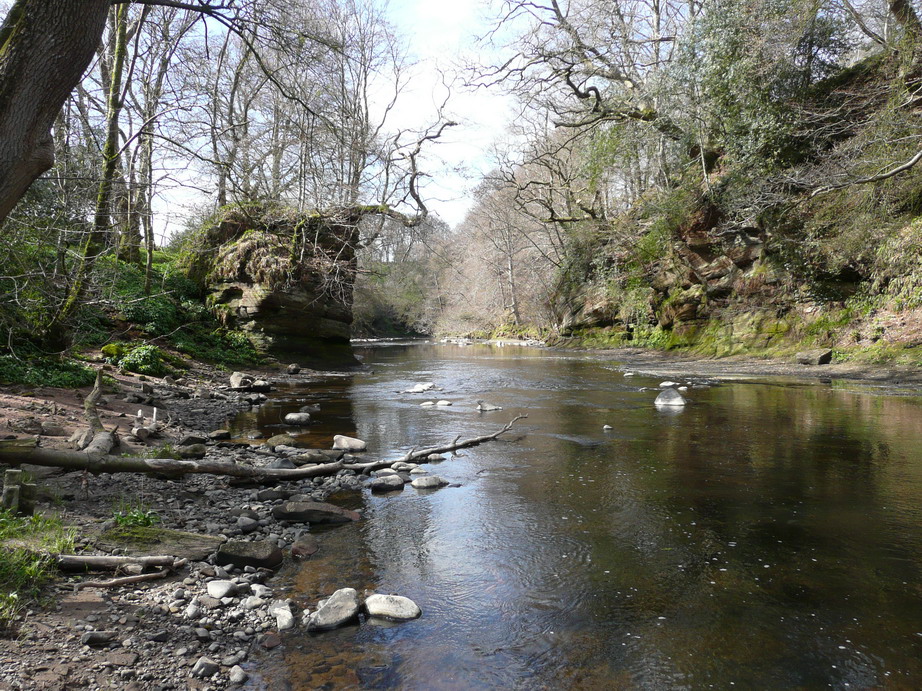
The Lugar, by David Johnston. Image: Wikimedia Commons
STUART MILLSON wanders imaginatively across peaceful marshes and rivers, to glimpse a world at war
Composers are not necessarily good conductors of their own works — too fussy, sometimes, or just without the conducting charisma of a professional baton-wielder, more accustomed to the stage and the adulation of an audience. Not so in the case of composer-conductor, Sir James MacMillan, a native of Scotland whose musical outlook and versatility brought such intense playing from the BBC National Orchestra of Wales in that most English of works, Vaughan Williams’s early-20th century symphonic impression, In the Fen Country.
Sir James — who as we were to find out in his new euphonium score later in the programme — has a natural feel for music which puts man in his place in the midst of a landscape where remoteness and the movements of cloud banks and sunlight over water allow your mind to wander fantastically. So the Vaughan Williams unfolded, carrying us far from Swansea’s Brangwyn Hall, like a fen-tale recounted by a local on a warm May evening (which indeed this was) — orchestra and conductor carefully finding all the threads and patterns of the lonely land so beloved by Vaughan Williams.
A similar ‘genetic heritage’ flowed into Sir James’s Where the Lugar meets the Glaisnock, a picture of the confluence of two Ayrshire rivers — part tone-poem, part euphonium concerto. Seldom has this bold solo brass instrument sounded so subtle and ‘at one’ with the soft magic of strings – the writing for the latter section of the orchestra suggesting the half-light melancholia of Vaughan Williams, but through a twenty-first century prism. At one point in the score, I picked up in MacMillan’s Ayrshire filaments of sound from distant Estonia, where a passage brought to mind the mystical, frozen-in-time style of composer, Arvo Pärt. Our solo euphonium player, David Childs, certainly gave a thrilling performance of what was a successful, deeply meaningful MacMillan world-premiere.
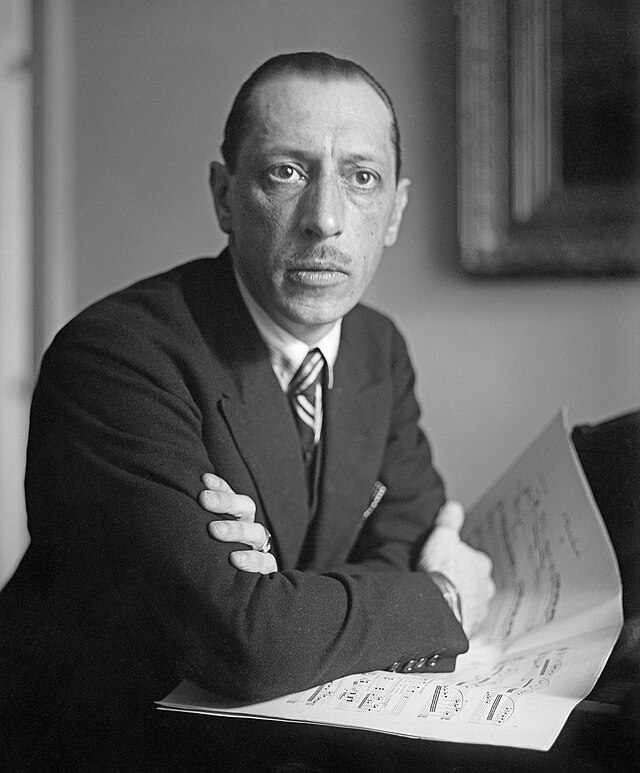
Igor Stravinsky
Thoughts of war (for Stravinsky, the stark image of goose-stepping machine-armies) were never far away in the composer’s emphatic, barbed, relentless Symphony in Three Movements, although the unsettling whirl of world events dispels quite uncannily in a surprising, eccentric, but warm and friendly little gavotte-like dawdle in the second movement — as if Pulcinella or Petrushka were never far away. The orchestra’s woodwind and brass produced pinpoint ‘Technicolor’ virtuosity — qualities which were centre-stage, too, in the shortish diversion (though with a clever, inventive sharpness) that is Stravinsky’s Symphonies of Wind Instruments.
The concert began with another compact and engaging mini-masterpiece, by Vaughan Williams’s composer-colleague, folk-song collector, and walking, hiking, inn-visiting friend, Gustav Holst — his Capriccio, a short work for full orchestra, with some magisterial trombone writing (Holst’s own instrument) and a foot-tapping march right in the middle of it. Yet the work seems to begin in Vaughan Williams’s fen and marsh, or the Ayrshire of MacMillan, another mysterious signpost of the continuum element in the music of these islands.