Correlations

IAN C SMITH’s work has been published in BBC Radio 4 Sounds, Cable Street, Griffith Review, North of Oxford, Rundelania, The Spadina Literary Review, Stand, & Westerly.  His seventh book is wonder sadness madness joy, Ginninderra (Port Adelaide).  He writes in the Gippsland Lakes area of Victoria, and on Flinders Island

Correlations

In March 1790 Bligh reaches England the same day as his letters describing the Bounty mutiny written five months earlier, Bligh aboard a Dutch vessel from the East Indies, his cannon shot news via France which seethes with its own uprising as does he with his need for vindication.

A new luminary deriving from his account of the miraculous feat of seamanship in the open launch, Bligh both seethes and basks at first. But questions soon arise suggesting all is not quite right with this talk of the town exploit, and Fletcher Christian is better connected than many in England, including Bligh. His clan numbers bishops, MPs, and university alumni, one brother a lawyer, another, a doctor.

Unable to defend himself, Fletcher of the tattooed arse constructs huts of vegetation and yard, cultivating his semi-tropical garden in a mutineers’ allotment on a little known and maddeningly more difficult to find island of the remote Pacific in residence with one of several native women and various scoundrels. Even from that distance he has allies with clout.

Rumour, gossip, abounds. We all love a mystery, each with an opinion. Nobody knows where Fletcher and his makeshift mob are, nor has heard from Bligh’s launch crew. Some scoff at the idea of so many ordered into an open boat, armed and provisioned, allowed to make their way home, however hazardous, without putting up a fight, the shame of this.

Several survivors of the incident-riddled launch odyssey are silenced, dead in the East Indies where tropical diseases scythe Europeans. Others stranded there by Bligh who couldn’t wait to be disencumbered of them are now debauched, drunken, threatening, even mutinous. Bligh writes to families of some of the original crew, expressing his feelings towards these shocked innocent people’s loved ones, whether calumnious or praiseworthy.

Fletcher’s fame, or infamy, puts Cockermouth on the map. Bounty’s voyage was financed to cultivate breadfruit as a profit-skimming basic slave diet. Political radicals sympathise with the French revolutionaries, among these the young Wordsworths in this time of a burgeoning anti-slavery movement. William attended the same school as Fletcher whose brother, Edward, shall later help the Wordsworths receive their rightful inheritance.

By 1808 when news of the discovery of the isolated Pitcairners – a tribe now with their own language – spreads, the South Pacific is well-charted. Illegally deposed as Governor of New South Wales during the Rum Rebellion after rubbing rogues the wrong way again, Bligh has nine years of life left.

In the heat of the mutiny he reminded Fletcher that he had dandled the Bligh children on his knee. His wife remaining in Lambeth where their twin sons are buried, Bligh’s married daughter deputised as his first lady in Australia. Did she captivate Sydney’s fledgling society with her childhood memory of Fletcher Christian?

Theatrical extravaganzas, prequels to future film flimflam, made much of Bligh’s dramatic days during his extraordinary life. Today, some still believe Fletcher found his way home to England, or vanished into America’s melting pot. In Hobart, anxious to clear his name again, did Bligh learn of the mutineers’ island descendants? Were these days of regret, of trembling sorrow?

Gardens of earthly delights

My Auntie Audrey used to cut the edges of her lawn with scissors. The grass was bowling green standard and a source of great pride, labour and constant concern. Her garden reflected her personality – meticulous attention to detail and a capacity to work endlessly to maintain her own high standards. I cannot remember her actually sitting in her garden, taking in the scents and views.  The esteemed editor of this magazine takes a different view. Let nature do its magnificent work whilst I lounge with a glass of something refreshing. Both approaches to gardening were to some extent on display at this year’s Chelsea Flower Show. The event has become a high societal event akin to strawberries at Wimbledon and flags at the Proms.

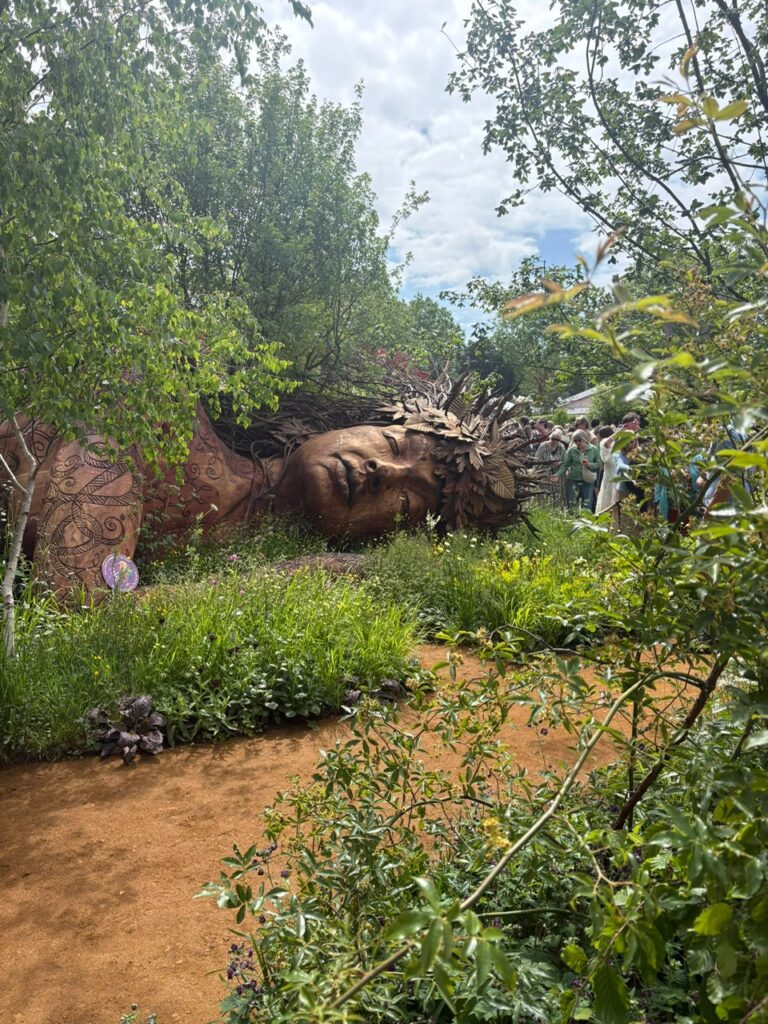
The best show garden this year was judged to be Sarah Eberle’s ‘On the Edge’ garden for the Council for the Protection of Rural England (see picture above). “Some of the best landscapes are where people and nature coexist in harmony…It’s about how it makes you feel. It’s almost a homecoming, an embrace, a hug.”  A central feature of this extraordinary garden is a fallen tree sculpted into the guardian figure of Gaia or Mother Nature. Her willow hair forms the top of a dry- stonewall that weaves through the copious, verdant planting. Weeds are reimagined celebrating our native flowing plants. There is a rusty corrugated tin fence suggesting a barn or tumbling warehouse where the countryside and development meet. Sarah Eberle’s guiding philosophy is for all gardeners to work with what they have. A boulder or tree stump can become a feature rather than a problem. She advises that we browse second-hand shops for weathered metal or wooden furniture. Beauty, she reminds us, can exist in the ordinary. The design encourages us to sit and ponder and do nothing.

The Tokonoma Garden

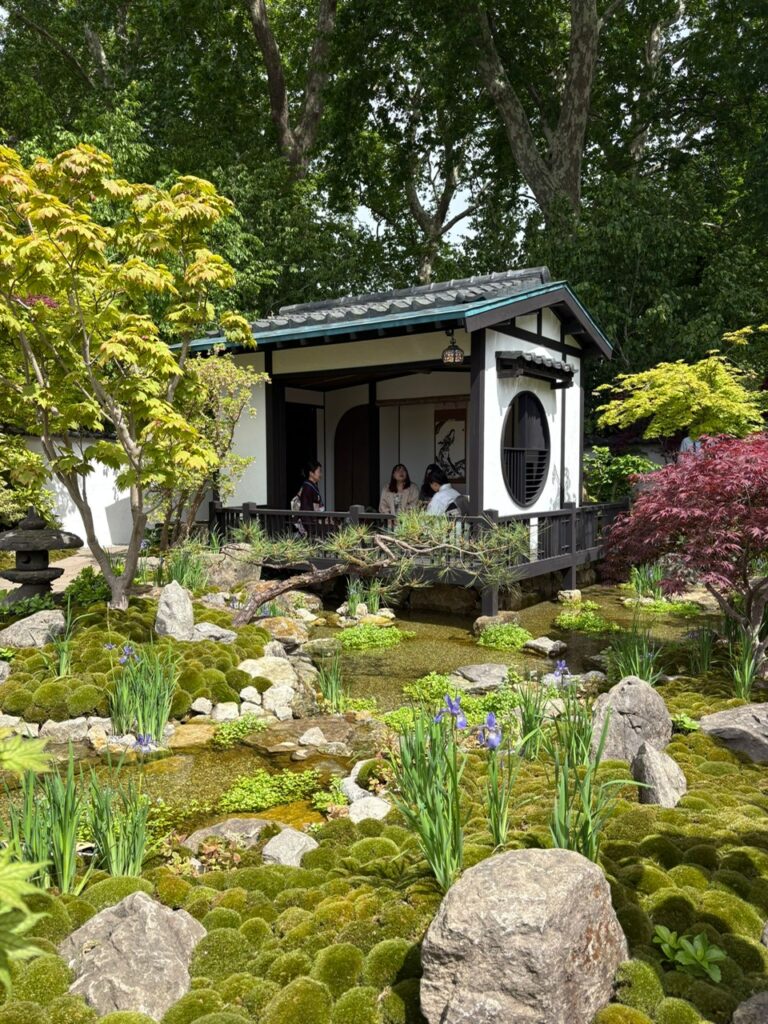
Contrast all this with the Tokonoma Garden designed by Kazuyuki Ishihara where Auntie Audrey’s scissors would definitely come in handy.  Everything is finely honed, brushed, choreographed. Everything has its defined and delicate space. It is the garden almost as a film set guided by well-defined Japanese traditions of harmony and beauty.  Weeds and corrugated iron are not welcome here. Nature has been squeezed and shaped into exquisite arrangements. The effect is stunning for very different reasons. In the CPRE garden you take off your shoes and socks and stretch out languorously. In the Tokonoma Garden you straighten your tie or adjust your fascinator. Two styles, two approaches, two designs that are different in almost every aspect in that one embraces nature and the other shapes it. 

The Garden for Every Parkinson’s Journey

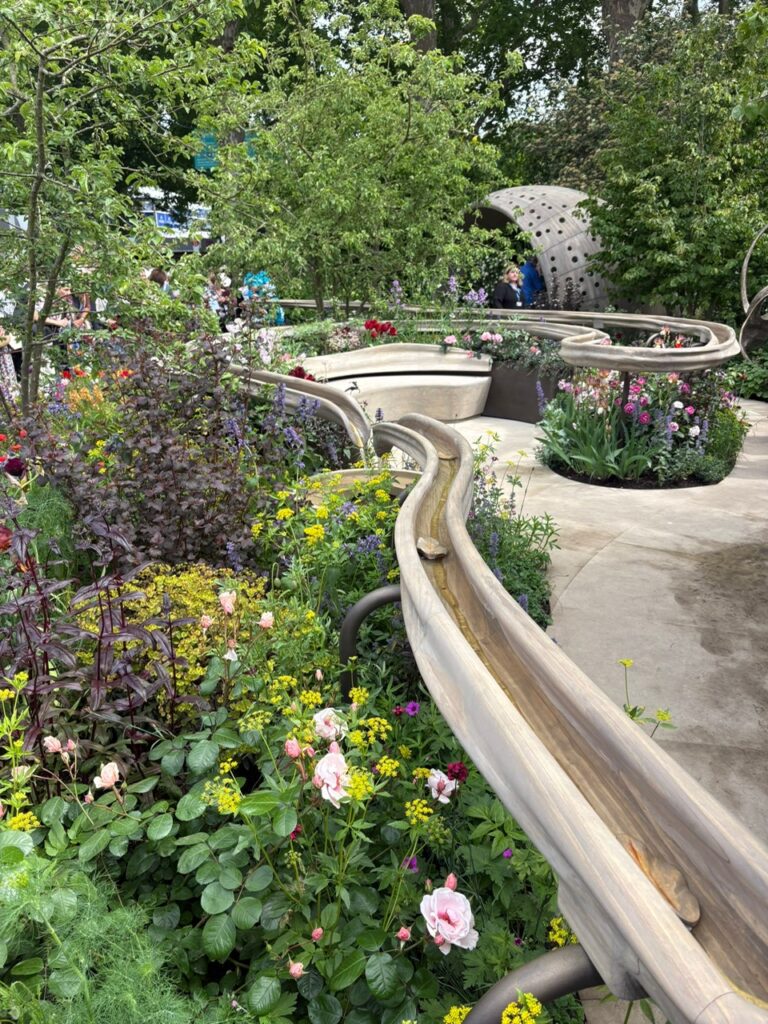
There are also show gardens with an explicit narrative, a message to convey. Such as the Garden for Every Parkinson’s Journey. We will ignore the overuse of the word ‘journey’ in current human experience. This garden is wonderful. A smoothly carved handrail weaves through the planting, offering stability and sensory experience for those afflicted by Parkinson’s. Its designer, Arit Anderson, has a sister who lives with the disease.  The garden offers a safe space to relax for a moment or two away from the constant challenges of living with Parkinson’s. It is also a soothing night garden as many people with the disease have difficulty sleeping.  One can see so clearly that Arit Anderson has designed the space for her sister. It is personal, empathetic, emotional. It underlines the immense beneficial impact that our gardens can have on both our mental and physical health. This has become a common topic for discussion: our garden ‘journey’ for mental wellbeing. And whilst being sometimes overblown, it is not new. For centuries we have known that being in nature is good for us even if it is well trimmed and intensely weeded.

My own garden journey was interrupted by an overheard remark: “Well, I must say that is the neatest lady garden I have ever seen.” Gardens never fail to surprise. I was now in front of the Lady Garden Foundation show garden. The information leaflet informed me that 21 women die every day from gynaecological cancers most people cannot even name. This ‘Silent No More’ garden was designed, somewhat disappointedly, by a man, Darren Hughes. It contains five sculptures to signify the different cancers – ovarian, uterine, cervical, vaginal and vulval. It is an unashamedly propaganda garden with a clear, vital message. At first, I was a little uneasy with the idea but slowly as I took in the planting and the message, I understood. Two ladies were chatting about a hysterectomy one had and the discovery of an undiagnosed cancer. It had got people to talk although its underlying message was skipped over by the BBC in their filming of their evening show. The idea for the garden came from Lady Garden Foundation ambassador Emily Plane who was diagnosed with ovarian cancer at the age of 23 and died five years later. A highlight for me was the contrasting ideas of planting to encourage both private and group conversations. The garden will be dismantled and rebuilt across multiple sites in Jersey and Cornwall.

With an equally therapeutic ambition is the Breathing Space Garden from Asthma + Lung UK. The design of the garden by Angus Thompson draws on the Japanese aesthetic of yohaku no bi – the beauty of empty space and ma – the beauty of empty time. He was giving an impromptu talk as I arrived. The aim was to create a tranquil woodland-edge retreat to help visitors to slow down, breathe more deeply and reconnect with the restorative qualities of nature. Despite visiting on a day when 30,000 others crowded across the site, I stared at the space and felt transported to a quieter place.

That is the power of gardens. Ultimately it is not about skilled design, strong messaging, striking architecture but discovering a space where you can breathe deeply and relax profoundly. And if you are lucky enough to have Gaia carved out of a fallen tree then all the better. One hopes that given these circumstances even my industrious Auntie Audrey (who now gardens in a higher place) would put down her scissors.

All photos by Richard Dove