Social ranking redux

Credit: Shutterstock

The New Snobbery

David Skelton, Biteback Publishing, 253 pp, £16.99

KEN BELL says many members of the middle classes have found ingenious new ways of disliking people

Britain is notoriously obsessed with class, but now there is a new, ideological way of looking down on people. David Skelton, a native northeasterner who is director of the Conservative-supporting think-tank Renewal, argues that we have replaced old forms of snobbery with new ones, based on beliefs rather than birth. Contemporary British politics shows no sign of Nancy Mitford’s famous ‘U’ and ‘non-U’ distinctions (napkin or serviette, long A or short), or inherited privilege, or Captain Mainwaring-like painful insecurity, but has developed new prejudices instead. The new breed of snob is not interested in how a man speaks or what his background is, but in his outlook.

The new political arbiters are the products of the post-1992 expansion of the education system, and for over a generation they have felt that they set the tone of public debate, a debate which often seemed to involve attacking the people they regarded as being beneath them:

Comedians, who are first to loudly claim to be offended in most circumstances, are the first to savage the so-called ‘crap town’ within the UK and ridicule narrow-minded, proletarian values. The likes of the BBC’s The Mash Report and Radio 4’s The News Quiz had a regular habit of punching down.

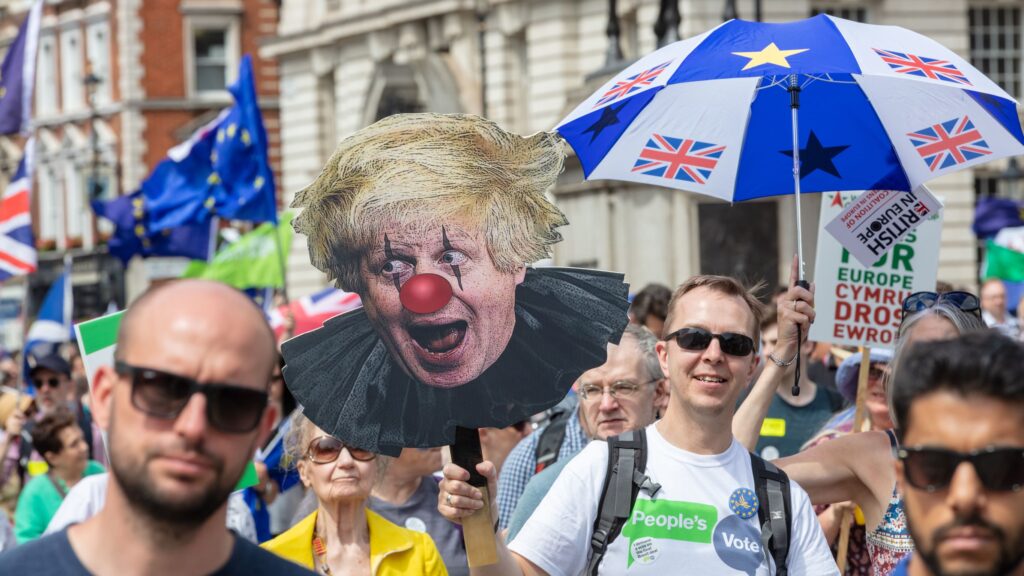
When, in 2016, a coalition of traditional middle class voters and even more traditional working class ones voted to take the UK out of the European Union, their sense of entitlement exploded in a righteous outrage that continues to this day as the reaction to the Conservative victory in the 2021 Hartlepool by-election shows. One writer argued that “a huge number of the general public are racists and bigots,” before going on to ask: “How do you begin to tackle entrenched idiocy like that?” This is not the old middle-class directing its angst at blue-collar ‘inferiors’; today’s snobs are the products of those former polytechnics that now degrade the name university, who almost invariably have well-paid roles as members of the local government nomenklatura.

What Skelton overlooks in his attack on today’s left is that Labour has never been an entirely plebeian party so the problem is not new. George Orwell made that point in The Road to Wigan Pier when he described the average Labour activist as being a rather shabby clerk, with “a background in Nonconformity”, possibly also a vegetarian, and the possessor of a position that he would not give up under any circumstances. Orwell could have been writing about the ancestors of today’s social work industry, teaching trade, NHS managerial caste and ancillary workers, but what saved Labour in those days were the industrial trades unions. Whenever some insane policy was thought up by the activists, the union block vote could be relied upon to knock it firmly on the head and keep Labour electorally sound.The destruction of industrial Britain, which led to the end of industrial unionism, has left the field wide open to Labour’s middle-class activists. The people they select for electoral office are as socially liberal as they are, and that factor pulls the party further away from its socially conservative voting base.

The snobbery and open contempt that Labour’s members have for their electorate is covered in great, depressing detail in Skelton’s work. In the aftermath of the Brexit vote, far too many of them “hoped the Nissan plant in Sunderland would close” as the people there were “stupid” and deserved everything that was coming to them. “Others said they would be ‘pleased’ if the fishing industry was harmed by Brexit” as that was what people had voted for. At root, as Skelton says, this attitude is based on the belief that low-income workers are the authors of their own misfortune. The new snobs are meritocrats, who managed to wangle themselves a berth in a post-1992 “university” and believe that people who haven’t followed that road are too thick to bother about. This attitude now seems to encompass a sizeable chunk of the middle-class as a whole.

The problem is that the working-class is not stupid. They may have rejected Labour, but that is because whenever a Labour MP sneers at a house that flies an English flag, or the party opposes the opening of a new coal mine, as it did this year in Cumbria, the message that goes down the wires is that Labour is not the party of their values or economic interests. This is important because The New Snobbery is also a plea for a politics that treats the working class vote as something to be fought for. Skelton may be a Conservative, but he realises that unless Labour takes on board policies that appeal to its old, core voters, his party is not likely to do it entirely on their own. The Tories need always to be moderated, and pushed, by a Labour Party that has regained its sanity. Skelton’s analysis is shrewd and worthy of attention. The only problem is that having put his finger on the problem, he does not come up with any solutions. On the other hand, perhaps there isn’t one.

Diary of a Somebody

Image: Wikimedia Commons

The Diaries 1918-1938

Henry Channon, edited by Simon Heffer, Penguin, London, hb, 1,002 pages, £35

KEN BELL dives into an interwar atmosphere of complacency and privilege

The complete diaries of Sir Henry “Chips” Channon are now being published and the first volume will be required reading for anyone interested in the interwar period.

Channon was a handsome, wealthy American with an easy charm, who lived on the income provided by his shipping magnate father. He spent most of the 1920s assiduously courting the British upper class, and by the end of the 1920s he had become such a part of English high society that he married a Guinness heiress, and became a British national and a Tory MP. Given that he was born in 1897, it is amusing to realise that the first thing he ever had that approached work was when he became an MP at the age of 38. That was for a seat, by the way, that was in the gift of his wife’s family, as both her parents had represented it. Eventually, Paul Channon, Chip’s only son, would sit for that division as well – proof, I suppose, that the age of the rotten borough is not yet over.

His bisexualism probably also helped his rise, as it looks as if he tended more towards men than women. If my reading of his character is correct, then women would find him safe in taxis, so there was a charming, handsome, wealthy man who wasn’t going to jump on every woman he met, but might not be averse to an evening with one of their husbands, so long as it was all handled very discreetly. Indeed, his sex life is handled discreetly even in the diary. Prince Paul of Yugoslavia seems to have been the great love of Channon’s life, but we are never given any details about how they got it on. He seems to have mooned over the Prince, and it is quite possible that it remained unconsummated.

In the 1920s, he also became entranced by Viscount (George) Gage, and it is possible that his visits to a young prostitute called Josephine may have been partly due to the fact that she also counted Gage as one of her clients. One imagines that as part of the bedroom chitchat, he got her to prattle about what Gage was up to. He did have sex with Josephine, in spite of the fact that he found her Newcastle accent distasteful, but we are not treated to full accounts of their couplings. In fact, that is the way it is throughout the diary as when he visited three very expensive Parisian brothels he took the trouble to tell us their addresses, but not how he had pleasured himself. It may be that he kept his clothes on and only went there to be seen.

On the other hand, he did have a fling with Tallulah Bankhead, and was fairly open in his diary about that, including the hilarious account of playing a stripping card game with her and another girl. The other girl left the room at some point, leaving the naked Chips and Tallulah to enjoy each other, but the most entertaining section comes at the end when she returned and both girls got to watch as Chips slowly got dressed. He was convinced that his body was so perfect that the two girls would enjoy that spectacle, so much so that he dedicated more wordage to the act of getting dressed than to describing his bout with Miss Bankhead.

Before the mid-1930s, Channon seemed to have no interest at all in politics or the major events of the day and his diary is full of the parties he attended, along with quite tedious lists of the very important people who were also in attendance. His catty remarks about some of their personalities will bring a smile to the reader, and it is amusing to read that one woman “has a face like a well-rounded bottom,” or another was so weighed down with jewels that she “looks like a ferret that has got loose in Cartier’s,” but it does wear after a while.

The diary comes alive after 1935, with Channon in the House of Commons and war looming in Europe. His account of the 1936 Berlin Olympics is interesting for his admiration of Hitler and what he was doing in Germany. One suspects that he may also have been quite taken with all the tall, blond, Aryan gods in their tailored black uniforms that he saw, but by that time, Channon, who had been long terrified of the workers, then saw the USSR as the greatest threat to his position, with Hitler as a staunch bulwark against upheaval.

Two years later, his account of the Munich Crisis is desultory in the extreme, as he clearly just wished that the tiresome Czechs would give in to Germany’s demands. When they did, his admiration for Neville Chamberlain knew no bounds, along with his contempt for Churchill and the other doomsayers. Channon was probably in the majority at that time, but it is still interesting that he devoted more space to the 1936 Olympics than to Munich. Then again, Herman Goring had hosted a fine bash at which Channon had been a guest in 1936, and Munich did rather put a downer on the London season that year.

Channon was at his best, as well as his worst, with the abdication crisis of late 1936. As a friend of the future King Edward VIII he was not only aware of Mrs Simpson, but on good terms with her – yet he hardly mentioned her until the story began to break in November 1936. It is as if Channon did not realise the full implications of a foreign, divorced woman marrying a future King and becoming Queen-Consort. Indeed, his failure to even grasp the fact that as head of the Church of England, the King was caught up in a theological battle of his own making is quite incredible. For his part, Channon just saw it all as Stanley Baldwin pandering to the Dominions and the reactionary parts of middle-class Britain. Channon may have been afraid of the working-class, but his distaste for the middle class runs through the diary.

Chips Channon was also at his best as a diarist, politician and friend to the King once it all exploded in November and December that year. He tried to get the King to announce that he had no intention of marrying Wallis Simpson, and hold to that story until after his coronation. He wanted the King to lie, in other words, to buy time until he had been safely crowned; then he could have married Wallis and presented the government with a fait accompli. The King refused the entreaty so Wallis scuttled off to France and Chips came up with a Plan B. She would lie and tell the world that she had no intention of marrying the King, but that failed when Channon realised that the King would have gone to France had she made such an announcement. The thought of the King-Emperor abandoning the country for such a reason is what brought Channon to a realisation that an abdication was the likeliest outcome, but he continued to argue the King’s case right up until the final moment. “We can only combine to save the sovereign and can we?” he wrote in early December 1936, before doing what he was good at which was working the ‘phones, networking long into the evening, and trying his very best to keep the King on his throne.  Let us give credit where credit is due: Channon was quite magnificent in the defence of his friend during those weeks.

In the aftermath, Channon wrote two memoranda that aimed to make sense of the crisis and a diary entry which assessed the personalities of the King and Mrs Simpson. His view was that Edward “suffers from sexual repression of another nature”. He “surrounded himself with extremely attractive men… and even these he dropped as they aged”.  So, Channon, writing as a closet homosexual, saw King Edward VIII as a repressed one.

Chips was not a complete cad, as he also loved his son dearly. That comes through various entries when he will end something unrelated to his family with a sweet comment about his then baby son. Other pleasant aspects are also to be found. On one occasion his wife discovered a half-starved stray dog, which Channon took in and fed. He then looked at the mutt’s collar and found an address, and was able to track down the owner who was on holiday in a converted railway carriage on the coast. Channon, his wife and the dog then climbed into his car, and the dog was restored to his master, who broke down in tears at the sight of his companion. The Channons were invited in for tea and everyone sat around chatting amiably. Channon’s account of all this is respectful to the family and lacks all the malice he used when dismissing the middle-class and their mores.

The Channon diary, unexpurgated though it may be, represses far too much of the author’s private life, so it is not on a par with that of Alan Clark. Yet, he was a wonderful writer who captured the spirit of the twenties and thirties very well – at least, that part of it that involved his wealthy social circle.

However, his repeated failure to spot a looming crisis when it was right in front of his nose marks down his utility for most of the major events of the period, except, of course, for the abdication. His fear of the working class was such that it clouded his admittedly limited political judgement, so in his penultimate entry of this volume he wrote that if war was to come then “I am indifferent to precautions, for if there is a major war, nothing matters. I don’t care to survive in a Moscow world.” The following day, his final entry lauded the “gentlemen’s peace” that was the Munich Agreement. He went on: “The whole world rejoices whilst a few malcontents jeer.”

He got that wrong, but so did most of Britain at the time. It will be interesting to see in the next volume – due out later in 2021 – how he managed to get out of that particular fix when the war finally broke out a year later.

Castro, Kennedy and Khrushchev – the nuclear option

Image: Shutterstock

Nuclear Folly: A New History of the Cuban Missile Crisis

Serhii Plokhy, Allen Lane, 2021, 464 pages, £25

KEN BELL admires an unusually informed study of one of History’s nearest misses

Serhii Plokhy’s Nuclear Folly: A New History of the Cuban Missile Crisis is the first work to mine the KGB files that are stored in Ukraine. Out of this, Plokhy has synthesised a new understanding of the crisis which argues that neither side understood the other, and both operated on the basis of faulty intelligence.

Fidel Castro was a caudillo, rather than a Marxist, but he realised that if Paris is worth a mass then Cuba was certainly worth some Marxist rhetoric, so he decided to announce his conversion to the principles of Marxism-Leninism in the aftermath of his victory at the Bay of Pigs.

For Moscow, this was a dream come true, but it did create three issues that needed to be addressed quickly. The first was the need to keep Cuba communist, and the second was how to deter further American aggression against it. Finally, there was a need to keep Peking from seducing Havana into its version of communism.

The installation of medium range nuclear missiles, with the Soviet troops to man them, answered all those issues and gave Khrushchev the added bonus of finally being able to threaten the USA directly; the USSR in 1962 still lacked the intercontinental missiles that the USA had recently developed. Khrushchev remembered the way in which Kennedy had accepted the fact of a Berlin Wall and hoped that the Americans would do the same with Soviet missiles in Cuba, if they could be installed before the Americans discovered their presence.

Things began to go wrong almost immediately. The advance party that was sent to Cuba reported that the country was heavily wooded, and installing the missiles could be done under that forest canopy. When the missile troops arrived, they discovered that palm trees do not provide much cover and rain forests are too dense for large trucks to move through. The country lacked bridges that could stand the weight of the Soviet trucks, and even Soviet rations began to go bad in the tropical heat. The troops began to contract dysentery and the whole thing began to look like a farce before it had got off the ground.

Luckily for the Soviets, the decision was taken to install anti-aircraft missiles first. These were quickly discovered by the Americans, but they had expected them, so did not trouble themselves over the Soviet ships. This meant the strategic and tactical nuclear missiles could be set up courtesy of American misreading of what was actually going on.

When the Americans did find out, Kennedy’s reaction at first was hawkish. But he quickly realised that a nuclear world war was not in anyone’s interests so began to find a political solution. However, by then his aides and military were almost united in speaking for war, so the blockade of Cuban waters that he came up with seems to have been intended to buy time and keep the warmongers off his back until he learned exactly what Khrushchev was willing to concede. For his part, once Khrushchev realised that Cuba was far more important than Berlin to the Americans he was more than willing to reach an agreement, but the problem then became bringing that about against a backdrop of rising chaos.

For instance, an American U2 aircraft over Cuba was shot down seemingly against orders from Moscow. The commander of the unit was in his bed with dysentery, so a less senior officer, under extreme pressure as he and his men had not slept for days while they battled to get their antiaircraft missiles operational, gave the launch order.

At sea, a Soviet submarine had surfaced to recharge its batteries. It carried a nuclear torpedo, and control over that weapon was in the captain’s hands. It was the middle of the night when he went up to the conning tower to communicate with the American ships that surrounded him via a Morse lamp, and the USAF took the opportunity to ignore its orders not to do anything provocative and began to drop flares on the boat so photographs could be taken. The Russians thought that they were under attack, and the captain ordered a crash dive and the torpedo tubes to be flooded. Luckily, the man carrying the Morse lamp got stuck on the ladder and the captain was able to look back at the main American ship and read an apology from its captain. Had that man not been caught for a few seconds with his lamp, most of the American ships would have been destroyed by the nuclear weapon.

Back on land, Kennedy’s willingness to swap the Soviet missiles in Cuba for American ones in Turkey almost came to nothing when the Americans realised that the Turks might just object to a deal about their country that did not involve them, but Khrushchev agreed that part could be kept secret. Then Castro got in on the act and refused to allow American inspections of the Soviet missiles as they were loaded onto ships, so the Russians had to agree to inspections at sea. Both superpowers were quickly discovering that even junior partners could not be treated with that same indifference that the Americans used in central America and the Soviets in eastern Europe.

Yet, there was just enough to trade-off, and just enough willingness to do it, to allow Khrushchev to walk away with an American promise not to invade Cuba, which meant that it would remain a communist country. Awash with Soviet arms and subsidies, Cuba ignored Chinese entreaties and remained a reliable Soviet ally until the USSR finally ceased to exist in 1991.

However, as Plokhy shows, that peaceful end to the crisis was a matter of good luck rather than good management. His work takes us through this period with a lucidity that allows his readers to finally make sense of those autumn days in 1962 when the Cold War almost became a catastrophe.

Compromising documents – the hidden history of constitutions

The U.S.S. Constitution, “Old Ironsides”, one of the United States Navy’s first frigates

The Gun, the Ship and the Pen: Warfare, Constitutions and the Making of the Modern World

Linda Colley, Profile, 512 pages, £25

KEN BELL finds a new way of looking at global constitutional history

A history of constitution making does not sound like a page turner at first glance, but in the hands of Linda Colley it becomes one, as she upends the notion that constitutions are necessarily liberal documents that helped only in the creation of the modern nation state. For her, their modern origins are imperial and grew out of the clash of empires in the 18th century. Many were not even born out of liberal thought; Catherine the Great spent long hours drafting a guide for legislatures that aimed at putting autocratic rule on a constitutional footing.

One of the questions that historians always seek to answer is why events occur at a particular moment in history, and not either before or after that moment. For Colley, the desire to write constitutions came about as a result of the “hybrid warfare” of the period, with empires clashing on land, at sea, and all across the globe. Those wars were costly in terms of lives lost, to say nothing of the financial terms. During the Seven Years’ War from 1756-1763, “Prussia lost an estimated 500,000 troops and civilians out of a pre-war population of 4.5 million.” The cost of those global wars to the taxpaying class was enormous, as just to build a 72-gun man of war took over 3,000 mature oak trees, along with acres of canvas, miles of rope and tons of iron for the nails to hold it all together.

Giving men constitutional rights made them more likely to put on a uniform and risk their lives for a cause. That is why so many generals were also constitutionalists, from Toussaint Louverture in Haiti to Napoleon Bonaparte in France, along with many of the men who met in Philadelphia in 1789 to draft the American constitution. At the same time, the men who paid the taxes would be more inclined to pay up with only minimal grumbling, if they had the right to vote for the governments that were levying the taxes to fight the wars.

The men who created the American Constitution met in secret, but as soon as the document had been finalised someone leaked it to the press. Then the jobbing printers got hold of it and ran off cheap pamphlets that contained the draft constitution along with essays that defended or attacked it. Ships carried these types of political works across the oceans, so what began as a Western affectation was quickly picked up by other cultures who wanted to get in on the cult of modernity. Simon Bolivar and the generals in South America swiftly created constitutions for the new republics that emerged in the wake of the defeat of the Spanish Empire and as Japan rushed to modernise from the middle of the nineteenth century, a constitution was swiftly adopted based upon the Prussian version.

Colley’s argument that these constitutions were often made by conservative military men, who wanted to ensure that other men would either serve in wars or pay for them, can also be used to explain why Great Britain did not adopt a written constitution. The English Civil Wars and the ‘Glorious Revolution’ that followed a generation later had already settled and legitimised the English, then British, constitutional dispensation. The King reigned with the consent of Parliament, and not by divine right.  His Protestant subjects had the right to carry arms thanks to legislation passed in the wake of William of Orange’s accession. So the British already had what the rest were battling to obtain, just not in a single document. They also had Jeremy Bentham who was only too happy to offer advice to the political exiles who made London their home, and who could then use the London printing trade to produce their new documents and British ships to carry them wherever they needed to go.

As with most globalist histories, the odd error is bound to creep in, so the Americanists will immediately spot the mistakes in her comments about American technology during the Civil War. “Quick-loading rifles using high-calibre bullets that were potentially lethal at 600 yards or more replaced older, far less accurate, muskets,” she claims. I suspect that she meant to write high-velocity, rather than high-calibre, which is not true, either, but aside from that, both sides used muskets throughout the war, with the Union fielding Springfield rifles and the Confederacy the British Enfield. The fact that they had rifled barrels does not mean they were not also muskets, as they were loaded from the muzzle.

The claim that the Confederacy had a rail network similar to that in the United States will also raise a few eyebrows. The South had about 10,000 miles of track, with a myriad of gauges and very little that linked up to anywhere else; the aim was to get cotton to a river or port, rather than connect the South’s few urban areas. So the railways that ran into Richmond, Virginia, from the south could not then go through to the north as there was a gap of several miles in that city between northern and southern lines, that was covered by draymen with carts. But however enjoyable such pedantry may be, minor details of this kind do not detract at all from Colley’s fascinating and highly original argument.

Brexit blindness

Heroic Failure: Brexit and the Politics of Pain

Fintan O’Toole, Head of Zeus, 2019

Three Years in Hell: The Brexit Chronicles

Fintan O’Toole, Head of Zeus, 2020

KEN BELL says a prominent Remainer still doesn’t comprehend Brexit

I have just finished reading Heroic Failure and Three Years In Hell, both by Fintan O’Toole, which is good for you as it means you don’t have to. I was attracted to these volumes by the fact that O’Toole as an Irishman might bring something new to the pro-EU debate, but unfortunately all he does is regurgitate lines British writers have already done to death.

Three Years In Hell is the lesser volume, and the easiest to dismiss, since it is essentially a diary covering dates in the years 2016 to 2019. Most of the entries became moot once Boris Johnson took over, so the entries that deal with Theresa May are little more than space fillers. Much is made in both books of the supposed fact that Brexit was an ‘English revolution’ – an engagingly off-the-wall line the Guardian emits regularly.

In the first place, the Brexit plebiscite was specifically set up as an all-UK vote. That is why Nicola Sturgeon could scamper off to campaign for ‘Remain’ in southern England. Now, you cannot have an all-UK vote and then dismiss its results because you come from an area that ended up on the losing side. Well, you can, if you are Nicola Sturgeon, but that does not mean that the rest of us have to take your whining seriously. That applies to writers as well as politicians, by the way.

Secondly, and this is where the much longer Heroic Failure takes over, to dismiss the Brexit vote as being a purely English victory when proportionally as many Welsh voters supported Brexit is to dismiss the people of Wales with an airy wave of the hand, which is what O’Toole does repeatedly. Not just Wales, either – pretty much anyone who is not part of the Guardian-reading metropolitan bubble is only referred to in passing. Thus, when discussing the makeup of the Brexit vote, he makes great play of the English middle class component and tries to slight the much larger working class element by saying that a majority of them were working class Conservative voters already! That may be the case, but it only leads us to a question of why did people who had historically voted Labour decide to switch parties, something which started to happen in 1997? It may be that Labour has changed and they haven’t. O’Toole does not even raise that theme in his books, being content to dismiss working class Brexiteers as people engaged in an act of self-harm.

A whole chapter of Heroic Failure is devoted to Boris Johnson’s journalistic pieces devoted to mocking the EU, with O’Toole then pointing out the errors and, by implication, the stupidity of the plebs who believed those tales.  This theme is not original to O’Toole, but it is what his readers believe, just as Boris’s believed his lines about prawn-flavoured crisps. Actually, Boris was on fairly solid ground with his EU reports, because even if he got some details wrong, there was a greater truth that he got right. When we joined the European Economic Community we were told that it was a big trading bloc and nothing that it did would ever affect us in any way. It was all about trade, nothing more.

Then we noticed that local council jobsworths were giving grief to market traders who wanted to sell their produce in pounds and ounces. We noticed that our children were coming home from school and talking about heat in Celsius and distance in metres. We battled to keep beer and milk in pints and road markings in miles, but in our hearts we knew that all we had bought was time, and that the jobsworths were just licking their lips at the thought of earning a tasty butty as they forced us to think the European way.

This brings me close to the end, with O’Toole convinced that the Brexit vote was due in no small measure to a desire to recreate the British Empire. It wasn’t, of course. It was a desire by millions of people, many of whom had never voted before and probably haven’t since, to be allowed to live their lives as they wanted under the jurisdiction of politicians who may be dubious characters – but they are our dubious characters and we can get rid of them every four or five years if we are bored with their faces. The EU may not really have instructed its provincial legislatures to enact laws against prawn-flavoured crisps, but the story illustrated a great truth that Brussels did order Westminster around on many issues, and Westminster did duly enact the legislation as instructed.

One day a pro-Brussels writer will investigate the mindset of the British people who voted freedom’s way, and a light will come on in his mind. He can then pass this information on to his readers, and his side will finally start to come to terms with the reasons for their defeat. Alas, Fintan O’Toole is not that writer.

A realm apart – why Brexit happened

SHUTTERSTOCK

This Sovereign Isle: Britain In and Out of Europe

Robert Tombs, Allen Lane, 224 pages, £11.22

KEN BELL praises an exceptionally historically-informed Brexit explainer

The small numbers who read the Guardian will no doubt disagree, but the argument over Brexit is now as much a part of history as the Free Trade debate that dominated life in the 19th century. As such, Robert Tombs in This Sovereign Isle has written the first of the many volumes that will dominate the reading lists for student historians. Luckily for the public at large, the book is also eminently accessible to the general reader as well, so I predict that this volume will go through many editions in the years to come.

Although Tombs never falls into the trap of arguing that Brexit was inevitable, he does make the point that for the British, membership of the EU was always a transactional issue and not an emotional one. Thus, when the downside of membership began to tell, there was no emotional appeal that could be made by the other side to try and even the balance. The Remainers lacked an Abraham Lincoln who could deliver a Gettysburg Address, because their side of the debate was just as transactional as that of the Brexiteers. Thus they were forced to rely on an increasingly hysterical version of the ‘Project Fear’ that had helped win the 2014 Scottish independence referendum. The problem in 2016 was that people just didn’t believe the howls, which allowed Boris Johnson to ask mockingly which catastrophe would come first, the world war or the economic collapse.

For the British, membership of the EU was always a transactional issue and not an emotional one

To be fair, as Tombs argues, Brexit was certainly helped over the line by the fact that the UK had managed to stay out of the Euro. Had we joined that common currency, the UK would have been in a similar position to the Scotland of 2014 and it is quite likely that Remain would have won. As it was, the result was close enough to argue that ‘Project Fear’ had a considerable effect on the final tallies.

On the other side of the English Channel, the Euro certainly helps keep difficult countries in line, as the EU demonstrated against the Greeks when it looked as if they were about to strike out for freedom. The mafia type threat: Nice economy you have here – be a shame if something happened to it, may very well be the one issue that keeps such countries voting the right way. Or to carry on voting until they get to the right way according to Brussels. That threat could not be used against the UK, and we owe a debt of gratitude to Gordon Brown for keeping us out of the Euro’s clutches.

Staying in Europe for a moment, Tombs makes the point that most of those countries were desperate to draw a line under their immediate pasts. The original six had the memories of defeat in the Second World War and political systems that had become illegitimate in the eyes of the populations. Later on, the post-Cold War entrants wanted to forget all about their Soviet experiences and similarly had discredited systems that needed to be put out of their misery. The EU for all those countries was in large part a stab at legitimacy and an exercise in forgetting the recent past.

The UK by way of contrast emerged from the two World Wars on the victorious side, with a legitimate political system intact. Thus roughly half the Brexiteers who were asked to give a single reason for their vote, answered that they wanted Britain to govern itself. They were able to say that because they had confidence in the British parliamentary system. It really was as simple as that.

The Remainers never seemed to understand that desire and so they discounted it as a factor. To them the Brexiteers were a caricature that they had created in their own minds and then decided that it represented the reality of their opponents. We were uneducated, old and we hankered after the British Empire, when actually, as Tombs shows, we just wanted to govern ourselves. Nevertheless, that mistake, which came about because Remainers tended to be concentrated in particular parts of the country where they did not come into day to day contact with Brexiteers, led them to overestimate their own numbers, and underestimate the need to get their vote out. As Sasha, Lady Swire, noted in her Diary of an MP’s Wife (https://brazen-head.org/2020/12/16/chumservatives) when her daughter called her as the results came in and complained that “white van man” had stolen her future, the result might have been different had the darling girl got her friends out of bed and chivvied them along to the polling stations.

One area that the author really should have been expanded upon was the 2017-2019 period that I think history will call the Rogue Parliament. If there is any truth to the argument of British exceptionalism, then this period provides a plethora of evidence for it. Many countries would have unpacked the rifles long before the period ended, but the British bided their time, seethed with rage at the antics that went on and waited for an election when they could exact their revenge against the guilty men who were responsible for it all.

The constitutional position, as Tombs makes clear, is that when a government has lost the support of the Commons, it should be voted down by a motion of no-confidence. Once carried, the rascals are thrown out and a new set of rascals elected in their place.

That did not happen during that roguish time, as an alliance of neo-Jacobin MPs, a compliant Speaker who clearly sympathised with them, coupled with a judiciary that seemed willing to flout established precedent all came together to try and force the government to act as they wished. The Fixed Term Parliament Act prevented the government from calling an election, and it looked for many long months as if the situation would continue to resemble the 17th century crisis that led to civil war, only this time as Tombs says, with “tragedy repeated as farce.”

Yet it ended, sooner than many of us expected, when the opposition folded and an election was called. Boris Johnson was given an 80 seat majority on the promise to get Brexit done and the Neo-Jacobins were packed off to a lifetime of obscurity. Readers of the Guardian will continue to whine and the rest of us will just get on with our lives, having rid ourselves on an undemocratic layer of government based in Brussels, which is all we ever wanted to do.

Chumservatives

KEN BELL enjoys an amusing and observant, if ultimately insubstantial, account of an eventful political period

The Diary of an MP’s Wife, Sasha Swire, Little, Brown, 544 pages, £8

A diarist needs a good eye for the little details that makes the reader feel that he is in the room where the events are happening. Sasha Swire has that diarist’s eye in good measure and uses it to full effect in The Diary of an MP’s Wife. Thus when meeting the Countess of Wessex, Lady Swire notes when the Countess talks about giving up her career in PR that there is “real regret in her eyes and sadness that this part of her life is gone and not allowed to return”. Meanwhile, Prince Edward, husband to the Countess, comes over as “over-excitable like a puppy”, which rather sums up his whole life when you think about it.

Along with her good eye for the small details, this authoress is also the mistress of the cutting, throwaway, dismissive comment, as she demonstrates on almost every page of the diary which covers the years 2010 to 2019 when her husband, Sir Hugo Swire, who is known as “H” throughout the volume, was in government. One of my favourites is her conclusion that Kate Middleton and her family displayed “middle-class dignity” during the 2011 royal wedding. Only the genuine upper-class can damn with faint praise like that.

Reading this volume, I was struck by how little there is about the great events of the period and how much is dedicated to sticking the boot in to people that Lady Swire does not like. The fact that most of them seem to be in the Conservatives, the party that her husband represented in the Commons, rather suggests that Harold Macmillan had it about right when he commented that a man’s political opponents are on the other side of the House, and his enemies are all around him on his side.

The greatest event covered by the diary must be the 2016 Brexit vote, but it is really only covered in passing. Having seemingly done very little during the campaign, Sir Hugo and Lady Swire decided to go to Scotland for a few days in the Highlands on polling day, and left on the sleeper train, thinking that victory was theirs. However, as the dawn rose and the news came through that victory had gone to the other side, Lady Swire dragged her husband out of his bed and they both returned to London to hold David Cameron’s hand. On the way back, one of the daughters rang up to cry that “old people and White Van Man have stolen her future”. Her mother, who presumably is aware of just how wealthy, privileged and connected the family is and that the little girl is in no danger of being reduced to taking in washing, has no sympathy and tells her that “she should have made more of her friends get out of bed and vote”.

Aside from paying back old scores, the diary really succeeds as an account of just how incestuous the Tory leadership crew is. This is the chumocracy in action, with people who are part of that magic circle getting a respectable naming and everyone else receiving a mocking nickname. So, David Cameron is referred to throughout as “DC” and Theresa May is dismissed as “Old Ma May.” George Osborne is “Boy George” in the diary, probably because he is only an honorary member of the magic circle, having been a day boy at his public school and his father being something in trade. I went to a secondary modern so all this is Greek to me, but it means something to this crowd.

It is not just that they all know each other, but they have been friends for years. So, Amber Rudd, who has now returned to well-deserved obscurity and will only merit footnotes in the histories that will be written of this time, seems to feature on far too many pages as if she is a really important person. Actually, she has been a friend of Sasha Swire since both were in their teens, and it shows in the diary in the sympathetic way she is portrayed and the amount of references to her.

This is all very much a book written by a member of the higher caste for other members of the caste who understand instinctively the cultural references. Thus, H goes to meet DC one Saturday morning in his casual attire and DC looks at his brown shoes, lifts an eyebrow and says, “Brown in town, Hugo?” To which Hugo replies that it is the weekend and he should not be in town but in the country, and so on and so forth.

There is nothing wrong with an authoress writing a book for her social set, and Sasha Swire is certainly a quite excellent writer with a fine turn of phrase who has crafted a work that it was a pleasure to read. The sad thing about her book is that it is unlikely to be referred to by future historians because the bulk of it is concerned with people who will be of interest only to the hardest of hardcore historians; thus it will date very quickly for the general reader.

Why two tribes went to war – Brexit’s background

KEN BELL reads a useful analysis of what led to the 2016 vote

Brexitland, Maria Sobelewska and Robert Ford, Cambridge University Press, 2020, 408 pages, £11.99

Porfirio Díaz, the man who dominated Mexican politics for a generation until his downfall in 1910, once remarked that nothing ever happened in his country until it happened. What he meant was that there has always been an enormous time lag between cause and effect in Mexican politics, and in Brexitland, Maria Sobolewska and Robert Ford show that the same is true of Britain.

In doing so, they have also managed to demolish the myth that is now an article of faith in Guardian-reading circles that nobody was bothered about the EU until a couple of years before the 2016 referendum. What the authors demonstrate rather well is that many issues that were of importance to the population were suppressed by the main political parties from just after the Second World War. Viewed in that light, Brexit is about more than just leaving the European Union; it is shorthand for a lot of long-standing factors that have led to a new political division in Britain.

Immigration, of course, is the most important factor and for that reason several chapters of Brexitland are devoted to it. Starting in 1948 when the great and the good created a nationality act which allowed Commonwealth citizens to settle freely in the UK, the aim was to tie the fully independent white Commonwealth states to their mother country and to create an Anglosphere long before that word was even coined. What nobody realised was that New Commonwealth people would take advantage of this liberalism, even though since most of their countries were not independent at that time they did not need this legislation. As Sobolewska and Ford point out, both parties supported immigration even when it became obvious that many of their traditional supporters did not.

The opposition to that policy, begun in places like Smethwick in 1964, continuing on via Enoch Powell’s ‘rivers of blood’ speech in 1968 and culminating, possibly, with Margaret Thatcher’s 1978 comment about people being afraid of being ‘swamped’ by new Commonwealth immigrants certainly helped the Tories acquire a reputation in the public mind as the party that was sounder on immigration than Labour. However, as Edward Heath proved when he decided to allow around 30,000 Ugandan Asians to enter the country, that soundness was often more in word than deed. As the country moved into the 21st century, with Labour allowing a major influx of eastern Europeans – many of them settling in areas that had no previous experience of immigration –people woke up to the fact that neither party was prepared to speak for them on that issue, so they began to support Nigel Farage and UKIP.

Other factors were in play, such as the growth of the university sector, which led to many inner city areas becoming home to students and graduates, who often made common cause with ethnic minorities to create a new voting core for Labour. That new core strategy was based on the gamble that the party’s traditional, collectivist, industrial working class voters would stay onside as they had nowhere else to go, but UKIP proved the flaw in that argument. As the authors also make clear, the new core was not as tribally loyal as the old one had been and was quite willing to dump Labour if they disagreed with particular party policies.

Out of all this churning, new identities were created, and a new political division was created. The referendum campaign, with its binary choice, forced people to choose one side or the other – and having made their choice they often found that they had more in common with people on their side of the referendum debate than they had with the parties with which they had once identified. Leading on from that, as the authors do, we can see that the referendum campaign made people aware of this new division, as well as helping to shape it. At the end of it, Britain had “two new tribes aware of who they were, what they stood for and what they opposed”.

A good example of this in action is not included in Brexitland, probably because it happened too late for inclusion. During the European election campaign in 2019, Featherstone Working Men’s Club (near Wakefield) played host to a Brexit Party rally. One of the main speakers was Anne Widdecombe, arguably one of Thatcher’s more ghoulish ministers, who was nicknamed “Doris Karloff” back in the day. The club’s members, men who had stood on the picket lines during the miners’ strike of 1984/85, cheered her to the echo, to the utter disgust of the Guardian.

 The 2016 referendum was very much the victory of one identity, which was the geographically rooted, socially conservative, but often economically radical section of the population against the Metropolitan, white-collar graduate element. Although the authors do not quote Theresa May, she may have had a point when she spoke about people from somewhere clashing with people from nowhere. Brexitland is a heavyweight, academic text that should be essential reading for anyone who wishes to understand this new political alignment in Britain and how it came about.

From Westminster to Whitechapel, and back

Lord Boothby, Reggie Kray and friend

The Peer And The Gangster

Daniel Smith, The History Press, 2020, hb, 256 pages, £14.99

KEN BELL traces an old and sordid story uniting West End and East

The Sunday Mirror thought that it had the scoop of the century in July 1964, when it ran a front-page splash about a prominent peer and a London gangster who were having a homosexual affair. By the following Sunday, the Mirror had obtained photographs of the two men with drinks in their hands, clearly at ease in each other’s company, yet by the following month the paper had issued a grovelling apology and paid the peer the goodly sum of £40,000.

The peer was Bob Boothby, a very well-known radio and television personality in the post-war years. The gangster was Ronnie Kray, who ran the Kray Twins’ gang along with his heterosexual brother, Reggie. Daniel Smith’s book is the story of how and why the tale of these two charmers did not see the light of day for many decades.

Boothby was not a very popular man in senior Tory circles. He had been the lover of Dorothy MacMillan, wife of Harold, who just happened to be the Prime Minister for many of the years when the relationship between Boothby and Kray was in full swing. One would have thought that Harold MacMillan would have wanted to pay back Robert Boothby with interest for putting the horns on him, but the asexual MacMillan just seems to have shrugged his shoulders at the affair. That was probably Boothby’s first bit of luck.

His second came about because the story was set to break in the wake of the Vassall scandal (1) and then the Profumo affair which followed hard on its heels. A third sordid scandal was too much for the government to stand, so the order went out to give Boothby a helping hand. Thus a key hinge to the Mirror story, which was that the Metropolitan Police were investigating the Krays, was kicked away when the compliant Met obligingly denied that any such investigation was taking place.

Labour wanted to take over from the Tories as the government, but they chose to help save Boothby’s political skin. So Harold Wilson sat back whilst the Labour-connected lawyer, Arnold Goodman, went to work putting the screws on the Mirror. Ronnie Kray was not just involved with Bob Boothby, but also Tom Driberg, a homosexual Labour MP. For Wilson, this was about saving Labour as much as anything else. Boothby was obviously bisexual, but there was enough heterosexuality about him to suggest that he might have been able to shrug off the allegations of inversion. That was not the case with the ever-cottaging Driberg, who had no interest in women at all. Had the story been allowed to break, it is quite likely that Labour would have been dragged into it via Driberg, so Wilson seems to have decided that it was better to cover it all up.

The paper provided Boothby’s final card with its poorly-worded story which claimed that the affair was between the peer and the gangster. In fact, Kray had no interest in the fat, over-60, Boothby; what drew them together was a shared desire for “boys”, as they both called the late-teenaged, early-twenties young toughs that came within Ronnie Kray’s orbit and whom he passed on to Boothby.

The relationship between the peer and the gangster, stripped of its homosexuality, was really one of those classical upper-class and working-class meetings of minds based upon a set of shared values. Put bluntly, both groups enjoy their drink, change their bed partners regularly, and both loathe the uptight middle-class. That is probably one of the reasons why working class people vote for Boris Johnson, because he is what they would be if they had money. In mid-1980s Oxford, Boris was very popular with the former miners, steelworkers and dockers who made up the bulk of the Ruskin College junior membership and quite happily voted for him every time he stood for Oxford Union office – and that was at the height of the miners’ strike. I know, as I am the Ruskin man who introduced Boris to my fellows.

The unpleasant aspect of this affair was not the easy sex and louche attitudes of everyone involved. Rather it was the fact that thanks to an establishment cover-up the Krays were allowed to continue wreaking havoc for five more years that left at least two people dead and any number of young men coerced into having sex with Kray and Boothby. One of Kray’s victims was a very young reporter with the Daily Telegraph, who was only able to escape thanks to the intervention of Reggie Kray – but that did not stop Ronnie from sending him on his way with a kick or two, or stop him ordering some underthugs to go and dish out a serious kicking to the poor hack some weeks later. As he was left battered and bleeding on the road, the message was given that it was the price he had to pay for defying Ronnie Kray.

If that could be done to a broadsheet journalist, then the price that a young Eastender would have to pay for defiance does not bear thinking about. That Boothby knew that his playthings had been coerced is beyond doubt, since at least one was produced for him, battered and bruised, and told firmly that if he did not please Boothby he could expect more of the same. This is the sickening aspect of the Boothby/Kray story. It demonstrates that from Boothby via Jeremy Thorpe to Cyril Smith, the list of homosexual abusers really does seem to be never-ending, and all with the connivance of an establishment that seems to be indifferent to the fate of the victims.

Editor’s Note

  1. John Vassall, 1924-1996, was a junior civil servant blackmailed by the KGB into providing the Soviet Union with sensitive naval information. His 1962 arrest and subsequent imprisonment (he was released in 1972) was a major embarrassment to the Macmillan government, and provoked a public investigation of the security services