From the sunbaked south to Nordic shores

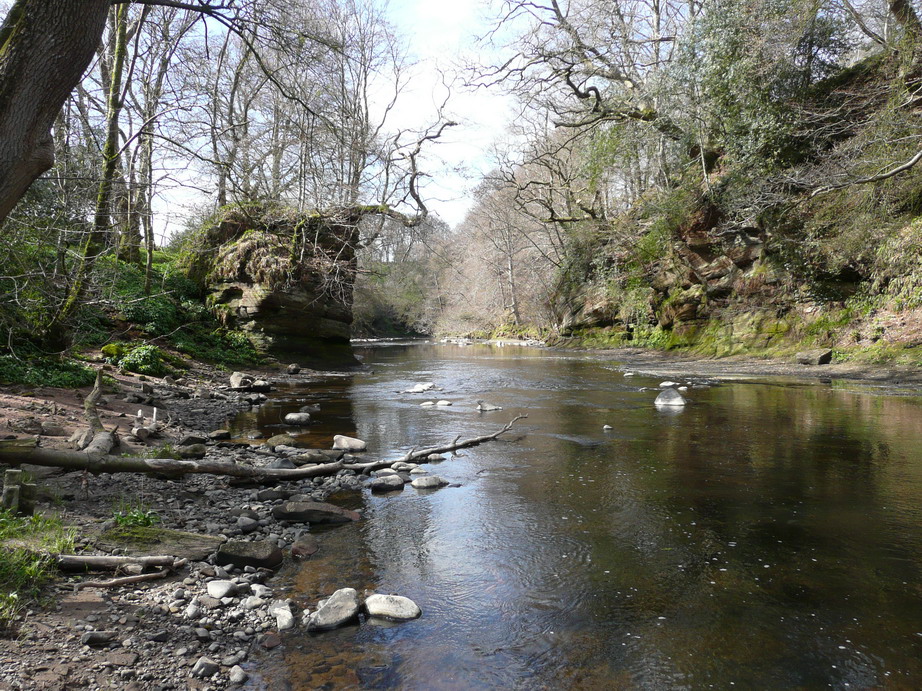
The Spanish vega from Caceres. Image: Derek Turner

New from the ever-exploring divine art label comes a collection of often sultry songs by a group of 20th-century Latin composers, beginning with a name that is, perhaps, not at all well-known: Fernando Obradors (1897-1945) a Catalan conductor who, in his relatively short life, does not seem to have strayed far from his native Barcelona.

Six of his short songs, from a large-scale collection – Canciones clásicas españolas – launch the CD, and we are at once in a world of captive hearts, “kisses as unaccountable as the number of hairs on my head”, passionate beating hearts, “rash and painful love”. This is music to mirror a landscape, a climate, a temperament, but also demonstrates the desire of a Spanish national – or nationalist? – composer to establish a lieder/songbook tradition for his country. However, without an equally passionate interpretation of the work, the stories distilled into these intriguing songs would probably not communicate quite as well. That is why we would do well to celebrate the CD’s artists, two US West Coast-based musicians: Esther Rayo, a dramatic soprano voice, accompanied by Sydney-born pianist, Peter Grunberg, who clearly holds the piano part here to be a voice in its own right. Sometimes shimmering, as if in the world of Ravel, or at other times with all the ease of a cabaret song, the piano emerges on this album as belonging to the centre of the stage.

Yet it is Esther Rayo’s voice which leads this CD of seduction – a voice known in the world of opera (Tosca and La Bohème in Italy) and sacred oratorio – an instrument able to switch between the sighs of the song, El majo celeso (“From the lovely person I’m falling for”) to the painful, fatal love of La maja dolorosa (The Sorrowful Woman) by Enrique Granados (1876-1916) – a composer fascinated by the Spain of Francisco Goya. A more modernist vitality informs the music of Xavier Montsalvatge (1912-2022) and two of the South American composers who are also featured on the album, Mexico’s Consuela Velazquez (1916-2005) and Argentina’s Alberto Ginastera (1916-1983) – the latter composer actually having heard the young Peter Grunberg toward the start of his career performing Gershwin’s Rhapsody in Blue.

The spirit of Spanish folk-poetry is again to the fore in six songs by Manuel de Falla, possibly the best-known of the composers featured here – a figure often spoken of in the same breath as Stravinsky, Ravel and Debussy, whose earthy ballet suites combine all the energy of The Rite of Spring, yet mixed with the dances and raw emotions of the rural folk of Iberia – at least, the folk who live in our and the composer’s imagination. This journey through a culture and people ends with the song from which the CD takes its name: Estrellita – Little Star – by Mexico’s Manuel Ponce (1883-1948) – in which the singer implores the light shining in the heavens to: “Come down and tell me if he loves me a little, because I cannot live without his love”.

I listened to these works and wrote this review as the snow settled in early January, the weather service announcing the movement of a “cold front across the country”. But closing one’s eyes and sinking into the warm hillsides and dusty village streets of Spain, Mexico, Argentina, it was as if music had the power to take me to another dimension. The CD, a firm recommendation.

Image: Derek Turner

Yet the cold front did come, musically, too, in the form of a release by Chandos Records of the Gothenburg Symphony Orchestra under the baton of Neeme Jarvi, summoning us on a sleigh ride to the cold Baltic/Nordic coastal areas of Einojuhani Rautavaara’s Cantus arcticus, written in 1972, and involving slow-moving clouds of orchestral sound, occasionally interrupted by the flight of flocks of birds – their calls, recorded, and played over the sound of the Gothenburg orchestra. The composer helpfully demarcates the score with headings such as: The Bog (Think of autumn and of Tchaikovsky) and Swans migrating. Rautavaara seems to bridge the time-span between the world of Sibelius and our own era, responding to the powerful imagery and sounds of Nature in a way which suggests the contemporary preoccupation with ecology, conservation, and an attempt – not to imitate birds – but to make them a living part of music.

Rautavaara’s drifting rhapsody and meditation, though, seems slightly out of place alongside the other two pieces presented by Chandos: the much more 19th-century-sounding ceremonial music of Hugo Alfvén’s Festpel (Festival Play) – all trumpets and courtly pride – and a score to historic derring-do at the time of the Thirty Years War, the Suite to a theatrical production from 1932 of Gustav II Adolf. A sense of national destiny flutters like a battle-standard throughout this telling of the story of the heroism and death of Sweden’s great monarch. The Gothenburg players rise to the occasion, with fervour and brassy pride – but also with some of the clouds and laments of men facing death the next day on the battlefield, but still able to fortify themselves with a tankard and a lively folk-dance.

With orchestral colour and a definite sense of place – and with a cover picture of Northern snows, migrating swans and forests of fire trees – no lover of rich orchestral music would want to be without this excellent Chandos recording.

CD details

Estrellita, Esther Rayo and Peter Grunberg, piano, divine art, ddx 21145

Alfvén, Festpel, Suite from Gustav II Adolf; Rautavaara, Cantus Arcticus, Gothenburg Symphony Orchestra, conducted by Neeme Jarvi. Chandos Super Audio CD: CHSA 5386

Musical winter warmers

Silver buckthorn under snow. Image: Derek Turner

Samuel Coleridge-Taylor, orchestral works, SOMM CD 0713

E.J. Moeran, Symphony and Violin Concerto, SOMM ARIADNE 5045

Arlene Sierra, Birds and Insects, BRIDGE 9599

Vaughan Williams, Mantegna, ALBCD067

Samuel Coleridge-Taylor (1875-1912) was a man of half-English and African descent, a composer in a monocultural Britain who was championed by those quintessential musical knights, Sirs Edward Elgar and Malcolm Sargent, and who was thought to represent a vital new generation in our cultural life. Yet Samuel died in poverty – and still in the prime of life. Who knows where his musical star might have guided us?

But on a new recording from the ever-adventurous SOMM label, we are able to savour an orchestral march – championed by Sir Henry Wood – that could easily slot in alongside Elgar’s famous contribution to the military oeuvre. In Coleridge-Taylor’s Ethiopia Saluting the Colours, we find – not a piece about mystical African Emperors, their cult and country’s ability to defeat European outsiders – but a touching story-in-music about a slave in the Carolinas – named Ethiopia – giving thanks to the Stars and Stripes, as flown by the Union Army in the latter stages of the American Civil War. Of course, there are many Southerners who have not forgotten the scorched earth policy of General Sherman as he ‘liberated’ the country known as Dixie, but historical controversies aside, listeners have the chance to savour Coleridge-Taylor’s semi-Elgarian style – not to mention the rich tone of the Ulster Orchestra, under the baton of Charles Peebles.

Other works on the disc also capture the Victorian-Edwardian period feel of the music, with Rebecca Murphy, soprano, the soloist in Zara’s Earrings, Op. 7 – A Moorish Ballad, with text by John Gibson Lockhart (Walter Scott’s son-in-law, and biographer). Ioana Petcu-Colan relishes the solo part the quarter-of-an-hour in length Ballade for Violin and Orchestra in D minor. A Brahmsian lyricism, but somehow sweeter than the original tones of the great Johannes, is never far from the surface. Lovers of the music of the English Musical Renascence will enjoy this collection enormously.

E.J. Moeran, who died during a storm on the coast of Eire in 1950, was a symphonist and tone-poem writer, able to establish an immediate atmosphere of landscape and folklore in his music. Of Irish descent, Moeran was born in England, and absorbed all the loneliness of the East Anglian coastal marshes and sands, earning the praise of fellow composer, Lowestoft-born Benjamin Britten. Yet despite Moeran’s Englishness of fen and meadow, and a beery period of mugs of ale and madrigals in the North-West Kent village of Eynsford with characterful composer, Peter Warlock, it was to an almost imaginary Ireland that E.J. – or ‘Jolly Jack’ – was drawn. His Violin Concerto, completed in 1938 and inspired by Kenmare Bay, seems to assemble every part of his character, and it is the one major work of Moeran which concert-programmers turn to on the rare occasions that the composer is even thought of these days. On a new CD from SOMM Recordings, founder and director, Siva Oke (with painstaking audio restoration from Lani Spahr) brings a 1946 live broadcast from St. Andrew’s Hall, Norwich, into the sound-world of 2025 – with the BBC Symphony Orchestra and soloist, Albert Sammons, conducted by Sir Adrian Boult.

Longer than the concerto by some 15 minutes, the CD also features the Symphony in G minor, a piece that is filled with lyricism and impetuous outbursts of energy – again, mirroring the composer’s stormy and unpredictable character. Those familiar with Bax’s Celtic twilight symphonic output will relish the Moeran, enjoying along the way the muscular playing of the BBC Symphony Orchestra of 1949 (again, under Boult) and a finale every bit as exciting as that found in Sibelius Fifth and Walton’s First symphonies.

Sarus Crane, Cornish Bantam, Thermometer Cricket, Lovely Fairywren – these are the magical titles of short pieces which comprise Books 1, 2 and 3 of Arlene Sierra’s collection devoted to Birds and Insects. A walk through a modern Natural History Museum, or a contemporary-music, natural-history sound-installation, Arlene’s music casts a strange spell – as if you were about to disappear into a fantasy of Nature. Arlene is an American composer, but London-based and has enjoyed many collaborations with leading orchestras in Britain, Japan and America. Although very much her own, distinctive, modern yet approachable style, the music seems to stand alongside similar evocations of birds by, for example, Messiaen or Ravel; and a feeling created for the listener, very much like the Japanese composer, Takemitsu, in A Flock Descends into the Pentagonal Garden. As complex and miraculous as the delicate bodies of the creatures it represents – the music wafts from the trees, canopies and cover of the forests and woods where its inspirations live their lives. In the hands of pianists Steven Beck and Sarah Cahill, I can think of no better album of contemporary music this wintertime.

Finally, great hymn tunes abound in a CD from Albion Records – Mantegna – so named because of the 15th-century artist, painter of The Agony in the Garden. The atmosphere of Passiontide and Gethsemane is very much to the fore, in Vaughan Williams’s setting of Sidney Lanier – an American author and poet who served in the Confederate Army in the Civil War: “Into the woods my master went,/Clean forspent, forspent;/Into the woods my master came,/Forspent with love and shame… ‘Twas on the tree they slew him, last,/When out of the woods he came.’

All People That on Earth Do Dwell (the ‘Old Hundredth’) – RVW’s famous arrangement, used at the Coronation of Elizabeth II – and the tune King’s Lynn make for inspiring listening, with the words of G.K. Chesterton: “O God of earth and altar,/Bow down and hear our cry,/Our earthly rules falter,/Our people drift and die…’ Although the son of a Gloucestershire clergyman, Vaughan Williams – though inspired by Christian culture and belief – remained an English agnostic for all his days, yet even in his deep, harmonic hymnody, misty mornings near coastal East of England churches, the Norfolk Rhapsodies and the horizons of Wenlock Edge are never far away. William Vann, the Dulwich Choral Society and the London Mozart Players (the ensemble due to open the 2026 English Music Festival) give a full-bodied and well-recorded performance.

A tale of three cities

A house on the Appian Way


The 2025 season of the BBC Proms was in its final furlong on Sunday 7th September, with an 11am performance of three highly descriptive works from the early part of the 20th-century – Respighi’s ‘Technicolor’ 1924 description of the Eternal City, The Pines of Rome (sun-drenched, but with a perfumed nocturne at its heart), Milhaud’s jazzy and wine-overflowing Le Boeuf sur le Toit, and the immediate pre-Great War London Symphony by Ralph Vaughan Williams.
All connected by the theme of great cities, each work was given a velvety performance by the ever-euphonious, silky-toned Royal Philharmonic Orchestra (but with additional antiphonal brass to set those Roman Legions marching in the Respighi). And relishing the writing of each musical postcard was the RPO’s conductor, St. Petersburg-born-and-educated, Vasily Petrenko, an expressive, energetic conductor of the younger generation.
Ottorino Respighi was the greatest film-score composer — who never wrote for the movies! He should have really been there for those great directors of the past, with their Xanadu grandeur and appetites for the mass-drama of the ancient world, but instead his epic scores accompany the picture-house of the mind: the rush and swirl of a heady city, full of the dust of the past, as children’s games in the park open his Roman pines holiday.

The Stravinsky-like opening, with its dainty little fanfares and marches, builds to a brazen crescendo — and suddenly the audience is plunged into a sepulchral atmosphere of ruins, remains, skulls, catacombs; and like an incantation from Roman worship, with seers and soothsayers never far away, the movement slowly lurches forward like a procession of colour plates from a history-book, come to life. The warmer, sensuous sounds of the night then waft into the score in The Pines of the Janiculum Hill, switching the panorama to one of soothing, delicate ultra-romanticism — the sweetness of the warm darkness crowned by a recording of a nightingale’s song played over the loving woodwind and strings. Respighi was right: not even a composer or first-class orchestra could imitate the such a bird.
Finally, a theme of some disquiet begins to rise and rumble on the horizon of the Via Appia — the occasional glint of sun on a shield, the faint sense of Legions’ standards coming into view. With batteries of brass and percussion standing by, the RPO made the slow, yet unmistakably glorious march to the capital of one of the world’s great empires, before the full weight of dazzling orchestral sound — reinforced by the hundreds-strong pipes of the Royal Albert Hall organ — brought Pini di Roma to its blazing finale.

Josephine Baker, by Paul Colin. 1930

Mid-20th-century Gallic wit, insouciance, even surrealism is the heady cocktail for Darius Milhaud’s Le Boeuf sur Le Toit — the jazz-age scena (with orchestral, rather human voices) which sparkles on the dance-floor of a nightclub named, bizarrely, ‘The Ox on the Roof’. This is carnival time, 1919, in a fictitious bar, a ballet of weird characters tapping their feet in time to jazzy tunes and dancing the night away — although a night-spot did open in Paris, using this very name, and they made the bon viveur Milhaud a member. Even though our Proms performance was nearing noon, the Royal Philharmonic made us all feel as though we were in a late-night, Bogart-type bar, with the Gitanes-smoke smouldering in the dark corners and the hedonists relishing every syncopated note on the dance-floor.

Ralph Vaughan Williams in 1917


When the English composer, Ralph Vaughan Williams takes an audience to a place — whether a lark ascending over the downland, or the oceans of A Sea Symphony — you can bet that there is more to it than just a portrait coloured in by an orchestra. The lark soars to an unknown region, or you steer, not for the deep waters of the mid-Atlantic, but navigate around your own deepest thoughts in the dark night of the soul. In the composer’s A London Symphony, written just before the Great War, we find ourselves seeing through the clearing of the morning mist, just like Wordsworth’s vision of the city from Westminster Bridge — or in the elegiac nocturne, the autumn leaves in Bloomsbury Square. But it is, too, a city of dreadful night — music which in its final movement Betjeman chose to accompany his 1977 television poetry anthology, but using the music for scenes of the stark grandeur of wintry hills, rather than the town: a sense of the life-cycle of the year — of us all — meeting the maker of our being.
Maestro Petrenko felt every pulse of this most English journey, bringing forth playing of nervy beauty in what is a complex, enigmatic, deep-water score. The finale, inspired by a passage from H.G. Wells’s novel, Tono-Bungay, depicts a vessel sailing by night along London’s river, to the Thames estuary and open sea… “London passes, England passes… all the old certainties glide astern…” — and here, the RPO’s woodwind and sepia strings conjured a Time Machine feel of dates, time, reality, all dissolving and meaningless as the city fades into a memory.
A Proms concert that won’t be easily forgotten, in this, my 44th year at these concerts.

Call of duty

Duty of Care 

Directed by Asa Bailey, co-written by Asa Bailey and Jack Marsden, starring Bruce Jones and Jack Marsden

In the world of film and cinema today, it is something of a relief to find, not just a story without improbable car chases through Los Angeles, AI-generated explosions or extreme-weather calamities, but which centres itself upon the quiet north Wales town of Llandudno and the lives of two men: army veteran, Major Harris, and his carer, Gary.

It is the kind of film at which our country excels – slow-burn, minimalist drama, set against the background of ordinariness – the result being the sense of an even more acute build-up of tension than one would find in any blockbuster. It is a simple enough idea: the retired soldier, looking back on a life of action, but unable to adjust completely to the banality of everyday life, coming into contact and conflict with the equally tedious world of care and social services. Gary (played by BAFTA winner, Jack Marsden*) – volunteer carer, dressed in casual clothes – knocks at the Major’s door, and at once there are the unmistakeable signs of an impending personality and culture clash. Gary seems domesticated enough and willing to help, but Harris is accustomed to his own household rituals and his emotional short-fuse (the result of his war-experiences) leads to a grand bust-up.

Jack Marsden

Taking the role of Major Harris is the well-known Coronation Street star, Bruce Jones, who brings something of the all-in-a-day weariness of a ‘soap’ character to the story. And yet, because of the pauses, the silences, the sense of brooding, anxiety, misery in the Major, the viewer is given far more than a low-budget film with an efficient, half-hour TV script. Jones’s performance is worthy of the highest accolades – and this is because he is completely believable in his role, so much so, that you – the viewer – may find yourself wanting to reach out and help him.

And it is Gary, the casual care-worker – a man who resides in a mobile home – who doesn’t even know his next step in life, who wants to give Harris the assistance he clearly needs. Rejected, though, and ordered out by the old soldier, Gary seems to pass from the story. A new carer arrives, a cheerful-enough girl (played by Sophie Anderson), this time, wearing a uniform; more what you would expect a care-assistant to look like, but it is soon clear that she, too, is just drifting in our modern Britain. Gary, meanwhile, breathless and in disarray, and unable to find any other work, tries to cling to his identity: ‘I’m Gary, I’m Gary,’ he says – as if trying to prevent himself from tipping into complete despair. Yet at this point, we discover something of his own identity: he, like Harris, has a past, but one which he hardly talks about and acknowledges to himself only in moments of extreme emotion.

Bruce Jones and Jack Marsden

The film, recalls Jack Marsden, was first premiered in Liverpool, in the presence of HM Lord Lieutenant of Liverpool – to a standing ovation, with many ex-servicemen in the audience clearly profoundly moved by the screenplay. Jack also notes the role played by Anthony H. Wilson of Factory Records, the founder of a Manchester-based charity concerned with suicide among men; and it was Anthony’s wide knowledge of this problem which helped Jack to shape his on-screen character.

Jack had also worked with Bruce Jones, prior to Duty of Care, on Ken Loach’s Cannes award-winner, Raining Stones; and it was with great pride that all those involved with the new film received the praise and endorsement of the senior filmmaker. Yet it is also the town of Llandudno that stars in Asa and Jack’s compelling work: a place, perhaps, of sleepy anonymity, where Major Harris and Gary spend so many of their hours looking out to sea, churning over the past and wondering what the future holds…

*Jack Marsden, BAFTA award-winner for his role as PC Rylance in The Cops

From searing symphony to Paradise Garden

Friday 23 May 2025 marked the beginning of the eighteenth English Music Festival, a much-looked-forward-to annual event in the classical calendar and a testimony to the considerable organisational and fundraising skills of its founding director, Mrs. Em Marshall-Luck. Despite receiving no support from the Arts Council of England, no help from the ‘Department of Culture, Media and Sport’ and no visit or encouragement from Government ministers (either Labour or Conservative – save for one brief appearance by Boris Johnson in the early days), the Festival has managed to galvanise a loyal following of supporters, benefactors and artists – thus ensuring the continuation, not just of the main four-day event, but a host of other concerts, events and recording initiatives.  A lesson in self-reliance and self-belief, the EMF must be considered as one of the most remarkable events of its kind – not least because of its presentation of a forgotten part of our national musical heritage.

Usually when one thinks of an English music concert, works such as Elgar’s ‘Enigma Variations’ or Vaughan Williams’s The Lark Ascending come to mind, and many such prominent works are indeed to be found in the Festival’s programmes. But what distinguishes the EMF is its patient work – hours spent in archives and in tracking down lost scores – reconstructing a lost world of English music. Thanks to the musicological detective work of figures such as Martin Yates, the conductor of the opening-night’s concert, audiences are taken way beyond the usual boundaries.

Stanley Bate

This year, we were treated to the enigma and variations of Stanley Bate’s Second Symphony – Bate, a pupil of Vaughan Williams and the German composer, Hindemith, yet who has been practically forgotten by the musical establishment in this country. The presentation of his searing four-movement symphony from the late 1930s amounted to a posthumous world-premiere for a potentially great but tortured figure, who died tragically before his time. It also brought home to the audience (and performers) just how avant-garde English composers could be – resetting our idea of our native music, as something that could be as Shostakovichian as pastoral or romantic.

Bate’s work had some radiant moments within its taut structure, like an exhalation of breath amid the angst, but on the whole, some of the febrile nature (and phraseology) reminiscent of Vaughan Williams’s Fourth Symphony made it a muscular, physical, challenging – even shattering – musical experience. The beginning of the last movement brought to mind the stretched tonality and astringent string writing of Britten’s Variations on a Theme of Frank Bridge, making the piece very much the province (you would have thought) of BBC Symphony Orchestra repertoire, those specialists of 20th century music. But I doubt that any ensemble could have rivalled the faultless, totally-committed rendition given at Dorchester by the BBC Concert Orchestra – musicians who seem to have the gift of versatility, allowing them to roam from show music to popular classics, and the pinnacles of British music of the last century.

William Alwyn

Alongside the Stanley Bate, the BBC CO gave us an injection of springtime energy, in the form of William Alwyn’s The Innumerable DanceAn English Overture. This was a vision of sensuality and radiance, every bit as transcendental as a Wagnerian Tristan and Isolde. It was followed by Delius’s well-known The Walk to the Paradise Garden, although the setting is Switzerland rather than our own land. The rich, expansive acoustic of Dorchester Abbey, full of reverberation and ‘air’ was just right for the Delius, as it was indeed for the Heroic Elegy and Triumphal Epilogue, an early work (1901) by Vaughan Williams, the monumental conclusion of which included the magisterial tones of the Abbey’s organ, ringing out over and through the orchestra.

The Festival paid tribute to Sir Arthur Bliss, in this the 50th anniversary year of his death, with another exceptional interpretation, the Cello Concerto of 1970, a piece premiered at the Aldeburgh Festival under the baton of Benjamin Britten. Originally written for the Russian cellist Rostropovich, the Dorchester performance was given by one of the greats of our own era, Raphael Wallfisch, who brought this neglected, fine and fluent score to life. Having performed Finzi’s Cello Concerto at the Festival some ten years ago, Wallfisch has the full measure of English music – bringing a warmth, detail, spirit and true authority to another part of England’s music that has tended to languish in a backwater. Sitting as I was on the second row, I found myself admiring the chamber-like detail of the cello playing, the soloist given a full spotlight of sound, thanks to the sensitive accompaniment of Martin Yates and the BBC Concert Orchestra.

Rupert Marshall-Luck and Peter Cartwright
Image: Stuart Millson

The next day at the Festival’s Saturday morning recital, the official chamber players took centre-stage – violinist, Rupert Marshall-Luck and pianist, Peter Cartwright, a powerful partnership dedicated (again) to works and composers who have become distant to us. First was Norman O’Neill’s (1875-1934) Suite in B minor for Violin and Piano, and then Alan Rawsthorne’ s 1933-34 Violin Sonata. Rawsthorne attained fame as a film composer in the 1940s and ‘50s, but his Violin Sonata is little known. In fact, the recitalists were giving the first public performance of the work in the United Kingdom. Both violinist and pianist were as skilled in delivering the foot-tapping finale to the Rawsthorne, as they were in the gentler, dreamier lines of Delius’s Sonata in B major and the Cradle Song by Herbert Howells (the latter, another premiere, thanks to the determination of the EMF) – confirming them as two of our country’s very finest performers and advocates of English chamber music.

From the Fens to Ayrshire – and Stravinsky’s dark times

The Lugar, by David Johnston. Image: Wikimedia Commons

Composers are not necessarily good conductors of their own works — too fussy, sometimes, or just without the conducting charisma of a professional baton-wielder, more accustomed to the stage and the adulation of an audience. Not so in the case of composer-conductor, Sir James MacMillan, a native of Scotland whose musical outlook and versatility brought such intense playing from the BBC National Orchestra of Wales in that most English of works, Vaughan Williams’s early-20th century symphonic impression, In the Fen Country

Sir James — who as we were to find out in his new euphonium score later in the programme — has a natural feel for music which puts man in his place in the midst of a landscape where remoteness and the movements of cloud banks and sunlight over water allow your mind to wander fantastically. So the Vaughan Williams unfolded, carrying us far from Swansea’s Brangwyn Hall, like a fen-tale recounted by a local on a warm May evening (which indeed this was) — orchestra and conductor carefully finding all the threads and patterns of the lonely land so beloved by Vaughan Williams.

A similar ‘genetic heritage’ flowed into Sir James’s Where the Lugar meets the Glaisnock, a picture of the confluence of two Ayrshire rivers — part tone-poem, part euphonium concerto. Seldom has this bold solo brass instrument sounded so subtle and ‘at one’ with the soft magic of strings – the writing for the latter section of the orchestra suggesting the half-light melancholia of Vaughan Williams, but through a twenty-first century prism. At one point in the score, I picked up in MacMillan’s Ayrshire filaments of sound from distant Estonia, where a passage brought to mind the mystical, frozen-in-time style of composer, Arvo Pärt. Our solo euphonium player, David Childs, certainly gave a thrilling performance of what was a successful, deeply meaningful MacMillan world-premiere.

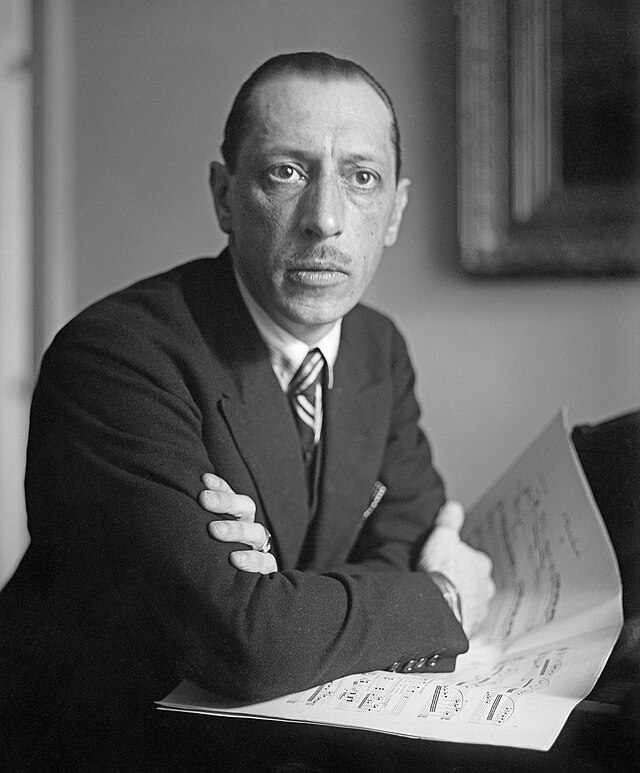
Igor Stravinsky

Thoughts of war (for Stravinsky, the stark image of goose-stepping machine-armies) were never far away in the composer’s emphatic, barbed, relentless Symphony in Three Movements, although the unsettling whirl of world events dispels quite uncannily in a surprising, eccentric, but warm and friendly little gavotte-like dawdle in the second movement — as if Pulcinella or Petrushka were never far away. The orchestra’s woodwind and brass produced pinpoint ‘Technicolor’ virtuosity — qualities which were centre-stage, too, in the shortish diversion (though with a clever, inventive sharpness) that is Stravinsky’s Symphonies of Wind Instruments.

The concert began with another compact and engaging mini-masterpiece, by Vaughan Williams’s composer-colleague, folk-song collector, and walking, hiking, inn-visiting friend, Gustav Holst — his Capriccio, a short work for full orchestra, with some magisterial trombone writing (Holst’s own instrument) and a foot-tapping march right in the middle of it. Yet the work seems to begin in Vaughan Williams’s fen and marsh, or the Ayrshire of MacMillan, another mysterious signpost of the continuum element in the music of these islands.

Boisterous banshees, and ghosts of war

Way back in orchestral history, at the 1971 Proms, a modest-sized broadcasting orchestra appeared at the Royal Albert Hall for the first time. An ensemble of some 40 players, the (then) BBC Welsh Orchestra performed smaller-scale works by Haydn, Mozart, Stravinsky and Brahms under the baton of the American conductor, Irwin Hoffman — who, incidentally, as a US serviceman, had been stationed in Britain. In a radio interview, Hoffman talked about the sense of occasion felt by the orchestral players, transported from their Cardiff studio duties to the international stage of the Royal Albert Hall — sentiments which might come as a surprise to concertgoers, today, accustomed to the work, international scope and remit of the c. 80-strong BBC National Orchestra of Wales.

From their modern performance centre, BBC Hoddinott Hall at Cardiff Bay (the larger St. David’s Hall in the city, opened in 1982, remains — curiously — closed and crumbling) the Welsh national orchestra plays for a dazzling array of international conductors. The trend started with Mariss Jansons in 1992 (with Richard Strauss’s massive Alpine Symphony) to Tadaaki Otaka, the Japanese maestro who loved and performed Elgar and attained laureate status with the musicians.

At Aberystwyth Arts Centre on the night of the 13th March (touring is a major priority of the orchestra) Christoph König presided over a programme of four intriguing divertissements for orchestra – Ravel’s Great War homage to lost friends and artists, Le Tombeau de Couperin, Anna Clyne’s modern saxophone fantasy on a theme of the banshee, Grasslands, Louise Farrenc’s boisterous, if uninterestingly-named ‘Second Overture,’ and Shostakovich’s Symphony No. 9 — the complete opposite in scale to his 7th, 1941’s ‘The Leningrad.’

A detailed delicacy of tone, especially in the woodwind section, made Ravel’s homage to an older France sound particularly tender and nostalgic. Yet the players switched effortlessly to a different scale of sound in the spikes and sparks of Anna Clyne’s banshee world, Grasslands, complete with an exciting pizzicato chase in the last movement — foreshadowing the Shostakovich 9th that ended the second half. The brilliant saxophonist, Jess Gillam, almost co-led the orchestra in this weird phantasmagoria — striding on with a complete stage-presence, notwithstanding her pink suit and blue spectacles. However, another player had a chance to shine in the concerto, the overlooked double-bassist, who had a mysterious little accompaniment to perform alongside Jess’s saxophonic highs – a moment of real atmosphere.

A sardonic march, a cheeky fizzing curtain-raiser to an odd sort of symphony, is what the first movement of Shostakovich 9 is all about — a far cry from the tense, tortured spans of the Stalin-shadowed 5th and 7th. Here, the BBC National Orchestra of Wales and their (batonless) conductor found much to enjoy — and full marks, of course, to leader, Lesley Hatfield and the ice-cold violin tingle achieved in her sinister-sounding mini-solo of the march theme. Even with such a divertissement of a symphony, Shostakovich still managed to create that hypnotic feel (which you find in the ‘Leningrad’ or in the 11th) in his slow movement — before the unsettling, quixotic torrents of the work reach their exciting finale. 

At Aberystwyth, the orchestra fielded c. 60 players, just right for the dimensions of the Arts Centre, and an audience of some 300. In this era of cuts to arts funding (even within the BBC) it is vital to maintain visits and tours to places which are a little off the usual orchestral beaten track. Perhaps the orchestra might consider going even further afield – deploying a detachment of string players to the Theatr Mwldan, Cardigan, for example – or chamber groups drawn from the various sections, to visit churches or village halls, or best of all, schools, in which classical music is desperately needed but often utterly absent.

Such considerations aside, the Aberystwyth concert was a good night for orchestra and audience, alike. Concertgoers in Wales are truly fortunate to have these inheritors of Irwin Hoffman’s BBC Welsh Orchestra.

Pilgrimage to the peninsula

Image: Stuart Millson

Born in London sixty years ago and although, as far as I know, possessing not a drop of Welsh blood, I now live in the country to the west of the River Severn, popularly known for its chapels, presided over by Kenneth Griffith-like ministers, its famous rugby players and opera-singers born in obscure green valleys (obscure, at least, to the English), its rousing songs, hymns and tunes: Men of Harlech, David of the White Rock, Cwm Rhondda – music and people, you might say, bred of heaven.

Throughout my life, my homes have been in England – in London, suburban, increasingly Greater-Londonish Kent, rural Kent, besieged by the planners; marshy Essex and hilly Gloucestershire – and I developed interests in English music, English pints and pubs, pilgrimages to Canterbury and Romney Marsh churches and bird sanctuaries (all some 300 miles away from Wales). Yet today, living in Cambria, it feels as though a Welsh moss, or ivy has entwined itself around my legs, rooting me to the spot – with late-night fog and early-morning mist blotting out any sight of the tips of the Severn suspension bridge, obscuring the entrance to the Severn Tunnel, and making me forget about my previous haunts, routines, and once-loved favourite places. What caused all this? What brought me here?

Thinking back, long-ago family holidays to Tenby or Aberdovey might have sown the seeds for the Welsh enthusiasm. Or perhaps it was the evocative section on Wales from our family’s 1970s’ AA Illustrated Guide to Britain (“the land of Merlin the Wizard and Dylan the Poet”). Or maybe it was the drive, undertaken with the girlfriend I would later marry, on a spring weekend in 1988 to Carmarthenshire and Cardiganshire? The trip, even in those younger days when you are meant to have a surfeit of energy, felt like an act of escape from work and everyday life – the return journey spent, inevitably, on those ‘grass is greener’ thoughts, so common to travellers, deep down, ill at ease with some aspect of life. So maybe that explains it all: the vague, formless urge to escape – with only the ‘Celtic fringe’ of the British Isles, less congested by the knotty, breathless way of life everywhere else, now capable of offering retreat?

Part of the pilgrimage path. Image: Stuart Millson

All of these thoughts and memories – why and how have I landed here? – and isn’t it a miracle – jangled together, as I set off at the very end of February from home in Carmarthenshire to the City of St. David’s (the smallest city in Britain) for the 1st March St David’s Day pilgrimage to the cathedral, in its wide valley hollow, at the tip of a Pembrokeshire peninsula. According to Welsh hagiography, the sixth-century future Patron Saint of Wales, Dewi Sant was born in a thunderstorm by the clifftop – his mother, St. Non, giving birth on an apocalyptic night, where, miraculously, a well appeared, which continues flowing to this day, to bring forth legendarily life-giving, health-giving waters, considered particularly efficacious for sore eyes, or more serious ocular conditions. Several of the pilgrims gathering for this year’s St. David’s Day ceremony did, in fact, dab their eyelids with well-water – just prior to the Bishop of St. David’s, Dorrien Davies, almost re-baptising the throng (including a Catholic delegation from Kent and pilgrims from Ireland) using a bunch of watercress soaked in a full jug drawn from the well.

It was a simultaneously serious and light-hearted ceremony. Watercress was the thin, subsistence food used by St. David and his followers during periods of fasting. Today, as well as proving effective in the dousing of pilgrims, it also plays a part in a nightly ceremony (reinforced with port and Davidstow cheese!) initiated by the Order of St. David and St. Non. For more than a decade now, the Order (founded by the late Simon Evans and now presided over by one, Steve Turner, from Kent – but with, he tells me, a Welsh grandmother to his genetic credit) has participated in the annual ceremony. This year the Order brought to the altar not just its devotees, but an offering for the cathedral – a substantial cheque to help with urgent repair works to the ceiling of the Quire. It was noticeable that the cathedral bells were not chiming on St. David’s Day morning, no doubt a precaution at this time of crumbling roof masonry. Prayers were said for a swift restoration to the problem; and in a purely spoken service, held at 4pm on the eve of St. David’s Day, other more personal prayers – for family, loved ones, peace in our troubled world etc., – written on small sheets of paper, each imprinted with the emblem of St. James’s pilgrimage shell and left on a silver plate, were unfolded and read aloud.

A glow of early springtime sunshine filled the cathedral – wide, broad, crystal-clear light, all of a sudden, no longer the mean, cramped, cold rays of winter. It really did feel, especially with the daffodils in the cathedral grounds as golden as the cross of St. David, as if the seasons had changed before our eyes. And the sea, viewed from the clifftop at St. Non’s well, sparkled in the westering sun, but had all the stillness of well-water. Earlier, en route to the cathedral, not far from Fishguard, a bank of white cloud, far out at sea, resembled the gigantic cliffs of a lost landmass. I imagined the probable reaction of mediaeval pilgrims to such a sight – a miracle on the horizon, people pausing, fingers pointing at a sign of God’s grandeur.

The Bishop and Dean of St David’s, and the Mayor of the city, addressing the pilgrims. Image@ Stuart Millson

The 1st March is a great moment in the life of the small city – a place probably not a great deal larger than my old town of West Malling in Kent – but ennobled and important, far beyond its physical size, by its heritage of Celtic Christianity; by the cathedral cradled in its valley, and overlooked by what appears to be the strange, craggy tip of an extinct volcano. No city should ever be allowed to be larger than St. Davids. The streets, filled with pilgrims, or visitors who just happened to be on holiday on the day of the devotions – folk dressed in historic costume – children parading with dragons and (later in the day) a band evoking a Mardi Gras procession in Louisiana – the Bishop, Dean and Mayor at the Market Cross addressing the citizens, as the breeze caught the large Red Dragon flag of Wales – everything felt right, in its place.

It is important to come away from a pilgrimage with that ‘God’s-in-His-heaven’ feeling.

Contemporary classics

Harvesting on the Sussex Downs, by John Charles Dollman.
Image: Wikimedia Commons

Part of the pleasure (or occasionally, the necessary discomfort) of reviewing music, is to find unfamiliar works and composers – in genres, perhaps, not entirely to your taste – and embarking upon a process of self-training – dismissing your prejudices, trying to clear your mind and hearing the music as if it is the first music you have ever heard. Of course, the exercise is nearly impossible, but there are occasions when you genuinely begin to find an attraction to something that, hitherto, you might never have listened to.

The first such CD in this month’s review pile fits into the latter category: the chamber music of Justin Connolly (1933-2020) – an overlooked figure even in the realm of contemporary music, who, in the late-1950s came under the wing of Roberto Gerhard (composer of the choral-orchestral The Plague) and symphonist, Peter Racine Fricker.

Connolly, who became a teacher in his own right, developed what could be described as an astringent, even hard style, something which can be found and felt in a three-movement String Trio (Op. 43) – a work which might complement a Britten String Quartet, or the quartet by Stephen Matthews (a tonality-challenging work given some years ago at the English Music Festival).

Yet there is much light and shade in the score, and it would be fair to say that Connolly, like Britten, in his quest for a pure form of music, did not turn his back entirely on folklore. In Ceilidh, Op. 29, written with younger musicians in mind and performed in the US during the country’s bicentennial celebrations, the composer retains his customary ‘gimlet focus’ on technicality, but hints at an old-world atmosphere with movement titles such as, Gathering, Dordfiansa (spear-clashing dance), Night, and Four-hand reel. Recorded in venues as various as the Royal Academy of Music and the studios of the Australian Broadcasting Company, Melbourne, the passionate devotee of contemporary music and audio perfection will find the Justin Connolly collection essential listening.

Another contemporary-music CD – Distant Voices, New Worlds, Songs, Landscape and Histories – brings together the Sky Rhythms of Ed Hughes, Shirley J. Thompson’s Hymn to the Evening, Evelyn Ficarra’s What Larks, and Rowland Sutherland’s Modes from the Downs (the latter two pieces, both written three years ago).  In Sky Rhythms, Ed Hughes adapts words taken from the Mass Observation Archive Day Survey, from 1937 – an interesting and involving weaving together of everyday thoughts, worries concerning the world situation, and an evocation of Sussex – of England. Here are some extracts (the words of one, Mary Robinson):

I live in a seaside bungalow town, in a furnished bungalow,

Very small and draughty,

but fortunately,

looking out across open fields and country

to the South Downs…

… To the news’ agents

Daily Herald Placard

Stalin might do something to make our bread dearer

Further depressed by news in paper

which hopes that England will not let France down…

… The air is splendid,

we get whatever sunshine is going,

and witness superb skyscapes,

Felpham, where Blake lived, is near…’

A modern ‘Lark Ascending,’ a contemporary ‘Land of Lost Content,’ a ‘Paradise Postponed,’ or the paintings of John or Paul Nash, Evelyn Mary Dunbar, John Piper, Eric Ravilious – all of these thoughts and associations came into my mind in this strongly modern setting, which includes electric guitar, as well as flute and clarinet. Expertly performed, this production by Sussex musicians (ensembles, The New Music Players, The Orchestra of Sound and Light) shows that the landscape inspiration in our artistic DNA is unbroken.

A mellow tonality of summer warmth and wandering can be enjoyed in Shirley J. Thompson’s An Hymn to the Evening (a setting of Phillis Wheatley, from the eighteenth century) and in Matthew Sheeran’s Languet Anima, in which echoes of fourteenth-century music gently appear and drift for an all-too-brief three minutes — a piece reminiscent of modern orchestral settings of Byrd or Dowland.

Finally, to the music of Arthur Butterworth (1923-2014), a one-time player in the Hallé Orchestra (incidentally, his signature appeared, alongside that of his orchestral colleagues on the score of Vaughan Williams’s Eighth Symphony – premiered by Manchester’s great orchestra) – but he went on, not in the orchestral ranks, but to forge a career as a composer.

Windy Hill, on the Pennine Way. Image: Jooniur, Wikimedia Commons

Not for Butterworth, though, the challenges of atonality, the abandonment of convention by the brave, new ‘Manchester School’ of Maxwell Davies, Goehr and Birtwistle. In Butterworth, we are taken by the hand, rucksacks on our backs – as if by a musical Wainwright – to the peaks and tarns of the North, in a rhapsodic, but never sweet or self-consciously nostalgic survey of sky, rock, scrubby path, rainfall, tufts of moorland grass vibrating in the wind, and eerie, supernatural forest shadows. The Fifth Symphony from 2001-2; Three Nocturnes, Northern Summer Nights; The Quiet Tarn; The Green Wind – the listener will revel in the Sibelius-like passage of clouds, the full use of the late-romantic orchestra (with some gorgeous harp moments) and a sense of escapism, dreamy altitudes, and communing with Nature. As Butterworth proves, not all contemporary music has to conform to one standard. And as the South Downs composers also reveal, modernism need not be removed from a wider audience.

CD details: Justin Connolly, Music for Strings (plus…), metier label, mex 77209; Distant Voices, New Worlds, metier, mex 77131; Arthur Butterworth, Symphony No. 5 etc, Dutton Epoch, CDLX 7253. Royal Scottish National Orchestra conducted by the composer

“The dawn’s early light” – American classical for today

October in the Catskills, Sanford Robinson Gifford, 1880

Kenneth Fuchs is Professor of Music Composition at the University of Connecticut. Born in 1956, Fuchs belongs to a generation of modern composers who, whilst creating a sound-world clearly of our time, have partially turned their backs on earlier avant-garde trends, in favour of symphonic music that is optimistic, open, communicative, cohesive and completely accessible to a wide audience — an important consideration in these times of dwindling arts funding and an audience that is not getting any younger. 

Inspired by a painting by his compatriot, Morris Louis — and entitled Point of Tranquility — Fuchs’s work of the same name is a mind-clearing, subtly dazzling eleven-minute tone-poem of sudden, shimmering sunlight. There is a sense of a sea dancing beneath silvery horizons, of new pages turning in life — or even a return to old haunts, refreshed and renewed after a long period of absence. A masterly deployment of orchestral colour, the Buffalo Philharmonic and their conductor, JoAnn Falletta, set us on course for an album that gives us a further three revelatory scores.

Next comes Russell Platt’s Symphony in Three Movements, inspired again by an artist — this time, Clyfford Still (1904-80), creator of what has been described as “dramatically jagged colour fields” and “abstract expressionism.” This work is the most modern item on the CD, with an outdoor, breath-of-fresh-air tonality sharing the orchestral platform with more dissonant forms, and showing in that exciting brew the tremendous virtuosity and flexibility of the Buffalo orchestra, which emerges here as a top-flight US ensemble. (Why haven’t they been invited to the Proms? Why do we never hear them on BBC Radio 3?)

However — for me — the most intoxicating work on the recording is the Oboe Concerto by Randall Svane (born 1955, although the CD notes list his birth-date as 1972). As a lover of Vaughan Williams’s 1944 Oboe Concerto, I was anxious to hear Randall’s piece — a classic example of new Americana. A composer of church music and late-Romantic symphonic works, with distant echoes of Roy Harris, Samuel Barber or the melodious Howard Hanson, the new concerto begins in a pastoral dream: a long, languid span — a haze — of bittersweet reflection; similar in pace to the opening of Walton’s Viola Concerto. The oboe soloist (in this case the Buffalo Philharmonic’s principal, Henry Ward) clearly believes in the work with all his heart, and hearing this gently-questing, passionate piece makes you believe that a new Vaughan Williams is at work in the world. The three movements are entitled: ‘Flowing,’ ‘Very slow,’ and ‘Quick and light.’ Notice the simple titles, no arcane or technical musical notation, just names that provide an easy guide for listeners, particularly newcomers to classical music.

The album concludes with Chinese-American composer, Wang Jie’s orchestral tour de force, The Winter that United Us — a brilliant Stravinsky-like orchestral showpiece, culminating in a broad, noble, hopeful finale; showing the listener that music can help us to overcome the shadows that pass over our world — in this instance, the Covid pandemic and the suffering and anxiety that forced all of humanity to face up to a common crisis.

Recorded at the Kleinhans Music Hall and superbly recorded by sound-engineer, Bernd Gottinger, I have no hesitation in recommending this collection.

CD details: Contemporary Landscapes, Beau Fleuve Records, 605996-998593. bpo.org