The Testified and Witnessed Ballad of the Truly Risen Elvis Aaron Presley

MICHAEL YOST is a poet and essayist living in rural New Hampshire with his wife and children. His essays and poems have been published in places like Modern Age, First Things, The University Bookman, Dappled Things, The Brazen Head, and others. He substacks at The Weight of Form.

The Testified and Witnessed Ballad of the Truly Risen Elvis Aaron Presley (As Reported in World News Weekly)

He rises from the purple sheen

    And velvet of his box

His sequined vest aquamarine

    Pomade spread in his locks,


His face unaged, bright red with youth

    As an immortal god.

He’s risen! This I know for truth

    (Although it may seem odd.)


He rocks death’s jailhouse even now,

    From Graceland, where he waits,

To play his last, and take a bow,

    Before the mighty fates.


For when Amurka’s own true king,

    Begins to gyre his pelvis

The juke-box joints will leap and sing

   “Salvation comes from Elvis.”


His golden buckle girding on,

    Likewise his golden shades

The King has come in bronze and brawn

   As our world’s music fades.


And after Armageddon, all

    Will be Banana-Bacon-

Peanut-Butter Sammich. All

     The lost, unloved, forsaken


He’ll shower with amphetamines,

    Cake, Coca-Cola, Jam,

Butabarbital, morphine,

    And piles of honeyed ham.


    Girls will dance naked, all for love

And T.V. sets will ring

    And squawk our songs and praises of

Our Once and Future King.

Five poems by Claudia Gary


CLAUDIA GARY lives near Washington DC and teaches workshops on Villanelle, Sonnet, Natural Meter, Persona Poems, Poetry vs. Trauma, etc., at The Writer’s Center (writer.org), currently via Zoom. Author of Humor Me (2006) and several chapbooks, most recently Genetic Revisionism (2019), she is also a health science writer, visual artist, and composer of tonal chamber music and art songs. Her chapbooks are available via the email address at pw.org/content/claudia_gary

Her article “Song as Conversation,” on setting poems to music, is online at

https://straightlabyrinth.info/conference.html

@claudiagary

Poet Under Fig Tree 

Some days he cannot choose

between the living and the dead.

The latter want too much of him,

the former want too little.


Talent’s a sticky riddle

whose seeds are strewn at nature’s whim,

whose fruit he heats and stirs to spread

before a mortal muse.

What Would Zeus Do? 

Most likely something with a thunderbolt:

Mistaking lightning for imagination,

he’d make the sky his canvas. Or he’d molt

into a swan, a bison, a dalmatian.


And you? Since I’m not Hera, you’ll keep looking

past me for glimmerings of her and Greece.

Your mouth will always water for her cooking.

It won’t appear, and we will have no peace.


As this land offers less and less to praise,

our beauty may be lost on one another.

Between the sleepless nights, how can the days

bring any comfort?  Here’s where Zeus’ brother

below ground and the one who rules the ocean

need to unroil, unrumble our commotion.

In the Void 

For one who loved Math and Latin

a spiritual Goth moment

became a teenage alias:

Nulla Ultima.


To be nothing, the extreme 

nullity, meant being 

on the inside of everything,

the ultimate persona.


Was it a pose? Did she 

actually know something

for one split-second—or nothing?

If it was only absence


what did she know in her absence?

This was where things could get 

interesting, if only 

for a nothing moment.

Presence               

Cape May, by Andrew Wyeth

http://andrewwyeth.net/artwork/cape_may_1992.html

As skies threatened rain I steered back the boat

to watch dappled clouds from this beach in half light,

frame planted, eyes fixed to the shifting horizon,

away from my flock for longer than planned.


You tell me my headdress appears to take flight?

Either this, or the being within, is disguise.

I don’t have the presence to open my hands.

The joy of the wind is caught in my throat.

On Having Misspoken        

Time set aside for poems I reassign

for wordlessness: to sort collected seashells,

see which of them already have their own

airgaps with room for silk cord, colored beads

on curved and rippled surfaces that cradle

all light, reflect it softly, hold it always 

at the best angle, unlike mistimed words.

Three poems by Thomas Simpson

THOMAS SIMPSON is a poet and sound artist based in Western Australia. He is completing a PhD at Deakin University combining poetry, walking, and soundscape ecology in south-west WA. His first collection of poetry Bone Picker was published by Ginninderra Press in 2022 and was shortlisted for the 2023 WA Premier’s Prize for an Emerging Writer.

Leading with the neck

Leaving the banks of Donnelly River

an emu blocks

the narrow gravel track.

Her plumage catching

ripples of blue and brown

in barred forest light.


I’m forced to slow

and mimic her gait—

hunched forward, hands folded

under the great lump of my pack,

I lead with the neck

and slowly lift each foot

all the bones and ligaments

relaxing and gathering in a point,

before they spread wide and sturdy

in each balanced step.


We stop and eye

each other side-on

before she darts

into the undergrowth of cycads   

and I stand up straight.

The other side of a mountain

Overgrowth heavy with last night’s rain

hangs over the track, its burden painting my sleeves

before soaking my socks.


As the winding starts and resistance builds,

towering jarrah starts to take on strange angles,

leaning away from the earth.


Dirt and pea gravel grow

into stones and quarried steps

of granite boulders.


Short and sharp breaths

leant so far forward I can smell the moss

hanging onto dimples in the rock.


Trees thin and the track disappears—

the only way is up.


Standing, exposed on the sparse summit,

clinging onto a gnarled and crooked sapling

in the sudden wind, I look west.


The humped serpent of the Darling Range stretches

along the horizon—the ocean and the safety of home

no longer visible from the other side of a mountain.

Sweep

Moving incrementally around the camp

with a morning sun—already weak

in its autumnal tardiness—trying  

to pierce the dense karri.


Wagtails sweep the dirt floor of the hut

while martins hop over the table and bunks

searching for scraps—glancing at the late starter

shivering as he shakes out his socks.

The Wounded Healer

LUCIUS FALKLAND is the nom-de-plume of a writer and academic from London

The wounded healer

The job description was always very clear:

You have autistic breakdowns, lose control.

Uncertain futures, a general sense of fear,

Takes hold of you and cuts into your soul,

So you palpitate and snap and use a word

That might cut me, but who cares? I’m not you. 

I’m part of unpredictable, absurd.

It comes upon you; I notice every clue.


My job is to absorb it like some spring

Mounted building on a fault line in Peru.

Sometimes you shun me, other times you cling

To me for comfort and I accept that it’s just “you.”

When I’ve got you back to calm and you say “Sorry,”

I feel closer to you then than I can show.

To be avalanched in anger, angst and worry;

I see the “me” of nineteen years ago:


The “me” at the age that you are now

Rejection-fear so strong I dare not send

My writing into journals, scared of how

I would take it. Would I contemplate the end?

Fear of talking about money. If things changed,

I would shout it like some primal, tribal chant,

Infantile and manically deranged:

“I can’t do this, I can’t do this; I just can’t!”


Now, when I hear those words from you,  

I know that only I can understand

The sensations, fear of chaos, fear of new,

That traps you like a foal in mud and sand.


Is our age gap merely a statistic?

Or must love on the spectrum so ensue?

To be soul mates you both must be autistic,

But the young girl will need guiding through

The shattering emotions that transfix her,

While the man, a wounded-healer, like a priest,

Controls his now, and age is an elixir

That mellows; the most frightening pains have ceased.

The job description wasn’t clergyman, but clear:

You have autistic breakdowns, lose control . . .

Prom perfection

Image: Wikimedia Commons
RICHARD DOVE relives a wonderful Last Night

For some it is all about vexillology.  For some the study of the flags being waved defined the evening. For the Daily Mail, the plentiful EU flags were a clear and obvious betrayal of Brexit. But they chose not to notice the quite resplendent union jack blazer on display in a plush box or the St George flag shirt (mine) on display in the stalls.

I had to look up another dominant flag being waved in the hot, sweltering arena. It was the flag of Norway to honour the statuesque mezzo soprano Lise Davidsen. Her voice soared around the Royal Albert Hall as she embraced arias by Wagner, Mascagni and Verdi. She stands tall – indeed, the same height as conductor Marin Alsop even as she is perched on the conductor’s podium. Lise’s dresses (three changes) were wonderfully theatrical and created for her for the evening by Norwegian designer Carejanni.

The programme was diverse, adventurous and traditional. The perfect mix. Max Bruch’s Kol Nidrei was played with great sensitivity by star cellist Sheku Kanneh-Mason, who for one piece took up a solo location in the centre of the arena, giving the ardent Promenaders, many of whom had queued since early that morning, a privileged view.

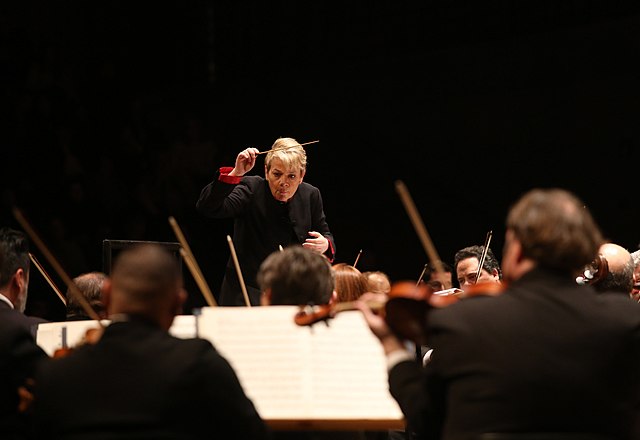
Marin Alsop in action in 2017. Image: Mastrangelo Reino /A2img. Wikimedia Commons

We had three world premieres with the composers present and spotlighted after the performances – James Wilson’s 1922, Roxanna Panufnik’s Coronation Sanctus and Laura Karpman’s Higher Further Faster Together. You felt the strong guiding hand of Alsop in these choices. She is a pioneer of new music and, as she said in her closing speech, gender equality in classical music. She was even brave enough to mention Aberystwyth as a location of a Proms concert next year. She admitted she had been practicing the pronunciation all day. I imagined the maestro stalking the back rooms of the RAH not with a Verdi score but a guide to Welsh place names. Let’s hope Llanfairpwllgwyngyllgogerychwyrndrobwllllantysiligogogoch puts a bid to host one year. Marin will certainly earn her fee.

It was a party atmosphere but tempered by reverence for the performers. The BBC Symphony Orchestra played their hearts out, and the loudest sustained cheers were for the BBC Singers, once threatened with extinction but now sort of reprieved (we must remain vigilant to keep them a going concern). The BBC Chorus was full of gusto for Jerusalem and Land of Hope and Glory and the concluding Auld Lang Syne when our collective voices drowned out the orchestra. Marin turned to conduct us all as balloons were sent soaring and crackers were set off almost in time to the music. This was a profound, passionate celebration of classical music with the barriers of elitism and traditions dissolved into pure joy.  In one evening we had the soaring wonders of William Walton’s Coronation Te Deum for the coronation of Queen Elizabeth II and the festive and glittering Coronation Sanctus of Roxanna Panufnik composed for King Charles III’s coronation service and the theme from the upcoming film The Marvels by flamboyant US composer Laura Karpman with Marvel Comics celebrating super heroines; very appropriate given Marin Alsop’s absolute control over the proceedings. Super Marin, perhaps.