Of course a man can imagine what it’s like to be a woman!

GUY WALKER says we must be allowed to imagine opposites

Fitzwilliam Darcy, Mr. Knightley, Dr. Lydgate, Edward Casaubon, Will Ladislaw, and Daniel Deronda are excellent examples of well-rounded and believable male literary inventions, with a variety of qualities of character.

Portia, Beatrice, Miranda, and Viola are excellent examples of brave, intelligent, and virtuous women, while Lady Macbeth, Regan, and Goneril are equally good examples of wicked women with the added factor, in the case of Lady Macbeth, that she is even regarded with a degree of human sympathy in her wickedness. Shakespeare also wrote a poem treating the story of the rape of Lucretia, the wife of a Roman aristocrat, by the King’s son. Rembrandt, an artist famous for his paintings of marital intimacy, especially with his own wives, produced two paintings of the victim. Seldom (especially in the second version, painted in 1666) have the anguish and shame of a rape victim been more tenderly evoked or better understood.

The remarkable thing about these very well-known creations is that they were all created by writers, a playwright, and an artist of the opposite sex. To take it further, Deronda and Shylock are created by writers who were not Jewish, and Othello is created by a writer who was neither black nor a convert to Christianity from Islam.

Modern orthodoxies might, however, insist that they shouldn’t exist. In Reni Eddo-Lodge’s book Why I Am No Longer Talking to White People About Race, the thesis is that it is futile to speak to white people about what it is like to be black in Western democracies because the simple fact of not being black disqualifies one from the possibility of understanding black experience and, therefore, from having a worthwhile opinion. A similar logic is often applied to the proposition of men being able to understand or hold opinions about female experience.

This being the case, how did Rembrandt, Jane Austen, George Eliot, and William Shakespeare, along with a host of other successful writers, manage to pull off the trick of evoking or inventing such believable characters, thus giving the lie to such thinking? Surely it is a combination of two things.

The first thing is the intense familiarity with the opposite sex that being social and sexual animals affords us. For example, most women have one or many of the following – a father, a brother, a male sexual partner, a son, a male friend. Secondly, we have the human aptitude for imagination afforded by the unique quality of self-awareness. This means that, although not all humans do it, it is relatively easy for us to think ourselves into the skins of those with a different skin colour, religion, status, or sex. Men are from Mars and women are from Venus, but space travel is hugely advanced and regular shuttles have been running for a long time. It is impossible to conceive (pun intended) us without our being constantly in each other’s orbit and being the very opposite to estranged aliens or alienated strangers.

I’m all in favour of the celebratory French dictum “Vive la différence!” For the heterosexual majority, the ever-renewed joy of sexual relation resides in the mystery of the otherness of their partners and mates and the fact that the two sexes complement each other to make the complete human wholeness.

However, this can be taken too far. Men and women are from the same sexually reproducing species, and therefore, in sexual relations with each other biological imperatives often encourage lifelong pair-bonds. As a result, sexual relation is the extant bedrock of most of our society. All of this, in fact, leads to an astonishing intimacy. Our other-gendered partners could not be less alien to us as, in a sense, they are us, being part of our wholeness. One can play here with the various meanings of the verb to know. If a couple know each other in the supremely intimate biblical sense, it is pretty likely that they will also know what makes each other tick. That being the case, how could we not have a very close acquaintance with each other? By definition of what sex is, what in the world do we study, whether we like it or not, more than our sexual partners? We may say different things but, for the most part, we speak the same human languages.

Given such intense and inevitable familiarity, a small effort of imaginative sympathy is bound to give intelligent and sensitive people a very good understanding of what motivates the opposite sex. To return to race or religion, that same imaginative sympathy can be applied in exactly the same way. Before we are black or white we are human – hopefully a statement that is the very opposite of racist. When Shakespeare created Othello or wrote Shylock’s “If you prick us do we not bleed” speech, he accessed a black man’s and a Jew’s consciousness by means of a humanity he held in common with them and perfectly understood their plight. Imagination triumphed and our human sameness, rather than demographic characteristics and differences, was insisted and focused on.

You could argue that such imaginative versatility is one of the very sophisticated qualities that distinguish our civilization, one of the jewels in its crown that lead to our ability to embrace considerable diversity within its aegis. So why is it that that very excellent quality is so under attack? What is to be gained from insisting so vehemently and so angrily that there are impassable obstacles in the way at the borders leading to the foreign lands of the other sex or of other races and religions, or that common humanity is trumped by demographic differences?

Who profits and what is driving those who prefer to propagate the myths of antagonism and alienation over the obvious truths of familiarity and commonality? The attempt to drive a wedge between the sexes, on whose happy relations we literally depend for our lives, might seem like an assassination attempt on the human race.

There is a clue in the very particular way chosen to describe human history here:

The history of all past society has consisted in the development of class antagonisms, antagonisms that assumed different forms at different epochs 

That, of course, is from the Communist Manifesto. Some people, then and now, profit from sowing discord and division (then it was class; now it is class, gender, race, and religion) because such false accounts of reality, configured entirely in terms of antagonism, exploitation, grievance, and alienation, afford opportunities and excuses to live out angry dramas and gain power based on the unjustified assumption that they are true. So habituated are we now to preferring to see things in terms of such antagonisms that we are almost dependent on the hits of outrage endorphins they give us and find it difficult to imagine weaning ourselves off them and seeing things in any other way. To see if this is true you have only to watch news programmes where virtually every item is routinely and unthinkingly configured in terms of who has been aggrieved by whom and who owes apology and compensation to whom. Division triumphs, and this is why we are no longer allowed to know each other and be friends.

A road by any other name…

Shutterstock
DEREK TURNER takes a Brum road-trip

What’s in a name? A great deal – so Birmingham City Council hopes. In December, as part of a £500m redevelopment of the city’s blighted Perry Barr district, it revealed the names of six new roads to “reflect community and Commonwealth sport values”. Diversity Grove, Equality Road, Destiny Road, Inspire Avenue, Respect Way and Humanity Close will shortly be adorning the Birmingham A-Z, and by 2023 residents will be giving their addresses embarrassedly to Deliveroo drivers.

Potential names were submitted by “the public”, and selected by a panel led by local politicians. According to one member of the panel, there was

…an impressive submission of entries that epitomised not just the core values and culture of Perry Barr but encompassed what the area is all about.

Puzzled Brummies immediately took to social media to wonder why none of these had been chosen.

According to the competition criteria,

Street names should ideally have a local connection, which is historically, geographically or culturally relevant.

Yet these names do not obviously have a particular Birmingham connection, and arguably not much “relevance” anywhere. These are not place-names for posterity, but sermons by street-furniture. Another Birmingham thoroughfare comes irresistibly to mind – Needless Alley – and a Lincolnshire road I noticed recently, Labour-in-Vain Drove.

Insofar as Diversity, Equality, Destiny, Inspire, Respect or Humanity do have real-world application, it may not be one all Brummies can embrace unreservedly. Elevated language frequently has less elevated applications; as Tacitus, quoting a subjugated Briton, noted of his own people, “they make a desert and call it peace”.

But then the Handsworth heroine who ‘thought’ of these names is a forward-thinking missionary, and above such earthly considerations. Social media sleuthing unearths wholly expected attitudes, a humdrum hashtaggery – BLM, Corbyn, DecoloniseBrum (and Yorkshire, while she’s on the subject, which is probably quite often), Israeli “apartheid”, race quotas, Tories hating the poor. She nurses an impressive dislike of James Watts’ business partner Matthew Boulton, judging from the many photos of Boulton-related Birmingham place-names onto which some monomaniac has Blu-Tacked typed ‘recontextualisations’. This is a lady who trends. The comical bathos of her toponymy exposes a hole in the heart of 21st century Brum, and Britain. In the land of the bland, the cliché is king. David Brent’s song Equality Street was a cynical ploy, and a good joke; Equality Road is less desirable.

Names have always been surrounded with superstition. As it says in 1 Samuel, “As his name is, so is he”.  Puritans aimed for Elect-ion by giving children hortatory names – Charity, Faith, Goody, Hope, Praise-God. Their Godless heirs try to be ‘Goodies’ in their turn by naming places after equally insubstantial ideals, chasing contemporary chimeræ with the same guilty enjoyment Ranters devoted to Revelations.

The coiner and adopters of these names clearly hope that, in the words of the 1791 ballad, Song on Obtaining the Birmingham and Worcester Canal Bill, “Twill prejudice stifle, and malice strike dumb”. A Conservative councillor who chortled at the new names as “Woke Way” was chided by the panel’s chair –

It is disappointing that Cllr Morrall does not appear to share these values or respect the views of the selection panel.

Behind these primly freezing words stretches a bleakly unwelcoming England, where human nature is to remade every morning, long-standing landmarks are to be levelled, and taken-for-granted things are to be taken. It is the same world, but a different planet – an alien environment with an atmosphere of noxious gases, and governed by platitudinous correctness. This may not be The Road to Serfdom, but it does resemble a Road to Nowhere. To turn around that property market cliche, “No location, no location, no location”.

Street-naming has historically been a form of culture-cleansing, warfare by other means, as incoming regimes impose their moral and social preferences on the losers. Names like Revolution Road, or 5th October Avenue, have frequently been inflicted on harmless highways, although sometimes only temporarily. Russia has reverted to many pre-1917 names – but the Cold War’s ‘winner’ has been convulsing its cultural cartography in response to radical social shifts, frenziedly naming roads after Martin Luther King, and recently even George Floyd. Is this ‘respect’, as is claimed – or is some less edifying emotion? Perhaps even fear? Renamers often seem not quite to know what they are doing, or why.

Romans Latinised England’s infra dig Iron Age trackways, and Normans Frenchified Saxon nomenclature. Socially-uncertain Georgian and Victorian town councillors sanitised suddenly shocking streets, exemplified by the “Grape Lanes” still seen in British cities – a gloss on “Gropecuntlane”, alluding to the ancient presence of prostitutes. They also sought to sweep away what they saw as irrelevant remembrances of the past – thus the 19th century rash of Gas Streets and Station Road (plus some more pious thoroughfares, often echoing religious revivals, like Fortitude Street or Temperance Road). They delivered a shiny new modernity, lavishly bestowing the names of engineers, explorers, generals, industrialists, missionaries, monarchs and planters on newly set-out streets, valorising the villas of the newly-rich and crowning even workmen’s terraces with classical and imperial motifs. Today’s craze for naming streets after Nelson Mandela, Windrush passengers, or Guru Nanak is a case of the Empire striking back.

Birmingham has always been busily Promethean, and has attracted the worst as well as the best kinds of change. Emma’s Mrs Elton expressed a common prejudice – “One has no great hopes from Birmingham. I always say there is something direful in the sound”. Two centuries or so on, the pleasant local accent ranks at the bottom of those unofficial but oddly powerful ‘trustworthiness’ surveys that appear spasmodically in the media, which are subliminally influential on those deciding where to site call centres and other industries. This is to ignore utterly the city’s shining other side – geniuses like Joseph Priestley, the kindness of the Cadburys, the civic pride of Joseph Chamberlain, the excellence of the CBSO, the many thousands of hardworking and respectable people.

The municipality has at times been badly served by its agenda-setters and political leaders, and modern Birmingham still bears the scars of the overlong incumbency (1935-1963) of Herbert Manzoni as City Engineer and Surveyor. Manzoni bequeathed Brummies a brutalist, traffic-blasted landscape at colossal cost, and his Bull Ring and Inner Ring Road are now being superseded at even greater expense. Manzoni’s views on Brum’s old buildings betray an absolute absence of imagination –

I have never been very certain as to the value of tangible links with the past… As for future generations, I think they will be better occupied in applying their thoughts and energies to forging ahead, rather than looking backward.

His epic incomprehension is echoed in the ostentatiously ‘socially concerned’ but secretly ruthless language of ‘decolonisation’ and ‘diversification’. These six roads in question may be new roads, but they are built on the thrown-down past. They are really different kinds of demolition, and their impossibly tangled rationales are the ideological equivalents of Perry Barr’s unsavoury neighbour, Spaghetti Junction. The Brave New Birmingham Manzoni and others brought was obsolete even before it was finished – and their “forging ahead” is now our inconvenient and shameful past, for which we must all undergo a painful and undignified procedure of deconstruction, and decolonic irrigation.

As Perry Barr booms and clangs with the din of earth-movers and pile-drivers, so the British imagination is being constantly razed and rebuilt, our inner and outer landscapes a permanent building site. Perhaps one day even the proud Handsworth heroine’s streets will become embarrassments, banal vestiges of a patronising political tradition and a worn-out West no longer ‘relevant’ to the Brum of 50 years hence.  

Brexit blindness

Heroic Failure: Brexit and the Politics of Pain

Fintan O’Toole, Head of Zeus, 2019

Three Years in Hell: The Brexit Chronicles

Fintan O’Toole, Head of Zeus, 2020

KEN BELL says a prominent Remainer still doesn’t comprehend Brexit

I have just finished reading Heroic Failure and Three Years In Hell, both by Fintan O’Toole, which is good for you as it means you don’t have to. I was attracted to these volumes by the fact that O’Toole as an Irishman might bring something new to the pro-EU debate, but unfortunately all he does is regurgitate lines British writers have already done to death.

Three Years In Hell is the lesser volume, and the easiest to dismiss, since it is essentially a diary covering dates in the years 2016 to 2019. Most of the entries became moot once Boris Johnson took over, so the entries that deal with Theresa May are little more than space fillers. Much is made in both books of the supposed fact that Brexit was an ‘English revolution’ – an engagingly off-the-wall line the Guardian emits regularly.

In the first place, the Brexit plebiscite was specifically set up as an all-UK vote. That is why Nicola Sturgeon could scamper off to campaign for ‘Remain’ in southern England. Now, you cannot have an all-UK vote and then dismiss its results because you come from an area that ended up on the losing side. Well, you can, if you are Nicola Sturgeon, but that does not mean that the rest of us have to take your whining seriously. That applies to writers as well as politicians, by the way.

Secondly, and this is where the much longer Heroic Failure takes over, to dismiss the Brexit vote as being a purely English victory when proportionally as many Welsh voters supported Brexit is to dismiss the people of Wales with an airy wave of the hand, which is what O’Toole does repeatedly. Not just Wales, either – pretty much anyone who is not part of the Guardian-reading metropolitan bubble is only referred to in passing. Thus, when discussing the makeup of the Brexit vote, he makes great play of the English middle class component and tries to slight the much larger working class element by saying that a majority of them were working class Conservative voters already! That may be the case, but it only leads us to a question of why did people who had historically voted Labour decide to switch parties, something which started to happen in 1997? It may be that Labour has changed and they haven’t. O’Toole does not even raise that theme in his books, being content to dismiss working class Brexiteers as people engaged in an act of self-harm.

A whole chapter of Heroic Failure is devoted to Boris Johnson’s journalistic pieces devoted to mocking the EU, with O’Toole then pointing out the errors and, by implication, the stupidity of the plebs who believed those tales.  This theme is not original to O’Toole, but it is what his readers believe, just as Boris’s believed his lines about prawn-flavoured crisps. Actually, Boris was on fairly solid ground with his EU reports, because even if he got some details wrong, there was a greater truth that he got right. When we joined the European Economic Community we were told that it was a big trading bloc and nothing that it did would ever affect us in any way. It was all about trade, nothing more.

Then we noticed that local council jobsworths were giving grief to market traders who wanted to sell their produce in pounds and ounces. We noticed that our children were coming home from school and talking about heat in Celsius and distance in metres. We battled to keep beer and milk in pints and road markings in miles, but in our hearts we knew that all we had bought was time, and that the jobsworths were just licking their lips at the thought of earning a tasty butty as they forced us to think the European way.

This brings me close to the end, with O’Toole convinced that the Brexit vote was due in no small measure to a desire to recreate the British Empire. It wasn’t, of course. It was a desire by millions of people, many of whom had never voted before and probably haven’t since, to be allowed to live their lives as they wanted under the jurisdiction of politicians who may be dubious characters – but they are our dubious characters and we can get rid of them every four or five years if we are bored with their faces. The EU may not really have instructed its provincial legislatures to enact laws against prawn-flavoured crisps, but the story illustrated a great truth that Brussels did order Westminster around on many issues, and Westminster did duly enact the legislation as instructed.

One day a pro-Brussels writer will investigate the mindset of the British people who voted freedom’s way, and a light will come on in his mind. He can then pass this information on to his readers, and his side will finally start to come to terms with the reasons for their defeat. Alas, Fintan O’Toole is not that writer.

American piety: meet the new Boss

SHUTTERSTOCK
MARK GULLICK sees wrinkles on the Free World’s senior stuffed-shirt

“I confess that in America I saw more than America; I sought the image of democracy itself, with its inclinations, its character, its prejudices, and its passions, in order to learn what we have to fear or to hope from its progress”1          

President Biden is already being granted the status of a deity. Roman Emperors nominated themselves as gods. Biden outsources that troublesome administrative business to the media. The New York Times has claimed the incoming administration is “the return of the adults”. One can only, as Bertie Wooster said, shake one’s head and pass on.

Joe Biden shares one political attribute with Donald Trump; his own party neither like him nor do they want him as president.

Just as many Republicans held their noses when Trump attained the presidency in 2016, so too Biden is not wanted by his own supposed fellow partisans, and he may well be a Trojan horse containing Kamala Harris and her people. Biden looks mentally and, frankly, morally frail, a man both bereft of any real intelligence save that of the rat-like, push-button, food-pellet cunning on which the political class rely, and the possible onset of a condition causing him to stumble through sentences in a way that makes George W. Bush look like Stephen Fry.

After yet another dirty and disputed election (they actually go back to JFK), a question really has to be asked of the USA. In a country acknowledged as the world’s superpower, and containing well over 300 million people, if the best of the best are a pugnacious boor and an old man clearly in the early stages of dementia, what does this say about that country? As the psychopathic killer Anton Chigurh in Cormac McCarthy’s No Country for Old Men asks of a man he is about to kill: if the rule you followed led you to this, of what use was the rule?

Biden’s appeal, of course, is that he is not Donald Trump, in much the same way that Trump’s USP was that he was not Hillary Clinton. Trump appalled the political and media class with his 2016 victory, coming as he did from outside the ideological training camps of the establishment, or ‘the swamp’ as Trump’s (few genuine) people dubbed it. The legacy of Trump’s presidency will be more or less meaningless on the ground in 2021, as Biden’s people will have the incoming president repeal anything of worth Trump might have done. Trump has, however, distilled a strain of conservatism from a good many Americans, and his next political move will be watched with interest. The formation of the ‘Patriot Party’ is being more than whispered in the corridors of power, although he may end up just throwing rocks over the perimeter wall of Fortress Biden.

This is no mere metaphor. The implication of Biden’s absurd inauguration, which saw more troops in Washington DC than were at that time serving in Iraq and Afghanistan (and who later had to bed down in a car park) was that some redneck army was about to storm Capitol Hill, and this because – to give the media’s supposedly unbiased tone – a gaggle of trailer-trash, tornado-bait, white supremacist wastrels pranced about in the Senate House and sat in Nancy Pelosi’s chair. The Soviet-style optics of Biden’s swearing-in show what the next four years will be like for America. This could well be the power grab, and all under the false flag of healing division and the supposed social unrest ‘caused’ by Trump and his non-existent far-Right Wehrmacht. Watch for the politicisation of the American military. A lot hangs on it. Biden has already ordered that troops serving in Washington DC have their social media backgrounds checked.

As much of a failure as it seems to genuine conservatives, however, The Trump presidency did have its uses. It served to bring the deep state out of the shadows and into the light. The citizenry, the real people, are aware now that there is something going on backstage, and that something is rotten in the state of Washington DC. And, following from this revelation, it finally became obvious that the political divisions in America are genuinely partisan, although not along party lines. These are a mere mummer’s play, to distract and entertain. The significant divide is between the deep state and its operatives – from Nancy Pelosi through CNN Thunderbirds-puppet Anderson Cooper right down to the most raggle-taggle Antifa street-fighter – and ordinary people who want no part in what is taking shape.

One of the marked effects of Trump’s reign was that one part of the USA got to see just how much the other part hates them. It is axiomatic now that while creatures of the political Right may not agree with what you say but will defend to the death your right to say it, the Left will defend their right to be hurt by it and to do their utmost to see that you go to jail for saying it. Biden will do nothing to discourage this Leninist cultural mood music during his regime.

The hippies were fond of saying that whoever you vote for, the government always gets in. So, meet the new boss, same as the old boss? Hardly. Obama quietly advised Trump to go easy on the executive orders in 2016 but, it goes without saying, no such restriction applies to the incoming President, at least one of whose strings Obama may be pulling, and Biden had his pen out and was signing executive orders on Day 1 (I wonder which of the White House’s many rooms has a few suits of Obama’s in the wardrobe for advisory stopovers).

Obama had set a record for recent presidents – a president precedent, if you will ­– with five executive orders in his first week, trumping Trump’s four, Clinton’s one, and Bush’s zero although, in all fairness, Bush may not have worked out the click function on his biro. Well before the end of Biden’s first week in the Oval Office, he had signed 21 executive orders, with 12 subsidiaries having more or less the same effect. At the time of writing, like a cricketer enjoying his innings, he has passed the half-century mark to 52. America, welcome to Papal governance, by bull and edict, circa the Middle Ages. My apologies for the lapse into Latin, but if you don’t know what a statement ex cathedra is, you had better learn.

This snow-flurry of immediate legislation has seen Biden lead with race and its subsidiary industries, and the course of his term can be seen with clarity right from what Americans call the ‘get-go.’ Like an expert bridge player, Biden (by which I will always mean those who prop him up politically) has led with the only suit guaranteed to win any game just at the moment: immigration.

Immigrants and their corporate and moralistic lobbyists will see many things to please them in the new White House team, such as including illegal immigrants in the census, protecting the same from deportation, whatever they might do, and, notably, the possibility of a much-touted amnesty. This remains to be seen as it is a bigger ask than the usual tinkering with green cards, and the potential for problems for the regime lie in wait in the form of a possible crime wave. Always remember, it is far easier for an MS-13 gang member to move to America than it is for you to move to Japan. On a related subject, Biden will be ending what the Regime Media called the ‘Muslim ban’. It was no such thing, of course, and again this is not the best time for a wave of immigrants whose COVID status it will cost you money you don’t have to ascertain.

Now, it would seem obvious that in a time of a pandemic governments across the world have been accused of over-reacting to, accelerated immigration would not be a priority. But that axiom would assume a guiding logic, with the result being favourable for the host country. Biden – and the Democrat Party as a whole – has made it clear that the opposite is the intention. Crippling and wounding America has been the ulterior motive of every move that party has made since Obama (very much America’s Tony Blair) came to power and proceeded to double the national debt, champion Islam, play more race card aces than a saloon-bar card-cheat, and target his enemies (like the Tea Party) with a weaponised tax-auditing system.

Along with an influx of Muslim immigrants – which cannot reduce a country’s chance of terrorist attacks – there are already new ‘refugee caravans’ forming from Honduras and elsewhere. If they make it to the promised land, they will drain that land of resources by virtue of being negative social capital. Trump was right, for all his boorishness, when he pointed out that Latin American countries do not always dispatch their best and brightest to America, and also that some of the countries they are understandably escaping from are indeed, as Trump so eloquently portrayed them, “shitholes”.

Culturally, one of the most meaningful things Trump did was cut out the rot of critical race theory – a non-subject invented for political and cultural power and control – from America’s public sector. Despite occasional muttering to placate the UK’s few remaining Conservatives, Boris Johnson would never do that in the UK because it would spook the horses at The Guardian which, for reasons unknown, Johnson believes most British people read rather than an ever-dwindling number of snub-nosed readers who eat artisan bread and have children called Pandora and Oberon. If Russia carpet-bombed the London boroughs of Islington, Hampstead and Crouch End, it would halve the readership of The Guardian. I digress.

Biden will, of course, reinstate the chippy, joke-woke curriculum that has become the fad, because it does him no harm to do so. It must always be remembered that the credo of every modern politician is almost the same as the first line of the Hippocratic Oath. First do no harm. To myself.

To his credit, Biden (or rather that of his people; he is a stuffed shirt) has distanced himself from the ‘defund the police’ crazies, and would do well to steer clear of Black Lives Matter, who will demand more and more in terms of reparations, affirmative action, lighter sentencing for blacks and so on. I don’t imagine Biden can pronounce ‘anarcho-tyranny’, but I hope his team know what it is, and are against it rather than for it.

Biden has an immediate problem here, or his optics people do. The list of pressure groups and plain-old fashioned ‘political activists’ (aka ‘community organisers’. Obama was one) who will be queuing at the White House door for their quid pro quo in return for their bloc vote will be a long one. Biden had better hope that the media sides with him and not with the crazies and zanies of the hard American Left.

In terms of infrastructure, some of the Biden moves will be yawn-inducingly obvious. He has already started by pulling the plug on the K1 pipeline, and halting fracking. This will make America’s spurious ally Saudi Arabia happy as they had no desire to see an energy-independent North America. Biden will set about dismantling Trump’s wall immediately, shedding American jobs but pleasing the open borders brigade. America has just announced it will return to the jamboree of the Paris Climate Accord, which is bound to cost the taxpayer money. Trump’s tax cuts for the middle class will, it goes without saying, be annulled.

Money. As The O’Jays memorably sang, you can do bad, do bad, do bad things with it. Inflation will be the next problem for the new administration, although the media will be working with all hands on deck to claim that any financial problems encountered by the Biden White House was because of the scoundrel, Hitler-tribute-act Trump, memory-holing the fact that the pre-COVID economy was buoyant under the 45th President. No matter how confident the technocrats are, economics continues to elude them. I have never found a definitive provenance for this gemlike phrase, although noted Islamic scholar Bernard Lewis has been suggested:

Astrology became astronomy. Alchemy became chemistry. I wonder what economics will become

America is playing a dangerous game. ‘Quantitative easing’ may sound technocratically efficient and soothing, but it just effectively means printing money, which tends to mean inflation blooming into hyperinflation, as with Weimar Germany, Zimbabwe and Venezuela. In three months in 2020, ostensibly to ease the economy through the somewhat exaggerated melodrama of COVID-19, the Federal Reserve ‘created’ $3 trillion. It does not, of course, literally print money (ordinary people might be able to get hold of actual cash, and that would never do) but buys what are essentially junk bonds and creates an artificial financial ecosystem in a fiscal hothouse many believe is unsustainable.

Add to this the fact that Biden has already effectively signed off another household stimulus check, and that he has a pack of rabid socialists – such as Alexandria Ocasio-Cortez, an extraordinary fudge-brained bimbo who inexplicably has slunk in to the corridors of power – baying at him to shake the magic money tree even harder and increase the amount – and even make it a regular, monthly payment, sounding very close to the universal basic income which is in the minds of many on the Left – and the full nature of history’s biggest-ever financial gamble begins to become worryingly clear.

And it won’t just be the money supply that is at issue. It is what happens to the money that already ‘exists’. Cronyism certainly won’t be going anywhere. There is already evidence that Biden wants to reintroduce the so-called ‘Settlement Slush Funds’, an Obama monstrosity whereby corporate offenders pay not the victims of their misdemeanours, nor even the government, but a coterie of Left-wing pressure groups, including as just one example La Raza – ‘the race’ (imagine a Caucasian equivalent!) – the openly racist Latin American hybrid pressure-group of lobbyists and thugs currently attempting a reconquista. This reverses the dedicated and specific – and surely morally upstanding – work against this extraordinary funding hack by former Attorney General Jeff Sessions, one of several Trump hires currently pulling a knife out of his back.

A priority of the Biden administration will be control of the media, particularly online. They don’t need to bother with the MSM who, if they acted any more like cheerleaders for Uncle Joe (where have I heard that name before?), would have ra-ra skirts and pom-poms and a college song. One of the most alarming events of 2020 – an alarming year all round – was the way in which government avoided accusations of censorship, de-platforming and banning various conservative voices by effectively outsourcing the dirty work at the crossroads to big tech in the same way a British bank has its call centre in Delhi. Biden won’t touch any of that. If it ain’t broke don’t fix it. (With the economy, on the other hand, it will be more a case of, if it ain’t broke, fix it till it is.)

The Biden administration will be a disaster to everyone save the media, who will be campaigning as though they were the captain of the Titanic saying that the ship hadn’t sunk at all, he was just inventing the submarine. To say that America is becoming a banana republic that can’t even run a free and fair election may be to be unfair to banana republics. After all, they at least have cheap bananas, and what happens next to America is anybody’s guess. May you live in interesting times, said the Chinese sage.

  1. Alexander de Tocqueville, Democracy in America []

A realm apart – why Brexit happened

SHUTTERSTOCK

This Sovereign Isle: Britain In and Out of Europe

Robert Tombs, Allen Lane, 224 pages, £11.22

KEN BELL praises an exceptionally historically-informed Brexit explainer

The small numbers who read the Guardian will no doubt disagree, but the argument over Brexit is now as much a part of history as the Free Trade debate that dominated life in the 19th century. As such, Robert Tombs in This Sovereign Isle has written the first of the many volumes that will dominate the reading lists for student historians. Luckily for the public at large, the book is also eminently accessible to the general reader as well, so I predict that this volume will go through many editions in the years to come.

Although Tombs never falls into the trap of arguing that Brexit was inevitable, he does make the point that for the British, membership of the EU was always a transactional issue and not an emotional one. Thus, when the downside of membership began to tell, there was no emotional appeal that could be made by the other side to try and even the balance. The Remainers lacked an Abraham Lincoln who could deliver a Gettysburg Address, because their side of the debate was just as transactional as that of the Brexiteers. Thus they were forced to rely on an increasingly hysterical version of the ‘Project Fear’ that had helped win the 2014 Scottish independence referendum. The problem in 2016 was that people just didn’t believe the howls, which allowed Boris Johnson to ask mockingly which catastrophe would come first, the world war or the economic collapse.

For the British, membership of the EU was always a transactional issue and not an emotional one

To be fair, as Tombs argues, Brexit was certainly helped over the line by the fact that the UK had managed to stay out of the Euro. Had we joined that common currency, the UK would have been in a similar position to the Scotland of 2014 and it is quite likely that Remain would have won. As it was, the result was close enough to argue that ‘Project Fear’ had a considerable effect on the final tallies.

On the other side of the English Channel, the Euro certainly helps keep difficult countries in line, as the EU demonstrated against the Greeks when it looked as if they were about to strike out for freedom. The mafia type threat: Nice economy you have here – be a shame if something happened to it, may very well be the one issue that keeps such countries voting the right way. Or to carry on voting until they get to the right way according to Brussels. That threat could not be used against the UK, and we owe a debt of gratitude to Gordon Brown for keeping us out of the Euro’s clutches.

Staying in Europe for a moment, Tombs makes the point that most of those countries were desperate to draw a line under their immediate pasts. The original six had the memories of defeat in the Second World War and political systems that had become illegitimate in the eyes of the populations. Later on, the post-Cold War entrants wanted to forget all about their Soviet experiences and similarly had discredited systems that needed to be put out of their misery. The EU for all those countries was in large part a stab at legitimacy and an exercise in forgetting the recent past.

The UK by way of contrast emerged from the two World Wars on the victorious side, with a legitimate political system intact. Thus roughly half the Brexiteers who were asked to give a single reason for their vote, answered that they wanted Britain to govern itself. They were able to say that because they had confidence in the British parliamentary system. It really was as simple as that.

The Remainers never seemed to understand that desire and so they discounted it as a factor. To them the Brexiteers were a caricature that they had created in their own minds and then decided that it represented the reality of their opponents. We were uneducated, old and we hankered after the British Empire, when actually, as Tombs shows, we just wanted to govern ourselves. Nevertheless, that mistake, which came about because Remainers tended to be concentrated in particular parts of the country where they did not come into day to day contact with Brexiteers, led them to overestimate their own numbers, and underestimate the need to get their vote out. As Sasha, Lady Swire, noted in her Diary of an MP’s Wife (https://brazen-head.org/2020/12/16/chumservatives) when her daughter called her as the results came in and complained that “white van man” had stolen her future, the result might have been different had the darling girl got her friends out of bed and chivvied them along to the polling stations.

One area that the author really should have been expanded upon was the 2017-2019 period that I think history will call the Rogue Parliament. If there is any truth to the argument of British exceptionalism, then this period provides a plethora of evidence for it. Many countries would have unpacked the rifles long before the period ended, but the British bided their time, seethed with rage at the antics that went on and waited for an election when they could exact their revenge against the guilty men who were responsible for it all.

The constitutional position, as Tombs makes clear, is that when a government has lost the support of the Commons, it should be voted down by a motion of no-confidence. Once carried, the rascals are thrown out and a new set of rascals elected in their place.

That did not happen during that roguish time, as an alliance of neo-Jacobin MPs, a compliant Speaker who clearly sympathised with them, coupled with a judiciary that seemed willing to flout established precedent all came together to try and force the government to act as they wished. The Fixed Term Parliament Act prevented the government from calling an election, and it looked for many long months as if the situation would continue to resemble the 17th century crisis that led to civil war, only this time as Tombs says, with “tragedy repeated as farce.”

Yet it ended, sooner than many of us expected, when the opposition folded and an election was called. Boris Johnson was given an 80 seat majority on the promise to get Brexit done and the Neo-Jacobins were packed off to a lifetime of obscurity. Readers of the Guardian will continue to whine and the rest of us will just get on with our lives, having rid ourselves on an undemocratic layer of government based in Brussels, which is all we ever wanted to do.

Learning from History – Herbart, Hayward and the Celebration Movement

ROSALIND RAWNSLEY recalls a visionary educationist

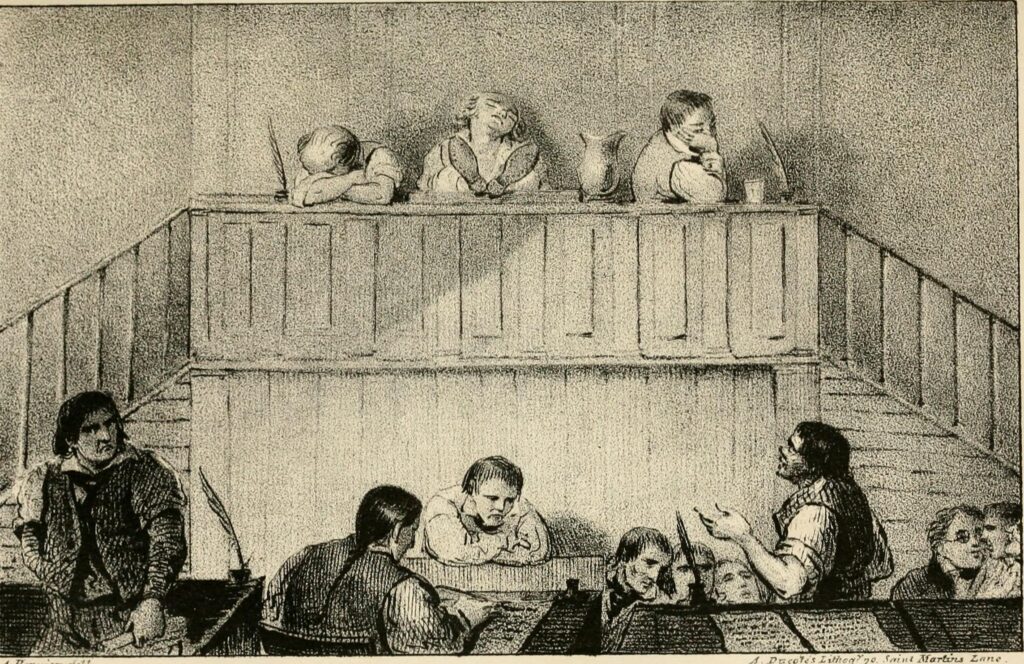
For centuries, a child’s mind was considered a tabula rasa on which the teacher would do his best to imprint a series of facts which with a bit of luck would give the pupil all the basic tools needed for him to make his future way in life – as the 19th/20th century English educationalist Professor Sir John Adams put it, dividing the ordinary consciousness from ‘mind within and the great world of facts outside’, 

…the teacher’s work is regarded as the shovelling in of as many of those outside facts as the mind can contain. The great shovel for this purpose is known as Observation; a word dear to the hearts of, ‘Teachers; Inspectors, School Superintendents; School Boards, Parents and Others interested.’1

In most cases, a basic grounding in the ‘3 Rs’, with, if they were lucky, a working knowledge of the Classics, was for centuries considered a sufficient education for those few boys who were fortunate enough to benefit from schooling of any kind. The vast majority of the population remained illiterate. 

Village School, by Jan Steen , circa 1670

As early as the early 17th century, there had been a few far-sighted philosophers with more advanced ideas on education. The best-known among them was the Czech, John Amos Comenius (1592-1670), who advocated among other innovations, pictorial textbooks written in native languages rather than only in Latin, teaching based on the introduction of gradual development from the simplest to more comprehensive concepts, lifelong-learning, focussing on logical thinking rather than rote learning, equal opportunities for poor children and education for women. 

With evident justification, Comenius is considered the father of modern education, but his was an exceptional voice crying in the wilderness.  It was not until the 18th century, with the dawn of the science of psychology, that educational innovation really began to gather pace in Europe, with the German States leading the way. But the child-centred, leisurely pace of education, first advocated by Pestalozzi and Froebel in the 18th century, and built upon by J.F. Herbart and his followers a century later, by which the child was guided by the teacher to uncover and develop his own innate understanding of the world and his place in it, could not last. With the exponential expansion of educational opportunities in the 21st century, with the invention of the microchip and the internet, space exploration and the vertiginous pace of advance in information technology in particular, this ‘Herbartian’ model has on the face of it had to be laid aside in favour of increasing specialisation. But Herbartianism, as applied through the work of the English educationalist, Frank Herbert Hayward has not been entirely superseded, and may still have a future.

J. F. Herbart, 1776-1841

Johann Friedrich Herbart (1776-1841) the German philosopher and early psychologist, is less well-known in the English-speaking world than Auguste Comte, his near contemporary, with whom he is sometimes compared. It is difficult to comprehend the reason for this neglect, given that for at least half a century after his death, as the founder of pedagogy as an academic discipline, Herbart’s philosophy of education was extremely influential.  It was widely studied and applied by prominent educationists not only in his native Germany, but also in England and in America where, as in Germany, Herbart Societies still flourish. 

Herbartianism, with all its faults, is a system; apparently the only educational system in existence which has at the same time a definite psychology; a vast and fairly coherent mass of literature, a considerable number of journals devoted to its cause; a series of great names – above all, the power of raising enthusiasm!2

Herbart’s philosophy of education can be perhaps labelled simplistically as idealist.  He begins with the concept of the mind or soul as a single, inert and homogeneous entity which becomes the battleground for the one set of forces which can have any effect upon it – the ideas. Ideas, once introduced to the soul, compete with each other for a place. 

John Adams, in his magisterial volume of essays The Herbartian Psychology Applied to Education, describes the Herbartian model of the soul as a dome, “the summit of which is the goal of the ambition of every self-respecting idea”3. The base of the dome marks the threshold between the conscious and the unconscious mind. Once an idea rises above that threshold, its first task, in order to consolidate its position in the dome, is to make useful acquaintances or connections, which together form what Herbart describes as an apperception mass. According to the Herbartian model, the whole of our intellectual life is spent in forming new apperception masses and in expanding old ones. Ideas which do not succeed in attracting others to form apperception masses, having for the time being lost the battle, will sink once again below the threshold of consciousness, where they will nonetheless remain until or unless called forth once again.

Herbart was born in Oldenburg in northern Germany in 1776.  Little is known about his early life, except that as a fragile child he was taught at home until the age of 12. Afterwards, he attended the local Gymnasium for six years, before going on to study under Fichte, who taught him to think logically, at the University of Jena. After Jena, Herbart moved to Switzerland as tutor to the children of the Governor of Interlaken.  Here he made the acquaintance of the Swiss educator Pestalozzi4 and through him became interested in educational reform.

This meeting, and his own experiences as a teacher, led Herbart during the following years to develop his own philosophy of education – first at the university of Göttingen, where he eventually became a lecturer, and later in Königsberg, where he moved in 1809 to take up the Chair of Philosophy earlier occupied by Kant. Here he established, and conducted for the next 24 years, an influential seminary of pedagogy. In 1833 he returned to Göttingen as Professor of Philosophy, where he remained in post until his death eight years later.

Herbart’s theories of education were taken up and developed in different ways by his followers, who likewise reinterpreted the philosophy of Herbart to suit their respective interpretations. ‘Herbartianism’ thus eventually became synonymous with a system of education, rather than with the original philosophy of Herbart himself. By the second half of the 19th century, Herbart’s doctrines had been so much changed that they would probably have been unrecognisable by their original author.

While Herbartianism had considerably less influence in England than in Germany and in America, it did nonetheless attract a following among influential English educationists following the 1870 Elementary Education Act. This established a framework for the compulsory education of children between the ages of five and twelve.  The direct result of this enactment was the construction and establishment countrywide of hundreds of new Elementary schools5 and it was not until the Education Act of 1891, the latest in a flurry of Education Acts passed during the twenty years after 1870,  that education was made free of charge to all pupils in Board and Church schools alike).

Among those educationists who took up the Herbartian torch were John Joseph Findlay6, John Adams7, and Catherine Dodd8 and Frank Herbert Hayward, all of whom were household names in the field of pedagogy well into the 1930s.

While students of the history of education would certainly be familiar with the first three, Hayward sank into obscurity very soon after his retirement and by the time of his death in 1954 he had more-or-less been forgotten. A pessimist by temperament, Hayward may not have forwarded his own cause as well as he might, had his personality been different; the title of his autobiography, An Educational Failure, published in 1938, encapsulated his self-doubt, and as is so often the case, he was taken at his own estimation. This neglect was nothing short of a tragedy in the field of moral education.

Frank Herbert Hayward was born in 1872 into a poor but industrious Nonconformist family in Wotton-under-Edge in Gloucestershire. Highly motivated and of a studious disposition, he was to become in early adulthood a man of formidable energy and mental ability, rising to become a prolific writer and a highly respected (though controversial) educationist.

He attended various schools, mainly in Bristol, becoming a Pupil Teacher at Barton Hill in 1887, where he seems to have remained on the staff until 1895, when he gained a scholarship to University College, Bristol. From Bristol he gained by private study a B.A. from London University and went on to study for a Teacher’s Diploma at the College of Preceptors, where he gained a Special Certificate of Ability to Teach in 1899. During his studies for this diploma, he appears simultaneously to have studied privately for a B.Sc. in chemistry and geology, and for an M.A. in philosophy and economics.

In 1900 he was admitted as an Advanced Student at Gonville & Caius College, Cambridge, whence the following year (at some point evidently having acquired a working knowledge of German) he was given a grant by his College to study education at the University of Jena. Here he wrote The Critics of Herbartianism (1903) in which he gives a detailed critique of some 14 German commentaries on Herbart.    

That same year, he gained a D.Litt. from London University, his thesis being entitled The Ethics and Philosophy of Sidgwick ((Henry Sidgwick,1838-1900) English utilitarian philosopher and economist.  Knightbridge Professor of Moral PhilosophyUniversity of Cambridge 1883-1900. Author of The Methods of Ethics. Co-founder (1875) of Newnham College, University of Cambridge for women)) published in book form as The Ethical Philosophy of Sidgwick (1901). Meanwhile, he gained the Moral Science prize and a B.A. from Cambridge. These studies in Germany and at Cambridge seem to have awakened his interest in moral education and the precepts of Herbartianism in this field, which was thereafter to remain the principal focus of his working life. 

In 1902 he became Organising Teacher for Mid-Devon, published lectures on Herbartianism in Cambridge, while that year and the years immediately following, he gave lectures in Marburg in Germany. Later, he was appointed Assistant Inspector of Schools for the London County Council, where, rising to become Chief Inspector, he remained until his retirement in 1937. 

During the next 35 years he gave lectures on moral education in various parts of the country, published innumerable pamphlets and some 30 books, not only on educational topics, but also on matters as diverse as ‘Temperance’ and the ‘Power of the Press’. Biographies of Oliver Cromwell, Marcus Aurelius and Alfred the Great were well received by the press. Perhaps his greatest and most original contribution to moral education, however, was the Celebration Movement.

In his biography of Marcus Aurelius (1935) Hayward wrote:

I have been hunting during thirty years for a solution of what has notoriously been regarded as a certain “difficulty” in schools, as well as of certain cultural and civic “difficulties” allied to it… In the spirit of Comte, and indeed under his direct influence, I am an advocate; in schools and out of schools of Celebrations of Great Men as well as of Great Ideas and Great Institutions, in the hope that such Assembly Methods, with their mass emotion and broad impressions and an occasional touch of splendour, will be of help in these times of spiritual unsettlement and distress…9

Hayward’s period of greatest activity was likewise a period of flux in educational thinking.  Moral education and education for citizenship became more important than ever during this time of profound upheaval in all aspects of life following the conclusion of the Great War. Education had already been high on the government agenda during the closing years of the 19th century, and, following the flurry of major Education Acts in the years following 187610 by the outbreak of war in 1914 Britain did already have a basic educational system.  Nonetheless, for most of the population this did not extend beyond the Elementary age limit of 12.  By the end of the war, it had become all too apparent that education was more important than ever, not just for the children, but for the improvement of national morale as the country attempted to rebuild the structure of society and to create a ‘land fit for heroes’ from the ashes of conflict.

Hayward did not claim originality for the idea of the Celebration, tracing it back to Plato in The Laws, but the worked-out development and application to educational purposes was entirely his own.

The notion of celebrating ‘Empire Day’, inaugurated in 1907, had set Hayward thinking. He considered it “scrappy, faddy and narrowly propagandist”.  However, he thought, if it were to be celebrated as one of a group of five annual festivities (the others being ‘Home’, ‘City’, ‘Nation’, and ‘League of Nations’), it could be an excellent idea. Alone, there was a danger of Empire Day being nothing but a display of jingoism. On the other hand, under intelligent guidance, the school celebration of Empire Day might include, “impressive references to the ancient empires of the world as well as to those of later times”. The significance of the modern (British) Empire would be enhanced by being set in context. Taken alone, Hayward thought, there was also the danger that children who associated the word ‘Empire’ with a local music hall or cinema, would completely miss the point:

No adult can conceive of the mix-up in many children’s minds as they gather at the annual event and are given a flag to wave about.

The Empire Day concept, he considered, was too good and too original to be lost, but the way in which it was marked was very unsatisfactory. As he thought of it, it required an entirely “new spiritual start”. If the notion of a Celebration of Empire or Commonwealth was legitimate and attractive, Celebrations of the other four concepts, he considered, should be given equal weight. Looking back over his life in An Educational Failure, he regretted that this logic had not appealed to others in authority. Before the First World War, Herbartianism had risen from almost complete obscurity to a position of some prestige, with astonishing rapidity, particularly in England. Yet in the wake of the 1918 Education Act it went, at least nominally, swiftly into decline.

During the War, Hayward, like many others, had been giving considerable thought to ways in which education might be advanced once hostilities were over. Towards the end of the War, he circulated to educational journals and influential individuals a 10,000-word pamphlet, The Religious Difficulty in Schools – A Solution of an ‘Insoluble’ Problem.  However, like an earlier, more academic pamphlet directed to various members of the clergy; supporters of the controversial Education Bill and others; this received a lukewarm response.

A few encouraging letters came, indeed; from teachers (mainly women) and one or two from people of the literary and artistic type; attracted by the idea of a National School Liturgy. Hardly any came from the champions of “religious education”, “freedom of the teachers from religious tests” and other catch phrases of the last decade or two.11

It may be, he continued sarcastically,

…that the majestic brains of these gentlemen are still silently absorbing my suggestions and preparing a scheme of incomparable grandeur.  Great minds need time… 

It was therefore useless to bandy reproaches.  Hayward evidently had grandiose hopes for his proposals: “I undertake”, he wrote:

…to make the British nation fundamentally cultured on matters of Bible, literature, and music if I can get a few collaborators and the moderate use of official notepaper and stamps of any responsible educational body such as the Board of Education or the National Union of Teachers”12

Evidently not lacking in self-assurance, Hayward had, he continued, indicated the way to a solution of,

…the very honest problem of religious, civic, and aesthetic education that has been raised during the past half century…  

As if this were not enough, a further problem, which to his mind educationists had not considered at all, and one which would equally be addressed by his scheme, was that of the didactic approach to the Bible, literature and even music. There was a need to rescue, he felt, “the ear from its bondage to the eye”; educationists imagining that the Bible and Shakespeare and music should be taught through the medium of print, rather than being heard in live reading or performance.13

While these pamphlets may have received a disappointing response, the second document led Hayward to make the acquaintance of Arnold Freeman. Freeman was a Fabian, a philosopher, an educationist, a playwright, an Anthroposophist and founder of the Rudolf Steiner Sheffield Settlement for adult education. Freeman was, according to Hayward,

…one of the few men actively on the look-out for an educational contribution to the very threatening contemporary situation

This meeting proved to be momentous: it led to the joint production of a much-reviewed ‘manifesto’, published in The Spiritual Foundations of Reconstruction (1919) in which was set out for the first time the concept of the Celebration as a means of moral and civic instruction. Hayward had evidently had the idea at the back of his mind for some time before meeting Arnold Freeman, and it now became a fully worked-out tool for teaching moral values.

Hayward considered that as a disinterested educational practitioner who was not susceptible to political whims, he could bring an independent mind to bear on the solution of great problems. His earlier idea for an Empire Day Celebration had been suspected of partisanship. But nobody, he maintained could discover partisanship in the Celebration itself.  “What we can discover”, he wrote,

…is sound pedagogy; and the only criticism that can be proffered is that it is a solitary Celebration instead of being, as it should be; one among fifty others, each designed to impress the child with the greatness and the weakness of man, and to convey to his mind the social heritage of the race.14

Education was seen as a key element in the creation of ‘a land fit for heroes’, to compensate for the horrors of war and the terrible wastage of life lost in the fields of Flanders, while at the same time acting as a means of offering some reparation to those who had given their lives, and even more, to those who had survived.  Education for peace, and social and spiritual reconstruction were high on the agenda before, and in the years following, the Armistice.

How was this to be achieved became a burning question for educationists. Hayward and Freeman had written in the opening words of The Spiritual Foundations of Reconstruction:

The people of Great Britain desire fervently that the coming peace may bring a League of Nations and an Industrial and Social Order based upon Co-operation… If we are to reconstruct with understanding and imagination, we must have an electorate possessed of an intelligent grasp of the truth of things – of the workings of nature; of man’s history upon this planet; of social evolution…  There must be developed for the appreciation of this environment a widely-diffused reverence for Beauty.  Year upon year, and perhaps decade upon decade of after-war disorder and conflict can be avoided only if the minds of the people are filled with such ideals of national and international Citizenship as will assure unity and co-operation.15

This was to be achieved, they thought, through the schools. The very fact that it had been thought necessary to institute a national celebration of Empire Day, was in their opinion a tacit admission by the authorities that the concept of patriotism had not adequately been conveyed to pupils in either denominational or non-denominational schools, on the pretext that religious instruction included moral and civic education. This notion had been proved in practice to be erroneous since,

…if patriotism had been adequately and impressively taught in scriptural or theological lessons, there would have been no need of these celebrations! 

Following the first Empire Day celebration in 1907, the Feast of St. David had been marked since 1915 and the birthday of William Shakespeare since 1916. What for Hayward and Freeman had been “the most pregnant feature” of these celebrations had been the entirely new conception of educational method to which they bore witness.

Whether or not their originators realized the principle underlying them does not concern us.  It is none the less revolutionary. In its bleakest and most absolute form the principle is that:  THE CLASS TEACHING OF THE BIBLE, LITERATURE, MUSIC, HISTORY, AND CERTAIN OTHER SUBJECTS SHOULD BE LARGELY ABOLISHED IN FAVOUR OF A LITURGICAL CEREMONIAL. OR CELEBRATIONAL TREATMENT.  THESE SUBJECTS ARE NOT SO MUCH LEARNED AS ‘IMBIBED’16

Here the Herbartian principle of ‘apperception’ is invoked. Herbart believed that the mind was the sum-total of all ideas which entered into one’s conscious life, which grouped themselves into “apperceptive masses”. By assimilation (or apperception) new ideas could enter the mind through association with ideas already present. This principle could be applied to almost any arts subject – History, Morals and Religion could better be taught through Celebrations than by formal didactic methods.

The ‘revolutionary Scheme’ which Hayward and Freeman now proposed had already in part been formulated by Hayward himself. Writing in 1912, in his controversial book on educational administration (The Psychology of Educational Administration and Criticism) which he had written as a rebuttal of Edmond Holmes’ notorious Circular attacking elementary school education17 Hayward argued that what was lacking from moral and religious lessons in particular was an understanding of the necessity for appreciation.

The formulary for this new approach consisted of four Proposals, which Hayward had earlier outlined in a jointly-written letter to The Times Educational Supplement, the first of which, based on his earlier ideas, was eventually to form the nucleus of the Celebration Movement under his sole aegis18.

PROPOSAL I [all capitals in original]

THERE SHOULD BE PREPARED A SYSTEM OF SCHOOL CELEBRATIONS, INTENDED AS IMPROVEMENTS ON THE EXISTENT EMPIRE DAY SHAKESPEARE DAY, AND ST. DAVID’S DAY CELEBRATIONS, AND AS VAST EXTENSIONS OF THE PRINCIPLE THEY EMBODY; THAT IS TO SAY, THERE SHOULD BE A NATIONAL SCHOOL LITURGY OF THE BIBLE, LITERATURE, MUSIC, AND CEREMONIAL.

Day after day, the child would hear the best portions of the Bible read impressively, as well as other splendid passages of poetry and prose. He would be familiarized with several hundred of the choicest pieces of music; once a week (say) he would witness or take part in a Celebration, ceremonial, or piece of pageantry in honour of a great personage (St. Paul, Alfred the Great, Joan of Arc, St. Francis, George Washington) or a great idea (The League of Nations, France, Agriculture, Science, Freedom).

PROPOSAL II

THE HUMDRUM DUTIES OF LIFE SHOULD BE EXPOUNDED BY THE TEACHER IN SPECIFIC MORAL AND CIVIC LESSONS, APART FROM THE LITURGY, BUT CONSTANTLY DRAWING ILLUSTRATION AND SUPPORT FROM THE LITURGY. DURING THESE LESSONS THE MAIN STRESS SHOULD BE ON THE REASON, WHEREAS IN THE LITURGY, REASON WOULD BE SUBORDINATE TO FEELING – TO “ADMIRATION, HOPE AND LOVE”.  Pro AND Con MATERIAL SHOULD BE OFFICIALLY SUPPLIED TO THE TEACHER FOR LESSON PURPOSES AND ALSO THE MOST UP-TO-DATE AND COMPLETE INFORMATION ON QUESTIONS OF HYGIENE, CIVICS, ETC. 

The teacher would be free to express personal opinions, but if they were controversial he would be expected to refer his pupils (particularly as they grew older) to pro and con documents provided for the purpose. These documents would be drawn up by a board of responsible educationists, every sect and party sending from time to time statements of its views.

PROPOSAL III

SCIENTIFIC CHARTS OF TIME, SPACE, AND HISTORY SHOULD BE STATUTORILY HUNG ON THE WALLS OF EVERY SCHOOL so that false views about the age of the earth, the existence of a material and spatial heaven “above the skies,” etc., could not obtain a fixed lodgement in children’s minds, and so that a definite and true time and space scheme could, on the other hand, receive a very fixed lodgement indeed.

PROPOSAL IV

REPRESENTATIVES OF ALL SECTS, PARTIES, PROFESSIONS, MOVEMENTS, ETC., AS WELL AS TEACHERS, SHOULD BE URGED TO GIVE ADDRESSES TO THE WHOLE SCHOOL AT THE TIMES SET APART FOR THIS IN THE LITURGICAL ARRANGEMENTS. Parents and “the public” should be specially invited to attend.”

During the recent war, the sinister influence of propaganda had been acutely recognised as a danger to democracy. It was therefore of vital importance that children should be educated to recognise that few issues are clear-cut. Future citizens trained to see both sides of every important hygienic, ethical and political question would thereafter be able to think for themselves and know how to get at the facts. The time charts advocated would give children a framework of space-and-time relationships which would familiarise them with the general scheme of things.

The rationale of the proposal, that children should listen daily to the finest music and literature and take part regularly in some sort of pageantry or ceremonial, would, it was felt, go a long way to rendering every child aesthetically sensitive – a more effective way of appealing to a child’s appreciation of Beauty than the lessons, dealing primarily and laboriously with technique, currently given.

The grandiose plan for a national liturgy of Celebrations – a sort of precursor of the National Curriculum – through which every child in the land would be offered the same experiences, would, the authors hoped, create a network of common culture-memories. Such a network would in turn help to bind the members of the population together, thus in turn combating the loneliness and isolation of a nation of individuals, a feeling exacerbated by the effects of the recent conflict. If adopted by schools of all classes, Hayward and Freeman’s proposals would, they averred, “bind the nation together by a thousand bonds of sympathy”, while at the same not destroying but intensifying whatever is valuable in sectional and individual effort”19

Although The Spiritual Foundations of Reconstruction was very well received by the press, the response from the teaching profession to the invitation to contribute their own suggestions was distinctly tepid. Hayward was understandably disappointed. In a letter to F.J. Gould, a secular humanist, follower of Comte and prominent educationist, who had reviewed the book with enthusiasm, he expressed his disappointment, but said that nonetheless he hoped to publish a first Book of Celebrations in the course of the year.

This volume duly appeared in 1920. It was reviewed in Nature as “a sound idea”, the writer considering that the suggestions made were wise and well thought out, and he was convinced that the methods suggested, “would grip in a way that nothing except the teacher’s personal influence has hitherto done”.20 He noted that the subjects dealt with were Shakespeare, the League of Nations, Democracy and St. Paul. Celebrations which had already appeared in The Spiritual Foundations of Reconstruction; to which were added Celebrations of,

…bards and seers; world conquerors, Samson, eugenics, temperance, commerce, summer, flying, Chaucer and Spenser.21

By the time the book was published the Celebration movement was beginning to gather momentum, but mainly through Hayward’s own promotional efforts through the London County Council Education Committee.

A second book of Celebrations, published the same year, expanded on the themes of the first, with the virtues of Work and Toleration, individual great men from history and from the recent past: Alfred the Great, Pasteur and Lister, Sir Philip Sidney, the artists Turner and Watts, The Musician, national Celebrations of Poland and Ireland (the latter in an attempt to alleviate the crisis following the 1918 uprising), Military Conflicts in Palestine, a revised Celebration for Empire Day, and finally, Political Parties, and School Leaving Day

No indication is given as to whether any of these Celebrations had actually been performed. However, The Journal of Education, reporting on a Summer School of Civics at High Wycombe noted that,

Dr. Hayward organised two of his school Ceremonials, one in honour of the city and the other to commemorate the League of Nations. These were carried out by the staff of the Summer School and proved impressive Celebrations  ((Journal of Education; September 1920, p.586))

In an interview with the present writer, Dr. Hayward’s son Frank observed that although the whole gamut of Celebrations eventually covered a great variety of topics, many of the early Celebrations were of a biographical nature, celebrating the lives of great men.  This he saw not just as a reflection of his father’s Herbartianism, but also because he was a Victorian projected into the 20th century, carrying with him the very Victorian characteristic of admiration for the great figures of history.

In a bid further to disseminate the concept, in 1926 Dr. Hayward launched a new quarterly journal, The Celebration Bulletin, which ran to 16 issues. Each contained several fully worked-out complete Celebrations, which could be staged by subscribers. In 1928, despite the rather discouraging response, Hayward published A New Book of Celebrations, reviewed in the Journal of Education:

On former occasions we have directed attention to Dr. Hayward’s idea of Celebrations, and to his very suggestive helps towards carrying the idea into practice… It is not difficult to detect the note of disillusionment and disappointment in Dr. Hayward’s preface. He has worked hard, and has received messages of approval from men so far apart in some ways as H.G. Wells, Bernard Shaw, Dr. R.J. Campbell and Prof. J. Arthur Thomson. Yet his efforts, marked though they are by ability and sincerity, have so far not commanded wide success.22

Hayward had many other eminent admirers within the profession, including Sir John Adams.23 Yet Sir Michael Sadler24 who must have known of Hayward even if they were not personally acquainted, did not find it necessary to include his name in his 1927 encyclopaedic list of British educationists, pioneering teachers, educational philosophers and administrators, whose talents had made Great Britain the greatest exporter of educational ideas of the time25.

A fourth and final book of Celebrations was published in 1932, in which details were given of those which actually had been performed. Of the 28 listed, ranging from Old Testament figures, classical writers, Shakespeare, Schubert, Purcell, various European countries, and India; to The Nation (England), The Home and the virtues of Temperance and Work and Saving.  Of these, nine or ten had been performed once, Schubert twice and Virgil three times. 

Altogether, F.H. Hayward compiled around 100 Celebrations on different topics, putting a lifetime’s knowledge and expertise into their creation. It was extremely discouraging therefore for him that his radical ideas were never enthusiastically embraced by the teaching profession, or the world’s educational authorities and governments. The Celebration as a means of moral and spiritual education seemed to be ‘dead in the water’.

Or was it?

Hayward had unfortunately become obsessed with the Celebration as the most effective means of combining religious instruction, moral education, and the teaching of citizenship, and this may have been his ultimate undoing.  Teachers, war-weary, conservative in outlook and no doubt discouraged when the first post-Armistice euphoria gave way all too soon to the Great Depression, were perhaps not ready to embrace this revolutionary inter-disciplinary concept.

The claims of science, not least as advocated by Bertrand Russell26 to be pre-eminent in any educational system at the expense of the humanities, may have been a contributory factor in the decline of interest in overt Herbartianism and, in parallel, in F.H. Hayward. Pedagogy, largely under the influence of the advances in educational psychology, also moved on, gaining its own momentum.

Yet Herbartian ideas did not expire with the 1918 Education Act, but continued to permeate educational thinking, even perhaps to the present day. The sinking of overt Herbartianism below the level of consciousness in educational theory does not imply its extinction. In 1929, Cyril Norwood, Headmaster of Harrow School, though not specifically acknowledging the influence of Herbart, wrote that an education on which the cause of international peace could be most firmly based was “founded on practical Christianity, culture, and character”. 27.  Norwood was advocating, in other words, the cultivation of the Herbartian ‘circle of thought’ as the foundation of a moral education. 

Child-centred education has not been abandoned.  It was a key to teaching practices, particularly in the 1970s – developing children’s understanding of the world by investigating the outdoor environment through a cross-curricular approach28. It was only with the introduction of a more rigid structure through the ‘National Curriculum’ proposed by the 1988 Education Act that this Herbartian’ approach to curriculum planning had, at least nominally, to be laid aside.  Every Government, of whatever political affiliation, has ever since the introduction of a National Curriculum if not from 1870 onwards, felt it incumbent upon them to tinker with the methods and content of education, in a manner which would no doubt have been anathema to Hayward.

Nonetheless, Herbart’s ideas and Hayward’s practical suggestions and theories continue to underpin educational praxis to this day, even if no longer in formal curriculum planning. The present writer, in collaboration with the Head Teacher and staff of a Shropshire primary school, during the late 1980s and early 1990s directed a series of major thematic interactive Festivals of the Arts and Sciences for young people, outside school hours, which could be considered as natural developments of Hayward’s ‘Celebrations’, and there were other examples elsewhere.

There are few comparable events today in schools, and certain aspects of Hayward’s theories feel outdated – which is rather ironic, considering that he conceived them as liberating and modernising. In 2021, history is more often contested than celebrated, morals, sociology and even the hard sciences are in a state of flux, while the concept of ‘Great Men’ is at odds with modern ‘diversity’ and egalitarian preoccupations. Yet still there must be a place for a model of education that uplifts even as it informs, and at the same time provides all-round thematic understanding rather than partisanship or uninspiring specialisation. Hayward, like Comenius in his day, seems for the moment to have been a voice crying in the wilderness, but perhaps his time too is yet to come.

  1. John Adams, The Herbartian Psychology Applied to Education, 1897, p. 135 []
  2. F.H.Hayward, The Critics of Herbartianism, p.52 []
  3. John Adams, The Herbartian Psychology Applied to Education, 1897, p.50 []
  4. Johan Heinrich Pestalozzi, 1746-1827. Founded several educational institutions, in Germany and in the Francophone cantons of Switzerland, publishing several works on his principles, revolutionary at the time. Educational motto: ‘Learning by head, hand and heart.’ Through his work, illiteracy in 18th century Switzerland was almost completely overcome by 1830 []
  5. Education did not become compulsory for all children until 1880 []
  6. John Joseph Findlay 1860-1940 Scottish educationist, Sarah Fielden Professor of Education, Owens College, Manchester []
  7. Sir John Adams 1857-1934, First Principal of UCL Institute of Education; Professor of Education at University of Glasgow, knighted 1925 for services to education. Author of The Herbartian Psychology Applied to Education []
  8. Catherine Isabella Dodd 1860-1932 First woman on academic staff of Victoria University, Manchester as lecturer in Education. Principal of Cherwell Hall Teacher Training College, Oxford 1906. Author of several titles on education including Introduction to the Herbartian Principles of Teaching (1898) in England in the last years of the 19th century and the first quarter of the 20th []
  9. Preface to Marcus Aurelius – A Saviour of Men, (1935) p.9 []
  10. 1876 – Compulsory for all children to receive an education; 1880 – Attendance made compulsory from 5 – 10; 1891 – Elementary Education Act made primary education for all intents and purposes free, since the State would pay school fees up to 10s per head; 1893 – School leaving age raised to 11; 1899 – School leaving age raised to 12 and later to 13; 1902 – Balfour Act []
  11. The Religious Difficulty in Schools, A Solution of an Insoluble Problem, The Literary Guide, 1917, also a pamphlet,  p.1 []
  12. The Religious Difficulty in Schools, p.3 []
  13. Ibid. p.4 []
  14. The Psychology of Educational Administration and Criticism, p.504f. []
  15. The Spiritual Foundations of Reconstruction, p.3f. []
  16. Capitals in original []
  17. E.G.A. Holmes, Chief Inspector of Elementary Schools in England , had in 1910 circulated a memorandum, not intended for publication, in which in the light of reports received from H.M. Inspectors of Schools, he is highly critical of elementary school teachers and local elementary school inspectors.  The majority of these, including F.H. Hayward, came from a working-class elementary school background and were ex-elementary school teachers.  The only local Inspectors who were really able to bring ‘freshness and originality” to their work, Holmes maintained, came from a public school and Oxbridge background.  The memorandum was leaked, and not surprisingly caused a furore. []
  18. The Times Educational Supplement, August 1st 1916, p.104 []
  19. The Spiritual Foundations of Reconstruction, p.15 []
  20. Nature, Vol.CV No;2649, 5th August 1920, p.707 []
  21. Ibid. []
  22. Journal of Education & School World, May 1928, p.361 []
  23. “The more I consider you and your educational work the more I regard you as a figure in the history of education rubbing shoulders with and rousing the writer’s wonder at the inability of your contemporaries to appreciate the value of your contribution…  The time will come when light will break… and you will be raised to the pedestal which is being silently prepared for you”, Sir John Adams, letter to Frank Herbert Hayward, 18th May 1933, quoted in An Educational Failure, p.152 []
  24. Sir Michael Ernest Sadler, KCSI, CB, 1861 – 1943) English historian, educationalist and university administrator (Manchester) and Vice-Chancellor, University of Leeds []
  25. J.H. Higginson (ed.) ‘The Educational Outlook’ in Selections from Michael Sadler, Studies in World Citizenship, p.150 ff. M.E. Sadler’s Presidential Address to the 16th Conference of Educational Associations, 1927 []
  26. Vide B. Russell, On Education, p.27 ff. []
  27. C. Norwood, The English Tradition of Education, p.187 []
  28. Vide Colin Brown & John Turnock, Curriculum Design in the Two/Three Teacher School.  Curriculum, Vol.2 No.2 Autumn 1981 []

The partition of Scotland

As the SNP again attempts to prise Scotland out of the UK, STUART MILLSON engages in a little counter-factual fantasy

Professor John Curtis of Strathclyde University, the country’s leading psephologist, had (within a few percentage points) been proved right. Ever since the announcement of a second independence referendum by Scotland’s First Minister, Nicola Sturgeon, the polls consistently showed a reversal of the 55:45 result from 2014 – leading to the unthinkable, the secession of Scotland from the United Kingdom after more than 300 years of union.

And yet already a constitutional crisis of another and unexpected sort had engulfed the SNP, threatening to sour its victory. Despite the overall majority vote for Scotland to revert to its pre-1707 state, certain sections of the Scottish electorate had not moved from their 2014 position: with the Borders resolutely clinging to their 70 per cent support for the Union, and several conjoining areas of the Lowlands narrowly keeping the unionist vote just above 50%. The Orkney Islands had also voted to remain within the United Kingdom – the islands first declaring their loyalty to the UK during the 2014 referendum campaign, when a group emerged on social media, proclaiming that in the event of an SNP victory, a petition would be presented to the Government in Edinburgh to leave the new Scottish state and rejoin the United Kingdom. Scotland – to the dismay of the party which had long seen itself as representing the country incarnate – was split: a schism that could only be resolved by the creation of a new border, a situation not seen in the British Isles since the creation of Northern Ireland and the Irish Free State in 1922.

The SNP’s position on independence, or what was presented as independence, had suffered considerably following the successful implementation in 2021 of a UK-wide Covid vaccine – Boris Johnson’s one true achievement during the pandemic (the effects of which were still being felt after the Scottish referendum). The First Minister’s earlier enthusiasm for Scotland to take its place as an “independent nation within Europe” had been readjusted somewhat, following the clumsy attempt by the European Commission to nationalise and control the manufacture and supply of Covid vaccines. Even to confirmed ‘Europeans’ and romantic Remainers, the actions of Brussels emphasised how little member-states could expect independence – especially in a Europe, which following the conclusion of the UK’s Brexit settlement, now saw itself as a ‘sovereign equal’, a state in itself.

The anxiety felt across the pro-Union areas of Scotland soon translated into a refusal to accept wholesale incorporation into the new system and state. The quiet, conservative Borders soon resounded with the cry to withhold council tax to the Scottish authorities; foreign news-crews made camp along the villages and towns of the Tweed valley, eager to interview farmers and freeholders, and Anglo-Scottish families who could not countenance living under what some described as ‘the Sinn Féin of Scotland’. (Despite its earliest, Scottish baronial conservatism, the SNP of the middle-2020s had evolved a strongly metropolitan ideological core, with one element – muzzled during the second referendum – espousing curbs on speech and thought, the abolition of the monarchy and perhaps the dispossession of the Royal Family from Balmoral.) A visceral dislike of the other point of view overcame Scottish politics: a breakdown of all consensus, a negation of all that Tony Blair had hoped to achieve in 1999 with his policy of devolution and the revival of a Scottish Parliament.

Scottish and Whitehall civil servants began to meet in Holyrood – a strange echo of their predecessors’ meeting in 1707, when a new country and flag were sewn together. Now, a country was being re-created, but one in which a limb of the original Union of Great Britain would survive. Within months a Royal Commission and a Commission of the Scottish Parliament had sketched a new Scottish border, based as accurately as could be on the votes cast in the referendum – pleasing some, disappointing many, dismaying, no doubt, most of the majority of Scots who had hoped at all costs to avoid another bad-tempered plebiscite. Glasgow, Edinburgh, Stirling would, it was thought, form the central part of the new Scotland, but the capital itself proved an impossible factor in the constitutional equation. As in 2014, Edinburgh had narrowly voted for UK membership: an embarrassing problem for the legislators of Holyrood.

With part of Scotland still in the United Kingdom, and the Orkney Islands granted a form of UK semi-autonomy (an Isle of Man of the North Sea), the United Kingdom survived, in wounded, chastened form. Boris Johnson’s ministers appeared, each day, with Union flags furled on platforms and arranged on bookcases for their announcements via Zoom – the Government keen to remind Nicola Sturgeon of the thousands of Scots in England and Commonwealth countries who belonged to the British family of nations. The independent Scotland, scarred by partition, nevertheless celebrated its new existence, although the European Commission had still not considered whether it would be allowed to rejoin the European Union. For the time being, the Bank of Scotland issued Scottish pound-notes, an arrangement supported by the broad shoulders of the UK Treasury, keen to show its goodwill. Sir Sean Connery’s image – his familiar form adorned in Highland dress – adorned the new banknotes, although a vociferous campaign by supporters of Alex Salmond to include the charismatic First Minister who resigned in 2014 was still underway.

It is not known if a third referendum will ever be held, to confirm, or disconfirm what came to pass with the remaking of the map of Great Britain – and the unexpected partition of Scotland.

From Jim Crow to George Floyd – a street view of US policing

MARK PATTON takes a personal view of the sad trajectory of US race relations

I was five. It was 1957. My recently divorced father had custody of me for the weekend. What I can recall from such a distant time, is that we had been traveling down a rural state road outside of Toledo, Ohio. It was late, I was sleepy and I had no idea of where we were headed to. Suddenly a white station wagon veered into the road from out of a farmer’s driveway. I woke up quickly as I careened into the dashboard and on to the floor as my father slammed the brakes of his faded navy blue, 1952, Chevy. The station wagon passed across the front of our car, then crashed into the rear quarter of another car that had been heading towards us in the opposite lane — instantly ejecting the operator of this vehicle out onto the roadway.

My father jumped out of our car, as did several other motorists. The station wagon then backed off the roadway to the front of the driveway it had come from. Two young men came out of it and leaned against the hood of their car. My father, as well as other witnesses to the accident, went to the aid of a man who had been injured by being catapulted onto the highway. He was sitting in the middle of the roadway and they attempted to get him up onto his feet. But this didn’t work. He kept falling back onto the ground. I later learned that both of his knees had been broken. There he sat, as my father went about collecting papers blowing about from a snapped open briefcase. I could see, from all of the headlights illuminating the scene, that the man was wearing a suit and he was a negro. I had been recently taught to call black people negroes, though coloured people was also acceptable.

The Ohio State Highway Patrol were soon on the scene, and the accident scene was further illuminated by the twirling red bubblegum lights on top of their cruisers. At this point my father reentered our car and attended to me. He felt that this was all a teachable moment for his young son. I gathered from his instruction that the black man was a businessman and an ambulance was on its way to help him to a hospital. My father then pointed to the two teenage farm boys, “See them?” I nodded compliantly, “They are drunk. Watch, the police will soon arrest them.” I then attentively watched the farm boys as they catcalled to the man sitting on the highway, shouting words that I had been taught never to use. The ambulance arrived, but it did not come for the black man. Instead, the ambulance crew persuaded the drunken farm boys to lie upon some stretchers and be carried into the back of the ambulance. Flummoxed, my father assured me that there was another ambulance coming for the man in the street. The police, who had been questioning the black businessman, now pulled him to his feet. Placing handcuffs on him, they loaded him into the back of one of their cruisers to take him off to jail. Shocked, my father went out to argue with them but was soon sent back to our car. Later on, he testified on behalf of the injured black man at his trial, but this did little good. The man received 90 days for reckless driving. To a boy of five, who hero-worshipped his dad, the most astonishing thing that had happened that night was how wrong my father was.
 

                                                                           ***                                                                     

By 1959 I was living in a newly constructed lower middleclass housing development south of Pittsburgh, Pennsylvania. It neighboured Wendel, a small mining town that had seen better days. From our small yellow brick house, you could see hilltop orchards, steep pasture for beef cattle and a mountainous slag dump that towered over all. Our slag dump view diminished over the years as it was excavated to make ‘red dog’ driveways. Everyone in our neighborhood had one of those driveways made from heated waste coal and shale tailings. Next to the repetitive brick homes, the orange, pink and metallic purple crushed stone made the neighbourhood more interesting, as did the people who were living in those homes. Most of the children with whom I played in the street had fathers who had been combat veterans in World War II. Mr. Fisher, who lived near us, was in two navy vessels that sank in the Pacific. Despite his ordeals of so frequently treading water, he was perhaps the nicest person in the neighbourhood. There were also several Jewish families on the road. Across from us was a Jewish engineer, his wife and four boys. He too had served in the navy and had seen combat. Next to his house was a Jewish family whose matriarch was a concentration camp survivor. She slept all the time due to depression, and her husband would come out and scold the local children for waking her as they played in the street. Oddly, next to their house lived a German family, the Graffins. The local story concerning Mr. Graffin was that he had deserted the German army by stealing a boat and rowing across a lake to Switzerland. Again, befitting the idiosyncratic nature of the mixing in this neighborhood, the Graffins were bookended on their other side by a pretty young Jewish woman. Her rather incomprehensible story was that at age three she was smuggled out of Germany in a wagon driven by her mother, disguised as a Gypsy. As she told it, they were stopped and interrogated by soldiers, but since they pretended to be Gypsies, they were allowed to cross. Somehow, they managed to squeak through the Germans, even though the Germans were in the habit of rounding up Romani as well as Jews.

Several houses up from her house was another Navy man. He was big, doughy and bald and always wore a white T-shirt, sleeve rolled up to house his Camel Cigarettes, and cutoffs. However, the main reason for this excessive display of flesh was not to be comfortable on a hot day. It was to proudly display all of his maritime sexual conquests. He was tattooed all over his legs and arms with Betty Boop-like women, each bearing a name under them. These women had been memorialized in an assembly line production on his skin, all very similar, more like stamps than tattoos. Perhaps during a bout of nostalgia, he had consumed enough beer to dump his savings on having the job done all at once? He was not shy.  Once while I was playing outside with his son, stepped out of his house, and upon my request, he lifted up his shirt and showed me the continuation of his love life, which lay beneath his T-shirt, inked there on his back and his chest for the duration of his life.

Our neighbourhood seemed to coexist rather well. Of course, there were occasional spats between children and housewives. There was no antagonism between ethnic groups, and the men got on quite well — finding time after their mill work to play a movable game of pinochle — going from one front door stoop to the next, up and down the street. However, two things happened to disrupt the quietude. The first was the night when the man at the top of the hill chased his wife down to the bottom of the hill. The chasing came to an end right in front of our house. I was in bed at the time and heard my playmates shouting,” Daddy! Daddy! Don’t shoot Mommy!” Then there was a bang. Daddy had arrived home earlier than expected from his nightshift, and found Mommy in bed with another man. This was my second encounter with law enforcement. The Westmoreland County Sheriff’s Department arrived, and once again, everything was lit up with flashing lights, this time. However, unlike the black man in the accident, Daddy wasn’t seriously prosecuted, if at all. Domestic bliss soon returned between Daddy and Mommy after the shooting. A few months later, as I was walking up the hill, I met Mommy coming down. I was very excited to see her. For a young boy back then, a bullet wound was about as neat a thing that you could have. So, I asked her if I could see it. There must have been some strange compulsion to lift clothing in this family, for she sheepishly complied, raising her skirt to her knee to display the scar.

About a year after the shooting, the second major local event took place. A Jewish engineer, directly across the street, had put his house on the market and sold it quickly. I remember the day the details of this sale got out. You could see all of the street’s menfolk congregating on the hill to the east of our house and also the hill to the west of our house. They soon came marching down from both directions and were very angry. Puzzled, my stepfather went out to find out what was going on. He too became angry. Then there was shouting for our neighbour across the street to come out and join them. He was very brave, for he did come out. Things became highly animated with cursing and shoving, but the demonstration ended almost as quickly as it had erupted. When my stepfather returned, he announced that our neighbour had sold his house to a mixed-race couple, and that property values were going to plummet, which did turn out to be the case.

Mrs. Brown, our new neighbour, was a huge white woman. She towered over all the men in the neighborhood. Her husband was a tall black man who owned and operated an eighteen-wheeler. They had only one child, a son, who also towered over a normal boy his age. Not long after their moving van pulled up, the Ku Klux Klan was summoned to help do something about the street’s ‘predicament’. One night, while the Brown family was enjoying an outing at the local drive-in theatre, the Klan showed up. They painted their garage door “N—-g—- Go Home, KKK”, and then they set up the traditional blazing fiery cross on their front lawn. When Mr. and Mrs. Brown drove into their driveway in their new shiny black Cadillac, stuffed full of their numerous children, they were quite shaken to see what had happened to their home. The sheriff’s department was called and they were puzzled as to the motivation for this crime. Why would a white family from Kentucky, by the name of Brown, be the object of the wrath of the Ku Klux Klan? Apparently, the Klan had gotten it wrong. They had attacked another Brown family house two streets up. After that, things quieted down. The Browns lived in their house for many decades till they passed away from old age. Mrs. Brown became the Sunday school teacher at the local Presbyterian church, and soon began complaining to my mother about my irreligiosity. The neighbourhood remained quiet for the next eight years we lived in it – and we did have a hard time selling our house.

                                                                              ***

I was 15 in 1967 and visiting my grandfather back in Toledo. At the time, I had a crush on the girl next door to his house. One day I worked up enough nerve to ask her out. To my surprise she said yes.  This was to be the first date for both of us. My grandfather volunteered to drive the two of us to a theatre in downtown Toledo to see the movie Doctor Zhivago. After the picture was over, he was out front in his station wagon waiting to return us home. Initially, it was an uneventful trip. However, as we passed through the black neighborhood on Dorr Street, traffic slowed to a crawl. We had no idea as to what the problem was and assumed that there was a bad accident up ahead. Through the smoke, we saw that there was some kind of road block. The date was July 24th, the evening when the black riots in Detroit spilled over into Toledo. The day before, the Detroit Police had arrested all of the patrons of an after-hours night club welcoming home some Vietnam War veterans. Eighty-four blacks were included in the arrests. The subsequent riot required Michigan’s governor to mobilize nine thousand National Guard. Over 10,000 people participated in this riot, which left 43 people dead. 
At the road block on Dorr Street, a mob of black men was surrounding cars as they tried to pass. Each vehicle was inspected and white men were being pulled out for a beating, before being allowed to move on. I thought we were all goners. We were stuck in line inching our way forward to receive a beating. When we got to where the barricade had been set up, my grandfather was told to roll down his window. A black man then poked his head through. He took a quick look at an old man in his mid-70s and a pair of 15 year-olds in the back seat, and elected not to hand out any beatings. We drove on.

                                                                               ***

Later that year, my family moved to Cape Cod. After graduating from high school in 1971, I became a member of the Research Vessel Chain. After leaving the Chain in 1973, I was offered a job as a summer police officer. I spent the next year pounding a beat and directing traffic. The political climate was similar to what we have today. Cars slowed down, as they passed me standing in the middle of an intersection – making pig noises, grunting, squealing, oinking, saying pig slowly and occasionally spitting. I had never dreamt of being a cop, but suddenly here I was in a blue suit carrying a gun and with one week’s training. I stayed on at the end of the summer as a provisional police officer. The next year, I enrolled in a degree program at Northeastern University’s College of Criminal Justice, graduating in 1979. I worked my way through school, not only as a cop, but also as a Federal fisheries enforcement officer.

Unfortunately, I was handed my degree during a recession when jobs were scarce. But fortunately, I had taken the Massachusetts Civil Service exam for patrolman back in 1978. The scores were slow to be announced. Consequently, I went to Texas and worked in the oil patch until of the results finally came out. What a strange exam. With police racism in mind, the Commonwealth sought to diversify the racial composition of the state’s police departments. To this end, it came up with an interesting multiple-choice exam. Many of the questions had two right answers. The questions were scored one way or another dependent upon which question the majority of minorities chose. However, this scheme didn’t work; not enough minorities had passed the exam, so the final score for passing was lowered to a 65.

By the late 1980s, the Falmouth Police Department was notified by the Massachusetts Civil Service Commission that it was out of compliance with their racial quotas for the composition of its staff. Officially, we had one black. He was my good friend, Percy Kennedy, who went to high school with me. Unofficially, and in reality, the department was close to one third black. The explanation for this was that when individual black officers took the civil service exam, they did not check the black ethnicity box but filled in a blank space entitled other. For them, the other was Cape Verdean. Cape Cod has a significant Cape Verdean population. They came as sailors or cranberry bog workers in the late 19th century. Being from African Islands off of Mauritania and Senegal, Massachusetts Civil Service had no category for them. So, they were not counted as being of African heritage. So, our black chief, of Cape Verdean ancestry, had to go out and recruit two official civil service blacks for our department to be in compliance. He sent the recruited cadets off to a Massachusetts Criminal Justice Training Council police academy. Upon graduating, they were assigned a training officer for three months of hands-on patrol training. Regrettably, one of the trainees was just not meant for the job. After two years of effort, she was still in training. Our chief became fed up, and fired her. This wasn’t an easy thing to do with both civil service protection and police union protection. But that was not the end of it; she turned around and sued our chief through the Massachusetts Commission Against Discrimination for discriminating against her due to the fact that she was black. We had a black officer suing a black chief for racial discrimination. She received a settlement. Law suits weren’t uncommon in the Falmouth Police Department, and the Town frequently gave plaintiffs $50,000 to go away. It was cheaper that way.

                                                                            ***

I was on duty the night Percy’s brother was shot to death by the Yarmouth Police Department. Percy was called out of his sector and sent to the nearby Cape town to identify his brother, Michael. Michael had been allegedly involved in a burglary. He was pursued by two units and lost control when his vehicle hit sand and skidded into a tree.  He was attempting to back out when the two officers who had been pursuing him approached his car on foot. During the inquest, it was articulated that the two white officers felt their lives were threatened — so they unloaded their revolvers into the car, reloaded and fired again.

I went to the police academy with one of these officers. He was a nice personable kid, who knew an awful lot about guns (maybe too much) and had been out of the academy for about a year when this shooting took place. Oddly, of the fourteen cadets in my class, two of my classmates had shot and killed someone during their first year on the road. No one else from this class shot anyone during the remaining years of their careers. Younger and freshly minted officers are the most aggressive. They have frequently had the ambition of joining a police force from an early age and have had a steady diet of police procedural movies and television series to fire their enthusiasm.

Young officers begin to take notice of the long, layered rap sheets with multiple felony convictions and no significant prison time. That’s when going to court becomes a farce.  It dawns on them that only the judges take the courtroom seriously. Police work becomes a job and ceases to be a calling. Most veteran cops have as a goal getting through their shift with the least amount of trouble. Confrontations, racial or otherwise, are the last thing they want during a patrol.

 Police see the best people at their worst and the worst people at their worst. Everyday contact with the meanest of our species eventually leaves its mark. Memories become choked, not with the names and events of great people and noble deeds but with the rap sheets of local felons and their crimes. Officers soon can recite criminal histories the way David Starkey can discuss the life stories of the monarchs of Britain. When the station dispatcher keys his radio microphone, blood pressure rises through all the department’s patrolling units. No one knows who is going to get the next call or what it will be. For those whose number isn’t called, there is relief. For those who receive a serious call, their minds race through possible scenarios and how they have dealt with similar events in the past, in hopes they will be up to the task.

                                                                         ***                                   

Two years after Officer Kennedy’s brother had been killed, I was on patrol in East Falmouth. The base station microphone was keyed and I got a radio call that kept my blood pressure up for some time. A Golden Gloves boxing champion, who happened to be a black man, was going door to door ringing doorbells and punching out whomever answered. The radio dispatcher said he had fled the scene in a car. He was to be regarded as highly dangerous. My colleagues began piping up on the radio about what a good boxer he was, and that I should be very careful.

I asked the dispatcher for the boxer’s home address and headed there to find him. His mother and sister greeted me at the door, stating he was not there. They asked if they could come with me to look for their relative. Today’s policy and procedures manuals would have forbidden taking civilians for a ride in pursuit of a criminal, but back then you had much more latitude for independent thought. I let the two women into the rear lockdown area of my cruiser. Only a few minutes had past when the station advised me that the man I was looking for was now attacking people at a local supermarket. As we pulled up, the boxer was punching out a tenacious store manager. I took the time to unlock the doors for my passengers, then ran towards him. At this time, an officer in a dispatched backup unit arrived. He did the same thing that I was doing, but then checked himself, and cheerily announced his name while extending his hand. He went down, one two, out cold, with a broken jaw.
I anticipated his throwing a punch. His eyes moved to the right and a right hook came my way. I moved just in time to receive a glancing blow to my head, but still managed to get behind him and place a sleeper hold on his neck. This was a version of what was recently applied to George Floyd – taught in police academies as a way of stopping blood flow to the brain and causing someone to pass out. It is not a choke hold. I had used that hold a lot, with blacks and whites, and it saved me from being the recipient of a beating on many an occasion. However, this time it wasn’t needed. His mother and sister had left my cruiser and were now staring at him in horror.  Suddenly the boxer appeared somewhat sane: “My ladies are here. You got me”. Now subdued, I handcuffed him and then had his ladies transported to the station. He relapsed into delusions as I transported him to the station’s prisoner drive-thru. It was a memorable ride. He was shouting about the devil, and yelling “Michael Kennedy”! Michael Kennedy, my friend Percy Kennedy’s brother. Back then, we had only a cage screen shielding the front seat from the back. The boxer took advantage of this and began spitting through the cage as he kicked at the front driver seat. I still can feel his saliva going down my back.

The shift commander was there to meet us in the drive-thru. He opened my cruiser’s back door and began talking to the boxer. They knew each other, and I could see that now a black officer was there, the raving lunatic went away and the boxer seemingly became normal and complacent.

I was told not to bother to book him but to drive him straight to the Taunton State Mental Hospital, about an hour away. The raving began as soon as I left. When I arrived at admissions, it was nearing 2 AM. The receptionist was in a sour mood. I was incredulous when she told me that, though beds were available, Cape Cod was assigned only five beds, which were all filled. I then had to return to the station, book my devil- talking prisoner, and place him in a cell. By 10 A.M. the next morning, he had been arraigned in court and released on bail.

                                                                            ***

Melvin Reine

For over three decades the Falmouth Police Department and the Town of Falmouth was terrorized by a short, spindly, Cape Verdean garbage contractor with snaps embedded in his scalp for the attachment of his toupee. Melvin Reine, the owner of Five Star Enterprises Garbage Collection, was not physically imposing, but willing to do anything to maintain people’s fear of him. They knew he’d run the risks, commit whatever crime it took to maintain control over the town. They also knew that no one seemed to care.  Melvin was from a large family living off a small strawberry farm. He did not come from money. But he did do a stint in prison, and when he came out he was loaded.
Shortly after I moved to Falmouth, there were a series of fires reported as being due to arson. Eventually, these fires were attributed to Melvin Reine. He was successfully prosecuted for them and did two years in the Massachusetts Correctional Institution at Cedar Junction. Not long after his release, he quarreled with his wife Wanda. She disappeared. No one has ever heard from her since then, including their two boys, which Reine raised. Around this time, Melvin had been frequenting the company of an 18-year-old girlfriend, Shirley Souza. Coincidentally, her boyfriend, 16-year old Jeffrey Flanagan, was found dead in a cranberry bog just across the street from Melvin’s house. Jeffrey had been executed while on his knees by someone using a twelve-gauge shotgun. Melvin was never charged with this murder. I have seen the initial police report; an auto accident investigation would have had more detail.

The fires started up again, but now mostly for insurance fraud. In 1977, a 17-year-old boy, Paul Alwardt, had been implicated in some of these arsons and was to testify against Melvin before the Barnstable County Grand Jury. Then, like Wanda, he went missing, and like Wanda was never heard from again.

In 1979, Patrolman John Busby was on his way to work when a station wagon operated by Melvin’s brother, John Reine, cut him off.  Shirley was in the passenger seat, and Melvin in the back with the window rolled down. A shotgun was again the choice of weapon. Busby was hit in the face, and his jaw was shattered. None of his assailants were ever arrested for this shooting, but Patrolman Busby was given a new identity and went into hiding for the next seven years.

I was not working for the department at this time, but pursing my degree. By October of 1980, I was again working for the Falmouth Police Department. Though I had not been there for the shooting of Officer Busby, I did talk to a lot of officers who were.  Most felt, as with the Flanagan murder, that there was no serious attempt to investigate the crime. One asserted that Melvin was never questioned, though he was considered a prime suspect for threatening John’s life during an altercation a few days before the ambush took place.

Emboldened by shooting a cop and getting away with it, Melvin got into the habit of lighting a match and saying, “I smell smoke”, whenever he was stopped by a cop for a motor vehicle violation. Though I never had the occasion to stop Melvin, I once stopped his son Todd for illegally driving a garbage truck with no plate or proper license. I hadn’t been out of my cruiser for more than five minutes when Melvin appeared out of the blue. Evidently his car had a police scanner, so he heard me radio the station that I was stopping his son. Now that he was conveniently on scene, I decided to cite him, as the owner of the company that had allowed these violations.

Oddly, as I cleared the scene, I couldn’t get the station on my radio. This wasn’t normal, especially for anyone who was in the process of citing Melvin Reine. Five-minute status checks were mandated for all motor vehicle stops. I kept calling in to say that I had cleared my stop, but there was absolute silence. I began to think that my cruiser radio had failed, when an officer in a neighboring unit responded to my radio traffic. He informed me that the desk officer had announced that he was going to the bathroom. I never had heard an officer make such a declaration on the air. Interestingly enough, this officer had recently volunteered to work the desk radio. His desire to get out of his cruiser and behind a desk was due to the fact that he had had a motor vehicle stop involving Melvin and felt his life might be in jeopardy.

That evening, I ignored regulations and did not file my report and citation concerning Melvin with our station’s court officer.  Instead, I and two other officers who had recently written similar citations for Melvin had our citations hand-carried to the court house by a State Police Captain. This State Police Captain was no fan of the garbage magnate, so made sure our paperwork wasn’t thrown in a convenient court waste basket.

Apparently, Melvin laboured under the misapprehension that the fix was in. He ignored the court house paperwork coming to him through the mail.  Three separate cases and he disregarded them all. Subsequently, the court issued an arrest warrant for him. This was the first time since his release from Cedar Junction that Melvin had been arrested. The flabbergasted Reine was arrested at his house, taken to the station and booked (snap-on toupee removed for photographic purposes) and then arraigned at the Barnstable County District Court.

By 1986, I was the head of a division of the department that was responsible for records, gun permit licensing and press releases. Since the statute of limitations was about to expire on the Busby shooting, I thought I might get the press to do a major story about it and the unsolved murders in hopes of getting some new information that might bring about a prosecution. The editor of the Cape Cod Times agreed to do the story and was taken to North Carolina, where John Busby was in hiding by the State Police. We did not have the chief of police’s consent to do this. We did it on the sly. Only a few people knew about it and they were all necessary to make it happen.

The Cape Cod Times did a full length front page Sunday exclusive. This was the first time that the paper had ever used a colour photo. A bearded John Busby (due to the destruction of his jaw) told the Times in detail about the day he was headed to work and shot in the face. However, the result of all of this effort was the silence of crickets. Nothing happened. No one came forward. However, I did get an angry call back from the editor of the paper. Before going down to North Carolina to interview John, he received a death threat concerning going forward with the upcoming interview. Then the tyres to his car were flattened while he was in his office. Someone had alerted Reine.

By July 1990, I was no longer working for the Falmouth Police Department. I had become the director of the Falmouth Department of Natural Resources. Now there wasn’t any reason for me to have contact with Melvin Reine and I was glad of this. For the next ten years, I heard little about him. Then, on the 27th of October 2000, Falmouth Police Department’s Detective Captain Roman Medeiros (younger brother of the missing Wanda Reine) called to discuss a landfill operation off of Old Barnstable Road. I had no idea that there was such a thing, so we went to the site. It was the old strawberry farm that Reine’s parents had willed to their children.  It was now surrounded by a ten-foot-high earthen berm, which totally masked the mounds of garbage within. We approached the land through a neighboring cranberry bog. When we crested the berm, I was amazed. There were acres of trash, a compound built for Melvin’s garbage trucks, and numerous thirty and one hundred cubic yard waste containers. It was such a flagrant violation of state laws that I felt sure that it must have been recently permitted and I just didn’t know about it. So, I pulled out my cellphone and started calling up officials. First, I called the Board of Health. The Board of Health refused to comment but told me to contact the Town’s engineering department. The Engineering staff would not comment due to their boss being away on vacation. The Building Department did comment, stating that the buildings there were for agricultural purposes, like a strawberry farm.

Soon, I learned that Melvin had been in a fight with his neighbour over the use of this land. The neighbour had called a group of town officials to complain. On the 28th of September, 2000, a mysterious 75-gallon drum of oil was dumped on this neighbour’s property. Of course, this criminal act was witnessed by good citizen Reine, who had promptly reported the spill. The Falmouth Fire Department, the Falmouth Health Department, and the Massachusetts Department of Environmental Protection were alerted. Again, no one notified me. Officials assembled at the scene and received a vague description of the vehicle and perpetrator of this ecological disaster. However, there was no way around it; the assembled officials could plainly see the piles of trash on Reine’s property from the site of the oil spill. They decided to work with him. He could be polite and assuaging when he wanted to, and promised to clean it up…but didn’t. And no one did check back on him. As for the woman on whose land the oil was dumped, she was forced to hire an eco-cleanup firm at her own expense. In desperation, another neighbour called the police, who in turn got hold of me. A search warrant was obtained, which discovered a solid mass of garbage to a depth of fourteen feet. The Massachusetts State Police brought their corpse sniffing dogs to the site. No bodies were found.

I called the Massachusetts Department of Environmental Protection, who permitted all of the state’s landfills. They had no permits for the landfill, so they opened an investigation. However, they soon became spooked and sent the hot potato off to the investigation off to the Massachusetts Attorney General’s Environmental Protection Division. I then arranged for several interviews between the AG’s office and Melvin’s two estranged sons in my office. Melvin’s sons were happy to fill them in. They were upset with their father because of a recent argument. After the argument, one of their houses caught fire.

My department then began developing a second case against Reine. Somehow, an industrial scale town dock from Martha’s Vineyard had been transported across Vineyard Sound, and dumped on private property. Guess who collected the disposal fee?

By now, you can imagine that Melvin was getting a bit peeved with us. Yes, death threats began coming in. A detective called me at home one Sunday to say that Melvin Reine was heard boasting that he was going to hire some boys in Boston to come down to put a man in greensix feet under. Melvin was supposed to have strong connections with the Boston Winter Hill Gang.

It should be noted that Whitey Bulger, the head of the Winter Hill Gang, was the brother of Billy Bulger, the then President of the Massachusetts Senate, and also an active informant for the F.B.I. He too was literally getting away with murder as the F.B.I. protected him from prosecution. This threat seemed plausible. I did ask the detective to put it in writing but he never found the time to do it. I found out about a second threat when an officer working a road detail stopped me and inquired about the death threats that were coming in concerning myself and a reporter with whom I was working. Apparently someone had called the Barnstable District Attorney’s Office Crime Prevention and Control Unit and made another threat. I called up the reporter, who told me that she had been recently warned by the District Attorney’s Office. Naturally I called up the District Attorney’s Crime Prevention and Control Unit and asked the state trooper who received the call why he hadn’t bothered to contact me? He said he’d forgotten. He played stupid, but did promise to write a report, which took him six months.

In 2002, all of the drama finally came to a head. A Ryder rental truck had parked in front of a kickboxing club in East Falmouth. The operator had foolishly parked in front of one of Melvin Reine’s dumpsters. When Melvin drove up to empty his dumpster, he became enraged. He expressed his displeasure by lifting the parked rental truck up and down with the lift tines on his garbage truck — slamming it down with each repetition. After his anger had passed, Melvin realized he might be charged with the assault on the truck. He and his lawyer went to the front desk of the Falmouth Police Department to discuss the matter.  The duty sergeant promptly placed him under arrest. The judge presiding over Melvin’s arraignment became alarmed over the defendant’s preoccupation with how hard the courtroom benches were and remanded to the Bridgewater State Mental Hospital for psychiatric evaluation, then off to the Taunton State Mental Hospital. This time they found a bed. Twelve years later, while being held as criminally insane, Melvin died of Pick’s Disease.

The saga continued. In 2005, Shirley was found shot to death, ambushed in her garage. Melvin’s two sons were under investigation for the crime. No one has yet been charged. Around the time of her murder there was this revelation in the Cape Cod Times:


In a 2003 police report, Reine family members say Falmouth police officer Arthur Monteiro, who died in 1990, provided Reine with information about Busby’s routine before the shooting. He also gave Reine updates about the department’s investigation into the shooting, according to the report, which consists of Falmouth and state police interviews with Melvin Reine’s sons, Todd and Melvin Reine Jr., and his brother, John Reine

Arthur Monteiro was called Monty. He was a large Cape Verdean officer, whose eyes had the puffiness of being in the ring. I was told that the reason he was initially hired was that officers were sick of fighting him and wanted him on their side. He was also a Golden Gloves champion and our Cape Verdean chief of police’s brother-in-law.

Falmouth Police Department pays tribute to one undeserving officer

On May 17th, 2020, a commemorative service was held at a newly created memorial garden in front of the Falmouth Police Department. This garden features four monuments celebrating officers who have been singled out for their “Honor”, “Integrity”, “Commitment” and “Dedication”. You can see how things have changed since the night of that accident, when I was five years old and seated in my father’s faded navy blue,1952, Chevy.

Rathfarnham – ‘Big House’ borderlands

“Bottle Tower, Rathfarnham”, by Harry Kernoff, RHA (1940) – built 1742 as a famine relief scheme after 1740/1741’s “Year of the Slaughter”
DERMOT O’SULLIVAN shows the secret history of a Dublin suburb

In university I did a module on Irish Literature which included ‘Big House’ novels. When I first heard the term, I thought it was a generic description of all novels connected to big country houses, whether they be set in Ireland or not. I mistakenly assumed that Castle Rackrent and The Last September were only Irish examples of a genre that included Jane Eyre, some of Austen’s works, perhaps Portrait of a Lady too.

I quickly discovered that this was not the case, that Big House novels are uniquely Irish works of literature concerned with the big houses of the Irish landlords and (usually) their relationship with the surrounding peasantry and politics of the time. In Maria Edgeworth’s Castle Rackrent, we follow the declining fortunes of an incompetent and abusive Anglo-Irish landowning family, the not-so-subtly named Rackrents. The Last September by Elizabeth Bowen focuses on the cultural ambiguity and divided loyalties of an Anglo-Irish family during the Irish War of Independence, as they both hobnob with the members of the British army and demonstrate their sympathy for and connection with the local Irish, including those who are fighting for independence.

Elizabeth Bowen, who wrote of the ambiguities of Anglo-Irishness

These books made me suddenly curious − not about the literary genre itself − but about the social and historical reality that lay behind these works. I became intensely aware of the fact that people had actually lived in big houses, and – more importantly to my mind – around them, ordinary people existing in relation to these houses and what they represented. This may seem mind-numbingly obvious: after all, Irish history and popular culture is chock-full of stories about landlords and their tenants. However, there is a difference between knowing something and knowing something in italics, as the saying goes. And in thinking about the Big House novel and the world it sprang from, I was knowing in italics, for the first time, this strange, strange corner of Irish history.

This excited me, but left me a little disheartened, feeling I’d missed out on something important. It seemed strange and inappropriate for an Irish person not to know anything about a uniquely Irish reality that had given rise to a whole genre of literature. I was not a 18th or 19th Century peasant, nor ever would be. Neither was I the scion of some blue blood family that still spent summers in their crumbling mansion somewhere in rural Offaly or Meath. It was not that I wanted to be either of these people – not at all – but I was hungry to know this part of my country’s history.

I do not know how long this feeling lasted, a number of weeks perhaps. And then one day, while strolling by the enormous chestnut tree in the shadow of the castle, I realised how ridiculous this sense of historical deprivation was. After all, I had actually grown up in the grounds of a Big House!

Rathfarnham Castle (Photo: southdublinhistory.ie)

Remarkably this had completely slipped my mind as I mulled over the Big House novel. Rathfarnham Castle was of course a landlord’s Big House – arguably from its construction by Adam Loftus in the late 1500s and definitely from its refurbishment in the 18th Century – and the house in which I grew up in Rathfarnham Wood estate had been built on an old patch of the demesne gardens. I had spent my childhood playing in the woodlands of this Big House, climbing the exotic trees, sitting on the ornamental stone lions that flank its main entrance, hearing stories about its ghosts (including that of a girl bricked up in its walls), driving past its former entry gates, one by the village and the other down by the Dodder some distance away. Our “village” – with its newsagents, charity shops, pubs and takeaways − was the village that grew up around and serviced this house and castle.

How exciting and bizarre to think that a once powerful family’s garden was now occupied by dozens and dozens of individual families, squatting commoners far below the social and economic status of the historic Loftuses, but who nonetheless lived in a state of technological sophistication that the Loftuses could only have dreamed of. I briefly imagined I caught a glimpse of how Henry – the 18th century owner − may have viewed the sleepy (soporifically so) middle class housing estate where I grew up: a strange cyberpunk colony of unlanded plebeians who lacked even a simple chambermaid and yet, as a matter of course, rode mechanical horses fed by internal fires, ate for breakfast the foreign fruits that only he could afford or access in his time, and flew across and between continents in a matter of hours while casually watching probe footage from nearby planets on their handheld library-cum-galleries.   

I’d not only grown up on a former landlord estate (which is obviously extremely common anywhere in Ireland or indeed Europe), but within a stone’s throw of the house itself (which is also quite common, if less so). And, to top it all off, this was so unremarkable to me that I’d completely forgotten about it to the point of feeling sorry for myself, when it should have been the first thing I thought of on reading Edgeworth or Bowen. This now seemed to me far more interesting than any Big House reality from centuries ago.    

This realisation of course made history alive and immediate for me. It was not the first time I’d taken an interest in local history, or in history in general, topics that I’d always felt drawn to. But it certainly added more texture and impetus to this curiosity.

I had always adored – and still do – the nature of Rathfarnham Wood. And it was curious to know that where I had picked up my love of the natural world had been in the decadent and overgrown gardens of some long-departed landowning family. There was (and to a lesser extent still is) a sort of natural gothic to Rathfarnham Wood, with its shattered ruins and superabundance of ivy. It’s no doubt a common aesthetic taste, but I am sure that my obsession with ruins and overgrowth, and – the jackpot – overgrown ruins, was influenced by growing up in an environment that abounded in them.

Archbishop Loftus, constructor (or reconstructor) of Rathfarnham Castle

A short history of Rathfarnham I read many years ago, shortly after the events recounted above, described the area as a “waste village” in the early 1580s when Adam Loftus took possession and began the construction (or reconstruction) of Rathfarnham Castle. This simple phrase – with its hints of violence and war − stirred my curiosity and led to another novel insight into Irish history for me. I went on to read more about how Rathfarnham had been the frequent victim of Gaelic plundering. I had vaguely known about the raids of the O’Byrnes and O’Tooles before, and I’d of course heard ad nauseam in school about the Pale, the small area of Ireland surrounding Dublin that was still under the control of the English Crown in the 1300s. But it was only reading about Rathfarnham on this occasion that these facts really hit home.

It now seemed remarkable to me that the Wicklow highlands, so close to the centre of English power in the country, had remained Irish for so long. It took 400 years for English power to reach the hills and mountains that I could see out the window of my childhood home – and a further 200 for that control to be complete and uncontested. That’s 600 years total, more than the time that has elapsed since significant numbers of Europeans first set foot in the Americas. What’s more, these highlands are clearly visible from the city centre, and with good traffic, just 30 minutes away by car. Even back in medieval times they could only have been a few hours march distant at most. This was fascinating – the fact that two worlds co-existed side by side for so many centuries, the fact that in medieval times guards on the walls of Dublin Castle could have looked south at the hills and known that there lay another country: different language, different culture, different law.

That Rathfarnham was to some degree a borderland between these two realities, and would have witnessed these raids, was utterly engrossing to me. And the realisation that the expression “Beyond the Pale” literally applied to my neighbourhood (which straddled the Pale in fact, my house being inside it), that I could see “beyond the Pale” out the window of my redbrick suburban home, this was the icing on the historical cake.

Ticknock Forest, all too near Rathfarnham

Rathfarnham is a middle-class suburb located on the southern extremity of Dublin city, where the land begins to crumple into green hills that eventually give onto the granite Wicklow uplands and their rolling moors and peaks. At first glance it is an entirely unremarkable district. And at closer glance it is still quite unremarkable: suburban housing estates, main roads, shopping centres and parks. That’s basically it.

The parks – such as Rathfarnham Wood mentioned above – are the keys to understanding the neighbourhood’s history, as most of them are not recently developed urban parks, but the remains of the demesne gardens of wealthy, almost exclusively Protestant landowners. From the time of the English Reformation until Ireland’s Independence in 1922, the country was divided from its colonial overlords by religion, in addition to political and cultural questions. In essence, Ireland was ruled by a wealthy, landowning Protestant elite, much like in Britain, except in Ireland the vast majority of the population was Catholic (and extremely impoverished). Being close to the seat of English power in Dublin, Rathfarnham was greatly sought after by members of this class, and so the suburb boasts a high density of their mansions, giving the area an uncommon level of historical continuity when compared to many other areas of the city.

But all that comes much later: the history of Rathfarnham begins thousands of years before even Catholicism – not to mentioned Anglicanism – were even dreamed of. In the suburb − and particularly in its hilly, rural sections − are many millennia-old megaliths: cairns, tombs, dolmens, all left scattered by peoples whose languages, cultures and beliefs are utterly lost to the great bog of history. A Neolithic passage tomb recently excavated on Montpellier Hill probably dates back more than 5,000 years. Flint lithics, a polished stone axe head and a bone pin were found at the site. Another passage tomb cairn known as Fairy Castle is not actually in Rathfarnham, but is visible from the area as a grey nipple on the rounded summit of Two Rock mountain. The portion of Rathfarnham’s history that we can speak about with any degree of certainty – less than 1,000 years – pales in comparison to these deep stretches of time.  

There is not much to say about Rathfarnham before the arrival of the Anglo-Normans in the 12th Century, but we can safely assume that this fertile country, close to the River Liffey and Ireland’s east coast, would have been inhabited. There were early Christian monasteries nearby, with one possibly being located on the site of the old churchyard in Rathfarnham village. From the founding of Viking Dublin in the 9th Century, there was probably extensive Scandinavian presence in the area. But it is only after the Anglo-Norman invasion that we begin to have a solid written record of Rathfarnham. Incidentally, Diarmaid Mac Murchadha – the Irish king who brought the Anglo-Normans to the island in order to try regain his lost kingdom – led the invaders through the Rathfarnham area on the final leg of their march to attack Dublin, the most prosperous settlement in Ireland at the time. Ironically, seeing as it would take the English settlers hundreds of years to subdue the Wicklow mountains, it was through these uplands that they first entered the Dublin region, choosing this difficult route in order to surprise the city’s defenders. So in one of those strange rhyming reversals of history, the hills that for several centuries afterwards would be a thorn in the side of English Dublin, the vulnerable southern flank of the Pale from which would descend raiders and armies; these very same hills that would become their nemesis in the centuries ahead, are what allowed the Anglo-Normans to invade and occupy the city of Dublin in the first place.

Just five years later in 1175, Rathfarnham was granted by Henry II to Walter the goldsmith (aurifaber). Then in 1199, Milo le Bret was given Rathfarnham and constructed a motte and bailey fort in the area. This marked the beginning of the Pale period of Rathfarnham’s history mentioned above, when the district’s position at the edge of Dublin, right on the foothills of the Wicklow mountains, made it a cultural and military borderland for centuries. The precarious situation of Rathfarnham (and all the Pale’s southern border) became much more severe in the 1300s when Europe-wide famine and the Black Death, among other factors, led to a weakening of English power in Ireland, subjecting Dublin’s hinterland to ever more frequent and vicious raids from the O’Byrne and O’Toole clans from the mountains. Violence also went in the other direction, with the medieval records of Dublin showing the levying of forces to carry out attacks on the Gaelic kingdoms.

This cultural fault line was plagued by violence for another 200 years. Only in the 1580s was the power of the Gaelic lords finally broken. It was at this time that Rathfarnham was described as a “waste village” and that the original Loftus − Adam – was granted the lands and built the Castle that still exists today. Adam Loftus was a Yorkshire clergyman who managed to secure extensive wealth while in colonial service in Ireland. As well as being the man who built Rathfarnham Castle, he was Archbishop of Dublin and the first provost of Trinity College Dublin, which he helped to found and which was named after his alma-mater in Cambridge. He had a reputation for being a self-serving opportunist and apparently opposed the foundation of Trinity College in St Patrick’s Cathedral as it would have deprived him of a lucrative source of income. In any case, the fortified house that he built – and the village that grew to serve it – has remained the central historical feature of Rathfarnham to this day. And, of course, it is in the lands of this castle that the red-brick 1980s housing estate that I grew up in would be built, almost exactly 400 years later.  

In 1600, in an act of nostalgic violence, the Wicklow clans, taking advantage of the Nine Years’ War, attacked the castle. Letters of Adam Loftus from the time lament the loss of his cattle, sheep and other goods to the raiders. During the Irish Confederate Wars and Cromwellian invasion of the 1640s the castle changed hands many times and was occupied by both Royalists and Roundheads. There is a tradition that Cromwell himself stayed in the castle but no one knows if this is true.  

Cromwellian agitprop – the English warrior slays the Irish dragon

After peace came to Ireland in the late 1600s, a “golden era” (at least for some) began in Rathfarnham. The 18th Century was the height of the power and influence of the Protestant Ascendancy in Ireland, a period when wealthy Protestants (some recent arrivals from England, others not) consolidated their control over the island. These landlords owned vast estates across the entire country, while Catholics had their rights restricted under various, ever-changing Penal Laws. It was from this landowning class that came the writers Maria Edgeworth and Elizabeth Bowen, and it was from the social reality of this elite’s status in Irish society that came the Big House novel genre. In Rathfarnham this contrast would probably have been less fraught, as ordinary peasants living close to Dublin would have been less obviously impoverished and less obviously “Irish” than those elsewhere in the country.

In any case, it is at this time that were built most of the large, extant and historically relevant structures in Rathfarnham: Rathfarnham House, The Hermitage, the Church of Ireland church in the village, Eden House (now a pub), Marlay House, the Priory (later demolished) and other less extravagant homes.

Just as significant was the refurbishment by Lord Ely (Henry Loftus) of Rathfarnham Castle, which converted the 16th Century fortified house into a luxurious modern home, complete with rococo ceilings, painted glass windows and other decorative features. Perhaps most tellingly, the Castle’s windows were enlarged to a size that would have been unthinkable in the era of the Wicklow clans’ incursions. But this was a new era for Rathfarnham, when security was no longer a great concern.

Lord Ely’s Gate, formerly the main entrance to the Rathfarnham Castle demesne

Funnily enough, approximately 250 years later an “attack” by another group of outsiders – probably some drunken roughs from another area of the city that had gate-crashed a party nearby –would result in some of these windows being smashed and a return to a state of  high vigilance at the castle. Motion sensors and cameras were installed to defend the place, instead of the more traditional armed watchmen of centuries past.

With increased freedom for the majority of Irish following Catholic Emancipation in 1829, Rathfarnham underwent another interesting shift that mirrored the social and political changes taking place across the country. From this time until Irish independence in 1922, the big structures of Rathfarnham were increasingly occupied by Catholic institutions as the power of the Protestant Ascendancy began to wane. Rathfarnham House became the Loreto convent (where Mother Teresa of Calcutta trained). The Hermitage became St Enda’s School, or Scoil Éanna, a bilingual Catholic school under the direction of Pádraig Pearse, the man who later led the 1916 Rising, which though a military failure led to the conflict that eventually saw Ireland gain independence from Britain. And the Castle itself became a Jesuit college and retreat centre. During this period the Church of the Annunciation Catholic church was built, there having been only a small mass house before.

Rathfarnham’s final transformation (and probably its last for the foreseeable future) came in the mid to late 20th century, when Dublin’s suburban sprawl spread to what had been a populated but still largely rural district. Many housing estates were built, including the one I grew up in. Shopping centres, schools, pubs and other services sprung up to attend to the needs of the new inhabitants. And now that is what Rathfarnham is: an area of suburban housing estates scattered with old Ascendancy mansions, or perhaps an area of stately Ascendancy parklands now occupied by suburban homes. It all depends on your perspective.           

So where does this leave us? Ultimately, for most of its residents, with a suburb that they can live in and its local parks that they can jog in, or play football in, or drink in at night when they are still underage. Rathfarnham is a place that holds a lot of physical history: there are few places in the whole country with such a high density of old buildings and ruins, particularly from relatively recent times, but also from extremely distant eras. However, buildings do not have memory, people do, and in this way Rathfarnham is a paradox, as while many old structures have persisted through the ages here, its people have not. In recent decades, this has been due to the explosion of suburban growth: the residents of the housing estates of Rathfarnham are mostly not from the area and a huge number are not from Dublin at all. As such there is little of the folk memory and interrelations that exist in parts of rural Ireland. And none of the big houses are occupied by their original residents.

Before this, Rathfarnham had its cultural continuity disrupted by the Viking and Anglo-Norman invasions and subsequent settlement. One thinks of the late, great Tim Robinson’s exceptional books on the Aran Islands and Connemara (Stones of Aran – Pilgrimage, Stones of Aran – Labyrinth, and the Connemara Trilogy – Listening to the Wind, The Last Pool of Darkness and A Little Gaelic Kingdom) how − though these were disappearing even as he recorded them – names existed for individual rocks and hummocks in the land; and how there were folk tales and traditions associated with individual cliff faces and bogs and bays. In Rathfarnham, this is almost non-existent, and entirely so for the vast majority of residents these days. One thinks of the local names and stories and traditions that must have existed here over the centuries, in English more recently, and further back in the Irish language itself.

This cultural dislocation is perhaps illustrated most clearly in the name of the place: no one knows exactly where the name Rathfarnham comes from. All that is certain is that it originates in a time when Gaelic culture would have been ascendant in the area. The Irish Ráth Fearnáin is usually translated as Fearnán’s ringfort, but even this is debated. And, even assuming this is correct, no one knows who Fearnán was or – though there are educated guesses − exactly where his ráth lay. The English form obviously alters the last syllable to make it similar to British place names such as Birmingham or Nottingham. This would be like renaming Castledermot in county Kildare, “Castledertown.” And if we translate ráth loosely as “castle” (on the logic that both were the central defensive structures of their respective cultures), the strange disjunction of this cultural forgetting becomes even clearer, as it would mean that Rathfarnham Castle, the central point of the neighbourhood, can be construed as the tautological “The Castle of the Castle of Fearnán,” which makes zero sense, or all the sense in the world. Again, it all depends of your perspective.

Study for the Head of Samuel Beckett, by Louis de Broquy – the Anglo-Irish analyst of states of mind depicted like a Celtic warrior

Exploring the history of Rathfarnham (or anywhere perhaps) is akin to psychoanalysis, insofar as what is most interesting and revelatory is usually not the discovery of something completely unknown, but rather the coming to awareness of things that were clearly there all along. In the case of Ireland, one theme is the ambiguity of our attachment to the relics of a colonial past, animosity towards which – for lack of other things, much of our native culture having been destroyed – is a fundamental part of the country’s national identity. For all the reasons outlined above, Rathfarnham embodies this starkly, it being a seat of both Protestant ascendancy and nationalist revolution. With its completely obliterated Gaelic past, and its colonial history remaining only in the repurposed or ruined shells of old buildings, Rathfarnham is ultimately the unremarkable embodiment of a clash of cultures that began 850 years ago and which continues to this day.

Unremarkable as, in the final analysis, this story is repeated all over the island, and is simply another way of defining the idea of Ireland itself, whether one lives on the grounds of a literal Big House or not. And as much as battles and rebellions, this clash is equally well represented by a modern, health-conscious suburbanite jogging in an ornamental parkland planted by a colonial landlord long, long ago.

Come back, Mrs. May – all is forgiven!

STUART MILLSON says the much-maligned Theresa had Brexit about right

The ousting of Boris Johnson’s close political adviser, Dominic Cummings – architect of the Vote Leave victory in 2016, and (at the time of writing) the continued impasse over a final Brexit deal, have brought our relations with the EU into sharp focus once again.

Since the referendum, a moment in our history which confirmed an end to one of the most significant parts of the post-war consensus – that Britain should root itself within a European sphere of influence – the defeated pro-Remain side in Britain has tried, time and again, to reverse, or dilute, the result. Their efforts reached a zenith during the days of Theresa May’s premiership: her Government’s small majority in the House of Commons (reinforced by Unionist votes, which in the end dematerialised) making it impossible to bring EU exit legislation successfully through its many stages.

Unable to enact the will of the people as expressed in the Vote Leave result, Mrs May’s position became untenable – the only way forward for Brexit being a bonfire of the vanities: a General Election which would sweep away the entrenched Remainish majority in the Commons – removing all those MPs who famously put their own eloquence and ideology before Brexit. And it should not be forgotten that one of those MPs, in those uneasy days, was none other than Boris Johnson: a figure who could be counted upon to vote against his Prime Minister and party. As one backbencher smirkingly remarked, it was indeed strange to see the Brexit purists marching through the same Division lobbies as the SNP and the second-referendum brigade, leaving Mrs. May with just the tatters of her policy.

Yet the former Prime Minister – whose instinct was always to strike a compromise – did set out with the highest hopes for Brexit – and a final settlement which whilst not, perhaps, embodying everything for which we Brexiteers had hoped, nonetheless set our country on a course of independence – but sustaining immediate economic contacts with the bloc to which we formerly belonged as a political member. Put very simply, Mrs. May’s idea was that United Kingdom should leave the political institutions of the European Union (institutions which no longer serve any European citizen) but remain within, or alongside, all the practical economic arrangements, which allow life to continue as normal: lorries and coaches driving on and off ferries or Eurotunnel services; goods and services freely flowing – and the English middle class still able to visit and settle in Normandy at the drop of a three-cornered hat. But more than that, Mrs. May – the pragmatist, the careful Whitehall moderator – saw her deal in more than just ‘foreign policy’ terms. For this Prime Minister, an heir to Chamberlainite ideals of a united, social-democratic, communitarian Tory Britain, her Brexit deal was a visionary attempt to honour the entire result of the referendum, in a fusion of moderate-Leave and moderate-Remain ideals. The result: social cohesion, acceptance, domestic harmony.

She reasoned as follows: the majority of Remain voters, though obviously believing that we should stay within the Euro-club, were by no means part of the much-mocked ‘Remainiac’ rump, which seemed – each day, to parade itself across the news bulletins, with Euro-banner demonstrations outside Parliament and yet more legal and parliamentary challenges to the Government’s legislation. (Readers will recall international businesswoman, Gina Miller and her offshore backers’ resolve to stop ministerial invocation of Article 50 – the EU treaty’s leaving mechanism – in the Supreme Court.)

Furthermore, went the thinking, that most ‘Remain’ supporters also tended to take the view that, (a) Britain had been a member of the European project for over 40 years, and (b) that much of our trade is conducted with our continental partners, so why ‘rock the boat’ – why unravel complicated arrangements beneficial to industries and workers, just for the sake of a political point? Sharing also, perhaps, the tabloids’ and Telegraph suspicion, or dislike of the ‘Brussels bureaucrats’ (rather than the European Community itself), the middle-of-the-road Remainers, nevertheless constituted a large segment of the British electorate – an electoral element Mrs May did not wish to alienate. If the May  Government could appeal to this part of middle-England, counting on their sense of fair play to respect the majority Brexit vote, then the extreme and influential pro-EU faction could be isolated – portrayed as anti-democrats whose instincts were simply unreasonable, even hostile to the nation-state, yet adulatory of foreign banners and bureaucrats.

With a consensus achieved, the country could then begin to repair the divisions which flared up and began to cast a gloomy atmosphere over Britain in the months following the referendum: Brexit would be generous and consensual – and pro-Europeans would still have some of the cultural links they craved. But the ideal – first propounded by Mrs May in her famous Chatham House speech, setting out the aim of a sovereign Britain linked to many international bodies – was not to be. With a Corbynite Labour Party (excited about another election) scenting fear – and blood – from its Tory opponents; and with a ‘Brexit party’ at work on the Tory backbenches, tripping up the Government at every opportunity, the consensus Prime Minister could no longer continue her mission.

As we survey the Brexit landscape at the end of our transition year to full independence, we might ponder the notion that Mrs. May did, in fact, get it right: with a path that would have steered us away from over-dependence upon either the United States or Europe – a sensible insurance policy, given the change of administration now underway in Washington and a less sympathetic view of Brexit from the new President-Elect. And with Britain now demoralised through Covid,  fragmenting at the edges, too, as devolved UK assemblies chart their own path through the crisis, Mrs. May’s hope for a re-uniting of people of goodwill – non-ideological Brexiteers and realistic Remainers – could have given us the cohesion required to take us on the next step of our national journey.