Jacques-Emile Blanche 1861-1942. Portrait of James Joyce
MICHAEL YOST explores Joyce’s life, work, and theory of art
Homer’s Odyssey begins thus: “ἄνδρα μοι ἔννεπε, μοῦσα, πολύτροπον…” or, in translation: “The man, to me, sing, O Muse, many-sided. . .”His word “polutropon” has been rendered as referring to a man “of twists and turns,” “of many devices” and, more recently and bathetically, “complicated.” But in whichever translation one prefers, I could think of no better passage of literature with which to introduce James Augustine Aloysius Joyce.
Joyce himself interwove the warp of his artistic identity around the woof of several imaginary literary identities; most famously, Odysseus and Hamlet. Yet no matter whether we look through the world of Joyce’s creation through the eyes of Leopold Bloom, Joyce’s mock-heroic man of twists and turns, or watch Stephen Dedalus wrestle with his mother’s ghost, we are always looking through Joyce’s eyes. He never removes all of his masks. But neither does he ever seem to be wearing one. To read him is to be immersed in a delicate stream of emotional, physiological and mental observations that seems to belie the real intricacies of his craftsmanship. The intended effect is minutely historical; we are reading the collected and transfigured experiences of the author. Whenever we read Joyce, we are, in a sense, reading history. Or rather, we are reading personal historical experience that has been atomically restructured into story and myth.
It is no secret that Joyce was deeply interested in setting up a place for himself in the literary history of Europe, but he was also driven to arrange and rearrange his own history within it. If, as T. S. Eliot put it, Joyce makes use of a “mythological method,” he does so only to frame personal or individual history as myth, if we accept myth to be, very broadly, a story told about somebody that is really a story about everybody. For example, we see Joyce’s proclivity towards the grand, operatic gesture in the very titles of his works: Dubliners, A Portrait of the Artist as a Young Man, Ulysses, The Exiles, and last, and certainly least read, Finnegans Wake.
Just as Dubliners is not merely a collection of vignettes, but a series of symbolic miniatures that, taken either together or individually, make up Joyce’s obsessively rendered critique of Ireland’s capital, so Portrait is not merely an autobiographical künstlerroman, but a depiction of the journey every true artist must undergo, if we abide by Joyce’s definition of the term as “a priest of the eternal imagination” (which he obviously thought applied perfectly to himself. If, as Joyce said to Marie Jolas (wife and collaborator with Eugene Jolas of transition fame), “In Ireland Catholicism is black magic,” then the real hero of Stephen Hero was, by contrast, attempting to practice something like literary white magic. When we reach Ulysses, we see Joyce’s method a little more clearly. Here he emerges as an architectonic creator on par with the mythical Dedalus or the historical Dante. Joyce’s choice of names (Dedalus and Ulysses or Stephen and Finnegan) conjure up not only notion of sojourning, craft, deceit, and labyrinthine cunning, but also of heroism, martyrdom, and the possibility of resurrection and return. We know from the beginning that Joyce is attempting something on a grand scale; an epic, but also something in which the multifaceted and constantly changing specie of perception and imagination can subsist, like an illuminated text from the Book of Kells, of which Joyce said:
In all the places I have been to, Rome, Zurich, Trieste, I have taken it about with me, and have pored over its workmanship for hours. It is the most purely Irish thing we have, and some of the big initial letters which swing right across a page have the essential quality of a chapter of Ulysses. Indeed, you can compare much of my work to the intricate illuminations.[i]
This method of transposing history into a superstructure of myth, (or, as we shall see later, of aesthetic philosophy) is also evident when we consider Joyce’s practice as a craftsman.
We can discern a repeating pattern in Joyce’s compositional method. First he creates a text, or texts, in which he musters his characters. He develops this to a greater or lesser extent, then abandons it, having since (with his characters now in situ) re-conceived it. He then newly develops the re-imagined version, occasionally cannibalising the earlier texts in the process. Thus we have A Portrait of the Artist as a Young Man emerging from the fragments of Stephen Hero,Ulysses emerging from the fragments of a sequel to A Portrait, from Giacomo Joyce, and from a planned but unwritten Dubliners story (also called Ulysses). His big books are, in a sense, a two-step process, a single step being too high a climb. The ur-works are like enzymes precipitating his creativity. [ii]
Such a statement ought to convince us of the sheer systematic effort with which Joyce crafted his work. We must also see on reading him, that one of his models, if not in style, yet in structure, is the Summa Theologica, insofar as the project of a systematic philosopher such as Aquinas is to create a whole out of parts, in which, to use a quotation from Schiller, “quietly and unceasingly he directs the greatest force upon the smallest point.” In such a system, the influence and weight of the whole is felt in each part, and the whole is itself a work of consummate artistry in which each part is ordered toward the achievement and weight of the whole. As Joyce himself wrote of Finnegan’s Wake: “every word can be justified.” But what, in the ultimate sense, is this justification? As I suggested earlier, it is nothing more or less than history itself.
In Dubliners, for example, the role of history is obvious. Joyce wished to bring Ireland to an examination of conscience. As he wrote to Grant Richards, a London publisher who would have the care of Dubliners, in 1906:
My intention was to write a chapter of the moral history of my country and I chose Dublin for the scene because that city seemed to me the centre of paralysis. I have tried to present it to the indifferent public under four of its aspects: childhood, adolescence, Maturity, and public life. The stories are arranged in this order.
They were, he said, written “in a style of scrupulous meanness” with a complete commitment to representing exactly what he had seen. . . The Irish, he declared, needed to look at themselves.” [iii] History, in this case, is directed towards a kind of national confession, in which the repressed, unrepresented, subterranean evils of the subject’s psyche are made known in all their filth-bespattered amplitude. However, we should not imagine that Joyce did not re-arrange his experiences with an eye towards his own artistic goals. Such a merely documentary ‘realism’ would be far from him, as his later works show. In any case, in Joyce’s infamous correspondence with his wife, we see a similar desire to simultaneously hide and to disclose what Joyce, prior to his apostasy, would have known as sin. This confessional turn, which Joyce uses to wallow in sensuous and often disgusting detail, is a paradoxical counterpart to the ‘matter-of-factness’ that is the basis of Joyce’s fantasia.
But this sense of degradation is also, clearly, a projection. It was not the only projection that Joyce would make of himself and his inner states upon an unsuspecting world. A single reading of Exiles serves to confirm for the reader Joyce’s irritating, pompous, hyper-romantic level of self-concern. The main character is a nearly un-veiled version of Joyce, as the other characters are thinly veiled versions of Nora Barnacle, his son Giorgio, and other associates. It is a failure in the same way that Portrait is a success: in a way, we never step beyond the realm of Joyce’s imagination. In the same way, Joyce incorporates and re-schematizes Dublin in Ulysses, famously claiming that he wanted to write the book so that it could be used to rebuild the city if need be. Christ said he would destroy the temple and rebuild it in three days; Joyce fragments, coalesces, warps and congeals Dublin in the space of one. Here, history is the substance, the prima materia of artistic creation. It was to be so always with Joyce.
Yet Joyce, even in his lyric poetry, reaches towards the impersonal control of a creative demiurge. But although in Portrait, one sees a picture of Joyce-as-Stephen, his tongue as sharp as a sword, and his mind full to the brim of syllogisms, distinctions, and all the rest of the furniture of his Jesuitical-Scholastic education; by the time he re-appears in Ulysses, he is embarking on a screaming bender with Buck Mulligan. Likewise, from the time after he proclaimed his emancipation from Ireland, Catholicism, and his family, Joyce’s life as an exile was in a continual state of shipwreck. Much like his father John Joyce, James was a drunk, a narcissist, a pervert, and a spendthrift, frequenting brothels and regularly eschewing the responsibilities of a husband, father, son, and brother. He was an arrogant dandy, iconoclastic, cynical, and boorish, who “loved obscene words, ‘savoring them like candy.’[iv]” He contracted venereal diseases that may have caused the deterioration of his eyesight. After his marriage to Nora, he worried (rightly) about his potential for abusive behaviour, the kind which we see again and again in the fathers and husbands of Dubliners. By this time, Joyce’s utterly sottish father had once attempted to strangle his long-suffering, highly religious mother, only to be wrestled ignominiously to the floor by John Stanislaus, Joyce’s younger brother, who would, at great personal cost, bear Joyce’s financial burdens for much of Joyce’s life. It takes very little effort to see to what degree Joyce’s obsessions, sins, and failings were bound up with those elements of himself that he believed to be most important: his vocation as an artist, his apostasy, his devotion to his own freedom, et al. He suffered much, at his own hands and at those of others. But whether it was self-inflicted or not, it was all, in a sense, a martyrdom.
Adolf Hoffmeister. James Joyce, 1966
On the theoretical side, this failure of The Exiles comes, in part, from an inability on the artist’s part to live up to his own aesthetic theory. An understanding of the course of Joyce’s career, taken alongside the aesthetic theory advanced in Portrait, shows us while Exiles was attempted, but also why it failed, and why Ulysses and Finnegans Wake followed. In Portrait, Stephen holds forth on his advancement of Thomistic aesthetic statements with the perverse and bestial Lynch: “Aquinas says ad pulchritudinem tria requiruntur, integritas, consonantia, claritas. I translate it so: Three things are needed for beauty, wholeness, harmony, and radiance.” These, according to Stephen, correspond to the order of knowing. In his terms, we apprehend something in its “wholeness” when we see it as a unity, as one thing which is distinct from others. We apprehend the “harmony” of a thing when we grasp the nature of its internal order in what Stephen terms “the rhythm of its structure.” We grasp that “it is a thing.” We “apprehend it as complex. . . made up of its parts, the result of its parts and their sum. . .” At the third step, we reach what Aquinas terms “claritas.”
Here, Stephen brings to our attention the fact that he has chosen to translate this word in a certain way:
It baffled me for a long time. It would lead you to believe that he had in mind. . . the supreme quality of beauty being a light from some other world, the idea of which the matter is but the shadow, the reality of which it is but the symbol. I thought he might mean that claritas is the artistic discovery and representation of the divine purpose in anything or a force of generalization which would make the esthetic image a universal one, make it outshine its proper conditions.[v]
In other words, a certain aesthetic philosophy threatens to become, for the newly fledged Stephen Dedalus, an aesthetic theology. It is a crucial moment for the “thoughtenchanted” boy. “But that,” he concludes, “is literary talk.” By this he means, with an echo of Ibsen trembling in the vibrations of his voice, that it is unreal. Rather, he returns, “You see that it is that thing which it is and no other thing. The radiance of which he speaks in the scholastic quidditas, the whatness of a thing. This supreme quality is felt by the artist when the esthetic image is first conceived in his imagination.[vi]” Rather than a transcendental, ‘Platonic’, theological aesthetic, Joyce, through Stephen, yokes his brand of Thomism to the wagon of materialist realism, rejecting outright the link between species and their genera, between universals and particulars, and between his art and God. In other words: non serviam. The affirmation of the term “quidditas,” usually referring to the formal qualities that a thing shares with others, should not fool anyone. Here, Stephen quite clearly uses the word to mean something closer to another scholastic term: “haecceitas,” which refers to the material, rather than the formal distinction between beings that might otherwise be members of one species. It is this obsession with a thing’s material particularity that plainly marks Joyce’s artistic concerns and style.
But Stephen quickly passes over into a consideration of the three genres of literature: lyric, epic, and dramatic insofar as they correspond to the three qualities of beauty:
…the lyrical form, the form wherein the artist presents his image in immediate relation to himself; the epical form, the form wherein he presents his image in mediate relation to himself and to others; the dramatic form, the form wherein he presents his image in immediate relation to others.
It is worthy of note that Joyce himself composed or attempted to compose in each of these three genres. Chamber Music, his first collection of poems, was published in 1907, but had been distilled and arranged from a mass of verse written while Joyce was still in Dublin. In that same year, Joyce began adapting Stephen Hero into Portrait,and was still trying, as he would until 1914, to find a publisher who would take Dubliners without major changes. The original title of his first novel, Stephen Hero, gives a suggestion of ambitions towards the epic, as per the English ballad Turpin Hero. If we accept the Joycean definition of “epical”, we see that Portrait does define Joyce’s relationship with himself relative to others within this work. That might be said, in fact, to be the burden of the novel. But of course, Portrait begins with the bedtime story being told to Stephen in the third person, and ends with fragments of Stephen’s diary, written in the first person. By the time we reach Finnegans Wake, Joyce has truly disappeared, “like the God of creation. . . within or behind or beyond or above his handiwork, invisible, refined out of existence, indifferent, paring his fingernails.[vii]” But the material is the same: Joyce’s impressions, his fragmentary sensations and observations, his literary tics and typical menagerie of references to Shakespeare, the Tridentine Mass, and the Irish mythos. But as Joyce himself claims: the more the artist approaches the “claritas” in which the “quiddity” of his art is known to his reader, the more he himself retreats, though his image remains. His fiat creates, transforms, the flux into a thing. Here is the ultimate use of history: not simply to rearrange the past, but to re-present it, and to draw our attention more closely to its reality, and to the quiddity of things; to define them, and to reveal them for what they are. To return for a moment to Stephen’s earlier interpretation of claritas as the radiance of quiddity: it should be clear now that for Joyce, words are imitative of language, not symbolic of them. Because things are nothing more or less than themselves, words must be nothing more than themselves, or at least, their imitative objects. Consider Stephen’s attention to the onomatopoeic qualities of the word “suck.”
Suck was a queer word. The fellow called Simon Moonan that name because Simon Moonan used to tie the prefect’s false sleeves behind his back and the prefect used to let on to be angry. But the sound was ugly. Once he had washed his hands in the lavatory of the Wicklow Hotel and his father pulled the stopper up by the chain after and the dirty water went down through the hole in the basin. And when it had all gone down slowly the hole in the basin had made a sound like that: suck. Only louder.
The word “suck” is not defined. It is felt. And herein lies an artistic challenge for Joyce. A word has no meaning beyond itself, as an object has no meaning beyond itself. There are no genera for Joyce, only species, and thus every object and experience become, ultimately, a thing unto themselves; the single member of a species of one, as St. Thomas says, for very different reasons, of the angels in paradise. Here we reach, perhaps, the place where Joyce’s aesthetic begins to devour itself in contradictions. Joyce has written works and passages of works that are truly unique in literature, and seem likely to remain so. He has created beauty. But he attempted to express things that were, perhaps, uncommunicable when he attempted to ground words almost utterly in the material, accidental eccentricities, of the ever-changing river of history, rather than on the formal, natural, essential qualities that are, in themselves, knowable. He may well have ended, not falling to the earth on burning wings, but rather trapped in a labyrinth of his own design.
Bibliography
Joyce, James, Ulysses, Modern Library Edition, Random House Inc., New York, 1992
Joyce, James, The Portable James Joyce, Penguin Books, London, 1976
Joyce, James, Finn’s Hotel, Ithys Press, 2013
Bowker, Gordon, James Joyce: A New Biography, Farrar, Straus, & Giroux, New York, 2012
Ellmann, Richard, James Joyce, Oxford University Press, USA, 1983
[i] James Joyce to Arthur Power, Ellmann, Richard, James Joyce, Oxford University Press, USA, 1983, p.545
[ii] From Danis Rose’s preface to Finn’s Hotel (Ithys Press, 2013)
MICHAEL YOST is a poet and essayist living in rural New Hampshire with his wife and children. His essays and poems have been published in places like Modern Age, First Things, The University Bookman, Dappled Things, The Brazen Head, and others. He substacks at The Weight of Form
Gulliver’s New Travels: Lemuel Gulliver Collides with the 21st Century
Guy Walker, self-published, 2022, 140pp, £4.99
DEREK TURNER is entertained by a clever updating of a classic
Satire, often thought of today as a liberal genre, can also be a conservative art. Any writing that relies for its comical or scourging effects upon the discrepancies between fantasy and truth, hypocrisy and sincerity, can lend itself easily to a conservative sense of realism, and distrust of fine rhetoric. Cant, dishonesty and foolishness are perennial, and no respecters of parties.
Satire was practised by Aeschylus and Euripides amongst others, who wrote plays as jocular tragedies, wherein the actions and words of serious characters were constantly being undercut by drunken, foul-mouthed, priapic satyrs. Such contrasts have a recurring appeal to a certain type of person, who may be of either ‘Left’ or ‘Right’, depending on who is in power, and how badly they are abusing that trust.
Chaucer belaboured corrupt clerics, not on anti-clerical but on pro-Church grounds. Satire was also deployed by reforming humanists like Sebastian Brant, whose still-read 1494 Das Narrenschiff (‘Ship of Fools’) was just one of many similar salutary works – not to mention Thomas More’s Utopia (1516). Rabelais’ Gargantua and Pantagruel was officially condemned, but 16th century Cardinals kept copies in their cassocks. Juvenal’s withering satires of the Rome of the first and second centuries were of intrinsic appeal to the 18th/19th century writer William Gifford, editor of the Quarterly Review (the journal which coined the term ‘Conservative’), who became one of the poet’s most successful interpreter-translators. The contemporary comedian Andrew Doyle uses his avatar ‘Titania McGrath’ to lampoon the inconsistencies of ‘intersectionalism’, and prick the priggishness and pomposity of over-sensitive orthodoxies.
Jonathan Swift was first a Whig and then a Tory, whose loathing of the Deist and mercantilist currents of his time led him into morally outraged vituperation, most famously his 1829 Modest Proposal to deal with Irish poverty by advocating anthropophagy, at a time when the English authorities seemed content to let the Irish starve – a phrase which has become shorthand for any straight-faced outrageous suggestion. Most lastingly, of course, he dreamed up the disingenuous Lemuel Gulliver – a supposedly simple mariner cast up by shipwreck into a parallel universe, where the assumptions, institutions and practises are oddly reminiscent of those of early 18th century Europe, with just a wicked twist to emphasise the essential ridiculousness of the originals.
Gulliver epitomises Swift’s ideal of the Englishman – brave, enterprising, inquisitive, resourceful and sturdily commonsensical, with a tincture of Protestant prejudice. Gulliver’s Travels was deservedly successful, even if at times Swift’s touch is too heavy, and the conceit is carried on too long. Two centuries on, the English writer Guy Walker has been inspired to follow this great unflagging example, and apply Swiftian lucidity and smiling scorn to some of the deceits and rodomontade of today.
Walker is notably widely read and a retired teacher of language, attributes made evident by the orthographical exactitude of his text (‘atchieve’, ‘Emmets’, ‘extream’, ‘Fanfaronade’, ‘smoak’), and his familiarity with the atmosphere and state of knowledge of the England of Swift’s time. An unwary reader could easily assume that the ‘real’ Gulliver did indeed visit the fantastical realms of Khiliastika, Obversia and Ypsilosia, especially as these are interponed on this itinerary with Swift’s Houyhnhnms and non-fiction’s St. Helena. The ‘authenticity’ of Walker’s style and vocabulary inescapably entails offensiveness to certain refined members of modern audiences, for whose delicate benefit he includes a prior ‘WARNING’ that is all part of his vigorous joke. But inside all his rumbustious humour, as inside Swift’s, is a swingeing critique of some of our prevailing reductive philosophies, a wonderfully witty appraisal of some of the ways we delude ourselves.
Khiliastika is a land of ostentatious self-abasement, whose inhabitants vie with each other in demonstrations of humility, even publicly classing themselves below animals. Inevitably, this so-public humility is really private pride, a neat inversion of the former worldview, when pride in being part of the hierarchical ‘Great Chain of Being’ had really been a kind of modesty, which acted as restraint. The present Khiliastikan elite is idly rich, existing parasitically on the fruits of former industry and responsibility, with rather too much time to adorn themselves and consider their own reflections in strategically placed mirrors. Domestic servants and other workers on Khiliastika (as elsewhere!) are largely disregarded as irrelevant, even as their masters and mistresses vie with each other in expressing egalitarian and internationalist sentiments, and loudly apologising for their very existence. Parallels with modern middle-class checking of privilege and virtue-signalling (a phrase Swift could almost have coined) hardly need to be adumbrated.
Wealthy Khiliastikans are also subscribers to an apocalyptic philosophy, which holds that the old industries had critically damaged the world through over-heating of the air, exacerbated by the ‘Flatus and Ructations’ of ‘Cattell’, horses, and the islanders themselves. People are ergo expected to abstain from meat-eating and leather- or wool-wearing, and await the coming of a braided young ‘Prophetess’ bearing a not wholly adventitious resemblance to Greta Thunberg.
Prestigious ‘Virtuosi’ and ‘Universal Artists’ are employed to find ways of storing the animals’ involuntary emissions, and even to plug an active volcano. Others are building vehicles powered by magnets, springs or wind, others metal domes to afford protection for when the sky falls in, yet others an Ark for the end of days. Those who diverge from any detail of the orthodoxy are pilloried, ridiculed and excluded even from employment. Even for readers less sceptical of anthropogenic climate-change than this author, the satirical strokes fall fast, and hard.
Onwards to Obversia, a black kingdom whose inhabitants treat the mariners with extraordinary condescension – because amazed ‘at the Miracle of Humans of a white Complexion shewing that they too could make Shift to build and navigate a Merchantman.’ Rich Obversians compete to offer accommodation to the pale barbarians, because they see this as an opportunity to demonstrate their non-racist charitableness. They are haunted by Obversia’s one-time prominence in the slave trade, which had long ago entailed the kidnapping of countless ‘white-Complexioned’ people to boost the economies of Africa.
Obversia’s impressive-looking Grand Academy is staffed by grave intellectuals, determined to upturn all assumptions (such as that men differ from women), and ultimately erase Nature. According to the Academy’s overarching theory, everyone is equal and interchangeable, and everything inherited from the past, including maths and science, is illegitimate. Politicians, including the rather ponderously-named ‘Sir Kirkley Streamer’, when not in power themselves, as a matter of both principle and policy always advocate the opposite of whatever the government is doing, irrespective of its merits. Poor and starving people are kept on a barren offshore island, so they can be inspected and publicly petted by wealthy mainlanders, who have themselves painted in such edifying poses. A whole ‘Œconomy’ has grown up around this practice, and when Gulliver asks why the poor are not allowed off this island, to settle in available fertile land on the mainland, he is laughed at for his simplicity – because they are more valuable to the exchequer (and public morality) where they are.
They leave this island gladly, and are then captured by the airborne ships of the powerful Ypsilosian Navy. All the Ypsilosians’ military might is dedicated ironically to the service of a state which advocates a universal language and ultimately universal peace. The savants and wealthy residents of the capital, Schro Dinga on the River Phrenos, float serenely above the ground, uplifted by the rarefaction of their reasoning, while earth-bound drudges toil below. Beautiful women in elegant salons condemn their Objectifycation and oppression by men, and bewail the squalid necessity of child-bearing. Prominent businessmen call for higher taxes, and condemn the common people for worrying about the price of food and value of their hovels. Senior military men espouse saccharine pacifism, and the country’s leading intellectual urges the severance of all connections to culture and nation – and biology and geography. At the Temple of Transcendence, a gorgeously attired celebrant preaches disbelief in deities, but foresees lifespans of a thousand years and in the meantime, the survival of intelligence by means of electricity.
Gulliver and his companion dislike all this vastly; ‘we had begun to find the Attempt to be and not be the same Thing at the same Time inimical to the Composure of our Brain and the Quietude of our Minds.’ They escape, and make sail to St Helena, a British colony and assumed safe haven – only to find that ideas like those prevailing in his recently-visited dystopias have made their way here too.
Under the rule of a party calling itself the Know-Alls, the common islanders have been discouraged from making up their own minds about anything until ‘This might extend to their not even being able to distinguish confidently between their Posteriors and their Elbows.’ Now called contemptuously Know-Nothings, ordinary people have been fenced out of old land-holdings by Projectors, enclosed out of ‘Common Sense’. Philosophers strive to reduce life on even this tiny outpost to rigid formulae, even trying to mathematize the arts, banning dangerous displays of spontaneity and enjoyment. This abhorrent state of affairs calls for outraged action, and Gulliver is just the kind of Englishman to act. Condign punishments ensue, and ancient arrangements are resumed, to general contentment.
Gulliver sails on eventually, the ever-restless Englishman, an Anglo-Saxon Everyman – but he leaves behind a better island, and real-life readers wishing real-life restorations could be quite so easy, or swift.
DEREK TURNER is the editor of The Brazen Head, as well as a novelist (A Modern Journey, Displacement, and Sea Changes) and widely-published reviewer. His first non-fiction book, Edge of England: Landfall in Lincolnshire, was published June 2022. Some of his writing may be found at www.derek-turner.com He is also on X – @derekturner1964
John Wyndham, three vols. (Day of the Triffids, The Midwich Cuckoos, The Chrysalids), Folio Society, 2022, 704 pps, £125
ALEXANDER ADAMS finds 1950s classics have troublingly modern messages
The publication of a clothbound boxset containing the classic novels Day of the Triffids, The Midwich Cuckoos and The Chrysalids by John Wyndham (1903-1969) by the Folio Society, prompts the question, ‘How much is Wyndham a man of his time?’ In this review, we will look at the novels, these illustrated editions and how much 1950s England influenced these stories.
Wyndham had a difficult childhood. His parents were involved in a high-profile divorce case, at a time when divorces were rare, and must have been aware of the consequent press coverage. The family moved around the country, and the young Wyndham attended a number of schools, including the famously progressive Bedales School. He had a number of different professions before deciding to pursue fiction writing. While he had some success as a writer of science fiction and pastiching American detective stories during the inter-war era, he did not seem to have found his metier. Although he did not know it at the time, his background and writing had set him up for spectacular success in the post-war period.
It was the catalyst of the war which seemed to bring Wyndham new introspection and a wider view of human nature. He was attached to a corps which saw heavy fighting in the advances through western Germany. Seeing the effects of wartime barbarity first hand – and the related crimes, atrocities, despair and vengeance – gave his vivid thoughts immediacy. Seeing exceptional events occurring in ordinary towns and houses, and the tide of history demolishing the certainties that complacent lives generate, meant the clichés of science fiction and crime noire (however clever) no longer seemed adequate.
The result of this transformed – or perhaps condensed – outlook led to Day of the Triffids (1951), the first book in this set. It is set in an alternative 1951, where a bio-engineered plant has become cultivated across the world for its rich oil. This ‘triffid’ plant can eat meat, stings animals, and can walk. Possessing a rudimentary form of intelligence, this plant is kept under control by docking the stings in ornamental individual plants or by penning undocked crop plants. In this alternative timeline, weaponised satellites orbit the Earth. A shower of meteors arrives, or an accident triggers weapons satellites; whichever it is, the result is that lights in the night sky blind almost the entire human population. Survivors have to struggle against gang warfare, disease, starvation and the threat of the triffids, which come to dominate the land.
In Triffids, Wyndham’s interests and skills form a glorious combination in his most successful and popular book. His progressive schooling and multiple careers gave him insight into the problems of farming and food supply; his wartime experiences sharpened his imagery of social breakdown and casual brutality. Wyndham’s sci-fi-writing origins allowed him to think through the plot; his experience of writing detective thrillers gave his prose a clipped asperity and punchy impact. He wrote strong characters and a compelling plot, yet Triffids is actually more of a novel-of-ideas than it seems. The excitement of the plot, believability of the characters and emotional appeal of the situations combined to make Triffids an ideas book that gets readers to think about issues organically, as we see characters deliberating options or forced to live out the consequences of their circumstances. Added to which, the astonishing imagery and haunting atmosphere make Triffids one of the best novels of the century. It far transcends science fiction, thrillers, dystopias and sociologically oriented examinations of the human condition and – I would say – functions as literature of the highest level. For the issues-driven, it includes discussion of environmentalism, disarmament, geo-politics, ethics and self-sufficiency. It has elements of thriller, romance, dystopia and social commentary, blended in a manner that is seamless.
Well, almost. There is a single chapter that is devoted to the backstory of the development of the triffids, which, while necessary, is rather dry on first reading. It is an obligatory exposition dump. On subsequent readings, it answers some of thoughts of readers now familiar with the titular antagonists of humanity. This chapter is the creakiest in terms of prose. Palanguez, the South American intermediary who smuggles triffid seeds from their point of origin in USSR laboratories, has a ‘sleek, dark head’ and addresses his interlocutor as ‘señor’. Wyndham’s pulp-fiction apprenticeship shows through a little. We have to sit through a bit of global politics, which is something that mars Wyndham’s follow-up novel The Kraken Wakes (1953 – not included in this set). However, if you can make it through chapter 2, the rest of Triffids is a terrific read – gripping, memorable, moving, thought-provoking. The contemporary film version was a wretched traducement, as was an embarrassingly updated 2009 television mini-series. A television version, co-produced by BBC Television in 1981, is excellent and well worth seeking out.
Wisely, for its new edition, Folio Society commissioned illustrations by Patrick Leger that are firmly in the 1950s style. The limited colours, bold blocking and strong line work all point back to the classic illustrations of comics and pulp fiction from the 1920s-1950s era. The speckling and deliberately loose registration imitate the printing of the time. Leger brings a cinematic eye to scenes, viewing protagonist Bill and young Susan from an aerial viewpoint. My favourite is the view of Bill in his hospital bed, with a swatch of sunlight illuminating his sheets. Folio Society, because it markets directly, rather than through bookshops, does not have to put text on its cover to inform browsers. This gives Folio Society designers a freer hand than otherwise. (Producing volumes for a boxset also allows book covers to remain text free.) Leger has illustrated all three books, including the covers.
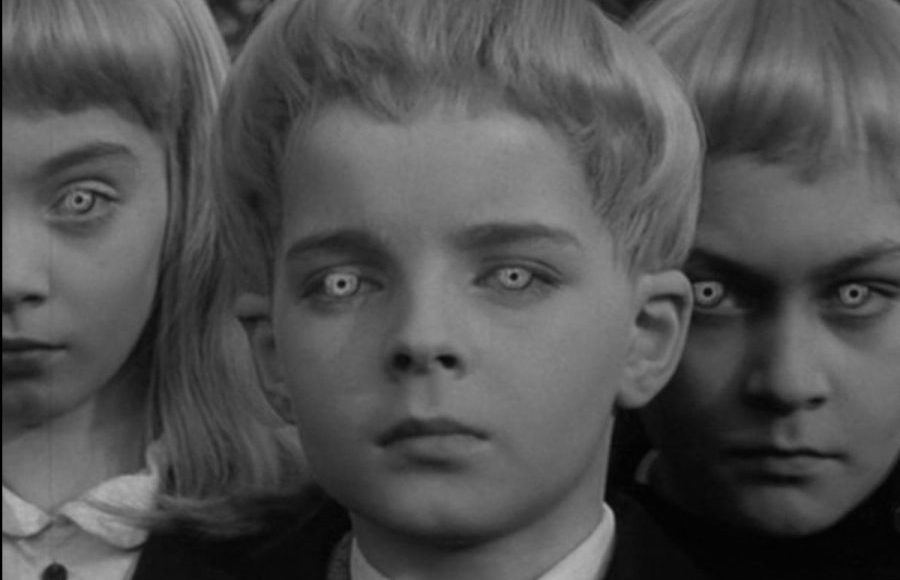
Like Triffids, The Midwich Cuckoos (1957) is infused with Cold War anxiety. Midwich, a village in southern England (based on Midhurst, Sussex), is suddenly isolated by an inexplicable forcefield and the residents rendered unconscious. When the barrier is lifted and people revive, they soon discover that all the women are pregnant. The human-seeming babies turn out to be uncanny cuckoos, planted into the wombs of women by aliens. Once born, the cuckoo children develop fast, act in a disciplined collaborative way and have powers of telepathy and limited mind control. This makes them an inscrutable and dangerous enemy. The hosts find themselves being held hostage by the parasite children, who threaten to grow strong enough to destroy the community that (warily and fearfully) cares for them.
Wisely, Wyndham does not dilute his story by introducing the aliens as other than prime movers. He has no interest in aliens. The science-fiction premise is merely a device to allow Wyndham to explore how communities (and civilisations) respond to the knowledge that they have in their midst forces that wish to supplant them and that are ruthless. From inter-species rivalry, Wyndham has moved to in-species rivalry. Of course, what must have been obvious to more observant readers of the time, was how this was an allegory for Communist infiltration of the West. The Midwich cuckoo-children, like Communists, form a tightly knit group working in concert to overturn the current order and advance to the next level of development, using any means necessary to overcome opposition. What seems so troublingly prescient, is how this scenario could act as a parable of multiculturalism. When a foreign group cannot be integrated, conflict for resources and status arises. If the organised minority overcomes the disorganised majority – as Mosca’s Law tells us – the numerical inferiority of the foreigners is no bar to them consolidating themselves and even coming to rule the hosts. So, while Midwich may seem dated sci-fi tosh set in a rural England of the past – Brian Aldiss will be forever remembered as the writer who damned Wyndham’s novels as ‘cosy catastrophes’ – it is actually a novel of ideas that is vitally relevant in a multicultural society facing a crossroads.
Likewise, The Chrysalids (1957) gives us another brilliant novel with exciting action, suspense and vividly drawn characters in a unique world, and one with a deeply troubling ethical conundrum. Chrysalids is a coming-of-age story set in a post-nuclear-war rural community in Canada, where millenarian Christianity holds sway. The society is obsessed by genetic stability, considering it a moral issue, which they police by destroying produce and animals if they genetically deviate from the norm, and exiling abnormal children. David, the protagonist, becomes aware that he has the power of telepathy. Living in fear that his psychic deviancy will come to light and lead to his expulsion, David forms a bond with the few other children of his age who also have this rare power. Eventually discovered, David and his friends have to flee into the wilderness to escape torture and (potentially) sacrifice.
Perhaps inadvertently on the author’s part, Chrysalids presents us with a question that is even more pointed than the one in Midwich: How far would you go to preserve your values and culture? What would you do if your children joined an extremist political group, or converted to a radical religion? Would you exile (even kill) relatives or your own children, knowing that if you did not, their values would supplant your own? I cannot think of any novels of ideas that are more pertinent today. Engaging with the novel’s issues honestly will result in readers doing some painful self-assessment about his/her limitations and the robustness of his/her values.
Wyndham, like every author, wrote in and of his time. In Triffids, a character drains the petrol from a car’s reserve tank. I don’t think I have ever travelled in a car with a reserve tank, although the concept is decipherable enough from the name. Perhaps the youngest of readers might need a reminder of what a corkscrew is; the idea of vacuum-packed cigarettes is rather neat, although today’s cellophane wrappers perform an inferior but cheaper alternative.
The language and social mores are of their time – which is a strong recommendation to readers of today – and this is particularly so in Triffids. When Wyndham presents the debates between pragmatists and Christians about whether or not sighted men should have multiple blind wives (who could give birth to seeing children), we encounter a slice of 1950s Britain, the last time Christian traditionalism had social hegemony. Today, I suppose many people would consider the matter merely one of avoiding partner jealousy rather than the breaching of a moral commandment.
The illustrations have a strong period flavour, with clothes, interiors and vehicles in Triffids and Midwich being contemporary with the period within which they were written. The retro quality of the illustration style suits the texts. If I had to venture one minor reservation about the illustrations in the Folio Society Wyndham boxset, it is that Leger tends to place us close to the actions, with main figures reaching the page edges. That means we are immersed in an event depicted, rather than viewing a scene at a distance. We are inside a motif, rather than outside a picture. This has some advantages – immediacy, engagement, impact, energy – but also reduces detached artistry, complex composition and contemplative reserve. On balance, it is well that Leger remains stylistically consistent within each volume and across the set.
Designers have taken care to co-ordinate the cover colours with the front and end-papers. The production quality is high and the margins and bindings make reading easy. This boxset with pictorial slipcase and hardback books with cloth spines (a reissue of the editions originally published in 2010) is a handsome set, and an ideal way to enjoy key novels of one of the greatest post-war British novelists.
ALEXANDER ADAMS is an artist, art critic, novelist and poet. His most recent book is Artivism: The Battle for Museums in the Era of Postmodernism (Societas/Imprint Academic, 2022)
BRENDAN MCNAMEE says that deconstruction is as old as its opposite
Eternity is in love with the productions of time
William Blake, The Marriage of Heaven and Hell.
Deconstruction is a modern cliché, but it is something much older and more substantive than a passing academic fad. Since it came to prominence in the sixties and seventies the word has been bandied about in general parlance, losing most of its meaning in the process.
It usually indicates a process of taking something apart and not much more than that, so you have films like Woody Allen’s Deconstructing Harry, which consists merely of a character’s evisceration, and restaurants serving desserts called deconstructed cheesecake, which consists of little more than components of cheesecake separated on a plate.
More seriously, it’s often seen as a destructive rejection of cherished beliefs and certainties. But that word ‘certainties’ is the hinge. Certainties have a way of subtly devolving from life-enhancing structures to stifling and destructive oppressions. An attractive form can hide a rotting interior. Many people instinctively recognise this. If cherished lines from widely beloved poets and musicians are an indication of this recognition then Leonard Cohen’s most oft-quoted line, ‘There is a crack in everything, that’s how the light gets in,’ from his song ‘Anthem’, indicates that deconstruction, as I will read it here, is already subconsciously understood and valued by many. Letting the light in on airless, out-dated structures and practices: that’s the essence of deconstruction.
In this essay, I shall look at deconstruction through a variety of literary quotations, ranging from Heraclitus to Heaney, which show that the practice has been around for as long as philosophy itself, and that it is, and always has been, an integral and vital part of both art and religion. I read it, in fact, as a modern secular form of mysticism, what the American academic John D. Caputo calls ‘religion without religion’ (The Prayers and Tears of Jacques Derrida: Religion Without Religion). Caputo and Jacques Derrida, the putative originator of deconstruction, will be my main (actually, my only) links to the practice of deconstruction as it is understood in academia. My focus will be on how it manifests in the world beyond. In the second part of the essay I will attempt to show how deconstruction can be seen at work in widely disparate instances of literature and film.
***
Without consciousness, there is, to all intents and purposes, no world. On that basis, it can be asserted that all time is contained in the present, the past as memory, the future as anticipation. The present consists of two elements, consciousness and nature, the world within and the world without, subject and object. The world without we call ‘actuality’, all the stuff that makes up the visible universe. We see it through this mirror called consciousness. The stuff changes all the time; the mirror remains the same (that is, the phenomenon of consciousness underlies the individual manifestations of that consciousness through sentient beings in time). Consciousness, then, is another word for eternity.
Wherever there is consciousness, it is always now. But because it only knows itself by its productions, the stuff of actuality, the productions themselves come to be considered paramount, come to be thought of as reality itself. And they are necessary. Crops must be planted, cities built, cultures and laws devised. Structure reigns. But with time these structures become stifling, burdensome, tedious – the weight of tradition, the boredom of habit. The mirror becomes fogged. Deconstruction is the wiping of the mirror. Deconstruction is eternity gasping for breath.
Vladimir Nabokov
When asked whether he believed in God, Vladimir Nabokov said, ‘I know more than I can express in words, and the little I can express would not have been expressed, had I not known more’ (Strong Opinions, p45).
Is this what lies at the heart of deconstruction? A sense that the world as it is described in language is missing some vital element, some element that cannot be captured in language, but the vague awareness of which is what largely drives that described world of language? As the theologian Paul Tillich puts it, ‘It is the riddle and the depth of all expression that it both reveals and hides at the same time’ (Art, Creativity, and the Sacred, p221). Derrida echoes that idea in these words: ‘We are dispossessed of the longed-for presence in the gesture of language by which we attempt to seize it’ (Acts of Literature, p78). Poetic language could be seen as both a lament at this dispossession and a desperate attempt to overcome it all in one.
You can extrapolate from Nabokov’s sentence to life itself: ‘I am more than I can express in words, and the little that I can express could not be expressed, were I not more.’ That ‘more’ is what divides the world between materialists and idealists. For materialists, the world we see around us is quite fascinating enough; for idealists there is something essential missing. For idealists (believers and non-believers alike), that indefinable ‘more’ is what keeps the ship afloat. Like a string on a well-tuned guitar it keeps life at a tension, a tension necessary to create the music of life itself. ‘The harmony past knowing sounds more deeply than the known,’ as Heraclitus has said (Fragments: The Collected Wisdom of Heraclitus, p31). Isn’t this why we make art? As Steve Toltz puts it, ‘We make art because being alive is a hostage situation in which our abductors are silent and we cannot even intuit their demands’ (Quicksand, p16).
Take Beckett’s Waiting for Godot. Where, or what, would Beckett’s tramps be without Godot to wait for? They wouldn’t be anywhere. They wouldn’t be. The essence of Godot is his non-arrival, just as – perhaps – the essence of God is his unknowability, his unattainability, and, almost certainly, his non-existence. By his non-existence I mean that God may simply be the idea of God. As Henri de Lubac put it, ‘We do not have desire for God; we are that desire. It is imprinted on our created nature’ (Mystery of the Supernatural pps176-77). Just as Godot is needed to keep the tramps on stage, so is the idea of God (or whatever unattainable ideal one substitutes for God) needed to keep us all trudging through the wastes of time. (Absence pervades presence, may indeed be the larger part of presence, much in the way that dark energy may be the larger part of the universe, even though it cannot be detected.)
More optimistically, the idea may be what’s needed to transform those wastes of time into something more like a garden. True religion, like true art, is alchemy. The effect of great art, regardless of what actual events are being portrayed, is exhilaration. In this sense, all great artists are mystics, and art is the most accessible form of mysticism we have, and one of the most effective ‘mirror-cleaners’ we have. Likewise, religion. Seen in this light, both art and religion are forms of deconstruction. Seen in another light, of course – when form overrides mystery, when significance declines into meaning – they are very much in need of deconstruction.
In his book, Deconstruction in a Nutshell, John D. Caputo calls deconstruction love. Love itself cannot be deconstructed because it is not a thing, it is not static. Love happens. How many stories there are that demonstrate this by showing love as a disruptive force: love across the race divide, the class divide, the cultural divide, always disrupting accepted ‘truths’ of life, which of course are not truths at all but merely comfort blankets masquerading as truths. Love underlies all social and cultural expressions of it, which are just that: expressions of an intangible reality, but not the thing itself (much like consciousness and the productions of time).
There’s a scene in a recent sitcom, called Hold the Sunset, which subtly illustrates this idea. John Cleese plays a crusty old codger with a reputation for sarcasm. One of his neighbours, often the butt of his jokes, is a dog lover. One day, the Cleese character encounters this neighbour out walking accompanied only by the dog’s leash. A brief conversation conveys the information that the dog has died, but the neighbour hasn’t quite got over it yet and it comforts him to walk with the leash. Cleese makes some sympathetic comment about this, which the man, knowing Cleese’s general outlook, takes to be mockery, but Cleese hastens to reassure him that it isn’t, that he understands fully the man’s actions, that love is love, whatever the nature or character of the recipient. Finally, the neighbour gets his point and says, ‘You mean, love can’t tell the difference.’
Love can’t tell the difference. In that sense, love doesn’t actually exist until it finds a recipient, just as deconstruction is not a ‘thing,’ and doesn’t actually exist until it has some established ‘truth’ to work on. Just as eternity doesn’t exist until it finds an expression through the productions of time. You can’t have a mirror without a dark back, and vice versa. Perhaps the same thing is meant when people say God is love. God doesn’t exist – or not for us, anyway – until he is manifested in the world. Manifested as the world?
There is an old Sufi legend about a certain Arab who died and left seventeen camels, which he bequeathed to his three sons in the following proportions: to the oldest a half; to the second a third; to the youngest a ninth. The three sons were disputing violently about the proper division of the camels when a stranger rode up to them from the desert and asked them the cause of their anger. When they had explained it to him he said: ‘But this is very simple. I shall give you my camel; so now you have eighteen instead of seventeen, and the sum is easily done. The eldest will take nine, the second six and the youngest two.’ When the three sons had each taken the camels allotted to him, they found that one was left over. ‘And therefore,’ said the stranger, ‘I can now take my own camel back again, and yet leave you with no further cause of dispute.’
This expresses the same idea as Blake’s aphorism, cited at the start. Time is where we live, the land of the tangible (camels and churches, governments, games, art, everything), but all of these productions, all these things, only make sense in light of an intangible force lying behind them. Deconstruction is the attempt to keep that mysterious force in play, to keep that crack open without which life would become stale and airless. In the absence of deconstruction, when there is too much order, too much rigidity, something snaps: ‘Tedium is the worst pain. The mind lays out the world in blocks and the hushed blood waits for revenge’ (Grendel, John Gardner, p109).
The mind lays out the world in blocks: this is a good definition of the world’s structures, whether cultural, social, literary, judicial or whatever. When they become set in their ways and fail to respond to changing circumstances or to the nuances of a situation’s contexts, as they invariably do due to human laziness and complacency, then boredom and discontent sets in. Eventually, something snaps. Modernism in its many forms – cultural, social, political – was perhaps the loudest snap of the twentieth century.
Norman Mailer
Norman Mailer once compiled an extensive list of opposing qualities, entities and concepts that he labelled hip/square, such as wild/practical, romantic/classic, instinct/logic, a question/an answer, self/society, associative/sequential and many more, all of which can be seen to be, in varying degrees, reflections of the chaos/order divide (Advertisements for Myself, pps346-48). The idea of deconstruction could be seen as the academic version of the corresponding societal movement that shook the sixties. Revolution was in the air. But it’s important not to forget the second member of the pairing. One of Mailer’s pairs of opposites, self/society, calls to mind a sentence from Machiavelli: ‘No stability without an institution; no progress without an individual.’You need some degree of stability or there would be no possibility of civilisation of any kind. So you need institutions (something Derrida was always at pains to stress). But you also need innovative individuals who insist on disrupting things when those institutions become stale or unworkable. And where would the innovative, deconstructing individuals be without institutions to work against? You can’t jump into the air without a ground to spring from.
Another, and perhaps more helpful, way of expressing the chaos/order divide is to call it a dynamic/static divide. In Lila: An Enquiry into Morals, Robert Pirsig proposed this as a more fundamental divide in life than the subject/object divide, which is the one that prevails in our current materialistic and common sense based world. And the deeper you delve into deconstruction, the more you find it corresponds to this division: the structures of the world, whether social, cultural, legal, literary, political, etc, all tend toward the static. Rules get laid down, they seem to work (they keep chaos at bay, they explain so much), so they are adopted with fervour and adhered to rigidly. Too rigidly. History is littered with the appalling results of this rigidity, this fundamentalism, mostly in the fields of politics and religion. Every effort to crack open such petrified structures is a form of deconstruction.
Theodore Adorno once described the relationship between empirical reality and works of art as a form of redemption: ‘Everything will be just as it is and yet wholly different’ (John Banville, Athena, p105). Everything will be as it is – that is, the structures of the world will not change in their essence, they will still be structures and continue to serve whatever purpose they were constructed to serve, but they will be wholly different because seen with different eyes, eyes that are open to potential, to nuance, to change. There will still be seventeen camels, but the brothers will have no cause for dispute because their eyes will be open to the possibility of an eighteenth camel, a possibility that, without having to exist in any material sense, redeems all that does so exist. Deconstruction then could be seen as a kind of open-ended, undefined faith.
John Banville
John Banville has written a radio play in which Isaac Newton, the inventor of the calculus (and also a devoted alchemist), says the following:
The calculus operates upon the premise of a closer and closer approach to infinity. Infinity, however, may not be approached. Infinity is, and there’s an end of it. Yet the calculus works . . .
Stardust
The same might be said for language and reality. Language operates upon the premise of a closer and closer approach to reality. Reality, however, may not be approached. Reality is, and there’s an end of it. Yet language works . . . Up to a point, anyway. There is still that tantalising mystery that keeps escaping, that no word seems equal to. But a word had to be found, nonetheless, so we came up with the word God. Yes, that’ll do. God is the name of and cause of everything that is. That settles the question, right?
No, very rightly wrong, as Beckett would say. There is no answer. ‘God’ is just another deferral. The word might have been fine had it not been taken for an answer. ‘He should have had a name that sounded like a question,’ as Cees Nooteboom puts it (Rituals, p42). That would have put deconstruction at the heart of all that is. In the Hindu mythology Prajapati, Lord of the Creatures, has a secret name, Ka, which in Sanskrit means, ‘who?’ ‘Prajapati is the god who has no identity, who is the origin of all insoluble paradoxes’ (Roberto Calasso, Ardor, p8).
***
Consider these two statements, the first from the Spanish writer, Javier Cercas, the second from Clarice Lispector, the Ukranian-born, Brazilian writer sometimes referred to as the Brazilian Kafka:
‘Literature is always anti-literary.’ (The Blind Spot, p36)
‘There’s one thing I understand: writing has nothing to do with literature.’ (The Paris Review, interview)
Both these statements are saying the same thing, though this is disguised by the fact that the word ‘literature’ is used in opposing senses by each writer. Cercas’s ‘literature’ is Lispector’s ‘writing’ and Lispector’s ‘literature’ is Cercas’s ‘literary.’ Both statements are intuitive expressions of deconstruction. This is best explained by recourse to Robert Pirsig’s division of life into what he calls dynamic quality and static quality. Applied to literature, this is the division between pure creativity as it happens, and the result of that creativity as it appears in the world, what Annie Dillard has called ‘the creative process frozen with its product in its arms’ (Living by Fiction, p164).
Cercas is using the word ‘literature’ to refer to the creative process, and by ‘literary’ in the term anti-literary, he means the ‘business’ of literature, the criticisms, the essays, the classification into genres and literary periods, the endless chatter about books, very little of which can claim close kinship with the creative process itself (though some of it can: those readers who, unaware of what they should or should not approve of according to the official tastemakers, are genuinely enraptured by some work or other. Such readers, it could be said, are partaking in that very creative process itself. As Borges has put it, the man who reads a line of Shakespeare becomes Shakespeare. Mind you, that would have to be a man with a very fresh eye). And Lispector is echoing this sentiment. Her ‘writing’ is Cercas’s ‘literature.’ Dillard’s image is a nice one. The frozen product is the hardened lava at the foot of a volcano. The volcano itself has little interest in poring over the remains of its effusions at the foot of the hill. This is why you will often hear writers and artists expressing little interest in past work, however lauded it might be by their audiences. It’s the process itself that truly enraptures them. It also explains the even more common expression from artists that they often feel themselves to be mere conduits for some mysterious force that uses them to reveal itself in the world.[1]
***
‘You are neither here nor there,
A hurry through which known and strange things pass.’
Seamus Heaney, ‘Postscript’
‘There is an absence, real as presence.’
John Montague, ‘A Flowering Absence’
Wittgenstein began his TractatusLogico-Philosophicus with the sentence, ‘The world is all that is the case,’ and ended it with this one, ‘Whereof we cannot speak, thereof we must be silent.’ Materialists have concentrated on the first sentence, and the detailed adumbrations that follow it; for idealists, on the other hand, the final sentence is the point where things begin to get interesting. What is it that we cannot speak of? And if we cannot speak of it, how are we aware of it in the first place? Could it be that this mysterious non-entity is what creates everything that is the case (everything that can be spoken of) to begin with? Could that be the reason for its eternal presence (as an absence) in our minds? This is an established religious idea: the world is God’s mirror, which God needs in order to see himself. In order to be? Two of Christianity’s most mystical theologians, the fourteenth century German Dominician, Meister Eckhart and the ninth century Irish philosopher, John Scotus Eriugena, would seem to think so:
This is why I pray to God to rid me of God, for my essential being is above God in so far as we comprehend God as the principle of creatures. . . And if I myself were not, God would not be either; that God is God, of this I am the cause. If I were not, God would not be God
Eckhart, quoted in Dermot Moran, The Irish Mind, p91
It follows that we ought not to understand God and the creature as two things distinct from one another, but as one and the same. For both the creature, by subsisting, is in God; and God, by manifesting Himself, in a marvellous and ineffable manner creates Himself in the creature
Eriugena, ibid. p91
This can be put in less religiously-charged language. This is Alex Dubilet:
The infinite names not a transcendence that ruptures the self-sufficiency of the subject, but an immanent and impersonal process that precedes and exceeds the very difference between self and other. [. . . a hurry through which known and strange things pass] . . . subjective life is always already a deformation, a life made to suffer by being forced into itself
academia.edu
Lawrence Durrell puts the same idea like this: ‘People are not separate individuals as they think, they are variations on themes outside themselves’ (Constance, p378). Love is perhaps the strongest of those ‘themes’ and might go some way toward explaining the ever-yearning nature of humans. We are like Philip Larkin’s young steers, ‘always seeking purer water, / Not here but anywhere’ (‘Wires’). Or, perhaps, anywhere but here, here being the ‘subjective life’ that is ‘always already a deformation’ because it knows intuitively that this sense of separation, of individuality, is unnatural, or incomplete.
***
‘Deconstruction arises in response to an imperative that has to do with the ‘mystery’ of the impossible, not merely the ‘problem’ of the possible’ (Caputo, lix). The idea of mystery lies at the heart of literature. Take Jorge Luis Borges’ definition: ‘Literature can be defined by the sense of the imminence of a revelation which does not in fact occur’ (Selected Non-Fictions, p346). To a certain mindset, this might seem thoroughly pointless. If the revelation does not in fact occur, haven’t you just wasted your time? This attitude, sadly, is very much the prevailing one today, and partly explains, I think, why literature is in decline. Definiteness reigns, and facts are king. But Borges is talking about living within an atmosphere of mystery wherein every aspect of the world is charged with a mysterious significance. He clarifies this in a re-statement of the idea:
Music, states of happiness, mythology, faces worn by time, certain twilights and certain places, all want to tell us something, or have told us something we shouldn’t have lost, or are about to tell us something; that imminence of a revelation as yet unproduced is, perhaps, the aesthetic fact (ibid. p346).
If we are attuned to those ‘known and strange things’ spoken of by Seamus Heaney in the lines above, then we are deconstructionists by default. Those lines continue, ‘As big soft buffetings come at the car sideways / And catch the heart off guard and blow it open’ (‘Postscript’). That, I would say, is a good definition of deconstruction’s purpose – catching the heart off guard, and blowing it open.
***
‘These things never happened, but are always,’wrote Sallust on myth (Roberto Calasso, The Marriage of Cadmus and Harmony, epigraph). Is myth itself a form of deconstruction? Myths are eternal truths underlying the more tangible realities of life, but they are unamenable to being captured in systems (unless mistaken as actual events). They are continually re-interpreted so that they continue to speak to peoples across a wide range of cultures. They never happened, so they can never take their assigned place in history; they inform all that does happen, giving it significance beyond the time in which actual events take place. ‘What has never anywhere come to pass, that alone never grows old,’ as Schiller has put it (Schopenhauer, p247). It’s been said about Shakespeare, for instance, that we don’t read Shakespeare, Shakespeare reads us. Shakespeare deconstructs us.
‘What has never anywhere come to pass, that alone never grows old.’ This is as good a definition of consciousness, or eternity, as one could ask for. The trouble with our normal understanding of consciousness is that, so thoroughly entwined is it with the stuff of life, we always think of it as consciousness of something. It is literally impossible to imagine consciousness alone (‘Consciousness-without-an-object’ is how one philosopher-mystic, Franklin Merrill-Wolff, describes the mystic state.) Try it and see. The nearest you can come is to imagine an empty space, but even this is ‘something.’ The problem appears to be that as long as you are consciously engaged in imagining, then you are imagining ‘something.’
Roberto Calasso
Hindu mythology can be helpful here. In Hinduism, brahman is ultimate reality. Roberto Calasso describes it thus:
But the brahman, whatever that might be, must necessarily be divided into two parts: the ‘unmanifest’ and the ‘manifest.’ The one is therefore always two. . . The brahman is the wild goose that ‘in rising from the water, it does not extract one foot. If it did, neither today nor tomorrow would exist.’ The water is the unmanifest brahman, the wild goose is the manifest brahman. (K, pps47-48)
The unmanifest brahman here would be consciousness alone, Merrill-Wolff’s consciousness-without-an-object; manifest brahman is the stuff of consciousness, the actual world we inhabit, the wild goose. But the wild goose, independent though it appears to be (and is, according to materialists), has one foot in the water, without which ‘neither today nor tomorrow would exist.’ Time itself, that is, arises from consciousness, the consciousness that is unmanifest, and can never be apprehended, because it is what is doing the apprehending, and what it apprehends is the wild goose, the actual world. So when Caputo talks about ‘the mystery of the impossible,’ this unmanifest aspect of reality is what I take him to mean. It stands apart from ‘the problem of the possible’ because the problem of the possible is the kind of problem that science and reason are equipped to deal with, the definable problems of the actual world. And, again as Caputo says, deconstruction (like art and religion) ‘arises in response to’ this mystery of the impossible. Derrida’s ‘trace,’ that mysterious intangible shadow he finds behind all language, is perhaps the wild goose’s dim awareness of the water from which it gains its life.
Deconstruction in film and literature
Purity is the malign inversion of innocence. Innocence is love of being, smiling acceptance of both celestial and earthly sustenance, ignorance of the infernal antithesis between purity and impurity. Satan has turned this spontaneous and as it were native saintliness into a caricature which resembles him and is the converse of its original. . . . Religious purification, political purges, preservation of racial purity – there are numerous variations on this atrocious theme, but all issue with monotonous regularity in countless crimes whose favourite instrument is fire, symbol of purity and symbol of hell.
Michel Tournier, The Erl-King, p. 70
If deconstruction is, as John D. Caputo has it, love, and, as Derrida says, ‘a response to a call,’ then the Bourne Trilogy can be seen as a subtle cinematic expression of deconstruction in action, and an instance of the power of love.
Jason Bourne is purity personified. He is a pure machine, trained to do one thing and not to let any extraneous factors, such as emotion or complexity, cloud that purpose. The purity derives from an idea. A noble idea. In this case, the idea of the American Way. Freedom. Democracy. It could just as easily be the idea of communism, or Aryan supremacy, or Islamic fundamentalism, or nationhood, anything, that is, with the power to capture people’s imaginations and inspire them to build an impregnable structure housing that idea. Nothing can be allowed to threaten or undermine this structure in any way. Soldiers must be trained to defend it. To be effective, such soldiers must never allow the muddle of human emotions to distract them from their purpose. Hence – ultimately – such soldiers as Jason Bourne. The shell protecting the purity of the purpose must be impenetrable.
But, thankfully, the shell is never impenetrable. There is a crack in everything. The pivotal moment of the Bourne Trilogy occurs towards the end of the first movie, The Bourne Identity, in a flashback scene wherein Bourne remembers the event that set him adrift on the ocean with two bullets in his back and a serious bout of amnesia. He is on a mission to execute an African leader on a ship. All prepared to pull the trigger on his sleeping victim, he suddenly finds himself looking into the clear innocent eyes of a five-year-old child – and the shell cracks. Something penetrates to the core, the core that perhaps attracted him to the purity of his cause in the first place. And this core is innocence in Tournier’s sense of the word, an instinctive recognition that life, in all its tumultuous variety and chaos, is the true value, and that to force this wondrous incorrigible plurality into a pre-conceived shape is the real sin. Trying to put order on the chaos of life is a natural and necessary human impulse, but it can go too far. When it does, life turns into death. In George Eliot’s words, ‘There is no general doctrine which is not capable of eating out our morality if unchecked by the deep-seated habit of direct fellow-feeling with individual fellow-men’ (Middlemarch).
In a word, Bourne is touched by love. And love is a force that will not be corralled into the neat paddock of ideology, whatever that ideology’s declared good intentions. This, I think, is what Caputo means when he calls deconstruction ‘love,’ and what Derrida means when he refers to it as ‘a response to a call’ (Dialogues with Contemporary Continental Thinkers: The Phenomenological Heritage, Richard Kearney , p118). Any idea can be deconstructed because ideas are essentially fictions to begin with, makeshift mental shacks erected to help us navigate the chaos of life. Love, by contrast, is not a construction (and if it is, it’s fake, self-delusion born of a deep need). Love is not a thing at all, but rather something that happens; a force with the power to disrupt all social, cultural and political structures, regardless of how reverently held they may be.
What happens to Bourne finds an echo in Samuel Taylor Coleridge’s poem, ‘The Rime of the Ancient Mariner.’ Like Bourne, the mariner is lost in darkness through an act of murder (the killing of an albatross), and, like Bourne, he too is blessed with an epiphany of sorts – in this case, the sighting of sea-snakes. He is struck by the beauty of the creatures, a beauty beyond the ability of any language to describe (‘No tongue / Their beauty might declare’), and thus beyond capture by any structure:
A spring of love gushed from my heart,
And I blessed them unaware:
Sure my kind saint took pity on me,
And I blessed them unaware
II. 282-87
‘Unaware’ is a key word in that quatrain (as Coleridge indicates by repeating it). It happens beneath the level of conscious thought, beneath the level at which mental structures are erected, and are thus immune from being deconstructed. Jason Bourne’s kind saint, the power of love itself, has stopped him in his tracks for just long enough to disrupt his planned assassination. The putative victim wakes up and takes a few shots at Bourne, who just manages to escape overboard, thus setting in motion a series of events that will in time become the flower of which this initial insight was the seed.
Over the course of three films, Bourne then spends his time getting to the root of the evil that has been done to him, and doing his best to put it right. The purity he fights is bluntly expressed by a CIA boss in a scene with Pamela Landy, a CIA controller trying to do the right thing by Bourne, in the third film. The boss has ordered that Nicki, the girl sent to talk to Bourne, be killed along with Bourne because he suspects she has gone over to the fugitive’s side. When Landy objects to this, saying, ‘If we start down this path, where does it end?,’ he snarls in reply, ‘It ends when we’ve won.’ The battle-cry of purists and fundamentalists the world over: It ends when we’ve won. When we’ve silenced or killed off all the opposition to our one pure way of life.
Pascal put the idea like this: ‘Man is neither angel nor beast, and unhappily whoever wants to act the angel, acts the beast’ (Pensées, p358). Deconstruction, seen in this light, is a way of guarding against the angel turning into the beast.
The ideal deconstructionist might be the character of Pamela Landy in the third Bourne film. She wants to take the risk of talking to Bourne though, for all she knows, he may well be the renegade assassin her superiors say he is. She certainly has no wish to destroy the institution of which she is a member, but she knows instinctively that it cannot function as a healthy body by simply following blind procedures without regard to other, and possibly dangerous, possibilities; without, in other words, being open to ‘the other.’ In a similar fashion, Derrida has no wish to destroy the philosophies which he deconstructs, but rather to let the fresh air of new thinking into them, in order to keep them alive. Deconstruction is a modern secular way of keeping the fresh air of the infinite blowing through the finite world.
Huckleberry Finn
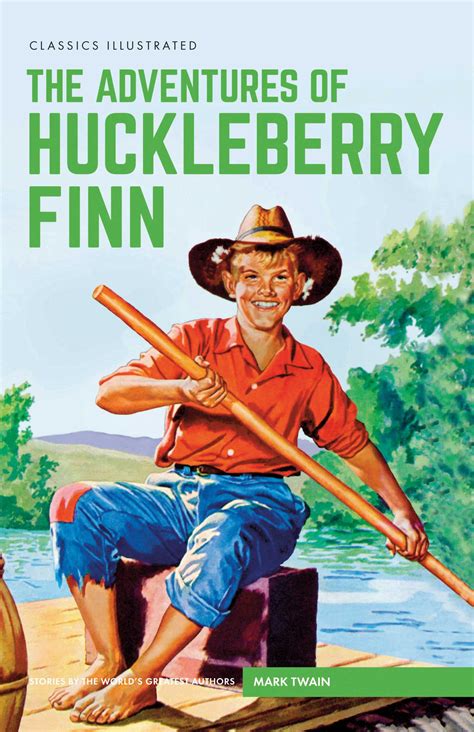
If deconstruction is spontaneity in action, the law of the heart triumphing over the law of the land, or over the law of whatever social mores or cultural rigidities are currently in vogue, then Huckleberry Finn provides a perfect example.
Huck’s essential being is itself a form of deconstruction of all the social and cultural structures that he’s surrounded and mostly oppressed by, all flying under the banner of ‘sivilisation,’ but the idea is most clearly and sharply focused in the story of the journey down the Mississippi with the escaped slave, Jim. Huck is no intellectual, he fully accepts his society’s view of slaves, which is that they are owned in their entire inferior being by the whites, who have been given this duty of care by God. Slavery, far from being an evil, is God’s law. Huck accepts this. But on the journey down the river, he comes to know and like Jim as an individual human being, one much like himself, and he is tortured by the thought of giving him up to the authorities, something his rational mind tells himis the correct thing to do. The law of the heart (or wherever the seat is of these fleeting, spontaneous impulses) comes up against the law of the head.
This is deconstruction in action. In allowing his heart the victory in this particular battle, Huck is deconstructing a fundamental fixed point of his society’s belief system. This is not at all the same thing as Huck thinking the problem out intellectually and deciding that slavery per se was a bad thing. This would simply be pitting one intellectual position against another. It’s important that Huck ends his inner conflict, not by suddenly becoming enlightened about the evils of slavery, but by obeying the deeper truth he hears within himself, the one that can’t be pinned down in any statute book. Derrida posits justice as the deconstructive element in law. There may be no justice in the world, but the law – fixed statutes and penalties – is fired and inspired by the idea of justice (but too often perverted by the actions of Tournier’s Law: ‘Purity is the malign inversion of innocence’). ‘You’ll get justice in the next world,’ goes the opening line of William Gaddis’s novel, A Frolic of His Own, ‘in this world we have the law.’ With Huck and Jim, justice is the event that has disrupted the rigidity of the law, that event being the un-deconstructible human connection between them. That is, love.
‘no help for that’
At heart, the human being is a lack (we’re all waiting for Godot), and deconstruction is the intuitive awareness of that lack, and of the necessity of keeping a weather eye on the dangers of anything that promises to be ‘the answer.’ I doubt if Charles Bukowski has ever been accused of being a deconstructionist, but he did write this:
no help for that
there is a place in the heart that
will never be filled
a space
and even during the
best moments
and
the greatest
times
we will know it
we will know it
more than
ever
there is a place in the heart that
will never be filled
and
we will wait
and
wait
in that
space.
What is this but Derrida’s longing for the impossible?
Three Colours: Blue
Julie, the protagonist of Krzysztof Kieslowski’s Three Colours: Blue loses her husband and child in a car accident and decides, as a way of alleviating the pain of this loss, to effectively shut down her life. She cuts all ties with friends and family, moves to a flat in the city and establishes a simple routine centred on the local cafe and the swimming baths. She puts her life on auto-pilot; safe, secure, swaddled in pain-free tedium. On a personal level, she echoes those fundamentalist religions and political systems that operate by strict rules and regulations and abhor all innovations and spontaneity.
But life will not have it. Slowly but surely she is drawn back into the flow. As the wife of a famous composer (and a composer herself) music had been her great love, and now, despite efforts to rid herself of this aspect of her past, it keeps stopping her in her tracks, pieces of a musical score suddenly banishing the mundanity around her. And people, too, will not be ignored. Her essential goodness and humanity (which will be made explicit towards the end of the film) is drawn out when she responds to the sounds of a man being attacked by thugs in the street outside her apartment. She doesn’t respond with enough vigour to do the poor man any good, but it’s a start – a start that creates a connection with a young woman living on the floor beneath. Then she refuses to sign a petition got up by the other residents who want to kick out this young woman whom they regard as a whore. As a result, the young woman becomes her friend. Bit by bit, she is drawn back into life – to the point where, finding out that her husband had been having an affair with a young lawyer, she goes to see the woman and, on hearing that she is pregnant, gives her a place to live – her old house (a beautiful chateau) which she had previously put up for sale. And she completes her husband’s final unfinished symphony in tandem with her husband’s assistant, with whom she embarks on an affair.
It’s a classic story arc in both literature and film: the stony heart, cut off from life through pain of one kind or another, gradually melted through contact with people, in effect, through the power of love. So what can it possibly have to do with deconstruction, or any of deconstruction’s extended family? As mentioned earlier, deconstruction is love, a response to a call. Love is the ultimate deconstructing power because it, alone, is not, and never can be, a construction of any kind. Rather, it is what infuses all other structures – families, institutions, philosophies – with their life. Julie has built herself a life which she believes will free her from pain, and love has deconstructed it, prevented it from degenerating into an empty shell. As if to underscore the point, the film ends with the famous words of St. Paul, set to the music she has composed: ‘If I have not love, I am become as hollow brass.’ An empty shell. Whether it’s a personal life, a religious organisation, a political system or a philosophy, without love at the heart of it, it’s worthless. St. Paul’s famous words, seen in this light, may well be western literature’s earliest deconstruction manifesto.
Pride and Prejudice
Possibly the most famous scene in Pride and Prejudice is the one where Darcy, fascinated despite himself by Elizabeth, dares to open a crack in his well-structured stuffy world in order to make her a proposal – and Elizabeth responds by blowing the walls down. She deconstructs his world in the best Derridean fashion: that is, she shatters his false, desiccated notions of propriety and decorum while leaving the solid structure supporting those notions intact (everything will be as it is yet wholly different). After all, she does want to live there.
Works Cited
Banville, John. Stardust. Radio monologues, BBC 3, 11/05/02.
Frye, Northrop. ‘Reconsidering Levels of Meaning,’ Christianity and Literature, 54.3 (Spring 2005), pp. 397-432.
Heaney, Seamus. Spirit Level. London: Faber and Faber, 1994.
Heraclitus. Fragments: The Collected Wisdom of Heraclitus. Trans. Brooks Haxton. New York: Viking Penguin, 2001.
Houellebecq, Michel. Public Enemies. London: Atlantic Books, 2011.
Imhof, Rudiger. ‘An Interview with John Banville: ‘My Readers, That Small Band, Deserve a Break.’’ Irish University Review 11.1 (1981): 5-12.
Kearney, Richard. Dialogues with Contemporary Continental Thinkers: The Phenomenological Heritage. Manchester: Manchester UP, 1984.
Larkin, Philip. Collected Poems. London: Faber and Faber, 1988.
Lispector, Clarice. The Paris Review. ‘Clarice Lispector: Madam of the Void,’ interview with Jose Castello, December 10, 2020. (theparisreview.org.)
Lubac, Henri de. Mystery of the Supernatural. London: Geoffrey Chapman, 1967.
Mailer, Norman. Advertisements for Myself. London: Granada, 1972.
Moran, Dermot. ‘Nature, Man and God in the Philosophy of John Scotus Eriugena’ in R. Kearney, ed. The Irish Mind. Dublin and New Jersey: Wolfhound Press and Humanities Press, 1985. pp. 91-106; pp. 324-332.
Nabokov, Vladimir. Strong Opinions. New York: Vintage International, 1990.
Pascal, Blaise. Pensees and Other Writings. Oxford: OUP, 2008.
Pirsig, Robert. Lila: An Enquiry Into Morals. London: Bantam Press, 1991.
Tillich, Paul. ‘Art and Ultimate Reality,’ in Diane Apostolos-Cappadona, ed. Art, Creativity, and the Sacred. New York: Crossroad, 1984. pp. 219-35.
Toltz, Steve. Quicksand. London: Sceptre, 2016.
Notes
[1] Some testimonies from artists on the subject: The French poet and novelist Michel Houellebecq has said: ‘It is as though – and I know this sounds irrational – it is as though the poem already existed, has existed for all eternity, and that all you have done is discover it’ (Public Enemies 247). John Banville had this to say on the creation of his novel, Kepler:
Always I begin with the shape. But let me make a distinction, a very important one. The form of say, Kepler, is in itself wholly synthetic, by which I mean that it is imposed from outside, yet by synthetic I do not mean false, or insincere. It is, this formal imposition, the means by which I attempt to show forth, in the Heideggerian sense, the intuitive shape of the particular work of art which is Kepler, and which was there, inviolate, before and after the book was written. (Imhof 6)
Keith Richards of the Rolling Stones has said this on the subject of song writing (I’m paraphrasing from a barely-remembered interview): ‘You don’t write songs, you sort of pluck them out of the ether. They’re there, all the time. You just have to find them.’ And speaking of such poets as Keats, Wordsworth and Eliot, Northrop Frye has claimed: ‘They’ve all said the same thing. The poet does not think of himself as making his poems. He thinks of himself as a place where poems happen. (Frye 408)
BRENDAN MCNAMEE is the author of books and articles on John Banville, Michel Houellebecq, Gerald Murnane, Robert Musil, Sean O’Casey, Flannery O’Connor, W B Yeats and others
Caino (bis) – Wilhelm von Gloeden (Wikimedia Commons)
This is Chapter 23 of GOMERY KIMBER‘s latest novel, No Air Native, No Man Kindred
August 1935. A young James Valentine pursues his cousin, Clarissa Wyvern, to Munich. Clarissa is the black sheep of the Wyvern clan, dishonouring the family name by joining the British Union of Fascists. She wants nothing less than to capture the heart of Adolf Hitler, in the belief that doing so will prevent war between England and Germany. But those closest to Hitler, such as occultist Professor Lustgarten, are certain she is a spy. It was Lustgarten who set Hitler on the path to dictatorship, and the Professor is determined that Clarissa will not ensnare the Fuehrer. But Lustgarten is distracted by the brilliant James Valentine, a young man of genius whose ambition is to become the foremost novelist of his generation. Lustgarten has a secret ambition of his own, nothing less than to become a god…
CHAPTER TWENTY-THREE
The Institute’s director lived in a secluded villa hidden amongst pine trees on the edge of the walled grounds.
It was hot and sultry when they arrived from the city in the early afternoon. Lustgarten parked the Opel in front of the villa. It was a rather ugly building, tall and narrow, with wooden beams and a steeply pitched roof, but its off-putting appearance was softened by the white roses climbing trellis work on either side of the front door.
Lustgarten led the way to a carved wooden gate, and James Valentine followed him round the side of the building and onto the terrace at the back of the house. The French windows stood open. They went inside. On the dining-table was an arrangement of summer flowers in a vase. The walls of the dining room were lined with glass-panelled bookcases on top of which were displayed a collection of primate skulls. On a side table, James saw books – Ernst Juenger’s war memoir and a volume of pseudoarchaeology by Ignatius Donnelly.
‘Let me get you a drink,’ said Lustgarten.
‘Thank you.’
‘Beer?’
‘Yes, please.’
Valentine was thirsty and hot. The prospect of a cold beer was delightful.
‘It is my housekeeper’s afternoon off,’ said Lustgarten, going through into the rear hallway which led to the kitchen.
‘You leave the doors open?’ said Valentine, following him.
‘Why not? As you saw, the front gate is guarded. This is a secure institution. No unauthorised person can get in, or out.’
As he was speaking, Lustgarten removed bottles of Munich beer from the Linde refrigerator. He was very tall with large feet, but as he went over to the dresser for the glasses he moved gracefully, like a dancer.
‘Here,’ he said, smiling at Valentine, offering him a glass and one of the bottles.
‘Wonderful,’ said Valentine, popping the porcelain cap.
He poured the iced beer into the glass, and as he waited for Professor Lustgarten to do likewise, he looked at the golden liquid foaming, and became quite enchanted with it. He heard Lustgarten chuckle.
‘What?’ asked Valentine, looking at him.
‘You are like a child. I am not being rude, it is merely an observation. You have a poet’s sensibility, I think; or better yet, that of a mystic.’
‘I’d have to agree with you,’ said Valentine.
He was amused. It was obvious that Lustgarten was taken with him. At school, such an infatuation would have been called a ‘pash.’ Valentine had found it mildly ridiculous when it was a fifth former who had a passion for an angelic eleven-year-old, but the present situation struck him as even more absurd. Lustgarten must have been over fifty, and he, Valentine, was no longer a pretty youth but a robust young man nearing twenty. Was the Professor about to make a fool of himself? Valentine hoped not. He liked the man. He was brilliantly accomplished and successful, even if he did have some strange ideas. What could be more risible than falling for a man the way a man fell for a girl?
Lustgarten raised his glass. ’Your very good health,’ he said, looking into Valentine’s eyes.
‘Cheers,’ said Valentine. The beer was icy and refreshing, and Valentine almost groaned with pleasure after taking a draught.
‘Good?’
‘I’ll say.’
‘Let me show you the experiment I mentioned,’ said Lustgarten, after a moment.
‘The planaria? All right.’
Once again, Valentine followed the German into the hall.
‘Yes, they are interesting creatures,’ said Lustgarten. ’Incredibly simple organisms, without brain or nervous system, they make for excellent laboratory subjects. But I wondered, you see, how they could learn without a brain. What I discovered is . . . well, let me show you.’
The laboratory was a large room with high windows at the front of the house. It was warm in the room and Lustgarten crossed to the windows, raised the blinds, and opened them wide. The flat worms were kept on a carved wooden bench at the back of the room. Valentine examined the glass tubes in which they were housed.
‘They cannot survive without water,’ said Lustgarten, returning from the windows. He pointed to one of the tubes. ’Open the tap.’
‘Seems a bit unfair,’ objected Valentine, but he did as he was asked.
As soon as the water started to drain, the flatworms began to rush along the tube in search of water. Quite soon they came to a fork in the tube. One branch was of clear glass and therefore lighted, the other had been painted black. It was the black tube that had been drained of water.
‘See what has happened?’ asked Lustgarten.
‘About half have found the water.’
‘Yes, that’s right. But yesterday these same worms chose the water nine times out of ten.’
Valentine thought for a moment, considering the implications of this. ’What you mean is, they aren’t stupid, but they’ve chosen the wrong tube deliberately?’
‘Exactly, even though choosing the wrong tube means no water, and death.’
‘Are you saying they’ve got bored?’
‘I am indeed, my young friend. That is precisely what I’m saying. They are bored to death.’
‘Remarkable.’
‘You see the implications of this experiment?’
‘If it is the same for humans, you mean? Yes, I do.’
‘It is the same for human beings,’ Lustgarten insisted. ’You said so yourself earlier at lunch when you spoke of the difficult beginnings of writers like Shaw and Dickens and H G Wells. You said that this had made them artists of the first rank.’
‘Of course,’ said Valentine, delighted. ’And you seem to have proved it, Professor.’
‘Not quite; not yet. I have ordered new glassware for a further experiment to test the boredom hypothesis. It will make the learning process more difficult. If I am right, and I think I am, then only the very best of the planaria will be able to find the water, but because it is so difficult to do so they will not regress. They will continue to find the water because they have had to put greater effort into learning how to do so, and therefore they will have achieved a higher degree of what you might call ‘imprinting,’ which I think is just another word for purpose.’
Valentine was excited. ’This is marvellous,’ he said. ’I can see why you made the experiment. It has implications for the treatment of mental illness, hasn’t it?’
‘I think so,’ said Lustgarten. ’So many of a psychiatrist’s patients suffer from what might be called discouragement, the feeling that life is empty, and, of course, so many of these people are members of the idle classes. Depression is a symptom of an affluent society, as I am sure your father would agree. I remember in August 1914 how cheerful everyone was. It was a paradox. We were going to war and might well be killed, but we were happy because we had a purpose, a difficult task upon which to concentrate our energies.’
Lustgarten was smiling distractedly. Valentine looked at him in admiration. Here in the flesh was one of Bernard Shaw’s ‘world-betterers.’
‘I’ll be sure to tell my father,’ he said. ’In fact, I shall write to him this very afternoon.’
‘Why not this evening?’ suggested Lustgarten. ’You aren’t about to hurry off?’
‘No,’ said Valentine, doubtfully.
‘Good. Have another beer.’
‘But I haven’t finished this one.’
‘Drink up, drink up,’ ordered Lustgarten, cheerfully, heading for the door. ’It is too hot in here. I think we need to cool down.’
Puzzled, and once again amused that the older man was flirting with him, Valentine followed Lustgarten down the corridor, past the kitchen, and out the back door. Beyond the terrace, the garden was laid to lawn, at the bottom of which was a wooden gate in an immaculately trimmed hedgerow, shadowed by tall pine trees. It looked idyllic.
‘But tell me, James,’ Lustgarten was saying. ’I may call you James?’
‘Of course.’
‘Tell me how you solved the problem. Your father is a professor of medicine and so, presumably, if you’ll forgive me, your family is not impoverished.’
‘No, we aren’t poor. But how do you know I’ve solved the problem, in any case?’
‘By examination, of course. I have been observing you and thinking about what you’ve told me. You say you are not a university student, you are merely here in Germany for a few months to study our language. You have no profession, you are not a soldier, you are not in any sort of formal training. Oh dear, I think to myself, the young man’s parents must despair of him, but then I make the observation that this youngster is no wastrel. And the way he talks of men like Schopenhauer being second-rate, this shows some mental acuity, and a degree of self-confidence unusual in one so young.’
‘I think you are being too kind,’ said Valentine. ’The natural conclusion must be that I am like most young men, arrogant, self-opinionated, and worthless.’
‘Oh no, not in this case. My observations tell me otherwise!’
Valentine was prepared to be annoyed, but something told him that Lustgarten was not flattering him but speaking the truth. By now they had reached the gate. Like the gate at the front of the house it was carved and decorated with runes. The handle was an iron ring which the professor turned while looking closely at Valentine’s expression. Valentine inclined his head in acknowledgement.
‘All right,’ he said. ’I solved the problem by taking a bed-sitting room near the British Museum. My father wanted me to study medicine, but it didn’t interest me enough to make a career of it. My mother on the other hand wanted me to go up to Cambridge and read English, which appealed to me slightly more. However, I decided not to take the path of formal education. It would have been too easy, that was my thinking. I should have been given a generous allowance and taken up my rightful place as a prospective member of the governing class. The idea repelled me.’
‘But why?’ asked Lustgarten. They were still standing by the gate which was only partly open.
‘It’s difficult to explain. Everyone I know takes life for granted. Heidegger has a phrase which captures it entirely: the triviality of everydayness. It is as if they are forgetful of existence.’
Lustgarten was nodding his long head in great seriousness.
‘Well, I’m not. I don’t want to forget I exist, or rather, I cannot forget. It’s like an itch I can’t scratch, and I can’t understand why everyone else doesn’t feel the same way. How can you train for a career, even a worthy career like medicine, when there is this great unanswered question ignored by everyone around you? No, I wanted purpose and meaning to my life. I think if I’d taken the easy route to university, I would have ended up like the poor devils you and my father treat! Sorry, I’m talking too much.’
‘Not at all, not at all.’
Valentine knew he wasn’t talking too much. The problem was, the longer they stood there in the cool shadows by the gate, the more uncomfortable he became. Lustgarten was standing close to him, and although Valentine was six foot three, the German appeared to tower over him. Valentine wanted to move a step back but was determined not to do so. The situation was becoming more ridiculous by the second, and he firmly decided that he would make an excuse and leave as soon as he reasonably could.
When Lustgarten asked, archly, ‘And what do you do in your bed-sitting room near the British Museum?’ for Valentine it was the final straw.
‘I write,’ he said, coldly. ’Every day I cycle to the Reading Room at the Museum, and I write. I write because I have the gift of finding words for divine truth. I write because I am destined to be the greatest English author of the twentieth century. Before I came to Germany, I sent a thirty-page letter to Bernard Shaw telling him I am his natural heir.’
Now it was Lustgarten’s turn to be amused. He finally pushed open the gate and stepped through into the heat of a sun-lit wide-open space that contained a wooden changing hut and a swimming pool.
‘You think it funny?’ Valentine asked him.
‘No,’ said Lustgarten. ’Please don’t be offended. It was just your reaction that made me smile, not the grandeur of your life’s ambition. That I can do nothing but applaud. There are so many little people, and so few great men. You have the makings of the latter.’
‘More flattery,’ said Valentine.
Lustgarten turned to face him. ’Now you are going to tell me you have decided to leave,’ he observed, with a touch of mockery. ’Believe me, you are quite safe.’
Valentine was angry. It was an automatic reaction and one he had no intention of giving in to. Annoyed, he said, ‘I suppose you have no swimming togs.’
Lustgarten began to take off his jacket. ’On the contrary, you will find bathing shorts in the pavilion.’
‘Then I shall be quite safe.’
Lustgarten chuckled. ’You will. You have nothing to fear from me.’
And so, Valentine went into the pavilion, disrobed, put on swimmers, and dived cleanly into the pool, which is what he’d wanted to do as soon as he’d set eyes on it. Lustgarten, also wearing trunks, came and joined him a minute later. The Professor was wearing a white handkerchief tied around his head, and as the German raised a hand to shield his eyes from the sun, Valentine looked at him in surprise. He wiped the water from his eyes and looked again. It was remarkable. For all the world, Lustgarten looked exactly like Bakst’s painting of Vaslav Nijinsky, at the Lido in Venice. Lustgarten slipped into the water, and the moment passed. Now that all that was visible was his head and the handkerchief, he looked almost prosaic, nothing like the dancer at all.
‘Ahhhh,’ said Lustgarten, with great pleasure. ’How lucky I am to have the use of this pool.’
The water was sun-warmed, and both men luxuriated in its refreshing coolness, floating on their backs, and talking without constraint. The comment about the pool had softened Valentine’s opinion of the Professor.
‘Do you know who you remind me of?’ James asked.
‘No.’
‘Nijinsky.’
‘I am flattered. I saw him dance in Paris once. He was superb.’
‘Are you a dancer?’
‘Me? Oh no. In my youth, I climbed mountains. I like to keep physically fit. I swim, I use the gymnasium, and I row. I also follow a special diet, eating no meat, only fish. Now, do you know who you remind me of?’
James answered flippantly. ’John Tanner?’
‘Oh no, greater than that: Wotan. You remind me of Wotan.’
‘Wotan?’ James repeated, wondering if he had misheard.
‘Yes. Haven’t you read Shaw’s book on Wagner? He is mistaken in many respects, but he is correct in saying that Wotan is symbolic of the Godhead. You remember what he said of those rare persons who in comparison to the dwarf Alberich might be called gods?’
‘Those whose aims extend beyond the satisfaction of mere bodily appetites and personal affections, you mean?’
Valentine thought that he had offended the older man, who now stood up in the shallows cupping a hand and looking up with a scowl at the brilliant sky. ’What is it?’
Lustgarten made a growling noise at the back of his throat and violently washed his hand in the water. ’Idiots!’ he said to himself.
Something floated past Valentine. It was dark and sooty, and at first he thought it was a downy feather from a corvid. It landed on the surface of the pool, and he examined it more closely: an oily smut. Lustgarten was noisily climbing the ladder out of the pool.
‘Excuse me,’ he apologised, hurriedly. ’I must go and telephone.’
‘Why?’
‘It is forbidden to use the incinerator in the daytime or at weekends,’ he explained, picking up a towel and draping it around his muscular neck. ’Against stupidity even the gods fight in vain!’
Valentine looked up at the sky. It was spotted black by the smuts that floated on the gentle breeze across a serene ocean of white and blue.
It was half an hour before Lustgarten returned. He was wearing a short towelling robe and carrying a camera.
‘I wondered where you’d got to,’ said Valentine.
‘My apologies. Now, before you leave, I would like to take your photograph. You don’t mind, do you?’
Valentine, who was drying off on a lounger, was surprised. At lunch, Lustgarten had made the effort to get him to come alone to the Institute, and since they arrived he’d been intent on keeping Val there, so why the sudden change of heart? For all his ambition and brilliance, in many ways James Valentine was an innocent.
‘Go ahead,’ he said.
Lustgarten raised the camera, focusing on him lying on the sunbed, and took the pictures.
Reluctantly, James got up. The thought of returning to his lodgings was unappealing. His room at the top of the house was hot and cramped. At the villa, Lustgarten hurried upstairs to change, and Val took the opportunity to visit the downstairs lavatory. When he came out, he noticed the door across the corridor. It stood ajar at the bottom of a short flight of steps. He was sure that earlier the door had been closed. Curiosity aroused, he descended the steps, pushed it open a few inches and peered inside. The basement room was lit by narrow horizontal windows shaded by blue blinds. It was the strangely coloured light which had attracted his attention.
On a bench lay a leather apron and a horse crop, but it was the strange wooden structure against the wall which caught his eye. He reached out a hand for the light switch. The structure turned out to be a sort of box about six feet high, inside which was a wooden throne upholstered in plush purple cloth and decorated with runic designs. The overall effect was somehow unsettling. He narrowed his eyes, trying to figure out why, but no idea presented itself. From upstairs came the sound of running water.
He glanced at himself in the mirror which hung on the wall above the bench. There was a book half-hidden by the leather apron. He looked at the title: it was a volume of de Sade. There were other books arranged on a shelf beneath the mirror. Deciding he ought to leave the room, he picked one at random and opened it. What he saw repulsed him, and he snapped the illustrated volume closed. But it occurred to him that he ought not be repulsed, and opened the book again, turning the pages until he found the photograph of the woman. He read the description beneath. The woman’s throat had been cut after she had been raped by Haarmann, the so-called ‘Vampire of Hamburg.’
Now that he had become used to the depiction of the gaping wound, he was able to think more clearly. It was difficult to imagine that the woman had once been alive, and that she had met such a violent end. The corpse did not seem real. Once again, the familiar feeling of devastation came, a laying to waste of reality.
He returned the book to the shelf, thinking, why existence? Why something; why not nothing? Why am I here? There was the familiar feeling of imprisonment. But he knew that analysis was pointless, the intellect powerless before the problem. It was infuriating. He wanted to penetrate life, to see it from the outside. There had to be a way to do it. But if there was, he had yet to discover how. If the intellect couldn’t help him, what could? Emotion? The body? It seemed unlikely. He was conscious that at lunch he’d been acting a role, pretending to be something he wasn’t, and he had lied to the Professor.
James had quarrelled so violently with his father over medical school that he’d been thrown out of the house, and it was only due to the kindness of his grandmother that he’d found somewhere to live. He ought to have been happy. He had got what he wanted. A room of his own, books, a typewriter, enough money for food (his mother sent him a postal order fortnightly), but half the time he was bored and listless, incapable of creative writing, even of thinking. It was quite ridiculous. There was something fundamentally wrong with human beings. To be free is nothing to us, but to become free everything.
That was when he became aware of the blue glow. He concentrated on its source with a kind of relief: he had struggled with the devastation many times before, and its immensity had always defeated him.
The blue glow appeared to be coming from a wooden box that stood on a workbench at the other end of the room. No longer worried about being discovered, he went over and examined it. The box was decorated with runes. He recognised only one with certainty – the life rune, Algiz, that looked like a stick man with raised arms. The hooked cross immediately above the life rune was easily identifiable, to be seen everywhere in Germany. He was about to lift the lid and discover the source of the blue glow when he heard footsteps in the passageway outside. He moved away. A moment later, Lustgarten’s head appeared round the door, and they looked at each other in the mirror.
‘There you are,’ said Lustgarten, amiably. ’I wondered where you’d got to.’
‘The door was open,’ explained James.
‘I know, I opened it. You suspect me of an ulterior motive, bringing you here? Quite right. You are a Wyvern like your cousin, Clarissa. When I heard that name, I was determined to make your acquaintance. Come along, I shall explain in the car.’
It was a twenty-minute journey back to town. Lustgarten spoke without pause the whole way. He spoke about his discovery of the very stuff of life, which he called Odinic energy, explaining that he had discovered it by considering Freud’s libido as a genuine physical phenomenon and not simply a metaphor. He spoke of his investigations into the theories of Reichenbach and Mesmer; he spoke of his Odinic Energy Accumulator Apparatus, and of his search for a cure for cancer; but most of all, he spoke of his admiration for Valentine’s ancestor, Sir Edward Wyvern, alchemist of Bohemia.
‘In his work I have discovered some of the most advanced ideas about Odinic energy,’ said Lustgarten. ’But there is something missing, something which he only alludes to, and which he never fully explains. It is said that the Wyvern family have in their possession certain documents . . .’
Valentine at last understood. By this time, they were in central Munich, and Lustgarten was parking the car near the railway station.
‘I have never heard of any such documents,’ said James, apologetically.
‘That is a pity,’ said Lustgarten.
‘I could enquire about them. My uncle is something of an expert on Sir Edward. He is writing a book about him.’
‘I know,’ said Lustgarten. ’I have tried to contact him more than once, but he has not deigned to reply.’
‘I’m sorry,’ said James, automatically.
He noticed that Professor Lustgarten’s expression had changed. No longer was he good humoured. He looked defensive, almost resentful, as though on the verge of losing his temper. Then Lustgarten laughed, and the air was cleared.
‘I have enjoyed our afternoon together,’ he said.
‘Me too,’ said James. ’Thank you very much.’
‘Sex,’ said Lustgarten.
‘I beg your pardon?’
‘Sir Edward’s secret doctrine. It is something to do with the sexual impulse.’
GOMERY KIMBER’s novel London Lies Bleeding, the first in a trilogy featuring Justin Martello, is published on Amazon on 22nd December. A free review copy can be downloaded here, or the book can be purchased here. Martello returns in Assassin of London at the end of February 2024. The third book of the trilogy, Live Not By Lies, is in the planning stage
LEMUEL GULLIVER continues to indite his extraordinary adventures to GUY WALKER
WARNING : THIS TEXT FROM THE BEGINNING OF THE EIGHTEENTH CENTURY CONTAINS DISCRIMINATORY LANGUAGE
Before Dawn we heaved Anchor and steered to the West in our Passage to the West-Indies but, for four Days, we were driven by a violent Storm eastwards towards the Coast of Africa. We lost a Man who fell from the Fore-mast into the Sea. When the Storm abated and the Wind slack’ned I took an Observation and computed that we werein the Latitude of 14 Degrees and 4 Minutes North and 20 Degrees Longitude West. The Vessel was staunch but there was some Damage to our Rudder which we repaired in a make-shift Manner with heavy Cordage. McRory, who knew the Region, was of the Opinion that we should seek the Island Nation of Obversia which he estimated to be in our Environs. He recommended a Visit to the Island for the Purpose of repairing our Rudder and also because he considered Obversia, and especially its reputed Grand Academy, which he had visited while with the Khiliast Navy, a Curiosity which might be a Diversion and an Occasion of Learning to me. He related that, being so close to Africa, the Island was populated by Blackamoors[1] of great Beauty and the most sable Complexion. He also discovered[2] to me that the Island had once, for a Century, been a Portugueze Out-post for which Reason the Portugueze Tongue was spoken there. For this Reason, although inhabited by Blackamoors, European Manners, Cloathes and Customs and a European Language were in Use amongst them. In Truth the Island rejoyced in all the Benefits of Mind and Spirit under which the Flowers of Christendom flourish which was an Anomaly to the Western Coast of the Continent of Africa[3]. I remarked to McCrory that I had a great Facility in learning Languages and I was sure that my Portugueze would be sufficient for me to be understood in Obversia.
The following Day the Island was descryed and, with a fair Wind, we steered with Ease towards the Harbour of the capital City which was known by the Citizens simply as Obversia City. As we drew near to the Port we saw common Blackamoors on fishing Canoos practising their Trade with Nets. On marking[4] us they became greatly enlivened and began to steer back to the Port alongside us. As we came closer we saw Blackamoors and their Ladies on Pleasure-boats. I supposed from their Habit that they were Persons of Quality. They were dressed in fine European Cloathes and the Ladies carryed Parasols and other Effects of Luxury. They too became excited upon seeing us and directed their serving men to turn their Boats towards the Harbour-side. We made a Signal for a Pilot as there were some Shoals and Rocks near the Harbour Mouth and a Pilot-craft approached us. We apprehended that, counter to normal Use, the Obversian Pennant at the Stern of the Craft was flown at the nether Part of the Flag-pole instead of the superior Extream. The Officers, once aboard, to our Consternation, prostrated them selves before us tho’ we were much at a Loss to understand the Cause of this.
On disembarking on the Quay-side we were honoured by being met by a Party which included the Blackamoor King and Queen of Obversia in their royal Persons. They were accompanied by the Cavalry of the Body-guard stretched along the Quay-side and a liveryed military Band played beautiful Airs in Welcome of us. The King wore on his Head a light Helmet of Gold, adorned with Jewels, and he had a Sword encrusted on the Hilt and Scabbard with Diamonds. We could not forebear to Notice that he wore it suspended in such a Manner that the Hilt was towards the Ground with the Scabbard uppermost. His Queen and her Courtiers were magnificently clad with fine Gowns and Petticoats embroidered with Figures of Gold and Silver.
We were supplied with a Legate and were thrown into great Disquietude as all of the Obversian Nobility, including the King and Queen, gave strong Marks[5] of Rivalry with each other in the Degree of Pleasure they could express at our Coming and in the fawning Nature of their Greetings to us. I asked the Legate the Cause of this. He bowed deeply and removing his plumed Tricorn, he answered that the Obversian People of Quality wished to demonstrate how much they appreciated and were in Astonishment at the Miracle of Humans of a white Complexion shewing that they too could make Shift to build and navigate a Merchant-man. This in Spight of all the Disadvantages preventing such an Atchievement which Triumph they, therefore, wished to celebrate. I was curious as to how they had contrived to forget the Aptitudes of the Portugueze In-comers who had departed the Island only Decades before but kept my Counsel on this Affair. In Addition to this Enthusiasm the Citizens of the City showed Rivalry in their Eagerness to provide Billets for our Sailers in their Homes. I marked some of their Number coming to Blows at the Periphery of the Croud upon this Article. It was clear that they saw the Advent of white People they considered to be at a disadvantage by their Whiteness as an Opportunity for the Display of their Virtue, Solicitude and the Degree to which they could graciously descend[6] to us. We became sensible[7] that we were much prized by them as an Opportunity to Ostentation.
We were presented to the King and Queen and we were in great Surprize when they made the lowest of Reverences[8] to us. Before yet speaking any Words of Welcome the King instantly made a Discourse to us in a Manner, the abject Nature of which is not expected of a royal Personage and which, therefore, caused us a great Disturbance in our Minds. He beat his Breast, dishonoured himself and told us that it pained and grieved him sorely that the Continent from which he and his People hailed was guilty of manifold Crimes. He told us unbidden that Tribes from Africa of which we had not heard and which he named the Yoruba, the Igbo and the Fulani[9]had been known to traffic in slaves they had taken from other Tribes in Warfare. We wondred why he was treating of the Article of[10] Slavery but he continued that many Hundreds of Thousands of white Folk had been abducted for the Purpose of Slavery from the Shoars of Nations such as Ireland, the Nether-lands, Britain, Iceland, Greece and Italy for many Centuries by Pyrates and Corsairs from the Barbary Coast[11] of Northern Africa. Although none of his Kin or his Forbears had taken part in such Commerce and none of our Party’s Kin or Forbears had been affected by it he bore a terrible Burden of Guilt for his Continent. This was in Spight of our bearing no personal Grievance against him. Our Admiration[12] increased as we knew that Slavery had always been conducted without Scruple in every Empire on Earth including our own. His Regret at a Lack of Adherence by his Kin to an Ideal which, it seemed to us, had seldom been witnessed on Earth seemed a great Curiosity to us. In spite of it being past our Conception what had guided him to make such Disclosure to us we made a Semblance of accepting his Entreaties and those of his Queen graciously and smiling.
On completing these Acts of Prostration he promised obligingly that our Ship should be repaired in Dry-dock, our Provisions replenished and that there should be a Banquet in our Honour that Evening. He then asked me if there was any further Assistance or Entertainment he could provide for us. As McRory had mentioned the Fame of the Grand Academy of Obversia I took the Boldness to ask his Majesty if it might please him for us to be shown this august and renowned Institution. He could scarcely forebear to shew his Delight that we took such an Interest in Obversian Learning. He immediately consented and directed the Legate to accompany us on a Visit as soon as we had been refreshed with Victuals and Beverages provided by his Royal Kitchen. He told us that the Grand Academy of Obversia was one of the most illustrious places of Learning in Christendom and that it was founded on the finest European Traditions of Inquiry and Study established by Scholars of Distinction such as Aristotle,Aquinas, Duns Scotus, Albertus Magnus, Peter Abelard, Erasmus, Mercator, Bacon, Kepler, Newton and Des Cartes.
The Grand Academy of Obversia
After Noon we were raized on garlanded Litters and taken in Procession to the Gates of the Grand Academy. Here, to our Relief, the Crouds departed leaving us in Peace. Above the entrance Portal bearing the royal Crest was inscribed the motto QUIDQUID EST, FALSUS EST which was ascribed to a great Obversian poet named Epop. Through the Portal we could discern that the Academy was arranged in a Multitude of Colledges with fine Chapels, and Schools in the same Manner as Oxford or Cambridge. We spied conversing Scholars, young and old, in black Gowns taking their Leisure in the Paths in the Courts of the Colledges.
At the Entrance we were greeted by the Warden of the Grand Academy who was to be our Guide. This grand Personage wore gilded Robes of great Volume. McCrory spied that his Eye-glasses were upside down on his Nose. He entreated us, before he led us on our Visit, to hear him as he set out for us the noble Principles on which his Academy was founded. We consented to his Entreaty upon which he proudly descanted for us on the Purpose of the Academy. This was, firstly, following Aristotle and Aquinas, to study profoundly and at length the Forms in which Nature was clothed and disposed according to the good Offices of the Creator. Having made such Discoveries which he gave the Appellation of The Coin of Nature it was the Travail and dedicated Industry of his devoted Scholars to find the Contrary to such Dispositions – this he named the Obverse of Nature.
He lamented to us the Discovery of an unfortunate Principle that he and his Scholars had encountered in their Enquiries. They had discovered that it was impossible to reverse Nature and find the Truth in its Contraries without depending on the prior existence of that Nature. Or, to express it differently, It was not possible for them to operate on No-thing at all in the Beginning and so they were obliged to operate on the Something that was, by Casualty[13], already provided for them. He boasted that, in the Face of such Adversity it was their Determination not to be defeated, but to struggle with Valor, by these Means, for the Publick Good.
In the Future their Hope was to be able to erase Nature and re-make it solely as the Product of their good Offices and their Science in place of those of the Almighty. He described this as the Principle of the Clean Slate or Tabula Rasa. This Principle, he hoped, might, in Time, permit them to take full Ownership of all Knowledge and all Being. He continued that, in this Undertaking, it was their Pleasure to replace the Will of the Almighty with their Will, an Aim, once achieved, which they would consider the greatest Triumph. He sighed and repined that, for the Moment, they had found them selves unable to dispense with the Inconvenience of original Nature.
The Grand Library
On Purpose to survey the first Stage in this Procedure he led us to the grand Library of the Academy where a Multitude of Scholars and Doctors studyed the Forms in which Nature, the Earth and human Beings were cloathed and embodied according to the Disciplines established by learned Men of the Past.
The Warden disclosed to us that, once the Substance of the Objects under Scrutiny had been established they took their Findings to the Chamber of Opticks out of a Design of finding what was their Opposite which is where he led us next.
The Chamber of Opticks
This was set in a large kind of a Room, containing a gently smoaking Fire ventilated with Bellows, and filled with Handicrafts[14] employed with polishing Lenses and silvered Glasses purchased at great Expense in the Low Countries. We also saw many Examples of the Apparatus known as the Camera Obscura.
We were fortunate enough to witness a young Scholar bring the detailed Diagrams of the internal Anatomy and outward Form of the Body of a human Female he had garnered in the Grand Library to the Chamber. He gave them to a Servant operating the Lenses, Mirrors and the Camera Obscura. The Servant set the Parchment Diagrams in Frames. He was soon able to direct his Apparatus in such a Manner as to project Images which reversed the Drawings so that the Left was on the Right and the Feet were where the Head is by Custom. The Scholar immediately set to sketching the up-ended and reversed Images. He divulged to us his Enthusiasm at finally arriving at the end of his Journey to see the Truth. He felt Pity for the un-schooled and ignorant who were deceived by the lying Appearance of Nature as she was and the shallow Belief that this was all there was. He continued in his Enterprise by using Optickal Contrivances which erased the Visage from the female Body so that she was no more than a Body with no Person inhabiting it. Another piece of Machinery erased her entirely from the projected Image of the Parchment. To our Horror a final optickal Engine rendered the Female Body Male by removing the Dugs and appending a Beard and a male Organ of Encrease to her. We were in great Amazement at the Appetite for Perversity that this Scholar displayed. He told us of a Volume he was intending to publish in a short time, which would guarantee his Renown in the great Universities of Europe, upon the Obversian Method and which he hoped to name Definire se Contra Natura.
As we departed from the Chamber of Opticks we noticed a low Building into which a Stream of earnest young Scholars with scant Beards in the Coats of common Working-men were entering while another Stream of bemired Scholars issued from the other End. Two Chimneys, from which Smoak emerged stood above the Roof of the Building. There was also a Tower made of Wood with a great mounted Wheel, Cables, Pullies and Hoists. Waggons and Horses waited beneath the Tower. We enquired of the Warden what the Purpose of this Building was. He told us it was the Structure set above the Vertue Mines.
The Vertue Mines
We enquired of him in what these Mines consisted and he was pleased to tell us that, the raw Material of Conceptions for Re-appraisal had constantly to be dug out of the Ground in order to generate the Coins of Nature by Means of the Investigations that took place in the Grand Library. These could then be obverted in the Chamber of Opticks. For the Purpose of unearthing the Material in sufficient Quantity the young Scholars made excavations in the Mines. They had already made Discovery of things in Nature that were subjected to Study in the Library and obverted in the Chamber of Opticks such as “So God created man in his own image, in the image of God created he him; male and female created he them.”[15] – which we had seen corrected in the Chamber of Opticks. He related that the Scholars had also mined un-formed Potential in Botany, Agri-culture, Architecture, and Military Engineering which were being driven to the Grand Library in Waggons as we spoke. The Miners had recently discovered a new Vein of Material which they had named History. They had brought to the Surface Practices and Institutions formerly regarded as of Benefit to Man-kind such as the Christian Church and the Effects of good Government. Here I durst ask the Warden in Point of the Appellation of the Vertue Mines. He assured me that this would become manifest as we proceeded on our Visit. Our next Visit did indeed satisfy my need of Understanding in this Respect.
The Schools of the Oeconomy of Vertue and Obversian Ethics and the Royal Mint
On the other Side of the Vertue Mines was a grand Edifice which seem’d a series of Buildings joyned together which the Warden informed us was the School of the Oeconomy[16] of Vertue combined with the Royal Mint and The School of Obversian Ethics. He was pleased to inform us these Buildings had been founded after the Revelations granted to certain Obversian Sages. It had been revealed to one that if the Truth lay on the Obverse of the Coin then what laid on the other Face must needs be a Lie. As telling Truth and Lies are moral Actions then this betokened that an entirely new System of Vice and Vertue might be established on the Foundation of such Coins.
Another esteemed Sage who began his Career as a Theologian but who later worked in the Treasury of Obversia had further been granted a Series of what he termed Epiphanys. In the first he grasped that if there were sufficient Coins of Vertue and Vice a whole new Currency of Ethics could be founded upon them. This caused him to found the School of Obversian Ethics.
The second Sage was sensible that moral Powers are the Commodity of greatest Value to Humans, which are, uniquely, the moral Creatures on the Earth. He had observed that they alone care about Reputation, Swine for example seldom being troubled by such Things, and that the Thirst for Righteousness and Justification is greatest in them. This being so it was revealed of a sudden to him, in his second Epiphany, that if a Nation were in Possession of enough of this Currency of Truth and Lies and, hence, of the Vertue attached to the Obverse Side of them it might be possible to convert this new Virtue into an Authority which affords moral Dominion. Supremacy in the moral Domain would be the true Supremacy. This Undertaking he imagined in the Guise of the Atchievement of the Transmuation of base Metal to Gold sought for so long by the Alchemists.
He made the Calculation that, to compleat the Venture, Obversia must needs claim Authority for their Ethics by boldly seizing the Hill of Legitimacy in the moral Domain from the other Nations that previously held it. This Annexation, what is more, had best be executed with a good Supply of the Fewel of a burning Indignation at the Manner whereof Human Kind has been fraudulently deceived into believing that the Coin of Nature is the Truth. Accompanied, thus, with the Indignation of a Jeremiah[17], it would be the more credible.
For this Reason the Nation that seized the high Hill of Legitimacy in such Matters and the Authority to say what was right and wrong might rule all Nations. It would also permit them to declare their own unceasing and impregnable Goodness. In this Manner they could truly become Self-righteous and Justified by their own Proclamations. They hoped the Authority seized in this way might entail their Right to pronounce on the Vice of others and that they might be endowed with the Power to justify and condemn their Fellows. It was on these intellectual Foundations that he set the new School of the Oeconomy of Vertue.
We could not forebear observing privately among our-selves that his Calculations were in a curious Contrast to the Teaching of the Customs of our Church which insists on our fallen Nature rather than our Self-proclaimed Goodness. We recalled to Mind that in our Dispensation it is only for Almighty God and his Son Jesus Christ to confer Righteousness on helpless Sinners. We were put in Mind of the Chief-priests and Pharisees who condemned our sovereign Lord.
The Warden continued that the Sage made the further Observation that if the new Currency might be sold abroad the Influence of Obversia would become great in the World. By Force of Confidence Obversia could set the golden Standard of what was good and evil in the World and arrive through several Gradations to the Superior Nation taking the Role of Instructor in Wisdom and Knowledge to all other Nations and Races who would be obliged to pay a Subaltern Court[18] to it. For this Reason the Royal Mint was established to stamp out new Currency. He and the King were hopeful that, in Time, the People of all Nations must clamour to be taught of this newly minted Currency of Vertue in their Grand Academy. As a Consequence, it was their earnest Hope that all former false Currencies would be debased. This would give Obversia Dominion over much of the Earth.
The School of Active Repudiation
As we drew near to this Institution we observed its Semblance to a Seminary. I descryed the Inscription Malum sit Bonum Meum carvedover the Lintel of the Entrance. The Warden happily imparted to us that, to improve the Likelihood of the Obversian Currency becoming dominant in the World, Doctors and Virtuosi in the School of Repudiation had bred up innumerable Examples of a type of zealous Jesuitical Scholar skilled in the beneficial Undermining and Repudiation of the Commonplaces foolishly accepted in the World as normal Currency. These Scholars were despatched into other Lands to prepare them for the Advent of Coin from the Obversian Mint as fore-running Propagators of correct Ideas in the like Manner in which the Church of Rome broadcasts its Faith from the Congregatio dePropaganda Fide. In their Mission, the Head of the School related to us, they counted them selves as performing a Role like that of John the Baptist who made streight the Way of the Lord[19]and prepared the People for his Truth. Each Scholar worked assiduously in a Cell in the School. As we passed the Cells, for our Benefit, the Warden proudly elicited the Exhibition of the Talents of several of the Scholars trained in these Aptitudes.
The first we encountered boasted to us that he was preparing the Repudiation of the Music of the West which he derived from a Coin stamped in the Royal Mint which had been entrusted to him. On the Reverse of the Coin was the Music of Europe. In much of Europe People mistakenly had some Imagination that Composers such as Cima, Scarlatti, Corelli, Lully, Purcell, Byrd and those of our Period such as JohannBach and Antonio Vivaldi brought Delight to those who heard their Music and enabled the Worship of the Almighty. In egregious Folly such Compositions were considered the Height of the Excellence of Atchievement. It was his Mission to lead Europeans away from such Mis-conceptions and to shew them the true Malevolence in the Music, rejoycing in revealing Truth in Opposition for them on the Obverse of his Coin. It was his Contention that, because of the Susceptibility of the fairer Sex to the sweet Enchantments pretended as the Aim of Music the Men who, exclusively, were its Practitioners, were enabled in their disguising the real Aim of it behind a deceiving Veil and a Plot. For, in Truth, Music was a Fraudulence whose real Purpose was to beguile Women in to continued domestick Drudgery and Subservience.
A second Scholar in his Cell told us of the Eagerness of his Anticipation for the Commencement of his Mission in Europe. He had been vouchsafed a Coin on which the Truth about Time and Time-keeping had been inscribed. He would carry the good News that the Purpose of Time and the Keeping of Time with Time-pieces and Sun-dials was the Subjection of Citizens and other Races to the Tyranny of Europe. He would reveal to his Audience that their Predilection for Orderliness in Publick Affairs and in Commerce had acted as a Trojan Horse whereby they had been en-slaved by Monarchs and others charged with keeping good Order. For, in their Folly, they had accepted the Measuring of the Movements of the Stars, the Planets, the Earth, the Seasons and the Passage of the Light as chosen by iniquitous Europeans driven by the most pernicious Motives. The Cosmolabes, Pantocosms, Planispheres, Scaphes, Quadrants, Sextants, Octants, Alidades Armillery Spheres, Orrerys, Globes, Dioptras, Astrolabes, Pocket-glasses, Perspectives, Clepsydras, Torquetums, Triquetums, Telescopes, Meridian Circles and other Satanic Instruments used by Astronomers for these Purposes were all part of an occult Conspiracy whose Design was to keep People in Thrall. He had a Design to promise them that when such a Tyranny had been overthrown they would know true Contentment. There must be a Bonfire of these Instruments which had brought Nothing but Woe to human Kind. When all of this had been encompassed it would be assuredly to the Satisfaction of the Common Weals[20].
A third Scholar confided in our Party that his Destination was to be the new World of the Americas. He was pleased to relate that Projectors[21] working in the Grand Library had carried out a Study of the Science of Mathematicks which had been taken to the Chamber of Opticks in the certain Knowledge that it must have been conceived in Iniquity. In the Chamber its Principles had mercifully been reversed and it was the new Incarnation that he had been entrusted with taking to the new World. The wicked Conceit[22] that Mathematicks is a Language which trades in publick Certainties that cannot be disputed or that there are Answers in the Discipline which are Right and others which are Wrong has been abandoned. Indeed, to insist on such Conceptions to young Children he regarded as an Oppression and a Tyranny on Citizens and their Children. The perpetuating of the Conception that it treats of Matters which can be commonly agreed in Publick as Objects that cannot be contradicted has been up-ended to the Benefit of all Nations. Discovered in the Grand Library, the Babylonians, Egyptians and Greeks such as Euclid and Archimedes have been designated as Reprobates and their Works have been proscribed for the Injury that they undoubtedly cause to human-Kind. The same has been decreed for the Mahometans who invented Al-gebra and those who carry on this villainous Trade close to our own Times such as Newton and Leibnitz have been revealed for the Deceivers and Corrupters of Youth that they are. It is suffered to be believed, tho’, that Newton brought some Advantage to us in his Study of Opticks. Otherwise, without these pernicious Influences it is sure that Societies must be able to thrive more successfully.
As we proceeded and were presented to more Scholars we marvelled at the Extent and Variety of their comprehensive Undertakings and the Profundity of the Enmity they felt for the Common-wealth in which they had been raised and the Extent to which they were devoted to repudiating it. A great Impression was made upon us by how studiously and comprehensively they employed the Methods of Study they had been tutored in according to the Instruction set down by the great Doctors whose works they encountered in the Grand Library. Their Zeal was an Occasion of great Admiration to us. We questioned in secret amongst our selves why it may be that these Scholars felt such active Hatred of Matters which we had considered as Advancements in our Societies.
We departed from the School of Repudiation and took some Refreshment with the Legate and the Warden in the Dwelling of the Latter. He was pleased to invite our Party to spend the Night in his Residence and, in the Morning we were shewn the School of Politickal Science.
The School of Politickal Science
The Doctors here had discovered in the Grand Library that the Human Polities that thrive in Nature and in History are conceived in two Matters. Firstly they have rescued Human-kind from the Predicament of constant War by establishing the Authority of Kings who can ensure the Rule of Law. Secondly, they have established, in England for example, Magna Carta, the Bill of Rights and a Constitution which act as a Bulwark against the Tyranny of Kings tempted to exceed their Power and as a Pledge of the Liberty of the Common Citizen.
In Obversian Reverse of these Achievements their Endeavour was to under-mine Authority and blame it for all the Ills that befall us. Their Legend was that all Aspects of Lacrimae Rerum[23]are always the Fault of the Government on which we depend and which protects us from our natural Condition of War. They also sought to malign those Regimes which had established a Tradition of Liberty and were an Example and a Beacon to other Nations for their being wicked and depraved in their Essence and Founding just as Adam and Eve were the Origin of our Woe in the Garden of Paradise.
The Master of the School of Politickal Science was especially delighted to enlarge upon one Principle of Government particular to Obversia of which he was manifestly proud on behalf of his Nation. This was the Obversian Principle of politickal Opposition whose Champion was a notable Member of Parliament by the Name of Sir Kirkley Streamer. Under a Necessity of conforming with Obversion the Party not in Government made it their chief Priority to avoid forming Policy on the Grounds of any independent Philosophy to which they adhered. Instead, they set to, like the Scholars in the Grand Library, studying the Policy of the Government. The Product of their Studies was then submitted to a Cabal of those skilled in the Art of Mathematicks. They would discover the mathematickal opposite to the Policy of the Government and this would immediately become the Policy of the Party not in Power. The Government would then be castigated with righteous Vehemence for not doing the diametrickal Opposite of what it was doing.
I further made bold to own [24] to the Warden that upon one Article I was confounded. I was not mercurial enough to discover nor were my Intellects [25] strong enough to conceive how it was that the King of Obversia, who commanded the Empire of Vertue in the ways made plain to us, could fall to grovel before us as he had on the Quay-side for the Wickedness of his Forbears. To us this appeared as a Confession of his Guilt. The Warden was pleased to make clear to us that this Display had been a Shew of the King’s great Vertue of Humility. This Vertue depended on the greatest Obversion of all, one that was known as The Royal Obversion. The King had made it his Endeavour to carry out a personal Study of Obversion and the Coining of Vertues it led to. In this Study he had happened on the Conception of Progress in Morals. He seized on the Opportunity this offered for defining himself compleatly in Opposition – or Obversion – to the Past. If the Coin of the Past was decreed entirely vicious then the other Side of the Coin was that the Obversian Present under his Reign was entirely good. This allowed him to grovel and make Penance for past Actions that he manifestly had no Part in while making a fine Exhibition of the Quality of his Humility in the Present. This was seen as Evidence of the great Genius of the King and he was much applauded for this Master-stroak. This Strife in the Comparison between the Present and the Past put me in Mind of a similar Struggle carried on in my own Country between the Ancients and the Moderns[26] where the Moderns falsely insisted that Sweetness and Light were the sole Preserve of present Authors schooled in modern Sciences.
I further enquired of the Warden whether the Royal Obversion might not be founded on an inherent Loathing of Man-kind and its History. The Warden was gratified by this Insight which he took as witness to my growing Understanding of what he named the Obversian Enlightenment. He agreed that such Loathing supplied the perfect Pretext for the Signalling and bragging him self of Humility of which the King and his Subjects were so desirous. It was a Contrivance – for truly the King felt no sincere Loathing for himself – which the whole Body Politick had greeted with Satisfaction at its Adroitness. He continued that in the final Building on our Tour we would see this Principle brought to Fruition in the most gratifying Manner.
The School of Performing Arts
The Legate who continued to accompany our Party, confided in us that one of the King’s Ministers in the Treasury had arrived at the Conclusion from Observation that the Obversian Monopoly on Vertue could be achieved by the minting of less costly and debased Counterfeit Coinage which used smaller Quantities of Gold and Silver. The King claimed his Authority in the World on the Perception of his Humility and other Vertues. However, this Perception had been secured at no personal Cost to him in Point of the unknown Victims of those Africans who had trafficked in Slaves a Century before. The King had no real Connexion to the Victims. The Advisor understood that the critical Necessity was the Force of Confidence in the Perception rather than the genuine Nature of the Currency of Vertue and for this Reason invented the Idea of a Bubble or Vertual Currency which would be of great Use in saving the Expense on the King’s Exchequer of real Vertue. Once the Principle of the Primacy of Perception was understood it was equally understood that it might be extended to a Range of other Vertues. McRory was bold to say to me that this was a Tradition that differed from the Scottish one that considered that a Man’s true Vertue and Vice lay in his Heart visible only to his Creator who can see all Things.
In the School of Performing Arts the Students were, therefore, being schooled in the Art of the Performance of Vertue with no Foundation in Reality. For this Reason we were shewn Students who enacted the Semblance of Humility by making Grimaces and by bowing and scraping before us in respectful Imitation of the King’s much admired Practice. We also witnessed Students who beat their Breasts, tore their Garments and lamented loudly the Pain they suffered upon witnessing the Woes of the Poor which were represented by Players[27] in Rags hired for the Purpose. They made great Advertisement of their Pity and Compassion and wiped away Tears with Kerchiefs made of fine Silk. Largely, it seemed to us that they were the Children of the Obversian Gentry. Others made a Fanfaronade[28] of their Zeal under the Colour of grieving for the Injustices of those oppressed by Tyrants in foreign Lands thousands of Miles away of whom they had read in the Volumes produced by Travellers and Writers of fantastickal Tales. There was a special Class in the Art of conveying Sincerity.
As another Day had almost come to an End the Warden invited us once more to return to his Lodgings for Sustenance and to take rest that Night. He told us that we would witness the crowning Example of Obversian Ingenuity of which he, the Legate and the King and Queen were justly proud the next Morning.
The Island of the Poor
In the Morning we were taken by Carriages to the opposing Side of the Island of Obversia. We arrived at a small Port and were embarked in Wherries[29] and were steered to an Island at little above a League from the Shoar. On departing we beheld Companies of Soldiers acting as Centrys posted in the Port and along the Coast to either Side for a considerable Distance and it was a Matter of Conjecture to us what their Purpose might be. In our Wherry we were accompanied by more Soldiers and by two Paynters of Portraits with their Assistants who carryed their Material for Painting and Easels. In other Craft there were also some Families of the Obversian Nobility accompanied by Valets and Ladies-in-waiting. As we neared the Coast of the Island we descryed more military Centrys along the Shoar facing their Fellows on the opposing Coast. We drew near to the Quay-side and the Wherrys’ Companies disembarked save the Sailers charged with steering them. At first we did not see any poor People. We marked that the small Landing-stage was fortified against the Interior of the Island and that, to visit the Island, we must needs pass through a large Gate set in a Bastion of stone mounted with Crenellations and watching Fusiliers with their Pieces charged[30].
Our Party mounted Carriages with the Legate, the Paynters and the noble Families and their Entourages and we were driven to the Interior accompanied by a detachment of Cavalry. We were able to distinguish that the Country was miserably wast. We drew near to a small Hamlet consisting of five or six Hovels in Ruins with smoaking Chimneys wherein some Families kept[31]. We could see a Knot of uncouth Children playing in the Dirt near a Dung-heap. We witnessed a Valet speak to some of the filthily bemired Children and their Mother. He offered them a Joynt of Mutton which the Mother secreted in her Hovel before she returned. One of the Painters next required the poor Family of Mother and Children to strike poses denoting their Indigence. The poorly clad Creatures assumed attitudes of Supplication. At this the Father of one of the noble Families stepped forward leading with him his Wife and his Children carrying Paniers of Bread and Fruit brought over with them from Obversia. He arranged his Family and him self in Attitudes of giving Succour to the poor Family, proffering Food to them. Tho’ one of the poor Children looked wild and cried at the Sight of the Bread it was not permitted that they might taste the Provender for that it might spoil the Composition. The Paynter’s Assistants set up an Easel and the Paynter fell to making Drawings for his Portrait of the wealthy Family giving their Alms. As the Painter was working we espied other Inhabitants at the Edge of the Hamlet, among them some of the Fathers dressed in Rags and half dead with Weariness. They carryed the Implements of Farming such as Hoes and Mattocks.
The Numbers of poor Islanders encreased by Gradation until there was a small Croud. I made bold to ask the Legate the Number of the Islanders. He told me it rose to an Estimate of five Thousand Souls. I enquired whence they derived and he was pleased to make plain to me that some were the Families of Debtors from Obversia while others were made up of Samples of poor People purchased by Obversian Merchant-men and the Obversian Navy in foreign Lands on Promise of better Lives. As I was inquisitive on every Particular I further enquired of the Cause of their current Penury and Misery and he was at Pains to explain that there was little natural Shelter and that the Soil on the Island was extremely thin on the Rock beneath and of a poor Quality so that it was barely possible to scrape a Living from it. For this Reason the Island people lived in an Abjection of Poverty. I further enquired if it was not true that, at a Distance of only one League, was the Bounty of Obversia with a Populace of thirty Thousands and excellent and plentiful Soil for Cultivation and the Grazing of Cattell[32] of all Kinds. He told me that this was indeed true. Obversia supplied all Manner of Luxury. When I asked him why, therefore, the Obversians did not suffer the Islanders to make their Passage to Obversia to live in greater Felicity he shewed him self greatly amused. He enlarged upon the Attempts that Islanders often made to take Boats to Obversia and how, due to the Vigilance of the Military Forces on the Coasts being sure to destroy all small Boats that were discovered, by holing them or setting them on Fire, successful Traverses of the Streight were rare. I confessed that I was in much Admiration why such unnecessary Efforts might be made when there was such Plenty on the larger Island. The Legate once more rallied[33] me upon my Question. He said it was manifest that I had still gained no Understanding through Custom of the Oeconomy of Obversia. He agreed that it was true that the Plight of the Islanders might be resolved with little Difficulty. The Obversians chose to maintain the poor Islanders in their mean Condition tho’ they could easily rescue them from it and bring them to encrease the Numbers of contented Citizens living in Plenty without overburthening the Realm. However, in Terms of the Oeconomy of Vertue, farming the Islanders for the Pretexts and Assistance they furnished for the Performance of Vertue was the most profitable Form of Industry in the Realm and the most useful Employment to which they might be put. That true Pity for such Creatures would be desirous of remedying their suffering by alleviating it was of small Concern as this was a Calculation for the Exchequer alone. Indeed he considered it a Mark of the Genius and Wisdom of the King and his Treasurers that the Maintenance of the Island at a Distance from Obversia betokened that no Drain on true Compassion was ever required as the Islanders might be easily forgotten on returning to Obversia. At this Juncture he revealed him self manifestly amused by our Innocence in these Matters. He continued that the Use of the Islanders for the Purpose of generating a fine Reputation for Charity was a most effective Manner of increasing the Authority of the Obversians and, thence, their Power. For this Reason the Island was a great Convenience to the Gentry and the Usefulness of the Islanders for this Purpose was greater than any Benefit they might bring as super-numerary Citizens. What is more the Opportunities that the Islanders supplied for the Performance of Vertue by Obversian People of Quality also sustained another profitable Industry in the Form of the Paynters who made a Record of the Charity of the Nobility for publick Display. The Islanders, maintained as they were, were a wonderful Advantage to Obversia.
Continuation of A VOYAGE TO THE HOUYHNHNMS
I had several Men died in my Ship of Calentures, so that I was forced to get Recruits out of Barbados, and the Leeward Islands, where I touched by the Direction of the Merchants who employed me, which I had soon too much cause to repent; for I found after-wards that most of them had been Bucaneers………
[1] An archaic term for a black person now considered disparaging and offensive
This is the opening extract from a hitherto unknown chapter of Gulliver’s Travels, as discovered by GUY WALKER. The full version is here
I continued at home with my Wife and Children about Five Months in a very happy condition, if I could have learned the Lesson of knowing when I was well. I left my poor Wife big with Child, and accepted an advantagious Offer made me to be Captain of the Adventure, a stout Merchant-man of 350 Tuns: For I understood Navigation well, and being grown weary of a Surgeon’s Employment at Sea, which however I could exercise upon occasion, I took a skilful young Man of that Calling, one Robert Purefoy, into my Ship. We set sail from Portsmouth upon the second day of August, 1710; On the Fourteenth we met with Captain Pocock of Bristol at Tenariff, who was going to the Bay of Campechy, to cut Logwood. On the Sixteenth, he was parted from us by a Storm; I heard since my Return, that his Ship foundered, and none escaped, but one Cabbin-Boy. He was an honest Man, and a good Sailor, but a little too positive in his own Opinions, which was the Cause of his Destruction, as it hath been of several others. For if he had followed my Advice, he might have been safe at home with his Family at this Time, as well as myself.
Four days from quitting Captain Pocock at Tenariff and 100 Leagues South of the Azores my Ship’s Company discovered that several of our fresh Water Barrels were holed and that an urgent Need for new Provision in this Respect pressed on us. Amongst my Men was a Scotsman by the Name of McCrory. He made it known to me that he had once been taken Prisoner near to Antigua and obliged to serve for two Years on Board a Man of War from the Island Nation of Khiliastica which he believed nearest our Position.
On the Sixth day a Boy on the Top-mast discovered Land and Signs of Humanity. A large and a much smaller Island were descryed together with a third Island to the East composed entirely of a Volcanoe. The Wind being northerly, and approaching from the North East we ran South-West Half a League off the long North-West shoar of the Island. McCrory agreed that this was indeed Khiliastica.
By use of a Perspective-glass I had purchased in Woolwich I could see that the main Island rose high out of the Sea and was well-cultivated. Beeves and Sheep grazed in well-ordered Pastures inclosed with good Fencing and Windmills were plentiful. Smoke rose from many Habitations. On the opposed side of the Island to ourselves I was able to distinguish the small Volcanic Island with a little Smoak issuing from it. My Curiosity was rouzed by the long wide Strand that ran on our side from the northern Tip of the larger Island diagonally to its Western Extream. Beginning at the Tip were considerable Piles of darken’d Wood in Heaps. After each Heap another, every one in a Gradation of lesser states of Dilapidation than the last which signified, as we progressed South-West along the shoar it was as though the true original Form of the Heaps disclosed itself to us. It soon became clear that they were once finely crafted Vessels set on towering Trestles which had collapsed with Age. The south-westerly Examples were intact and made of new Wood. Planked, Ship-carpentered and caulked with Competence, they were very broad of Beam and stoutly built with a deep Draught. The Super-structure consisted of a wide, long House with a low Roof and a Dove-Cote in the Prow giving the Vessels the appearance of nothing so much as Noah’s Ark. I espyed a new set of Trestles with no Ship resting on it which completed the Procession at its South Western end.
Ahead of us began to rise the small Island situated just North of the larger Island’s western Tip and divided from it by a Streight, by my Computation, of one Third of a League in Width. On the main Island the procession of Arks was succeeded by the Opening of a large Harbour. The first Half of this was devoted to a Miscellany of Basons and Dry-docks, taken together forming a Dock-yard as impressive as that of Venice or of Chatham or Portsmouth. Derricks and Cranes were in abundance as were many-masted Merchantmen and Men of War tyed up on the Dock-sides. This Array was again succeeded by the Habitations of a Town. McCrory confirmed to me that this Metropolis was the capital Town of Khiliastica. By means of my Perspective-glass I was able to discern that these Habitations gave Evidence of Prosperity in the Quality of their Decoration and Maintenance. The Roofs were in excellent Repair, the Windows were plentiful and filled with Glass and the stone Lintels richly carved. Publick Statues, Fountains and Flowers abounded. I was under Perplexity of Mind occasioned by the seeming absence of any Token of human Presence or Activity. Another Mystery I was at a loss to understand was a Con-stellation of sparkling Lights that danced constantly about the Town even in places where there were no Windows. The Lights, danced as Sun-light does on the Sea in Summer.
It was my Intention to weigh Anchor and lower the Long-Boat in order to enter the Harbour and investigate the Town when The Adventure was overcome by a sudden Flurry from the North-East and driven past the Harbour Mouth towards the lesser Island. The Wind fell as suddenly as it had arisen and, noticing Signs of Habitation and Husbandry equally on the small Island and the Convenience of a sufficient Jetty, we took in our Sails, hove to and moored beneath the Island.
Above us we could see a simple Chapel with a Bell-cot for a single Bell and the thatched Cover of a Well where we hoped we might replenish our Water-barrels. We were greeted hospitably at the Jetty by a bearded Man of middle Years and his Children. McCrory revealed at this Juncture that he could speak the Tongue of Khiliastica having been obliged to learn it on board the Man of War in which he had been pressed into Service. He was content to act as my Interpreter. The Native of the small Island gave his Name as Khelat Per Zhall. He invited myself and my Landing-party to take the Steps up to the Farm-stead wherein he dwelt. He presented his Wife to us and, with great Courtesy, consented to my Men drawing Spring-water from his Well for the replenishment of our Provisions. He also consented to dining on board The Adventure that evening. His Wife was pleased to give us Refreshment in the Form of a small Cyder. Khelat Per Zhall also shewed me his Family’s House and their Chapel from which it was evident that they were properly observant of their Religion. This Chapel contained simple Statues, the Scriptures of that Religion and an Altar-Table.
Credit: Shutterstock
That Evening, encouraged by the Presence of McCrory who was able to converse in his language, I asked Khelet how he and his Family came to live in Separation from the Inhabitants of the Metropolis. In Answer he related the Tale of his Determination to remove himself and his Family to the smaller island for Reasons of religious Dissension. He told me that, in their Idleness and much in the manner of the Israelites when they began to worship the Golden Calf in the Absence of Moses, above ten Years before, the Khiliasts had happened on vicious and novel Creeds and Practices of their own Invention which had turned them into a Sect. According to the Chain of Being and in the true Humility to which their Station obliged them their old Religion enjoyned them to show Gratitude to their Creator and to his Minister on earth, their King who, for the Care of them shewed much Diligence. Their new Creed turned upside down such Doctrine. Instead of Gratitude for the Blessings of the Condition of being human and of its Sustenance they practised perverse Scorn and Derision for them. In their Conception the more they were seen to take Pleasure in trampling on and rejecting their Humanity the more they demonstrated the Virtue of Humility. This led them to strive ostentatiously in Rivalry with each other in the Degree of Abasement they could atchieve. They derided the Gift of being sapient Creatures above mere Animals and even took Pleasure in counting themselves as lesser than Crows and Apes. Their newly created Humility was in truth the Opposite of and an inversion of true Humility and signified instead that their Hearts were filled with Pride – a Pride taken in how humble they were. Hearing of such Perversion it was easy to understand Khelet’s Disgust and the Cause of his Desire to remove himself and his family apart from this Sect of Inversion.
Next he explained that the people of the Town were all engaged that day in an annual religious Festival of great Moment to them. This explained to me the Absence of human Activity. I pressed him further as to the Nature of their religious Practices and, being of a hospitable Character, he offered to act as my Guide on a Visit to Khiliastica – for that was the Name he gave the larger Island. I asked Khelat if he feared meeting his former Country-men from whom he had dissented so violently. He told me that he had visited the Festival on several Occasions before out of Curiosity and had succeeded in not being recognised by disguising him self. He told me it was his Custom on such Occasions to wear a leathern Mask covering half of his Face and the principal Lineaments of his Countenance and to give out, if asked, that he was the Victim of burning and Laceration in a Fire which had made his Face unsightly. I accepted his kind Offer and, the next morning, the Wind having settled and the Day set fair, we left The Adventure tyed at the Jetty and embarked in the Long-boat with Khelat Per Zhall and McCrory in the Party. Landing at the Quayside in the Harbour of Khiliastica we found the Town as deserted as it had appeared the day before.
Immediately on disembarking the Mystery of the dancing Lights was resolved for me. In many Places, on Squares, on Streets and on the Quay-side were placed long Fences twelve Foot high. These Fences bore silvered Glasses attached to them like those found on a Lady’s Dressing Table but of a giant Proportion. Everywhere we went we were accompanied, consequently, by our own Reflexions which was a disturbing Sensation for me. Glancing through the Windows of the Habitations I was able to see rich Furnishings and musical Instruments such as Guittars, Spinets and Lutes. Khelat found some fine Horses which had been left with plenty of Water and Oats in a nearby Stable so that we were able to quit the Town towards the Interior of the Island. I was relieved to find that the giant Glasses ceased as we left the outer Precincts of the Town.
I asked him, by Means of McCrory, further in point of the great Appearance of Prosperity and Industry of the Isle, Town and Dock-yard. He told me that this was due to the countenance and encouragement of the King who was a renowned Patron of Learning. He had made it his Business, in his Youth, to make Mercantile Œconomy one of many studies effected in Venice, London and Antwerp. Returning to Khiliastica he had guaranteed the extensive Prosperity of his Subjects by instructing them in the Wisdom he had acquired in the Domains of Iron-smelting, Animal Husbandry, Agri-culture, Glass-blowing and Maritime Commerce. As a result of his good Offices on their Behalf his Subjects lived in considerable Comfort and Security while the King was able to live chiefly upon his Demesnes without troubling the Khiliasts with Subsidies brought upon them. He told me that such was the Opulence the King had brought to their Land through the good Ordering of their Industry that his Subjects, discounting, of course, their Domesticks, had many hours of Leisure at their Disposal and it was this that had led to the Idleness which was a Cause of their Folly.
The Road rose to a Hill which our Party mounted with Ease on our fine Coursers. Reaching the Summit of the Hill a grand Prospect was laid out before us. A wide Valley was shewn with, at its extreme End, a grand Demesne inclosing a Palace and voluminous Royal Parks and Woods of at least twenty Stangs1[1] within a circular Wall of hewn Stone with iron Gates. The Demesne lay at half a League’s Distance. I concluded that this must be the Residence of the King of Khiliastica which Conclusion Khelat confirmed to me. He told me the Demesne was named the King’s Kapital.
In the Fore-ground, in the Valley’s Bottom was a Ring of Tents and luxurious Pavilions encircling a large Ground in the Semblance of a Country Show in which a Variety of Diversions was taking place. At the Center of the Show-ground a large number of what appeared as Emmets from our Hillock swarmed around a new Ark set on a Stage fashioned in Beams of Wood. Khelat informed me that the grand Festival of the Catastrophe lay before me. I could descry a Multitude of human Figures moving across the Ground and around the Tents. We began to descend. Arriving in the Valley Bottom we dismounted so as the easier to investigate the Festival and the Khiliasts on foot. My first Observations were of the Appearance of the Khiliasts and their Habit. The Ladies bore Gowns of watered Silk resplendent with Figures of Gold and Silver. Their Petticoats were of the finest Lace and they wore Pearls and Diamonds fastned in their Hair and on their Forms. The Gentlemen were dressed finely in the European Manner and wore plumed silver Helmets and Swords sheathed in golden Scabbards enriched with Diamonds. More remarkable than the Extravagance of their Attire was a singular Accoutrement that each wore. Framed around their Necks and placed over their Shoulders was a small Harness in the form of a metal Bracket which held a small Glass of the size of a Lady’s Hand-glass beneath their Visage at the top of their Chest. The Glass was so tilted that, at all times, these Persons of Quality could observe their every Expression. It was evident that they did or said few things without verifying the Attitudes that they struck in the silvered Glass about their Necks. Much of their Attention was given to this Activity. I saw many of them making Grimaces and complaisant Smiles at their Glass. It seem’d, in truth, that they had brought portable Versions of the Mirrors of giant Proportions that adorned their Town by the Harbour-side. Only the Domesticks and the Children were not furnished in this way.
In point of Domesticks these Persons were attended by an Army of Valets, Ladies-in-waiting, Cooks, Waiters, Servants, Handicrafts2, Postilions, Coachmen, Grooms and Ostlers for their Horses and Carriages. The Servicing of their Needs was largely conducted outside the Circle behind the Tents. It was here that the Victuals, Dainties and Delicacies that they consumed were dressed.
The Festival-ground was broad of a Diameter of a Quarter of an English Mile and arranged into a Variety of Tryals and Contests, in which the Khiliastic Nobility and Gentry particularly encouraged their children, with Prizes awarded to the best Attempts. At one Point on the Circumference of the Show-ground was a Table of great Length at which sate a row of venerable Professors, Virtuosi, Projectors3, Universal Artists4 and Doctors in the Manner of Jurymen and in the greatest Solemnity with all of the outward Tokens of their Learning on Display. It was they who judged the Outcome of the Tryals and Contests making Judgements and Pronouncements from whence there could be no Appeal. These grave Personages were known as The Panel.
To aid my understanding of the Spectacles before me Khelat thought it fit to describe to me somewhat the Khiliastic Religion and its Import. He told me that a great Virtuoso, the most venerable, indeed, at The Panel, sitting in his Hours of Idleness, had suffered a Series of Visions or Revelations concerning the End of Days. These he had committed to Parchment and given the name of The Apocalyptick Prognostickations. Thereafter these served as the Scriptures of the new Khiliastic Religion.
A Procession of Flagellants, By Goya
The Import of these Scriptures was that the Prosperity and Contentedness of the King’s Island was a Chimaera given Creedence only by Fools and Blockheads. Those things that bore the Semblance of great Benefit were, truly, the Occasions of great Disaster. It had been revealed to the Professor that a Cataclysm of terrible Proportions was imminent. This was to be engendered by the Heat from the Island’s Smithys, the Furnaces of the Glass-blowers and the Dock-yard, the Establishment of all of which the King had so encouraged, and from the Multitude of domestick Fires. All, taken together, would burn a Hole in the Sky. Through this Hole would enter Comets with blazing Tails and Fire-balls from the Sun which must end in a Conflagration of the Island. The Sky and the Clouds would fall to Earth with great Combustion and the Habitations of the Khiliasts, the Kapital, the Metropolis and the Dock-yard would be devoured in an infernal Blaze.
In addition to the disastrous Effect of the Smithys and Furnaces it was revealed to the Virtuoso that the Flatus and Ructations issuing from Cattell and Horses and even from the Islanders themselves, taken together with Emanations of a Natural Gas generated from Leaves turning to faetid purulent Matter after their Fall from the Trees were adding to the Erosion of the Clouds. Because it increased the Volume of Flatus from Live-stock kept for eating the Consumption of Shoulders, Legs, Loins and other Joynts of Animal Flesh was deemed a Sin. In the same Manner the Use of Wool and Leather for the making of Cloaths was despized.
Many Trees were felled each Year in the Forests of the Island for Timber to make the Ships in the Khiliast Navy and for the Merchant-men and other Barques. The Virtuoso condemned this Practice for the Reason that the Trees removed the Natural Gas from the Air that burned a Hole in the Sky.
The first Signs that the general Conflagration was to be visited on the Island would be Fires in the Forests and a Rising of the Ocean’s Waters to overwhelm the Metropolis and the Dock-yard. A young Prophetess would arise in the last Days tearing her Weeds in the Manner of Job ((Job 1:20)).She would be known by her braided Hair and her Denunciation of earthly Kings as Satans. This Maid would un-Mask these Evil-doers in their true Nature – as dysmal Architects of the Extinction of the Earth rather than great Benefactors of their People. If there were Apostates from this Creed in some Quarters such Schismatics of Religion would be taken as infallible Proof of its Veracity. In this Way the Sheep would be divided from the Goats.
This Account aided me in my Understanding of how, in Addition to the moral Causes described before by Khelat, the Khiliasts rejoyced in the Occasions the vain Prognostickations afforded them for Play-acting, Dramatick Conceits and other Distractions. In the Opinion of Khelat the Khiliasts took Pleasure and found Entertainment in the constant Condition of Disquietude and Disturbance of Mind these Apprehensions and Alarms engendered and in the Opportunities for Zeal and Evangelism they afforded to them as a Remedy to their Idleness.
Khelat further related that it was chiefly the Eminences of the Panel who sustained the Apprehensions of Calamity in the Minds of the remaining Mortals of the Island. It was they who confirmed the Visions of the Virtuoso who wrote the Apocalyptick Prognostickations by means of regular Observations of the Effluvia of the Sun, Changes in the Celestial Bodies and in the Progress of certain Comets and of the Levels of the Sea and the Temperature of the Air. For these Purposes they used a large Selection of mathematickal measuring Instruments, Globes, Rules, Compasses, Quadrants and Astrolabes. These Paraphernalia conferred an Authority, and Reverence as great as that attendant on Priests on them.
As a Consequence the Khiliasts had little Time for the common Pleasures or Amusements of Life and all their Conversation was taken up in Questions about the Health of the Sun and the latest Reports of the Panel. Their chief Discovery was of a guiding Purpose in their complaisant Idleness. It also gave them Contentment to know that they were virtuous in their constant Condition of Disturbance.
Crime writer Stephen Niskus suspects that his long-lost school friend, Alexei Orphonov, is a serial killer. When he catches sight of Alexei in Alderley Edge, he embarks upon an urgent quest to prevent another murder. But Stephen’s investigations soon lead him into a far more tangled and deadly web than he could ever have imagined, one whose origins lie in the heathen history of The Edge, yet whose far-reaching strands threaten to re-engineer the future of humanity itself
CHAPTER ONE
A black-suited six-footer descended the steps of Manchester Victoria station. He twitched his Celto-Lancastrian nose like a rabbit. There was a storm coming, one of those Pentecostal storms which occur only in this region of hills and neogothic spires, tall as obelisks, when dams burst, roofs are swept away, squares are flooded, and every lead pipe becomes a fountain. After a few meaningless but magnanimous hours that had resembled good weather, so Manchester was, on cue, creaking back into its rainy groove like a tram proudly regaining its rails. The man signalled a taxi and gave an Alderley Edge address. Streets of angry red brick assumed a tone of purple as they drove out of town, until, beneath the uncertain and swinging illumination of a Northern gale, the skyline of his youth became but a badly smudged Lowry, an opaque deepening of twilight itself.
Fifteen miles later, the taxi’s headlights swept down the cobbled and very superior half-mile of Woodbrook Road, where bronchial trees soared high in the darkness, and medievalish lampposts bore aloft wavering haloes of golden drizzle. “People think Cheshire as flat as a pancake,” said the driver, “and it is for the most part, but not ‘ere.” Six hundred feet high and three miles long, the detached mass of the Edge rose from the Cheshire Plain, a long-backed hill that was tall and sombre and dark. Estates crept down its slopes, stepping on their own shadows.
At the base of the wooded sandstone hill was Alderley itself, the “best” postcode in all of Cheshire. It was Cheshire’s Kensington, its Linlithgow, its Sandycove, its Charlottenlund, and (to the Welsh at least) its Cowbridge. Alderley was rich in the early aura of old halls, fallen fortunes, and county families common to so many of too many English autobiographers. Much rarer in the North than the South, Stephen Niskus thought, but only mildly less intolerable. During the day, the Edge would hum with the sounds of Alderley villagers, be they cashmere-draped ramblers trampling down the dead leaves or the self-exiled grandchildren of the self-made racing their smoke-blue Mercedes’. But at dusk, such life withered in a moment, and the sounds became those of the wood, the crystal tongues of water and nightingale, and the heathen murmurings of Roman mines and druid bones lay beneath the marl.
The deluge was so great now that visibility was cut to a few yards; rain lashed against the windows, tearing the streetlight into golden shrapnel. The taxi turned off the bottom of Woodbrook onto Mottram Lane, which, having shaken off the shadow of the Edge, ran more straight and free. Cricket fields lay on the right, nude and white as blanched nut kernels, while a swim of oxblood manors and Mississippian mansions drifted by on the left, each with cactus and bamboo trees leaden in their greenness, sad feathery shafts dripping water, intense against the dark sky. The driver said:
“Strange weather, isn’t it?”
Stephen was slavonically mute. He had never been the type to answer a curt “yes” to such observations, nor to reply with a similarly hackneyed phrase. The driver continued:
“An’ they were sayin’ this might turn to snow overnight. Don’t think we’ve had a white Christmas since 2010.”
Stephen managed to say, “really?” and stroked a disinterested hand through neat terraces of auburn hair.
“Aye. I’d steer well clear of the Edge though tonight, it being the solstice an’ all. The crackpots’ll all be out in force.”
Alderley looked strange and melancholy in its moon-polished state, with only a few Brueghel-like characters, necks swathed in mufflers, stalking about the lanes like plump wraiths. It reminded Stephen of Prague last winter, of mist in the gingerbread gothic square, the bells of Týn Church echoing in their black Catholicly way, and of a tyrolean-hatted shadow receding into the darkness down Alchemist Alley. A nostalgia at least half revulsion affected him, only to be dissipated by the driver’s voice:
“What do you do, son, if you don’t mind my asking? Couldn’t help but notice all of them tags on your luggage.”
“I’m a crime writer,” said Stephen, “I’ve just finished a promotional tour.”
“Oh, really?” the driver replied with raised (or over-raised) eyebrows. A twenty-something living on his wits — what! — a label which, harmless as it may sound to foreign ears, somehow in England confers upon a person a moral ambiguousness. “I knew I’d seen your face around. You were in Cheshire Life, weren’t you? The missus reads it.”
He continued to talk as the taxi turned onto the high street, but Stephen no longer listened. His eyes closed. Being back in Alderley provoked other memories, the rain encouraging them to unfold like those Japanese flowers that open in water. He recalled being dressed in his confirmation suit, drenched to the skin, that first day he alighted at an autumn-leaved Alderley station which was quite unlike the godforsaken one (broken mirrors, tattered plush, arsoned vending machines) from which he had set out. Stephen had just passed the entrance exam for Manchester Grammar School, the “Eton of the North”, and it had divided his life as cleanly as Roald Dahl’s Boy and Going Solo. He had not gone to a poor primary: indeed, the best Catholic schools were all in the North, for the Reformation, like blood from the feet when the arteries harden, could not push up so far so easily. But his eschewal of the local Catholic secondaries (St. Ambrose and Cardinal Newman) meant that his life swiftly became one of two towns, two skies and two-tone shoes: streets of fatal poverty gave way onto a world of fatalistic wealth, Michaelmas blues, bonfire moons, and gothic quads, not to mention those metallic-green lawns whose edges you could slice your finger on, the eternal wait for fifth-period break after Double Latin, that most wintery of phases ‘Lent Term’, and, last but not least, Little Arthur’s History ofEngland with its sketch of the Princes in the Tower, those two royal princes, so innocently embracing, so soon to be smothered. What only child could look upon them without a disturbance?
“Typical,” the driver tut-tutted as they hit the Christmas traffic on London Road, “would you look at the way they park…”
Stephen lowered the window to let out the smell of the driver’s cigarette, admitting a gust of rain and the sounds of swishing tyres on the wet asphalt. His taxi halted at the lights. He peered across the road. A Daimler Sovereign had drawn up outside De Trafford hotel as two silhouettes emerged from the lobby’s golden oblong. One was a boy, head held like an emperor stag, and the other a vulturine old man. The boy eased the aged fellow into the waiting Daimler, and as he did so, shot a glance up at Stephen’s taxi, sharp and swift as the click of a camera. Then he tilted the head away with that same arrogance made up of having stared at you, measured your value, and decided you were not there. That same! Stephen felt the stab of recognition as keenly as a knife on a wintery mountaintop. He was about to leap out of the taxi and shout hello when the boy vanished into the Daimler. The vehicle cleared its throat and, tyres slewing, sped toward the private road labyrinth of Nether Alderley.
The traffic lights remained mulishly red. Stephen was tempted to tell his driver to give chase, but he rapped on the partition screen and said:
“Would you please stop outside that hotel?”
“But we’re almost at Davey Lane!”
“Yes, but I’ve remembered I have to see someone. It’s urgent.”
The taxi turned into De Trafford’s horseshoe driveway, joining a flotilla of taxis who sought with the unwieldy wariness of reluctant machinery a place to park. Stephen leapt out by the flood-lit fountain and shouted:
“Wait for me here. I shan’t be two minutes.”
The trees flanking the hotel were shivering and erect. Above the half-hearted portico, smoky clouds were gathering, twirling in triskelions. Stephen took the shallow steps two at a time, the keen air of the dying year resisting each stride. He had the door open before the commissionaire could oblige. The very wood of the reception felt full of the imminent snowstorm. A teenage girl stood behind the hostess stand with her pentathletic head thrust forth. Stephen approached her.
“Excuse me, there was a young lad who left here a second ago. Do you have a name? Is he staying here?” He added: “I believe he’s an old school friend.”
“Gosh, I couldn’t say. We’ve had such a busy night tonight; it’s our Christmas buffet. All traditional Cheshire food, sir. There’s still some left if you’d like: Potted Pigeon, Fidget Pie, Rabbit Brawn, Chester Pudding…”
“I’m sure,” said Stephen. “But could I please see a guest list?”
Her eyebrows were ruched as she turned to find a manager. Stephen cursed the impulsivity which went along with his red hair— how often it led him into scrapes like this! He’d only seen the boy thirty feet away through a rain-spattered window. He could have been anyone… couldn’t he? A moment later, the girl returned with the list. Stephen scanned it twice, then shook his head and handed it back. She apologised and said:
“We did have a cancellation earlier, now I come to think of it. It was taken by an older gentleman, I would have thought he was with his grandson, but the boy didn’t seem local. His name was Alex, I think?”
“Alex?” Stephen pressed. “Could it have been Alexei? Alexei Orphonov?”
“It might have been… I’m so sorry, but I couldn’t say for sure.”
Stephen gave a rare double smile of eye and mouth. “Never mind, you’ve already been most helpful.”
“A pleasure, Mr Niskus.”
“You know my name?”
“Of course! I read your novel. How do you pronounce it, The Venatio? I love a good whodunit, but I have to say, I never saw that twist coming.”
Stephen thanked the girl again and then turned to leave. Thoughts of Alexei obscured the anonymous farewells of women pursuing him from the gaping mouth of the lobby. Before him, taxis began to purr, and keen patches of light sped over the slushy wastes of the drive. The word “venatio” echoed in his mind as he zippered his coat, offering the minuscule pleasure that one word from Double Latin had returned amid this electrifying turn of events. Vēnātiō: the hunt, a hunting spectacle. They taught Latin well at Manchester Grammar School. He climbed back into his taxi.
“Fun and games over for tonight, sir?” The driver inquired.
LUKE GILFEDDER is a writer from Manchester, whose debut novel, Die When I Say When, came out in 2025. Previously, he worked as a playwright, with scripts produced at the Royal Exchange Manchester, the Lyric Hammersmith, and in London’s West End. He has recently completed a PhD on the life and work of Wyndham Lewis
This is Chapter Thirteen of GOMERY KIMBER‘s novel, The War Party, the second book of the Big Shilling trilogy. ‘Verity Clissold wants the whistle-blower terminated. But he’s taken refuge in a London embassy and not even the CIA can reach him. There is only one solution. Call in the most accomplished assassin in the world, the Big Shilling.’
After his shower, the Big Shilling lay on the bed and closed his eyes for five minutes. He’d opened the upstairs windows, and, along with the banal cacophony of the city – emergency sirens, incessant traffic, airliners sailing overhead – there came the sound of a party in one of the back gardens. Raucous Australians were preparing a barbie.
As he drifted in his natural element, that state of consciousness on the borderland between waking and sleep, BS could smell burning charcoal, and sensed anger. He ignored it, and concentrated instead on imagining the future, on imagining the best.
Fidel, eh? You shouldn’t have crossed me, you shouldn’t have crossed me, Fidel. You’ll get what for, you’ll get what for. You don’t suffer from hives, eh? You don’t, Del? Are you sure, my boy? Are you sure?
A few minutes later, raised voices disturbed his tranquil state. There was some kind of altercation underway outback. No longer drowsy, BS threw on some clothes and went to investigate.
From the window of the back bedroom he saw that the garden next door was thronged with people, not only Australians, but Poles as well. There were two barbecues pluming grey smoke, but food didn’t appear to be the main attraction for these young men and women: no, they had gathered to get slaughtered. A black plastic dustbin was brimming with ice and cans of beer, and the Poles were doing vodka shots. There was an amusing drinking game in progress as well: with the aid of a funnel and a tube, an Aussie girl in cut-off jeans and a bikini top was able to consume half a litre of lager in two seconds flat. The Big Shilling watched as the girl gripped the handle of an upright garden hoe and attempted to circle the implement as quickly as possible. To hysterical laughter, she spun out of control, and ended up on top of a heap of half-naked men.
It gave the Big Shilling an idea. Seeing that girl and the hoe, and the smoking charcoal and the booze, it gave him an idea.
‘Soma,’ he said, delighted, ‘polar. The goddess naked, surrounded by flames, her hair loose, wearing a necklace of skulls, and dancing on the still body of Shiva.’
The secret ritual. Why not attempt it? Why not indeed? The powers would come to him. He would have powers. Now, that would be something to put his biography, wouldn’t it, eh? Powers? Yes, it would.
‘This is not fair,’ the Big Shilling heard someone call plaintively from above. ‘This is not right, or fair.’
From the garden there were a variety of replies:
‘Stop your whingeing, mate.’
‘It’s the Owl Man, woo-woo!’
‘Come and have a beer, mate.’
‘Let your bloody hair down for once and have a laugh.’
The Owl Man, thought the Big Shilling leaving the bedroom, how interesting. He went up the narrow stairs to the second floor. The door to the balcony was ajar, and he could see the painter of owls leaning over the parapet, appealing to the good nature of the pissed partygoers below.
‘Peace and quiet, that’s all I want, a little bit of peace and quiet,’ said the young man. ‘You said there would be no more noisy parties. But all right, if you are to have a party at least let it not go on till the early hours – please?’
‘All right, mate,’ said the biggest of the Aussies, ‘no worries. We’ll call it a night before eleven.’
‘Thank you, Brandon,’ said the Owl Man, as though he actually believed what the rugger-bugger had said. ‘I’m going to go out now, so you can make as much noise as you want.’
‘Yeah, see you later, mate,’ said Brandon, sarcastically. ‘Remember to stand well back from the platform edge, won’t you? Don’t want you throwing yourself under a train.’
‘Brandon,’ chided a couple of the girls, but their voices were submerged in the general laughter.
The painter of owls turned away, brushing his unkempt chestnut hair out of his eyes, eyes which spoke of pain and confusion and angst. ‘Swine,’ he muttered, ‘why can’t they leave me alone?’ Then he saw the Big Shilling, who had been observing him from the shadows, and started. Amused, Shilling raised a hand in apology, but the boy was gone, scurrying inside like a rabbit down a hole.
After observing the party further, particularly the girl with the hoe, the Big Shilling went downstairs and finished getting dressed. He was planning a night out as well, and as he dressed, he sang himself some Sinatra, some Frankie, even going so far as to perform a few dance moves. But the noise from the garden put him off his stroke.
‘Better not keep me awake tonight, Brandon,’ he murmured. ‘That wouldn’t be a good idea, Brandon. Eh?’
When he was done, he collected the bag with the painting, and went downstairs. He was locking the front door when he noticed the Owl Man coming down the steps next door.
‘Evening,’ said the Big Shilling, not too loudly. ‘Sorry if I startled you.’
The Owl Man again looked startled, and it was obvious that he really didn’t want to be forced to converse.
‘It’s all right,’ he mumbled, before lowering his head and setting off down Sundheim Street, shoulders hunched, his hands in the pockets of baggy, paint-stained brown cords.
The Big Shilling took his time following, not wanting to spook the young man further. But it soon became apparent that their destination was the same: Notting Hill Gate tube station. The Owl Man went through the turnstile, while Shilling went to the window to buy a Lobster card from a West Indian. He paid in cash, two twenty-pound notes, and admired the artistry of the black lady’s nail technician which earned him a shy smile.
Once on the eastbound platform, which was practically deserted, he encountered the Owl Man again. They stood well apart in the tunnelled heat, Mr Shilling relaxed and smiling, the Owl Man fidgeting in a threadbare tweed jacket, pacing up and down aimlessly, never calm, never still. Three minutes later, they boarded the same Central Line train. And both got off, eight minutes after that, at Oxford Circus. On the busy escalator, with its faint breeze of lukewarm air, Shilling stood behind him. The Owl Man glanced back, nervously.
‘Are you going to see Aunt Mimi?’ Shilling asked him.
The Owl Man nodded gravely.
‘Me too. She owns both houses, does she?’
The Owl Man nodded again. The Big Shilling climbed up the escalator until he was two steps in front of him. Since the Owl Man was stooping, they were at about eye level. Shilling pointed a finger at him.
‘You’re a painter,’ he said.
‘Not a very good one.’
The answer was immediate, and, Shilling decided, characteristic.
‘I’ve got a painting you might like to see, in my bag.’
‘Oh yes?’
‘It’s by probably the greatest British painter of the twentieth century.’
The Owl Man’s interest was piqued. ‘Bacon?’
The Big Shilling smiled. ‘The one and only Francis,’ he said. ‘What’s your name?’
‘Geoffrey.’
‘Well, Geoffrey, I’m very pleased to meet you, eh, very pleased indeed.’
They reached the top of the escalator and proceeded, side by side, to the exit.
‘Have you really got a painting by Bacon in there?’ asked Geoffrey, boyishly.
‘As God is my witness,’ said the Big Shilling with solemnity.
Geoffrey’s eyes goggled.
‘Lead the way or lead astray,’ said Shilling. ‘I’ve never been to Mimi’s club before.’
‘Haven’t you? I think you’ll like it. It can get quite busy on a Saturday night. Auntie is always there. It’s hot, isn’t it? I’m rather thirsty.’
‘Are you going to speak to her about Brandon?’
Like a child, Geoffrey’s emotions immediately revealed themselves in his facial expression. Now he was anxious again.
‘Not sure there’s much point,’ he said. ‘I’ve mentioned the parties to her before, and she talks to them, she does, and it’s a bit quieter for a day, or even two, but then it goes back to the same way it was before.’
‘Well, maybe I’ll have a word as well. I’ve just moved in, you see, and I don’t want to listen to a racket from next door.’
‘Would you?’ said Geoffrey, hopefully.
‘In fact,’ said the Big Shilling, ‘I’ll probably be having a word with Brandon myself, hey?’
‘Oh, I see. He’s a nice chap really, just likes to let off steam. They all work jolly hard, you know, twelve hour shifts six days a week. At least I don’t have to. I mean I can’t, really.’
By now they had exited the station and were heading into Soho. The hot streets of the megalopolis were packed and rammed, and Geoffrey kept getting in other people’s way, and had to dart and skip to keep up with the Big Shilling who ploughed through the throng in his usual energetic manner, letting others get out of his way.
‘Are you a painter?’ Geoffrey said suddenly. ‘I mean if you don’t mind my asking.’
‘No, I’m not. You could say I’m a psycho-therapist.’
‘Oh,’ said Geoffrey, ‘are you? I see. That must be really fascinating.’
The Big Shilling guessed that young Geoffrey had had more than his fair share of dealings with the psychiatric and psychological professions, and really didn’t want to be reminded of it.
‘You know, I think I’ve changed my mind. I might just go and get a coffee somewhere, or go for a walk, or something. Or . . .’
But the Big Shilling didn’t stop moving, and the indecisive Geoffrey was forced to keep moving as well.
‘And miss out on the chance of seeing a Bacon that has been out of the public eye for over thirty years?’ Shilling said, smiling amicably. ‘Come on, Geoffrey, I’m new in town. Everyone needs a friend.’
‘I suppose they do. Are you American, by any chance? I mean, your accent, sorry, can’t quite place it.’
‘No, I’m a cosmopolitan, Geoffrey my boy. I’m a citizen of the world.’
Geoffrey smiled shyly.
‘Oh, all right then, you’ve convinced me,’ he said, and pointed up the street. ‘It’s not very far now, up there on the left. Glasp Mews, it’s called. Oliver Glasp was a painter. A bit like Van Gogh, in fact. Do you know him? It’s busy on a Saturday. That’s why I only come on Sundays, or Mondays sometimes. Aunt Mimi doesn’t like it if I keep myself to myself. She says it’s not good for me to spend so much time alone.’
Geoffrey was right. The New Colony Club was busy. In fact, it was standing room only, but at least there was air-con, as advertised on the torched flyer. At the top of the stairs, after by-passing the bouncers and negotiating the foul-mouthed greeter, Geoffrey held open the door, looking inside in what was almost despair. The Big Shilling ignored him, running an amused eye over the signs instead: No vaping. It is against the law to smoke in these premises. This is a gay-friendly space – respect it. We are a member of Soho Door Watch. Anybody found using or dealing illegal drugs will be banned for life and the police informed. On and on they went, the rules and regulations. Yep, the New Colony Club might have been as busy as the old place Shilling remembered, but it could not have been more different.
‘Come on, Geoffrey. Piss, or get off the pot,’ he said, encouragingly, and pushed the young man through the door.
‘Are you a member?’ Geoffrey asked him, looking surprised. ‘If not, I can sign you in as my guest. It’s cheap to join, just a pound for life membership.’
The Big Shilling laughed. ‘Anyone can join, eh?’ he said. ‘No distinctions anymore. The inclusive economy, eh? Well, Mimi invited me in. I don’t need to be a member.’
But Geoffrey couldn’t hear what he said because a noisy group of Tamils or Sri Lankans was politely pressing around them, ferrying drinks from the bar. The Big Shilling walked through them, tugging Geoffrey along by the hem of his disgraceful tweed jacket. Have to take him to my tailor. Have to, eh?
‘Sorry,’ said Geoffrey, ‘so sorry. I do beg your pardon.’
Eventually, the crowd grew too thick to penetrate. After a moment, Geoffrey tapped the Big Shilling faintly on the shoulder.
‘Sorry, Mimi’s over there.’
‘Lead the way, Geoffrey, or lead astray. I can’t see a thing from down here.’
So Geoffrey led the way, inching between people, apologising, over and over again.
‘The Owl Man cometh,’ the Big Shilling heard Mimi say, and not in a friendly fashion.
‘Hullo, Auntie!’ Geoffrey cried. ‘I’ve brought a friend.’
Mimi was perched on a stool at the end of the bar, drinking gin. She did not deign to look at the puppyish young man, so her face was in profile and the Big Shilling was reminded of the famous optical illusion of the pretty young maid and the old hag. In profile, like the tips of a crescent moon, Mimi’s nose and chin arced to meet each other. It was only when she turned her head that she looked younger, and much more attractive. Now she saw him and, as though a switch had been thrown, her expression changed from frosty to delight.
‘Oh,’ she said, ‘so this is your friend, Geoff! Why didn’t you say?’
‘Yes, er,’ said Geoffrey. He didn’t know the Big Shilling’s name and was too shy to ask.
‘Hello, Mimi,’ said Shilling.
‘How lovely to see you! And you’ve met the wonderful Geoffrey. So nice to be neighbourly, isn’t it?’
‘Er,’ began Geoffrey, ‘Mimi?’
‘What is it, dear?’
‘Well.’
‘Silly, it’s not your housemates been bothering you again?’
‘Geoffrey?’ said the Big Shilling. ‘Mimi? If I may, I think I can take care of this, eh. I’ll just have a little word with Brandon and sort it all out.’
‘Would you?’ said Mimi. ‘I’d be so grateful. You see, I have, in the past, but I think Brandon would respond better if . . .’
‘Say no more, Mimi,’ said the Big Shilling, sick of the sound of duplicity. The woman punched taxi drivers in the head, she could certainly cow a cretin like Brandon. ‘Allow me. Now, on the way over here I promised young Geoffrey a look at a painting.’
The Big Shilling pushed empty glasses out of the way with a forearm and laid his bag on the bar.
‘It’s by Francis Bacon,’ explained Geoffrey.
‘What!’ said Mimi.
‘Oh dear, sorry. Did I spoil the surprise?’
‘You’ve spoilt nothing,’ Shilling assured him. ‘First the photographs, eh? As you know, Francis didn’t like to paint from memory, let alone from life. He preferred to work from photos. These were taken by Carl Castering. You both know Castering, don’t you, the infamous thief and drunkard? Have a look, Geoffrey. Go on, open the envelope, it won’t bite.’
The young man opened the envelope with some reverence. The Big Shilling awaited his reaction.
‘No,’ he said. ‘This is you. Isn’t it? It’s you, when you were younger. I mean, is it? Yes, it is. Good Lord.’
‘What’s going on?’ asked Misha Bent, appearing from a mirrored door.
‘Bacon,’ said Mimi, excitedly taking the photos from the Owl Man. ‘Bacon.’
‘Uh?’ said Misha.
‘You’re a philistine,’ said Mimi, scathingly. ‘He’s a philistine, ignore him. Look at these, they’ve been retouched.’
‘By the master himself,’ said Shilling.
‘Oooh,’ said Mimi, ‘don’t keep us in suspense, I can hardly stand it.’
‘All right,’ said the Big Shilling, bringing out the painting, ‘feast your eyes, lady and gentlemen.’
He held up the master’s work for them to examine. It was Misha Bent who spoke first.
‘Hey,’ he said, ‘Bacon. Now I know who you mean. It’s the guy who did them screaming popes.’
‘Maybe he’s not so stupid,’ said Mimi, in passing. ‘Oh my God, is it real? Tell me it is.’
‘It is,’ said Geoffrey, reverently. ‘No one else could paint like this. The photos are obviously Castering.’
‘You know your art, my boy,’ said the Big Shilling.
‘I should hope so,’ Mimi interjected.
‘Big, contrasting blow-ups,’ said Geoffrey, ‘showing every pore and blemish.’
Overjoyed, the kid’s face gleamed with excitement.
‘That’s right, Geoffrey,’ said Shilling. ‘Hey, I’m proud of you, eh? You come alive, eh, you come alive when you’re in the presence of genius.’
Geoffrey blushed and briefly hung his head, a big smile on his boyish face.
‘Is there any label or a gallery mark on the back?’ asked Mimi, rubbing her hands together.
‘There’s a label,’ said Shilling, ‘but it was never exhibited. Francis gave it to me. He told a lot of people he painted that he’d give them the painting, but he never did. With me, he was different.’
He turned the painting round so that Mimi could read the label: ‘Study for a portrait of R.H. 1971.’
‘1971,’ Misha repeated, taking out his phone.
‘Why was he different?’ asked Geoffrey, solemnly. ‘With you, I mean? Sorry.’
‘Well, Geoffrey, I was a different man myself back then. I was a tough kid who only knew how to talk with his fists. As you know, Francis was a masochist, liked to be beaten up. Well, back then I liked to hurt people. Don’t look so worried, my boy, that was then, this is now. Now I like to help people. And Francis, well, let’s say he decided it was best if he handed over the painting. Shortly after, I went away, so to speak, and we stopped seeing each other.’
Geoffrey was goggle-eyed at this. He leaned back, away from the Big Shilling, as though in awe of him, and regarded him from a greater distance. Someone else was goggle-eyed as well: Misha Bent.
‘Well, whadda you know? The little guy wasn’t snowing us,’ he said, showing the screen of his phone to Mimi.
Mimi raised her voice, because the unveiling of the painting and the photographs had earned them something of a crowd, saying, ‘It’s genuine, everybody, it’s genuine! A real-life Francis Bacon, here in the New Colony Club! Never before been exhibited.’
There was a clamour of excitement.
‘Drinks on the house, Mimi?’ called a wag.
‘Any more talk like that and I’ll bar you for fucking life,’ said Mimi, to a gale of laughter.
‘Here,’ said the Big Shilling, preening himself, delighted to be the centre of attention. ‘Take it. Put it behind the bar.’
‘Really?’ said Mimi. ‘I can hardly speak.’
Misha, however, was looking at the Big Shilling like he was the biggest dumb ass he’d ever met.
‘You can display it for a few weeks,’ the Big Shilling went on, ‘while I’m in town.’
Mimi took the painting. ‘If you’re sure, dearie.’
‘Sure I’m sure.’
‘You know how much the portraits of George Dyer made, don’t you?’ she said, eagerly. ‘There were three of them, but they made something like twenty-five mill at auction. This must be worth six or seven at least.’
The Big Shilling reached across the bar and gripped the painting by the frame. ‘Maybe I’ll change my mind, Mimi, if you keep crowing about how much it’s worth. Maybe I’ll change my mind, hey?’
‘Oh no,’ said Mimi, quickly. ‘I didn’t mean anything by it.’
The Big Shilling was looking into her eyes as she spoke and he could see she was furious at being criticised, and in her own club as well, in front of a crowd of sycophants she doubtless called her friends.
‘Here, Misha,’ said the Big Shilling, ‘hang it.’
‘You sure?’ asked Misha, his voice surly. ‘You better change your mind now, because once I hang something, it stays hanged.’
Shilling grinned at him. ‘Go get your toolbox, Misha.’
Misha grinned back at him, humourlessly, and took the painting from him.
‘Geoffrey, I want you to have the photos.’
‘Oh no, really?’
‘To remember me by, my boy. You know, Castering said Francis Bacon could be tender, generous, and cruel? Well, me, I’m just tender and generous, these days anyway. Mimi, give this young man a drink. Can’t you see he’s dying of thirst here? Give him a drink with plenty of ice. His face is all red, he needs to cool down.’
‘Your money’s no good here tonight,’ said Mimi with a sniff.
The Big Shilling winked at her and, unnoticed, slid a twenty into Geoffrey’s top pocket.
And with that, the Big Shilling slipped away. He slipped away through the gossiping crowd because the idiotPhones had come out and people were asking if he’d pose with his portrait, and what was his name again? Also, he had spied his quarry, the Latina diplomat, unlucky Loretta. He’d spied her in the mirrors behind the bar, drawn to the Bacon portrait like a moth to the flame.
At the door he turned and looked back through the throng. Loretta was speaking to Geoffrey the Owl Man who had a cold glass in his nervous hand. Loretta was asking if she could look at the photographs, and in his eagerness to accommodate her, Geoffrey spilled them on the floor. Quickly, he gathered them up and the girl examined them, clearly fascinated.
‘I am the power,’ said the Big Shilling to himself. ‘I cause it to happen. I imagine the best, and I create the future. My imagination is a godlike power, oh yes.’
GOMERY KIMBER’s novel London Lies Bleeding, the first in a trilogy featuring Justin Martello, is published on Amazon on 22nd December. A free review copy can be downloaded here, or the book can be purchased here. Martello returns in Assassin of London at the end of February 2024. The third book of the trilogy, Live Not By Lies, is in the planning stage
A story about the 21st century celebrity conscience, by NICK ARAGUA
‘I wanna give something back,’ said Maisie. ‘I dunno how though.’
‘There are plenty of ways to do that,’ said Anthony Parson, her accountant, vaguely. ‘We can talk about that some time.’ These kids, he thought. They have millions in the bank and all they want to do is throw their money away. ‘You don’t want to run at decisions like that.’
‘I don’t want to put it off, Anthony.’
Maisie de Sope had long ago reached and passed the stage when she visited her accountant: the bean counter came to her, up to her vast Spanish-style palace in Hollywood, to be served tea and ice-cold sandwiches filled with thin lines of mysterious, ethical, plant-derived paste. Grey-haired Parson, with his paunch and prostate worries, would marvel at the little army of gardeners, pool cleaners, stable lads and lasses, vineyard workers, garage attendants, assistants, under-assistants, stylists, colourists, personal trainers, advisers and social media editors who worked at Maisie’s place. Maisie’s place: boy, that was like calling Versailles Marie Antoinette’s place, he thought. People have spent lifetimes trying to get a tiny fraction of this kind of set-up. And here she is trying give half of it away.
They were in the Moorish lounge on the first floor. Back in the Twenties Charlie Chaplin had eyed up the junior talent in that very room, but Maisie was only vaguely aware of its fabulous past and its staggering art collection. ‘Just the three Matisses in the Moorish lounge,’ Parson would sometimes joke with his wife. ‘The Picassos are all in the Blue Room.’
A maid brought in some Earl Grey and vegan biscuits.
Maisie lit a joint: fine weed aged in Himalayan sea salt and eucalyptus honey. Parson sometimes got a contact high but never complained.
He tapped at his laptop. ‘Thing is,’ Maisie said flatly, ‘whatever I do it’s gotta be real. Everyone is doing endorsements, everyone is doing trans, race. I mean that’s where I wanna be – but it’s gotta be real. They’re like calling people out now for being remote, for just setting something up, for not being like properly engaged.’ She ended that sentence on a daffy note of up-speak. ‘You have to give something back, like, real, something that isn’t easy: you have to show that it kinda hurts almost.’
Parson said, ‘Isn’t this kind of a PR issue?’
‘No Anthony, it’s a cash issue; that makes it an issue for you.’ The daffiness was gone in a flash.
Time was, Parson reflected, when stars who wanted to do charity would be anxious to know how it might be made to work in their favour tax-wise. But the new crowd had gone one step further. The mania now was to demonstrate they were getting nothing from it or, better still, less than nothing. As Maisie said, they liked to show that it hurt. But savvy old Parson knew that the new advantage they all sought wasn’t money, at least not in the short term.
‘OK, how much do you want to set aside?’
Maisie’s beautiful but dead blue eyes, the eyes of the Dragongirl franchise, stared vacantly up at the ceiling and warbled: ‘I dunno, like a million?’
Parson looked up.
‘Is that too small? Should I say two? Three?’
Parson had a small coughing fit and reached for his tea. ‘You need to be more specific,’ he said.
‘I’ll give it some thought while I’m in New York.’
But she didn’t give it much thought. Maisie flew to New York the following day in her private jet. Bella, her main assistant, sat opposite her with Geraldo, Bella’s emotional support pet, on her lap. ‘The vet says he has asthma,’ she said of the tired-looking lapdog. This information had just garnered 16,000 weep emojis on Geraldo’s Twitter page.
With a glint of malice, suggestive of a Roman emperor at the games, Maisie’s dead eyes ranged over Bella and the dog. ‘I read,’ Maisie said, ‘a great piece somewhere that said that keeping dogs as pets is a form of imperialism. I myself would never do it – horses yes, but is a horse a pet? No. I mean I’d go further and say that the pet relationship is a kind of slavery for the animal. A pa – pa – para …’
‘Paradigm?’ said Bella.
‘That’s it, a paradigm of the master-slave relationship.’
This was a riff she had picked up from her second husband, the film star Tommy Bupp. In his addled-pated middle age he fancied himself an intellectual and so flipped through weighty books to divine the meaning of existence. From him Maisie had learned the word imperialism. Once at a party she used it in front of an old European film composer who asked her to define the term. It was an awkward moment rescued by Tommy Bupp.
Bella put Geraldo on the seat beside her. ‘I can see that,’ she said carefully.
Maisie stared out at the clouds over the Midwest. ‘Bella, I want you to draw me up a list of potential groups I can offer support to. Like in an activist sense: climate, sex or race – or any new angles on that. I wanna give something back.’
Geraldo coughed several times and then vomited in a slow way that reminded Maisie of when she’d once watched a rock star vomit at a party: it was unhurried and seemed to cause no alarm or discomfort. Bella cleaned it up with a wipe. ‘You will note,’ she said, ‘that I’m cleaning up the sick, me, the master, or should I say mistress?’
Maisie’s eyes narrowed and her jaw moved forward. The emperor’s thumb, so to say, twitched.
The next day in New York, after appearing on a TV show to promote Neck, about an empowered female vampire, she instructed Serena, another assistant, to sack Bella. Bella was having a good day as well: news of Geraldo’s vomiting had been received with many thousands more weep signs on Twitter. There were a lot of tears and hassles about Bella getting back to LA but Maisie didn’t have to deal with any of it, and moreover wouldn’t hear of Bella and Geraldo getting on her plane either, and that was that. Bella had drawn up the list Maisie asked for but that had been forgotten.
Once back in LA she got a call from Joey Twist, a former child pop star, originally from Canada.
‘’Sup, Maisie?’
‘You’re out of rehab, Joey.’
‘I like heard you’re flying to, like, South America. Can I tag along?’
‘This is work, Joey. I’m flying down there to work.’
But, she thought, there’s only one goddam reason you want to go to South America – and on my nickel!
She was standing in the cool shade of the Spanish palace’s vast Blue Room where dinner parties were supposed to be held. Fatty Arbuckle had done a backward somersault in it in 1920. Through French windows she looked down on the formal gardens towards a line of trees in the far distance where the paddock began. She spotted one of the gardeners moving slowly in the heat. Joey could be fun, she thought. He was gabbling away about how well he felt, how he was ‘sub-ten per cent body fat’ and ‘like ready for anything’. ‘Jesus, I like wrote five hundred pages of rehab statements. I’m cured, I’m like there. No coke, no meth, no pills, no Xanax, not even weed – not even sugar, man. Please, Maisie, I need the trip. You’ll love me coming. I’m part activist now and I need some jungle action on Twitter. Joey with a tree kind of thing, maybe Joey with an alligator… Joey saves villagers from fascist logging company, you know?’
‘All right but don’t be a dick, Joey. Especially not on the plane or you’ll spend the flight locked in the galley.’
She rang off and called up Mitzi Piccolo, the world famous model, and arranged to dine at Blowback, a rooftop bar specialising in mezcal.
They were mildly papped outside and shared a beetroot taco with flash-fried Brussel sprouts.
Mitzi, blonde, near-athletic, showed her perfect teeth in her perfect mouth. It was her idea of a smile. She said: ‘I’ve been made ambassadress for some pink wine called something rose.’ She reached into her bag and produced a bottle. With one eye shut she arranged it by the cruet and took a picture, and another one of her perfect hand grabbing its neck. She busied herself for a few moments on the phone. ‘Ping,’ she said. ‘Done. It’s on social media. My working day begins and ends.’
Then they got a bit trashed and summoned up all the news stories on their phones about Mitzi and Maisie alleging they were having a lesbian affair. They had discussed this several times. Maisie admitted that she would love to be a lesbian, and had ‘got up to stuff’ but only, she said, because, like, it was the thing to do. She had never had a lesbian impulse in her life. The lack of them made her sad. Her first husband, Mikey Devizes, the son of a billionaire who started the Hoof Onna Hoof beer and pattie chain, could attest to this, having initiated various drugged-up threesomes which were unsatisfactory due to Maisie’s reluctance.
Devizes crossed her mezcal-and-weed clouded mind now. His rages and threats, his manic, comic thrusting in bed, which was so fast and aggressive it seemed to Maisie like one of those old silent comedy movies where everyone moved, like, real fast. Devizes was a disaster area but the divorce court had made her, already a very rich young woman, even richer.
‘Hey, dreamy,’ said a slow, dull voice.
‘Hey, Jabbsy.’
Li’l Jabbsy, to give him his full name: one of the most prominent white mumblerappers on the West Coast. Legend had it that he couldn’t read and so couldn’t write his lyrics; he had to extemporise them into a mobile phone recorder and learn them back. This did not harm his success. Other gossip had it that he was the son of well off parents and could read and write. Maisie had never been able to get to the bottom of it.
Bitch sittin’ in my face
I’m like that fly in the hole
Hoe knows that fly
Hoe knows ever’ fly
Grindin’ poundin’ grindin’
Poundin’ grindin’ poundin’
The last line formed the title of Li’l Jabbsy’s first album, which had won a Grammy. Maisie had met him when she presented him with another industry award for best lyrics. There was excited talk that night that Li’l Jabbsy might soon win the Nobel Prize for Literature but that notion, Maisie had reflected, was ‘mis-sold’. Tonight, like every night, Li’l Jabbsy was dressed for unspecified competitive athletics but his bleary brown eyes and drug-loosened face appeared to militate against any rapid physical movement. He had a baseball cap on backwards and seemed to be dragging one foot behind him as if suffering from a neurological problem. Maisie briefly wondered how, in this state, he might manage the champion lovemaking he boasted of in song. She had never found him to be quite such a champ in the sheets as he made out in his art.
He stood still and looked at the pair of them, blinking slowly, as if trying to figure out whether something sexual was on offer. To Maisie he said: ‘Are you still livin’ in that old museum? I need brandy. Bitch just run over my foot outside. I heard you got the part in that jungle film. That looks like it’s gonna be el cool.’
Maisie took seriously what Jabbsy had to say. She valued his street-cred but their relationship was long over. Something had gone wrong. After he’d moved into Maisie’s palace the honeymoon period had been riotous, everyone in town talked about it: crazy parties that were heard on the other side of the valley; crack and crank, coke blizzards, goo parties, firework displays like the Fourth of July, golden guns, pussy like you wouldn’t believe, some said, armies of it; Maisie’s armour-plated golden Merc driven wildly around the grounds by a person or persons unknown, in the process wrecking the midget golf course and crashing into the lake in the Japanese garden, where it remained to this day in six feet of water. An artist friend of Maisie’s begged her to leave it rusting under the giant waterlilies. Once he pronounced it a work of art in its own right and named it The Wreck of Capital Maisie agreed to let it stay. Now its only passengers were expensive and highly coloured fish swimming sedately over its leather seats.
That was a fun time for her. But after a while, Jabbsy’s retinue became tiresome: there was too much stealing, too many drugs and too much loud music when Maisie was learning a script. ‘I have to concentrate on this, goddammit,’ she had screamed at him when reading Lost in the Supermarket, a retro tale about indie bands that bombed. ‘How the fuck did you ever think I’d look good in a beanie?’ she had yelled at her agent Freyja Bulk when the reviews landed. Somehow she managed to break it off with Jabbsy and, with even more effort by her retinue, managed to get Jabbsy and his crew out of the house.
Jabbsy joined Maisie and Mitzi’s table and they all drank until the three of them were feeling merry. They ended up back at Maisie’s palace where she agreed to let Jabbsy come to South America too.
Joey Twist behaved on Maisie’s jet to Ecuador, as did Li’l Jabbsy. They both hung around the galley trying and succeeding in attracting the two hostesses and then going on to have sex with them in the loo. Maisie mainly stayed in her cabin studying the script for Green Heaven. This, she had told Serena, was ‘the one’. ‘I don’t want to be typecast as a fuckin’ superhero all my life. I’m thirty in a couple of years and if I don’t transition to more serious roles I’m stuck and it’s over. This movie has Oscars written all over it.’
When she said that to Freyja Bulk, Bulk had drily observed that if the Oscars’ TV audience kept declining at its present rate, in five years no one at all would be tuning in. This did not deter Maisie.
After several weeks of watching Maisie filming in the jungle, Li’l Jabbsy and Joey were getting restless.
‘Man, I think we need a trip,’ said Joey, looking up to the dense forests.
‘Yep. I thought you were clean now?’
‘What happens in Ecuador stays in Ecuador.’
‘Damn right.’
‘I’ll speak to Maisie.’
Joey found that Maisie was also up for an adventure. The director and producers, who no doubt would forbid any trips to the interior on pain of injury and flouting of insurance policies, were not to be told. They and most of the crew were going into El Coca for the weekend.
Joey hired two guides and off they all went up a jungle road in a people carrier. It was not more of the gloomy, shrieking forest that Joey or Jabbsy wanted to see. Maisie knew this full well. Soon the car stopped at a small village of native Indians, overhung by a vast canopy of trees. Joey made enquiries for the local variety of witchdoctor. They were directed to a hut where they found the witchdoctor drinking beer and watching an English Premier League football match on television. Maisie stood outside and became aware of the villagers watching her. Even in jeans and a logger’s shirt she was a rare specimen of beauty. She smiled and, for want of any better way of communicating, pressed her hands together in an attitude of prayer and bowed, as if she were in Thailand. Her mind was still ranging over what her charitable work should be. Perhaps she could build these people a new village?
Inside his hut the witchdoctor, through one of the guides’ translation, was made to understand that his visitors were seeking the ancient hallucinogenic potation of the jungle people. He finished his beer, removed his trilby and replaced it with a headdress of lurid red and green feathers. He produced a much-thumbed plastic-covered price-list with several European languages on it. ‘With the full spiritual cleanse you will see all things and understand all things,’ said the guide. ‘You will see the before-life and the afterlife.’
‘I’m like really up for that,’ said Joey. They explained the deal to Maisie, who asked a lot of questions about additives and acid rain, then agreed. The trio paid the money and the witchdoctor spat water over each of them. This was, he said, the beginning of the ritual.
The trip was unlike anything the three of them had experienced, and they were all seasoned drug users. In any case Maisie had never been impressed or excited by the prospect of drugs. (She had first taken illegal narcotics as a child with her father, a car salesman from Iowa, who now ran a religious sect with a strong mail order arm. She kept him permanently at bay with an ongoing series of restraining orders. He it was who got her into catalogue clothes modelling – she was the Toledo Toddler. Her beauty rapidly carried her on from there.) But this drug, with some unpronounceable name, was different.
They were shown to a ceremonial tent and spent a few hours being violently sick. ‘This barfing is like hard,’ Jabbsy remarked between retches. Joey said nothing. His eyes were wide, his face looked profoundly shocked and it shone with sweat. Whatever he was seeing was not in the tent.
In his hut, the shaman was watching a US television programme about competitive eating.
Maisie realised it was a mega trip and, just as with LSD in her teen years, knew that the most important thing she could do was accept it. ‘It’s a fairground ride,’ her father had said of lysergic acid when they’d dropped a tab each on a Sunday drive over to Grandma Quimby’s house in the early Noughties. What an afternoon that had been. ‘Sure,’ her father had added, ‘You might see God but that’s howdy doody.’ It seemed that eventually her father had indeed seen God, or a god, but Maisie never did.
In their drug-altered states Maisie, Joey and Jabbsy seemed to wander for years in a kind of underworld unique to each of them. This melted into new nightmares, at least for the men. Joey felt at one point that he had been trapped for 14 years in a McDonald’s burger box stuck at the back of a cupboard in his former mother-in-law’s house in Queens, New York. Demons and troglodytes, vast jaws and pitchy hells passed before his eyes.
Maisie was undisturbed by her experience. While Joey and Jabbsy rolled around in the hut screaming, she lay serenely, imagining she was flying over the jungle. She came to a lost city and found a ruined temple crowned with a gold Oscar statuette. The whiteness of the temple glowed in sunlight. It was then she remembered something that Jabbsy had said that night in Blowback: ‘Are you still living in that museum?’
A warm glow settled on her. She began to walk towards the temple, head held high. The problem was solved. In the gloom of the hut she smiled with her eyes shut.
Maisie was the first to recover, brought back to full consciousness via the thread of jungle noise. Jabbsy emerged next. His hair and clothes were filthy from the floor and the front of his track-suit was covered in dried vomit, like a baby’s bib. Joey, it turned out, was in a coma. The shaman was not overly concerned despite being unable to rouse him by spitting water in his face. ‘He’s resting,’ he said. After they got Joey back to town in the people-carrier he was admitted to hospital.
Jabbsy was greatly troubled by the development. ‘Like shit, Maisie, what are we going to do?’ he said, anxiety twanging his voice high.
‘We’re not going to do anything, are we,’ she said. ‘It’s not our job. Joey was very clean and took a big dose. How many people leave rehab and overdose on something? Could any of us stop him?’
‘Sposin’ he like dies?’
‘Then I’ll be all over the news, and the studio will be angry and everyone will be angry. I can’t help that. I need to make a call.’
She rang Parson. The accountant was in the middle of a dinner party which was by LA standards an old-fashioned affair involving meat, martinis and Frank Sinatra CDs. Parson’s wife watched him take the call in the kitchen. He rolled his eyes as he noted down Maisie’s instructions. Towards the end of the call he switched to speaker-phone and all his guests were beckoned in to hear the movie star saying: ‘I want it all done by the time I get back from South America, do you understand? I want it all done.’
Location shooting for Green Heaven wrapped two months later. Privately Maisie decided that green wasn’t so heavenly. ‘I never want to see another fuckin’ rainforest in my life,’ she thought on her jet back to LA. But she felt her role as a UN doctor exposing exploitation in the jungle was proper mature material. Jabbsy did himself some good PR-wise with further visits to the village, where he was photographed helping to install a water pump. Adversity and the enforced exile of a film set rekindled Maisie and Jabbsy’s old romance. He dumped the bitch who had driven over his foot that night outside Blowback. Maisie felt the need for some loving, as she put it. When I need something, she told Mitzi in an encrypted text, I don’t deny myself.
Joey had been flown back to the US still comatose. He’d woken up at long last. ‘But he ain’t making much sense,’ Jabbsy reported after calling the hospital. Joey’s misfortune had made news but because the director broke his arm and a stuntman drowned, Joey’s ‘mystery’ illness dissolved into a wider showbiz gossip narrative that the production was suffering from an Inca curse. The trip to the shaman went unreported.
When she got out of her chauffeur-driven car at home the first thing Maisie did was walk to the field where the old orangery had stood. It had been demolished, fenced off and a new road built for public access. Where the orangery had stood there was in its place a large building of several storeys in blinding white masonry and internationally postmodern design. A sign on the front in big sans serif letters said:
MUSEUM OF OPPRESSION
Maisie smiled her big Dragongirl smile. She had seen the building being constructed on all the TV news channels. It had played very well with a lot of the networks. Her PR team had done a wonderful job. She stood for a moment in the sunshine. She had done it, she thought. She walked slowly up the steps and went through heavy glass doors into a hushed interior.
Here and there in the huge lobby workmen were putting finishing touches to exhibits. She had told Parson to collect as many artefacts as were necessary to fill the building and make the point. Parson had consulted academics, historians and French philosophers before going on a tour of the world’s salesrooms and private collections. He did this sadly, mentally keeping an appalled eye on the bottom line.
Maisie stroked the barrel of a Civil War cannon in the foyer. Close by on a dais she noticed an ancient bell, which a card said came from some old cathedral in Europe. Behind that was a life-size model of slaves’ quarters from the antebellum South with a looped recording of field hollers playing. She moved on through galleries devoted to western art, western books and western religion. There were mock-ups of concentration camps, Fifties kitchens with waxworks of housewives cooking their husbands’ evening meals; a Vietnam section; a World War Two section with two fighter planes; sections on penal injustices, the British Empire, containing a papier-mâché statue of Queen Victoria and a recreation of Rorke’s Drift; there was an electric chair, a replica guillotine and a gallows from a British prison; there were sections on corporal punishment, healthcare, the CIA, Richard Nixon, police brutality, John Wayne, homosexuality, phallocentric design, climate change, acid rain, Elvis Presley, otherness, Queerness, gendering, a Shakespeare first folio and even an artful little waxwork of Gandhi (when she stood in front of it she activated a pressure switch under the floor and heard some of his obiter dicta).
Maisie reached the end of the exhibits and came back out into the sunlight. She punched the air then dropped her head and cried tears that felt sweet.
Once the private view and official opening of the Museum of Oppression – televised and star-studded – had occurred in the weeks that followed, visitor numbers fell off dramatically. Maisie was not overly concerned. The money she had spent was quite extraordinary, lunatic even, and it had not gone unnoticed. ‘A clear demonstration of commitment,’ some commentators said, having cherry-picked the phrase from the press pack released by Maisie’s PR firm. ‘Commitment yes,’ she thought, ‘but is it enough?’
Social media was divided along the usual lines. It didn’t matter what all the right-wing mockers and abusers said. It was the social justice warriors and pressure groups who counted. Maisie would sit stoned in the Moorish lounge until late at night, scrolling through social media while Jabbsy smoked bongs and laughed at what he called ‘crazy shit’ on the gigantic television. After an influential community organiser in LA had observed on social media that Maisie’s Museum of Oppression was ‘an expression of privilege and therefore a form of hierarchical and OPPRESSIVE action in and of itself’, the seed of doubt grew in her mind. The post got thousands and thousands of approval emojis. ‘Like,’ she thought, ‘what do you have to do?’ It depressed her as she learned lines for her fourth Dragongirl film.
Time passed. Green Heaven bombed on release and, far worse, Maisie did not make it into the Oscar shortlists. She heard that Joey had improved to a degree and now only needed a walking frame if tired. The museum averaged six visitors a week. It was quietly announced that henceforward it would only open on Mondays and Thursdays.
As the weather grew hotter Jabbsy had the idea of throwing a party to take Maisie’s mind off things. She had consulted her doctors complaining of depression and had been told to give up weed and take long walks. Not so long ago the party idea would not have appealed but now, in her low and restless state, Maisie agreed that it would be fun. She told Serena to throw everything at it: waiters, champagne, goo party, snow machine, waltzers, fire-eaters, vegan hot dogs, clowns, strippers, wrestlers, motorcycle stunt-riders, house DJs, a giant stage for Li’l Jabbsy to do his mumblerap on, everything. ‘It’s got to be something no one will ever forget,’ she told Serena.
That is just what it was.
The party became a festival, with hundreds of tents pitched in the paddock and spilling into the ornamental gardens and vineyard. There was pissing in the fountains and fucking on the midget golf course. Roadies built a massive stage in the paddock. The whole grounds were bathed in a diaphanous admixture of cannabis smoke and the smell of onions from vegan hot dog stands. Everyone who was anyone in the mid-ranks of the LA entertainment business dropped by and hordes of their employees had also got in on the act. An invite was Hollywood gold dust. Even Bella, the assistant Maisie sacked after the discussion about pet-keeping on the plane, was there using the invitation that was sent to her in error. Geraldo ran excitedly before her down the gravel paths of the gardens. The house was off limits – a brigade of hard-core security staff enforced the cordon sanitaire. Barbaric inhuman music came from gigantic speakers driven on to the estate on low-loaders.
In the gardens flower beds were trampled on and ornamental lawns pounded with tent pegs and ploughed by the traffic of the crowds. Bottles and beer cans rolled everywhere. A makeshift ashram had been constructed in the long herbaceous border and five DJs from Encino were micro-dosing and meditating inside it before playing their sets. The head gardener sat in his office in a rage, drinking heavily. And this was only 6pm!
Maisie surveyed the scene from the Moorish lounge balcony like a marshal before a battle, or a member of the British royal family. Jabbsy embraced her, his drug-addled eyes glittering in a kind of aspic. ‘See,’ he said in his lover voice, ‘ain’t it great?’ And it was. Maisie nodded. ‘Everybody loves Maisie,’ he added. He hugged her closer and took a drag on his blunt at the same time.
Inside, unnoticed, television news was showing pictures of a riot that had started over a man shot by police while robbing a liquor store. Cars were overturned and the reporter was wearing face protection. And this was only 7pm!
Hours later, just before Jabbsy – who was very high indeed – started his set, members of his coterie, Li’l Splod, Li’l Lol and Li’l Teenzy – to name but three – and indeed Mitzi Piccolo had tweeted that a big party was happening at Maisie’s and ‘the whole city was invited’. Thousands acted on the invitation. The grounds of Maisie’s place were mobbed with intruders. Cars jammed roads for a mile around.
Midway through Jabbsy’s set the house was breached by rampaging hordes and Maisie was forced to lock herself in the panic room with her domestic staff as rioters stormed through the house. It was comprehensively looted, though the Matisses and Picassos were left behind. It was unclear, the LA County Law Office later said, who set the fire but soon the old palace was ablaze.
The rioters did not stop with the house. Many on social media reasserted their disapproval of Maisie’s Museum of Oppression. A fuckin’ museum of oppression, they jabbed angrily into their devices. Nah, that won’t do. It’s just more oppression. This played well online. Before long the Museum of Oppression was also set on fire.
It was a long ghastly night of chaos, of sirens, police, riot squads, gunshots, TV news crews, ambulances, smoke and flames and fighting.
Dawn brought a dismal scene: two huge plumes of smoke rose from Maisie’s house and her museum. The grounds were wrecked. Even the maze was in ashes. Triages had been set up in the ornamental gardens and the vineyard. Most of the crowds had gone and firefighters hosed the ruins.
Li’l Jabbsy and his coterie plus Joey and Mitzi sat at a table in the grounds. No one was saying much. Ash fell around them like apocalyptic drizzle.
Maisie appeared with a sprightly step. ‘Morning people,’ she said brightly. Mitzi looked up, surprised at this bonhomie.
‘How are you so clean?’ asked Mitzi. Indeed, Maisie was clean: she was showered, primped, blow-dried, and freshly clothed. ‘I washed in the trailer – the garages never burned.’ Jabbsy, exhausted, hungover, stoned and bewildered, was leaning his head on his hand. His eyes flicked up to Maisie like a sullen child in class.
They heard a car and looked over to the gates across the immense, ruined lawns. A car had been allowed past the police lines. It came up the drive towards them and stopped. Parson got out. ‘Jesus,’ he kept saying. ‘I hope your insurance –’
‘Don’t start on all that crap, Anthony,’ said Maisie. She turned and looked at the prospect of smoking mansion and museum. ‘Isn’t this wonderful?’ she said in her Californian warble. ‘Isn’t this just the most wonderful fucking thing that ever happened? I didn’t feel I was like there with things. I felt I’d fallen short. But now I feel like I’ve done it.’ She turned towards them. ‘I’ve given something back.’
She started to laugh and this was a cue for the others to smile. ‘I am so happy!’ she said gaily and with not a hint of irony. Now they all laughed, some genuinely, some uneasily, some through suggestion, some through dope. A passing policeman looked at them. The only person who didn’t laugh was Parson. Maisie noticed this. ‘I’ve given something back, Anthony,’ she said. ‘I’ve paid my dues. What are you gonna do? Now crew, let’s go out for breakfast ‘cos, like, there’s no kitchen. I’m flying to Europe tomorrow, there’s a climate change conference in Oslo. I’m an ambassador. I was thinking that I could offset the fires and smoke by planting a forest upstate or maybe in, like, Brazil or something. Anthony? Thoughts?’
Parson did not answer. He stared at the smoking ruins. ‘Jesus,’ he said again in a small voice.
The noise of sirens across the city joined together in one vast and hideous wail. As they drove away from the ruins in a caravan of cars, the smoke from the wreck of Maisie’s house and museum wafted across LA and merged with the smoke from the looting and the rioting, and its smuts and ashes, the ashes of the museum’s contents, of furniture, paintings, artefacts, objects, books and parchments, of Gandhi’s waxwork and of the Shakespeare first folio fell on the city, on rich and poor alike.