Samuel Coleridge-Taylor, orchestral works, SOMM CD 0713
E.J. Moeran, Symphony and Violin Concerto, SOMM ARIADNE 5045
Arlene Sierra, Birds and Insects, BRIDGE 9599
Vaughan Williams, Mantegna, ALBCD067
Samuel Coleridge-Taylor (1875-1912) was a man of half-English and African descent, a composer in a monocultural Britain who was championed by those quintessential musical knights, Sirs Edward Elgar and Malcolm Sargent, and who was thought to represent a vital new generation in our cultural life. Yet Samuel died in poverty – and still in the prime of life. Who knows where his musical star might have guided us?
But on a new recording from the ever-adventurous SOMM label, we are able to savour an orchestral march – championed by Sir Henry Wood – that could easily slot in alongside Elgar’s famous contribution to the military oeuvre. In Coleridge-Taylor’s Ethiopia Saluting the Colours, we find – not a piece about mystical African Emperors, their cult and country’s ability to defeat European outsiders – but a touching story-in-music about a slave in the Carolinas – named Ethiopia – giving thanks to the Stars and Stripes, as flown by the Union Army in the latter stages of the American Civil War. Of course, there are many Southerners who have not forgotten the scorched earth policy of General Sherman as he ‘liberated’ the country known as Dixie, but historical controversies aside, listeners have the chance to savour Coleridge-Taylor’s semi-Elgarian style – not to mention the rich tone of the Ulster Orchestra, under the baton of Charles Peebles.
Other works on the disc also capture the Victorian-Edwardian period feel of the music, with Rebecca Murphy, soprano, the soloist in Zara’s Earrings, Op. 7 – A Moorish Ballad, with text by John Gibson Lockhart (Walter Scott’s son-in-law, and biographer). Ioana Petcu-Colan relishes the solo part the quarter-of-an-hour in length Ballade for Violin and Orchestra in D minor. A Brahmsian lyricism, but somehow sweeter than the original tones of the great Johannes, is never far from the surface. Lovers of the music of the English Musical Renascence will enjoy this collection enormously.
E.J. Moeran, who died during a storm on the coast of Eire in 1950, was a symphonist and tone-poem writer, able to establish an immediate atmosphere of landscape and folklore in his music. Of Irish descent, Moeran was born in England, and absorbed all the loneliness of the East Anglian coastal marshes and sands, earning the praise of fellow composer, Lowestoft-born Benjamin Britten. Yet despite Moeran’s Englishness of fen and meadow, and a beery period of mugs of ale and madrigals in the North-West Kent village of Eynsford with characterful composer, Peter Warlock, it was to an almost imaginary Ireland that E.J. – or ‘Jolly Jack’ – was drawn. His Violin Concerto, completed in 1938 and inspired by Kenmare Bay, seems to assemble every part of his character, and it is the one major work of Moeran which concert-programmers turn to on the rare occasions that the composer is even thought of these days. On a new CD from SOMM Recordings, founder and director, Siva Oke (with painstaking audio restoration from Lani Spahr) brings a 1946 live broadcast from St. Andrew’s Hall, Norwich, into the sound-world of 2025 – with the BBC Symphony Orchestra and soloist, Albert Sammons, conducted by Sir Adrian Boult.
Longer than the concerto by some 15 minutes, the CD also features the Symphony in G minor, a piece that is filled with lyricism and impetuous outbursts of energy – again, mirroring the composer’s stormy and unpredictable character. Those familiar with Bax’s Celtic twilight symphonic output will relish the Moeran, enjoying along the way the muscular playing of the BBC Symphony Orchestra of 1949 (again, under Boult) and a finale every bit as exciting as that found in Sibelius Fifth and Walton’s First symphonies.
Sarus Crane, Cornish Bantam, Thermometer Cricket, Lovely Fairywren – these are the magical titles of short pieces which comprise Books 1, 2 and 3 of Arlene Sierra’s collection devoted to Birds and Insects. A walk through a modern Natural History Museum, or a contemporary-music, natural-history sound-installation, Arlene’s music casts a strange spell – as if you were about to disappear into a fantasy of Nature. Arlene is an American composer, but London-based and has enjoyed many collaborations with leading orchestras in Britain, Japan and America. Although very much her own, distinctive, modern yet approachable style, the music seems to stand alongside similar evocations of birds by, for example, Messiaen or Ravel; and a feeling created for the listener, very much like the Japanese composer, Takemitsu, in A Flock Descends into the Pentagonal Garden. As complex and miraculous as the delicate bodies of the creatures it represents – the music wafts from the trees, canopies and cover of the forests and woods where its inspirations live their lives. In the hands of pianists Steven Beck and Sarah Cahill, I can think of no better album of contemporary music this wintertime.
Finally, great hymn tunes abound in a CD from Albion Records – Mantegna – so named because of the 15th-century artist, painter of The Agony in the Garden. The atmosphere of Passiontide and Gethsemane is very much to the fore, in Vaughan Williams’s setting of Sidney Lanier – an American author and poet who served in the Confederate Army in the Civil War: “Into the woods my master went,/Clean forspent, forspent;/Into the woods my master came,/Forspent with love and shame… ‘Twas on the tree they slew him, last,/When out of the woods he came.’
All People That on Earth Do Dwell (the ‘Old Hundredth’) – RVW’s famous arrangement, used at the Coronation of Elizabeth II – and the tune King’s Lynn make for inspiring listening, with the words of G.K. Chesterton: “O God of earth and altar,/Bow down and hear our cry,/Our earthly rules falter,/Our people drift and die…’ Although the son of a Gloucestershire clergyman, Vaughan Williams – though inspired by Christian culture and belief – remained an English agnostic for all his days, yet even in his deep, harmonic hymnody, misty mornings near coastal East of England churches, the Norfolk Rhapsodies and the horizons of Wenlock Edge are never far away. William Vann, the Dulwich Choral Society and the London Mozart Players (the ensemble due to open the 2026 English Music Festival) give a full-bodied and well-recorded performance.
DEREK TURNER goes to find a France of youthful dreams
At some time during my teens, I came across a science-fiction story by Michael Moorcock, featuring a certain ‘Dorian Hawkmoon,’ an adventurer of a distant future who existed in a post-apocalyptic version of France’s furthest south.
My memories of the book (maybe books – Hawkmoon was a recurring character in Moorcock’s ‘multiverse’) are hazy in the extreme, and probably the details are not worth remembering. But it was the first time I had heard of the Camargue – ‘Kamarg’ to Hawkmoon – the extensive flatlands around the delta of the Rhône. For some unfathomable reason, this region I had never seen lodged in my mind. Moorcock’s Kamarg was a land of neo-medieval ‘swords and sorcery,’ with castles, beautiful countesses and an evil empire, where everyone travelled by ornithopter – but I soon learned the real place was at least equally interesting.
Embarrassing though it is to admit it, this fragment of pulp fiction was one of the reasons why in August we found ourselves disembarking from a too-cold Ryanair jet into 34 degrees of heat and haze at Marseille’s Marignane airport. We found our bus, and around thirty minutes afterwards were decanted blinkingly at the Gare Routière in Aix-en-Provence.
Aix must also have been mentioned by Moorcock, but whether it was or not I had come across many mentions of it since. Like the Camargue, like all of Provence, Aix had become lodged in my imagination as a place of beautiful strangeness. To me, the name connoted an elegant and honey-coloured city of baroque fountains, refined dining and high culture, set in an immemorial terroir of lavender fields, sunflowers, red rock, Roman ruins and sleepy villages that had been hymned by troubadours, reverenced by fourteenth century Popes, and lovingly depicted by Cézanne and Van Gogh.
Provence was later also an Elysium for nineteenth and early twentieth century English travellers, drawn to the balmy air and brilliant glitter of the Cote D’Azur, with its twisting corniche roads and scented Corsican pines, beset with fishing villages and healthful views over history-haunted waters. Ice-cream architectured towns like Monaco, Monte Carlo, Nice and St. Tropez boasted wide boulevards for snobbish and stylish promenading, and casinos whose faint frisson of ‘sinfulness’ made them magnets for unbuttoning Anglicans.
Daphne du Maurier made her never named heroine meet Maxim de Winter along the Riviera in 1938’s Rebecca – two of many real-life Anglo-Americans who would be drawn to the South’s easy-going charm and artistic possibilities during the interwar years, or France’s trente glorieuses of 1945-1975. Laurence Durrell, F. Scott Fitzgerald, Katherine Mansfield, Somerset Maugham, and Edith Wharton were just some of the writers drawn here.
The Cannes Film Festival began in 1946, and the Avignon Festival of theatre in 1947. Michael Powell and Emeric Pressburger set formative scenes of their 1948 ballet film The Red Shoes in Provence – an impossibly glamorous backdrop of black-tie concerts, white-tie dinners, dazzling esplanades, expansive villas, lavish oleanders, old stone staircases and mahogany-decked yachts, for their study of obsessive perfectionism in the most artificial of dance forms. Provence had earlier been home to the pioneering film-makers, the Lumière brothers, who filmed one of the world’s first projected motion pictures in the area, 1895’s L’Arrivée d’un train en gare de La Ciotat.
Later still came Peter Mayle, whose 1989 memoir A Year in Provence describing the often amusing adventures of expatriate life in the Luberon launched a cultural trend and property boom, as thousands of northern Europeans gravitated south, swapping cramped maisonettes in chilly cities for crumbling but capacious and ineffably charming farmhouses. Mayle was lucky; we had only ten days.
Darker if romantically fascinating histories too of course were to be found across Provence, emblematised in abandoned abbeys, slighted castles, and the hulking island prison Chateau d’If made infamous in TheCount of Monte Cristo – a region ranged over for centuries in bitter wars of dynasty, identity, ideology and religion, a hard and hilly land of poverty and suspicion, and strange superheated mirages like that of Saint-Rémy-de-Provence boy, Michele de Nostradame (1503-1566), better known to us as Nostradamus.
It had also always been a frontier zone, open to curious sailors like the Greeks who landed here to found Massalia (Marseilles) – from which Pythea sailed yet further, to become the first classical commentator to mention Britain. Later came the Romans to make Provence their first possession beyond the Alps – Provincia Romana, from which we get ‘Provence.’ They founded the city they called Aquae Sextiae for its healthful springs, corrupted by later lazier people into Aix.
Later, the Provence coast was often dangerously exposed to Vikings, Normans, medieval and early modern European navies and privateers, and sometimes even more meridional forces. Umayyad Berbers invaded in 719 and would occupy parts of southern France for the next 40 years, and would return again spasmodically in ensuring centuries, only finally being expelled in 973. In 1973, the conservative writer Jean Raspail’s novel Camp of the Saints offered a still vividly controversial vision – of a piteous ‘Last Chance Armada’ of rust-bucket ships overflowing with impoverished Indians landing on this beautiful coastline, destined to overwhelm a richly decadent Europe. Now, this suggestive region lay open to us.
Fountain on the Cours Mirabeau
A traditional shop
Aix is beautiful. It is also enamoured of the tourist economy, its refined streets thronged with sun-worshippers and aperitif-sippers in sandals and shorts, who fill the air with accents of America, Britain, Germany, Ireland, the Netherlands, and northern France. Naturalised ring-necked parakeets screech and swoop in the upper branches of graceful mature plane trees that offer grateful shade – while pigeons, sparrows and starlings dart amongst people’s feet for crumbs or hop onto bistro tables to peck at uncleared plates.
The statue of Rene of Anjou at Aix
The central Cours Mirabeau – with its statue of ‘Good King René’ looking down past banks and cafés towards a grand classical fountain – was constantly busy with tourists and those ministering to them – shopkeepers, waiters, tour guides, and stall-holders coming in from outlying districts to sell bric-a-brac, calissons (melon and orange flavour iced biscuits), cheeses, espadrilles, fruit, garlic, honey, lavender, liqueurs, nougat, perfumes, sausages, wine, and yet other things ranging from the beautifully distinctive to the utterly superfluous. The gendarmes so obviously present in other French cities were much less so here, as if they too were almost superfluous in this safe-feeling city.
The statue of King René (1409-1480) recalls when Provence was its own country, ruled by Counts who were also linked to Anjou, Lorraine and Piedmont, and at least nominally to the kingships of Naples (from where René had been expelled in 1443, by Aragonese forces) and even Jerusalem. Provence after all had never been French, although it had been subject to the Carolingians – and had always had its own language, Occitan (of which Provençal is a dialect), which had given rise to a highly distinctive culture, a Roman rather than Frankish legal system, and its own geostrategic considerations – more interested in the Mediterranean than the Atlantic, and in Rome as much as Paris. Occitan is a distinguished language, richly inflected with ideas and vocabulary from across the whole Mediterranean basin. Christian codes of knightly chivalry are thought to have evolved first in the pays d’Oc, and the langue d’Oc exerted profound effects on European music and poetry – famously attracting the 20th century attentions of Ezra Pound, who wandered the Midi in romantic search of medieval Europe, seeing himself as a latter-day vagabond troubadour, adapting and translating many Provençal poems for his collections, including the Cantos. It is amusing to note that one notable Provençal chansonnier, Foulques de Marseille (c.1150-1231, whose romantic verse was admired by Richard the Lionheart) would later become bishop of Toulouse, and a notorious persecutor of the Cathars.
Provençal would be widely spoken in the region until it began to decline in the 19th century under the pressures of modernity. In 1854, the Maillane-born lexicographer-poet Frédéric Mistral (1830-1914) and others launched a campaign to preserve it, called the Félibrige (a word of obscure origins) – with some success; Mistral was co-recipient of the 1904 Nobel Prize for Literature. But the French government made increasing efforts to extirpate the language as part of the drive to standardise and unite France, only changing course after the 1960s; today, in Aix and elsewhere, street names are usually signed bilingually.
The benevolently remembered René was a prince of the blood of the Valois-Anjou royal line, and his younger daughter Margaret married England’s Henry VI in 1445, as part of the Hundred Years’ War toing-and-froing which the following decade saw him helping drive the English forever out of Normandy. Forsaking war and high politics at last – as much as anyone of his rank and station could – he settled in Aix, and presided over something of an artistic efflorescence, sponsoring painters, goldsmiths, sculptors and tapestry makers. He is also credited with being a painter himself, and certainly tried his hand at literature, with poetry, religious writings and a treatise on tournaments all coming from his quill. He introduced the muscat grape to the region, which ever since has helped local tipplers drown whatever tristes they may have had, such as Provence’s subsumption into the Kingdom of France the year after the good king died.
Monte Ste-Victoire by Paul Cezanne
Another Aix resident is even more fondly remembered – indeed, is something of an obsession, whose genius is exploited enthusiastically by tourism promoters. Paul Cézanne (1839-1906), the son of an Aix banker, is a ubiquitous presence in the town where he spent much of his life, with visitors queuing to see exhibitions of his work in central galleries, his atelier, his home in the western suburbs, and the Bibémus quarries outside the town that were the subject of some of his most famous pictures. The ‘father of us all’ (as he was called by Matisse and Picasso) was friends with the likes of Émile Zola, Camille Pissarro and Pierre-Auguste Renoir – yet also a dedicated provincial of rather conservative tastes, who would become a devout Catholic.
The Bathers by Cezanne
Cézanne created over 1,000 paintings during some 40 years, although many were never finished – ochreous rural vistas, many featuring Provence’s geographical symbol, the Monte Ste-Victoire – but also interiors with family and friends, still life studies of foods, or deeply intent card-players, or memento mori skulls. But he languished in artistic obscurity until quite late in life. Many art-arbiters, even in Aix, did not care for his vivid colours and distorted perspectives – although he is lionised now as an essential bridge between Impressionism and such later movements as Cubism and Fauvism. Faintly heretical though it may be to say in Aix, I don’t find his work exciting. But he imprinted his personality on his loved landscape; it is impossible not to see Provence today at least partly through his eyes.
The Musée Granet contains other things not partly obscured by troops of dutiful list-tickers and phone-clickers. An offshoot, the Fondation Jean et Suzanne Planque, has around 300 20th century artworks from artists including Picasso, Pierre Bonnard, Georges Braque, Fernand Léger, Nicolas de Staël and Jean Dubuffet. Cezanne’s influence can clearly be seen in some of these. The early 20th century artistic love affair with Primitivism was inspired by items like some of the genuinely primitive artefacts held by the Musée – originating from the Oppidum d’Entremont, a Celt-Ligurian ringfort on an ancient crossroads between Marseille and the Durance valley, and Fréjus and the Rhône. Stone heads and pieces of torso found there in 1946 suggest a stern warrior culture, with the human head perhaps holding special significance as domed symbol of the heavens, and seat of spirituality. They invaded Italy, getting as far as Rome in the 4th century BC, and would assist Hannibal’s invasion of 218 BC. The Romans never forgot these indignities, and eventually crushed the Celt-Ligurians in 102 BC. The Oppidum, now in Aix’s northern suburbs, has echoed empty ever since.
Celt-Ligurian heads from the Oppidum d’Entremont
Aix’s Cathédrale-St-Sauveur was hagiographically founded by St Maximinius in the 1st century. According to legend, Maximinius had been the steward of Jesus’ family, but following the Crucifixion was cast adrift in a rudderless boat, with companions including Mary Magdalene – landing providentially at last on the coast of Provence. The cathedral has an atmospheric 6th century baptistery, Romanesque cloisters carved with beasts of the Revelation, and extraordinary 16th century west doors, showing four Old Testament prophets and 12 sibyls, pagan prophetesses who legendarily foretold Christ’s story. Its most famous artwork is a 1475-6 triptych of The Burning Bush painted by Avignon painter Nicholas Froment, commissioned by King René for his own tomb in Paris, but moved to Aix after the Revolution. The most striking statue on the Gothic west front is of St Mitre, a 5th century Greek farm labourer living in Provence, who was ironically convicted of witchcraft for making miracles come true. Undaunted by being decapitated, he picked up his head and carried it to Aix, where his relics would become a cultic cynosure, reputed to cure eye problems.
St Mitre, on the west front of Aix Cathedral
The Tapestry Museum in the former Bishop’s Palace has an array of tapestries from the 17th century onwards, showing dancers and grotesque creatures, and scenes from Don Quixote, including an armour-clad cat being undressed by adoring women. While we were there, it also had a temporary exhibition showing the lavish opera and theatrical costumes made by famous stage designer Patriche Cauchetier, who died in 2024 – a very suitable display of great ingenuity and interest, relics of an unabashedly elitist culture of fully-staged productions of classics commoner on the continent than in the UK.
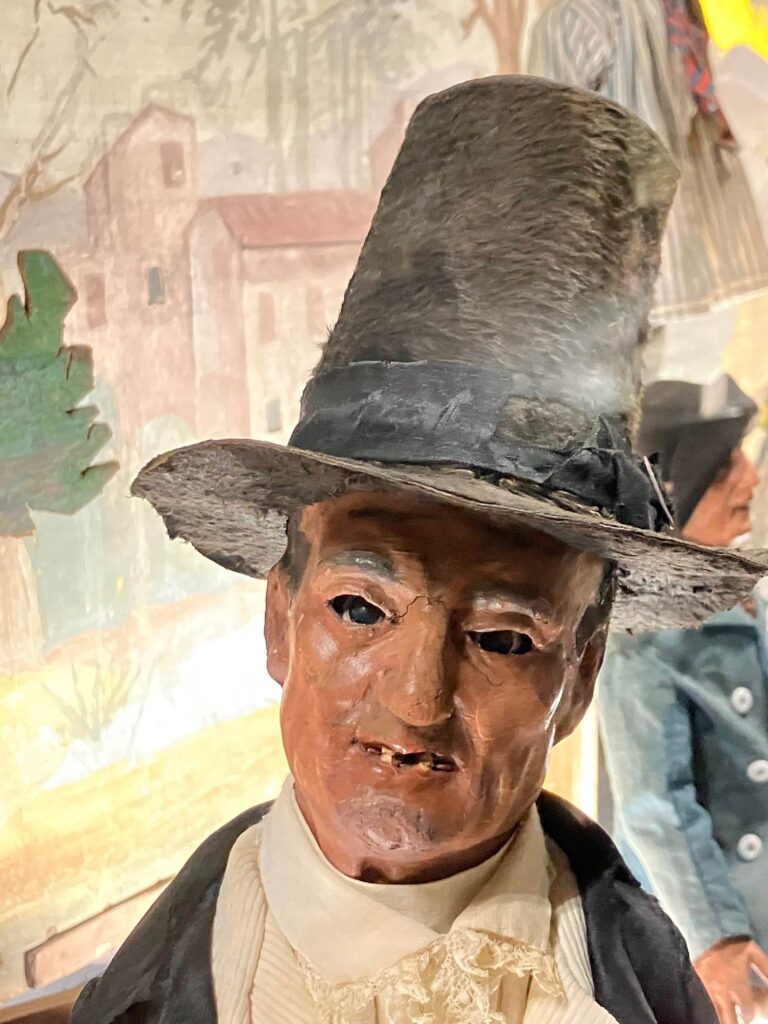
Street puppet in the Museum of Old Aix
The Museum of Old Aix also has some costumes, plus furniture, pottery and a huge, naively painted screen showing scenes from the lavish processions of the Fête Dieu (Corpus Christi). Early 20th century street entertainers’ puppets glare blankly from a display case – like all puppets, faintly creepy when seen too close and under too much light. Provence is incidentally famous for the finely detailed figures called santons – dioramas and models of animals and humans originally designed for Christmas nativity displays, but long extended to depict many aspects of Provençal life. I noticed displays in museums and shop windows of santon scenes from the Camargue, farmyards, city streets, Vincent Van Gogh standing at his easel, and even Snow White as envisioned by Walt Disney.
Our trip coincided with the 81st anniversary of the Allied landings in Provence in 1944. France and America have often had differences in the postwar period, but the Americans are certainly remembered fondly for their vital part in the Liberation of France. One evening in Aix, we watched reenactors and World War Two vintage vehicles lining up in the Cours Mirabeau, in an array of American and French military uniforms, who then processed up the parade, preceded by bicycling gendarmes with Cross of Lorraine brassards, to a spontaneous round of applause – a wistful memory of a time when enemies were more obvious, and France more alive.
Avignon’s bridge and Papal Palace
Our first trip out from Aix was to Avignon, famous of course for its Pont, and as having hosted the Papacy between 1309 and 1378. To the famously danceable bridge, first of all – for centuries the only bridge to cross the Rhône between Lyons and the Mediterranean (although the bridge may have been built on the site of a Roman bridge), and bridging Provence to France proper. Originally 900 metres long when built in the 12th century, there are only four of its 22 original arches still standing following a disastrous flood in 1668 – like a broken finger pointing towards the halfway-over Île de Barthalasse over green waters glinting with perch. The great river swells with latent force, even in the languorous dogdays of August; it is unsurprising it has a Loch-Ness-like monster legend, of the Tarasque, a water dragon said to have been tamed by St Martha (sister of Mary Magdalene), an effigy of which is still carried in an annual folkloric-religious ceremony in the town of Tarascon. There are incidentally real-life leviathans in the river’s depths, in the form of the Wels (Siluris glanis), the European catfish, which can grow to 9.4 feet in length and 300 lbs in weight, eats waterfowl and is popularly suspected of taking swimming dogs or even children.
But the Palais des Papes is an even greater architectural distinction, for much of the 14th century home to the Pontiffs – a fortress-like structure dominating the Place du Palais, visible from everywhere in the city, the perfect hub for the walled old city. The French-born Pope Clement V (pontiff between 1305-1314) was invited to transfer the Papacy to Avignon by France’s King Philip IV (‘Philip the Fair,’ who reigned between 1285 and 1314). Rome had for some time been seriously unstable, but Philip also clearly saw advantages in having the Pope so close to his own borders, and under French influence. Clement was the first of seven Popes to rule from Avignon. His successor, Jean XXII (Pope 1316-1334), had previously been bishop of Avignon, so had no objections to remaining there, and his successor Benedict XII (Pope 1334-1342) showed his consent to the arrangement by beginning the building of the present Palais. Both were French, and seem to have been devotedly attached to their home-from-Rome, as noted by the Persian-American scholar Marzieh Gail:
From their aerial palace gardens they gazed down over plains and rounded hills, silver and green with olive trees. They watched the January snows on Mount Ventoux, and the planted fields walled with black cypresses and yellow cane against the wind. They could not leave. Their delights were all summed up in the wine of Beaune, which did not travel well. Petrarch says that the Cardinals, urged Romeward, would answer: ‘But Beaune is not there.’ (The Three Popes, Marzieh Gail, London: Robert Hale, 1969, p.16)
The massive Palais was luxuriantly appointed and furnished, and the city magnetised Europeans of all degrees and none, from royals in search of politico-spiritual support to criminals preying on the many wealthy or otherworldly visitors. Fourteenth century Popes accustomed to noble and reverential emissaries would probably have been startled or even insulted by the attire of many 21st century visitors to the Palais, in their earrings, flip-flops, shorts, tattoos, and T-shirts bearing such spiritual messages as “World’s Greatest Dad” or “Motorhead.”
The Holy See was finally returned to Rome in 1378 by Pope Gregory XI (Pope 1370-1378), although this was not without controversy. Stay-behind cardinals promptly elected their own Pope at Avignon, giving rise to what is called the Western Schism – during which yet another Pope was appointed at Pisa (Alexander V, widely regarded as legitimate during his short reign – 1409-1410 – but now officially an antipope).
The Palais has secret chambers in the floors with stone trapdoors, designed to hold treasure and important papers, while the vast kitchen with its central cooking fire hints at the scale of the catering. The great dining room known as the Grand Tinel saw countless feasts – which must sometimes have been rather strained affairs, judging from the fact that only the Pope was allowed to have a knife – and was also used for conclaves. Its library was famous across Europe, attracting Petrarch amongst many other scholars, artists and musicians. Petrarch worked at the Palais as an official, and it was supposedly at Avignon that he first saw his celebrated paramour, Laura, in the Chapelle St-Claire on 6 April, 1327 (part of which still survives) – for whom he spent the next 20 years writing anacreontics that were very influential on all European poetry.
Clement’s bedroom and study, with their oak and vine motifs, and hunting scenes, are almost the only rooms where the original décor has survived centuries of deterioration, and sacking during the French Revolution. Avignon remained a Papal enclave until 1791, when a Revolutionary mob demanding its full absorption into France attacked the Palais, and patriotically massacred some 60 royalists and religious in one of the towers. Later federalist and royalist insurrections in this generally conservative area would elicit further deadly reprisals.
The overall impression today is one of great severity, which made it a suitable venue for the works of the artist Jean-Michel Othoniel (b. 1964), who experiments with floral forms, mathematical and topological concepts. Huge strings of large Murano glass or metal beads, mostly in blue, purple and silver, were hanging in stairwells or from vaulted ceilings, looking like the spawn of the Tarasque, arranged in astronomical constellations, Borromean rings and ‘wild knots’ – very medieval conundrums, oddly effective in spaces that could otherwise have echoed empty.
Othoniel installation in the Papal Palace
Avignon beyond the bridge and Palais was almost bereft of people. On the way back to the train station along largely silent handsome streets, we ventured into the Musée Requien, to find an old friend. This is a small and pleasantly old-fashioned natural history museum, with informative typed labels rather than audio-guides or buttons to press. It has a good display of trilobites and a Tyrannosaurus skull, as well as 19th and early 20th century taxidermy. Taxidermy is always melancholy, but it was of its time, and played a part in early natural history, offering countless opportunities for examination of animal anatomy and morphology. The pinned insects and spiders were sad too, in their smaller way, but were made for interesting for me by the fact many of them had been collected personally by Jean-Henri Fabre (1823-1915).
Like Michael Moorcock, Fabre must also assume some responsibility for my vacance. I had first heard of him as a teenager, through Gerald Durrell’s My Family and Other Animals, a favourite book of mine. Like Durrell, I became captivated by the Frenchman who was called the “Father of Entomology” – enmeshed by his Life of the Spider, a wonderfully enthusiastic as well as closely observant study of creatures that are too often detested and feared. It made other entomological treatises seem ploddingly pedantic, as his admirer Maurice Maeterlinck noted:
[We] open the book without zest and without unreasonable expectations; and forthwith, from between the open leaves, there rises and unfolds itself, without hesitation, without interruption and almost without remission to the end of the four thousand pages, the most extraordinary of tragic fairy plays that it is possible for the human imagination, not to create or to conceive, but to admit and to acclimatize within itself. (Maurice Maeterlinck, introduction to 1912 translation of Life of the Spider)
Fabre’s spider book was just one part of an outpouring of writings written in a delightfully light style, combining serious natural history with classical and Provençal animal lore, united by the gifts of an instinctive essayist. He was also both devout, and something of a mathematician, seeing in evolution evidence of intelligent design. To him, spiders’ webs showed a grand kind of geometry, a divine dispensation manifested in logarithmic spirals. He was apparently a local curiosity around Avignon, where he taught in the school , teased by townspeople for lying in the gutter to watch ants – something for which he was once nearly arrested by a new gendarme, who only changed his mind when Fabre stood up, revealing the red Legion d’Honneur ribbon on his lapel. It was exciting to come across some of the great, humble man’s own specimens, in this quiet back street in a little visited museum – samples from the dawn of a new science.
Fabre was oddly unmentioned by the Rev. George Comerford Casey (1846-1912), a Fellow of both the Geographical and Linneaen Societies, whose anonymously published Riviera Nature Notes of 1898 is a charming evocation of Provence’s flora and fauna – presumably because Fabre had not then been translated. It is likely he would have found the Frenchman as congenial as he is himself.
Casey starts – appropriately for a clerical author – with the date palms that are still to be seen tied to balconies and front doors to mark Palm Sunday, but then goes to less welcomed creatures. He exults in the call of the cicada (a noise some find maddening) – “the Diva of the insect world,” he calls the cicada, an “Insect minstrel” whose melodies are “no modest drawing-room pieces, but a wild, fierce, passionate whirling chant, like that of the sun worshippers of old, as they danced intoxicated round the image of their god.” He tells of a species of snake that allegedly eats mosquitoes, and jokes – “Why should not some ophiologist introduce this serpent to the Riviera? The hotels might then advertise: ‘Snakes in every bedroom; no extra charge!” He records seeing a scorpion marooned on a rock in the middle of a rapid stream, but left it there, even though he knew Provençal scorpions were not deadly. He chortles, “To save the live of a Scorpion (or a lawyer) would be to push humanitarian principles to an absurd degree!” He muses on an old folk belief that people who have been bitten by tarantulas ever afterwards remain in the same mood and with the same thoughts as on the day they were bitten:
Perhaps there is an allegory concealed in the statement…It may well be that the Angel of Death hands each man over to the complete control of his ruling passion; and that we thus obtain for ever that which we have loved and longed for in this present state.
***
Vincent Van Gogh alighted in Arles in a snowstorm, and created over 300 masterpieces. We arrived in an opened oven-door blast of heat, and created nothing. But we were in search of similar things – beauty, heat and history – and fortunate Arles can provide all three. The city is famous for its Roman amphitheatre, one of the best preserved anywhere – and bullfighting, although increasingly these days non-lethal tauromachy (called the course camarguaise) when men try to snatch roses off the animals’ heads rather than killing them. These contests, which are held in the arena, are a rare example of continuity with the kinds of ‘entertainments’ that would have been seen there during the Roman presence. Thirty thousand spectators can be accommodated within its walls, much later including Picasso and Hemingway. Arles was the capital not just of Gaul, but also Hispania and Britannia, and even after the Western Empire fell long remained prosperous, thanks to shipping coming up the Rhône – especially when rivalrous Marseille was being blockaded in times of war.
Arles’ amphitheatre
Arles was later a celebrated centre of Christian learning and power. St Caesarius was bishop of the city from 503-543, during a period when the Burgundians, Franks. Ostrogoths and Visigoths were all vying for control of the region, and he was credited with ensuring the eventual triumph of the Frankish party and stabilising the local Church. He was notably ascetic; as a young cellarer on the island of Lérins off the coast of Provence, he had decided that the meals given to monks were too large, so reduced all rations accordingly. It is perhaps not coincidental that he left soon afterwards for Arles. He was also an effective preacher and prolific writer, and the first non-Pope to be allowed to wear the Papal pallium – an ecclesiastical vestment consisting of a white woollen band adorned with six black crosses, worn around the neck. It is thought that St Augustine of Canterbury was consecrated as Archbishop of Canterbury in Arles in 597, following the success of his mission to England. The city’s Roman necropolis, known as Les Alyscamps, was for centuries regarded as the most hallowed burial place in all Christendom; until well into medieval times, coffins of the recently deceased from upstream districts would be floated down by their families to Arles for interment.
Romanesque carvings at the Eglise St-Trophime
The principal Christian sight in Arles today is the Église St-Trophime, standing unobtrusively on the present Place de la République. Closer examination reveals some of the best Romanesque carving in the world – a 12th century Last Judgement, with the naked and chained damned going down on one side, and robed blessed ascending on the opposite, heralded by angel musicians. There are yet more Romanesque extravagances in the beautiful cloisters, including wildly staring monks, rampant animals, and St Martha with her tamed Tarasque – feverish fantasies frozen as surreal backdrop for sandwich-eating trippers and twittering sparrows.
***
Aix, Arles and Avignon felt distinctly provincial, as we walked warily down steep streets from Marseille’s Estacio de Autobuses towards the harbour, picking our way fastidiously between manic traffic, shining sputum, urine stains, piles of flyblown rubbish, and Arabic conversations. Many of the buildings were stately indeed, but flaking and stained, clearly unloved by anyone. Marseille was, we had been warned, a dangerous city, an unrestful one, a place of pickpocketing and even violence. We had expected little less, judging from the gang tags and graffiti that disfigured so many suburban buildings on our approach into the city – even on very high buildings, when the vandals’ lives must surely have been in danger.
Marseille has often been a radical city. It embraced the Revolution with such vigour that the song sung by its excited volunteers in the streets of Paris (originally written to boost the morale of the faltering Army of the Rhine) would become known as ‘La Marseillaise.’ A half-hearted counter-revolution in the city in 1793 was put down with savage force by outraged citoyens, and in revenge the Revolutionary general briefly renamed the city Ville sans nom (‘City without a name’). It took several years before Marseille was forgiven its lapse into realism, symbolised by the formal adoption in 1795 of ‘La Marseillaise’ as France’s first national anthem. The city would be a red flag-flying Communard stronghold in 1871, constituency of the radical politician (and future Prime Minister) Léon Gambetta, and the site of Corbusier’s Unité d’habitation, the world’s first Brutalist building. After Algerian independence in 1962, the disgruntled repatriated white settlers known as the pieds noirs settled in the city in large numbers – uneasy neighbours to the many North Africans who also began arriving at that time.
Untold millions of Euros have been spent on the city in recent decades, especially while it was European City of Culture in 2013, with much stress laid on its multicultural character – but there is not much evidence of all this expenditure outside the small central area, let alone any signs of social integration. This was the only place in Provence we saw the CRS on patrol – the Corps Republicaine Securité, the toughest of the various French police divisions, responsible for riot control – and our two days in the city were often punctuated by fire engine sirens, as lespompiers charged past on their way to their next emergency. Some apparent locals looked tough in their own right – burly and capable-looking men emptying bins and driving taxis, who may all once voted Communist, but are now probably for Le Pen.
Ghost ships at Marseille’s Roman port
Founded around 600 BC by Greeks fleeing Persian aggression in Asia Minor, the city became a hugely important port, trading upriver or by sea as far as the Baltic. It remained important under the Romans, until 49 BC when the city unwisely preferred Pompey’s cause to Caesar’s – leading to serious repercussions at the hands of the victorious Caesar. But Marseille’s position meant it could not long be kept down, and the city’s Musée Histoire has a remarkable display on the site of the Roman port, including the impressive remains of two large Roman rafts, preserved on the spot they were found, along with quay walls, amphorae, anchors and huge chunks of masonry. The sculptured outlines of ghost ships await ghost crews and ghost winds against a backdrop of buses and office blocks.
Vieux Port
The Vieux Port is magnificent – a sea of yacht masts cradled in a natural basin, entered between the two forts built by Louis XIV to subdue the restive townspeople. The commercial port lies slightly to the north – so the basin is purely for pleasure, as elegantly accoutred weekend sailors step off €1m craft to find fine restaurants, luckily still serving Marseille’s most famous foodstuff, the fish soup, bouillabaisse. Mullet and crabs tryst around mooring ropes leading down through bobbing rubbish and dumped e-bikes into classical maritime history, in blissful ignorance of humans’ hungers. Ferries tote tourists out to the Chateau d’If, or further, to the calanques – deep sea inlets that are characteristic of this coast, beautiful, protected refuges from the press and rush and dirt of the city.
High on its hill (531 feet above sea level), Notre-Dame-de-la-Garde, the city’s symbol, was unfortunately obscured by scaffolding. It beckoned even though, even on an airless August evening, and so I toiled my way up there without a street map, winding always upwards, along increasingly quiet and desirable streets, with expensive Citroens in the driveways of lovely villas – roads of high hedges, private lycées, and stone stairs frequented by geckos and outsize grasshoppers. There were times I regretted my impulse, especially near the top, where the houses and even vegetation fell away and the great church seemed to stand all alone in a barren and unforgiving Golgotha, through which crumbling and uneven steps wound upwards unshaded like one last test for pilgrims.
These were probably the same steps taken at a rush by the 2nd and 7th Algerian Tirailleurs on the 25th of August 1944, as they battled up towards the German garrison. A shell fired down from the basilica hit a Free French tank called the Jeanne d’Arc, incinerating three of its crew. Those Germans surrendered the same day, but World War Two had not quite done with the building, as it came under fire for two days more from other German positions in the city, with shrapnel scars still visible on the stonework.
But there were pilgrims there at Notre Dame that evening, even as the church was closing up – hundreds of people milling around on the outside terraces, taking in the inspiring prospects of the city far below. I marvelled at their apparent freshness as I gulped down water from a vending machine. I was less impressed – and felt repulsively virtuous – to find that there was an easy road up, with dozens of buses and cars awaiting those they had brought.
It was not until the following day that I had the chance to see inside the great basilica, built between 1853 and 1893, on the site of a 13th century chapel. Its monumental outline, its tower surmounted with its gold Madonna and Child, has featured on tourist ware ever since inception, but it is inside that its emotional significance becomes clear. France was notoriously anti-clerical even in the 19th century, and Marseille has always been one of France’s most radical (and now also Islamic) towns – but Notre Dame still offers spiritual solace to at least some Marseillais and Marseillaise.
Some Protestants would sniff, but the lavish interior is wonderfully adorned with ex-votos donated by worshippers who wished to express their gratitude for deliverance from some danger or illness. The walls are covered with paintings and other artworks depicting house fires escaped, once-afflicted limbs, sailed-on ships, and flown-in aircraft, while beautifully detailed models dangle down from the vault (many others are in a museum downstairs). These are touching testaments by true believers, to ghostly physicians and guardian angels they believed (and believe) are still watching over us, even in an era of unbelief – true faith helicoptered into the 20th and even 21st centuries. I felt I liked those unknown people much more than the boorish show-off I noticed shuffling along the aisles wearing a T-shirt bearing the un-churchlike, even inhuman, enquiry, “Do I look like a fucking people person?” Some people will do anything to assert their alleged individuality.
Back down the hill is the very different church of Abbaye St-Victor, originally part of a 5th century monastery built on a burial ground for martyrs, most notably Victor of Marseille, who according to legend was a Roman army officer beheaded in 290 for kicking over a statue of Jupiter. (“Some people will do anything to assert their alleged individuality”!) One ex-Abbot would become Pope Urban V, one of the Avignon popes. Externally, the church resembles a fortress, which it needed to be, on this site outside the city walls. Some of the walls are ten feet thick, layered and strengthened between the 10th and 12th centuries. The nave is cool darkness, lifted only by sanctuary lamp and shrine lights – but the real interest of the church is in the crypt, a complex of old arches, little chapels and walkways, with some sarcophagi going back to the late Roman era.
In the crypt of the Abbaye St-Victor
Roman sarcophagus in the crypt of the Abbaye St-Victor
Ancient though the Abbaye is, it feels callow in comparison with the Cosquer Cave. The actual Cosquer Cave is unfortunately inaccessible to everyone except licensed divers – its entrance now around 100 feet under water, although the cave itself is dry. But it was possible for Palaeolithic people to walk into the cave – and they did, until slowly rising sea levels made it first difficult to use, and eventually to fall out of memory. Then in 1985, a speleologist-diver named Henri Cosquer daringly went into an underwater tunnel in the cliff of the Calange de Morgiou, and surfaced into a prehistoric art gallery. We can visit this vicariously thanks to an amazing reconstruction on the northern bank of the Vieux Port, in a fine modern building cantilevered over the water.
Between around 27,000 BC and 19,000 BC, people drew and painted in the cave – everyday animals, and piquant outlines of their own hands. Most of the animals they depicted would not be visible now in this region – bison, seals, beautifully detailed wild horses – and at least one is not visible anywhere, the great auk, in prehistoric times a common seabird around European shores (and origin of our word ‘penguin’), but now extinct, with the last recorded specimens beaten to death off Iceland in 1844. Visitors are transported around the ‘cave’ in electric carts, but the trip is more immersive than it probably sounds, thanks to the scale and detail of the reconstruction, worked out to the smallest stalagmite. There is a palpable sense of the mystery and wonder of the prehistoric cave – a space not just to shelter and sleep, but also a theatre for the early human imagination. Above, in the contrastingly bright exhibit hall, are life size models of some of the many animals which the cave dwellers would have – elk, aurochs, lions and saiga antelopes – seeming in that white space to hover like avatars of ancient bioabundance.
***
As we rumbled along a baking and narrow road in our 4×4, I was thinking of a painting I remembered from childhood – ‘Bee-eaters in the rain,’ by Abel Chapman (1851-1929). Chapman, son of a Sunderland wine merchant, was an artist-hunter-conservationist instrumental in the foundation of Spain’s Cota Doñana nature reserve, and preventing the Spanish ibex from becoming extinct. He travelled all over the world, and was friends with the likes of Frederick Selous, the explorer and soldier who was the model for H. Rider Haggard’s ‘Allan Quatermain,’ and after whom the Rhodesian Army named their elite unit, the Selous Scouts.
‘Bee-Eaters in the Rain’ had been in another favourite book of my youth – Chapman’s Memories of Fourscore Years Less Two, published posthumously in 1930. It was just one of many fine oils, created in places from the Arctic to the Serengeti, showing such spectacles as lions roaring across the Serengeti and wildebeest migrating across the Rift Valley. One of the many places Chapman had visited in his full life was the Camargue, where he had painted this group of claret, turquoise and yellow birds flitting gorgeously through gentle grey rain, which had somehow suggested to my childish mind the vast marshes and salt-spits of the delta.
But it was not these we had come to see on our Camargue ‘safari,’ let alone Moorcock’s ornithopters. We were in search of a bird almost as fantastical to northern European eyes – the thousands of flamingos who lend Alice in Wonderland surrealism to France’s southernmost saltmarshes.
A rice irrigation channel
The Camargue, islanded between two branches of the Rhône and the sea, is divided into two parts by a large lagoon, the Étang de Vaccarès – the highly fertile north, and the barren but beautiful south. France is one of only five European countries that grows rice, and it is only the Camargue that can produce it – thanks to an elaborate irrigation system built up over centuries, diverting river waters across vast levels swept clean by Provence’s many distinctive winds – the Mistral and Tramontane (from the north), the Levant (from the east), and the Marin and Sirocco (from the south). The rice-fields feel very ‘foreign’ – flat, large, and darkly green with the crop just coming, and in between them elephant grass, reeds, tinkling channels and runnels of warm Rhône disappearing into pipes to pass under little roads. Flamingos sometimes descend into these fields, to the disgust of farmers, but the only animals we saw were crimson dragonflies and large lizards (most likely the Common Wall Lizard) which only moved when you were almost standing on them. Rice is not cheap to produce – it requires huge quantities of fresh water, and maintenance of countless irrigation channels and sluices – but Camargue riz can command a premium, whether on the shelves of the Arles branch of Monoprix, or far-away Waitrose.
As well as flamingos, the Camargue is known for black bulls and white horses. There are two kinds of black bulls in the Camargue – the Provençal and the Brava, the former lucky enough to be exempted from lethal bullfights. They live in semi-feral conditions under the huge skies, roaming largely at liberty, munching whatever they can find – in appearance as well as habits akin to the buffalo one finds wandering along back roads in India (although with a more peppery temperament).
They are marshalled, when they are marshalled, by gardians (guardians) – ‘cowboys’ who traditionally rode the aforementioned white horses, and around whom there accreted many equestrian and folk customs. Gardians have been present for centuries, predating even the foundation of the brotherhood known as the Confrérie des Gardians in 1512, but they received greater prominence during the 19th and early 20th century Provençal cultural renaissance led by Frédéric Mistral, which drew national attention to the region (the word gardian only passed into national circulation in the 20th century).
Traditional gardian garb includes trilby-type hats, highly coloured shirts and ties, moleskin waistcoats, light trousers and high boots, and they would carry a long thumb-stick for controlling the cattle. They lived in thatched windowless cottages, sometimes with a rounded northern end to blunt the force of the Mistral, with bulls’ horns set above the door to ward off evil spirits. There are around 2,500 gardians today, still playing a vital agricultural role, but also putting on bull and horse spectacles for tourists.
The horses they ride are born black or brown, and only turn white in their third or fourth year. Like the cattle, they are semi-feral, living outdoors all year round, and are renowned for spiritedness. Seen en masse, they can be majestic, even poetical, as Roy Campbell observed in ‘Horses on the Camargue:’
In the grey wastes of dread, The haunt of shattered gulls where nothing moves But in a shroud of silence like the dead, I heard a sudden harmony of hooves, And, turning, saw afar A hundred snowy horses unconfined, The silver runaways of Neptune’s car Racing, spray-curled, like waves before the wind. Sons of the Mistral, fleet As him with whose strong gusts they love to flee, Who shod the flying thunders on their feet And plumed them with the snortings of the sea…
The horses we saw were less thunderous. Some were wonderfully earthy, leaning over gates to take from us long grasses they couldn’t reach themselves – their hot breath, tiny hairs and sharp intoxicating tang rising to mingle with smells of dung, mud, old water and the sea, their deep brown eyes blinking as if in sorrow at the flies. We encountered strings of them bearing tourists, clopping along dusty roads lined with holm oaks, juniper and tamarisk, or saw them from further away on the beaches, half-in-half-out of the water – samite steeds sometimes looking disconnected from the earth as temperature inversions hid parts of their bodies.
That storied water, entered from crispy, hot and shell-strewn sand – brackish, shallow, soft, warm, bedded with slime, smelling of salt and more faintly of guano, washing up tiny pink feathers from the dozens of flamingos that hovered and hoovered further out, placing clumsy feet precisely, sieving tiny shrimp like the ones that raced away from my feet, using those croquet-mallet beaks that so captured Lewis Carroll’s imagination. They sieved and stalked, sieved and stalked, on the edge of Europe and imagination, like visitors from some other planet, coming in and out of focus as the air shimmered around them and us as we stewed in the giant salt-pan of the South – an actualisation of a vision of youth, evoked even now by the three still mud-stained feathers I picked up and pocketed, before me now on my desk – functional agglomerations of keratin proteins but also magical passports.
Saintes-Maries-de-la-Mer is curiously un-Camargue-like – like so many seaside settlements in its feeling of insubstantiality and precariety, but attractive – unlike many seaside settlements elsewhere. Many of the central buildings are home to ice-cream shops and the like, except for the handsome Église des Saintes-Maries, fortified in the 14th century against pirate attacks, and with its own water supply – a church literally militant, used to defend villagers while pirates rampaged outside. In the crypt is the swarthy effigy of Sarah – according to legend Egyptian servant to Jesus’s aunt, who after coming ashore on the Camargue with her and other New Testament characters set about preaching the Gospel with rare eloquence and vigour.
Sarah’s ‘Egyptianness’ means she even now exerts a powerful attraction on devout gypsies (who were themselves long thought to originate from Egypt), who ever since the 16th century have piled into town each May to do her honour with a grand festival. Sarah’s statue, and those of her equally charmed companions, are carried down to the sea, accompanied by mounted gardians in full traditional garb, amid guitarists, singers, tambourinists and the clangour of church bells, all of this blessed by the bishop aboard a bobbing fishing boat – a colourful and melodious memory of a long ago legendary landing.
It was quieter in late August, sitting alone in the evening on the apex of the church’s gently sloping roof. I looked north through haze towards the rice-fields and Arles, east towards La Crau and the Riviera, west towards Montpellier and the Languedoc, and far south beyond the umbrella-studded little beach to the sighing Gulf of Lion. It was a memorable last misty vista, a farewell to a legendary landing of my own. Provence was already slipping back into story.
DEREK TURNER is the editor of The Brazen Head, as well as a novelist (A Modern Journey, Displacement, and Sea Changes) and widely-published reviewer. His first non-fiction book, Edge of England: Landfall in Lincolnshire, was published June 2022. Some of his writing may be found at www.derek-turner.com He is also on X – @derekturner1964
PAUL D. DEANE is a computational linguist by profession and a poet by avocation. Since 1999, he has edited Forgotten Ground Regained, a website and (since 2023) a quarterly journal devoted to modern English alliterative verse. Three of his poems appeared in Dennis W. Wise’s 2023 anthology, Speculative Poetry and the Modern Alliterative Revival: A Critical Anthology
The Last Man on Mars
They told us to volunteer. We had what it took,
or so they said. We were the new settlers
on the Final Frontier, that bold fiction
that made Captain Kirk (not Musk) our king.
Only the best and the brightest could hope to beat
PAUL DEANE is a computational linguist by profession and a poet by avocation. Since 1999, he has edited Forgotten Ground Regained, a website and (since 2023) a quarterly journal devoted to modern English alliterative verse. Three of his poems appear in Dennis W. Wise’s 2023 anthology, Speculative Poetry and the Modern Alliterative Revival: A Critical Anthology
ISABEL CHENOT has loved, memorised, and practised poetry all her remembered life. Some of her poems are collected in The Joseph Tree, available from Wiseblood Books
overcast
Riddled with hidden stars, hinged with a hint of white, the sky won’t open.
A single file of cars wends even muter light; and hills, half spoken,
heave up around that glow. Asleep, they don’t show green — pitched over black.
My face to earth’s huge back: how can I know hills I have never seen?
They’re a desire between here and the sky’s shadow.
ISABEL CHENOT has loved, memorised, and practised poetry all her remembered life. Some of her poems are collected in The Joseph Tree, available from Wiseblood