From the Fens to Ayrshire – and Stravinsky’s dark times

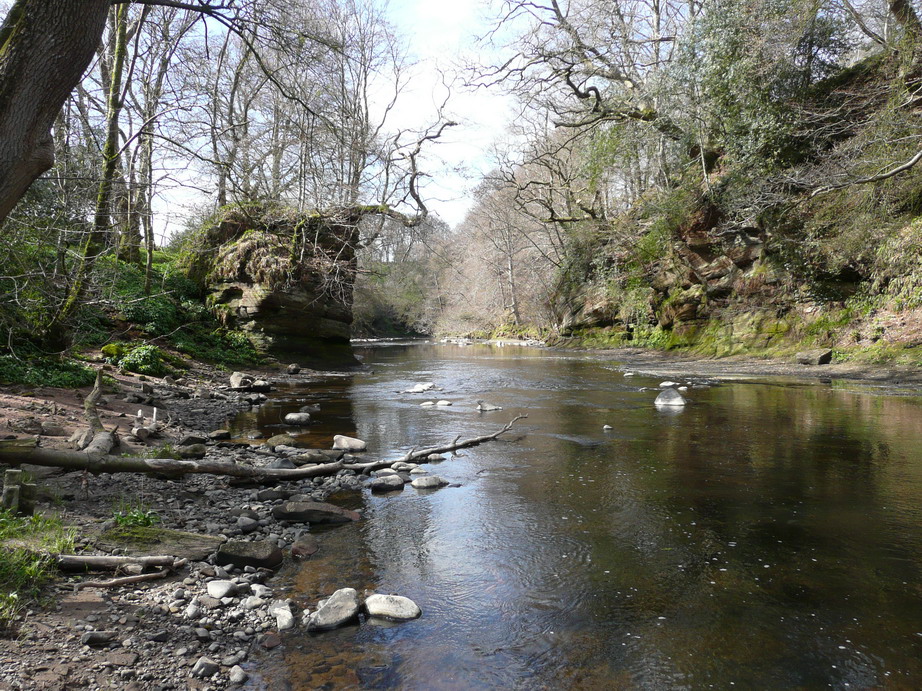
The Lugar, by David Johnston. Image: Wikimedia Commons

Composers are not necessarily good conductors of their own works — too fussy, sometimes, or just without the conducting charisma of a professional baton-wielder, more accustomed to the stage and the adulation of an audience. Not so in the case of composer-conductor, Sir James MacMillan, a native of Scotland whose musical outlook and versatility brought such intense playing from the BBC National Orchestra of Wales in that most English of works, Vaughan Williams’s early-20th century symphonic impression, In the Fen Country

Sir James — who as we were to find out in his new euphonium score later in the programme — has a natural feel for music which puts man in his place in the midst of a landscape where remoteness and the movements of cloud banks and sunlight over water allow your mind to wander fantastically. So the Vaughan Williams unfolded, carrying us far from Swansea’s Brangwyn Hall, like a fen-tale recounted by a local on a warm May evening (which indeed this was) — orchestra and conductor carefully finding all the threads and patterns of the lonely land so beloved by Vaughan Williams.

A similar ‘genetic heritage’ flowed into Sir James’s Where the Lugar meets the Glaisnock, a picture of the confluence of two Ayrshire rivers — part tone-poem, part euphonium concerto. Seldom has this bold solo brass instrument sounded so subtle and ‘at one’ with the soft magic of strings – the writing for the latter section of the orchestra suggesting the half-light melancholia of Vaughan Williams, but through a twenty-first century prism. At one point in the score, I picked up in MacMillan’s Ayrshire filaments of sound from distant Estonia, where a passage brought to mind the mystical, frozen-in-time style of composer, Arvo Pärt. Our solo euphonium player, David Childs, certainly gave a thrilling performance of what was a successful, deeply meaningful MacMillan world-premiere.
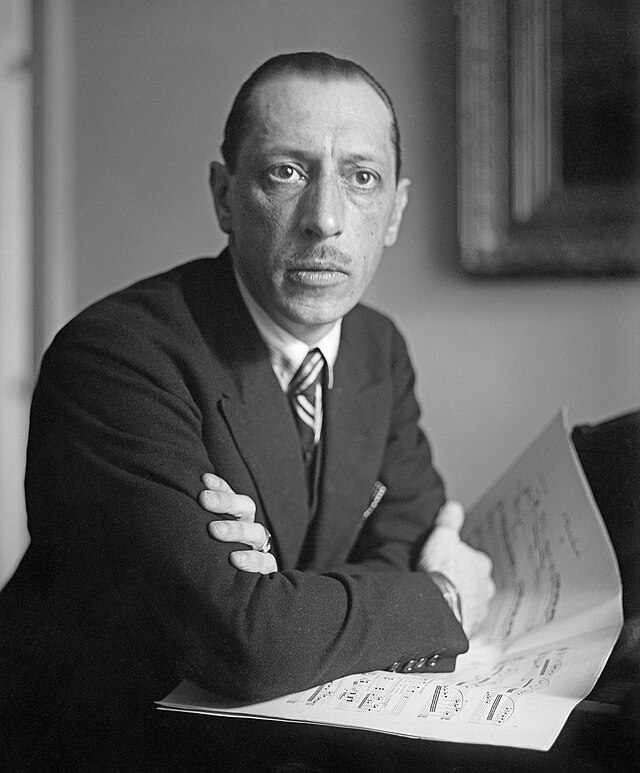
Igor Stravinsky

Thoughts of war (for Stravinsky, the stark image of goose-stepping machine-armies) were never far away in the composer’s emphatic, barbed, relentless Symphony in Three Movements, although the unsettling whirl of world events dispels quite uncannily in a surprising, eccentric, but warm and friendly little gavotte-like dawdle in the second movement — as if Pulcinella or Petrushka were never far away. The orchestra’s woodwind and brass produced pinpoint ‘Technicolor’ virtuosity — qualities which were centre-stage, too, in the shortish diversion (though with a clever, inventive sharpness) that is Stravinsky’s Symphonies of Wind Instruments.

The concert began with another compact and engaging mini-masterpiece, by Vaughan Williams’s composer-colleague, folk-song collector, and walking, hiking, inn-visiting friend, Gustav Holst — his Capriccio, a short work for full orchestra, with some magisterial trombone writing (Holst’s own instrument) and a foot-tapping march right in the middle of it. Yet the work seems to begin in Vaughan Williams’s fen and marsh, or the Ayrshire of MacMillan, another mysterious signpost of the continuum element in the music of these islands.

Boisterous banshees, and ghosts of war

Way back in orchestral history, at the 1971 Proms, a modest-sized broadcasting orchestra appeared at the Royal Albert Hall for the first time. An ensemble of some 40 players, the (then) BBC Welsh Orchestra performed smaller-scale works by Haydn, Mozart, Stravinsky and Brahms under the baton of the American conductor, Irwin Hoffman — who, incidentally, as a US serviceman, had been stationed in Britain. In a radio interview, Hoffman talked about the sense of occasion felt by the orchestral players, transported from their Cardiff studio duties to the international stage of the Royal Albert Hall — sentiments which might come as a surprise to concertgoers, today, accustomed to the work, international scope and remit of the c. 80-strong BBC National Orchestra of Wales.

From their modern performance centre, BBC Hoddinott Hall at Cardiff Bay (the larger St. David’s Hall in the city, opened in 1982, remains — curiously — closed and crumbling) the Welsh national orchestra plays for a dazzling array of international conductors. The trend started with Mariss Jansons in 1992 (with Richard Strauss’s massive Alpine Symphony) to Tadaaki Otaka, the Japanese maestro who loved and performed Elgar and attained laureate status with the musicians.

At Aberystwyth Arts Centre on the night of the 13th March (touring is a major priority of the orchestra) Christoph König presided over a programme of four intriguing divertissements for orchestra – Ravel’s Great War homage to lost friends and artists, Le Tombeau de Couperin, Anna Clyne’s modern saxophone fantasy on a theme of the banshee, Grasslands, Louise Farrenc’s boisterous, if uninterestingly-named ‘Second Overture,’ and Shostakovich’s Symphony No. 9 — the complete opposite in scale to his 7th, 1941’s ‘The Leningrad.’

A detailed delicacy of tone, especially in the woodwind section, made Ravel’s homage to an older France sound particularly tender and nostalgic. Yet the players switched effortlessly to a different scale of sound in the spikes and sparks of Anna Clyne’s banshee world, Grasslands, complete with an exciting pizzicato chase in the last movement — foreshadowing the Shostakovich 9th that ended the second half. The brilliant saxophonist, Jess Gillam, almost co-led the orchestra in this weird phantasmagoria — striding on with a complete stage-presence, notwithstanding her pink suit and blue spectacles. However, another player had a chance to shine in the concerto, the overlooked double-bassist, who had a mysterious little accompaniment to perform alongside Jess’s saxophonic highs – a moment of real atmosphere.

A sardonic march, a cheeky fizzing curtain-raiser to an odd sort of symphony, is what the first movement of Shostakovich 9 is all about — a far cry from the tense, tortured spans of the Stalin-shadowed 5th and 7th. Here, the BBC National Orchestra of Wales and their (batonless) conductor found much to enjoy — and full marks, of course, to leader, Lesley Hatfield and the ice-cold violin tingle achieved in her sinister-sounding mini-solo of the march theme. Even with such a divertissement of a symphony, Shostakovich still managed to create that hypnotic feel (which you find in the ‘Leningrad’ or in the 11th) in his slow movement — before the unsettling, quixotic torrents of the work reach their exciting finale. 

At Aberystwyth, the orchestra fielded c. 60 players, just right for the dimensions of the Arts Centre, and an audience of some 300. In this era of cuts to arts funding (even within the BBC) it is vital to maintain visits and tours to places which are a little off the usual orchestral beaten track. Perhaps the orchestra might consider going even further afield – deploying a detachment of string players to the Theatr Mwldan, Cardigan, for example – or chamber groups drawn from the various sections, to visit churches or village halls, or best of all, schools, in which classical music is desperately needed but often utterly absent.

Such considerations aside, the Aberystwyth concert was a good night for orchestra and audience, alike. Concertgoers in Wales are truly fortunate to have these inheritors of Irwin Hoffman’s BBC Welsh Orchestra.