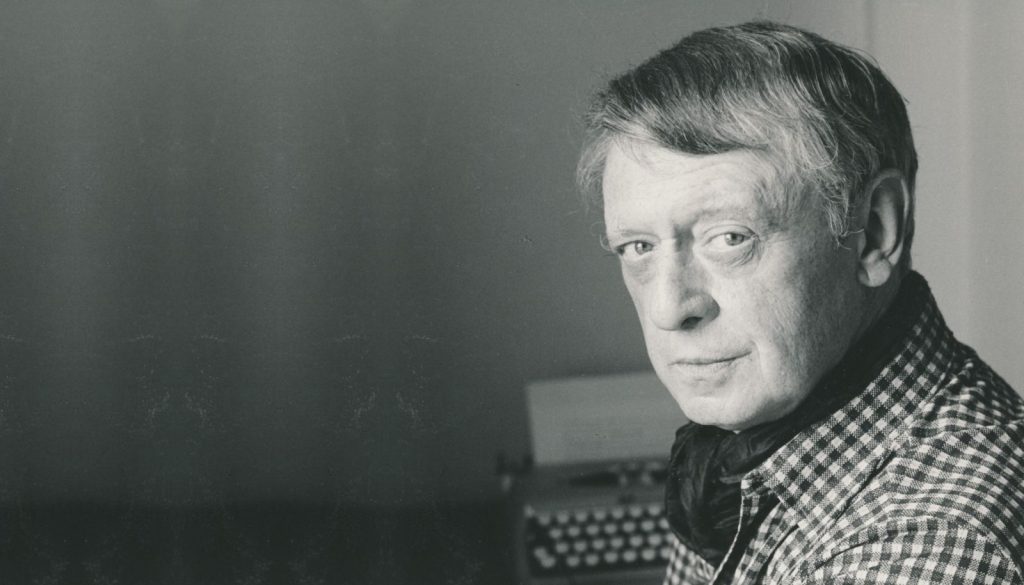
Anthony Powell – a century’s chronicler-conjuror

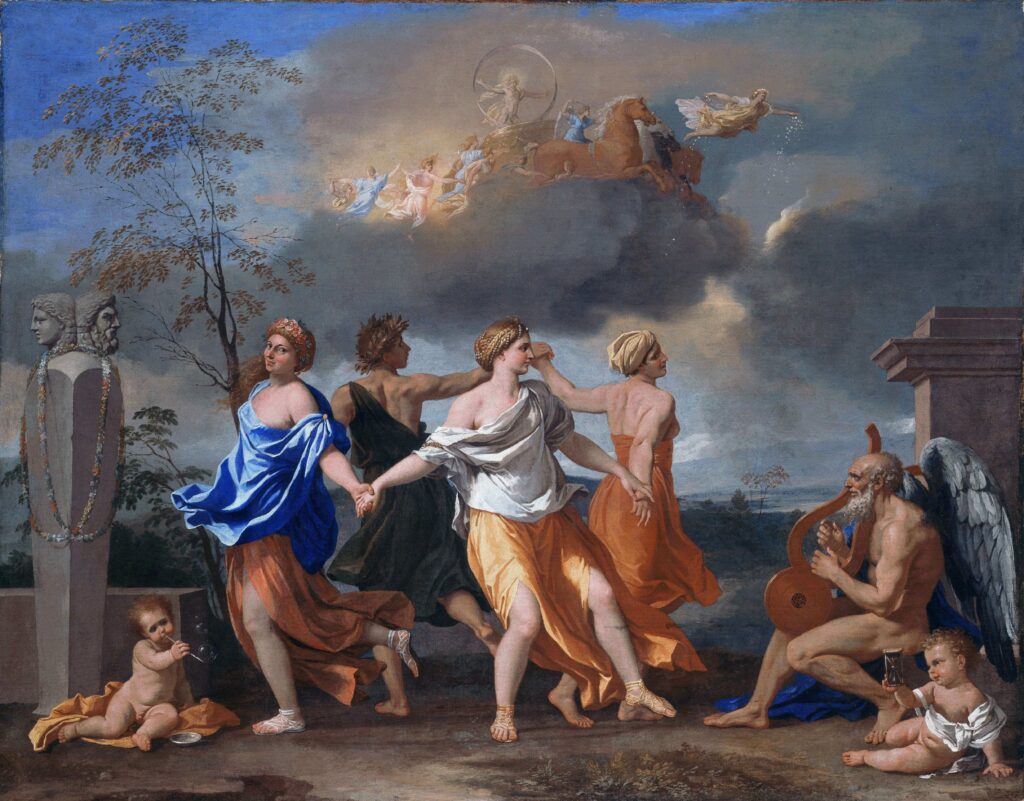
Dance to the Music of Time, by Nicholas Poussin (c.1640)

A framed letter faces me on the desk as I write this. Composed in an engaging mix of spidery longhand and erratic manual-typewriting, with a rubber-stamped phone number giving it a further touch of the haphazard, dated September 1992, it reads:

Dear Mr. Sandford

I am delighted you like Dance well enough to want more, but I have always set me [sic] face against doing any sort of coda after I finished, because even while I was writing, it was difficult enough to keep the same tone of voice, and now that I am so ancient it would be quite impossible. All the same, kind of you to ask.

Yours sincerely

Anthony Powell

PS I expect you know Hilary Spurling’s Handbook to a Dance (Heinemann), which is very good and amusing.

It was the beginning of a modest correspondence I kept up with Powell, author of the magisterial 12-novel sequence A Dance to the Music of Time – the last volume of which appeared a blink-of-an-eye half-century ago, in September 1975 – during the remaining eight years of his life. He would have been 86 at the time of our initial exchange, and by all accounts was becoming increasingly crotchety, not least in the matter of the correct pronunciation of a name he insisted should rhyme with ‘bowl’, not ‘trowel’.

One freezing January morning later in the 1990s, a plumber answered an urgent call to attend to a burst pipe at a large Georgian house in the English countryside near Bath. An elderly man dressed in tweed answered the door.

“Mr. Powell?” asked the plumber, pronouncing it Pow-ell.

“There is no one here of that name,” replied the old man.

“Oh, sorry,” said the plumber. “I must be at the wrong house.”

“I can’t help you,” said the old man.

The plumber then drove around the frozen neighbourhood before being told that Anthony Powell did indeed live in the house he had just visited. So he returned.

The same man opened the door. This time the plumber enquired, “Does a Mr. Powell live here?” “No,” the elderly gentleman said. “However, do you mean Pole?” The plumber nodded. “Ah! Then go round to the back door, the leak is in the kitchen.”

This is surely a scene that could have been torn direct from the pages of Dance, peopled as it is by a cast of louche London artistic types, colourful military coves and eccentric English landed squires. The sequence has been described as everything from “Proust anglicised” to “a kind of social accountancy, and not much more enlivening than the financial sort.” Evelyn Waugh’s son Auberon (of whom more presently) thought the whole thing no more than “an early upmarket TV soap.” PG Wodehouse, by contrast, was “absolutely stunned by [Powell’s] artistry.” Fifty years later, the critical divide persists. Powell’s magnum opus has become an odd sort of cult work, its reputation kept alive not just by the devotees who have loved or still love it – among them Christopher Hitchens, Stephen King and Clive James, who called Dance “the best modern novel since Ulysses” – but by those who love to hate it and consider the whole thing a testament to staleness.

I’m in the supporters’ camp. Taken as a whole, the Dance’s twelve-book sequence strikes me as an unsurpassable panorama of a vanished Britain, and – lest you not yet have made its acquaintance – an almost chemically addictive joy to read; hence my brazen request of its author for more of the same. But here’s a curious thing. As I say, I had the pleasure of corresponding with and meeting Powell himself, and have read and re-read both his novels and the various biographies, particularly the aforesaid Hilary Spurling’s, and yet the more one comes to learn about the man the more elusive he seems to be as a flesh-and-blood human being – not to mention one whose life took him from a lonely and nomadic boyhood at around the time of the First World War to the twilight years spent as an obsessive genealogist and high-and-dry Tory who, almost incredibly, survived long enough to see in the twenty-first century. All I can add by way of a physical sketch is that in person Powell was compact, immaculately turned out in a manner that seemed to have been frozen in place since about the year 1933, with a piercing stare under incongruously untidy eyebrows, and a sharp, nasal voice that was close to a comic turn in itself.
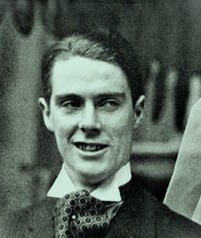
Anthony Powell in 1934

On the other hand, in a canonical work full of shadows, as Powell nearly wrote in Books Do Furnish a Room, certain characters are bound to be shadowy. There is the superbly detached role, to cite only the most obvious example, he gives his alter ego Nick Jenkins, the narrator of A Dance to the Music of Time. Both the author and his fictional self seem to have gone through life as scrupulously neutral observers of the human condition, rarely if ever offering a declarative judgement on people or events, let alone asserting their own identities. There’s a section in the early wartime novel The Valley of Bones, about midway through the whole sequence, where Jenkins’s wife Isobel suddenly goes into labour with the couple’s first child, an event she announces with the line: ‘Look here, I’m sorry to have to call attention to myself at this moment, but I’m feeling awfully funny. I think perhaps I’d better go to my room.’ This same sense of supreme self-effacement applied equally to the author who gave her the lines to speak, who himself once said, ‘I have absolutely no clear picture of myself’, and confessed that he began writing shortly after coming down from Oxford in large part because he couldn’t think of anything else to do, rather than due to any particular aptitude or talent.

With respect to that judgement, it strikes me as taking diffidence to unnatural lengths, if not to qualify Powell as a martyr to false modesty. Taken as a whole, Dance is a fiendishly intricate literary feat, which its author carries off throughout the whole 3,000-page, million-word sequence as it passes over some sixty years of English social history, conveyed through perfectly ordinary (which is to say, often absurd) situations rather than conventional drama. It remains a singular, and brilliantly sustained, achievement of twentieth-century letters. Powell himself, as conveyed by his biographers, may be retiring to the point of near invisibility, but his great roman fleuve more than once touches the artistic heights occupied by P G Wodehouse and Evelyn Waugh.

Yes, to address a frequently heard opinion of the Dance sequence, there are moments where the prose is arid and the terminology fustily dated. Powell’s characters adopt “sun spectacles”, for example, when finding themselves in “not wholly inclement climes”, or travel on that “uncomfortable but commodious conveyance” the Clapham omnibus. It might be said that the author sometimes makes heavy work of simply getting the reader from A to B. When introducing the minor character Rosie Manasch, a patron of the arts who emerges in the tenth installment of the series, Books Do Furnish a Room, Powell notes: “In the course of further preliminary conclaves with Bagshaw on the subject of Fission’s first number, mention was again made of an additional personage, a woman, who was backing the magazine.”

Or, of a pair of MPs, Labour and Conservative, meeting at a funeral described in the same book: “The two had gravitated together in response to that immutable law of nature which rules that the whole confraternity of politicians prefers to operate within the closed circle of its own initiates, rather than waste time with outsiders; differences of party and opinion having little or no bearing upon the preference.”

The Dance, then, may have an old-fashioned roll to it, but beyond the occasional dowager style Powell’s genius was surely to sustain a vibrant, and highly credible, self-contained imaginative world. Some of the series’ individual performers recur from book to book, going on from school to university, their careers interweaving, marrying, divorcing, fighting for their country, haunting the rackety dives of postwar Soho, and finally catching up with life in the hedonistic, culturally vapid 1970s. As anyone who’s ever written a novel will tell you, it’s hard enough to plausibly develop even a single life over any protracted amount of time. Powell does this for literally scores of deftly sketched, sometimes honourable, not infrequently comic, invariably compelling leading characters, appearing and disappearing and then reappearing at intervals, all in perfectly logical order, guiding us from the Great War to the moon landings in the process, with the subordinate cast, typically drawn from the English literary or artistic demi-monde, providing the crucial ballast.

In short, Powell’s achievement is that of the architect as well as the author. The delicate slapstick of events is slowly drawn together, the apparent coincidences and chance reunions never less than true to life, the touch exquisitely light in its sardonic treatment of the material.  Here is Powell’s doppelgänger Nick Jenkins, musing in a rare moment of intellectual candour, in the third book of the sequence The Acceptance World:

I began to brood on the complexity of writing a novel about English life, a subject difficult enough to handle with authenticity even of a crudely naturalistic sort, even more to convey the inner truth of the things observed … Intricacies of social life make English habits unyielding to simplification, while understatement and irony – in which all classes of this island converse – upset the normal emphasis of reported speech.

As often noted, Powell’s opus is really a form of elegant soap opera, with cyclical themes and characters, and an infallible knack – the envy of many a television screenwriter – of ending each episode with a crisis. (Powell spent the winter of 1936-37 script-doctoring in Hollywood for Warner Brothers, an experience, however venal, he later admitted was invaluable ‘when one came to the engineering’ of Dance.) When the series’ narrator joins the army in 1939, he is promptly assigned to the corrosive Kenneth Widmerpool, his school contemporary of twenty years earlier. The physically clumsy, socially tone-deaf Widmerpool then returns at intervals in each of the remaining novels of the series, variously translated from soldier to businessman to MP to university chancellor-cum-pagan cultist, a figure at once ludicrous and sinister, and taken as a whole one of the great comic ogres of 20th century literature. It says something for Powell’s artistry that there was intense competition among his circle to be publicly identified as the model for a character synonymous with the harsh and manipulative use of power, the author’s brother-in-law Lord Longford laying the strongest claim, but the likes of Powell’s wartime chief Denis Capel-Dunn, the richly-tinted jurist and latterly Lord Chancellor, Reginald Manningham-Buller, the art historian Gerald Reitlinger, and even the sometime Tory prime minister Ted Heath all making a persuasive bid for consideration.

If not exactly required reading these days, Powell’s masterpiece remains one of Western literature’s enduring feats, and might even be one of the few things that nurtures an awareness of an older, more reticent England, not dead, perhaps, but gone into hiding until the present tabloid version self-destructs. The author himself lived long enough to see such bracing developments in British life as the advent of punk rock and of Sarah, Duchess of York, as well as a modern idiom in which domestics would come to refer to assaults, not servants – all recorded in his wonderfully mordant late-life diaries. A modest man with a profound dislike of reckless informality and self-promotion, Powell continued working almost until the end, publishing the final volume of his Journals in 1997, not long before Channel 4 finally succeeded in bringing a seven-hour version of his magnum opus to television screens. He once told me in characteristic tones that he was “not wholly unsatisfied” by the Dance sequence (in written, if not screen format) as a whole. It remains good literary fun, like all the best fiction a brilliantly contrived escape from the banality of the real world. The author Michael Frayn perhaps put it best when he recalled of stumbling on Powell for the first time: “It was like discovering a complete civilisation – and not in some remote valley of the Andes or the Himalayas, but in the midst of my own life … Another world had been superimposed upon my own, refracting and reflecting it.”

As mentioned, Powell brought his opus to a triumphant conclusion with its final installment, Hearing Secret Harmonies, as long ago as September 1975, and resisted all overtures to revive it from behind its marble slab at any point during the remaining quarter-century of his life. That decision notwithstanding, the years in question were far from without interest for him. Apart from turning out a stream of increasingly free-form reviews and memoirs, Powell found himself at the age of 84 embroiled in one of those explosive literary feuds the English seem to do almost as well as their genius for the political sex scandal, and which itself might have graced the pages of Dance. His adversary in the matter was Evelyn Waugh’s eldest son, Auberon, who published a damning review of Powell’s latest volume of memoirs in the Sunday Telegraph, a paper to which they were both long-time contributors. When the moment came, Hilary Spurling would pass lightly over the incident in her official life of her subject by taking what could be called the psychological approach to the whole affair. Waugh Jr, she writes, had himself not long beforehand published a memoir,

…contain[ing] a scary portrait of Evelyn as a monstrous egoist who regarded all his sons, and this one in particular, as rivals to be snubbed, derided and put down. Even in his own distress, Powell regarded young Auberon’s response [to his book] as essentially vicarious, the vengeful product of a largely loveless childhood.

Be that as it may, Powell went ballistic, severing his relations with the Telegraph, who rather bizarrely commissioned a bust of their departing eminence grise but then found they had nowhere to put it. It perched for a while on an office filing cabinet. The Powells and the Waughs never spoke again. Somehow, the whole episode could once again have been taken from one of those darkly comic contemplations of the postwar London literary scene that enliven Books Do Furnish a Room, the tenth and in my judgement best individual installment of the Dance.

Anthony Powell was that highly overused word, unique. The room he occupied in the mansion of English literature was distinct, located on a level where no one else regularly ascended, although Evelyn Waugh might be said to have inhabited broadly the same space. Any reader not yet familiar with the Dance, widely available today in various formats, should treat themselves to one or more of its volumes immediately. The dozen subsidiary novels, so beautifully written, so riotously entertaining, for all their pervasive air of English melancholy and social decay, are the work of a master of his craft. We have not his equal.

Anthony Burgess – The Professional

BENJAMIN AFER outlines an extraordinarily prolific and versatile author

Some weeks ago, I was offered a small commission by a respectable new journal to contribute a few thousand words on Marcel Proust’s À la recherche du temps perdu, but reluctantly deferred owing to considerable concern that a short essay composed under the duress of manic end-of-year busyness would result an inadequate treatment of such a monumental work. But when I was offered some column inches in this journal on the subject of Anthony Burgess, I accepted without hesitation. After all, Burgess has long been one of my most-admired authors, and I have more than a casual familiarity with his work, having read and re-read a good deal of his fiction many times over.

This cheerful attitude quickly fell into a tense anxiety when I realised, sitting down to write, that the great scope of Burgess’s œuvre would make this a more complicated and technically demanding matter than any essay on Proust. For even if Marcel still has Anthony pipped on word-count (and that’s not entirely certain), the latter’s ability to write masterful works in so many genres, in so many different styles, on endlessly varying subjects, in both fiction, non-fiction, symphonic music and poetry means that there is ample material for several lifetimes worth of Burgess-study. Both authors can be poked in the ribs, so to speak, with that infamous jibe given by a member of the royal family upon the presentation of yet another volume of Decline and Fall – “Another damn’d thick, square book! Always scribble, scribble, scribble! Eh, Mr. Gibbon?”

Even Burgess’s socially mobile origin story is so uniquely mid-century that it requires hefty contextual explanation, and the subsequent biographical aspects seem to go on twisting and turning forever. We have Burgess the precocious Catholic schoolboy, Burgess the soldier, Burgess the lover, Burgess the adulterous scoundrel, Burgess the schoolmaster, Burgess the august television intellectual, Burgess the tax-dodging expatriate, Burgess the linguist, Burgess the Joyce expert, Burgess the librettist, Burgess the avant-garde composer, satirist and poet. At least Proust remained mercifully confined to his bed, doing little else but huffing Escouflaire [Ed. Anti-asthmatic medicines] and “scribble, scribble scribble.”

Indeed, this systematic under-appreciation of Anthony Burgess seems to be less a consequence of any mediocrity on his part and more a consequence of sheer befuddlement on the part of lazy critics, academics, and other taste-making ne’er-do-wells. There is no adjectival hole into which the man or his work can be easily pigeoned. As G.K. Chesterton said of the Christian ideal, Burgess has not been tried and found wanting. He has been found difficult, and left untried.

John Burgess Wilson (later confirmed into the Catholic Church with the middle name Anthony) was born in Manchester, in February 1917. His mother, Elizabeth Burgess, died less than two years later of the Spanish Flu, and his father Joseph took up with Margaret Dwyer, the landlady of the pub in which he played the piano as an evening job. Though Joseph Wilson was by trade a shopkeeper dealing mainly in tobacco and alcohol (which kept the family out of poverty during the long depression years – “the poor always found money to drink”) Burgess always recalled his father as a frustrated composer, skilled enough to play all the favourite pub tunes and provide spontaneous accompaniment to silent films in the local picture house, but otherwise an archetypical mute inglorious. His self-description was always that of a composer who wrote books rather than a writer who dabbled in music.

Despite his father’s apparent gifts, Burgess remained ignorant to music as a whole until hearing a prelude by Debussy on his home-built radio. The attitude among lower-middle class Mancunians of the interwar years, both at home and at the Xaverian College to which the bookish young man had earned a scholarship, held against teaching music to young people – there was no realistic prospect of any money in it – so, undeterred and with characteristic bullheadedness, Burgess taught himself to play the piano at the age of 14.

Moreso than the solitariness of his schoolyears and the often-warlike relationship between himself and his stepmother (later given brilliantly repulsive illustration in the Enderby novels), Burgess was always quick to recall the Catholic, and particularly Irish, aspect of his background. At least one journalist joked that to hear Burgess talk of his home city, one would suppose that Manchester was a suburb of Dublin. With echoes of the late-century “Troubles literature” that familiarised many British and American readers with the largely self-generated Cagot-apartheid between denominations in Northern Ireland, Burgess recalled in print and on television interviews the automatic jeering and separation between “Cat-licks” and “Proddy-dogs” in Jazz Age Manchester, long before the children on either side of the dispute had any rational grounds to do so. Burgess’s father often took him aside and cautioned “Son, don’t give allegiance to any Hanoverian Protestant monarch. Your last monarch was James II.” It was taken both as a sort of nostalgic joke and as a deadly serious reminder of where the lines lay in the Britain of that era.

Once again hobbled in his ambitions to become a composer when the music department at Victoria University [Ed. Now part of the University of Manchester] turned down his application, he was instead taken in by the literature department in 1937, and a female economics student called Llewela “Lynne” Isherwood. Burgess was able to finish his degree before the inevitable call-up for National Service.

To put it plainly, the army did not suit him. He was constantly being arraigned for disciplinary offences and, most commonly, for overstaying his married leave. Despite his best efforts, the army promoted him to sergeant and found a place for him in the Educational Corps. Burgess’s flair for language earned him a posting in Gibraltar, working as a debriefer on behalf of stranded Dutch and French expatriates. A brief lock-up on the other side of Spanish border following an ill-advised tirade on the diminutive height and not-so-diminutive portliness of General Franco would be given its vicious counterpoint in an incident made famous by a disturbing quasi-literation in A Clockwork Orange: Lynne, still back in England and pregnant with the Burgess’s first child, was beaten and raped by a gang of marauding American deserters under the cover of the blackout, losing the baby as a consequence. Burgess, for reasons unknown, was denied home leave to see her. The horrifying inability to protect his wife or even comprehend the reasons for such an act seems to have given succour to Burgess’s mystical-Catholic belief in the existence of a pure evil that stalks out potential in every human being. Try to find any trace of rational-choice doctrine or liberal social-excuse theory in the following passage:

All right, Dim,’ I said. ‘Now for the other veshch, Bog help us all.’ So he did the strong-man on the devotchka, who was still creech creech creeching away in very horrorshow four-in-a-bar, locking her rookers from the back, while I ripped away at this and that and the other, the others going haw haw haw still, and real good horrorshow groodies they were that then exhibited their pink glazzies, O my brothers, while I untrussed and got ready for the plunge. Plunging, I could slooshy cries of agony and this writer bleeding veck that Georgie and Pete held on to nearly got loose howling bezoomny with the filthiest of slovos that I already knew and others he was making up. Then after me it was right old Dim should have his turn, which he did in a beasty snorty howly sort of a way with his Peebee Shelley maskie taking no notice, while I held on to her. Then there was a changeover, Dim and me grabbing the slobbering writer veck who was past struggling really, only just coming out with slack sort of slovos like he was in the land in a milk plus bar, and Pete and Georgie had theirs.

These are not horrors to be explained away by some bunk about absentee fathers or inadequate youth-group opportunities. The bucking refutation of modern sociological ideas in A Clockwork Orange is, in my view, the true cause of the furore later kicked up around the hitherto modestly known book when the Stanley Kubrick film appeared. As Burgess himself noted, the Russell-esque socially liberal literati, who normally kept their safe, snobbish distance from those poor working-class underdogs whom they supposedly championed, took great personal offence at the character of Alex – an obviously intelligent, strategically minded-young man with two loving parents and an orgasmic appreciation for “lovely Ludwig van.” They were forced to see, not as they usually did a violent, irrational sub-species in need of a good Pygmalion-job, but instead a character they themselves identified with.

A Clockwork Orange takes the territory explored by Dostoyevsky via Raskolnikov to a logical end by removing even the pretence of a reason for what Alex does. Unlike the would-be Übermensch Raskolnikov, there are no delusions of grandeur to Alex. His material needs are well-satisfied, and he delights in the pleasure of violence itself rather than violence as a means to an end like robbery or survival. He indulges in evil acts more or less for their own sake. He knows the difference between right and wrong, but simply fails to consider why such a contrast should impede him. More chillingly to the modern progressive mind, Burgess takes a firm stand on the human necessity that Alex be able to choose to live in such a way. A further insult is levelled at the intelligentsia by the way in which their “Ludovico Treatment” gives us a stronger feeling of nausea and repulsion than any of the crimes committed by young Alex, because the former is a hideous restriction on any moral choice that renders the victim an eponymous clockwork orange – only superficially organic and alive. By contrast, the ultra-violence and juvenile thuggery of the Droogs is all-too-human. Their lives are an expression of forces that cannot be created or destroyed; merely redirected; a fact so wonderfully illustrated by Burgess when a wretched, suffering, “reformed” Alex is torturously worked over by two policemen, whom he suddenly recognises as former members of his gang.  

Although A Clockwork Orange is the title most people will conjure in their minds when they hear the author’s name, for Burgess, the success and media frenzy around the book became a case-study in the ancient artist’s headache: the inability to choose which of your works becomes a public ‘favourite.’ Though the creation of Alex’s “Nadsat” argot is a deservedly acclaimed feat, Burgess was always quick to point out that he considered the work a minor one of his own canon, a jeu d’esprit knocked off in a couple of weeks. From the release of the film to his last days, he was continually badgered by obnoxious phone calls from tabloid papers and crusading members of the public asking if he felt personally responsible for that week’s nondescript heinous act of violence, particularly if the act in question involved sexual extremism. 

But Burgess, ever our dogged professional, was never one to pass up the opportunity to turn a unique life experience into fine prose. Picture a corpulent, dyspeptic middle-aged English poet-cum-lecturer staggering around a New York apartment borrowed from some ten-a-penny feminist academic on sabbatical. He’s naked. He’s staggering towards a telephone which, when answered, usually delivers a barrage of ranting phone calls from angry citizens who are eager to denounce him for what began as a film adaption of Hopkins’ poem The Wreck of the Deutschland, which has evolved to become a salacious piece of exploitation. The poor chap did not produce, write, or contribute to the project in any meaningful sense, but nevertheless his name has appeared all over the credits. A talk show has phoned asking him for an appearance that night:

[…] Some boys have been attacking some nuns. In Manhattanville. I’m shocked you didn’t know. I assumed–

“Nuns are always being attacked. Their purity is an affront to the dirty world.”

“Remember that. Remember to say that. But the point is that they said they wouldn’t have done it if they hadn’t seen the movie. That’s why we’re—”

I see. I see. Always blame art, eh? Not original sin but art. I’ll have my say, never fear.”

“You have the address?”

“You ignore art as so much unnecessary garbage or you blame it for your own crimes. That’s the way of it. I’ll get the bastards, all of them. I’m not having this sort of nonsense, do you hear?” There was silence at the other end. “You never take art for what it is – beauty, ultimate meaning, form for its own sake, self-subsisting, oh no. It’s always got to be either sneered at or attacked as evil. I’ll have my bloody say. What’s the name of the show again?” But she had rung off, silly bitch.

Enderby went snorting back to his poem. The stupid bastards.

Enter Francis Xavier Enderby. On the back cover of my copy of the excellent Vintage Classics edition of ‘The Complete Enderby,’ is a snippet of praise from Gore Vidal, who pronounces the Enderby series to be “even finer comedies than those by Evelyn Waugh.” I cannot really disagree with this, devotee of Messrs Pennyfeather and Boot though I am, but my first point of comparison would not be to anything by Waugh, but rather to the borborygmically-challenged elephantine Catholic Ignatius J. Reilly in John Kennedy Toole’s A Confederacy of Dunces.

The Enderby novels (Inside Mr Enderby, Enderby Outside, The Clockwork Testament and Enderby’s Dark Lady) belong to that august class of comedic books which can be called, without hyperbole or cliche, achingly funny. Concerning the declines and falls of a minor poet who writes in his filthy lavatory and lives off a small annuity left him by his detested stepmother (Burgess leaves little speculation room for biographical critics), Enderby appears to us as a kind of innocent shrew of self-supported masculinity, unsociable and fragile as he may be. His livings, though squalid, are secure, and his muse is to be reliably found in the WC whenever he wishes to call upon her. Any aspiring writer or artist will know what a screamingly enviable position this is to be in.

But alas, the forces of polite society, modernity, Ludovico-toting medical-establishment quacks and (shudder) females and marriage all conspire to destroy what precious little Enderby has in life. Like any master of the picaresque, Burgess knew that the plot is wholly superficial; what keeps the humour alive and glowing is the flavour of each situation the protagonist finds themselves in, and how they go about the inevitable extrication into the next one. Enderby’s numerous literary and menial vocations, alternate personalities, disconcerting love interests, expatriate nationalities and endless personal problems are navigated deftly enough by Burgess, though with a little slowing and self-indulgence at various points. 

It feels a little wrong to reserve so little space for the “serious” masterpieces. Like everything Burgess wrote other than A Clockwork Orange, the major novels remain ignored and little-read. Napoleon Symphony is a controversial, rather Freudian portrait of l’Empereur composed along the lines of Beethoven’s Third Symphony, which in itself might be the only work of art famous for who it isn’t dedicated to. Earthly Powers deserves its own treatment entirely, but suffice to say it is a heroic send-up of a man Burgess fervently envied for his wealth and literary celebrity – the repressed homosexual author, intelligence agent and fellow Riviera-expatriate W Somerset Maugham. Christopher Hitchens pointed out that the novel’s famous first line (“It was the afternoon of my eighty-first birthday, and I was in bed with my catamite when Ali announced that the archbishop had come to see me.”) is such savagely accurate parody because it is so much better than anything “poor old Willie” ever wrote in his life.

There is so much more to Burgess than can be covered in a small essay such as this. He began his career, for example, with the superb Malayan trilogy, concocted when he was a colonial civil servant in the 1950s with a terminal diagnosis (obviously proved to be wrong) and a moody, alcoholic wife to support as best he could. The switch from “John Burgess Wilson” to “Anthony Burgess” was to accommodate the fact that in those days, it simply wasn’t on for respectable government men to write funny novels.  But Burgess knew which career beckoned most.

What I admire most about him was the sheer professionalism he brought to the craft of writing. There is nothing bohemian or “artsy” or, God forbid, “Bloomsbury” about his character or life. This is borne out in his habits – come rain, come shine, come hangover, he would swing his way to the writing room at nine o’clock each morning to set down his 2,000 words. Other writers chided him for this (“written your weekly novel yet, Burgess?”) but this was so obviously spurred by shame and jealously. There really never is any excuse for the loose manner in which so many scribblers comport themselves; writing is not some gentlemanly pastime but a profession, with all the great and grim caveats that label entails. When encouraged by his publishers to try a word processor, Burgess rejected it not for any romantic attachment to typewriters or pen-and-ink, but because the keys could be pressed all to easily – “the slam of key against platen is like the hammer to the anvil, you can hear that work is being done.” Ite, missa est, Mr Burgess.