‘The Sentinel’

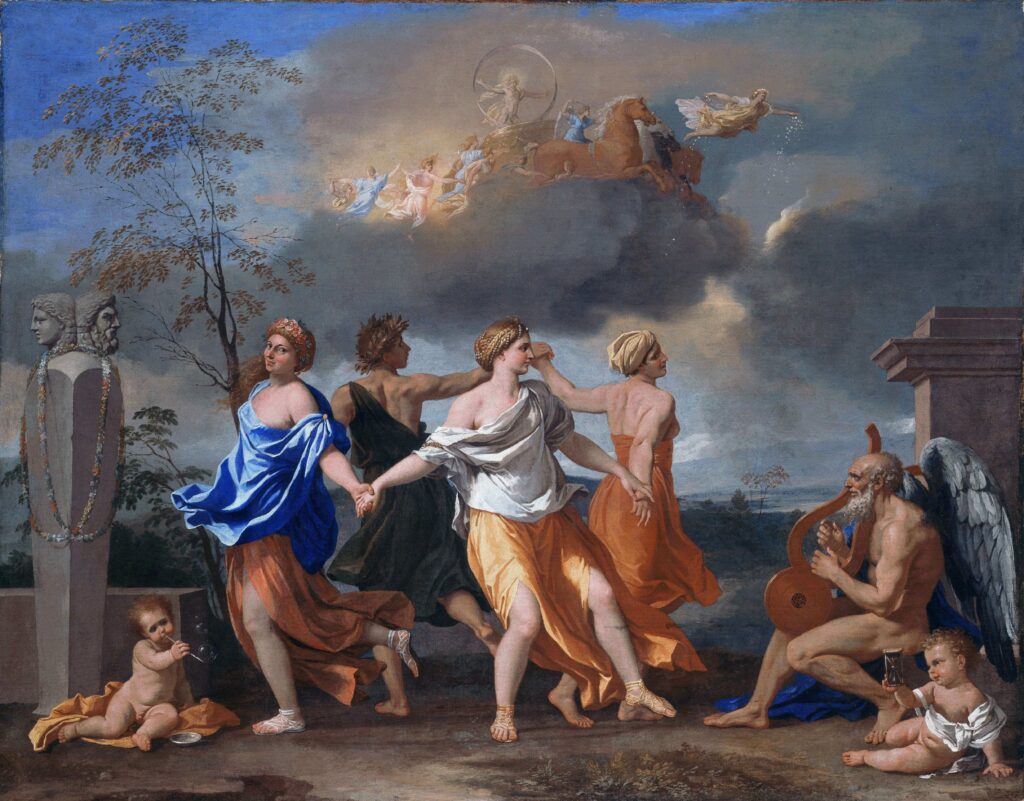
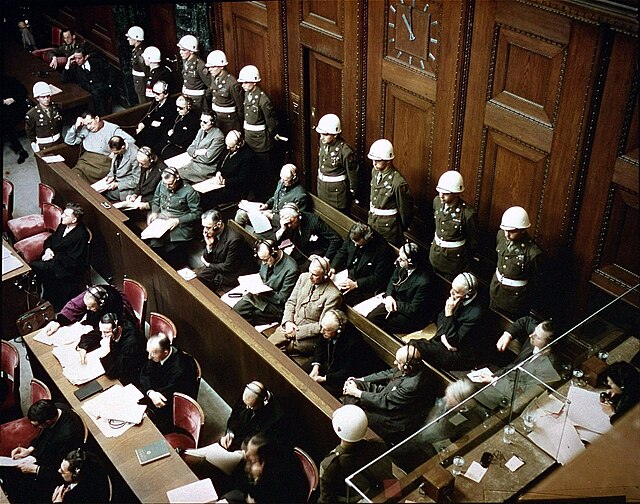
Defendants at the Nuremberg Trials

“Don’t mention the war,” my grandfather advised me a few minutes before our guest, an old friend from the faculty of the nearby University of Puget Sound, joined us for lunch. This was Tacoma, Washington, about twenty miles south of Seattle in America’s Pacific Northwest, in mid-August 1975 (I was visiting from Cambridge) and thus about ten weeks before John Cleese immortalised the phrase in ‘The Germans’ episode of Fawlty Towers, which I see was first broadcast on 24 October that year. Among other distinctions my grandfather ended up as the US’s oldest active full-time professor, but that aside he was always a man ahead of his time, and I think would have enjoyed the happy coincidence of this use of the line that entered into the shared folklore of my generation of Brits.

Our guest that day in Tacoma was Colonel Burton C. Andrus (US Army, Ret), and, true to his military calling, he arrived with us precisely on time. Or, to be more literally true, he didn’t. About fifteen minutes before the appointed hour, my grandfather called me over to the front window and, with an amused smile, pointed to a large-finned old Cadillac parked directly across the street. I could see a bespectacled, grey-haired man sitting bolt upright in the driver’s seat, reading a newspaper. My grandfather and I then stood waiting for the hands of the living-room clock to reach exactly 12.30pm. During these minutes, the figure in the car continued reading the paper, as though he were in fact sitting unobserved in a chair in his own home, and not parked immediately opposite our front door, ten yards away. Then, precisely at 12.30pm, the man got out of the car, walked briskly to the door, and rang the bell. “Ah, Colonel,” my grandfather greeted him. “Punctual as ever.”
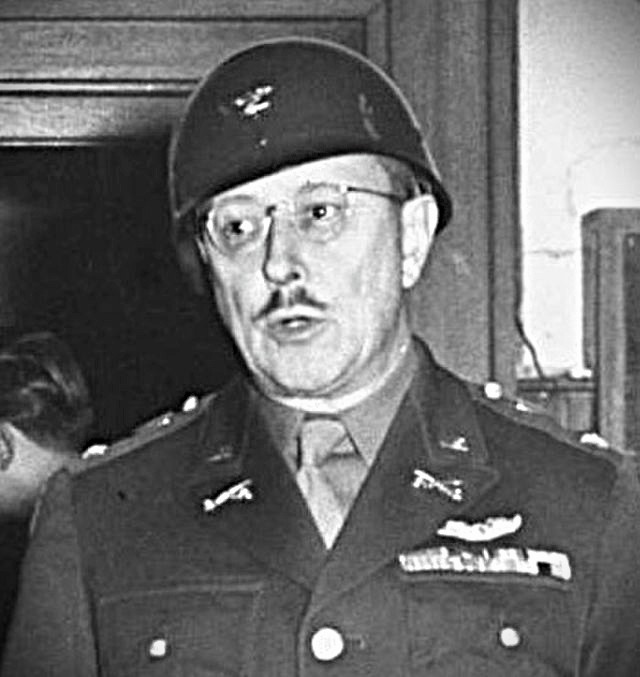
Colonel Burton C. Andrus

Colonel Andrus was then 83, and it was immediately apparent that he retained his decisive, soldierly approach to life. An October 1946 issue of Time, which I’d read in my grandfather’s scrapbook the previous evening, gave a rather unflattering account of our guest. It described him as “a pompous, unimaginative, if thoroughly likeable officer who wasn’t up to his job … Every morning his plump little figure, looking like an inflated pouter pigeon, moved majestically around, impeccably garbed in his uniform and highly shellacked helmet.” Now, thirty years later, Andrus retained the same crispness of dress – I seem to remember a funereally dark suit and tie – but there was little about him that was plump or inflated. He was, if anything, a trim, wiry figure who could have passed for twenty years younger than his real age (and, incidentally, nothing like the actor John Slattery, who impersonated him in the recent film Nuremberg), and I could immediately see how formidable, in fact frightening, a character he once must have been.

When introduced, the colonel eschewed the traditional handshake and instead seized my arm near the elbow for a second in a grip of steel, as if making a sudden arrest. He then gazed fiercely around the room, which he remarked, rightly, if a shade caustically, had ‘a lot of possessions’ in it. His relentlessly critical eye had been trained over the decades to spot weakness, and he could still be abrupt in noting any blemishes or other details that failed to meet his exacting standards. I was glad that I had had a haircut the day before.

Born about 300 miles away in Spokane, Washington, in 1892, Andrus had a successful early career working for Standard Oil. He volunteered for the army on America’s entry into the First World War, and an officer’s report on him even in this youthful period praised both his “iron self-will” and “ability to inspire the fighting man which endear[ed] him to their hearts.” Although not posted overseas, Andrus was to foreshadow his later career when in July 1919 he was promoted and sent to the Presidio in Monterey, California, where he served as Prison and Intelligence Officer. Various staff and administrative posts followed in the inter-war years. In September 1941, then Lt-Col Andrus was sent to Great Britain to study its air-ground operations, and did a “thoroughly conscientious” job there, as even Time acknowledged. His was a world of briefing notes, technical manuals, dockets, manifests and fussily annotated guidelines on military procedure – a gift for detail that did not diminish with age. Andrus returned to Britain in January 1944 to serve as Commanding Officer of the 10th Traffic Regulation Group in the run-up to D-Day. In December of that year, he transferred to Allied field headquarters in liberated France as a Combat Observer. In May 1945, Col. Andrus was appointed governor of the Mondorf-les-Bains facility in Luxemburg, an interrogation centre for Nazi war criminals popularly known by its code name ASHCAN. When the inmates were moved to a new prison built at the back of the Nuremberg Palace of Justice, Andrus joined them there as their Commandant.

Notwithstanding my grandfather’s proverbial words of warning, Col. Andrus, once settled in a chair and fortified by a dynamite-strength martini, positively enjoyed talking about the war. And talk he did. Thrillingly. At length. In a dry, crisp voice he told us how military discipline and morale among the staff on his arrival at Nuremberg had been “a joke”, and that one night early on in his tenure a fellow officer had announced that he was leaving the post with the 200 men of his battalion, as he felt they could be of more service to the Allied cause elsewhere. At that, Col. Andrus quick-marched down to the motor-pool. “I posted guards overlooking it and I said: ‘The first man to drive out of that pool tonight – shoot him.’ No one moved. That particular officer soon found himself transferred out of Nuremberg, and sent to a less desirable posting than he might have wished,”  the Colonel smiled. The two hundred men of his unit remained behind to become the nucleus of the prison staff.

Not long after that, Andrus went to deliver the formal indictments to the men in their cells. “They were a motley crew,” he remembered. “You looked at them and wondered how they could possibly have terrorised so many millions of people.” The colonel came to the conclusion that

…it was largely a matter of image. These gangsters had always strutted about with retinues of boot-licking aides. No one questioned them. They created an impression which, through newspapers, radio, and movie films, became a cult. This cult had to be lived up to. To increase their lustre, the men had to keep going forward – in the end, they so lost track of right and wrong that in prison they felt not guilt but a kind of indignation at their confinement.

The only one of the indicted men who had mildly impressed him was Field-Marshal Wilhelm Keitel, until lately the Head of the German Armed Forces and de facto War Minister. “He at least snapped to attention when receiving the papers I handed him,” Andrus allowed.

Like other prisoners before and after them, some of the inmates at Nuremberg turned to the solace of religion. Hans Frank, the former Governor-General of Poland, and as such thought to be responsible for the deaths of up to two million Polish Jews, “used to pray at all hours of the day, and I have no doubt genuinely felt that the Church had relieved him of guilt,” Andrus said. Several others among the accused preferred the more secular consolation of the law. Keitel and his colleagues Field-Marshal Kesselring and Grand Admiral Doenitz all addressed letters to the Supreme Allied Commander that Andrus felt would almost have been comic but for the circumstances. Many quoted the Geneva Convention, and some asked that their former aides and orderlies be sent to join them in prison. Kesselring had wanted a more comfortable bed and bigger windows in his cell to alleviate his rheumatism, a request that Andrus had felt it within himself to refuse.

The prisoners themselves weren’t the only ones to suffer the particular stress of life at Nuremberg. To my surprise, Andrus told us that when he arrived,

…most of the rest of the jail was already occupied by German civilian prisoners. It would have been easy for any of them to infiltrate our wing, and the prospect kept me awake at night until I finally got permission to erect a barrier. For that matter, the security outside the compound wasn’t any better, and if some fanatical pro-Nazis had taken it on themselves to load a truck with TNT and send it speeding through the outer wall to the cell-block itself, we would all have been blown sky high.

Andrus had also been worried about the morale of the Nuremberg jailers, or ‘sentinels’ as he called them. “These men were often 19 or 20 years old, and they were to stand in shifts in dark concrete walkways watching the prisoners day and night. It wasn’t a job for sissies. Over my whole term of duty, I experienced a 600 per cent turnover in staff,” Andrus remarked, not bothering to hide a faint snort of derision. Adding to the sombre atmosphere, two of the Nuremberg inmates, the so-called Reich Health Leader Leonardo Conti, and head of the Labour Front Robert Ley, committed suicide in captivity, while the Luftwaffe chief and Reichsstatthalter of Prussia (though he acquired offices of state almost at will) Hermann Goering later cheated the hangman by biting down on a cleverly concealed cyanide capsule only hours before his scheduled execution in October 1946.

But by far the most enigmatic – and troublesome – of Col. Andrus’s charges at Nuremberg was the former Deputy Fuhrer, Rudolf Hess. Hess was then 51, and had been in Allied hands since famously flying to Scotland in an apparent solo attempt to broker peace with the United Kingdom in May 1941. Was he mentally unhinged, as his bizarre flight, and subsequent real or feigned amnesia, seemed to suggest?
The colonel’s first encounter with “this beetle-browed little man who arrived in a grey suit and a crumpled felt hat” was far from promising. Hess was being marched down a corridor in the jail when he saw Goering and his guard coming towards him. “Conveniently forgetting to forget, he immediately snapped to attention and threw up his arm in the Nazi salute to greet his old comrade.” The black comedy of the scene struck me, and I asked the colonel what he had done. “I instructed Hess, ‘Do not raise your arm like that again. I consider it a vulgar gesture.’ ‘The Nazi salute is not a vulgar gesture,’ he said. ‘It is now,’ I told him.”

“I knew right away that he was faking it,” the colonel continued. When later questioned about his family, “Hess was able to answer in very great detail about events that had happened 40 years earlier. The fact that he was reading two highbrow books a day while in custody also told me that he must have retained some of the background of his education in order to understand them.” A US Army psychiatrist examined all the Nuremberg prisoners. His report found that Hess was “passive, suggestible and naïve … Like the typical hysterical personality, he was incapable of facing reality and escaped by developing a functional disorder” – in this case, selective amnesia. “I looked him in the eye and told him I knew he was a sham. Hess just glared at me. He was ‘mad’ all right, mad at me for disbelieving him,” the colonel said.

As for Goering himself, ‘he came to me as a 300-pound hophead,’ Andrus remarked, employing the terminology of the day. “He had sixteen suitcases, wore a Cartier watch, and his fingernails were painted bright red.” After several months of the colonel’s regimen, Goering was cured of his morphine addiction, and his weight was down to something approaching normal. Even so, the table in his cell was deliberately built so that it would have collapsed had he tried to use it to reach the small barred window with a sheet or towel as a possible means of suicide. Andrus admitted that he had found Goering “a cunning and not always disagreeable internee, whom you could never turn your back on.” One morning in March 1946, the Nuremberg prisoners were being taken out of their cells to be marched to the nearby courtroom. “Goering took the opportunity to reach out and strike the sentinel several times on his arm and shoulder. The soldier hit him back with his billy-club. Goering then went loco and started screaming in German, and using his hands with incredible speed to lash out at the man. It took four GIs to subdue him.” A few years later, I was uncomfortably reminded of this incident when I sat watching the scene of Hannibal Lecter maniacally attacking his guards in The Silence of the Lambs.

After being condemned to death, Goering had made a request to face a firing squad rather than the gallows. The Allied control commission rejected his petition. “In my mind, that was the moment he took the decision to kill himself,” Andrus said. The colonel would not be drawn on the rumour that a sympathetic GI had palmed the cyanide capsule to his prisoner, and rather stiffly repeated the formal conclusion of the enquiry that “Goering had the poison in his possession when apprehended”, that “he may have hidden it in an obscure recess in the inside of his toilet under the overhanging rim,” and that “no blame for dereliction of duty is ascribed to any prison guard.” The colonel repeated the words verbatim, and I could tell that the matter still rankled all these years later. To have lost three men at Nuremberg by their own hand was the one obvious regret of this proud and supremely capable soldier. Twenty years after the event, the colonel received a letter out of the blue from the National Archives in Washington, DC. It attached a photocopy of the suicide note Goering had personally addressed to him. This, too, concluded: “None of those charged with searching [for the cyanide] is to be blamed, for it was practically impossible to find it. It would have been pure accident. [The army psychiatrist] informed me that the control board has refused the petition to change the method of execution to shooting.”

Given our continued fascination both with the Nazis and with prison dramas, it’s hard to imagine anything that could make the events of the early hours of 16 October 1946 more morbidly compelling. The execution by hanging of ten condemned men at Nuremberg (Goering was to have been the eleventh) had it all: a long walk through a rainswept prison yard into a starkly lit gymnasium, where one by one the condemned men were escorted up the steps (there were thirteen) to the gallows. Colonel Andrus read the formal sentence to each one moments before the end, and even he admitted that “It was a terrible task.” The Reich foreign minister Joachim von Ribbentrop was the first to be dispatched and, like most of the others, he met his fate with a certain dignity. “My last wish is that Germany’s unity shall be preserved and that an understanding be reached between East and West,” he said. As the rope was then tightened around Ribbentrop’s neck, he turned to the army Lutheran chaplain at his side and whispered: “I’ll see you again.”

“The military men went to their deaths impeccably,” Col. Andrus said. When his turn came, Arthur Seyss-Inquart, formerly Chancellor of Austria and later Nazi commissar of the occupied Netherlands, remarked in a level voice: “I hope that this execution is the last act of the tragedy of the Second World War, and I hope that out of this disaster wisdom will inspire the people, which will result in understanding between the nations and that peace on earth will be finally established. I believe in Germany.” Then he, too, was hanged. The only difficulty had come in the case of the former publisher of the rabidly antisemitic newspaper Der Stürmer, Julius Streicher – a “very shapeless man in a baggy suit with a large bald head and short legs.” Once at the scaffold, Streicher had screamed “Heil Hitler!”, and then made some further unappreciative remarks about the Jews. As the executioner stepped forward to the lever, the condemned man had hissed at him through his black hood: “The Bolsheviks will hang you one day!” After these blood-chilling events, Andrus insisted that the bodies, including Goering’s, had been taken to Dachau and cremated in the same concentration camp ovens where tens of thousands of Jews and others had met their end, although some historians doubt this detail. The ashes were secretly dispersed in a river. The colonel had nothing to say on the long-standing rumour that the executions had been botched, meaning that some of the men had fallen with insufficient force to snap their necks and had instead slowly suffocated to death.

I was then a remarkably vain and self-absorbed 18-year-old, but even so I like to think I realised how lucky I was to be included at the lunch table that day. The time seemed to fly by. Precisely at 2.30pm, Colonel Andrus stood up, thanked us for our hospitality, and announced that he would now go home for his scheduled nap and a walk. You saw again the rigid self-discipline, and remembered that this was a man who had lived his whole adult life in a world ruled by punctuality, professionalism and unswerving devotion to duty. As he left, the colonel seized my arm once more and looked me hard in the eye. “I hope I haven’t bored you too much,” he said. I assured him he hadn’t.

Colonel Burton Andrus died on 1 February 1977, at the age of 84. It’s said by his son that his last recorded thoughts were of Nuremberg. “I think that it haunted him … ‘Goering has committed suicide. I must report it to the Commission,’ he said. I told him it was the middle of the night, and it could wait until morning. Four hours later, my father died.”

Six for 2026

Image: Ralf Roletschek, Wikimedia Commons

As I write this it’s the tail end of January, and I sit at home on the edge of a Pacific Northwest rainforest, which means that it’s one of those times when the miseries of the world threaten to engulf us and the precariousness of the human condition, far from appearing a worthwhile and even noble struggle, seems an infinite rebuke.

Meanwhile, we’ve collectively at least survived the traditional blizzard of Christmas review roundups, and no doubt – unless we’re all blown to smithereens in the meantime – we’ll soon have the inevitable Easter reading recommendations and summer beach-book lists in our sights, until before long the season of mists and mellow fruitfulness rolls around once more, and with it yet more critical effusions, and so on, ad infinitum.

If for no other reason than to get a head start on the whole craze, I offer here a brazenly subjective midwinter lineup of half-a-dozen worthy candidates culled from among the many thousands of our publishers’ new or forthcoming titles, any one of which is guaranteed to warm the reader’s heart in these otherwise unremittingly bleak days and nights.

Matt Haig, The Midnight Train

Like several million others around the world, you may know the basic outline of Haig’s breakthrough 2020 novel The Midnight Library. In short: the book’s protagonist, Nora Seed (even great writers sometimes struggle with names), in her mid-thirties, single and childless, feels useless. Her cat is dead, she’s alone, and she’s been fired. Late one night, she tries to kill herself. Unpromising, I know, but this is where Haig lifts the whole thing out of itself and into the sort of energetically sustained parallel universe that C.S. Lewis might not have disowned. Instead of death, what Nora finds is a library in which each volume represents a version of her life where she made different choices. All she has to do to step into that life is to open the book. You may possibly recognise some of the plot ingredients of the 1998 film Sliding Doors, itself a product of the so-called many-worlds theory in which a new universe beckons from our every choice and decision.

The whole enterprise possibly sounds a bit strained, but in Haig’s hands it delivers the goods as a serviceable get-away-from-it-all novel that works both on the level of a good yarn and a speculative rumination on what we’re really doing during our brief tenancy of the planet. What’s the best that can happen in your life, and what’s the worst? Those are the questions. Without spoiling the treat, The Midnight Train is broadly speaking in the same vein as its predecessor, only – as the title rather implies – translated from a library onto, well, a train. I’ve slightly furtively read about three-quarters of the new book in what publishers like to call uncorrected proof form, and I can confirm it’s well up to par with its distinguished prototype; both have interesting things to say about how hard it sometimes is for any of us to completely accept ourselves for what we are – and, like the eponymous train itself, it all rattles along at a brisk clip.

Canongate Books, April 2026, £20

Malcolm Galfe, Near Horizons

The author here knows his technology and he knows his psychology, and the two combine in seven wonderfully engrossing stories which themselves incorporate elements of horror, sci-fi, mystery, dystopia and good old-fashioned (it never seems to go out of style) human drama.

That said, I’m pleased to report that we’re not exactly in Stephen King, let alone Stranger Things country in Near Horizons. Without exception, Galfe’s tales have a rich, understated texture to them, weaving together a patchwork of tropes and allusions to create something that feels consistently exciting and new. He achieves his effects by tweaking our anxieties and using the suggestive power of good dialogue, not by the sudden arrival of a race of invading pod-people or their like. It’s the literary equivalent of the way in which the best Hitchcock films play with cinematic techniques to tease and torment us, and in its way just as delectable.

As a matter of fact, it’s not entirely illogical to review this title in close physical proximity to the aforementioned Matt Haig; both are neatly crafted, elegantly written, sharp, shocking and often mordantly funny. What raises Near Horizons above the pack of lesser tech-themed morality stories is Galfe’s wise and pitch-perfect ear for dialogue, his grasp of the elements of suspense, and the way he weaves fictional characters into recognisably true-to-life crises in consistently gripping ways.

But if Haig’s book stands as a just slightly over-manicured front lawn, complete with reassuringly familiar garden gnomes and even a fluffy household pet or two on hand, Galfe’s has an authentic touch of the jungle to it: it feels exotic and a little dangerous, often disarming the reader with a page or two of seemingly casual exposition before blindsiding them with a sudden plot twist. Or put another way: these are the sort of stories tailor-made for those of us who like to be both entertained and shocked, and perhaps also secretly comforted by the fact that it’s the characters in Near Horizons, not themselves, being manipulated in this way. There’s something inherently reassuring in the notion that nothing here could ever, surely, happen to us – an almost physically soothing sensation, like a welcome descent into a warm bath when the door is firmly locked and bolted against a storm raging outside. I confidently predict that we will be hearing much more of this supremely assured author in the future.

Woodbridge Publishers, November 2025, hardcover £16.12, paperback £13.05

Cheryl Hines. Image: David Torcivia, Wikimedia Commons

Cheryl Hines, Unscripted: A Memoir

This book shouldn’t work. A memoir written by a 60-year-old actress, who, frankly, has never threatened to become a major film star – you may know her best as Larry David’s foil on the TV series Curb Your Enthusiasm – hardly sounds promising. Then there’s the author’s personal baggage. Since 2014, Cheryl Hines has been married to Robert F. Kennedy Jr., the raspy-voiced US cabinet minister who served as one of Donald Trump’s chief surrogates during his last presidential campaign. Rarely has a book been written that straddles the worlds of Hollywood and conservative politics, let alone those as embodied by the current administration in Washington DC. Yet, against the odds, Unscripted turns out to be an enthralling read.

Essentially, what’s on offer here is a well-told and often deftly comic account of a working-class Florida girl with dreams of doing something in life other than following in her father’s footsteps as the manager of a local Burger King outlet. In time, Hines goes on to catch the acting bug, makes her way to the Universal Studios in Orlando, and promptly finds herself staffing a sex chatline. Next she’s offered a part in a cable-TV show called Swamp Thing, where the script calls on her to do little more than emerge from a large manmade puddle on the studio floor and stand there for a while, topless. Another time she appears on an episode of American TV’s The Dating Game, but isn’t chosen to go on a date.

Life was a bit like that for Hines in the 1990s. This may have been her nadir as a working actress, but it’s the high point of her book, which passes over the serial rebuffs and setbacks in breezy, vernacular fashion, with none of the professional biographer’s tendency to choke the pages with a flat-footed account of names and dates. Things slow down a bit once we settle into the groove of Hines’s long and apparently blissfully untroubled run on Curb, and her equally happy marriage to RFK Jr., but the first act of the show is itself worth the price of admission.

Skyhorse, March 2026, £21.59

Sir Anthony Hopkins. Image: Elena Torre, Wikimedia Commons

Anthony Hopkins, We Did OK, Kid: A Memoir

According to its publisher, this book is a ‘raw, honest and moving account’ by one of our foremost living actors. It’s certainly raw. Hopkins lays out his early life in unsparing detail, as the son of a tough, hard-headed Port Talbot baker who didn’t have much time or sympathy for a son with an alarming tendency to slap on makeup and hang out with the local amateur dramatics society. ‘My mother and father were both prone to depression and black moods,’ we learn. ‘They fought and wept. My father drank heavily, which only fueled his heightened emotionality.’ Anthony Hopkins himself liked a drop in later life, to put it no stronger than that, and proved a less than stellar National Service recruit as a result, often brought up on charges of brawling with his fellow soldiers. The fractious reputation followed him back into civvy street, first in the world of semi-professional provincial theatre, and then the more refined halls of RADA in London.

Hopkins assesses his talent in these days modestly. ‘I could barely speak, and had the posture of a camel,’ he writes. But he worked hard, and never turned down a job. In time he came to the notice of Laurence Olivier, who made him his understudy in a production of Strindberg’s The Dance of Death. After standing in for the great man one night, Olivier complimented him for having ‘walked away with the part like a cat with a mouse between his teeth.’ Even so, the young Hopkins was soon bored by the repetition of the stage, one of those people who always seem to want to be elsewhere, doing something else. ‘I began to feel that acting was just a by-product,’ he writes. ‘I wanted to find value in the rest of my life.’

As with the aforementioned Cheryl Hines memoir, this book most comes alive when charting the uphill struggles of the author’s early career, and rather settles into a holding pattern once we come to see him triumph in The Silence of the Lambs and all the rest. Anyone hoping for rollicking Hollywood scandal à la Bette Davis or David Niven may be disappointed, although Hopkins does allow himself a few disobliging remarks on the late actor Paul Sorvino, with whom he worked unhappily on Oliver Stone’s Nixon. In the absence of gossip, there’s a good deal of what’s-it-all-about rumination on the author’s part, some bits of it more compelling than others. The takeaway message of the book is of the essential strangeness of the acting profession, which, like any intelligent observer, the author sometimes struggles to take entirely seriously. For all the money and awards, I grew to feel quite sorry for Anthony Hopkins as I finished We Did OK, Kid. But that’s because he knows how to tell a story.

Simon & Schuster, November 2025, £25

Bob Spitz, The Rolling Stones: The Biography

Ah, the Stones. By now there have been almost as many books on the old devils as records and concerts by the lads themselves over the course of their sixty-plus year career. In no particular order, we’ve had the late Stanley Booth’s fly-on-the-wall account of the band’s notorious 1969 tour of the United States, ending with their disastrous concert at Altamont; an enjoyably gossipy romp through the narcotic days of the 70s by their factotum and sometime heroin dealer ‘Spanish’ Tony Sanchez; formidably brainy group biographies by the likes of the journalists Stephen Davis and Philip Norman; and, not least, the necessarily sanitised but still quite lively first-hand accounts by Keith Richards, Bill Wyman and Ronnie Wood themselves, all of them estimable enough in their own right, if perhaps betraying the hand of a ghostwriter. Back in the dark ages, there were even biographies of both Richards and Mick Jagger, and a third book (a glutton for punishment, that author) on the band collectively by a character named Sandford, but we needn’t linger on them.

Now Bob Spitz, an American journalist known for his previous works on pop-cultural figures like the Beatles and several lesser groups, as well as his juvenile nonfiction books (in so far as there can truly be said to be a difference between the two genres), brings us this ‘definitive’ account of rock’s bad boys, which he stretches out to the gatefold triple-album length of 700-plus pages. Does it actually say anything new? Yes and no. The basic story is present and largely correct: an initial eighteen months of struggle, followed by ten years of inspired music and personal debauchery – and in turn by five decades of meticulous decline management – might sum it up. Spitz is at his most engaging when he abandons the weary chronological plod, and instead follows the template of Ian Leslie’s triumphant recent dual-biography John & Paul in putting the Jagger-Richards relationship under the microscope. The author takes on the tired polarities – Mick as the uptight details guy, Keith the agreeably wrecked one – by reframing the story as a volatile bromance: ‘passionate, tender and tempestuous, full of love, riven by jealousy.’ However much they were at odds, seems to be the message, Mick ’n Keef were, or are, still an indivisible twosome, the driving force of the Stones, with the others, even the band’s original wayward genius Brian Jones, mere talented add-ons. The cast and basic plot may be familiar, but Spitz has at least succeeded in giving a recognisably human face to the whole star-crossed saga.

Penguin Press, April 2026, £26.14

1918 – Children play on a captured German field artillery gun exhibited in the Mall, London. Image: Wikimedia Commons

Alwyn Turner, A Shellshocked Nation: Britain Between the Wars

It’s always good to find a readable and well-researched variant on the standard schoolroom account of events, which in this case would have had us see the UK of the years 1918-39 as a uniformly grim place, grey, soupily lit and generally austere, somewhere the Great Depression set in like a chill Channel fog and lifted again just in time for the arrival of the Luftwaffe. What’s most striking about Alwyn Turner’s new book, by contrast, are the similarities between those sepia-toned times, seemingly out of some vanished Jurassic social order, and our own. Consider that, in 1922-24, Britain managed to get through four prime ministers; that politicians as a class were said to be ‘uniquely unpopular’, occupying a place in the nation’s affections only slightly more elevated than that of child molesters; that London itself was a soiled, sad place whose inhabitants habitually murdered, stole, lied and cheated as they slithered around in a sea of immorality; that the UK was drowning in debt while simultaneously undergoing the Spanish Flu epidemic that killed an estimated 40-50 million people worldwide, roughly three times more than Covid; and that ‘tariff reform’ divided the nation much as Brexit did a century later.

For that matter, many of the products and institutions of our current daily lives entered service in the 1920s or early 30s. Among other goodies, Turner lovingly catalogues the new confectionery brands manufactured in Britain: ‘Aero, Black Magic, Chocolate Digestive, Chocolate Orange, Crunchie, Fruit and Nut, Kit-Kat, Maltesers, Mars Bars, Quality Street, Rolos, Roses and Smarties.’ That’s not to mention such establishments as the BBC, Butlin’s holiday camps, British Home Stores, NAAFIs, Wembley Stadium and London Transport, or the last’s iconic diagrammatic tube map and double-decker buses.

Maybe the book as a whole tends to be long on lists of this sort, as opposed to locating the human narrative that generally makes a social history come alive on the page, but, that minor cavil aside, A Shellshocked Nation is still a bracing and well-paced read, set against the ever-louder ticking clock of international events, which reminds us why the author’s devoted fans admiringly refer to him as ‘Page’ Turner. You could do much worse than to treat yourself to a copy this winter.

Profile Books, January 2026, £17.99

Anthony Powell – a century’s chronicler-conjuror

Dance to the Music of Time, by Nicholas Poussin (c.1640)

A framed letter faces me on the desk as I write this. Composed in an engaging mix of spidery longhand and erratic manual-typewriting, with a rubber-stamped phone number giving it a further touch of the haphazard, dated September 1992, it reads:

Dear Mr. Sandford

I am delighted you like Dance well enough to want more, but I have always set me [sic] face against doing any sort of coda after I finished, because even while I was writing, it was difficult enough to keep the same tone of voice, and now that I am so ancient it would be quite impossible. All the same, kind of you to ask.

Yours sincerely

Anthony Powell

PS I expect you know Hilary Spurling’s Handbook to a Dance (Heinemann), which is very good and amusing.

It was the beginning of a modest correspondence I kept up with Powell, author of the magisterial 12-novel sequence A Dance to the Music of Time – the last volume of which appeared a blink-of-an-eye half-century ago, in September 1975 – during the remaining eight years of his life. He would have been 86 at the time of our initial exchange, and by all accounts was becoming increasingly crotchety, not least in the matter of the correct pronunciation of a name he insisted should rhyme with ‘bowl’, not ‘trowel’.

One freezing January morning later in the 1990s, a plumber answered an urgent call to attend to a burst pipe at a large Georgian house in the English countryside near Bath. An elderly man dressed in tweed answered the door.

“Mr. Powell?” asked the plumber, pronouncing it Pow-ell.

“There is no one here of that name,” replied the old man.

“Oh, sorry,” said the plumber. “I must be at the wrong house.”

“I can’t help you,” said the old man.

The plumber then drove around the frozen neighbourhood before being told that Anthony Powell did indeed live in the house he had just visited. So he returned.

The same man opened the door. This time the plumber enquired, “Does a Mr. Powell live here?” “No,” the elderly gentleman said. “However, do you mean Pole?” The plumber nodded. “Ah! Then go round to the back door, the leak is in the kitchen.”

This is surely a scene that could have been torn direct from the pages of Dance, peopled as it is by a cast of louche London artistic types, colourful military coves and eccentric English landed squires. The sequence has been described as everything from “Proust anglicised” to “a kind of social accountancy, and not much more enlivening than the financial sort.” Evelyn Waugh’s son Auberon (of whom more presently) thought the whole thing no more than “an early upmarket TV soap.” PG Wodehouse, by contrast, was “absolutely stunned by [Powell’s] artistry.” Fifty years later, the critical divide persists. Powell’s magnum opus has become an odd sort of cult work, its reputation kept alive not just by the devotees who have loved or still love it – among them Christopher Hitchens, Stephen King and Clive James, who called Dance “the best modern novel since Ulysses” – but by those who love to hate it and consider the whole thing a testament to staleness.

I’m in the supporters’ camp. Taken as a whole, the Dance’s twelve-book sequence strikes me as an unsurpassable panorama of a vanished Britain, and – lest you not yet have made its acquaintance – an almost chemically addictive joy to read; hence my brazen request of its author for more of the same. But here’s a curious thing. As I say, I had the pleasure of corresponding with and meeting Powell himself, and have read and re-read both his novels and the various biographies, particularly the aforesaid Hilary Spurling’s, and yet the more one comes to learn about the man the more elusive he seems to be as a flesh-and-blood human being – not to mention one whose life took him from a lonely and nomadic boyhood at around the time of the First World War to the twilight years spent as an obsessive genealogist and high-and-dry Tory who, almost incredibly, survived long enough to see in the twenty-first century. All I can add by way of a physical sketch is that in person Powell was compact, immaculately turned out in a manner that seemed to have been frozen in place since about the year 1933, with a piercing stare under incongruously untidy eyebrows, and a sharp, nasal voice that was close to a comic turn in itself.

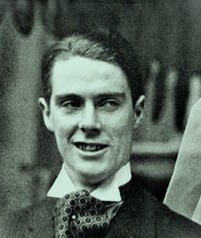
Anthony Powell in 1934

On the other hand, in a canonical work full of shadows, as Powell nearly wrote in Books Do Furnish a Room, certain characters are bound to be shadowy. There is the superbly detached role, to cite only the most obvious example, he gives his alter ego Nick Jenkins, the narrator of A Dance to the Music of Time. Both the author and his fictional self seem to have gone through life as scrupulously neutral observers of the human condition, rarely if ever offering a declarative judgement on people or events, let alone asserting their own identities. There’s a section in the early wartime novel The Valley of Bones, about midway through the whole sequence, where Jenkins’s wife Isobel suddenly goes into labour with the couple’s first child, an event she announces with the line: ‘Look here, I’m sorry to have to call attention to myself at this moment, but I’m feeling awfully funny. I think perhaps I’d better go to my room.’ This same sense of supreme self-effacement applied equally to the author who gave her the lines to speak, who himself once said, ‘I have absolutely no clear picture of myself’, and confessed that he began writing shortly after coming down from Oxford in large part because he couldn’t think of anything else to do, rather than due to any particular aptitude or talent.

With respect to that judgement, it strikes me as taking diffidence to unnatural lengths, if not to qualify Powell as a martyr to false modesty. Taken as a whole, Dance is a fiendishly intricate literary feat, which its author carries off throughout the whole 3,000-page, million-word sequence as it passes over some sixty years of English social history, conveyed through perfectly ordinary (which is to say, often absurd) situations rather than conventional drama. It remains a singular, and brilliantly sustained, achievement of twentieth-century letters. Powell himself, as conveyed by his biographers, may be retiring to the point of near invisibility, but his great roman fleuve more than once touches the artistic heights occupied by P G Wodehouse and Evelyn Waugh.

Yes, to address a frequently heard opinion of the Dance sequence, there are moments where the prose is arid and the terminology fustily dated. Powell’s characters adopt “sun spectacles”, for example, when finding themselves in “not wholly inclement climes”, or travel on that “uncomfortable but commodious conveyance” the Clapham omnibus. It might be said that the author sometimes makes heavy work of simply getting the reader from A to B. When introducing the minor character Rosie Manasch, a patron of the arts who emerges in the tenth installment of the series, Books Do Furnish a Room, Powell notes: “In the course of further preliminary conclaves with Bagshaw on the subject of Fission’s first number, mention was again made of an additional personage, a woman, who was backing the magazine.”

Or, of a pair of MPs, Labour and Conservative, meeting at a funeral described in the same book: “The two had gravitated together in response to that immutable law of nature which rules that the whole confraternity of politicians prefers to operate within the closed circle of its own initiates, rather than waste time with outsiders; differences of party and opinion having little or no bearing upon the preference.”

The Dance, then, may have an old-fashioned roll to it, but beyond the occasional dowager style Powell’s genius was surely to sustain a vibrant, and highly credible, self-contained imaginative world. Some of the series’ individual performers recur from book to book, going on from school to university, their careers interweaving, marrying, divorcing, fighting for their country, haunting the rackety dives of postwar Soho, and finally catching up with life in the hedonistic, culturally vapid 1970s. As anyone who’s ever written a novel will tell you, it’s hard enough to plausibly develop even a single life over any protracted amount of time. Powell does this for literally scores of deftly sketched, sometimes honourable, not infrequently comic, invariably compelling leading characters, appearing and disappearing and then reappearing at intervals, all in perfectly logical order, guiding us from the Great War to the moon landings in the process, with the subordinate cast, typically drawn from the English literary or artistic demi-monde, providing the crucial ballast.

In short, Powell’s achievement is that of the architect as well as the author. The delicate slapstick of events is slowly drawn together, the apparent coincidences and chance reunions never less than true to life, the touch exquisitely light in its sardonic treatment of the material.  Here is Powell’s doppelgänger Nick Jenkins, musing in a rare moment of intellectual candour, in the third book of the sequence The Acceptance World:

I began to brood on the complexity of writing a novel about English life, a subject difficult enough to handle with authenticity even of a crudely naturalistic sort, even more to convey the inner truth of the things observed … Intricacies of social life make English habits unyielding to simplification, while understatement and irony – in which all classes of this island converse – upset the normal emphasis of reported speech.

As often noted, Powell’s opus is really a form of elegant soap opera, with cyclical themes and characters, and an infallible knack – the envy of many a television screenwriter – of ending each episode with a crisis. (Powell spent the winter of 1936-37 script-doctoring in Hollywood for Warner Brothers, an experience, however venal, he later admitted was invaluable ‘when one came to the engineering’ of Dance.) When the series’ narrator joins the army in 1939, he is promptly assigned to the corrosive Kenneth Widmerpool, his school contemporary of twenty years earlier. The physically clumsy, socially tone-deaf Widmerpool then returns at intervals in each of the remaining novels of the series, variously translated from soldier to businessman to MP to university chancellor-cum-pagan cultist, a figure at once ludicrous and sinister, and taken as a whole one of the great comic ogres of 20th century literature. It says something for Powell’s artistry that there was intense competition among his circle to be publicly identified as the model for a character synonymous with the harsh and manipulative use of power, the author’s brother-in-law Lord Longford laying the strongest claim, but the likes of Powell’s wartime chief Denis Capel-Dunn, the richly-tinted jurist and latterly Lord Chancellor, Reginald Manningham-Buller, the art historian Gerald Reitlinger, and even the sometime Tory prime minister Ted Heath all making a persuasive bid for consideration.

If not exactly required reading these days, Powell’s masterpiece remains one of Western literature’s enduring feats, and might even be one of the few things that nurtures an awareness of an older, more reticent England, not dead, perhaps, but gone into hiding until the present tabloid version self-destructs. The author himself lived long enough to see such bracing developments in British life as the advent of punk rock and of Sarah, Duchess of York, as well as a modern idiom in which domestics would come to refer to assaults, not servants – all recorded in his wonderfully mordant late-life diaries. A modest man with a profound dislike of reckless informality and self-promotion, Powell continued working almost until the end, publishing the final volume of his Journals in 1997, not long before Channel 4 finally succeeded in bringing a seven-hour version of his magnum opus to television screens. He once told me in characteristic tones that he was “not wholly unsatisfied” by the Dance sequence (in written, if not screen format) as a whole. It remains good literary fun, like all the best fiction a brilliantly contrived escape from the banality of the real world. The author Michael Frayn perhaps put it best when he recalled of stumbling on Powell for the first time: “It was like discovering a complete civilisation – and not in some remote valley of the Andes or the Himalayas, but in the midst of my own life … Another world had been superimposed upon my own, refracting and reflecting it.”

As mentioned, Powell brought his opus to a triumphant conclusion with its final installment, Hearing Secret Harmonies, as long ago as September 1975, and resisted all overtures to revive it from behind its marble slab at any point during the remaining quarter-century of his life. That decision notwithstanding, the years in question were far from without interest for him. Apart from turning out a stream of increasingly free-form reviews and memoirs, Powell found himself at the age of 84 embroiled in one of those explosive literary feuds the English seem to do almost as well as their genius for the political sex scandal, and which itself might have graced the pages of Dance. His adversary in the matter was Evelyn Waugh’s eldest son, Auberon, who published a damning review of Powell’s latest volume of memoirs in the Sunday Telegraph, a paper to which they were both long-time contributors. When the moment came, Hilary Spurling would pass lightly over the incident in her official life of her subject by taking what could be called the psychological approach to the whole affair. Waugh Jr, she writes, had himself not long beforehand published a memoir,

…contain[ing] a scary portrait of Evelyn as a monstrous egoist who regarded all his sons, and this one in particular, as rivals to be snubbed, derided and put down. Even in his own distress, Powell regarded young Auberon’s response [to his book] as essentially vicarious, the vengeful product of a largely loveless childhood.

Be that as it may, Powell went ballistic, severing his relations with the Telegraph, who rather bizarrely commissioned a bust of their departing eminence grise but then found they had nowhere to put it. It perched for a while on an office filing cabinet. The Powells and the Waughs never spoke again. Somehow, the whole episode could once again have been taken from one of those darkly comic contemplations of the postwar London literary scene that enliven Books Do Furnish a Room, the tenth and in my judgement best individual installment of the Dance.

Anthony Powell was that highly overused word, unique. The room he occupied in the mansion of English literature was distinct, located on a level where no one else regularly ascended, although Evelyn Waugh might be said to have inhabited broadly the same space. Any reader not yet familiar with the Dance, widely available today in various formats, should treat themselves to one or more of its volumes immediately. The dozen subsidiary novels, so beautifully written, so riotously entertaining, for all their pervasive air of English melancholy and social decay, are the work of a master of his craft. We have not his equal.

Far pavilions

CHRISTOPHER SANDFORD remembers English cricket’s 1945 resumption

In early April 1945, even while Hitler remained alive, directing phantom armies from his bunker beneath the Reich Chancellery garden in Berlin, the impressively insouciant English cricket authorities decided it might be possible to stage a number of Test-level matches with Australia during the course of the summer.

The ensuing ‘Victory’ series presented its organisers with a significant feat of logistics. Many of England’s cricket grounds bore the scars of Luftwaffe bombing, while there was also the small matter of securing the services of eleven fit men to put into the field. Two of the nation’s leading prewar bowlers, Yorkshire’s Hedley Verity and Essex’s Ken Farnes, had fallen in action, while others had returned from years of captivity in far from ideal condition to play representative sport.

An especially poignant example was that of the repatriated 36-year-old Yorkshire player Bill Bowes. Tall and bespectacled, with a shock of wavy blond hair, the fast-bowling Bowes looked more like a gangling Nordic university professor (and, it was unkindly said, sometimes batted like one) than a professional sportsman. He represented his country 14 times before the war and just once afterwards, having lost over four stone in weight as a guest of the German Reich in the interim. Delaying his comeback until the middle of June 1945, Bowes managed to bowl nine overs for a Services team, following which he promptly left the field to be physically ill in the pavilion.

Later that month, we find him writing to the English selection panel, which had enquired about his availability for future matches against Australia, in a letter preserved in the archives at Lord’s:

Dear Sirs:
The weather up North has been so bad that last Saturday was the first time I have had a decent bowl – it was short, but I haven’t recovered yet – and even as I write it is again raining.

I met [fellow cricketer] Les Ames on Sunday, and if I had forgotten he refreshed my memory of those long Eng. v. Australia matches when he told me how tired he was after the first day. I feel tired now after only a few overs, and if I had to bowl again, and then again, well, quite frankly I do not yet feel equal to it …The doctors tell me that it is ridiculous of me to expect to get over a three-year period of under-nourishment in three months, so will you please consider me very doubtful for inclusion in any team?

Such was one example of the human cost of Hitler’s ruinous attempt to determine the matter of who might be allowed to live freely in Europe.

In the measured words of the 71-year-old Pelham ‘Plum’ Warner, the man primarily responsible for selecting the England team: “The project [of a 1945 series] seemed sound when initially advanced to me, but it proved harder to effect than ideal” – particularly at a time when such men had none of the benefits of our modern communications technology at their disposal. If Warner wanted to correspond with someone like Bill Bowes about a matter such as their availability to play cricket for England, he did so by writing them a letter, putting it in an envelope, affixing a stamp, taking it to the nearest pillar box and then awaiting developments. “It was not a task I [had] undertaken in the full awareness of the actual burden it might present,” Warner was later to ruefully admit.

Walter Hammond, circa 1930

Not the least of the matters demanding Warner’s attention in April 1945 was the question of who might captain England in the hastily arranged series with Australia. The peerless Walter Hammond had been the man in charge for his side’s last Test fixture before the war, a drawn match against the West Indies at the Oval. Hammond himself was clearly the best batsman England had produced since the Jack Hobbs era of twenty years earlier. Yet doubts about his fitness to ‘continue to assume the high honour of the England Test Match captaincy’, as The Times put it, remained. Hammond was then nearly 42, somewhere between muscular and heavyset, a chain smoker and a martyr to lumbago, with a love life that attracted a certain amount of what passed for tabloid scrutiny in those more reticent times. He had joined the RAF on the outbreak of hostilities, but in the event found himself playing a good deal of sport, and occasionally training new recruits, rather than assuming any more active role in Hitler’s downfall, while also coming to resolve a complicated home life that led to the terse Press Association report: “A decree was granted to Mrs. Dorothy Hammond, wife of the England star. Misconduct was alleged with a woman named Harvey.”

Hammond was perhaps fortunate, even so, to enjoy Pelham Warner’s unstinting respect and friendship, which had something of a father-son quality to it. In that elaborately formal age, when even routine business letters tended to open with phrases such as “Sir, I have the honour to state that consideration has been given to the matter of your application for overdraft facilities at this institution …,” and were topped-and-tailed either by the use of precise titles, or merely by surnames, the Warner-Hammond correspondence preserved at Lord’s is invariably of the ‘Dear Wally’ and ‘Yours ever, Plum’ variety.

Like Warner (the youngest of 21 children born to the-then 67-year-old Attorney General of Trinidad, where he, Plum, spent his early years) Hammond had grown up abroad. His father, a corporal with the Royal Artillery who seems to have been of the opinion that children should be brought up in mild fear of their parents, was posted successively to Hong Kong and Malta. The family returned to England just before the First World War, and Walter, an only child, was sent to boarding school. His father was killed fighting in France in 1918, and his mother seems to have been more concerned with her social status than in the daily welfare of her young son. She handed him over to tutors during the school holidays, starved him of love, and on the occasions they did meet beat him regularly. It’s surely not stretching psychology too far to conclude that this upbringing turned Hammond into something of a loner and a bully, “a dreadful little shit” as he admitted years later to a younger colleague, none of which should in the least detract from a proper acknowledgement of his obvious skills as a magnificent all-round cricketer.

After seventeen years as a professional player, Hammond had turned amateur in 1938, largely because this was then thought to be the proper status befitting England’s national cricket captain. The move gave him the curious distinction of leading out the notionally unpaid ‘Gentlemen’ in their annual grudge match against the more horny-handed ‘Players’ at Lord’s, having done the honours for the Players in an earlier fixture. But even someone as well versed in the nuances of the British class system as Hammond could perhaps mistake widespread respect for his sporting skills for broader social acceptance. Cricket has a way of finding the truth about people, and the evidence suggests that although the incumbent England skipper might look, behave and sound not unlike a proper gentleman, that did not necessarily mean that he would be universally treated as one. Hammond was and remained, in the blunt terminology of the day, ‘in trade.’ Walter Robins, a Lord’s grandee whose own personal charm came equipped with a sensitive on-off switch, once referred to him as “a jumped-up car salesman,” while the Clifton and Cambridge-educated Basil Allen, Hammond’s predecessor as captain of Gloucestershire, was on ground well beyond that when he spoke of his dislike of a “moody bugger” who took “no interest in other people’s lives unless they happened to be pretty girls.”

The author David Foot quotes an exchange of views on the subject between Allen and Pelham Warner while seated together at a match at Lord’s: “Basil, that Wally Hammond of yours really is a wonderful chap, isn’t he?” “If you want my honest opinion, Plum, I think he’s an absolute shit.”

Nonetheless, Hammond would duly return to lead England in the five Victory matches against Australia in the summer of 1945. The series was eventually tied two-all, with one draw, and huge crowds flocked to each of the 15 days’ cricket despite the generally atrocious weather. Hammond himself finished with a total of 396 runs, scored at an average of 46 that most modern players would kill for. It says something for his technical prowess that certain critics would interpret even those figures as evidence of his waning powers. A lesser batsman would consider them highly creditable, and of the century the England captain scored in the series’ second match, at Sheffield, the Wisden correspondent wrote: “The finest game of the season was memorable for a wonderful hundred by Hammond on the opening day, when the pitch was at its worst. He never neglected a scoring opportunity.”

The 18-year-old batting prodigy John Dewes was one of a trio of hitherto unknown schoolboy cricketers, alongside Donald Carr and the Honourable Luke White (always so rendered on the scorecards of the day), who to some surprise – including their own – found themselves asked to represent England in the summer’s third international fixture, played at Lord’s. Forty years later, Dewes remembered what had happened after he and his fellow debutants were summoned by the captain to join him at the White City dog-racing track late on the Saturday evening of the match.

“’When we got there,’ Dewes recalled,

“…we all sat down to a meal in the stadium, which was packed like Wembley on Cup Final day, the skipper at one end of the table, one or two others in the middle, and the three new boys down at the end. It was a bit like being back at school again. Then the racing itself began. From then on for the rest of the night we were basically Hammond’s runners. ‘Dewes!’ he’d call out. ‘Put a quid on dog number 5 for me.’ I’d walk up, collect the pound from the skipper, go to the window, pass it over, then go back and hand Hammond the slip. His dog didn’t win. Next race it was the same thing, only this time the skipper shouted: ‘Carr! Put this down on number 4,’ or whatever it was. And Carr did that. Hammond kept that up for about six races, alternating between the two of us, I might add with never a winner among them, and then on the final heat he shouted out ‘Mr. White!’ as if just now remembering his name. And Luke White said ‘Yes, sir?,’ went up, took the skipper’s money, passed it through the window for him, and trotted back with the slip. Still no joy for old Wally.

‘I suppose we could have objected,’ Dewes continued. ‘After all, putting money down on the greyhounds had nothing to do with our duties as Test cricketers. It would probably qualify as a sackable offence by modern standards. But that’s how it was in those days. I should say that like everyone else I admired Hammond the cricketer to the ends of the earth. He was one of the true giants of the game. But he could also be pretty snooty to those he deemed to be small fry, including some of his own teammates.

It’s a strange thought that while he and his fellow countrymen were playing representative cricket, the great Australian all-rounder Keith Miller was also still an on-call RAAF pilot attached to 169 Squadron at RAF Great Massingham that summer. There were rumours as late as the middle of July that his unit would be deployed to Burma to help fight the Japanese, and in the meantime, like other sportsmen-warriors, he continued to lead an almost clinically schizophrenic double life between the cricket field and the cockpit of a Mosquito fighter-bomber, dispatched on reconnaissance missions at the pleasure of the squadron’s commanding officer, Wing Commander Neville Reeves. In time, Reeves came to find his admiration for his famous subordinate’s undoubted coolness under fire tempered by certain reservations about his relaxed approach to military discipline, while Miller in turn found his CO tiresomely “tight-arsed.”

The Royal Australian Air Force cricket team, 1945. Keith Miller stands third from right, back row

One untypically warm and dry afternoon in late July, Reeves ordered an unimpressed Miller aloft on a training flight, while, as if to rub salt into the wound, he took several of the other men under his command to practice in some cricket nets set up just off the end of the base’s main runway. Soon enough, Miller’s green-and-white camouflaged Mosquito appeared overhead. It did not go unnoticed by his colleagues on the ground that the plane’s starboard engine appeared to be on fire, and that thick clouds of smoke were pouring past the fuselage. There had been a mechanical malfunction of some sort, and now the plane spiraled down at a sickeningly steep angle for what seemed from the ground to spell certain doom for both Miller and his navigator, who were already far too low to bail out. ‘It looked like curtains for them both,’ Reeves later confirmed.

Back in the base’s control tower, Miller’s unmistakable voice came over the intercom. ‘I’m sorry, boys,’ he announced evenly, ‘but the plane’s buggered.’ As if in illustration, a few seconds later the Mosquito ploughed into a field just opposite the nets, its port wing shearing off in a ball of fire when it hit a steel fence post. Emergency vehicles raced to the scene, with Wing Commander Reeves at the head of an animated posse of men in cricket whites following close behind. By some twist of fortune, both the plane’s occupants were able to hurriedly unstrap themselves and walk away from the burning aircraft seconds before its fuel tanks exploded in a spectacular plume of jet-black smoke, with shards of twisted metal and bursts of sparks shooting up like an early fifth of November firework display. Wiping the grime from his face, Miller looked at the flannel-clad airmen gathered anxiously around him, nodded back to the smoking wreckage of his plane, and remarked casually, “Nearly stumps drawn that time, gents, I think.”

The Australian team left England in the middle of September that year in order to continue their progress homeward by way of a further series of matches in modern-day India and Pakistan. The actual results of their English tour, impressive enough in themselves, were perhaps of secondary importance to the part the whole venture played in bringing a semblance of normal life back to a public so hungry for its resumption. The tourists’ manager, Keith Johnson, caught some of the essential mood of the occasion when it came time to pay tribute to his team’s hosts. “I would like to say thank you to the cricket administrators, the cricketers and above all to the great cricketing public of Britain,” he remarked. “The matches this season will always be a pleasant memory to us, and if we have in any way contributed to the rehabilitation of the English way of life, then it was our honour and our pleasure to do so.”

Walter Hammond himself retired from cricket after a generally unhappy final tour of Australia over the winter of 1946-47, and in time emigrated with his second wife to South Africa. The popular consensus on him was that of a dazzling youthful talent – deemed by one critic to be the ‘Nijinsky of cricket’, almost spoilt by fortune – who later bloated in his Durban exile like Elvis Presley at Graceland. It’s a caricature, if one with a grain of truth. In February 1965, the England cricket team was playing a Test match down the coast at Port Elizabeth, and happily agreed to pass round the hat in order to take their old skipper out to dinner. In recent years, Hammond had both lost his job in the motor trade and been involved in a serious car crash, events that possibly served to further darken a personality already prone to the choleric.

The England wicketkeeper John Murray remembered:

We got to the hotel and there was Wally waiting for us. Everyone said a cheery hello and we told him we just had to nip in to another room to shake some hands, but that we’d be right out again and on our way to a slap-up meal. When we got back fifteen minutes later, Wally was gone. He left a note behind. It said he’d never been so insulted in all his life by our behaviour in making him wait for us. “I am a former captain of England, and you buggers have dishonoured the office” was the gist of it. He died just a few months later. All very sad.

Walter Hammond was just 62 at the time he suffered a fatal heart attack in July 1965. It may be unfair to judge him from a modern perspective in which it’s no longer fashionable to admire reticence, not to mention a certain hauteur, in our sporting heroes. But there were periods in the 1930s when Hammond was the complete cricketer, a batting genius who on his day was also a useful seam bowler and an electrifying slip fielder who once held 78 catches in a season, ten of them in a single match. He was beyond doubt the man best qualified to lead England in the series that did so much to restore a sense of sane, normal life in that summer of 1945. I continue to think of him as one of the nation’s greatest ever sportsmen, if also as a man who sometimes struggled to make taking an interest in lesser mortals seem less of an obvious burden.

Truman Capote’s century

Truman Capote, 1948. Photo: Carl Van Vechten. Wikimedia Commons

Better men than me will find ways to celebrate the centenary of Truman Capote’s birth on 30 September 1924, or will have already done so. Forty years after his death, the critical consensus on Capote is of a radiant youthful talent who later developed a tragic addiction to drugs, alcohol and the attention of well-heeled café-society ladies, whilst bloating in his kitschy New York penthouse apartment like Elvis Presley at Graceland. It’s a caricature, if one with a grain of truth.

Some of Capote’s early stories, written when he was barely out of school, still dazzle today in their precocity, craftsmanship, clarity, and, above all, the tendency to leave powerful things unsaid just below the surface that he shared with Ernest Hemingway. By and large, they deal with the lives of the lonely, broken and/or marginalised in society, and it could fairly be said that their author, having grown up gay in the American Deep South of the 1920s and 30s, knew whereof he spoke. Capote’s debut novel, Other Voices, Other Rooms, written when he was 23, bears comparison in some of its broad outline to The Catcher in the Rye as acoming-of-age saga,both books in their way a definitive work on what it was like to be a teenager in those rackety immediate postwar years. Each one speaks in the unforgettably haunting voice of the adolescent at odds with an uncaring world.

I admit I can take or leave Capote’s celebrated 1966 true-crime novel In Cold Blood. It’s an arresting tale in itself – the slaughter of four innocent members of the Clutter family in their desolate midwestern farmhouse – but set against that the author’s implied sympathy for the two murderers, and the note of voyeurism throughout, always seem to produce effects comparable to mainlining castor oil. For better or worse, the book made Capote’s reputation for the ages. Sometimes considered the original non-fiction novel, it became an international best-seller but also in time took a heavy toll on its author. Capote himself later remarked following the judicial execution of the Clutter family’s killers, “I’m still haunted by the whole thing. I may have finished the book, but in a sense I never will.” For whatever reason, he never wrote anything of real substance again.

Truman Capote, 1968. Photo: Erich Koch. Wikimedia Commons

Which brings me to the events of April or May 1983 (in those blissful analogue days, I wasn’t keeping a precise diary of my movements), when I was living a somewhat makeshift existence in a basement room on the Upper West Side of New York, trying, and failing, to become a great Anglo-American novelist, or for that matter a novelist at all. A local friend had worked on and off with John Cheever, who actually was a great author – you should read his story ‘The Enormous Radio’, if you haven’t already – who had died about a year earlier at the age of seventy. Now he, the friend, was organising an informal gathering to celebrate Cheever’s life at a bar across town called The Guardsman, where the deceased had apparently often come to loiter of an evening. I went along.

The Guardsman (since defunct) was one of those dimly-lit, wood-pannelled rooms with framed caricatures of famous habitués on the walls and a perhaps overdone but not wholly unsuccessful aspiration to the general look and feel of a London gentleman’s club. Everyone there – journalists mainly – was clever, voluble, and (those were the days) beautifully dressed. Our host, for example, wore a red silk shirt and a Tom Wolfe-like luminous white suit, in which he darted hither and thither like a large tropical fish. (Wolfe himself, though living reasonably nearby, wasn’t present.) There was quiche and bite-sized sausages to eat and plenty of champagne chilling in the stainless-steel Miele fridge behind the bar. The conversation was bright, witty and ill-informed. I remember that one prominent Manhattan political columnist assured me that “that bitch Thatcher” would lose the forthcoming British general election, and I advised him not to bet on it. (When the day came, the Conservatives won their biggest parliamentary majority since the Second World War.)

Truman Capote, 1980. Photo: Jack Mitchell. Wikimedia Commons

It wasn’t all vacuous backslapping amongst hacks out for the night, however, because seated on a high stool at a table in the corner of the room, his tiny legs dangling down far short of the floor, was a middle-aged man in rumpled grey trousers and what looked suspiciously like a crested school blue blazer, with five or six young people standing attentively around him. “Truman,” my friend hissed in my ear, as if he might not be instantly familiar. It turned out that Capote had been both a friend and an admirer of the writer whose memory we were there to honour, which was no small accolade coming from him. This is a man who had said of James Baldwin of Go Tell It on the Mountain fame; “I loathe his fiction; it’s crudely written and of a balls-aching boredom,” which was harsh, certainly, but almost counted as a rave review compared to his opinion of Gore Vidal. “I’m always sad about Gore,” Capote once quipped. “Very sad that he has to breathe every day.”

Catching my own breath, I went over to the centre of the action. It was Capote, all right. Diminutive, sallow-faced, such hair as remained a sort of cornfield blond-and-grey stubble, pink-framed sunglasses, the trademark singsong voice. Everyone was laughing loudly about something he’d just said, the way people do when someone with a reputation as a wit does so much as to ask what time it is. He smelled a bit musty, but with a patchy application of dynamite-strength cologne. One woman aged about nineteen was standing at the back of the circle, eating a slice of quiche. “What did he just say?” I asked her quietly as I came up to join the group. She tried to tell me, but her mouth was too full of quiche for her to reply coherently.

I had just one direct exchange with Capote. After a while he asked me my name and occupation, and when I mumbled the word “writer” he said “Oh?” and enquired what I was working on just at present.

Since he’d asked, I launched into my still-unrealised plan to publish the definitive biography of Charlie Chaplin, my hero then and now, with words along the lines of “There’s a poignancy to him that I’m not sure anyone’s ever really captured in print, when you come to consider his upbringing on the back streets of Lambeth, and how just a few years later his wealth and fame fused together to create something close to our modern definition of celebrity, beyond anything people had conceived before …” My voice trailed off as I realised, hopefully just in time, that I might have been telling Mozart about this little piece I was larking about with on the piano.

I have to say that Capote’s face – so far as it was visible behind the shades – registered nothing but good-natured interest. After a bit he gave a high, ringing laugh, which sounded something like a pile of loose change being thrown onto a counter-top, looked up at me, his eyes then seeming to dart around the room to make sure everyone was listening, and began a long and magnificently obscene story about “my friend Charlie” and his widow Oona, that concluded with an account of how a few years earlier a pair of feckless Bulgarian auto mechanics-turned-grave robbers had removed Chaplin’s body from its resting place in a Swiss cemetery in a failed attempt to extort money from his family for its return. On the whole, Capote was loquacious, unapologetically rude about certain parties, and still very funny. No doubt his Chaplin monologue might have been construed as inappropriate, or offensive, had one of today’s culture police overheard it. But everyone around Capote’s stool was guffawing. I thought him to be on cracking form, and apparently content to sip a single glass of what looked like either gin or possibly vodka, although I noticed the merest hint of a reel when, a few minutes later, he stood up, bowed to us elaborately, and made for the door. After he left, it felt as if about twelve people were suddenly missing from the room.

Although Capote appeared commendably restrained in the Bacchic rites that night at The Guardsman, I wasn’t completely amazed when I read a couple of months later that he’d been found guilty on a drunk driving charge – appearing in court, to the presiding judge’s displeasure, in a pair of tight blue shorts and a sports jacket – nor, sadly, when it was announced in August 1984 that he’d died, at the age of 59, officially as a result of ‘liver disease complicated by phlebitis and multiple drug intoxication’, to quote the coroner’s report. His old sparring partner Gore Vidal, unable to restrain his glee at the news, called his death “a wise career move.”

Some time later, I found myself thinking of the strange tale of Charlie Chaplin’s exhumation once again when it was reported that Capote’s own ashes had been twice stolen from the home of his friend Joanne Carson, and then on Carson’s own death put up on public auction, where they were sold for $44,000 to an anonymous bidder. Perhaps the Southern-gothic writer in him might have been sardonically amused by the notion of complete strangers competing to own his mortal remains. Or perhaps not. Somehow you could see Capote making it the denouement of one of those wonderful early stories with their lapidary prose style and fascination with what happens once someone moves the guardrails defining the limits of what constitutes acceptable moral behaviour.

As I say, a purely personal, thus subjective, Capote story to mark his centenary. Intelligent, opinionated, scathingly funny, arch, camp, surprisingly kind, and in my limited experience raucously good company, even if his charm came equipped with a sensitive on-off switch, his career might be broadly divided into a first half in which he was positively touched by genius – almost spoilt by fortune – and a second in which he increasingly became not so much a creative artist as a character, a carefully constructed image that seemed, frankly, to be more mask than man. On 30 September I shall raise a glass of something suitable, and re-read the last pages of Other Voices, Other Rooms, in his honour.

Enlightenment on Nirvana

CHRISTOPHER SANDFORD feels slightly guilty about Kurt Cobain

The Peaceable Kingdom probably isn’t the first place one might have looked for Kurt Cobain. Of all the ironies and confusions of his brief life, perhaps none was as pointed as his choosing to kill himself in a room overlooking that sign, announcing the entrance to Seattle’s exclusive Leschi neighbourhood, with its panoramic views of Lake Washington and the snow-capped mountains beyond, where one morning in April 1994 Cobain, then in the third year of his marriage to his fellow musician and sometime actor Courtney Love, first injected himself with heroin and then took a shotgun and blew his brains out.

Yes, he was 27, like several other high-profile musicians including Brian Jones, Jimi Hendrix, Janis Joplin and Jim Morrison before him, and Amy Winehouse to follow, which has helped popularise the belief that age is imbued with a mystical horror for anyone who plays the guitar or goes near a microphone for a living. A professor of psychology at the University of Sydney named Dianna Kenny has even published a statistically detailed paper on the subject. It concludes that the most common age for a rock musician to leave the mortal stage is in fact 56 (2.2%, compared to 1.3% at 27), although she concedes that an inordinate number of those both in and out of the 27 Club have succumbed by suicide, murder, injury or accident. The percentage of professional musicians dying by their own hand reached 9.6% of all such fatalities in the early 1990s, before falling to 4.5% today, set against an overall suicide rate which remains broadly stable at 0.25% of the adult UK population as a whole, while remaining the major single cause of death for males under the age of 45.

Why did Cobain do it? That’s a question the statistics can’t answer. Among other contributory factors, there was a history of self-harm in his family; he was a heroin addict, and, perhaps not coincidentally, suffering from crippling stomach pain; he may have been bipolar. And then of course there’s Richard Burton’s aphorism about the toxic nature of fame, which he defined as ‘a sweet poison you drink of first in eager gulps, before you come to choke on it.’ In 1989, Cobain moved from the ghost town of Aberdeen, Washington (British readers need only think of one of the country’s sadly reduced former Northern manufacturing hubs, but with rows of domino-like houses built of decaying wood, rather than brick, to get some of the flavour) – where, showing a bitterly precocious lyrical talent, he once scrawled on his childhood bedroom wall, ‘I hate Mom. I hate Dad. Dad hates Mom. Mom hates Dad. It simply makes you sad’ – 100 miles up the road to the comparative bright lights of Seattle.

Kurt Cobain (playing drums) in 1981

Within two years Cobain and his group Nirvana, with a sludgy, bottom-heavy guitar sound and a matching dress sense that some critics fastened on to dub ‘grunge’, had accommodated themselves to signing a seven-figure contract with the corporate behemoth Geffen Records. Six months later, the band released its breakthrough album Nevermind, which to date has sold 35 million copies worldwide, been recognised by the US Library of Congress as ‘culturally, historically and aesthetically important’ to the nation, and which Rolling Stone magazine, displaying its usual air of critical reserve, describes as

…a dynamic mix of sizzling power chords, manic energy and life-changing words … boast[ing] an adrenalised skill at inscribing subtlety onto dense, noisy rock … At the album’s sonic extremes, “Something in the Way” floats a translucent cloud of acoustic guitar and cello, while “Breed” and “Stay Away” race flat-out, the latter ending in an awesome meltdown rumble that’s both prehistoric and very contemporary in its approach.

(No, I don’t really know what it means, either.)

Before long, Cobain was wasting away in his own private Graceland, in this case a multi-level Seattle lakefront home hidden behind a brick wall topped by a screen of bushes with a sign out front reading ‘Beware of the Dog.’ He seems to have enjoyed the money, if not the deceitful comfort of living amongst the very software billionaires and corporate bankers whom he despised.

At bottom, I think the sad but inescapable truth is that Cobain saw himself as ill-placed in life’s queue. Perhaps only in America could a multi-millionaire in his mid-twenties complain of being under-valued, but there were compelling reasons for his dissatisfaction beyond the obvious material ones. Not only did Cobain have the misfortune to come from a family of depressives, he chose a profession notorious both for the brevity of its successes and the shark-like aspect of most of its managerial class, whose business morals might well have raised tuts of disapproval among the more malevolent attendees of a Sicilian Mafia conclave. Add the proximity of drugs and guns, for both of which he had a marked taste, and you can see the beginnings of the potential for disaster.

Cobain’s cousin Beverley, herself a psychiatric nurse, once told me that it was always hard to envision him growing old and contented, or for that matter reconciling himself to the indignities of today’s burgeoning senior-citizen rock tour circuit. For what it’s worth, I happened to write a slim biography of Cobain which appeared in the summer of 1995, about a year after he died, where I allowed myself the reflection: ‘The prospect of him playing Nevermind to a crowd of paunchy, late middle-aged fans in the year 2020 must have been unthinkable for a man who insisted life effectively ended at the age of 30.’ I’d change quite a lot of the book if I had the chance to do so today, but I think that one observation, at least, has stood the test of time.

Speaking of which biography: looking back on it now from my advanced antiquity I feel that in certain fundamental aspects I may have done its subject a disservice in suggesting to the world, or at least that small part of it that actually bought the book, that Cobain was at bottom little more than a petulant, self-loathing young man, admittedly with an ephemeral talent to entertain, who ultimately stands as a representative specimen of the sort of individual, surely found predominantly if not exclusively in the United States, who can be both materially pampered beyond avarice and yet simultaneously and vocally unhappy. This was not quite fair of me.

Cobain had certain quantifiable reasons for his misery: ill health, the residual effect of his wretched childhood in the backwater of Aberdeen, a difficult marriage, the bitter aftermath of Nevermind, which led to renewed record-company pressures for more of the same and to the consequent regime of doing tour after album after tour ad infinitum, which Cobain himself likened to the spectacle of a caged gerbil running on a treadmill. Both perversely nostalgic for his impoverished childhood and ever apprehensive about the future, he seems not to have had the gift of enjoying the moment. In the years since his death, several of Cobain’s journals have come to light in either commercial or private form. His disregard for dates and names, his rather approximate handwriting, and his apparently only passing familiarity with the rules of English grammar can often serve to confound the reader. As a rule, he narrates in a kind of singsong stream-of-consciousness which, disconcertingly, gives equal weight to events great and small; drugs and deaths, and thoughts of suicide, roll along with minute observations on the physical appearance of things. But Cobain’s voice is nonetheless always compelling. Reflecting on the whole thing today, one is increasingly left with a profound sense of sadness and waste, as opposed to any more venal emotion, at his loss. There’s also the fact, in passing, that with hindsight I should never have wholly swallowed the reminiscences of certain of those of Cobain’s near contemporaries with an axe to grind against him, or for that matter with some obscure agenda to pursue of their own that might have led them, and thus their interviewer, to an at best partial understanding of the events of the-then recent past. Nonetheless, it should go without saying that none of those who in their different ways contributed to my understanding of my subject can be blamed for the shortcomings of the text. They are mine alone.

Three decades on, Cobain’s image as the unwitting poster-boy of Generation X, the ones experiencing the world through the fun-house mirror prism of MTV and cheap drugs (later stigmatised by the American author Douglas Coupland as “42 million gripers”) serves as a distraction from his actual body of work. For the patron saint of slackers, he was surprisingly prolific. Nirvana released three full studio albums in just four years, which borders on the Stakhanovite by modern standards, quite apart from the profusion of greatest-hits compilations, live recordings, remixes and box-sets padded by spurious ‘rarities’ that help to pay for the Geffen company Christmas bonus to this day. Added to that, Cobain was constantly writing, touring, subjecting himself to interviews and in general becoming the world’s consensus rock star in the era between Michael Jackson and Michael Stipe. No, none of Nirvana’s music changed the world, despite what some of its more excitable proponents claimed for it. But it was always meticulously well crafted, and there are countless stories about Cobain’s habit of simulating ennui (what was Nevermind, but a shrug of indifference?) while in reality spending endless hours polishing the product. An early and rather touching example of this dedication to the job was recalled by a woman named Betty Kalles, who hired the 22-year-old Cobain to work as a summer maintenance man at a Washington state seaside hotel at the time Nirvana were coming up through the ranks.

Kurt was quiet, but he was also clean-cut and polite,’ Kalles told me. ‘He was never able to work on Fridays or Saturdays because his band would go out and play on those days, but he would always make it in to work on Sunday morning on time. He was really a model employee, but when he finally quit his job he told me the chemicals he was using to wash the windows were making his fingernails soft, and he was unable to play guitar. “I have to do everything for my music,” he said.

The author William Burroughs, who knew a thing or two about life (and for that matter death, having once drunkenly shot his wife through the head), whatever one makes of the literature that ensued, once remarked that he thought Cobain had been ‘acting out a kind of morality tale about what it means to be famous in America.’ Essentially, the plot was a simple one: the mother-dominated yet wayward boy from the wrong side of the tracks, discovering a talent to amuse, knows enough to turn it into money and stardom, but would always rather be elsewhere, doing something else.

In that context, I’m always reminded of the story Cobain’s estranged father Don told me about seeing his son for the first time in seven years after talking his way backstage at a Nirvana concert in Seattle in September 1992. The scene was an unprepossessing, concrete-walled room filled with tables of sweating, plastic-wrapped cheese plates and domestic beer, with people constantly tugging at Kurt’s arm even during his few minutes alone with his father. ‘I felt sorry for him,’ Don said poignantly. ‘It didn’t look very glamorous to me.’

Perhaps in the end it’s enough to say that when a materially and emotionally stunted childhood gives way to an adolescent taste for heavily amplified rock music and nihilistic literature, and factors such as debilitating stomach cramps, heroin, and the need to project oneself on stage in front of tens of thousands of delirious strangers are added to the mix, even a more self-confident man than Cobain might have been brought to the point where he considers his options.

Just twelve months after Cobain’s brief reunion with his father, Nirvana released a new album containing a sardonic and often caustic collection of songs named In Utero. One of the record’s tracks contained the line, ‘Wait, I’ve got a new complaint’, and another one ended with the repeated chorus, ‘I miss the comfort in being sad.’ Six months later, Cobain barricaded himself in a spare room above the garage attached to his Seattle home, took a lethal dose of drugs and then put a shotgun to his head. Sadly we’ll never know, but it’s entirely conceivable that had he lived he could have become a sort of David Bowie figure, his cutting edge progressively dulled, perhaps, but still remaining creatively restless across a variety of media, and on balance not likely to be found today crooning a medley of Nevermind-era hits from the stage of a Vegas casino auditorium. He is badly missed.

Polanski at (nearly) 90

Photo: Shutterstock
CHRISTOPHER SANDFORD looks back at an astonishing and controversial career

Temporal landmarks may be purely arbitrary and exist only in our heads, as Einstein and his crew tell us, but it surely still comes down to a case of tempus fugit in the matter of the Rosemary’s Baby director Roman Polanski. Turning 90 on 18 August 2023, he’s seemingly gone from being cinema’s perpetual enfant terrible to its grand old man, albeit with some significant growth pains along the way.

As often noted, Polanski’s own life has the makings of a Hollywood drama, if one with some distinctly noirish twists. His mother Bula, four months’ pregnant, was killed in the Holocaust, and his father Ryszard survived nearly three years in a German death camp. Polanski himself escaped the Nazis, but then spent the rest of his early life under Stalin’s jackboot. He eventually made it to freedom in the West, only for his wife Sharon Tate, also pregnant, to be brutally murdered in the couple’s Los Angeles home in 1969 by members of the so-called Manson family.

That might seem quite enough shadow for one life, but more was to come. In March 1977, Polanski, who was then 43, took a 13-year-old girl to a house in the Hollywood Hills to take photos of her for a magazine. Once there, he gave her champagne and tranquilizers, had sex with her, drove her home, and the following week was arrested. Polanski absconded from court on the eve of his being sentenced a year later, apparently in the belief that he was about to be locked up for life. As a dual Franco-Polish citizen, he was able to settle in Paris, where he remains at liberty to this day.

Before moving on, just a brief note on the judicial proceedings against Polanski in re. his statutory rape of a minor, which these days is increasingly portrayed – not least by Polanski himself – in almost Kafkaesque terms, and more particularly as a case of a vindictive and senile judge – one Laurence J. Rittenband, then aged 72, who presided over the Superior Court in Santa Monica, California – seeking to make an example of the ferret-faced, foreign-born sex predator standing before him in the dock.

Rittenband, it should be noted in this context, already had a long and not undistinguished legal career spanning some fifty years at the time Polanski first entered his courtroom. Of a modest background in Brooklyn, New York, he’s agreed to have been knowledgeable and personally unassuming – in one account, ‘not one of those judges who always thinks he’s in the movies’ (although by the same token, also not above keeping his own press cuttings file). In his memoirs, Polanski implies that Rittenband was star-struck by the 1977 proceedings, and, after initially exercising due judicial restraint (setting the defendant’s bail at a modest $2,500, and even allowing him to travel outside the country ‘should he so wish’), was ‘clearly over-enjoying his first excursion into the limelight.’

This account is not quite fair. In fact by the time he met Polanski, Rittenband had already presided over a host of high-profile Hollywood cases, including Elvis Presley’s divorce, Marlon Brando’s child-custody battle and a paternity suit against Cary Grant. Nor could it be concluded from these proceedings that the judge was in any way prejudiced against his celebrity defendants. In the case of Grant, for instance, Rittenband had made the eminently sensible suggestion that both the actor and the alleged mother of his child submit to a blood test, ‘after which we will determine what to do.’ When the woman in question had failed to appear for her scheduled test, and for two subsequent appointments, Rittenband curtly dismissed her suit. As well as being a stickler both for the letter and the spirit of the law, regularly advising plaintiffs and defendants alike of the need to be ‘decorous’ and punctual in his court, the judge was impressively well read in a variety of fields, which enabled him to make pertinent and original connections in his rulings. Regarding Elvis, for example, he quoted Jonathan Swift, observing to the charismatic but modestly educated ‘Hound Dog’ singer that ‘Censure is the tax a man pays to the public for being eminent.’ Looking back on the Polanski case years later, Rittenband puckishly told the press, ‘It reminds me of a line from Gilbert and Sullivan: “I’ve got him on my list.”’

Three final things need to be said about the morals rap that has effectively defined the second half of Polanski’s life.

First, there was – and in some quarters, remains – a certain amount of doubt as to whether the then-widowed director had been fully aware of his victim’s age at the time he had sex with her. It’s true to say both that the child in question, Samantha Gailey, looked significantly older than thirteen, and also that she wasn’t perhaps the naïf widely portrayed by her defenders. In her own Grand Jury testimony on the matter, Gailey noted that she had had sex twice in the year before she met Polanski, that she had been drunk, and that “yeah, once I was under the influence of [drugs] when I was real little.”

However, it should also clearly be noted Gailey was still then a seventh-grade schoolgirl who “had a Spider Man poster on the wall and kept pet mice,” as she recalled in a magazine interview. Born on 31 March 1963, she was fully four years under the age of consent then required by the state of California. Polanski was later asked by the prosecuting attorney in the case how old he had believed his victim to be when he met her. “She was 13,” he said.

Next there’s the salient point of whether Polanski had in fact raped the child, or, conversely, whether, as he later insisted, she had been a ‘not unresponsive’ partner in the act. This is what Gailey had to say on the matter when questioned at the time in front of the Grand Jury:

Q: After Polanski first kissed you did he say anything?
A: No.

Q: Did you say anything?
A: No, besides I was just going, ‘No. Come on, let’s go home.’

Q: What was said after you indicated that you wanted to go home when you were sitting together on the couch?

A: He said, ‘I’ll take you home soon.’

Q: Then what happened?
A: Then he went down and he started performing cuddliness.

Q: What does that mean?
A: It means he went down on me or he placed his mouth on my vagina.

Gailey was asked whether either party had said anything following that point.

‘No.’

‘Did you resist?’

‘A little, but not really because … ’

‘Because what?’

‘Because I was afraid of him.’

Finally, there’s the belief, still widely in vogue today, that Polanski had been railroaded by a corrupt and/or incompetent judge who was apparently about to renege on a formal commitment not to send the defendant to prison following the completion of a mandatory 90-day diagnostic evaluation sentence. Those who insist the director was somehow misled into believing that his plea bargain in front of Rittenband would preclude the threat of further jail time may be interested in the previously sealed transcript of the critical August 1977 hearing at which Polanski pleaded guilty to a single reduced count of unlawful sex with a minor. As part of the process, the defendant was required to answer 62 separate questions posed by the district attorney in the case, among them the following exchange:

Q: Mr. Polanski, who do you believe will decide what your ultimate sentence will be in this matter?
A: The judge.

Q: Who do you think will decide whether or not you will get probation?
A: The judge.

Q: Who do you think will determine whether the sentence will be a felony or a misdemeanor?
A: The judge.

Q: Do you understand that at this time the court has not made any decision as to what sentence you will receive?

A: Yes.

Now turning from the criminal, or depredatory, to the small matter of whether Polanski’s films are actually any good. The director’s first full-length feature Knife in the Water (1962) is a beautifully crafted, if at times noticeably budget-conscious, thriller that offers the classic Polanskian brew of claustrophobia, latent menace, voyeurism, class antagonisms and sexual tension, in this case set aboard a small yacht. Seen today, it still seems as fresh as the moment it was released more than sixty years ago. Among other charms, Knife has some of the most convincing examples of the kind of pure and honest personal hatred that can pass for conversation in a marriage since Who’s Afraid of Virginia Woolf? All cult black and white Polish films should be shot on a shoestring, in an increasingly mutinous atmosphere among their cast and crew – that way they might be half as good as this one. Perhaps the best sign of the film’s artistic merits came when its distributors arranged a special showing for members of the Polish cabinet in Warsaw, and the state’s hardline communist party boss Wladyslaw Gomulka expressed his reservations about it by hurling an ashtray at the screen.

Following that there was a wonderfully twisted thriller named Repulsion, shot in London, which charts the mental disintegration of a young woman who lives with her sister on the top floor of a seedy South Kensington mansion block. As with Knife, the film occasionally betrays its budget-related shortcomings, but still shows an originality and a lightness of touch well beyond the stock Hammer-horror genre that its producers, a faintly comic-opera pair of East End entrepreneurs named Michael Klinger and Tony Tenser, had in mind. The gradual crack-up of what Polanski calls ‘an angelic-looking girl with a soiled halo’, bereft of any of the sort of state emotional-welfare apparatus we might expect today, is what seems most shocking to modern viewers: both pitiable and ugly.

Repulsion was perhaps the logical curtain-raiser to Polanski’s first significant, and commercially successful, venture, 1968’s Rosemary’s Baby. Essentially, it’s the tale of a young woman whose world, like that of the heroine in Repulsion, spirals into a living hell once she becomes pregnant – inseminated by Beelzebub himself, apparently – with her first child. Things soon take a downward turn. At first the neighbours in the woman’s New York apartment building show an unusual interest in her welfare, and in time weird chanting can be heard through the walls at night. Then another neighbour commits suicide by jumping out of a window. When the new mother finally gives birth, she’s at first told that her child has died on delivery. Hearing its cries from the next room, she locates her infant son, who it appears has highly unusual eyes, causing Rosemary to clap a hand over her mouth to stifle a scream. It’s all just a touch extreme, and the veteran actress Ruth Gordon, playing one of Rosemary’s neighbours, appears to have inadvertently wandered in from the set of a knockabout comedy, but set against this the direction itself is crisp, unpretentious and rarely stoops to cliché. The film brought Polanski both fame and fortune, but perhaps more importantly saddled him with the faintly unsavoury reputation he arguably still enjoys today. To some, it was as though the director himself had sold his soul to the devil, as some real-life equivalent of the Faustian pact seemingly entered into by Rosemary’s neighbours and tormentors. One widely-seen press headline of the time, parodying the advertising for Rosemary’s Baby, ran ‘Pray for Roman Polanski’.

After that came a notably sanguinary Macbeth, which most critics took as a cathartic exercise by Polanski, whose wife had been murdered the previous year, followed by Chinatown, a hard-boiled but gently paced saga of big-city corruption, peopled by Raymond Chandler-style wiseguys and featuring a memorable cameo by the director himself as a knife-wielding thug.

We can perhaps draw a discreet veil over the years from around 1975 to 2002, although the visually sumptuous Tess (1979) – like Macbeth, inviting numerous Freudian, if not overtly autobiographical interpretations, with its central plot of a young girl sexually violated by an older man – had both its admirers and detractors. Perhaps it’s enough to say that Polanski brought a distinct vision to bear in almost all his films, good or bad, and that this included a technical expertise (he remains an acknowledged master of matters such as camera lenses and stage-dressing) not as common in even the most prominent directors as one might think, as well as a tendency to explore the darker side of the human condition: the idea that we’re essentially adrift in a hostile world, the butt of some cosmic jest of unfathomable cruelty. ‘My characters’ destinies [are] the result of apparently meaningless coincidence,’ Polanski once said, which would appear to apply to much of his own career. One of the most pronounced themes, rarely far from the surface in his scripts, is the subject of betrayal, and, by extension, death – of compelling interest to the man whose mother, wife and unborn son were all murdered – and the inevitable survivor’s guilt. When asked about the violence in his films, muted as it may seem by modern standards, Polanski inevitably notes that he does no more than show the world around him, and whatever else he’s surely one of the few directors, living or dead, to have experienced quite as many of the twentieth century’s homicidal monsters at first hand. ‘People talk about the autobiographical aspect of Roman’s work,’ the critic and Polanski collaborator Ken Tynan once observed. ‘But his life’s much more interesting than that. The cliffhangers end with real falls.’

This somehow leads irresistibly to 2002’s The Pianist, the affecting Holocaust drama for which Polanski won his first and as yet only Academy Award. Surely one of the film’s many attractions is that it dares to underplay the obvious horror of the subject matter, never pandering to the audience with the sort of pity-of-it-all approach taken by other directors treating broadly the same material. In Polanski’s world there are no soaring choirs to mark the moments of redemption, and no Jaws-like thudding to signal the perils. The film’s climactic confrontation, when a leather-clad SS officer asks the eponymous musician Wladyslaw Szpilman to prove he can play the piano, the stark implication being that he’ll be shot if he can’t, stands as an exquisite example of the power of understatement. Where another director might have given us close-ups of squinting eyes and sweaty palms, Polanski lets the scene unfold quietly, with just the right balance of tension and release. Instead of the panoramic sweep of a Schindler’s List, The Pianist confines itself to a more modest and specific set of events. In scaling down the action to a single, not invariably heroic figure, it invites the audience members to put themselves in Szpilman’s shoes, and so achieves an impact that Spielberg’s worthy but heavy-going epic had somehow lacked. Taken as a whole, the film remains Polanski’s masterpiece, one that surprises through its understated and irresistible power to move.

It remains only to note that when Polanski won his Oscar for The Pianist, he wisely elected not to personally attend the awards ceremony in Los Angeles. Had he done so, he would presumably have been met not by the traditional Academy limousine but by an armed police detail, which would have executed the outstanding warrant for his arrest and transported him to the nearest jail. Polanski’s friend Harrison Ford collected the trophy on his behalf, and was later able to fly to Paris and present it to him in person. The Oscar ceremony itself took place on 23 March 2003. By a morbid coincidence, it was sixty years to the day since Polanski’s father Ryszard had been marched off to the Mauthausen concentration camp, thus exposing his son to the full horrors of the Nazi occupation of Poland. On at least one level, the whole ordeal now finally seemed to have been brought full circle. ‘I am deeply moved to be rewarded for The Pianist. It relates to the events so close to my own life, the events that led me to comprehend that art can transform pain,’ Polanski said in a statement from his Paris exile.

It is not a bad epitaph on his career as a whole.

The enigmas of Erskine Childers

Image: Gary Woods
CHRISTOPHER SANDFORD remembers a gifted novelist and nationalist contrarian

The era either side of the First World War was a golden age for the spy novel. Perhaps there’s nothing like a really cataclysmic global shock to get the creative juices flowing. In July 1914, Arthur Conan Doyle put Sherlock Holmes aside long enough to publish a story with the unambiguous title of ‘Danger!’, a cautionary tale of the British Isles being starved into submission by an enemy submarine blockade – and in at least some accounts one that proved spectacularly counter-productive, in that it spurred the Kaiser and his naval chiefs to do exactly what Doyle had warned of. The following year, John Buchan’s The Thirty-Nine Steps mixed jingoism and Germanophobia in a topical yarn involving a sinister anarchist gang, a man with part of his finger missing, and an extended chase scene through the Scottish highlands.  Somerset Maugham went one further and actually became a wartime spy, an experience he later put to good use in his celebrated Ashenden series.

But perhaps the pick of the literary crop was 1903’s The Riddle of the Sands, by the Anglo-Irish writer, soldier, politician and latterly radical nationalist Erskine Childers. It had the lot. If some destructive process were to mysteriously eliminate the world’s entire spy-thriller library, only The Riddle remaining, we could surely reconstruct from it every outline of the basic formula, every essential character and flavour contributing to the genre. In essence, the novel mixes some gentle satire about the graded snobberies of the Edwardian class system (at least a generation ahead of its time in that respect alone) with a lively seafaring adventure involving a couple of topping British chaps going after German spies in the Baltic. It’s not only a riveting tale in itself, but so cogent in its account of the decrepit state of Britain’s maritime defenses that it prompted the Admiralty to hurriedly install a series of new coastal gun batteries, and The Times to call the author ‘a hero’ as a result; an ironic and perhaps poignant tribute in the light of what ultimately happened. Childers’s book was an instant bestseller, and still ticks over today. No less a judge than Ken Follett has called it ‘the first modern thriller.’ If you want a really gripping read, with plenty of white-knuckle action, some energetically sustained period idiom, and the sort of mass of technical description and verifiable detail later found in the James Bond series, The Riddle is for you.

Jenny Agutter in the 1979 film of The Riddle of the Sands

Curiously enough, about the one person seemingly unmoved by the book’s success was Childers himself, something of an odd bird, by all accounts, even by literary standards. Aged 33 at the time of The Riddle’s publication, he never wrote another novel, instead concentrating on dry military manuals and increasingly strident political tracts. To call Childers a man of humanising contradictions is an understatement. On the one hand, he served the Crown as a wartime intelligence and aerial reconnaissance officer, greatly distinguishing himself in the 1915 Gallipoli campaign. On the other, he was busy on the side smuggling German-bought guns to supply the Home Rule nationalists in Ireland, running the weapons onto a moonlit beach north of Dublin on his racing yacht Asgard, accompanied by his wife Molly and a small crew. It was almost like a scene out of The Riddle, with the critical distinction that instead of sounding the alarm about German ambitions, Childers was in the curious position of serving the King while transporting arms from the Kaiser intended for a revolution behind the lines.

The 1916 Easter Rising that saw the deaths of 485 men, women and children, among them a number of swiftly enacted judicial executions, in a week of rioting around Dublin seems to have finally clarified any remaining questions of allegiance in Childers’s mind. ‘I am daily witness to the prostitution of the British Army I served to fulfill the many aims I loathed and combated,’ he wrote. ‘I am Anglo-Irish by birth. Now I am identifying myself wholly with Ireland.’

Having cemented his establishment credentials by winning the Distinguished Service Cross for his work at Gallipoli, Childers settled down to live as a sort of proto-hippy on a farm in County Wicklow, extolling the virtues of vegetarianism, enjoying an occasional toot of cocaine and, it’s said, a degree of freedom from the traditional monogamous ideal, while sending his three young sons to a progressive school where they would be taught nothing about religion until they were old enough to decide for themselves.

The war over, Childers was a victim of the worldwide Spanish Flu pandemic, and barely survived. This was apparently another significant, or decisive, turning-point in his evolution from popular middlebrow author to radical activist. At least one of his biographers has speculated that he suffered a psychological breakdown during the winter of 1919-20 as a result, with a subsequent ‘addiction to danger that amounted almost to a death-wish.’ The following May, Childers published Military Rule in Ireland, a stinging attack on British policy, and followed it by a series of articles in the weekly Irish Bulletin tearing the Liberal prime minister David Lloyd George to shreds. Childers was secretary to the delegation that negotiated a treaty with Westminster in December 1921, providing for effective Home Rule a year later. Following that, the proposal went, the Dublin government would act as a self-sufficient dominion of the British Empire, much like Canada or Australia. Lloyd George wrote in his diary of a ‘sullen’ Childers, seething with ‘compressed wrath’ that his attempts to bring about total and immediate Irish independence had failed. Winston Churchill went one further, calling him a ‘murderous renegade’, and a ‘strange being, actuated by a deadly hatred for the land of his birth.’

The Anglo-Irish Treaty spurred Childers, and others of his persuasion, to take direct action in the face of what they saw as a sellout to London. After a further series of articles in the perhaps provocatively titled War News, one morning in early November 1922 the now middle-aged and frail Childers set off by bicycle from his current home in County Kerry on the 200-mile journey to confer with Eamon De Valera and his fellow rebels in Dublin. There might almost be a certain wry comedy to the scene, which you could imagine, say, Alec Guinness later portraying on film, but for its consequences. Childers was soon arrested by British troops along the way, and found to be in possession of a small .32 calibre pistol, which may or may not have been in working order, in violation of the recently passed Emergency Powers Resolution.

The subsequent judicial proceedings were swift. Childers was indeed taken to Dublin, if under radically different circumstances than he would have wished, where he was put on trial a week later. The proceedings ended on 18 November 1922, after the defendant had refused to recognise the legitimacy of the British Military Tribunal convened for the event. The possession of the pistol was enough to condemn him to death. Childers lodged an appeal against the sentence, and this was heard the next day by a civil magistrate who said he lacked jurisdiction because of the ongoing paramilitary disturbances in the area. ‘The prisoner disputes the authority of the Tribunal and comes to this Court for protection,’ the judge wrote, ‘but its answer must be that its jurisdiction is ousted by the state of war that he himself has helped to produce.’

Early on the morning of 24 November 1922, Childers, now a stooped, gaunt-looking man of 52, was led into a tin-roofed shed used as a firing range on the Beggars Bush barracks in Dublin, where a row of twelve soldiers was waiting for him in front of an open coffin. Perhaps nothing in the life of this brilliant, troubled and sometimes perverse figure became him like the leaving it. After shaking the hand of each member of the firing squad, his final words were: ‘Take a step or two forwards, lads, it will be easier that way.’ A few hours earlier, Childers’s 16-year-old son – also named Erskine, and a future President of Ireland – had been allowed to briefly visit his father in his cell. The condemned man made him promise two things: that he would forgive every minister in the provisional government who was responsible for his death, and that if he ever went into politics he was never to seek to capitalise on his execution. The younger Childers did as he was asked, and in later years sometimes produced a scrap of paper on which his father had written his last testament: ‘I die loving England, and passionately pray that she may change completely and passionately towards Ireland.’

Wilko Johnson, 1947-2022

Wilko Johnson
CHRISTOPHER SANDFORD remembers the first time he met Dr. Feelgood’s ace guitarist

It’s a strange thing about biography. No matter how many facts are told, how many details are given or lists are made, the essential thing all too often resists telling. To say that so and so was born here, that he did this and did that, that he wrote this song or painted this picture, that he went around the world and married and had children and grew old and died – none of that tells us very much. What we want is a story.

In that spirit, all I can personally add to the numerous obituaries of the guitarist, sometime actor and raconteur Wilko Johnson, who died on 21 November at the age of 75, is a primordial memory of around December 1974, when I was just up at Cambridge and the Fitzwilliam student union somehow scraped together enough money to hire the band Dr. Feelgood to enliven our college Christmas party. This was the season, let it be remembered, of ubiquitous high heels and loon pants, of crushed velvet jackets with lapels as wide as hang-glider sails, when the charts were full of extravagantly quiffed artists like Rod Stewart and Bryan Ferry, or David Bowie camping it up in his soul-revue phase, with a rather depressing weekly Top of the Pops regimen characterised by names like Charlie Rich, the Carpenters, John Denver, Olivia Newton-John and Jasper Carrott doing his ‘Funky Moped’.

Anyway, into the midst of this dross came the Feelgoods, and such was the shock I had to momentarily check the cigarette in my mouth (those were the days) to see if it might possibly have been tipped with something more exotic than Players Number 6. I mean, incredible. Four stony-faced Canvey Island geezers who looked like they might just as soon put the boot in as entertain you: two brooding hulks on drums and bass, both well tasty, and the twitchily charismatic figure of Lee Brilleaux up front singing – snarling, really – in a suit that might once have been white, jabbing his fist around in time to the beat in a way that suggested definite malice rather than some hippy-like state of being transported by the music, banging out a no-frills mix of sweaty rock and rhythm and blues typified by two-minute songs with titles like ‘I’m a Hog for You’ and ‘Stupidity’ and ‘Tequila’. This was not a group you could imagine sitting cross-legged over a communal bowl of brown rice to a backdrop of herbally-tinged joss sticks and the wafted strains of the latest Yes triple-gatefold concept LP.

And then slightly stage left, right there in front of me, Wilko Johnson on guitar. Amazing. Clad totally in black, pudding-bowl haircut, eyes staring out across the audience like searchlights, about twice a song he would suddenly take off like an overwound Energizer Bunny and go lurching across the stage, side to side, back to front, all the while keeping up a stark, percussive rhythm with a chopping right hand interspersed with a few demented solos that seemed to be more the product of a semi-tuned chainsaw than a traditional musical instrument, a routine he varied only by periodically lifting the guitar to his shoulder and peering down it as if to strafe the audience. As I say, stunning. [EDITOR’S NOTE: Johnson’s distinctive guitar style and powerful stage presence can be seen here.]

At the end of the show, Wilko walked right past me. He had little choice in the matter, because there was no backstage area to speak of and the band just had to push their way through the crowd as best they could in order to make it out to the impressively knackered-looking transit van waiting for them at the back gate. Anyway, there he was: sweating, hollow-eyed, carious teeth, funereal two-piece suit that looked like he might have slept in it. ‘Great show,’ I said with that originality of phrase certain critics later so admired in my various rock biographies. And since Wilko apparently still wasn’t going anywhere, I had a further moment of inspiration. ‘Who’s your favourite guitarist?’ I asked, thinking it might be one of the consensus heroes of the day like Clapton or Beck or Page, or even dear Keith Richards, with whom he undoubtedly shared a certain laconic, back-to-basics playing style. But no. ‘Mick Green,’ my new friend informed me, and then to my surprise stuck around long enough, right there in the chaotic aftermath of the gig, ankle deep in spilled beer and stubbed-out fags, as people banged past us, to tell me, a total stranger, all about Green, another great British eccentric, it transpired, and sometime staple of early-60s combos who also liked to chop up his lead and rhythm parts into one percussive wall of sound, and – proving his versatility if nothing else – later went on to rock up albums by everyone from Paul McCartney and Van Morrison up or down to Cliff Bennett and Engelbert Humperdinck. At the end of what became a sort of oral PhD thesis on the whole history of early British R&B, Wilko asked my name, introduced himself – as though he might not already be familiar – shook my hand, and effusively signed the scrap of paper I hurriedly thrust at him. ‘Keep in touch,’ he said. My first interview. Then he was gone.

Speaking of versatile, it later turned out that Johnson himself had been to university, wrote poetry, spoke Old Icelandic among half a dozen other slightly fringe languages, and in later years developed a keen interest in astronomy to the extent that he built an observatory on the roof of his Essex semi. Along the way, he married his childhood sweetheart Irene and they remained together, raising two sons, until her death from cancer 38 years later. As the world knows, Wilko himself was diagnosed with an apparently incurable tumour in 2013. He reacted with notable stoicism, remarking that he had never felt so alive than whilst under an imminent death sentence, continuing to perform every night he could and teaming up with The Who’s Roger Daltrey to make the album Going Back Home. Then the apparent miracle happened, and doctors in Cambridge performed a nine-hour procedure that saved Johnson’s life while relieving him of most of his intestines. Paradoxically, having cheerfully faced death, Wilko fell into one of his recurrent funks once given the all-clear. ‘I knew I was really getting better from the cancer when I started getting depressed again,’ he said wryly.

It seems funny to say this, but for all the bug-eyed stage antics and raucously loud, sweat-soaked nights in dingy rock clubs, there was a quality of innocence – an innate modesty, the eagerness to please, to connect with the audience, never to lose sight of his roots – that distinguished Wilko Johnson throughout his life and career. I doubt we’ll see his like again.

Fifty years of Exile on Main Street

CHRISTOPHER SANDFORD remembers a basement-born, band-defining album

According to most accounts of the genesis of the Rolling Stones’ iconic album Exile on Main Street, there was a richly symbolic moment early in the recording process.

One of the group’s satellite members, in most versions the pianist Nicky Hopkins, reported for duty in the Stygian bunker-studio in the south of France where the Stones found themselves in the summer months of 1971, along with an extended cast of friends, hangers-on and others of a more narrowly entrepreneurial mien, perhaps most prominently the great country-rock pioneer and one-man cocaine industry Gram Parsons, who was eventually evicted for having come to assume he was a de facto member of the band.

More specifically they were in the cellar of Keith Richards’s rented house named Villa Nellcote, which stood perched on a clifftop overlooking the sparkling Cap Ferrat. The other Stones – Mick Jagger, Charlie Watts, Bill Wyman and Mick Taylor – were similarly domiciled, in varying degrees of luxury, with no immediate plans to return to their native land, hence the evocative eventual title of their new album.

To this day some disparity exists as to the reasons for their French sojourn. Keith himself insists that it was the logical result of a vindictive British ‘establishment’ campaign to rid itself of the Stones, while others saw it as a prosaic reaction to certain more material matters concerning the Inland Revenue. During the winter of 1970-71, the group’s newly appointed financial adviser, the portly, Mozart-loving Prince Rupert Loewenstein of the bankers Leopold Joseph, had hammered out a deal whereby the Stones would collectively spend between £150,000 and £200,000, or roughly £3 million in today’s money, each year of their chosen exile, and that the French government in return would waive any claim it might have to tax the band’s corporate earnings. So much for the anarchic spirit of rock and roll.

Anyway, working on the basis that it was easier to bring the band and its accessories to Keith Richards than it was to ask Keith to assume the vertical position long enough to report to a commercial studio, everyone went downstairs into the Nellcote cellar and plugged in their instruments, leaving Exile to become the greatest and most profitable record ever to emerge from a basement. And it was in this grim, chthonian spot that Hopkins, or whomever it was, had his sudden moment of insight into the uniquely troubled history of his present working environment. ‘I looked around me that first night we were down there,’ this individual reported, ‘and there were actual swastikas carved on the walls. The place had been local Nazi headquarters during the war. Somehow that really set the tone for me.

It’s a good story, with an almost theatrical quality to it: as in a stylised Hollywood film, a young man stands gazing up at the symbol that brings a frisson midway between horror and a strange exhilaration at the task that lies ahead of him. Keith Richards’s own abiding memory of the recording sessions might be said to display something of the same spirit. ‘It was a sick scene, man’, he recalled.

The basic vibe was like Hitler’s bunker. It was about 110* down there, no air conditioning, sweat pouring off the walls, people crashed out, shirtless, out of their minds. Hazy blue light, crappy equipment, everyone zonked, and yet somehow out of this chaos came maybe the greatest moment in Stones history.

Again, there’s a sort of cinematic vividness to the scene. Rock music’s own Boris Karloff figure lurches around in the sinister old Nazi redoubt – a cell or even torture chamber of some sort, he later theorised – conducting his similarly dead-eyed accomplices through the most gloriously debauched weeks of even their career. It seems an almost churlish technicality to note that the Germans occupied that particular part of France only from May 1943 to June 1944, and that Nellcote itself remained in private hands throughout the war, or that, for all the undoubted privations of the subterranean workplace, the estate itself was one of the loveliest on that stretch of the Riviera, with spacious formal salons decorated with antique brocade chairs, their floors inlaid with purple and white tile, and white silk curtains flowing from the windows, which offered a commanding view of hills almost obscenely bright with bougainvillea. But, anyway, there you have the enduring and pervasive legend of Exile‘s birthplace – a grim Nazi dungeon bathed in candlelight.

Even so, we can perhaps take Keith’s point. The album we know as Exile on Main Street, then going by the somehow fitting working title of ‘Tropical Disease’, was largely recorded by distinctly low-fi means, at the home of a musician then as legendary for his chemical intake as for his songwriting, in the last non-air-conditioned studio the Stones would ever inhabit, where the group sat around in their underwear bathed in a ghastly grotto-blue light, keeping their customary vampiric hours, and, perhaps not surprisingly, the work that ensued tended to be a bit on the dark and sludgy side as a result.

In fact, many of Exile’s best tracks worked in close connection with the chaotic and increasingly paranoid atmosphere at Nellcote, which the local police, alerted by the nightly arrival there of men in dark suits wearing sunglasses with briefcases chained to their wrists, kept under constant supervision that hot Riviera summer. ‘Rip this Joint’, to give one example, was comfortably the fastest thing the Stones had ever recorded, sounding as if they were in a collective race to finish it before the gendarmes kicked down the door. Sometimes it seemed the band were happy even to live with their mistakes, such as that heard in the guitar intro to ‘All Down the Line’, which was shrill, nutty and out of tune – if also perfect for the song. By the time it came to ‘Casino Boogie’, Keith himself once informed me, ‘Jagger and I had run ourselves ragged’ and resorted to William Burroughs’s cut-up technique for the lyrics, which perhaps helps explain lines like: ‘Sky diver inside her, skip rope, stunt flyer/wounded lover, got no time on hand.’ Friends could almost hear the banished Gram Parsons on the countryfied ‘Sweet Virginia’, like a musical phantom limb after an amputation. Likewise, ‘Soul Survivor’ seethed with subversive energy and a riff that lingered long after it was over. According to Keith’s inamorata Anita Pallenberg, the final part of Exile was recorded with power diverted from the French railway system. Mostly, though, it drew its electrical charge from an interior source, the tension between Jagger and Richards.

Apart from the central issue of drugs (Keith enthusiastically pro, Mick broadly anti), the Stones’s venerable songwriting firm faced a number of other creative and logistical challenges during the making of Exile. Agreeing to work in one of their own homes was no guarantee that the band members would actually all be present at the same time. Jagger particularly disliked the communal vibe – ‘you didn’t know whether you [were] recording or having dinner’, he later complained – and he also had his heavily pregnant and vocally unhappy wife, the former Bianca Perez-Mora Macias, to consider. Before long, Bianca decamped to Paris, effectively forcing Mick to commute across France for the remaining sessions. More than once, she threatened to leave him for good. The band sometimes called her ‘Bianca the Wanker’ behind her back. The drummer Charlie Watts was his normal congenial self, but his rhythm-section partner Bill Wyman was unhappy both about money and being forced to leave England in the first place (‘You’re getting up my nose’, Keith would remark to his lugubrious colleague, if so by no means the only substance to do so), although Wyman would at least go on to find that the Riviera was the ideal spot to indulge his hobby of photographing topless women. More than once, Bill sat in a boat anchored off the nude beach at St Tropez, aiming his camera at the obliging sunbathers, although often even this mild ruse wasn’t necessary. According to the journalist Robert Greenfield, who visited the Stones in exile, Wyman would ‘simply ask the most attractive woman at the dinner table to slip in to another room for a moment and remove her blouse so he could snap a quick photo to add to his collection.’

Mick Jagger for his part had now exchanged cheek for chic, dressing like a Frenchman in a beret and tight suede maxicoat, also the subject of some in-house chafing around Nellcote in his absence. His sometime host Keith was meanwhile living up, or down, to his most gloriously debauched 1970s rock star image. By the autumn Nellcote was beset on every front. The local flics were making their interest in the house and its hollow-eyed tenants more obvious by the day. Burglars walked in one morning while everyone was sleeping off the previous night’s session and walked out again with most of Richards’s prize guitars. The resident cook somehow managed to blow the kitchen up. The men in sunglasses began dropping by with generous offerings of what the musicians called ‘cotton candy’, otherwise known as pure Thai heroin. A stoned Anita duly set her and Keith’s bed on fire. One of the band’s chauffeurs broke down the door to find them lying there, comatose, with the mattress in flames all around them. ‘A wake-up call,’ Keith later ruefully admitted, in every sense of the term.

Shortly after that, Jagger, Richards and their immediate families and entourage deemed it expedient to catch a midnight flight from Nice to Paris, and then on to Los Angeles, where in time they were joined by the rest of the band. In their haste to decamp, they abandoned most of Keith’s sizable record collection, his two boats, and his E-type Jaguar. Some doubt exists about the exact nature of the mass breakout. In one version, the French authorities had let, perhaps even invited, Keith to leave the country on condition that he continue to rent the house while abroad, as proof that he meant to return. In another popular account, the local force was unaware that its wrecked-looking prey had moved on. In either case, neither Richards nor anyone else in the Stones would ever see Nellcote again.

Exactly two weeks later, on 14 December 1971, a squad of twelve policemen rammed open the gate and poured in to Nellcote through the doors and windows. According to published reports, they turned up enough heroin, coke and hash to throw the book at the home’s principal tenant. A maid told them that everybody had suddenly left one night, taking their mysterious cannisters of tape with them. A year later, a court in Nice charged Richards and Pallenberg with possession, tried them in absentia, and imposed a sizable fine.

Mick, Keith and the technicians spent most of the winter of 1971-72 at Sunset Sound studios in Los Angeles, turning ‘Tropical Disease’ into Exile on Main Street. The album may have had an underlying note of film-noir in its conception, but it still got its Hollywood ending. Horns and washes of pop-blues hollering would flesh out tracks like the ever-popular ‘Tumbling Dice’, ‘Shine a Light’ got the full gospel-organ treatment, while ‘Let it Loose’ was subjected to a week-long revision by the Stones’ friend Mac Rebennack, aka Dr. John, and a soul-sister chorus. Bill Wyman wanted nothing to do with any overdubbing, and would appear on only eight of Exile’s eighteen finished tracks. In his absence, the Indo-jazz pioneer Bill Plummer came in to play upright bass. ‘The Stones weren’t exactly the Mormon Tabernacle Choir’, Plummer later confirmed.

There was a lot of lubricating going on, and of course it’s always a thrill to be asked to play on a song called “Turd on the Run”. But they also knew exactly what they wanted. I did four tracks in about four hours, shook everyone’s hand, went home. There was a big crowd at the back door, I remember, and people were worried it was the Hell’s Angels. Mick and Keith were being hassled by them.

Plummer’s rollicking bass helped make Exile a major hit in Britain, the US and twenty-four other markets. He was paid his standard session fee of $125, or about $2000 in today’s money. Thirty years later, someone in the Stones organisation thought to send him a commemorative gold disc, which arrived snapped in half in the mail.

Wrapped in an arresting cover designed by the Swiss filmmaker Robert Frank showing a collage of circus performers and freaks, Exile on Main Street was released on the world in May 1972. The album’s legacy would loom large over both the Stones legend and the whole subsequent history of rock and roll, ushering in several decades’ worth of lo-fi tributes and parodies. It did a brisk enough business, if judged a failure by some of the reviewers – one of those ‘honourable’ failures, however, that rather endear a band to its critics, who noted that among other flaws the record sounded a touch murky, a discordant note coming at a time when studio technology was already aiming for the crisp, digitally-sharp result we expect of our music today. Although time has been kind to Exile, now one of those official classic-rock double albums, like Dylan’s Blonde on Blonde, whose reputation ought to be sealed up in an eternal amber of chart and sales statistics, it initially flummoxed some of the same sages who had flocked to its more accessible predecessor Sticky Fingers, and who were left scratching their heads, not nodding them.

Writing in Rolling Stone, the journalist and future Patti Smith guitarist Lenny Kaye said, ‘There are songs that are better, songs that are worse, there are songs that will become your favorites and others you’ll probably lift the needle for when their time is due … You can leave the album and still feel vaguely unsatisfied, not quite brought to the peaks that this band of bands has always held out as a special prize in the past.’

Other critical assessments were that Exile was an ‘hour of bluesy clatter’, sounding  as if ‘recorded down a pit’ (not far off the mark), with an ‘overall vibe [like] a gang-fight inside a rusty trash-can’, while some of the era’s moral guardians, among them the venerable Mary Whitehouse of the UK’s National Viewers’ and Listeners’ Association, had more specific reservations about the likes of ‘Turd on the Run’, or for that matter the jaunty chorus of ‘Sweet Virginia’ which remarked on the need, in reference to low-grade heroin, to ‘scrape that shit right off your shoes.’ The album itself was a summer number one and spent six months on the chart before returning to the top on its re-release thirty-eight years later. You could do worse than listen to the song ‘Loving Cup’ as a brief taster of the insinuatingly loose-limbed feel of the record as a whole. Sticky Fingers may have been more organic, it’s true, but Exile was a flawed, sprawling masterpiece, and the last great extreme work the Stones have ever done.