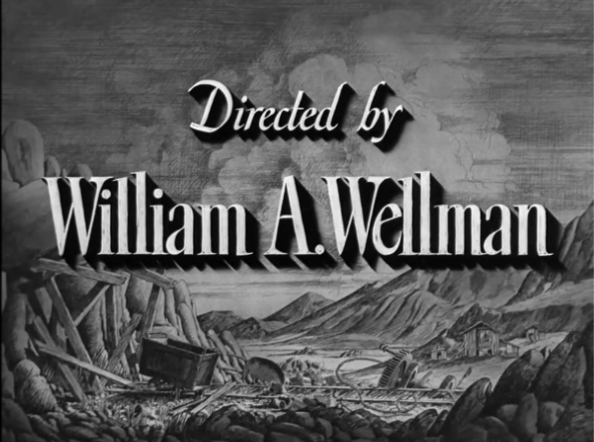
LAWRENCE FREIESLEBEN revisits Yellow Sky, 1948, directed by William A. Wellman
Both the triumphant and then jolly music of Yellow Sky[i], with its flippant echo of Oh! Susanna[ii] are a complete contradiction to the overall mood of the film. Whatever your definition of noir, Yellow Sky comes stylistically and psychologically close until the end. Purely noir[iii] Westerns that also have negative endings are very rare. Wellman’s later, colour Western, Track of the Cat (1954) starring that fatalistic ‘Tsar of Noir’, Robert Mitchum[iv], though regularly considered one of the bleakest of Westerns, scrapes some hope at the end – albeit not for Mitchum.
Despite being known as “Wild Bill” for his confrontational personality, womanising and World War 1 exploits as a fighter pilot, Yellow Sky’s director, William A. Wellman[v], is not a household name. A hard-working, cross-genre versatility, valuing story over distinctive personal signature, has limited easy categorisation. Obviously, I didn’t know the man . . . and whenever fashions change, biographical accounts (and lots more besides) habitually shift emphasis to be in tune with them . . . who can you trust?
The frivolous banjo of Oh! Susanna is almost withering on Yellow Sky’s soundtrack as a headline spells out: The West – 1867. When the film was released on Christmas Eve, December 1948, I expect US cinemagoers would have realised the date’s significance. Not having studied American history at school, I needed to hear the characters’ backstories to discover that the American Civil War[vi] is not long over. This setting in time (echoed roughly by the gap between the end of World War 2 and the film’s release) must be intended to partly justify, or at least explain, the wild, egotistical and reckless behaviour likely to occur on the margins of traumatised civilizations.
After the titles conclude, the stock opening music of blaring victory and light-heartedness hits a streak of menace which declines into a thunder-clap over a sunny marshland area. If opening night audiences were looking forward to Christmas, they should postpone such thoughts!
A group of seven weary-looking men, their horses splashing onward in single file, ride slowly across the screen. We are only a minute and 40 seconds into the film – including logos, titles and a fine series[vii] of sketches of ghost towns and mine ruins – and the mood, having swung all over the compass, settles here with the kind of grim certainty one associates with either stoicism or desperation. Yet the landscape looks lushly verdant, flowery and appealing before the youngest of the group spots a skull with an arrow right through it.
“Prospector.” States a man who transmits an air of authority. Since he is portrayed by Gregory Peck, we imagine that if at times he must be brutal, he will usually be fair.
“Skinny little fella. Them bones ain’t hardly as big as my little finger,” opines the portly Walrus (Charles Kemper, who had been a foil to Danny Kaye early in his career and was often to provide an element of comic relief; in Yellow Sky it is faint). Picking the powerful arrow from the two huge holes it has punched in the skull, the youthful Bull Run (Robert Arthur) takes it to the probable leader, who regards its still pristine shaft. With the possibility of vengeful or “crazy Indians” adding to the landscape’s threat, the group survey their immediate surroundings. Dude – played by Richard Widmark, seems to know the area well and starts to lay it out (00:02:48): “up north there are lots of canyons and draws . . . if you know which ones are open.” Intrigued by what a “draw” might be – does it draw you in and then prove to be a fatal dead end? – I discovered a whole chain of words[viii] which construct a hierarchy of depressions and ravines, descending into canyons. Draws are the least significant. Draws drain into arroyos, which drain into coulees, which drain into canyons. As with so many words and word origins this is both fascinating and yet disappointing – disappointing that one imagines additional mysterious meanings. But aren’t such extra implications, to some extent, what poetry and music and the visual arts rely on? How is it that great black and white photography can often suggest more depth, even more colour than colour – can look more real than the reality of colour?
Dude continues to summarise the area’s variety. I’m not sure if such environmental diversity actually exists in such close proximity to Death Valley[ix] – with fertile looking marshes, killing salt flats, canyons, hills, mountains, and a dusty desert town all within a few miles’ radius . . . but if it does, take me there and there I’ll happily live!
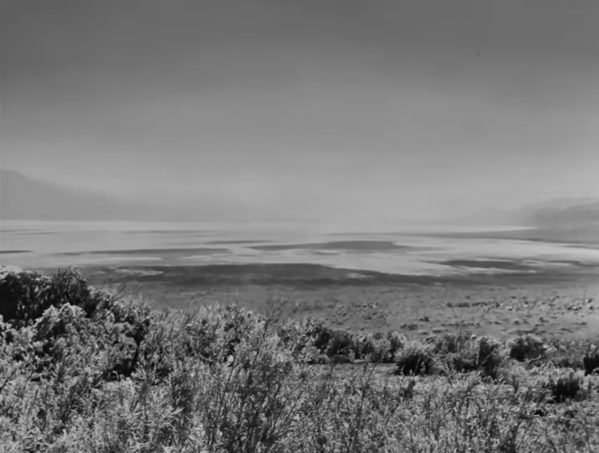
Of the salt flats “down south” at 00:03:00, (Death Valley, the hottest place on Earth[x]) Dude chuckles “even a rattlesnake couldn’t get across em”. Is Dude referring to the reptile or to the memorable psychopath, Tommy Udo[xi], who he portrayed so effectively the year before Yellow Sky was releasedin Kiss of Death, (1947), almost stealing the film with his insane intensified chuckle – a chuckle he only slightly revives once (at 00:37:47) in Yellow Sky.
Eventually, in a town saloon, reviving themselves with a drink, the band encounter an extraordinary painting[xii]. A partly naïve, partly delirious, painting. Albert Pinkham Rider[xiii] crossed with Chagall[xiv]. Pale Death on a dark horse![xv]. This large image behind the bar fixates them all.
Lengthy (John Russell) whose awestruck lascivious comment at 00:03:57, harvests lust from the silence and then amusement: “I wonder if she’s got any plans after she gets through ridin’ that horse?” is reprised with more words but less universal staring at 00:05:29 – the camera closer to an image now about 50% larger. The statuesque woman appears to be tied to the rearing horse yet has the posture of someone reclining calmly on a sun lounger. The image is surreal and haunting – and perhaps intended to be subjective? Are the men all seeing it differently? She is not depicted as a victim. Does the horse represent the spirit of the woman? A woman as beyond the pale as Ellen Berent Harland (Gene Tierney) in Leave Her to Heaven (1945). Lengthy wouldn’t stand a chance!
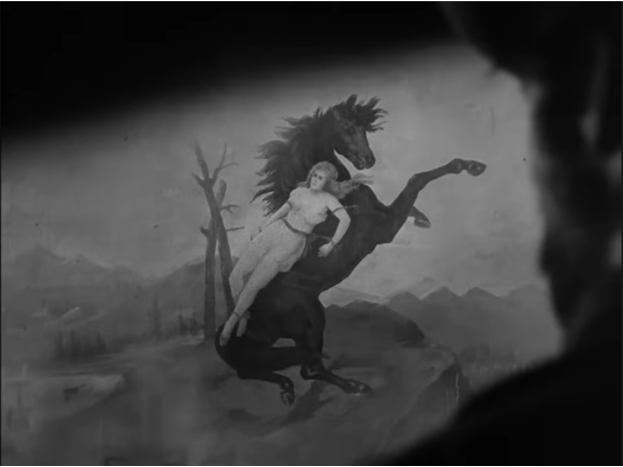
through ridin’ that horse?” 00:05:29
The hold up (00:05:52) shoot up and escape is all over in less than a minute and by 00:07:52, chased by the cavalry out into a rocky wilderness among amazing tooth-shaped rocks towards the salt flats, they have lost their rear lookout rider. The cavalry captain calls a halt to the chase knowing the gang aren’t likely to survive crossing the sink of Death Valley: “Let ‘em go! Save us the trouble of hanging ‘em!” (00:08:30)
As Stretch divides the loot, the gang appear on the verge of fragmenting, though it’s hard to imagine they were ever a very cohesive unit. Dude, not caring personally about Jed being shot by the cavalry, is superstitiously fearful that the number of gang members no longer adds up to seven (00:09:21): “This desert’s a mighty unlucky place. A man needs all the odds he can get.” Several of them know it’s crazy not to turn back, “It’s a good 70 miles across this sink, maybe more!”, protests Lengthy, yet Stretch (at 00:09:38) asserts “it’s just a place, a place can be crossed.” At a horse walking speed of four miles an hour it would take 17 and a half hours to cover 70 miles. Wouldn’t travelling by night have been a good idea? Do most cinematic cowboys lack common sense? But since there is no shade to be had, maybe it’s better just to get going? In the end, even Dude, who was thinking of pulling back with the dark, follows Stretch and the gang out into the whiteout heat of the sink.
At minus 86 metres below sea level (or minus 282 feet) the Badwater Basin is one of the lowest places on earth as well as one of the hottest. As the band become dots in the whiteness, the scene conveys the idea that Stretch, like Captain Ahab (whose obssession with Moby Dick – the White Whale – Gregory Peck was to portray with festering intensity in 1956) is resolute and tenacious, yet also perhaps, recklessly self-destructive. At 00:12:16 the crazed crust of salt becomes soft and the horses begin to sink and stumble, obliging the men to walk. The film expertly gives an epic sense of this ordeal, of the heat and dessication, of wrong decisions – the folly of Walrus having filled his canteen with whiskey, the mistake of sleeping at night. To cut short a midnight fight between Walrus and Bull Run, when the former tries to drink from the latter’s water canteen, Stretch hurls a large chunk of salt at Walrus’s head (00:13:57). Stretch’s authority is no longer in doubt – as neither is his compassion the following day when he wets his horse’s mouth with valuable water from his canteen (00:15:15). This could be viewed as enlightened self-interest, except that he follows up by doing the same for Walrus’s horse. “Kinda noble, aren’t ya?” sneers Dude (00:15:45) to which Stretch replies “A horse’s a useful animal, no use letting him suffer just because he belongs to a jackass”. The hostility between the two men increases from here on, with Dude less ironically detached from the possibility of taking charge – although at this juncture, he appears to believe they are all doomed. When Lengthy shoots a lizard (00:16:31), basically for looking chipper and able to survive when he probably won’t. Half Pint (Henry Morgan) protests: “he wasn’t doing you no hurt”. The sink however, has no truck with compassion: it is Half Pint’s horse that soon collapses in sand dunes and has to be shot (00:18:19).
After almost ten minutes (a long time, especially in 1940s cinematic terms) at 00:18:47, Stretch, suspecting mirage, spots what appears to be salvation in the form of a distant town. Hope to cracked lips and dried out voices. They struggle on…to find the town of the title: Yellow Sky. A dehydrated ghost town. Dead. Crumpling up all over the steps of a collapsing saloon, the gang don’t have the energy or sense to even get out of the sun, resigned to becoming skeletons. Then there is the faint click of a rifle hammer being cocked. At 21 minutes, Mike (Anne Baxter, hilariously described in IMDb as a “gun toting tomboy”) at last appears:
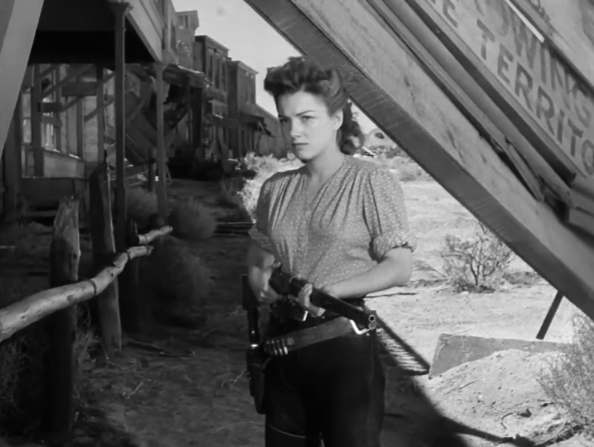
If I could have it to myself – or better still, share it with Anne Baxter – Yellow Sky is another place I wouldn’t mind living. The rock formations around are superb and the dilapidation aesthetically surpasses Heysham and Morecambe, without people to complicate it![xvi]
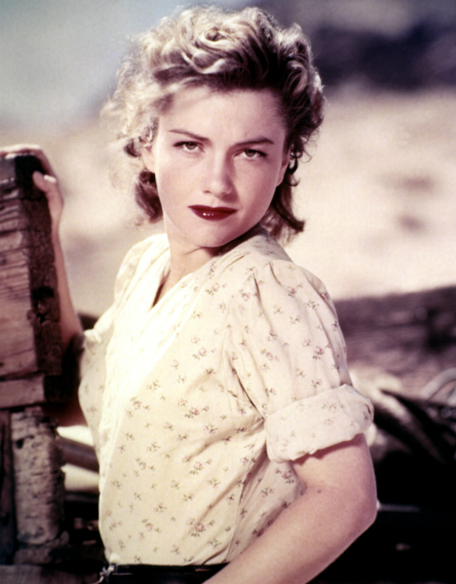
In his wonderfully terse, two-minute recommendation of Yellow Sky[xvii], John Sayles may not overstate Anne Baxter’s impact but does exaggerate what she’s wearing: “tight jeans and a 50s bra that could put your eye out”. The high-contrast noir-etched photography of Baxter is stunning. Without doubt, apart from settings and landscapes, Baxter is the best thing about Yellow Sky, but although frowningly beautiful, its her spirit and character that most impress.
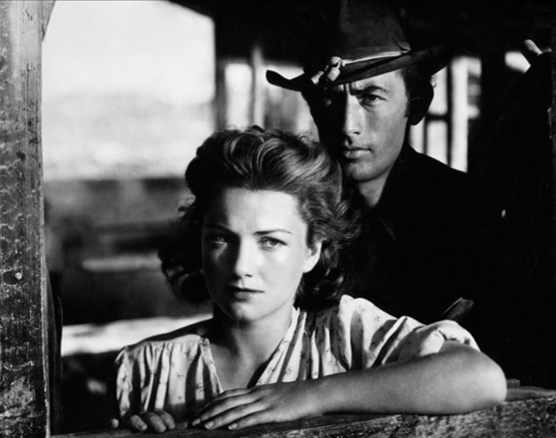
I’ve long had a thing about Anne Baxter, especially in earlier films such as Swamp Water[xviii] (1941) before fashion styled her hair in that increasingly fixed, bouffant power-perm manner which I can no longer bear to see because it unfailingly reminds me of the night and daymare that was Margaret Thatcher![xix] You can see this style creeping in by the time of another of my old screen favourites: 1958’s Chase a Crooked Shadow – although realistically, even in much earlier films, the secure Forties hairstyles aren’t so very different. Perhaps it is her wilder character in both Swamp Water and Yellow Sky that is so appealing?
Where matte[xx] shots are interposed into genuine landscape is often hard to tell when watching films in a relaxed way, but the solid ghost town of Yellow Sky, “fastest growing town in the territory” – its appearance and atmosphere – are entirely convincing. Apparently, the filmmakers reused and partly rebuilt or wrecked an old set known as “Last Outpost” in the Alabama Hills[xxi] just to the west of Lone Pine[xxii]. A hundred miles east, the salt flats and desert scenes were shot mostly in the Death Valley National Park[xxiii] with actors and crew staying at the evocatively named Furnace Creek.
At 00:21:54 Mike tells the exhausted gang where to find the spring “up behind those big rocks, at the head of the street”, suspiciously tracking them, rifle in hand. Later, at 00:23:47 she appears dominantly on a boulder above them, regretting their arrival, poised as they gulp and wallow in the pool.
It has often been repeated that Yellow Sky is loosely based on Shakespeare’s The Tempest,[xxiv] and you can see certain obvious parallels: desert = sea, Stretch/Peck = Ferdinand, Grandpa = Prospero and Mike/Anne Baxter = Miranda . . . but if so, it’s a still looser adaptation than Forbidden Planet (1956), and Mike clearly has no wonderstruck admiration for Stretch: Miranda in Act 1, Scene 2 of The Tempest: “I might call him / A thing divine, for nothing natural / I ever saw so noble”.
If I had money for every film ‘loosely based’ on Shakespeare (the seventh art tirelessly in quest of respectability?) I would not be poor! In any case, the true value of Shakespeare, is the poetry, not the plots – most of which The Bard lifted from earlier sources. Once the description ‘loosely based’ is applied, most films would begin to resemble one (or several) of the seven – 36 basic plots[xxv] available. One might just as well say that Yellow Sky is ‘loosely based’ on the shipwreck of the Sea Venture off Bermuda in 1609[xxvi]!
No, Mike is not enraptured by this new humanity and if she were less defensive when the now hydrated Stretch first visits her house (00:24:25), could she have falsely conveyed that she was hiding nothing other than herself? With water, food and rest, the gang are bound to remember that weird painting in the saloon and revive their other animal instincts.
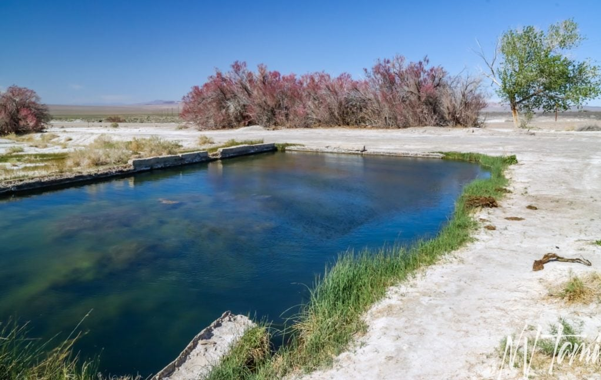
At 00:25:05, Mike tells Stretch that “it ‘aint far to Alkali, you could make it easy, if you try”. Alkali is a real place[xxvii] albeit a ghost town now[xxviii] in the inappropriately named Esmerelda County. Or perhaps the name only seems inappropriate because owing to one of those carelessly poetic lateral slips, it makes me think of emerald green grass . . . rather than sand, salt and emeralds[xxix]?
I don’t want to venture into the political incorrectness of Stretch and his gang’s attitude towards the Apache[xxx] (though not only was Mike raised “with Apaches”, Grandpa praises them (00:26:11) as “fine people, if you can understand them”) or their lust or chivalry (the latter particularly in Bull Run’s case) regarding Mike/Constance Mae, or the necessity for a 1948 production to reinforce gender stereotypes for its mainstream coda (more on that later). Some of these attitudes are obviously toxic, some just amusingly or irritatingly of their time. Yes, it was inevitable that Mike and Stretch would ‘fall in love’ and probably both of them subconsciously feel this from the first moment they see each other – or so runs the timeless loathing-to-loving story convention, as well as the popular romantic notion. Mike tries to resist, whereas Stretch violently relaxes (!) into it, ceasing to sufficiently lead or control his gang and breaking his own rule to “stay away from those people!” (00:29:03). Eventually, stung by Mike telling him he smells bad (00:33:19), he even washes and shaves.
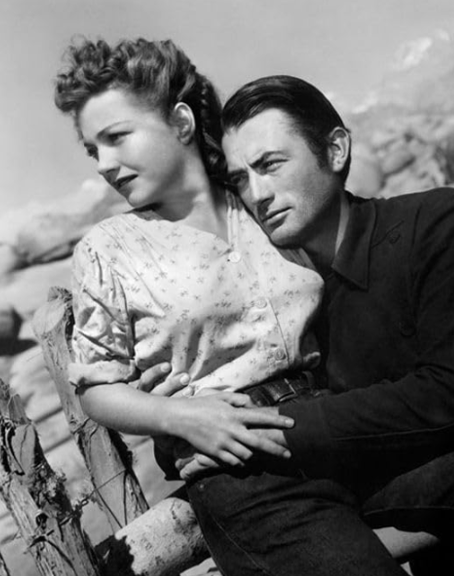
Stretch looks much less appealing once shaved . . . but I’m getting ahead of myself and far ahead of the plot since it is Dude who dolls himself up first, just before Mike first comes to the spring for water (00:27:47). I hope she is going to boil that water before use after the mob has all slurped and wallowed in it! Or maybe, it’s just that I feel like washing after the battery of sexist comments and leering – all of which Mike takes in her stride. Of this and more violent scenes, no less than the BFI seems to have become over-compliantly politically correct[xxxi] proposing to demote a film made in 1948 for not having the worthwhile but somewhat idealised values of 2026. However enlightened we think we are 78 years later, such situations have not gone away. In watered-down fashion they happen in Heysham and Morecambe every day and my 16-year-old daughter prefers not to walk on the prom alone.
With dozens of wrecked buildings to choose from, why do the gang all “bunk down” in the saloon (00:29:50) – I’d chose a building as far away from the others as possible. The characters that “amount to nuthin’ nohow” (to quote Lengthy) seem able to sleep through Walrus snoring like a “wounded buffalo”, but Lengthy is driven outside – to find Stretch contemplating on the veranda of the ruined saloon. After needling Stretch about the whereabouts of Dude he goes back inside.
Is Stretch really looking for Dude, as he claims, when having moved towards the tenebrous homestead Mike emerges from the shadows to challenge him at 00:31:58? Tackling her by surprise, they fight, she head butts him, he does it back harder and forces a kiss on her, before desisting. This is where she tells him twice that he smells, and then taking careful aim, shoots him across the scalp (00:33:39). In another excellent post from 2008[xxxii], the writer highlights the scene which follows with Mike trying to explain to Grandpa why she shot Stretch:
“He made me feel . . . I don’t know.” But she does know. Stretch has made her feel like a woman for the first time in her life. Wellman then cuts to Mike’s room, in which a picture of an elegantly dressed lady is pinned onto her wall. Seeing it fills her with disgust and causes Mike to angrily tear it into pieces. It’s a great moment of self-loathing – she hates herself for feeling something that she’s been trying so hard to suppress. Although having such a picture on her wall in the first-place clues us into the fact that Mike longs to be as pretty as any other woman out there. In that one short scene, we sense Mike’s vulnerability for the first time.”
More specific than the tragic/Romantic pop songs that are a chart constant, the romances of old films still need last only half an hour or so of screen time – this is why they can be so haunting. Novels and tedious soaps and serials often do them to death. The best romance stories are about potential and hope, not dull, chronological reality. Being fundamentally frustrating, the human condition (in its customary form) cannot fulfil our yearnings for long – yet almost everyone who refuses to let the human state get them down, clings to hopes we project from imagination. Hence good love stories (and happy endings) have a general appeal even if many who have experienced the long-term reality of romantic love, try to reject such unreliable optimism. Romantic love may linger as familiarity and companionship, even flourish and create a sense of safety for decades, but are its deepest feelings of connection and joint projection, always liable to return to being about the other or the elsewhere? To a degree, this could be why I have abstracted my own deepest feelings into landscapes, atmospheres and the most searching art – which doesn’t mean that I can resist a wistful attraction to actresses[xxxiii] usually long dead. In great films none of the characters or landscapes are ever dead!
Bathing his scalp at the spring, Stretch encounters Dude. Could they have once been friends? Could they become friends? Not in Yellow Sky – this, distinctively, is one of its noir aspects. Stretch’s romantic inclinations have prevented him from deducing what Dude has had a hunch about all along – the presence of gold! Dude is greedy for gold and has no interest in romance. He tells Stretch his history and it’s the thought of his betraying ex-woman being made to suffer, that briefly revives Widmark’s insane chuckle from 1947’s Kiss of Death (00:37:47)[xxxiv]: “she lit out with a fella who ended up beating her”.
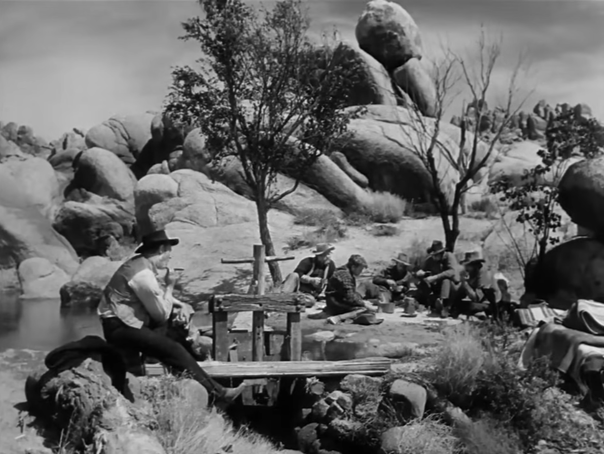
Shattered the showershields, roofs ruined,
age under-ate them.
And the wielders & wrights?
Earthgrip holds them – gone, long gone,
fast in gravesgrasp while fifty fathers
and sons have passed.[xxxv]
From first encountering the Anglo-Saxon poem The Ruin, as a teenager,the idea of the ghost town, or of ghost areas – such as the ex-lead-mining moors of Northumberland upon which we lived for seven years – may be even more fascinating than the allure of actresses who, while society survives, will never die. Ghost towns represent the flip side to potential, and up to a point, their history becomes fixed in time. Tyneham[xxxvi] in Dorset was one such place explored when we lived in the southwest of England. Appropriated as a training ground for D-Day in 1943, it was never returned to its inhabitants. Mardale in Cumbria[xxxvii] was another valley we knew well, though we never knew its villages, Mardale Green and Measand, only the reservoir which gradually drowned them from the late 1930s. By contrast, the ghost towns of the desert states of Nevada and California largely record a failure to survive at the periphery. Spelling out tales of greed, aspiration or over-ambition, they are gradually destroyed by extreme temperatures and the wind.
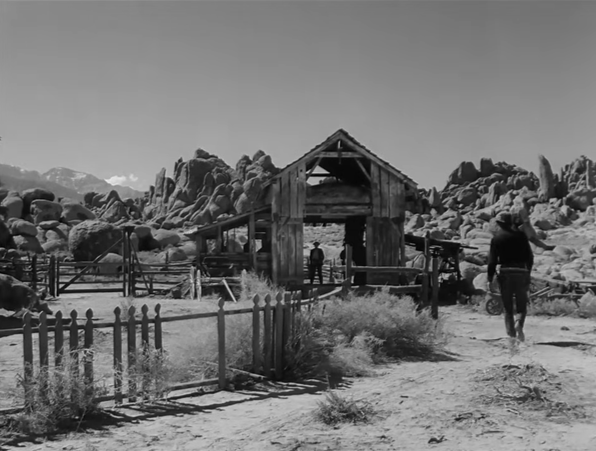
Stretch makes no attempt to understand or appease Dude (00:38:16). The increased antagonism between them begins the central section, though at first, Stretch is more interested in smartening himself up. The gang meet to decide on a course of action having voted Dude as new leader (00:41:53). Stretch has no regard for democracy, but before a direct showdown, Mike takes the initiative from the boulders above – with her rifle. The existence of gold can no longer be doubted.
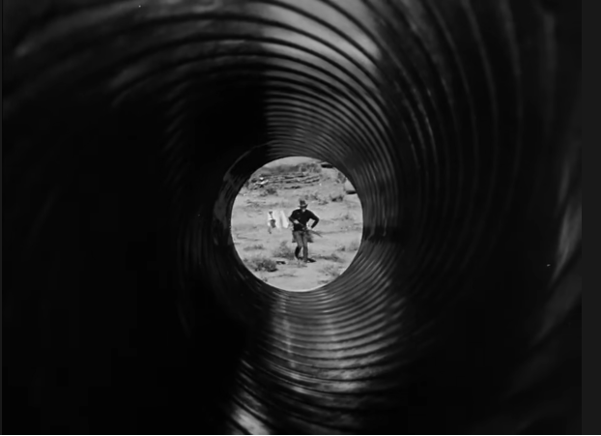
This was probably not the first time such an idea was used in a film. Since the helical grooving[xxxviii] is clearly shown, was it actually shot through a larger diameter gun barrel or was this a special effect added in post-production?
If you have read this far without knowing Yellow Sky at all, I will leave all the nuances and twists of fate of the film’s second half to your imagination and jump to the perhaps unjustly despised coda which opens at 01:34:37. For long sections of its often nocturnal second half, Yellow Sky looks like a noir, but both the romantic elements and the reformation of Stretch to “James Dawson”, run counter to this. Stretch starts his biography by telling Mike and Grandpa (01:04:42) that “I come from good people. When I give my word, I mean it”.
Long prefaced by Grandpa’s compassion (01:08:02): “Guess the wars upset a lot of those boys and set them off on the wrong foot,” the coda is not just happy but quite comic and begins with the chagrined, contrite surviving bandits returning the stolen money to the bank. As if all crime could be so simply undone!
At 01:37:00 as the three survivors gallop across a beautiful flower-filled water-meadow for a rendezvous with Grandpa and Mike, the film reverts to its framing triumphalism and lightness. However, rather than the exploratory, adventurousness of the opening, the ending quickly becomes jubilant.
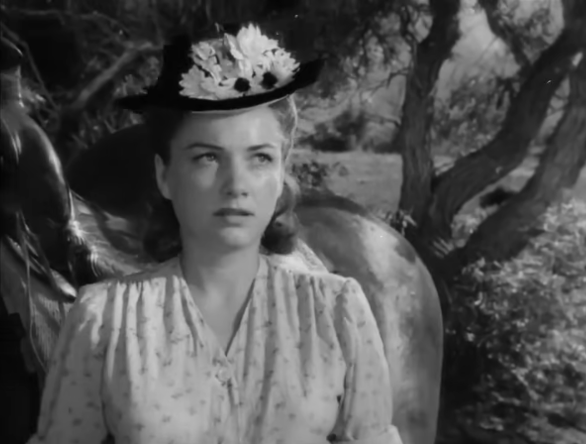
At 01:37:30 Stretch presents Mike with the hat bought from the head of an only temporarily affronted lady at the bank. This might all be “sappy” and “unbelievable”[xxxix], but personally, I enjoy it. Even if it was a studio imposition, it is a humorous, loving, throwaway thing, not worth getting wound up about[xl]. I don’t believe Mike will change because of it.
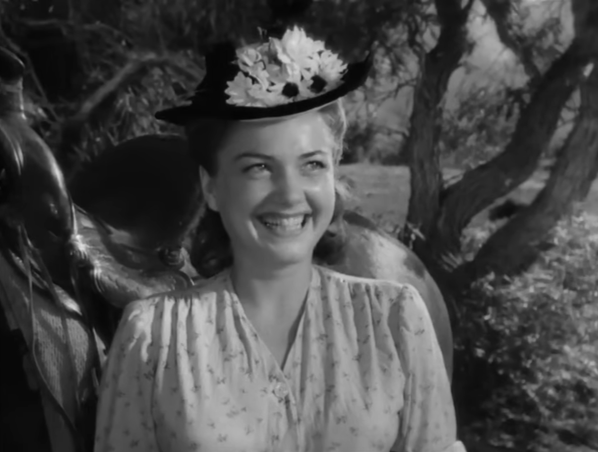
Mike dares herself and accepts the hat. Love is in the air, let’s end quickly before the wedding!
© Lawrence Freiesleben, 2026
Notes
[i] Available on YouTube: youtube.com/watch?v=XoSVGw_Ex-Q
[ii] See songofamerica.net/song/oh-susanna/
[iii] In this outstanding piece by Stark Holborn, starkholborn.com/2020/01/23/review-yellow-sky- 1948/ he claims Yellow Sky as a precursor to the “Acid Western” sub-genre: “Acids, if you haven’t come across them before, are known, and named, for their counterculture tendencies; the desire to kick the western away from the glowy sunset of manifest destiny and into the dark corners of the soul.”
[iv] This article by Imogen Sara Smith brightlightsfilm.com/past-sunset-noir-in-the-west/ is so good on Bob Mitchum and others and on Pursued (1947), that I might abandon all future hopes of writing about that particular film!
[v] en.wikipedia.org/wiki/William_A._Wellman
[vi] en.wikipedia.org/wiki/American_Civil_War
[vii] Actually, there are only four different sketches; the dissolves between title changes create the impression of more.
[viii] youtube.com/watch?v=noxTiJNgmxk landscape features explained by Randy Newberg
[ix] A location coincidentally carried over from Z’s film in this Z-A: Zabriskie Point (1970). See A Z-A of films: Zabriskie Point – The Brazen Head
[x] en.wikipedia.org/wiki/Highest_temperature_recorded_on_Earth
[xi] crimereads.com/tommy-udo-film-noirs-greatest-homme-fatal/
[xii] I cannot find out who painted this. Presumably an artist employed by the film studio? If Sherlock Holmes were alive now, we need a monograph on bizarre portraits and paintings of old Hollywood A and B pictures – though I’m not sure it would be much help in the field of crime solving. When I’d almost reached the end of this essay, I encountered yet another wonderful post about Yellow Sky jeffarnoldswest.com/2022/03/yellow-sky-fox-1948-2/ which highlighted the similarities between the scene with the strange painting behind the bar and the opening of Wellman’s earlier film, The Ox-bow Incident (1943). The painting in Ox-Bow is not nearly so strange, but Henry Fonda’s comment “that guy’s awful slow getting’ there” sets off an interesting dialogue exchange.
[xiii] en.wikipedia.org/wiki/Albert_Pinkham_Ryder
[xiv] en.wikipedia.org/wiki/Marc_Chagall
[xv] clevelandart.org/art/1928.8 The Racetrack or Death on a Pale Horse c. 1896–1908
[xvi] Or perhaps not! According to jeffarnoldswest.com/2022/03/yellow-sky-fox-1948-2/ “In temperatures topping 120°, with Gila monsters and scorpions everywhere, it wasn’t a comfortable set for the actors.”
[xvii] See: youtube.com/watch?v=SrbtgJTe6ok 00:01:14
[xviii] The first of Jean Renoir’s five films made in Hollywood during the Second World War was produced by 20th Century Fox. Categorised by the Nazis as “Cinematic Public Enemy Number One” Renoir’s left-wing anti-fascist and anti-war stance gave him no choice but to flee.
[xix] en.wikipedia.org/wiki/Margaret_Thatcher Whom I reference in the hope that time can be reversed and she and her dire legacy can be exorcised from history!
[xx] thepropgallery.com/painting-in-pictures-the-lost-art-of-the-matte-shot
[xxi] en.wikipedia.org/wiki/Alabama_Hills – an area famous for its rock shapes and widescreen vistas of the Sierra Nevada en.wikipedia.org/wiki/Sierra_Nevada
[xxii] en.wikipedia.org/wiki/Lone_Pine,_California See also: lonepinechamber.org/sightseeing-in-the-lone-pine-area/movies-filming-in-the-lone-pine-area In the centre of the movie map at the end of this page you can see ‘Yellow Sky’ (Gregory Peck)
[xxiii] en.wikipedia.org/wiki/Death_Valley_National_Park
[xxiv] Alex Good goes into this more carefully in another outstanding post on Yellow Sky: alexonfilm.com/2022/01/25/yellow-sky-1948/
[xxv] en.wikipedia.org/wiki/The_Seven_Basic_Plots ; en.wikipedia.org/wiki/The_Thirty-Six_Dramatic_Situations
[xxvi] https://www.rsc.org.uk/news/archive/the-ship-that-inspired-shakespeare
[xxvii] https://en.wikipedia.org/wiki/Alkali,_Nevada
[xxviii] Or is it? nvtami.com/2021/05/17/alkali-spring-nevada/
[xxix] en.wikipedia.org/wiki/Esmeralda_County,_Nevada “Esmeralda is the Spanish and Portuguese word for “emerald”. An early California miner from San Jose, James Manning Cory, named the Esmeralda Mining District after Esmeralda the Romani dancer from The Hunchback of Notre-Dame.”
[xxx] Ibid, from Alex Good’s post: “At one point I was hoping for the return of the Apache at the end in the role of the cavalry, saving Stretch and Mike and Grandpa from Dude and the gang. That, however, would have been a turn of the screw too far in 1948.”
[xxxi] bfi.org.uk/lists/william-wellman-10-essential-films see also, reference xxxv below. It is notable that after Yellow Sky, Anne Baxter’s very next film, You’re My Everything (1949), a slight, cringy and often irritating musical drama, insidiously reinforces sexist attitudes as well as racism – Dan Dailey even blacking up for one film-within-the-film. Rightly unacceptable now, this was standard at the time. Unlike the constant threat of the lustful men (a gang of criminal roaming men would be no different nowadays) towards Mike in Yellow Sky, this casual racism is not intrinsic to the contrast, tension or plot. An amusing aspect of You’re My Everything however, are the silent film take-offs – one entitled Flaming Flappers – acted out in believable, satirical fashion by Baxter, whose character is supposedly “patterned” on Clara Bow. She is certainly utterly different to Mike!
[xxxii] theroadshowversion.wordpress.com/2008/02/27/to-save-and-be-saved-yellow-sky-1948/
[xxxiii] It would never have occurred to me to think of an actress as being in any way inferior to an actor. See: theguardian.com/theobserver/2011/sep/25/readers-editor-actor-or-actress
[xxxiv] Ibid: crimereads.com/tommy-udo-film-noirs-greatest-homme-fatal/
[xxxv] The Ruin, lines 8-13, translation by Michael Alexander, from The Earliest English Poems, Penguin Classics, first published in 1966, is thought likely to be about Aquae Sulis (Bath).
[xxxvi] virtual-swanage.co.uk/things-to-do/towns-and-villages/tyneham
[xxxvii] lakelandwalkingtales.co.uk/haweswater-and-the-lost-kingdom-of-mardale/
[xxxviii] en.wikipedia.org/wiki/Rifling The wonderful post about Yellow Sky, encountered when I’d almost reached the end of this essay, jeffarnoldswest.com/2022/03/yellow-sky-fox-1948-2/ said exactly what I was going to suggest: that it “must have inspired the people who did the credits for the James Bond movies.”
[xxxix] In his splendidly terse, to-the-point, two-minute recommendation of Yellow Sky, John Sayles hates its possibly studio-required end: youtube.com/watch?v=SrbtgJTe6ok saying at 00:01:36 “If I ruled the world, I’d cut the sappy, unbelievable coda off the movie!” But I often like abrupt happy endings, unless they are so bad they make you nauseous. They can be less tiring. I always feel tempted to rewrite bad endings. Every time I watch Out of the Past (1947), for example, I always want Bob Mitchum to survive even though that would defy one of the rules I consider essential to true noir – a tragic conclusion.
In William A. Wellman: 10 essential films www.bfi.org.uk/lists/william-wellman-10-essential-films the BFI also finds fault with the cheerful ending (and other things): “Were it not for some alarmingly dodgy sexual politics – from Gregory Peck’s assault on Anne Baxter to her final acquiescence (via a bonnet) to his idea of feminine norms – Yellow Sky might rank among Wellman’s best.” I fail to see why depicting things how they simply would have been, counts as “alarmingly dodgy sexual politics”. That is to apply modern attitudes to a film made 78 years ago. The hat incident may or may not have been a studio imposition, but it is a humorous, loving, throwaway thing, neurotic to be wound up about, and absurd that it should affect how we rank the film. We can deplore aspects of the past, but we can’t expect the past to fit in with our current fashions. Personally, I don’t believe Mike/Constance Mae will change all that much because of a silly hat and both Stretch and I would be disappointed if she did. But that’s why films end when they do. In ‘real life’ we are often likely to be disappointed. One of the major problems with long-form TV is that it never ends but merely staggers on into the desert.

LAWRENCE FREIESLEBEN, Film & Television Editor of The Brazen Head, has been an artist and writer as long as he can remember – cycling away at weekends from the council estate where he grew up, to paint the countryside as an escape from the restrictive tedium of the school week. Leaving home at 16, he has lived in 17 different areas of the UK – from Devonshire to Northumberland – painting and writing, always vigilantly questioning the interior light of landscape, cityscape and wider atmosphere. Living virtually off-grid with his large family, both remote locations and urban visits have formed the backscene to a passion for film which has intertwined with art and writing throughout his career. Films remain a key creative focus since childhood, resulting in encyclopaedic folders and clippings as well as a constant stream of home-made film festivals. He currently lives in a dilapidated Lancashire seaside town