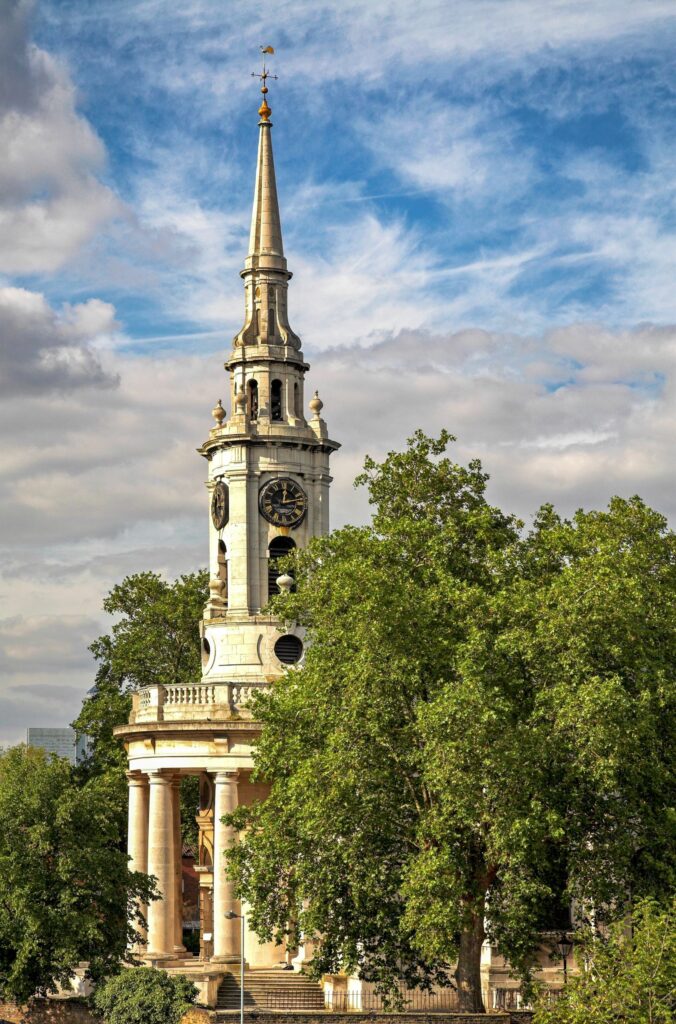
Blackheath

Nobody wanted proper light they want to be in the dark, they liked it, they liked

the little cupboardsTo live a story written in invisible ink, painted in

abstract arcs, but atmospheric, poignant, calm, devastating . . .  Perhaps this

could never happen except in some strange half-apprehension inside?
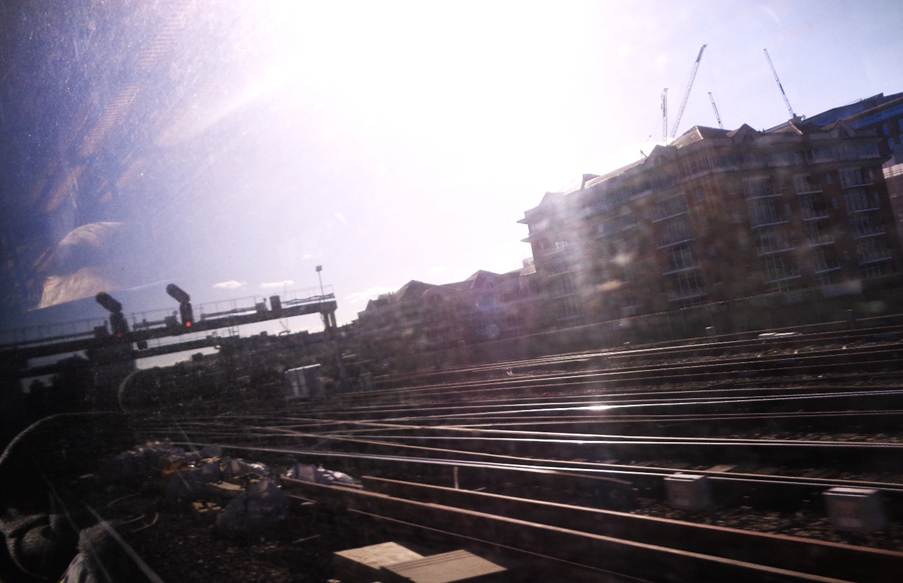

Hurtling the elevated course[i]

viaducts arching forwards

headlong,

cable-ducting streaming a frantic pulse

while gantries blink at signals vanishing 

gaps before speech

no time to question

twelve tracks in unison, dividing, merging,

aimed reckless

– a geometric exaltation –

at the sharp radius, weed-ragged triangle

of Borough Market Junction

(slow thunder amongst the attics),

braking will have its moment, but now is not it,

now is acceleration,

exploding through the jumbled visual inundation

of miraculous panoramas vaunting the compass

to praise and shun

from slum to gentrification’s skyward balconies

skewed bridges over stalled clutter

horns accusing each other  

St. James’ Bermondsey[ii] – foregrounded – is granted time,

Tower Bridge Road is not.

Scaling steel and dazzle of glass, mirror and kaleidoscope

the solid eras from which they took insolent flight,

splintering visions into the grey-green river’s tidal swell.

Cannon Street or Charing cross . . . default to London Bridge:

this sublime chaos has been overripe for a century,

between the essence of specific words

changing with the hour

the light, the region of Europa, the confident stairways.

Did the bombing try to neaten things or only add another density?

Followed by two or three decades of hopefulness[iii]

(in retrospect overstated, deluded),

soon came the point where things went subtly

yet more incurably wrong. 
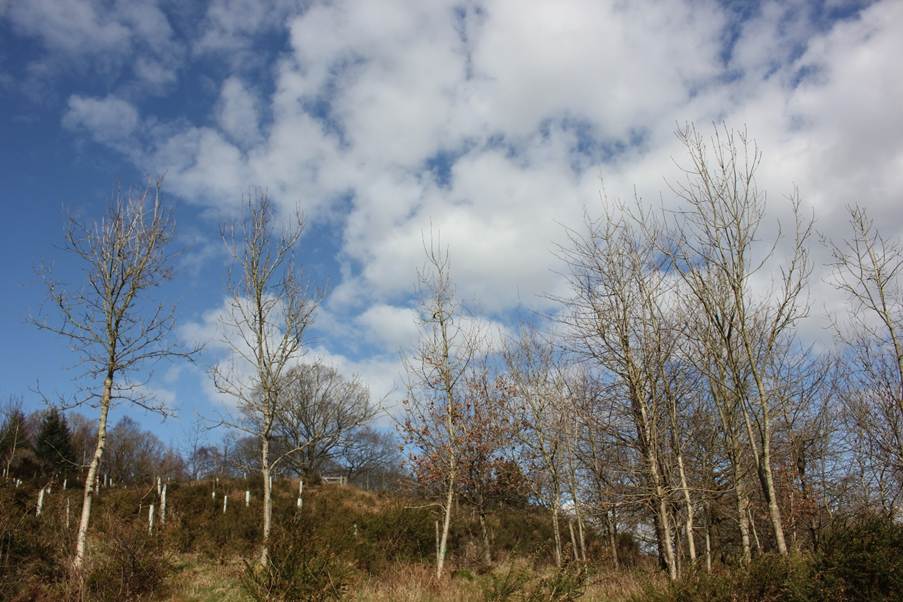

More than anything, landscape had always given him freedom. Uninsistent.

It had no care for the human world.

All that dialogue, phrasing, signature, soundwave, all that need and frustration:

it made no impression. It missed almost everything.
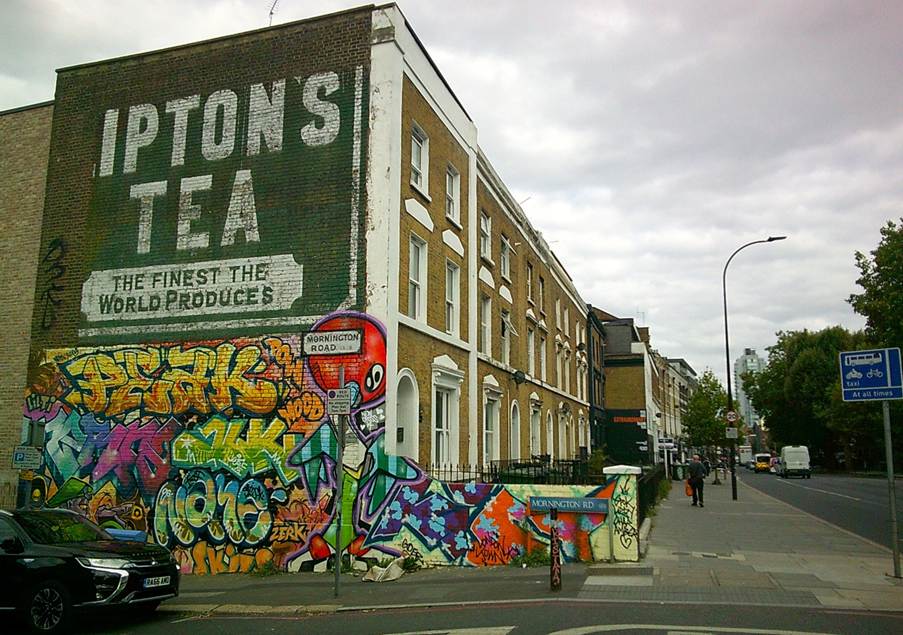

Censor the didactic rant to puzzle on the outpourings of runic graffiti

ipton’s Tea, the finest the world produces

disrupting or expanding Deptford Broadway

bloated Arabian Nights or a portal to secret cults

conspiracy conflations overrunning all others

horror sunflowers with erotic intent

Eine Kleine Nachtmusik[iv] is not the genre

nor boombox cars racing their decibels

no wardrobes or courtyards conceal the past

for the hangars of wire are all a-rattle with nothing 

nothing visible

and the indulgence expanding from self-control,

intensifying experience to give a purpose,

rings artificial,

yet undoubtably the ancient and the medieval

exhale through every area of wood or raven black

and transitory 21st century towers alike suggest demise and the diagonal

upon which the air itself will carry their dust

their stone tapes[v] into the clouds and colours

as though history is more than dead structures and the fabrications of books

is rather the ether itself (as some claim love is truth and truth is love)

behind and above all terminal, worn out, buzzing industry

this daily to and fro of mindlessness

the impatient global death-wish.
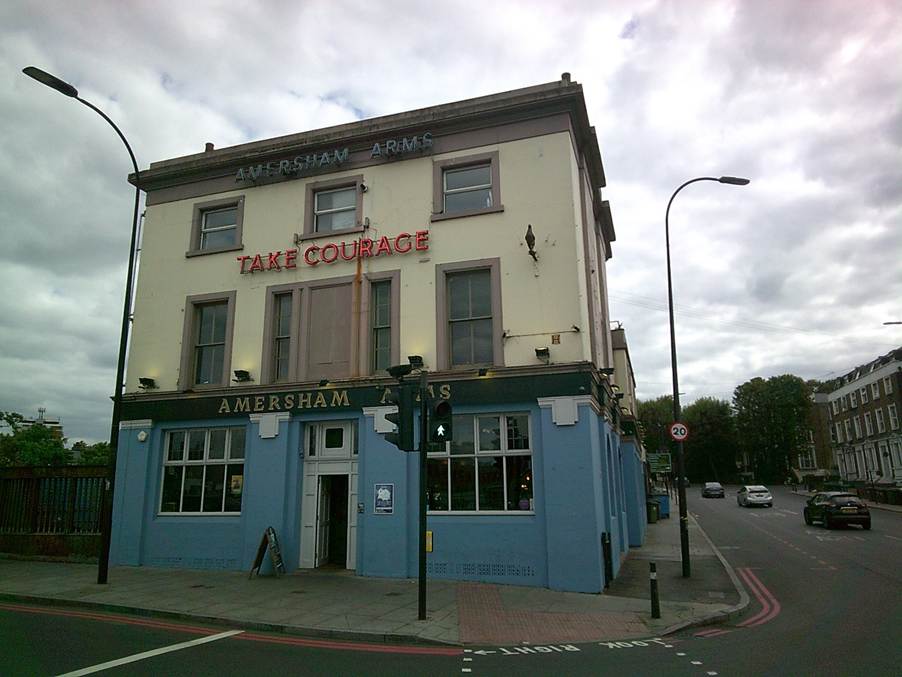

Take Courage at the Amersham Arms by the double red lines:

I did and I didn’t – no alcohol passed my lips

chalk on the wet wood around the shadow of alphabets

all of these corrections

and all of these failings[vi]

echo from the mesh fence over New Cross station

expectant platforms freed from rush hour below

looking south to Hastings (theoretically),

taste the wash of the tide and the rush of shingle

briefly fade the queue of danger lights shining on bin bags

the pierce of brakes . . .

what first impressions from a precarious pushchair!

boys will be . . . what we teach them to be[vii],

as this mental brass rubbing, struggles corridors into distances

angles waking from the dormant

tries staves to support a cloven harmony.
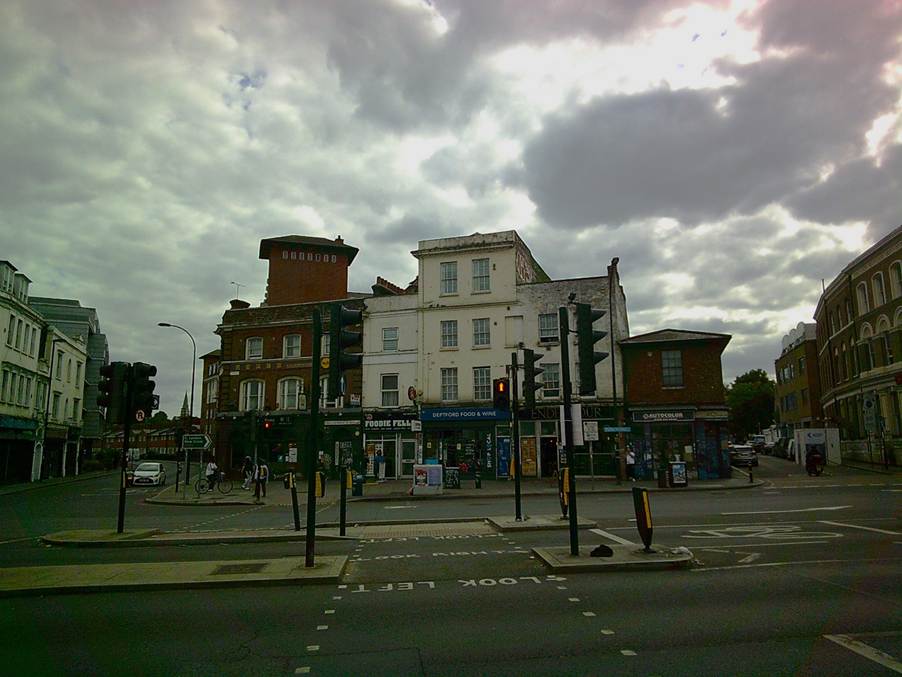

Obviously, it wasn’t good to have all this contempt. It wasn’t kind.

Even to wish for a magic wand to wave up another life . . .

the lodge house on a disused drive . . .

Only he would ever open the gates between the trees. High ornate gates that would

symbolically exclude or welcome –

if occasionally he felt expansive towards the outside world.
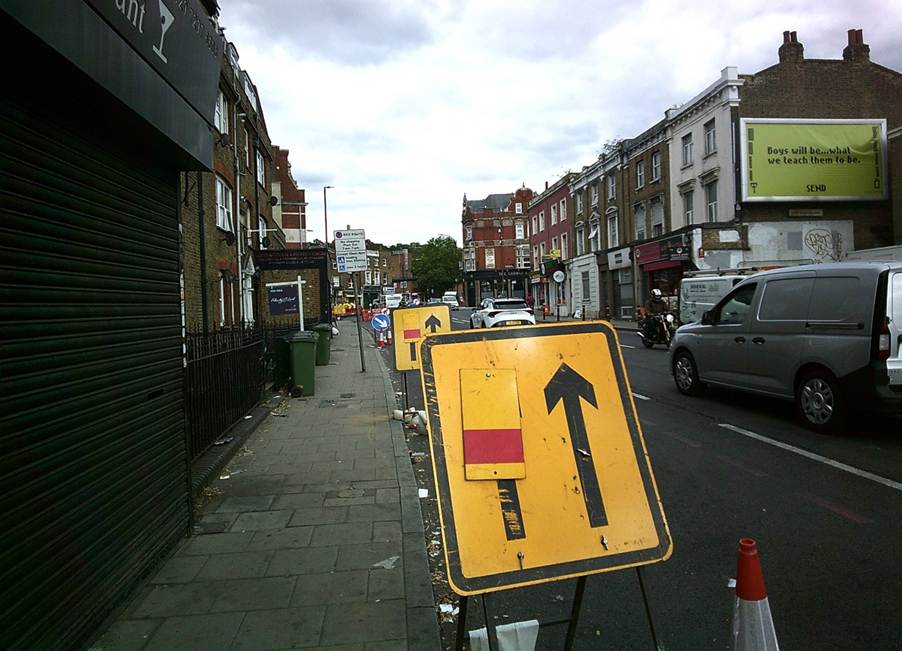

Roadworks now upon the winding hill

funnel the yellow box junction overlooked

by that endless fight of George and Dragon

good versus evil or more complex alchemy?[viii]

From a smile to the left, other soundscapes flow

reducing plastic vehicles to a whispering haze

mind-manacled time zones intersect and cancel

hint forms, images, prospects

even narrative

from tilted rooms fumed with exhaust

from fenced corridors under bamboo screen and radar dish,

stunted palms and arrowslit windows

from country villas stranded in their rowdy future

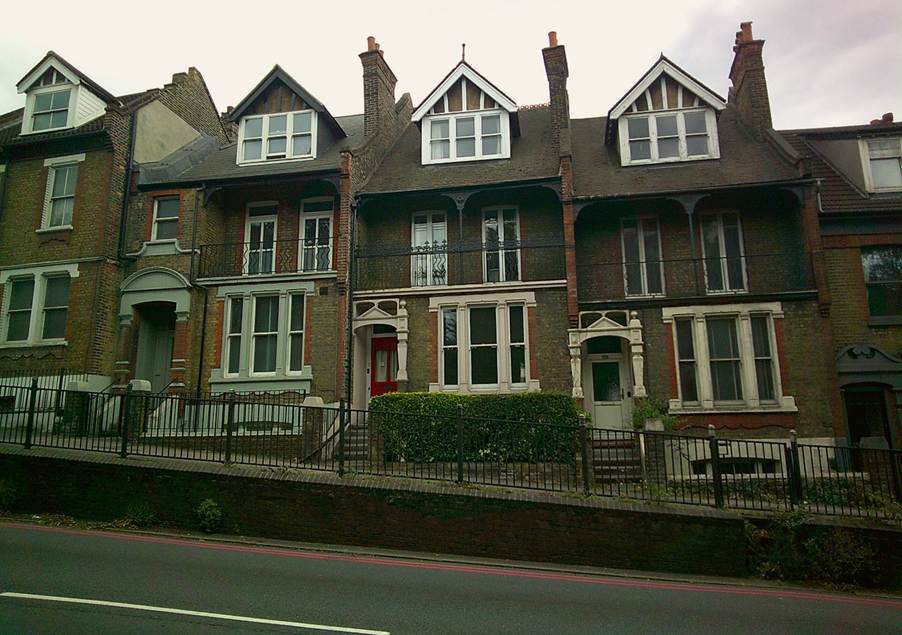
dilapidated, behind railing and creeper

preceding 40s flats . . . perhaps? (they have a rectilinear austerity).

The projection may be drab 

but climbing Blackheath Hill toward the grass, drought-widening common 

its balconies are not stale,

filled with town and country,

their musics drift above the heavy traffic

the stop and start of hybrid buses

the slant of dreams and aspirations in many languages . . .

“If you can’t satisfy yourself, how can you satisfy anyone else?” runs the wise phrase,

the target of self-knowledge, bow and arrow, individualist parade.

The only trouble being: who but the ignorant, the arrogant or the lucky, can ever

satisfy themselves?


Higher, as the plateau begins to break,

wooded commons buffer zones of peace

where red shuttered bays remember green wartime garages,

until a siren sounds from 80 years past

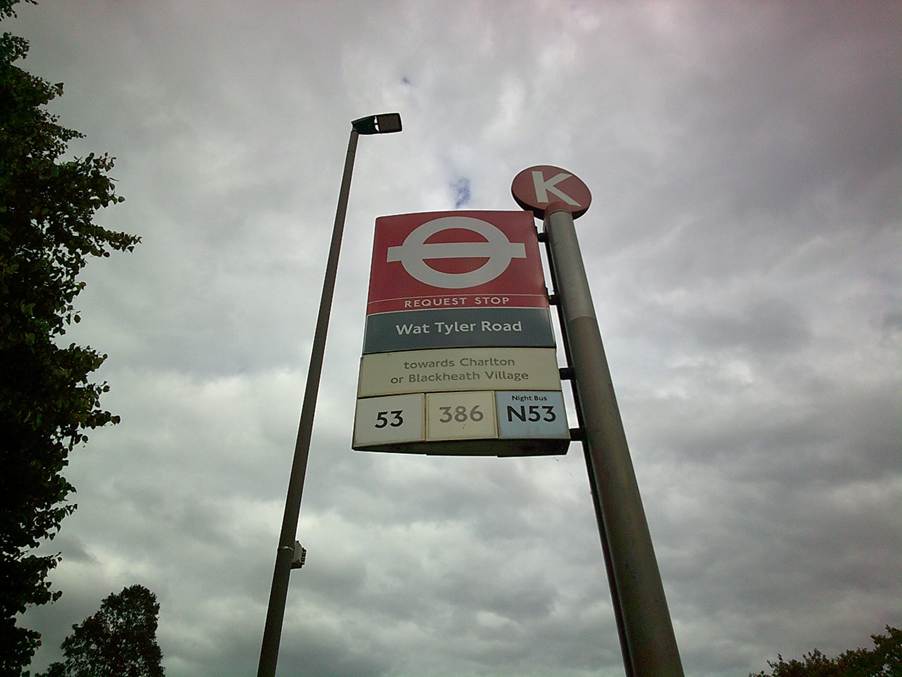
loud enough to wake Wat Tyler[ix] from his abysmal mooring

reduced to a road sign,

loud enough to date other more recent subjectivities

garnered from artists, writers and characters who preferred art to living,

half-dead or lost, fascinated perhaps 

and wishing to stay that way –

forgetting that at its most vivid, art is life multiplied

or aware that such a level or spiritual leap[x], is too great a risk or challenge

and prudence often worse than a toxin.

Gestures and beauty gone –

You had your chance

and mine is nearly done

there is never finally any way to turn

but take port duty free on the link span[xi].


Is history the attempt of spirit to conquer matter[xii]

or no more than an accretion of grime?

something we should try to learn from but forget,

the circles through which we overlap or not . . .

our one-way flow with no option but to follow

– or a topological map with infinite directions and choice?

Here, the country church[xiii]

invisible tock upon the bookshelves . . .

red bus through the trees and fences that reach backwards and block

all diagonal pursuit

no sleep ever seems just

only a pause between enigmas

unless you switch off to it all and dream of Wales, or a remote coast

or a vineyard in Chile  

as if the dream were all.
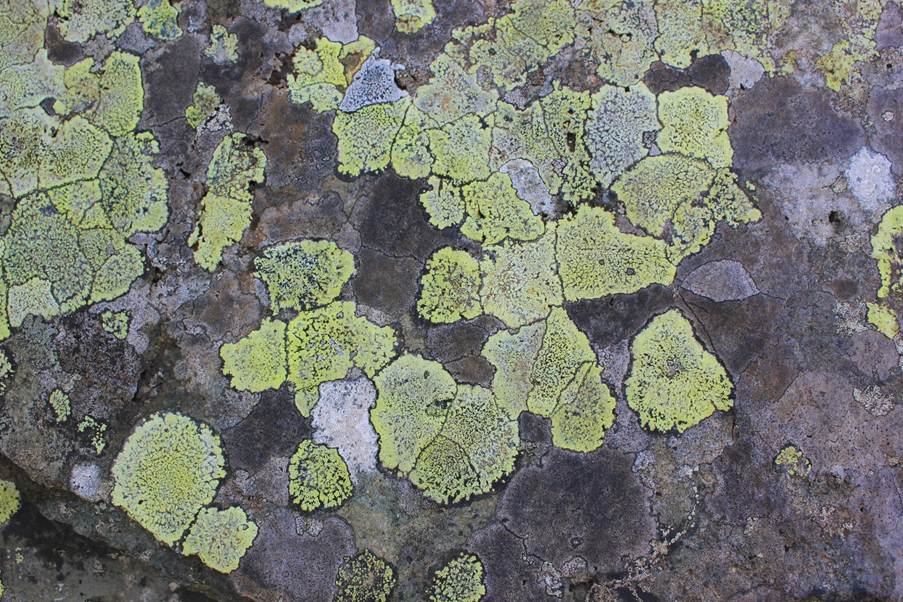

That dream could be the dream of the lodge, off the map, disused, forgotten,

but self-sufficient – as in the end we must all become, unless (or even if) we can

rekindle love. Our own fracture is enough, only the landscape or the lover can heal,

not the peer group or the distant friend.

Once it becomes impossible to tolerate life as it is, there is only the light inside. 

The gates opened into woodland sun and shade.

All human drivel died between the avenues

all ambition drowned on the unspoilt riverbanks which followed.

And through the lines, words, shapes, the movement arose,

becoming tastes and notes and colours.


At New Cross station, Sutherland[xiv] asked “Do you think I’ll ever be an artist?”

This was the late 1920s – before the primeval incursion of Pembrokeshire

shattered his mould,

“Or shall I get my father to find me some other kind of work?”

Do such assumptions, signifying class structure, still remain?

Should I have been a meter reader[xv], musing on life’s paradox as I walked my round . . .

never troubling to scrawl any of it down,

never disturb the peace

for anything beyond style or template originality may be too cruel.

Was post-war optimism also when culture began to slither more generally trivial,

relaxed too far?

or can such impressions be blamed on the inevitable drought,

the scrap to maintain one’s personality in the face of the world? . . .

However –

since the developed temperament and will

can banish or dialectically justify all negative reality,

or dissolve material into metaphysical

today’s dull light is more than enough to make us content

avoiding the fairground and the ever-flashing blue lights

of ambulance and fuzz

as we walk, expecting rain, flippant but uplifted,

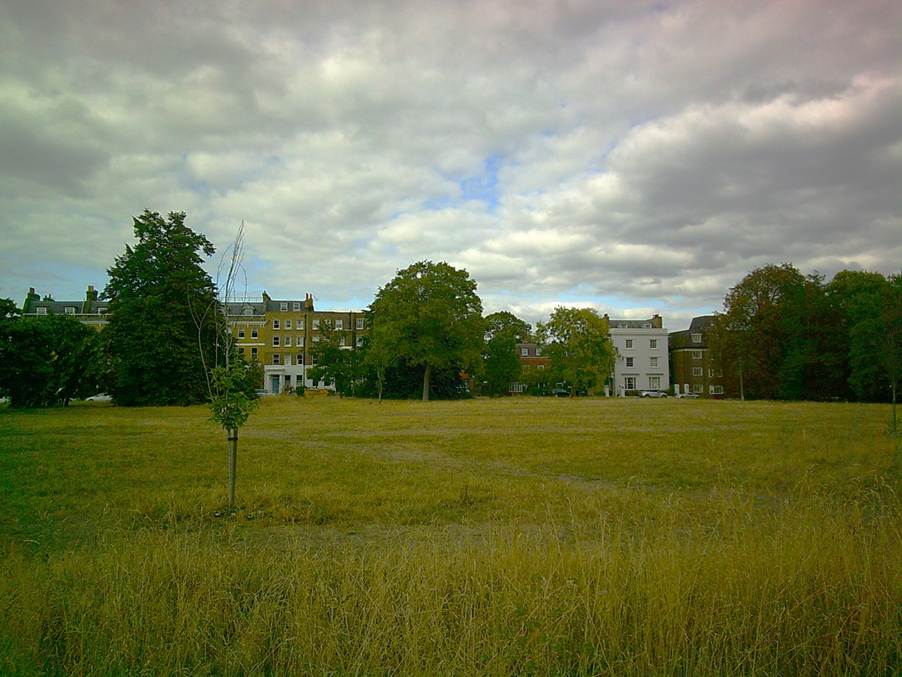
crossing the parched August space of

Blackheath.
NOTES


[i]    en.wikipedia.org/wiki/London_Bridge_%E2%80%93_Greenwich_Railway_Viaduct

[ii]    Neo-classical. This image seems to exaggerate both the height of the viaducts and the closeness of St. James’ Church to the railway: blackcablondon.net/wp-content/uploads/2013/06/near-bermondsey-church.jpg

[iii]   From 1945 – 1975: arguably the maximum period of post-war hope – during which (for one example) ecological concerns were fully realised but insufficiently acted upon. During which, global corporations became too powerful and greed became a virtue.

[iv]  Both the music and specifically (in the line above this one), Dorothea Tanning’s painting of 1943: https://www.dorotheatanning.org/life-and-work/view/64/

[v] https://www.imdb.com/title/tt0069316/  1972 British television horror drama film written by Nigel Kneale.

[vi] https://genius.com/Songs-ohia-travels-in-constants-lyrics  (paraphrased) lyrics written and performed by Jason Molina: www.youtube.com/watch?v=bTcNpD1YyoI&list=RDbTcNpD1YyoI&start_radio=1  at 12.46 – 13.39

[vii] Slogan on a screen or billboard?  [visible but small in the top right of the roadworks photo –21st August 2025]

[viii] From https://brill.com/view/journals/rt/13/2/article-p195_4.xml  :

“It is the purpose of this paper to interpret the legend of St. George and the Dragon in terms of alchemical symbolism. While the victory of the Christian hero over the Dragon is traditionally interpreted as symbolic of the triumph of good over evil, it is argued that both combatants represent the four alchemical elements: air, water, earth and fire. Instead of a duel of opposites their combat transmutes the coiled-up energy of the dragon into solar light, which manifests as the beautiful princess of the myth. The conclusion is drawn that there is a dialectical movement of force in the battle between St. George and the dragon. The hero releases the antithetical power of the dense, dark matter symbolised by the dragon so that the elements of a polarity do not remain contrasted but are resolved creatively.”

[ix] en.wikipedia.org/wiki/Wat_Tyler

[x] Søren Kierkegaard et al

[xi] Link Span, BTF film of 1956, directed by Michael Clarke. See: www.imdb.com/title/tt1754135/  “This documentary from British Transport Films, follows 24 hours in the life of three British Railways Channel ferry services.”

[xii]  Colin Wilson paraphrasing Arnold Toynbee in Religion and the Rebel (1957) reprinted by Aristeia Press in 2017, page 130.

[xiii] Charlton village is the one here of many.

[xiv] https://en.wikipedia.org/wiki/Graham_Sutherland  While Sutherland’s Pembrokeshire landscapes may not be “realistic”, personally, I wouldn’t think of them generally as “surreal” – which word to me indicates an element of attitude, even a degree of literary willing, more evident in (for example), Paul Nash’s gently surrealist, Landscape from a Dream, or in Dorothea Tanning’s, Eine Kleine Nachtmusik (A Little Night Music) www.tate.org.uk/art/artworks/tanning-eine-kleine-nachtmusik-t07346

Sutherland’s best Pembrokeshire work celebrates the mystery and reveals the hidden power and primeval qualities of the landscape. However, I can see how, given that his landscapes are often ‘more real than reality’, this can easily be associated with surrealism, and at times he does utilize a more surreal approach. In fact, it could be argued that the most relevant aspect of surrealism, is not the exaggerated drama of melting watches and so on, but simply an ability or a moment in which one sees and notices things more vividly. Walking through a suburb of Heysham yesterday, gradually moving into a heightened sense of seeing, I was reminded how ‘surreal’ so many houses and gardens can look in bright daylight, the layout of shrubs and pots, the window surrounds and porches etc – all those aspects of daily life it is so easy to take for granted or disregard. Down on the prom, I was reminded of Paul Nash’s short essay Swanage, or Seaside Surrealism published in The Architectural Review (Volume LXXIX, April 1936, pp. 161-4). Nash himself distinguished between the work of artists belonging to a Surrealist group, distinguishing their work by a capital ‘S’, and “artworks, situations, objects or locations that have a dreamlike character or incongruous settings that evoke disquiet or the uncanny. These, he describes, as surreal with a small ‘s’.” See: www.paulnashdorset.co.uk/timeline/1936#

[xv] https://internationaltimes.it/?s=meter-reader  Obituary for my father, 2024.

Portrait of the Artist as a Young Man

Image: Creative Ignition, Wikimedia Commons

The Naked Spur

Alexander Adams, London: Exeter House, 2025, 304pps., pb., £14.93 (Amazon)

In 2007, a burned-out young British artist arrived in Berlin from London. He rented a frigid apartment in the worst district of the city, and subsisted on coffee and chocolate while he hammered out the draft of a novel ‘inspired’ by his recent bad experiences in London, perversely using an old-fashioned typewriter instead of a user-friendly laptop. In a May 2025 article published on his Substack, he explained his mindset at that time: “I wanted to do it the difficult way because that was what made it real. Suffering – even self-inflicted unnecessary suffering – made any achievement more worthwhile because it had been hard won.” Alexander Adams’ grimly determined mindset has changed little since that time, although he has subsequently found not just some artistic success, but also greater acceptance and understanding of himself, and the art world in which he operates as a rare ‘conservative’ presence.

Adams made desultory attempts to publish his manuscript at that time, but following rejections put it away for almost two decades. Having come across some of the artwork of that period again while working on a new project, he feels it is now a good time to publish, to set his present work in context and reveal more of his backstory to his subsequently acquired audience. It will also, he feels, be purgative – “a personal accounting” that can balance his books.

Novelists, as we know (or think we know) write largely about themselves, but The Naked Spur really is based very closely on actual experiences. The protagonist is a thoughtful artist called “A,” he is highly skilled but commercially unsuccessful, and he lives where Adams used to live, and bristles with his former emotions – a frustrated, lonely and resentful figure surrounded by equally atomised but usually far less intelligent individuals.

In desperate need of money, and in search of any kind of recognition, A has a cunning plan – to sell customised nude pictures to wealthy sensate individuals who wish to parade not just their wealth as patrons of the arts, but their allegedly ‘liberated’ selves. It is a cynical and even seedy concept, designed to prey on the gullibility and vanity of self-styled ‘sophisticates,’ and the reader is not sorry when it fails, despite the strenuous efforts of A and several revolving-door associates and collaborators.

One does, however, develop some sympathy for A himself – an impressive person reduced to such resorts, who has besides come to believe in the worth of the art he is producing for such shabby purposes. Yet in the end the failure of the scheme was good for him, as well as for society – because it forced him to do something infinitely more useful with his talents than flogging pornography-adjacent images to the wealthy and credulous. And he has done many more useful things in the years since – produced artworks which are held in world-famous collections, staged powerful exhibitions, edited anthologies, and written insightfully about the state of the arts in many articles and reviews, and important books like 2002’s Artivism.

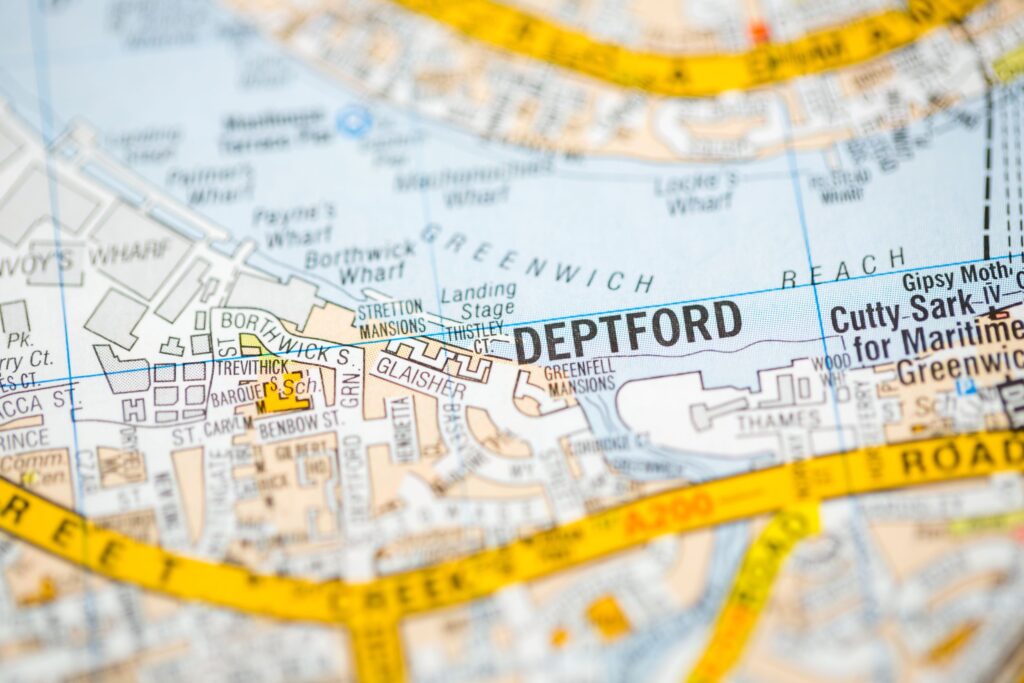
In the present book, the London of some twenty years ago is excellently evoked in innumerable gritty details. I lived in Deptford around the same time as the artist, and his landmarks were also mine – the handsome baroque church of St Paul’s, the Bird’s Nest pub, the High Street, the Docklands Light Railway, and immediately across the river Canary Wharf still rising around its central silver tower. The sadness and shabbiness he shows in such photorealist detail – the drunks and their vomits, the glue-sniffers, the unhygienic takeaways, the graffiti and litter, the futile casual encounters and conversations in grubby rented rooms, the sleazy ‘top shelf’ magazines in newsagents – all that too rings authentic, the underbelly of the brittle metropolitan world A so badly wants to break into. It is closely observed, and faithfully depicted.

But sometimes the detail takes up space that might have been better devoted to character development. Some of the characters in The Naked Spur seem insubstantial, at times almost staffage, representations of sets of attitudes rather than real people. Even A hovers on the edge of focus, an observer rather than instigator, a reactor rather than a principal. He is obsessed with his single big idea, and concentrates so hard on trying to bring it to fruition that everything else is forgotten. The project becomes an end in itself, the artistic vision increasingly reduced to individual brush strokes, and the logistics of packing crates and pots of varnish. For a book about ‘nakedness’ and ‘spurs’ – a book, furthermore, which the author has described as “very personal” – A’s character and motivations seem rather opaque.

Insofar as we can see into A’s soul, it can seem sere. Sitting in that freezing flat in Berlin, he was writing in “self-aware replication” of his project’s failure. He goes on, “I would become an isolated broke author engaged in a private unprofitable gesture writing an uncommissioned novel about an isolated broke artist engaged in a private unprofitable gesture painting unsaleable pictures. The novel would be as sterile as the paintings – uncontaminated by commerce, uncompromised by any consideration of propriety.” As an explanation of what he was doing and thinking at that time, it is bracingly honest, but it sounds like a rather unappetising fictive formula.

The prose style is generally austere, a welcome change from the pretentious word-salads of the arts ‘establishment.’ This amorphous entity is the hinted-at villain of the piece, a jellyfish without a central brain but capable of responding quickly to environmental stimuli (money, or trending politics), and of course armed with poisonous nodules. Whatever the merits of A’s art (and Adams really is a superb craftsman) he was destined to be included out of lionisation or major grants by early Noughties arbiters – and he did not exactly help himself with his choice of subject matter. Adams’ more recent art must similarly sometimes have found itself treated with suspicion, because of his now publicly known political views; it is a testament to his abilities that he has achieved as much as he has against such odds. His art is luckily likely to last longer than that of many of his establishment-embraced contemporaries.

One slightly wonders who the novel is addressed to, apart from himself. Some of Adams’ generally conservative admirers and followers might even look askance at these productions of the artist’s youth – although conservatives are frequently more forgiving than the liberal-minded, and more morally complex. All would doubtless welcome a more recent autobiographical outline, in which the tough but callow young A can be balanced with the thoughtful and experienced Alexander, the ‘naked spur’ clad more warmly. For now, at least we have a striking study of a clever and interesting man at a low ebb in his life, losing all illusions to his and our advantage.

Deptford dreaming

Credit: Shutterstock
DEREK TURNER pays tribute to grittily resilient S.E.8

Aircraft always overhead, trains pulling in and out, traffic backed up along the New Cross Road, pulsating rap from open windows, plastic bottles in the gutter, pigeons with fungus-eaten toes, gang tags on gritty walls, smells of exhaust, fast food, sweat and the shower-gel of the highly made-up, high-heeled woman who just clicked by oblivious, while texting someone worth noticing somewhere worth noticing…

Drake, Blake, and Nelson look not down on us but rather out, over somewhere in the storied past before this unremarkable moment. A gilded galleon glints on the weathervane above them, a naval battle is taking place in the tympanum beneath their feet, and tritons uphold the front door.

Deptford’s Town Hall is a rare outpost of exuberance to find in an inner-suburban sea, a neo-baroque flourish built between 1903 and 1905 for the Metropolitan Borough of Deptford, with iconography reflecting the area’s long maritime history. It was never the most practical of buildings, but it has been increasingly inconvenient since the 1960s, when the Borough was eaten by the new Borough of Lewisham, which eventually sold it to Goldsmiths College. Today, its architecture is even more inconvenient – and the swaggering statues are worse than that, facing calls by ‘activists’ for their removal and erasure. They are too confident role-models for an era in English history that doesn’t much care for confidence – or even Englishness.

Drake could never have imagined such Angst-ridden arguments, as he waited aboard the Golden Hind alongside at Deptford on 4 April 1581, looking out for a very special visitor – Elizabeth I, come to honour his epic circumnavigation. Before evening, he would be Sir Francis, knighted aboard by the French Ambassador rather than the Queen, who however privately proud, could not be seen to endorse Drake’s more dubious activities. He was hitherto ensconced in an island nation’s mythology, an unmissable inclusion for the Town Hall architects seeking English ‘immortals’ to keep permanent watch above the New Cross Road. Blake could not have foreseen all this either, as he kept an anxious eye along the Thames corridor for the Dutch – and Nelson would certainly not have seen that signal.

The Golden Hind lay at Deptford (and stayed there until she fell to pieces) because Elizabeth’s father had established the King’s Yard – later, the Royal Naval Dockyard – there in 1513, on a convenient bend in the Thames, downstream from the crammed Pool of London, in the flatlands of the north Kent/Surrey borders. On 19 June 1549, the young Edward VI toured his father’s Yard, and was shown an after-supper spectacle, a mock-naval battle:

…a fort made upon a great lighter on the Thames … of which Mr. Winter was captain, with forty or fifty other soldiers … To the fort also appertained a galley …  Wherefore there came 4 pinnaces … which … with clods, squibs, canes of fire, darts … and bombards, assaulted the castle; and at length … burst the outer walls of the castle, beating them of the castle into the second ward, who after issued out and drove away the pinnaces, sinking one of them, out of which all the men in it … leaped out, and swam in the Thames. Then came th’ admiral of the navy and three pinnaces, and won the castle by assault, and burst the top of it down, and took the captain…

Deptford seen from Greenwich, early seventeenth century

Between 1513 and the Yard’s closure in 1869, hundreds of ships were built, fitted out or repaired at Deptford, making it an epicentre of English seapower on the edge of otherwise quiet countryside – a teeming townlet of hovels, smithies, stores, taverns and workshops, the headquarters of the navigational guild Trinity House, and grand houses of those who needed to be near to the Navy for reasons of duty or state. There were always secrets, troubles and valuables to be found at Deptford, locked up in statesmen’s offices or shipwrights’ desks, bonded in warehouses, guarded by marines, yarned about or perhaps passed over furtively in pubs, like the one in which Christopher Marlowe was stabbed to death by Francis Frezer in 1593, allegedly in a quarrel over the ‘recknynge’, although some think this was only a pretext, and the gay playwright was there on a secret mission for Elizabeth’s ‘spymaster,’ Sir Francis Walsingham. In 1993, we saw a tablet unveiled to him at St Nicholas Church, after a starry, strange dedication service during which Anthony Sher read from Tamburlaine the Great, Janet Suzman from Dido, Queen of Carthage, and Sam Wanamaker read Edward Blount’s 1598 reflections on his dead friend, while men dressed as nuns distributed leaflets about AIDS.

Christopher Marlowe

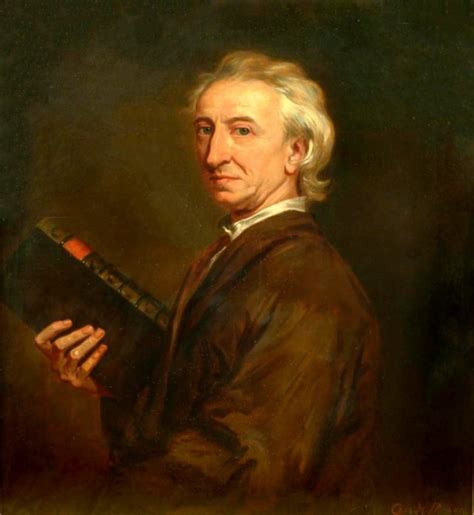
The Yard would remain a major strategic asset through the following century, when Blake knew the Yard, and after Restoration, Samuel Pepys and John Evelyn. Pepys came down here often on Admiralty business, busily commuting between here and his house in the City, his head full of practical reforms and quidnunc preoccupations. On 16 April 1661, for example, he diarized ‘Then we put off for Deptford, where we went aboard the Kings pleasure-boat that Commissioner Pett is making; and endeed it will be a most pretty thing.’

John Evelyn

John Evelyn lived in Deptford for forty years, fertilely for local legend. In 1658, a 58 feet long whale was killed off Deptford Strand, and another almost as big in 1699. In 1671, Evelyn came upon a highly skilled woodcarver in ‘an obscure place’ in Deptford, and was so impressed he introduced him to Christopher Wren and Charles II. Grinling Gibbons would go on to adorn some of the greatest houses of England.

Evelyn’s house was Sayes Court – a rambling brick house with a famous 100-acre garden, an experimental station and pleasure-ground for the romantic but also scientifically-minded author of Sylva (1664), one of the first and most influential books about forestry. Evelyn was devoted to his garden, and wrote copious maintenance and management notes under the title of Directions for the Gardiner at Says-Court, But which may be of Use for Other Gardens. A 1652 plan shows an elegant arrangement of ‘faire gravel walkes,’ fountains, grassy ‘plotts’, ‘long pourmenades’, box-hedged ‘par=terres’, an orchard and an evergreen thicket ‘for Birds private walkes, shades and Cabinetts’ – a haven of ‘choice flowers, and Simples,’ French walnuts and much else.

In 1696, Evelyn leased the house to Admiral Benbow, but found him a careless tenant. Worse came in 1698, when Evelyn, ‘asked’ by William III, allowed Czar Peter the Great and his entourage to rent Sayes Court while Peter was staying in England to study the latest shipbuilding techniques, as part of the modernizing monarch’s opening of a ‘window to the West.’ The towering, twenty-something Czar (he was 6 feet 7 inches tall) was none too careful with other people’s possessions. Evelyn’s servant reported to his master while the Czar was in residence, ‘There is a house full of people, and right nasty.’ Peter and his retinue trashed the house and garden, amongst other damage burning the bedding, using paintings for target practice, and crashing through an ilex hedge in a go-kart, causing the diarist to grumble on 9 June 1698:

To Deptford, to see how miserably the Czar had left my house, after three months making it his Court. I got Sir Christopher Wren, the King’s surveyor, and Mr London his gardener, to go and estimate the repairs, for which they allowed £150 in their report to the Treasury.

Sayes Court, John Evelyn’s house, in the early twentieth century

Evelyn’s painfully repaired paradise has gone, although there is a park on part of the site, with a twisted old mulberry tree on metal crutches (sadly, not one of his). Part of the house survived somehow, latterly as a workhouse, until the 20th century, by which time Deptford had long lost the Dockyard and most of its greenery, and become synonymous with urban deprivation. But other things have survived.

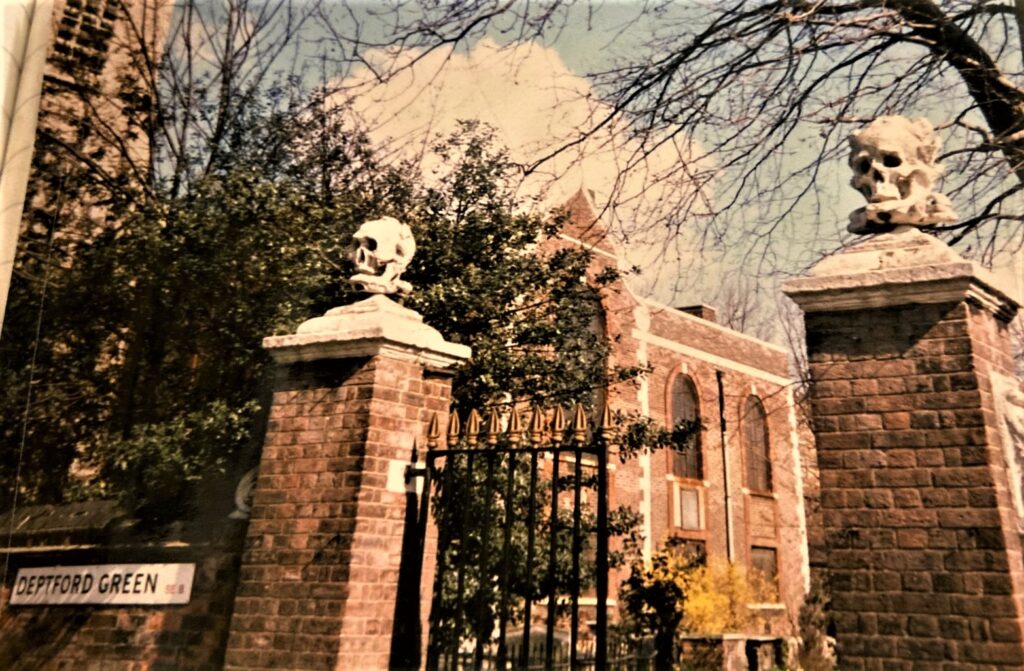
St. Nicholas’ Church – ‘I seemed to stand in a moralizing Georgian aquatint’. Credit: Derek Turner

The first time I saw St Nicholas’ Church, it was snowing, it was dark, and I seemed to be the only soul in all S.E.8. The cast-iron gates in the tall, thin eighteenth century brick walls were closed and locked, and there were no lights on inside the round-windowed church or charnel-house. Looming over, blacker than black, were the chunky medieval tower, the oldest building in Deptford, and overhanging yews – and straight in front, two great stone death’s heads surmounting the gateposts, with snow piled up on their laurel-wreathed craniums, the silence and whiteness accentuating the unfathomableness of their eye-sockets.

I seemed to stand in a moralizing Georgian aquatint, the churchly assemblage a cautionary note in the silent townscape, like a backdrop from The Rake’s Progress, or one of Rowlandson’s illustrations for The English Dance of Death – the ‘Horrid’ caperers that burst in upon the frightened Statesman, silence the Virago, wheel the Sot to his long louche home. Like the skeleton grinning madly in the Porter’s Chair, making that unfortunate operative recoil, the skulls of St Nicholas seemed to represent ‘What watchful Care the Portal keeps / A Porter He, who never sleeps.’

A sombre graveyard lies through those gates, most grass killed off by the yews, mud and mean needles giving acidic emphasis to the monuments to chandlers, merchants, shipwrights and John Evelyn’s beloved son, Richard, who died in January 1657 and is remembered searingly in the Diary:

[A]fter six fits of a quartan ague, with which it pleased God to visit him, dies my dear son, Richard, to our inexpressible grief and affliction, five years and three days only, but at that tender age a prodigy for wit and understanding; for beauty of body, a very angel; for endowment of mind, of incredible and rare hopes.

Evelyn probably hoped to see Richard again, because he was a believer in ghostly miracles, as suggested by a scrap of local lore he gave to the Royal Society, which ended up in John Aubrey’s Miscellanies:

…a Note under Mr. Smyth’s Hand [the Curate of Deptford] that in November 1679, as he was sick in bed of an Ague, came to him the Vision of a Master of Arts, with a white Wand in his Hand: And told him, that, if he did lie on his back three Hours, viz. from ten to one, that he should be rid of his Ague. He lay a good while on his back: but at last being weary he turned, and immediately the Ague attacqued him; afterwards, he strictly followed the Direction, and was perfectly cured. He was awake, and it was in the day-time.

Off-duty sailors too sleep under the yews, like Captain George Shelvocke, whose 1726 memoir A Voyage Round the World by Way of the Great South Sea included an incident that inspired one of English literature’s finest poems:

We all observed that we had not had the sight of one fish of any kind since we were come to the southward of the Straits of Le Maire, nor one sea-bird, except a disconsolate black albatross, who accompanied us for several days, hovering about us as if he had lost himself, till Hatley, my second captain … imagining from his colour that it might be some ill-omen, after some fruitless attempts, at length shot the albatross, not doubting, perhaps, that we should have a fair wind after it.

Instead, they experienced six weeks of constant bad weather – but the senseless killing of the bird did at least have one positive consequence decades later. In 1797, William Wordsworth, who had recently been reading Shelvocke’s book, mentioned the incident to Coleridge, who made it the central motif in Rime of the Ancient Mariner.

Sunset over the Pepys Estate. Credit: Derek Turner

An even ancienter rime connected to Deptford comes from Chaucer – ‘Sey forth thy tale, and tarie nat the tyme; / Lo, Depeford! And it is half-way pryme.’ The New Cross Road was the main medieval road to Canterbury, sometimes as thronged with pilgrims as it is thronged now with the profane. The ‘depe ford’ was not over the Thames, but the Ravensbourne – supposedly named in reference to the raven flags flown by Sweyn Forkbeard’s fleet, which rampaged up here in 1013 – which flows ten miles up from Bromley to debouch into the more famous river.

Deptford Creek, 1988. Credit: Peter Marshall

Deptford Creek is still a tiny port, where Kentish coasters go in under the lifting bridge (disgusting drivers, delighting me) and come alongside to unload aggregates. The river almost empties at ebb tide, revealing shining mud and shopping trollies perched on by herons. Cranbrook Road, that runs along the Ravensbourne higher up, carries the folk-memory of even less likely avifauna – the cranes that once must have danced and nested among reeds beyond fields. Henry Williamson, author of Tarka the Otter, was a local, and wrote an eco-story about the poor polluted bourne (today’s Ravensbourne is greatly improved), linking a human down-and-out living on its slithery banks, with the last lesioned fish gasping in its filthy flood. Old quay walls host unusual species of crabs and plants, and a little upstream a fig tree, legacies of exotica trafficked through here over years. Earlier incarnations of the bridge were long strategically significant for forces advancing on London, like those of Wat Tyler in 1381, Jack Cade in 1450, and Thomas Wyatt in 1554 – and the scene of a battle on 22 June 1497, when Lord Audley and his Cornish rebels were easily defeated by the Earl of Oxford.

Late nineteenth century postcard of Deptford Broadway

Today’s Deptford has been gentrified – it has a Waitrose, even a Dance Studio – but in the early 1990s it was often cruelly distinctive, surrounded by areas with their own pathologies – Bermondsey, Elephant and Castle, Eltham, Kidbrooke, Millwall, Peckham. It was a little bit of East End that had somehow come south of the Thames. My flat had been built on a road that in the 1930s had been occupied by businesses like Brisbane Laboratories, producers of liquid paraffin and hospital disinfectants, and the Floetta Liquid Soap Co. Ltd., suggesting not only the noxious air quality of those times, but maybe the nature of today’s underlying earth. In summer, drunks lay prostrate in the High Street – I once saw a pitiable woman urinating onto the aghast A2 at midday – and there were high levels of crime. A man pulled a knife on me in a park, luckily just swearing and running away when I – instinctively, stupidly – declined to hand over my wallet. More serious criminals featured frequently in the pages of the South London Press, perpetrators of carried-through muggings, ‘steaming’ attacks on the old slam-door commuter trains (gangs would pass through carriages and demand valuables at blade-point, leaping exultantly out and through the ticket barriers at the next station), and even fatal drive-by shootings. This was an area with some terrible memories – desperate poverty and squalor which long after infused the lurid novels of local boy Edgar Wallace, and which in the 1990s was still in evidence – the 1944 V2 bombing of Woolworth’s opposite Deptford Town Hall, in which 168 were killed – the never-explained 1981 New Cross Fire, in which thirteen teenagers died.

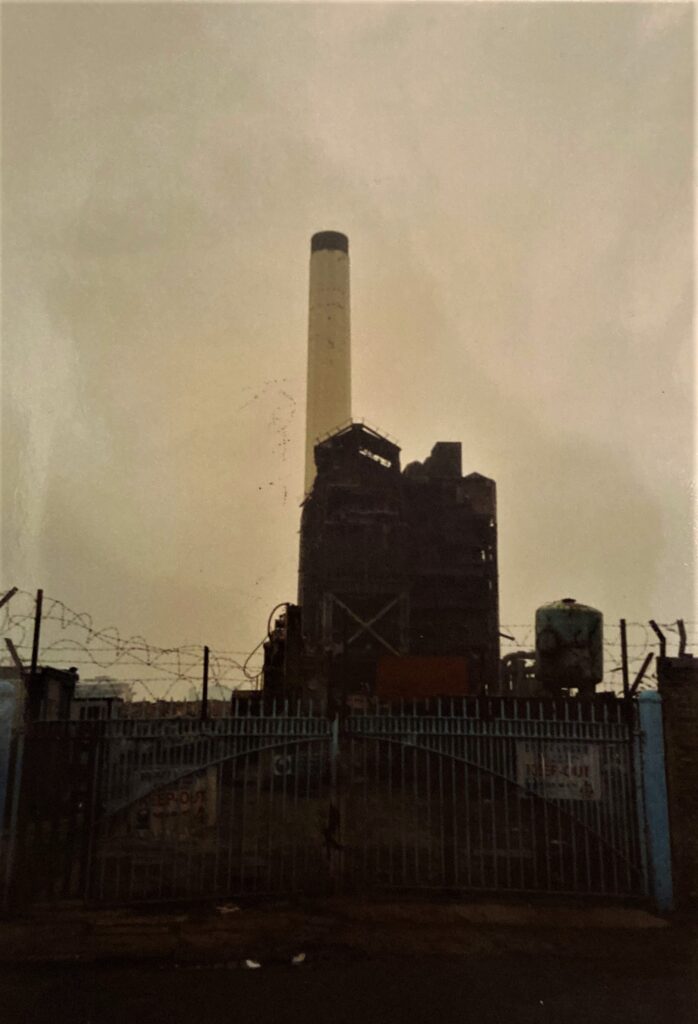
Deptford Power Station, being demolished. Credit: Derek Turner

But there were also striking survivals, like the trilby and tie-wearing rag-and-bone man who surreally drove his pony and trap along the frantic A2, stabling his animal down a cobbled lane just behind Deptford High Street. Another cobbled street called The Stowage led to ‘The Light’ – Deptford Power Station, then recently closed, but whose chimney still stood gaunt landmark above SE8 – between scrap yards patrolled by Alsatian dogs that would throw themselves savagely at the corrugated iron fences when they heard you passing. Staff said the basement of No. 2 Turbine-Generator was haunted by those who had died on the gibbets alongside the dry dock. 

Watergate Street. ‘There were alleyways where you could get right down to the water’s edge.’ Credit: Derek Turner

Not far off were the surviving Georgian gates to the Victualling Yard, with their classical frieze decorated with bucrania (cows’ skulls linked by floral swags), an allusion to Greek and Roman ritual sacrifices. Suitably close was the site of grosser sacrifices, the hugely, horribly busy Foreign Cattle Market of the Victorian and Edwardian periods. In 1907 alone, 184,971 cattle and 49,350 sheep passed through the Market, many to die in the attached slaughterhouses with their notoriously heavy drinking ‘gut girls’ (who could have blamed these women for drinking to forget their days?) There were alleyways where you could get right down to the water’s edge, with cattle (or maybe whale!) bones visible at low tide, amongst dark and viscous sludge. Elements of these animals must have passed across the well-scrubbed surfaces of Wellbeloved’s, a family butcher which had carried on the same business in the same premises since 1828, and only closed in 2021.

St. Paul’s Church, ‘pearl in the heart of Deptford.’ Credit: Shutterstock

Albury Street had grand Georgian doorcases, plaster cherubim with dimpled knees holding up lead canopies over old sea captains’ houses. Nearby was St Paul’s church, John Betjeman’s ‘pearl in the heart of Deptford,’ an eighteenth century beauty built by Thomas Archer, famous for St John’s, Smith Square. Charles Burney, who was vicar and organist here between 1811 and 1817, was a son of the eponymous and celebrated music historian. He was also brother to James, who travelled with Captain Cook, and Fanny, author of Evelina. He also ran an academy for the sons of local naval officers, so severe that he provoked a rebellion by pupils, who barricaded themselves into the school and beat him with sticks when he burst down the door. In less choleric moments, Burney was a renowned classicist, collector of books and ephemera (who sold his collection to the British Museum for an impressive £13,500), and royal chaplain.

There were some of the oldest surviving shops in London, including a tailor where smirking men made vinegarish comments about the people passing outside as they measured lapels and inside legs, in a 1650s cubbyhole made even darker by racks of tweeds, and 1970s photos of hirsute men wearing flared trousers made of alarming cloths. There was even the last smithy in SE8, where I had burglar bars made by a hatchet-faced and taciturn man in a tiny forge smelling of hand-rolled cigarettes and hot steel. This tiny iron underworld felt at one with all the other outdated crucibles of identity, from shipbuilding and milling to imperial imports and industrial oils – all of them contrasting with, yet also oddly complementing, the elegant churches and stories of Tudor, Stuart and Georgian derring-do.

Outside grand Victorian villas on Lewisham Way stands Deptford’s 1930s war memorial, a stele with a stone flame on top, and a staring-down soldier, his rifle pointing to the ground – an irrelevantly outdated symbol, yet at whose feet every year the red poppies are renewed. All things combine, come together as symbols of a suburb past and present – a place that has changed, is always changing, but where even now old memory has not been entirely erased.