The Museum of Imaginary Musical Instruments
Deirdre Loughridge & Thomas Patteson
London: Reaktion, 2026, hb., 199pps., 88 illus., £13.55
DEREK TURNER hearkens to strange sounds
The idea that the universe has an underlying sonic structure is as old as philosophy, and as perennial. Ancient observations of planetary orbits encouraged Pythagoras to hypothesize that just as the pitch of musical notes was determined by the rapidity of vibrations, so planets which orbited at different speeds must also make unique sounds, which harmonised as a majestic “music of the spheres”. Classical world-influenced Christian thinkers dreamed up trumpets toppling the walls of Jericho or signalling the End of Days, and the allegorical Instruments of St. Jerome, whose tuba had three mouthpieces, symbolising the Trinity, and four openings, to symbolize the Four Evangelists. Since its invention in the third century BC, the organ has been seen as much more than a machine – rather, with its air currents and complexity of construction, a metaphor of a breathing grand design.
Sir Thomas Browne called God “the First Composer” in Religio Medici, and saw music as key to universal understanding; he would have known the already old proverb “Music is the eye of the ear.” In 1921, 64 years-old Edward Elgar would write wistfully to his friend, the critic Sir Sidney Colin, “I am still at heart the dreamy child who used to be found in the reeds by Severn side, with a sheet of paper trying to fix the sounds and longing for something very great.” The music of the spheres seems inseparable from the music for our ears.
But while music can express emotions not easily conveyable in words, it can have limitations of its own, because of the imperfections of the instruments we use to “fix” the music we hear in our heads. Even the most advanced instruments are really reminders of music rather than music in themselves. In this diverting and handsomely illustrated book – an offshoot of their project www.imaginaryinstruments.org – two American organologists examine how musical visionaries have always sought to supersede the shortcomings of the tools of their trade, and surpass previous sounds.
Instruments, according to the authors’ expansive definition, are not necessarily contrivances of metal, wood and catgut, but can be wholly conceptual – a “constellation of forms, at once material and intellectual.” A radio, to these authors, can be an instrument – so too a piece of software. Instruments may not even be intended to make what we would consider musical sounds, but can be used to convey visual and even olfactory ‘music’ – colours or odours obtained by pressing keys. Conventional organologists categorise instruments according to their primary sound-producing mechanisms – for example, idiophones have vibrating bodies, and aerophones vibrating air columns – to which these authors now add ‘fictophones’, instruments which either never existed or progressed no further than prototype, yet inspired actual instruments, or otherwise resound in our imaginations. This is a highly entertaining account of artistic playfulness from ancient times to today; it also constitutes a serious study of the natures and meanings of music.
Inventive musicians in all ages have sought to make instruments that are larger, louder, sweeter or more versatile, or that can render audible otherwise undetectable sounds. While many of these experimentations led to colourful dead ends, others eventually sparked off calculus, computing, medical audiology, recording and streaming, science-fiction, and psychological concepts like synaesthesia.
Renaissance anatomical discoveries encouraged musicians in search of amplification to try and replicate the inner ear in cochlear whorls of brass. The polymath Giambattista della Porta thought it possible to trap sounds in pipes to be listened to later, a reiteration of older traditions that sounds could be frozen in mid-air, or that one of the biblical Joseph’s exhalations had been preserved in a jar held at the Vatican. Leonardo filled notebooks with ideas for instruments from kettledrums with instantaneously tuneable skins to a concept of coaxing musical correspondences from different-sized waterfalls.
Isaac Newton analogised his colour spectrum with the musical scale, which encouraged experimenters to try and make music with colours. Voltaire was dismissive of the ‘optical harpsichords’ thus envisaged, but even he allowed there might be “hidden rapports”. The early twentieth century American artist Thomas Wilfred invented the ‘Clavilux’, a silent instrument where colours were conjured by keys – a service less to music as we think of it than to the emerging genre of ‘lumia’ or light art.
Even people could almost become instruments, as seen for example in the origin story of the Arabian oud – supposedly modelled on a dead boy’s bones by his grieving luthier father – or the Austrian author-composer Johann Beer’s 1701 satire Bellum musicum, in which the forces of musical conservatism are assailed by demotic ‘bunglers’ (village fiddlers and the like) led by an ‘ambassador’ whose body is confected of musical notations and parts of instruments. So, too, could animals – at least according to the sadistic invention known as the ‘cat piano’, in which cats were allegedly fastened in rows and made to issue different yowls by being jabbed with pins. Mercifully, the cat piano seems mostly myth, but Peter the Great of Russia really did commission one in 1716, which was apparently used occasionally as late as 1803.
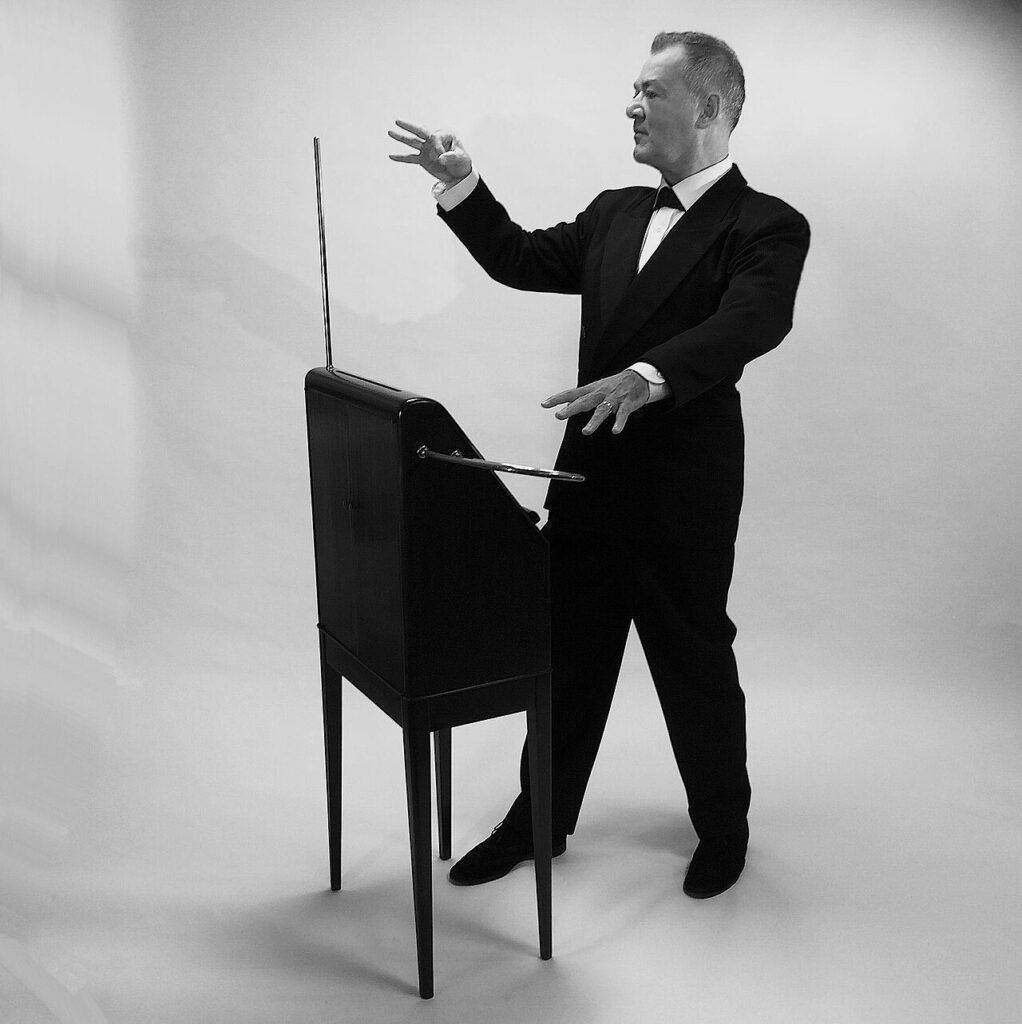
The Greek Aeolian harp, in which music is made by the wind passing over untouched strings, is distant ancestor to the equally unhandled theremin (invented in 1928), whose ethereal tones in turn inspired the Moog synthesiser (invented in 1964). The prophetic ‘speaking heads’ of medieval legend prefigure today’s (and tomorrow’s) robots. In 1739, the German-Danish music theorist Johann Adolf Schiebe conceived of a musikalische wunder-Maschine – a device that could not only create music but appraise its artistic worth – a satire, but a forerunner of today’s AI music generators. The Panharmonicon “mechanical orchestra” invented by Johann Nepomuk Maelzel inspired his friend Beethoven’s 1813 symphony Wellington’s Victory, and can be seen as an antecedent to today’s electronic keyboards.
Adolphe Sax envisaged gigantic steam-powered organs and an array of other impossible instruments, including a thirteen-bell trumpet, but he also gave us the saxophone. Francis Bacon’s 1526 utopian novel New Atlantis, in which his hero visits an island off Brazil where the inhabitants operate official sound-houses to “practice and demonstrate all sounds and their generation” inspired Daphne Oram to co-found the BBC’s world-famous Radiophonic Workshop in 1958. Musical Prometheans still look backwards in order to look forwards, like Brian Eno whose insights into medieval bells are informing his ideas of the sounds of thousands of years hence, when bells may be built of very different materials and ring with radically different tones. Whatever that far off world might sound like, it seems certain some of us will always be straining our ears to hear yet farther.
This review first appeared in Café Americain, and is reproduced with permission

DEREK TURNER is the editor of The Brazen Head, as well as a novelist (A Modern Journey, Displacement, and Sea Changes) and widely-published reviewer. His first non-fiction book, Edge of England: Landfall in Lincolnshire, was published June 2022. Some of his writing may be found at www.derek-turner.com He is also on X – @derekturner1964