Speculative sounds

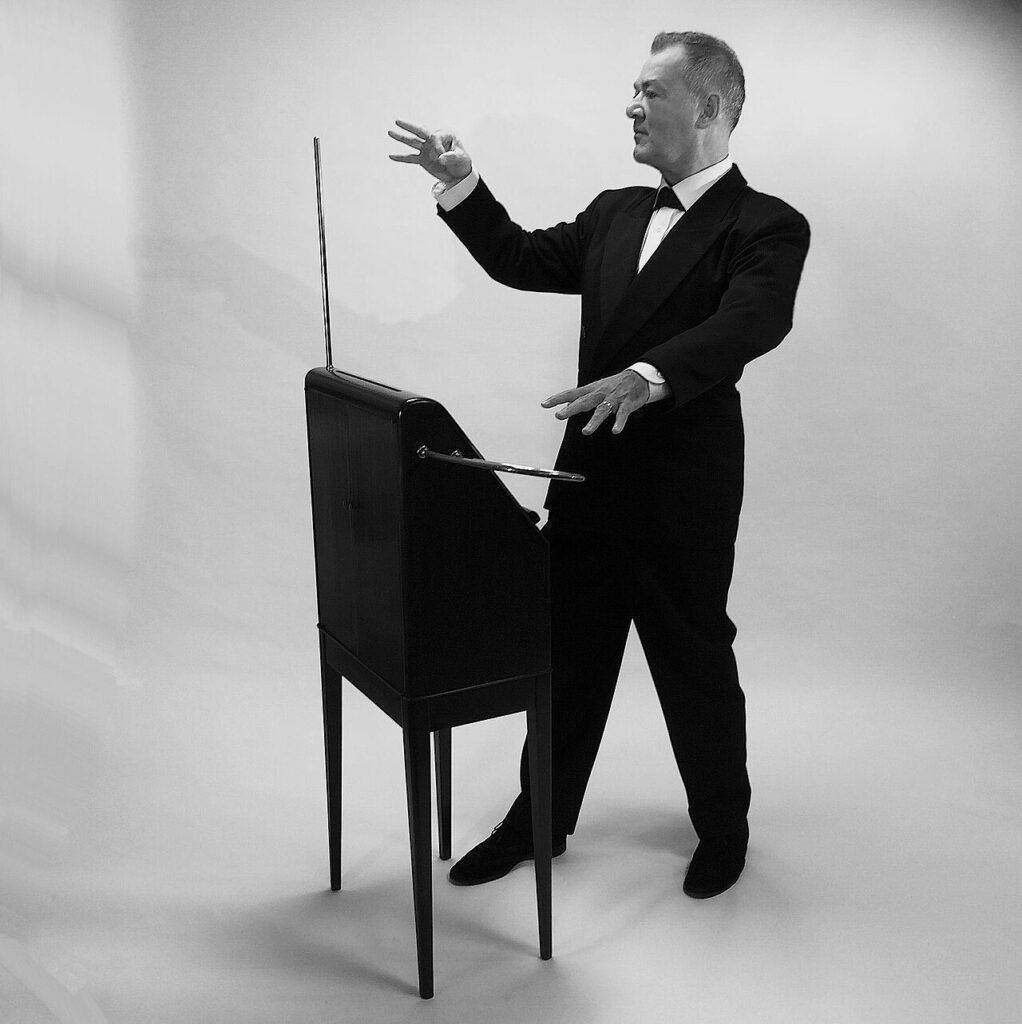
The RCA Victor theremin, played by Bruce Woolley. Image: Wikimedia Commons

The Museum of Imaginary Musical Instruments

Deirdre Loughridge & Thomas Patteson

London: Reaktion, 2026, hb., 199pps., 88 illus., £13.55

The idea that the universe has an underlying sonic structure is as old as philosophy, and as perennial. Ancient observations of planetary orbits encouraged Pythagoras to hypothesize that just as the pitch of musical notes was determined by the rapidity of vibrations, so planets which orbited at different speeds must also make unique sounds, which harmonised as a majestic “music of the spheres”. Classical world-influenced Christian thinkers dreamed up trumpets toppling the walls of Jericho or signalling the End of Days, and the allegorical Instruments of St. Jerome, whose tuba had three mouthpieces, symbolising the Trinity, and four openings, to symbolize the Four Evangelists. Since its invention in the third century BC, the organ has been seen as much more than a machine – rather, with its air currents and complexity of construction, a metaphor of a breathing grand design.

Sir Thomas Browne called God “the First Composer” in Religio Medici, and saw music as key to universal understanding; he would have known the already old proverb “Music is the eye of the ear.” In 1921, 64 years-old Edward Elgar would write wistfully to his friend, the critic Sir Sidney Colin, “I am still at heart the dreamy child who used to be found in the reeds by Severn side, with a sheet of paper trying to fix the sounds and longing for something very great.” The music of the spheres seems inseparable from the music for our ears.

But while music can express emotions not easily conveyable in words, it can have limitations of its own, because of the imperfections of the instruments we use to “fix” the music we hear in our heads. Even the most advanced instruments are really reminders of music rather than music in themselves. In this diverting and handsomely illustrated book – an offshoot of their project www.imaginaryinstruments.org – two American organologists examine how musical visionaries have always sought to supersede the shortcomings of the tools of their trade, and surpass previous sounds.

Instruments, according to the authors’ expansive definition, are not necessarily contrivances of metal, wood and catgut, but can be wholly conceptual – a “constellation of forms, at once material and intellectual.” A radio, to these authors, can be an instrument – so too a piece of software. Instruments may not even be intended to make what we would consider musical sounds, but can be used to convey visual and even olfactory ‘music’ – colours or odours obtained by pressing keys. Conventional organologists categorise instruments according to their primary sound-producing mechanisms – for example, idiophones have vibrating bodies, and aerophones vibrating air columns – to which these authors now add ‘fictophones’, instruments which either never existed or progressed no further than prototype, yet inspired actual instruments, or otherwise resound in our imaginations. This is a highly  entertaining account of artistic playfulness from ancient times to today; it also constitutes a serious study of the natures and meanings of music.

Inventive musicians in all ages have sought to make instruments that are larger, louder, sweeter or more versatile, or that can render audible otherwise undetectable sounds. While many of these experimentations led to colourful dead ends, others eventually sparked off calculus, computing, medical audiology, recording and streaming, science-fiction, and psychological concepts like synaesthesia.

Renaissance anatomical discoveries encouraged musicians in search of amplification to try and replicate the inner ear in cochlear whorls of brass. The polymath Giambattista della Porta thought it possible to trap sounds in pipes to be listened to later, a reiteration of older traditions that sounds could be frozen in mid-air, or that one of the biblical Joseph’s exhalations had been preserved in a jar held at the Vatican. Leonardo filled notebooks with ideas for instruments from kettledrums with instantaneously tuneable skins to a concept of coaxing musical correspondences from different-sized waterfalls.

Isaac Newton analogised his colour spectrum with the musical scale, which encouraged experimenters to try and make music with colours. Voltaire was dismissive of the ‘optical harpsichords’ thus envisaged, but even he allowed there might be “hidden rapports”. The early twentieth century American artist Thomas Wilfred invented the ‘Clavilux’, a silent instrument where colours were conjured by keys – a service less to music as we think of it than to the emerging genre of ‘lumia’ or light art.

Even people could almost become instruments, as seen for example in the origin story of the Arabian oud – supposedly modelled on a dead boy’s bones by his grieving luthier father – or the Austrian author-composer Johann Beer’s 1701 satire Bellum musicum, in which the forces of musical conservatism are assailed by demotic ‘bunglers’ (village fiddlers and the like) led by an ‘ambassador’ whose body is confected of musical notations and parts of instruments. So, too, could animals – at least according to the sadistic invention known as the ‘cat piano’, in which cats were allegedly fastened in rows and made to issue different yowls by being jabbed with pins. Mercifully, the cat piano seems mostly myth, but Peter the Great of Russia really did commission one in 1716, which was apparently used occasionally as late as 1803.

The Greek Aeolian harp, in which music is made by the wind passing over untouched strings, is distant ancestor to the equally unhandled theremin (invented in 1928), whose ethereal tones in turn inspired the Moog synthesiser (invented in 1964). The prophetic ‘speaking heads’ of medieval legend prefigure today’s (and tomorrow’s) robots. In 1739, the German-Danish music theorist Johann Adolf Schiebe conceived of a musikalische wunder-Maschine – a device that could not only create music but appraise its artistic worth – a satire, but a forerunner of today’s AI music generators. The Panharmonicon “mechanical orchestra” invented by Johann Nepomuk Maelzel inspired his friend Beethoven’s 1813 symphony Wellington’s Victory, and can be seen as an antecedent to today’s electronic keyboards.

Adolphe Sax envisaged gigantic steam-powered organs and an array of other impossible instruments, including a thirteen-bell trumpet, but he also gave us the saxophone. Francis Bacon’s 1526 utopian novel New Atlantis, in which his hero visits an island off Brazil where the inhabitants operate official sound-houses to “practice and demonstrate all sounds and their generation” inspired Daphne Oram to co-found the BBC’s world-famous Radiophonic Workshop in 1958. Musical Prometheans still look backwards in order to look forwards, like Brian Eno whose insights into medieval bells are informing his ideas of the sounds of thousands of years hence, when bells may be built of very different materials and ring with radically different tones. Whatever that far off world might sound like, it seems certain some of us will always be straining our ears to hear yet farther.

This review first appeared in Café Americain, and is reproduced with permission

Lincolnshire – a land apart

Crowland Abbey. Photo: Derek Turner
Edge of England: Landfall in Lincolnshire
Derek Turner, Hurst & Co., 2022, hb., 446pps, 32 col. Illus. & map, £20
PAUL GARNER enjoys a survey of an oddly little-known county

Edge of England is a rich tapestry woven of many threads—history, nature, industry, geography, religion and folklore—all intertwining to create a picture full of interest. It tells the story, or rather multiplexity of stories, of the author’s adopted county of Lincolnshire, an unjustly overlooked and unfashionable part of England, one that is often, as the author reminds us in his opening chapter, the butt of snide jokes and liberal disdain. Turner’s book challenges this snobbery and prejudice, revealing “a county like no other … an England time half-forgot, where you can still find an unabashed past inside an unpretentious present—and freedom and space on a little offshore island”.

Turner delights the reader with captivating tales of eccentric characters, atmospheric places and intriguing events, his wide reading and breadth of knowledge apparent on every page. A thousand and one rabbit trails are laid by the author, any one of which could profitably be followed by an inquisitive reader. We learn about the lives and times of many sons and daughters of the shire, some well-known, others less so. Among the colourful characters that we meet are parliamentarians, scientists, explorers, military men, poets and writers, and religious figures.

The more familiar include John Wesley, the evangelical clergyman whose spirited preaching was the fountainhead of the emerging Methodist movement, Sir Isaac Newton, the scientific prodigy who developed differential calculus while sheltering from the plague at Woolsthorpe in 1665, and Dutch engineer, Cornelius Vermuyden, whose land reclamation work met with fierce opposition from locals, who feared dispossession. But we are also introduced to less familiar personalities, such as the cantankerous nineteenth-century contrarian, Sir Charles Sibthorp, who, as MP for the city of Lincoln, vehemently opposed steam railways, water closets and barrel organs, the polymathic Sir Joseph Banks, who accompanied Captain Cook aboard HMS Endeavour, and amassed important collections of botanical specimens, and the demon-afflicted Saint Guthlac, who, at the end of the seventh century, established a hermitage at Crowland, destined, after his death, to become a monastic centre and place of Christian pilgrimage.

Turner writes with affection of the ordinary people of Lincolnshire. They are kind, practical, helpful and courteous, even to outsiders, and when they get to know you “accord you the ultimate sign of acceptance—telling you about the idiocy of London”. He describes, with wistful melancholia, Lincolnshire’s lost villages, decaying industries and disappearing ways of life, but does not rub salt into the wounds in the fashion of some unkind commentators. Grimsby may be down-at-heel today, with “a depressed town centre, and too much bad housing”, but Turner writes movingly of the skill and bravery of its sailors and fishermen, and the fortitude of their families, ensuring that the reader knows of the town’s epic origins, regal connections, and dogged “tough pride.”

Many absorbing stories are related, ranging from the whimsical and quirky to the ghoulish and macabre. There is the curious tale of the “Stamford Schism”, an ill-fated attempt by a cadre of unhappy students and tutors from Oxford to establish a rival institution at Stamford in 1333. It was a short-lived venture, the brass door knocker the students took with them when they left Oxford now proudly displayed above high table at Brasenose, in the manner of a spoil of war. The Haxey Hood is another oddity, a game played every January in the town of Haxey, during which enthusiastic locals chase a group of costumed “Boggins” around the town in pursuit of a leather bolster, ostensibly re-enacting an incident with a riding hood said to have taken place almost 700 years ago.

Grisly crimes, pogroms and witch trials are also part of the county’s story. For instance, Turner tells of the tragic death of poor Mary Kirkham in 1806, and the execution of her murderer and erstwhile suitor, Tom Otter, whose skull was said to have provided a home for nesting blue tits when he was gibbeted at Saxilby. However, one of the darkest episodes in the county’s history took place in 1255, when an antisemitic rumour began to circulate in Lincoln that a young boy named Hugh had been murdered by a local Jewish man. This led not only to the arrest, torture and execution of the suspect, but the imprisonment of ninety-one others, eighteen of whom were also executed. The boy’s burial place became a shrine, and “Little Saint Hugh” acquired legendary status, becoming the subject of ballads and folk songs.

Those who, like me, appreciate tales of the strange and uncanny will enjoy reading about the ghostly goings-on at Epworth Rectory, home, in the eighteenth century, not only to the Wesleys, but also, it was said, to a noisy and disincarnate spirit called “Old Jeffrey”. We learn of the spectral “Green Lady” who haunts a tree-lined avenue near Thorpe Hall in Louth, and the “Black Lady” of Bradley Woods, still weeping for her lost children. The county also has tales of water sprites, wild men and mysterious big cats, and, although not mentioned by Turner, Black Shuck, the demonic hellhound that patrols the county’s byways, its red eyes flaming like coals through the fen mists.1 Anyone eager to explore the supernatural aspects of Lincolnshire further may want to consult a series of hair-raising articles by Rob Gandy in recent editions of Fortean Times.2

Turner says of the Lincolnshire-born antiquarian, William Stukeley, that he could see “the magic of words”. If so, Stukeley would have appreciated the spellbinding mellifluosity of Turner’s own writing. Almost every page yields memorable examples. Consider, for instance, Turner’s charming distillation of one village’s peculiarities and idiosyncrasies as “a little ampoule of English eccentricity” – his spinetingling description of old gateways as “unquiet, touched by the memories of everyone who has ever gone through them, especially if they never came back” – and his description of a carved stone man, high on the forlorn ruins of Barlings Abbey, abandoned at the time of the Dissolution, “stuck in eternal outrage, his mouth forever open as if howling at all this sacrilege and sky”. Turner sees poetry in the everyday, as when he recalls a dead carrion crow, “lying in a patch of sun beneath trees, intact and gleamingly black, studded with iridescent greenbottles, like a mislaid piece of Visigoth jewellery”, or when he waxes lyrical about the vistas that open up from the Humber bridge, “especially to the west on a warm evening when it has been raining, with the sun going down in splendour, and backlit air and water so full of each other that it is like being inside a pearl”.

The reader is also treated to some wonderfully dry asides, perhaps my favourite being an anecdote about a cringeworthy sermon given by the new Bishop of Lincoln at his enthronement, its low culture references jarring awkwardly with the high pomp of the ceremony that had preceded it. Turner concludes, somewhat archly, “The Order of Service read ‘After the sermon, silence is kept for a few moments,’ and it was, but not necessarily for the right reasons”.

Edge of England is a book to savour and is accompanied by thirty-two colour plates and a rather beautiful, Tolkienesque map in which the Wolds take on something of the aspect of the “misty mountains”.

Notes

  • Ethel Rudkin, ‘The Black Dog,’ Folklore 49 no. 2, 111-131 (1938).
  • ‘The Ruskington horror,’ Fortean Times 401, 32-38 (January 2021); ‘The Ruskington horror: part 2,’ Fortean Times 402, 38-43 (February 2021); ‘The Ruskington goblin,’ Fortean Times 405, 48-38 (May 2021); ‘Weird wheels of the Wolds,’ Fortean Times 407, 48-51 (July 2021); ‘Scary stories from Scunthorpe,’ Fortean Times 411, 48-52 (November 2021); ‘Not the face,’ Fortean Times 414, 46-47 (January 2022); ‘Lincolnshire’s bevy of the bizarre,’ Fortean Times 416, 44-48 (March 2022); ‘A warning to the Fortean,’ Fortean Times 421, 42-45 (August 2022); ‘A grand fen-ale!’ Fortean Times 423, 42-45 (October 2022)