Musical winter warmers

Silver buckthorn under snow. Image: Derek Turner

Samuel Coleridge-Taylor, orchestral works, SOMM CD 0713

E.J. Moeran, Symphony and Violin Concerto, SOMM ARIADNE 5045

Arlene Sierra, Birds and Insects, BRIDGE 9599

Vaughan Williams, Mantegna, ALBCD067

Samuel Coleridge-Taylor (1875-1912) was a man of half-English and African descent, a composer in a monocultural Britain who was championed by those quintessential musical knights, Sirs Edward Elgar and Malcolm Sargent, and who was thought to represent a vital new generation in our cultural life. Yet Samuel died in poverty – and still in the prime of life. Who knows where his musical star might have guided us?

But on a new recording from the ever-adventurous SOMM label, we are able to savour an orchestral march – championed by Sir Henry Wood – that could easily slot in alongside Elgar’s famous contribution to the military oeuvre. In Coleridge-Taylor’s Ethiopia Saluting the Colours, we find – not a piece about mystical African Emperors, their cult and country’s ability to defeat European outsiders – but a touching story-in-music about a slave in the Carolinas – named Ethiopia – giving thanks to the Stars and Stripes, as flown by the Union Army in the latter stages of the American Civil War. Of course, there are many Southerners who have not forgotten the scorched earth policy of General Sherman as he ‘liberated’ the country known as Dixie, but historical controversies aside, listeners have the chance to savour Coleridge-Taylor’s semi-Elgarian style – not to mention the rich tone of the Ulster Orchestra, under the baton of Charles Peebles.

Other works on the disc also capture the Victorian-Edwardian period feel of the music, with Rebecca Murphy, soprano, the soloist in Zara’s Earrings, Op. 7 – A Moorish Ballad, with text by John Gibson Lockhart (Walter Scott’s son-in-law, and biographer). Ioana Petcu-Colan relishes the solo part the quarter-of-an-hour in length Ballade for Violin and Orchestra in D minor. A Brahmsian lyricism, but somehow sweeter than the original tones of the great Johannes, is never far from the surface. Lovers of the music of the English Musical Renascence will enjoy this collection enormously.

E.J. Moeran, who died during a storm on the coast of Eire in 1950, was a symphonist and tone-poem writer, able to establish an immediate atmosphere of landscape and folklore in his music. Of Irish descent, Moeran was born in England, and absorbed all the loneliness of the East Anglian coastal marshes and sands, earning the praise of fellow composer, Lowestoft-born Benjamin Britten. Yet despite Moeran’s Englishness of fen and meadow, and a beery period of mugs of ale and madrigals in the North-West Kent village of Eynsford with characterful composer, Peter Warlock, it was to an almost imaginary Ireland that E.J. – or ‘Jolly Jack’ – was drawn. His Violin Concerto, completed in 1938 and inspired by Kenmare Bay, seems to assemble every part of his character, and it is the one major work of Moeran which concert-programmers turn to on the rare occasions that the composer is even thought of these days. On a new CD from SOMM Recordings, founder and director, Siva Oke (with painstaking audio restoration from Lani Spahr) brings a 1946 live broadcast from St. Andrew’s Hall, Norwich, into the sound-world of 2025 – with the BBC Symphony Orchestra and soloist, Albert Sammons, conducted by Sir Adrian Boult.

Longer than the concerto by some 15 minutes, the CD also features the Symphony in G minor, a piece that is filled with lyricism and impetuous outbursts of energy – again, mirroring the composer’s stormy and unpredictable character. Those familiar with Bax’s Celtic twilight symphonic output will relish the Moeran, enjoying along the way the muscular playing of the BBC Symphony Orchestra of 1949 (again, under Boult) and a finale every bit as exciting as that found in Sibelius Fifth and Walton’s First symphonies.

Sarus Crane, Cornish Bantam, Thermometer Cricket, Lovely Fairywren – these are the magical titles of short pieces which comprise Books 1, 2 and 3 of Arlene Sierra’s collection devoted to Birds and Insects. A walk through a modern Natural History Museum, or a contemporary-music, natural-history sound-installation, Arlene’s music casts a strange spell – as if you were about to disappear into a fantasy of Nature. Arlene is an American composer, but London-based and has enjoyed many collaborations with leading orchestras in Britain, Japan and America. Although very much her own, distinctive, modern yet approachable style, the music seems to stand alongside similar evocations of birds by, for example, Messiaen or Ravel; and a feeling created for the listener, very much like the Japanese composer, Takemitsu, in A Flock Descends into the Pentagonal Garden. As complex and miraculous as the delicate bodies of the creatures it represents – the music wafts from the trees, canopies and cover of the forests and woods where its inspirations live their lives. In the hands of pianists Steven Beck and Sarah Cahill, I can think of no better album of contemporary music this wintertime.

Finally, great hymn tunes abound in a CD from Albion Records – Mantegna – so named because of the 15th-century artist, painter of The Agony in the Garden. The atmosphere of Passiontide and Gethsemane is very much to the fore, in Vaughan Williams’s setting of Sidney Lanier – an American author and poet who served in the Confederate Army in the Civil War: “Into the woods my master went,/Clean forspent, forspent;/Into the woods my master came,/Forspent with love and shame… ‘Twas on the tree they slew him, last,/When out of the woods he came.’

All People That on Earth Do Dwell (the ‘Old Hundredth’) – RVW’s famous arrangement, used at the Coronation of Elizabeth II – and the tune King’s Lynn make for inspiring listening, with the words of G.K. Chesterton: “O God of earth and altar,/Bow down and hear our cry,/Our earthly rules falter,/Our people drift and die…’ Although the son of a Gloucestershire clergyman, Vaughan Williams – though inspired by Christian culture and belief – remained an English agnostic for all his days, yet even in his deep, harmonic hymnody, misty mornings near coastal East of England churches, the Norfolk Rhapsodies and the horizons of Wenlock Edge are never far away. William Vann, the Dulwich Choral Society and the London Mozart Players (the ensemble due to open the 2026 English Music Festival) give a full-bodied and well-recorded performance.

A tale of three cities

A house on the Appian Way


The 2025 season of the BBC Proms was in its final furlong on Sunday 7th September, with an 11am performance of three highly descriptive works from the early part of the 20th-century – Respighi’s ‘Technicolor’ 1924 description of the Eternal City, The Pines of Rome (sun-drenched, but with a perfumed nocturne at its heart), Milhaud’s jazzy and wine-overflowing Le Boeuf sur le Toit, and the immediate pre-Great War London Symphony by Ralph Vaughan Williams.
All connected by the theme of great cities, each work was given a velvety performance by the ever-euphonious, silky-toned Royal Philharmonic Orchestra (but with additional antiphonal brass to set those Roman Legions marching in the Respighi). And relishing the writing of each musical postcard was the RPO’s conductor, St. Petersburg-born-and-educated, Vasily Petrenko, an expressive, energetic conductor of the younger generation.
Ottorino Respighi was the greatest film-score composer — who never wrote for the movies! He should have really been there for those great directors of the past, with their Xanadu grandeur and appetites for the mass-drama of the ancient world, but instead his epic scores accompany the picture-house of the mind: the rush and swirl of a heady city, full of the dust of the past, as children’s games in the park open his Roman pines holiday.

The Stravinsky-like opening, with its dainty little fanfares and marches, builds to a brazen crescendo — and suddenly the audience is plunged into a sepulchral atmosphere of ruins, remains, skulls, catacombs; and like an incantation from Roman worship, with seers and soothsayers never far away, the movement slowly lurches forward like a procession of colour plates from a history-book, come to life. The warmer, sensuous sounds of the night then waft into the score in The Pines of the Janiculum Hill, switching the panorama to one of soothing, delicate ultra-romanticism — the sweetness of the warm darkness crowned by a recording of a nightingale’s song played over the loving woodwind and strings. Respighi was right: not even a composer or first-class orchestra could imitate the such a bird.
Finally, a theme of some disquiet begins to rise and rumble on the horizon of the Via Appia — the occasional glint of sun on a shield, the faint sense of Legions’ standards coming into view. With batteries of brass and percussion standing by, the RPO made the slow, yet unmistakably glorious march to the capital of one of the world’s great empires, before the full weight of dazzling orchestral sound — reinforced by the hundreds-strong pipes of the Royal Albert Hall organ — brought Pini di Roma to its blazing finale.

Josephine Baker, by Paul Colin. 1930

Mid-20th-century Gallic wit, insouciance, even surrealism is the heady cocktail for Darius Milhaud’s Le Boeuf sur Le Toit — the jazz-age scena (with orchestral, rather human voices) which sparkles on the dance-floor of a nightclub named, bizarrely, ‘The Ox on the Roof’. This is carnival time, 1919, in a fictitious bar, a ballet of weird characters tapping their feet in time to jazzy tunes and dancing the night away — although a night-spot did open in Paris, using this very name, and they made the bon viveur Milhaud a member. Even though our Proms performance was nearing noon, the Royal Philharmonic made us all feel as though we were in a late-night, Bogart-type bar, with the Gitanes-smoke smouldering in the dark corners and the hedonists relishing every syncopated note on the dance-floor.

Ralph Vaughan Williams in 1917


When the English composer, Ralph Vaughan Williams takes an audience to a place — whether a lark ascending over the downland, or the oceans of A Sea Symphony — you can bet that there is more to it than just a portrait coloured in by an orchestra. The lark soars to an unknown region, or you steer, not for the deep waters of the mid-Atlantic, but navigate around your own deepest thoughts in the dark night of the soul. In the composer’s A London Symphony, written just before the Great War, we find ourselves seeing through the clearing of the morning mist, just like Wordsworth’s vision of the city from Westminster Bridge — or in the elegiac nocturne, the autumn leaves in Bloomsbury Square. But it is, too, a city of dreadful night — music which in its final movement Betjeman chose to accompany his 1977 television poetry anthology, but using the music for scenes of the stark grandeur of wintry hills, rather than the town: a sense of the life-cycle of the year — of us all — meeting the maker of our being.
Maestro Petrenko felt every pulse of this most English journey, bringing forth playing of nervy beauty in what is a complex, enigmatic, deep-water score. The finale, inspired by a passage from H.G. Wells’s novel, Tono-Bungay, depicts a vessel sailing by night along London’s river, to the Thames estuary and open sea… “London passes, England passes… all the old certainties glide astern…” — and here, the RPO’s woodwind and sepia strings conjured a Time Machine feel of dates, time, reality, all dissolving and meaningless as the city fades into a memory.
A Proms concert that won’t be easily forgotten, in this, my 44th year at these concerts.

From searing symphony to Paradise Garden

Friday 23 May 2025 marked the beginning of the eighteenth English Music Festival, a much-looked-forward-to annual event in the classical calendar and a testimony to the considerable organisational and fundraising skills of its founding director, Mrs. Em Marshall-Luck. Despite receiving no support from the Arts Council of England, no help from the ‘Department of Culture, Media and Sport’ and no visit or encouragement from Government ministers (either Labour or Conservative – save for one brief appearance by Boris Johnson in the early days), the Festival has managed to galvanise a loyal following of supporters, benefactors and artists – thus ensuring the continuation, not just of the main four-day event, but a host of other concerts, events and recording initiatives.  A lesson in self-reliance and self-belief, the EMF must be considered as one of the most remarkable events of its kind – not least because of its presentation of a forgotten part of our national musical heritage.

Usually when one thinks of an English music concert, works such as Elgar’s ‘Enigma Variations’ or Vaughan Williams’s The Lark Ascending come to mind, and many such prominent works are indeed to be found in the Festival’s programmes. But what distinguishes the EMF is its patient work – hours spent in archives and in tracking down lost scores – reconstructing a lost world of English music. Thanks to the musicological detective work of figures such as Martin Yates, the conductor of the opening-night’s concert, audiences are taken way beyond the usual boundaries.

Stanley Bate

This year, we were treated to the enigma and variations of Stanley Bate’s Second Symphony – Bate, a pupil of Vaughan Williams and the German composer, Hindemith, yet who has been practically forgotten by the musical establishment in this country. The presentation of his searing four-movement symphony from the late 1930s amounted to a posthumous world-premiere for a potentially great but tortured figure, who died tragically before his time. It also brought home to the audience (and performers) just how avant-garde English composers could be – resetting our idea of our native music, as something that could be as Shostakovichian as pastoral or romantic.

Bate’s work had some radiant moments within its taut structure, like an exhalation of breath amid the angst, but on the whole, some of the febrile nature (and phraseology) reminiscent of Vaughan Williams’s Fourth Symphony made it a muscular, physical, challenging – even shattering – musical experience. The beginning of the last movement brought to mind the stretched tonality and astringent string writing of Britten’s Variations on a Theme of Frank Bridge, making the piece very much the province (you would have thought) of BBC Symphony Orchestra repertoire, those specialists of 20th century music. But I doubt that any ensemble could have rivalled the faultless, totally-committed rendition given at Dorchester by the BBC Concert Orchestra – musicians who seem to have the gift of versatility, allowing them to roam from show music to popular classics, and the pinnacles of British music of the last century.

William Alwyn

Alongside the Stanley Bate, the BBC CO gave us an injection of springtime energy, in the form of William Alwyn’s The Innumerable DanceAn English Overture. This was a vision of sensuality and radiance, every bit as transcendental as a Wagnerian Tristan and Isolde. It was followed by Delius’s well-known The Walk to the Paradise Garden, although the setting is Switzerland rather than our own land. The rich, expansive acoustic of Dorchester Abbey, full of reverberation and ‘air’ was just right for the Delius, as it was indeed for the Heroic Elegy and Triumphal Epilogue, an early work (1901) by Vaughan Williams, the monumental conclusion of which included the magisterial tones of the Abbey’s organ, ringing out over and through the orchestra.

The Festival paid tribute to Sir Arthur Bliss, in this the 50th anniversary year of his death, with another exceptional interpretation, the Cello Concerto of 1970, a piece premiered at the Aldeburgh Festival under the baton of Benjamin Britten. Originally written for the Russian cellist Rostropovich, the Dorchester performance was given by one of the greats of our own era, Raphael Wallfisch, who brought this neglected, fine and fluent score to life. Having performed Finzi’s Cello Concerto at the Festival some ten years ago, Wallfisch has the full measure of English music – bringing a warmth, detail, spirit and true authority to another part of England’s music that has tended to languish in a backwater. Sitting as I was on the second row, I found myself admiring the chamber-like detail of the cello playing, the soloist given a full spotlight of sound, thanks to the sensitive accompaniment of Martin Yates and the BBC Concert Orchestra.

Rupert Marshall-Luck and Peter Cartwright
Image: Stuart Millson

The next day at the Festival’s Saturday morning recital, the official chamber players took centre-stage – violinist, Rupert Marshall-Luck and pianist, Peter Cartwright, a powerful partnership dedicated (again) to works and composers who have become distant to us. First was Norman O’Neill’s (1875-1934) Suite in B minor for Violin and Piano, and then Alan Rawsthorne’ s 1933-34 Violin Sonata. Rawsthorne attained fame as a film composer in the 1940s and ‘50s, but his Violin Sonata is little known. In fact, the recitalists were giving the first public performance of the work in the United Kingdom. Both violinist and pianist were as skilled in delivering the foot-tapping finale to the Rawsthorne, as they were in the gentler, dreamier lines of Delius’s Sonata in B major and the Cradle Song by Herbert Howells (the latter, another premiere, thanks to the determination of the EMF) – confirming them as two of our country’s very finest performers and advocates of English chamber music.

From the Fens to Ayrshire – and Stravinsky’s dark times

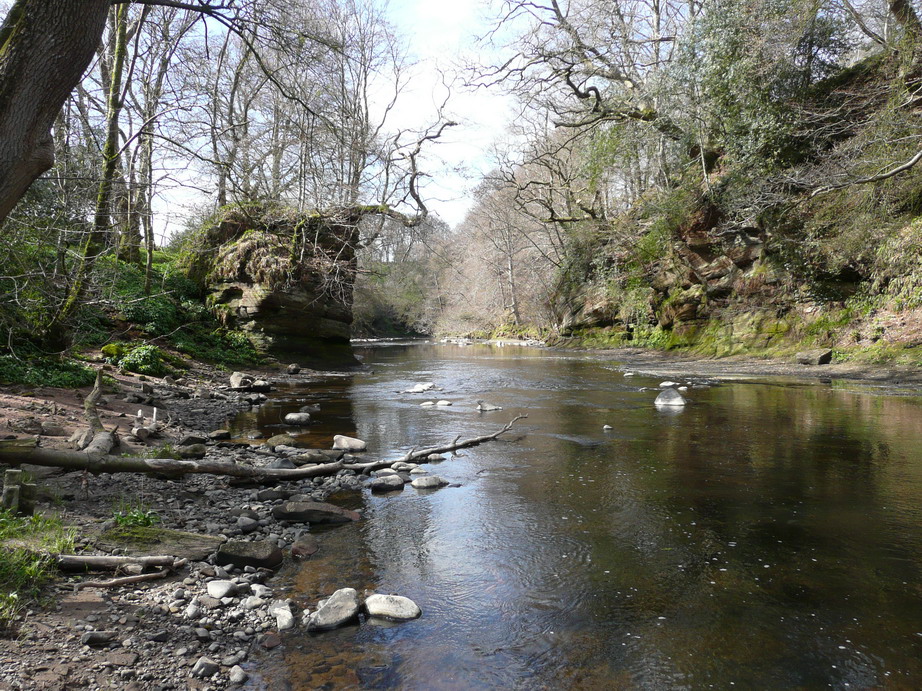
The Lugar, by David Johnston. Image: Wikimedia Commons

Composers are not necessarily good conductors of their own works — too fussy, sometimes, or just without the conducting charisma of a professional baton-wielder, more accustomed to the stage and the adulation of an audience. Not so in the case of composer-conductor, Sir James MacMillan, a native of Scotland whose musical outlook and versatility brought such intense playing from the BBC National Orchestra of Wales in that most English of works, Vaughan Williams’s early-20th century symphonic impression, In the Fen Country

Sir James — who as we were to find out in his new euphonium score later in the programme — has a natural feel for music which puts man in his place in the midst of a landscape where remoteness and the movements of cloud banks and sunlight over water allow your mind to wander fantastically. So the Vaughan Williams unfolded, carrying us far from Swansea’s Brangwyn Hall, like a fen-tale recounted by a local on a warm May evening (which indeed this was) — orchestra and conductor carefully finding all the threads and patterns of the lonely land so beloved by Vaughan Williams.

A similar ‘genetic heritage’ flowed into Sir James’s Where the Lugar meets the Glaisnock, a picture of the confluence of two Ayrshire rivers — part tone-poem, part euphonium concerto. Seldom has this bold solo brass instrument sounded so subtle and ‘at one’ with the soft magic of strings – the writing for the latter section of the orchestra suggesting the half-light melancholia of Vaughan Williams, but through a twenty-first century prism. At one point in the score, I picked up in MacMillan’s Ayrshire filaments of sound from distant Estonia, where a passage brought to mind the mystical, frozen-in-time style of composer, Arvo Pärt. Our solo euphonium player, David Childs, certainly gave a thrilling performance of what was a successful, deeply meaningful MacMillan world-premiere.

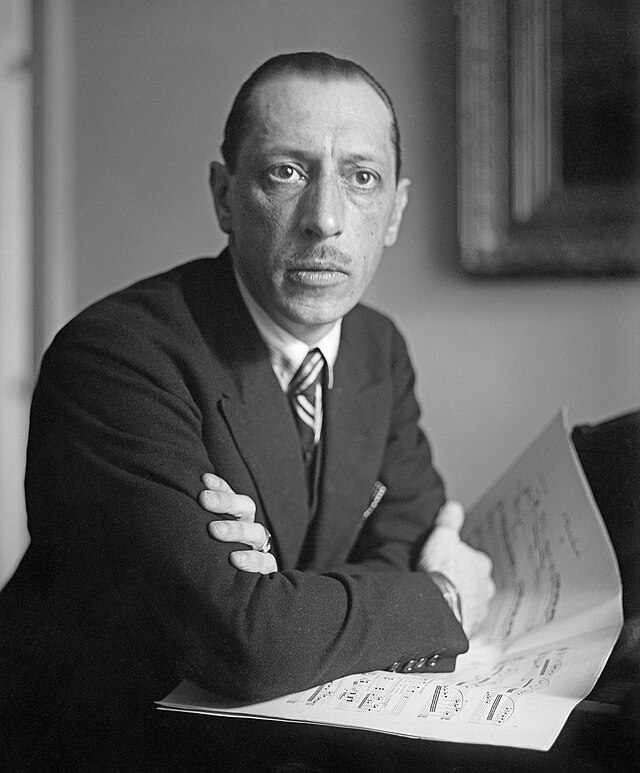
Igor Stravinsky

Thoughts of war (for Stravinsky, the stark image of goose-stepping machine-armies) were never far away in the composer’s emphatic, barbed, relentless Symphony in Three Movements, although the unsettling whirl of world events dispels quite uncannily in a surprising, eccentric, but warm and friendly little gavotte-like dawdle in the second movement — as if Pulcinella or Petrushka were never far away. The orchestra’s woodwind and brass produced pinpoint ‘Technicolor’ virtuosity — qualities which were centre-stage, too, in the shortish diversion (though with a clever, inventive sharpness) that is Stravinsky’s Symphonies of Wind Instruments.

The concert began with another compact and engaging mini-masterpiece, by Vaughan Williams’s composer-colleague, folk-song collector, and walking, hiking, inn-visiting friend, Gustav Holst — his Capriccio, a short work for full orchestra, with some magisterial trombone writing (Holst’s own instrument) and a foot-tapping march right in the middle of it. Yet the work seems to begin in Vaughan Williams’s fen and marsh, or the Ayrshire of MacMillan, another mysterious signpost of the continuum element in the music of these islands.

Masters of the English musical renascence

Image: Stuart Millson

STUART MILLSON reports from the 17th English Music Festival

Ever since 2006, except for the shortest of absences due to the Covid crisis, the Oxfordshire village of Dorchester-on-Thames has been hosting the English Music Festival, the EMF – the artistic creation of one dedicated Englishwoman, Mrs. Em Marshall-Luck. The first-ever concert was held on an October evening, given by the BBC Concert Orchestra conducted by (the late) David Lloyd Jones – a conductor noted for his love of opera and Russian music, but also for the music of the English musical renascence: the era often seen as dominated by Elgar, but actually the time when Holst, Vaughan Williams, Bax, Bliss, Ireland and many others shaped a national musical style (or styles) with their expansive symphonies and folk-infused song-cycles.

For an initially small Festival with great ambitions, but – inevitably – with limited funds, the participation of the BBC’s most versatile orchestra was a masterstroke of strategy by the Festival founder – ensuring a prestigious beginning to her concert series and an all-important broadcast on BBC Radio 3. At once the Festival was put on the map and thanks to many others being inspired by Em’s great enthusiasm, has grown in scale and scope through the years, with the BBC’s orchestra still the mainstay of the opening concert.

Today, the Festival takes place over the May Bank Holiday, a time when the countryside surrounding Dorchester comes into its own: willow cotton drifting on the air; the footpaths to the Thames laced with white cow parsley; meadows of buttercups leading to Iron Age embankments; and nearby, under the full canopy of churchyard trees, the welcome shade and cool recesses of places such as St. Peter, Little Wittenham. 

Here, among the tomb chests and brasses, the Oxfordshire of quiet parsons and fussy parochial church councils can be found – but also the dreamy, immemorial Thames-scape of William Morris and Kenneth Grahame, the immemorial England of T.S. Eliot, Sir John Betjeman, or Philip Larkin’s Whitsun Weddings. High above the hamlet, like a sentinel in the downland, stand the trees of the Wittenham Clumps: inspiration for Paul Nash – and welcome shade for grazing cows and OS-guided walkers who find themselves a little too warm after wandering to the ridge on a hot day. As was the case with Richard Adams’s rabbits of Berkshire-set Watership Down, the view here seems to take in ‘the whole world!’ – or at least, the Chilterns to the east, Evelyn Waugh’s Oxford to the north, and beyond, an outline of the beginnings of the English Midlands.

Dorchester Abbey is the largest building visible in the landscape (save for a lurking, distant 1930s-looking factory-type structure to the northwest). The Abbey has been a seat of Christianity since the seventh century and a survivor of the reign of Henry Vlll – its great window and towering arches a worthy rival to more famous landmarks, such as Gloucester Cathedral. As the Wittenham Clumps were to Paul Nash, so the Abbey became an inspiration to fellow artist, John Piper – and in our own time, for the orchestral musicians of the EMF, the great church offering a near-perfect acoustic and a truly inspiring setting for their concerts. 

And for the musical offering of Friday 24th May, Doreen Carwithen’s Suffolk Suite opened the BBC Concert Orchestra’s programme, the work based upon romantic and folk-reminiscent melodies originally penned for a short 1950s transport film, entitled East Anglian Holiday. A superior piece of public information-film scoring, the suite begins with a stirring ‘spirit of England’ theme, which gives the impression that you are back on the Wittenham Clumps, surveying the majesty of ‘this other Eden.’ However, East Anglia has no downland, so listeners find themselves rubbing shoulders with morris-dancers at a Suffolk festivity, or being lulled into an afternoon slumber by the waters of Orford Ness. A stirring, martial portrait of Framlingham Castle ends the sequence, but not before a brief reappearance of the moving opening tune – a pleasing farewell to the East of England on Carwithen’s bus or rail trip to the county.

Holst’s imposing and early (1899-1900) Symphony in F major, subtitled The Cotswolds, was the main work in the concert – its last movement, like the Carwithen, conjuring scenes of bucolic, open-air celebration and the atmosphere of a countryside where people still whistled folk-tunes. Yet the work’s other movements sometimes seemed to bypass the village green, with an altogether less scene-painting feel – although it has to be said that the brooding and dark slow movement is a memorial in music to the Arts and Crafts luminary, William Morris. Conductor Martin Yates and the BBC Concert Orchestra played with deeply-felt intensity, with brass and the darker hues of the orchestra summoning the spirits of the Cotswold hills and combes.

Brass instruments were very much in evidence in the world premiere of Ralph Vaughan Williams’s Richard II – A Concert Fantasy, woven together from fragments of music and ‘cues’ written by the composer for a planned wartime radio play. The arranger and bringer-to-life of this Shakespeare scenario is Nathaniel Lew, Professor of Music at St. Michael’s College, Colchester, Vermont, who – like conductor, Martin Yates (the arranger of RVW’s Falstaff suite, ‘Fat Knight’, also once premiered at this Festival) – has a fascination with the rescuing and revival of works once thought to be lost, or not to have existed at all. The performance fully honoured the EMF’s guiding philosophy of what can almost be seen as musical archaeology, or restoration.

Saturday morning’s chamber recital featured Rupert Marshall-Luck, violin, and Peter Cartwright, piano, doing their brilliant bit in bringing obscure works into the limelight, including Ernest Farrar’s Celtic Suite, Bliss’s Theme and Cadenza, and sonatas by Herbert Howells and Sir Charles Villiers Stanford (whose Clarinet Concerto, played by Michael Collins, featured in the first-night concert). Known for his authoritative performances of Elgar’s famous Violin Sonata, Rupert Marshall-Luck, brought gravitas to the Howells and Stanford, aided by the concerto-like strength of Peter Cartwright’s piano playing. Both artists channelled huge energy and concentration into what was a lengthy, often heavyweight chamber programme, which allowed us to see the overlooked greatness of England’s heritage of smaller-scale works.

Hilary Davan Wetton, with the Godwine Choir. Image: Stuart Millson

My journey to Dorchester ended this year with the Saturday evening concert by the Godwine Choir conducted by Hilary Davan Wetton, an effervescent, ever-youthful 80-year-old veteran of the concert podium. Addressing the audience on the desperate need for arts funding in Britain, and contrasting how Parisian politicians would authorise the pouring of money into any festival of French music, the Maestro went on to conduct choral masterpieces such as Vaughan Williams, O Clap Your Hands; Elgar’s 1914 Give Unto The Lord, but with time, too, for the enchanting Blake-inspired part-song by Havergal Brian, The Dream – with a folkish, fairy atmosphere of glades and glow worms. Dreamscapes were also created by the wonderful Godwine voices in the form of Holst’s Sanskrit-inspired Hymns from the Rig Veda, pieces that had the Abbey audience spellbound, especially one of my concert companions, a youngish (still under-40) relative newcomer to music. Proof indeed, should the Arts Council require it, that you stimulate an interest in classical music by playing to people… classical music.

With its Suffolk and Sanskrit music, its Cotswolds and choral contributions, the 2024 EMF may well go down as a vintage ‘season’ – but we say that every year.