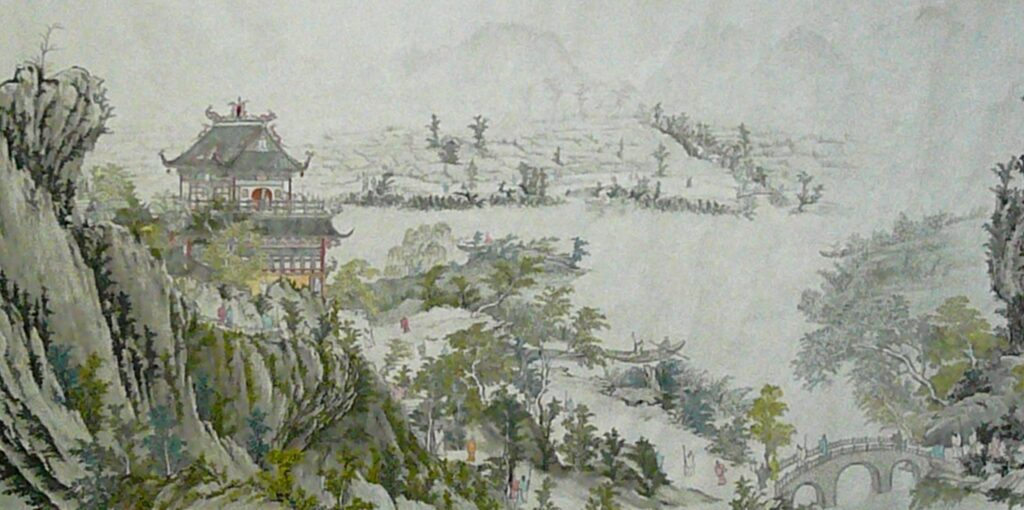
Inked echoes: Tang verse for young readers
Wenguang Shao, Newsstand, distributed by 300tangpoems.newsstand.co.uk
RICHARD DOVE can hear classical China in his garden
Maybe it was the gentle splutter of rain on the greenhouse roof and the weak rays of sunlight squeezing through the clouds that focused my attention on the Tang poetry book. Perched on a stool that had probably never seen better days, I took a break from gardening to read Inked Echoes: Tang verse for Young Readers by Wenguang Shao. This beautifully produced large format book seemed, at first, to be a little out of place in my well worn greenhouse. But the poetry did not.
“On a quiet night, with no neighbour in sight.
A yellow-leafed tree in the cold steady rain,
Or a lamp’s dying glow, with grey hairs that remain.”
Tang poetry is widely regarded as China’s golden age of cultural achievement. The poems were composed during the Tang Dynasty (619-907 AD) when poets were revered and occupied lofty status. In this time of immense political and artistic endeavour, we could do with poets in Parliament now more than ever, I reflected. I had been listening to Radio 4 and needed to escape from Epstein and Mandelson: “Human affairs endure vicissitudes, with turns and twists: / Events, betwixt centuries, emerge like sudden mists. / On sites of history, words of insight are soberly chiselled.”
We need far more words of insight in these turbulent times. This poem by Men Haoran tells me that “fierce winds take their toll”. Clearly, politically and physically – Prime Minister Keir Starmer facing calls for his resignation, and this greenhouse has been reassembled two or three times after fierce winds.
Tang poetry embraces what nature offers us and more generally, our emotional response to the world around us. Being both a Mandarin and English scholar, Dr. Shao captures the nuances in the translation. A flock of noisy Canadian geese has just flown overhead and what do I read: “Falling leaves compel wild geese to southward flight; / The rivers chill beneath the northern wind’s bite.”
A van pulls up in a lane near the greenhouse and I hear pop music blaring and shouted greetings. I read on: “The music dances, echoing on tranquil streams, / Carried by sad winds across the Lake of Light. / The final strains dissolve, the player gone in a dream, / Only a few green peaks remain, spellbound in sight.”
Am I reading an account of the here and now? Tang poetry is clearly both ancient and modern. It whispers great truths across the centuries. This book is written primarily for young readers but the young at heart should not feel excluded. I loiter over the elegant calligraphy of the poems (Dr. Shao’s own hand here) and the gardening is set aside for another day. This is a book for regular dipping and diving. Take in two or three poems every day and the world will shift a little into the light.
I will leave the last words with Liu Changqing: “The dying sun descends, and dazzles men’s pride. / Birds roam unaware of hills and vales estranged, / Returning at dawn and dusk o’er streams unchanged.”
I close up the greenhouse and head down the garden path. The garden can wait, the poet told me so.
RICHARD DOVE writes from Kent