LUKE GILFEDDER describes the characters and places of Eric Tucker, Warrington’s ‘Secret Lowry’
The best half-dozen artists of any nation, Wyndham Lewis remarked, are never dependent on the objective world for their success or stimulus; they can make a new thing of anything, however provincial the original. This proved particularly apt for Eric Tucker, who had not even Rembrandt’s country mills and Dutch canals to draw on, but instead the factories, pubs and angry red-brick streets of Warrington — officially Britain’s ‘worst town for culture’, according to the Royal Society of Arts.
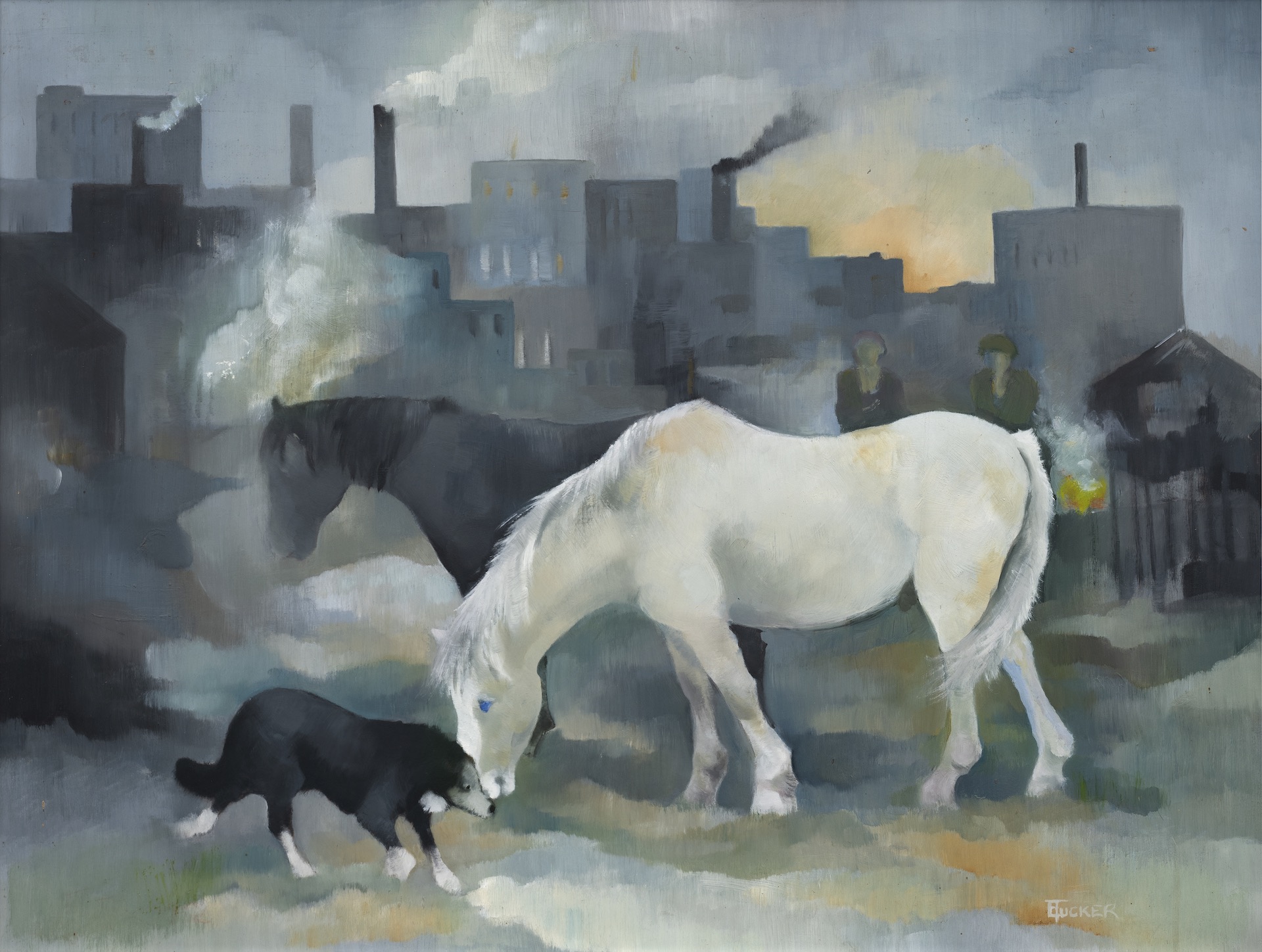
Yet despite its lack of vibrant cycle paths, world-class heritage sites and inclusive street furniture, the old Wire Town still inspired Tucker to create a prodigious body of work. He left behind some five hundred paintings, concealed throughout his end-of-terrace home: stashed on top of and behind wardrobes, hidden in a stairwell cupboard and the garden shed, and even stuffed into empty compost bags in the remains of an old air-raid shelter. Shortly after he died in 2018, his family turned his home into a gallery for a weekend – dubbed a “terraced-house Tate” in his nephew Joe Tucker’s book, The Secret Painter – and more than two thousand locals attended. National press coverage, museum retrospectives and West End exhibitions followed, sealing Tucker’s reputation as Warrington’s ‘Secret Lowry’.
But does this comparison hold? Tucker was certainly a fan of Lowry, but among his art books, he apparently had only one on the Manchester painter. For the most part, his collection consisted of works on early Modern artists, predominantly Post-Impressionists: Cézanne, Toulouse-Lautrec, Gauguin, and Van Gogh. But the Art World has an unfortunate habit, when it belatedly discovers Northern artists, of yoking them all to Lowry. See here: another Gulley Jimson of the North, dimly emerging from Lancashire’s mephitic glooms, a reclusive eccentric whose voice has been heard only too late…
Lowry spent eighty-eight years in Manchester polishing this fantasy about himself: the myth, as Brian Sewell put it, that he sprang fully formed from the brow of Minerva and painted more or less the same picture of urban dereliction eight hundred times after a Pauline revelation in a Pendleton park. His converting angel said, “Look,” and, looking, Lowry saw that grime was good. Yet compared with Tucker, Lowry was relatively middle-class. He grew up in the leafy suburb of Victoria Park. In photographs, he appears a formal, distant, clerkly figure. Tucker, while also a lifelong bachelor who lived with his mother, had been a boxer, labourer and gravedigger — by all accounts a private yet popular character who modelled his shtick more on Ken Dodd than the Douanier Rousseau. Where Lowry painted as an outsider looking in, Tucker painted as an insider looking out. “Eric is one of the people in the pictures,” his brother explained to art historian Ruth Millington. “He knows them all.”
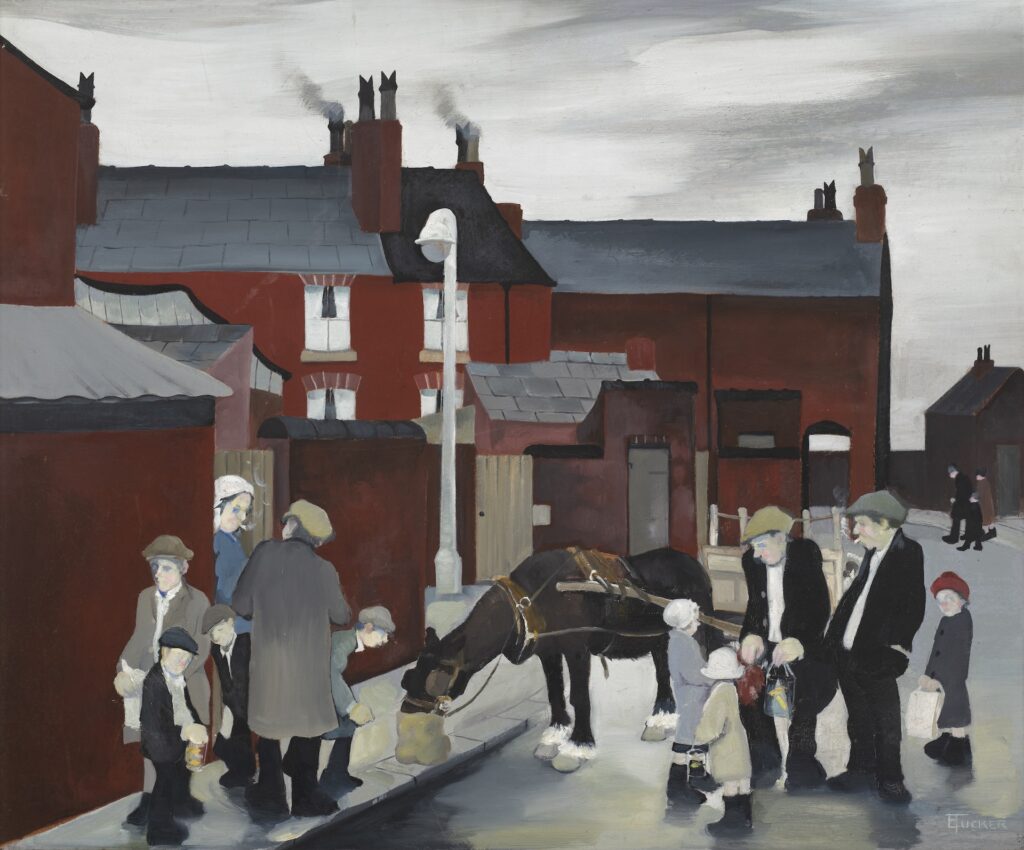
This distinction is writ large on the walls of a recent Mayfair retrospective, Characters and Places. Tucker gives us industrial life up close: there are no long-shot vistas of market squares and factory gates, no matchstick men pouring from blackened mills — Lowry’s “undignified, pea-brained homunculi”, as Edwin Mullins termed them. Tucker’s characters are rounded in every sense: ruddy-cheeked, individual, full of vim and vigour. You wish you were having as good a time as his pubgoers. Each subject is rendered not in Lowry’s muted palette but in ham pinks, russets, ochres and blacks. Flat-capped pipe smokers and their grizzled ale-mates jostle with young couples and cabaret singers amid crisply defined bottles and glasses. There are no gloomy kitchen-sink shenanigans here: Tucker’s oils and watercolours transform Warrington’s nightlife into something as joyfully carnivalesque — though less coldly abstract — as Wyndham Lewis’s drawings of Breton peasant fêtes.
Lowry may have convinced Tucker that life in the industrial north was worthy of painting, but Tucker shows what Lowry missed in it. This is as true of Tucker’s ‘places’ as of his characters. Beyond the smoky pubs and clubs, Tucker depicts vignettes from Warrington’s backstreets and alleyways, peopled with half-spectral figures playing games, lighting bonfires, dealing scrap, or simply smoking a cigarette and staring at an egg-carton-grey sky. Elsewhere, we see pigeon fanciers, rag-and-bone men, circus ringmasters, confabbing housewives and brangling corner-boys. What leaps out from these canvases is not the Lowry influence, but Tucker’s admiration for Edward Burra — the English painter of surreal, vividly satirical urban scenes, and another maverick who, like Pound’s Hugh Selwyn Mauberley, was “out of key with his time.” Indeed, Tucker’s scenes are strangely anachronistic. To a millennial eye, only the concrete bollards and streetlights distinguish them from the Edwardian era.
In truth, the same might be said of much of Warrington today. It certainly could of the street I grew up on, only a few streets away from Tucker, in the late 1990s. Yet the fact that Tucker rarely dated his pictures feels significant: it suggests they were never intended as nostalgia or mere social record, to be framed in glass-walled museums as exhibits of a world willingly forgotten. Like Burra, he paints with an unaffected affection for a world that is conventionally reckoned drab or ugly—a world which, in Tucker’s case, is now considered as lost to time as Woolworths or The Wheeltappers and Shunters Club. Yet so deeply immersed was Tucker in this forgotten North that one feels the artist is still there, in these pictures. So too, it seems, are his characters. I need only open the door and look.

LUKE GILFEDDER is a writer from Manchester, whose debut novel, Die When I Say When, came out in 2025. Previously, he worked as a playwright, with scripts produced at the Royal Exchange Manchester, the Lyric Hammersmith, and in London’s West End. He has recently completed a PhD on the life and work of Wyndham Lewis