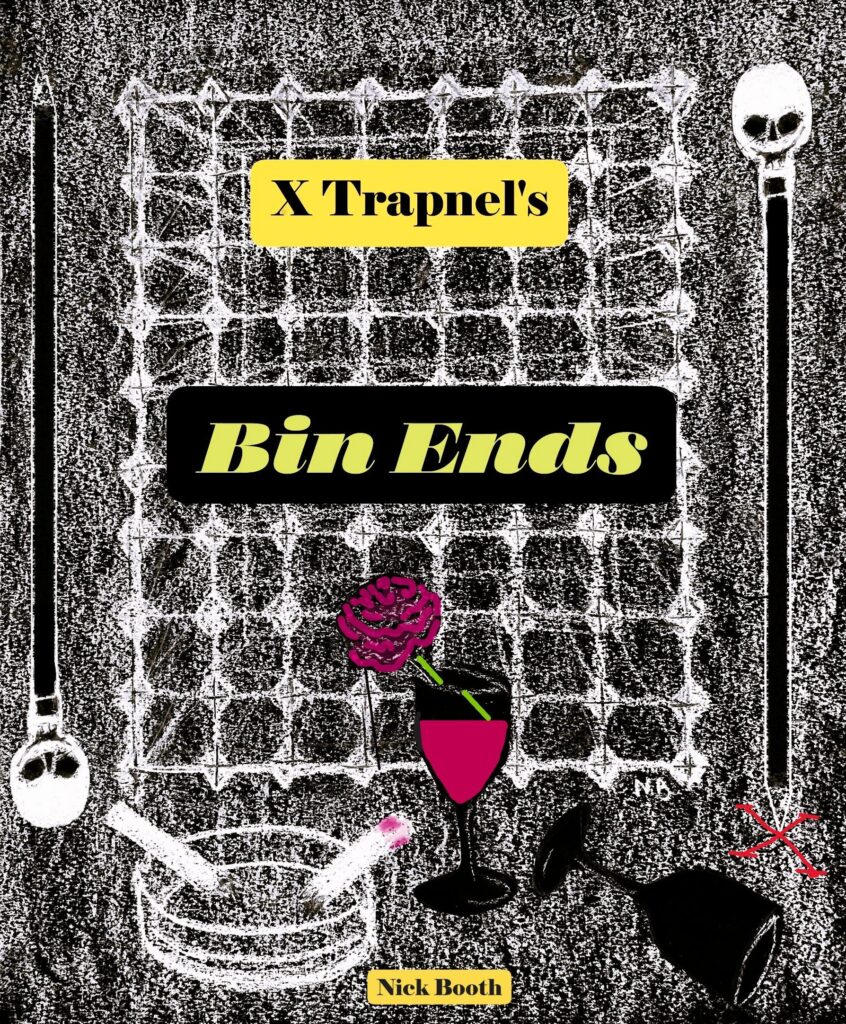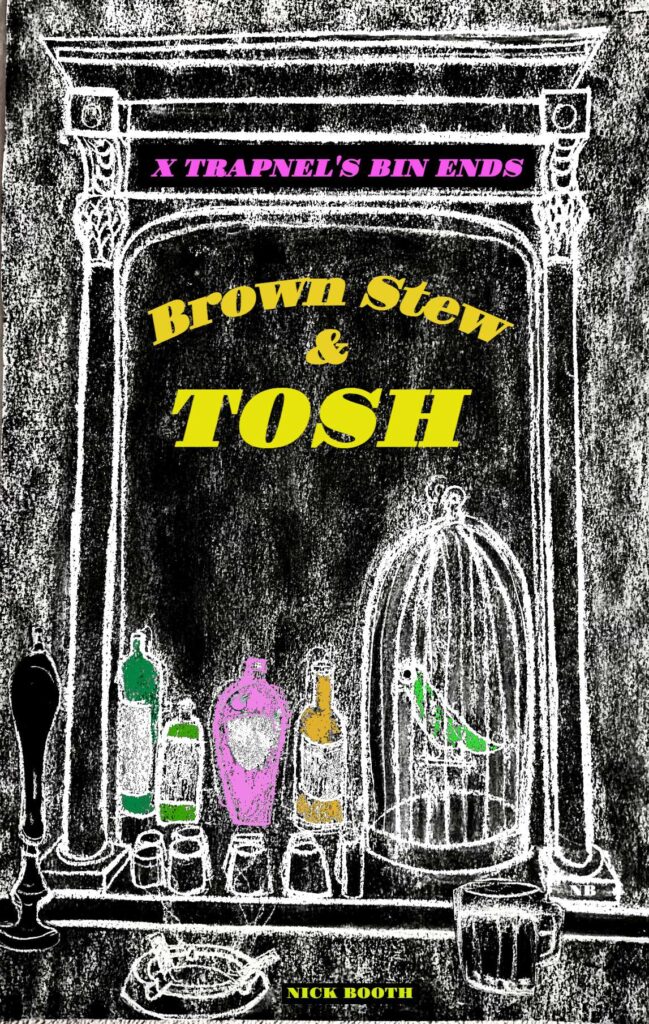
NICHOLAS BOOTH offers the second exclusive extract from X Trapnel’s legendary short story collection, Bin Ends
I never thought I’d see Maltbeam again. Assumed he was dead. We’d been pals round the pubs very early in the war then he said he was being posted overseas and I’d more or less forgotten about him, as one forgot many people encountered and mislaid in those days. “We’ll meet up after this lot’s over” was a common motto. Often enough it came off.
It was easiest to track down people like me who stuck to a beat of watering holes around the Tottenham Court Road end of Oxford Street. North Soho, all that. So it was that Maltbeam found me again, in the public bar of the Lion and in a good mood. I’d had a double come up at Taunton the day before: Notoriety and Boveridge.
Maltbeam said he’d had a devil of a time of it fighting for king and country. That caused me to reflect that my great struggles in history’s largest conflict, apart from dodging bombs and doodlebugs, was finding coins for the gas fire and trying to get poems published in Penguin New Writing.
Maltbeam seemed to have put quite a bit of chub on. I mentioned this as food was hardly plentiful that first winter after the war. “Oh, I had a good landlady in Dover,” he said. He didn’t say what he was doing in Dover. I didn’t pry into his war service but after a few drinks he came out with a catalogue of close-run-things with death: North Africa, Italy, Germany, the whole show as he put it. “I’ll tell you,” he said. “It was hell.” He certainly seemed lucky to make it back.
“When I killed a Jerry,” he said, “believe me I thought, one up for us. I know a bloke who got a little crooked cross tattooed on his back for every Nazzy he did in. I can’t believe I came back. Never thought I’d see London again I can tell you. Anyway, I’ve found a bed-sitting room now and I need a job – I’ve got enough for beer and fags till Sunday. Hero’s welcome, what.”
Behind the bar the landlord, Teddy, was shuffling about in carpet slippers and an ancient cardigan, feeding his caged parrot, Tosh. Teddy’s green cardigan was complementary to his crimson grogblossom, making both a bit richer. He congratulated me on the double. I wished he had not. In fact knowing old Teddy he may have done it on purpose. I knew what was coming.
“Lend us two quid will you, chum?” Maltbeam said. “I’ll pay you back next week.”
Of course, this was a bit much. Teddy winked at me.
As Maltbeam made his request Tosh sidled rapidly along his perch, inclined his head and stared at Maltbeam. “You fat ___,” said the parrot tartly. Maltbeam laughed – we all did. “He’s on the scrounge,” shrieked Tosh.
“You want to watch that bird, Teddy,” said Maltbeam. “He could get you into trouble. What if he says a word like that to some old girl who’s well-to-do?”
“Don’t get that sort of customer in here,” said Teddy. “He only talks to people he takes a dislike to.”
I lent Maltbeam the two quid, and he bored on again about his war. Now and again he’d look across at Tosh, who stared right back at him.
*
Of course Maltbeam didn’t pay me back the following week. About a month later on a Sunday evening at the Lion I was still nursing a rotten hangover from the morning. The place was deserted except for two young BBC types along the bar from me. One was tall in an old brown suit and had a toothbrush moustache, and the other a dumpy type in tweeds with rosy cheeks from beer. I knew them both as regulars at the Lion, which in those days attracted a thirsty clientele from the national broadcaster. I was content to stay out of their talk, which was usually on an arcane political or cultural theme.
“Well, we’re a socialist country now,” Clive, the dumpy one, said. “You’ve got to admit that.” He was misty-eyed at this. “They didn’t achieve that in Spain.”
Rollo, the tall one, sipped his beer. “Quite,” he said. “But Lewis is of the opinion that it could all go horribly wrong.”
“Who’s Lewis?”
“My pal, the professor.”
“Yes but he’s a professor of corners or something, isn’t he?”
“Rectangles, I think. Something like that. I wanted him to give a talk on the Third Programme about it but when I saw his script it was quite impossible. Completely impenetrable. If I couldn’t understand a word of it what chance did listeners have? It went on about things such as continuous function and topological space. I thought, I’ll get TS Eliot instead because it made his stuff look like the Beano.”
“The intolerable shirt of flame, eh,” I quoted, butting into their conversation. Well, you would butt rudely into the conversation of someone called Rollo, wouldn’t you.
“Yes, that’s right,” said Rollo.
“I’ve always hoped to find an intolerable shirt of flame in a 15½ inch neck in the summer sales,” I said. Clive snorted but stopped when he saw Rollo was not amused.
“Lewis takes a strong line,” said Rollo to Clive. “A very strong line. He thinks the people should rise now. Storm the citadels of power. We’re still up to our necks in filthy capitalism.” Rollo gave a disagreeable glance at me as he said that. “Up to our necks in it. I’d arm the people.”
I had a vile headache born of mixed drinks consumed injudiciously at lunchtime. I took a long draught of bitter and hoped it would help. That’s when the Lion’s old mock-medieval door creaked open and Maltbeam appeared in his British Warm, for it was a cold night. His big red face cracked a grin as he moved down the bar.
It was deliciously warm for once as Teddy had grudgingly banked the fire up. Maltbeam caught the end of another speech by Rollo about violent revolution and looked askance. “We’ve just had a dose of violence, chum,” he said loudly. “Six years of it. Of course – you may not have seen much of it.” This was ignored.
“Thank God for heat,” said Maltbeam. “My gas fire’s broken.”
Rollo and Clive were onto whether they could execute someone. “If the cause is right and just then you must,” said Rollo. He drank some more beer. “It’s your duty.”
“But supposing it’s the King, or some other royal person,” said Clive.
“Shoot the King?” said Rollo wonderingly.
“Oi,” said Teddy as he placed a pint in front of Maltbeam. “That’s enough of that. Just you behave yourselves. We won’t have talk like that in here.”
As Teddy went to the till Tosh, who had noted the arrival of Maltbeam, scraped along his perch. He looked rather seedy. He turned his head and peered at Maltbeam out of a sinister eye. “You’re a ____,” said the parrot. His high-pitched rasping voice was horrible and comic, like a ventriloquist’s dummy. The worst of all words hung in the air. It was ironic given Teddy’s warning to the BBC pair. They laughed, no doubt seeing Tosh’s remark as a sort of vengeance for what Maltbeam had said.
Maltbeam raised his eyebrows, then his pint and said cheerio.
We started talking about money, women and prospects. I noticed that Tosh was moving his head from side to side but his attention remained fixed on Maltbeam.
“D’you know,” said Maltbeam. “I wonder what it was all for, the war I mean. I risked life and limb time and time again and when I got home I found my wife was shacked up with an Italian PoW, my old job had vanished and now I’m in a pub listening to bolshies talking about killing the King.”
Before I could offer any remarks Tosh said: “I’ve told you once, you’re a fat ____. Kindly leave my pub.”
Teddy, perched on a high stool, chuckled round his pipe. Maltbeam was discomfited. “You think that’s funny, do you?” he asked Teddy.
“I didn’t say it, did I?” said Teddy, his low voice muffled by his moustache and lack of teeth.
“He’s merely laughing at the surrealism of the moment,” ventured Rollo.
Maltbeam did not even turn round to remonstrate. He just said: “You keep out of this, Mary.”
Then to me: “Do you know what, chum, I’m going to have a scotch. It seems like the whole bloody world is against me.”
So Maltbeam did; and another, and another. As we talked and drank he looked at the birdcage warily. Tosh stared back at him. Clearly Maltbeam had money but I did not think it politic to raise the two quid owed.
With all five of us smoking, the bar was wreathed in a fine grey mist. My headache had eased right off. Rollo and Clive were now tipsy and talking about some variety programme on the wireless. Thanks to the ale and scotch Maltbeam, who never had much of a head for drink, was boozed up. Inevitably we’d got on to his war days. Restless energy flowed through him. Now he was on his feet acting out the storming of a machine gun nest. “…I came over the top and went in for the kill with the bayonet,” he said. He mimed holding a Lee-Enfield at just that angle. “I pulled back the gun for the final irremediable plunge…”At this point Tosh’s querulous voice cut across Maltbeam: “Oh for Christ’s sake shut up, you boring ____” the parrot said.
Maltbeam looked round. His wet blue eyes glittered madly. “One more word, one more word and I’ll do that bloody bird,” Maltbeam snarled. “So help me, I’ll do that bloody bird.”
“I told you to shut up,” said Tosh. “You’ve had too much for one night. So shut up.”
“You shut up,” said Maltbeam.
“You’re a big fat ____, why don’t you just ____ off out of it,” said Tosh. This last bit of cheek seemed to almost stupefy Maltbeam with shock. He was of choleric colouring by nature but now he reddened deeply as his surprise added to his rage. “Take that bird out of this bar, landlord, or else I’ll do it,” he yelled at Teddy.
“Can’t do that,” said Teddy in an amused voice; “can’t take Tosh out of the bar. He likes it in here. If I put him out the back he starts singing Nearer My God to Thee. It gives me the willies. It’s only a bird, mate.”
“Look,” said Maltbeam to me in a rather rattled voice, “why don’t we go round the Tartan? You fancy the landlady and – ”
“Ain’t you got a home to go to?” said Tosh. “Where’s yer missus?”
At this, Rollo and Clive squealed with amusement. By God Maltbeam looked mad. He reached into his greatcoat and produced a revolver.
“Win that throwing coconuts?” Teddy said.
“It fires a stick of Brighton rock,” said Rollo with mock authority.
Maltbeam swore horribly. “One more word out of anyone, especially that parrot, and things’ll get very lively.”
“Shut up, you _____,” said Tosh. “I won’t tell you again.”
Rollo and Clive laughed. Before anyone could say a word Maltbeam raised his arm, took aim at the cage and fired.
There was a split second of great confusion: a big crack, a spark and a puff of smoke in the tobacco fug, then another. For a moment I could see nothing. All I could hear was the shrieks of Rollo and Clive. Maltbeam pointed the gun at them and said: “Want some?”
Rollo had the sort of unfortunate accident more associated with children than adults. Clive had his hands up as if in a Western.
“You ____”, said Tosh. “Call the police, Ted!” I suppose it was a phrase he’d heard Teddy’s missus use.
Maltbeam aimed the revolver at the parrot. I knocked it out of his hand then grabbed it from the floor. Maltbeam went to take it off me but I pushed him away. As I did I expected to hear Teddy deliver a volley of remonstrance but all I could hear was his wife shouting down the stairs asking what was going on. “Look at Teddy,” shouted Clive. Teddy lay on the floor behind the bar. My headache was back with a vengeance.
*
Teddy was quite dead. One of the bullets had bounced off something and hit him. The other one went through a mirror behind the bar. Seven years’
bad luck, I’d said. Maltbeam looked a bit green. Much of the above had to be given out by me from the witness box at the Old Bailey.
Maltbeam had dashed out of the pub and spent a day or two on the run before being found staring into the middle distance on a bench in Regent’s Park.
He was not an especially contrite defendant. It came out that he’d tried to strangle his landlady in Dover but she had not reported it until after Teddy’s shooting made headlines.
Along with his threat to shoot the two BBC men, who also gave evidence, there were a good deal of other unsavoury incidents to be taken into consideration. Maltbeam was a rogue, a thief, a strangler manqué as well as a lethal looser-off of revolvers in public houses, the court was told. The prosecution introduced the idea that he might have drunkenly been out to settle Teddy’s hash rather than Tosh’s. They’d dredged up some row he’d had with the landlord long ago. There was, they said, no getting away from the fact that Teddy’s death had been caused by reckless shooting with a Webley bought on the black market.
Somehow they stood up a murder charge. Another aggravating element for Maltbeam was that the incident at the Lion occurred not long after an armed robbery that resulted in the killing of an innocent bystander had made headlines. A hard mood had emerged in the judiciary. The upshot was that once the guilty verdict was in, the judge put the black cap on, and an expected reprieve did not come.
*
I visited Maltbeam while he was in the condemned cell. It was a day of dreary fog when I took the tube to Caledonian Road and thence to Pentonville. Two warders brought him to the visiting room. He looked a bit slimmer and less choleric.
I did not have the first idea what to say. It seemed a most awful moment. Maltbeam had been looking down at a packet of fags I’d brought him. Now he looked up. His mad blue eyes had turned a little bit grey. I had feared he would burst into tears but not a bit of it. Maltbeam launched into a diatribe.
“I dare say you have seen in the papers that the home secretary has dismissed my appeal. You’d think he’d have a sense of humour. As the Daily Sketch had it, I set out to murder a parrot and ended up killing a man. Mind you, the home secretary’s a Unitarian, isn’t he?” He was lisping, and explained he’d broken his false teeth. “Obviously, given my predicament I’ve been boning up on religion: you want half an idea of what you might be getting into on the other side. These nonconformist types see God and heaven like one of their endless bloody squabbles about county councils. I mean, doesn’t my war record count, I ask myself? I blame Attlee and co. It’s like having the country run by a pipsqueak from Mac Fisheries. I might write him a letter now I think about it. Give him a piece of my mind.” He lit a fag and went on in the sort of aggrieved tone that housewives use when complaining about the price of everything in the shops. “I was clearly aiming for the bird. Can I help it if the bullet bounces off and into Teddy? I feel bad about Teddy, but for heaven’s sake it was an accident.” He went on in this way for quite a while. When the time was up and he stood to be led away by the warders he said: “Well, see you on the other side, old boy – with any luck.” Then as he walked away he turned and said: “Sorry I didn’t pay you back that two quid.”
One morning a few days later a dinner-suited voice on the wireless announced Maltbeam had been hanged.
*
One evening not long afterwards I turned in at the Lion late on. The barmaid was a girl I’d once had a fling with. Like everything after the war she looked a bit older and in need of a clean. Tosh was in his cage – he’d become something of a celebrity: a few local bohemians had formed a sort of fan club. The broken mirror was still in situ and was also a cult object. Rollo and Clive were dining out on the story.
I bought a half and took my usual place. The barmaid chucked an evening paper on the bar. “They’ve given your pal a write-up in there,” she said.
So had they. The headline was “Rage of landlord killer” or something like it. The piece concentrated on trying to spice up his wife’s affair with the PoW but it also mentioned his war career. Ronald Maltbeam, it said, was a fantasist as well as a killer.
He had spent the entirety of his war service as a cook in the Army Catering Corps at a camp in North Wales. They’d even found a few colleagues for quotes. “Old Ronnie was a dab-hand at Brown Stew No1,” said one of them. “He was so good at it we nicknamed him Brown Stew. No word of a lie, I never thought old Brown Stew would turn out to do something like that.”
I folded the paper over and dropped it back on the bar. It had not occurred to me to wonder why the defence had not made anything of his heroic war service. It had not occurred to me to ask about decorations.
I heard a little scraping noise: it was Tosh sidling to the end of his perch. His newfound celebrity had not made him any less scruffy. He turned his head and fixed me with a rather diabolical eye. He stared at me for a while. I declined to meet his gaze.
Tosh began to sing in an awful falsetto.
“Or if, on joyful wing cleaving the sky,
Sun, moon, and stars forgot, upward I fly,
Still all my song shall be,
Nearer, my God, to thee.”
I was very thirsty but left my half untouched and started walking towards the door.
“Lend us two quid will you, chum,” I heard Tosh say as I walked out. “We’re closing. Get out. Time gentlemen, please. Drink up.” The parrot’s voice got louder. “You’ve had your time. Ain’t you got homes to go to?”
As I came out of the Lion Rollo was hurrying in. I had not seen him since the trial. As he passed me he said: “Your pal got an intolerable shirt of flame, eh.”
“Right neck size an’ all,” I shot back, but Rollo was through the Lion’s mouth.

NICK BOOTH works in publishing, and lives in London. He is writing a monograph about the Forties neo-romantics