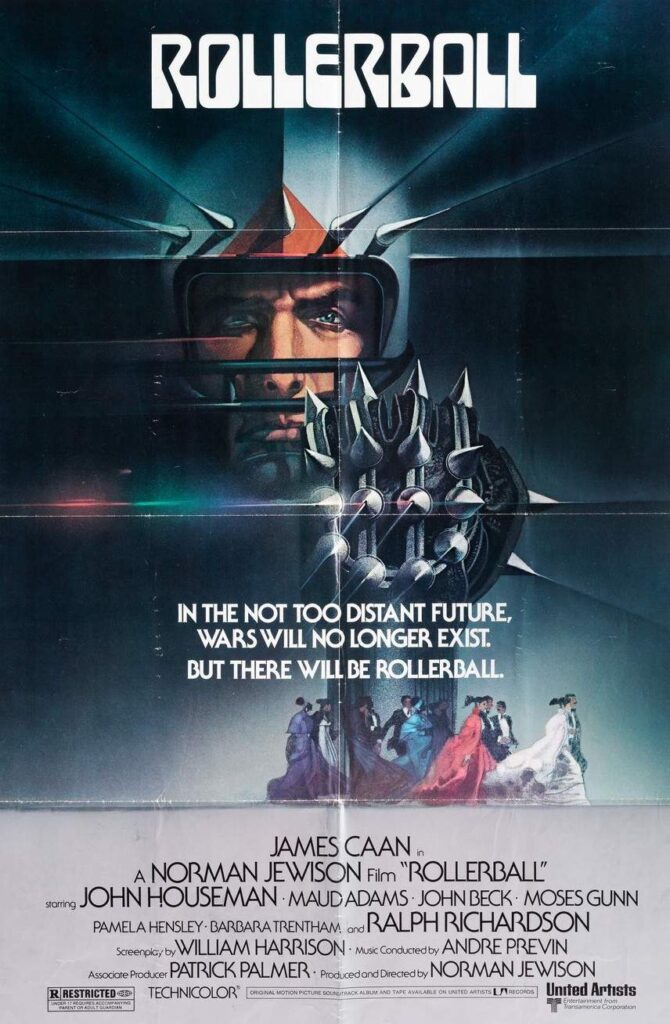
Rollerball (1975)
The Warriors (1979)
Mad Max 2 (1981)
RUPERT LOYDELL reflects on political games and post-apocalyptic futures
These are some of the films I remember from my teens and start of my twenties. In my mind they were released closer together but searching for the release dates online today I can see that is not true. However far apart they were, they are linked together by a kind of stylised, cartoon-like violence that mostly avoided the horrific, and only occasionally made use of pathos.
I am not going to engage with the debate about whether violent films make us more violent and desensitize us, nor am I going to visit the argument about whether children know that cartoon violence is different from actual violence. If you want that kind of thing there are plenty of academic articles and books that engage with media and communications theory, psychology and critically dissect cinema tropes, motifs and individual films – not to mention lots of online unsubstantiated opinions and rants. Be my guest.
No, I want to think about why these three films have remained films which I frequently enjoy rewatching, despite (or possibly because of) the onscreen violence.
The first, Rollerball, imagines a world where everything has been bought. Everything is owned by giant corporations, everything is seen as a commodity, be that sex, property, audiences and, of course, sport. War (contrary to the actual capitalisation of wars) is not profitable; instead, there is a televised sport where each corporation’s teams play each other on a banked circuit, chasing a steel ball before capturing it and getting it into a kind of basket or hole at the top of the bank. Oh, and everyone is dressed like American Football players on roller skates, except for a couple of guys who ride motorbikes, which can also be used to tow the skaters.
Confused? It doesn’t matter. This film is actually about an individual (Jonathan E., played by James Caan) holding out against the state and/or big business. The game of Rollerball is a futuristic version (I say futuristic, but the film is set in 2018!) of the Roman gladiatorial circus, designed to distract and pacify the population; it is watched live by millions of people on TV and also in person. There are not meant to be standout individual players, and when Jonathan becomes recognised and idolised the corporations ask him to resign.
Jonathan, of course, refuses, so the corporations start changing the rules and the game becomes more and more deadly. Players no longer get injured, they get killed; motorbikes are used as weapons, and explode and burn; Jonathan’s friends and teammates mostly end up dead. Jonathan is not happy about this, but he will not run away. In the final game of the film, with all rules cancelled in favour of ‘anything goes’, he is the last man standing and slowly gathers his wounded self together to start skating a victory lap as the crowd chants his name.
It is not a subtle film, although for a while it was used in economics and political studies classes to show one possible outcome of neoliberalist capitalism and business monopolies. Beautifully stylised and choreographed, it makes use of a computer-style font specifically designed for the film on the players’ jerseys and films the games in an immersive way. Although there are scenes away from the game arena, carefully highlighting the teams’ camaraderie and also the wealth and degeneracy of corporation executives as they and their friends casually use fire guns to burn down trees, the film is about the game.
The game provides an endless background noise of roller skate wheels on wood, accompanied by the revving of motorbikes and the thunk of gloved fists on opposition bodies, but there is also a clever use of classical and background music, the latter composed by André Previn. Most of the time the music is accompaniment rather than featured, but the exception is the film’s use of Bach’s Toccata and Fugue in D minor, which blasts out as introductory music and again during the closing credits.
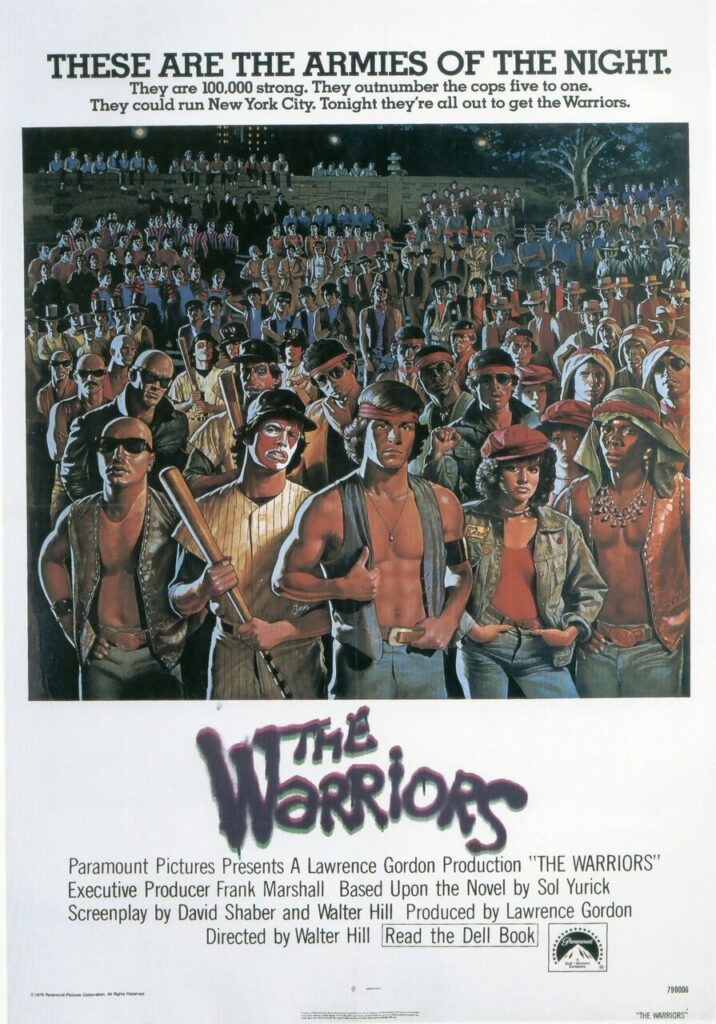
Music is much more important in The Warriors, where a small Coney Island gang are trying to make it back home after an assassination of another gang leader, Cyrus, who was presiding over a huge gathering of all the New York gangs in the Bronx. Cyrus pointed out that there were far more gang members than policemen if they chose to work together, but is shot by the psychopathic Luther, who then points out The Warriors and says that they shot Luther. The summit and gangs’ truce are over, and The Warriors are at the wrong end of New York City.
I didn’t go to New York until 1980, so one of the great things about the film was seeing New York in all its grubby, run-down glory, just like the reality I would encounter a year on. New York City was bankrupt, dirty, violent and dangerous. It was also full of energy, music, art and attitude, 24 hours a day. It wasn’t, however, full of gangs in fancy dress, which The Warriors is.
It is the costumes and make up, along with the funky soundtrack and naturalistic filming, that makes The Warriors work. The film is episodic in nature, each episode containing a chase or fight or romantic encounter, each accompanied by an appropriate track, be that pumping synthesizer music for running, romantic pop for emotions, or Joe Walsh’s ‘In the City’ for the uplifting heroic credits where the remaining survivors of the gang’s long trek home walk into the distance along the beach. The film also makes good use of lyrics to reinforce the tension and offer narrative commentary, particularly with the songs ‘Nowhere to Run’ and ‘You’re Movin’ too Slow’. At times the music is played by a radio DJ who also keeps those gangs listening cryptically updated about The Warriors’ run for home.
The DJ has a sultry voice and red lips, which is pretty much all we see of her. She is a sexy presence throughout, as is Mercy (Deborah Van Valkenburgh) who following a street standoff defects from a rather pathetic gang, The Orphans, to join The Warriors. She has her eye on Swan (Michael Beck) and by the end there is clearly something going on.
It’s not a film about lurve though; it’s about male bonding, choreographed fighting skills and the constant arrival of yet another gang. The Warriors include a stupid macho tough guy, who gets caught by an undercover cop – a clever, observant kid – a couple of would-be leaders; and an amazing number of athletes and weapons specialists, be that swinging a baseball bat or manufacturing Molotov cocktails out of nothing.
The Warriors wear leather vests (waistcoats) with their gang colours on the back, but other gangs each have their own uniform: baseball outfits and face paint, top hats and white mime face with a red and black ensemble, denim dungarees and roller skates, silk jujitsu outfits, or leather jackets and caps. There’s also a skinhead gang who drive round in an old school bus, and a lesbian girl gang who try to seduce three of The Warriors who are oblivious to their seductresses’ sexuality.
Of course, in the end The Warriors make it home, only to find Luther and other members of The Rogues waiting for them. Swan suggests Luther and he fight one to one, but Luther is having none of it, so Swan throws a knife into his hand, then cuts a lock of Luther’s hair from him while he whines for forgiveness. He needs to do this as The Gramercy Riffs, the huge gang which Cyrus was leader of, have realised that The Warriors are innocent and have come looking for Luther, who is not a happy bunny. It is at this point The Warriors walk off into the sunset, Mercy and Swan hand in hand…
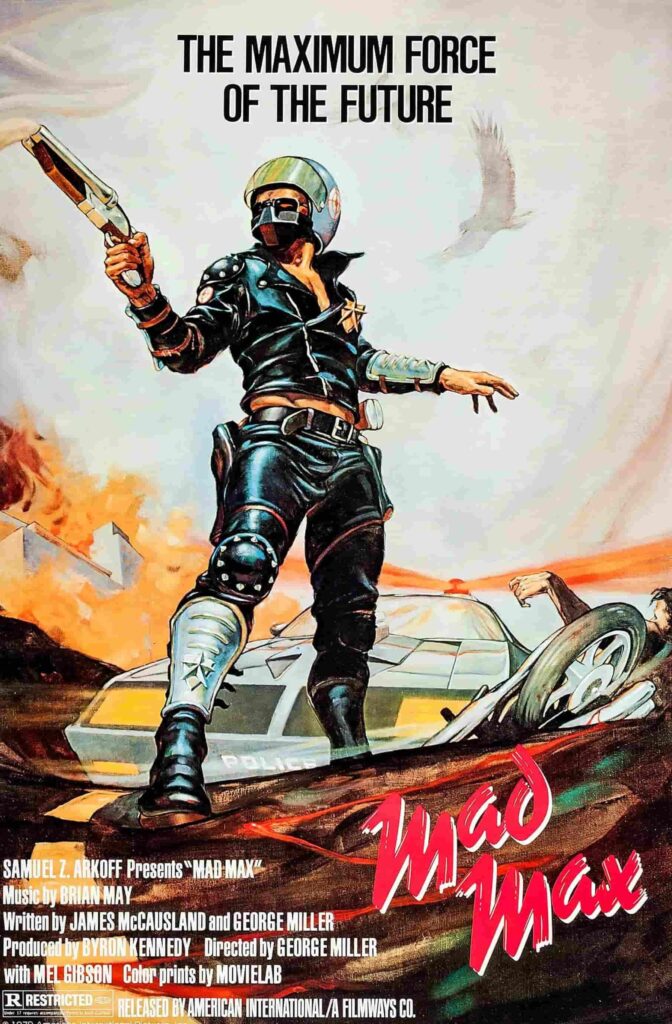
Nobody in Mad Max 2 (known as The Road Warrior in some territories) is very happy either. They all live in a post-apocalyptic desert world where fuel is scarce, vehicles are cannibalised for parts and clothing is a kind of D.I.Y. goth/sci-fi/biker hybrid. Mel Gibson plays Max, who is alone apart from his dog and a well-worn turbocharged cop car. Early on he observes a battle between a small walled town and a deranged gang of Hell’s Angels and soon ends up helping the town’s citizens escape to somewhere else with a tanker full of gas.
The escape is, of course, an excuse for an epic chase sequence, with exploding vehicles, impossible jumps between vehicles, shouting, shooting and stunts. There’s also a gyrocopter, sand storms, violent threats and sexual abuse, along with a feral kid and some far-fetched characters and cars. In the end Max remains standing in the desert whilst a voiceover informs viewers that the narrator “never saw the Road Warrior again”.
I remember my mate and I standing up at the end of this film to put on our leather jackets and pick up our motorbike helmets, only to have several hundred people in the audience stare at us, unable it seemed, to differentiate between reality and feature film.
Of course, having seen Mad Max 2, we decided to play catch-up and watch Mad Max (1979). This turned out to be a very different type of film, providing a grim back story to what would become a whole series of Mad Max capers. In the first film, Max is a highway patrolman, with a souped-up police car and several colleagues, who cruise the long, straight desert roads, trying to stop trouble brewing, particularly dealing with a biker gang who not only terrorise people but seem to cause semi-mystical apparitions of a crow.
It’s a clumsy device at best, but is indicative of the whole film, which has clearly not been completely thought through and has been filmed on the cheap. There are a few motorbikes, a couple of cop cars, lots of images of the Australian outback and not much else. Most of the violence, including the murder of Max’s wife and child, happens offscreen but it is still horrific, and the ending, where Max exacts his revenge on a biker, is even more horrific and nasty.
The film does, of course, explain why Max is like he is in Mad Max 2 but George Miller, who directed both films, clearly knew which side his bread was buttered on. However, instead of trusting the vehicular capers and dynamics of the sequel, he signed up Tina Turner for 1985’s Mad Max: Beyond Thunderdome, dressed her in chain mail and put her in charge of Bartertown, a makeshift settlement run on methane from pigs, and policed by a bunch of bully boys.
Bartertown also has its own kind of gladiatorial arena, a weird dome where those fighting are strung up on elastic and have to bounce their way to any weapons provided and to their opponents. Max, of course, ends up in there (it might even be more than once, I can’t remember) and also manages to be mistaken by another community – this time young people and kids living around an oasis – as a mythical and possibly resurrected Captain Walker, the pilot who crashed the plane they were travelling on.
Miller not only drew on William Golding’s novel Lord of the Flies but also decided to steal speech, language and elements of the plot of Russell Hoban’s Riddley Walker wholesale, and to let Tina Turner sing the theme tune. Despite the film’s utopian ending, which sees the lost tribe from the oasis now safely ensconced in the ruins of a city, it seemed to be the final Mad Max film of a loose trilogy.
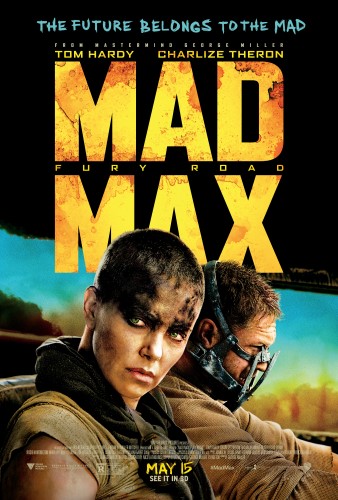
2015’s Mad Max: Fury Road proved that wrong, though. It reinvented the post-apocalyptic world Max lives in, replaced Mel Gibson with Tom Hardy, and was basically a long chase sequence followed by another one back to where the film started. I saw it at the cinema with my friend Pete (who had not seen any of the Mad Max movies) and remember him outside saying ‘What was that?’ Shellshocked wasn’t the word; gobsmacked probably was. Impressive vehicles, great make-up & costumes, spectacular explosions, a gaggle of female concubines rescued, a ridiculous and not-scary baddy, some weird but also funny acolytes, lots of gymnastics & pole-vaulting and some terrific action sequences and scenery. What more could anyone possibly want?
In the Los Angeles Review of Books, Isabel Ortiz said that “Mad Max: Fury Road does not look like an animated movie” but went on to add “And yet, despite the oozing corporeality of the film’s protagonists, many critics have commented on its resemblance to a cartoon.” In an argument that could apply to all three of my films, Ortiz states that
Fury Road is notable for transferring not only the rule-bound integrity of the cartoon genre onto fleshy heroes and heroines, but also the physics and bodily elasticity. Just as the animated body can stretch and recoil to absorb the impact of dizzying attacks, in Miller’s film human forms are endowed with the plasticity of cartoon characters.
Like Tom & Jerry, or other cartoon characters, these films are notable for their visual wit, pace and entertainment value, constant speed and dynamic, not to mention their impossibly indestructible heroes. And best of all, they are fun.
NOTES
• Avoid the appalling 2002 remake of Rollerball
• Details and a download of the Rollerball 1975 font, designed by Anthony Robinson, can be found here
• The Warriors Movie Site is online here. It includes news, deleted scenes, a list of all the gangs, location sites and more
• Isabel Ortiz’s ‘The Cartoon Bodies of “Mad Max: Fury Road”’ can be read in full here

RUPERT LOYDELL is the editor of Stride magazine, contributing editor to International Times and a writer and abstract artist. He has many books of poetry and several collaborative publications in print and has edited anthologies for Shearsman, KFS and Salt. His critical writing has appeared in Punk & Post-Punk (he is a member of the journal’s editorial board), Journal of Writing and Creative Practice, New Writing, English, Text, Axon, Short Fiction in Theory and Practice, Musicology Research, Revenant, The Quint: an interdisciplinary journal from the north, and Journal of Visual Art Practice. He has also contributed chapters to Brian Eno. Oblique Music (Bloomsbury, 2016), Critical Essays on Twin Peaks: The Return (Palgrave Macmillan, 2019), Music in Twin Peaks: Listen to the Sounds (Routledge, 2021) and Bodies, Noise and Power in Industrial Music (Palgrave Macmillan, 2022)