Wenguang Shao, Newsstand, distributed by 300tangpoems.newsstand.co.uk
RICHARD DOVE can hear classical China in his garden
Maybe it was the gentle splutter of rain on the greenhouse roof and the weak rays of sunlight squeezing through the clouds that focused my attention on the Tang poetry book. Perched on a stool that had probably never seen better days, I took a break from gardening to read Inked Echoes: Tang verse for Young Readers by Wenguang Shao. This beautifully produced large format book seemed, at first, to be a little out of place in my well worn greenhouse. But the poetry did not.
“On a quiet night, with no neighbour in sight.
A yellow-leafed tree in the cold steady rain,
Or a lamp’s dying glow, with grey hairs that remain.”
Tang poetry is widely regarded as China’s golden age of cultural achievement. The poems were composed during the Tang Dynasty (619-907 AD) when poets were revered and occupied lofty status. In this time of immense political and artistic endeavour, we could do with poets in Parliament now more than ever, I reflected. I had been listening to Radio 4 and needed to escape from Epstein and Mandelson: “Human affairs endure vicissitudes, with turns and twists: / Events, betwixt centuries, emerge like sudden mists. / On sites of history, words of insight are soberly chiselled.”
We need far more words of insight in these turbulent times. This poem by Men Haoran tells me that “fierce winds take their toll”. Clearly, politically and physically – Prime Minister Keir Starmer facing calls for his resignation, and this greenhouse has been reassembled two or three times after fierce winds.
Tang poetry embraces what nature offers us and more generally, our emotional response to the world around us. Being both a Mandarin and English scholar, Dr. Shao captures the nuances in the translation. A flock of noisy Canadian geese has just flown overhead and what do I read: “Falling leaves compel wild geese to southward flight; / The rivers chill beneath the northern wind’s bite.”
A van pulls up in a lane near the greenhouse and I hear pop music blaring and shouted greetings. I read on: “The music dances, echoing on tranquil streams, / Carried by sad winds across the Lake of Light. / The final strains dissolve, the player gone in a dream, / Only a few green peaks remain, spellbound in sight.”
Am I reading an account of the here and now? Tang poetry is clearly both ancient and modern. It whispers great truths across the centuries. This book is written primarily for young readers but the young at heart should not feel excluded. I loiter over the elegant calligraphy of the poems (Dr. Shao’s own hand here) and the gardening is set aside for another day. This is a book for regular dipping and diving. Take in two or three poems every day and the world will shift a little into the light.
I will leave the last words with Liu Changqing: “The dying sun descends, and dazzles men’s pride. / Birds roam unaware of hills and vales estranged, / Returning at dawn and dusk o’er streams unchanged.”
I close up the greenhouse and head down the garden path. The garden can wait, the poet told me so.
ETHAN MCGUIRE is a writer and computer scientist whose essays, poems, short stories, and translations have appeared in Blue Unicorn, The Dispatch, Emerald Coast Review, New Verse News, VoegelinView, and other publications. He is an editor at Tar River Poetry, Literary Matters, and New Verse Review and the author of Songs for Christmas (Harmonia Mundi) and Apocalypse Dance (Wipf & Stock). Ethan lives with his wife and children in Fort Wayne, Indiana.
Original author’s bio:
Chinese folk hero YUE FEI (AD 1103-1142) was a warrior poet of the highest order – a master and a founder of multiple martial arts, a dedicated Confucianist, a Taoist student, a great military strategist, a successful Song Dynasty general, and a poet. However, Yue Fei began to experience bouts of depression after the 1127 “Humiliation of Jingkang,” a turning point of the Jin-Song Wars in which Jurchen forces from the Jin Dynasty conquered the northern Song Dynasty capital of Kaifeng, captured two Song emperors, and isolated the remaining emperor and his armies to the South. Yue Fei fought a long campaign against the invading Jurchens to protect the Southern Song people and to recapture their northern Song territory, but just before he retook Kaifeng, the Emperor recalled him, to seek peace with the Jin Dynasty. To prevent a civil war and avoid exile, Yue Fei returned to the southern Song capital of Lin’an, where the Emperor imprisoned him in compliance with Treaty of Shaoxing requirements and eventually had him executed on false charges. Amidst these troubles, Yue Fei wrote some of the Song Dynasty’s most memorable poems, including “Red River” (“Man Jiang Hong”) which is still beloved throughout China today.
A POEM ON THE WALL OF XIAO TEMPLE NEAR QINGNI MARKET
Hear me!
My spirit’s strong—majestic!—
Piercing through the bull in battle.
Great heaven’s gods shall be my witnesses:
Today, I vow I will avenge our faithful emperor
With my straight sword: I—will!—cut down, wipe—out!—
The stubborn wicked, and—
returning from the war
Triumphant in my chariot, ignoring fame—
Restore our temples, and repair
Ten thousand households’ torn-down doors.
A POEM AT THE TEMPLE OF THE EMERALD CLIFF
The harvest winds have halted
the royal army’s river journey,
Forcing us to slowly march
toward the emerald mountains.
As clouds descend, I think:
the righteous loyalty we need!—
To guard clear boundary waters—men
desiring glory and honor.
There’s no use fleeing to the howling
mountain forests now.
The desert bandits will wreak havoc
anyway. Let us, instead,
March back through the three mountain passes,
to rescue the three sages,
Those golden chieftains—harried, captured—
returned then to their people.
SENDING OFF MASTER ZHEN TO MOUNT LUSHAN
Where do the sage’s forest paths,
in clouds, become confused?
The wise ones said, “The trails
at hand are—the—paths—we—have used!”
Vegetable leaves, from time
to time, drift with the river’s flow,
Reminding me of all the huts
near Cui Wei thatched with reeds.
It’s not a waste, with drink in hand,
to talk till night recedes;
The mist, the rain, the snow—
these likewise come and, unrushed, go.
Like them, though suddenly,
in all directions, we set out
Again, into the countless mountains,
jade dust strewn throughout.
TOURING THE TOWERING ROCK MOUNTAIN TEMPLE
Before the mountain stones, a temple stands,
Hidden amidst the woods, sat by a spring.
The Buddha’s image there is purple and gold;
White snow has gathered on the old monks’ heads.
A pond’s cold water nightly births the moon;
The wind through bands of pines bears Autumn’s chill.
I’ve come this way to share the dragon’s words,
To serve, as rain, to ease this people’s worries.
SEEING OFF MASTER ZHENG OF PURPLE ROCK ON HIS WAY TO THE NORTHERN CAMPAIGN
An exhortation
The commands come on the wind, in thunderclaps—
The orders from the heavens shake the mountains—
The drive is long across the Luo River—
The storm-attack goes to the underworld—
The horses hooves splash through red-trampled blood—
The banners soar like owls o’r chieftains’ heads—
Go give this clear report to our wise ruler—
Keep fighting to restore the ancient realm.
ONE THOUSAND REBUKES FROM THE CLASSIC PAVILION
Three hundred poems from the great Tang masters;
Six hundred verses holding old Han rhymes:
The ancient gods, ghosts, monsters haunt the land;
The mothers, fathers weep and wipe their last tears.
This morning, my own tears wet my cheeks and hand—
I must remind my country of those times. . .
A QUICK POEM AT SHANGZHU TEMPLE
Written impromptu and tacked to a wall at the temple—
When passing by—
While returning to attend to my duties—
Barbarians surged through the golden gate
And only stopped once south of Yangtze River.
One emperor has vanished, two souls vanquished;
Their minister alone fights in a fervor.
Yet even with sword of magic, mind-state of Siddhartha,
ETHAN MCGUIRE is a writer and computer scientist whose essays, poems, short stories, and translations have appeared in Blue Unicorn, The Dispatch, Emerald Coast Review, New Verse News, VoegelinView, and other publications. He is an editor at Tar River Poetry, Literary Matters, and New Verse Review and the author of Songs for Christmas (Harmonia Mundi) and Apocalypse Dance (Wipf & Stock). Ethan lives with his wife and children in Fort Wayne, Indiana.
CHRISTOPHER SANDFORD relives an extraordinary encounter
“Don’t mention the war,” my grandfather advised me a few minutes before our guest, an old friend from the faculty of the nearby University of Puget Sound, joined us for lunch. This was Tacoma, Washington, about twenty miles south of Seattle in America’s Pacific Northwest, in mid-August 1975 (I was visiting from Cambridge) and thus about ten weeks before John Cleese immortalised the phrase in ‘The Germans’ episode of Fawlty Towers, which I see was first broadcast on 24 October that year. Among other distinctions my grandfather ended up as the US’s oldest active full-time professor, but that aside he was always a man ahead of his time, and I think would have enjoyed the happy coincidence of this use of the line that entered into the shared folklore of my generation of Brits.
Our guest that day in Tacoma was Colonel Burton C. Andrus (US Army, Ret), and, true to his military calling, he arrived with us precisely on time. Or, to be more literally true, he didn’t. About fifteen minutes before the appointed hour, my grandfather called me over to the front window and, with an amused smile, pointed to a large-finned old Cadillac parked directly across the street. I could see a bespectacled, grey-haired man sitting bolt upright in the driver’s seat, reading a newspaper. My grandfather and I then stood waiting for the hands of the living-room clock to reach exactly 12.30pm. During these minutes, the figure in the car continued reading the paper, as though he were in fact sitting unobserved in a chair in his own home, and not parked immediately opposite our front door, ten yards away. Then, precisely at 12.30pm, the man got out of the car, walked briskly to the door, and rang the bell. “Ah, Colonel,” my grandfather greeted him. “Punctual as ever.”
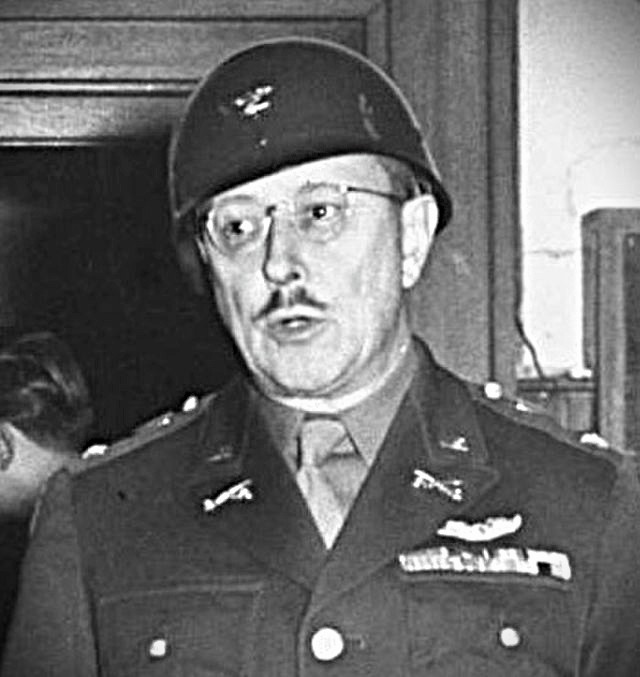
Colonel Burton C. Andrus
Colonel Andrus was then 83, and it was immediately apparent that he retained his decisive, soldierly approach to life. An October 1946 issue of Time, which I’d read in my grandfather’s scrapbook the previous evening, gave a rather unflattering account of our guest. It described him as “a pompous, unimaginative, if thoroughly likeable officer who wasn’t up to his job … Every morning his plump little figure, looking like an inflated pouter pigeon, moved majestically around, impeccably garbed in his uniform and highly shellacked helmet.” Now, thirty years later, Andrus retained the same crispness of dress – I seem to remember a funereally dark suit and tie – but there was little about him that was plump or inflated. He was, if anything, a trim, wiry figure who could have passed for twenty years younger than his real age (and, incidentally, nothing like the actor John Slattery, who impersonated him in the recent film Nuremberg), and I could immediately see how formidable, in fact frightening, a character he once must have been.
When introduced, the colonel eschewed the traditional handshake and instead seized my arm near the elbow for a second in a grip of steel, as if making a sudden arrest. He then gazed fiercely around the room, which he remarked, rightly, if a shade caustically, had ‘a lot of possessions’ in it. His relentlessly critical eye had been trained over the decades to spot weakness, and he could still be abrupt in noting any blemishes or other details that failed to meet his exacting standards. I was glad that I had had a haircut the day before.
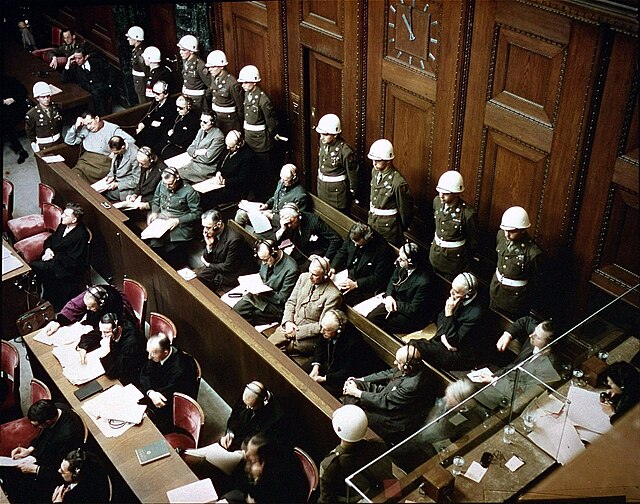
Born about 300 miles away in Spokane, Washington, in 1892, Andrus had a successful early career working for Standard Oil. He volunteered for the army on America’s entry into the First World War, and an officer’s report on him even in this youthful period praised both his “iron self-will” and “ability to inspire the fighting man which endear[ed] him to their hearts.” Although not posted overseas, Andrus was to foreshadow his later career when in July 1919 he was promoted and sent to the Presidio in Monterey, California, where he served as Prison and Intelligence Officer. Various staff and administrative posts followed in the inter-war years. In September 1941, then Lt-Col Andrus was sent to Great Britain to study its air-ground operations, and did a “thoroughly conscientious” job there, as even Time acknowledged. His was a world of briefing notes, technical manuals, dockets, manifests and fussily annotated guidelines on military procedure – a gift for detail that did not diminish with age. Andrus returned to Britain in January 1944 to serve as Commanding Officer of the 10th Traffic Regulation Group in the run-up to D-Day. In December of that year, he transferred to Allied field headquarters in liberated France as a Combat Observer. In May 1945, Col. Andrus was appointed governor of the Mondorf-les-Bains facility in Luxemburg, an interrogation centre for Nazi war criminals popularly known by its code name ASHCAN. When the inmates were moved to a new prison built at the back of the Nuremberg Palace of Justice, Andrus joined them there as their Commandant.
Notwithstanding my grandfather’s proverbial words of warning, Col. Andrus, once settled in a chair and fortified by a dynamite-strength martini, positively enjoyed talking about the war. And talk he did. Thrillingly. At length. In a dry, crisp voice he told us how military discipline and morale among the staff on his arrival at Nuremberg had been “a joke”, and that one night early on in his tenure a fellow officer had announced that he was leaving the post with the 200 men of his battalion, as he felt they could be of more service to the Allied cause elsewhere. At that, Col. Andrus quick-marched down to the motor-pool. “I posted guards overlooking it and I said: ‘The first man to drive out of that pool tonight – shoot him.’ No one moved. That particular officer soon found himself transferred out of Nuremberg, and sent to a less desirable posting than he might have wished,” the Colonel smiled. The two hundred men of his unit remained behind to become the nucleus of the prison staff.
Not long after that, Andrus went to deliver the formal indictments to the men in their cells. “They were a motley crew,” he remembered. “You looked at them and wondered how they could possibly have terrorised so many millions of people.” The colonel came to the conclusion that
…it was largely a matter of image. These gangsters had always strutted about with retinues of boot-licking aides. No one questioned them. They created an impression which, through newspapers, radio, and movie films, became a cult. This cult had to be lived up to. To increase their lustre, the men had to keep going forward – in the end, they so lost track of right and wrong that in prison they felt not guilt but a kind of indignation at their confinement.
The only one of the indicted men who had mildly impressed him was Field-Marshal Wilhelm Keitel, until lately the Head of the German Armed Forces and de facto War Minister. “He at least snapped to attention when receiving the papers I handed him,” Andrus allowed.
Like other prisoners before and after them, some of the inmates at Nuremberg turned to the solace of religion. Hans Frank, the former Governor-General of Poland, and as such thought to be responsible for the deaths of up to two million Polish Jews, “used to pray at all hours of the day, and I have no doubt genuinely felt that the Church had relieved him of guilt,” Andrus said. Several others among the accused preferred the more secular consolation of the law. Keitel and his colleagues Field-Marshal Kesselring and Grand Admiral Doenitz all addressed letters to the Supreme Allied Commander that Andrus felt would almost have been comic but for the circumstances. Many quoted the Geneva Convention, and some asked that their former aides and orderlies be sent to join them in prison. Kesselring had wanted a more comfortable bed and bigger windows in his cell to alleviate his rheumatism, a request that Andrus had felt it within himself to refuse.
The prisoners themselves weren’t the only ones to suffer the particular stress of life at Nuremberg. To my surprise, Andrus told us that when he arrived,
…most of the rest of the jail was already occupied by German civilian prisoners. It would have been easy for any of them to infiltrate our wing, and the prospect kept me awake at night until I finally got permission to erect a barrier. For that matter, the security outside the compound wasn’t any better, and if some fanatical pro-Nazis had taken it on themselves to load a truck with TNT and send it speeding through the outer wall to the cell-block itself, we would all have been blown sky high.
Andrus had also been worried about the morale of the Nuremberg jailers, or ‘sentinels’ as he called them. “These men were often 19 or 20 years old, and they were to stand in shifts in dark concrete walkways watching the prisoners day and night. It wasn’t a job for sissies. Over my whole term of duty, I experienced a 600 per cent turnover in staff,” Andrus remarked, not bothering to hide a faint snort of derision. Adding to the sombre atmosphere, two of the Nuremberg inmates, the so-called Reich Health Leader Leonardo Conti, and head of the Labour Front Robert Ley, committed suicide in captivity, while the Luftwaffe chief and Reichsstatthalter of Prussia (though he acquired offices of state almost at will) Hermann Goering later cheated the hangman by biting down on a cleverly concealed cyanide capsule only hours before his scheduled execution in October 1946.
But by far the most enigmatic – and troublesome – of Col. Andrus’s charges at Nuremberg was the former Deputy Fuhrer, Rudolf Hess. Hess was then 51, and had been in Allied hands since famously flying to Scotland in an apparent solo attempt to broker peace with the United Kingdom in May 1941. Was he mentally unhinged, as his bizarre flight, and subsequent real or feigned amnesia, seemed to suggest? The colonel’s first encounter with “this beetle-browed little man who arrived in a grey suit and a crumpled felt hat” was far from promising. Hess was being marched down a corridor in the jail when he saw Goering and his guard coming towards him. “Conveniently forgetting to forget, he immediately snapped to attention and threw up his arm in the Nazi salute to greet his old comrade.” The black comedy of the scene struck me, and I asked the colonel what he had done. “I instructed Hess, ‘Do not raise your arm like that again. I consider it a vulgar gesture.’ ‘The Nazi salute is not a vulgar gesture,’ he said. ‘It is now,’ I told him.”
“I knew right away that he was faking it,” the colonel continued. When later questioned about his family, “Hess was able to answer in very great detail about events that had happened 40 years earlier. The fact that he was reading two highbrow books a day while in custody also told me that he must have retained some of the background of his education in order to understand them.” A US Army psychiatrist examined all the Nuremberg prisoners. His report found that Hess was “passive, suggestible and naïve … Like the typical hysterical personality, he was incapable of facing reality and escaped by developing a functional disorder” – in this case, selective amnesia. “I looked him in the eye and told him I knew he was a sham. Hess just glared at me. He was ‘mad’ all right, mad at me for disbelieving him,” the colonel said.
As for Goering himself, ‘he came to me as a 300-pound hophead,’ Andrus remarked, employing the terminology of the day. “He had sixteen suitcases, wore a Cartier watch, and his fingernails were painted bright red.” After several months of the colonel’s regimen, Goering was cured of his morphine addiction, and his weight was down to something approaching normal. Even so, the table in his cell was deliberately built so that it would have collapsed had he tried to use it to reach the small barred window with a sheet or towel as a possible means of suicide. Andrus admitted that he had found Goering “a cunning and not always disagreeable internee, whom you could never turn your back on.” One morning in March 1946, the Nuremberg prisoners were being taken out of their cells to be marched to the nearby courtroom. “Goering took the opportunity to reach out and strike the sentinel several times on his arm and shoulder. The soldier hit him back with his billy-club. Goering then went loco and started screaming in German, and using his hands with incredible speed to lash out at the man. It took four GIs to subdue him.” A few years later, I was uncomfortably reminded of this incident when I sat watching the scene of Hannibal Lecter maniacally attacking his guards in The Silence of the Lambs.
After being condemned to death, Goering had made a request to face a firing squad rather than the gallows. The Allied control commission rejected his petition. “In my mind, that was the moment he took the decision to kill himself,” Andrus said. The colonel would not be drawn on the rumour that a sympathetic GI had palmed the cyanide capsule to his prisoner, and rather stiffly repeated the formal conclusion of the enquiry that “Goering had the poison in his possession when apprehended”, that “he may have hidden it in an obscure recess in the inside of his toilet under the overhanging rim,” and that “no blame for dereliction of duty is ascribed to any prison guard.” The colonel repeated the words verbatim, and I could tell that the matter still rankled all these years later. To have lost three men at Nuremberg by their own hand was the one obvious regret of this proud and supremely capable soldier. Twenty years after the event, the colonel received a letter out of the blue from the National Archives in Washington, DC. It attached a photocopy of the suicide note Goering had personally addressed to him. This, too, concluded: “None of those charged with searching [for the cyanide] is to be blamed, for it was practically impossible to find it. It would have been pure accident. [The army psychiatrist] informed me that the control board has refused the petition to change the method of execution to shooting.”
Given our continued fascination both with the Nazis and with prison dramas, it’s hard to imagine anything that could make the events of the early hours of 16 October 1946 more morbidly compelling. The execution by hanging of ten condemned men at Nuremberg (Goering was to have been the eleventh) had it all: a long walk through a rainswept prison yard into a starkly lit gymnasium, where one by one the condemned men were escorted up the steps (there were thirteen) to the gallows. Colonel Andrus read the formal sentence to each one moments before the end, and even he admitted that “It was a terrible task.” The Reich foreign minister Joachim von Ribbentrop was the first to be dispatched and, like most of the others, he met his fate with a certain dignity. “My last wish is that Germany’s unity shall be preserved and that an understanding be reached between East and West,” he said. As the rope was then tightened around Ribbentrop’s neck, he turned to the army Lutheran chaplain at his side and whispered: “I’ll see you again.”
“The military men went to their deaths impeccably,” Col. Andrus said. When his turn came, Arthur Seyss-Inquart, formerly Chancellor of Austria and later Nazi commissar of the occupied Netherlands, remarked in a level voice: “I hope that this execution is the last act of the tragedy of the Second World War, and I hope that out of this disaster wisdom will inspire the people, which will result in understanding between the nations and that peace on earth will be finally established. I believe in Germany.” Then he, too, was hanged. The only difficulty had come in the case of the former publisher of the rabidly antisemitic newspaper Der Stürmer, Julius Streicher – a “very shapeless man in a baggy suit with a large bald head and short legs.” Once at the scaffold, Streicher had screamed “Heil Hitler!”, and then made some further unappreciative remarks about the Jews. As the executioner stepped forward to the lever, the condemned man had hissed at him through his black hood: “The Bolsheviks will hang you one day!” After these blood-chilling events, Andrus insisted that the bodies, including Goering’s, had been taken to Dachau and cremated in the same concentration camp ovens where tens of thousands of Jews and others had met their end, although some historians doubt this detail. The ashes were secretly dispersed in a river. The colonel had nothing to say on the long-standing rumour that the executions had been botched, meaning that some of the men had fallen with insufficient force to snap their necks and had instead slowly suffocated to death.
I was then a remarkably vain and self-absorbed 18-year-old, but even so I like to think I realised how lucky I was to be included at the lunch table that day. The time seemed to fly by. Precisely at 2.30pm, Colonel Andrus stood up, thanked us for our hospitality, and announced that he would now go home for his scheduled nap and a walk. You saw again the rigid self-discipline, and remembered that this was a man who had lived his whole adult life in a world ruled by punctuality, professionalism and unswerving devotion to duty. As he left, the colonel seized my arm once more and looked me hard in the eye. “I hope I haven’t bored you too much,” he said. I assured him he hadn’t.
Colonel Burton Andrus died on 1 February 1977, at the age of 84. It’s said by his son that his last recorded thoughts were of Nuremberg. “I think that it haunted him … ‘Goering has committed suicide. I must report it to the Commission,’ he said. I told him it was the middle of the night, and it could wait until morning. Four hours later, my father died.”