Layoffs

JON BISHOP is an MFA candidate at the University of St. Thomas in Houston, where he studies poetry. He lives in New Hampshire.

His boss stood at the door and told him

To pack his things and leave, like scraps or trash,

And looked at him with cold and empty eyes

And said it was just math; don’t take it hard.

He sighed and gathered what he had and left.

There would be other jobs, but what he had

Was dead and bleeding on the granite floor. 

The sky outside was drained of all its glow

And building lights succeeded all the stars.

And then they each went out, and all was dark. 

Horses for remorses

CLARENCE CADDELL is the author of a collection of verse, The True Gods Attend You, published by Bonfire Books. His poems have appeared recently in The Brazen Head as well as in Quadrant, The Crank and other venues. A translation of Jean Moréas’ Les Stances is underway, as well as another book of original poetry

Why is it that I never win on horses?
The one my brainstem picks I look on past
To pick the one that comes, if not quite last,
Just in the middle, as I knew it would.
It is as if the knowing in me pauses
Before an obstacle it knows it should
Jump over; as if coming in first place
Were something frightening; as if the ways

It trod were drawn upon a map the same
Size as the path itself, obscuring it.
And this is why I foamed about the bit
When it was time to tell the one of you
I chose the other. Then when the words came
I said them to the wrong one, right on cue.

Violenta’s Revenge, Part II

JEZ PUNTER is based in London. His poetry has appeared in First Time, Popshot, Bunbury, Eunoia, Snakeskin, Riggwelter, Dream Catcher, theCRANK and on the Society of Classical Poets website. He is currently writing a commentary on Shakespeare’s Sonnets. This is Part II of his long poem, ‘Violenta’s Revenge’; Part I may be found here

After wooing her, Lord Didaco jilts his lowborn wife Violenta in favour of someone else.

Violenta exacts her revenge. Based on a story from Matteo Bandello’s Novelle (1554)


My faithful maid leaned close to hear my plan.

‘I keep five hundred coins with certain jewels,’

I said to her, ‘by which that beast began

his odious seducing, fash’ning fools                            

from this impov’rished house while buckling rules.

Now this same money shall be all your fruit

if what I plan you help me execute.


‘Yet come of it what will, this hate I harbour

soon shall manifest itself in deed,

if not by accident then by a murder;

for vengeance will not stop until its feed,

until it gains what nature has decreed.’

My maid, aware of my determined nature,

promised then to aid me in my venture.


‘First of all,’ she did instruct, ‘you must

dissemble totally your burning grief,

contrive to show not one bit of mistrust

of him, our knight, his new nuptials. In brief,

you must applaud them well, show your belief

that he and his new wife are meet and right;

that rather than offence you cheer the sight.


‘And then to him a letter you must pen,

well-scripted by your own person, thereby

to let him understand just how and when

great pain you suffer, how you should surely die

if not another visit he might try

to you; for you, you’ll write, “still love him so”,

and are “with horror filled to let him go”.


‘Our rich deceiver shall be quite beguiled

by thinking to have you at his command.

He’ll come to lie with you; he’ll see his child;

he’ll act as he did previously, demand

you do his want and will. But you’ll be damned

if this restarts a circumstance of strife.

For unbeknownst to him, he’ll lose his life.’


So to begin the enterprise: I prayed

Janique to for a time withdraw herself

because, although indebted to her aid,

to write I needed to be by myself.

I hence did lift some parchment from my shelf

and with renewed and fresh audacity

inscribed as follows with capacity:


Señor Didaco, I’m persuaded now

that if you will vouchsafe to read, peruse

these characters within, you might allow

by your compassion ease of my agues

and griefs that so assault and so confuse.

Dear Sir, these pages penned are of a soul

by heat lost now transformed to cindered coal.


Behold now here the image of my life:

A wench with child forsaken and forlorn,

quite stupefied by gloom which, like a knife,

dissevers, tears apart what was reborn

when you appeared as like some wished-for dawn.

Our coalition was secure, I thought.

But how your breach of pledge left me distraught!


Only my maid (God bless her charity)

has had the wherewithal to save this soul

so brutally condemned eternally.

Evicting me from an engulfing hole

she set my thinking mind then on a goal.

No longer did I feel Death did conspire

but hoped that you – whom did my offspring sire –


might read these words and know of my appeal.

Alas, how many hundred-thousand times

of late have I longed to, in helpless zeal,

descry the sound of Death’s foreboding chimes

and wish he would enclose me for my crimes.

I have not recognised, for all my sins,

where blissful sleep has ends and doom begins.


And yet the journey of my thoughts within

is further torment – swollen vexing visions,  

mutilating worlds of voices, sin,

unhappiness, regret for my decisions,

where neighbours’ accusations are incisions!

My self is stolen from me, set adrift

by subtleties of claw so sharp, so swift.


Come hither to me, cruellest man, I say.       

See in what lean and ugly state I’m left.

Perhaps rejoice in how I’ve split away –

a mind that married, now a mind bereft;

a mind and soul inside their body cleft. 

Behold an aging, broken, piteous dam,

fragile of frame yet once a noble lamb.


Thus as my tears did make my words dry up

I suffered not my pen to issue more.

I wet my tongue with water from my cup

and called out for my maid to do this chore:

‘Gentle Janique, go forward from my door

and carry unto him these letters written.

With hope upon receipt we shan’t be bitten.


The residence was of his pa-in-law.

When welcomed in she asked if she might speak

to Lord Didaco. The servant went before

her, querying after he whom she did seek

while she then waited for what seemed a week.

At last a face – broad and framed with beard.

’Twas he, she knew. And though she was afeared


she feigned a smile and duly spoke her duty:

‘Renowned Señor, I stand before you here

as one who neither reads nor knows the beauty

of good literature, but yet I dare

to say all’s true in these here leaves. I swear.

Madame Violenta sends them unto you

and begs you give them all attention due.’


Janique then handed forth my written letter,

which he read reclining in his chair.

She watched his facial muscles get the better

of him, scanning it hard, revealing bare

the thoughts my words incited in his care.

It was as if he’d been withholding breath

when he exhaled; it shocked her half to death!


‘Janique, dear friend!’ (he started as he spoke),

‘the tenor of these words that bite my eyes

does such a sudden passion now provoke

within, I catch myself hence by surprise.

It is as if a cloud in me does rise

but yet contains many a contrary gust –

much pity, hatred, love, disdain . . . and lust!


‘My heart is vexed, yet yearns to now do battle;

the window of my soul is freed from blinds.

Janique, dear friend, assist these thoughts to settle.

Tell Violenta still a feeling binds.

So yes I’ll visit her – if this she finds

appropriate. And say unto your mistress

too: I’ll duly make amends, redress


‘for my neglect and every ounce of sorrow

caused. But mark: my call must be at nine

o’clock P.M. No more then shall she furrow

her brow in aimless anguish and consign

my name to mud. I’ll love her ’cause she’s mine.

I’ll come tomorrow early ’mongst the gloom

so may a reconciliation bloom.’


On hearing what the man had thus imparted

I replied, ‘Janique, God bless you for

your service. I’ve not slept here since you started

out for worry, but now you’ve prised the door

to our proceedings I can act the more.

I have devised that we’ll provide a rope

secured unto my bed. Its end will droop


‘over the edge. Didaco will soon nap,

and when he does I’ll cast the end to you

so you may thenceforth take it up and wrap

it round your arms most tight and pull it true

across the bed trapping the sleeper who,

before knows what’s occurring, will then float

in dreams of death – for I’ll have cut his throat!


‘Therefore a knife must you prepare – nay, two

in fact; of but the finest steel, no matter

the cost. Didaco’s soul shall thereby rue

the day he sent to me his first love letter,

and I shall laugh to see his lifeblood spatter!

But pray, Janique, allow me this one thing:

leave me alone when those knives start to swing.’


At home inside his pa-in-law’s that night

Didaco at an early hour did break

away from dinner saying he must make flight

to go and map his land – of hill and lake,

a survey was he ‘now required to make’.

His wife asked why he’d not done this before.

He had ‘forgot’, he said. But it was ‘law’.


‘And love,’ he added as he stood and dressed,

‘I won’t be back until next day is dawning,

since I’ve some chief affairs to be assessed.

His wife acknowledged him with sleepy yawning,

muttering, ‘Farewell. Till next day’s morning.’

Didaco’s groom then brought forward a steed

and off he cantered to perform his deed.


The clock was nine o’the evening when I let            

my door swing fro and was confronted by

the fiend. He kissed my hand. I was well met.

Directly then a shrewd, facinorous lie:

My scripted words, he claimed, had made him cry!

I listened patiently to this announcer,

saw him sat, and then began my answer:


‘Señor Didaco, you bid me good morrow,

yet you in deed have quite annihilated

she whom you abandoned. So much sorrow

I’ve borne, so many imaginings vacated,

hopes and aspirations amputated

from a mind receded into air.

Now here observe my state, my dire welfare!’         


Didaco hence, observing my affliction,

fearing from my mouth some more alarms,

was moved to sympathy, was moved to action:

he collected me up in his arms!

He complimented me upon my charms

before vouchsafing his new marriage ill!

In to it he’d been ‘handled’ ’gainst his will


so on, so forth. A second then I thought

he might be speaking true. Howbeit

I then recalled the reason I had brought

him here so did regain myself and hit

him with a contrived smile; and then with grit

embarked upon my speech: ‘Señor Didaco,

although you left me in a state of woe,


‘and though I’ve no foundation to believe

your present words, the love I hold for you

is rooted deep within. I can’t conceive

your fault to be so great that I’d imbue

myself with warring hate till turning blue.

And so my offer’s this: You and I

shall twice a week within my bed here lie.


‘For I suspect that if I might at times

enjoy your company I could remain

within your grace and favour, and the climbs

of love again grow strong, then the domain

of mutual warmth once more become germane.

By God in Heaven’s will we shall grow old –

together in love, content in all the world.’


Attending well to this the man agreed

to all that I proposed. (Of course he did,

his blood was up, he prepared to breed.)

But first of all at supper was he bid

to sit. Janique had made a meal, varied

in meats and bread – and pudding rather stodgy.

Then wine, and thus our guest became sleepy.   


Suggesting we both rest a couple of hours,

I said, ‘As you’re aware, a restful sleep

is something I’ve not known in months. It sours

the appetite for love. But you shall keep,

my love, I know. You don’t wish me to weep.

And fear you not, when I no longer tire

accommodate I shall your great desire.’        


This rankled with the man but yet before

too long my foe – former husband – yielded,

laid beside me still, beginning to snore.

And then I spied (although the curtain shielded)

Jan, my maid, and recognised she wielded  

in her hand the aforementioned rope.

Then she moved and I was filled with hope.


Conveying the cord across his sluggish body

Janique then passed the end of it to me

and I to her beneath the bed, thus ready

to fast ensnare our hated enemy

as we’d devised. I was now fully free

to act the thing that we had so arranged.

Now was the moment I would be avenged.   


I quickly snatched the first great knife from off

my stool and sought the perfect point of skin

for entrance in. He gave a kind of cough

as I advanced upon his throat. His sin

of treating me like naught would mean no win

was he to ever see. Thus in a flash

I plunged that blade into his cheating flesh.


The body jerked beneath me where it lay

as I, becoming now enchanted, rose

up on my knees and, as though at play,

began to hack with blinded fury those

few features that were eyes and mouth and nose.

I was Medea filled with fuel and fury,

no more the victim suffering injury.


I angled neat my weapon’s dripping point

and then like oysters shucked his eyeballs clear,

the salty fluid bubbling to anoint

my raging hands, impelling me to sneer,

‘Farewell! No longer can you interfere

with my emotions, wretched plunderers!

Now it is known you were but harbingers


‘of doom!’ And then his lying tongue I took.

I seized and fast removed it at the root.

‘Abominable perjured thing! Villain and crook

of truth, deforming words just to recruit

a foolish girl! Say, am I still as cute?’

I flung that member on the floor to lie;

no longer would it make a maiden cry!


And then into his useless gut I tore,

creating holes without insight or taste.

My blades, now whirling windmill branches, bore

like mining tools, mashed organs down to paste,

all juice and red stuff happily displaced.

The warm wet pleasure galvanised my heart

and made me howl with laughter at my art.


‘You’ve breathed your last, your very, very last!’

I sang. Then, out of breath, I sought my maid.

She was still there, wrapped in the rope we’d cast

with all the strength of thousands. She had stayed

until the end. But now as she surveyed

the aftermath of all my frenzied work

she was struck mute. The sight did try and irk


her eyes. ‘Janique,’ I said, ‘fear not, the end

of all our woeful darkness has arrived.

Each prick of pain that once did fast distend

has been dispelled, and we are left, survived.

A better outcome could not be contrived.

I now do feel myself so eased of pain

when Death appears for me. I know I’ll gain


‘an even greater rest – eternal peace.’

Janique, although wide-eyed at all she’d seen,

regained herself enough to help release

the rope and then assess the poor has-been.

‘These sheets,’ she quipped, ‘will be hell-fire to clean.’

‘Hush, hush,’ I said. ‘Just help me move this louse,

expel these wrecked leftovers from our house.’


We listened once we’d thrown and heard a thump.

We looked and spied it half upon the pavement.

Next, on top of it, I dropped the pump

that was his lying, cankered heart. It’s movement

spoilt for all eternity; enslavement

of girls a thing no longer to take place.

The trial was over, mine the winning case.


But I yet had instructions for my maid:

‘Janique, this casket here is full of money,

that which I promised you. So be well paid

for all your service, easing the agony

I did inherit. You have been my nanny,

nurse and maid, plus more than you can know.

I’m full of gratitude. But now, do go.


‘Go to the nearest port and find a ship.

Thence sail at once to Africa and there

be safe. Use well your earnings and equip

yourself with anonymity. Prepare

yourself a brand new life. You’ve been so fair

to me, now please, accept this extra pay

and make some haste. God bless you on your way.’ 


And so with mutual tears we said farewell.

My serving maid of ages went away

while I in out-and-out exhaustion fell

onto the floor and slept. For many a day

I’d not so much as dozed without the play

and pull of fretting thought, but now . . . peace.

I slept, emphatically. I found . . . release.


It was the noise that woke me up – the shouts

and cries of outrage from the street below.

And under this a general murmur, bouts

of talk as crowds were drawn to see the show.

I watched them in the morning’s early glow

and heard that none of them could recognise

the victim in his disfigured disguise.


And so I shouted from on high: ‘Good sirs

and ladies of the streets, you all contend

upon this issue like a pack of curs

but shan’t know how this quarry met its end

unless to my account your ears you lend!’

The crowd, intrigued, did lift upwards their heads

and asked, ‘You know why he was torn to shreds?’


‘I do,’ I cried. ‘So hear my testimony!

Know this: the form that once did stride as Lord

Didaco here without great difficulty

lost his life. He was by my hands gored

and hacked to death – because he was deplored

by me in every way. Then down he plunged,

and thereby I was mercifully avenged!’


Perhaps it was my hellish look of eye

that meant the throng accepted what I said;

or that my forearms glistened with red dye

and many curdled splats adorned my head.

I laughed at them. I knew that I was dead.

They whispered it was ‘known a well-dressed knight

did keep the girl; ’twas sure he was her blight.’


However, the deed was done; I was a brute.

The sergeants, officers of law were called,

and, with my brethren and my mother mute

on learning what had chanced, all too appalled

to speak, henceforth to prison was I hauled.

I wondered at what speed I’d meet my fate.

They told me that was for the magistrate.


The sun had barely nudged the mist next morn

when I was mauled and wrenched into the air.

The brows of all the officers wore scorn

or else gestured they’d reason none to care.

Thus to the palace was I taken, there

to meet, as well as the judiciary

determining my fate, near everybody


of the town within which I had grown.

Didaco’s pa-in-law, his widowed wife

and all their kin did seek to view the ‘crone’

who stole from their loved one his ‘blameless life’.

My brothers twain were there, addled with strife;

but mother? No. Too mentally harassed.

I wept. And then the magistrates amassed.


Before them all, the greatest of the town,

I was instructed to relate my tale.

They wished to know how I had been brought down

so low by this well-dressed, well-valued male.

Thus I embarked upon a new travail:

I told them how the demon had pursued me,

had said for months on end I was his, ‘truly’,


how he had had us married in the night,

the nuptials solemnised by priest unknown;

of how we’d lived together out of sight

for near a year until one day alone

I found myself. ‘He’d chosen to disown

me,’ I relayed, ‘like some old ragged doll,

condemning me to stare and blankly loll.


I then divulged how all had thus emerged

the previous night, how he whom was a wolf

was by my maid Janique held fast and purged

of all his worldly essence by myself,

but then how all the horror did engulf

Janique and, fearing similar mania,

she’d jumped into the Rio Turia.


From wall to wall inside the palace court

light lukewarm tears did fall from doleful eyes.

Many lamented the misfortune brought

upon my pitiful soul, the hardship, lies

of one who eagerly did optimise

his carnal pleasure playing with his power,

whom now had fixed it so my life was over.


The chief justice began: ‘A woeful crime

is this that’s been your harsh and ruthless deed.

Therefore it is decided that your time

upon this earth is ended. You did bleed

yourself through sorrow and through anguished need,

but this excuses not defying the law

for your own means. Your actions we deplore,


‘and so do sentence you to be beheaded

by the axe within our public square.

Not only was your plan well executed,

so excessive was your want to tear

your prey to pieces little can compare. 

Your mother and your brethren can go free.

May God have mercy on them, and on thee.’


Now here I am, dear reader, in my cell,

awaiting patiently my devilish fate.

The day on which I am to enter hell

has been postponed until a later date

whereon a certain duke can celebrate

my end amongst all of Valencia.

He comes from Italy, Calabria,


and undertakes a fair old trek. No matter,

I’ve had additional time in which to write

my tale, recalling how, one day, a letter

did arrive for me from one young wight,

a boy who laughed and danced and made a sight

beneath my rickety agèd chamber window.

‘Real love’ was his, he claimed. His name? ‘Didaco’.


Was it just merely youth that killed us both,

condemning two to death by cutting blade?

We each had barely but begun our growth,

and now a poem’s tragic end is made;

herein are my last thoughts before I fade.

The ink is smudging underneath my tears,

and yet I’m smiling now – I’ve no more fears.

                        FINIS

Jazz, and An Aside from Critias

MICHAEL YOST is a poet and essayist living in rural New Hampshire with his wife and children. His essays and poems have been published in places like Modern Age, First Things, The University Bookman, Dappled Things, The Brazen Head, and others. He substacks at The Weight of Form.

Jazz

Smooth and liberal,

It mounts and valleys down, percussive,

Tempoed to itself, accustomed nowhere.


In pulsing figural

It floats; a summer gown, successive

Patterns born and dying in the show-wear


Donned by limbs as loose

As birdsong larking through the growling

Traffic down by ninety-five; the silence


Short, the sound profuse

As flesh in Rubens, pain in howling,

Or leisure in a world convulsed by violence.

An Aside From Critias

You see how Socrates, in fact, is dead.

All talk of immortality aside,

There is no touch of it in that bald head.

And neither does his daimon still abide.


And I see also how the just are paid –

The bastard filches birthright from the heir,

Good kings go mad and die betrayed,

As doves go gracing, landless, through the air.


I see the grass push up between the garden stones,

As mobs push through the guard at courts of law,

Or as the maggot pushes twixt the bones

Of some philosopher, the rib and jaw.

Then come on wildness; blast both weak and strong

Since nothing is forever, or for long.

Invention

BEN MORGAN is a writer based in London. His pamphlet Medea in Corinth: Poems, Prayers, Letters and a Curse is published by Poetry Salzburg and he has also published in Stand, Oxford Poetry, AlchemySpoon, One Hand Clapping and elsewhere.


“Where did we go wrong, do you think?
Probably with the discovery of agriculture”
Hari Kunzru, Interview Magazine, March 2020

We needn’t only leave things as they are.
The great roof of leaves and monkeys is a beauty,
and sometimes, yes, it triumphs over rain –

though the storm will always beat it –
but it grows as you or I grow, as we feed it.
Nor can it outrun us like the deer.

See, here, where the sharp berry
answers your touch with a bite.
She never rears her head as high

as the star-hungry forest, but she bleeds
sweetness in winter; and the limbs
of the bodiless spider are rivers in air,

sailable by foot. The purple hearts,
bruised lips of the goddess,
which purse and beat around our feet

die into life’s blood – food, livid wetness.
All purposeful things are shaped for hands
like yours and mine. Time itself

will fall from us. No more days
like slow-blooming beads of water,
waiting for the crash of an animal,

but a series of small and greater dances,
each nestled in the circle of the larger,
like you, and me, and the children.

We needn’t only leave things as they are.
I learned this last night inside a dream,
then woke in a sweat, thinking he was here,

the one who told me – boarlike in his fatness,
yet his children, who carried his great bier,
thin and trembling as arrows in the wind.

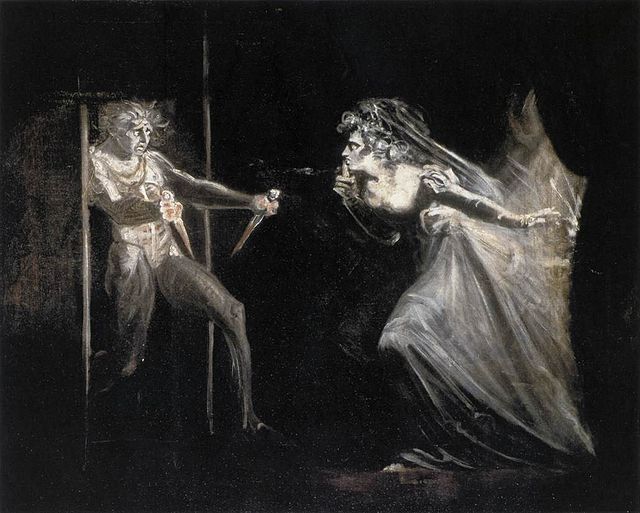
Is this a dagger they see before them?

STUART MILLSON is appalled to find Mid Wales Opera facing closure

Founded 35 years ago to bring the finest music and drama to rural towns and communities, Mid Wales Opera is a company specialising in bringing pared-down versions of the greatest music-dramas to far-flung parts of the country. 

On Saturday 23rd March, their run of Verdi’s Macbeth came to an end at the c. 500-seat Brecon Theatre (Theatr Brycheiniog), with a capacity audience enjoying Jeremy Sams’s English version of the score. Directed by Richard Studer – and full marks here for the stage lighting and ‘recycling’ of roles among the chorus – Mid Wales’s own glorious opera company succeeded in generating a dramatic effect, just as overwhelming as anything you might hear at Welsh or English National Opera.

How was it possible for an orchestra-pit ensemble, just 15-strong, to conjure much of Verdi’s lush orchestration? Under conductor Jonathan Lyness the resident chamber orchestra, Ensemble Cymru, achieved this miracle – the timpanist also playing the side-drum, and their splendid cellist generating a rich, resonant sound in those dark moments of the drama. 

On stage, meanwhile, Macbeth’s court, began its disintegration: soldiers with a Fascistic air, reminiscent of Richard Loncraine’s film of Richard lll, marched up and down, Lady Macbeth – the brilliant stage presence of Mari Wyn Williams unleashing her amoral powers, and Macbeth himself, sung by Jean-Kristof Bouton, descending into his ‘feverish visions’ as the apparition of the murdered Banquo appears at a castle feast.

The witches, dressed as 1950s’ office secretaries, but with demonic eye make-up reminiscent of Kathleen Byron’s unsettling appearance in the 1947 film, Black Narcissus, deserve great praise for their unsettling performance. Finally, the end comes for Macbeth as a forest supernaturally advances upon his fortress – actually, the English army in camouflage, although on stage at Mid Wales Opera only the Scottish saltire was raised. (Surely a major omission that the Cross of St. George did not appear?!)

What next for Mid Wales Opera? A real-life dramatic crisis, no less: the shocking removal of one hundred per cent of their grant from the Arts Council of Wales, casting doubt over whether productions of this kind could ever be staged again. Is this a dagger they see before them? It would seem so. But the story is the same, everywhere. Last year, the BBC tried to disband its own elite choir, the famous BBC Singers, and cut its symphonic strength across three ensemblesMeanwhilethe length and breadth of these islands, from Birmingham to Bournemouth, our orchestras and theatres struggle to convince those in power of the vital need for the arts. 

Quite simply, Britain now has a choice: do we just become a TV/consumer society, turning our backs on the splendour and enrichment of music and the arts? Or do we challenge the Arts Council and those in political office for a change in direction? As the wise Hans Sachs in Wagner’s Die Meistersinger put it: “Neglect the civilised arts at your peril…”

To support the appeal for Mid Wales Opera, write to Bryn Wgan, Caersws, Powys, Wales, SY17 5QU

Un-harkened Angel

Angel

Alex Kurtagic, London: Spradabach, 2023, hb., 997pps.

DEREK TURNER finds mordant fun in a tale of modern alienation

In 2009, Alex Kurtagic published Mister, his novel of a highly-cultured IT consultant operating within what he saw as the hellscape of contemporary Europe – a man too intelligent for an age suspicious of intellectual distinctions, and too independent-minded for a continent in thrall to neurotic pettifoggery. In Angel, we meet a similarly misfitting man, but one with even less adaptive ability – indeed, a man almost without agency. This is a behemoth of a book about a midget of a man, wandering solitarily in the drab wasteland of these times.  

Angel is a student of 17th Century literature at an English university, whose unhappy fate it is to combine refined tastes and fastidiousness with an inability to impose these on even his immediate surroundings. He is physically slight and correspondingly cowardly, chronically short of money, and not even compensatingly articulate. Traditionally, angels enunciate glad tidings, but this one (aspiring poet though he may be) can barely sustain a basic conversation. He is announced to, rather than an annunciator. His most obvious resemblance to Biblical or Hebrew angels lies in his essential insubstantiality.

Angel is surrounded by people infinitely more impressive than he is – especially women, from his formidable mother and sister, and brilliantly inductive fellow-students to the mothering Amelia who (for some incomprehensible reason) pants to enfold Angel in her ample embonpoint. He is an incel, but unlike some incels, not potentially dangerous. He is not even angry – although the debased nature of his university, and society, deserves almost unlimited contempt. Kurtagic’s front-cover oil of his Van Dyck-bearded subject excellently conveys the nervy nature of his character, his twitching worriedness and state of blinking surprise at the awfulness of almost everything.

We do not lose sympathy for Angel as the tale unfolds, because we never really develop any. Even if somehow we could, he would haemorrhage it with his every action, or more precisely inaction. It is only at the very end that we start to feel sorry for him, but we can never feel respect. He is epically inept and wholly dependent on others, unable to perform the simplest task without mishap. He gets a menial job, but can’t manage the hours. He is given expensive things, and loses them. He is given excellent advice, and makes no attempt to follow it. He gets blamed even for things that aren’t his fault – and we are neither surprised, nor particularly perturbed. The reason he has no money is that he burned through a generous grant from his wealthy and influential parents in pursuit of an American woman (Madison) so obviously unworthy that people who have never met her instantly smell the gold-digger.

Huge events unfold around him, which culminate in unexpectedly dramatic style, but he is so busy mooning about his love-interest (and feeling sorry for himself) that he misses all the portents. And yet this over-specialised evolutionary aberration ends up as one of his cohort’s rare survivors. His near-invisibility ensures that he is mercifully overlooked by the most malign influencers, except when he accidentally offends à la mode ‘activists’ of one kind or another. He does encounter real rebels, but (probably luckily for him) never capitalizes on these encounters, through distractedness or pusillanimity.

But if we cannot admire Angel, we can smile at some of his pratfalls and predicaments. The author’s mordant sense of humour is abundantly in evidence, as his protagonist lurches from one petty indignity to the next – building up debts, humiliations and resentments, borrowing money he can’t repay, exasperating his family, failing his few friends, irritating his tutors, losing all his clothes at the launderette (and all his illusions about Madison), and vomiting all over the fragrant front of the only woman in the world who wants anything to do with him. Angel’s phobias are Ruskinian in their rarefaction, as he registers disgust with bad table manners, dirt, drunkenness, earrings, oxter hair (on women), tobacco and tattoos.

This is however not just a novel of amusing incidents, but also of serious ideas. The author is a determined logophile, and even those with above-average vocabularies may encounter words that are new to them, or that they have forgotten. These pleasing encounters contrast with sometimes over-long staccato dialogue sections when Angel is trying to attract the attention of barmen or shopkeepers, or, yet again, failing to explain himself to his supposed intellectual peers.

Sophisticated sociopolitical arguments are seeded through this book – about sex differences, elitism, the nature and purpose of universities, and freedom of conscience – but none of these viewpoints are expressed by Angel, although we infer that he generally agrees with their conservative-reactionary tenor. There are shrewd observations of today’s cry-bully tendencies, with their manic oscillations between psychological extremes, attacks on easy Aunt Sally targets, and protesting-too-much parading – and excellent evocations of cityscapes in all their Bladerunner alienness, or broken-down decrepitude. Strewn names of books, films, and paintings betoken authorial wide interests, and the book’s production values hint at his awareness of the importance of aesthetics in shaping worlds. Kurtagic is certain there is such a thing as ‘good taste’, and that it is at root a moral choice. This is weighty literature, in more than just a physical sense.

We eventually leave Angel all alone, contemplating the ruins of all his hopes and with no obvious avenue of escape, with even his once-powerful parents implicated in his downfall. It is a desolate outcome indeed even to so inglorious an odyssey, and even for someone not obviously deserving of respect – because behind his seriocomic unfolding can be seen substantive insights into 21st century society, and in his deeply-grained disappointment something of ourselves.

This review first appeared in The Miskatonian (Home page – The Miskatonian) and is reproduced with permission

London Lies Bleeding – Prologue

Image: Derek Turner
GOMERY KIMBER introduces Justin Martello, “a new kind of hero”

‘No,’ I said. 

Saul Ruzo opened the cell door. 

‘Abandon all hope, ye who enter here,’ said Ruzo.  ‘Strip.’ 

‘No.’ 

At knifepoint, Ruzo’s thugs stripped me naked and bundled me inside. 

‘You like it, Martello?’ Ruzo asked. ‘I call it the torture cell.  It’s based on a design by Alphonse Laurentic.  You heard of him?  He fought for the good guys in the Spanish Civil War. Only we’ve made a couple of improvements, bring it into the twenty-first century.’ 

‘American progress – where would the world be without it?’ 

Smirking, Ruzo slammed the door shut on my remark. 

The torture cell. 

It was impossible to rest. The concrete bed sloped at an angle of twenty degrees. It was impossible to sit comfortably on it either. And exercise was out of the question because the floor of the cell was an obstacle course of house bricks fixed haphazardly into concrete. 

Painted on the cell walls were surrealistic patterns designed to disorientate the prisoner. The clock above the cell door ran either too slow or too fast, and there was no window, making it impossible to know whether it was night or day. 

Air con and cameras were two of Ruzo’s improvements, the lighting effects also. 

Sometimes the cell was tolerably warm, sometimes freezing, and sometimes so hot that the sweat ran down my bare legs. And at any moment, the space might be bathed in lurid green light, or pitch suddenly black, followed by strobe lights, daylight, dusk, dawn, then back again to green, or crimson, or puce. 

And all the time the phantasmagoria was accompanied by repetitive music and noisy sound effects: death metal, advertising jingles, vicious dogs barking, babies screaming, women weeping. Over and over and over again. 

‘It’s designed to send you crazy,’ Saul Ruzo confided when his men returned me to the chamber after the first mock execution. 

And it had. 

With a start, I opened my eyes and looked at my visitor. 

‘Lieutenant Mbweha is very pleased with the progress you’ve made, Justin,’ said Piers Wyvern. ‘She says you might be well enough to be discharged in a day or two.’

I was seated in the uncomfortable armchair beside the hospital bed. Piers Wyvern glanced at me to gauge my reaction, but I was so full of sedatives that I barely reacted at all. I wondered where I would go, now that my house had been sold. 

‘Pity about the rain,’ he said. ‘We might have had our picnic in the grounds.’ 

Piers opened the wicker basket that he’d brought to the military hospital where I was being held. He claimed he’d just returned from a week in Venice where he’d lost heavily at the casino but enjoyed some wonderful food. He was certainly plumper than the last time I’d seen him. His sandy hair was sun-bleached and his florid face tanned. He wore a reddish-brown suit, and not for the first time he put me in mind of a well-fed fox. 

‘Still,’ he said, spreading out the picnic blanket on the hospital bed, ‘cosy little room they’ve given you. We can have a nice chat.’ 

I made an effort to stir myself. 

‘Chat?’ I said. ‘About what?’

‘Why, the future, of course. Now, what would you say to a glass of wine?’ 

I didn’t respond. I sat slumped in the chair wearing military issue pyjamas and dressing gown feeling nothing at all, apart from the draught from the window. So far as I could see I had no future. 

Piers removed the bottle of Gambellara from the wine cooler sleeve and poured two drinks. As I put my glass down on the wooden bedside locker, I spilled some wine. Piers produced a paper napkin and fussily mopped up the drops. He needn’t have bothered. The stained old locker was defaced with many a scratch and cigarette burn. 

‘There’s roast beef with watercress and horseradish,’ said Piers, trying to tempt me. ‘And antipasto, kalamata olives – or one of these delicious miniature scotch eggs.’

His voice was thick with anticipation, for Piers was a greedy man, at his happiest when there was the prospect of not just three, but four meals a day. 

‘Pour me some water,’ I said. 

Reluctantly, Piers did so, from the two-litre plastic jug that stood on the locker. The medication made my mouth dry and I drained the plastic tumbler as soon as he handed it to me. Piers looked disappointed.  I was spoiling a treat. 

‘I don’t wish to appear rude,’ I said. 

‘Not at all, Justin. They’ve got you doped, haven’t they? Silly of me. I thought you might be fed up with hospital fare, it’s always ghastly. But perhaps you’d have been happier with a bowl of clear soup and a soft bread roll.’ 

Disappointed, Piers popped one of the miniature scotch eggs into his mouth and devoured it with relish. 

I looked away. Summer rain ran down the dirty windowpane, and outside in the gardens a gusty south wind whipped the rhododendrons. I didn’t care for Piers Wyvern, just as I didn’t care for the Royal Navy psychiatrist, Lieutenant Missy Mbweha. Before diagnosing me, she’d gone and fetched the official manual of psychiatric disorders and consulted it for some minutes before pronouncing her verdict. 

‘Do you believe in ghosts?’ she’d asked at one point. The question had made me burst out laughing. 

I looked at Piers. He was a confirmed materialist as well. As far as Wyvern was concerned, pleasure was the only thing of undoubted value, and it was around pleasure that he arranged his life. I watched as he decided what to devour next. 

‘Won’t you have something?’ 

‘Have you been discussing my health with Mbweha, Piers?’ 

‘Of course not. Patient confidentiality, and all that,’ said Wyvern, looking up sharply from the delicacies. He softened his tone. ‘The thing is, everyone’s concerned about dear old Justin, who’s come through a very rough time, who in fact has had a rough old life, all told.’

‘A very rough time,’ I repeated. ‘A rough old life.’

‘Your parents and everything,’ explained Piers with great kindness. ‘That sort of traumatic event in childhood, it’s bound to affect one in later life.’

The comment angered me. I wasn’t ‘traumatised.’ So far as I could see, the psychiatric profession pathologised any deviation from ‘normality.’ The only people considered ‘normal’ were those who posed no threat to the possessors of power. 

‘This has nothing to do with my parents’ murder, Piers.’ 

‘We just want what’s best for you,’ he went on, blithely. ‘I mean, you don’t want to be stuck in one of these places for the rest of your life, do you?’

So that was it.  I suppose I would have realised sooner if I hadn’t been doped. 

‘Where exactly are we, Piers?’ 

‘Thought they’d told you, dear boy. Rendlesham Hall, Suffolk.’ 

‘Yes, that’s what they told me, and I said I’d never heard of a military hospital of that name.’

‘Well, neither had I for that matter.’

‘It’s off the books.’

‘Now now,’ Piers chided me. ‘Don’t get upset. Why not try that wine? It’s Giovanni Menti.’ 

‘So, what is your plan for me?’ I asked. 

‘We thought you might like to do us the occasional service,’ Wyvern said, choosing one of the roast beef sandwiches. ‘Nothing too onerous, and nothing that will trouble your conscience, either.’

He bit into the finger sandwich. 

‘No.’

Hurriedly, Piers chewed so that he might respond. ‘There’s no need to decide right away. Have a think about it over the next few days.’

‘The answer is no, Piers.’ 

‘It will do you the power of good. The nine-to-five, there’s something to be said for it. Reason not to get hammered in the evening for one thing, or at lunchtime.’ With a smile, he raised his glass to me.  It was a thin smile and not entirely pleasant. ‘Ordinary life, more or less, keeps one grounded.’

Mounting anger was rousing me from my sedation. 

‘I flew too close to the sun, you mean.’

Piers regarded me sceptically. 

‘I intend to speak of forms changed into new entities,’ he quoted.   

Piers had no time for metaphysics, which was surprising given his ancestry (the Wyvern family had produced many an occultist and alchemist). I’d known him twenty years. As a green lieutenant, I’d been assigned to act as his bodyguard while on secret service in Iraq, and Piers had been delighted to learn I’d attended what he allowed was a fairly decent school and knew Latin and Greek. 

I intend to speak of forms changed into new entities

It was from Ovid, the opening line of The Metamorphoses. The poet’s unifying theme of transformation, I recalled, involved the hunter and the hunted, and more often than not, violence inflicted on the victim, as well. 

‘Come home, Justin,’ Piers said. ‘All is forgiven.’ 

I was feeling emotional.     

‘That’s right, drink your wine, there’s a good chap. Remember Thorne, your old Staff Sergeant? We thought he might act as liaison.’ 

I almost choked. 

‘What do you mean? I run my own ship.’ 

Piers frowned. ‘Not any longer, I’m afraid,’ he said. ‘Theresa thought it better you step down. After all, it was only on an interim basis, wasn’t it? And you’re not really a businessman, are you?’

I took the comment personally. True, I wasn’t a businessman, but I was a leader, and it was on that basis that I’d agreed to run the Seton-Glennie operation.   

‘Theresa spoke to you?’ I said. 

‘Mrs Seton-Glennie did indeed speak to me, icily admittedly, but she told me she wanted you to step down. I’m sure you’ll speak to her, in due course.’ 

‘Get out.’ 

‘Steady, Justin, steady.’ 

‘Leave me alone, you bastard.’

‘Now that’s quite enough! Need I remind you I was the one who rode to the bloody rescue after you were shanghaied by Ruzo?’ 

‘Shanghaied?’ I repeated. ‘Abducted, you mean, from the most secure police station in London, Paddington Green. Do you really think I believe you people didn’t have a hand in it?’ 

We did not, asserted Piers, red in the face.  Handing one of our own to the Yanks so that they could torment you? Absolute rubbish!’ 

I bit my lip and looked away. I was absolutely certain that the powers that be had indeed handed me over to Ruzo and his loathsome ‘gators, but saying so, even to my ears, sounded like paranoia. 

Piers regarded me as though with great concern.   

‘Justin,’ he said softly, ‘you’re my friend and I have your best interests at heart. What has to be has to be. You’ll come back to work for us, and that’s that.’

‘Never.’

Wyvern was about to remonstrate but when he saw the murderous look on my face he decided that discretion was the better part of valour. I watched the smooth-talking cynic struggle to stand. 

‘I shall leave the picnic,’ he said, breathing hard, ‘for you to enjoy. Goodbye, Justin.’

After Wyvern left, it took me some time to calm down, and by then I was hungry. I stood up unsteadily and examined the picnic hamper. Amongst the food I discovered presents – Italian coffee and biscuits, a pack of Marlboro cigarettes (the brand we’d smoked in Iraq), a lighter, and a little box of Baci chocolates. On the back of a picture postcard Piers had written in his florid hand: ‘Dear Justin, trusting you’ll be on parade again very soon, much love from your DQ.’

DQ, Delta Quebec. That had been Wyvern’s call-sign in Baghdad, until the Americans learnt what DQ referred to, that is. 

I turned the postcard over and looked at the picture, not surprised to see the Botticelli self-portrait. When Piers first saw me in shorts he told me I had ‘Botticelli legs.’ 

Rejecting the nostalgia and the feeling I’d behaved discourteously to an old friend, I flicked the postcard aside, and helped myself to a sandwich. 

That was when I discovered the phone, in amongst the food.  It was of a special design, the kind issued to MI6 officers in the field overseas.  It contained only one contact number: Thorne’s. 

There was something else – my passport. But when I opened it I discovered it had been stamped ‘WITHDRAWN’ in red ink and the top corners of the pages clipped off. I supposed it meant I’d be working for 6 in the UK, MI5 territory, and therefore supposedly forbidden. I swallowed the food in my mouth, but without appetite. 

I remembered the time when I had dominated life, but for some time now life had been dominating me. 

Cutting the grass

That was the phrase Saul Ruzo had used. 

‘You got above your station, Martello, you need to be reminded who’s boss. You loused up my operation, Operation Eagle’s Nest! Well, now you’re gonna pay.’ 

Hands trembling, I cleared the picnic away, got into bed and tried to go back to sleep.

Forest fantasy

Image: Leonhard Lenz. Wikimedia Commons

Seren of the Wildwood  

Marly Youmans, Wiseblood books, illustrated, hb., 72pps., US$16

LIAM GUILAR is beguiled by a dream of tangled trees

The Wildwood holds the remnants of the past, / Strange ceremonies that the fays still love / To watch – the rituals of demon tribes / Who once played havoc with the universe, / And everything that says the world is not / Exactly what it seems is hidden here, / But also there are paths to blessedness.

So begins Seren of the Wildwood, Marly Youmans’ narrative poem that drifts the reader through a tale that seems both familiar and strange.

Traditional fairy and folk tales have been a resource for many modern writers and film makers. The old story is usually rewritten to correct a perceived ideological bias, or to rationalise the magic, or to make it acceptable to modern audiences, whose ideas of story have been shrunk by mass market films. With notable exceptions, rewriting fails to produce anything that comes close to the originals in their ability to unsettle and entertain. Writers can study archetypes, read the psychoanalytical literature, immerse themselves in Joseph Campbell et al, naturalise Propp’s Morphology, and still produce a story that fails to hold an audience.[i]

The stories Walt Disneyfied are closer to inappropriate dreams that don’t care about your daylight ideology, or your preferred version of the world. They exist in the liminal space between waking and sleeping, recalling a time when the wolves were real and the forest was a dangerous place. Marly Youmans’ story moves bodily into that space, where nothing is quite what it seems, and never quite what it should be, where hope and disappointment are as commonplace as leaves and what we might label cruelty is just the way the world is.

Her poem is not a retelling of a previous story – but is rather a new story, inhabiting old spaces to make them new again. Seren grows up on the edges of the Wildwood, her childhood overshadowed by the death of her brothers, which the story ascribes to her father’s ill-chosen words. Constrained at home by her mother’s care, she is lured into the trees by the promise of friendship and adventure. She meets characters who harm and help her, moving through a dream-like landscape, made real by Youmans’ descriptions, until she finds her way home.

The poem is written in sixty-two stanzas, each consisting of twenty-one lines of unrhymed iambic pentameter ending with a ‘Bob and Wheel’. The Bob is an abrupt two syllable line, the Wheel four short lines rhyming internally. They break the visual and aural monotony even the best blank verse can produce over a long narrative; they can summarise the stanza, comment on it, or provide an opportunity for epigrammatic statement:

[…]Next, a King

Not young but middle-aged his curling beard

Gone steel,

His mind turned lunatic,

His body no ideal

Of grace and charm to prick

Desire: man as ordeal.

The Bob and Wheel, famously used in Gawain and the Green Knight, inevitably evoke medieval precedent, as does the walled garden Seren finds but can’t enter. Although the Wildwood is not the harsh landscape Gawain rides into before returning home, the Knight of Romance rode into the forest to seek adventures because the forest was the place where the normal social rules and expectations did not apply. There is often a didactic element to such stories, but fortunately Youmans avoids the temptation to turn hers into a sermon.

Her poem is full of good lines:

Like some grandfather’s pocket watch wound tight

But then forgotten, Seren moved slower

And slower.

The descriptions of the landscape anchor the fantastic story. In the following quotation Seren is heading towards a river she must cross and discovers a waterfall:

And so she travelled toward the roar of rain

With thunder, apprehensive as she neared

The lip where torrents catapulted free

From stone and merged into a muscular

And sovereign streaming force – the energy

That shocks the trembling pebbles into flight

And grinds the massive boulders into bowls.

Occasionally it is not easy to decide if a line is padded or what might be padding is deliberate stye: ‘It seemed satanic, manic, half insane’, but this is so rare that the fact it’s noticeable is a tribute to all the other lines where it isn’t.  

The poem is rich in images and incidents and packed with a diverse cast of characters, but what does it mean? This is the wrong question. In school we are taught ‘how to read a poem’. For ‘read’, understand ‘analyse’ and the purpose of the analysis is to explain ‘what the poem means’ or, in its most depressing formulation ‘what was the poet was trying to say’. These questions and the approaches they require have little to do with the experience of reading poetry outside the academy.

Stories, poems, and narrative poems especially, can be a way of thinking in and through language, in a non-linear, perhaps non-rational, associative way. The story works for the reader when it activates memory, prior reading, knowledge and experience. The question therefore should be, what does the story do for you while you’re reading it, and afterwards, when a phrase, an incident, or an image remains in your memory.[ii]

Youmans’ poem encourages such a line of thinking; there are numerous allusions to other stories, tying Seren into a network of intertextuality, (at one point she is helped in the story by remembering the stories she has been told), there are images, which evoke a host of medieval precedents, but Youmans avoids the simplification of neat equivalence or the temptation of a tidy conclusion.

In terms of traditional narrative arcs, if you believe in the importance of such things, the story ends abruptly and very little is explained. There are questions left unanswered and threads that were run out but not neatly tied together at the end. The reader is being treated with respect and left alone with the story. It is a book that invites and rewards multiple rereading.

Reading is made easier because the book itself is a beautiful object. Wiseblood books are to be commended on producing such a fine hardback at such a low price. Printed on good quality paper, one stanza to a page, Seren of the Wildwood is illustrated by Clive Hicks-Jenkins. His black and white images complement the tone and mood of the story.


[i] There are obvious exceptions to this generalisation and to be precise everyone who has told these stories has altered them; the Grimms were notorious revisers.

[ii] The undeniable consequence of this line of thinking is that the book that haunts one reader is the same book another reader can’t be bothered to finish, regardless of the reviewer’s praise or condemnation. This seems especially true of narrative poetry. 

Anthony Burgess – The Professional

BENJAMIN AFER outlines an extraordinarily prolific and versatile author

Some weeks ago, I was offered a small commission by a respectable new journal to contribute a few thousand words on Marcel Proust’s À la recherche du temps perdu, but reluctantly deferred owing to considerable concern that a short essay composed under the duress of manic end-of-year busyness would result an inadequate treatment of such a monumental work. But when I was offered some column inches in this journal on the subject of Anthony Burgess, I accepted without hesitation. After all, Burgess has long been one of my most-admired authors, and I have more than a casual familiarity with his work, having read and re-read a good deal of his fiction many times over.

This cheerful attitude quickly fell into a tense anxiety when I realised, sitting down to write, that the great scope of Burgess’s œuvre would make this a more complicated and technically demanding matter than any essay on Proust. For even if Marcel still has Anthony pipped on word-count (and that’s not entirely certain), the latter’s ability to write masterful works in so many genres, in so many different styles, on endlessly varying subjects, in both fiction, non-fiction, symphonic music and poetry means that there is ample material for several lifetimes worth of Burgess-study. Both authors can be poked in the ribs, so to speak, with that infamous jibe given by a member of the royal family upon the presentation of yet another volume of Decline and Fall – “Another damn’d thick, square book! Always scribble, scribble, scribble! Eh, Mr. Gibbon?”

Even Burgess’s socially mobile origin story is so uniquely mid-century that it requires hefty contextual explanation, and the subsequent biographical aspects seem to go on twisting and turning forever. We have Burgess the precocious Catholic schoolboy, Burgess the soldier, Burgess the lover, Burgess the adulterous scoundrel, Burgess the schoolmaster, Burgess the august television intellectual, Burgess the tax-dodging expatriate, Burgess the linguist, Burgess the Joyce expert, Burgess the librettist, Burgess the avant-garde composer, satirist and poet. At least Proust remained mercifully confined to his bed, doing little else but huffing Escouflaire [Ed. Anti-asthmatic medicines] and “scribble, scribble scribble.”

Indeed, this systematic under-appreciation of Anthony Burgess seems to be less a consequence of any mediocrity on his part and more a consequence of sheer befuddlement on the part of lazy critics, academics, and other taste-making ne’er-do-wells. There is no adjectival hole into which the man or his work can be easily pigeoned. As G.K. Chesterton said of the Christian ideal, Burgess has not been tried and found wanting. He has been found difficult, and left untried.

John Burgess Wilson (later confirmed into the Catholic Church with the middle name Anthony) was born in Manchester, in February 1917. His mother, Elizabeth Burgess, died less than two years later of the Spanish Flu, and his father Joseph took up with Margaret Dwyer, the landlady of the pub in which he played the piano as an evening job. Though Joseph Wilson was by trade a shopkeeper dealing mainly in tobacco and alcohol (which kept the family out of poverty during the long depression years – “the poor always found money to drink”) Burgess always recalled his father as a frustrated composer, skilled enough to play all the favourite pub tunes and provide spontaneous accompaniment to silent films in the local picture house, but otherwise an archetypical mute inglorious. His self-description was always that of a composer who wrote books rather than a writer who dabbled in music.

Despite his father’s apparent gifts, Burgess remained ignorant to music as a whole until hearing a prelude by Debussy on his home-built radio. The attitude among lower-middle class Mancunians of the interwar years, both at home and at the Xaverian College to which the bookish young man had earned a scholarship, held against teaching music to young people – there was no realistic prospect of any money in it – so, undeterred and with characteristic bullheadedness, Burgess taught himself to play the piano at the age of 14.

Moreso than the solitariness of his schoolyears and the often-warlike relationship between himself and his stepmother (later given brilliantly repulsive illustration in the Enderby novels), Burgess was always quick to recall the Catholic, and particularly Irish, aspect of his background. At least one journalist joked that to hear Burgess talk of his home city, one would suppose that Manchester was a suburb of Dublin. With echoes of the late-century “Troubles literature” that familiarised many British and American readers with the largely self-generated Cagot-apartheid between denominations in Northern Ireland, Burgess recalled in print and on television interviews the automatic jeering and separation between “Cat-licks” and “Proddy-dogs” in Jazz Age Manchester, long before the children on either side of the dispute had any rational grounds to do so. Burgess’s father often took him aside and cautioned “Son, don’t give allegiance to any Hanoverian Protestant monarch. Your last monarch was James II.” It was taken both as a sort of nostalgic joke and as a deadly serious reminder of where the lines lay in the Britain of that era.

Once again hobbled in his ambitions to become a composer when the music department at Victoria University [Ed. Now part of the University of Manchester] turned down his application, he was instead taken in by the literature department in 1937, and a female economics student called Llewela “Lynne” Isherwood. Burgess was able to finish his degree before the inevitable call-up for National Service.

To put it plainly, the army did not suit him. He was constantly being arraigned for disciplinary offences and, most commonly, for overstaying his married leave. Despite his best efforts, the army promoted him to sergeant and found a place for him in the Educational Corps. Burgess’s flair for language earned him a posting in Gibraltar, working as a debriefer on behalf of stranded Dutch and French expatriates. A brief lock-up on the other side of Spanish border following an ill-advised tirade on the diminutive height and not-so-diminutive portliness of General Franco would be given its vicious counterpoint in an incident made famous by a disturbing quasi-literation in A Clockwork Orange: Lynne, still back in England and pregnant with the Burgess’s first child, was beaten and raped by a gang of marauding American deserters under the cover of the blackout, losing the baby as a consequence. Burgess, for reasons unknown, was denied home leave to see her. The horrifying inability to protect his wife or even comprehend the reasons for such an act seems to have given succour to Burgess’s mystical-Catholic belief in the existence of a pure evil that stalks out potential in every human being. Try to find any trace of rational-choice doctrine or liberal social-excuse theory in the following passage:

All right, Dim,’ I said. ‘Now for the other veshch, Bog help us all.’ So he did the strong-man on the devotchka, who was still creech creech creeching away in very horrorshow four-in-a-bar, locking her rookers from the back, while I ripped away at this and that and the other, the others going haw haw haw still, and real good horrorshow groodies they were that then exhibited their pink glazzies, O my brothers, while I untrussed and got ready for the plunge. Plunging, I could slooshy cries of agony and this writer bleeding veck that Georgie and Pete held on to nearly got loose howling bezoomny with the filthiest of slovos that I already knew and others he was making up. Then after me it was right old Dim should have his turn, which he did in a beasty snorty howly sort of a way with his Peebee Shelley maskie taking no notice, while I held on to her. Then there was a changeover, Dim and me grabbing the slobbering writer veck who was past struggling really, only just coming out with slack sort of slovos like he was in the land in a milk plus bar, and Pete and Georgie had theirs.

These are not horrors to be explained away by some bunk about absentee fathers or inadequate youth-group opportunities. The bucking refutation of modern sociological ideas in A Clockwork Orange is, in my view, the true cause of the furore later kicked up around the hitherto modestly known book when the Stanley Kubrick film appeared. As Burgess himself noted, the Russell-esque socially liberal literati, who normally kept their safe, snobbish distance from those poor working-class underdogs whom they supposedly championed, took great personal offence at the character of Alex – an obviously intelligent, strategically minded-young man with two loving parents and an orgasmic appreciation for “lovely Ludwig van.” They were forced to see, not as they usually did a violent, irrational sub-species in need of a good Pygmalion-job, but instead a character they themselves identified with.

A Clockwork Orange takes the territory explored by Dostoyevsky via Raskolnikov to a logical end by removing even the pretence of a reason for what Alex does. Unlike the would-be Übermensch Raskolnikov, there are no delusions of grandeur to Alex. His material needs are well-satisfied, and he delights in the pleasure of violence itself rather than violence as a means to an end like robbery or survival. He indulges in evil acts more or less for their own sake. He knows the difference between right and wrong, but simply fails to consider why such a contrast should impede him. More chillingly to the modern progressive mind, Burgess takes a firm stand on the human necessity that Alex be able to choose to live in such a way. A further insult is levelled at the intelligentsia by the way in which their “Ludovico Treatment” gives us a stronger feeling of nausea and repulsion than any of the crimes committed by young Alex, because the former is a hideous restriction on any moral choice that renders the victim an eponymous clockwork orange – only superficially organic and alive. By contrast, the ultra-violence and juvenile thuggery of the Droogs is all-too-human. Their lives are an expression of forces that cannot be created or destroyed; merely redirected; a fact so wonderfully illustrated by Burgess when a wretched, suffering, “reformed” Alex is torturously worked over by two policemen, whom he suddenly recognises as former members of his gang.  

Although A Clockwork Orange is the title most people will conjure in their minds when they hear the author’s name, for Burgess, the success and media frenzy around the book became a case-study in the ancient artist’s headache: the inability to choose which of your works becomes a public ‘favourite.’ Though the creation of Alex’s “Nadsat” argot is a deservedly acclaimed feat, Burgess was always quick to point out that he considered the work a minor one of his own canon, a jeu d’esprit knocked off in a couple of weeks. From the release of the film to his last days, he was continually badgered by obnoxious phone calls from tabloid papers and crusading members of the public asking if he felt personally responsible for that week’s nondescript heinous act of violence, particularly if the act in question involved sexual extremism. 

But Burgess, ever our dogged professional, was never one to pass up the opportunity to turn a unique life experience into fine prose. Picture a corpulent, dyspeptic middle-aged English poet-cum-lecturer staggering around a New York apartment borrowed from some ten-a-penny feminist academic on sabbatical. He’s naked. He’s staggering towards a telephone which, when answered, usually delivers a barrage of ranting phone calls from angry citizens who are eager to denounce him for what began as a film adaption of Hopkins’ poem The Wreck of the Deutschland, which has evolved to become a salacious piece of exploitation. The poor chap did not produce, write, or contribute to the project in any meaningful sense, but nevertheless his name has appeared all over the credits. A talk show has phoned asking him for an appearance that night:

[…] Some boys have been attacking some nuns. In Manhattanville. I’m shocked you didn’t know. I assumed–

“Nuns are always being attacked. Their purity is an affront to the dirty world.”

“Remember that. Remember to say that. But the point is that they said they wouldn’t have done it if they hadn’t seen the movie. That’s why we’re—”

I see. I see. Always blame art, eh? Not original sin but art. I’ll have my say, never fear.”

“You have the address?”

“You ignore art as so much unnecessary garbage or you blame it for your own crimes. That’s the way of it. I’ll get the bastards, all of them. I’m not having this sort of nonsense, do you hear?” There was silence at the other end. “You never take art for what it is – beauty, ultimate meaning, form for its own sake, self-subsisting, oh no. It’s always got to be either sneered at or attacked as evil. I’ll have my bloody say. What’s the name of the show again?” But she had rung off, silly bitch.

Enderby went snorting back to his poem. The stupid bastards.

Enter Francis Xavier Enderby. On the back cover of my copy of the excellent Vintage Classics edition of ‘The Complete Enderby,’ is a snippet of praise from Gore Vidal, who pronounces the Enderby series to be “even finer comedies than those by Evelyn Waugh.” I cannot really disagree with this, devotee of Messrs Pennyfeather and Boot though I am, but my first point of comparison would not be to anything by Waugh, but rather to the borborygmically-challenged elephantine Catholic Ignatius J. Reilly in John Kennedy Toole’s A Confederacy of Dunces.

The Enderby novels (Inside Mr Enderby, Enderby Outside, The Clockwork Testament and Enderby’s Dark Lady) belong to that august class of comedic books which can be called, without hyperbole or cliche, achingly funny. Concerning the declines and falls of a minor poet who writes in his filthy lavatory and lives off a small annuity left him by his detested stepmother (Burgess leaves little speculation room for biographical critics), Enderby appears to us as a kind of innocent shrew of self-supported masculinity, unsociable and fragile as he may be. His livings, though squalid, are secure, and his muse is to be reliably found in the WC whenever he wishes to call upon her. Any aspiring writer or artist will know what a screamingly enviable position this is to be in.

But alas, the forces of polite society, modernity, Ludovico-toting medical-establishment quacks and (shudder) females and marriage all conspire to destroy what precious little Enderby has in life. Like any master of the picaresque, Burgess knew that the plot is wholly superficial; what keeps the humour alive and glowing is the flavour of each situation the protagonist finds themselves in, and how they go about the inevitable extrication into the next one. Enderby’s numerous literary and menial vocations, alternate personalities, disconcerting love interests, expatriate nationalities and endless personal problems are navigated deftly enough by Burgess, though with a little slowing and self-indulgence at various points. 

It feels a little wrong to reserve so little space for the “serious” masterpieces. Like everything Burgess wrote other than A Clockwork Orange, the major novels remain ignored and little-read. Napoleon Symphony is a controversial, rather Freudian portrait of l’Empereur composed along the lines of Beethoven’s Third Symphony, which in itself might be the only work of art famous for who it isn’t dedicated to. Earthly Powers deserves its own treatment entirely, but suffice to say it is a heroic send-up of a man Burgess fervently envied for his wealth and literary celebrity – the repressed homosexual author, intelligence agent and fellow Riviera-expatriate W Somerset Maugham. Christopher Hitchens pointed out that the novel’s famous first line (“It was the afternoon of my eighty-first birthday, and I was in bed with my catamite when Ali announced that the archbishop had come to see me.”) is such savagely accurate parody because it is so much better than anything “poor old Willie” ever wrote in his life.

There is so much more to Burgess than can be covered in a small essay such as this. He began his career, for example, with the superb Malayan trilogy, concocted when he was a colonial civil servant in the 1950s with a terminal diagnosis (obviously proved to be wrong) and a moody, alcoholic wife to support as best he could. The switch from “John Burgess Wilson” to “Anthony Burgess” was to accommodate the fact that in those days, it simply wasn’t on for respectable government men to write funny novels.  But Burgess knew which career beckoned most.

What I admire most about him was the sheer professionalism he brought to the craft of writing. There is nothing bohemian or “artsy” or, God forbid, “Bloomsbury” about his character or life. This is borne out in his habits – come rain, come shine, come hangover, he would swing his way to the writing room at nine o’clock each morning to set down his 2,000 words. Other writers chided him for this (“written your weekly novel yet, Burgess?”) but this was so obviously spurred by shame and jealously. There really never is any excuse for the loose manner in which so many scribblers comport themselves; writing is not some gentlemanly pastime but a profession, with all the great and grim caveats that label entails. When encouraged by his publishers to try a word processor, Burgess rejected it not for any romantic attachment to typewriters or pen-and-ink, but because the keys could be pressed all to easily – “the slam of key against platen is like the hammer to the anvil, you can hear that work is being done.” Ite, missa est, Mr Burgess.