A Man of Heart – Chapter 11: Things Fall Apart

LIAM GUILAR is Poetry Editor of The Brazen Head, and the author of several poetry collections including Lady Godiva and Me, From Rough Spun to Close Weave and, most recently, A Man of Heart

This is the last installment of the story of Vortigern. Chapter two onwards can be read on the Brazen Head site. Chapters One and Twelve appeared in Long Poem Magazine. The full story is published by Shearsman UK as A Man of Heart

The story so far. Fifth Century Britain. The legions have gone, leaving the Britons to fend for themselves.  Despite his success in uniting the province and bringing peace, Vortigern’s sons have led a rebellion against him. He now faces three problems: the remnants of his sons’ rebellion, the return of Aurelius and Uther, sons of the deposed King, and Hengist who wants revenge for his brother’s death during the rebellion.

Things Fall Apart

1

In the midnight forest,

in the moonstained tower.

the princess stares towards the morning

while her sleeping lord

dreams of a desperate hunt,

racing, branch whipped,

though the trees. His dogs,

white coats shining, red ears shining,

howling after a milk white stag.

The stag is walking, unconcerned, 

and his sweating horse

cannot close the distance.


Could you feel the moonlight on your skin?

She wanders the circuit of the room,

orbiting the bed, watching the sleeper

twitch, hearing him mutter orders

to the slavering pack

who pay him no attention.


Inside the winter forest of his dream,

the bored stag stops beside the river,

and turns to face the dogs

who cower from his indifference.

He’s standing on the river wall,

with London burning at his back.

The mighty silver river turned to silt.

The child with golden eyes

emerging from the smoke and shadows

holds the coin he’s worn around his neck

since he found it in the mud.


‘I know what lies beyond the ninth wave,’

says the child, ‘I know the age of the wind.

I know why Gwydion sang an eagle from an oak.

Why Math wouldn’t sell his mouse…’

on and on as the child grew older,

the mountains rising, like an insult,

to cut the road that fades into the fields,

the road to Lincoln, overgrown, baffled

by vertical grey stone veined by snow,

barriers of rock and ice blocking the horizon.

He is laughing at the boy, who hasn’t stopped.

‘Do you know why the gods allow humans to suffer?

Why wise men fail and fools succeed?

Why good men die and bad ones prosper?’

‘No,’ said the boy, flicking the coin

so it drifted like an ember in the smoke.

‘I do ,‘ he says, as they watch it settle in the silt

and the dirty waters swirl and cover it.


He wakes, feeling for the coin,

reassured, but it’s a dream within a dream.

‘You did come back?’ ‘Oh foolish man’

she says, ’when will you ever learn?’

He turns to the golden boy.

‘Because there are no gods,

only Fortune and her wheel

and she’s a brutal mistress

destroying all she favours.’

2

All winter Saxons from Thongcaester

and loyal northern tribes

had raided south, while Vortigern

from his own estates,

coordinating every detail,

had harried from the west,

‘til Vortimer’s writ no longer ran

north of Watling street or west of Dere.

They’d kept him bottled up and shaken,

watching his following dissolve.


The plan had been to wait ‘til spring

and then with Hengist sweep him off the map.

Yesterday the news. Keeping his promise,

Hengist had returned and landed fifty ships,

and then the twist: on the southern coast.

Hearing Gloucester had retreated to his own lands,

Hengist’s army was rampaging north and west,

undisciplined, voracious, hunting British heads,

like the Pictish horde that he’d been hired to stop[i].


There was death and destruction

to rival Boudica’s march on London.

Some of Vortigern’s supporters

had been mauled, their lands ransacked.

Another fleet led by Hengist’s sons,

had landed in the north

between the stone wall and the turf.


The Britons had sent a cautious embassy:

‘Your son, my lord is dead.’

‘My son died to me the day that he rebelled.’

He says the words again,

in private, surprised to find

wispy echoes drifting over nothing.

A dull sense of relief?

He will not humiliate his eldest son

destroying the rabble

he could not lead,

nor order his execution

after his inevitable defeat.

Their story is he killed himself,

playing the defeated Roman.

3

The ambassadors shuffle and fidget.

They won’t look him in the eye.

They say ‘He measures us for burial.’

‘Tell Gloucester if he comes to me,

and will submit, I will forgive him.’

It’s not the answer they expected.

They would have served him Adolf

on a golden platter,

stuffed and garnished to his taste.


‘As for the other matter,

I will reply tomorrow morning.

Until then, go, you are messengers,

you are safe, enjoy our hospitality.

Congratulations, gentlemen.

Tell your masters, when you return,

their folly has undone our wisdom.’

4

In the circular room,

at the top of their tower,

he curls against her

watching the rough-hewn stones

liquid in the fire’s light.


The way she moved could turn his world to water.

That nameless place where neck and shoulder meet.

This bewildering encounter with intelligence and affection.

Everything changes, nothing stays the same.

Unless you’re Vortigern the King?


Moonlight picking out a patch of floor.


We were sunlight dancing on water,

dazzling and scattered,

now gathered, still,

carried on a darker

gentle current.


The world can be forgotten.

He could drift along beside her.


But the day will have its answers.


‘If I accept their offer,

become again the ruler

of this fractured,

fractious province,

your father and I

must go to war

as enemies.’


‘How many times?

Your friends are my friends;

your enemies are mine.’

‘We don’t have the numbers

to stand against the force he’s raised.’


‘Adolf has an army.’


‘Adolf’s mob of whining British lords

will be fighting over precedent and office

after Hengist’s warriors strip their corpses

and leave them on the battlefield to rot.’


‘We have allies. They’ve stood by us all winter.

Why would they desert you now?’


‘Fear and Economics.

Fifty ships, a thousand men,

that rabble doesn’t care

for Hengist’s oath.

Without a commissariat,

he can’t feed a horde that size.

They’ll plunder every village

and estate and town

that’s on their route.


No one dares come south

with your brothers

camped between the walls.

Your father rides a tidal wave.

He can point it at his enemy

but it won’t discriminate

between the British lords

who joined in the revolt

and those who fought against it.’


The patch of moonlight fades.


‘He told me a story about your uncle.

Caught in a monster storm,

he turned his ship and surfed

straight down a wave face

three times higher than his mast.’


‘That sounds like him,

howling jubilant defiance at his Gods.’


‘His ship was overwhelmed.

The crew were drowned.

Your uncle swam ashore.

Hengist will crash into Gloucester and his army

and bury them. But The Boys have landed

and there will be a mighty showdown.’

5

Wylaf wers, tawaf wedy[ii]

She finds him on the roof,

staring towards the east.


‘They’re coming like the sunrise,

like a wave bearing down on a straw hut.

We have a month at most.’


Whatever he is trying to say,

she will not help him.

She watches night shapes

assume their daylight forms.

Waiting, knowing

there is cruelty in her silence.


He will not look at her.

‘Go to your father.

He will keep you safe.‘


In a hut ringed with body parts.[iii]


‘Hengist will trade me to the necessary ally.

Slightly soiled, one previous owner,

still worth fifty ships.

I will not become a sex toy for Aurelius.’


‘If you stay; you die.’


‘And you will play the Roman and fall upon your sword,

be Stilicho and go so quietly for the greater good,

dignified and honest in an age devoid of both?’


‘Hush lady…’


‘No. I will not hush!


I will not weep and then be silent!

I will not be the loyal wife

proudly watching as her man

acts with atypical stupidity.


What possible profit is there in your death?

Do you think they’ll tell your story straight after you’re dead?

They cannot, will not, do it when you’re still alive.

What does it matter what they think about you in a thousand years?

If bookish men still scrutinize your life, searching for the truth,

they will not find it. We will be figures dancing

on the limits of their comprehension,

simplified for story’s sake.’


She gestured to the hilltops to the west.

‘Who would bother chasing us?

There will be a place to raise this child.

We can carve ourselves a kingdom,

and if defeat becomes a fact

when there is no escape…’


A golden ampule in her palm.


‘There is enough for two.

We go to sleep: we don’t wake up.’


‘How do you know it works?’


‘Old Mother Gothel gave it to me,

before I sailed for Britain.

I made her prove that it was painless and effective.’


‘Who was Mother Gothel?’


‘You never met her:

she was honest.’


‘We will need bodies.

At least one must be a woman’s.’


‘There is a village in the next valley.

They have not offered us their help.

Anyone we cannot trust must die.’


‘Better dead friends than live enemies?’


‘For now.’

6

Ewch nawr[iv]

‘Go now,’ she said, ‘I set you free.

Go find my father, tell our story,

tell it straight.’ Keredic objects:

‘No lady, I have come this far

and I will stay with you.’


‘Do as I tell you, nithing.

It would sadden me to have you killed.

We cannot hold against an army.

But we will die facing our enemies.

We have been good to you.

Now go!’

7

For the ashes of your fathers, and the temples of whose gods?[v]

Dark rider on the riverbank at dusk;
he can smell how cold the water is,
listening to it hurry past,
a pale stain between the overhanging trees.
A stale moon behind sick clouds.
The flickering army on the other bank,
dead ancestors, mustering against his crossing.


Muttering: Duty, Loyalty, Reputation.


Go forward or go back? Dame Fortune
cranked her wheel to bring him here.


Tell me then,

what purpose does my death serve

at this point in the story?

I have been loyal to my oath of service,

faithful to all that made you great

when those I served were not deserving.


I have done everything I could

as well as I knew how.

Been honest in my dealings

held my office without guilt

I’ve done my duty.

held the line you drew

and seen the selfish,

the short-sighted

and the stupid destroy

everything you built.’


The massed ranks shift and mutter:

Loyalty, Honour, Duty.

8

The Boys

It takes time to land an army.

Mercenaries mostly, survivors of Chalons,[vi]

who fought beside Attila or against him.

Within the walls of Porchester,

in the clattering busyness, the rattle of voices,

the scurry of patrols, the interruptions of messengers,

the herding of the necessary horses,

The Boys wait for the British lords to come in;

for Gloucester and the army he has promised;

for loyal Britons to welcome their return

and for those who find their names on the wrong list;

dragged away and butchered,

their ragged heads raised on the wall,

staring slack mouthed at a desperate future.  


Trying to eat in the organised riot of the camp

at a long table under an awning, with the banners

the ceremonial armour, the purple cloaks,

the servants and all that is necessary to identify kings

to killers in their pay who wouldn’t recognise their faces.

Aurelius, fastidious with his food, was describing

his latest plan for Vortigern. ‘Of all men,

he is surely the most villainous.[vii]

How he will die I have yet to decide

but it will be slow and painful and terrible to behold.’


He’s got him blinded and castrated, flayed and crucified,

then burning when the news arrives to interrupt the catalogue.


According to Gloucester’s messenger,

Adolf had gone, unarmed, to parley

with the Saxons at the great stone ring.

They had drawn their hidden knives,

slaughtering the British lords. Heroically,

alone, Gloucester, had seized a log from a passing carter

and bludgeoned his way to the safety of his town.


‘The fool attempts Imperial diplomacy:

invite your federates to a feast,

wait ‘til they’re drunk,

then slit their throats?

Out thought. Out fought.

And then he ran.’


‘Talking was his only option.

But now we’re down an army.

We can still pick Hengist off,’

says Uther, ‘If we catch him

before he joins the northern horde.’


While they argue,

a man is bundled towards their table.


‘My Lords.’

He is trying to fold himself into nothing,

to become invisible and inaudible

at the centre of their attention.


‘If you bring bad news,

we will not harm you.’


Uther, who doesn’t lie,

often wonders why his brother is so good at it.


‘Merowch the Frank sends you greeting.

The leader of the scouting party?

The man you taxed to find the traitor?

He says, some of his auxiliaries,

over enthusiastic in their loyalty,

torched the tyrant’s fortress.


Soon there was nothing left.

Just cracked stone and charred bones.

They found the villain and his whore

or what was left of them.


As proof, this ancient coin,

the tyrant wore around his neck.’

The British lords are eager to confirm:

‘He’d take it off and stare at it

while making up his mind.’

‘Do you remember, how, before…’

Aurelius isn’t listening.

‘I want to see this tower.’


‘Hengist first,’ says Uther,

‘the tower can wait.

What is this obsession

with yesterday’s man?’


‘He killed…


‘I know who he killed.

But why hound the man who saved your kingdom.

Alive or dead, he’s now irrelevant.’


‘Because I want to see his charred remains.’

He wants to mutilate the bodies.

He’s spent years imagining his revenge.

But he also trusts his brother’s judgement.

‘What do we do with Gorlois?’


Thought is annihilated.

like a rabbit struck by a plunging hawk.


A dirty unkempt boy.

The ragged stinking fact of him

infecting the moment.


‘Greetings,’ he says

and smiles his dreamy smile,

blinking those golden eyes.


‘I am Merlin.

You need me.’


[i] See chapter four

[ii] I will weep and then be silent. See Chapter One.

[iii] As he does in chapter One

[iv] Go now. See Chapter One.

[v] A misquotation from ‘Horatio at the Bridge’ by Thomas Macaulay.

[vi] A battle between The Western Empire and Attila the Hun involving hundreds of thousands of combatants. Fought in 451, in modern France, a year or two after the traditional date for the landing of Hengist and Horsa’s three ships in Britain.

[vii] This sentence is a direct quote from Geoffrey of Monmouth. I’ve reduced the rest of his speech, which is almost a page long in Thorpe’s translation, to the next two lines.

The Concert in the Egg

MICHAEL YOST is a poet and essayist living in rural New Hampshire with his wife and children. His essays and poems have been published in places like Modern Age, First Things, The University Bookman, Dappled Things, The Brazen Head, and others. He substacks at The Weight of Form.

The Concert in the Egg

And now we climb the marble stairs, and roam

Beneath the LED’s electric wash.

We see, within the art museum’s dome.

A painting by a follower of Bosch:

I

Placed in the quarter of the upper right,

A snake hangs on a branch that seems to grow

Out of the chaunt-book’s leather back. By sight,

Notation’s bars and measured ratio

Are present, silent. See a branch suspend

A slender rosy jug for furniture,

that seems impossibly, to rest its end

Upon the polished, creamy curvature;

While further up the branch, a basket holds

a dead upended bird, an orchard limb

With fruit, of shadowed pinks and quiet golds.

It dangles lusciously, almost by whim.


Then sang the funnel hatted quack: 

“I read the birds, and note the star,

And scan the viscera of pigs

For knowledge of the things that are.


And these are the most casual facts,

That anyone could understand.

The world expands, goes round, contracts,

And blows like grains of gusted sand.”

                              II

The lapwings, stork, the bat in half-light blacked,

An owl, with eyes in back of the beaky head,

A neck that twists like one whose body’s racked,

Are met, as ghouls who come to eat the dead.

The owl winds talons in a wimpled nun’s

Habitual veil. He hovers over tangled

Night, who sees much, hears much, in the sun’s

Departure, over air presiding, angled

On eastern winds. And he is thus their vane

and orient; eyes black, intelligent

of good and evil, of desire’s pain,

And old rebellion’s rich impoverishment.


And harped the man with the tuberous nose

“To make a lad feel young and gay

There’s nothing like a tub of beer

Make haste, for all things pass away.


For drink and life are much the same:

There’s both too much, and not enough.

I drink enough to keep me tame,

And to forget the other stuff.

                              III

Over the open fissure of the shell

— Whose slabbed sides cracked like pistol shot,

Or plates of broad midwinter ice in hell,

that frigid deadland, deep as hate or thought —

Thus, in the dimming dawn, (or end of day),

The snake is honored in its figuration.


A type and image merely for the way;

Effective only via dispensation.

One man, birdhouse on head, in back, observes. 

A stork stands on the crimson chaperon

Belonging to the piper who disserves

His neighbor’s ear with wheedling semitone.


And pipes the man in the scarlet hat:

“The wealthy never need resign

their riches to the poorer man.

Of Virtue, Wealth’s the surest sign.


My avarice is needed, too;

It all coheres, in one great whole

Where good and evil, false and true

All twist toward one final goal.”


                              IV

Beneath the egg’s receding, round horizon,

a village of the plain lies feverish,

Afire. Floating in darkness’ orison,

A leopard guards a tender, cooking fish.

A tortoise plods beneath the egg as well

Who’s yet to be flipped over, unstrung, bored 
And hollowed with a knife blade from his shell

To make a merry lyre’s sounding board,

And blend all chaos in harmonious love.
His peeling, wrinkled hams drag needled claws,

His ancient eyes scan all the scene above

For food to pinch and tear in beaky jaws.


Then sang the fish on the cooking grill,

“The fireside is near and warm

But though it burns a bloody red,

I know it will not do me harm.”


Sensation heats my chilly flesh

And is a sign, at least, of life.

A sign is substance, rendered fresh,

And cannot lie, or deal out strife.”


                              V

Then breaking out, a monkey blows a shawm,

And hunching, gazes cunningly at you,

And grips his instrument with hairy palm,

As if to hide it secretly from view.

The egg tilts on a ledge, half off the ground,

Into the dark, where, lit by new moon’s shine,

An elf prince sits, attended all around.

His nude well-favored, red-skinned concubine,

Flirts and displays herself to minute men,

Who tender their respects, with downcast cross-eye,

to her idolic, tiny frame; and then

All nuzzle closer with their stiff probosci.


Then sang the scarlet elfin queen

“Come close, my thin-legged lovers all,

There’s more to sight than you have seen.

Come feel the flesh that caused the fall.


There is no love that knits all life

Together, save rampaging lust,

Therefore, embrace me, little men

And bend your bodies as you must.”


And at the centre of it all, alive,

Bizarre, grotesque, and painted out of tune,

Out sprout a clutch of human beings. They strive

Like lilies in the thorns inopportune.

Remember: “ex nihilo, nihil fit.”

What hen, I wonder, laid and warmed this brood?

What blimpish, half-breed cockerel seeded it

With half-born harmonies and music rude?


Then sang an echo from the egg:

“I am myself, a ship of fools,

And all my crew are born in me

And learn my inner logic’s rules.


They breed, and fight, and learn to play

The little game I teach to them.

It is a game where no one wins.

I hatch them only to condemn.


And when at length, they break my crust,

And venture through the outer space,

The darkness is all light to them,

And all the road before their face.”


We leave the gallery, and take the street.

And silence breaks beneath the weight of feet.

The Testified and Witnessed Ballad of the Truly Risen Elvis Aaron Presley

MICHAEL YOST is a poet and essayist living in rural New Hampshire with his wife and children. His essays and poems have been published in places like Modern Age, First Things, The University Bookman, Dappled Things, The Brazen Head, and others. He substacks at The Weight of Form.

The Testified and Witnessed Ballad of the Truly Risen Elvis Aaron Presley (As Reported in World News Weekly)

He rises from the purple sheen

    And velvet of his box

His sequined vest aquamarine

    Pomade spread in his locks,


His face unaged, bright red with youth

    As an immortal god.

He’s risen! This I know for truth

    (Although it may seem odd.)


He rocks death’s jailhouse even now,

    From Graceland, where he waits,

To play his last, and take a bow,

    Before the mighty fates.


For when Amurka’s own true king,

    Begins to gyre his pelvis

The juke-box joints will leap and sing

   “Salvation comes from Elvis.”


His golden buckle girding on,

    Likewise his golden shades

The King has come in bronze and brawn

   As our world’s music fades.


And after Armageddon, all

    Will be Banana-Bacon-

Peanut-Butter Sammich. All

     The lost, unloved, forsaken


He’ll shower with amphetamines,

    Cake, Coca-Cola, Jam,

Butabarbital, morphine,

    And piles of honeyed ham.


    Girls will dance naked, all for love

And T.V. sets will ring

    And squawk our songs and praises of

Our Once and Future King.

Five poems by Claudia Gary


CLAUDIA GARY lives near Washington DC and teaches workshops on Villanelle, Sonnet, Natural Meter, Persona Poems, Poetry vs. Trauma, etc., at The Writer’s Center (writer.org), currently via Zoom. Author of Humor Me (2006) and several chapbooks, most recently Genetic Revisionism (2019), she is also a health science writer, visual artist, and composer of tonal chamber music and art songs. Her chapbooks are available via the email address at pw.org/content/claudia_gary

Her article “Song as Conversation,” on setting poems to music, is online at

https://straightlabyrinth.info/conference.html

@claudiagary

Poet Under Fig Tree 

Some days he cannot choose

between the living and the dead.

The latter want too much of him,

the former want too little.


Talent’s a sticky riddle

whose seeds are strewn at nature’s whim,

whose fruit he heats and stirs to spread

before a mortal muse.

What Would Zeus Do? 

Most likely something with a thunderbolt:

Mistaking lightning for imagination,

he’d make the sky his canvas. Or he’d molt

into a swan, a bison, a dalmatian.


And you? Since I’m not Hera, you’ll keep looking

past me for glimmerings of her and Greece.

Your mouth will always water for her cooking.

It won’t appear, and we will have no peace.


As this land offers less and less to praise,

our beauty may be lost on one another.

Between the sleepless nights, how can the days

bring any comfort?  Here’s where Zeus’ brother

below ground and the one who rules the ocean

need to unroil, unrumble our commotion.

In the Void 

For one who loved Math and Latin

a spiritual Goth moment

became a teenage alias:

Nulla Ultima.


To be nothing, the extreme 

nullity, meant being 

on the inside of everything,

the ultimate persona.


Was it a pose? Did she 

actually know something

for one split-second—or nothing?

If it was only absence


what did she know in her absence?

This was where things could get 

interesting, if only 

for a nothing moment.

Presence               

Cape May, by Andrew Wyeth

http://andrewwyeth.net/artwork/cape_may_1992.html

As skies threatened rain I steered back the boat

to watch dappled clouds from this beach in half light,

frame planted, eyes fixed to the shifting horizon,

away from my flock for longer than planned.


You tell me my headdress appears to take flight?

Either this, or the being within, is disguise.

I don’t have the presence to open my hands.

The joy of the wind is caught in my throat.

On Having Misspoken        

Time set aside for poems I reassign

for wordlessness: to sort collected seashells,

see which of them already have their own

airgaps with room for silk cord, colored beads

on curved and rippled surfaces that cradle

all light, reflect it softly, hold it always 

at the best angle, unlike mistimed words.

Three poems by Thomas Simpson

THOMAS SIMPSON is a poet and sound artist based in Western Australia. He is completing a PhD at Deakin University combining poetry, walking, and soundscape ecology in south-west WA. His first collection of poetry Bone Picker was published by Ginninderra Press in 2022 and was shortlisted for the 2023 WA Premier’s Prize for an Emerging Writer.

Leading with the neck

Leaving the banks of Donnelly River

an emu blocks

the narrow gravel track.

Her plumage catching

ripples of blue and brown

in barred forest light.


I’m forced to slow

and mimic her gait—

hunched forward, hands folded

under the great lump of my pack,

I lead with the neck

and slowly lift each foot

all the bones and ligaments

relaxing and gathering in a point,

before they spread wide and sturdy

in each balanced step.


We stop and eye

each other side-on

before she darts

into the undergrowth of cycads   

and I stand up straight.

The other side of a mountain

Overgrowth heavy with last night’s rain

hangs over the track, its burden painting my sleeves

before soaking my socks.


As the winding starts and resistance builds,

towering jarrah starts to take on strange angles,

leaning away from the earth.


Dirt and pea gravel grow

into stones and quarried steps

of granite boulders.


Short and sharp breaths

leant so far forward I can smell the moss

hanging onto dimples in the rock.


Trees thin and the track disappears—

the only way is up.


Standing, exposed on the sparse summit,

clinging onto a gnarled and crooked sapling

in the sudden wind, I look west.


The humped serpent of the Darling Range stretches

along the horizon—the ocean and the safety of home

no longer visible from the other side of a mountain.

Sweep

Moving incrementally around the camp

with a morning sun—already weak

in its autumnal tardiness—trying  

to pierce the dense karri.


Wagtails sweep the dirt floor of the hut

while martins hop over the table and bunks

searching for scraps—glancing at the late starter

shivering as he shakes out his socks.

The Wounded Healer

LUCIUS FALKLAND is the nom-de-plume of a writer and academic from London

The wounded healer

The job description was always very clear:

You have autistic breakdowns, lose control.

Uncertain futures, a general sense of fear,

Takes hold of you and cuts into your soul,

So you palpitate and snap and use a word

That might cut me, but who cares? I’m not you. 

I’m part of unpredictable, absurd.

It comes upon you; I notice every clue.


My job is to absorb it like some spring

Mounted building on a fault line in Peru.

Sometimes you shun me, other times you cling

To me for comfort and I accept that it’s just “you.”

When I’ve got you back to calm and you say “Sorry,”

I feel closer to you then than I can show.

To be avalanched in anger, angst and worry;

I see the “me” of nineteen years ago:


The “me” at the age that you are now

Rejection-fear so strong I dare not send

My writing into journals, scared of how

I would take it. Would I contemplate the end?

Fear of talking about money. If things changed,

I would shout it like some primal, tribal chant,

Infantile and manically deranged:

“I can’t do this, I can’t do this; I just can’t!”


Now, when I hear those words from you,  

I know that only I can understand

The sensations, fear of chaos, fear of new,

That traps you like a foal in mud and sand.


Is our age gap merely a statistic?

Or must love on the spectrum so ensue?

To be soul mates you both must be autistic,

But the young girl will need guiding through

The shattering emotions that transfix her,

While the man, a wounded-healer, like a priest,

Controls his now, and age is an elixir

That mellows; the most frightening pains have ceased.

The job description wasn’t clergyman, but clear:

You have autistic breakdowns, lose control . . .

Prom perfection

Image: Wikimedia Commons
RICHARD DOVE relives a wonderful Last Night

For some it is all about vexillology.  For some the study of the flags being waved defined the evening. For the Daily Mail, the plentiful EU flags were a clear and obvious betrayal of Brexit. But they chose not to notice the quite resplendent union jack blazer on display in a plush box or the St George flag shirt (mine) on display in the stalls.

I had to look up another dominant flag being waved in the hot, sweltering arena. It was the flag of Norway to honour the statuesque mezzo soprano Lise Davidsen. Her voice soared around the Royal Albert Hall as she embraced arias by Wagner, Mascagni and Verdi. She stands tall – indeed, the same height as conductor Marin Alsop even as she is perched on the conductor’s podium. Lise’s dresses (three changes) were wonderfully theatrical and created for her for the evening by Norwegian designer Carejanni.

The programme was diverse, adventurous and traditional. The perfect mix. Max Bruch’s Kol Nidrei was played with great sensitivity by star cellist Sheku Kanneh-Mason, who for one piece took up a solo location in the centre of the arena, giving the ardent Promenaders, many of whom had queued since early that morning, a privileged view.

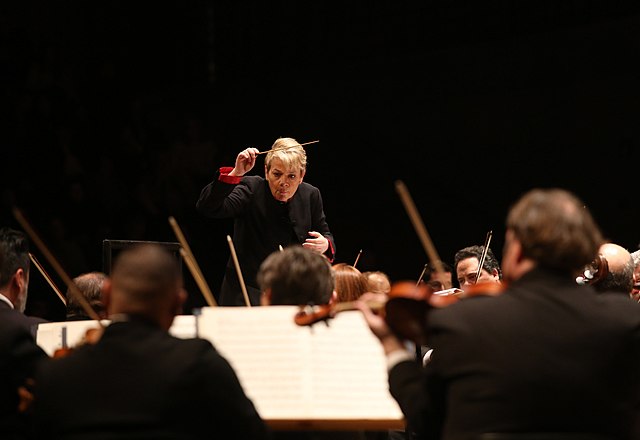
Marin Alsop in action in 2017. Image: Mastrangelo Reino /A2img. Wikimedia Commons

We had three world premieres with the composers present and spotlighted after the performances – James Wilson’s 1922, Roxanna Panufnik’s Coronation Sanctus and Laura Karpman’s Higher Further Faster Together. You felt the strong guiding hand of Alsop in these choices. She is a pioneer of new music and, as she said in her closing speech, gender equality in classical music. She was even brave enough to mention Aberystwyth as a location of a Proms concert next year. She admitted she had been practicing the pronunciation all day. I imagined the maestro stalking the back rooms of the RAH not with a Verdi score but a guide to Welsh place names. Let’s hope Llanfairpwllgwyngyllgogerychwyrndrobwllllantysiligogogoch puts a bid to host one year. Marin will certainly earn her fee.

It was a party atmosphere but tempered by reverence for the performers. The BBC Symphony Orchestra played their hearts out, and the loudest sustained cheers were for the BBC Singers, once threatened with extinction but now sort of reprieved (we must remain vigilant to keep them a going concern). The BBC Chorus was full of gusto for Jerusalem and Land of Hope and Glory and the concluding Auld Lang Syne when our collective voices drowned out the orchestra. Marin turned to conduct us all as balloons were sent soaring and crackers were set off almost in time to the music. This was a profound, passionate celebration of classical music with the barriers of elitism and traditions dissolved into pure joy.  In one evening we had the soaring wonders of William Walton’s Coronation Te Deum for the coronation of Queen Elizabeth II and the festive and glittering Coronation Sanctus of Roxanna Panufnik composed for King Charles III’s coronation service and the theme from the upcoming film The Marvels by flamboyant US composer Laura Karpman with Marvel Comics celebrating super heroines; very appropriate given Marin Alsop’s absolute control over the proceedings. Super Marin, perhaps.   

Last Night of a distinguished Prommer

MARTIN GODLEMAN witnesses Sir Simon Rattle’s LSO swansong

Sir Simon Rattle. Image: Monika Rittershaus. Wikimedia Commons

I should have had a more pronounced focus on advanced ticket sales of Prom 56 when I casually noticed that Simon Rattle would not only be present at the eight week festival of music, but there to conduct Mahler’s Symphony No.9 [27 August, but available until 9 October on BBC Sounds].

Rattle, himself British-German, was born in Liverpool in 1955, the same year that the International Gustav Mahler Society was established. Needless to say, the concert had sold out almost immediately by the time I had become aware of it. Fortunately, thanks to a generous and industrious benefactor, I managed miraculously to procure a seat for myself just a week before the event.

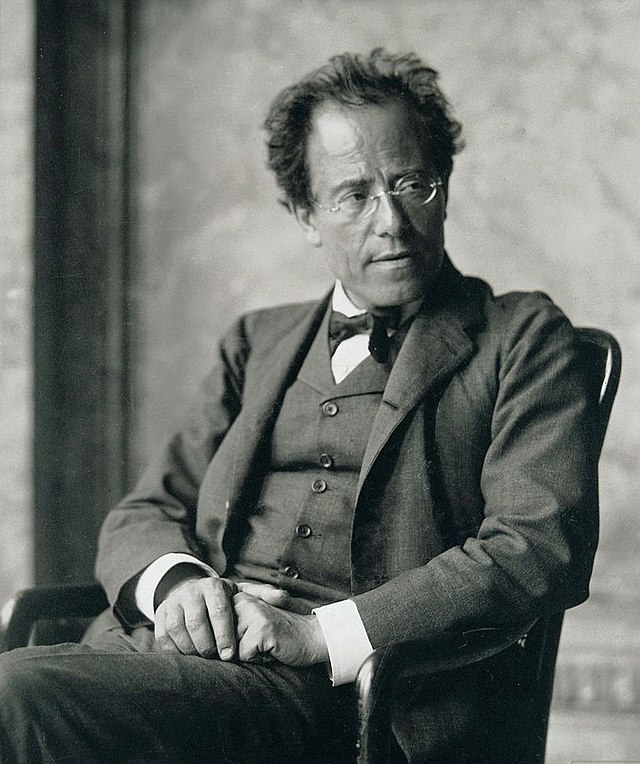
Mahler, an Austro-Bohemian, actually earned his living at the turn of the 20th century as a conductor of opera, interpreting the stage works of, amongst others, Mozart, Tchaikovsky and Wagner. His was a career that led to his post as director of New York’s Metropolitan Opera. On his days off, most of which he must have spent travelling across the world from concert to concert, he managed to somehow find time to attend to his other passion as a composer, one that brought him little financial success in his own lifetime, but one which, thankfully for us, he never abandoned.

Perfect then that Rattle, whose lifespan covers the years over which Mahler’s reputation as a composer has been established, should conduct him. Equally sublime that Rattle, for whom this is a final UK outing as Music Director of the London Symphony Orchestra, should choose to conduct Mahler’s farewell symphony, the ninth. Rattle himself was knighted in 1994, eight years before becoming principal conductor and artistic director of the Berlin Philharmonic, then taking on the challenge of Mahler’s Symphony No. 5 at his opening performance in September 2002, almost exactly 21 years ago.

Gustav Mahler

I had been fortunate enough to attend Mahler’s ninth at the Proms before in July 2011, when Sir Roger Norrington conducted the Stuttgart Radio Symphony Orchestra in his final concert with them. The appeal of this piece of music to orchestrate a professional farewell from one’s role as principal conductor of a world-renowned orchestra was therefore not lost on me, or indeed Rattle. Few conductors are recognisable from outer space, but I’d wager that any alien with a penchant for classical music would immediately recognise the white, crimped locks of Rattle, monochromous tonight against his smart black livery.

Rattle takes initially to the podium to conduct the BBC Singers performing Poulenc’s Figure Humaine, a cantata, a hymn to freedom, dedicated to Picasso and composed in 1943 during the Nazi occupation of France. The BBC Singers were also behind its premiere in London, in English, on Palm Sunday, 25th March 1945 – the score having been smuggled over to the UK five months before the war ended. A beautiful and intense choral work, chosen specially by Rattle who has described it as ‘profoundly moving; one of the greatest masterpieces that people don’t know.’

It was tonight the perfect appetiser for the evening’s main course, radiant in energy and harmonic, a choral masterpiece against tyranny. Rattle makes a point of leading out Sofi Jeannin, the Swedish chief conductor of the BBC Singers, to share the applause she has paid a central part in promoting. Then, after a short rehydration break, the conductor faces his ‘farewell’ challenge with the LSO, a group of people he has on more than one occasion described as his ‘family’. There is something religious about the falling silent of audience, orchestra and conductor before the onset of a final performance, whether it be of the night, a concert series, or of a career in post.

The ninth is, I would argue, the most self-consciously reflective of all of Mahler’s works, its tone set by the ponderous and lugubrious opening to the symphony, so alien to any of Mahler’s other, bolder dramatic initiations. I am gripped in anticipation by that silence. What a man is Rattle that he can let the whole of this majestic, mysterious and magnificent piece of music inhabit him as he hangs over that silence, ready to conduct.

Through Rattle, Mahler’s work tonight occupies a landscape of sound, narrating a man’s pain as cuckolded husband, unrecognised composer, dying… a man who was intimately aware of his own fate. James Joyce once said that for anyone to be serious about the study of his writing, they would have to be prepared to dedicate a lifetime to the task. For me, this single piece of music cries out for the same attention.

I find myself drawn to the horn section, and tonight the emotion of the opening movement is cradled by the subtlety of their handling of its many hanging moments. With his back to me, I cannot see Rattle’s cheek puffing, his teasing out of the connect between the players and the piece, but I can see them looking up at him, their eyes smiling. His family. The tiny mallets skilfully tap out the ringing of the tubular bells at the edge of that first movement; the climbing and scaling of the players across the terrain that Mahler has challenged them to cove. From the roof of the piccolo to the floor of the contrabassoon, Rattle weaves them in and out of the musical foliage.

It is a wondrous performance, and like the knowledge of death that Mahler hints at across the piece, the experience tonight is ultimately mortal. At the end of the first movement, Rattle nods knowingly in judgement of what we have all experienced, players and audience alike. I wonder at how effective my ears are tonight. Like reading a book at 18 and again at 65, the words, the notes, are static on the page, only ever brought to life by the human experience. As the orchestra move gently, urgently, left and right, I contemplate the cold fact that Mahler never heard or directed this piece himself. It only ever moved in his head, as he wrote it. What would he think about all of this? This performance 114 years on from the writing of it, conducted by someone whose love of the work has given us all this sublime evening. The thought is worthy of something with which to underpin tonight’s unforgettable experience.

Italian light, and Nordic darkness

Image: Stuart Millson
STUART MILLSON (celebrating his 43rd season) reports from the 2023 Proms

‘Where are the Proms of my youth?’ asked Barrie Hall’s now almost forgotten book, The Proms and the Men Who Made Them – a title that would be unlikely to pass the sensitivity readers of today’s London publishers. When I first attended the Proms, one joined a queue (along with all the other sixth-formers and undergrads) for the Gallery or Arena. You paid your few pounds at a little booking-office-type hole on the south side of the Royal Albert Hall and in you went. For the Last Night, people camped outside on the pavement near the Hall’s South Steps for two weeks, just to ensure a place on the front rail of the Arena, or close to it. Today, Promenaders no longer queue up: you book your Arena or Gallery ticket online. And the Last Night camp was abolished years ago, on health and safety grounds.

There have been changes in the repertoire and in presentation: this season, the BBC Concert Orchestra collaborated in a Northern Soul Prom – something that would have been virtually unheard of in the days of past Controllers of Music and Directors of the Proms (although Soft Machine did manage to creep in under Sir William Glock’s radar in 1971). Have such initiatives opened up the Proms to a younger audience? I am not sure. In 1983, the Arena was composed of 75% youth, 25% oldies. The ratio seems to have reversed. So more work needs to be done – perhaps more classical music, less Northern Soul, or at least another type of soul from the North.

Sir William Walton. Image: NPG (Wikimedia Commons)

For the 3rd August Prom, given by the BBC Philharmonic (formerly, BBC Northern Symphony Orchestra), Oldham-born William Walton (1902-83) provided the centrepiece of the concert, in the form of his Violin Concerto of 1939 – a work inspired by the composer’s abiding love for Italy and its riviera. Tinged with Mediterranean sunsets and shadows, and containing many moments of deep lyrical introspection and unbridled romanticism, the Concerto nevertheless provides some ferociously exciting and incisive sections for both soloist and orchestra. Playing the solo part that night was Manitoba-born James Ehnes – a musician renowned for his interpretation of Walton – and one who finds the true measure of a composer too often seen as something of a steely recluse, but who, in his heyday, was a determined, passionate and often avant-garde figure.

The Violin Concerto (like the stormy First Symphony written some four years earlier) has a surprise up its sleeve for the listener – a break from all the heavy preceding passion via a ‘presto’ movement, laced with a dash of jabbing, smirking, sardonic humour; softened by a waltzy, Neopolitan dance rhythm – the effect, like a generous glug of wine tipped into a glass during a fiesta. The movement, though, also broadens out into a serious nocturne: dreamy, intense; the dissatisfied Englishman abroad sinking into his local surroundings, yet thinking (perhaps) of glimpses of home. But for Walton after the Second World War, ‘home’ ceased to be England; with his new Argentinian wife, the composer turned his back on queues and nationalisation, settling on the little isle of Ischia out in the Bay of Naples. Continuing to compose, he produced such fine pieces as his Cello Concerto and a grand opera, but never quite recapturing the ardour and brilliantly-written soundscape of the Violin Concerto. As author Laurie Lee once observed: “All the great hymns to the sun are written in cold garrets.” When you are in the sun, you just… sit in the sunshine.

Image: Daniel Nyblin (Wikimedia Commons)

Sibelius’s Symphony No. 1 ended the concert. In a lifespan similar to that of Vaughan Williams, Sibelius lived from the era of empires and Grand Duchies, to the atomic age and world order of the United Nations. Yet throughout the changes remained rooted to a vision – and a physical reality – of an unchanging landscape and heritage. In his music, Nordic deities make brief, spectral appearances through endless pine woods; swans in flight sweep like angels across frozen lakes, on corridors of cold air – and at night, bards tell tales of heroes and worlds gone by. The First Symphony comes from 1900 – or rather, it was revised in that year, because it is essentially a late-19th-century piece, influenced by the dense harmonies of Tchaikovsky, but still (in the opening movement) showing signs of the fleeting, sparkling, supernatural Northern Lights that characterise the fully-individual works that would come – the kind of delicate, subliminal Nordic Impressionism of, say, the Sixth Symphony. Conducted by the Finnish maestro, John Storgards, both Walton and Sibelius found a worthy interpreter.

Just a word about the opening piece, Kafka’s Earplugs (a BBC commission for Irish contemporary composer, Gerald Barry, born 1952). Not even the Kafka title and the composer’s self-described “sense of humour, which I obey” could rescue this ten-minute monotony – and mediocrity. As the piece ended, one member of the audience shouted: “Total rubbish!” Who are we to disagree? 

Deep state

DEREK TURNER is editor of The Brazen Head. He is also a novelist, reviewer, travelogist, and the author of the chorography Edge of England: Landfall in Lincolnshire (Hurst, 2022). www.derek-turner.com. Twitter: @derekturner1964. Instagram: edge.of.england

“Stilled legendary depth:
It was as deep as England”

‘Pike’, Ted Hughes

The plumber’s van’s been standing since the small hours

At the fishing-place beside the chartered town;

Its driver has been sounding deeper waters

Since he set up as the night was going down.


He saw the sun come wheeling up from ocean,

Watched whitening sky go glowing into gold;

Heard the birds orchestrate their calling,

Stamped booted feet to counteract life’s cold.


Cynosure of today these level courses –

These muddy understated lowland drains

Whose depths hide evolution’s shining forces –

Silver knights swim pricking on these plains.


Other men stare silent at reflections,

Itching for a twitch upon their lines,

Unknowing echo ancient Izaak Walton,

Compleatest anglers, contemplating time.


Coarse fishers here can sit on thrones like Doges

Wedded to the waters of their wealth;

Serene for once among the mace and sedges,

Each man an island nation to himself.


Slow surface holds deep state of planted kingdoms,

Mirrors showing sallow, alder, oak –

Chlorophylled and kingly-symbolled leaves

The royal trees on any English road.


The tops of reeds stand proud among sheet-silver,

Their dirty roots outshone by swelling light –

Excaliburs – or the lances of dead riders

Who rode here once to set the east alight.


Waterfowl calls urgently to offspring –

Brown fuzzy balls bob cheeping at her steer.

The angler cannot stop himself from smiling,

As he casts for luck across the haunted mere.


(Awake by now at home, his fishing widow,

Sipping her first coffee of the day.

Smiling at her grandkids out the window –

Her ducklings’ ducks, so soon to swim away.)


The plants that edge the lake have grown here always;

Reseeded from some Anglo-Saxon store –

Marginalia from the seventh century,

Still richly green if now less filled with lore.


Epona tails of Rome and Celt connections

Vanished lands in floreated forms –

Lush lowland lawn, these thronging herbs of nations,

Forget-me-nots and flags, dog-rose and thorn.


Apothecaries prospected these elixirs,

Water-mint and yarrow, woad and rue –

Cut and dried for daubed dog-Latined ewers,

Cures for flux, stone, plague, and marsh-ague.


Pallid fish slide silent near the surface

Or nose among new-inundated grass,

Animals always searching for advantage,

Ghosts glimpsed in oxidising antique glass.


Carp suck and spap and rise to find him casting;

Their ancestors gaped for God-believing men;

Now endless sky, that abbey’s painted ceiling –

Great fane forlorn, foundation lost in fen.


He throws his line along the deepest margins,

His hook hangs in the decomposing ooze;

He hovers with all fish beyond all ageing –

Quick and dead commingled in long view.