Refighting the last war

The Armchair General: Can You Defeat the Nazis?

John Buckley, Century, £14.99

KEN BELL goes on the counterfactual offensive

Many historians like to say that counter-factualism is a waste of time, at least until the port has been around the table twice and then they tend to become as keen as the rest of us on the what if game. John Buckley’s The Armchair General is probably one of the best examples of counter-factualism I have seen in a long time, probably because he sticks as closely as possible to either what happened, or to what we think would have happened had things been slightly different.

Buckley takes eight major events from the Second World War and sets the scene for each of them in turn. Then, the reader has to make a choice from two options that are presented to him. Depending upon his choice, he then moves to another section of the book, where that scenario plays out and further options are offered.

Let’s take the aftermath of the Norway Debate in May 1940 as a case in point, as it is the first chapter in the book. Chamberlain has won the debate, but with a party that is badly split. Playing the role of David Margesson, the Tory Chief Whip, you take soundings and find that Winston Churchill and Lord Halifax are the two favourites to succeed him. Labour will not form a coalition under Chamberlain and lean towards Halifax, but will accept Churchill. Who do you recommend?

If you choose Halifax then the possibility of Italian mediation would probably have come into play. The war would end with a British defeat, but the army would have been allowed to leave the continent in good order and with all its equipment intact. Germany would probably have taken back the African colonies that she had lost in 1918 and possibly Malta would have gone to the Italians as a reward for their efforts at peace. All this would have amounted to a defeat, but not the end of the world, and a lot of people in Britain would have been happy enough to take the deal and ignore future events in Europe.

On the other hand, if you opt for Churchill, then your options can lead you to the actual historical outcome, but that is far from certain. The other option is based on the fact that Churchill was afraid that Halifax might have resigned as Foreign Secretary and taken Chamberlain with him to form a peace faction unless peace feelers went out. In reality that did not happen, but had Halifax threatened it unless he could at least explore the Italian option he would have probably got his way. In this version that is exactly what he does so we head towards a mediated peace brokered by Italy.

The really engaging aspect of this book is that by keeping to what we know about these events the younger students of history will be encouraged to see that historical outcomes are the result of the decisions that were taken by real men. Those men were often acting with unclear information against a backdrop of real pressure to come up with something.

It would have been very easy for Professor Buckley to fall into what I call the fantasy trap of the counter-factual game and go off with ludicrous flights of whimsy. Sir Winston Churchill as a writer did that with a piece that speculated on what might have happened had the Confederacy won the Battle of Gettysburg in 1863. He started by allowing General Lee to abolish slavery in the new republic, an utterly risible thought. Buckley keeps to the conservative options at all times, which makes his work very credible indeed.

The Armchair General takes the reader from May 1940 to the dropping of the atomic bomb in 1945. Some chapters are more complicated than others, with the one devoted to the opening stages of Operation Barbarossa being a case in point. As part of the Soviet leadership do you remove Joe Stalin? If you keep him can Moscow be held? That section was one that I really enjoyed as the reader gets to play an NKVD officer, and I have always thought that I would have been rather good at that role.

The whole book is similarly great fun, based on solid research by a professional historian. I enjoyed every minute of it.

Punishing treatment

Bleeding for Jesus: John Smyth and the Cult of the Iwerne Camps

Andrew Graystone, Darton, Longman & Todd, £12.99

KEN BELL winces through a sad story of sadistic abuse and cover-up

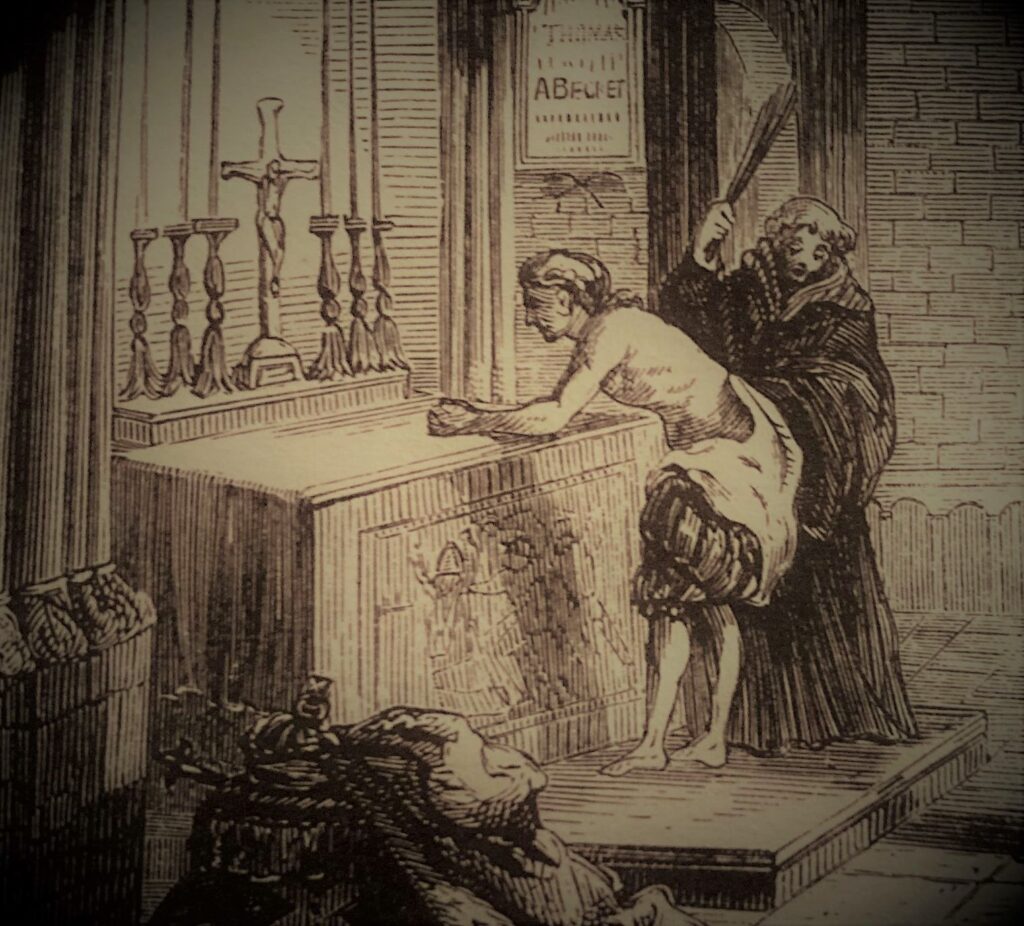
John Smyth QC had a public image in the 1970s and 1980s as a conservative activist who worked with Mary Whitehouse in her failed campaigns to hold back the twentieth century. He lived near Winchester College, and was well-known there as a senior figure in the Iwerne Trust, which recruited young men to Evangelical Anglicanism. John and Anne Smith often entertained boys from the college at their home, and Smyth became known as a man who would openly discuss matters that troubled the budding Evangelicals. Masturbation was one, and the need for a man who has given himself to Christ to suffer for his sins was another.

You can see where this is going, and sure enough it made a marvellous cover for Smyth, a moralistic homoerotic sadist who used his position to take youths and young men to his garden shed, order them to strip naked before administering ferocious canings to their bare bottoms. As part of the ritual, Smyth was also naked, and lotion was helpfully kept on a side table which Smyth used to soothe the ravaged backsides before putting the victim into adult nappies so that the blood after a caning of up to several hundred strokes would not stain his trousers. Then the fellow would be sent off to the house, for a nice cup of tea from Anne, who would offer him a cushion to sit on. Smyth had thoughtfully soundproofed his shed and a small pennant was stuck in the garden as a sign to Anne not to approach.

On one level the story of John Smyth and his predilection for BDSM is yet another account of an older, upper-class, closeted homosexual getting his rocks off with younger men. There is no suggestion in Andrew Graystone’s account of anybody being coerced, and neither can Smyth be accused of paedophilia, as none of the submissive participants were pre-pubescent. However, it is always the cover-up that is important with these matters, and the concealment of Smyth’s activities involved rather a lot of people who did an excellent job of keeping a lid on the story for many years.

Smyth looked for participants amongst the older pupils at Winchester, which was an inspired choice as the school, according to Graystone, comes over as a closed world where what happens in the school stays in the school. The pupils speak what amounts to a cant tongue, where words that are really only known to the initiates are used; thus homework is called ‘toytown’ and bicycles are ‘bogles,’ to give just two examples. The whole institution seems to operate with its own ‘complex and arcane culture’ that had been handed down the generations with its original meanings probably long forgotten but which were adhered to religiously. New pupils were tested at the end of their first term on their grasp of the cant, and any who failed could often expect a dose of the cane to encourage further study.

His chairmanship of the Iwerne Trust allowed him to recruit volunteers for the rod from a wider field than just Winchester. The trust ran summer camps to provide intense religious training in Evangelicalism and entry was restricted to pupils at the elite public schools. The aim of the camps was to take tomorrow’s leaders of Britain and ensure that as many as possible became Evangelicals. John Smyth must have been in his element.

Eventually, of course, the complaints about Smyth’s activities began to mount, but incredibly enough, all the complainers did was contact the senior figures within the same Evangelical sub-section of Anglicanism that was part and parcel of the problem. A gaggle of fathers descended on Winchester College to demand that something be done, but at the same time they insisted that whatever was done had to happen quietly.

A report on Smyth was prepared in 1982, which runs to twenty-two short paragraphs, and sets out succinctly what he had been up to. This report was then hidden away and only shown to a few senior Evangelicals. Its author, Mark Ruston, was very concerned that Smyth’s activities may have been heretical. In particular, he believed that the canings strayed dangerously close to ‘a flirtation with Popery,’ owing to the obsession with ‘penance’ and it seems to have been that theological concern, rather than the BDSM dungeon that Smyth had created out of his garden shed that was the most troubling.

The headmaster of Winchester College banned Smyth from the premises, which mollified the fathers at least. The Evangelical capos concluded that Smyth was in error theologically, and that issue could be corrected quietly.  Smyth helped the process along by taking his collection of canes and nappies into the garden and making a bonfire out of them.

Finally, the Iwerne Trust arranged for Smyth and his family to move to Zimbabwe in 1984 with a special trust fund to cover his living expenses. There, he pretty much carried on as before only this time with African youths rather than English ones. Eventually, the heat became too much in that country, so he scampered off to South Africa and there continued in his old way until the local church expelled him. By 2018, with the story having finally broken, he very conveniently for all concerned died of a heart attack in Cape Town.

This fairly unpleasant tale is not really about Anglicanism or its Evangelical sub-section. It is actually the seemingly endless story of upper-class abuse, the sense of entitlement that those people have and the code of omerta that governs it all. By helping to break the story, Andrew Graystone has helped to shed some light into the activities, mores and attitudes of our country’s rulers and the state that exists for their benefit. That, finally, is a very good thing indeed.

Unfinished symphony in Oz

R. J. STOVE says reports of the death of Australian classical music education have been greatly exaggerated

The most satisfying paid regular employment that I have ever experienced concluded on 11 November 2021. For a twelve-week course, I worked as a sessional tutor under the University of Sydney’s auspices. The tutorials – overarching title: ‘Music in Western Culture’ – catered not purely for first-year music majors, but for first-year majors in other fields too. (As I write this paragraph, there remains some essay-marking for me to complete.)

Initially, I felt overwhelming panic, thanks to the requirement for near-Lisztian virtuosity in the Zoom-PowerPoint combination. ‘Have I turned the sound on?’ ‘Have I turned it off?’ ‘Have I accidentally shared the answers to tutorial questions?’ Of the course’s first two weeks, almost no memories remain except my visceral technophobia.

Besides, what (I wondered) if my students turned out to be a monstrous regiment of snowflakes, merrily toppling the nearest Queen Victoria monument, when not ululating into their smartphones about being ‘triggered’ by my own ‘Eurocentric’, ‘cisgendered,’ ‘heteronormative’ ‘microaggressions’ and ‘cultural appropriations’ upholding ‘the patriarchy’? Could my restricted didactic aptitude ensure those ‘safe spaces’ that Homo Snowflakiens considers indispensable?

My fears proved excessive. Zoom’s malfunctions and eastern Australia’s draconian lockdowns notwithstanding, I received from students consistent politeness. Whether this resulted from good luck – or from, instead, some antecedent administrative colander by which the palpably woke had been strained out, before they could contaminate the main dish – others must determine. Possibly a third cause prevailed.

All in all, my first salaried academic occupation gave me intense pleasure. The moment when everything clicked occurred as I replayed one of the tutorials’ set pieces: a Haydn piano sonata scintillatingly performed by L’viv-born, Manhattan-based Emanuel Ax. Suddenly I realised: ‘I’m receiving federal subsidies for listening to this marvellous stuff.’

Last summer’s dirge from a prominent British musicologist, who has huffily left the discipline (short version: ‘Goodbye, cruel world’), inspires not the faintest empathetic echo in my bosom. The musicologist achieved a full professorship before he had turned thirty-eight; maybe therein lies his whole trouble. 

Yes, my job had its nuisances, principally an exasperating holdup in my wages’ arrival, plus a nasty bout of mid-term illness which required my hospitalisation (and which complicated my already overworked colleagues’ timetables). About these nuisances I shall say little, partly because I crave further university employment, but chiefly because such irritants come with fallen human nature. Erstwhile Esquire boss Arnold Gingrich cherished a magnificently orotund sentence redeeming, circa 1947, one otherwise humdrum epistle to the editor: ‘I find no fault in Esquire that I do not find with the age that produced it.’ Mutatis mutandis, this encapsulates my response to Australian academe.

+++

What straightaway impressed me, regarding the ‘Music in Western Culture’ course, was its predominating old-fashioned decorum. The main textbook, A History of Western Music, is but a revision – by Indiana University’s J. Peter Burkholder – of an identically named volume known earlier as ‘Palisca’ and even earlier as ‘Grout’ (after the previous versions’ respective authors: C.V. Palisca and Donald J. Grout, who died in, respectively, 2001 and 1987).

We who grew up with ‘Palisca’ and ‘Grout’ found much of Burkholder’s tome familiar. True, Burkholder cites hip-hop and sexual identity politics, as Grout would never have done; true, feminist considerations now compel coverage of female composers – Hildegard of Bingen among them – whom Palisca and Grout either underrated or omitted. These are incidentals. Aesthetic detachment marks all three musicologists: their audiences, happily, will find no clues as to which genres are the authors’ own favourites.

It scarcely requires accentuating how objectionable this dignified scholastic model is within Critical Race Theory’s snake-pit, which one Philip Ewell now inhabits. Ewell (of City University New York) bears the same relation to a conventional apparatchik like Norman Lebrecht that Wilhelm Reich bore to Freud, Foucault to Sartre, and Pol Pot to Brezhnev.

The Wuhan market, as it were, which first disseminated Ewell’s ‘thinking’ was a 2019 lecture to the blandly named Society for Music Theory, where Ewell demanded that Western music’s ‘white racial frame’ be ‘decolonised.’ (He nowhere condescended to explain who would do the decolonising. R. Kelly?) Ewell cast special opprobrium upon theorist Heinrich Schenker, a Jewish thinker never previously charged with white supremacism. Ordinary teaching of Western staff notation, teaching liable to necessitate such elitist hierarchical signifiers as ‘dominant’ and ‘subdominant,’ goaded Ewell to rage.

Timothy Jackson, a white liberal at the University of North Texas, organised a firm but courteous refutation of Ewell. This refutation – involving fifteen writers – occupied an issue of the magazine that Jackson co-edits, the Journal of Schenkerian Studies. The issue’s appearance activated frenzied calls for Jackson’s dismissal. At his references to racial slurs among Ewell’s beloved rappers, the anti-Jackson brigade took particular offence. One touch of (inadvertent) farce emerged from Ewell’s champions, when a female Canadian pundit treated the world to its least felicitous  recent neologism: she derided Schenker’s white female adherents as ‘SchenKarens.’

Throughout my own work contract, I heard not a syllable of Ewell-advocacy. This argues for some inherent common sense within the Australian university system.

+++

The system had other merits. On average, each of my online tutorials contained twelve students. This was (apologies for sounding Panglossian) the best of all possible class sizes. Too small a group, and a single garrulous individual can monopolise the whole hour. Too large a group encourages dumbed-down populism. The latter hazard could well plague all vast programmes aiming to save the world through one colossal music lesson.

Of the Orff and Kodály instructional methods’ details, I lack the competence to speak. Alas, no such mitigating circumstances characterise the Suzuki method, which its founder’s fake doctorate and bogus claims to Weimar Republic tuition make hard to stomach now. Nor do they characterise the Venezuela-derived El Sistema. Once viewed as the ultimate in pedagogical chic, El Sistema prompted in 2014 a devastating book-length exposé by Geoff Baker, left-wing musicologist and Guardian correspondent. Baker’s harrowing disclosures incorporate accounts of El Sistema’s explicitly erotic corruption.

So much for the New York Times feature on El Sistema (16 February 2012) with a banner typifying the method’s longstanding media hype about proletarian empowerment: ‘Fighting Poverty, Armed With Violins.’ The perfect modern validation, surely, of William Dean Howells’s acerbic epigram ‘Americans want tragedies with happy endings.’

+++

Naturally ‘Music in Western Culture’ was spared all carnal predators and all holders of counterfeit PhDs. My largely congenial experiences engendered my quiet, healthy scepticism towards anti-intellectual harangues from Fox News’s talking heads. Had I believed apocalyptic rhetoricians so obsessive that they could probably detect woke outrages on the planet Saturn, I would have been too scared to do my job.

Unlike those talking heads, I acutely recollect Australia’s higher education during the Cold War. This had its joys, above all Sydney’s Dr Andrew Riemer – specialist in Elizabethan-Jacobean drama – who gave the clearest, most fair-minded lectures which I have heard on any topic. (He subsequently produced memoirs as readable as, and striking deeper than, Clive James’s.)

Yet no milieu is less apt than my undergraduate youth to provoke my predispositions, themselves infinitesimally sparse, towards Golden Age nostalgia. Is woke craziness in 2021 truly more malevolent in its effects on academe than was Martin Bernal’s craziness (the briefly modish ‘Black Athena’ phantasm) in 1991? Or Sandinista craziness in 1981? Or anti-Vietnam-War craziness in 1971? Or D.H. Lawrence’s craziness in 1961? Or – lest we forget – Freudian craziness in 1951? Frankly, I doubt it. (I speak as one who, when a small and always fearful child, repeatedly wondered whether my father would get home alive after his daily encounters with draft-dodging, vandalising mobs who shrieked ‘Ho, Ho, Ho Chi Minh! / The NLF is gonna win!’.)

Against several benchmarks, Australian humanities departments have improved. A trivial but significant amelioration: I marvel at how attractive their latter-day recordings of medieval music are.

Students no longer gain their formative exposures to the Middle Ages’ sounds, as I gained lots of mine forty-one years ago, through the Historical Anthology of Music  series (surface-noise-infested American LPs supplementing a primer that dated from 1946). There, every second track seemed to comprise bleating from three Teutonic nonagenarians with vibratos almost wide enough to march a platoon through. It was, furthermore, mandatory to capture the nonagenarians in an acoustic resembling someone’s broom-cupboard. Today, anyone trawling through music schools’ libraries (to say nothing of Spotify or YouTube) can find more abundant and beauteous early-music renditions inside an hour than we in 1980 could have located inside six months.

+++

More momentous are universities’ newish regulations for conduct. I think of those Australian academics in the 1980s – wielding influence disproportionate to their limited numbers – who at best channelled Lucky Jim Dixon, and at worst channelled Walter Mitty. Thanks in part to online packages like Turnitin, sanctions against plagiarism (whoever commits it) have teeth now, whereas in the 1980s no such sanctions existed. Admirers of that classic 1948 film The Red Shoes will appreciate the impunity with which unscrupulous teachers once thieved pupils’ material, in music as elsewhere.

Heaven knows, present-day Australian students are susceptible enough to the pernicious worldviews expounded by Peter Singer. That said, I – unlike those students – am conversant with the equally pernicious worldviews expounded by the University of Sydney’s 1927–1958 philosophy professor John Anderson: militantly anti-Christian demagogue and long-time Communist Party fellow-traveller, with compulsive unwillingness to differentiate the ontological concept of ‘female undergraduate’ from that of ‘sex toy.’ Nor was Anderson’s unwillingness unique. While the worst predation flourished amid the Age of Aquarius, as late as 1984 our juvenile gossip included a pervasive wisecrack concerning the relevant transaction: ‘a lay for an A.’ And this taxpayer-funded bonking  was, be it emphasised, entirely legal.

Some outstandingly toxic teacher-student relationships encompassed no physical acts. Wherever degrees are both rare and esteemed, opportunities for students to levy emotional blackmail against teachers (or vice versa) proliferate. Joyce Carol Oates’s short story ‘In the Region of Ice’ frighteningly depicts the inexorable persecution of a teaching nun by her male protégé.

‘Well, for good or evil’ – I here quote Chesterton’s Autobiography – ‘that is all dead.’ Manipulative teacher-student interactions will seldom eventuate when each participant is a mere flickering Zoom image to the other. Moreover, with the nation’s 1989–1992 university reforms, the droit du seigneur over female students (not to mention over female secretaries) disappeared from Australian tenured life’s fringe-benefits.

This tenured life itself – like its British counterpart – has dwindled to a rarity which in the USA is unimaginable. In 2006, one Australian lecturer told Inez Baranay, a Sydney-based novelist-essayist: ‘the area I teach in has not appointed any tenured academics in ten years.’ Undoubtedly, entrenching casual labour carries risks; in Sydney’s and Melbourne’s higher education systems, wage theft has reached alarming levels. But likewise undoubtedly, the pre-1989 antipodean routine of near-automatic tenure mollycoddled so many layabouts that it just had to be scrapped.

Australia’s sustained Cold War prosperity facilitated tenure’s abuse. The abolition of student fees in 1974, by Gough Whitlam’s government, merely reinforced the long-extant system whereby eighty per cent  of local undergraduates avoided paying fees anyhow (the University of Western Australia, in Perth, charged no fees at all). Nor, in that profligate epoch, did stringent selection criteria for staffers invariably operate. Thank goodness, arbiters of Australian students’ destinies no longer include that frequent pest from my young manhood: the rancorous idler who had not published a solitary article or, indeed, drawn a solitary sober breath since around 1960.

+++

Another, and unexpected, modern improvement concerns religion. Current Australian academe has got ninety-nine problems, but Freemasonry ain’t one. (Read the 1997 biography of Australia’s classics scholar F.J.H. Letters, by his widow Kathleen, if you dispute local lodges’ former influence over universities.) Whatever my attire’s shortcomings, no-one has commanded me to rectify these by procuring a leather apron.

Neither have any university personnel weaponised against me my Catholicism, shared with Letters himself, and discoverable through five minutes on Google. To Australians my age or older, such newfound tolerance of ‘papists’ is mind-boggling. We recall the longevity of a tabloid, The Rock, which for half a century after 1944 spewed Klan-style vilification against Catholicism (it greeted sponsored Italian immigrants with headlines like ‘450 Human Wogs Arrive’).

Hardly anyone admitted to reading The Rock, but that fact indicates how many liars Australia had. Because at the tabloid’s pre-Vatican-II apex, it sold 30,000 copies per issue: a remarkable total in a country with under eleven million inhabitants, and quite adequate for coercing numerous politicians into servility. Witnessing The Rock’s diatribes and their parliamentary counterparts, Scottish newspaperman John Douglas Pringle – an unbeliever – lamented: ‘Anti-Catholic feeling is extremely strong in Australia. From time to time it bursts out like lava from a sleeping volcano, burning and destroying everything it touches.’

Of course, as the mendacious campaigns against Cardinal Pell showed, this emotion has not vanished from Australia’s midst. It still governs our state police forces and schoolteachers’ unions; all of our gutter media (what are our surviving non-gutter media, pray tell?); much of our medical establishment; and much of our judiciary. Nonetheless, for whatever reason, anti-Catholic wrath now leaves New South Wales’s universities undisturbed. Without this welcome change, I could never have attained academic emolument.

Decades back, my late Sydney chaplain friend Father Paul Stenhouse once parked his car on campus, having left visible his dashboard’s Virgin Mary statuette; he returned to find the windshield smashed. These days, comparable sectarian malevolence incurs serious penalties, Twitter castigation included. Back then, had Father Stenhouse formally submitted a complaint, campus officials would have all but laughed in his face.

Cardinal Sir Norman Gilroy, Sydney’s Catholic archbishop from 1940 to 1971, had discouraged his flock from university attendance in general. What with Marian figurines being punishable by smashed windshields – and what with Anderson the bellicose Christophobe on the prowl, sizing up the female talent – the Cardinal was conceivably on to something.

+++

Altogether, therefore, I remain as conscious of Australian universities’ past defects as of their present ones. Whilst the latter are undeniable, I question the novelty and the immediate nature of their threat.

Incontrovertibly, it is dreadful that various full-fee-paying foreign students now graduate despite their limited spoken and written English. But even that vexation, albeit new in degree, has a prototype in kind: the Colombo Plan’s late-1950s zenith. This zenith placed academics like my father in loco parentis to numerous young Southeast Asians, who too often secured Australian degrees while insufficiently Anglophone to request a train-ticket unassisted, let alone to grasp my father’s lectures on David Hume’s metaphysics. In Dad’s own weary but eloquent aphorism: ‘the challenge is to fail.’

As for the reckless dream of higher education for all, surely the pandemic dispelled that dream faster than any libertarian think-tank could do. COVID has intensified our established dependence on couriers, cleaners, nurses, postal clerks, supermarket clerks, warehouse workers, slaughterhouse workers, aged-care workers, truck-drivers, and garbage-collectors, all of whom can acquire their specific proficiencies with not the slightest collegiate force-feeding. No First World polis can cope without these persons for twenty-four hours. Any First World polis can cope evermore without my musicological and organ-playing functions, though my school crossing function has retained since 2016 (in coronavirus-afflicted Melbourne at that) its utilitarian efficacy.

I wish to declare only this: however Augean academe’s stables might be elsewhere, my colleagues and I kept our own minuscule domain really rather neat. Hereabouts, to update Mark Twain, the death of music teaching has been greatly exaggerated. For outsiders, combating this exaggeration will rarely matter much. But if televisual pundits grew rich from proclaiming that you yourself were dead, publicising the truth would urgently matter to you and your loved ones.

Sadly, perhaps my age (I am 59) will preclude further academic employment. Yet if offered it, would I accept it? Verily I say unto you, ‘Bring it on.’

Five poems by J. M. Jordan

J. M. JORDAN recently began writing again after a twenty-year hiatus. He is a Georgia (US) native, a Virginia resident, and a homicide detective by profession. His poems have appeared in Arion: A Journal of Classics and the Humanities, The Chattahoochee Review, Chronicles, Image Journal, Louisiana Literature, The Potomac Review and elsewhere.  

The Golden Key

I

He grabs his phone, his notebook and his gun.

A  trumpet echoes in the distant woods.                                       

A body is sprawled in the broke-bulb alley.

The wolf somehow knows him by his name.

A mute crowd gathers down the block.

The forest all around him laughs and whispers.

 II

The phone rings on a cluttered desk.

Watch  for an old blind beggar bearing gifts.                    

Rows of streetlights stretch in all directions.

The giant’s castle has a thousand rooms.

He puts a quiet finger to his lips.

The golden key turns slowly  in the lock.

III

He bangs the table in the tiny room.

The dragon crumbles in a cloud of smoke.

Technicians bag up items of intent.

The revelers at the feast all bow and vanish.

Sleep comes at last as daylight breaks.

The leaves all turn to birds and fly away.

Re-Reading

These words once were music

lifting from the page

like a soft grey clutch of quail

drifting in a sudden movement of the matinal air.                              

But that was time-lost, time-gone,

before a white hand pressed                                                           

against the window of a train

leaving a town I thought would do me in. 

Now these words curl like ash,

disintegrate on contact or

slip through the haggard mind

with all the meaning of the wind at dusk

whistling through a rag

hung upon a crooked stick                                         

in a field where great dark birds

swap jokes and laugh under their wings.

How Dare the Damn Wind

How dare the damn wind

come banging down the block,

swinging schoolyard elbows

and kicking over trashcans.

How dare the damn rain

slick streets and slosh the awnings,

snuffing out the bright ambitions

of afternoon and smoke-breaks.

How dare the damn cold

blister windows, stick car doors,

chasing dice and fistfights

from the treachery of sidewalks.

How dare it dammit all

conspire to keep you elsewhere,

from your deep quotidian double

at the end of this derelict bar,

stranding me here with only

a cough and a broken hat

and a row of untenanted stools,

fit only to cuss and mutter,

How dare the damn wind.

The Midnight Squad

We have burnt out our various ends,

ground down otherwise hours as

the bright blank day descends

in culverts and ramshackle alleys.

We have turned from the quick and close,

from every normal circadian debt,

to a tangled pursuit of ghosts.

Remember us then to the world

in bright-blown prayers that track

the startled rounds of each new day.

Bless us, then, remand us back

to the custody of the unlit hours.

Lines on Leaving

Under the gentle sway of the backyard string-lights,

in this golden space hollowed out here in the darkness,

sit with me for a moment, sheltered from the night’s

relentless rumor, and the drone of distant voices.

The raw brightness has slipped at last from the sky

and with it all the day’s attendant noises,

leaving only the whippoorwill’s call and a train

as it rumbles deep and distant down in the chest.

So stay with me here and finish the last of the wine,

for soon enough, I must step off into the night’s

impossible embrace, so thank you for this golden moment

under the gentle sway of the backyard string-lights.

From ‘The Wounded Cavalier’

These poems by BEVIL LUCK are from a dream-sequence set in the country house and garden of a cavalier who has fled the English Civil War. As his wound festers and the war is lost he languishes in the country, waiting for his lost love, all the while slowly becoming aware of other, older presences in the garden about him.

From ‘The Wounded Cavalier

I

Once in the wreck of a finch’s dream

I spied a single treasure,

plucked it from dust, one black

and garish-red bejewelled wing,

hurried it home, hid in my purse

to wait you for your pleasure—

but ah what sudden stream

of loveforbidding breeze snatched back

your fairing, lady, to the foul

nests of a warring universe?                                     

Long years since passed, I rise each dawn

and search the house: the gift is gone.

II

What hovers in the dust?

The light

like lint

a tint

with no slight

taint

—no saint

this white—

too bright

to see or paint,

too fine a glint

to paint, or trust.

III

There’s a grotto in the garden

hides a secret stair

with steps descending into shadow

made of shell and bone,

when soldiers came with torches

that tore the invisible air

I hid within my grotto

and whispered to my god.

The soldiers left the garden

but something else remained:

at the angle of the first turn

that shadow has a presence—

I’ll go no further down.

IV

Take hands, and kiss

oh kiss and kiss

under the apple tree

when the skirl of the viol

and the covey-coo

call the young to their wooing:

“for love, for love”.


Take hands, take hands

to kiss, and kiss

under the damson plum;

a theorbo’s thrum

in the damson bough

calls love to come

with wine in tow

for the young are at their wooing

and stars blush in the air.


Take hands, to kiss,

for love and youth

will flee with the knock in the night:

though the wooddove shouts

in the trees above

for love, for love,

the soldiers are deaf to its cries.

Inner pieces, inner peace

Credit: Shutterstock
PETER KING says inconsistency is not incoherency

We live in fragments. There is nothing that is so large to be all encompassing. There is nothing that is dominant, nothing that is the essence. Of course, we humans are common in our biology, psychology and our mortality, but this is not what defines us as individuals. As individuals we are wholes that are also fragments. We are complete and entire while also being part of something that is beyond us.

We do many different things that make us the whole that we are. All of these things can be ends in themselves, worthwhile without any exterior validation. We watch and play sport, and we do so for no other reason than the enjoyment we gain from the activity itself. Some of us may feel that our sporting allegiances define us, but this is never all that we are. We might describe ourselves by our job, our profession or perhaps our employer. But we come home at night and are someone else – a wife or husband, partner or parent, brother, sister, friend or even enemy. We have political views and we may only wish to associate with those who we agree with or have some affinity to. We may ‘never kiss a Tory’, but we probably work with them, sit next to them on the bus or train, wait behind them in a queue and are taught or treated by them when we are pupil, student or patient. We have tastes in art, and we have tastes in music which might be very different from our taste in art. We can have diverse tastes, admiring El Greco and Rubens as well as Rothko and Twombly; we can listen to Bach and Anthony Braxton and follow it up with Laurie Anderson; we can read James Boswell and Edward Lear before moving on to Vladimir Solovyov; we can watch a sci-fi thriller and the next night lose ourselves in Tarkovsky’s Mirror or Kurosawa’s Seven Samurai.

Is this inconsistent and incoherent? It might be seen to be, but I would say that this inconsistency is actually quite defining of what we are. As Ralph Waldo Emerson noted, “A foolish consistency is the hobgoblin of little minds.” The choices of what we listen to, read and watch may be different, but we each have diverse and often contradictory tastes, both at any one time and through time. As a teenager I read lots of war stories and fantasy novels as well as listening to punk music. I actively hated both Wodehouse and Eliot and all they stood for, and I had little time for classical music or jazz. Forty years later, I love both Wodehouse and Eliot and have no interest in going back to the novels of Sven Hassel or Michael Moorcock. But even now, as I have suggested above, I shift from the light to the heavy, the old to the new, the tuneful to the discordant, the easy to the difficult. These are all parts of what I am. They are fragments of my personality. None of them defines who I am; not one of them is me. But each of them says something about me, and each is as real as the any other.

My choices, I am sure, are not confected. I do not listen to certain types of music because I think I should or because it is what ‘people like me’ are supposed to do. I do not watch black and white Russian and Japanese films out of duty, but because I really enjoy them as well as finding them compelling and challenging. I will quite happily read Edward Lear’s nonsense verse while there is Anthony Braxton’s improvised jazz playing in the background.

So I do not see all this variety as incoherent or inconsistent. It is just how I, and, I believe, most others, live. It seems to me to be perverse to believe one should have such a consistency so that if one is a traditionalist in politics one must also be one in art and music. Not only does this forget that these, now traditional artists and composers, be it Caravaggio, Rembrandt, Bach or Mozart, were considered outrageously modern in their own time, but it also ignores that different arts progress at different stages. To do this is to put artificial criteria over our individual choices.

There is a lot of debate and disquiet over the issues of difference and diversity. These terms can be used to impose categories on people otherwise unwilling to accept them. They might also be seen as the means to attack traditional values. I can accept both those points while also insisting that each of us is diverse and full of difference. I would go so far as to say that most, if not all, of us have contradictory tastes. I would further state that this is natural and to be relished. If we have different moods, why not diverse tastes that can accommodate those moods? I would suggest we accept difference and diversity for no other reason that this is just how we are. This does not mean that we have to accept these terms beyond categories that apply to an individual. We do not have to accept them in political terms and nor does one have to buy into a postmodern worldview. We can have diverse views, and remain traditionalists.

What I want to suggest is that we are made of fragments. Each of these demonstrate a particular feeling, attitude, mode of behaviour, even view of the world. Each fragment is, at it were, complete. It is entire and we can express it fully, whether it be a particular allegiance or an attitude towards a painting or poem. We can, of course, express negative attitudes and feelings regarding things we do not like or which we feel in some way oppress us or stop our enjoyment.

These are entire unto themselves: we enjoy Bach’s cello suites and that is it. We do not have to qualify our love for this music or justify it to anyone else. We do not love Bach because of his contemporaries or because of the period in which he lived. We can sit and listen and lose ourselves in its sublime qualities. Yet the following day we may be watching a game of football and lose ourselves in the tribe of fellow supporters shouting on our team. Later that day we may read Eliot or watch Saturday night television. We do not have to explain ourselves, and we would resent being made to. We do not question what we are doing either during or after, and the issue of consistency doesn’t enter our heads.

However, these fragments do come together into a whole. This whole is an entire person. We have a complete life that we take to be continuous and coherent and which we know consists of a multiplicity of parts, each of which can satisfy some aim, need or desire. We are seen by others as a whole and are expected to act as such. But this whole is, in turn fragments of a greater whole. We are entire as ourselves, but we can come together in a larger whole we call ‘community’.

What I particularly object to in politics is principle. I tense up when someone says that they act according to principle and I automatically wish to support someone accused of lacking principles. This is not because I have no principles of my own – I like to think I am reasonably principled in the manner I behave. But I make a distinction between the personal and the political. I want to be moral and, despite failing often, I work at being so. And, of course, I want others to be moral as well. What I do not want is for anyone, myself included, to feel enabled to impose their principles on society through control over political institutions. What I object to is not that a politician has principles but that they wish to impose them on everyone else, regardless of what these others may think. In other words, I do not want my principles to be swamped by those of someone else.

Any society is made of diverse and different individuals who believe in many different things. These views may well be irreconcilable. A society may consist of traditional Roman Catholics and radical feminists, and progressive liberals and reactionary conservatives. All of these views are legitimate and we must assume they are sincerely held. People naturally disagree on a whole range of issues such as abortion, immigration, gender, the proper roles of governments and markets, the environment and globalisation. While we hope that we can talk with those with disagree with, it will often be the case that we cannot agree. Some views are simply irreconcilable and all we can agree on is that we differ.

What we need then is some means to ensure we can be left to differ in peace. We might take the view that we accept the majority view, and there is some sense in this. But this does not end the issue of principles. Even if there is a majority in support of an issue, why should we assume that an argument is determined solely by the number of its supporters? A Roman Catholic will still believe they are right to oppose abortion, even if they know they are in a minority. A traditional conservative will not agree with radical views on the fluidity of gender merely because there appears to be a majority of parliamentarians who will vote for it. A majority does not negate or diminish the principles of the minority.

Politics, then, is essentially antagonistic. It is made up a diverse collection of views, deeply held and based on clear principles, but which cannot be reconciled. The proper response of government here is not to impose one view at the expense of the others, but to find a means of balancing these irreconcilable views in such a way that society remains peaceful and stable. This means developing and maintaining institutions that protect different views and maximise the ability of individuals to express them freely and safely.

This suggests that the only purpose to governing is governance itself. Governing is indeed an end in itself. There is no end to governing in either sense of the word ‘end’. Governing does not stop and there is no presumption that we will reach a higher or better state, whether we express that as human perfection, utopia or the end of history. Governing is necessary to hold a balance between antagonistic ends sincerely held by free and competent citizens. It is about protecting those institutions that allow for those views to be expressed in a manner that does not coerce others.

Government then does not believe in anything other than its own maintenance. The reason this is necessary is not because a society believes in nothing, but precisely because it believes in many diverse things. Just as there are irreconcilable ends in a society, so there are within each of us. We act inconsistently because we hold diverse views and act according to the context in which we find ourselves. We try to hold them in balance, but they are not necessarily reconcilable. We can only hold them serially and not concurrently (without making ourselves unwell).

However, it is this serial nature, that at any one time we are committed to a particular end, that allows us to lead untroubled lives. Each fragment of ourselves is complete unto itself and we can live with it. To be consistent is to lack imagination. It is where we do not feel or think. People who are oppressed or coerced appear consistent because they have views imposed upon them. They are told what to believe, what to think and how to act.

We are made up of regrets as well as triumphs, of things half done, things we wished we had done or not done, paths not taken or only part taken, things left unbuilt. These are all fragments, which we did not complete. Yet they stand there as memories or regrets. These too are now complete, in that they cannot be completed or added to. They can only be lost further or retained as they were left.

Think of a valuable pot that has been smashed into a thousand pieces. It is irreplaceable, and we feel we should try to save it, so we painstakingly put back the pieces back together again. From a distance, the pot may look as good as new. But when we get closer we can see the multiple fractures and how the pieces have been joined together. It is skilful work, but we can see that it is not the same. And there may be weak points or even bits missing. But it is still a whole, it is a pot – and it may well now have a different form of beauty that comes from being in this reconstructed state. We can sense its vulnerability and its complexity. We can better sense the love that went into its making and in its preservation. This is how we are, skilfully put together from many, many pieces. We may be scarred and there may be gaps but we are, in our own way, more or less complete.

Travels into several remote Nations of the World by Captain Lemuel Gulliver – A Voyage to Khiliastica

This is the opening extract from a hitherto unknown chapter of Gulliver’s Travels, as discovered by GUY WALKER. The full version is here

I continued at home with my Wife and Children about Five Months in a very happy condition, if I could have learned the Lesson of knowing when I was well. I left my poor Wife big with Child, and accepted an advantagious Offer made me to be Captain of the Adventure, a stout Merchant-man of 350 Tuns: For I understood Navigation well, and being grown weary of a Surgeon’s Employment at Sea, which however I could exercise upon occasion, I took a skilful young Man of that Calling, one Robert Purefoy, into my Ship. We set sail from Portsmouth upon the second day of August, 1710; On the Fourteenth we met with Captain Pocock of Bristol at Tenariff, who was going to the Bay of Campechy, to cut Logwood. On the Sixteenth, he was parted from us by a Storm; I heard since my Return, that his Ship foundered, and none escaped, but one Cabbin-Boy. He was an honest Man, and a good Sailor, but a little too positive in his own Opinions, which was the Cause of his Destruction, as it hath been of several others. For if he had followed my Advice, he might have been safe at home with his Family at this Time, as well as myself.

Four days from quitting Captain Pocock at Tenariff and 100 Leagues South of the Azores my Ship’s Company discovered that several of our fresh Water Barrels were holed and that an urgent Need for new Provision in this Respect pressed on us. Amongst my Men was a Scotsman by the Name of McCrory. He made it known to me that he had once been taken Prisoner near to Antigua and obliged to serve for two Years on Board a Man of War from the Island Nation of Khiliastica which he believed nearest our Position.

On the Sixth day a Boy on the Top-mast discovered Land and Signs of Humanity. A large and a much smaller Island were descryed together with a third Island to the East composed entirely of a Volcanoe. The Wind being northerly, and approaching from the North East we ran South-West Half a League off the long North-West shoar of the Island. McCrory agreed that this was indeed Khiliastica.

By use of a Perspective-glass I had purchased in Woolwich I could see that the main Island rose high out of the Sea and was well-cultivated. Beeves and Sheep grazed in well-ordered Pastures inclosed with good Fencing and Windmills were plentiful. Smoke rose from many Habitations. On the opposed side of the Island to ourselves I was able to distinguish the small Volcanic Island with a little Smoak issuing from it. My Curiosity was rouzed by the long wide Strand that ran on our side from the northern Tip of the larger Island diagonally to its Western Extream. Beginning at the Tip were considerable Piles of darken’d Wood in Heaps. After each Heap another, every one in a Gradation of lesser states of Dilapidation than the last which signified, as we progressed South-West along the shoar it was as though the true original Form of the Heaps disclosed itself to us. It soon became clear that they were once finely crafted Vessels set on towering Trestles which had collapsed with Age. The south-westerly Examples were intact and made of new Wood. Planked, Ship-carpentered and caulked with Competence, they were very broad of Beam and stoutly built with a deep Draught. The Super-structure consisted of a wide, long House with a low Roof and a Dove-Cote in the Prow giving the Vessels the appearance of nothing so much as Noah’s Ark. I espyed a new set of Trestles with no Ship resting on it which completed the Procession at its South Western end.

Ahead of us began to rise the small Island situated just North of the larger Island’s western Tip and divided from it by a Streight, by my Computation, of one Third of a League in Width. On the main Island the procession of Arks was succeeded by the Opening of a large Harbour. The first Half of this was devoted to a Miscellany of Basons and Dry-docks, taken together forming a Dock-yard as impressive as that of Venice or of Chatham or Portsmouth. Derricks and Cranes were in abundance as were many-masted Merchantmen and Men of War tyed up on the Dock-sides. This Array was again succeeded by the Habitations of a Town. McCrory confirmed to me that this Metropolis was the capital Town of Khiliastica. By means of my Perspective-glass I was able to discern that these Habitations gave Evidence of Prosperity in the Quality of their Decoration and Maintenance. The Roofs were in excellent Repair, the Windows were plentiful and filled with Glass and the stone Lintels richly carved. Publick Statues, Fountains and Flowers abounded. I was under Perplexity of Mind occasioned by the seeming absence of any Token of human Presence or Activity. Another Mystery I was at a loss to understand was a Con-stellation of sparkling Lights that danced constantly about the Town even in places where there were no Windows. The Lights, danced as Sun-light does on the Sea in Summer.

It was my Intention to weigh Anchor and lower the Long-Boat in order to enter the Harbour and investigate the Town when The Adventure was overcome by a sudden Flurry from the North-East and driven past the Harbour Mouth towards the lesser Island. The Wind fell as suddenly as it had arisen and, noticing Signs of Habitation and Husbandry equally on the small Island and the Convenience of a sufficient Jetty, we took in our Sails, hove to and moored beneath the Island.

Above us we could see a simple Chapel with a Bell-cot for a single Bell and the thatched Cover of a Well where we hoped we might replenish our Water-barrels. We were greeted hospitably at the Jetty by a bearded Man of middle Years and his Children. McCrory revealed at this Juncture that he could speak the Tongue of Khiliastica having been obliged to learn it on board the Man of War in which he had been pressed into Service. He was content to act as my Interpreter. The Native of the small Island gave his Name as Khelat Per Zhall. He invited myself and my Landing-party to take the Steps up to the Farm-stead wherein he dwelt. He presented his Wife to us and, with great Courtesy, consented to my Men drawing Spring-water from his Well for the replenishment of our Provisions. He also consented to dining on board The Adventure that evening. His Wife was pleased to give us Refreshment in the Form of a small Cyder. Khelat Per Zhall also shewed me his Family’s House and their Chapel from which it was evident that they were properly observant of their Religion. This Chapel contained simple Statues, the Scriptures of that Religion and an Altar-Table.

Credit: Shutterstock

That Evening, encouraged by the Presence of McCrory who was able to converse in his language, I asked Khelet how he and his Family came to live in Separation from the Inhabitants of the Metropolis. In Answer he related the Tale of his Determination to remove himself and his Family to the smaller island for Reasons of religious Dissension. He told me that, in their Idleness and much in the manner of the Israelites when they began to worship the Golden Calf in the Absence of Moses, above ten Years before, the Khiliasts had happened on vicious and novel Creeds and Practices of their own Invention which had turned them into a Sect. According to the Chain of Being and in the true Humility to which their Station obliged them their old Religion enjoyned them to show Gratitude to their Creator and to his Minister on earth, their King who, for the Care of them shewed much Diligence. Their new Creed turned upside down such Doctrine. Instead of Gratitude for the Blessings of the Condition of being human and of its Sustenance they practised perverse Scorn and Derision for them. In their Conception the more they were seen to take Pleasure in trampling on and rejecting their Humanity the more they demonstrated the Virtue of Humility. This led them to strive ostentatiously in Rivalry with each other in the Degree of Abasement they could atchieve. They derided the Gift of being sapient Creatures above mere Animals and even took Pleasure in counting themselves as lesser than Crows and Apes. Their newly created Humility was in truth the Opposite of and an inversion of true Humility and signified instead that their Hearts were filled with Pride – a Pride taken in how humble they were. Hearing of such Perversion it was easy to understand Khelet’s Disgust and the Cause of his Desire to remove himself and his family apart from this Sect of Inversion.

Next he explained that the people of the Town were all engaged that day in an annual religious Festival of great Moment to them. This explained to me the Absence of human Activity. I pressed him further as to the Nature of their religious Practices and, being of a hospitable Character, he offered to act as my Guide on a Visit to Khiliastica – for that was the Name he gave the larger Island. I asked Khelat if he feared meeting his former Country-men from whom he had dissented so violently. He told me that he had visited the Festival on several Occasions before out of Curiosity and had succeeded in not being recognised by disguising him self. He told me it was his Custom on such Occasions to wear a leathern Mask covering half of his Face and the principal Lineaments of his Countenance and to give out, if asked, that he was the Victim of burning and Laceration in a Fire which had made his Face unsightly. I accepted his kind Offer and, the next morning, the Wind having settled and the Day set fair, we left The Adventure tyed at the Jetty and embarked in the Long-boat with Khelat Per Zhall and McCrory in the Party. Landing at the Quayside in the Harbour of Khiliastica we found the Town as deserted as it had appeared the day before.

Immediately on disembarking the Mystery of the dancing Lights was resolved for me. In many Places, on Squares, on Streets and on the Quay-side were placed long Fences twelve Foot high. These Fences bore silvered Glasses attached to them like those found on a Lady’s Dressing Table but of a giant Proportion. Everywhere we went we were accompanied, consequently, by our own Reflexions which was a disturbing Sensation for me. Glancing through the Windows of the Habitations I was able to see rich Furnishings and musical Instruments such as Guittars, Spinets and Lutes. Khelat found some fine Horses which had been left with plenty of Water and Oats in a nearby Stable so that we were able to quit the Town towards the Interior of the Island. I was relieved to find that the giant Glasses ceased as we left the outer Precincts of the Town.

I asked him, by Means of McCrory, further in point of the great Appearance of Prosperity and Industry of the Isle, Town and Dock-yard. He told me that this was due to the countenance and encouragement of the King who was a renowned Patron of Learning. He had made it his Business, in his Youth, to make Mercantile Œconomy one of many studies effected in Venice, London and Antwerp. Returning to Khiliastica he had guaranteed the extensive Prosperity of his Subjects by instructing them in the Wisdom he had acquired in the Domains of Iron-smelting, Animal Husbandry, Agri-culture, Glass-blowing and Maritime Commerce. As a result of his good Offices on their Behalf his Subjects lived in considerable Comfort and Security while the King was able to live chiefly upon his Demesnes without troubling the Khiliasts with Subsidies brought upon them. He told me that such was the Opulence the King had brought to their Land through the good Ordering of their Industry that his Subjects, discounting, of course, their Domesticks, had many hours of Leisure at their Disposal and it was this that had led to the Idleness which was a Cause of their Folly.

The Road rose to a Hill which our Party mounted with Ease on our fine Coursers. Reaching the Summit of the Hill a grand Prospect was laid out before us. A wide Valley was shewn with, at its extreme End, a grand Demesne inclosing a Palace and voluminous Royal Parks and Woods of at least twenty Stangs1 [1] within a circular Wall of hewn Stone with iron Gates. The Demesne lay at half a League’s Distance. I concluded that this must be the Residence of the King of Khiliastica which Conclusion Khelat confirmed to me. He told me the Demesne was named the King’s Kapital.

In the Fore-ground, in the Valley’s Bottom was a Ring of Tents and luxurious Pavilions encircling a large Ground in the Semblance of a Country Show in which a Variety of Diversions was taking place. At the Center of the Show-ground a large number of what appeared as Emmets from our Hillock swarmed around a new Ark set on a Stage fashioned in Beams of Wood. Khelat informed me that the grand Festival of the Catastrophe lay before me. I could descry a Multitude of human Figures moving across the Ground and around the Tents. We began to descend. Arriving in the Valley Bottom we dismounted so as the easier to investigate the Festival and the Khiliasts on foot. My first Observations were of the Appearance of the Khiliasts and their Habit. The Ladies bore Gowns of watered Silk resplendent with Figures of Gold and Silver. Their Petticoats were of the finest Lace and they wore Pearls and Diamonds fastned in their Hair and on their Forms. The Gentlemen were dressed finely in the European Manner and wore plumed silver Helmets and Swords sheathed in golden Scabbards enriched with Diamonds. More remarkable than the Extravagance of their Attire was a singular Accoutrement that each wore. Framed around their Necks and placed over their Shoulders was a small Harness in the form of a metal Bracket which held a small Glass of the size of a Lady’s Hand-glass beneath their Visage at the top of their Chest. The Glass was so tilted that, at all times, these Persons of Quality could observe their every Expression. It was evident that they did or said few things without verifying the Attitudes that they struck in the silvered Glass about their Necks. Much of their Attention was given to this Activity. I saw many of them making Grimaces and complaisant Smiles at their Glass. It seem’d, in truth, that they had brought portable Versions of the Mirrors of giant Proportions that adorned their Town by the Harbour-side. Only the Domesticks and the Children were not furnished in this way.

In point of Domesticks these Persons were attended by an Army of Valets, Ladies-in-waiting, Cooks, Waiters, Servants, Handicrafts2, Postilions, Coachmen, Grooms and Ostlers for their Horses and Carriages. The Servicing of their Needs was largely conducted outside the Circle behind the Tents. It was here that the Victuals, Dainties and Delicacies that they consumed were dressed.

The Festival-ground was broad of a Diameter of a Quarter of an English Mile and arranged into a Variety of Tryals and Contests, in which the Khiliastic Nobility and Gentry particularly encouraged their children, with Prizes awarded to the best Attempts. At one Point on the Circumference of the Show-ground was a Table of great Length at which sate a row of venerable Professors, Virtuosi, Projectors3, Universal Artists4 and Doctors in the Manner of Jurymen and in the greatest Solemnity with all of the outward Tokens of their Learning on Display. It was they who judged the Outcome of the Tryals and Contests making Judgements and Pronouncements from whence there could be no Appeal. These grave Personages were known as The Panel.

To aid my understanding of the Spectacles before me Khelat thought it fit to describe to me somewhat the Khiliastic Religion and its Import. He told me that a great Virtuoso, the most venerable, indeed, at The Panel, sitting in his Hours of Idleness, had suffered a Series of Visions or Revelations concerning the End of Days. These he had committed to Parchment and given the name of The Apocalyptick Prognostickations. Thereafter these served as the Scriptures of the new Khiliastic Religion.

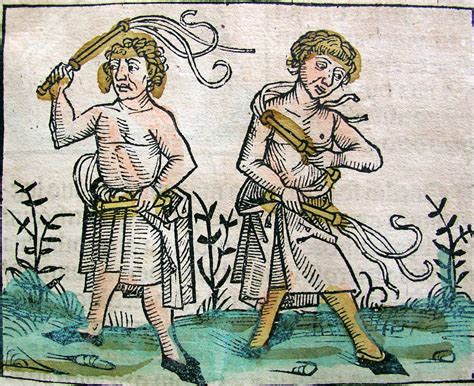
A Procession of Flagellants, By Goya

The Import of these Scriptures was that the Prosperity and Contentedness of the King’s Island was a Chimaera given Creedence only by Fools and Blockheads. Those things that bore the Semblance of great Benefit were, truly, the Occasions of great Disaster. It had been revealed to the Professor that a Cataclysm of terrible Proportions was imminent. This was to be engendered by the Heat from the Island’s Smithys, the Furnaces of the Glass-blowers and the Dock-yard, the Establishment of all of which the King had so encouraged, and from the Multitude of domestick Fires. All, taken together, would burn a Hole in the Sky. Through this Hole would enter Comets with blazing Tails and Fire-balls from the Sun which must end in a Conflagration of the Island. The Sky and the Clouds would fall to Earth with great Combustion and the Habitations of the Khiliasts, the Kapital, the Metropolis and the Dock-yard would be devoured in an infernal Blaze.

In addition to the disastrous Effect of the Smithys and Furnaces it was revealed to the Virtuoso that the Flatus and Ructations issuing from Cattell and Horses and even from the Islanders themselves, taken together with Emanations of a Natural Gas generated from Leaves turning to faetid purulent Matter after their Fall from the Trees were adding to the Erosion of the Clouds. Because it increased the Volume of Flatus from Live-stock kept for eating the Consumption of Shoulders, Legs, Loins and other Joynts of Animal Flesh was deemed a Sin. In the same Manner the Use of Wool and Leather for the making of Cloaths was despized.

Many Trees were felled each Year in the Forests of the Island for Timber to make the Ships in the Khiliast Navy and for the Merchant-men and other Barques. The Virtuoso condemned this Practice for the Reason that the Trees removed the Natural Gas from the Air that burned a Hole in the Sky.

The first Signs that the general Conflagration was to be visited on the Island would be Fires in the Forests and a Rising of the Ocean’s Waters to overwhelm the Metropolis and the Dock-yard. A young Prophetess would arise in the last Days tearing her Weeds in the Manner of Job ((Job 1:20)).She would be known by her braided Hair and her Denunciation of earthly Kings as Satans. This Maid would un-Mask these Evil-doers in their true Nature – as dysmal Architects of the Extinction of the Earth rather than great Benefactors of their People. If there were Apostates from this Creed in some Quarters such Schismatics of Religion would be taken as infallible Proof of its Veracity. In this Way the Sheep would be divided from the Goats.

This Account aided me in my Understanding of how, in Addition to the moral Causes described before by Khelat, the Khiliasts rejoyced in the Occasions the vain Prognostickations afforded them for Play-acting, Dramatick Conceits and other Distractions. In the Opinion of Khelat the Khiliasts took Pleasure and found Entertainment in the constant Condition of Disquietude and Disturbance of Mind these Apprehensions and Alarms engendered and in the Opportunities for Zeal and Evangelism they afforded to them as a Remedy to their Idleness.

Khelat further related that it was chiefly the Eminences of the Panel who sustained the Apprehensions of Calamity in the Minds of the remaining Mortals of the Island. It was they who confirmed the Visions of the Virtuoso who wrote the Apocalyptick Prognostickations by means of regular Observations of the Effluvia of the Sun, Changes in the Celestial Bodies and in the Progress of certain Comets and of the Levels of the Sea and the Temperature of the Air. For these Purposes they used a large Selection of mathematickal measuring Instruments, Globes, Rules, Compasses, Quadrants and Astrolabes. These Paraphernalia conferred an Authority, and Reverence as great as that attendant on Priests on them.

As a Consequence the Khiliasts had little Time for the common Pleasures or Amusements of Life and all their Conversation was taken up in Questions about the Health of the Sun and the latest Reports of the Panel. Their chief Discovery was of a guiding Purpose in their complaisant Idleness. It also gave them Contentment to know that they were virtuous in their constant Condition of Disturbance.


[1] A rood or one fourth of an acre

  1. a rood or one fourth of an acre []
  2. Manual workers []
  3. Improvers, believers in panaceas []
  4. Polymaths []

The Outsider and The Enemy: Colin Wilson on Wyndham Lewis

The Good and Evil Angels, by William Blake
LUKE GILFEDDER examines the differences – and parallels – between two original thinkers

In 1956 Colin Wilson published The Outsider, an overnight literary sensation which saw the 24-year-old autodidact hailed as a prodigy and the first home-grown British existentialist. He sent a copy to T.S. Eliot, who, in a prompt and kind reply, said it was a pity to have missed Wyndham Lewis out of the book, for Lewis was surely an ‘archetypal outsider’1. Wilson would make up for this omission – albeit 33 years later – with the excellent but sadly neglected essay ‘Wyndham Lewis: A Refracted Talent?’. Published in a long out-of-print collection 1989 Existentially Speaking, it is to the good fortune of Wilson and Lewis scholars alike that the title still survives in the British Library archives.

Colin Wilson

Wyndham Lewis was born in circumstances quite distinct from Wilson’s Leicesterian upbringing, on his father’s yacht off Amherst, Nova Scotia, in 1882. Yet by the time he died, in 1957, Lewis was based just a few streets away from the then-rising star Wilson in a Notting Hill Gate flat. The young Wilson had made several attempts to appreciate Lewis, but each time to no avail. He likened late career works such as The Human Age to “mediaeval castles”, impossible to get into, or quite possibly “not worth the effort”.2 Yet Wilson soon found himself in Lewis’s position of critical neglect – once a boy genius, twice a “pretentious fraud” – the critics who launched The Outsider savaging 1957’s Religion And The Rebel. Both were to remain best regarded for their earliest works: Wilson, for The Outsider, andLewis as pioneer of the avant-garde art movement, Vorticism (England’s double-edged critique of the franticness of Marinetti’s Futurism and the passivity of Cubism).

Wilson soon left London for Cornwall, fulfilling Lewis’s reflection in Rude Assignment that “the writer does not ‘escape’ or flee from the world of men in general: he is more likely driven from it”.3 When Wilson next encountered Lewis’s work, via Tomlin’s 1969 anthology, he found he had acquired a fairly strong feeling of identification with Lewis. Here was, as Eliot had suggested, a true outsider, out of key with his time, equally unsympathetic to the assumptions which his contemporaries took for granted, turning out book after book in defence of his unpopular and idiosyncratic views. Lewis saw modern science, art and politics as conspiring to create an unreal state of mind in which the sentimental, illusory and mechanically Progressive flourished, and to this, he opposed a vison that fused radical modernism with an external, static and classical approach to art. Still curious as to whether Lewis was an important writer, Wilson decided to settle the matter by writing an essay purely for fun, delivering his opinions “en pantoufles”, as if “sitting over a glass of wine with friends”.4

As a result, ‘Wyndham Lewis: A Refracted Talent?’ is a lively example of Existential Criticism, an original conception of Wilson’s which advocates that a writer’s work be judged by what he has to say rather than how he says it. William James wrote “a man’s vision is the great fact about him”, and Existential Criticism seeks to examine that vision, to see how much of reality it incorporates, or, conversely, to determine how far a writer’s attitude towards the world is parochial or based upon some temperamental defect of vision5. Wilson begins by criticising Lewis’s first novel, 1918’s Tarr (a satire of the bourgeois-bohemia of post-war Montparnasse) as a “savage, humourless Shaw”. The book, he says, is obsessed with the trivial and personal, much in the manner of a D. H. Lawrence novel or Ulysses, yet without the redeeming flights into impersonality these works take. If Joyce is a “thin-skinned Irishman who disciplined himself into greatness” and Lawrence a “thin-skinned Englishman who occasionally forgot himself enough to be great”6, then Wyndham Lewis, Wilson argues, never forgets himself for a moment. Not that Lewis, who held that “art is the expression of a colossal preference” – and posited “what is genius but an excess of individuality?”7 – would necessarily contend this. But Wilson differentiates between a strong self-image – an instrument writers use to convey higher truths about reality – and self-preoccupation, which is, by contrast, inward-looking and pessimistic. Wilson posits that artists find release from such solipsistic nihilism through their symbols of meaning, be it Religion for Eliot, Courage for Hemingway or the mystery of sex for D. H. Lawrence. But Lewis was said to find sex as boring and irritating as he found everything else. Wilson speculates that lacking the capacity for such abandonment of the self was Lewis’s main reason for his fateful turn to politics as his form of objectivity (Lewis’s reputation never recovered from his ill-judged and hastily recanted 1931 essay, Hitler).

Having foregrounded solipsism and artistic pessimism as potential defects in the Lewisian vision, Wilson attempts to trace throughout his essay how they might have developed and their effect upon Lewis’s value as a writer. He understands Lewis to be striving to achieve a post-impressionist revolution in prose, seeking to transmute into text the Cubist craving of beauty through abstraction. Wilson describes this as a romantic urge, a turning away from the real world to a misty ideal one, as is made clear in the 1927 story ‘Inferior Religions’:

Beauty is an icy douche of ease and happiness at something suggesting perfect conditions for an organism… Beauty is an immense predilection, a perfect conviction of the desirability of a certain thing…8

Wilson says this formulation could have come from Yeats or even Walter Pater – a far cry from T. E. Hulme’s classicism with which Lewis was associated. But Wilson makes an interesting distinction here: the new Classicism never fully materialised, at least not as we like to think of it. All that happened was the emotional romanticism of the 18th century gave way to the intellectual romanticism of Proust, Ulysses, The Waste Land or Musil’s Man Without Qualities. Only the likes of H.G. Wells and Chesterton truly dispensed with romantic idealism by turning back to human reality, immersing themselves in socialism or Religion. Wilson says Lewis glimpsed another vision, namely that the ideal beauty of the Romantics could be achieved not by “flying up into the eternal gases”9 but instead through a cold, precise, intellectual art, gleaming like the snows of the Himalayas. This does not sound like much of an existential defect; in fact, it is rather close to the worldview of Bernard Shaw – a Wilsonian hero – who rejected romantic idealism in favour of a discriminating idealism. Discriminating idealism is just what Wilson perceives in Lewis’s paintings; their determined clarity, their quality of precision and “coolness” is said to remind one of Blake or indeed Shaw’s plays.

Wyndham Lewis

Wilson’s central contention is that Lewis’s effortless mastery as an artist failed to translate into his prose, where one needs the “patience of Job” to cut through the “blanket of fog” and figure out what it is all about10 He reasons that while painting can survive a lack of purpose – it deals in visual effects and can still be great if the worldview of its creator is ambiguous – writing deals in ideas and cannot survive the same ambiguity. Prose must have a positive impetus; satire alone is not enough. Lewis may paint like Blake, but he is said to write with the technique of a Daumier. Wilson judges this satirical bent as a negative trait, for Lewis is placing himself above his characters for the sake of lacerating them – only in The Revenge for Love does one sense any sympathy between writer and protagonist. So where War and Peace feels bigger than Tolstoy personally, in The Apes Of God (a satire of the Bloomsbury group), for example, we never forget for one second that it is Lewis holding the brush, pulling the strings of his puppets. And whereas Joyce’s precise technique of photographing his characters through words makes the reader blend with his descriptions, Lewis constantly interjects himself as though trying to dazzle the reader with verbal brilliance, never allowing the object to appear in its own right. This, Wilson says, creates a contradiction between Lewis’s impressive, even “monumental”, technique and his “rather vague, boring characters”. Resultantly, Lewis’s novels tend to “run down like an old hand-gramophone someone has forgotten to wind”11.

Wilson proposes that such “miscalculations of effect” in Lewis’s prose stem from his solipsistic vision of art, as announced in Blast 2:

There is Yourself: and there is the Exterior World, that fat mass you browse on. / You knead it into an amorphous imitation of yourself inside yourself”12

Wilson insists that Tolstoy or Shakespeare’s greatness depended on them not kneading the world in their image, but instead trying to get rid of “themselves” from their work, becoming more like a mirror or a magnifying glass, able to capture that “odd whiff of reality, like a spring breeze blowing through an open window”((Colin Wilson. Existentially Speaking: Essays on the Philosophy and Literature, 1989, p. 100)). He speculates whether the character of Victor Stamp (the protagonist of The Revenge for Love) is a partial admission by Lewis of this “parochial” defect when, in desperation, Victor decides to forego his usual mannerisms and paint something which would “remind him least of Victor Stamp”((Wyndham Lewis, The Revenge for Love, 1937)). It still does not sell, because it is old-fashioned. But old or new-fashioned, Victor never attempts to say anything, he – like Lewis – fails to recognise art is not self-expression but a reaching out towards reality.This overpowering sense of self-expression in Lewis was also critiqued by Anthony Burgess, who described the wartime autobiography Blasting and Bombardiering as reading like a “gor-blimied police report” with the strange yoking of the “Allo-allo-allo-what’s-all-this-‘ere to the intellectual and the exquisite painter” making for such exasperating reading13.

We must pause briefly to deal with the objection that has doubtless sprung to mind, at least to readers familiar with Lewis, namely that Lewis does know that the root of great art is the impersonal and the objective; moreover, he was a paragon of the ‘lone external viewpoint’14. It is not for nothing that Lewis’s critical writings develop from a defence of the self in 1927’s The Art Of Being Ruled – a treatise in how to remain a “sovereign of oneself” in a world where this is “nothing so difficult as not belonging to a party”15 – to a defence of objective reality itself against Sartrean existentialism in 1952’s The Writer and the Absolute. Lewis directly attacks solipsism in the former work, writing that “ideas of beauty, of a god, or of love, depend severally on separation and differentiation”, and compares the foolishness of “the savage who ate his god to procure divinity” to Freudian inwardness16. Yet we may argue the clearest contradiction to Wilson’s interpretation is in The Letters Of Wyndham Lewis, where Lewis opposes the “crushing of the notion of the subject” and states a belief in a sense of objective value which sees “the answer is there all the time; we ‘discover’ it”.17

Wilson is, however, too perceptive a critic not to have anticipated this response; he explains the above as merely demonstrating Lewis’s “Platonic sense of reality”18. This interpretation is the string with which he binds together his varying conclusions as to Lewis’s merits and defects. On the one hand, Lewis’s belief in a world of timeless ideals makes him an excellent critic, especially of the philosophies of time in Spengler and Marx, and in his merciless dismantling of imperfect idealisms – Lawrence, Hemingway, Orwell, Sartre, Malraux – any kind of romanticism that is the opposite of the real. But, on the other hand, Lewis’s Platonic nature is said to lead him into an artistic pessimism, a sense that the real world is corrupt and disjointed, and the artist must remain true to his ideal world. As a painter, Lewis may have stumbled on Shaw’s trick of uniting the irreconcilable opposites of romanticism and anti-romanticism (this is especially evident in Lewis’s late-career paintings, such as 1942’s Homage to Etty, a Lewisian heaven of exterior forms). But as a writer, his Platonism led him into a “life-denying pessimism”, and he spent more energy denouncing the world than expressing with discriminating idealism that “perfect conviction of the desirability of a certain thing”19. As if unfavourably comparing Lewis to Shaw wasn’t enough, Wilson concludes by noting how much he has in common with George Orwell. Both are said to be tough-minded and honest cultural critics, but who wrote “hysterical” and “bad” novels because of this same artistic pessimism, a pessimism out of which “no vital creation can spring”18. Alas, Wilson’s final judgement is that Lewis was less the “enemy of the stars” than of himself.

Such an atypical interpretation of Lewis may appear highly contentious upon first reading, but even if one disagrees with the answers Wilson provides, his essay leaves the reader with better questions than they arrived with – surely the true mark of fine criticism. He intended for the piece to be “the kind of thing I would want to read if I was curious about Lewis” and on this count, he has succeeded. The only minor gripe is that there is scant discussion of the sympathy between Lewisian and Wilsonian themes. Lewis’s critique of existentialism as merely placing a token emphasis upon freedom – “Sartre’s novels are jokes about Freedom”20 is the perfect foil for Wilson’s ‘New Existentialism’, a corrective against Absurdism. Lewis’s writings also dovetail with Wilson’s criminology studies, each observing the “evil fog” of pessimism and nihilism present at the start of the 20th century plunged people into acts of violence as a means of escape21. Both have an intuitive approach to literary criticism, finding similar flaws, for example, in Hemingway’s characters. Wilson says they know who they are, not what they want to become22, just as Lewis writes “they are invariably the kind of people to whom things are done, who are the passive (and rather puzzled) guinea-pig type – as remote as it is possible to be, for instance, from Nietzsche’s ‘super’ type”23. Lewis, however, believes this is not a shortcoming in a work of art, it “defines it merely”, meaning “the work in question is classifiable as lyrical”21. Lewis allows a novel to be superior from a literary standpoint, even if it is existentially lacking. In the final analysis, Wilson does not afford Lewis the same generosity.

The new avenues of thought opened by this essay make it a double pity that Outsider and Enemy never met, especially given that they once lived just a few hundred yards from each other, in Notting Hill. One senses that they had more in common than this essay suggests, and they could have found common ground over their similar mistreatment by the establishment. When F. R. Leavis derided the Sitwells as belonging to the history of publicity, not the history of literature, we may conclude that no two writers embodied the reverse equation more than Colin Wilson and Wyndham Lewis.24

NOTE This article first appeared in Lewisletter, the journal of the Wyndham Lewis Society, and is republished with permission

  1. Colin Wilson. Existentially Speaking: Essays on the Philosophy and Literature, 1989, p. 83 []
  2. Ibid, p. 89 []
  3. Wyndham Lewis, Rude Assignment: An Intellectual Autobiography, 1984, p.29 []
  4. Colin Wilson. Existentially Speaking: Essays on the Philosophy and Literature, 1989, p. 10 []
  5. William James. A Pluralistic Universe (1977), p. 14 []
  6. Ibid, p.83 []
  7. Wyndham Lewis, Doom of Youth, 1932 []
  8. Wyndham Lewis, The Wild Body, 1927, p. 241 []
  9. T. E. Hulme, Romanticism and classicism, Speculations: Essays on Humanism and the Philosophy of Art, 1924, p. 120 []
  10. Colin Wilson. Existentially Speaking: Essays on the Philosophy and Literature, 1989, p. 97 []
  11. Colin Wilson. Existentially Speaking: Essays on the Philosophy and Literature, 1989, pp. 99-103 []
  12. Wyndham Lewis, Blast 2, 1915, p.91 []
  13. Anthony Burgess, ‘Gun and Pen’, 1967 []
  14. Wyndham Lewis and E.W.F. Tomin, Wyndham Lewis, An Anthology of his Prose 1969, p. 18 []
  15. Wyndham Lewis, The Writer and the Absolute, 1952, p.67 []
  16. Wyndham Lewis, The Art of Being Ruled, 1927, p.227 []
  17. Wyndham Lewis and W.K. Rose, The Letters of Wyndham Lewis, pp. 155, 378 []
  18. Colin Wilson. Existentially Speaking: Essays on the Philosophy and Literature, 1989, p. 103 [] []
  19. Wyndham Lewis, The Wild Body, 1927, p. 242 []
  20. Wyndham Lewis, The Writer and the Absolute, 1952, p.26 []
  21. Ibid, p.86 [] []
  22. Colin Wilson, The Craft of the Novel, 1975 []
  23. Wyndham Lewis, The Writer and the Absolute, 1952, p.86 []
  24. F.R. Leavis, New Bearings in English Poetry, 1932 []

Brownshirts under the bed

Credit: Shutterstock

How to Stop Fascism

Paul Mason, Allen Lane, 256 Pages, £20

KEN BELL finds a noted Labour intellectual fighting an imaginary enemy

Paul Mason is one of those interesting characters who now seem to pop up everywhere, telling the rest of us what to believe. In his student days he was a member of Workers’ Power, a Trotskyite grouplet that never had any actual workers in it. After a period as a teacher he moved into the media, first as economics editor of BBC Newsnight, then switching to Channel 4 in a similar role. He is now a freelance writer who pops up often in the Guardian, and his work seems to influence today’s left, which is probably why Labour keeps losing elections.

His latest offering, How to Stop Fascism, is a case in point. It argues that there is a new, fascist menace in Britain which must be rooted out. However, he presents no evidence to back up that claim, but then it is quite likely that he doesn’t need any. Mason’s works are clearly aimed at a particular middle-class readership – people who are convinced that working people are a racist tribe to be overcome.

That does not stop him from looking around to find evidence of this threat, and funnily enough his working class enemies always turn up to illustrate and confirm everything he is saying to his readership. So, in the 2019 general election, he went back to his home town of Leigh to campaign for the Labour candidate in that division, and on the doorsteps he heard “men my own age openly fantasizing about the ethnic cleansing of Romanian migrants.” Of course you did, Paul. My experience of canvassing is that if you can get people away from the TV long enough to open the door they tell you just what you want to hear to get rid of you, before going back to Coronation Street. The last thing you get is anything approaching a political debate.

Fast forward to June 2020 and our hero is in London, “an obviously multicultural city.” On the day that he was there, the statue of Sir Winston Churchill in Parliament Square had recently been defaced by the Black Lives Matter rabble, so understandably, groups of British working people had turned up to protest at that outrage to one of the nation’s heroes. Mason was just outside the square and found that he had

…entered a zone of white monoculture. Suddenly there were no students, no people of colour, no tourists, no out-gay people. I was back in the world I grew up in. White men, working class… shouting profanities and swilling lager.

It really is amazing how this author manages to keep bumping into working class men who confirm his colourful thesis. He even managed to see a postman in the crowd, and you can’t get prolier than that.

He ropes in Donald Trump to help bolster his case, even though he admits that “Trump is not a fascist”. However, he then goes on to say that “there is a plebeian mass base for American fascism, and Trump has chosen to lead it”. It is hard to know what to make of that concept, which reads as if Trump is a sort of Schrödinger’s Politician, simultaneously in two states of being at the same time. I was also taken with his “plebeian mass base” line: presumably he feels that the problem with today’s world is that patricians (like him) do not rule it. Mason goes on to say:

Trump’s victory in 2016 was a turning point. It confirmed that there is a massive constituency in the United States for economic nationalism and isolationism, and forced all other countries to accept deglobalisation as a strategic reality.

Now, given that for most of its history up to the advent of the Progressive Era in the 1890s the USA had been firmly isolationist and had protected its nascent industries behind a massive tariff wall, a very good case can be made for arguing that all Trump wanted to do was to restore the status quo ante, which is hardly the mark of a fascist. More importantly, Mason claims to be a socialist, and since when have socialists been in favour of globalisation? It should be remembered that globalisation is not the same as internationalism. I can remember when Communist shop stewards in British factories collected money to buy bicycles that were shipped to Vietnam. There they were used on the Ho Chi Minh Trail to carry war supplies to the South, as part of Vietnam’s war of national liberation. The aim was not the globalist one of opening Vietnam’s borders to all and sundry, or seeing Vietnamese people flooding over here to provide cheap labour in nail bars. It was the internationalist one of providing help to a people who wanted to govern themselves without interference from outside. (A bit like us with Brexit, perhaps?)

Mason is clearly a great fan of globalisation, since the politicians he hates, specifically Trump and Johnson, are “authoritarian nationalists” who “broke with the globalist consensus in the 2010s”. It is difficult to imagine either man as being authoritarian, with Boris in particular anguishing over the lockdown to try and control the coronavirus and Trump leaving all that up to the states. However, both men did break with the “globalist consensus” and since Mason is all in favour of that consensus it must mean that they are authoritarians. Or something; you can never tell with this author.

He never gets close to actually pointing his finger at any real fascists, or explain what fascism is, so that we can recognise its followers if we ever see them. To get around that problem he tells us,

Once we move beyond sterile definitions and understand fascism as a process of social breakdown…we can see the nit-picking formalism among some historians and the left as an obstacle to comprehension

I hope that is clear to you, because it reads like gibberish to me. The best I can come up with from a reading of the text is that fascists are the socially conservative, perhaps economically radical, “plebeian mass” who refuse to listen to Paul Mason.

Do I recommend this book to my readers? Surprisingly, I do. If you are a Tory worried by the shenanigans of Boris and his surreal cabinet, then you may be worried that your party will lose the next election, so read Mason’s book and put your mind at ease. On the other hand, if you are a Labour supporter who hopes your party will win the next election, you should probably have your hopes dashed now, so you will be emotionally prepared for defeat at the next election. People like Mason obviously detest traditional British values and the people who uphold them, and they now control the Labour Party, especially at local level. They are the ones who read works like this and believe the arguments in them because they tie in with views that the readers already hold. Come the next election, all Boris has to do is point out the contempt and disdain so many Labour intellectuals have for ordinary people – the plebeian mass – and then ask if they want people like Paul Mason ruling over them? I think that the answer to that question is obvious.

The closing down of History

Credit: Shutterstock
GUY WALKER calls for a realistic view of humanity’s record


Earlier this year a Palace coup at the National Trust saw the Chairman, Tim Parker, helpfully defenestrate himself before the pursuing Imperial Guard did it for him. The revolting soldiery were later in hot pursuit, through the gilded corridors, of the Director-General, Hilary McGrady, overseer of an absurd National Trust slavery report. They had been entrusted with the fascinating educational resource of our concrete national history. Instead of preserving its precious stones like true custodians, in an access of intellectual vandalism, they had traitorously tried to recut them into conforming with the ephemeral taste for wokery.

This is an example of the tidy rationalistic minds behind modern technocracies regretting the fact that history did not arrange itself according to their orderly notions of perfect justice, resembling much more what W.H. Auden, in his 1969 poem, Moon Landing, called “the usual squalid mess called History”. Why should this be a truer description of what history is

The Tower of Babel probably never existed in reality but, the invention of a storyteller or a myth-maker whose genius should not be under-estimated, it is a wonderful symbolic encapsulation of the nature of the human realm. That realm consists of the undeniable fact of a variety of races, languages and cultures living alongside each other, often in competition.

As humans, in spite of the fact that many of our greatest pleasures such as eating, drinking and sex derive from the animal part of our nature, we like, as modern technocrats, to flatter ourselves that we are somehow ‘above’ or transcend that animality. Of course we don’t. The anally retentive, retrospective rationalists demand perfect manners and reassuring orderliness in the relations between human races and cultures. However, it is hard to deny that this fallen, sublunary human sphere contains more than an element of the Darwinian evolutionary that we are familiar with observing in animals.

Because of this, sooner or later in the squalid mess called History cultures inevitably emerged with greater vigour, confidence, and technical and military capacity. Little caring for prissy rules about good manners and seldom consulting handbooks of rights etiquette, these cultures found it almost impossible to prevent their vigour spilling over into neighbouring territories. This happened countless times with, to name but a few in the full catalogue, the Assyrians, various Chinese dynasties, the Mongols, the Romans, the Huns, the Aztecs, the Incas, the Ottomans, the Benin, the Zulu, and, more recently, the British, Belgian, French, German and Italian. To have expected such incursions not to have happened in the thousands of years of human history is to be ludicrously fastidious and legalistic. It would be like asking the weather to be well-behaved. Indeed, if you subtract the imperial there is practically no human history left.  

In addition, one could easily argue that, in spite of the infringements of perfect ‘after you’ politeness, ‘compassion’ and thoughtfulness such over-flowings represent, the Darwinian effect also showed the good side of evolution – the propagation of vigour, refinement and civilisation. At the risk of sounding like a Monty Python sketch, it is true that Europe was left with excellent road and irrigation systems by the Romans, and India inherited useful technology and rail, communication, administrative and legal systems from the British. We should, perhaps, then, not rail at the fact of empire but look at the nature of particular empires. It might have been more pleasant to be subjugated by the British than by Darius’s Persians or Attila’s Huns, for example. 

Why is it that the modern “Justice Warriors”, who bully the likes of the management of the National Trust into assuming such ridiculous attitudes, have such unreasonable expectations of human history? Perhaps it is because, ironically lacking in historical self-awareness, they are unaware that, curiously, they were born into a distinctive modern technocracy whose self-flattering and comforting idea – that it can control and order the nature of reality – they share. They do this in spite of the fact that we have seen such ideas tested to revealing destruction in recent years in the failure of Big Data to predict economic and political outcomes and in the inability of ‘The Science’ to achieve cognitive harmony on subjects like climate change and COVID. Such visions, born out of control freakery, usually prove inadequate.  

Justice Warriors, consciously or not, take for granted that human conduct can be arranged according to platonic ideal of perfect kindergarten thoughtfulness that exists nowhere on earth except in the imagination of a tiny remnant of virtual aunts or in the legal libraries of the United Nations Human Rights Council in Geneva. There is a difference between noticing that things are not platonically ideal, and expecting such perfection to be easily accessed or imposed on earth. One wonders also whether, were such a finicky, paternalistic vision to be achieved, we would all be grateful for it. 

We can only conclude, then, that the modern rationalistic justice warrior has absurd expectations of humanity. He or she, taking for granted that he or she adheres scrupulously to it, thinks everyone should live up to a notional, managerial standard. The past too has somehow to be dragooned into inoffensive moral antisepsis in order to make it presentable in polite company. To understand how unrealistic this is we have only to look at the subject so close to the hearts of Justice Warriors: justice. In the real world, justice systems are imposed in order to fight a rearguard action against the excesses of human nature, to provisionally hold a line and put markers down – not to impose a perfect reign of justice of a kind that we might envisage as existing only in heaven itself or on a hopeful “protocol” somewhere. We are making the best of a bad job just as we do by resorting to democracy, “the worst form of government except for all the others” as Churchill put it. 

Auden, who enjoyed sex and cooking, was notorious for his slovenliness and poor personal grooming, so was well qualified to speak of squalid messes. Perhaps the mentality of the modern justice warrior is that of someone with a version of OCD whereby they compulsively attempt to wash both the present and history clean in order to make it perfect according to a neurotic vision they have. They haven’t learned to accommodate the truly human, or to realize where it is that they find themselves. Fortunately, our squalid human history contains many redeeming visions of heaven and perfect justice; it is only sane to believe that they just aren’t here.