Another portion of Chips

Chips and Honor Channon

Henry “Chips” Channon, Diaries Vol. 2, 1938-1943

Edited by Simon Heffer, Hutchinson, 1,120 Pages, £35

KEN BELL renews his acquaintance with the famous Tory diarist

The Conservative MP and socialite, Henry “Chips” Channon, was a brilliant writer with an acid wit who also had an amazing capacity to misunderstand the people and events of the days he lived through and chronicled.

His wife, Honor, an heiress to the Guinness fortune, had been having affairs since at least 1937 with various muscular European skiing instructors, and this volume begins with Chips devoting many words to his fears that the marriage was breaking up. He could not understand why, and tied himself in knots trying to make sense of Honor’s attitude. In 1940 when the Luftwaffe bombed a farm belonging to Honor, Chips was disgusted by the attitude of Frank Woodman, Honor’s land bailiff, towards her:

He is insolent, swaggers about, and treats her with scant respect. She allows herself to be so familiar with that sort of people.

To anyone reading Chips’ diary entry it is so blindingly obvious that Honor had become Frank Woodman’s lover. When eventually Honor told Chips that she wanted a divorce, he went into an engaging meltdown and then on almost the next page he listed the money that he would make after a divorce, starting with the £5,000 a year that will be paid to him by her for agreeing to it. (That is about £250,000 in today’s money, by the way.)

By that time Chips had met Peter Coates, the upper-class rent boy who was known by those in the know as ‘Petticoats’, and by the more waspish amongst them as ‘Mrs Chips’. The two stayed together until Chips’ death in 1958, but as Simon Heffer points out in his editor’s introduction, Chips spent about £1,000 on Coates between their first meeting in mid-1939 and the end of that year. This would be around £55,000 today, so Chips was clearly much taken with Petticoats.

Channon was no better at understanding the political events that also swirled around him. He had supported Chamberlain’s Munich Agreement with Hitler in 1938, and was devastated at the decision by Germany in March of 1939 to recognize the breakaway state of Slovakia, and then to grab the Czech-speaking rump of Czechoslovakia. However, in Chips’ mind this seemed more like Hitler betraying Neville Chamberlain personally, and less like the mark of a reckless gambler who was always playing double or quits, which is what it was.

The Norway debate in 1940 which led to the downfall of Neville Chamberlain is a masterpiece of reportage, mixed with a complete failure to understand just what was actually going on. Chamberlain won the division by 80 votes, and for Chips that was more than enough. However, it obviously wasn’t when such large numbers of Tories had either voted against their own government or abstained. To Chips’ disgust, the man he hero-worshipped resigned and Steepledick (the mocking nickname that the anti-Churchill faction had for Winston Churchill) took office as Prime Minister. Simon Heffer, who is no bad hand at dry wit, explains that the steeple part of the jibe was a play on the first syllable of Churchill’s name before going on to remind us that the nickname never really took off.

Channon kept his junior government post until mid-1941, and his war entries have a lot of good information. For instance, on 20th June 1941, Channon mentioned to friends that the Germans were going to attack Russia on the 22nd, which they duly did. That information about the attack had reached down to such low levels in the government, and that Channon could mention it over dinner, suggests that knowledge of the attack was pretty widespread in London. Once the attack did commence, instead of looking at ways to aid Russia, Channon slipped into his old habit of not understanding what needed to be done; instead, he dedicated much wordage to what would happen if Germany succeeded in her war-aim. He was convinced that she would win, and that would be the end of the British Empire, and the likes of Chips and his circle.

These caveats aside, Chips wrote incredibly well in a gossiping, housewifely style. He met Lord Alfred Douglas, the infamous ‘Bosie’ who had done so much to destroy Oscar Wilde’s life and reports without comment that Bosie had denied ever being “Wilde’s catamite”. Then, his advice was sought by a constituent who was also the mother of an 18-year-old daughter who was being courted by an over-60s baronet. Chips advised the mother to encourage the match, presumably so that in a few short years the girl could become a merry widow. Finally, he got into the habit of giving lifts to people during the bombing raids and one working man gave him a shilling tip when he alighted from Chips’ car. For once, Chips was rendered speechless. Normally, Chips had an answer for everything, usually very cutting, as at Chamberlain’s funeral in 1940 when he asked a fellow mourner who had not supported Chamberlain if the man had sent a wreath. When told that he hadn’t, Chips remarked that of course, “Decent Judas Blossoms are out of season,” before strolling away to leave his victim seething.

As a war diary this volume is sadly lacking in many ways, but as an account of life during the war for Channon and people of his circle it is a valuable source of information and gossip. Sadly, once Chips was out of office, the social scene takes over almost completely, along with tedious yearnings for Peter Coates who was away with the army.

Regretfully, Simon Heffer made the editorial decision to censor one entry which refers to a still living person. There are only two people this could be – the first being Clarissa Eden, who is 101 and an unlikely candidate. The other is the present Queen, and in spite of Heffer’s protest that the entry “adds nothing to historical knowledge”, that really is for us to decide in a volume that is sold as unexpurgated. That objection aside, enough remains to make this work a worthy successor to the first volume and leaves the reader eagerly anticipating the third and final part, which is due in 2022.

The year of Dr. No – and rural poverty

On the Cusp: Days of ’62

David Kynaston, Bloomsbury, 239 P, £18.99

KEN BELL admires a study of 1962, but wonders why that year was singled out for attention

David Kynaston must be the premier social historian of post-war Britain writing today, and his latest book is a fine, standalone work which really captures the air of a country that was about to change beyond all recognition.

The first three volumes of his putative series that will take the British national story from 1945 to 1979, Austerity Britain, Family Britain and Modernity Britain are house-brick sized volumes that really capture the themes embodied in their titles, and take the reader from 1945 to the early months of 1962. The next volume, which we have been waiting for since 2013, is to be called Opportunity Britain and will take the story from late 1962 to a point in 1967. However, that has not been written so what we have to keep us going is this short volume which argues that the starting point for the 1960s was October 1962 when the first James Bond film (Dr. No) and the first single by the Beatles (‘Love Me Do’) were released on the same day.

The Beatles clearly embody much of the 1960s, as do the Rolling Stones who also played one of their first gigs before a paying audience of two in a North Cheam pub “while four people stood outside listening for free”. However, it was far from certain in 1962 that either of those two groups would amount to anything at all, but the same cannot be said of what must surely be the real start to the 1960s which came about the year earlier in 1961.The contraceptive pill was only prescribed by the NHS to married women until 1967, but it was available on a private prescription from its 1961 introduction. That, along with the five-point geometric haircut invented by Vidal Sassoon in 1965, and the miniskirt of 1966, must embody the hedonistic spirit of the decade that only ended with the oil crisis in 1974. The music was background noise to the glorious New Britain that actually began with the Pill.None of those factors are mentioned by Kynaston, who instead chose to concentrate on three themes not discussed in his earlier works – rural life, industrial Wales, and immigration.

Life in the agricultural regions began to change in 1947 with the Agriculture Act:

On the one hand, cheap food for urban consumers without a heavy reliance upon imports; on the other hand, price-support manipulation, capital grants, subsidies and so on for the farmers. 

It was a system that worked very well, especially for the large-scale farmers, in what we think of today as agri-business. But the lot of the rural poor remained drab and miserable. Kynaston illustrates this with the tale of two spinster sisters, both in their 50s, who had pooled their limited resources to buy the farmhouse where they had both been born. They kept a few cows and other livestock. Water was brought in from a well, the cows were milked by hand and the resulting milk was churned by them into butter which was sold to their neighbours. The sisters’ way of life died with them as the young left the countryside to seek better wages in the towns and the urban middle class began to move into the vacated villages.

The old squirearchy became irrelevant, with only a few from the old order hanging on in greatly reduced circumstances. At the same time, as farm-sizes increased, the number of actual farmers and farm workers fell. Although farmers were involved in local politics and many of them served on district councils where they sat as the replacements for the old manor house caste, many stopped doubling up as local politicians because running their farms as businesses took up far too much time. Thus the professional, middle-class incomers began to run life in the rural areas, for better and for worse.

Over in Wales, coal was still king, but the throne looked decidedly wobbly. Oil was taking over as a means of heating and steam engines were giving way to diesel ones. Luckily for the Welsh, steel making boomed, as did the ancillary industries that relied on steel, so a redundant miner had few problems finding work that was a lot cleaner, a lot safer and often a lot better paid than mining. Few in Wales objected to pit closures; that would come decades later when mining had become the only game in many Welsh towns. Politics was dominated by Labour who had run Wales as a fiefdom for most of the century. By the 1960s that had led to the usual story of civic corruption and local cronyism, but demands for change were muted at best. The desire for Home Rule was a minority interest, mainly amongst the declining numbers who spoke Welsh. It is true that the Welsh Language Society was formed in 1962 to fight for the language, but Wales in that year still looked like the country that had been formed by the valleys, the mines, the chapels, the temperance societies, the unions and above all the Labour Party. Given that Wales is still dominated by Labour, one might ask what was really so special about 1962 in the country’s long history?

Opposition to non-white immigration was fairly widespread, with some managers at some factories letting the immigrant workers go first if there was a retrenchment. As one manager pointed out, “there would be a riot” if he hadn’t done that. The unionised workers were often opposed to the new influx as they saw the incomers as a tool that would be used by management to cut the wages. Peter Rachman was still alive and still letting out properties to West Indians most landlords would not rent to. Kynaston suggests that much of the opprobrium that settled on Rachman later came about not by his actions, but by those of his underlings who found him his tenants and collected the rents. Rachman set a rent, and the underlings increased it substantially, so that they could rip off both Rachman and the tenants. Opposition to New Commonwealth immigration was widespread but inchoate, as both main parties supported the government’s policy. Sometimes a hard line was attempted, as when a Jamaican shoplifter was deported back to her home country – something today’s government cannot seem to manage – but by and large a lid was kept on popular discontent via a quiet agreement between the two parties. It is hard to tell what has changed since then, to be honest.

One error that has crept into the text is a reference to my old tutor at Ruskin College, Oxford, Raph Samuel. Kynaston refers to him as “Ralph (later Raphael) Samuel,” but he was never called by that name and was known to everyone who knew him as Raph. That minor caveat aside, On the Cusp is a worthy addition to anyone’s shelf, and reminds us of just how close and yet so far away we are from the early 1960s.

The God that failed – Fanny Trollope’s America

Credit: Wikimedia Commons
R. J. STOVE remembers a classic work of anti-travel literature

So far as Anglo-American relations are concerned I have always felt that they would probably have been better had the two nations spoken different languages. In the latter years of the eighteenth century there was a school of thought which held that German, rather than English, should be the official tongue of the new state, and on many grounds it is to be regretted that their views did not prevail. Because the Englishman and the American speak the same language they are inclined to take it for granted that they mean the same thing, with the result that misunderstandings arise. (Sir Charles Petrie, 1895–1977, Anglo-Irish historian)

Now that COVID has made us all empathise with Macbeth’s complaint ‘I am cabined, cribbed, confined, bound in / To saucy doubts and fears’ – unless of course we have the privilege of political office enabling us to swan around G7 meetings – maybe we can take special pleasure in that healthy, much underrated sub-genre of travel literature: anti-travel literature. Any halfway competent Public Relations Officer for a tourist bureau can make foreign lands seem attractive; it requires much more exalted authorial aptitude to make foreign lands seem repulsive. The foundational masterwork of English-language anti-travel literature must be Frances ‘Fanny’ Trollope’s 1832 Domestic Manners of the Americans. One hundred and eighty-nine years after it exploded upon the consciousness of British and American readers alike, it can still be hailed with the aphorism once coined about a truly great library: it ‘contains something to offend everyone.’

Imagine a quaint little period piece, endurable only by vigilant exercise of the historical imagination, and you will acquire a near-perfect idea of what Mrs Trollope’s chronicle is not. It remains one of those books which makes the centuries roll back. Goodness knows what a present-day reader of it who had never visited the USA would make of it. But for those of us who have repeatedly spent time in the States, usually in unglamorous capacities – who have performed work for American enterprises, had American clients, seen America itself at its awe-inspiring best and at something like its hellish worst; whose own experiences range from Detroit at its slummiest to Los Angeles at its sleekest and Washington DC at its most patrician – the overwhelming sensation derived from the book is that of plus ça change. To reach Mrs Trollope’s final pages is to ask: can there be any country in the world, except perhaps for Russia, where the national character’s fundamentals have changed less than America?

Mrs Trollope really knew how, as youngsters now say, ‘to push people’s buttons.’ The chief reaction among Americans themselves to her exposé consisted of disgust mingled with fear. As she herself archly mused:

 Other nations have been called thin-skinned, but the citizens of the Union have, apparently, no skins at all; they wince if a breeze blows over them, unless it be tempered with adulation.

A new verb, to trollopize (meaning ‘to revile others’ etiquette’) briefly entered American English. American cartoonists ransacked their armoury of visual invective to portray her as a goblin and a harridan. One ambitious versifier, coyly hiding under the pseudonym ‘Nil Admirari, Esq.’, made her the target of an epic poem entitled The Trollopiad. Within seven years Domestic Manners of the Americans had already achieved a fifth edition, guaranteeing protracted affluence for its hitherto impoverished author, who had embarked on the project mainly because of financial need. American readers railed against the book but, for whatever obscure psychological reason, could not bring themselves to ignore it. (Which would have been the sensible response for those existentially affronted by it.)

Not all American readers joined the choruses of vituperation. Washington Irving found much merit in the travelogue. So did Mark Twain, who clearly recognised in Mrs Trollope a fellow scourge, and who knew better than anyone how much scourging depends for its lasting effectiveness on a strict (albeit usually implied rather than stated) moral code. The author of The Innocents Abroad paid fitting tribute to the English non-innocent abroad:

She lived three years in this civilization of ours; in the body of it – not on the surface of it, as was the case with most of the foreign tourists of her day. She knew her subject well, and she set it forth fairly and squarely, without any weak ifs ands and buts. She deserved gratitude … Nearly all the tourists were honest and fair; nearly all felt a sincere kindness for us; nearly all of them glossed us over a little too anxiously … but Mrs Trollope, alone of them all, dealt what the gamblers call a strictly ‘square game’. She did not gild us; and neither did she whitewash us.   

Without naming any obvious names, let this be said in 2021: the political phenomena which have dominated America over recent years, the last five years especially, were unimaginable to our Eisenhower-revering, Reagan-liking, and Nixon-tolerating parents. Were these parents still alive to witness post-2016 America, they would have concluded that the ‘land of the free and the home of the brave’ – in which they themselves had invested so much allegiance, and so much deserved allegiance, during the Cold War – increasingly resembled one vast insane asylum.

Mrs Trollope’s chief literary assets include her unconscious ability to make us perceive how much a departure the (mostly) fortunate happenstance of Cold War decorum represented from the national default mode. She had the historiographical benefit of seeing America at something like its pre-Civil-War societal nadir: during the 1829–1837 presidency of Andrew Jackson, whose iconoclastic wrath against what are now called ‘elites’ (pronounced, Stateside, ‘eeleets’) has in 2021 a familiar ring. Through another far-sighted strategy, Jackson revealed exceptional enthusiasm for making local non-Caucasians wish that they had never been born. The ethnic cleansing of Native Americans which Jackson did so much to carry out, and to which history has accorded the name ‘the Trail of Tears,’ inspired some of Mrs Trollope’s most caustic paragraphs.

Young America, by Thomas Le Clear

Nothing in Mrs Trollope’s pre-American life led her to expect an overwhelming allergy to the USA. In her world-view, there lurked the acrimony of a cultural love-affair gone hopelessly wrong. The truest parallels to her experience can be found in those subsequent authors – George Orwell, W.H. Auden, Arthur Koestler, André Gide – who at first welcomed communism in theory at home, recoiling from it with justified terror when they saw it in practice abroad: Gide through his direct experience of Stalin’s USSR, the others through their direct experience of notionally independent but actually communist-ruled Spain.

Neither Moscow nor Barcelona seemed more exotic to 1930s foreign travellers than America did to foreign travellers a hundred years earlier. To cross the Atlantic at all in 1827, let alone to live for three years on the other side of the ocean, presupposed steady nerves coupled with an almost deranged optimism about one’s prospects. These advantages the forty-eight-year-old Mrs Trollope abundantly possessed. She had planned to join the Neshoba Commune in rural Tennessee, which a friend of hers, Frances Wright, had established with the aim of educating former slaves. Her own husband, Thomas Trollope, had already shown much greater talent at running up debts than at contributing usefully to his household. When, seeking relief from his disabling headaches, he became habituated to a mercury-based drug, his already few credentials for the paterfamilias’s role became still fewer. Much asperity can be forgiven a woman with children to feed, when she has been yoked to such an unreliable spouse.

After a fashion, the marriage (which produced not just the great Anthony Trollope but another novelist, Thomas Trollope Junior) survived. The friendship with Frances Wright – one hitherto much deeper than Mrs Trollope’s cryptic published allusions to it would imply – did not. No prizes are offered for guessing what Miss Wright thought when she read Mrs Trollope’s printed observations at her expense:

 … it was my purpose to have passed some months with her [Miss Wright] and her sister at the estate she had purchased in Tennessee. This lady, since become so celebrated as the advocate of opinions that make millions shudder, and some half-score admire, was, at the time of my leaving England with her, dedicated to a pursuit widely different from her subsequent occupations. Instead of becoming a public orator in every town throughout America, she was about, as she said, to seclude herself for life in the deepest forests of the western world, that her fortune, her time, and her talents might be exclusively devoted to aid the cause of the suffering Africans. Her first object was to show that nature had made no difference between blacks and whites, excepting in complexion; and this she expected to prove by giving an education perfectly equal to a class of black and white children. Could this fact be once fully established, she conceived that the Negro cause would stand on firmer ground than it had yet done, and the degraded rank which they have ever held amongst civilized nations would be proved to be a gross injustice.

Already we can discern how Miss Wright has become a trial run for Mrs Jellyby. It should be stressed that Dickens himself grew to cherish Mrs Trollope’s account (having initially deplored it), and underwent a similar metamorphosis in his attitude to America.

At home when young, Dickens had raved about the country for the same reasons which many of his most voluble compatriots ever since George III’s time – from Charles James Fox and William Cobbett, to Kenneth Tynan and Christopher Hitchens well within living memory – have raved about it. They have rhapsodised over its democratic institutions, its freedom from chip-on-shoulder class warfare, its fundamental egalitarianism, its self-confessed global obligation as ‘the city upon a hill.’ (This phrase originated, not with Woodrow Wilson in 1917 or with George W. Bush in 2001, but with Massachusetts Puritan John Winthrop as long ago as 1630.) All these American characteristics are most readily detected from that distance which proverbially lends enchantment; all, when sought in America itself, are less immediately conspicuous, and, when conspicuous, less charming. Such starry-eyed pro-Americanism among Englishmen – it almost never afflicts Englishwomen – moved Mrs Trollope to the following acidulous verdict:

 … the theory of equality may be very daintily discussed by English gentlemen in a London dining-room, when the servant, having placed a fresh bottle of cool wine on the table, respectfully shuts the door, and leaves them to their walnuts and their wisdom; but it will be found less palatable when it presents itself in the shape of a hard, greasy paw, and is claimed in accents that breathe less of freedom than of onions and whiskey. Strong, indeed, must be the love of equality in an English breast if it can survive a tour through the Union.

Dickens’s own love of equality failed to last the distance. Once on American soil, he wailed to his actor friend William Macready: “I am disappointed. This is not the Republic I came to see. This is not the Republic of my imagination”. When he wrote Martin Chuzzlewit, he took his revenge. Yet somehow the American reading public found Dickens’s wild anger forgivable, in a way that it never found forgivable Mrs Trollope, with her profound belief in revenge as a dish best eaten cold. To this day, mentioning Mrs Trollope to all Americans outside the ranks of one’s closest friends can be a risky gesture; sometimes one almost feels as if one is recommending them to enthuse over pornography or Mein Kampf.

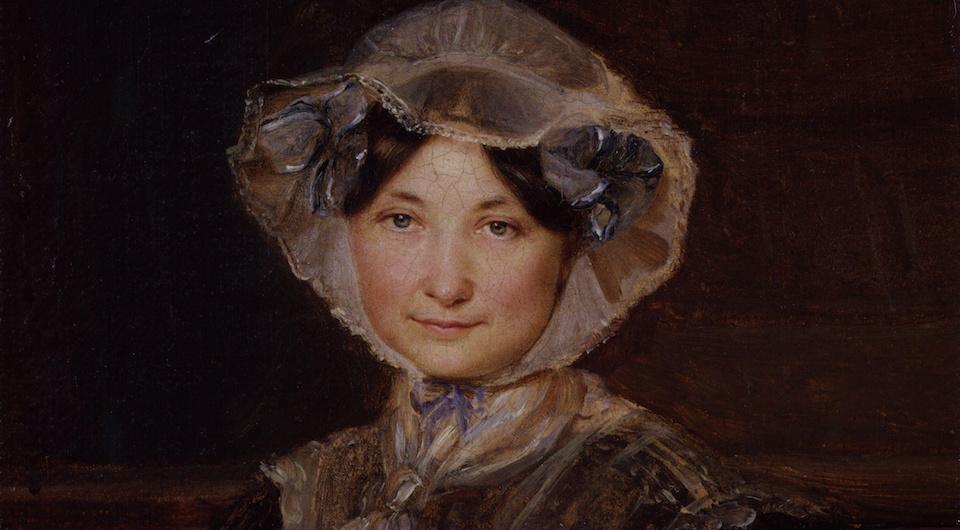
Frances Trollope, by Auguste Hervieu

Perhaps she amounted to collateral damage in the sex war. Rightly or wrongly, her portraits make her look both aristocratic and somewhat cunning, in a very English fashion that even now many Americans could well dislike. Certainly her rather small eyes and mouth accord with no American criterion, past or present, of physical pulchritude. She can easily be envisaged administering rat-poison amid an episode of Midsomer Murders, while murmuring banalities about the weather in a refined BBC voice.

Routinely Mrs Trollope laments what she views as the inferior social position of American women, ‘guarded by a sevenfold shield of habitual insignificance.’ This finding will seem odd to most non-American readers nowadays, who all too reasonably dread the surrender of our media, administrative, and academic institutions to America’s forever unhinged viragos, among whom the moaning maenads of #MeToo are simply the latest example. Still, Mrs Trollope knew better than to ignore the emotional depths below the American female surface. Not for nothing was she a novelist, and in her own day a much appreciated one. She devotes to American womanhood one of the book’s most penetrating and clairvoyant sentences:

 There is a great quietness about the women of America (I speak of the exterior manner of persons casually met), but somehow or other, I should never call it gentleness.

Any suggestion that Mrs Trollope’s anti-American sentiment precluded pro-American sentiment needs to be halted forthwith. Repeatedly in her book, she praises individual Americans. She marvels at the natural beauty that so often surrounds her (however much she insists that she lacks a descriptive pen, she manages to describe this beauty with great effectiveness). New York City and, to a lesser extent, the national capital prompt her to open delight. In her age’s American literature she takes a serious, and periodically an admiring, interest. She congratulates American painters and sculptors for their diligence and craftsmanship in economic circumstances more burdensome than anything which their European counterparts usually faced.

What she always refused to do was to pretend that black was white – an apt metaphor in the American racial context – concerning America’s amour-propre. She would have been much readier to grant America’s contributions to liberty and human progress if the locals themselves had not thrust these contributions down her throat, in season and out of season. We can witness from her account the cheap demagogic trick which any number of Third World Marxists have exemplified since, and to which any number of Americans resorted in Mrs Trollope’s day: the trick of adopting the first principle ‘I must be judged by my intentions, which are glorious; my enemies must be judged by their results, which are atrocious.’

Naturally this comprises the perfect method of making oneself look good and one’s foes look bad. It turned Mrs Trollope’s stomach. Her entire volume may be legitimately viewed as a full-length sequel to the unanswerable question with which the great Dr Johnson, in 1775, taunted American revolutionists: “How is it that we hear the loudest yelps for liberty among the drivers of Negroes?”

Or, for that matter, among the drivers of Amerindians. Here is Mrs Trollope on the latter theme:

Had I, during my residence in the United States, observed any single feature in their national character that could justify their eternal boast of liberality and the love of freedom, I might have respected them, however much my taste might have been offended by what was peculiar in their manners and customs. But it is impossible for any mind of common honesty not to be revolted by the contradictions in their principles and practice. They inveigh against the governments of Europe, because, as they say, they favour the powerful and oppress the weak. You may hear this declaimed upon in Congress, roared out in taverns, discussed in every drawing-room, satirized upon the stage, nay, even anathematized from the pulpit: listen to it, and then look at them at home; you will see them with one hand hoisting the cap of liberty, and with the other flogging their slaves. You will see them one hour lecturing their mob on the indefeasible rights of man, and the next driving from their homes the children of the soil, whom they have bound themselves to protect by the most solemn treaties.

Sometimes she changed her mind. When she could be shown to have committed an honest mistake, she conceded the mistake and, in later editions, regretted it. On no issue did she more clearly avow an alteration of her assessments than on the issue of chattel slavery.

Never did she openly defend that ‘peculiar institution.’ But at first, not least when exploring Louisiana and Virginia, she extenuated it as the lesser of two evils. Initially she shared the belief – articulated by Cobbett, although she nowhere mentions him – that chattel slavery in domestic environs had its merits compared with the conscienceless sweatshops and dark satanic mills of Industrial Revolution England, inimical as those were to any save the most utilitarian and transactional family ties. (Brazil retained chattel slavery long after Jefferson Davis’s downfall, without thereby inspiring hysterical rage generations thence, least of all among Brazilians.) Over the passing years, her limited forbearance towards slavery deserted her. By 1839 we find her writing:

I have had the pleasure of receiving acknowledgements from many who at first raised their voices to contradict me, that my statements were essentially correct, and that in many cases they have been useful; nor have American voices been wanting to confirm this judgement … I should have no fear of meeting anything but a friendly reception from the educated classes were I to revisit America. But this must not be till slavery be abolished, OR, till that part of the Union which has a right to call itself free, shall separate for that whose fame and whose history rests, and will forever rest, more on its reputation for slavery, than on its claim to freedom. Till then, indeed, the Union must be a negative one; it is life and death bound up together.

There was Mrs Trollope, a Cassandra predicting the Civil War two decades before it broke out. Few Americans shared her prescience; fewer still imagined that by the time an exhausted peace could reign (peace which Mrs Trollope, dying in 1863, never saw), 600,000 of their fellow Americans would have forfeited their lives, and that a further century and a half would not avail to eliminate the bitterness of the vanquished or the evangelistic hubris of the victors. In one of her deadliest passages, she holds up to the most thorough derision Thomas Jefferson’s mixture of tireless libertarian ranting with the most shameless sexual predation upon his slave-girls.

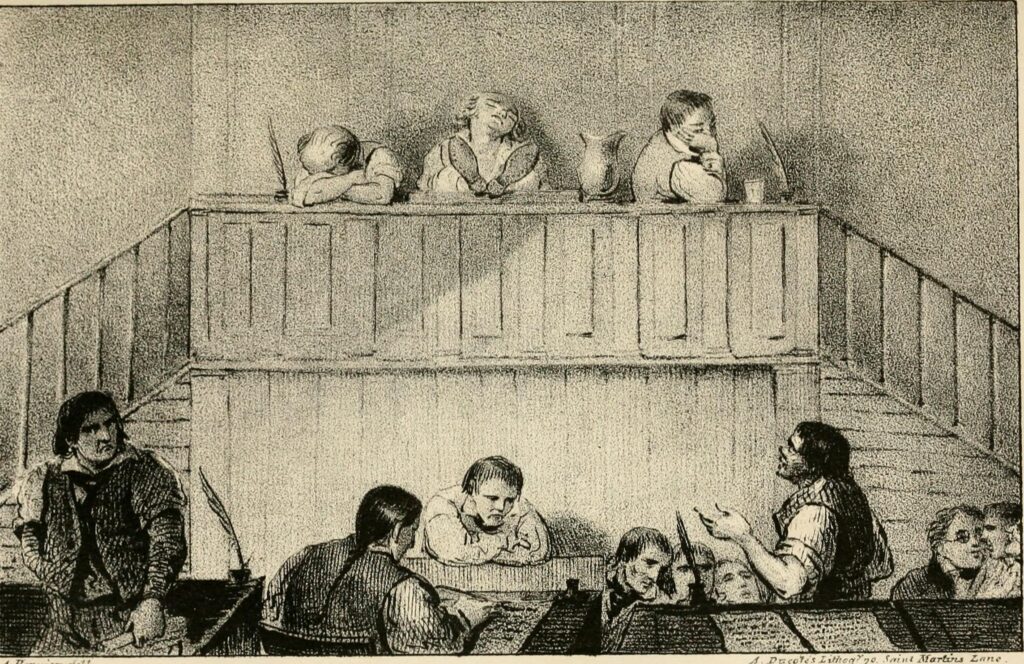
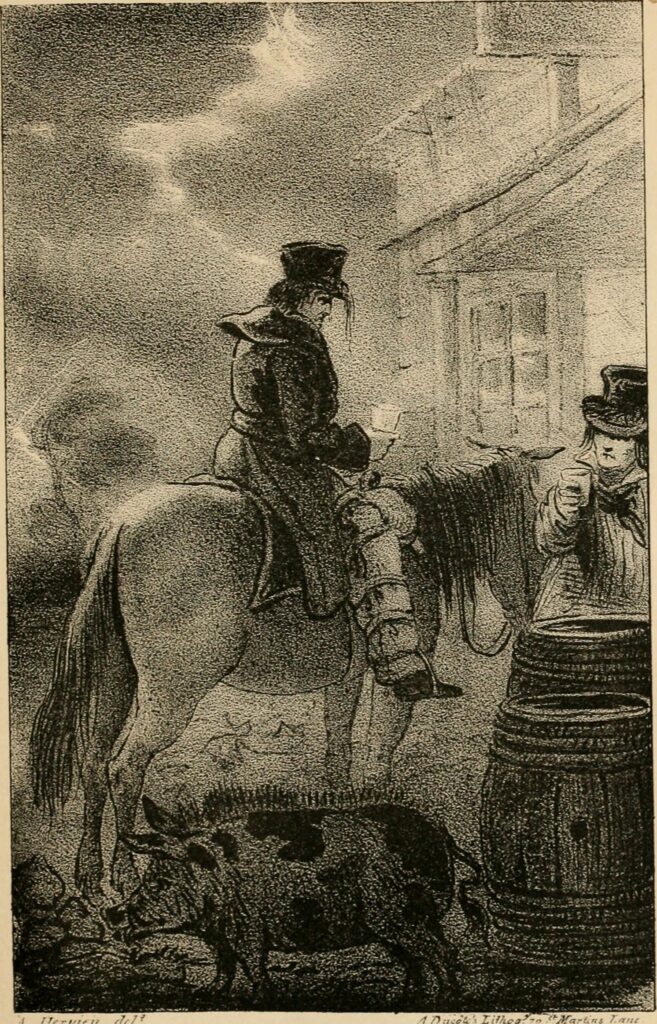
Illustration from the first edition of Domestic Manners of the Americans

This is but one area where Mrs Trollope’s analysis seems to have been ripped from today’s newspaper headlines. Another is her treatment of American religion. Do you find yourself, gentle reader of 2021, contemplating with mingled disbelief and nausea the shrieking, bellowing, gibbering brainlessness which distinguishes several hundred thousand of the USA’s church services each Sunday? Does these services’ unexamined equation of Christianity with American world conquest instil in you a passionate desire to vomit? Fear not: Mrs Trollope was there before you, marvelling and blanching. And whilst she would later attain considerable popularity by writing not one but two explicitly anti-Catholic novels (to write one is a misfortune, to write two seems like carelessness), she found American Catholicism something of a relief after the local brands of Protestantism:

It is impossible, in witnessing all these unseemly vagaries, not to recognise the advantages of an established church as a sort of headquarters for quiet unpresuming Christians, who are contented to serve faithfully, without insisting upon having each a little separate banner, embroidered with a device of their own imagining. The Catholics alone appear exempt from the fury of division and subdivision that has seized every other persuasion. Having the Pope for their common head, regulates, I presume, their movements, and prevents the outrageous display of individual whim which every other sect is permitted.

She supplied a glowing commendation of Edward Dominic Fenwick, Cincinnati’s Catholic archbishop from 1822 to 1833. ‘I … have never known in any country,’ she insisted, ‘a priest of a character and bearing more truly apostolic.’

Yet an entire episcopal conference’s worth of Fenwicks could not have made her amenable to her American hosts’ curious ideas of what constituted adequate schooling. Now that almost every month newspapers and current-affairs websites notify us of yet another American school massacre – invariably perpetrated by males on government-run premises, and usually perpetrated by white males – we can consult Mrs Trollope for proof that already, in her epoch, such evils lay in the womb of time. They required for their eventual parturition nothing more than changed external circumstances, four in particular: mindless affluence; the likewise mindless ascription to Freud, John Dewey, and suchlike grotesques of a moral wisdom which threescore Father Damiens would be hard-pressed to reach; a mass-media and social-media culture without the slightest residue of a conscience; and the quaint belief in the salvific operation of antidepressant-dependence upon the adolescent brain.

Mrs Trollope’s painter friend, the Frenchman Auguste Hervieu, voiced with fascinated dismay a finding which has echoed down the ages: ‘American parents never reprimand their children.’ For her own part, Mrs Trollope comments on whatever occurrences of sensibly conceived tuition she can find in the USA, if only because of their rarity value. She is likelier to issue such grim warnings as this:

I have conversed with many American ladies on the total want of discipline and subjection which I observed universally among children of all ages, and I never found any who did not both acknowledge and deplore the truth of the remark. In the state of Ohio they have a law (I know not if it exists elsewhere), that if a father strike his son, he shall pay a fine of ten dollars for every such offence. I was told by a gentleman of Cincinnati, that he had seen this fine inflicted there, at the requisition of a boy of twelve years of age, whose father, he proved, had struck him for lying. Such a law, they say, generates a spirit of freedom. What else may it generate?

What indeed? Try the following varieties of pseudo-intellectual garbage, Mrs Trollope. An American campus gulag archipelago purporting to offer something called ‘higher education,’ where grown men hourly tremble in dread of the latest outrage by hormonal yahoos against insufficiently sycophantic visiting speakers and even against insufficiently woke statuary. Police forces so terrified of having another George Floyd on their watch that they must stoically indulge every form of Oregonian rioting, and every type of obscene abuse from every ululating pubescent with a Twitter account. A milieu where each American adult with two functioning brain-cells will admit in private that only the most comprehensive program of enforced military service can possibly stave off – at least in the interim – endless, still bloodier repeats of last January’s insurrection; but where no such adult will dare hint at the need for this program in public, because the usual suspects will Get Offended. The elementary political will needed to impose such military service on American youth (modern America being an unmistakable embodiment of Chairman Mao’s notorious epigram ‘Political power comes from the barrel of a gun’) is as non-existent after four years of presidential rule by an alleged conservative, as it was in the heyday of Herbert Marcuse and Ho Chi Minh.

One could continue citing Mrs Trollope’s gifts as a seer. She exhibited remarkable insight into the hideous isolation that had already come to differentiate America’s backwoodsmen – about whose supernal virtue Jefferson loved to fantasise – from even the most ‘solitary, poor, nasty, brutish, and short’ lives of communitarian rural England:

These people were indeed independent, Robinson Crusoe was hardly more so, and they eat and drink abundantly; but yet it seemed to me that there was something awful and almost unnatural in their loneliness. No village bell ever summoned them to prayer, where they might meet the friendly greeting of their fellow men. When they die, no spot sacred by ancient reverence will receive their bones – Religion will not breathe her sweet and solemn farewell upon their grave; the husband or the father will dig the pit that is to hold them, beneath the nearest tree; he will himself deposit them within it, and the wind that whispers through the boughs will be their only requiem. But then they pay neither taxes nor tithes, are never expected to pull off a hat or to make a curtsy, and will live and die without hearing or uttering the dreadful words, God Save the King.

J.D. Vance, for taking several hundred pages to say less than Mrs Trollope here says inside four sentences, is regularly hailed as a genius. Might not Mrs Trollope’s own ‘hillbilly elegy’ receive its due meed of praise?

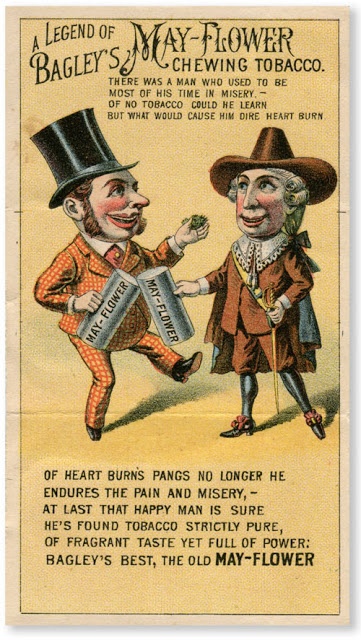
But enough. One day the pandemic will abate; America will regain some kind of tourism industry; and we might discover for ourselves the relevance or otherwise of Mrs Trollope’s reportage to a post-COVID polis. The chances are that this reportage will require little revision, and that what little revision is needful will concern outward and visible signs alone (just as improved public health has already rendered socially unacceptable a particular aversion of Mrs Trollope’s: the constant spitting and tobacco-chewing to which most American males of 1827 were addicted). Meanwhile – for however many years the only two political movements maintaining traction in the USA can be summed up as, respectively, the 1619 Project and the 1776 Project – the cool sardonic voice of Mrs Trollope the European Tory realist can continue to work its magic.

Social ranking redux

Credit: Shutterstock

The New Snobbery

David Skelton, Biteback Publishing, 253 pp, £16.99

KEN BELL says many members of the middle classes have found ingenious new ways of disliking people

Britain is notoriously obsessed with class, but now there is a new, ideological way of looking down on people. David Skelton, a native northeasterner who is director of the Conservative-supporting think-tank Renewal, argues that we have replaced old forms of snobbery with new ones, based on beliefs rather than birth. Contemporary British politics shows no sign of Nancy Mitford’s famous ‘U’ and ‘non-U’ distinctions (napkin or serviette, long A or short), or inherited privilege, or Captain Mainwaring-like painful insecurity, but has developed new prejudices instead. The new breed of snob is not interested in how a man speaks or what his background is, but in his outlook.

The new political arbiters are the products of the post-1992 expansion of the education system, and for over a generation they have felt that they set the tone of public debate, a debate which often seemed to involve attacking the people they regarded as being beneath them:

Comedians, who are first to loudly claim to be offended in most circumstances, are the first to savage the so-called ‘crap town’ within the UK and ridicule narrow-minded, proletarian values. The likes of the BBC’s The Mash Report and Radio 4’s The News Quiz had a regular habit of punching down.

When, in 2016, a coalition of traditional middle class voters and even more traditional working class ones voted to take the UK out of the European Union, their sense of entitlement exploded in a righteous outrage that continues to this day as the reaction to the Conservative victory in the 2021 Hartlepool by-election shows. One writer argued that “a huge number of the general public are racists and bigots,” before going on to ask: “How do you begin to tackle entrenched idiocy like that?” This is not the old middle-class directing its angst at blue-collar ‘inferiors’; today’s snobs are the products of those former polytechnics that now degrade the name university, who almost invariably have well-paid roles as members of the local government nomenklatura.

What Skelton overlooks in his attack on today’s left is that Labour has never been an entirely plebeian party so the problem is not new. George Orwell made that point in The Road to Wigan Pier when he described the average Labour activist as being a rather shabby clerk, with “a background in Nonconformity”, possibly also a vegetarian, and the possessor of a position that he would not give up under any circumstances. Orwell could have been writing about the ancestors of today’s social work industry, teaching trade, NHS managerial caste and ancillary workers, but what saved Labour in those days were the industrial trades unions. Whenever some insane policy was thought up by the activists, the union block vote could be relied upon to knock it firmly on the head and keep Labour electorally sound.The destruction of industrial Britain, which led to the end of industrial unionism, has left the field wide open to Labour’s middle-class activists. The people they select for electoral office are as socially liberal as they are, and that factor pulls the party further away from its socially conservative voting base.

The snobbery and open contempt that Labour’s members have for their electorate is covered in great, depressing detail in Skelton’s work. In the aftermath of the Brexit vote, far too many of them “hoped the Nissan plant in Sunderland would close” as the people there were “stupid” and deserved everything that was coming to them. “Others said they would be ‘pleased’ if the fishing industry was harmed by Brexit” as that was what people had voted for. At root, as Skelton says, this attitude is based on the belief that low-income workers are the authors of their own misfortune. The new snobs are meritocrats, who managed to wangle themselves a berth in a post-1992 “university” and believe that people who haven’t followed that road are too thick to bother about. This attitude now seems to encompass a sizeable chunk of the middle-class as a whole.

The problem is that the working-class is not stupid. They may have rejected Labour, but that is because whenever a Labour MP sneers at a house that flies an English flag, or the party opposes the opening of a new coal mine, as it did this year in Cumbria, the message that goes down the wires is that Labour is not the party of their values or economic interests. This is important because The New Snobbery is also a plea for a politics that treats the working class vote as something to be fought for. Skelton may be a Conservative, but he realises that unless Labour takes on board policies that appeal to its old, core voters, his party is not likely to do it entirely on their own. The Tories need always to be moderated, and pushed, by a Labour Party that has regained its sanity. Skelton’s analysis is shrewd and worthy of attention. The only problem is that having put his finger on the problem, he does not come up with any solutions. On the other hand, perhaps there isn’t one.

The Venatio – an extract

LUKE GILFEDDER tells a dark tale of Cheshire

Crime writer Stephen Niskus suspects that his long-lost school friend, Alexei Orphonov, is a serial killer. When he catches sight of Alexei in Alderley Edge, he embarks upon an urgent quest to prevent another murder. But Stephen’s investigations soon lead him into a far more tangled and deadly web than he could ever have imagined, one whose origins lie in the heathen history of The Edge, yet whose far-reaching strands threaten to re-engineer the future of humanity itself

CHAPTER ONE

A black-suited six-footer descended the steps of Manchester Victoria station. He twitched his Celto-Lancastrian nose like a rabbit. There was a storm coming, one of those Pentecostal storms which occur only in this region of hills and neogothic spires, tall as obelisks, when dams burst, roofs are swept away, squares are flooded, and every lead pipe becomes a fountain. After a few meaningless but magnanimous hours that had resembled good weather, so Manchester was, on cue, creaking back into its rainy groove like a tram proudly regaining its rails. The man signalled a taxi and gave an Alderley Edge address. Streets of angry red brick assumed a tone of purple as they drove out of town, until, beneath the uncertain and swinging illumination of a Northern gale, the skyline of his youth became but a badly smudged Lowry, an opaque deepening of twilight itself.

Fifteen miles later, the taxi’s headlights swept down the cobbled and very superior half-mile of Woodbrook Road, where bronchial trees soared high in the darkness, and medievalish lampposts bore aloft wavering haloes of golden drizzle. “People think Cheshire as flat as a pancake,” said the driver, “and it is for the most part, but not ‘ere.” Six hundred feet high and three miles long, the detached mass of the Edge rose from the Cheshire Plain, a long-backed hill that was tall and sombre and dark. Estates crept down its slopes, stepping on their own shadows.

At the base of the wooded sandstone hill was Alderley itself, the “best” postcode in all of Cheshire. It was Cheshire’s Kensington, its Linlithgow, its Sandycove, its Charlottenlund, and (to the Welsh at least) its Cowbridge. Alderley was rich in the early aura of old halls, fallen fortunes, and county families common to so many of too many English autobiographers. Much rarer in the North than the South, Stephen Niskus thought, but only mildly less intolerable. During the day, the Edge would hum with the sounds of Alderley villagers, be they cashmere-draped ramblers trampling down the dead leaves or the self-exiled grandchildren of the self-made racing their smoke-blue Mercedes’. But at dusk, such life withered in a moment, and the sounds became those of the wood, the crystal tongues of water and nightingale, and the heathen murmurings of Roman mines and druid bones lay beneath the marl.

The deluge was so great now that visibility was cut to a few yards; rain lashed against the windows, tearing the streetlight into golden shrapnel. The taxi turned off the bottom of Woodbrook onto Mottram Lane, which, having shaken off the shadow of the Edge, ran more straight and free. Cricket fields lay on the right, nude and white as blanched nut kernels, while a swim of oxblood manors and Mississippian mansions drifted by on the left, each with cactus and bamboo trees leaden in their greenness, sad feathery shafts dripping water, intense against the dark sky. The driver said:

“Strange weather, isn’t it?”

Stephen was slavonically mute. He had never been the type to answer a curt “yes” to such observations, nor to reply with a similarly hackneyed phrase. The driver continued:

“An’ they were sayin’ this might turn to snow overnight. Don’t think we’ve had a white Christmas since 2010.”

Stephen managed to say, “really?” and stroked a disinterested hand through neat terraces of auburn hair.

“Aye. I’d steer well clear of the Edge though tonight, it being the solstice an’ all. The crackpots’ll all be out in force.”

Alderley looked strange and melancholy in its moon-polished state, with only a few Brueghel-like characters, necks swathed in mufflers, stalking about the lanes like plump wraiths. It reminded Stephen of Prague last winter, of mist in the gingerbread gothic square, the bells of Týn Church echoing in their black Catholicly way, and of a tyrolean-hatted shadow receding into the darkness down Alchemist Alley. A nostalgia at least half revulsion affected him, only to be dissipated by the driver’s voice:

“What do you do, son, if you don’t mind my asking? Couldn’t help but notice all of them tags on your luggage.”

“I’m a crime writer,” said Stephen, “I’ve just finished a promotional tour.”

“Oh, really?” the driver replied with raised (or over-raised) eyebrows. A twenty-something living on his wits — what! — a label which, harmless as it may sound to foreign ears, somehow in England confers upon a person a moral ambiguousness. “I knew I’d seen your face around. You were in Cheshire Life, weren’t you? The missus reads it.”

He continued to talk as the taxi turned onto the high street, but Stephen no longer listened. His eyes closed. Being back in Alderley provoked other memories, the rain encouraging them to unfold like those Japanese flowers that open in water. He recalled being dressed in his confirmation suit, drenched to the skin, that first day he alighted at an autumn-leaved Alderley station which was quite unlike the godforsaken one (broken mirrors, tattered plush, arsoned vending machines) from which he had set out. Stephen had just passed the entrance exam for Manchester Grammar School, the “Eton of the North”, and it had divided his life as cleanly as Roald Dahl’s Boy and Going Solo. He had not gone to a poor primary: indeed, the best Catholic schools were all in the North, for the Reformation, like blood from the feet when the arteries harden, could not push up so far so easily. But his eschewal of the local Catholic secondaries (St. Ambrose and Cardinal Newman) meant that his life swiftly became one of two towns, two skies and two-tone shoes: streets of fatal poverty gave way onto a world of fatalistic wealth, Michaelmas blues, bonfire moons, and gothic quads, not to mention those metallic-green lawns whose edges you could slice your finger on, the eternal wait for fifth-period break after Double Latin, that most wintery of phases ‘Lent Term’, and, last but not least, Little Arthur’s History of England with its sketch of the Princes in the Tower, those two royal princes, so innocently embracing, so soon to be smothered. What only child could look upon them without a disturbance?

“Typical,” the driver tut-tutted as they hit the Christmas traffic on London Road, “would you look at the way they park…”

Stephen lowered the window to let out the smell of the driver’s cigarette, admitting a gust of rain and the sounds of swishing tyres on the wet asphalt. His taxi halted at the lights. He peered across the road. A Daimler Sovereign had drawn up outside De Trafford hotel as two silhouettes emerged from the lobby’s golden oblong. One was a boy, head held like an emperor stag, and the other a vulturine old man. The boy eased the aged fellow into the waiting Daimler, and as he did so, shot a glance up at Stephen’s taxi, sharp and swift as the click of a camera. Then he tilted the head away with that same arrogance made up of having stared at you, measured your value, and decided you were not there. That same! Stephen felt the stab of recognition as keenly as a knife on a wintery mountaintop. He was about to leap out of the taxi and shout hello when the boy vanished into the Daimler. The vehicle cleared its throat and, tyres slewing, sped toward the private road labyrinth of Nether Alderley.

The traffic lights remained mulishly red. Stephen was tempted to tell his driver to give chase, but he rapped on the partition screen and said:

“Would you please stop outside that hotel?”

“But we’re almost at Davey Lane!”

“Yes, but I’ve remembered I have to see someone. It’s urgent.”

The taxi turned into De Trafford’s horseshoe driveway, joining a flotilla of taxis who sought with the unwieldy wariness of reluctant machinery a place to park. Stephen leapt out by the flood-lit fountain and shouted:

“Wait for me here. I shan’t be two minutes.”

The trees flanking the hotel were shivering and erect. Above the half-hearted portico, smoky clouds were gathering, twirling in triskelions. Stephen took the shallow steps two at a time, the keen air of the dying year resisting each stride. He had the door open before the commissionaire could oblige. The very wood of the reception felt full of the imminent snowstorm. A teenage girl stood behind the hostess stand with her pentathletic head thrust forth. Stephen approached her.

“Excuse me, there was a young lad who left here a second ago. Do you have a name? Is he staying here?” He added: “I believe he’s an old school friend.”

“Gosh, I couldn’t say. We’ve had such a busy night tonight; it’s our Christmas buffet. All traditional Cheshire food, sir. There’s still some left if you’d like: Potted Pigeon, Fidget Pie, Rabbit Brawn, Chester Pudding…”

“I’m sure,” said Stephen. “But could I please see a guest list?”

Her eyebrows were ruched as she turned to find a manager. Stephen cursed the impulsivity which went along with his red hair— how often it led him into scrapes like this! He’d only seen the boy thirty feet away through a rain-spattered window. He could have been anyone… couldn’t he? A moment later, the girl returned with the list. Stephen scanned it twice, then shook his head and handed it back. She apologised and said:

“We did have a cancellation earlier, now I come to think of it. It was taken by an older gentleman, I would have thought he was with his grandson, but the boy didn’t seem local. His name was Alex, I think?”

“Alex?” Stephen pressed. “Could it have been Alexei? Alexei Orphonov?”

“It might have been… I’m so sorry, but I couldn’t say for sure.”

Stephen gave a rare double smile of eye and mouth. “Never mind, you’ve already been most helpful.”

“A pleasure, Mr Niskus.”

“You know my name?”

“Of course! I read your novel. How do you pronounce it, The Venatio? I love a good whodunit, but I have to say, I never saw that twist coming.”

Stephen thanked the girl again and then turned to leave. Thoughts of Alexei obscured the anonymous farewells of women pursuing him from the gaping mouth of the lobby. Before him, taxis began to purr, and keen patches of light sped over the slushy wastes of the drive. The word “venatio” echoed in his mind as he zippered his coat, offering the minuscule pleasure that one word from Double Latin had returned amid this electrifying turn of events. Vēnātiō: the hunt, a hunting spectacle. They taught Latin well at Manchester Grammar School. He climbed back into his taxi.

“Fun and games over for tonight, sir?” The driver inquired.

“No,” Stephen said, “they have only just begun.”

9/11: premonition of disaster

Credit: Shutterstock
GOMERY KIMBER believes there really can be second-sight

On the afternoon of September 11th 2001 I was making notes for a story I planned to write about the ghost of a slave ship captain. I’d already named the ghost Noah, but I couldn’t think of a suitable surname. I sat there, pen in hand, awaiting inspiration.

Eventually, a name popped into my head: Shanks, Noah Shanks.  That sounded just right. I wrote it down, made a sandwich as I’d had no lunch, and turned on the TV.  When I saw what was happening in the USA that afternoon – real horror, real terror – making notes for work of fiction seemed not a little pointless.

It was two days later, while reading newspaper reports of the attacks on America that something strange happened.  As everyone knows, there was a fourth aircraft that never reached its hijackers’ target. Flight 93, a United Airlines Boeing 757, was carrying 38 passengers and seven crew. It crashed 80 miles south-east of Pittsburgh. Or to be more precise, 8 miles east of Jennerstown, near Shanksville, Pennsylvania. I looked again. Shanksville? My first reaction was, now that’s unusual, that’s the same name as the character in my story. Then I noticed that Flight 93 had crashed at 2:00 PM Greenwich Mean Time – about the same time that the name Shanks had swum to my head.

Now for several months before September 11th I had been plagued by nightmares of explosions, nuclear warfare, and natural disasters; one particularly disturbing dream concerned a skyscraper in a city under air attack. In June 1996, the flat I shared with my girlfriend was blown up by the IRA bomb which badly damaged city centre Manchester. I had assumed the nightmares related to that traumatic event, but now I wasn’t so sure. I’d dreamed of a skyscraper (there were none in Manchester) in a city attacked from the air (the IRA used a lorry bomb); could it be possible that I had glimpsed the future, dreaming of a terrorist attack that had yet to happen? But how could I have been?

Everyone knows that time is linear, flowing from the past into the future. It is impossible to have prior knowledge of a future event. Or is it? I recalled reading about the journalist John Godley who dreamed more than once of future horse race winners; on the strength of his fame as a psychic punter he went on to be a racing correspondent1. So perhaps time is stranger than we think, perhaps all of us have precognitive dreams but forget about them as soon as we wake up.

In 1927, in his famous book An Experiment With Time, J W Dunne suggested exactly that. Upon waking, Dunne would write down what he had been dreaming about, and quickly discovered that he did indeed dream of future events. While reading about a combination lock, he realised he had dreamt about it the night before. On another occasion he dreamed that his watch had stopped at four-thirty and that a crowd was shouting, “Look!  Look!”  Dunne woke up and discovered that his watch had indeed stopped at four-thirty. He wound it up, only to find the next morning that his watch was showing the right time: his dream had woken him at the moment it had stopped.

Not all Dunne’s dreams were so mundane. In 1902, as a soldier in South Africa, he dreamed he was on an island threatened by a volcanic eruption. In the dream he “was seized by a frantic desire to save the four thousand (I knew the number) unsuspecting inhabitants”. Days later he read an account of a volcanic eruption in Martinique. 40,000 people were said to have died, but Dunne misread the figure as 4,000. It was fifteen years before he realised his error. “My wonderful ‘clairvoyant’ vision had been wrong in its most insistent particular!” he noted, concluding that his dream was of reading about the eruption in the newspaper, not of the event itself.

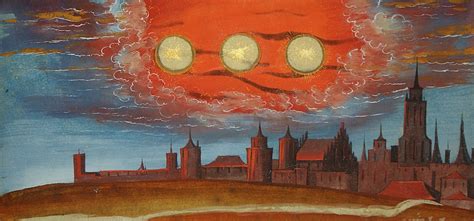
Illustration from the 16th century Augsburg Book of Miracles

Dunne is not alone in having prior knowledge of disasters. In October 1966, a coal tip slid down a hillside and buried the Welsh mining village of Aberfan, killing 144 people, 128 of whom were children. Following a visit to Aberfan, Dr J C Barker made an appeal in the London Evening Standard for those who felt they had foreseen the disaster to contact him.  Of the 76 people who came forward, Barker was able to confirm that 26 had spoken to others about their premonition before the event. The precognitions had affected people all over the UK, from five weeks before the disaster to within two hours of it. So vivid were the precognitive dreams that in some cases people woke in great distress, reporting that they had heard children screaming. Some claimed to have had premonition of other disasters; Doctor Barker called such people “human seismographs”.

Indeed, it would seem that the greater the reading on the psychic Richter scale, the greater the number of people who receive glimpses of the future.  It should therefore be no surprise that a rash of premonitions preceded the sinking of the Titanic in April 1912, which claimed 2207 lives. Ten days before he was due to sail on the ill-fated vessel, businessman J. Connon Middleton twice dreamed of a ship that turned keel upwards surrounded by frantic people in the water. Luckily for him, the conference he was due to attend in New York was cancelled and he stayed at home. Fortunate too was sailor Colin MacDonald. Three times he was asked to join the Titanic as second engineer, and three times he refused; he had a strong premonition that the ship’s maiden voyage would end in disaster. Newspaper editor W. T. Stead was not so prudent. Strangely, since he was interested in the occult, Stead ignored the advice of the fortune teller Cheiro (real name William John Walker) not to travel by water during April 1912, especially about the middle of the month (the Titanic sank on the 14th). Stead died in the disaster.

Perhaps the most uncanny of all the premonitions concerning the loss of the Titanic occurred in 1898. The American novelist Morgan Robertson was something of an oddity, in that he felt himself not a creative artist but a channel for the writings of someone else. Often Robertson was blocked and could only write when he felt himself possessed by his invisible partner. It was in this role as amanuensis that he wrote The Wreck of the Titan, the story of a ship designed to be unsinkable due to its watertight compartments. On its maiden voyage in April, the Titan, travelling at a speed of 25 knots, strikes an iceberg. The ship has only 24 lifeboats for its 3000 passengers and crew and sinks with huge loss of life. The parallels with the Titanic are remarkable. At the time it struck an iceberg on its April maiden voyage, the Titanic was travelling at 23 knots, and carried only 20 lifeboats. Like the 70,000-ton Titan, the 66,000-ton Titanic was sailing from Southampton to New York. 22,007 lives were lost, a death toll which would have been even greater at the ship not been two-thirds full . . .

But how is it possible to know about something that has not yet happened? Classical science, and common sense, revolts at such a notion. Newtonian physics tells us that all elements of the universe are isolated from each other, divisible, wholly self-contained and separate. We are Mind, sitting outside this mechanical universe, looking in. Strangely, this paradigm still obtains. I say strangely because discoveries in quantum physics should have caused its demise in the early part of the last century. In quantum physics, matter cannot be divided into discrete units, but is completely indivisible. The universe can only be understood as a web of interconnections. Things once in contact remain in contact throughout all space and time. Indeed, space and time appear to be nothing more than arbitrary constructs, and do not in fact exist.

Augsburg Book of Miracles

In The New Immortality, J. W. Dunne equates our lives to a strip of film which shows everything that happens to us from cradle to grave.  The ‘everyday you’, which Dunne calls Observer 1, travels along this film strip, totally engrossed in the mundane business of living.  But when the ‘everyday you’ relaxes, a strange thing happens: you become the ‘real you’, able to observe the strip of film from a distance and see into the future just as easily as you can see into the past. It was in such a relaxed state – trying to come up with the name for a character in a story – that the name Shanks drifted into my mind.

A similar state of mind, which we might call alert relaxation – is used by remote viewers, which is what the US military calls its clairvoyants. Astonishing as it may seem, during the Cold War, the Pentagon spent millions of dollars on the Stargate Programme, training military personnel as psychic spies, spies who were used to discover the secrets of the Soviet Union without ever leaving the USA. Stargate was disbanded in 1995, and since then former remote viewers have gone into business, predicting the future of the stock market for corporate clients and teaching civilians how to ‘’see at a distance’. One such RVer is Prudence Calabrese who claims to have had a vision of the attack on the World Trade Centre as long ago as 1997. Posted on her LargerUniverse.com website are the ten pages of sketches and notes she claims to have made during a remote viewing session on 10 March 1997.

But is there any hard scientific evidence to support the theory that everything is connected, that time is not linear, that we can forecast the future? In fact, there is.

On September 11th, 2001, three hours before the first airliner struck the World Trade Centre, a machine at Princeton University in New Jersey predicted some major disaster. The machine is a Random Event Generator used to monitor completely unpredictable processes, such as the decay of a radioactive ingredient. The results it produces are down purely to chance and are recorded on a graph. Most of the time the graph shows a wavy line, with only a few minor variations, but occasionally the line peaks. That is what happened on the morning of September 11th. Between 9am to 10am Eastern Standard Time, as the attacks began and those infamous pictures were broadcast around the world, the graph peaked enormously.

In fact, the REG graph began to rise at 6am, three hours before the first strike on the WTC. Writer on the paranormal, Colin Wilson, believes that this was because many people around the world, Barker’s human seismographs, were experiencing premonitions of the coming disaster, and that this surge of fear and distress showed itself on the graph three hours before the attack began.

I was not alone in my premonition of disaster. Actress Nicole Kidman has described how she intended to fly to New York from Los Angeles on September 10th, but changed her mind because she had a premonition that things ‘would not go well there’. A British writer on the paranormal has related to me how she cancelled a trip with her mother to the USA after experiencing a vivid nightmare in which the plane on which they were travelling was deliberately crashed into the ground Mother and daughter had been recommended by a relative to visit the viewing deck of the World Trade Centre.  The only gap in their tight schedule for such a visit was on the morning of the 11th . . .

In America, countless individuals have contacted psychical investigators to report similar premonitions. Perhaps the most sinister of all concern followers of Osama Bin Laden. In a video tape found by US troops in Afghanistan, Bin Laden and his lieutenants make extensive reference to precognitive dreams about September 11th amongst their own followers.

In The Roots of Coincidence, Arthur Koestler quotes Oxford Professor of Logic, H. H. Price. Price believed that “telepathically received impressions have some difficultly in crossing the threshold and manifesting themselves in consciousness. There seems to be some barrier . . . which tends to shut them out of consciousness . . . and they make use of all sorts of devices for overcoming it. Sometimes they make use of the muscular mechanism of the body, and emerge in the form of automatic speech or writing [we are reminded of Morgan Robertson who believed himself merely the channel for another writer]. Sometimes they emerge in the form of dreams . . . And often they can only emerge in a distorted or symbolic form (as other unconscious mental contents do). It is a plausible guess that many of our everyday thoughts and emotions are telepathic or partly telepathic in origin, but are not recognised to be so because they are so much distorted and mixed with other mental contents in crossing the threshold of consciousness”

So, were my nightmares a premonition of disaster, garbled and distorted? I am inclined to think that they were. As for the name Shanks popping into my mind at the time Flight 93 crashed near Shanksville, was that coincidence or clairvoyance? I can’t prove it, but I think it was the latter.

  1. John Godley was the Irish peer, Lord Kilbracken, and the story of his dream winners are related in this documentary from the 1970s, introduced by Colin Wilson: Leap in the Dark – Dream me a winner – Paranormal – Documentary – YouTube []

The War Party – extract

‘Hypnos’, Wilhelm von Gloeden
This is Chapter Thirteen of GOMERY KIMBER‘s novel, The War Party, the second book of the Big Shilling trilogy. ‘Verity Clissold wants the whistle-blower terminated. But he’s taken refuge in a London embassy and not even the CIA can reach him. There is only one solution. Call in the most accomplished assassin in the world, the Big Shilling.’

After his shower, the Big Shilling lay on the bed and closed his eyes for five minutes. He’d opened the upstairs windows, and, along with the banal cacophony of the city – emergency sirens, incessant traffic, airliners sailing overhead – there came the sound of a party in one of the back gardens. Raucous Australians were preparing a barbie.

As he drifted in his natural element, that state of consciousness on the borderland between waking and sleep, BS could smell burning charcoal, and sensed anger. He ignored it, and concentrated instead on imagining the future, on imagining the best.

Fidel, eh? You shouldn’t have crossed me, you shouldn’t have crossed me, Fidel. You’ll get what for, you’ll get what for. You don’t suffer from hives, eh? You don’t, Del? Are you sure, my boy? Are you sure?

A few minutes later, raised voices disturbed his tranquil state. There was some kind of altercation underway outback. No longer drowsy, BS threw on some clothes and went to investigate.

From the window of the back bedroom he saw that the garden next door was thronged with people, not only Australians, but Poles as well. There were two barbecues pluming grey smoke, but food didn’t appear to be the main attraction for these young men and women: no, they had gathered to get slaughtered. A black plastic dustbin was brimming with ice and cans of beer, and the Poles were doing vodka shots. There was an amusing drinking game in progress as well: with the aid of a funnel and a tube, an Aussie girl in cut-off jeans and a bikini top was able to consume half a litre of lager in two seconds flat. The Big Shilling watched as the girl gripped the handle of an upright garden hoe and attempted to circle the implement as quickly as possible. To hysterical laughter, she spun out of control, and ended up on top of a heap of half-naked men.

It gave the Big Shilling an idea. Seeing that girl and the hoe, and the smoking charcoal and the booze, it gave him an idea.

‘Soma,’ he said, delighted, ‘polar. The goddess naked, surrounded by flames, her hair loose, wearing a necklace of skulls, and dancing on the still body of Shiva.’

The secret ritual. Why not attempt it? Why not indeed? The powers would come to him. He would have powers. Now, that would be something to put his biography, wouldn’t it, eh? Powers? Yes, it would.

‘This is not fair,’ the Big Shilling heard someone call plaintively from above. ‘This is not right, or fair.’

From the garden there were a variety of replies:

‘Stop your whingeing, mate.’

‘It’s the Owl Man, woo-woo!’

‘Come and have a beer, mate.’

‘Let your bloody hair down for once and have a laugh.’

The Owl Man, thought the Big Shilling leaving the bedroom, how interesting. He went up the narrow stairs to the second floor. The door to the balcony was ajar, and he could see the painter of owls leaning over the parapet, appealing to the good nature of the pissed partygoers below.

‘Peace and quiet, that’s all I want, a little bit of peace and quiet,’ said the young man. ‘You said there would be no more noisy parties. But all right, if you are to have a party at least let it not go on till the early hours – please?’

‘All right, mate,’ said the biggest of the Aussies, ‘no worries. We’ll call it a night before eleven.’

‘Thank you, Brandon,’ said the Owl Man, as though he actually believed what the rugger-bugger had said. ‘I’m going to go out now, so you can make as much noise as you want.’

‘Yeah, see you later, mate,’ said Brandon, sarcastically. ‘Remember to stand well back from the platform edge, won’t you? Don’t want you throwing yourself under a train.’

‘Brandon,’ chided a couple of the girls, but their voices were submerged in the general laughter.

The painter of owls turned away, brushing his unkempt chestnut hair out of his eyes, eyes which spoke of pain and confusion and angst. ‘Swine,’ he muttered, ‘why can’t they leave me alone?’ Then he saw the Big Shilling, who had been observing him from the shadows, and started. Amused, Shilling raised a hand in apology, but the boy was gone, scurrying inside like a rabbit down a hole.

After observing the party further, particularly the girl with the hoe, the Big Shilling went downstairs and finished getting dressed. He was planning a night out as well, and as he dressed, he sang himself some Sinatra, some Frankie, even going so far as to perform a few dance moves. But the noise from the garden put him off his stroke.

‘Better not keep me awake tonight, Brandon,’ he murmured. ‘That wouldn’t be a good idea, Brandon. Eh?’

When he was done, he collected the bag with the painting, and went downstairs. He was locking the front door when he noticed the Owl Man coming down the steps next door.

‘Evening,’ said the Big Shilling, not too loudly. ‘Sorry if I startled you.’

The Owl Man again looked startled, and it was obvious that he really didn’t want to be forced to converse.

‘It’s all right,’ he mumbled, before lowering his head and setting off down Sundheim Street, shoulders hunched, his hands in the pockets of baggy, paint-stained brown cords.

The Big Shilling took his time following, not wanting to spook the young man further. But it soon became apparent that their destination was the same: Notting Hill Gate tube station. The Owl Man went through the turnstile, while Shilling went to the window to buy a Lobster card from a West Indian. He paid in cash, two twenty-pound notes, and admired the artistry of the black lady’s nail technician which earned him a shy smile.

Once on the eastbound platform, which was practically deserted, he encountered the Owl Man again. They stood well apart in the tunnelled heat, Mr Shilling relaxed and smiling, the Owl Man fidgeting in a threadbare tweed jacket, pacing up and down aimlessly, never calm, never still. Three minutes later, they boarded the same Central Line train. And both got off, eight minutes after that, at Oxford Circus. On the busy escalator, with its faint breeze of lukewarm air, Shilling stood behind him. The Owl Man glanced back, nervously.

‘Are you going to see Aunt Mimi?’ Shilling asked him.

The Owl Man nodded gravely.

‘Me too. She owns both houses, does she?’

The Owl Man nodded again. The Big Shilling climbed up the escalator until he was two steps in front of him. Since the Owl Man was stooping, they were at about eye level. Shilling pointed a finger at him.

‘You’re a painter,’ he said.

‘Not a very good one.’

The answer was immediate, and, Shilling decided, characteristic.

‘I’ve got a painting you might like to see, in my bag.’

‘Oh yes?’

‘It’s by probably the greatest British painter of the twentieth century.’

The Owl Man’s interest was piqued. ‘Bacon?’

The Big Shilling smiled. ‘The one and only Francis,’ he said. ‘What’s your name?’

‘Geoffrey.’

‘Well, Geoffrey, I’m very pleased to meet you, eh, very pleased indeed.’

They reached the top of the escalator and proceeded, side by side, to the exit.

‘Have you really got a painting by Bacon in there?’ asked Geoffrey, boyishly.

‘As God is my witness,’ said the Big Shilling with solemnity.

Geoffrey’s eyes goggled.

‘Lead the way or lead astray,’ said Shilling. ‘I’ve never been to Mimi’s club before.’

‘Haven’t you? I think you’ll like it. It can get quite busy on a Saturday night. Auntie is always there. It’s hot, isn’t it? I’m rather thirsty.’

‘Are you going to speak to her about Brandon?’

Like a child, Geoffrey’s emotions immediately revealed themselves in his facial expression. Now he was anxious again.

‘Not sure there’s much point,’ he said. ‘I’ve mentioned the parties to her before, and she talks to them, she does, and it’s a bit quieter for a day, or even two, but then it goes back to the same way it was before.’

‘Well, maybe I’ll have a word as well. I’ve just moved in, you see, and I don’t want to listen to a racket from next door.’

‘Would you?’ said Geoffrey, hopefully.

‘In fact,’ said the Big Shilling, ‘I’ll probably be having a word with Brandon myself, hey?’

‘Oh, I see. He’s a nice chap really, just likes to let off steam. They all work jolly hard, you know, twelve hour shifts six days a week. At least I don’t have to. I mean I can’t, really.’

By now they had exited the station and were heading into Soho. The hot streets of the megalopolis were packed and rammed, and Geoffrey kept getting in other people’s way, and had to dart and skip to keep up with the Big Shilling who ploughed through the throng in his usual energetic manner, letting others get out of his way.

‘Are you a painter?’ Geoffrey said suddenly. ‘I mean if you don’t mind my asking.’

‘No, I’m not. You could say I’m a psycho-therapist.’

‘Oh,’ said Geoffrey, ‘are you? I see. That must be really fascinating.’

The Big Shilling guessed that young Geoffrey had had more than his fair share of dealings with the psychiatric and psychological professions, and really didn’t want to be reminded of it.

‘You know, I think I’ve changed my mind. I might just go and get a coffee somewhere, or go for a walk, or something. Or . . .’

But the Big Shilling didn’t stop moving, and the indecisive Geoffrey was forced to keep moving as well.

‘And miss out on the chance of seeing a Bacon that has been out of the public eye for over thirty years?’ Shilling said, smiling amicably. ‘Come on, Geoffrey, I’m new in town. Everyone needs a friend.’

‘I suppose they do. Are you American, by any chance? I mean, your accent, sorry, can’t quite place it.’

‘No, I’m a cosmopolitan, Geoffrey my boy. I’m a citizen of the world.’

Geoffrey smiled shyly.

‘Oh, all right then, you’ve convinced me,’ he said, and pointed up the street. ‘It’s not very far now, up there on the left. Glasp Mews, it’s called. Oliver Glasp was a painter. A bit like Van Gogh, in fact. Do you know him? It’s busy on a Saturday. That’s why I only come on Sundays, or Mondays sometimes. Aunt Mimi doesn’t like it if I keep myself to myself. She says it’s not good for me to spend so much time alone.’

Geoffrey was right. The New Colony Club was busy. In fact, it was standing room only, but at least there was air-con, as advertised on the torched flyer. At the top of the stairs, after by-passing the bouncers and negotiating the foul-mouthed greeter, Geoffrey held open the door, looking inside in what was almost despair. The Big Shilling ignored him, running an amused eye over the signs instead: No vaping. It is against the law to smoke in these premises. This is a gay-friendly space – respect it. We are a member of Soho Door Watch. Anybody found using or dealing illegal drugs will be banned for life and the police informed. On and on they went, the rules and regulations. Yep, the New Colony Club might have been as busy as the old place Shilling remembered, but it could not have been more different.

‘Come on, Geoffrey. Piss, or get off the pot,’ he said, encouragingly, and pushed the young man through the door.

‘Are you a member?’ Geoffrey asked him, looking surprised. ‘If not, I can sign you in as my guest. It’s cheap to join, just a pound for life membership.’

The Big Shilling laughed. ‘Anyone can join, eh?’ he said. ‘No distinctions anymore. The inclusive economy, eh? Well, Mimi invited me in. I don’t need to be a member.’

But Geoffrey couldn’t hear what he said because a noisy group of Tamils or Sri Lankans was politely pressing around them, ferrying drinks from the bar. The Big Shilling walked through them, tugging Geoffrey along by the hem of his disgraceful tweed jacket. Have to take him to my tailor. Have to, eh?

‘Sorry,’ said Geoffrey, ‘so sorry. I do beg your pardon.’

Eventually, the crowd grew too thick to penetrate. After a moment, Geoffrey tapped the Big Shilling faintly on the shoulder.

‘Sorry, Mimi’s over there.’

‘Lead the way, Geoffrey, or lead astray. I can’t see a thing from down here.’

So Geoffrey led the way, inching between people, apologising, over and over again.

‘The Owl Man cometh,’ the Big Shilling heard Mimi say, and not in a friendly fashion.

‘Hullo, Auntie!’ Geoffrey cried. ‘I’ve brought a friend.’

Mimi was perched on a stool at the end of the bar, drinking gin. She did not deign to look at the puppyish young man, so her face was in profile and the Big Shilling was reminded of the famous optical illusion of the pretty young maid and the old hag. In profile, like the tips of a crescent moon, Mimi’s nose and chin arced to meet each other. It was only when she turned her head that she looked younger, and much more attractive. Now she saw him and, as though a switch had been thrown, her expression changed from frosty to delight.

‘Oh,’ she said, ‘so this is your friend, Geoff! Why didn’t you say?’

‘Yes, er,’ said Geoffrey. He didn’t know the Big Shilling’s name and was too shy to ask.

‘Hello, Mimi,’ said Shilling.

‘How lovely to see you! And you’ve met the wonderful Geoffrey. So nice to be neighbourly, isn’t it?’

‘Er,’ began Geoffrey, ‘Mimi?’

‘What is it, dear?’

‘Well.’

‘Silly, it’s not your housemates been bothering you again?’

‘Geoffrey?’ said the Big Shilling. ‘Mimi? If I may, I think I can take care of this, eh. I’ll just have a little word with Brandon and sort it all out.’

‘Would you?’ said Mimi. ‘I’d be so grateful. You see, I have, in the past, but I think Brandon would respond better if . . .’

‘Say no more, Mimi,’ said the Big Shilling, sick of the sound of duplicity. The woman punched taxi drivers in the head, she could certainly cow a cretin like Brandon. ‘Allow me. Now, on the way over here I promised young Geoffrey a look at a painting.’

The Big Shilling pushed empty glasses out of the way with a forearm and laid his bag on the bar.

‘It’s by Francis Bacon,’ explained Geoffrey.

‘What!’ said Mimi.

‘Oh dear, sorry. Did I spoil the surprise?’

‘You’ve spoilt nothing,’ Shilling assured him. ‘First the photographs, eh? As you know, Francis didn’t like to paint from memory, let alone from life. He preferred to work from photos. These were taken by Carl Castering. You both know Castering, don’t you, the infamous thief and drunkard? Have a look, Geoffrey. Go on, open the envelope, it won’t bite.’

The young man opened the envelope with some reverence. The Big Shilling awaited his reaction.

‘No,’ he said. ‘This is you. Isn’t it? It’s you, when you were younger. I mean, is it? Yes, it is. Good Lord.’

‘What’s going on?’ asked Misha Bent, appearing from a mirrored door.

‘Bacon,’ said Mimi, excitedly taking the photos from the Owl Man. ‘Bacon.’

‘Uh?’ said Misha.

‘You’re a philistine,’ said Mimi, scathingly. ‘He’s a philistine, ignore him. Look at these, they’ve been retouched.’

‘By the master himself,’ said Shilling.

‘Oooh,’ said Mimi, ‘don’t keep us in suspense, I can hardly stand it.’

‘All right,’ said the Big Shilling, bringing out the painting, ‘feast your eyes, lady and gentlemen.’

He held up the master’s work for them to examine. It was Misha Bent who spoke first.

‘Hey,’ he said, ‘Bacon. Now I know who you mean. It’s the guy who did them screaming popes.’

‘Maybe he’s not so stupid,’ said Mimi, in passing. ‘Oh my God, is it real? Tell me it is.’

‘It is,’ said Geoffrey, reverently. ‘No one else could paint like this. The photos are obviously Castering.’

‘You know your art, my boy,’ said the Big Shilling.

‘I should hope so,’ Mimi interjected.

‘Big, contrasting blow-ups,’ said Geoffrey, ‘showing every pore and blemish.’

Overjoyed, the kid’s face gleamed with excitement.

‘That’s right, Geoffrey,’ said Shilling. ‘Hey, I’m proud of you, eh? You come alive, eh, you come alive when you’re in the presence of genius.’

Geoffrey blushed and briefly hung his head, a big smile on his boyish face.

‘Is there any label or a gallery mark on the back?’ asked Mimi, rubbing her hands together.

‘There’s a label,’ said Shilling, ‘but it was never exhibited. Francis gave it to me. He told a lot of people he painted that he’d give them the painting, but he never did. With me, he was different.’

He turned the painting round so that Mimi could read the label: ‘Study for a portrait of R.H. 1971.’

‘1971,’ Misha repeated, taking out his phone.

‘Why was he different?’ asked Geoffrey, solemnly. ‘With you, I mean? Sorry.’

‘Well, Geoffrey, I was a different man myself back then. I was a tough kid who only knew how to talk with his fists. As you know, Francis was a masochist, liked to be beaten up. Well, back then I liked to hurt people. Don’t look so worried, my boy, that was then, this is now. Now I like to help people. And Francis, well, let’s say he decided it was best if he handed over the painting. Shortly after, I went away, so to speak, and we stopped seeing each other.’

Geoffrey was goggle-eyed at this. He leaned back, away from the Big Shilling, as though in awe of him, and regarded him from a greater distance. Someone else was goggle-eyed as well: Misha Bent.

‘Well, whadda you know? The little guy wasn’t snowing us,’ he said, showing the screen of his phone to Mimi.

Mimi raised her voice, because the unveiling of the painting and the photographs had earned them something of a crowd, saying, ‘It’s genuine, everybody, it’s genuine! A real-life Francis Bacon, here in the New Colony Club! Never before been exhibited.’

There was a clamour of excitement.

‘Drinks on the house, Mimi?’ called a wag.

‘Any more talk like that and I’ll bar you for fucking life,’ said Mimi, to a gale of laughter.

‘Here,’ said the Big Shilling, preening himself, delighted to be the centre of attention. ‘Take it. Put it behind the bar.’

‘Really?’ said Mimi. ‘I can hardly speak.’

Misha, however, was looking at the Big Shilling like he was the biggest dumb ass he’d ever met.

‘You can display it for a few weeks,’ the Big Shilling went on, ‘while I’m in town.’

Mimi took the painting. ‘If you’re sure, dearie.’

‘Sure I’m sure.’

‘You know how much the portraits of George Dyer made, don’t you?’ she said, eagerly. ‘There were three of them, but they made something like twenty-five mill at auction. This must be worth six or seven at least.’

The Big Shilling reached across the bar and gripped the painting by the frame. ‘Maybe I’ll change my mind, Mimi, if you keep crowing about how much it’s worth. Maybe I’ll change my mind, hey?’

‘Oh no,’ said Mimi, quickly. ‘I didn’t mean anything by it.’

The Big Shilling was looking into her eyes as she spoke and he could see she was furious at being criticised, and in her own club as well, in front of a crowd of sycophants she doubtless called her friends.

‘Here, Misha,’ said the Big Shilling, ‘hang it.’

‘You sure?’ asked Misha, his voice surly. ‘You better change your mind now, because once I hang something, it stays hanged.’

Shilling grinned at him. ‘Go get your toolbox, Misha.’

Misha grinned back at him, humourlessly, and took the painting from him.

‘Geoffrey, I want you to have the photos.’

‘Oh no, really?’

‘To remember me by, my boy. You know, Castering said Francis Bacon could be tender, generous, and cruel? Well, me, I’m just tender and generous, these days anyway. Mimi, give this young man a drink. Can’t you see he’s dying of thirst here? Give him a drink with plenty of ice. His face is all red, he needs to cool down.’

‘Your money’s no good here tonight,’ said Mimi with a sniff.

The Big Shilling winked at her and, unnoticed, slid a twenty into Geoffrey’s top pocket.

And with that, the Big Shilling slipped away. He slipped away through the gossiping crowd because the idiotPhones had come out and people were asking if he’d pose with his portrait, and what was his name again? Also, he had spied his quarry, the Latina diplomat, unlucky Loretta. He’d spied her in the mirrors behind the bar, drawn to the Bacon portrait like a moth to the flame.

At the door he turned and looked back through the throng. Loretta was speaking to Geoffrey the Owl Man who had a cold glass in his nervous hand. Loretta was asking if she could look at the photographs, and in his eagerness to accommodate her, Geoffrey spilled them on the floor. Quickly, he gathered them up and the girl examined them, clearly fascinated.

‘I am the power,’ said the Big Shilling to himself. ‘I cause it to happen. I imagine the best, and I create the future. My imagination is a godlike power, oh yes.’

Five poems by Claudia Gary

CLAUDIA GARY’s latest chapbook is Genetic Revisionism. She is also author of Humor Me (David Robert Books, 2006) and earlier chapbooks including Bikini Buyer’s Remorse and Epicurigrams. A writing instructor, health journalist, and composer of art songs and chamber music, she lives near Washington D.C. Her workshops at The Writer’s Center (writer.org) on Villanelle, Sonnet, Natural Meter, Poetry vs. Trauma, and other topics are currently worldwide via Zoom. See pw.org/content/claudia_gary; follow @claudiagary

To a Mollusk             

Your life is not defined by an old story

in which, had you remained, you’d surely die.

Nor is it the palatial territory

you crave, create, secure, and occupy.

It’s rather the progression from before

to after, the formation of each new

foyer, parlor, salon, and corridor

in which your predecessor becomes you.

After the briefest stay you labor on,

building a spiral path that winds toward more—

inwardly smooth, pearlescent where you’ve gone

ahead, outwardly rough as ocean’s floor.

You lodge concealed within the earthly mire,

inhabiting your curly multiplier.

Message to Earthlings from Voyagers I and II    

               for Carolyn Porco, Voyager imaging scientist and Cassini imaging leader


Beyond some human lifetimes now, we’ve filled

your minds with data, pictures, dreams. Though twinned, 

our paths diverge, itineraries build.

Reaching the boundary of solar wind,

we rode its termination shock to sail

out into plasma space. While you continue

sorting our childhood photos, they grow stale.          

We bear vital statistics from within you —

your faces, body images and voices —

toward other stars, toward anyone who cares

enough to grasp your golden disk, your choices

of what they’ll see, hear, touch, assuming there’s

contact or empathy. Onward we fly,

your complex way to say hello/goodbye.

Catheter Ablation 

Two hours on the table

his body reclines

arranged as a path

            for cautery’s snake

            to enter his heart.

Clean current stamps

invisible scars

to settle his pulse.

            No longer two steps

            ahead and one back,

blood coursing forward

oxygen-laden

quickens his brain.

            The serpent withdrawn,

            he gathers his wisdom.

Credo-in-Progress 

I. Tough Customer

A stubborn teen, she needed to find out

what life was for, whether it had a point.

“I won’t go on, God, till you let me know.

So tell me now or set me free.”  She waited,

and God did both. “Brilliant!” she said. “You win.

I’ll give you a few years – but I’ll be watching.

You’re going to have to show me every day

that you’re still there”. She heard, or felt, a rumble

that may have been laughter, as if the deal

were sealed.

II. Anything to Declare?        

Presented with the light

at seventeen, she chose

to turn back, stay a while,

having seen that joy

kept an outpost here.  

            And what was hovering there?

            No prophets, true believers,

            or any kind of shadow.

Because her life is made        

of unexpected gifts,

she won’t turn one away

without looking to see

what light it holds. 

III. Her Invocation

Temperamental universe in whose purpose

(known, unknown, unknowable) we are swimming,

safe within your energy and your chaos:

make me your prism.

Becoming Buddhist 

The summer of learning to type 

I also slogged to the river with Siddhartha

and analyzed dreams in the shallows

as Dr. Sigmund dictated the code.

Thinking I knew their source

made dreams seem safe, but Hesse was a puzzle

suffused with Eastern sentiments, ideas

I seldom understood.

So when I awoke at night

with fingers typing “nothing” on the blanket

over and over, I blamed nihilism 

or adolescent darkness. 

But no: I was absorbing 

what to expect in order

to be content.

http://www.pw.org/content/claudia_gary / 

@claudiagary

Chapter 4 – Vortigern and Hengist

This is Part 4 of LIAM GUILAR’s almost completed epic of Britain. Chapter One was published in Long Poem Magazine #25 Spring 2021, and Chapters Two and Three in The Brazen Head

The story so far: 449 AD in the Roman province of Britannia. The Legions have long gone and raiders and civil war are becoming endemic as central authority breaks down. The Vicarius, de facto ruler of the province, is dying and about to appoint his successor. There are only two candidates. Adolf of Gloucester has been sent North (See chapter three); Vortigern has been sent south to hire three shiploads of Germanic warriors who have arrived off the coast.

You can read more about Vortigern, Hengist and The Legendary History1 at www.liamguilar.com.

1. Old Friends?

What Vortigern wrote in his report

There are three ships,

60 fighting men,

all experienced.

They have a British Latimer  ((In Laȝamon’s time a latimer was a translator, the term is anachronistic here))

called Keredic.

I have made the standard deal.

What happened

From London, along Watling Street towards Canterbury

in easy stages for his infantry. Crossing the Medway,

he had left his officers billeting the troops

ridden the short distance to this estate

for the comfort of time

spent with someone he could almost trust.

Aurelianus was old-school.

An imperial patrician of

impressive pedigree.

Perhaps more honest than the rest,

but generations of his family

had enforced the rules

they were happy to ignore

then wondered why no one

respected their authority.

They had dissolved the distinction

between ‘legitimate behaviour’

and ‘corrupt self-interest’.

If he were appointed Vicarius,

that line was his to draw

and to enforce. But for now, imagine,

two old friends in an autumn evening

as the light softens and the air begins to bite.

In a tidy garden by the water feature,

sipping imported wine and reminiscing.

The abrupt shifts, unfinished statements,

allusions no one else would understand.

Aurelianus could talk the hind legs off a donkey

but retirement has made him garrulous.

‘I heard you freed the slaves on your estate.’

Vortigern waits for the verdict.

Aurelianus sips his wine

settles in his chair, brushing at the midges.

He was a very junior officer on this man’s staff.

First post, a favor owed to somebody,

a debt paid in another lifetime.

The neat patterns of tidy fields

fall to a distant line of trees,

sprinklings of huts, lazy,

innocent smoke from cooking fires.

Voices rising towards them.

Some of the huts are rectangular.

‘They’re calling you their new Stilicho.

Hardly a compliment.

Why are you heading south?

Adolf’s Comes Litotes2 etc. etc.’

‘Did you ever fathom the Vicarius?’

‘No one has. I knew hard men

who stood their ground, outnumbered,

facing Attacotti …

                          …You’d think he was a bad dream

and then meet someone who was there and know that he was real.

No one’s threatened him since Locrin was in nappies.’

‘Constantine?’

‘A minor irritation. Swatted,

with your co-operation,

if rumors are to be believed. 

‘I didn’t kill him.’

‘The difference between you and Gloucester?

He wants the title; you want the job.’

‘Gloucester’s good.‘

Aurelianus pours more wine and waits.

‘I’ll say it if you won’t. He’s competent.

He’d make a fine quartermaster.

But well-meaning, hard-working, ordinary’s not enough.

Men who thought that power and influence

were theirs by right of birth or wealth,

who went to the right schools and joined the right clubs,

could rule the province when it ran itself

and competence was irrelevant. But now

they’re learning how inadequate they are

and talent, skill and application, regardless

of the family’s history, are what’s required.

Extra ordinary times highlight just

how ordinary our leaders are.

There was a time a clumsy oaf like Constantine

could rule the creaking province

and you and I, young Gorlois, Adolf, the Vicarius,

we’d sweat and bleed to make it work.

I saw a bridge collapsing once.

Dust first, then random bricks,

then a pillar, then the whole thing went.

The bricks are loose. It’s only time

before it all comes tumbling down.

The Vicarius will name you his successor.

The question is, will you accept?’

Only fools pick fights that they can’t win?’

‘Someone has to hold the pass.’

You have Germans on your estate?’

‘Hard working men.

I hear you’ve learnt their language.’

‘Slaves?’

‘No. I followed your example.

I give them land for service.

So many days a year to work my fields,

a pig from the litter, honey from the hive.’

‘And if the land you offer them

happens to be on the wrong side of that tree line?’

‘My estates spread. If my neighbors object…’

‘Your Saxons fight well.

No magistrate to hear complaints?’

‘Magistrates, yes. Magistrates with clout, no.’

There is no longer Greek nor Jew, slave or free?’3

‘All that bollix about Britain for the Britons.

Any man who rolls the dice, leaves his home,

and braves the crossing, recommends himself.

As for the women, they’re a race apart.

If I were younger, I’d have me a Saxon wife.

The sons we’d breed. How are your boys?’

            ‘Vigilant, on the coast, with troops,

watching the new arrivals.’

‘That wasn’t what I meant.’

‘They’re bringing them to Canterbury.’

‘You’ll stay the night? No? Of course not. 

You’ll be there when the first man stumbles out to piss.

Which is as it should be.’

Torchlight, patient horses, patient grooms.

‘I’ll lend you a guide if you’ll send him home.

What’s left of the army will follow you

unless you put it on a ship to France.

You are the best man for the job.

There’s a rumor in the fields.

South of here they’ve called the county out.

An armed mob moves on Thanet.

You’ll meet them on the road.

You cannot reason with a man

who thinks ten thousand Saxons landed.

Ask him how many ships that would require

show him three keels pulled up on the sand

he’ll still call you a liar and claim

you hid the rest by sleight of hand.

Don’t bet on their obedience. 

Deference has been replaced with calculation.

We’ve lived to see the end of institutional authority.’

2. The job not the title

Said the man expanding his estates.

And if that were the last time that they met?

He thought of things he didn’t say,

wondering if they needed to be said.

Some debts lack their vocabulary.

And if that were the last time that they met?

Or if they met again as enemies?

Take the title, become the title.

The obligations of the office

before friendship or desire?

Overhearing the soldiers in the column

as they crunched their way south-east

in perfected order of march.

Yes Ma’am, he tells her memory4

I did take notes. I studied hard,

and learnt from men who knew their trade.

His officers about their business,

until the scouts returned and put an end to banter.

A mob in the road.

Britons, with farm implements,

rusty swords and hunting spears.

No match for a German warband.

A pot-bellied old man shouting at him in a reedy bellow:

‘A thousand Saxons pillage Thanet.

The county’s out and armed

we go to slaughter pagans.

Ride with us!’

‘There are three ships: sixty men.

They have come in peace.’

Spears and pitch forks twitching,

like reeds in the wind

as they ebbed towards the riders

then recoiled from the levelled spears.

The wide boys at the back began to chant

the usual obscenities and physical impossibilities.

Your father was a traitor too!

He never met his father!

His mother outdid Messalina.

She never knew which bean made her fart.

The mob seethes,

growing coherent in its shoaling.

stones starting to rattle and ping

as the men behind him tightened their ranks.

A spear wobbled towards him from the back.

Softly, for the form of it,

knowing nobody could hear.

‘This is your last warning:

obey the law, go home.’

The mob surged forward.

He shouted the necessary words.


3. Foederati

Bugger meeting on a beach and pandering to pagans.

Vortigern and his staff arranged the reception as a set of signs: 

nothing ornate, redundant, nothing ramshackle or improvised.

Everything tidy, trim, bright, like a well-honed killing edge.

Turned out in battle order. We are fighting men,

we strike a deal; wealthy enough to pay,

strong enough to crush you without effort.

Vortimer, his eldest son,

riding beside the walking Saxons.

They stack their spears.

He notes their care,

the bright, honed points,

their polished shields,

abundant swords.

The knives that name them

are to be left outside.

And God,

these were not the shabby discards time had spat up on a beach.

These were fighting men who didn’t need to strut.

With an army of these men he can hold the Northern Border

and use The Wall for landfill.

‘Who are you?

You are not the usual dregs

washed up on these shores.

Unless my eyes deceive me,

these are front-fighters

battle scarred and tested. These men

have stood their ground.’

Keredic translates.

‘I am Hengist, son of Wictgils,

son of Witta, son of Wecta, son of Woden.

This is my brother Horsa son of Wictgils,

son of Witta, son of Wecta, son of Woden.’

Vortimer, interrupting:

‘Who does he worship?

We are Christians here.’

‘I don’t care who he worships

if his god has a special hell

for men who break their oaths.

Where are you from?’

‘We have no home. We seek a lord

who will reward our service.’

‘Without a lord or land

a man is nothing to your people.

If you are exiles, speak now

and do not hide your crimes.’

The translator hesitates.

‘Exactly what I said,

and nothing more.’

Like little knife cuts.

This Hengist does not flinch.

‘Fierce, unrelenting tribal warfare

interrupted by long, bitter winters.

The sea rises, pushing us towards the Franks.

The Franks push us towards the rising sea.

So we drew lots and those who lost stayed home.

You will be our Lord.

We will astonish you.

And we will see our families again.

I have my name and sword.

I will keep both bright

and earn your gratitude.’

As if that were sufficient.

Later Vortigern thinks

one culture’s arrogance

is another’s confidence. 

He’s met this type before:

one more tribesman on the make

one more thug who kills,

and lets the paymaster decide who dies.

Who wants whatever the Empire has to offer.

But this man, this Hengist, is impressive.

There’s something godlike in his certainty.

If his self-confidence is tinged with madness

it’s the kind that founds dynasties and crumples empires.


4. Vortigern the King

The past begets us,

then grows old as any parent must.

Comes a time it cannot offer shelter.

Cannot satisfy our restless need

for whatever tomorrow calls to us.

It becomes the parent standing at the door

watching us set out on our own.

A private audience.

The map is still rolled out across the table.

Mad as a cut snake

and twice as vicious,

the Vicarius is folded into a high backed chair;

a skull balanced on a bundle of fine cloth.

Word is, he’s got less than weeks to live.

‘You took the oath to serve:

For the ashes of my fathers,

and the temples of their gods.

You gave your word,

under the watchful gaze of your ancestors

as custodian of their tarnished honour.

You stand by it?’

The Vicarius almost smiles.

Perhaps he winces,

old age raging his joints,

and twisting his mouth.

‘Of course you do.’

The old man starts to cough,

doubles and shakes,

a man beaten by time.

((See Chapter Three, ‘Adolf of Gloucester goes to the Wall’, The Brazen Headhttps://brazen-head.org/2021/06/09/adolf-of-gloucester-goes-to-the-wall/))

‘He’d have wasted his time 

playing with the Empire’s carcass

rebuilding towns we can’t live in

maintaining roads that lead

nowhere we need to go.

What will you do?’

Poisoned as any half-expected chalice.

But there’s no time to say,

take this cup away from me.

‘The Saxons and Picts don’t worry me.

They’re a military problem.

The legions were victorious while they held their line.

Now that line is broken,

so many little princelings who’d rather claim a dung heap

than work their corner of a mighty empire.

Who don’t care if their kingdom falls tomorrow

as long they‘ve been ruler for a day.’

‘Talking won’t save you.

You can lay out all the reasons

for co-operation. Explain

why they always win if they’re united.

And still they will refuse.

Splintered, word will spread,

is spreading even now.

This is no longer Ynys y Kedeirn5

The land is good, the Britons weak. Soon

three hundred ships, not three will land.’

‘Even now the Picts are gathering.’

‘Gloucester didn’t mention this.’

His voice has the dirty edge of a blade

the executioner doesn’t clean.

‘He saw empty villages

met with no resistance,

assumed they were afraid of him.

The women and children

head to the heather

while the men are gone.

They know what we know.

Once they cross The Wall

there’s nothing to oppose them.

The princelings have to choose:

join in or be destroyed.

This is their moment.

If they succeed,

they’ll swarm over the midlands.

Death and misery on a scale

no Briton’s seen since Boudicca trashed London.‘

But Vortigern isn’t looking at the map.

The wind behind him mutes the stench

of so many unwashed bodies

but doesn’t dim the shaking

cacophony of their howling voices

as they race towards his waiting ranks.

Discipline beats numbers every time.

His voice, calm, saying, ‘Hold your lines.

Hold your lines and you can’t lose.’

The Saxons proud of his centre to break the first assault.

Afterwards, his horsemen in pursuit.

The horrors of a routed army,

hunted down ‘til the beasts of battle,

so glutted on their favourite food,

lie down and refuse to move.

Then the work of devastation

until there comes a day when no dog barks

between the stone wall and the turf.

‘We have a month before they move.

an inauspicious moon demands

their priests’ attention.

We’ve summoned the leaders of the North.

The messengers will bring them,

or their replies, to Lincoln.

I’ll meet Adolf and his soldiers there.’

‘Those who don’t respond?’

‘Once the Picts are defeated

these tyrants are no match for us.

Not one can field an army worth the name.

Most of them have twenty, fifty men at most.’

‘After you defeat the Picts,

take this Hengist and his men,

find the kinglet furthest north

who refused your call,

slaughter his people,

devastate his ‘kingdom’.

Become a terror to your enemies

and your friends’.

They make a wasteland and call it peace?

((Vortigern is quoting Tacitus ‘quoting’ Calgacus, an enemy of Rome))

‘Fear, the rack and a well-stocked gallows

guarantee obedience.‘

‘A frightened man is never loyal.

If he thinks you’re weak, or threatened,

he’ll run or rip your heart out.

The mess we’re in proves that.’

‘Unreason frightens you. It always has.

A man who’s wrong and disregards the facts,

short sighted, blinded by self-interest,

acts knowing that his actions are disastrous.

You might as well talk philosophy to your horse.

Don’t be misled by eloquent historians

who make the past seem rational.

Don’t think that your intelligence

will solve the problems you encounter.

You have to deal with people as they are.’

Better a dead friend than a live enemy?’

‘Yes. [Cough] Emphatically, yes.

Always.’

‘There has to be a better way.

When Gwendoline ruled this island,

a woman, with a baby at her breast,

or a man, with the red gold in his bag,

could walk the length of Britain unmolested6

 ‘…That old fairy tale.

Kill Gloucester before he murders you.

Then purge the council and the senate.

Survive or perish. That’s your only choice.

If you decide to rule, power has its logic.

You can no more change this system

than you can push the cart you’re sitting in.’

5. What may mon do but fonde7

In the early morning light,

on the inland wall,

now looking north,

London at his back.

His position ratified

by a wary council.

The old man’s pyre

still smouldering.

Could he have had the clarity

to understand his world was gone?

The ideology that held the empire; gone.

Comfort and sophistication; gone

and none of it was coming back.

For the next five centuries,

tiny kingdoms and their tyrant kings,

scrapping each other with armies

that would have made a Caesar laugh:

‘Surely they’re not serious?’

His map torn up to make a jigsaw,

the tiny pieces ‘kingdoms’

with their ragged edges 

lines of rivers, ridges, roads.

Glued together, then re-torn

as violent men compete,

for the right to strut a short day

as King of the Breadcrumbs.

In their draughty barns,

with their mead and alliteration

their imperial fantasies

their beautiful books and demented priesthood

whose love of learning and their God,

will give them strength to lecture

killers about a God of Peace.

He watches his soldiers prepare to march,

and Hengist’s men accumulate untidily.

The road leads straight to Lincoln

to the mustering of his army. 

There will be more than he expected

and less than he wanted.

But they will come to his name

not to some ornate Latin title

that would once have activated

a well-drilled, dutiful response.

What’s left is personalities,

rivalries, irrational animosity.

In place of public servants,

working for the public good

self-serving functionaries

asking ‘what’s in it for me?’

With greed its own event horizon,

and a life defined by its fulfilment

or frustration. Loyalty and obedience,

replaced with automatic calculation:

weighing effort against cost.

The empire was expert in legalised brutality;

whips regulation length, tortures itemised.

Four hundred years and not one independence movement?

After it stacked the corpses of its enemies

possessed their lands, erased their way of life

it offered their descendants the benefits of Empire.

From Persia to The Wall the grandchildren

of those it killed queued up to out-Rome Rome.

Beyond greed and fear, there are better reasons for obedience.

Britannia stood or fell on their discovery.

In retrospect, and there’s 1500 years of it,

it’s obvious he must lose

but he stands on the inland wall,

that faded coin in his hand8

planning to save his province.

  1. ‘The Legendary History’ is shorthand for the history of Britain that was being told in the 12th century. These chapters began life as an attempt to understand the version told in Laȝamon’s Brut. The Legendary History cannot be reconciled with modern understandings of the history of this period. Improbabilities, anachronisms and contradictions abound. I have not tried to tidy them up []
  2. Count of the Saxon Shore. The Saxon Shore would include the area Vortigern is heading towards, while Gloucester has been sent North []
  3. Vortigern is misquoting St Pauls’ letter to the Galatians []
  4. See Chapter Two, ‘A Man of heart?”, The Brazen Head – ((https://brazen-head.org/2021/02/28/britannia-in-peril-an-extract-from-an-epic-of-britain/ []
  5. ‘The Island of the Mighty’ []
  6. Gwendoline’s story is told in A Presentment of Englishry, Shearsman, 2018 []
  7. What can a man do but try? From Gawain and the Green Knight. Gawain too sets out on an impossible quest and holds himself to an impossible standard []
  8. An imperial coin worn smooth which he found in Chapter Two []

Marooned in Van Diemen’s Land

IAN C. SMITH’s work has been published in Antipodes, BBC Radio 4 Sounds, The Dalhousie Review, Griffith Review, San Pedro River Review , Southword, The Stony Thursday Book, & Two Thirds North.  His seventh book is wonder sadness madness joy, Ginninderra (Port Adelaide).  He writes in the Gippsland Lakes area of Victoria, and on Flinders Island.

I rationed precious pencil, notebook, checked the tideline, garnered flotsam from sea-wrack to supplement my meagre conveniences.  At dawn, arcing that cove, sliver of sunlight blessing water, wave-beat at my back, upwind of them shielded by giant stacks cloaked in orange, I shivered in slipped time.  Behind a bark windbreak they squatted, wallaby hunters sharpening stones, wrists slender, eucalyptus smoke in the cove’s tresses incense waft evoking ritual, piercing me, my beloved distant, with memories, loneliness.  Gutted ormer shells, mussels, glistened, tea-tree trembling in this constant offshore wind.  A woman lulled a child with breast comfort.  Working rhythmically, voices guttural in tribal certainty, fur-clad, festooned, sometimes chanting in harmony, they put me in mind of honour, tradition.  Hastening back to my makeshift camp around the shoe of the bay in sudden sunburst, fervid to record time, place, impressions, I gazed back across that light-blessed strand, the threnody of Roaring Forties water-wind-wash the only music still heard, this remembered from long ago.