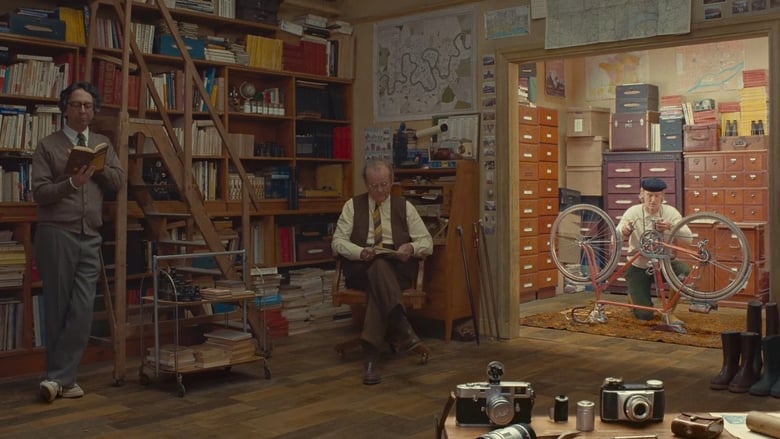
GUY WALKER greatly enjoys a playful new film, but finds it ultimately insubstantial
Early on in The French Dispatch we encounter an imprisoned murderer who takes the art world by storm with an abstract nude painting of a female prison officer, with whom he manages to conduct an affair, secretly painted in his French prison. After his release he conducts an affair with the female reporter – named Berensen, thus echoing the name of the art historian Berenson – telling his story. The wall in the prison canteen on which he painted a series of abstract murals is, then, air-lifted to an art museum in Kansas after slow motion mayhem has unfolded between prisoners, prison staff and denizens of the art world. Next, a middle aged female American reporter reports on and has an affair with the boyish leader of a soixante-huitard revolution, naturally conducted via chess moves relayed through a loud hailer, before she encourages the lad to sleep with a female revolutionary who contradicts everything he proposes on principle. He is then electrocuted in an accident on a radio tower. Finally French Police Noir, Maigret and Tintin-style are comprehensively elided with French haute cuisine.
By now we are in no doubt that the movie is modern, it’s post-modern, it’s meta, full of cutesy kitsch, it appeals to the child in us and it wilfully and proudly obeys none of the rules or the unities and satisfies none of our expectations. There’s slow motion and freeze frame and switches from colour to black and white, from real life to cartoon. We are put in mind of the labyrinths of Jorge Luis Borges’ psyche, and Magical Realism takes a bow. It’s a complicated delight with an endless stream of puns, verbal and visual. There is, therefore, also a Chef/Police Officer who, in a joke typical of the rapid-fire surrealist jokes that are sprinkled throughout, is called Nescaffier and is played by an American actor of Korean heritage. All of the stories are set in a fictional French town called Ennui-sur-Blasé which is actually parts of old Angoulême, the home of the French Comic-book Festival. The French Dispatch salutes in passing the art dealer Lord Duveen who enriched himself by satisfying the thirst of American millionaires for European art, the overweight and brilliant American writer on World War 2, boxing and French cuisine, AJ Liebling and Mavis Gallant, the Canadian chronicler of Paris in May ‘68 all of whom appeared in the famed New Yorker magazine as writers or subjects. It’s all very affectionate, charming and whimsical in the tradition of Amélie and The Budapest Hotel. The whole, pitched as ‘a love letter to journalists’ is framed within the Foreign Bureau Magazine of the Liberty, Kansas Evening Sun – The French Dispatch in which the stories appear in an obituary edition for the recently deceased editor and founder. It’s studded with the stars, many of them current hot properties, who must make up most of Wes Anderson’s address book, many of them having appeared in his earlier films. All of the thespian brilliance and talent of Frances McDormand, Tilda Swinton, Timothée Chalomet, Bill Murray, Adrien Brody, Saoirse Ronan, Anjelica Houston, Edward Norton, Christoph Waltz, Willem Dafoe, Cécile de France, Rupert Friend, Léa Seydoux, Benicio del Toro, Henry Winkler, Elisabeth Moss, Owen Wilson, Bill Murray and even Jarvis Cocker is showcased and shop-windowed to great effect. And that’s only half of the cast! So, what do we think about all of this? How do we respond to it? It’s the nature of contemporary art and that includes le septième art, even when it’s set in other periods and unfamiliar places and, as this film is, studiedly untethered from any connection with now, to tell us something about the time in which it was made and the modern consciousness that made it. Whimsy and Magical Realism, although they entertain and tickle us, somehow fail to satisfy us at a profound level. This is, perhaps, because of what they really are. Our modern zeitgeist demands the abolition of intelligence, wit, irony and humour for fear that they undermine or, perish the thought, laugh at the witless totalitarianism of identity politics and correctness. This means, in practice, that a ban has effectively been imposed on the brilliance of Western wit to exercise itself to its full extent in relation to the real contemporary world. The result of this proscription is that European and American wit, a sad and forlorn refugee, has had to migrate into intellectual exile, retreating into a green screen cultural vacuum where it cannot be incriminated by association with anything linkable to the actual modern world. In this instance it is welcomed into a French world set somewhere between the 30s and the 70s (thus allowing the existence of anachronisms like big-hearted show-girls) that is no more than the figment of someone’s imagination and is incontrovertibly ‘detoxified’ by being totally over and hermetically sealed in that vacuum. It is given free rein to do its soubresauts and pirouettes on condition that none of them mean anything or make any comment on our times. Wit can obtain as long as it is defanged and not dangerous to the status quo. And this is the sad comment on our times that the film, unwittingly, makes……
ALEXANDER ADAMS applauds a comprehensive study of a complicated writer
If, after I die, they should want to write my biography,
There’s nothing simpler.
I’ve just two dates – of my birth, and of my death.
In between the one thing and the other all the days are mine. […]
– ‘lf, After I Die’, Fernando Pessoa writing as Alberto Caiero
He led a respectable life. He wore smart clothes to the office. He wrote and translated material, sometimes with a flourish that belied his extramural activities. He was courteous and a touch playful, a bachelor in his thirties. He was given to using spare time to write at his desk. At the end of the work day, he would put on his hat and raincoat and walk through the capital’s streets, thinking of his latest project. Perhaps he would go to his usual café, where he would see friends. They admired him as a writer, appreciating his abilities, chiding him for his perfectionism. He published a little but they knew he wrestled with larger work which was not made public, even to them. When he died he was mourned by his friends and his readers but they did not realise what a giant he had been. In time, he would come to define their whole nation.
This could be a description of Franz Kafka but it is not. American Richard Zenith is a leading authority on Fernando Pessoa. He has edited and translated Pessoa’s writing. Living in Lisbon, Zenith inhabits Pessoa’s home city, relic of a glorious age and scene of an inexorable decline. It is a testament to Zenith’s devotion and ingenuity that he has managed to produce a 1,000-page biography of a figure whom he describes as ‘fanatically private.’ There is no autobiography; there are few revealing letters; the most informative ones are the drafts and unsent (mostly unfinished) letters he kept. There were no direct descendants. There are three diaries with short factual entries that together cover a total of over half a year. Zenith describes the interviews and memoirs of those who knew Pessoa as uninformative – or at least informative on how reserved the subject was. Pessoa was well aware of this and seemed to have actively participated in this occlusion. He was much given to self-reflection and intimations of both immortality and obscurity.
Pessoa claimed to be descended of ‘a mixture of aristocrats and Jews’ although neither predominated nor were proximate to him. His family was largely agnostic (or non-practising) Catholics, more devoted to music than God, who earned a living serving the state. His maternal grandfather was a civil servant and his paternal grandfather was a senior general. Joaquim de Seabra Pessoa (1850-1893), the poet’s father, was a civil servant. He was an opera fanatic and (anonymously) wrote music criticism for a newspaper. In 1887, he wed Maria Madalena Nogueira (1861-1925), the Azorean-born daughter of a civil servant. She was intelligent, well-educated and a keen reader.
Fernando António Noguiera Pessoa (1888-1935) was born on 13 June 1888, in Lisbon. He was delicate, introverted and passionate about literature. He was a voracious reader and writer at a young age. He was encouraged by his cultured family. In 1893, his father died of tuberculosis. The following year, Pessoa’s infant brother died of a fever. In 1895, the widow Pessoa married João Miguel Rosa, another civil servant, this one a diplomat.
Rosa was appointed Portuguese Consul in Durban, South Africa; his new wife and stepson followed in 1896. They would stay (increasing the family with three surviving children) until 1905. They lived through the Boer War and saw rural refugees camped in Durban’s public spaces and outskirts. Pessoa’s schooling and first year of university were in English. The young Pessoa won prizes for English. Winning the Queen Victoria Memorial Prize in 1903 for an original essay (beating 898 other entrants) was one of his proudest achievements, something he cherished until his death. Although Pessoa’s English was fluent, it was unidiomatic and airy, influenced by his reading of Romantic and Victorian poetry, and the bookish Pessoa spent more time reading Carlyle and Keats than bantering on the school playing fields. Pessoa would use his English to good effect in later life and wrote verse and prose in both English and Portuguese.
II
‘I am astounded whenever I finish anything. Astounded and distressed.’
– Pessoa writing as Bernardo Soares
When he was an adolescent, Pessoa began his own newspaper for his family, filling it with fictional news, jokes and poems. The authors were numerous and all pseudonyms. Over his lifetime, Pessoa published under multiple names and wrote under others, over 100 in all. The degree to which he actually inhabited these ‘heteronyms’ is debatable. It seems to have freed him creatively and allowed him licence to intellectually position himself outside of his life experience. There is the question of whether or not these Borgesian alter egos were part of a meta-fiction, additional to the text. Pessoa stated that these were the real authors of his writings. Each had a distinct style and character. Pessoa published verse under pen names Alberto Caeiro, Ricardo Reis and Álvaro de Campos, as well as under his own name, plus others. Like Kafka, who is a useful point of comparison, Pessoa published a fair amount of creative writing and non-fiction prose during his lifetime, but left a sizeable unpublished legacy. In his lifetime, he was best known as a political and cultural commentator. Only in the last year of his life was his stature as a poet generally realised. His unpublished manuscripts were found in a wooden trunk after his death.
‘The trunk indeed existed, and some ten years after Pessoa’s death more than three hundred of the poems it contained found their way into a handsome edition of his poetry, with separate volumes for Alberto Caeiro, Ricardo Reis, Álvaro de Campos, and Fernando Pessoa himself. Since each of the three heteronyms boasted a large and exquisite body of work stylistically unlike the poetry of his fellow heteronyms or of Pessoa himself, one could say that Portugal’s four greatest poets from the twentieth century were Fernando Pessoa.’
Pessoa – and his alter egos – submitted poems, stories and criticism to publications in Portugal and Great Britain. Hungry for success and recognition – hence the decision to often write in English – Pessoa was afflicted with chronic doubt, lapses of confidence and changes of heart. In this biography and editions of Pessoa’s writing, the adjectives ‘unfinished’, ‘incomplete’ and ‘fragmentary’ are commonplace. One could conclude that Pessoa’s use of heteronymic personae is a double-edged sword. It permitted him freedom to develop diverse and distinct bodies of writing but it left him without a core body of writings. The decision to write short texts also allowed him the opportunity to drop projects unfinished without too much investment. Without the impetus to write a novel and publish it, Pessoa could afford to bounce between ideas. His only substantial book published in his lifetime was one year before his death and consisted of poems. Pessoa may have been temperamentally unsuited to write a novel but his propensity to write short, often and under different identities exacerbated his weaknesses of prevarication and detachment. His trunk was filled with unfinished plays, poems, stories, translations and letters.
‘The human author of these books has no personality of his own. Whenever he feels a personality well up inside, he quickly realizes that this new being, though similar, is distinct from him – an intellectual son, perhaps, with inherited characteristics, but also with differences that make him someone else.’
It is possible that – with regard to the legion of heteronyms – readers will experience alternating intrigue and boredom. When Zenith devotes paragraphs to investigating the recurring signature of ‘Gaveston’ – remarking that this is the sole case of an alter ego appearing persistently over time in Pessoa’s jotting without being credited with a single text – how is one supposed to react? It is curious but is it a matter for curiosity for anyone other than a scholar who has spent countless hours poring over Pessoa’s manuscripts? It is a true fact and (presumably) a new fact, but does it mean anything and do we care? The principal heteronyms have bodies of work attached, some of it now published in English, but discussion of peripheral heteronyms (associated with mere jumbled fragments, inaccessible to all except researchers) is more distracting than illuminating.
Zenith diligently hunts down seeds of heteronyms in the writings of past authors, great and forgotten alike. Pessoa’s favourite authors included Thomas Carlyle, Poe, Keats, Milton, Ruskin, Wilde and Baudelaire. A less obvious influence was Max Nordau’s Entartung (Degeneration) (1892), a book identifying and condemning degeneracy. According to this account, it was Nordau’s passages on mania and mental degeneration that fascinated Pessoa most. His grandmother had suffered from severe and atypical dementia, diagnosed as intermittent. He was worried that he too might come to be afflicted. (One also thinks here of Lovecraft’s narrators fearing for their sanity. Lovecraft lost his father to madness, albeit tertiary syphilis, with which Lovecraft himself was not infected.) ‘Pessoa’s fascination, it turns out, was restricted to the relationship that the writer posited between exceptional intellectual or creative activity and psychological deviation from the norm.’
‘It surprises us that Pessoa could have been so enthralled by Nordau – a fluent, effectual writer who was well read but intellectually rigid, priggishly moralistic, and aesthetically reactionary.’
Not at all. Just as Zenith points out that Pessoa had to wait until the end of the twentieth century for a receptive audience for his meta-textually ludic fiction; so Zenith should not be surprised that Pessoa then and others now search for the link between (on one hand) decadence, social atomisation and destruction of tradition and (on the other) liberalism, progressivism and materialism. Pessoa himself was not a traditionalist, but he was eager to understand the causes of social and personal decline. Nordau, Otto Weininger, Herbert Spencer, (later) Oswald Spengler and others advanced ideas that vary in insight and plausibility, but any intelligent open mind would have found such material to be thought-provoking, even if ultimately it disfavoured those authors’ conclusions. Decadence is appealing to vanguardists and the elite but it has characteristics of both pathology and poison.
Images from NCultura.pt, with acknowledgements – https://ncultura.pt/15-fantasticas-curiosidades-sobre-fernando-pessoa/
III
Pessoa used his inheritance to establish Ibis Press in 1909, which would be a commercial printer but also published advanced literature (including Pessoa’s books). It folded almost immediately, due to debt and tough competition. He burned through his inheritance accrued debt in under a year. This put him at odds with his family, then still in South Africa, especially when he requested they pay off his debts whilst at the same time refusing to get a job. The most he would do was provide translations of poems for a giant library of world classics in Portuguese.
In 1914 Pessoa wrote as Álvaro de Campos, Portugal’s first Futurist poet. With author-friend Mário de Sá-Carneiro, Pessoa would act as shadow editor for the avant-garde literary journal Opheu. The journal was published in 1915 and lasted only two issues. Influenced by the Futurist Manifestoes and the British Vorticist Blast, Orpheu caused a sensation. Its radical sensibilities, taboo subject matter (sex) and Cubist collages, ignited debate in Portuguese cultural circles. Who were these madmen? At least three of them were Pessoa. Sá-Carneiro fled to Paris, where he committed suicide after a period of debauchery.
Pessoa described himself as elitist, nationalist, imperialist (Portugal at this time still had a substantial empire) and (nominally) a republican, although one disillusioned with the corruption of the republican government established in 1910. He antagonised republicans in a newspaper letter and he had to evade a gang that came to assault him. It was one of the few physical escapades of this normally timid man. He was unenthusiastic about the Great War and critical of Portugal’s entrance into direct hostilities against the Central Powers on the continent, reasoning that war in France against the Germans did not contribute to protecting and ruling colonies in Africa. Pessoa’s unformed aspiration was the foundation of an aristocratic republic of Portugal, led by great men. He himself had no political aspirations. Zenith never mentions Pessoa delivering a public speech or broadcast.
At this time, Pessoa became involved with esoterica, mysticism, magic and spirit reading, all complementing an established commitment to astrological predictions. He was in the habit of gauging planetary alignments when submitting manuscripts to London publishers. The publishers were uniformly unreceptive to his submissions and proposals, though his chapbooks of poems won praise for the author’s accomplishment. He dabbled in secret societies, but (as a lover of mystery stories) Pessoa seemed more stimulated by the intrigue than the reality.
In 1930, Pessoa was Aleister Crowley’s companion on a visit to Lisbon. Pessoa, a native of Lisbon, steeped in occult knowledge and fluent in Portuguese and English, was the ideal choice. Crowley’s reputation as an indefatigable fornicator, Satanist and drug fiend put Pessoa on edge before Crowley’s arrival by ship. Crowley wanted Pessoa to head the Portuguese chapter of his spiritualist society; Pessoa wanted Crowley to publish his writings in England. They both assumed the other was richer than he actually was, which entailed mutual disappointment. Crowley departed after staging a hoax suicide, which Pessoa partially corroborated. This is one of the most amusing passages in a biography that makes an intelligent and lively read.
IV
‘I’m suffering from a headache and the universe.’
– Pessoa
In 1919, Pessoa started work at an import-export firm, using his knowledge of English and French. This was where (in 1920) he met the only woman he courted, Ophelia Queiroz.
Pessoa was averse to sexual intimacy. There is plenty of evidence in Pessoa’s writings of sexual attraction but also physical repulsion, perhaps linked to venereal disease. Love arises in the poems in an abstracted sense, derived from his reading. Zenith has good reason for assuming Pessoa died a virgin. Zenith also finds ample examples of misogyny in Pessoa’s writing and marginalia, provoked by fear (and disgust) regarding female libido. There are a number of sensitive and passionate homoerotic love poems ascribed to heteronyms, though Zenith (and others) do not believe this ever translated into carnal fulfilment.
Ophelia was nineteen years old and employed to act as a secretary. Pessoa was thirty-two but youthfully unattached, respected by colleagues as a great poet yet one unaccountably unrewarded. She was strongly attracted to Pessoa. Pessoa kindled to the affection and they carried on a romance of trysts, walks and love letters. It was imbalanced, with Ophelia taking the lead and wanting commitment. Pessoa was too detached and cautious for the relationship to develop straightforwardly. Unusually for Pessoa, their letters survive and are quoted in this account. Ophelia is insistent and puzzled by Pessoa’s reticence. Pessoa is playful and affectionate but unwilling to translate that into an engagement. (Him writing as his heteronyms was an augury of a poor outcome.) The impasse led to estrangement, though they did resume writing over the period 1929-30. By temperament and choice, Pessoa was determined to remain unencumbered by the emotional or domestic burden of partnership. Ophelia married the year after the poet’s death.
Pessoa’s apparent support for homosexual men as men and as writers comes as no surprise considering the poems he wrote. Even if Pessoa was not himself homosexual, he displays empathy and must have gained some pleasure from imagining himself as a homosexual poet, modelled on Walt Whitman. He publicly defended two homosexual writers whose work was banned. This attitude aligns with the idea of an aristocratic elite heading a nation founded on excellence and spurning the distractions of materialistic progress. In Pessoa’s vague imaginings, it was priest-scholars rather than Spartan warriors. Women in politics was anathema to him.
In 1921, Pessoa planned to publish The Protocols of the Elders of Zion in Portuguese. He did not do so. Instead, he wrote an essay about what he saw as the malign influence of Jews. ‘Without any perceptible animus toward Jews, writing as a calm analyst who happened to be informed by reactionary ideas, he noted that the three hundred members of the oligarchy allegedly plotting to overthrow the world order were not all Jews but were imbued by the spirit of what he called “sub-Judaism,” characterized by crass materialism and support of democracy and humanitarian causes.’ Later, he wrote about Jews in less charged terms, assigning to races ‘characteristics, however, [that] were neither genetic not altogether static; they depended on a complex web of historical, geographical, and sociological circumstances.’ Interesting lines of thought for an author who claimed Christianised Jews in his lineage to take.
Zenith criticises Pessoa for not being an egalitarian (while admitting that such an attitude was not incompatible with the poet’s outlook) and condemns Pessoa for wearing blackface as a prank (‘the inherent offensiveness of blackface’). What, a reader may wonder, is gained by wagging the measuring stick of American morality of 2021 at a Portuguese who grew up in Victorian-era colonial Africa? For the most part, such presumptions are not too intrusive.
Pessoa was both an artistic Modernist and a political reactionary; he was empathetic towards certain minority groups, indifferent towards others. He approved of the suppression of Communists and Socialists but was hostile towards Italian Fascism. (Perhaps he discerned within Fascism a core of Socialism.) Zenith thinks, ‘The “real Fernando Pessoa” was always someone else.’ I disagree. I see Pessoa as perfectly consistently himself in his apparent contradictions; he was honest enough to fully inhabit contradictory ideas. We have the concept of cognitive dissonance. However, there is no dissonance when there is no urge to harmonise contradictory ideas. Pessoa never believed he had to hold a consistent position. It seems he realised that a human being without contradictions is an impossibility.
V
‘An original, typically Portuguese literature cannot be Portuguese, because the typical Portuguese are never Portuguese’
– Pessoa
In 1928, António de Oliveira Salazar (1889-1970) was appointed finance minister and he would remain the directing force in the technocratic Portuguese government until a brain aneurysm in 1968. He would see out the last two years of his life as only the nominal (rather than actual) head of government of Portugal. His dryness – a devout Catholic, private, personally reserved, not given to rhetorical excess – and his competence as a director of the state finances won him widespread support. Pessoa supported Salazar’s measures, which stabilised Portugal’s finances and curbed the hedonistic excesses of Lisbon’s nightlife.
Almost a decade after their split, Ophelia and Pessoa reconnected during 1929-30. They resumed their correspondence and meetings. Again, they fell into the old pattern of conflict. Ophelia wanted marriage and companionship; Pessoa wanted to write. She was worried about his heavy drinking. It would leave him severely ill in the summer of 1932. He evidently enjoyed the excitement and experience of being desired but perhaps he felt guilty for giving Ophelia (about whom he evidently strongly cared) false hope of matrimony. Maybe he suspected he was not a writer in love but a writer researching love.
His Mensagem (Message) (1934) collection of poems won a prize from the government for its contribution to patriotic renewal. Pessoa was ambivalent, appreciating the recognition and the cash, but wary of official honours. The following year, Pessoa opposed a bill to outlaw secret societies, specifically the Freemasons. Pessoa had an affinity for societies so he took the legislation personally and wrote in the press strongly opposing the law. It was a futile effort because the parliament would rubberstamp the legislation. In his last months, he turned definitively against the regime for restricting personal freedom, especially freedom of artistic expression. His anti-Salazar poems could not be printed, but they apparently were circulated in a limited form. Zenith discloses that in his last months, Pessoa was writing an essay against Italy’s invasion of Abyssinia. Also, he was weighing up the merits of equality and humanitarianism. Death – intestinal obstruction (or possibly pancreatitis) apparently caused by alcoholism – intervened. Pessoa died on 30 November 1935, in hospital.
VI
‘Everlasting remembrance, how briefly you endure!’
– Pessoa
Over the subsequent years, volumes of the erroneously titled Complete Works of Pessoa were published by colleagues, amounting to a fraction of the slew of 25,000 sheets. The verses can be a little abstract and diffuse but often deploy pleasing irony, cutting humour and mordant insights. The best poem by Pessoa I have read is one of the longer ones, 1928’s ‘Tobacconist’s’ (written under the heteronym Álvaro de Campos) – one of his most involved and most concrete poems, featuring the poet’s thoughts upon watching a tobacconist and his store from across the street. It combines melancholy, levity and grandiosity.
The only lengthy work of fiction that Pessoa brought close to completion was The Book of Disquiet, which is assigned to Bernardo Soares. It consists of over 500 entries written over 1913-35, and was only published in 1982. It comprised hundreds of pages in an envelope. (One is put in mind of B.S. Johnson’s The Unfortunates (1969). His famous ‘book in a box’ is composed of individual sheets and sheaves.) The ordering and transcription are debated and since the first publication there have been new editions, some dramatically different. One English edition has been edited and translated by Zenith. The entries range from single sentences to passages of many pages. They are meditative, alternately detached and intensely personal, forming what Pessoa called a ‘factless autobiography’. It has a detached quality, splenetic humour and despairing melancholy that presages existentialist literature and the internal monologues of Beckett.
In an age of Borgesian meta-narratives and Post-Modern playfulness – as well as a (sadly) reduced capacity to concentrate on more involved lengthy prose – The Book of Disquiet and Pessoa’s heteronymic transformations have found warm appreciation. There is no doubt he was a serious, world-class writer and richly deserves this handsome biography.
Zenith is adept at sketching the situation of Portugal during the Belle Époque, republican and Salazar periods. He knows his subject matter inside out and speaks the languages of his subject. On balance, Zenith’s assertion that Pessoa’s heteronymic alter egos (at least, the major ones) are genuinely felt expressions of different intellects with unique voices, and not gimmicks, carries weight and is eloquently argued, with evidence. Once one grants Zenith his ethical and political interjections, even the most negative of critics is left with mere cavils. The biography hits the rare sweet spot of being as comprehensive as one might wish for while not lingering too long on any point. The amount and depth of research is humbling. Pessoa: An Experimental Life is a grand achievement – thorough, thoughtful, insightful and generally sympathetic, it does what all the best literary biographies do: inspire us to seek out the writings of its subject.
ALEXANDER ADAMS is an artist, art critic, novelist and poet. His most recent book is Artivism: The Battle for Museums in the Era of Postmodernism (Societas/Imprint Academic, 2022)
Many historians like to say that counter-factualism is a waste of time, at least until the port has been around the table twice and then they tend to become as keen as the rest of us on the what if game. John Buckley’s The Armchair General is probably one of the best examples of counter-factualism I have seen in a long time, probably because he sticks as closely as possible to either what happened, or to what we think would have happened had things been slightly different.
Buckley takes eight major events from the Second World War and sets the scene for each of them in turn. Then, the reader has to make a choice from two options that are presented to him. Depending upon his choice, he then moves to another section of the book, where that scenario plays out and further options are offered.
Let’s take the aftermath of the Norway Debate in May 1940 as a case in point, as it is the first chapter in the book. Chamberlain has won the debate, but with a party that is badly split. Playing the role of David Margesson, the Tory Chief Whip, you take soundings and find that Winston Churchill and Lord Halifax are the two favourites to succeed him. Labour will not form a coalition under Chamberlain and lean towards Halifax, but will accept Churchill. Who do you recommend?
If you choose Halifax then the possibility of Italian mediation would probably have come into play. The war would end with a British defeat, but the army would have been allowed to leave the continent in good order and with all its equipment intact. Germany would probably have taken back the African colonies that she had lost in 1918 and possibly Malta would have gone to the Italians as a reward for their efforts at peace. All this would have amounted to a defeat, but not the end of the world, and a lot of people in Britain would have been happy enough to take the deal and ignore future events in Europe.
On the other hand, if you opt for Churchill, then your options can lead you to the actual historical outcome, but that is far from certain. The other option is based on the fact that Churchill was afraid that Halifax might have resigned as Foreign Secretary and taken Chamberlain with him to form a peace faction unless peace feelers went out. In reality that did not happen, but had Halifax threatened it unless he could at least explore the Italian option he would have probably got his way. In this version that is exactly what he does so we head towards a mediated peace brokered by Italy.
The really engaging aspect of this book is that by keeping to what we know about these events the younger students of history will be encouraged to see that historical outcomes are the result of the decisions that were taken by real men. Those men were often acting with unclear information against a backdrop of real pressure to come up with something.
It would have been very easy for Professor Buckley to fall into what I call the fantasy trap of the counter-factual game and go off with ludicrous flights of whimsy. Sir Winston Churchill as a writer did that with a piece that speculated on what might have happened had the Confederacy won the Battle of Gettysburg in 1863. He started by allowing General Lee to abolish slavery in the new republic, an utterly risible thought. Buckley keeps to the conservative options at all times, which makes his work very credible indeed.
The Armchair General takes the reader from May 1940 to the dropping of the atomic bomb in 1945. Some chapters are more complicated than others, with the one devoted to the opening stages of Operation Barbarossa being a case in point. As part of the Soviet leadership do you remove Joe Stalin? If you keep him can Moscow be held? That section was one that I really enjoyed as the reader gets to play an NKVD officer, and I have always thought that I would have been rather good at that role.
The whole book is similarly great fun, based on solid research by a professional historian. I enjoyed every minute of it.
KEN BELL is a Mancunian who fetched up in Mexico, and who now lives in shabby retirement in Edinburgh. He writes as a hobby in his twilight years; a fuller biography can be found at his Amazon author page
Bleeding for Jesus: John Smyth and the Cult of the Iwerne Camps
Andrew Graystone, Darton, Longman & Todd, £12.99
KEN BELL winces through a sad story of sadistic abuse and cover-up
John Smyth QC had a public image in the 1970s and 1980s as a conservative activist who worked with Mary Whitehouse in her failed campaigns to hold back the twentieth century. He lived near Winchester College, and was well-known there as a senior figure in the Iwerne Trust, which recruited young men to Evangelical Anglicanism. John and Anne Smith often entertained boys from the college at their home, and Smyth became known as a man who would openly discuss matters that troubled the budding Evangelicals. Masturbation was one, and the need for a man who has given himself to Christ to suffer for his sins was another.
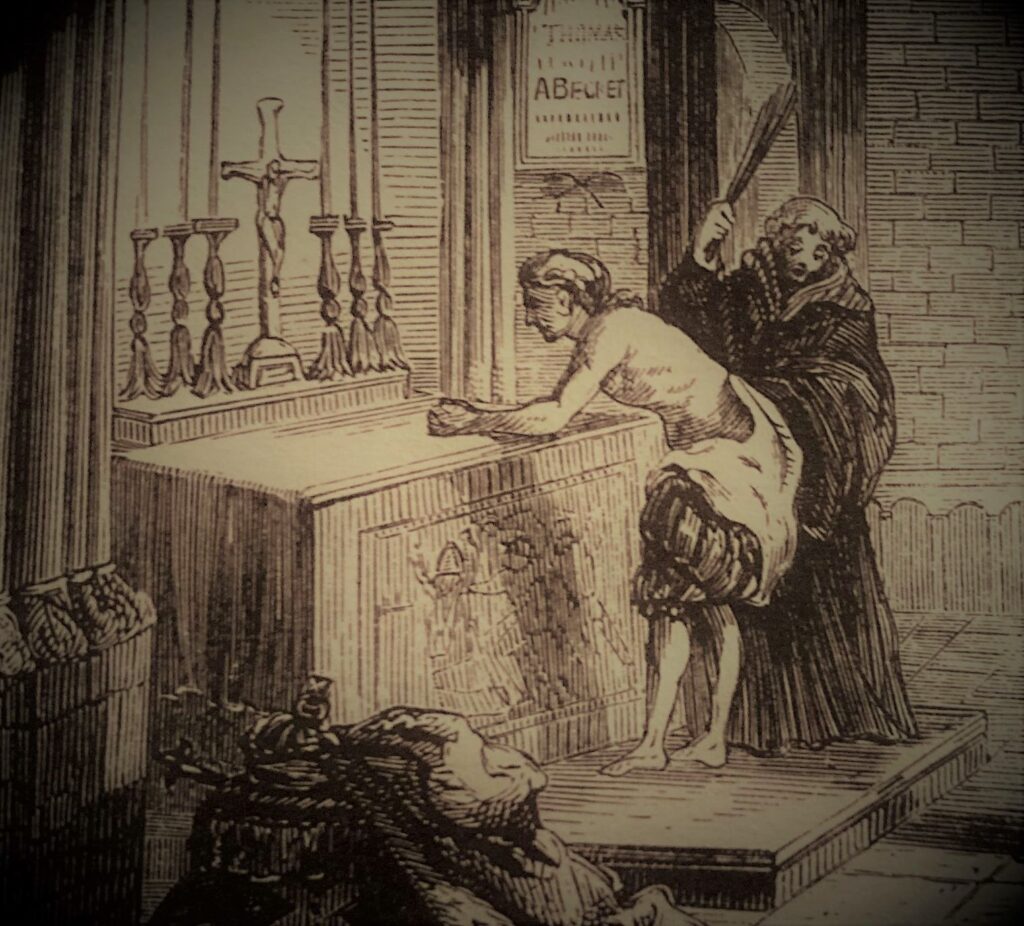
You can see where this is going, and sure enough it made a marvellous cover for Smyth, a moralistic homoerotic sadist who used his position to take youths and young men to his garden shed, order them to strip naked before administering ferocious canings to their bare bottoms. As part of the ritual, Smyth was also naked, and lotion was helpfully kept on a side table which Smyth used to soothe the ravaged backsides before putting the victim into adult nappies so that the blood after a caning of up to several hundred strokes would not stain his trousers. Then the fellow would be sent off to the house, for a nice cup of tea from Anne, who would offer him a cushion to sit on. Smyth had thoughtfully soundproofed his shed and a small pennant was stuck in the garden as a sign to Anne not to approach.
On one level the story of John Smyth and his predilection for BDSM is yet another account of an older, upper-class, closeted homosexual getting his rocks off with younger men. There is no suggestion in Andrew Graystone’s account of anybody being coerced, and neither can Smyth be accused of paedophilia, as none of the submissive participants were pre-pubescent. However, it is always the cover-up that is important with these matters, and the concealment of Smyth’s activities involved rather a lot of people who did an excellent job of keeping a lid on the story for many years.
Smyth looked for participants amongst the older pupils at Winchester, which was an inspired choice as the school, according to Graystone, comes over as a closed world where what happens in the school stays in the school. The pupils speak what amounts to a cant tongue, where words that are really only known to the initiates are used; thus homework is called ‘toytown’ and bicycles are ‘bogles,’ to give just two examples. The whole institution seems to operate with its own ‘complex and arcane culture’ that had been handed down the generations with its original meanings probably long forgotten but which were adhered to religiously. New pupils were tested at the end of their first term on their grasp of the cant, and any who failed could often expect a dose of the cane to encourage further study.
His chairmanship of the Iwerne Trust allowed him to recruit volunteers for the rod from a wider field than just Winchester. The trust ran summer camps to provide intense religious training in Evangelicalism and entry was restricted to pupils at the elite public schools. The aim of the camps was to take tomorrow’s leaders of Britain and ensure that as many as possible became Evangelicals. John Smyth must have been in his element.
Eventually, of course, the complaints about Smyth’s activities began to mount, but incredibly enough, all the complainers did was contact the senior figures within the same Evangelical sub-section of Anglicanism that was part and parcel of the problem. A gaggle of fathers descended on Winchester College to demand that something be done, but at the same time they insisted that whatever was done had to happen quietly.
A report on Smyth was prepared in 1982, which runs to twenty-two short paragraphs, and sets out succinctly what he had been up to. This report was then hidden away and only shown to a few senior Evangelicals. Its author, Mark Ruston, was very concerned that Smyth’s activities may have been heretical. In particular, he believed that the canings strayed dangerously close to ‘a flirtation with Popery,’ owing to the obsession with ‘penance’ and it seems to have been that theological concern, rather than the BDSM dungeon that Smyth had created out of his garden shed that was the most troubling.
The headmaster of Winchester College banned Smyth from the premises, which mollified the fathers at least. The Evangelical capos concluded that Smyth was in error theologically, and that issue could be corrected quietly. Smyth helped the process along by taking his collection of canes and nappies into the garden and making a bonfire out of them.
Finally, the Iwerne Trust arranged for Smyth and his family to move to Zimbabwe in 1984 with a special trust fund to cover his living expenses. There, he pretty much carried on as before only this time with African youths rather than English ones. Eventually, the heat became too much in that country, so he scampered off to South Africa and there continued in his old way until the local church expelled him. By 2018, with the story having finally broken, he very conveniently for all concerned died of a heart attack in Cape Town.
This fairly unpleasant tale is not really about Anglicanism or its Evangelical sub-section. It is actually the seemingly endless story of upper-class abuse, the sense of entitlement that those people have and the code of omerta that governs it all. By helping to break the story, Andrew Graystone has helped to shed some light into the activities, mores and attitudes of our country’s rulers and the state that exists for their benefit. That, finally, is a very good thing indeed.
KEN BELL is a Mancunian who fetched up in Mexico, and who now lives in shabby retirement in Edinburgh. He writes as a hobby in his twilight years; a fuller biography can be found at his Amazon author page
LUKE GILFEDDER examines the differences – and parallels – between two original thinkers
In 1956 Colin Wilson published The Outsider, an overnight literary sensation which saw the 24-year-old autodidact hailed as a prodigy and the first home-grown British existentialist. He sent a copy to T.S. Eliot, who, in a prompt and kind reply, said it was a pity to have missed Wyndham Lewis out of the book, for Lewis was surely an ‘archetypal outsider’1. Wilson would make up for this omission – albeit 33 years later – with the excellent but sadly neglected essay ‘Wyndham Lewis: A Refracted Talent?’. Published in a long out-of-print collection 1989 Existentially Speaking, it is to the good fortune of Wilson and Lewis scholars alike that the title still survives in the British Library archives.
Colin Wilson
Wyndham Lewis was born in circumstances quite distinct from Wilson’s Leicesterian upbringing, on his father’s yacht off Amherst, Nova Scotia, in 1882. Yet by the time he died, in 1957, Lewis was based just a few streets away from the then-rising star Wilson in a Notting Hill Gate flat. The young Wilson had made several attempts to appreciate Lewis, but each time to no avail. He likened late career works such as The Human Age to “mediaeval castles”, impossible to get into, or quite possibly “not worth the effort”.2 Yet Wilson soon found himself in Lewis’s position of critical neglect – once a boy genius, twice a “pretentious fraud” – the critics who launched The Outsider savaging 1957’s Religion And The Rebel. Both were to remain best regarded for their earliest works: Wilson, for The Outsider, andLewis as pioneer of the avant-garde art movement, Vorticism (England’s double-edged critique of the franticness of Marinetti’s Futurism and the passivity of Cubism).
Wilson soon left London for Cornwall, fulfilling Lewis’s reflection in Rude Assignment that “the writer does not ‘escape’ or flee from the world of men in general: he is more likely driven from it”.3 When Wilson next encountered Lewis’s work, via Tomlin’s 1969 anthology, he found he had acquired a fairly strong feeling of identification with Lewis. Here was, as Eliot had suggested, a true outsider, out of key with his time, equally unsympathetic to the assumptions which his contemporaries took for granted, turning out book after book in defence of his unpopular and idiosyncratic views. Lewis saw modern science, art and politics as conspiring to create an unreal state of mind in which the sentimental, illusory and mechanically Progressive flourished, and to this, he opposed a vison that fused radical modernism with an external, static and classical approach to art. Still curious as to whether Lewis was an important writer, Wilson decided to settle the matter by writing an essay purely for fun, delivering his opinions “en pantoufles”, as if “sitting over a glass of wine with friends”.4
As a result, ‘Wyndham Lewis: A Refracted Talent?’ is a lively example of Existential Criticism, an original conception of Wilson’s which advocates that a writer’s work be judged by what he has to say rather than how he says it. William James wrote “a man’s vision is the great fact about him”, and Existential Criticism seeks to examine that vision, to see how much of reality it incorporates, or, conversely, to determine how far a writer’s attitude towards the world is parochial or based upon some temperamental defect of vision5. Wilson begins by criticising Lewis’s first novel, 1918’s Tarr (a satire of the bourgeois-bohemia of post-war Montparnasse) as a “savage, humourless Shaw”. The book, he says, is obsessed with the trivial and personal, much in the manner of a D. H. Lawrence novel or Ulysses, yet without the redeeming flights into impersonality these works take. If Joyce is a “thin-skinned Irishman who disciplined himself into greatness” and Lawrence a “thin-skinned Englishman who occasionally forgot himself enough to be great”6, then Wyndham Lewis, Wilson argues, never forgets himself for a moment. Not that Lewis, who held that “art is the expression of a colossal preference” – and posited “what is genius but an excess of individuality?”7 – would necessarily contend this. But Wilson differentiates between a strong self-image – an instrument writers use to convey higher truths about reality – and self-preoccupation, which is, by contrast, inward-looking and pessimistic. Wilson posits that artists find release from such solipsistic nihilism through their symbols of meaning, be it Religion for Eliot, Courage for Hemingway or the mystery of sex for D. H. Lawrence. But Lewis was said to find sex as boring and irritating as he found everything else. Wilson speculates that lacking the capacity for such abandonment of the self was Lewis’s main reason for his fateful turn to politics as his form of objectivity (Lewis’s reputation never recovered from his ill-judged and hastily recanted 1931 essay, Hitler).
Having foregrounded solipsism and artistic pessimism as potential defects in the Lewisian vision, Wilson attempts to trace throughout his essay how they might have developed and their effect upon Lewis’s value as a writer. He understands Lewis to be striving to achieve a post-impressionist revolution in prose, seeking to transmute into text the Cubist craving of beauty through abstraction. Wilson describes this as a romantic urge, a turning away from the real world to a misty ideal one, as is made clear in the 1927 story ‘Inferior Religions’:
Beauty is an icy douche of ease and happiness at something suggesting perfect conditions for an organism… Beauty is an immense predilection, a perfect conviction of the desirability of a certain thing…8
Wilson says this formulation could have come from Yeats or even Walter Pater – a far cry from T. E. Hulme’s classicism with which Lewis was associated. But Wilson makes an interesting distinction here: the new Classicism never fully materialised, at least not as we like to think of it. All that happened was the emotional romanticism of the 18th century gave way to the intellectual romanticism of Proust, Ulysses, The Waste Land or Musil’s Man Without Qualities. Only the likes of H.G. Wells and Chesterton truly dispensed with romantic idealism by turning back to human reality, immersing themselves in socialism or Religion. Wilson says Lewis glimpsed another vision, namely that the ideal beauty of the Romantics could be achieved not by “flying up into the eternal gases”9 but instead through a cold, precise, intellectual art, gleaming like the snows of the Himalayas. This does not sound like much of an existential defect; in fact, it is rather close to the worldview of Bernard Shaw – a Wilsonian hero – who rejected romantic idealism in favour of a discriminating idealism. Discriminating idealism is just what Wilson perceives in Lewis’s paintings; their determined clarity, their quality of precision and “coolness” is said to remind one of Blake or indeed Shaw’s plays.
Wyndham Lewis
Wilson’s central contention is that Lewis’s effortless mastery as an artist failed to translate into his prose, where one needs the “patience of Job” to cut through the “blanket of fog” and figure out what it is all about10 He reasons that while painting can survive a lack of purpose – it deals in visual effects and can still be great if the worldview of its creator is ambiguous – writing deals in ideas and cannot survive the same ambiguity. Prose must have a positive impetus; satire alone is not enough. Lewis may paint like Blake, but he is said to write with the technique of a Daumier. Wilson judges this satirical bent as a negative trait, for Lewis is placing himself above his characters for the sake of lacerating them – only in The Revenge for Love does one sense any sympathy between writer and protagonist. So where War and Peace feels bigger than Tolstoy personally, in The Apes Of God (a satire of the Bloomsbury group), for example, we never forget for one second that it is Lewis holding the brush, pulling the strings of his puppets. And whereas Joyce’s precise technique of photographing his characters through words makes the reader blend with his descriptions, Lewis constantly interjects himself as though trying to dazzle the reader with verbal brilliance, never allowing the object to appear in its own right. This, Wilson says, creates a contradiction between Lewis’s impressive, even “monumental”, technique and his “rather vague, boring characters”. Resultantly, Lewis’s novels tend to “run down like an old hand-gramophone someone has forgotten to wind”11.
Wilson proposes that such “miscalculations of effect” in Lewis’s prose stem from his solipsistic vision of art, as announced in Blast 2:
There is Yourself: and there is the Exterior World, that fat mass you browse on. / You knead it into an amorphous imitation of yourself inside yourself”12
Wilson insists that Tolstoy or Shakespeare’s greatness depended on them not kneading the world in their image, but instead trying to get rid of “themselves” from their work, becoming more like a mirror or a magnifying glass, able to capture that “odd whiff of reality, like a spring breeze blowing through an open window”((Colin Wilson. Existentially Speaking: Essays on the Philosophy and Literature, 1989, p. 100)). He speculates whether the character of Victor Stamp (the protagonist of The Revenge for Love) is a partial admission by Lewis of this “parochial” defect when, in desperation, Victor decides to forego his usual mannerisms and paint something which would “remind him least of Victor Stamp”((Wyndham Lewis, The Revenge for Love, 1937)). It still does not sell, because it is old-fashioned. But old or new-fashioned, Victor never attempts to say anything, he – like Lewis – fails to recognise art is not self-expression but a reaching out towards reality.This overpowering sense of self-expression in Lewis was also critiqued by Anthony Burgess, who described the wartime autobiography Blasting and Bombardiering as reading like a “gor-blimied police report” with the strange yoking of the “Allo-allo-allo-what’s-all-this-‘ere to the intellectual and the exquisite painter” making for such exasperating reading13.
We must pause briefly to deal with the objection that has doubtless sprung to mind, at least to readers familiar with Lewis, namely that Lewis does know that the root of great art is the impersonal and the objective; moreover, he was a paragon of the ‘lone external viewpoint’14. It is not for nothing that Lewis’s critical writings develop from a defence of the self in 1927’s The Art Of Being Ruled – a treatise in how to remain a “sovereign of oneself” in a world where this is “nothing so difficult as not belonging to a party”15 – to a defence of objective reality itself against Sartrean existentialism in 1952’s The Writer and the Absolute. Lewis directly attacks solipsism in the former work, writing that “ideas of beauty, of a god, or of love, depend severally on separation and differentiation”, and compares the foolishness of “the savage who ate his god to procure divinity” to Freudian inwardness16. Yet we may argue the clearest contradiction to Wilson’s interpretation is in The Letters Of Wyndham Lewis, where Lewis opposes the “crushing of the notion of the subject” and states a belief in a sense of objective value which sees “the answer is there all the time; we ‘discover’ it”.17
Wilson is, however, too perceptive a critic not to have anticipated this response; he explains the above as merely demonstrating Lewis’s “Platonic sense of reality”18. This interpretation is the string with which he binds together his varying conclusions as to Lewis’s merits and defects. On the one hand, Lewis’s belief in a world of timeless ideals makes him an excellent critic, especially of the philosophies of time in Spengler and Marx, and in his merciless dismantling of imperfect idealisms – Lawrence, Hemingway, Orwell, Sartre, Malraux – any kind of romanticism that is the opposite of the real. But, on the other hand, Lewis’s Platonic nature is said to lead him into an artistic pessimism, a sense that the real world is corrupt and disjointed, and the artist must remain true to his ideal world. As a painter, Lewis may have stumbled on Shaw’s trick of uniting the irreconcilable opposites of romanticism and anti-romanticism (this is especially evident in Lewis’s late-career paintings, such as 1942’s Homage to Etty, a Lewisian heaven of exterior forms). But as a writer, his Platonism led him into a “life-denying pessimism”, and he spent more energy denouncing the world than expressing with discriminating idealism that “perfect conviction of the desirability of a certain thing”19. As if unfavourably comparing Lewis to Shaw wasn’t enough, Wilson concludes by noting how much he has in common with George Orwell. Both are said to be tough-minded and honest cultural critics, but who wrote “hysterical” and “bad” novels because of this same artistic pessimism, a pessimism out of which “no vital creation can spring”18. Alas, Wilson’s final judgement is that Lewis was less the “enemy of the stars” than of himself.
Such an atypical interpretation of Lewis may appear highly contentious upon first reading, but even if one disagrees with the answers Wilson provides, his essay leaves the reader with better questions than they arrived with – surely the true mark of fine criticism. He intended for the piece to be “the kind of thing I would want to read if I was curious about Lewis” and on this count, he has succeeded. The only minor gripe is that there is scant discussion of the sympathy between Lewisian and Wilsonian themes. Lewis’s critique of existentialism as merely placing a token emphasis upon freedom – “Sartre’s novels are jokes about Freedom”20 is the perfect foil for Wilson’s ‘New Existentialism’, a corrective against Absurdism. Lewis’s writings also dovetail with Wilson’s criminology studies, each observing the “evil fog” of pessimism and nihilism present at the start of the 20th century plunged people into acts of violence as a means of escape21. Both have an intuitive approach to literary criticism, finding similar flaws, for example, in Hemingway’s characters. Wilson says they know who they are, not what they want to become22, just as Lewis writes “they are invariably the kind of people to whom things are done, who are the passive (and rather puzzled) guinea-pig type – as remote as it is possible to be, for instance, from Nietzsche’s ‘super’ type”23. Lewis, however, believes this is not a shortcoming in a work of art, it “defines it merely”, meaning “the work in question is classifiable as lyrical”21. Lewis allows a novel to be superior from a literary standpoint, even if it is existentially lacking. In the final analysis, Wilson does not afford Lewis the same generosity.
The new avenues of thought opened by this essay make it a double pity that Outsider and Enemy never met, especially given that they once lived just a few hundred yards from each other, in Notting Hill. One senses that they had more in common than this essay suggests, and they could have found common ground over their similar mistreatment by the establishment. When F. R. Leavis derided the Sitwells as belonging to the history of publicity, not the history of literature, we may conclude that no two writers embodied the reverse equation more than Colin Wilson and Wyndham Lewis.24
NOTE This article first appeared in Lewisletter, the journal of the Wyndham Lewis Society, and is republished with permission
LUKE GILFEDDER is a writer from Manchester, whose debut novel, Die When I Say When, came out in 2025. Previously, he worked as a playwright, with scripts produced at the Royal Exchange Manchester, the Lyric Hammersmith, and in London’s West End. He has recently completed a PhD on the life and work of Wyndham Lewis
Colin Wilson. Existentially Speaking: Essays on the Philosophy and Literature, 1989, p. 83 [↩]
KEN BELLfinds a noted Labour intellectual fighting an imaginary enemy
Paul Mason is one of those interesting characters who now seem to pop up everywhere, telling the rest of us what to believe. In his student days he was a member of Workers’ Power, a Trotskyite grouplet that never had any actual workers in it. After a period as a teacher he moved into the media, first as economics editor of BBC Newsnight, then switching to Channel 4 in a similar role. He is now a freelance writer who pops up often in the Guardian, and his work seems to influence today’s left, which is probably why Labour keeps losing elections.
His latest offering, How to Stop Fascism, is a case in point. It argues that there is a new, fascist menace in Britain which must be rooted out. However, he presents no evidence to back up that claim, but then it is quite likely that he doesn’t need any. Mason’s works are clearly aimed at a particular middle-class readership – people who are convinced that working people are a racist tribe to be overcome.
That does not stop him from looking around to find evidence of this threat, and funnily enough his working class enemies always turn up to illustrate and confirm everything he is saying to his readership. So, in the 2019 general election, he went back to his home town of Leigh to campaign for the Labour candidate in that division, and on the doorsteps he heard “men my own age openly fantasizing about the ethnic cleansing of Romanian migrants.” Of course you did, Paul. My experience of canvassing is that if you can get people away from the TV long enough to open the door they tell you just what you want to hear to get rid of you, before going back to Coronation Street. The last thing you get is anything approaching a political debate.
Fast forward to June 2020 and our hero is in London, “an obviously multicultural city.” On the day that he was there, the statue of Sir Winston Churchill in Parliament Square had recently been defaced by the Black Lives Matter rabble, so understandably, groups of British working people had turned up to protest at that outrage to one of the nation’s heroes. Mason was just outside the square and found that he had
…entered a zone of white monoculture. Suddenly there were no students, no people of colour, no tourists, no out-gay people. I was back in the world I grew up in. White men, working class… shouting profanities and swilling lager.
It really is amazing how this author manages to keep bumping into working class men who confirm his colourful thesis. He even managed to see a postman in the crowd, and you can’t get prolier than that.
He ropes in Donald Trump to help bolster his case, even though he admits that “Trump is not a fascist”. However, he then goes on to say that “there is a plebeian mass base for American fascism, and Trump has chosen to lead it”. It is hard to know what to make of that concept, which reads as if Trump is a sort of Schrödinger’s Politician, simultaneously in two states of being at the same time. I was also taken with his “plebeian mass base” line: presumably he feels that the problem with today’s world is that patricians (like him) do not rule it. Mason goes on to say:
Trump’s victory in 2016 was a turning point. It confirmed that there is a massive constituency in the United States for economic nationalism and isolationism, and forced all other countries to accept deglobalisation as a strategic reality.
Now, given that for most of its history up to the advent of the Progressive Era in the 1890s the USA had been firmly isolationist and had protected its nascent industries behind a massive tariff wall, a very good case can be made for arguing that all Trump wanted to do was to restore the status quo ante, which is hardly the mark of a fascist. More importantly, Mason claims to be a socialist, and since when have socialists been in favour of globalisation? It should be remembered that globalisation is not the same as internationalism. I can remember when Communist shop stewards in British factories collected money to buy bicycles that were shipped to Vietnam. There they were used on the Ho Chi Minh Trail to carry war supplies to the South, as part of Vietnam’s war of national liberation. The aim was not the globalist one of opening Vietnam’s borders to all and sundry, or seeing Vietnamese people flooding over here to provide cheap labour in nail bars. It was the internationalist one of providing help to a people who wanted to govern themselves without interference from outside. (A bit like us with Brexit, perhaps?)
Mason is clearly a great fan of globalisation, since the politicians he hates, specifically Trump and Johnson, are “authoritarian nationalists” who “broke with the globalist consensus in the 2010s”. It is difficult to imagine either man as being authoritarian, with Boris in particular anguishing over the lockdown to try and control the coronavirus and Trump leaving all that up to the states. However, both men did break with the “globalist consensus” and since Mason is all in favour of that consensus it must mean that they are authoritarians. Or something; you can never tell with this author.
He never gets close to actually pointing his finger at any real fascists, or explain what fascism is, so that we can recognise its followers if we ever see them. To get around that problem he tells us,
Once we move beyond sterile definitions and understand fascism as a process of social breakdown…we can see the nit-picking formalism among some historians and the left as an obstacle to comprehension
I hope that is clear to you, because it reads like gibberish to me. The best I can come up with from a reading of the text is that fascists are the socially conservative, perhaps economically radical, “plebeian mass” who refuse to listen to Paul Mason.
Do I recommend this book to my readers? Surprisingly, I do. If you are a Tory worried by the shenanigans of Boris and his surreal cabinet, then you may be worried that your party will lose the next election, so read Mason’s book and put your mind at ease. On the other hand, if you are a Labour supporter who hopes your party will win the next election, you should probably have your hopes dashed now, so you will be emotionally prepared for defeat at the next election. People like Mason obviously detest traditional British values and the people who uphold them, and they now control the Labour Party, especially at local level. They are the ones who read works like this and believe the arguments in them because they tie in with views that the readers already hold. Come the next election, all Boris has to do is point out the contempt and disdain so many Labour intellectuals have for ordinary people – the plebeian mass – and then ask if they want people like Paul Mason ruling over them? I think that the answer to that question is obvious.
KEN BELL is a Mancunian who fetched up in Mexico, and who now lives in shabby retirement in Edinburgh. He writes as a hobby in his twilight years; a fuller biography can be found at his Amazon author page
Edited by Simon Heffer, Hutchinson, 1,120 Pages, £35
KEN BELL renews his acquaintance with the famous Tory diarist
The Conservative MP and socialite, Henry “Chips” Channon, was a brilliant writer with an acid wit who also had an amazing capacity to misunderstand the people and events of the days he lived through and chronicled.
His wife, Honor, an heiress to the Guinness fortune, had been having affairs since at least 1937 with various muscular European skiing instructors, and this volume begins with Chips devoting many words to his fears that the marriage was breaking up. He could not understand why, and tied himself in knots trying to make sense of Honor’s attitude. In 1940 when the Luftwaffe bombed a farm belonging to Honor, Chips was disgusted by the attitude of Frank Woodman, Honor’s land bailiff, towards her:
He is insolent, swaggers about, and treats her with scant respect. She allows herself to be so familiar with that sort of people.
To anyone reading Chips’ diary entry it is so blindingly obvious that Honor had become Frank Woodman’s lover. When eventually Honor told Chips that she wanted a divorce, he went into an engaging meltdown and then on almost the next page he listed the money that he would make after a divorce, starting with the £5,000 a year that will be paid to him by her for agreeing to it. (That is about £250,000 in today’s money, by the way.)
By that time Chips had met Peter Coates, the upper-class rent boy who was known by those in the know as ‘Petticoats’, and by the more waspish amongst them as ‘Mrs Chips’. The two stayed together until Chips’ death in 1958, but as Simon Heffer points out in his editor’s introduction, Chips spent about £1,000 on Coates between their first meeting in mid-1939 and the end of that year. This would be around £55,000 today, so Chips was clearly much taken with Petticoats.
Channon was no better at understanding the political events that also swirled around him. He had supported Chamberlain’s Munich Agreement with Hitler in 1938, and was devastated at the decision by Germany in March of 1939 to recognize the breakaway state of Slovakia, and then to grab the Czech-speaking rump of Czechoslovakia. However, in Chips’ mind this seemed more like Hitler betraying Neville Chamberlain personally, and less like the mark of a reckless gambler who was always playing double or quits, which is what it was.
The Norway debate in 1940 which led to the downfall of Neville Chamberlain is a masterpiece of reportage, mixed with a complete failure to understand just what was actually going on. Chamberlain won the division by 80 votes, and for Chips that was more than enough. However, it obviously wasn’t when such large numbers of Tories had either voted against their own government or abstained. To Chips’ disgust, the man he hero-worshipped resigned and Steepledick (the mocking nickname that the anti-Churchill faction had for Winston Churchill) took office as Prime Minister. Simon Heffer, who is no bad hand at dry wit, explains that the steeple part of the jibe was a play on the first syllable of Churchill’s name before going on to remind us that the nickname never really took off.
Channon kept his junior government post until mid-1941, and his war entries have a lot of good information. For instance, on 20th June 1941, Channon mentioned to friends that the Germans were going to attack Russia on the 22nd, which they duly did. That information about the attack had reached down to such low levels in the government, and that Channon could mention it over dinner, suggests that knowledge of the attack was pretty widespread in London. Once the attack did commence, instead of looking at ways to aid Russia, Channon slipped into his old habit of not understanding what needed to be done; instead, he dedicated much wordage to what would happen if Germany succeeded in her war-aim. He was convinced that she would win, and that would be the end of the British Empire, and the likes of Chips and his circle.
These caveats aside, Chips wrote incredibly well in a gossiping, housewifely style. He met Lord Alfred Douglas, the infamous ‘Bosie’ who had done so much to destroy Oscar Wilde’s life and reports without comment that Bosie had denied ever being “Wilde’s catamite”. Then, his advice was sought by a constituent who was also the mother of an 18-year-old daughter who was being courted by an over-60s baronet. Chips advised the mother to encourage the match, presumably so that in a few short years the girl could become a merry widow. Finally, he got into the habit of giving lifts to people during the bombing raids and one working man gave him a shilling tip when he alighted from Chips’ car. For once, Chips was rendered speechless. Normally, Chips had an answer for everything, usually very cutting, as at Chamberlain’s funeral in 1940 when he asked a fellow mourner who had not supported Chamberlain if the man had sent a wreath. When told that he hadn’t, Chips remarked that of course, “Decent Judas Blossoms are out of season,” before strolling away to leave his victim seething.
As a war diary this volume is sadly lacking in many ways, but as an account of life during the war for Channon and people of his circle it is a valuable source of information and gossip. Sadly, once Chips was out of office, the social scene takes over almost completely, along with tedious yearnings for Peter Coates who was away with the army.
Regretfully, Simon Heffer made the editorial decision to censor one entry which refers to a still living person. There are only two people this could be – the first being Clarissa Eden, who is 101 and an unlikely candidate. The other is the present Queen, and in spite of Heffer’s protest that the entry “adds nothing to historical knowledge”, that really is for us to decide in a volume that is sold as unexpurgated. That objection aside, enough remains to make this work a worthy successor to the first volume and leaves the reader eagerly anticipating the third and final part, which is due in 2022.
KEN BELL is a Mancunian who fetched up in Mexico, and who now lives in shabby retirement in Edinburgh. He writes as a hobby in his twilight years; a fuller biography can be found at his Amazon author page
KEN BELL admires a study of 1962, but wonders why that year was singled out for attention
David Kynaston must be the premier social historian of post-war Britain writing today, and his latest book is a fine, standalone work which really captures the air of a country that was about to change beyond all recognition.
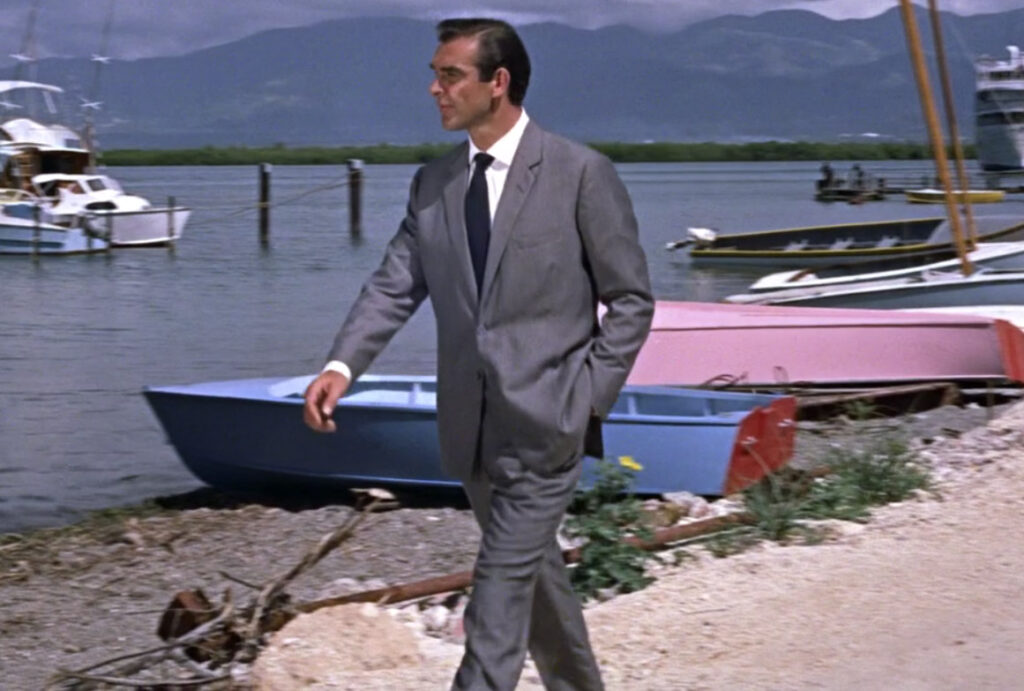
The first three volumes of his putative series that will take the British national story from 1945 to 1979, Austerity Britain, Family Britain and Modernity Britain are house-brick sized volumes that really capture the themes embodied in their titles, and take the reader from 1945 to the early months of 1962. The next volume, which we have been waiting for since 2013, is to be called Opportunity Britain and will take the story from late 1962 to a point in 1967. However, that has not been written so what we have to keep us going is this short volume which argues that the starting point for the 1960s was October 1962 when the first James Bond film (Dr. No) and the first single by the Beatles (‘Love Me Do’) were released on the same day.
The Beatles clearly embody much of the 1960s, as do the Rolling Stones who also played one of their first gigs before a paying audience of two in a North Cheam pub “while four people stood outside listening for free”. However, it was far from certain in 1962 that either of those two groups would amount to anything at all, but the same cannot be said of what must surely be the real start to the 1960s which came about the year earlier in 1961.The contraceptive pill was only prescribed by the NHS to married women until 1967, but it was available on a private prescription from its 1961 introduction. That, along with the five-point geometric haircut invented by Vidal Sassoon in 1965, and the miniskirt of 1966, must embody the hedonistic spirit of the decade that only ended with the oil crisis in 1974. The music was background noise to the glorious New Britain that actually began with the Pill.None of those factors are mentioned by Kynaston, who instead chose to concentrate on three themes not discussed in his earlier works – rural life, industrial Wales, and immigration.
Life in the agricultural regions began to change in 1947 with the Agriculture Act:
On the one hand, cheap food for urban consumers without a heavy reliance upon imports; on the other hand, price-support manipulation, capital grants, subsidies and so on for the farmers.
It was a system that worked very well, especially for the large-scale farmers, in what we think of today as agri-business. But the lot of the rural poor remained drab and miserable. Kynaston illustrates this with the tale of two spinster sisters, both in their 50s, who had pooled their limited resources to buy the farmhouse where they had both been born. They kept a few cows and other livestock. Water was brought in from a well, the cows were milked by hand and the resulting milk was churned by them into butter which was sold to their neighbours. The sisters’ way of life died with them as the young left the countryside to seek better wages in the towns and the urban middle class began to move into the vacated villages.
The old squirearchy became irrelevant, with only a few from the old order hanging on in greatly reduced circumstances. At the same time, as farm-sizes increased, the number of actual farmers and farm workers fell. Although farmers were involved in local politics and many of them served on district councils where they sat as the replacements for the old manor house caste, many stopped doubling up as local politicians because running their farms as businesses took up far too much time. Thus the professional, middle-class incomers began to run life in the rural areas, for better and for worse.
Over in Wales, coal was still king, but the throne looked decidedly wobbly. Oil was taking over as a means of heating and steam engines were giving way to diesel ones. Luckily for the Welsh, steel making boomed, as did the ancillary industries that relied on steel, so a redundant miner had few problems finding work that was a lot cleaner, a lot safer and often a lot better paid than mining. Few in Wales objected to pit closures; that would come decades later when mining had become the only game in many Welsh towns. Politics was dominated by Labour who had run Wales as a fiefdom for most of the century. By the 1960s that had led to the usual story of civic corruption and local cronyism, but demands for change were muted at best. The desire for Home Rule was a minority interest, mainly amongst the declining numbers who spoke Welsh. It is true that the Welsh Language Society was formed in 1962 to fight for the language, but Wales in that year still looked like the country that had been formed by the valleys, the mines, the chapels, the temperance societies, the unions and above all the Labour Party. Given that Wales is still dominated by Labour, one might ask what was really so special about 1962 in the country’s long history?
Opposition to non-white immigration was fairly widespread, with some managers at some factories letting the immigrant workers go first if there was a retrenchment. As one manager pointed out, “there would be a riot” if he hadn’t done that. The unionised workers were often opposed to the new influx as they saw the incomers as a tool that would be used by management to cut the wages. Peter Rachman was still alive and still letting out properties to West Indians most landlords would not rent to. Kynaston suggests that much of the opprobrium that settled on Rachman later came about not by his actions, but by those of his underlings who found him his tenants and collected the rents. Rachman set a rent, and the underlings increased it substantially, so that they could rip off both Rachman and the tenants. Opposition to New Commonwealth immigration was widespread but inchoate, as both main parties supported the government’s policy. Sometimes a hard line was attempted, as when a Jamaican shoplifter was deported back to her home country – something today’s government cannot seem to manage – but by and large a lid was kept on popular discontent via a quiet agreement between the two parties. It is hard to tell what has changed since then, to be honest.
One error that has crept into the text is a reference to my old tutor at Ruskin College, Oxford, Raph Samuel. Kynaston refers to him as “Ralph (later Raphael) Samuel,” but he was never called by that name and was known to everyone who knew him as Raph. That minor caveat aside, On the Cusp is a worthy addition to anyone’s shelf, and reminds us of just how close and yet so far away we are from the early 1960s.
KEN BELL is a Mancunian who fetched up in Mexico, and who now lives in shabby retirement in Edinburgh. He writes as a hobby in his twilight years; a fuller biography can be found at his Amazon author page
R. J. STOVE remembers a classic work of anti-travel literature
So far as Anglo-American relations are concerned I have always felt that they would probably have been better had the two nations spoken different languages. In the latter years of the eighteenth century there was a school of thought which held that German, rather than English, should be the official tongue of the new state, and on many grounds it is to be regretted that their views did not prevail. Because the Englishman and the American speak the same language they are inclined to take it for granted that they mean the same thing, with the result that misunderstandings arise. (Sir Charles Petrie, 1895–1977, Anglo-Irish historian)
Now that COVID has made us all empathise with Macbeth’s complaint ‘I am cabined, cribbed, confined, bound in / To saucy doubts and fears’ – unless of course we have the privilege of political office enabling us to swan around G7 meetings – maybe we can take special pleasure in that healthy, much underrated sub-genre of travel literature: anti-travel literature. Any halfway competent Public Relations Officer for a tourist bureau can make foreign lands seem attractive; it requires much more exalted authorial aptitude to make foreign lands seem repulsive. The foundational masterwork of English-language anti-travel literature must be Frances ‘Fanny’ Trollope’s 1832 Domestic Manners of the Americans. One hundred and eighty-nine years after it exploded upon the consciousness of British and American readers alike, it can still be hailed with the aphorism once coined about a truly great library: it ‘contains something to offend everyone.’
Imagine a quaint little period piece, endurable only by vigilant exercise of the historical imagination, and you will acquire a near-perfect idea of what Mrs Trollope’s chronicle is not. It remains one of those books which makes the centuries roll back. Goodness knows what a present-day reader of it who had never visited the USA would make of it. But for those of us who have repeatedly spent time in the States, usually in unglamorous capacities – who have performed work for American enterprises, had American clients, seen America itself at its awe-inspiring best and at something like its hellish worst; whose own experiences range from Detroit at its slummiest to Los Angeles at its sleekest and Washington DC at its most patrician – the overwhelming sensation derived from the book is that of plus ça change. To reach Mrs Trollope’s final pages is to ask: can there be any country in the world, except perhaps for Russia, where the national character’s fundamentals have changed less than America?
Mrs Trollope really knew how, as youngsters now say, ‘to push people’s buttons.’ The chief reaction among Americans themselves to her exposé consisted of disgust mingled with fear. As she herself archly mused:
Other nations have been called thin-skinned, but the citizens of the Union have, apparently, no skins at all; they wince if a breeze blows over them, unless it be tempered with adulation.
A new verb, to trollopize (meaning ‘to revile others’ etiquette’) briefly entered American English. American cartoonists ransacked their armoury of visual invective to portray her as a goblin and a harridan. One ambitious versifier, coyly hiding under the pseudonym ‘Nil Admirari, Esq.’, made her the target of an epic poem entitled The Trollopiad. Within seven years Domestic Manners of the Americans had already achieved a fifth edition, guaranteeing protracted affluence for its hitherto impoverished author, who had embarked on the project mainly because of financial need. American readers railed against the book but, for whatever obscure psychological reason, could not bring themselves to ignore it. (Which would have been the sensible response for those existentially affronted by it.)
Not all American readers joined the choruses of vituperation. Washington Irving found much merit in the travelogue. So did Mark Twain, who clearly recognised in Mrs Trollope a fellow scourge, and who knew better than anyone how much scourging depends for its lasting effectiveness on a strict (albeit usually implied rather than stated) moral code. The author of The Innocents Abroad paid fitting tribute to the English non-innocent abroad:
She lived three years in this civilization of ours; in the body of it – not on the surface of it, as was the case with most of the foreign tourists of her day. She knew her subject well, and she set it forth fairly and squarely, without any weak ifs ands and buts. She deserved gratitude … Nearly all the tourists were honest and fair; nearly all felt a sincere kindness for us; nearly all of them glossed us over a little too anxiously … but Mrs Trollope, alone of them all, dealt what the gamblers call a strictly ‘square game’. She did not gild us; and neither did she whitewash us.
Without naming any obvious names, let this be said in 2021: the political phenomena which have dominated America over recent years, the last five years especially, were unimaginable to our Eisenhower-revering, Reagan-liking, and Nixon-tolerating parents. Were these parents still alive to witness post-2016 America, they would have concluded that the ‘land of the free and the home of the brave’ – in which they themselves had invested so much allegiance, and so much deserved allegiance, during the Cold War – increasingly resembled one vast insane asylum.
Mrs Trollope’s chief literary assets include her unconscious ability to make us perceive how much a departure the (mostly) fortunate happenstance of Cold War decorum represented from the national default mode. She had the historiographical benefit of seeing America at something like its pre-Civil-War societal nadir: during the 1829–1837 presidency of Andrew Jackson, whose iconoclastic wrath against what are now called ‘elites’ (pronounced, Stateside, ‘eeleets’) has in 2021 a familiar ring. Through another far-sighted strategy, Jackson revealed exceptional enthusiasm for making local non-Caucasians wish that they had never been born. The ethnic cleansing of Native Americans which Jackson did so much to carry out, and to which history has accorded the name ‘the Trail of Tears,’ inspired some of Mrs Trollope’s most caustic paragraphs.
Young America, by Thomas Le Clear
Nothing in Mrs Trollope’s pre-American life led her to expect an overwhelming allergy to the USA. In her world-view, there lurked the acrimony of a cultural love-affair gone hopelessly wrong. The truest parallels to her experience can be found in those subsequent authors – George Orwell, W.H. Auden, Arthur Koestler, André Gide – who at first welcomed communism in theory at home, recoiling from it with justified terror when they saw it in practice abroad: Gide through his direct experience of Stalin’s USSR, the others through their direct experience of notionally independent but actually communist-ruled Spain.
Neither Moscow nor Barcelona seemed more exotic to 1930s foreign travellers than America did to foreign travellers a hundred years earlier. To cross the Atlantic at all in 1827, let alone to live for three years on the other side of the ocean, presupposed steady nerves coupled with an almost deranged optimism about one’s prospects. These advantages the forty-eight-year-old Mrs Trollope abundantly possessed. She had planned to join the Neshoba Commune in rural Tennessee, which a friend of hers, Frances Wright, had established with the aim of educating former slaves. Her own husband, Thomas Trollope, had already shown much greater talent at running up debts than at contributing usefully to his household. When, seeking relief from his disabling headaches, he became habituated to a mercury-based drug, his already few credentials for the paterfamilias’s role became still fewer. Much asperity can be forgiven a woman with children to feed, when she has been yoked to such an unreliable spouse.
After a fashion, the marriage (which produced not just the great Anthony Trollope but another novelist, Thomas Trollope Junior) survived. The friendship with Frances Wright – one hitherto much deeper than Mrs Trollope’s cryptic published allusions to it would imply – did not. No prizes are offered for guessing what Miss Wright thought when she read Mrs Trollope’s printed observations at her expense:
… it was my purpose to have passed some months with her [Miss Wright] and her sister at the estate she had purchased in Tennessee. This lady, since become so celebrated as the advocate of opinions that make millions shudder, and some half-score admire, was, at the time of my leaving England with her, dedicated to a pursuit widely different from her subsequent occupations. Instead of becoming a public orator in every town throughout America, she was about, as she said, to seclude herself for life in the deepest forests of the western world, that her fortune, her time, and her talents might be exclusively devoted to aid the cause of the suffering Africans. Her first object was to show that nature had made no difference between blacks and whites, excepting in complexion; and this she expected to prove by giving an education perfectly equal to a class of black and white children. Could this fact be once fully established, she conceived that the Negro cause would stand on firmer ground than it had yet done, and the degraded rank which they have ever held amongst civilized nations would be proved to be a gross injustice.
Already we can discern how Miss Wright has become a trial run for Mrs Jellyby. It should be stressed that Dickens himself grew to cherish Mrs Trollope’s account (having initially deplored it), and underwent a similar metamorphosis in his attitude to America.
At home when young, Dickens had raved about the country for the same reasons which many of his most voluble compatriots ever since George III’s time – from Charles James Fox and William Cobbett, to Kenneth Tynan and Christopher Hitchens well within living memory – have raved about it. They have rhapsodised over its democratic institutions, its freedom from chip-on-shoulder class warfare, its fundamental egalitarianism, its self-confessed global obligation as ‘the city upon a hill.’ (This phrase originated, not with Woodrow Wilson in 1917 or with George W. Bush in 2001, but with Massachusetts Puritan John Winthrop as long ago as 1630.) All these American characteristics are most readily detected from that distance which proverbially lends enchantment; all, when sought in America itself, are less immediately conspicuous, and, when conspicuous, less charming. Such starry-eyed pro-Americanism among Englishmen – it almost never afflicts Englishwomen – moved Mrs Trollope to the following acidulous verdict:
… the theory of equality may be very daintily discussed by English gentlemen in a London dining-room, when the servant, having placed a fresh bottle of cool wine on the table, respectfully shuts the door, and leaves them to their walnuts and their wisdom; but it will be found less palatable when it presents itself in the shape of a hard, greasy paw, and is claimed in accents that breathe less of freedom than of onions and whiskey. Strong, indeed, must be the love of equality in an English breast if it can survive a tour through the Union.
Dickens’s own love of equality failed to last the distance. Once on American soil, he wailed to his actor friend William Macready: “I am disappointed. This is not the Republic I came to see. This is not the Republic of my imagination”. When he wrote Martin Chuzzlewit, he took his revenge. Yet somehow the American reading public found Dickens’s wild anger forgivable, in a way that it never found forgivable Mrs Trollope, with her profound belief in revenge as a dish best eaten cold. To this day, mentioning Mrs Trollope to all Americans outside the ranks of one’s closest friends can be a risky gesture; sometimes one almost feels as if one is recommending them to enthuse over pornography or Mein Kampf.
Frances Trollope, by Auguste Hervieu
Perhaps she amounted to collateral damage in the sex war. Rightly or wrongly, her portraits make her look both aristocratic and somewhat cunning, in a very English fashion that even now many Americans could well dislike. Certainly her rather small eyes and mouth accord with no American criterion, past or present, of physical pulchritude. She can easily be envisaged administering rat-poison amid an episode of Midsomer Murders, while murmuring banalities about the weather in a refined BBC voice.
Routinely Mrs Trollope laments what she views as the inferior social position of American women, ‘guarded by a sevenfold shield of habitual insignificance.’ This finding will seem odd to most non-American readers nowadays, who all too reasonably dread the surrender of our media, administrative, and academic institutions to America’s forever unhinged viragos, among whom the moaning maenads of #MeToo are simply the latest example. Still, Mrs Trollope knew better than to ignore the emotional depths below the American female surface. Not for nothing was she a novelist, and in her own day a much appreciated one. She devotes to American womanhood one of the book’s most penetrating and clairvoyant sentences:
There is a great quietness about the women of America (I speak of the exterior manner of persons casually met), but somehow or other, I should never call it gentleness.
Any suggestion that Mrs Trollope’s anti-American sentiment precluded pro-American sentiment needs to be halted forthwith. Repeatedly in her book, she praises individual Americans. She marvels at the natural beauty that so often surrounds her (however much she insists that she lacks a descriptive pen, she manages to describe this beauty with great effectiveness). New York City and, to a lesser extent, the national capital prompt her to open delight. In her age’s American literature she takes a serious, and periodically an admiring, interest. She congratulates American painters and sculptors for their diligence and craftsmanship in economic circumstances more burdensome than anything which their European counterparts usually faced.
What she always refused to do was to pretend that black was white – an apt metaphor in the American racial context – concerning America’s amour-propre. She would have been much readier to grant America’s contributions to liberty and human progress if the locals themselves had not thrust these contributions down her throat, in season and out of season. We can witness from her account the cheap demagogic trick which any number of Third World Marxists have exemplified since, and to which any number of Americans resorted in Mrs Trollope’s day: the trick of adopting the first principle ‘I must be judged by my intentions, which are glorious; my enemies must be judged by their results, which are atrocious.’
Naturally this comprises the perfect method of making oneself look good and one’s foes look bad. It turned Mrs Trollope’s stomach. Her entire volume may be legitimately viewed as a full-length sequel to the unanswerable question with which the great Dr Johnson, in 1775, taunted American revolutionists: “How is it that we hear the loudest yelps for liberty among the drivers of Negroes?”
Or, for that matter, among the drivers of Amerindians. Here is Mrs Trollope on the latter theme:
Had I, during my residence in the United States, observed any single feature in their national character that could justify their eternal boast of liberality and the love of freedom, I might have respected them, however much my taste might have been offended by what was peculiar in their manners and customs. But it is impossible for any mind of common honesty not to be revolted by the contradictions in their principles and practice. They inveigh against the governments of Europe, because, as they say, they favour the powerful and oppress the weak. You may hear this declaimed upon in Congress, roared out in taverns, discussed in every drawing-room, satirized upon the stage, nay, even anathematized from the pulpit: listen to it, and then look at them at home; you will see them with one hand hoisting the cap of liberty, and with the other flogging their slaves. You will see them one hour lecturing their mob on the indefeasible rights of man, and the next driving from their homes the children of the soil, whom they have bound themselves to protect by the most solemn treaties.
Sometimes she changed her mind. When she could be shown to have committed an honest mistake, she conceded the mistake and, in later editions, regretted it. On no issue did she more clearly avow an alteration of her assessments than on the issue of chattel slavery.
Never did she openly defend that ‘peculiar institution.’ But at first, not least when exploring Louisiana and Virginia, she extenuated it as the lesser of two evils. Initially she shared the belief – articulated by Cobbett, although she nowhere mentions him – that chattel slavery in domestic environs had its merits compared with the conscienceless sweatshops and dark satanic mills of Industrial Revolution England, inimical as those were to any save the most utilitarian and transactional family ties. (Brazil retained chattel slavery long after Jefferson Davis’s downfall, without thereby inspiring hysterical rage generations thence, least of all among Brazilians.) Over the passing years, her limited forbearance towards slavery deserted her. By 1839 we find her writing:
I have had the pleasure of receiving acknowledgements from many who at first raised their voices to contradict me, that my statements were essentially correct, and that in many cases they have been useful; nor have American voices been wanting to confirm this judgement … I should have no fear of meeting anything but a friendly reception from the educated classes were I to revisit America. But this must not be till slavery be abolished, OR, till that part of the Union which has a right to call itself free, shall separate for that whose fame and whose history rests, and will forever rest, more on its reputation for slavery, than on its claim to freedom. Till then, indeed, the Union must be a negative one; it is life and death bound up together.
There was Mrs Trollope, a Cassandra predicting the Civil War two decades before it broke out. Few Americans shared her prescience; fewer still imagined that by the time an exhausted peace could reign (peace which Mrs Trollope, dying in 1863, never saw), 600,000 of their fellow Americans would have forfeited their lives, and that a further century and a half would not avail to eliminate the bitterness of the vanquished or the evangelistic hubris of the victors. In one of her deadliest passages, she holds up to the most thorough derision Thomas Jefferson’s mixture of tireless libertarian ranting with the most shameless sexual predation upon his slave-girls.
Illustration from the first edition of Domestic Manners of the Americans
This is but one area where Mrs Trollope’s analysis seems to have been ripped from today’s newspaper headlines. Another is her treatment of American religion. Do you find yourself, gentle reader of 2021, contemplating with mingled disbelief and nausea the shrieking, bellowing, gibbering brainlessness which distinguishes several hundred thousand of the USA’s church services each Sunday? Does these services’ unexamined equation of Christianity with American world conquest instil in you a passionate desire to vomit? Fear not: Mrs Trollope was there before you, marvelling and blanching. And whilst she would later attain considerable popularity by writing not one but two explicitly anti-Catholic novels (to write one is a misfortune, to write two seems like carelessness), she found American Catholicism something of a relief after the local brands of Protestantism:
It is impossible, in witnessing all these unseemly vagaries, not to recognise the advantages of an established church as a sort of headquarters for quiet unpresuming Christians, who are contented to serve faithfully, without insisting upon having each a little separate banner, embroidered with a device of their own imagining. The Catholics alone appear exempt from the fury of division and subdivision that has seized every other persuasion. Having the Pope for their common head, regulates, I presume, their movements, and prevents the outrageous display of individual whim which every other sect is permitted.
She supplied a glowing commendation of Edward Dominic Fenwick, Cincinnati’s Catholic archbishop from 1822 to 1833. ‘I … have never known in any country,’ she insisted, ‘a priest of a character and bearing more truly apostolic.’
Yet an entire episcopal conference’s worth of Fenwicks could not have made her amenable to her American hosts’ curious ideas of what constituted adequate schooling. Now that almost every month newspapers and current-affairs websites notify us of yet another American school massacre – invariably perpetrated by males on government-run premises, and usually perpetrated by white males – we can consult Mrs Trollope for proof that already, in her epoch, such evils lay in the womb of time. They required for their eventual parturition nothing more than changed external circumstances, four in particular: mindless affluence; the likewise mindless ascription to Freud, John Dewey, and suchlike grotesques of a moral wisdom which threescore Father Damiens would be hard-pressed to reach; a mass-media and social-media culture without the slightest residue of a conscience; and the quaint belief in the salvific operation of antidepressant-dependence upon the adolescent brain.
Mrs Trollope’s painter friend, the Frenchman Auguste Hervieu, voiced with fascinated dismay a finding which has echoed down the ages: ‘American parents never reprimand their children.’ For her own part, Mrs Trollope comments on whatever occurrences of sensibly conceived tuition she can find in the USA, if only because of their rarity value. She is likelier to issue such grim warnings as this:
I have conversed with many American ladies on the total want of discipline and subjection which I observed universally among children of all ages, and I never found any who did not both acknowledge and deplore the truth of the remark. In the state of Ohio they have a law (I know not if it exists elsewhere), that if a father strike his son, he shall pay a fine of ten dollars for every such offence. I was told by a gentleman of Cincinnati, that he had seen this fine inflicted there, at the requisition of a boy of twelve years of age, whose father, he proved, had struck him for lying. Such a law, they say, generates a spirit of freedom. What else may it generate?
What indeed? Try the following varieties of pseudo-intellectual garbage, Mrs Trollope. An American campus gulag archipelago purporting to offer something called ‘higher education,’ where grown men hourly tremble in dread of the latest outrage by hormonal yahoos against insufficiently sycophantic visiting speakers and even against insufficiently woke statuary. Police forces so terrified of having another George Floyd on their watch that they must stoically indulge every form of Oregonian rioting, and every type of obscene abuse from every ululating pubescent with a Twitter account. A milieu where each American adult with two functioning brain-cells will admit in private that only the most comprehensive program of enforced military service can possibly stave off – at least in the interim – endless, still bloodier repeats of last January’s insurrection; but where no such adult will dare hint at the need for this program in public, because the usual suspects will Get Offended. The elementary political will needed to impose such military service on American youth (modern America being an unmistakable embodiment of Chairman Mao’s notorious epigram ‘Political power comes from the barrel of a gun’) is as non-existent after four years of presidential rule by an alleged conservative, as it was in the heyday of Herbert Marcuse and Ho Chi Minh.
One could continue citing Mrs Trollope’s gifts as a seer. She exhibited remarkable insight into the hideous isolation that had already come to differentiate America’s backwoodsmen – about whose supernal virtue Jefferson loved to fantasise – from even the most ‘solitary, poor, nasty, brutish, and short’ lives of communitarian rural England:
These people were indeed independent, Robinson Crusoe was hardly more so, and they eat and drink abundantly; but yet it seemed to me that there was something awful and almost unnatural in their loneliness. No village bell ever summoned them to prayer, where they might meet the friendly greeting of their fellow men. When they die, no spot sacred by ancient reverence will receive their bones – Religion will not breathe her sweet and solemn farewell upon their grave; the husband or the father will dig the pit that is to hold them, beneath the nearest tree; he will himself deposit them within it, and the wind that whispers through the boughs will be their only requiem. But then they pay neither taxes nor tithes, are never expected to pull off a hat or to make a curtsy, and will live and die without hearing or uttering the dreadful words, God Save the King.
J.D. Vance, for taking several hundred pages to say less than Mrs Trollope here says inside four sentences, is regularly hailed as a genius. Might not Mrs Trollope’s own ‘hillbilly elegy’ receive its due meed of praise?
But enough. One day the pandemic will abate; America will regain some kind of tourism industry; and we might discover for ourselves the relevance or otherwise of Mrs Trollope’s reportage to a post-COVID polis. The chances are that this reportage will require little revision, and that what little revision is needful will concern outward and visible signs alone (just as improved public health has already rendered socially unacceptable a particular aversion of Mrs Trollope’s: the constant spitting and tobacco-chewing to which most American males of 1827 were addicted). Meanwhile – for however many years the only two political movements maintaining traction in the USA can be summed up as, respectively, the 1619 Project and the 1776 Project – the cool sardonic voice of Mrs Trollope the European Tory realist can continue to work its magic.
R. J. STOVE’s organ recordings are available via the website www.arsorgani.com, and via the main streaming services (Spotify, Deezer, Apple, Tidal, YouTube).
David Skelton, Biteback Publishing, 253 pp, £16.99
KEN BELL says many members of the middle classes have found ingenious new ways of disliking people
Britain is notoriously obsessed with class, but now there is a new, ideological way of looking down on people. David Skelton, a native northeasterner who is director of the Conservative-supporting think-tank Renewal, argues that we have replaced old forms of snobbery with new ones, based on beliefs rather than birth. Contemporary British politics shows no sign of Nancy Mitford’s famous ‘U’ and ‘non-U’ distinctions (napkin or serviette, long A or short), or inherited privilege, or Captain Mainwaring-like painful insecurity, but has developed new prejudices instead. The new breed of snob is not interested in how a man speaks or what his background is, but in his outlook.
The new political arbiters are the products of the post-1992 expansion of the education system, and for over a generation they have felt that they set the tone of public debate, a debate which often seemed to involve attacking the people they regarded as being beneath them:
Comedians, who are first to loudly claim to be offended in most circumstances, are the first to savage the so-called ‘crap town’ within the UK and ridicule narrow-minded, proletarian values. The likes of the BBC’s The Mash Report and Radio 4’s The News Quiz had a regular habit of punching down.
When, in 2016, a coalition of traditional middle class voters and even more traditional working class ones voted to take the UK out of the European Union, their sense of entitlement exploded in a righteous outrage that continues to this day as the reaction to the Conservative victory in the 2021 Hartlepool by-election shows. One writer argued that “a huge number of the general public are racists and bigots,” before going on to ask: “How do you begin to tackle entrenched idiocy like that?” This is not the old middle-class directing its angst at blue-collar ‘inferiors’; today’s snobs are the products of those former polytechnics that now degrade the name university, who almost invariably have well-paid roles as members of the local government nomenklatura.
What Skelton overlooks in his attack on today’s left is that Labour has never been an entirely plebeian party so the problem is not new. George Orwell made that point in The Road to Wigan Pier when he described the average Labour activist as being a rather shabby clerk, with “a background in Nonconformity”, possibly also a vegetarian, and the possessor of a position that he would not give up under any circumstances. Orwell could have been writing about the ancestors of today’s social work industry, teaching trade, NHS managerial caste and ancillary workers, but what saved Labour in those days were the industrial trades unions. Whenever some insane policy was thought up by the activists, the union block vote could be relied upon to knock it firmly on the head and keep Labour electorally sound.The destruction of industrial Britain, which led to the end of industrial unionism, has left the field wide open to Labour’s middle-class activists. The people they select for electoral office are as socially liberal as they are, and that factor pulls the party further away from its socially conservative voting base.
The snobbery and open contempt that Labour’s members have for their electorate is covered in great, depressing detail in Skelton’s work. In the aftermath of the Brexit vote, far too many of them “hoped the Nissan plant in Sunderland would close” as the people there were “stupid” and deserved everything that was coming to them. “Others said they would be ‘pleased’ if the fishing industry was harmed by Brexit” as that was what people had voted for. At root, as Skelton says, this attitude is based on the belief that low-income workers are the authors of their own misfortune. The new snobs are meritocrats, who managed to wangle themselves a berth in a post-1992 “university” and believe that people who haven’t followed that road are too thick to bother about. This attitude now seems to encompass a sizeable chunk of the middle-class as a whole.
The problem is that the working-class is not stupid. They may have rejected Labour, but that is because whenever a Labour MP sneers at a house that flies an English flag, or the party opposes the opening of a new coal mine, as it did this year in Cumbria, the message that goes down the wires is that Labour is not the party of their values or economic interests. This is important because The New Snobbery is also a plea for a politics that treats the working class vote as something to be fought for. Skelton may be a Conservative, but he realises that unless Labour takes on board policies that appeal to its old, core voters, his party is not likely to do it entirely on their own. The Tories need always to be moderated, and pushed, by a Labour Party that has regained its sanity. Skelton’s analysis is shrewd and worthy of attention. The only problem is that having put his finger on the problem, he does not come up with any solutions. On the other hand, perhaps there isn’t one.
KEN BELL is a Mancunian who fetched up in Mexico, and who now lives in shabby retirement in Edinburgh. He writes as a hobby in his twilight years; a fuller biography can be found at his Amazon author page