Max Hastings, William Collins, September 2022, 576 pages, £30
KEN BELL recalls the Cold War’s most dangerous moment
2022 has been the sixtieth anniversary year of the Cuban Missile Crisis so a lot has been written about the event, with Max Hastings’ Abyss: The Cuban Missile Crisis 1962 being the year’s final offering. It is also one of the better works, especially since it is aimed, as Hastings notes, for ‘the general reader’. Thus the work assumes no prior knowledge of the events, so the first three chapters consist of an explanation of the interaction between Havana, Moscow and Washington in the decades leading to the Missile Crisis. I confess I found that a little tedious, but I suspect that I am not one of the target readers. That said, the work is footnoted throughout and comes with a very decent bibliography, so it will feature on a lot of student reading lists.
As the KGB archives were opened fairly recently in Ukraine and Serhii Plokhy mined them assiduously in 2021 to produce Nuclear Folly: A New History of the Cuban Missile Crisis there may not be much new material that is awaiting discovery. Given that, Hastings has produced a synthesis of the existing knowledge in a wonderfully readable form. Good historian that he is, he also manages to put new interpretations on much of this material.
For instance, Cuba managed to liberate herself from the American informal empire in 1959, and then went on without any outside help to destroy the American-sponsored attempt to bring the country back into Washington’s orbit at the Bay of Pigs. The USSR sent a delegation, headed by Deputy Premier Anastas Mikoyan to investigate what was going on, and Fidel Castro whispered to him that he ‘had been a closet Marxist since his student days’. As Hastings points out, ‘this fragment of autobiography’ was really nothing more than a ploy for Soviet support against the USA, but Mikoyan took the bait and returned to Moscow in a state of euphoria. The USSR had waited for a country to free itself from capitalism without the Soviet army forcing it on them, and here was Cuba doing just that. As Mikoyan later exulted to Dean Rusk, Cuba made the Soviet leadership ‘feel like boys again’ with the glory days of 1917 returning in a hot climate.
In other words, Havana made the running in the relationship with Moscow and Castro had the Soviet government exactly where he wanted it, doing his bidding. That, more than anything kept Cuban independence alive down the following decades as together the USA and USSR gave Cuba ‘the right friends and the best enemies’ that she could ever hope for.
The Soviet Union could probably have signed an agreement with Cuba that would have led to the former openly placing her missiles in Cuba, just as the USA had done with Turkey. The American reaction would have been the same, but it is possible that western Europe would have shrugged and a serious division might have been created between the United States and its European clients. That did not happen because of the mercurial personality of Nikita Khrushchev, who was a born gambler, not to say outright chancer.
Khrushchev was probably the worst man to put in charge of any foreign policy, because he invariably neglected to plan for contingencies. He thought that if the missiles could be installed in Cuba then the Americans would accept the situation just as they had accepted the Berlin Wall. When Washington refused to play along, Khrushchev was caught in a bind and had to find a way to get out of the situation that his failed gamble had created.
John F. Kennedy was willing to negotiate, but he was faced with a military that seemed to be basically insane as it egged him on to war. As one such lunatic said, if there were two Americans left standing at the end and only one Russian, then America had won. It is a tribute to his patrician sense of self-belief that he was able to ignore such madness and keep the negotiations with Moscow going until the other side finally blinked.
One wonders what would have happened had America been led by a Ronald Reagan or George W. Bush during that time, instead of a man who could take time out from looming Armageddon to order an underling to smuggle a young typist who couldn’t actually type into the White House to provide him with an evening’s entertainment. Say what you like about JFK; this was the era of the Imperial Presidency, he reigned at the height of the Pax Americana and he knew how to prioritise and ensure the obedience of those around him as well as any emperor during the Pax Romana.
The world came through the crisis in 1962, which is why I am able to write this in 2022. For the reader who wants to understand the sequence of events that led to that near catastrophe I cannot praise Max Hastings’ work too highly.
KEN BELL is a Mancunian who fetched up in Mexico, and who now lives in shabby retirement in Edinburgh. He writes as a hobby in his twilight years; a fuller biography can be found at his Amazon author page
STUART MILLSON enjoys some neglected gems of British music
Why does the spiritual toll of the Great War seem to have been harsher for Britain than for any of the other European combatants, asks organist, scholar, music-writer Robert James Stove, in commentary for a booklet which accompanies a new CD on the Australian Ars Organi label. His answer is clear and convincing: ‘… the innate stability of British political institutions meant a lack of opportunities for citizens to work off their war-neuroses by revolutionary activism, as agitators did on the Continent.’ Only in a marginal way did iconoclasm and an avant-garde spirit affect Britain, post-Passchendaele: for every Vorticist there was a Vaughan Williams offering benediction, although few realised that the composer’s Pastoral Symphony of 1922 was inspired by his own experiences of service on the Western Front. (Listen more closely to the ghostly, wordless voice in the unsettling final movement…)
The new recording, a superb audio curation of British music made in the magnificent acoustic of Our Lady of Victories Basilica, Camberwell, Victoria, Australia, assembles less-well-known names from the canon of Albion’s musical renascence. Alongside John Ireland and Vaughan Williams, for example, are Thomas F. Dunhill (excerpts from his ThreeChiddingfoldPieces), Sir Walter Galpin Alcock (Westminster Abbey organist at three coronations during the high-tide of Empire) and Alan Gray (successor to Stanford in the organ loft at Trinity College, Cambridge).
All works and composers chosen by the Ars Organi Recordings for this collection have in common a profound attachment to English tonality (although Norman Fulton, at CD track 11, is a Scot). It is as if the music of our islands is a mirror-image of the (physical and psychological) architecture of the very institutions that have long-governed us. The slow-breathing, hushed voices of churchgoers, a ray of wintry light, piercing through a cathedral window like a gimlet; a sense of eyes being drawn toward the pinnacle of a Norman arch – these are some of the feelings and imaginings inspired by many of the works, some of which are ethereally-enhanced by the participation of singers Elizabeth Barrow (soprano), Brigette De Poi and Emily Tam (mezzo-sopranos), Leighton Triplow (tenor) and bass, James Emerson.
John Ireland’s TheHolyBoy and a George Herbert setting (TheCall) from Vaughan Williams’s FiveMysticalSongs are probably the best-known pieces in the entire collection. Peter Warlock’s old English carol, Adamlay Ybounden, also finds an occasional place in concerts and Radio 3 schedules. But who knows the music of the composer, whose work concludes the CD: Geoffrey Turton Shaw? A near-contemporary of Vaughan Williams, he served as a school inspector and was himself schooled by that master of church music, Sir Charles Villiers Stanford. Setting Milton, Ringout, yecrystal spheres/Onceblessourhumanears… Turton Shaw embodies all the virtues of his genre and world, confirming the past, present and future solidity of English music.
The music of a Welshman, Daniel Jones (1912-1993) makes up another important collection of lesser-known music from our shores, in a well-presented four-disc set from Lyrita Recorded Edition. Many will remember the remarkable ground-breaking Lyrita vinyls of old: symphonies by Bax and Rubbra, John Ireland songs, TheMagic Island by William Alwyn, and a record that particularly caught my eye when I first came across it in the record department of Foyles, some 40 years ago – Ireland’s Forgotten Rite, Legend, Mai–Dun and Satyricon – with its strange, haunting cover-artwork; a picture which hinted at the form of a landscape, with dotted colours and distances just out of reach. In fact, if I were to try to find a simple, neat description of Daniel Jones’s music, it would come close to those suggestions inspired by the Ireland graphics – although this enigmatic composer (a code-breaker during World War Two) never really embraced, at least self-consciously, folklore and the symbolism of place. He tended to think of himself as a composer who happened to come from Wales, rather than an artist who had a civic responsibility to proclaim a culture – although he did write a major choral-orchestral piece, TheCountryBeyondthe Stars, which – post-Festival of Britain – seemed to have an ambience of dreamy peninsular coasts, beacons and Black Mountains.
Perhaps the nearest he came to a home-spirit, an imprint of Welshness, was in his DanceFantasy, performed at the 1982 Proms by the (then) BBC Welsh Symphony Orchestra under Bryden Thomson – although the work still seemed somewhat set apart from Welsh dances and Celtic legends by fellow-countrymen Hoddinott, Mathias and Arwel Hughes. And it was at this concert that I briefly met the musician… As I walked around the hall at the end of the evening, making my way back to the tube station and suburbia, I spied the bespectacled composer (this one-time friend of Dylan Thomas) at the Royal Albert Hall Artists’ Entrance. Venturing over, I asked for an autograph, which was cheerfully forthcoming and written in a neat, methodical hand, with a fountain pen. An avuncular, slightly diminutive figure, Daniel Jones seemed very pleased by the performance of his own music at the Proms. (It has to be said, the Proms Planning Department has been less than generous to the composers of Wales.)
Lyrita’s new CD collection puts the music of Jones and Cambria very much on the map. Pianist Martin Jones has spent many hours in the National Library of Wales, painstakingly uncovering an almost Bach-like progression, cycle, abundance of piano works, from a neatly-crafted Capriccio of 1934, to the much more ambitious (“big stride”, was the composer’s own description) Theme, VariationsandFugue in C-sharp minor, dated 1945 – the year of Britten’s PeterGrimes and the advent of the Attlee era. Tonal, but sometimes wandering away from those clear lines; meditative, but never obscurely introverted, Daniel Jones created, it seems, pure music, for its own sake. Rigorous, never arduous, and always making the listener wonder what the next piece will bring.
A great deal of the composer’s character is also suggested by some of the photographic portraits featured in Lyrita’s CD booklet, not least the final black-and-white plate: Dan Jones, with benevolent eyes and a grin, partly concealed by the pint of bitter he is bringing to his lips. A good Welsh brew, no doubt.
CD details
Undertones of War, British Organ and Vocal Music After 1918. Robert James Stove, organ. Ars Organi, AOR004
Daniel Jones, Rediscovered Piano Works, Martin Jones, piano. Lyrita, SRCD.2396
Basil Bunting. Photo: National Portrait Gallery, Creative Commons licence
Letters of Basil Bunting
Selected and edited by Alex Niven, Oxford University Press, 2022, £35
LIAM GUILAR welcomes new insights into a little-studied modernist’s mind
Basil Bunting died in 1985. Despite having been praised as one of the twentieth century’s ‘greatest poets’ critical attention to his work has been rare. A reliable biography didn’t appear until the publication of Richard Burton’s A Strong Song Tows Us in2013; an annotated collected poems, edited by Don Share, not until 2016. Now, with the publication of Alex Niven’s much anticipated edition of Bunting’s correspondence, it’s possible to eavesdrop on one of the twentieth century’s most interesting conversations about poetry[i].
In his eighties, Bunting looked back on his life:
Once upon a time I was a poet; not a very industrious one, not at all an influential one; unread and almost unheard of, but good enough in a small way to interest my friends, whose names have become familiar: Pound and Zukofsky first, Carlos-Williams, Hugh MacDairmid, David Jones, few indeed, but enough to make me think my work was not wasted.[ii]
If you recognise the names of his friends, that ‘good enough in a small way’ is an excellent example of the English art of understatement. But it’s not a popular list and despite the excellence of his poems, Bunting remains a marginal figure. No one reviewing the letters of T. S. Eliot needs to explain who T. S. Eliot was, or why he is of interest.
The life
Born in 1900, Bunting was imprisoned as a conscientious objector immediately after leaving his Quaker school in 1918. He studied economics before drifting to Paris where he met Ezra Pound and worked, alongside Ernest Hemingway, for Ford Madox Ford. Following Pound to Italy, he met W.B. Yeats and Louis Zukofsky in Rapallo and began a life-long and life altering affair with Persian literature.
His first published poem, Villon, is one of the finest long poems of the 1920s[iii], but by the end of the 1930s Bunting’s career as a poet had stalled: his first marriage had failed, he was out of work and separated from his children. The war rescued him. He discovered he had skills that others valued. He rose through the ranks to Squadron Leader, worked for British Intelligence, then after the war, returned to Persia, first as a diplomat, before resigning to marry a Persian and becoming the Persian correspondent for The Times.
Expelled from Persia and then unceremoniously dumped by The Times, he struggled to find work in post war Britain.
Despite the excellence of his poems, the story could have ended here, with Bunting as a footnote in histories of literary modernism, remembered as one of Pound’s ‘more savage disciples’[iv], but in his sixties, spurred on by his meeting with a young Tom Pickard, he wrote Briggflatts; at 700 lines a short long poem, praised as the ‘finest’, ‘greatest’ or ‘most important’ long poem either of the twentieth century or ‘since The Wasteland’. He enjoyed a brief period as ‘Britain’s greatest living poet’ before fading away in a series of university jobs and poetry readings.
Poetry
From such a long and varied, life Niven estimates only about 800 letters have survived, of which approximately 600 relate to Briggflatts and the period after its publication. He has selected almost two hundred and thankfully decided to print complete letters rather than extracts.
Divided into three sections, the bulk of the book is devoted to the 1960s and afterwards. For anyone interested in poetry, rather than Bunting’s biography, the core of the book may be the pre-1960s letters to Pound and Zukofsky.
Briggflatts was praised by critics of the stature of Hugh Kenner and Donald Davie and poets as diverse as Thom Gunn, Allen Ginsberg and George Oppen, but Bunting’s status in the critical hierarchy has never been secure.
Perhaps his version of poetry is too austere to be popular. In a letter to Poetry Chicago (not printed by Niven), he wrote:
We are experts on nothing but arrangements and patterns of vowels and consonants, and every time we shout about something else we increase the contempt the public has for us. We are entitled to the same voice as anybody else with the vote. To claim more is arrogant.[v]
Throughout these letters and in later interviews he repeatedly stated the belief that politics, philosophy and theory harm poetry. The poet’s job is to write good poems.
What I have tried to do is to make something that can stand by itself and last a little while without having to be propped by metaphysics or ideology or anything from outside itself, something that might give people pleasure without nagging them to pay their dues to the party or say their prayers, without implying the stifling deference so many people in this country still show to a Cambridge degree or a Kensington accent. [vi]
It’s possible to go through these letters and compile a list of quotations to show he had little time for academics or literary criticism. He was publicly dismissive of creative writing courses and poetry competitions, while working on the former and once, memorably, judging the latter. He didn’t think poems should be explained; if a poem requires footnotes it’s a failure and tying the poem to the poet is a fundamental mistake.
What characterised Bunting and his correspondents was the intense seriousness with which they applied themselves to writing. Poetry was a craft and writing it involved ‘sharp study and long toil’. The ‘study’ involved arguing into existence a standard of excellence selected from poems going back to Homer. Once tentatively established, they attempted to excel their models, supporting each other through stringent criticism.
Bunting’s criticism, shown here in his letters to Zukofsky, was not for the faint hearted, but it was driven by the belief that some poets, Pound and Zukofsky explicitly, were ‘entered without handicap against Dante and Lucretius, against Villon and Horace.’ In the same letter, he explains: ‘At least for my part, I’d rather have somebody who is thinking of Horace call my poems bloody bad than to hear them praised by somebody who is thinking of-who-Dylan Thomas?’ (p.194).
Two other reasons for Bunting’s odd position in the critical hierarchy stand out. In some quarters he is tainted by his association with Pound, especially where Pound is only known, vaguely, for his political and racial opinions. The other is the insistence that ‘All Roads lead to Briggflatts’[vii] which condemns him to the role of a minor poet who pulled off one great poem and consistently ignores the quality of the rest of his work.
The letters qualify the first of these, while Niven’s editing and commentary seem driven by the second. If there ever was a tribe of Ezra to match the tribe of Ben, with Rapallo replacing the London taverns, Bunting was always too obdurate an individual to be anyone’s acolyte. [viii].
The explosive end of the pre-war correspondence with Pound is well-known, though the full text of the letter hasn’t been available until now. What becomes obvious is that from the late 1920s and through the 1930s the letters show Bunting becoming increasingly resistant to Pound’s politics. Bunting’s repeated statements that poetry is hampered when it tangles itself in philosophy and politics became focussed in his insistence to Pound that banging on about ill-informed economic theory was a waste of Pound’s time and literary talent, although Bunting himself isn’t adverse to sharing his ‘theories’ with Pound.
Initially refusing to believe Ezra was writing for the British fascist movement, he finally reached the limits of his patience when he learnt that Pound was ‘spilling racist bile’ in his letters to Zukofsky. His angry letter to Pound ends:
I suppose if you devote yourself long enough to licking the arses of blackguards you stand a good chance of becoming a blackguard yourself. Anyway, it is hard to see how you are going to stop the rot of your mind and heart without a pretty thoroughgoing repudiation of what you have spent a lot of work on. You ought to have the courage for that; but I confess I don’t expect to see it. (p.136)[ix]
It says a lot about the robust nature of their friendship that despite this, Pound would continue attempting to promote Bunting’s poetry, and Bunting would continue to acknowledge his debts to Pound. After the war, when Pound was incarcerated in Saint Elizabeth’s hospital for the mentally ill, Bunting picked up the correspondence, encouraged by the news that a letter from Basil brightened up Ezra’s week. Pound’s letters to Bunting, by turns abusive and incoherent, didn’t put him off.
As he wrote to Zukofsky: ‘The difficulty is how to avoid being involved in the network of fallacies while profiting from his illuminate faculty for verse and enjoying his energy and kindness.’
The same problem faces everyone today: how to see beyond the politics and racism to profit from what any poet in the past had to say about poetry and learn from what he or she achieved as a poet. Bunting managed it with his two closest friends, one a communist, one a fascist. It seems an important precedent.
Anyone interested in Basil Bunting or twentieth century poetry owes Alex Niven a great debt for the time and work that must have gone into this project.
How different the picture would be if this were a complete edition of the letters, only he knows. When Jonathon Williams published a selection of his letters from Bunting, he wrote: “What a stern, serious, funny, extraordinary ‘literary’ (LETS HEAR IT FOR LITERARY) North of England person he was’ (Williams, p.252).[x] The Bunting of those letters, watching the birds and wild life in his garden, is absent from Niven’s collection, as are the descriptions of Persia that suggested to Burton that Britain lost a major travel writer to the Official Secrets Act.
The book’s sense of its reader is uneven. Niven explicitly describes a model reader who knows the outline of Bunting’s life and is not put off by occasional difficulties (p.xxvii). This model reader has a positive effect on his annotations, but seems to have been forgotten when he came to write his commentaries.
Why Niven thinks such a reader needs to be told what to think about the letters and how to interpret them, is a mystery. You buy an edition of a poet’s letters, wanting to read the poet’s words, and find a portion of the book contains the editor’s personal opinions and interpretations which you will never reread.
Based on his model reader, Niven’s annotations are usually deft and show a shrewd judgement of what this reader could be expected to know. He assumes that anyone reading these letters won’t need a gloss on Dante, Swift, Winston Churchill, or others. He is also unwilling to overload the letters with commentary, assuming, (rightly), that anyone who wants to follow Bunting’s detailed responses to Pound’s books; ABC of Reading, Guide to Kulchure, will have a copy.
In his letters, Bunting could be crudely dismissive of poets he didn’t like. It’s disappointing to see his editor join in: ‘Philip Larkin (1922-1985) hard right British poetaster and trad jazz critic.’ (n.277 p.384).
Sometimes the annotation strays a long way from objective facts: ‘It must be said that Briggflatts faintly resembles certain of [Dylan]Thomas’ work in form, subject and (marginal sense of) place’ (p.194). Briggflatts probably ‘faintly resembles’ a lot of things, but it also must be said it’s hard to imagine Bunting admiring Thomas enough to be influenced by him.
The introduction includes a clear and necessary discussion of editing methods. Whether an introduction to a selection of letters needs a dramatic retelling of the first reading of Briggflatts, or is an appropriate place for a summary and critique of existing criticism, depends on the individual reader. As I don’t agree with his evaluation of Don Share’s edition of the Collected Poems, unless ‘the book’s only major limitation’ is intended ironically, or his criticisms of Burton’s biography, and I think he misreads the Pound-Bunting disagreement over Bunting’s translations of the Shahnemeh, I’m suspicious of his statements about literary matters where he strays from simply providing factual biographical context.
He uses his introduction to stake out his version of Bunting’s life, at times in explicit opposition to other published versions. I’m not convinced this is the right place for it. His dissent from Burton’s views of the significance of Bunting’s Quakerism is pointed, but his dismissal of Burton’s biography as ‘relatively light on critical explication’ is baffling. Eager to point out that book’s ‘shortcomings’, he seems to be criticising Burton’s biography for being a biography while temporarily forgetting just how problematic and limited letters are as biographical evidence.
The trust in the reader, obvious in the annotations, is not evident in the editorial commentary running between the letters. I think there’s too much. Rather than let the letters speak for themselves, he interprets the evidence and intrudes his opinions, unnecessarily:
For all that his language and actions often fell a long way short of today’s ethical standards, Bunting certainly thought of himself as a determined anti-racist-and this letter would seem to support that view. In the context of his historical moment, Bunting’s basic philosophical views about race were, to put it mildly, considerably more progressive than Pound’s. (p. 134-135)
Comments such as this one and less lengthy interventions like ‘even if the age difference of over thirty years was problematic in more ways than one (p.140)’ seem to miss the point that adult readers are capable of coming to their own conclusions.
Sometimes the comments have nothing to do with the content of the letters: ‘There is a pressing need to apply more and deeper scrutiny to Bunting’s colonial phase than has been evident in previous scholarly and biographical treatments. But whatever its unexamined moral and political complications’ […]. (p.139)
Superfluous in terms of contextualising a letter, this manages to suggest something sinister without being informative. Even for a reader who knows the biography it’s not clear what the unexamined ‘complications’ are, or how ‘scrutinising’ them would add to the enjoyment of the poems or why or to whom such a need is ‘pressing’.
Letters encourage the tendency to tether the poems to the poet. The results of failing to distinguish between the two is a depressing characteristic of contemporary discussions of poetry, obvious in attitudes towards writers as diverse as Ezra Pound, Phillip Larkin (see above) and most recently, Dorothy Hewett[xi].
As Bunting wrote to Zukofsky:
Letters are meant to be written to affect one bloke, not a public. What is true in the context of sender and recipient may be a bloody lie in the context of author and public…secondly: the bane of the bloody age is running after remnants and fragments and rubbish heaps to avoid having to face what a man has made with deliberation and all his skill for the public’. (June 1953 qtd in Burton, page 354 Ellipsis in Burton.)
There’s nothing anyone can do to prevent that, it’s still the bane of this age, but its sad inevitability is outweighed by the opportunity to eavesdrop on one of the century’s most interesting conversations about poetry. Hopefully, Niven‘s suggestion that a complete collection of the Pound Bunting correspondence should be published will be taken up sometime soon (preferably with the letters to Zukofsky). What they had to say about poetry transcends their time, politics and personalities.
‘Long awaited’, ‘much anticipated’ and ‘ground-breaking’ are cliches of the blurb writer. For once they can all be applied honestly and accurately to Niven’s work in making these letters available. The good news is that the long wait and the anticipation have been generously rewarded.
[i] Page numbers are to Niven’s book. Richard Burton’s Biography, A Strong Song Tows Us is referred to throughout as Burton.
[ii] I transcribed this from Peter Bell’s film, Basil Bunting: An introduction to the work of a poet (1982). He seems to say something after ‘David Jones’ but I can’t understand it.
[iii] The poem was written sometime in the 1920s but first published in 1930. As Niven explains, the letters cast doubt on the standard dating and chronology of some of the poems.
[iv] The description belongs to W.B. Yeats. He surprised Bunting by reciting one of Bunting’s poems from memory when they met.
[vi] Another transcription, this time from a talk Bunting gave in London, in Keats’ house, in 1979. From ‘The Recordings of Basil Bunting’ with thanks to the late Richard Swigg who looked after ‘The Bunting tapes’.
[vii] Julian Stannard. Basil Bunting Writers and their work. p.88
[viii] Consigning Bunting to the role of ‘Pound’s disciple’ is to misrepresent him as badly as Tom Pickard is misrepresented when his own excellent poetic output is ignored and he’s remembered simply as the boy who midwifed Briggflatts.
[ix] Zukofsky’s response to this letter and whatever Pound had written that offended Bunting so much, can be read in Pound/Zukofsky Selected letters of Ezra Pound and Louis Zukofsky ed Barry Ahearn.
[x] Williams, Joanthan, ‘Some Jazz from the Bazz: The Bunting-Williams Letters’ in The Star you Steer By. Ed, McGonigal and Price.
LIAM GUILAR is Poetry Editor of The Brazen Head, and the author of several poetry collections, including the series A Man of Heart, Presentment of Englishry and The Fabled Third (Shearsman), set in post-Roman Britain. His most recent publication is a translation of the Mabinogion folk-tale How Culhwch Won Olwen (Shearsman, 2026)
Reagan M. Sova, First to Knock, 2022, 265 pages, US$17
LIAM GUILAR takes a ringside seat for a dazzling extravaganza
‘Wildcat Dreams in the Death Light is an incantatory work of narrative poetry. Infused with hobo melancholy, Jewish lore, bloodshed and hilarity…’.
It’s rare for a blurb to be so accurate. For the price of the book, Reagan M. Sova will perform as ring master, troubadour, high wire artist and magician to entertain and dazzle the awestruck crowd.
Set in the first decades of the twentieth century, the story is told by Mort Sloman, who leaves home at thirteen. He falls in with a circus, and in love with a Gypsy trapeze artist, discovers friendship across the barriers of race and difference, witnesses institutionalised racism, violent death and corruption, joins the Wobblies (Industrial Workers of the World, IWW) and unionizes his circus, travels through Europe during the First World War to Egypt, returns to America to help the union cause and finally performs the Festival of Light for his dead relatives.
A lot happens.
At the beginning, the narrator sets out on a quest, mounted on a mule rather than a white charger:
i/consecrated unto myself the sacred mission
the ceremony of light to honor Frank and Aunt J
i had the song in hand but i
could not do it without the right guitar
nor the Locksmith keys
not even the rabbis have them
While this quest gives the story a beginning and end, the ‘sacred mission’ fades into the background, replaced first by Sloman’s devoted pursuit of the gypsy acrobat, then by his experiences with the travelling circus, and his involvement in the IWW. Although set in a world anchored in the familiar by historical names – Ringling Brothers, Big Bill Hayward, Eugene V. Debs – and recognisable conditions and historical events, the story moves in a liminal space that shifts Sloman’s journey into the realm of legend.
The circus, which Sloman calls ‘The Kingdom’, is a ready-made symbol of America, with its outcast others, unusual characters labelled as freaks, and self-confident, exploitative hucksters and frauds. His is an American Dream where the poor boy escapes the bullies, finds love and wealth, and good guys find friendship and love, and win despite the odds stacked against them.
The poem exploits its own intertextuality in a cheerfully unembarrassed way. There are echoes of Whitman and the Ginsberg of Howl. But the influences are taken and adapted. A rambling man bound for glory with guitar on his back, writing songs and supporting the union, evokes Woody Guthrie, but the verbal inventiveness of Sloman’s songs is a world away from Woody’s. Like Sloman’s parade, which begins with himself and his friend and grows throughout the story, Wildcat Dreams in the Death Light is robust and generous enough to accommodate whatever resonance the individual reader brings.
The dominant stylistic presence, however, is Frank Stanford and The Battlefield Where the Moon Says I Love You. Of all Sova’s many magic tricks, the most impressive is the way he has managed to take Stanford’s instantly recognisable style, make it his own and adapt it to his own purposes.
By shortening Stanford’s line, leaving it unpunctuated and rarely end stopped, Sova has given the poem a rhythm which carries the reader through Sloman’s adventures. Stanford’s distinctive incantatory eruptions are present, but kept under control so they never take over the story the way they do in The Battlefield. They are a major factor in producing the slightly hallucinatory effect that keeps shifting the story from its factual, historical setting into the dream realm.
When Alf, the circus master, asks the thirteen years-old Sloman what he could have seen ‘with so few years under your cap’, he replies:
i have seen the elderly monk gored by the falling icicle
i have seen the family of elk sleeping next to me in the moonlight
i have seen bob’s jar of brandy
i have seen the vial of goof dust I used to trick the trickster
i have seen the blood trickling
from my grandfather’s ear when he died roller-skating
i have seen good luck without grace invite darkness
i have seen the Gypsy’s vision of my death by the mountain
This early list is typical of the many that follow. They can include everything from the factual to the surreal, as Alf’s reply does. Sometimes it is not obvious how the items coalesce into coherence. Their exuberance often seems an enjoyable end in itself.
As well as contributing to the tone of the story, they serve another function. A long narrative poem needs variety in pace. A relentlessly onward rush becomes as boring as a story that goes nowhere. Part of Sova’s balancing act is to know when to allow the voice to narrate action without interruption, and know when to pause the narration and use the incantatory to add variety.
In the circus, the emperor’s armless great granddaughter plays the violin with her toes. As an image it’s simultaneously pitiful and ridiculous. Like the circus performers, the story risks absurdity. In the wrong hands, much of it would be silly. But the final magic trick, and perhaps the most subtle, is to make Sloman’s voice and story believable on its own terms and hold a reader’s attention for 250 pages. Stylistically assured, inventive, entertaining, Wildcat Dreams in the Death Light is that rare thing, a well-written narrative poem with a distinctive style creating an unforgettable story world.
LIAM GUILAR is Poetry Editor of The Brazen Head, and the author of several poetry collections, including the series A Man of Heart, Presentment of Englishry and The Fabled Third (Shearsman), set in post-Roman Britain. His most recent publication is a translation of the Mabinogion folk-tale How Culhwch Won Olwen (Shearsman, 2026)
Chips Channon. Photo: National Portrait Gallery, Creative Commons licence
The Diaries 1943-1957
Henry ‘Chips’ Channon and Simon Heffer, Hutchinson, 896pp, £35
KEN BELL closes the book on the celebrated diarist
This third volume of the Channon diaries concludes the publication of all the surviving diaries that have come down to us, and as with the previous two volumes it is a hernia-inducing doorstopper of a book. Chips really saw fit to include just about everything that he did in his diary and by 1943, with his ministerial career over, an awful lot of what went on involved Channon lounging in bed, making long telephone calls to snipe about others and planning his social engagements.
Although the war still had two years to run, it hardly impinged on Channon or his set, so there are few references to world events in this volume. Instead, we are treated to a series of engaging vignettes involving Channon and any number of other men getting it on, as the young people say. In previous volumes, Channon often seemed to want to do little more than allow women to see him naked and dream about young men, but by 1943 he is giving us chapter and verse on his sexual life.
Peter Coates (“Petticoats”), to whom we were introduced to in the second volume of the diaries, was still Channon’s great love, but as he was in India with the army that left Chips with plenty of free time. The House of Commons, according to Chips, was a sort of glorified molly house and Channon was quite happy to bed members from both sides, in a spirit of bipartisanship. Thus he had a fling with Labour’s Raymond Blackburn, an alcoholic who would later be imprisoned for fraud, and ended his days as an assistant to Lord Longford in the latter’s entertaining anti-porn campaign. Nigel Davies was a Tory MP who was also being bedded by Selwyn Lloyd, a future foreign secretary who ended up as Speaker of the Commons. That did not stop him from finding the time to have a foursome with Chips, the playwright Terence Rattigan and Lord Montagu of Beaulieu.
As if there was not enough excitement in Parliament, Chips had the energy to enjoy a four-year fling with a corporal in the Life Guards, until 1955, when the soldier married a woman named Brenda. One likes to think that the money that Chips paid him gave the happy couple a good start to their new life. Channon was generous to all his bed mates, especially Rattigan who took over while Petticoats was away on military service. When Channon’s mother (whom he loathed) died and her final legacy of just over £1,000 arrived in Chips’ account, he spent most of the money on a gift for the playwright.
Channon’s often obtuse comments about the people around him are much in evidence in this volume. Upon seeing the images of starved corpses of concentration camp victims, he wrote: “The rows of dead emaciated bodies all looked like Margot Asquith naked!” At the end of his life, he was still as incapable of predicting the future as he had always been. Thus, in 1952, he predicted that “The new Queen is determined, humourless, serious and will be a success but not loved – after her youth and novelty wear off.”
He wasn’t too keen on the rest of the Royal Family, either. Chips avoided the Princess Margaret and Peter Townsend affair, “as I don’t like either of them”. He blamed it on the “fat Queen Mother” for being too lazy to stop the affair becoming a public scandal, and fulminated that Margaret was “a silly, selfish, ill mannered sensationalist”. Townsend he dismissed with his greatest insult of being “middle-class”. Chips, of course, loathed the middle-class with a passion: “How I detest the middle classes! Two from Southend proposed themselves to tea at the House and stayed two hours, never knowing when to leave!!”
We read Channon for his waspish descriptions of events. Thus, at the coronation of Queen Elizabeth II in 1953, we learn that the four Garter knights carrying the Queen’s canopy managed to bungle the operation, and that Lady Carnock “was so drunk that she had to be removed forcibly from the abbey.” For his part, Channon nipped outside several times during the service onto the parapet for a cigarette and a chat with others having their own smoke breaks.
It is a pity Channon only commented on events in which he was directly involved, so there is no analysis of the Suez Crisis of 1956. Simon Heffer thinks charitably that this may be because Channon was in the last year of his life, but it seems more likely that Chips just didn’t care, because he wasn’t at the centre.
Channon in later life. Photo: National Portrait Gallery, Creative Commons licence
Nevertheless, he is a great chronicler of events during the first half of the last century. Even his failure to understand them gives us an insight into how men of his time and class thought; thus he gives us a window into the world of the upper-class Tory grandee, still at the height of his power. As an individual, I suspect that an evening with Channon would be an engaging night to remember.
It is to be hoped that a single volume of the diaries will be produced. This smaller portion of Chips is needed for the general reader who may not wish to plod through endless accounts of conversations with titled people and minor royalty. However, for the serious student of Britain in the inter-war and post-war period, these three volumes taken together are an essential primary source.
KEN BELL is a Mancunian who fetched up in Mexico, and who now lives in shabby retirement in Edinburgh. He writes as a hobby in his twilight years; a fuller biography can be found at his Amazon author page
Artivism – The Battle for Museums in the Era of Postmodernism
Alexander Adams, Societas – Imprint Academic, pp 215, £14.95
GUY WALKER welcomes a spirited sortie onto the cultural battlefield
One function of placing fine paintings in ornate gold frames or sculptures on marble plinths is to demonstrate the special status accorded to fine art in human affairs. These objects earn this status by virtue of their ability to furnish us with some of the most sophisticated pleasures in the hierarchy of human pleasure. The treatment of the pulling down of statues from their plinths to serve baser ends (rather than for reasons of historical guilt) is, therefore, a cultural matter. As a result, it is in no way demeaning to say that the latest book by artist and art critic, Alexander Adams, fires an impressive salvo in what have become known as ‘Culture Wars’.
‘Artivism’ is the pressing of art and resources for art into the grubbier service of political protest and campaigning. It is also the displacement of fine art by what is no more than political activism. This is antithetical to the uplifting precepts of Emmanuel Kant, whose ‘Categorical Imperative’ made human beings ends in themselves in his ‘Kingdom of Ends’, never to be used as mere means to ends. The ability to produce representative art is a pleasure-giving end of this kind, one which appeals to deep human needs rather than shallow political outlooks. The greatest artists of the past understood this intuitively, and underwent long technical apprenticeships in order to fulfil this role properly.
Adams’ survey of the phenomenon and origins of artivism is comprehensive in its breadth. Although the book begins with the Athenian Parthenon and references Leonardo and Michelangelo, he finds the real philosophical origins of it in the rational Enlightenment begun by Bacon and Descartes. Their mathematical and “scientific method….encouraged the collection of data”. This led directly to Jeremy Bentham’s anti-Kantian, utilitarian approach which emphasised the best mathematically calculated ‘outcomes’ for the largest number above all things; there are echoes here of the impersonal big data approach and equality by outcome or ‘equity’ that plague modernity. Adams underscores an essentially conservative allegiance later, in his conclusion, by writing “….every institution established ( or substantially reshaped) according to Enlightenment liberalism has fallen to progressive subversion.”
Rather than Kant, Adams uses other big guns to underpin his art-for-art’s sake, pro-formalism, pro-connoisseurship, pro-objectivity and pro-canon thesis – first, Benedetto Croce, “[Art] has its own object, the Beautiful, that stands independently on equal terms with the other three (Logic, Economics and Morality). […] true poetry must have no utilitarian, moral, or philosophical agenda.”
Equally weighty support comes from George Orwell: “…many writers about 1939 were discovering that you cannot really sacrifice your intellectual integrity for the sake of a political creed – or at least you cannot do so and remain a writer.”
Goya’s images of war might be “if not a cry for passivism, a call for pity and restraint”, but they only survived to be in the canon (if one remains) in the twenty-first century by placing artistic execution above political executions that could have been recorded by a plethora of lesser artists.
The author studies the aetiology of the disease of ‘cultural entryism’ that demotes fine art and promotes activism, that has colonised our public museums. This occurred in stages. First was the movement, demanded by Enlightenment universalist and utilitarian principles, from private, monastery or university-owned art collections to public libraries, galleries and museums: “The modern state encroached on the functions of monarchy, aristocracy and church, so noblesse oblige was replaced by the duty of an enlightened bourgeoisie, industrialists and landed gentry.”
This inevitably led to a symbiotic relationship between corporate business and the state, incarnated in bodies such as the Arts Council of England (ACE) and the American National Endowment for the Arts (NEA), and the emergence of a variously located ‘managerial elite’ whose progressive, Whiggish ideas involve a desire for “..homogenisation, globalisation, technocracy, atomisation and planned economies…”. To these can be added a desire for increased immigration and anti-capitalism. Once in control this elite effected a “territory grab of resources earmarked for art without any consideration for the wishes of the public…” and it is these resources that are used to commission and fund artivism.
Having explored this historical pathology and its philosophical origins, Adams unpicks economic and psychological strands. The funding of artivism by public bodies and corporations has created an underclass of artistically emasculated ‘artists’ subject to “no aesthetic competency threshold” and reduced to a kind of dependent serfdom. Some are real artists reduced to penury and dependency, others have no talent at all. Adams encourages pity for these latter“…a generation of non-artists (produced by universities) doomed to redundancy, deliberately left unskilled, chockful of abstruse theory and puffed up with self-regard, for whom the art world (and wider society) has no use whatsoever. Where else could these graduates have gravitated to except artivist quasi-social work?”
In the face of this, a return of old-style patronage of artists by wealthy patrons which guaranteed that only the excellent survived and thrived while the untalented withered from the field, might be welcomed, to put this deluded underclass out of the misery of its unrealistic artistic aspirations. It might also remove a “client class” of minorities cynically and exploitatively created by “…corporations wishing to improve their images, pressure groups wishing to make an impact, charities needing to disburse sums periodically and state agencies with annual budgets to be allocated.”
Psychologically, Adams detects a vengeful totalitarian predilection within the ‘managerial elite’ who run the arts show. In a further echo of a modernity where the BBC uses our licence fees to admonish and sermonise us on our lack of virtue, this elite uses tax pounds and dollars extracted from the populace to remind them how despicable they are. This is one of the abounding ironies and paradoxes Adams indicates. He also shows how potentially dangerous activist renegades are tamed by the “ruling class” to the extent that they become establishment “foot soldiers” – and how foreign artivist migration advocates are often in conflict with the wishes of the local populations they visit. The managerial elite use the tactic of making us pay for our own humiliation as a “power play” intended to reinforce and signal the subjugation of the populace, the desire for which may derive from the “Dark Triad (narcissism, Machiavellianism and psychopathy)”. It’s that sombre and that pathological for Adams. As in much climate activism, a profound anti-humanism is in play, as well as a depersonalisation where ‘collectives’ refers to persons as ‘bodies’ and ‘voices.’
This is an excellent publication doing fine work in identifying, naming and recording a phenomenon which Adams describes as “a predatory pike released into a carp pool” and “an invasive species”. If I have any quibbles, they are as follows.
He makes it clear in the body of the book that real “artistic merit” and “artistic endeavour” must trump everything in the art world and complains, for example, that “Feminists state that all art must be political because there is no division between art and politics.” Orwell and Croce seem to back this up. However, the beginning of the book is a little confusing on this point. He writes, “Drawing lines between art, artivism and political action is not always possible. This ambiguity (and precedents set up by art of older eras) allows overt political action cloaked as artivism to enter the area we set aside for public arts, allowing artivism to assume the status and resources of art.”
He illustrates this ambiguity with examples of artistic resources being used in the creation of the “political statement” of the Parthenon and the lending of their talents by Leonardo and Michelangelo to the political projects of their patrons. He also cites the socialist content of Millais’ and Courbet’s work. A writer and critic of Adams’ undoubted firepower should be able to make the fine but real distinctions between the passing contemporary content and the brilliant artistic execution that makes it survive amongst a welter of similar material or between artivism – and also between an artist lending his talent in return for remuneration to projects that aren’t his, and prototype artivism. He seems to make exactly this distinction in the rest of the book.
He raises a very interesting idea early on:
There is more than a touch of the religious rite about artivism. The activist- shaman-priestess prescribes the place and time of communion, her assistants prepare the space and provide necessary materials. The tribe gathers to attend the publicly announced rite, respectfully assisting by witnessing and participating as directed.
My regret is that he didn’t pursue this line later in the book. He writes very well, but there is a strange stylistic tic whereby he frequently omits the definite article as in “…but it is worth bearing in mind that progressive artivism of today is complementary to….” This sometimes gives a clunkiness to the prose.
Stuckist demonstration. Photo: WIkimedia Commons
But excellences by far outweigh the quibbles. I could add to the former a welcome practical prescription for resisting artivism in the chapter of that name, under the headings of “1, Ethics, 2. Exclusion, 3. Defunding, 4. Reduction, 5. Education, 6. Enforcement”, and the pages devoted to the true dissidents known as the ‘Stuckists’ after Tracy Emin’s derogatory term. I also enjoyed the pace-changing of the entertaining and colourful insertion of Case Studies between chapters, especially the swingeing take-down of Banksy.
The book ends on a pessimistic note. Adams feels our arts establishment has an “inherent foundational flaw” deriving from its roots in the Enlightenment’s rationalism. He suggests, root and branch: “…maybe it would be better to lose trust in that system.” One senses, perhaps, a longing for the more Darwinian days of the Renaissance.
PAUL GARNER enjoys a survey of an oddly little-known county
Edge of England is a rich tapestry woven of many threads—history, nature, industry, geography, religion and folklore—all intertwining to create a picture full of interest. It tells the story, or rather multiplexity of stories, of the author’s adopted county of Lincolnshire, an unjustly overlooked and unfashionable part of England, one that is often, as the author reminds us in his opening chapter, the butt of snide jokes and liberal disdain. Turner’s book challenges this snobbery and prejudice, revealing “a county like no other … an England time half-forgot, where you can still find an unabashed past inside an unpretentious present—and freedom and space on a little offshore island”.
Turner delights the reader with captivating tales of eccentric characters, atmospheric places and intriguing events, his wide reading and breadth of knowledge apparent on every page. A thousand and one rabbit trails are laid by the author, any one of which could profitably be followed by an inquisitive reader. We learn about the lives and times of many sons and daughters of the shire, some well-known, others less so. Among the colourful characters that we meet are parliamentarians, scientists, explorers, military men, poets and writers, and religious figures.
The more familiar include John Wesley, the evangelical clergyman whose spirited preaching was the fountainhead of the emerging Methodist movement, Sir Isaac Newton, the scientific prodigy who developed differential calculus while sheltering from the plague at Woolsthorpe in 1665, and Dutch engineer, Cornelius Vermuyden, whose land reclamation work met with fierce opposition from locals, who feared dispossession. But we are also introduced to less familiar personalities, such as the cantankerous nineteenth-century contrarian, Sir Charles Sibthorp, who, as MP for the city of Lincoln, vehemently opposed steam railways, water closets and barrel organs, the polymathic Sir Joseph Banks, who accompanied Captain Cook aboard HMS Endeavour, and amassed important collections of botanical specimens, and the demon-afflicted Saint Guthlac, who, at the end of the seventh century, established a hermitage at Crowland, destined, after his death, to become a monastic centre and place of Christian pilgrimage.
Turner writes with affection of the ordinary people of Lincolnshire. They are kind, practical, helpful and courteous, even to outsiders, and when they get to know you “accord you the ultimate sign of acceptance—telling you about the idiocy of London”. He describes, with wistful melancholia, Lincolnshire’s lost villages, decaying industries and disappearing ways of life, but does not rub salt into the wounds in the fashion of some unkind commentators. Grimsby may be down-at-heel today, with “a depressed town centre, and too much bad housing”, but Turner writes movingly of the skill and bravery of its sailors and fishermen, and the fortitude of their families, ensuring that the reader knows of the town’s epic origins, regal connections, and dogged “tough pride.”
Many absorbing stories are related, ranging from the whimsical and quirky to the ghoulish and macabre. There is the curious tale of the “Stamford Schism”, an ill-fated attempt by a cadre of unhappy students and tutors from Oxford to establish a rival institution at Stamford in 1333. It was a short-lived venture, the brass door knocker the students took with them when they left Oxford now proudly displayed above high table at Brasenose, in the manner of a spoil of war. The Haxey Hood is another oddity, a game played every January in the town of Haxey, during which enthusiastic locals chase a group of costumed “Boggins” around the town in pursuit of a leather bolster, ostensibly re-enacting an incident with a riding hood said to have taken place almost 700 years ago.
Grisly crimes, pogroms and witch trials are also part of the county’s story. For instance, Turner tells of the tragic death of poor Mary Kirkham in 1806, and the execution of her murderer and erstwhile suitor, Tom Otter, whose skull was said to have provided a home for nesting blue tits when he was gibbeted at Saxilby. However, one of the darkest episodes in the county’s history took place in 1255, when an antisemitic rumour began to circulate in Lincoln that a young boy named Hugh had been murdered by a local Jewish man. This led not only to the arrest, torture and execution of the suspect, but the imprisonment of ninety-one others, eighteen of whom were also executed. The boy’s burial place became a shrine, and “Little Saint Hugh” acquired legendary status, becoming the subject of ballads and folk songs.
Those who, like me, appreciate tales of the strange and uncanny will enjoy reading about the ghostly goings-on at Epworth Rectory, home, in the eighteenth century, not only to the Wesleys, but also, it was said, to a noisy and disincarnate spirit called “Old Jeffrey”. We learn of the spectral “Green Lady” who haunts a tree-lined avenue near Thorpe Hall in Louth, and the “Black Lady” of Bradley Woods, still weeping for her lost children. The county also has tales of water sprites, wild men and mysterious big cats, and, although not mentioned by Turner, Black Shuck, the demonic hellhound that patrols the county’s byways, its red eyes flaming like coals through the fen mists.1 Anyone eager to explore the supernatural aspects of Lincolnshire further may want to consult a series of hair-raising articles by Rob Gandy in recent editions of Fortean Times.2
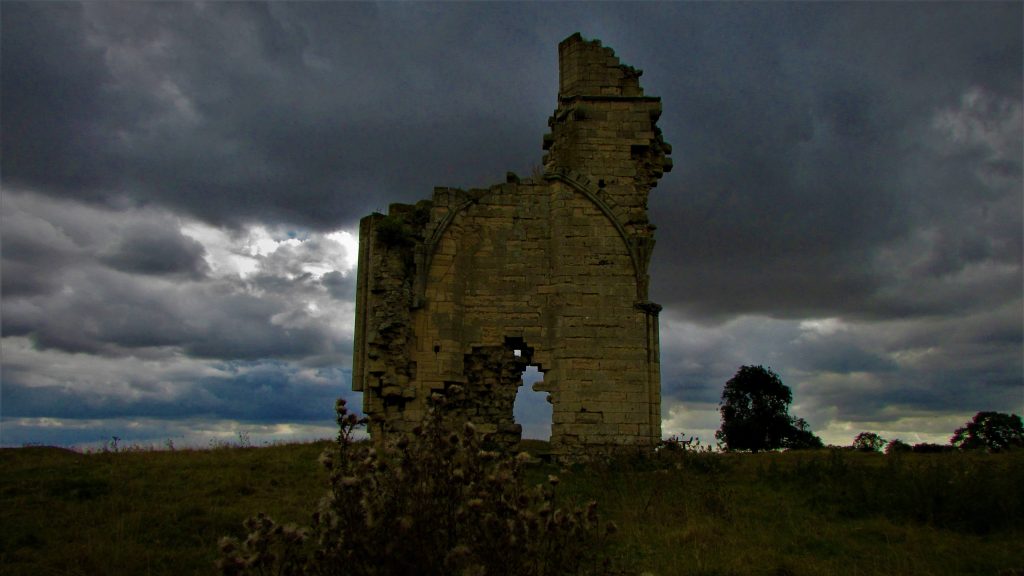
Turner says of the Lincolnshire-born antiquarian, William Stukeley, that he could see “the magic of words”. If so, Stukeley would have appreciated the spellbinding mellifluosity of Turner’s own writing. Almost every page yields memorable examples. Consider, for instance, Turner’s charming distillation of one village’s peculiarities and idiosyncrasies as “a little ampoule of English eccentricity” – his spinetingling description of old gateways as “unquiet, touched by the memories of everyone who has ever gone through them, especially if they never came back” – and his description of a carved stone man, high on the forlorn ruins of Barlings Abbey, abandoned at the time of the Dissolution, “stuck in eternal outrage, his mouth forever open as if howling at all this sacrilege and sky”. Turner sees poetry in the everyday, as when he recalls a dead carrion crow, “lying in a patch of sun beneath trees, intact and gleamingly black, studded with iridescent greenbottles, like a mislaid piece of Visigoth jewellery”, or when he waxes lyrical about the vistas that open up from the Humber bridge, “especially to the west on a warm evening when it has been raining, with the sun going down in splendour, and backlit air and water so full of each other that it is like being inside a pearl”.
The reader is also treated to some wonderfully dry asides, perhaps my favourite being an anecdote about a cringeworthy sermon given by the new Bishop of Lincoln at his enthronement, its low culture references jarring awkwardly with the high pomp of the ceremony that had preceded it. Turner concludes, somewhat archly, “The Order of Service read ‘After the sermon, silence is kept for a few moments,’ and it was, but not necessarily for the right reasons”.
Edge of England is a book to savour and is accompanied by thirty-two colour plates and a rather beautiful, Tolkienesque map in which the Wolds take on something of the aspect of the “misty mountains”.
‘The Ruskington horror,’ Fortean Times 401, 32-38 (January 2021); ‘The Ruskington horror: part 2,’ Fortean Times 402, 38-43 (February 2021); ‘The Ruskington goblin,’ Fortean Times 405, 48-38 (May 2021); ‘Weird wheels of the Wolds,’ Fortean Times 407, 48-51 (July 2021); ‘Scary stories from Scunthorpe,’ Fortean Times 411, 48-52 (November 2021); ‘Not the face,’ Fortean Times 414, 46-47 (January 2022); ‘Lincolnshire’s bevy of the bizarre,’ Fortean Times 416, 44-48 (March 2022); ‘A warning to the Fortean,’ Fortean Times 421, 42-45 (August 2022); ‘A grand fen-ale!’ Fortean Times 423, 42-45 (October 2022)
PAUL GARNER is a researcher, speaker and writer based in the Cambridgeshire Fens. His interests include the natural sciences, Christian theology, classic TV sci-fi and fantasy, British folklore, and the ghost stories of M. R. James. He is also a dancer with the Devil’s Dyke Morris Men
Maxim Peter Griffin, London: Unbound, 132pps, hb., £16.99
DEREK TURNER admires a unique landscape artist
Several years ago, when I was thinking about writing a book about Lincolnshire, I found a strikingly original Twitter account. Almost every day, the seemingly tireless Maximpetergriff posted pictures painted during or after apparently endless walks across Lincolnshire, in all weathers and states of mind, showing the things he had seen in clear and luminous tones – birds, buildings, clouds, dogs, people, planes, planets, plants, pylons, rains, roads, skies, stars and suns.
These things had not just been seen, but looked at – everyday things uplifted by a strong sense of their possibilities, made resplendent in modern hues. Nothing seemed beneath this observer’s notice, nothing predictable in this parallel Lincolnshire, his glowing images intercut with staccato captions about bats overflying, bridges crossed, dogs howling, insects hurrying, litter lying, people overheard, the smell from takeaways, strange stones picked up, waterways running slickly away under moonlight.
The images were small, apparently simple and spontaneous, but in truth were full of thought. This was a county beyond conventional depictions, a painterly psychogeography; here were Englands within England. This walker was no pedestrian, but dashed off little-known vistas with verve, influenced by the likes of Nash and Piper while also being confidently contemporary; as he records, “two older ramblers look on the work with dismay”.
Some of these evanescent images have now been confined within the boundaries of a book, crowdfunded by those who liked this take on this territory. Field Notes’ freeze-frame cover suggests the unusualness of the author’s perspectives, and the élan of his approach. A redder than real sun stands in a yellow-brown sky, silhouetting black grasses. Geese power south from Scandinavia in a sky like a destroyer’s dazzle pattern. Suggestions of cirrus shadows spot Ravilious-reminiscent fields. Cruciform crows angle home over saltmarsh. White pylons overlay lands filled with decayed life-forms. On the inside back cover, where we expect an author photograph, we find a fugitive Everyman in a raincoat, painted from behind on a beach improbably alchemised from greens and blacks – the self-effacing artist as Sebaldian character, stepping out sturdily across the echoing east.
Griffin is sometimes sentimental, but never nostalgic; the book, like many of his Twitter posts, ends on the word “Onwards”. Yet he honours equally the mammoths that stomped drowned Doggerland (whose bones are taken up by trawlers), the antiquarians and eccentrics who discovered or dreamed our ideas of England, and today’s young English, heedlessly in the moment yet standing on the same fossiliferous foundations. Seams of gaseous Kimmeridge, outcrops of chalk, flint hagstones, the slimed tree-roots exposed at the lowest tides and the movements of muntjac are in a continuum with John Aubrey, boys on BMX bikes, exhausted seaside resorts and whooshing wind-turbines, while overhead ley-lines intersect with jet-fighter flight paths.
Field Notes is an account of one closely-noticed, deeply felt year in Lincolnshire, starting for the author (predictably, unpredictably) in October, with a Humbrol-hazed moon announcing the equinox, and the coming of the cold. “Look – the peak of autumn”, he marvels – with anthropophagical arachnids eating each other on barbed wire, RAF Chinooks, leaking boots, geological specimens arriving in the post, and ancient tracks to towerless churches passed over by Pevsner. “Look” again, he urges us, at the waning of the year, the chiaroscuros of clouds, the shadows of fences, the darkness under trees, the unlikely reds of earth, the arsenics and Prussian blues of limitless firmaments.
November brings branches waving against vastness, bleached bones in dunes, beachcombed sealskins and plastic bottles, deserted caravan parks, huge ships hove to off Spurn Point, memories of the drowned. An Airfix-coloured pillbox gives rigidity to the dynamic landscape, and a gun port leads into blacker than blackness. December holds the old names of ditches, mysterious murmurations, Mesolithic mirrors, thoughts of Raymond Briggs and memories of Mablethorpe Carnival Queens, the turning of this twelvemonth accepted as part of the epic, indifferent, unalterable cosmic churn; “The ocean will have us all – good.” Deep Time, East Midlandian history and today meet and mingle, even his cooking over campfires a sensory link with aurochs-eating, the crude charcuterie once carried out in willow-meads ages ago eaten by the waves.
Month by month, step by sometimes blistered step, sketch by swift sketch, we glimpse something of this arcane county’s blend of beauty and bathos, its grand desolations so often made mean by bungalows, car boots, leylandii, phone masts, and the demolition derbies of Skegness. There is grit in this Lincolnshire, some hardness and ugliness – asbestos sheds, chicken concentration-camps with humming extractors and the sharp stink of ammonia, algae-choked dykes, desperate biro notes found on the ground, rat-gnawed rubbish, washed-up whales, a man in an oxygen mask expending too much of his short time selling 1970s cassettes. But the overarching impression is deeply positive – room to breathe and self-realisation under the biggest of big skies, despite the oncoming storm-fronts of life.
Field Notes is filmic, impressionistic, and personal. It also manages to be unpretentious. In Griffinland, knowledge of the exploits of Alexander, Welsh poetry, Kurosawa, or “our pal Pieter Bruegel the Elder” co-exist chummily with pop blasting from cars, addicts passed out in hedges, shops selling tourist tat, and lost footballs floating out to the estuary. Phrases that from others might have been merely gnomic point towards places you’d want to visit. Even those who have some acquaintance with Lincolnshire will not be familiar with all the artist’s itineraries, and are certain to see new sights from his very particular vantage-points.
After long obscurity, Lincolnshire may be rejoining the mainstream of national history, with uncertain effects. This paean to little-known landmarks carries folk-memories forwards, while facing “Onwards” with equanimity. Ultimately, it suggests that whatever happens or is done, Lincolnshire has always been, and will always be, a land of graphic dreams.
DEREK TURNER is the editor of The Brazen Head, as well as a novelist (A Modern Journey, Displacement, and Sea Changes) and widely-published reviewer. His first non-fiction book, Edge of England: Landfall in Lincolnshire, was published June 2022. Some of his writing may be found at www.derek-turner.com He is also on X – @derekturner1964
Franz Kafka, Reiner Stach (ed.), Shelley Frisch (trans.), Princeton University Press, 2022, hb, 230pp + XXII, 9 mono illus., £20/$24.95
Franz Kafka: The Drawings
Pavel Schmidt, Andreas Kilcher (ed.), Kurt Beals (trans.), Yale University Press, 2022, hb, 368pp, 240 col. illus., £35/$50
ALEXANDER ADAMS sees different sides to an arch-dystopian
While he was writing The Trial, a novel that remained unfinished and unpublished during the author’s lifetime, Franz Kafka would read aloud chapters to his friends. Closest friend and Kafka’s future biographer Max Brod recalled that as Kafka read, he would be convulsed with laughter. The novel commonly considered the epitome of existential despair and implacable authoritarianism, was viewed by its creator as a black comedy. Franz Kafka (1883-1924) is seen as the prophet of the totalitarian modern society operating through a labyrinthine bureaucracy. It is easy to overlook Kafka’s sense of humour, penchant for absurdity and taste for farce. What continues to attract readers is the brilliance of his ideas and the visionary quality of images. Kafka’s fondness for the paradox and ironical gives even his bleakest work a touch of levity.
Two new books present Kafka at his most playful and wry – also at his most oracular and obscure. The Drawings reproduces all surviving drawings by the author. The Aphorisms publishes Kafka’s most impenetrable and oracular pronouncements.
Kafka’s drawings have been one of the great unknowns of his output. Although a few (showing stylised, simplified single figures) had been reproduced in Brod’s biography and on the cover of a few editions of the 1950s, exactly how extensive and how various his drawings were was unclear. Not least, the obscurity came from the fact Kafka destroyed almost all his own drawings and only a few survived in letters and scraps that Brod preserved from the time they were law students together in Prague. Brod was enthusiastic about the drawings and attempted to interest publishers in hiring his friend as an illustrator, to no avail. After Kafka’s death, Brod published a few drawings then went cold on a proposed exhibition and substantial catalogue. The drawings disappeared into obscurity. Brod had given them to his partner-secretary, Esther Hoffe. After Brod’s death in 1968, the Kafka manuscripts and drawings were shuffled between a Zurich bank vault and Hoffe’s Tel Aviv apartment.
Publishers and scholars were antagonised by Hoffe’s unwillingness to make the manuscripts accessible. (In 1983, she would not let a publisher into her apartment, saying that it would cost him the equivalent of $150,000 even to see the drawings. The publisher demurred and departed. No book was published.) When her daughters continued the obstruction after her death, the Israeli state took legal action to claim possession of Kafka’s manuscripts. The state argued that the sheets were being kept in humid and dirty conditions and in danger of deteriorating; there was the threat of the works disappearing into hands of private collectors. In 2019 the state won, the Hoffe sisters lost possession of the manuscripts, and the National Library of Israel acquired relics of a Jewish titan of culture.
With the newly available originals accessible, plus all the other few Kafka drawings in other collections photographed, The Drawings presents all of Kafka’s surviving drawings. Essays cover aspects of Kafka’s drawing and the history of the manuscripts; a catalogue raisonné documents 163 pages of drawings.
Kafka took art classes, attended lectures on art history and visited museums. He personally knew some artists. Long after his university course on art history, he remained interested in differing art styles, including Renaissance art, Expressionism and Japanese colour wood-block prints. Kafka claimed that art education had ruined his ability to draw and that whatever he had done in terms of drawing had been achieved despite that constraint. Most of Kafka’s drawings are caricatures and fantasy cartoon figures, in exaggerated clothing and adopting parodic positions. On the evidence of comparative illustrations in The Drawings, it seems Kafka was an admirer of cartoons published in the German and Bohemian presses.
Around 1901, when Kafka was 18, he began a small sketchbook. He filled it with drawings, mainly of figures. As many of the personages are walking and seen in profile, they invite the comparison with a parade (or promenade) of eccentrics. There are curving jockeys riding improbable horses, angular men slumped at desks, striding gentlemen with walking sticks. Strong ink lines and solid black bodies are influenced by line-block illustrations, common to journals and books of that era. Kafka seems not have specific plans or projects in mind for his drawings; the figures are drawn at random on the pages, in every orientation, out of order and without accompanying writing.
There are similar ink figures in his letters, also reproduced. Figures appear in diary pages, often relating to the subjects of the day’s entry. On separate sheets of writing paper, portraits (including self-portraits) were drawn in pencil from life and photographs. These reveal Kafka’s art training. They are lightly worked fragments, with no settings indicated, but have realistic shading and the proportions are faithful to life, except where deliberately exaggerated. In artistic terms, they are slight and unfinished but the best of them have a magnetic pull to them – not least a self-portrait with haunted eyes. He did little drawing after 1908, with the majority of surviving drawings dating from his youth.
Did Kafka take his drawings seriously? Fairly so, on this evidence. Although he was self-effacing and reluctant to publish or exhibit them, Kafka took care over making them. He developed forceful images that were crisp and striking. Overall, in The Drawings we find Kafka at his most playful and relaxed; the best of the drawings are really fine and we might wish that more drawings of this type had been saved from Kafka’s wastepaper basket by Brod. Kafka might have been amused at a scholarly cataloguing of his drawings, doodles and elaborate crossings-out.
The Aphorisms collects 108 statements by Kafka, written over the winter of 1917-8, which he copied out into two small exercise books. At the time he was staying with his sister Ottilie in a village called Zürau. On sick leave from his office job, he was attempting to stem the progress of pulmonary tuberculosis by escaping the smoke of Prague, eating well and doing some farm work for exercise.
Part religious parables, part philosophical propositions, part distilled observations, entirely literature, the aphorisms still baffle even the most serious readers of Kafka. “From a certain point on, there is no turning back. This is the point that needs to be reached.” “Like a path in autumn: no sooner has it been swept clean than it is once more covered with dry leaves.” The most famous is, “A cage went in search of a bird.” These are the shortest, but none run longer than half a page. The final sentence of the collection is unusually pungent and vivid. “The world will offer itself to you to be unmasked; it cannot do otherwise; it will writhe before you in ecstasy.”
The aphorisms are gnomic and elusive. The reader gets the impression that he is being told something true and important, but also something unclear, even deliberately obscured. Although these sayings have been published before (sometimes incorporated into collections of short stories), they are the probably the least read of his works. As the editor notes,
In comparison with Kafka’s other writings, his aphorisms have been overlooked by researchers and even more by his general readership. The aphorisms, like everything Kafka wrote, require interpretation, but in contrast to his fictional prose, for example The Trial, they do not reward the reader with the sensory and aesthetic pleasure of a story.
This new edition supplies commentary written by Reiner Stach (author of an excellent recent biography), with English translation by Shelley Frisch, who did a fine job on Stach’s biography. There has been no shortage of complicated interpretations of the aphorisms; wisely, Stach avoids committing himself. Commentaries include Kafka’s original draft, so we can note the revisions and follow the author’s thinking a little. Rather than offer explanations, Stach’s commentaries relate the aphorisms to comparable phrases or ideas from writings by Kafka and mention what he was known to have read at the time.
The aphorisms are as tricky to decipher as anything Kafka wrote. If you fancy giving yourself food for thought, then The Aphorisms are ideal. If you prefer something playful, then The Drawings is for you. Both publications serve to broaden our knowledge of one the greatest authors of European literature. What would expand that knowledge even more would be a first translation of the new German editions of Kafka’s letters, including texts inaccessible to non-German readers. When will Princeton University Press commission Shelley Frisch to translate Kafka’s letters into English?
ALEXANDER ADAMS is an artist, art critic, novelist and poet. His most recent book is Artivism: The Battle for Museums in the Era of Postmodernism (Societas/Imprint Academic, 2022)
STUART MILLSONenjoys a super-orchestra’s seasonal offerings
The re-formed Sinfonia of London (a recording and film-score orchestra of the 1960s) appeared at the Proms on Saturday 16th July under the baton of the ever-popular John Wilson, for a concert of music by British composers. The programme was made up of Vaughan Williams’ 1910 Fantasia on a Theme by Thomas Tallis, Welsh composer, Huw Watkins’s new Flute Concerto, the Partita by Walton, Bax’s 1917 Arthurian tone-poem, Tintagel, and Elgar’s ‘Enigma Variations’ of 1899.
The Sinfonia is a handpicked, super-orchestra – a superior “scratch-band” of top freelancers, players drawn from existing orchestras and even members of string quartets and chamber groups, dedicated to reviving the idea of “demonstration sound quality”, i.e. dazzling, virtuoso performance, chiefly in a studio setting. A previous example of this type of ensemble was the old National Philharmonic Orchestra, which appeared on the RCA label and notched up some notable recordings, often under conductors such as the suave American, Charles Gerhardt. But to have real life and vigour, an orchestra must play in public, so what better arena for publicising the dynamic stage presence of your orchestra than at the Proms on a Saturday evening, right at the beginning of the season?
Thomas Tallis
And what finer non-ecclesiastical setting for a cathedral-inspired piece, such as the Tallis Fantasia, than the Royal Albert Hall, in which John Wilson cleverly created antiphonal special effects by placing part of his string band in a line, high on the right at the rear of the platform? The two bodies of strings answered each other: the music moving across the centuries, from Tallis’s Elizabethan sound-world of church voices, to the well-upholstered, romantic early 20th-century string writing of Vaughan Williams.
Ralph Vaughan Williams in 1898. British Library. Wikimedia Commons
The one new work in the programme, the Huw Watkins Flute Concerto also suited the hall’s great acoustic – a beautifully air-borne thing and (for this reviewer) strangely reminiscent of a scene from the Ken Loach film, Kes, about a boy from a deprived background, spiritually rescued by a chance ownership of a hawk. In the film, there is a moving scene where the boy takes his kestrel to a field at the edge of the northern town in which he little more than exists, and flies him with all the skill of a mediaeval falconer. The bird takes to the wing, accompanied by flute music, neither tuneful nor atonal, which seems to represent freedom, air, longing, space. All of those qualities were to be found in the Huw Watkins piece, played by distinguished soloist, Adam Walker.
The great (literally) landmark work of the evening was the 1917 tone-poem by Englishman and also Celtic enthusiast, Arnold Bax, Tintagel. The composer visited the dreamy north Cornwall coast with his mistress, fellow musician Harriet Cohen, and found deep escapism and solace in the ancient surroundings of rocky coast and the ever-present gentle, heaving breast of the sleepy Atlantic. The work begins in pure, clear-blue summertime, but as Bax pointed out in an explanation of the piece, not a windless day.
John Wilson’s orchestra began their evocation with gentle, dreamy woodwind conjuring a feeling of sea-birds and distances. The growing swell of the sea against the rocky sentinels of Cornwall’s headlands was beautifully executed in the surging, strong, cohesive orchestral tide of sound created by the Sinfonia. But just as quickly as the physical setting of Cornwall has been established, Bax then begins to dissolve it all, with the supernatural drama of the ancient kings, Arthur and Mark, and the destructive, legendary love of Tristan and Isolde – the latter, a symbol of Bax’s own romantic entanglement. The composer wrote several Celtic-folklore-inspired pieces and seven impressive, well-orchestrated symphonies (the Fourth being the most radiant and most-often played, although an outing for a Bax symphony is still a rare occasion).
What Tintagel represents is a (nearly) fifteen minutes-long condensed symphony – a clear, concise distillation of some of the more long-winded ideas which all long symphonic structures have, but which in the case of this piece are assembled with utterly persuasive and spellbinding cohesion and power. Not a note is wasted in Tintagel: there is a beginning, middle and an end, and like Sibelius’s The Oceanides (a tone-poem of some ten minutes), a listener or concertgoer can instantly know the composer just from this one calling-card piece.
With instantly recognisable pieces in mind, the concert concluded with Walton’s shimmering, Italianate Partita, written in the Mediterranean sun and siesta of the late 1950s – and Elgar’s Variations on an Original Theme, (‘Enigma’), penned at the end of the 19th century, but looking forward with masterful confidence to a new century and (for Elgar) new successes and untold honours. Again, the Sinfonia of London matched the mood, its players responding with great physical commitment to the scores of these British giants; men whose music, in different ways, captured the spirit of our native music.
Skara Brae on the Orkneys. Photo: Daniel Bordeleau. Wikimedia Commons
Yet what really is our native music? – as BBC Radio 3’s Tom Service (a Scot) asked in the evening’s programme notes. Slightly dismissive of the insularity of the land “sandwiched between Hadrian’s Wall and the South Coast” (his words), the writer nevertheless correctly noted the way in which our music has transcended the country’s physical boundaries. However, metropolitan observers should not be so quick to dismiss country cottages and “folky-wolky melodies”. As Vaughan Williams pointed out, all great universal art is rooted in a place, whether Bach’s Lutheran northern Germany, or the Spain of Velazquez. And as Tom Service should know, modern composer Peter Maxwell Davies, who settled in the Orkney Islands, immersed himself in a Scottish island identity, garnering, like a beachcomber, every conceivable Orcadian cadence, myth into his music, showing just how powerful “insularity” can be as a creative inspiration.
The capacity audience at the Royal Albert Hall, not a bit dissuaded by the Met. Office’s red-alert, heat-wave weather warnings, gave the performers a typical Proms ovation. And John Wilson gave them in return, one more piece – an encore from Eric Coates’s Summer Days suite, a nostalgic, innocent waltz. Judging by the overflowing applause, it is a world that still means something to so many.