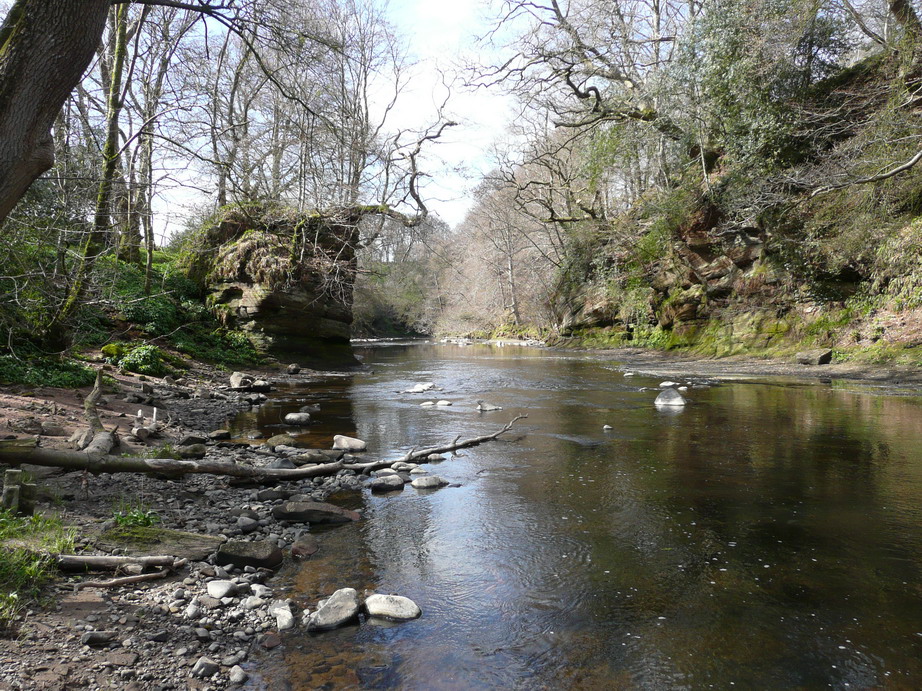
The Lugar, by David Johnston. Image: Wikimedia Commons
STUART MILLSON wanders imaginatively across peaceful marshes and rivers, to glimpse a world at war
Composers are not necessarily good conductors of their own works — too fussy, sometimes, or just without the conducting charisma of a professional baton-wielder, more accustomed to the stage and the adulation of an audience. Not so in the case of composer-conductor, Sir James MacMillan, a native of Scotland whose musical outlook and versatility brought such intense playing from the BBC National Orchestra of Wales in that most English of works, Vaughan Williams’s early-20th century symphonic impression, In the Fen Country.
Sir James — who as we were to find out in his new euphonium score later in the programme — has a natural feel for music which puts man in his place in the midst of a landscape where remoteness and the movements of cloud banks and sunlight over water allow your mind to wander fantastically. So the Vaughan Williams unfolded, carrying us far from Swansea’s Brangwyn Hall, like a fen-tale recounted by a local on a warm May evening (which indeed this was) — orchestra and conductor carefully finding all the threads and patterns of the lonely land so beloved by Vaughan Williams.
A similar ‘genetic heritage’ flowed into Sir James’s Where the Lugar meets the Glaisnock, a picture of the confluence of two Ayrshire rivers — part tone-poem, part euphonium concerto. Seldom has this bold solo brass instrument sounded so subtle and ‘at one’ with the soft magic of strings – the writing for the latter section of the orchestra suggesting the half-light melancholia of Vaughan Williams, but through a twenty-first century prism. At one point in the score, I picked up in MacMillan’s Ayrshire filaments of sound from distant Estonia, where a passage brought to mind the mystical, frozen-in-time style of composer, Arvo Pärt. Our solo euphonium player, David Childs, certainly gave a thrilling performance of what was a successful, deeply meaningful MacMillan world-premiere.
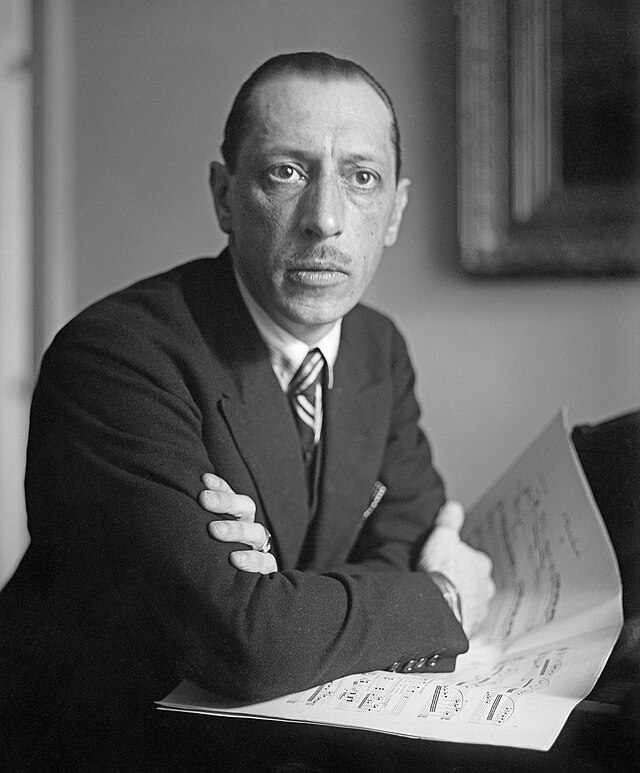
Igor Stravinsky
Thoughts of war (for Stravinsky, the stark image of goose-stepping machine-armies) were never far away in the composer’s emphatic, barbed, relentless Symphony in Three Movements, although the unsettling whirl of world events dispels quite uncannily in a surprising, eccentric, but warm and friendly little gavotte-like dawdle in the second movement — as if Pulcinella or Petrushka were never far away. The orchestra’s woodwind and brass produced pinpoint ‘Technicolor’ virtuosity — qualities which were centre-stage, too, in the shortish diversion (though with a clever, inventive sharpness) that is Stravinsky’s Symphonies of Wind Instruments.
The concert began with another compact and engaging mini-masterpiece, by Vaughan Williams’s composer-colleague, folk-song collector, and walking, hiking, inn-visiting friend, Gustav Holst — his Capriccio, a short work for full orchestra, with some magisterial trombone writing (Holst’s own instrument) and a foot-tapping march right in the middle of it. Yet the work seems to begin in Vaughan Williams’s fen and marsh, or the Ayrshire of MacMillan, another mysterious signpost of the continuum element in the music of these islands.
MEG HEPHER is moved by a musical reminder of a maritime tragedy
On 24 March 2025, I headed to St Giles’ Cripplegate, for a concert by the Lloyd’s Choir and Cohen Ensemble under the baton of the Choir’s Musical Director, Jacques Cohen. I had no idea of the emotionally charged evening that lay ahead.
The medieval stone Church of St Giles’ was built just outside London’s City Wall and is now a tranquil centrepiece of the bustling, brutalist Barbican estate. The gothic architecture provided a space that was both intimate and reverent, creating the perfect ambiance for the themes of the evening. There were three works in the programme: Mendelssohn’s setting of Psalm 114, ‘When Israel went out of Egypt;’ the premiere of ‘Lancastria’, by Jacques Cohen, and Rossini’s Stabat Mater. As the evening progressed, I felt the powerful emotional thread connecting the three pieces.
Jacques Cohen, Music Director of the Lloyd’s Choir, wrote ‘Lancastria’ to commemorate the sinking of HMT Lancastria in the early part of the Second World War, and a painting of the ship was hung on a pillar at the front of the Church for the concert.
In June 1940, HMT Lancastria received orders to sail from Liverpool to the west coast of France to repatriate British servicemen and civilians who had been left in France after the evacuation of Dunkirk. On the morning of 17 June 1940, the Lancastria was anchored three miles off St. Nazaire as British servicemen, and a small number of British, French and Belgian civilians, poured from the French coast to the ship on destroyers, tugs, fishing boats and small boats.
Shortly after the ship had embarked for Britain with almost 9,000 people crammed into every space, German bombers hit her with several bombs and she sank within 20 minutes. The loss of life is estimated at between 7,000 and 9,000, more lives lost than the tragedies of the Titanic and the Lusitania combined.
Before the concert began, I found myself in conversation with Roger C. H. Round, former Chairman of the Lancastria Association, whose uncle was among the servicemen who lost their lives on that day. Roger has spoken to a number of survivors. He described how, against the backdrop of fears of U-boats lurking in the deep, there was nevertheless a sense of relief and expectation among the troops, full of hope that they were embarking on their journey homewards.
The performance opened with a powerful and moving rendition of Mendelssohn’s Psalm 144, ‘When Israel came out of Egypt.’ The parallel between the troops “leaving the foreigners’ land” for the sanctuary of their homeland, and the Israelites leaving Egypt for the sanctuary of Judah, was striking. The choir and orchestra were perfectly balanced, capturing with sensitivity both the human vulnerability, and the strength found in faith, that are expressed in the Psalm. The concluding sections were uplifting, resonating with a sense of hope and assurance that was to prove ironic as the central work of the evening unfolded.
Jacques Cohen as the conductor of the evening ensured that the orchestra and choir brought to the fore every nuance of his powerful composition, Lancastria. The full work premiered this evening was written for choir and orchestra, a musical setting of Tennyson’s poem, ‘Crossing The Bar.’ The poem is a metaphorical meditation on death, comparing dying to gently crossing the sandbar between the coast and the wider sea.
As the bombs struck the ship, bells, alarms and whistles sounded, and the screams of people aboard the ship filled the air. The noise, the chaos, were all captured in Cohen’s music, which gave a heart-rending musical illustration of the tragedy.
Cohen wove subtle hints of the tune of ‘The Flowers of the Forest’ through the piece, with the tune finally emerging fully, played on the bagpipes by an unseen piper, combining with the choral melody of the work. Cohen thereby masterfully not only referenced the ship’s Scottish origins, but also introduced into the music the theme of the Scottish folk song: the grief of the women and children for their menfolk killed in battle, “the Flowers of the Forest are a’ wede away”. A portent of the grief to come in the concert’s second half.
At the end of the piece, there was a long period of silence and stillness, powerful and moving, before the conductor lowered his arms and the audience broke into enthusiastic applause.
After the interval, the heavy silence that had ended ‘Lancastria’ was broken by the opening notes of Rossini’s Stabat Mater. The impact of the first words was almost unbearable, “Stands the wretched mother weeping,” reflecting the flood of heart-rending grief experienced by families receiving the news of the loss of their loved ones on the Lancastria. The four soloists, Susanna Davis, Beatriz Volante, Andrew Henley and Daniel Barrett were outstanding in their interpretations of the music, giving full expression to the rich and varied emotions of the work: the pain, passion, and compassion. The choir sang the penultimate movement, with its acceptance of death and the yearning for God’s love in the Paradise to come, with a soothing tenderness before filling the whole Church with their glorious and uplifting final movement. After the choir’s final rousing “amen” had died away, the audience did not want to let the conductor, the lead violinist, the soloists, the choir or the orchestra leave.
Although not a memorial service, the concert was a moving and fitting tribute to the Lancastria – to all those whose lives were lost on her, and to all those who mourn for them.
The Lloyd’s Choir is based at St Katharine Cree Church, in the centre of the historic shipping industry of the City of London. The Choir takes part in a memorial service for the loss of the Lancastria held at the Church around the date of the anniversary each year. This year’s service will be held 1pm on Thursday 12 June, and will feature a shorter a cappella version of Cohen’s ‘Lancastria’ created especially to be performed at the memorial service.
It has been described as the most influential photograph ever. It was taken by astronaut William Anders during the Apollo 8 mission on Christmas Eve, 1968. It shows the moon’s surface and the earth rising from the darkness of space. Previous photographs were taken by robotic probes. But this has a human being behind the lens. It is a perfect visual metaphor for the awe and emotion encapsulated in this rich recording by the adventurous Musici Ireland ensemble led by violist Beth McNinch.
It was Beth herself who commissioned Liam Bates’ Earthrise. Surprisingly this piece is the second track on the CD. One can imagine taking the photograph oneself as the music swoops and swirls with dramatic crescendos and contented interludes. As Bates says: “Crafting music that evokes a resonant and emotive experience has always been the compass of my compositional aspirations.”
It is clear that Bates composes music for ballet and contemporary dance. One can almost see dance movements across a moonlight stage as three movement composition shifts from “Majestically” to “Gently and finally to “With Spirit”. The piece showcases Beth McNinch’s soulful virtuosity, with its technical versatility and emotional resonance.
The CD opens with Deirdre Gribbin’s ‘Before the Moon Shattered and Shone Again.’ This takes its inspiration from Celtic mythology as Elathan arrives at night by sea on a silver boat. The shimmering strings evoke the dancing moon on waves. We are now on a beach at dusk rather than the moon’s surface. We are watching daylight turn to dusk as, in the words of the composer, “The moon in this string quartet symbolizes life waxing, waning, renewing and redefining.” The ending to the pieces as blackness descends is exquisite.
We are very much back in Ireland for Ian Wilson’s ‘Her Charms Invited – String Quartet No. 12’ taking its inspiration from ‘Sean-nos’, traditional Irish singing. We are dancing in the grasslands and by mountain streams. We are earthbound but joyous. An evocative account of a spring day by mountain streams.
The Irish composer Linda Buckley takes inspiration from the hardingfele or Norwegian fiddle for her piece ‘Fiol for String Trio.’ Fiol means fiddle in 17th century Norwegian and Danish. A fiol is similar to a violin but has eight or nine strings with four strings resonating as the other four are played. ‘Fiol’ sees Buckley treating the twelve strings of the string trio almost as one instrument rather than three separate voices. It is as if the instruments have their own accompanying choir. It caused this reviewer to pause and stare at the proud host of daffodils in my garden – my choir for the cello, viola and violin.
The final piece on the CD is ‘Mr. Shah’ by Deirdre McKay. Mr. Shah (Peter Shah who lives in a hillside bungalow at Meifod near Welshpool) spends his evenings exploring space through a telescope and a hole in the roof of his garden shed. He photographs star clusters many light years from earth, matching the extraordinary space images provided by the £2.5 billion Hubble telescope. A garden shed, a cup of cocoa and an inexhaustible curiosity. “Night after night, in solitude, staring into vast soundless space,” says the composer. Now Mr Shah has a soundtrack for his astrological activities. The piece uses silence to punctuate the roving discoveries of the garden shed telescope – sometimes vast bursts of scattered light and sometimes deep darkness. The music beautifully envelops this quest to tell the stories of galaxies both known and unknown. Put on your headphones and step outside with a cup of freshly brewed cocoa and a curious eye. Find a new story in the night sky with this intoxicating music.
STUART MILLSON enjoys four Divertissements from the BBC National Orchestra of Wales
Way back in orchestral history, at the 1971 Proms, a modest-sized broadcasting orchestra appeared at the Royal Albert Hall for the first time. An ensemble of some 40 players, the (then) BBC Welsh Orchestra performed smaller-scale works by Haydn, Mozart, Stravinsky and Brahms under the baton of the American conductor, Irwin Hoffman — who, incidentally, as a US serviceman, had been stationed in Britain. In a radio interview, Hoffman talked about the sense of occasion felt by the orchestral players, transported from their Cardiff studio duties to the international stage of the Royal Albert Hall — sentiments which might come as a surprise to concertgoers, today, accustomed to the work, international scope and remit of the c. 80-strong BBC National Orchestra of Wales.
From their modern performance centre, BBC Hoddinott Hall at Cardiff Bay (the larger St. David’s Hall in the city, opened in 1982, remains — curiously — closed and crumbling) the Welsh national orchestra plays for a dazzling array of international conductors. The trend started with Mariss Jansons in 1992 (with Richard Strauss’s massive AlpineSymphony) to Tadaaki Otaka, the Japanese maestro who loved and performed Elgar and attained laureate status with the musicians.
At Aberystwyth Arts Centre on the night of the 13th March (touring is a major priority of the orchestra) Christoph König presided over a programme of four intriguing divertissements for orchestra – Ravel’s Great War homage to lost friends and artists, LeTombeaudeCouperin, Anna Clyne’s modern saxophone fantasy on a theme of the banshee, Grasslands, Louise Farrenc’s boisterous, if uninterestingly-named ‘Second Overture,’ and Shostakovich’s Symphony No. 9 — the complete opposite in scale to his 7th, 1941’s ‘The Leningrad.’
A detailed delicacy of tone, especially in the woodwind section, made Ravel’s homage to an older France sound particularly tender and nostalgic. Yet the players switched effortlessly to a different scale of sound in the spikes and sparks of Anna Clyne’s banshee world, Grasslands, complete with an exciting pizzicato chase in the last movement — foreshadowing the Shostakovich 9th that ended the second half. The brilliant saxophonist, Jess Gillam, almost co-led the orchestra in this weird phantasmagoria — striding on with a complete stage-presence, notwithstanding her pink suit and blue spectacles. However, another player had a chance to shine in the concerto, the overlooked double-bassist, who had a mysterious little accompaniment to perform alongside Jess’s saxophonic highs – a moment of real atmosphere.
A sardonic march, a cheeky fizzing curtain-raiser to an odd sort of symphony, is what the first movement of Shostakovich 9 is all about — a far cry from the tense, tortured spans of the Stalin-shadowed 5th and 7th. Here, the BBC National Orchestra of Wales and their (batonless) conductor found much to enjoy — and full marks, of course, to leader, Lesley Hatfield and the ice-cold violin tingle achieved in her sinister-sounding mini-solo of the march theme. Even with such a divertissement of a symphony, Shostakovich still managed to create that hypnotic feel (which you find in the ‘Leningrad’ or in the 11th) in his slow movement — before the unsettling, quixotic torrents of the work reach their exciting finale.
At Aberystwyth, the orchestra fielded c. 60 players, just right for the dimensions of the Arts Centre, and an audience of some 300. In this era of cuts to arts funding (even within the BBC) it is vital to maintain visits and tours to places which are a little off the usual orchestral beaten track. Perhaps the orchestra might consider going even further afield – deploying a detachment of string players to the Theatr Mwldan, Cardigan, for example – or chamber groups drawn from the various sections, to visit churches or village halls, or best of all, schools, in which classical music is desperately needed but often utterly absent.
Such considerations aside, the Aberystwyth concert was a good night for orchestra and audience, alike. Concertgoers in Wales are truly fortunate to have these inheritors of Irwin Hoffman’s BBC Welsh Orchestra.
Harvesting on the Sussex Downs, by John Charles Dollman. Image: Wikimedia Commons
STUART MILLSON assesses some horizon-broadening CDs
Part of the pleasure (or occasionally, the necessary discomfort) of reviewing music, is to find unfamiliar works and composers – in genres, perhaps, not entirely to your taste – and embarking upon a process of self-training – dismissing your prejudices, trying to clear your mind and hearing the music as if it is the first music you have ever heard. Of course, the exercise is nearly impossible, but there are occasions when you genuinely begin to find an attraction to something that, hitherto, you might never have listened to.
The first such CD in this month’s review pile fits into the latter category: the chamber music of Justin Connolly (1933-2020) – an overlooked figure even in the realm of contemporary music, who, in the late-1950s came under the wing of Roberto Gerhard (composer of the choral-orchestral ThePlague) and symphonist, Peter Racine Fricker.
Connolly, who became a teacher in his own right, developed what could be described as an astringent, even hard style, something which can be found and felt in a three-movement String Trio (Op. 43) – a work which might complement a Britten String Quartet, or the quartet by Stephen Matthews (a tonality-challenging work given some years ago at the English Music Festival).
Yet there is much light and shade in the score, and it would be fair to say that Connolly, like Britten, in his quest for a pure form of music, did not turn his back entirely on folklore. In Ceilidh, Op. 29, written with younger musicians in mind and performed in the US during the country’s bicentennial celebrations, the composer retains his customary ‘gimlet focus’ on technicality, but hints at an old-world atmosphere with movement titles such as, Gathering, Dordfiansa (spear-clashing dance), Night, and Four-hand reel. Recorded in venues as various as the Royal Academy of Music and the studios of the Australian Broadcasting Company, Melbourne, the passionate devotee of contemporary music and audio perfection will find the Justin Connolly collection essential listening.
Another contemporary-music CD – Distant Voices, New Worlds, Songs, Landscape and Histories – brings together the Sky Rhythms of Ed Hughes, Shirley J. Thompson’s Hymn to the Evening, Evelyn Ficarra’s What Larks, and Rowland Sutherland’s Modes from the Downs (the latter two pieces, both written three years ago). In Sky Rhythms, Ed Hughes adapts words taken from the Mass Observation Archive Day Survey, from 1937 – an interesting and involving weaving together of everyday thoughts, worries concerning the world situation, and an evocation of Sussex – of England. Here are some extracts (the words of one, Mary Robinson):
I live in a seaside bungalow town, in a furnished bungalow,
Very small and draughty,
but fortunately,
looking out across open fields and country
to the South Downs…
… To the news’ agents
Daily Herald Placard
Stalin might do something to make our bread dearer
Further depressed by news in paper
which hopes that England will not let France down…
… The air is splendid,
we get whatever sunshine is going,
and witness superb skyscapes,
Felpham, where Blake lived, is near…’
A modern ‘Lark Ascending,’ a contemporary ‘Land of Lost Content,’ a ‘Paradise Postponed,’ or the paintings of John or Paul Nash, Evelyn Mary Dunbar, John Piper, Eric Ravilious – all of these thoughts and associations came into my mind in this strongly modern setting, which includes electric guitar, as well as flute and clarinet. Expertly performed, this production by Sussex musicians (ensembles, The New Music Players, The Orchestra of Sound and Light) shows that the landscape inspiration in our artistic DNA is unbroken.
A mellow tonality of summer warmth and wandering can be enjoyed in Shirley J. Thompson’s AnHymntotheEvening (a setting of Phillis Wheatley, from the eighteenth century) and in Matthew Sheeran’s LanguetAnima, in which echoes of fourteenth-century music gently appear and drift for an all-too-brief three minutes — a piece reminiscent of modern orchestral settings of Byrd or Dowland.
Finally, to the music of Arthur Butterworth (1923-2014), a one-time player in the Hallé Orchestra (incidentally, his signature appeared, alongside that of his orchestral colleagues on the score of Vaughan Williams’s Eighth Symphony – premiered by Manchester’s great orchestra) – but he went on, not in the orchestral ranks, but to forge a career as a composer.
Windy Hill, on the Pennine Way. Image: Jooniur, Wikimedia Commons
Not for Butterworth, though, the challenges of atonality, the abandonment of convention by the brave, new ‘Manchester School’ of Maxwell Davies, Goehr and Birtwistle. In Butterworth, we are taken by the hand, rucksacks on our backs – as if by a musical Wainwright – to the peaks and tarns of the North, in a rhapsodic, but never sweet or self-consciously nostalgic survey of sky, rock, scrubby path, rainfall, tufts of moorland grass vibrating in the wind, and eerie, supernatural forest shadows. The Fifth Symphony from 2001-2; Three Nocturnes, Northern Summer Nights; The Quiet Tarn; The Green Wind – the listener will revel in the Sibelius-like passage of clouds, the full use of the late-romantic orchestra (with some gorgeous harp moments) and a sense of escapism, dreamy altitudes, and communing with Nature. As Butterworth proves, not all contemporary music has to conform to one standard. And as the South Downs composers also reveal, modernism need not be removed from a wider audience.
CD details: Justin Connolly, Music for Strings (plus…), metier label, mex 77209; Distant Voices, New Worlds, metier, mex 77131; Arthur Butterworth, Symphony No. 5 etc, Dutton Epoch, CDLX 7253. Royal Scottish National Orchestra conducted by the composer
WILLIAM KING relishes a cinematic realisation of a great musical moment
There was a time when I never thought of visiting YouTube, believing it to be full of cat videos uploaded by doting owners. Later I discovered my error – it was, in fact, full of a wide range of pointless videos. Then I came to discover that there are many worthwhile grains to be found among the chaff and Eroica is surely one of them. I think myself exceptionally fortunate to have accidentally discovered this British film, and this is my justification for reviewing something made over two decades ago, in 2003.
Eroica is a dramatisation of the first, private premiere of Beethoven’s third symphony, the ‘Eroica’ or heroic symphony. The film’s most remarkable feature was the brave decision that saw the full symphony – all 49 minutes of it, plus a little bit of Mozart – incorporated into a film that is only 83 minutes long. This might seem to leave little time for any drama as well: surely the drama – the main plot and an amorous sub-plot – must cease when the music commences? That this is not the case is due to the excellent screenwriting of Nick Dear, the intelligent direction of Simon Cellan Jones, and the emotional sensitivities displayed by the cast. And, of course, the very fine playing by the Orchestre Révolutionnaire et Romantique, conducted by Beethoven in the film, and by John Eliot Gardiner ‘behind the scenes.’ As a result, music and drama become inseparably fused throughout the film.
It might be best to sketch briefly some of the known facts relating to the private premiere of Beethoven’s third symphony. As we shall see, it should perhaps be called the first rehearsal, rather than the first performance.
Eighteenth century view of the Palais Lobkowitz in Vienna
It was held in June 1804, in the Vienna palace of the Bohemian nobleman Prince Joseph Franz von Lobkowitz, one of Beethoven’s principal patrons. It took place in a small hall – still known as the Eroica Hall – usually reserved for chamber music, but which could accommodate over two dozen musicians and guests. Lobkowitz was born with a deformed hip, and needed to use a crutch all his life. As a young man he inherited a fortune in money and estates and was known for his lively disposition and warm-heartedness. He was also renowned for his extreme passion for music, employing his own orchestra and chorus – a passion that was ultimately financially ruinous to him. As Count Razumovsky, a Russian nobleman and ambassador in Vienna, later noted: “This Prince was as kindhearted as a child and the most foolish music enthusiast. He played music from dawn to dusk and spent a fortune on musicians.”
A cynic might say Lobkowitz squandered his fortunes on music; I prefer to think that he sacrificed his fortunes to music. Certainly it was he, and a small number of other patrons, who gave Beethoven the financial security to devote himself to composition.
Rehearsals were unusual for symphonies at that time. Professional musicians were expected to give a competent performance by sight-reading the score – even at a premiere. The ‘Eroica’ was different however: almost twice the length of a conventional symphony, the complexity of the score and Beethoven’s perfectionist attitudes rendered rehearsal imperative. The – thankfully private – premiere rehearsal/performance did not go well. With Beethoven himself conducting, errors crept into the playing.
However, one of the most famous incidents came when Ferdinand Ries, pupil and friend of Beethoven, interrupted the playing when he incorrectly thought the horns had come in too early. As Ries recalled: “’That dammed hornist,’ I said. ‘Can’t he count. It sounds frightfully wrong. I nearly got my ears boxed and Beethoven did not forgive me for a long time.’”
Joseph Haydn, revered as the Grand Old Man of music in the early 1800s, arrived at the palace in time to hear the final movement of the symphony, and to make a number of prophetic comments about it.
The public premiere did not take place until April 1805. We may be certain that the orchestra was properly rehearsed this time, but the length, scope and sheer power of the piece, especially the first movement, was too much for some. One member of the audience was infamously heard to cry out: “I’ll give another kreuzer [a copper coin] if the thing will only stop!” There was muted applause at the end.
So much for history; what of the drama? It is a sad fact of life that film and TV dramatisations have rarely more than a nodding acquaintance with historical reality. All too often dramatists, whether through ignorance, an ‘agenda,’ or a desire to ‘jazz things up,’ see no reason to let reality get in the way of a good drama. A bit like newspaper editors never letting the facts get in the way of a good story! Thankfully there are few such blemishes here, and when they occur they can be excused on the grounds of dramatic licence. A few examples should however be mentioned.
Wenzel Sukowaty, Beethoven’s copyist, rushes in shortly before the performance is due to start to give out the sheet music to the orchestra. Cue much baffled incomprehension from the players – “The fingering. Have you seen bar 34?” and indeed, “Bloody hell.” The copyist quietly explains to Prince Lobkowitz, “The piece is a monster… It may not be music at all.”There are a few false starts when Beethoven commences conducting, and he has to explain that the orchestra are to play ‘sforzando,’ attacking each note, for maximum intensity. The sad plea “Can’t we play a bit slower?” is answered with a resolute no. However, from then on the orchestra sight-reads, at first time of asking, a piece that is exceptionally long, complex and not like anything they have played before, without error.
This is surely not what happened in real life, but – and this is a huge but – it means we get to hear the Eroica as Beethoven wished it to be heard, played on historically authentic instruments by a first-rate orchestra, under a leading conductor, fully in sympathy with the music. If dramatic licence is not forgivable here, then when is it?
More examples of such licence may be given. The long-suffering Ries does indeed interrupt the playing, leading to a volcanic eruption of rage from Beethoven, but did he really cry out, “Piss off!” to his hapless apprentice, in front of Prince Lobkowitz and his assembled guests, many of them ladies? No doubt Nick Dear, the writer, felt it necessary to ‘update’ the language for 21st century ears. One can only say, O tempora, O mores…
Finally, towards the end there is a ‘flash-forward’ scene when Beethoven and Ries visit a tavern after the performance. Ries there discovers from a friend that Napoleon has declared himself Emperor. He nervously informs Beethoven of this, knowing that Beethoven was a great admirer of Napoleon, regarding him as an embodiment of republican virtues. Beethoven, in a towering rage, rips out Napoleon’s name from the dedication to him on the front page of the manuscript score. Historical accounts vary slightly but it would seem Beethoven did hear of Napoleon’s declaration from Ries, and he did destroy the dedication to Napoleon, but probably not immediately after the premiere performance. This is, of course, why the third symphony is called the Eroica symphony, and not the ‘Buonaparte’ symphony as originally planned. A little dramatic licence is surely excusable here.
These minor quibbles aside, what are the most noticeable virtues of Eroica? Apart, of course, from the exquisite playing by the orchestra. First and foremost Eroica is superb in its exploration of the relationship between music and society as a whole: specifically, in this case, the musical revolution that Beethoven is about to unleash against the backdrop of the social and political changes after the French Revolution, and symbolised by Napoleon Buonaparte.
This is, for the most part, done with much subtlety. For example. the film opens with the lead violinist of Prince Lobkowitz’s orchestra playing a piece by Mozart, before the guests have arrived and the new symphony is to be first aired. It is very beautiful piece, calm and serene, but it is not in any way threatening – it will never, as it were, be the backing track to a revolution. Playing it serves as a counterpoint to what will come. No wonder Beethoven laughs on hearing this music on his arrival – he knows just how much of a shock his music will be.
There is much debate about music and its place in society. The opposition to Beethoven, and all he stands for, comes from Count Dietrichstein, a nobleman friend of Prince Lowkowitz. He is very much a supporter of ancien régimes – if you don’t have a title your views scarcely count. Wisely he has not been presented here as an ignorant buffoon. Rather he is an intelligent man but with fixed ideas – fixed about the nature of society and fixed about what music is. Since the feelings and opinions of the ‘lower orders’ count for little he condemns, to Beethoven’s face, the first movement as “Violent, needlessly violent” and “a tasteless intermarriage of the diatonic and chromatic.”
Dietrichstein is however honest: as the symphony progresses, he is clearly emotionally affected. Nonetheless he explains to Beethoven,
That wasn’t bad. It’s not a symphony though… The symphony has a structure. This is a formless mass. A mere arrangement of noise. A great piling up of colossal ideas. It’s very moving. In parts it has elements of the sublime. But it is also full of discord… But it is not what we call a symphony.
Mozart can be enjoyed by Count Dietrichstein – it does not threaten his musical tastes or the social order he inhabits. He simply does not understand the Eroica – and we are all unsettled by that which we do not understand. But he does understand that this is new music, which challenges the established musical order, and he worries that he does not know what the broader impact on society might be.
Beethoven is in more congenial company among the lower orders: he joins the members of the orchestra as they enjoy a mid-symphony lunch break. They discuss Napoleon: is he a threat or a liberator? Should he be resisted if he leads an army to Vienna? And will the existing social order continue?
Prince Lobkowitz has long believed that music is not just for the nobility. He is keen to have his servants enlightened and educated by exposure to high culture, thus the sound of Eroica has echoed throughout his palace. Downstairs in the servants’ quarters, an inexperienced footman is discussing it with Gerhardt, a senior servant, evidently one who has received a significant musical education through his years with the Prince:
“What do you reckon to the band, then?”
“They’ve taken the symphony to new heights.”
“Christ, have they?”
Thus the first wholly-unequivocal praise given to Eroica in the drama comes from a servant. Should we be surprised? Probably not.
There is a brief romantic sub-plot, centering on Beethoven’s unsuccessful proposal of marriage to the Countess Josephine von Deym, but most of the film relentlessly focuses on the symphony and reactions to it. Much of the film consists of shots, often quite long shots, of people listening to the music and their reactions, intercut with the sight of the orchestra playing. This depiction of the listening process is surely one of the keys to the film’s success. The facial expressions of members of the audience, variously showing delight, distaste, excitement and incomprehension carry the plot forward without the need for dialogue. There is also the aesthetic benefit that one can enjoy the music without people talking over it. This was quite a risky directorial decision: the slightest trace of ‘ham’ overacting could have left the film liable to ridicule. Thankfully what we got was acting at its best, from the actor playing Beethoven, through to those portraying the assembled nobility and down to the kitchen staff. Every part was played excellently. It would be invidious to single out any of the actors for especial praise – but I fear this is what I must do. Three of the finest British actors demand special praise.
First, Ian Hart as Beethoven. His face is alert, alive, the face of a man who cannot but show all his emotions. From towering rage, to marital disappointment, to sublime joy as he hears his creation come to life, Hart is excellent. As the last of the symphony ends, Hart is left in total silence – a grim foreshadowing of Beethoven’s forthcoming deafness.
Secondly, Tim Pigott-Smith as Count Dietrichstein. His haughty dialogue with Beethoven – always on the verge of verbal fisticuffs – is good, but the unspoken scenes, when he is listening to the symphony, clearly not wanting to like it, yet becoming emotionally affected by it, are sublime. A lesser actor could easily have ruined these scenes.
Finally, Frank Finlay, in a cameo role as a frail, elderly Joseph Haydn, the only man that Beethoven calls ‘Master.’ Arriving late to hear the finale of the symphony his words are a fitting conclusion to this review:
He’s done something no other composer has attempted. He’s placed himself at the centre of his work. He gives us a glimpse into his soul. I expect that’s why it’s so noisy. But it is quite, quite new – the artist as hero. Quite new. Everything is different from today.
Eroica, directed by Simon Cellan Jones, screenplay by Nick Dear. Music by the Orchestre Révolutionnaire et Romantique, conducted by John Eliot Gardiner. Run time: 1 hour 23 minutes
October in the Catskills, Sanford Robinson Gifford, 1880
STUART MILLSON gets lambent glimpses of light
Kenneth Fuchs is Professor of Music Composition at the University of Connecticut. Born in 1956, Fuchs belongs to a generation of modern composers who, whilst creating a sound-world clearly of our time, have partially turned their backs on earlier avant-garde trends, in favour of symphonic music that is optimistic, open, communicative, cohesive and completely accessible to a wide audience — an important consideration in these times of dwindling arts funding and an audience that is not getting any younger.
Inspired by a painting by his compatriot, Morris Louis — and entitled Pointof Tranquility — Fuchs’s work of the same name is a mind-clearing, subtly dazzling eleven-minute tone-poem of sudden, shimmering sunlight. There is a sense of a sea dancing beneath silvery horizons, of new pages turning in life — or even a return to old haunts, refreshed and renewed after a long period of absence. A masterly deployment of orchestral colour, the Buffalo Philharmonic and their conductor, JoAnn Falletta, set us on course for an album that gives us a further three revelatory scores.
Next comes Russell Platt’s Symphonyin ThreeMovements, inspired again by an artist — this time, Clyfford Still (1904-80), creator of what has been described as “dramatically jagged colour fields” and “abstract expressionism.” This work is the most modern item on the CD, with an outdoor, breath-of-fresh-air tonality sharing the orchestral platform with more dissonant forms, and showing in that exciting brew the tremendous virtuosity and flexibility of the Buffalo orchestra, which emerges here as a top-flight US ensemble. (Why haven’t they been invited to the Proms? Why do we never hear them on BBC Radio 3?)
However — for me — the most intoxicating work on the recording is the Oboe Concerto by Randall Svane (born 1955, although the CD notes list his birth-date as 1972). As a lover of Vaughan Williams’s 1944 Oboe Concerto, I was anxious to hear Randall’s piece — a classic example of new Americana. A composer of church music and late-Romantic symphonic works, with distant echoes of Roy Harris, Samuel Barber or the melodious Howard Hanson, the new concerto begins in a pastoral dream: a long, languid span — a haze — of bittersweet reflection; similar in pace to the opening of Walton’s Viola Concerto. The oboe soloist (in this case the Buffalo Philharmonic’s principal, Henry Ward) clearly believes in the work with all his heart, and hearing this gently-questing, passionate piece makes you believe that a new Vaughan Williams is at work in the world. The three movements are entitled: ‘Flowing,’ ‘Very slow,’ and ‘Quick and light.’ Notice the simple titles, no arcane or technical musical notation, just names that provide an easy guide for listeners, particularly newcomers to classical music.
The album concludes with Chinese-American composer, Wang Jie’s orchestral tour de force, The Winter that United Us — a brilliant Stravinsky-like orchestral showpiece, culminating in a broad, noble, hopeful finale; showing the listener that music can help us to overcome the shadows that pass over our world — in this instance, the Covid pandemic and the suffering and anxiety that forced all of humanity to face up to a common crisis.
Recorded at the Kleinhans Music Hall and superbly recorded by sound-engineer, Bernd Gottinger, I have no hesitation in recommending this collection.
CD details: Contemporary Landscapes, Beau Fleuve Records, 605996-998593. bpo.org
RICHARD DOVE is blown away by an ambitious brass ensemble
A Saturday morning concert always puts a spring in my step, particularly when the sun is shining and the venue is the ancient barn at Pilsdon in West Malling. This is the second day of the ever ambitious annual Music@Malling festival. Cups of coffee and tea and custard creams are being consumed as we listen to the fast-rising young quintet Connaught Brass tune their gleaming instruments. They arrived in the early hours after a trek across the country following a concert in Wales. Despite this they look fresh-faced and eager.
They stand in a semi-circle – tuba, horn, trombone and two trumpets. Elliot Carter’s arrangement of Purcell’s Fantasia on One Note sets the tone for a wonderfully varied repertoire. It is explained that Carter thought the one note was underdone and so this 20th century composer put his own slant on this Baroque piece. Indeed, we bounce between Baroque and the 20th century throughout the programme.
The interplay is stunning as the trumpeters take the lead and the tuba takes the pulse of the piece. After a resonant Vivaldi Concerto in F Major we move to unmistakable Leonard Bernstein and one of his final compositions, Dance Suite. These are brass vignettes with a quirky, bouncing, exuberant character which match the zest and energy of the ensemble.
Then, a surprise; the musicians move to all four corners of the barn to replicate Giovanni Gabrielli’s surround sound textures in St Mark’s, Venice. I stare at the high timbered ceiling as the sound merges and seemingly floats. This is virtuosity with imagination and a dash of daring.
We are transported from Venice to New York with Gershwin’s Three Preludes – a slice of Manhattan in West Malling. With their jazz traditions it is evident that Gershwin and Bernstein relish the sounds of brass and exploit the range of the instruments to the upmost. The mood changes with Dowland’s Flow My Tears, and this glorious melancholy embraces the Barn. How could such a varied programme be concluded? Well, the Connaughts deliver a magnificent finale with trombonist Will Foster’s arrangement of Kurt Weill’s Threepennny Opera. It has spoken interjections, piccolo trumpet, flugelhorn, multiple muted sounds (muting a tuba involves a very elaborate contraption) and even a pause for a custard cream as one trumpeter soloist seemingly gives up the struggle and wanders to the back of the barn. They first performed the piece at the Lucerne Festival where the guiding theme was “Crazy.”
The sheer verve of the playing just makes one smile with wonder and astonishment. It is evident why this chamber group won first prize in the inaugural Philip Jones International Brass Ensemble Competition. After a Gershwin encore they stride purposefully out of the barn as the applause resonates. We have all witnessed something very special and it’s not even lunchtime. As we head out, the musicians are all sitting around a picnic table chatting. Friendship and virtuosity is a winning formula. Do keep a watch out for Connaught Brass.
STUART MILLSON finds royalist strains in the complex composer
Since the days of Purcell and Handel, English composers have often excelled at royal music, or more accurately, marches and anthems for great regal occasions. Ralph Vaughan Williams (1872-1958) did not quite fit into this tradition, with Elgar, Bliss and Walton largely assuming that role during his lifetime. He used to say he would never write such music. He nevertheless famously composed for Elizabeth ll’s coronation (‘O Taste and See,’ a setting of Psalm 34, and ‘All People That On Earth Do Dwell,’ based on Psalm 100) although in a way that stressed the link between monarch and people – which is characteristic of his complex character and work, bridging ancient and modern, mystical and democratic.
Vaughan Williams also wrote for monarchs less directly, in his many incidental orchestral and vocal pieces for (or inspired by) Shakespeare’s history plays – dramas laying bare the trials and tribulations of the kings of old, the dark moments of their reigns as well as the moments of jubilation. Ironically enough, on the strength of this latest CD release from Albion Records, it could be argued that Vaughan Williams was in fact the most prolific servant of the Royal remit of any English composer, commemorating England’s battles, bloodshed, dynastic struggles, civil wars and crownings of Kings across the entire span of the country’s life as a monarchy.
Shakespeare being the inspiration, the disc offers us such gems as the 1913 Stratford Suite, in which ‘Greensleeves’ and several other famous tunes from Tudor antiquity make an appearance. Throughout the 72 minutes of music carefully curated and conducted by Vaughan Williams expert, Dr. James Ross, the listener will recognise folk-tunes which appear in other guises, such as Henry lV’s ‘Princess Royal’ — also heard in the quick-march opening to the composer’s jaunty ‘Sea Songs,’ ‘Halfe Hannikin’ (found in Sir John in Love and Fat Knight), Dowland’s ‘Pavane Lachrymae’ which was used by Sir Granville Bantock in Old English Dances, and finally, the noble plainsong melody which makes an appearance in the semi-final movement of Tippett’s Suite for the Birthday of Prince Charles, and in the Allan Gray film score for the classic Powell and Pressburger film, A Canterbury Tale — the uplifting ‘Angelus ad Virginem.’
However, what makes this recording such an exciting find, the production such a success — so atmospheric and authentic, throughout — is the use of a smaller orchestra, in this instance the poised, elegant, silvery strings (listen out for the latter quality in Track 18) of the often-overlooked Kent Sinfonia. Recorded in Kent churches (Wye and Hythe) James Ross’s players bring an atmosphere of the theatre to the proceedings, but sacrifice nothing in the expansive and spine-tingling moments in Richard ll, or in Henry V’s appointment with destiny in the “vasty fields of France” (the seven-minute long ‘Henry V Overture’).
The recording has plenty of ‘air’ around it, so the dry acoustic of studios and modern concert-halls is, mercifully, avoided. A Tudorish brass sound, spot-on woodwind and martial side-drums ring out from the spaces of the mediaeval churches (so often the best recording venues), whilst the choral contribution of the Albion Singers in Henry lV – especially the rich baritones – suggests a larger number of singers than were actually present at the making of the record. Guildhall-trained soprano, Eloise Irving, also brings her magic to solo songs, such as in the famous melancholy setting from Othello, ‘Sing willow, willow willow.’
With informative programme notes, excellent photography and artwork from the Ralph Vaughan Williams Society’s John Francis, the CD is complete joy from start to finish: my ‘album of the year.’
CD details: Vaughan Williams, Royal Throne of Kings, Albion Records, ALBCD062
RICHARD DOVE loves a sonic celebration of ‘Czechness’
Snesi bych ti modre z nebe – I will bring you the blue from the sky. This Czech saying was writ large for the two nights the Czech Philharmonic, led by conductor Jakub Hrůša, took over the Proms. This was music and performance from the depths of the soul – the effort clearly in evidence as the conductor wiped sweat from his brow and dried his glasses. The performances were visceral, pure, undiluted Czech identity.
Bust of Antonín Dvořák by Josef Mařatka
Dvorak’s Cello Concerto opened these strident proceedings, with soloist Anastasia Kobekina delivering both passion and power. It is difficult to comprehend why, initially, Dvorak considered the cello insufficient for a solo concerto, having considered the upper registers of the instrument too nasal and the lower register as a mumble. This work confounds both views, having been described by some as the greatest cello concerto. Kobekina’s playing exuded the gentleness of a breath and the crack of a crescendo.
Josef Suk
The Symphony in C Minor (‘Asrael’) by Dvorak’s protégé and son-in-law, Josef Suk, saw the Czech Philharmonic at its passionate best with this highly emotional work. It was composed after his mentor’s death and the death at 27 of Suk’s wife, who was Dvorak’s daughter – a veritable dance with death. Like the poems of ecstasy by Zemlinsky and Scriabin, this intense, thickly-textured work is not played nearly enough. This music is almost a distillation of Czech identity, where life is arduous but the spirit can still soar. The reception was thunderous and enduring. We had all danced with death and triumphed.
Vítězslava Kaprálová
The second night was devoted to Jancek and Dvorak and a premier performance of Vítězslava Kaprálová’s Military Sinfonietta. Kaprálová’s story is another tragedy – a brilliant student who died in 1940, aged just 25. This is a work that seems to define the triumph and desolation of war. It is no hymn to glorious victory but combines cries of despair and the rhythmic roar of a battalion advancing.
The fiendishly difficult Dvorak Piano Concerto in G minor provided the opportunity to view the intense technical and subtle skills of rising Japanese star Mao Fujita. When not playing, Fujita turned towards the orchestra embracing this complete work. He nodded, smiled and then focused, head down at the keyboard – a soloist not apart but integral to the work, the sound and the orchestra. There were quite a few Japanese people in the audience to appreciate their new star, as we did. His fluid playing defied belief on occasions. Was that really one piano and two hands? The cheers and applause was sustained and heartfelt. We had witnessed something very special and unique. Conductor Hrůša seemed to merge with the orchestra with his intense gestures and visual cues. This was not conducting, but living and breathing the music.
Leoš Janáček
The evening closed with the gigantic Glagolitic Mass by Leoš Janáček. The orchestra was joined by the Prague Philharmonic Choir and soloists soprano Corinne Winters and mezzo soprano Bella Adamova, along with tenor David Butt Philip and bass Brindley Sherratt. As the orchestra and choir took up their places we steeled ourselves for a beautiful onslaught. The Archbishop of Olomouc had suggested to Janáček a Mass in Old Church Slavonic (which uses the Glagolitic alphabet). The final version of the work was completed in 1928, with the addition of a gargantuan organ solo. The idea appealed to the composer’s pan-Slavism; he saw the ancient language as the ancient wellspring of Czech culture. The orchestra played as if they embodied that culture and those traditions. The silvery strings and ‘Central European’ brass achieved an authentic Middle European sound in this extraordinary, atavistic work. Again, the thought occurs that the Czech Philharmonic was, before us, curating their heritage in this modern sound with ancient roots. We roared at the end and almost refused to let the performers leave the stage. In the slightly revised words of Czech playwright Tom Stoppard: “Notes are sacred. They deserve respect. If you get the right ones in the right order, you can nudge the world a little.” As we headed home, our worlds had all been nudged, not a little but a lot.