The pause was exquisite. The silence seemed to embrace the sold-out Royal Albert Hall. The conductor was momentarily lost in a sound world of his own. He sighed and slowly exhaled. And then the eruption of applause broke the reverie.
This was Sir Mark Elder’s last performance with the Hallé Orchestra: Mahler’s Fifth Symphony. I watched as he smiled and joyously relaxed, gesturing to the orchestra. In his valedictory speech, he reminded us that he had been leading the Hallé for 25 years from its base in Manchester. “Some of you may not know where Manchester is. Well, you get the train to Crewe and keep going.”
Sir Mark Elder is now 77 and whilst stepping down as Music Director, he will still be conducting around the world.
He introduced me to opera. I read an interview with him and David Poultney on their plans for the ENO in 1979. They wanted to create a stir and bring opera to new audiences. I gave it a go, and have been giving it as go ever since.
The triumph and tragedy, exasperation and exuberance of Mahler’s Fifth seemed an entirely appropriate swan-song; an unconventional composer and an unconventional conductor. Elder liked to do things differently and was not afraid to speak out. He abandoned evening dress for the Hallé and called into question the latent jingoism of the Last Night of the Proms at the time of the Gulf War. He lost the conducting gig as a result. He was a very talented bassoonist and keyboard player who found his métier in leading and conducting. He is a fervent advocate of music in schools and reminded us in his finale speech of the importance of music in the cultural life of this country and, indeed, our own lives. He also urged us to protect and nurture the Proms Festival and not to take its continued existence for granted. It was absolutely appropriate that someone who has never been afraid to speak out and challenge orthodoxy should issue not bland platitudes about his career (“Let’s not get too sentimental”) but warn us to be on our guard and ensure that “this unique festival of music” has a future.
Sir Mark should have the last word:
I’ve tried to make the Hallé so much a part of the fabric of the city that even people who don’t appreciate the music we produce at least recognise that Manchester would be a poorer place if the Hallé did not exist. We need different sorts of music. If you can show a five years-old child a concert orchestra, they may not need that music until they are 45, but they try that and remember these people who came to school. Music is a spiritual food. We need it as much as we need fresh air and companionship, a social life or sports. Music is something to share with others. It has to have an open door.
Olatunji Akin Euba (1935 – 2020), founder of African pianism
RICHARD DOVE enjoys African-European intercultural excellence
I still remember when I first heard the unusual rhythms and bell-like tones of the Ethiopian pianist and composer Emahoy Tsegue-Maryam Guebrou. The smell of burnt toast brought me out of a musical reverie. I could hear the patterns of African percussion in her playing even though I had no clue as to whom I was listening to. Emahoy was a reclusive nun who rarely gave performances. She died last year, prompting a reissuing of her sparse recordings.
She remained my main introduction to piano composition in Africa until the arrival of a new CD – African Pianism by Rebeca Omordia – where the work of seven contemporary African composers are featured, as well Chicago-born Florence Price who was the first black female composer to have a symphony premiered in that city in 1933.
There is much to enjoy, from the Arabic timbres of Algerian composer Salim Dada and Morocco’s Nabil Benabdeljalil to the polyrhythms of Soweto-born Mokale Koapeng, who explains that in his Prelude in D he “infuses the dance elements I grew up listening to and witnessing in various townships.”
South Africa’s Grant McLachlan composed his Sonatina for Double Bass and Piano in 2016 and the third movement, Senzeni Na? (‘What have we done?’) remains hugely popular across the country. He says, “It is a recreation for piano of an anti-apartheid protest song often sung at funerals and demonstrations…inextricably linked to the struggle for freedom and democracy.” The piece is slow and gentle, but with a quiet rage; it is easy to imagine it being played at sombre funerals.
In contrast, Fela Sowande’s Two Preludes on Yoruba Sacred Folk Melodies is a joyful, original and, as the excellent accompanying sleeve notes by Robert Matthew-Walker reveal, “a profoundly African print with a descending quasi-scalic theme in which seconds and thirds unfurl as leaves of a flowering plant.”
Akin Euba, who died in 2020 was regarded as the most distinguished Nigerian composer, musicologist and pianist of his generation. He was the originator of “African Pianism” which he described as a style of composition aiming to join the inherent musical syntax of Nigerian Yoruba music to the European keyboard with connotations of fundamental harmony. Euba was a siren voice for interculturalism in composition, pointing out the similarities between the piano as a Western instrument and several Nigerian traditional instruments. Wakar Duru is Euba’s arrangement of three of Nigeria’s most popular Yoruba songs. One can imagine the piece being played in a concert hall or in a rural village church with feet tapping or bodies swaying depending on location.
This recording is volume 2 of Rebeca Omordia’s exploration of the rich diversity of African piano compositions on the innovative Somm Recordings label. It is a constantly surprising feast of sounds, moods and emotions. Born in Romania to a Romanian mother and Nigerian father, she is hailed as an African classical music pioneer and is the artistic director of the world’s first ever African Concert Series at the Wigmore Hall in London. This is a perfect starting point for intercultural musical exploration, east, west and all points north and south.
A rain-soaked, windy, grey Sunday afternoon on the Deal seafront and around 50 valiant, anorak-wrapped hardy souls are in deckchairs facing the Royal Marines tribute (after the 1989 Deal Bombing, in which 11 Royal Marines died) bandstand listening to the Sandwich Concert Brass Band. Can there be a more enduring English scene? As I stand and observe, I wonder if any other genre of music could attract these people to this place, given the atrocious weather.
Brass bands have warmth, whiffs of nostalgia and an enduring empathy with audiences. We are not in awe of their virtuosity. A brass band is the friendly, helpful neighbour who always has that drill bit or lawn spiker to loan you.
Sir Arthur Bliss came to mind as I sheltered and listened. He adored brass bands and was often astounded by their virtuosity: “Hearing the sound these players can produce, it did not take much to persuade me to write Kenilworth.”
The previous few days I had been listening to a new Chandos CD, Bliss:Works for Brass Band, performed by the Black Dyke Band and conducted by that musical polymath, John Wilson. Kenilworth, F13 was composed in 1936 after a visit to four Lancashire towns and Kenilworth Castle. It has everything – an up-beat march, solemn ceremony, solo fanfares, touches of melancholy and a joyous concluding march. It is music that inspires the spirits and warms the heart whatever the weather.
John Wilson has ranged far and wide across Bliss’s brass band works. A highlight is ‘Things to Come’, a suite for Alexander Korda’s film based on H G Wells’ novel The Shape of Things to Come. Wells invited Bliss to compose the music for the film even before filming began. Bliss joined the production team to modify and embellish the score during shooting. The excellent sleeve notes note that the March melody is sorrowful in character, suggesting a weary humanity locked in never-ending strife, yearning for peace. Plus ça change.
Diaghilev’s Ballets left a lasting impression on Bliss. He recalled that leaving a ballet had led him to board the bus home with a Nijinsky leap. A meeting with Ninette de Valois led to the composition of his ballet Checkmate. The four dances on from the ballet soar and swirl as Love and Death compete for ascendancy. We hear rapid shifts of mood as elation and despair are played out. Hardly suitable for a wet Sunday afternoon in Deal – try evening twilight.
This wonderful CD encapsulates the moods and circumstances of a day, a week, a lifetime. John Wilson cajoles and nurtures the Black Dyke (have we lost all our Mills?) Band across this spectrum of Bliss and his love of brass.
STUART MILLSON enjoys hearing Donizetti’s bel canto legacy honoured
At this year’s prestigious OPUS KLASSIK Awards, the Opera Rara recording label took centre-stage. Its success in winning the plaudits of the judges with a handsome CD set of a little-known opera by Offenbach, La PrincessedeTrebizonde, has very much put the spotlight on a discerning recording initiative. Their latest release, Donizetti’s equally rare (1828) L’esulediRoma – ‘the exile from Rome’ – brings the work of opera conductor, Carlo Rizzi, to the fore, once again, as well as reminding us that 225 years have passed since Donizetti’s birth.
Rizzi, for many years associated with Welsh National Opera, has a rich and varied repertoire and endeared himself very much to audiences at the New Theatre, Cardiff, home of WNO, during the heyday of his tenure. The maestro’s Italianate ‘light touch’ – as opposed to the Teutonic heft of mid- to late-19th century opera – is put to great use in the belcanto genre of Donizetti. Yet this particular piece has many of the hallmarks of ‘heroic opera’, set as it is in the reign of Tiberius – whose opponents have been vanquished by General Publius, an outcome hailed by all it seems, except the Senator Murena, father of the beautiful Argelia, who has mysteriously disappeared… The reason: the ardent Septimus (the son of a man exiled by Murena) has returned to win Argelia’s heart – freely given – a situation which leads to his imprisonment. There is the unnerving unravelling of a political conspiracy, and the mental breakdown of Murena, who has condemned Septimus to death – but then, the eventual pardon and reuniting with Argelia – a typically joyful end for an opera of this era.
Bass-baritone Nicola Alaimo, bel canto soprano Albina Shagimuratova, and tenor Sergey Romanovsky in the title role, lead the cast – supported by that orchestral precision-instrument, Britten Sinfonia, whose ensemble size as a chamber orchestra make it perfect for those intense moments for the romantic duo at the heart of this Roman epic – and yet also capable of the grand moment (a prelude, perhaps, to the age of Verdi). And what a combination the leading stars make: each scene and aria outshining the previous, giving the opera a sense of unrelenting drama, with no feeling of drift or dullness, just an immersion into the fate of the exile, and the pain of internal exile, in the stifling atmosphere of Tiberius’s citadel.
With an excellent CD booklet (synopsis, artist profiles etc.) the new discs are a firm recommendation for those who relish front-rank operatic performance, the intrigue and passion of Ancient Rome, and recordings capable of evoking the radiant, searing sounds of the opera house.
CD details: Donizetti, L’esule di Roma, Opera Rara, (ORC64)
STUART MILLSON travels from Moorish Spain to Beethoven’s more-ish Mass
Newly minted by the imaginative Meridian CD label comes a recording which is best played, late in the evening – on a warm night – with a glass of Rioja to hand and candlelight flickering in the corner of your room. In the absence of real Iberian surroundings, the disc – FromAlAndalusto theAmericas – takes the listener from the times of the Moorish domination of Spain from the eighth century, to the fall of Granada in 1492 to King Ferdinand and Queen Isabella and eventually the late 19th/early 20th centuries, the era of composers Granados, Turina and the Argentinian, Ginastera.
The motivating force for and on the recording is the acclaimed American soprano, Christine Moore Vassallo, whose mother, of Arab-Levantine ancestry, inspired the singer to delve into the richly-textured, heady, overlapping mix of Muslim, Spanish, folk, religious, pastoral music and lamentations – fanned, like seeds in the air, to the New World, but rooted in the hills and gardens of Al-Andalus (the name for Spain during Umayyad rule). For this Meridian recording, Christine’s collaborators are Philip Arditti – an expert in Sephardi culture and an exponent of Darbuka, Riqq and Frame drums, Rachel Beckles Wilson, a writer and composer who is one of the West’s foremost authorities on the music of the oud, the guitar virtuoso, Pablo Gimenez, flautist Anthony Robb, and the Spanish pianist, Jorge Robaina. Each musician contributes to this fascinating hour-long time-travel through the history of the Iberian peninsula.
An anonymous pre-15th century piece begins the journey – Lammabada yatathanna – from a poetic genre of the Arab language which appeared in the tenth century. The song, though, is ageless, describing a gentleman’s interest in the ‘swaying hips’ of a woman, and bemoaning his malady of love. Sephardic songs then follow (arranged in 1975 by Manuel Valls), leading on to three anonymous 15th to 17th century items, collected by the poet, Lorca (1898-1936) Cancionesantiguasespanoles; the first ballad, LasmorillasdeJaen, telling the tale of three Moorish girls, converts to Christianity, gathering olives and apples on dusty terraces, but earning, too, admiring glances from a nearby farmer. The Iberian climate clearly inspires ‘youth, mirth and warm desire’…
In CancionesdelJardinSecreto, a composer of modern times, Anton Garcia Abril (1933-2021) sets old Arab texts, including the lament of Boabdil (or Abdullah, the last Moorish king) for his lost fortress of Alhambra:
‘Longed-for Alhambra, your castles are weeping
About what happened to me, Lord Abu-Abdullah
Give me my stallion and white blade
And let us go and take back the Alhambra…’
The collection ends with the colours and magic of Ginastera’s Five popularArgentiniansongs; taking us to the New World; to the frontiers of the Latin civilisation founded by trade, exploration, conquest, yet tinged and underpinned by the cadences of a culture – that of Islam and the Moors – which itself formed one of the world’s mighty empires.
Gustav Blaeser’s 1840 model for a never-made monument to Beethoven
Finally, by way of complete contrast, we travel to a mediaeval church in the ancient kingdom of Kent (the land now criss-crossed by motorways, the pilgrims in shorter supply) to a performance of Beethoven’s MassinC major, given by the powerful forces of the 70-strong East Malling Singers – Kent’s large-in-scale, large-in-ambition ‘amateur’ choral society. Able to attract exceptionally fine instrumental accompanists and accomplished soloists, the Singers (conducted by Ciara Considine, with organist, Nick Bland) patiently rehearse their repertoire for many gruelling weeks – a repertoire that typically includes Masses by Haydn, the occasional Handel oratorio, uplifting anthems and hymns by Parry and Vaughan Williams.
At first, the regular concertgoer and buyer of CDs might pause before considering a non-professional performance of a Beethoven Mass. But such reticence would be a mistake, because here – like an amateur orchestra tackling Strauss’s AnAlpine Symphony – we enjoy the pleasure of hearing the rush of adrenaline of aspiring artists, our fellow human beings, activating every sinew in the cause of doing their very best. And in the wide acoustic of the Church of St. James the Great, the rising swell of sound in Beethoven’s opening Kyrie is just as satisfying for any true music-lover, as if you had just ventured into a Deutsche Grammophon recording studio. With a reverential Bruckner motet as an extra item on the CD, how could you resist?
CD details: From Al-Andalus to the Americas, Meridian, CDE 84647
Beethoven, Mass in C Major. A private recording, but for further details contact Mrs. Elaine Gordon of East Malling Singers,www.eastmallingsingers.co.uk
STUART MILLSON reports from the 17th English Music Festival
Ever since 2006, except for the shortest of absences due to the Covid crisis, the Oxfordshire village of Dorchester-on-Thames has been hosting the English Music Festival, the EMF – the artistic creation of one dedicated Englishwoman, Mrs. Em Marshall-Luck. The first-ever concert was held on an October evening, given by the BBC Concert Orchestra conducted by (the late) David Lloyd Jones – a conductor noted for his love of opera and Russian music, but also for the music of the English musical renascence: the era often seen as dominated by Elgar, but actually the time when Holst, Vaughan Williams, Bax, Bliss, Ireland and many others shaped a national musical style (or styles) with their expansive symphonies and folk-infused song-cycles.
For an initially small Festival with great ambitions, but – inevitably – with limited funds, the participation of the BBC’s most versatile orchestra was a masterstroke of strategy by the Festival founder – ensuring a prestigious beginning to her concert series and an all-important broadcast on BBC Radio 3. At once the Festival was put on the map and thanks to many others being inspired by Em’s great enthusiasm, has grown in scale and scope through the years, with the BBC’s orchestra still the mainstay of the opening concert.
Today, the Festival takes place over the May Bank Holiday, a time when the countryside surrounding Dorchester comes into its own: willow cotton drifting on the air; the footpaths to the Thames laced with white cow parsley; meadows of buttercups leading to Iron Age embankments; and nearby, under the full canopy of churchyard trees, the welcome shade and cool recesses of places such as St. Peter, Little Wittenham.
Here, among the tomb chests and brasses, the Oxfordshire of quiet parsons and fussy parochial church councils can be found – but also the dreamy, immemorial Thames-scape of William Morris and Kenneth Grahame, the immemorial England of T.S. Eliot, Sir John Betjeman, or Philip Larkin’s Whitsun Weddings. High above the hamlet, like a sentinel in the downland, stand the trees of the Wittenham Clumps: inspiration for Paul Nash – and welcome shade for grazing cows and OS-guided walkers who find themselves a little too warm after wandering to the ridge on a hot day. As was the case with Richard Adams’s rabbits of Berkshire-set Watership Down, the view here seems to take in ‘the whole world!’ – or at least, the Chilterns to the east, Evelyn Waugh’s Oxford to the north, and beyond, an outline of the beginnings of the English Midlands.
Dorchester Abbey is the largest building visible in the landscape (save for a lurking, distant 1930s-looking factory-type structure to the northwest). The Abbey has been a seat of Christianity since the seventh century and a survivor of the reign of Henry Vlll – its great window and towering arches a worthy rival to more famous landmarks, such as Gloucester Cathedral. As the Wittenham Clumps were to Paul Nash, so the Abbey became an inspiration to fellow artist, John Piper – and in our own time, for the orchestral musicians of the EMF, the great church offering a near-perfect acoustic and a truly inspiring setting for their concerts.
And for the musical offering of Friday 24th May, Doreen Carwithen’s Suffolk Suite opened the BBC Concert Orchestra’s programme, the work based upon romantic and folk-reminiscent melodies originally penned for a short 1950s transport film, entitled East Anglian Holiday. A superior piece of public information-film scoring, the suite begins with a stirring ‘spirit of England’ theme, which gives the impression that you are back on the Wittenham Clumps, surveying the majesty of ‘this other Eden.’ However, East Anglia has no downland, so listeners find themselves rubbing shoulders with morris-dancers at a Suffolk festivity, or being lulled into an afternoon slumber by the waters of Orford Ness. A stirring, martial portrait of Framlingham Castle ends the sequence, but not before a brief reappearance of the moving opening tune – a pleasing farewell to the East of England on Carwithen’s bus or rail trip to the county.
Holst’s imposing and early (1899-1900) Symphony in F major, subtitled The Cotswolds, was the main work in the concert – its last movement, like the Carwithen, conjuring scenes of bucolic, open-air celebration and the atmosphere of a countryside where people still whistled folk-tunes. Yet the work’s other movements sometimes seemed to bypass the village green, with an altogether less scene-painting feel – although it has to be said that the brooding and dark slow movement is a memorial in music to the Arts and Crafts luminary, William Morris. Conductor Martin Yates and the BBC Concert Orchestra played with deeply-felt intensity, with brass and the darker hues of the orchestra summoning the spirits of the Cotswold hills and combes.
Brass instruments were very much in evidence in the world premiere of Ralph Vaughan Williams’s Richard II – A Concert Fantasy, woven together from fragments of music and ‘cues’ written by the composer for a planned wartime radio play. The arranger and bringer-to-life of this Shakespeare scenario is Nathaniel Lew, Professor of Music at St. Michael’s College, Colchester, Vermont, who – like conductor, Martin Yates (the arranger of RVW’s Falstaff suite, ‘Fat Knight’, also once premiered at this Festival) – has a fascination with the rescuing and revival of works once thought to be lost, or not to have existed at all. The performance fully honoured the EMF’s guiding philosophy of what can almost be seen as musical archaeology, or restoration.
Saturday morning’s chamber recital featured Rupert Marshall-Luck, violin, and Peter Cartwright, piano, doing their brilliant bit in bringing obscure works into the limelight, including Ernest Farrar’s Celtic Suite, Bliss’s Theme and Cadenza, and sonatas by Herbert Howells and Sir Charles Villiers Stanford (whose Clarinet Concerto, played by Michael Collins, featured in the first-night concert). Known for his authoritative performances of Elgar’s famous Violin Sonata, Rupert Marshall-Luck, brought gravitas to the Howells and Stanford, aided by the concerto-like strength of Peter Cartwright’s piano playing. Both artists channelled huge energy and concentration into what was a lengthy, often heavyweight chamber programme, which allowed us to see the overlooked greatness of England’s heritage of smaller-scale works.
Hilary Davan Wetton, with the Godwine Choir. Image: Stuart Millson
My journey to Dorchester ended this year with the Saturday evening concert by the Godwine Choir conducted by Hilary Davan Wetton, an effervescent, ever-youthful 80-year-old veteran of the concert podium. Addressing the audience on the desperate need for arts funding in Britain, and contrasting how Parisian politicians would authorise the pouring of money into any festival of French music, the Maestro went on to conduct choral masterpieces such as Vaughan Williams, O Clap Your Hands; Elgar’s 1914 Give Unto The Lord, but with time, too, for the enchanting Blake-inspired part-song by Havergal Brian, The Dream – with a folkish, fairy atmosphere of glades and glow worms. Dreamscapes were also created by the wonderful Godwine voices in the form of Holst’s Sanskrit-inspired Hymns from the Rig Veda, pieces that had the Abbey audience spellbound, especially one of my concert companions, a youngish (still under-40) relative newcomer to music. Proof indeed, should the Arts Council require it, that you stimulate an interest in classical music by playing to people… classical music.
With its Suffolk and Sanskrit music, its Cotswolds and choral contributions, the 2024 EMF may well go down as a vintage ‘season’ – but we say that every year.
Alexander Ffinch, the organ of Cheltenham College Chapel, Divine Art Recordings. DDX 21112
RICHARD DOVE is transported by a new album of organ music
My father adored church organ music. At the weekend, I would often wake to the grand noise of Nôtre Dame, Rouen, or the three manual, 44 stop organ at Freiburg Cathedral (a particular favourite). I was constantly reminded of him as I listened to Parallels, a new CD by Alexander Ffinch.
Ffinch is the organist at Cheltenham College and oversaw a complete rebuild of the organ in 2017. There is an intimacy between player and instrument which is both rare and wonderful. There is also a refreshing boldness in the selection of compositions. Where else could one find Gustav Holst alongside Coldplay’s Chris Martin? As Ffinch explains in the sleevenotes:
Today, one of my daily duties is to play to 700 students at the start of their working day. I am facing a generation with the power to instantly access the music they want at any time and trust me, it’s not likely to be original organ music. So to capture their attention, I have enjoyed turning to classical some pop/rock arrangements to present music they hear elsewhere.
The Coldplay song ‘Paradise’ soars around the college chapel, stirring even the most indolent student.
There are other surprises on the recording – a Suite by Florence Price, an African-American composer who combines her classical training with Southern black American culture. Her ‘Symphony No 1 in E Minor’ was premiered at the Chicago World’s Fair by the Chicago Symphony Orchestra in 1933. The concert was the first performance of a composition by a black woman by a major orchestra in the US. The ‘Suite’ is jaunty, mellifluous and immediately engaging, with jazz phrasing and gospel singing inspiration.
There is a wonderfully atmospheric, gently-paced interpretation of Elgar’s ‘Nimrod,’ benefiting from the resonance of the chapel’s ancient stones.
Dan Locklair’s ‘Rubrics’ is another surprise, and requires Ffinch’s masterful dexterity. After a tumultuous first movement, we move to a gentle second movement using silence as a sort of leitmotif. As the composer explains in the excellent accompanying booklet: “To be sure, it is impossible to have true silence when music is sounded. But the illusion of silence can be suggested.”
The recording closes with Leon Boellman’s ‘Suite Gothique.’ It was early morning when I listened to the Suite and its third movement ‘Prière a Nôtre-Dame.’ My father was almost with me in the room as the melody floated and swirled. Nôtre Dame was his first port of call on any visit to Paris. From this embracing reverie we launch into the thunderous final movement, the Toccata. It awakened the household as Dad was prone to do. Time to put the kettle on.
STUART MILLSON is appalled to find Mid Wales Opera facing closure
Founded 35 years ago to bring the finest music and drama to rural towns and communities, Mid Wales Opera is a company specialising in bringing pared-down versions of the greatest music-dramas to far-flung parts of the country.
On Saturday 23rd March, their run of Verdi’s Macbeth came to an end at the c. 500-seat Brecon Theatre (Theatr Brycheiniog), with a capacity audience enjoying Jeremy Sams’s English version of the score. Directed by Richard Studer – and full marks here for the stage lighting and ‘recycling’ of roles among the chorus – Mid Wales’s own glorious opera company succeeded in generating a dramatic effect, just as overwhelming as anything you might hear at Welsh or English National Opera.
How was it possible for an orchestra-pit ensemble, just 15-strong, to conjure much of Verdi’s lush orchestration? Under conductor Jonathan Lyness the resident chamber orchestra, Ensemble Cymru, achieved this miracle – the timpanist also playing the side-drum, and their splendid cellist generating a rich, resonant sound in those dark moments of the drama.
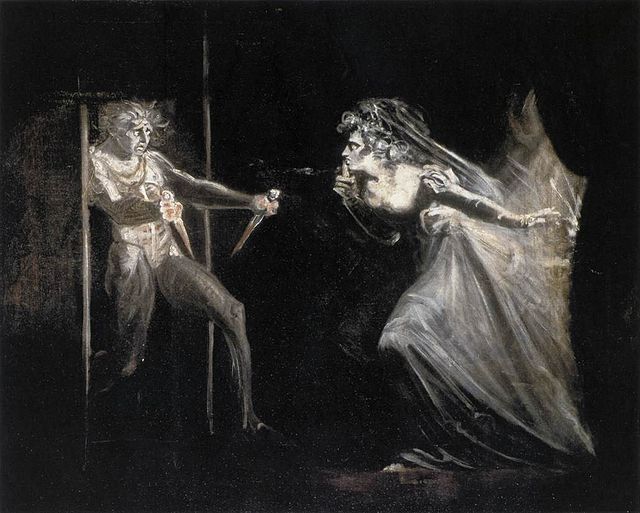
On stage, meanwhile, Macbeth’s court, began its disintegration: soldiers with a Fascistic air, reminiscent of Richard Loncraine’s film of Richardlll, marched up and down, Lady Macbeth – the brilliant stage presence of Mari Wyn Williams unleashing her amoral powers, and Macbeth himself, sung by Jean-Kristof Bouton, descending into his ‘feverish visions’ as the apparition of the murdered Banquo appears at a castle feast.
The witches, dressed as 1950s’ office secretaries, but with demonic eye make-up reminiscent of Kathleen Byron’s unsettling appearance in the 1947 film, Black Narcissus, deserve great praise for their unsettling performance. Finally, the end comes for Macbeth as a forest supernaturally advances upon his fortress – actually, the English army in camouflage, although on stage at Mid Wales Opera only the Scottish saltire was raised. (Surely a major omission that the Cross of St. George did not appear?!)
What next for Mid Wales Opera? A real-life dramatic crisis, no less: the shocking removal of one hundred per cent of their grant from the Arts Council of Wales, casting doubt over whether productions of this kind could ever be staged again. Is this a dagger they see before them? It would seem so. But the story is the same, everywhere. Last year, the BBC tried to disband its own elite choir, the famous BBC Singers, and cut its symphonic strength across three ensembles. Meanwhile, the length and breadth of these islands, from Birmingham to Bournemouth, our orchestras and theatres struggle to convince those in power of the vital need for the arts.
Quite simply, Britain now has a choice: do we just become a TV/consumer society, turning our backs on the splendour and enrichment of music and the arts? Or do we challenge the Arts Council and those in political office for a change in direction? As the wise Hans Sachs in Wagner’s DieMeistersinger put it: “Neglect the civilised arts at your peril…”
To support the appeal for Mid Wales Opera, write to Bryn Wgan, Caersws, Powys, Wales, SY17 5QU
Wenceslaus Hollar, Coronation Procession of Charles II Through London, 1662
STUART MILLSON visits one of Kent’s great houses – and savours a perfect choice of music
On the eve of his royal return and progress from Dover to London in 1660, the heir to the throne, the second Charles Stuart, paused for rest at the City of Rochester on the River Medway. He stayed in an Elizabethan mansion built in 1587, on a gradient just above Rochester’s main thoroughfare – a stately town abode that took the name, Restoration House, in honour of the great event that would soon be formally confirmed by the English state
Today, some 360 years since that first visit, Restoration House continues to project and transmit an aura of history to its many visitors, thanks to the care, custodianship and ownership of patrons of the arts, Jonathan Wilmot and Robert Tucker. On Saturday 7th October, these renaissance and restoration gentlemen hosted a recital by the emerging eminence that is harpsichordist, Nathaniel Mander – a young musician already distinguished by a recording of J.S. Bach’s monumental GoldbergVariations, and performances with the celebrated Les Musicians du Louvre and Marc Minkowski.
In a grand, yet intimate candlelit room, accessed by an ascent of a wooden staircase (upon which a ghost must surely walk past midnight), Mr. Mander performed a recital of harpsichord pieces, from Frescobaldi and Froberger in the middle of the 17th century, to Bach and Handel, a century later. But at the centre of the concert, echoes of Tudor and Elizabethan England abounded, in the form of Grounds, Almans and Fantasias by the masters of that first English musical renascence, Byrd and Gibbons.
The audience was particularly delighted by the soloist’s engaging introductory mini-talk before each work, a sometimes humorous, neat lacing-up of the historical context of the music – none so remarkable as Johan Jakob Froberger’s travels to England, during which he was not only robbed on a European highway, but intercepted by pirates at sea, thus arriving at the royal court in little more than rags donated by sailors. Froberger had to play some music before his Royal hosts believed who he was.
Historical authenticity was very much the lodestar of the evening – Nathaniel performing on Restoration House’s Zenti Harpsichord of 1658, an instrument once in the possession of and adapted to the needs of Queen Christina of Sweden (r.1632-1654). The craftsmanship which created the instrument remains a thing of wonder – a work of art itself, a piece of furniture so delicate, it seemed almost dangerous to walk near it. Yet Nathaniel Mander drew from the elegantly-turned casket on its delicate, spindly legs sounds of such antique quality, that audience members – judging from their closed eyes and expressions of sheer peace – seemed transported to the candlelit past.
For me, two of the highlights were the Ground by Thomas Tomkins and Nathaniel’s first encore to the evening’s proceedings, the Aria to Bach’s Goldberg Variations ~ the five-minute meditation that forms the beginning and end to the piece. For Thomas Tomkins (1572-1656) church music was a lifelong calling. From his early days at St. Davids, Pembrokeshire, to his life in the service of Worcester Cathedral (during which time he endured the ravages of the Civil War), Tomkins came to signify all that we understand by the English ecclesiastical choral tradition – anthems, pieces for services, which rely so much on great spans of sound (the imprint of Tallis and Byrd) and which, centuries later, would continue through Parry, Elgar, Vaughan Williams and Howells. Yet we discovered from Nathaniel that following the destruction of the Tomkins home in a Civil War bombardment, the composer – taken in by kind friends – sought solace in the writing of dozens of pieces for harpsichord. An English melancholy was certainly conjured by our soloist in the Tomkins Ground.
However, happier thoughts were prompted by the inclusion of Byrd’s folk-based airs, The WoodsSoWilde and Selingers Round; music which, along with a spirited Allegro by a gourmandising Handel, provided an uplifting, animating spirit to a memorable oak-brown October evening.
Nathaniel Mander is artist-in-residence at Restoration House. His recording of Bach’s Goldberg Vatiations is available on the ICSM label
Image: On the South Downs Way. Malcolm Oakley. Wikimedia Commons
RICHARD DOVE savours the sounds of Ed Hughes and Airat Ichmouratov
On a couple of occasions, I have cycled across the South Downs, and even managed (once) the slow climb up Ditchling Beacon. I should have had Ed Hughes’ music to accompany me. It would have made a wonderful bike ride even more special.
His Music for the South Downs is a recent release on the Metier label and part funded, in a most enlightened way, by the South Downs National Park Authority. The music embraces the rolling landscape and its endless natural variety. We can be in open fields and wooded valleys, beside fresh bright streams and rolling waves. The music is both evocative and grounded in this verdant environment. Listening to Flint Movement 2 on a dull and rainy afternoon, I was transported to a forest watching the sunbeams dance through the leaves – and then in the next movement I am on the bank of a fast-flowing stream. Such is the magical power of Ed Hughes’ music.
It was composed for Sam Moore’s film, South Downs: A Celebration, to mark the National Park’s tenth anniversary, and is played by the New Music Players, founded by Hughes and the Primrose Piano Quartet. Ed is professor of composition at the University of Sussex and is very obviously steeped in the South Downs landscape. He has walked the paths that he now portrays in this music. I will ensure that Hughes’ music is with me when I next tackle the South Downs trails. He might even encourage me to ascend effortlessly up Ditchling Beacon. And that takes some doing.
On a first listen to Airat Ichmouratov’s Piano Concerto (a recent release on Chandos) I could not get Tchaikovsky out of my mind. He is clearly an influence on Ichmouratov. The notes to the CD underline my first impression in a description of piano, woodwinds and glockenspiel engaging in a Tchaikovskian exchange of scurrying semiquavers. Indeed, the use of percussion throughout the work to punctuate, embellish and encourage is consistently surprising.
In the Viola Concerto, also on the CD, Ichmouratov brings in tubular bells to build the rousing climax before closing with the melancholic tones of a clarinet. Both works are masterfully played by the London Symphony Orchestra conducted by the composer. Ichmouratov is guided by tonality and romantic traditions in his exuberant music coupled with a very original sense of drama. The soloist in the Viola concerto No 1 is Elvira Misbakhova who wanted something new and challenging for her doctoral performance at the University of Montreal. She certainly got it.
For the Piano concerto, Jean-Philippe Sylvestre is the soloist and it needs all the energy of this “poet of the piano” (as described by conductor Yannick Nezet-Seguin) to take on this demanding Concerto where the piano is rarely silent for more than a few bars. In the words of Airat Ichmouratov: “When I compose I hear a certain tonality and simply follow what I hear. Sometimes I end up with surprising key relations.” Quite true and well worth an absorbing listen.