Friedrich Nietzsche, Michael Hulse (trans.), Notting Hill Editions, 2022, pb., 312pps + xiv, £12.99
Unpublished Fragments from the Period of Thus Spoke Zarathustra
Friedrich Nietzsche, Paul S. Loeb, David F. Tinsley (eds., trans.), Stanford University Press, 2022, pb., 576pp + xii, US$30
Nietzsche’s “Thus Spoke Zarathustra”
Keith Ansell-Pearson, Paul S. Loeb (eds.),Cambridge University Press, 2022, hb., 277pps + xiv, £75
ALEXANDER ADAMS sees new sides of Nietzsche
Apparently, at one stage of World War I, every German soldier deployed was given a copy of Nietzsche’s Thus Spake Zarathustra, apparently to fortify their will. It is in some ways an odd choice. Nietzsche subtitled it “A book for all and none”, realising that many readers would be baffled by the messages. Although few would have been perplexed at the presentation of moral-philosophical issues in the form of fables – for what are fables, if not moral-philosophical issues rendered in colourful narrative form? – many would wonder what exactly those messages were. Initially, that was not a problem because there were so few readers. A long, fabulous narrative, featuring a protagonist barely known in modern Europe, split over multiple volumes, written by a little-known retired professor of philology had few takers at the time. It is hard not to think that while it might have been undervalued on first appearance, it was equally overvalued soon afterwards.
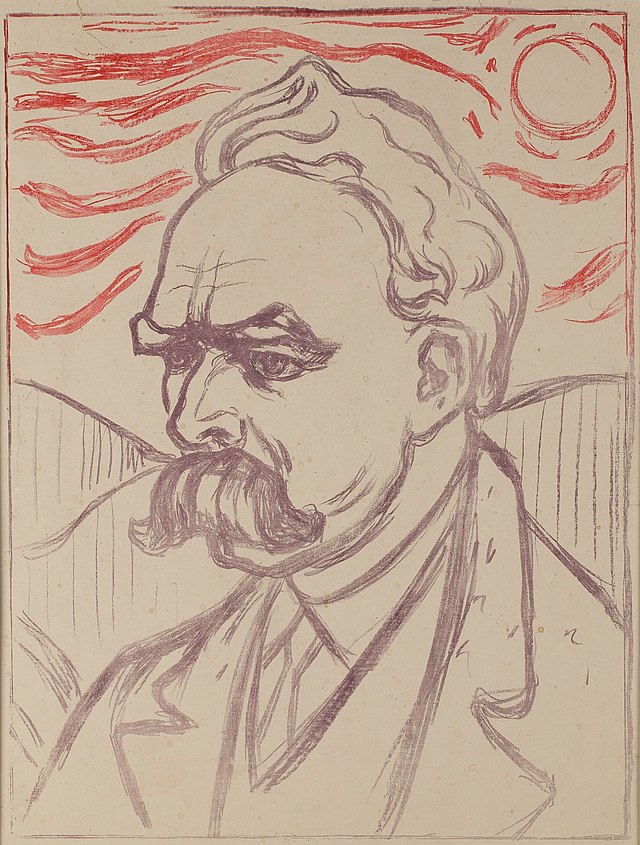
No philosopher had greater influence on the development of modern history and Modernism in the arts than Friedrich Nietzsche (1844-1900). Of his writings, Thus Spake Zarathustra (1883-5) is unique in that it is written from the perspective of a fictionalised character, Zarathustra (or Zoroaster), founder of the Zoroastrian religion. It became the book Nietzsche was most pleased with, even though it has been criticised as verbose and overwritten. His later, aphoristic style, written in the manner of Heraclitus, is easier to follow and considered more effective as prose; as rhetoric, Zarathustra maybe carries more impact. A new translation of this, perhaps Nietzsche’s most popular book, has just been published. It joins two other related books, one a critical analysis of the text and another being a previously unseen fragment written at the same time as Zarathustra not included in other publications. This review will discuss all three.
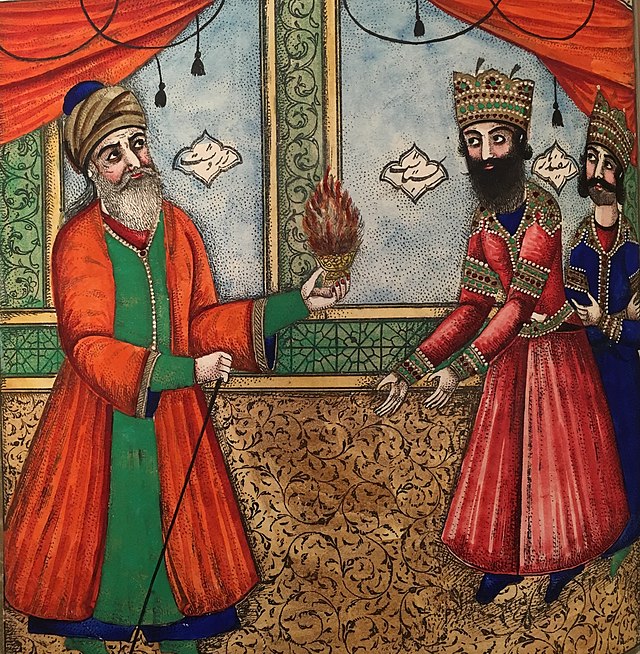
A mid-nineteenth century Indian depiction of Zoroaster/Zarathustra
Nietzsche presents his thoughts through the voice of Zarathustra, acting as religious-philosophical counter to the Gospel narrative of the teaching of Christ. He wanted to bypass scholars and reach readers directly, although he had no pretensions to populism or accessibility (remember – “A Book for All and None”). For those seeking the evidential arguments of The Birth of Tragedy or the late aphorisms written in Heraclitus’s style, Zarathustra will prove a trying book. Not that it is hard to read, but rather its indirectness and intrusive imagery prove an impediment to understanding Nietzsche’s reasoning, even if it is effective rhetoric.
A fifteenth-century Flemish depiction of Zoroaster/Zarathustra
Nietzsche’s book, originally published in four volumes, has been characterised as the resolution to a crisis reached in the preceding book The Gay Science, which included the dramatic passage in which a truth-saying madman declares that God is dead, killed by modern society, one in the throes of scientism and humanism. In Zarathustra Nietzsche explores a way out of this spiritual dead-end. He concluded that the Übermensch (German: superman), the man who embodies truth and will to power were the solution to the derangement of values and the death of trust in religion. The nihilism that consumes deracinated, scientific, rational man can only destroy and cannot produce – at least in the long-term, outside of art as “the sum of destructions” pace Picasso – and must be countered by a conscious transubstantiation of all (received) values. The Übermensch will master first himself and then the world, through the exertion of the will to power, which overcomes fear. Not every man will be capable of that; only the superior man will be capable. The normal man must be led by these self-actualised Übermenschen. This is clearly the part that was meant to stimulate German soldiers in the muddy trenches towards heroism.
Image: Talmoryair. Wikimedia Commons
Nietzsche is scathing of many movements and grand figures of his time. The most striking fable is of socialists (“preachers of equality”) as tarantulas:
Revenge sits within your soul; a black scab grows wherever you bite; your venom makes the soul giddy with revenge! […] ‘What we call justice shall be precisely this: the world shall be filled with the storms of our revenge’ – that is how they talk among themselves. ‘We shall practise revenge and abuse against any who are not as we are’ – that is what the tarantula-hearts pledge to each other. […] Vengefulness sounds from every one of their complaints, and all of their praise is hurtful; and to be judges seems a blessed thing to them.[i]
This is related to Nietzsche’s thoughts on ressentiment, the system of behaviour springing from recognition and reaction against a person’s weakness and inferiority and reacting by projecting anger upon others as a way of evading self-knowledge and self-correction. Self-overcoming is one of the main themes of the book. The mass adoption of mindful self-overcoming will see the rise of the Übermenschen on a civilisational (epochal) level.
The figures who appear in part 4 are often seen as disguised responses to individuals and types. These have been seen as follows: the soothsayer is Schopenhauer, the conscientious man is the scientist (Darwin?), the sorcerer is Wagner, the ugliest man is the atheist, the shadow is the freethinker, the voluntary beggar is Buddha or Tolstoy. This interpretation is omitted from the new translation. Likewise omitted are textual notes on features of the original text, which includes some untranslatable puns and wordplay. The translation of the new edition is by Michael Hulse, former academic at Warwick University and translator of W.G. Sebald, Rilke and Elfriede Jelinek. He is also an acclaimed poet and therefore in an ideal position to capture the sweep and precision of Nietzsche’s mannered style in English – not least the passages of verse. Hulse has chosen to strike a middle path between directness of speech and the language of the King James’s Bible, eschewing the archaic but retaining something of the stiff rhetoric of the ancients. This is effective and never attempts to conceal the deliberately florid style Nietzsche adopted for this book.
In terms of fluency and potency – accuracy is something that I cannot aver – Hulse’s version is excellent. The awkwardness one encounters is deliberate and reflects Nietzsche’s deliberate stylistic choices. Hulse’s version reminds us that Zarathustra is written in a portentous, high-spirited manner, while never favouring fluency over exactness. This translation is slightly less of an easy read than others because it forces you to notice and does not slip into a manner. So, although it might seem paradoxical, the granularity of the Hulse translation directs one’s attention to the meaning rather than (more passively) imbibing the prose style or becoming attached to the atmosphere.
Editors Keith Ansell-Pearson and Paul S. Loeb assert in their introduction to Nietzsche’s “Thus Spake Zarathustra”: A Critical Guide:
…recent philosophical scholarship tends to marginalize TSZ and to downplay its significance in our engagement with Nietzsche’s thought. […] The aim of this volume is to remedy neglect of TSZ by highlighting its importance for a fuller understanding of Nietzsche’s contribution to philosophy…TSZ needs to assume a central role in any informed appreciation of his style of philosophical practice as well as of the fundamental content of his core ideas.[ii]
Ansell-Pearson and Loeb observe that Nietzsche wished to detach himself from professionalised philosophy by taking up a persona and writing in fables:
Nietzsche knew that the philosophical texts he wrote in his own voice could be easily assimilated into this bloodless academic culture, so he deliberately designed a new kind of philosophical text that would resist any such assimilation. His fictional protagonist actually practices philosophy as a way of life and this is shown by the narrative of his transformative travels […][iii]
Nietzsche intended Zarathustra to be a return to the Greek model of lived philosophy.
Benedetta Zavatta discusses the controversy about the composition of the book. The first three parts were published in separate volumes and the author considered them complete. He then published a fourth part, which was part of an intended further three volumes. Whether this last part is a new book, or an extension, is an open question, made all the more pointed by the fact that the author later wanted volume IV retracted. Other essays by specialists consider Zarathustra as ecological warning, because of Nietzsche’s naturalism (contra Schopenhauer’s metaphysics), as well as the book’s treatment of moral philosophy, politics and transhumanism. Ansell-Pearson and Marta Faustino’s essay on the quest to embody philosophy in a text for living is particularly effective at unlocking Nietzsche’s intentions. Christopher Janaway refutes the common correlation between the soothsayer character in Zarathustra with Schopenhauer, going on to argue that Zarathustra’s teachings do indeed reject Schopenhauer’s urge to combat ubiquitous ceaseless will.
Zarathustra is sometimes partitioned from the main body of Nietzsche’s philosophy as fiction. Likewise, the Nachlass (German: estate) papers, currently being published in a critical edition (translations published by Stanford) are considered by some illegitimate, as working materials that were not deemed suitable for publication (or even preservation). As such, some writers will not consider them as part of Nietzsche’s oeuvre.
That is what makes so contentious the Unpublished Fragments from the Period of Thus Spake Zarathustra (Spring 1884-Winter 1884/5), the 15th volume in the series The Complete Works of Friedrich Nietzsche published by Stanford University. Each volume comes with extensive notes and commentary. Summaries guide our general understanding of themes, while translators’ comments on the most important terms allow non-German-speakers to gauge Nietzsche’s text, making us aware of linguistic subtleties, as well as adding extra thoughts regarding Nietzsche’s sources, influences and intentions. An index is included. It comes as a surprise to encounter Nietzsche writing so much on fine art, especially painting, about which he never published. Nietzsche’s view of history is both linear and cyclical, with cycles unable to repeat exactly due to linear characteristics of historical development. He is a pessimist – “The dumbing-down and homogenization of Europe on the rise, / Ever-increasing enmity of the progeny of the nobility toward l’homme supérieur. / […] The lack of any moral practices: feelings instead of principles.”[iv]
In response to the deterioration of Europe following the French Revolution, Nietzsche toys with the idea of selective breeding to counter racial decline.[v] However, once work starts in earnest on Zarathustra, he returns to the nature of morality and moral exemplars. He is insistent on the destruction of Christianity, as an impediment to development.
Most of the fragments are aphorisms only a sentence or two long. The drafts for Zarathustra are the only sections longer than a page. There is a section of verse – verse forms a significant part of Zarathustra – which has more merit as a distillation of thought than as poetry. The lists of images in the notes reach the level of Surrealist poetry inadvertently and top the verse. “– thistle-heads, scrupulous saps – hasty, like jumping spider monkeys – between coffins and sawdust – dizzy dogs and sickly breeds all around me – a cold bath […]”[vi] The Fragments are a terrific read – pithy, cutting, stark, playful, grand. It is like being in the company of the philosopher at his most expansive and garrulous. It is, of course, not the same as a considered conclusion or articulated argument, which is why anyone seeking enlightenment and information about Nietzsche’s philosophy must be extra wary of these seductive writings.
ALEXANDER ADAMS is an artist, art critic, novelist and poet. His most recent book is Artivism: The Battle for Museums in the Era of Postmodernism (Societas/Imprint Academic, 2022)
MICHAEL YOST finds a collection of original religiously-inspired verse rather forced
There are two major traditions pertinent to verse literature that are seldom engaged in, but for all that are the more interesting when an artist does make use of them: the theological and imaginative Christian tradition of faith, and the much more practical tradition of formal verse craft.
In most people’s minds, the two probably go together; one thinks of the Anglican John Keble’s Christian Year, the Roman Catholic James Matthew Wilson, or the American Protestant Longfellow, all of whom reward the interest of their readers. However, the major religious tradition of the West is less often engaged today, and many Christian poets take the outward and visible signs of form as Luther and Zwingli took the outward and visible signs of the Eucharist: conventional, and unessential.
T.S. Eliot suggested in his essay Religion and Literature that what was needed was not religous literature in the obvious, propagandizing manner of a Keble or Chesterton, but rather the unconsciously religious literature of a Dante or a Joyce. As I have suggested in another essay, Eliot’s idea of the relation between religion and literature also is true of any set of first principles, or overarching metaphysics; the reason Eliot sought for an unconsciously religious literature was because he wished religion to inform the bones and marrow, the form and substance of literature, not merely decorate it with the furniture of, say early-mid-twentieth century Anglo-Catholicism. In brief, the law of craft is the law of belief, or philosophical conviction, or more often, the lack of those things.
This is not to say that formal verse is always the work of deists. But it is per se the work of people who have some stake in things as ordered, even if the order is conventional, or merely conservative in character. Here we come to Clarence Caddell’s The True Gods Attend You, a chapbook published by Bonfire Books, the Australian press. What makes Caddell interesting is that his poems do often address religious themes; but in each case they are pitched with a deep and seemingly impenetrable irony. In reading them, I cannot help but place them in the category of consciously religious.
This is largely because the primary concern of the poems is, as in a devotional poem, religion and religious experience. The difference is that the religious poems are counter-propaganda; they are devotional poems in reverse. Not much to their credit, the poems’ engagement with religion largely draws from the fragmentary and derivative gnostic texts of the Church’s early period, as well as two books that each propose a conspiracy-theorist’s account of the origins of Christianity. There are poems of some formal merit, such as Initiations, The Golem, Passover Feasts of the New Covenant, Elegy With an Omen, and A Mobius Wedding Band; as well as a long blank verse narrative poem, The Candidate. These I would single out among the collection as poems whose ideas are engaging, but more importantly, solidly executed. In many of the other poems, there is a distinct lack of metrical control. Cadell’s hand is often shaky as he tries to unpack complex situations, parallels, and resonances within a brief space. Trochees, eye rhymes, weak rhymes, (such as the anachronistically signaled elision “o’er” that exists in order to rhyme with “floor”) and awkward syntax abound, marring an energetic idea, crippling a final stanza, and perhaps most difficult, undermining the authority of Cadell, the poet and speaker. On one or two occasions the concrete situation of the poem is nearly impossible to discern.
There is also a distinct difference between the poems that rely on history, the re-formulated symbolism of the Gnostics, or the tendentious and ludicrous thesis that Christianity was a political invention of the Flavian dynasty, and the poems that seem to draw from Caddell’s own experiences of life, love, and loss. The aforementioned poems can be by turn, difficult, energetic, and reliant upon an imaginative world inherited by Caddell. When they succeed, they succeed because Caddell unlocks their complexity, which pours out in a torrential fashion reminiscent of the metaphysical poems of John Donne. This is the case in the Blakean Initiations. But where they fail, it is because that complexity has failed to materialize in an ordered way. Caddell’s more intimate poems, by contrast, work precisely because that same intricacy is in play, but in a context that is both familiar, tender, and surprising, such as A Mobius Wedding Band. But even here the shield of irony is raised. I wish to turn to that particular poem as a success: an English sonnet that treats of married love; a love that is painful and yet inseparable, desired and feared. It plays with the same themes of distance, suffering, betrayal and desire that another of his poems, Vicar of Christ, engages; but with a more perfect union between form and content, a clearer direction and drive moving through the entire poem, and a perfect complication of the symbolic ring of marriage. Here, the symbol seems to truly mean something, even in its reversal. The Candidate, the longest poem in the collection, details the conversion and reversion of a family man to and from the Roman Catholic Church, or at least, a parodic vision of that church. Throughout the poem, the sincerity of his spiritual search is pushed back against, and ultimately revealed as an expression of his own narcissistic quest for “religious experience.” The heavy-handed moral is that the candidate should avaunt church-shopping and return from its distractions to his wife and family. It is singular insofar as it depicts an often undepicted subculture within Catholicism. But it does not ascend above the level of caricature.
Earlier in the review, I suggested that “the law of craft is the law of belief, or philosophical conviction, or more often, the lack of those things.” How does this apply in Caddell’s case? The True Gods Attend You stands half within the world of traditional religious expression (if ironically so), and half out of it. Likewise, Caddell has difficulty fully achieving coherence and rigor of poetic expression. His poems are indeed “formalist” as the blurb of the chapbook declares. But often the poems are (it seems unintentionally) rumpled. In both cases, it is hard for a Christian reader not to suggest that both constitute a falling away – an imperfect or misunderstood discipline. In sum, there is something to commend the originality and force, as well as the wit behind The True Gods Attend You. Caddell has skill, and an idiosyncratic vision. What remains to be seen is whether both, in time, develop.
MICHAEL YOST is a poet and essayist living in rural New Hampshire with his wife and children. His essays and poems have been published in places like Modern Age, First Things, The University Bookman, Dappled Things, The Brazen Head, and others. He substacks at The Weight of Form
STODDARD MARTIN remembers a dedicated litterateur’s late works
One can hardly think but with affection of Harold Bloom, addict of the Word, historic lover of literature, and coiner of the phrase “anxiety of influence” among other more recondite tags.
It would be invidious not to feel that affection when considering his final books, compendious and repetitive though they may be, composed or compiled as they were during bouts of convalescence between the illnesses that led to his corporeal silence in 2019, aged eighty-nine. It is likely that more words from the indefatigable commentator may be stored up yet to come, editing angels and publishing deities willing. The prospect is daunting, to some perhaps dismaying, for after seven decades of pronouncements, more Bloom may seem less.
Of the supreme enunciator of literary rankings in recent times – “probably the most famous literary critic in the English-speaking world” of his day – posterity might require for a tidy canon. But tidy Bloom is not. In his 2019 book Possessed by Memory: The Inward Light of Criticism, the idealiser of Falstaff and his perceived form of “heroic vitalism”[1] tacitly put faith in excess. Bloom’s object, insofar as it ever went beyond an exuberant autodidact’s self-revelations, was to provoke more than to instruct (Possessed, p12 – all subsequent page numbers refer to this book). “I am a Nietzschean,” he declares in the last of his provisional last words (p79) after a lifetime of enthusiasm for the philosopher’s kindred spirits, such as W. B. Yeats. Thus at the end, like the author of Ecce Homo when approaching fatal dispersion into madness, Bloom eerily claims: “Something in me speaks for multitudes around the globe.” (p11)
“Oh my brothers!” is Zarathustra’s refrain, and Bloom never tired of projecting that he was carrying on a dialogue with colleagues and students, whether at Cornell, Yale or Cambridge where a boy from a Yiddish-speaking immigrant family earned degrees, or at the same or similarly distinguished institutions where a publicity-loving adult would ultimately profess. First person plural is the mode. Bloom’s method as critic was conversational, sometimes ingratiating, especially in books where he might indulge in a lifetime’s penchant for having the last word. Why argue with him? Listen. Admire. Reflect. Then, perhaps, carry on a silent conversation of one’s own in the watches of night – those insomniac hours in which, as he tells us, Bloom had his most fertile ideas and, when not idealizing, lay awake reciting favourite works to the shades – incanting, as if a religious at prayer.
This is the milieu. And it determines content. Bloom’s canon finally includes, from the beginning, what he considers to be the great literary passages of “the Hebrew Bible” (Old Testament), for as he says, beyond having become Sterling Professor of Humanities at Yale, Charles Eliot Norton Professor at Harvard, recipient of the American Academy of Arts and Letters Gold Medal for Belles Lettres and Criticism, etc., he is “a literary and religious critic” (emphasis mine), whose “tradition is dying” and whose dying wish is “to rally a saving remnant”(p11). Again, a note of Nietzschean messianism, if perhaps with a hint of the disingenuous tendency of that other heroic vitalist (“the Fat Knight”) to humour and guff, “nimble believing and disbelieving”.
The lifelong lover of Shakespeare ascribes these qualities to Hamlet, whom he sees as “his own Falstaff… a consciousness so enormous that it contains all of human self-otherseeing” (p112). It might be a description of what Bloom aspired to be himself; it is also what he finds lacking in the Hebrew God – Yahweh, a dislikable presence for him at almost every turn, despite his Jewish roots. Here the old Bloom, whose early literary critical self started with Shelley, returns to youthful insurgency. Something is wrong in the heavens, as it was for the renegade Romantic: Prometheus punished by Jupiter is dealing with a false God or at least a faulty one – there is better beyond, in the pleroma. Gnosticism is in the air, and Bloom inhales it, lauding the work of his late “mentor” Gershom Scholem and concentrating passing attention on Scholem’s special study, the Kabbalah. “I have spent part of a lifetime,” Bloom states, “trying to work out a pragmatic relationship between Kabbalah and literary criticism” (p20). The provisionality implied here is matched by an achievement that is opaque and fragmentary. Bloom links Kabbalah and poetry both to “heretical subversions of orthodoxy”, “salvation by transgression”, “the frontier between the sacred and the profane” and no requirement to complete the Great Work but no freedom to desist in the attempt (pps23-5).
A Christian attempt to unravel Kabbalism, by the 16th/17th century thinker Heinrich Khunrath
From here it is small distance to Blake, Whitman and others of Bloom’s un-Leavisite “great tradition”, grounded in English literature fundamentally not only on Shakespeare but more portentously on Milton’s Satan. However – and here is an essential, perhaps under-recognised element in Bloom – heresy is only a pretext for a new/old orthodoxy and God. For Bloom’s ultimate standard is breadth and depth of vision, a vastness of sensibility and inclusion, reminding one perhaps of what a critic once complained of in the French symboliste Mallarmé: a sense that anything less than the all-embracing might be presumptuous[2].
Bloom, in short, disliking the Yahweh of tradition, sets out in effect to descry a truer God – humane, non-vindictive, invisible but glimpsed beyond Demogorgon up in starrier heavens. Like Shelley’s Prometheus being liberated from his bonds, the tireless yet mortally ill individual must rely on a bevy of maidens to help him complete the job – seven female assistants are named at the start of Possessed by Memory. This could be interpreted as Kabbalistic in the sense of Bloom’s contention that the proper mystical Yahweh can only function with aid from the Moon Queen or female spirit that resides in Malkuth, foundational pod of the Sefiroth [EDITOR’S NOTE: The Sefiroth are ten attributes of emotion, intellect or will in Kabbalistic esotericism]; it might also bring to mind accusations of “inappropriate” attention to female students that marked the professor’s later years.
Be that as it may, the inclusions in his excursion towards a summatory roundup of values betray composition by many hands: sketches, bits of lectures, notes from seminars are the basis, even in one case a funeral address. The authorial scholar gives way to the genial teacher, whose mission is foremost to enthuse. Possessed is designed to tell us why a dying man has recalled this passage or that poem and what is outstanding about it. It is a trawl, a last judgement on the canonical, as per a decent God’s instincts. And why not? Many an ailing scholar would love to engage in such a pastime, and Bloom’s range is such that he is almost always engaging at it – almost being the lively interlocutor’s operative word. In difference lies interest, in qualifications glided over or simply not made, in enthusiasms too grandly stated.
The Fat Knight Falstaff, for Bloom an exemplar of ‘heroic vitalism’
Falstaff, for instance, is not for this reader the exemplar that he is for Bloom, nor do the plays in which he appears seem the Bard’s best. Bloom has little time for the Marlovian in Shakespeare, speaks dismissively of Hotspur, and ignores the coruscating soliloquies of that supreme Machiavel, Richard. He is intriguing about the bastard Faulconbridge in the oft-neglected King John, but says little of comedies which now may strike the ear as warm-ups for Blackadder. As to Milton, he admits with Dr Johnson that few read him with pleasure (p176); re Johnson himself, he forgives eccentric pomposities. Bloom is of a generation of American Jewish scholars who began in awe of English literary tradition. He does not rate the deviations of Pound and Eliot towards Europe, attention to Dante excepted. The superior art of Baudelaire earns from him no more than an aside in a discussion of Swinburne (p301).
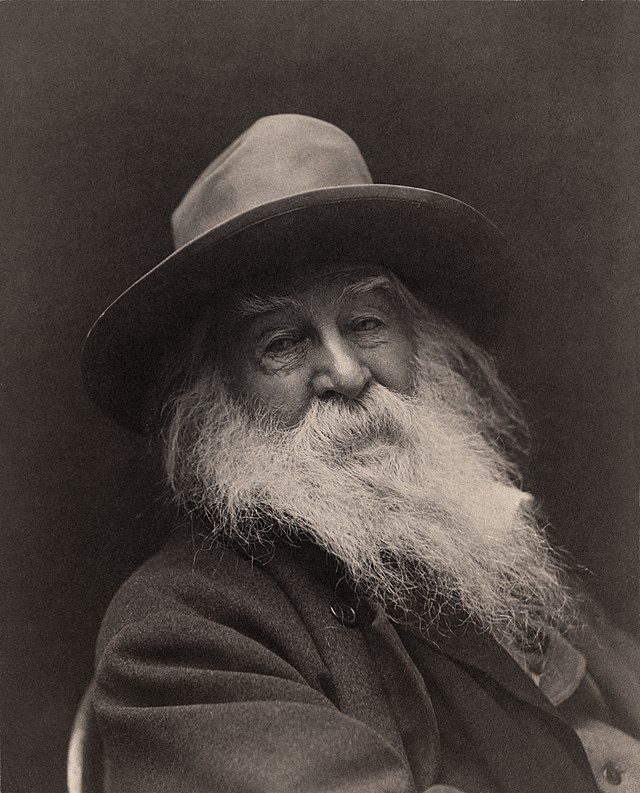
Walt Whitman, whom Bloom considered the greatest American poet
Much else is missing. Where for instance is Wilde, save in apt citation of a quote from ‘The Critic as Artist’ as the book’s epigraph? As for Wilde’s countryman Yeats: is he quite understood? In these summatory pages, how much space does old Bloom accord to a signal figure of his youth? His trajectory now, whatever it was in journeyman days and however much he may remain haunted by Shakespeare and Shelley, is towards fellow Americans – those who, unlike Eliot and Pound, did not “beat out [their] exile” but stayed home to “make [their] pact”, to borrow from the latter, Whitman-as-internationalist, as Bloom resolutely won’t. The god who stands at the head of American poetic tradition is for Bloom the seminal incantor – psalmic “transumptor” – of Leaves of Grass. Whitman the untidy, the vastly inclusive proto-Zarathustran – in him the professor finds a lodestone more congenial than in an Irishman whose attention to craft moved George Moore to depict him coming down to lunch at Coole Park to report to Lady Gregory that his morning’s work had consisted of removing a comma which he later restored[3]. Whitman’s incontinence, like Falstaff’s, if wilder, exposes another facet of “heroic vitalist” genius chez dying Bloom. Might we conclude that, in the light of his disintegration, a coherence strained for in youth seems no longer essential – analogous to how for the late Turner a glimmer of sun through vague clouds became preferable as subject to the detail of ship and sail? One suspects it to be partly the case. Bloom alludes en passant to Yeats’ “Byzantium poems”, but the exactitude of “hammered gold and gold enamelling” is hardly seen as a destiny. Bloom may live on as critic or at least enthuser: penning fifty-odd books suggests aspiration to transcendence beyond mere bodily existence. But if he lives on, Bloom is liable to do so as the critic permissive rather than the critic precise.
Again, why not? The third of four parts of Possessed by Memory begins to judder and creak as it extends Anglo tradition to snippets from the canonical Browning and Meredith; but the fourth part, commencing with its long devotion to Whitman, moves to some eye-opening appreciations, not only of the predictable Stevens, Williams and Crane, but more appealingly of the less obvious Edward Arlington Robinson and Conrad Aiken among others. With Aiken, comparison to his Harvard classmate Eliot leads to a fuller understanding of why Bloom felt antipathy for the most celebrated Anglo-American voice of the past century. That said, Bloom’s account of Aiken’s work falls short of full praise, and his explanation for why Aikens failed to reach “the eminence” of “Robert Frost and Wallace Stevens, Thomas Stearns Eliot and Hart Crane” seems partly to tell against itself – “Associative rhetoric was both Aiken’s mode and, sadly, his weakness. He did not try to make it new but to augment the foundations by relying upon the major poets of the Romantic tradition.” (p393)
Might this not be a description of Bloom’s own approach as critic? Might one even go so far as to see it as either a veil drawn over a latent, counter-canonical preference for poets of Aikens’ pitch or a subconscious admission of Bloom’s own less than supreme rank as critic? These are not idle questions. Somerset Maugham once famously quipped that his status as writer was in the first rank of the second rate. The false modesty hardly strained to disguise a popular novelist’s healthy antipathy for experimental modernists whom a cognoscenti lionized, but the common reader found unreadable: Woolf, Joyce and so on. Bloom, when set alongside the Derrida-ists, Deconstructionists, Structuralists and such fashionable ‘critics’ of his epoch, might strike one analogously as among the first rank of the middle-brow.
John Ashbery, by David Shankbone. Wikimedia Commons
Like Maugham in The Summing Up, Bloom laces his learned observations with recollection. His remarks on one of two women included in a 500-page book, May Swenson, pivot on their meetings at a café in Greenwich Village in the 1960s. His discussion of the original and vitalist ex-soldier Richard Eberhardt stems from a lecture tour at the University of Florida, where Eberhardt frightened him with the campus alligator. Bloom’s account of the master of negation, Weldon Kees, begins with an encounter at a jazz club in Harlem. Longer pieces on lesser-knowns such as Archie Randolph Ammons or Alvin Feinman are founded on yet closer association, as is the inclusion on John Ashbery, with whom Bloom’s “friendship has been continuous these sixty years… I have just phoned him at the Whittier Rehabilitation Center where he is recovering rather slowly from double pneumonia” (p431). Illness and age are constant companions in these last works, not notably cheerful ones, rather ones with whom Bloom struggles manfully to come to terms, never quite achieving reconciliation with, let alone joy in, observation of their processes – intrinsic to life, after all, thus a subset of the “heroic vital”. Bloom resists falling back into angry, non-accepting “rage, rage against the dying of the light”; rather he strives to win from these ultimate confrontations a revitalised urgency and heightened appreciation. He can still read, or be read to, and hear. He can still idealize and recite in the watches of night. Most of all he can remember. Which brings us to the ‘coda’ of the book, Proustianly entitled “In Search of Lost Time”.
Before one arrives there, one must be reconciled with Bloom’s subjectivity. One has to accept that his judgments have often to do with where he could most comfortably locate himself; that his “we” posits a community both transitory and presumptuous; that his lordly opinions, such as that Hart Crane is the great American poet after Whitman and Dickinson, may pass as gospel without being convincingly preached; that he gives himself grace to make errors and to speculate beyond what accords with known facts; that he settles scores on occasion – against Saul Bellow, for instance (p416) – and will not always refrain from resorting to guff.
What, say, is the sense of a sentence such as “His consciousness was a plenum that could have created a heterocosm, where space and sun might have made another world” (p430)? From here it is not far to complain of Bloom’s cherished inventions such as “self-othering” or “transumptive”. But let it pass. Bloom is a character in his literary universe. He is too Shakespearean not to put a high, perhaps excessive, value on personality. That he has a big one has been part of his “body of fate”, to use a Yeats term; Bloom has embraced and cultivated it, and created a space for it to exist in and flourish and suffer. Irritating this may be, but one can also be glad for it. Bloom himself becomes a standard, not just what he says: a brand, an embodiment of forces to reckon with, if not revere – something of a god. Apotheosis may not be a fate he has worked for entirely nakedly, but he has certainly flirted with it often, notwithstanding the trademark baggy garb of being “human, all-too-human”.
God incarnate in Bloom? Will He live on as Holy Ghost? Close to his physical end, Bloom muses: “When we die, our own survival will be the extent to which we have changed the lives of those who come after us… I have to consider how little I know of time to come. Doubtless it is better that way. Foretelling can be destructive.” (p507) His coda to Possessed begins in this way to evince a becoming humility. Before sojourning with Proust, he recalls Saint Augustine’s conversations with his mother about God’s eternal light. The aptness is to what Bloom characterises as Proust’s “sublime lucidity”, which transcends Jewish and Christian roots to be “closer to Hindu philosophy”. While admitting that Proust probably never read the Bhagavad-Gita, Bloom invokes it.
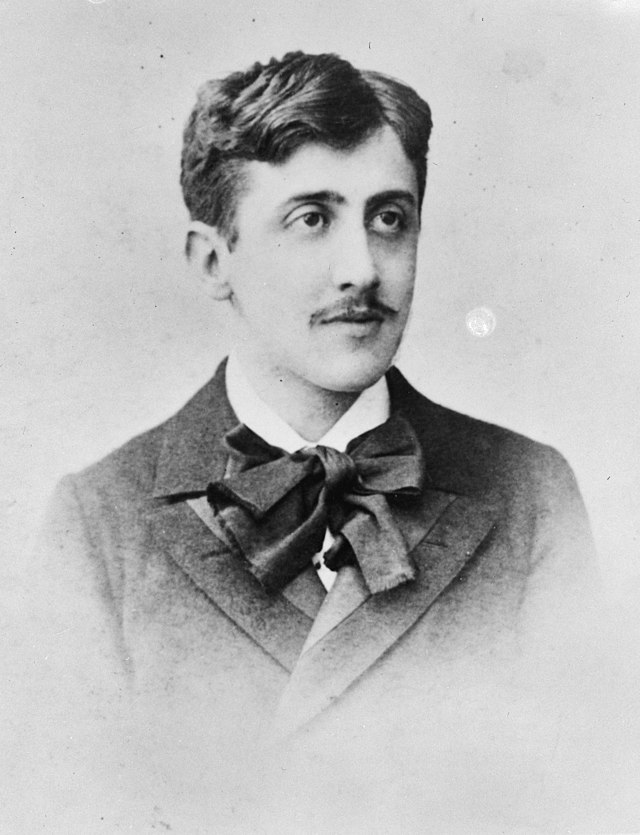
Marcel Proust, for Bloom a kind of Gnostic seeker
Shortly afterwards, he qualifies a roving meditation by confessing, “I have the realisation or fantasy that simultaneously I know everything and nothing” (p481). This precedes recollection of moments of “sudden radiance” in early childhood, which “seem now to be heretical intimations of a lost gnosis” (p487). Proust’s similar epiphanies, Bloom muses, may stem from “worship of an unknown God who is yet knowable” (p492); in any case, the novelist’s truth “is compounded of perception, involuntary memory, impressionism, a search for spiritual meaning, and a kind of aesthetic mysticism” (p497). Is this not Bloom’s “truth” in a mirror? The presiding return of “childlike vision” is for him, as for Proust, “allied to phantasmagoria and to the world of dreams… modified delirium” (p501). Here one might end, or with association of “the survival of the inner self with a world founded upon benignity” (p503), or with a largeness that “could be at once atheist and mystic” (p505). But Bloom actually concludes by reverting to Dr Johnson, whose wisdom allows for ebb as well as a flow that chez Proust is continuous. Bloom has indeed already undercut his paean to In Search of Lost Time by stating that he would choose Richardson’s Clarissa in preference to it. Why? Because the heroine and her rapist lover are “more vital”.
One trusts this no more than one might accept Mozart’s sympathy to be with the survivors rather than with the deposed libertine at the end of Don Giovanni. Bloom’s coda, brave as it is in conveying what remains at the approach of his earthly dissolution, conveys one back towards his penultimate book, which occupies a more preliminary stage in the process and thus may constitute a more reliable summing-up of a career of concentrated literary contemplation.
W B Years in 1908
The book is less given to reminiscence and enthusiasm, though some is ever present. There are no chapters devoted to lesser talents such as John Wheelwright, James Merrill, Jay Macpherson or Amy Clampit, with whom Bloom ends his pre-coda trawl in Possessed. Among those, notably Merrill, Bloom remains ready to deviate back to consideration of his traditional greats: he cites phone calls “in which we explored W. B. Yeats’s A Vision, the Gnostic religion, and the relation of Yeats to Shelley and to Blake” (p449). Reader, take note. Bloom subsumes the Irish poet here to two English Romantics whom he has consistently ranked as the foremost. He glides from A Vision to Scholem’s topic as if Yeats’s mystico-historic text were self-evidently Gnostic. He considers the matter no further except to say “I suspect that Yeats would not have taken to James Merrill’s poetry” (p453), then somewhat conversely he postulates that in Merrrill’s poetry “the Byzantium of William Butler Yeats hovers and is deftly evaded” (p456). Deftly seems a loaded adverb, not least in a context where the Irish poet’s full name is iterated, as it is in most other scattered allusions to him throughout this book. Why? Shelley almost never requires “Percy Bysshe”. Is there some other Yeats that Bloom fears we may think of, or is there some more telling nuance at play??
Looking at this penultimate work, so boldly entitled Take Arms Against a Sea of Troubles: the Power of the Reader’s Mind over a Universe of Death, and among chapters Bloom devotes to the usual titans – Shakespeare, Milton, Blake, Wordsworth, Shelley, Byron, Keats, Browning, Tennyson, Whitman, Frost, Stevens, Crane, Freud (eccentrically) and Dante (again, lone continental) – we find “William Butler Yeats and D. H. Lawrence: Start with the Shadow”. The title seems tricksy – it matters little: tags chez Bloom and others of his generation of academics often do. What does matter is the shadow of doubt that pervades. Bloom invokes an American favourite to contrast “three modes of mastery. In Lawrence it is chthonic. In Yeats it is occult. In Stevens it is massive acceptance of things as they are.” (p474) Proceeding to quote from one of the American’s poems, Bloom wonders if it is not “a critique by Stevens of the endless series of questing wanderers in Yeats” (p476). Endless series? “William Butler Yeats,” we are told (entire name again) “had the good fortune and the vital temperament to refuse any despair of his own quest” (p479). Are we to infer that a less “occult” sensibility should have despaired? Later, in parsing “All Souls” Night”, Bloom informs us that “the magnificence of gesture, metric, diction overcomes what could be judged sheer silliness” (p483); later still, in relation to Yeats’s alleged “pagan purpose”, we are told that “The force of his diction and metric brushes argument aside” (p485). “Devoted readers of Yeats learn that for him God and Death are one,” Bloom states, “a Gnostic formulation” (p486). This is of course arguable and reflects what Bloom is finally obliged to confess: “More than ever I have a mixed response.” (p490). He lauds “Adam’s Curse” in part to question the quality of what comes after; and when he reaches “Under Ben Bulben”, he decries a “farrago… much of it of a badness not to believed” (p497).
Old Bloom clearly had a problem with old Yeats. From a concluding phrase one might take it that he continued to rate or anyway grapple with the Irish master mainly out of an older loyalty: “The daemon in Yeats, as he acknowledged, was Shelley” (p499). This is arguable too and, at best, partial. But then, as I have indicated, partiality is characteristic of critic Bloom, in age as in youth. He is, to repeat his claim, a Nietzschean, as he fancies it: a “provoker”. A windbag like his beloved “Fat Knight”, he is more than a touch averse to fine concision. He is also no dedicated traveller in realms of magic and dream, however insomniac his nights may have been. Baudelaire comments somewhere that it would be impossible for a poet not to contain a critic but it would be prodigious for a critic to contain a poet. Harold Bloom adored poetry: of that there is no doubt. What may be lacking in him – one leaves it to weigh up – is a thoroughgoing sense of the poetic.
Harold Bloom bibliography (partial)
Shelley’s Mythmaking, 1959
The Visionary Company: A Reading of English Romantic Poetry, 1961
Blake’s Apocalypse: A Study in Poetic Argument, 1963
Yeats, 1970
The Ringers in the Tower: Studies in Romantic Tradition, 1971
STODDARD MARTIN is the American-born owner of the London-based publisher Starhaven, a cultural critic who has taught at Harvard, Oxford, Lodz and Warsaw universities, and the author of books including From Wagner to the Wasteland and Monstrous Century
R. J. STOVE says reports of the death of Australian classical music education have been greatly exaggerated
The most satisfying paid regular employment that I have ever experienced concluded on 11 November 2021. For a twelve-week course, I worked as a sessional tutor under the University of Sydney’s auspices. The tutorials – overarching title: ‘Music in Western Culture’ – catered not purely for first-year music majors, but for first-year majors in other fields too. (As I write this paragraph, there remains some essay-marking for me to complete.)
Initially, I felt overwhelming panic, thanks to the requirement for near-Lisztian virtuosity in the Zoom-PowerPoint combination. ‘Have I turned the sound on?’ ‘Have I turned it off?’ ‘Have I accidentally shared the answers to tutorial questions?’ Of the course’s first two weeks, almost no memories remain except my visceral technophobia.
Besides, what (I wondered) if my students turned out to be a monstrous regiment of snowflakes, merrily toppling the nearest Queen Victoria monument, when not ululating into their smartphones about being ‘triggered’ by my own ‘Eurocentric’, ‘cisgendered,’ ‘heteronormative’ ‘microaggressions’ and ‘cultural appropriations’ upholding ‘the patriarchy’? Could my restricted didactic aptitude ensure those ‘safe spaces’ that Homo Snowflakiens considers indispensable?
My fears proved excessive. Zoom’s malfunctions and eastern Australia’s draconian lockdowns notwithstanding, I received from students consistent politeness. Whether this resulted from good luck – or from, instead, some antecedent administrative colander by which the palpably woke had been strained out, before they could contaminate the main dish – others must determine. Possibly a third cause prevailed.
All in all, my first salaried academic occupation gave me intense pleasure. The moment when everything clicked occurred as I replayed one of the tutorials’ set pieces: a Haydn piano sonata scintillatingly performed by L’viv-born, Manhattan-based Emanuel Ax. Suddenly I realised: ‘I’m receiving federal subsidies for listening to this marvellous stuff.’
Last summer’s dirge from a prominent British musicologist, who has huffily left the discipline (short version: ‘Goodbye, cruel world’), inspires not the faintest empathetic echo in my bosom. The musicologist achieved a full professorship before he had turned thirty-eight; maybe therein lies his whole trouble.
Yes, my job had its nuisances, principally an exasperating holdup in my wages’ arrival, plus a nasty bout of mid-term illness which required my hospitalisation (and which complicated my already overworked colleagues’ timetables). About these nuisances I shall say little, partly because I crave further university employment, but chiefly because such irritants come with fallen human nature. Erstwhile Esquire boss Arnold Gingrich cherished a magnificently orotund sentence redeeming, circa 1947, one otherwise humdrum epistle to the editor: ‘I find no fault in Esquire that I do not find with the age that produced it.’ Mutatis mutandis, this encapsulates my response to Australian academe.
+++
What straightaway impressed me, regarding the ‘Music in Western Culture’ course, was its predominating old-fashioned decorum. The main textbook, A History of Western Music, is but a revision – by Indiana University’s J. Peter Burkholder – of an identically named volume known earlier as ‘Palisca’ and even earlier as ‘Grout’ (after the previous versions’ respective authors: C.V. Palisca and Donald J. Grout, who died in, respectively, 2001 and 1987).
We who grew up with ‘Palisca’ and ‘Grout’ found much of Burkholder’s tome familiar. True, Burkholder cites hip-hop and sexual identity politics, as Grout would never have done; true, feminist considerations now compel coverage of female composers – Hildegard of Bingen among them – whom Palisca and Grout either underrated or omitted. These are incidentals. Aesthetic detachment marks all three musicologists: their audiences, happily, will find no clues as to which genres are the authors’ own favourites.
It scarcely requires accentuating how objectionable this dignified scholastic model is within Critical Race Theory’s snake-pit, which one Philip Ewell now inhabits. Ewell (of City University New York) bears the same relation to a conventional apparatchik like Norman Lebrecht that Wilhelm Reich bore to Freud, Foucault to Sartre, and Pol Pot to Brezhnev.
The Wuhan market, as it were, which first disseminated Ewell’s ‘thinking’ was a 2019 lecture to the blandly named Society for Music Theory, where Ewell demanded that Western music’s ‘white racial frame’ be ‘decolonised.’ (He nowhere condescended to explain who would do the decolonising. R. Kelly?) Ewell cast special opprobrium upon theorist Heinrich Schenker, a Jewish thinker never previously charged with white supremacism. Ordinary teaching of Western staff notation, teaching liable to necessitate such elitist hierarchical signifiers as ‘dominant’ and ‘subdominant,’ goaded Ewell to rage.
Timothy Jackson, a white liberal at the University of North Texas, organised a firm but courteous refutation of Ewell. This refutation – involving fifteen writers – occupied an issue of the magazine that Jackson co-edits, the Journal of Schenkerian Studies. The issue’s appearance activated frenzied calls for Jackson’s dismissal. At his references to racial slurs among Ewell’s beloved rappers, the anti-Jackson brigade took particular offence. One touch of (inadvertent) farce emerged from Ewell’s champions, when a female Canadian pundit treated the world to its least felicitous recent neologism: she derided Schenker’s white female adherents as ‘SchenKarens.’
Throughout my own work contract, I heard not a syllable of Ewell-advocacy. This argues for some inherent common sense within the Australian university system.
+++
The system had other merits. On average, each of my online tutorials contained twelve students. This was (apologies for sounding Panglossian) the best of all possible class sizes. Too small a group, and a single garrulous individual can monopolise the whole hour. Too large a group encourages dumbed-down populism. The latter hazard could well plague all vast programmes aiming to save the world through one colossal music lesson.
Of the Orff and Kodály instructional methods’ details, I lack the competence to speak. Alas, no such mitigating circumstances characterise the Suzuki method, which its founder’s fake doctorate and bogus claims to Weimar Republic tuition make hard to stomach now. Nor do they characterise the Venezuela-derived El Sistema. Once viewed as the ultimate in pedagogical chic, El Sistema prompted in 2014 a devastating book-length exposé by Geoff Baker, left-wing musicologist and Guardian correspondent. Baker’s harrowing disclosures incorporate accounts of El Sistema’s explicitly erotic corruption.
So much for the New York Times feature on El Sistema (16 February 2012) with a banner typifying the method’s longstanding media hype about proletarian empowerment: ‘Fighting Poverty, Armed With Violins.’ The perfect modern validation, surely, of William Dean Howells’s acerbic epigram ‘Americans want tragedies with happy endings.’
+++
Naturally ‘Music in Western Culture’ was spared all carnal predators and all holders of counterfeit PhDs. My largely congenial experiences engendered my quiet, healthy scepticism towards anti-intellectual harangues from Fox News’s talking heads. Had I believed apocalyptic rhetoricians so obsessive that they could probably detect woke outrages on the planet Saturn, I would have been too scared to do my job.
Unlike those talking heads, I acutely recollect Australia’s higher education during the Cold War. This had its joys, above all Sydney’s Dr Andrew Riemer – specialist in Elizabethan-Jacobean drama – who gave the clearest, most fair-minded lectures which I have heard on any topic. (He subsequently produced memoirs as readable as, and striking deeper than, Clive James’s.)
Yet no milieu is less apt than my undergraduate youth to provoke my predispositions, themselves infinitesimally sparse, towards Golden Age nostalgia. Is woke craziness in 2021 truly more malevolent in its effects on academe than was Martin Bernal’s craziness (the briefly modish ‘Black Athena’ phantasm) in 1991? Or Sandinista craziness in 1981? Or anti-Vietnam-War craziness in 1971? Or D.H. Lawrence’s craziness in 1961? Or – lest we forget – Freudian craziness in 1951? Frankly, I doubt it. (I speak as one who, when a small and always fearful child, repeatedly wondered whether my father would get home alive after his daily encounters with draft-dodging, vandalising mobs who shrieked ‘Ho, Ho, Ho Chi Minh! / The NLF is gonna win!’.)
Against several benchmarks, Australian humanities departments have improved. A trivial but significant amelioration: I marvel at how attractive their latter-day recordings of medieval music are.
Students no longer gain their formative exposures to the Middle Ages’ sounds, as I gained lots of mine forty-one years ago, through the Historical Anthology of Music series (surface-noise-infested American LPs supplementing a primer that dated from 1946). There, every second track seemed to comprise bleating from three Teutonic nonagenarians with vibratos almost wide enough to march a platoon through. It was, furthermore, mandatory to capture the nonagenarians in an acoustic resembling someone’s broom-cupboard. Today, anyone trawling through music schools’ libraries (to say nothing of Spotify or YouTube) can find more abundant and beauteous early-music renditions inside an hour than we in 1980 could have located inside six months.
+++
More momentous are universities’ newish regulations for conduct. I think of those Australian academics in the 1980s – wielding influence disproportionate to their limited numbers – who at best channelled Lucky Jim Dixon, and at worst channelled Walter Mitty. Thanks in part to online packages like Turnitin, sanctions against plagiarism (whoever commits it) have teeth now, whereas in the 1980s no such sanctions existed. Admirers of that classic 1948 film The Red Shoes will appreciate the impunity with which unscrupulous teachers once thieved pupils’ material, in music as elsewhere.
Heaven knows, present-day Australian students are susceptible enough to the pernicious worldviews expounded by Peter Singer. That said, I – unlike those students – am conversant with the equally pernicious worldviews expounded by the University of Sydney’s 1927–1958 philosophy professor John Anderson: militantly anti-Christian demagogue and long-time Communist Party fellow-traveller, with compulsive unwillingness to differentiate the ontological concept of ‘female undergraduate’ from that of ‘sex toy.’ Nor was Anderson’s unwillingness unique. While the worst predation flourished amid the Age of Aquarius, as late as 1984 our juvenile gossip included a pervasive wisecrack concerning the relevant transaction: ‘a lay for an A.’ And this taxpayer-funded bonking was, be it emphasised, entirely legal.
Some outstandingly toxic teacher-student relationships encompassed no physical acts. Wherever degrees are both rare and esteemed, opportunities for students to levy emotional blackmail against teachers (or vice versa) proliferate. Joyce Carol Oates’s short story ‘In the Region of Ice’ frighteningly depicts the inexorable persecution of a teaching nun by her male protégé.
‘Well, for good or evil’ – I here quote Chesterton’s Autobiography – ‘that is all dead.’ Manipulative teacher-student interactions will seldom eventuate when each participant is a mere flickering Zoom image to the other. Moreover, with the nation’s 1989–1992 university reforms, the droit du seigneur over female students (not to mention over female secretaries) disappeared from Australian tenured life’s fringe-benefits.
This tenured life itself – like its British counterpart – has dwindled to a rarity which in the USA is unimaginable. In 2006, one Australian lecturer told Inez Baranay, a Sydney-based novelist-essayist: ‘the area I teach in has not appointed any tenured academics in ten years.’ Undoubtedly, entrenching casual labour carries risks; in Sydney’s and Melbourne’s higher education systems, wage theft has reached alarming levels. But likewise undoubtedly, the pre-1989 antipodean routine of near-automatic tenure mollycoddled so many layabouts that it just had to be scrapped.
Australia’s sustained Cold War prosperity facilitated tenure’s abuse. The abolition of student fees in 1974, by Gough Whitlam’s government, merely reinforced the long-extant system whereby eighty per cent of local undergraduates avoided paying fees anyhow (the University of Western Australia, in Perth, charged no fees at all). Nor, in that profligate epoch, did stringent selection criteria for staffers invariably operate. Thank goodness, arbiters of Australian students’ destinies no longer include that frequent pest from my young manhood: the rancorous idler who had not published a solitary article or, indeed, drawn a solitary sober breath since around 1960.
+++
Another, and unexpected, modern improvement concerns religion. Current Australian academe has got ninety-nine problems, but Freemasonry ain’t one. (Read the 1997 biography of Australia’s classics scholar F.J.H. Letters, by his widow Kathleen, if you dispute local lodges’ former influence over universities.) Whatever my attire’s shortcomings, no-one has commanded me to rectify these by procuring a leather apron.
Neither have any university personnel weaponised against me my Catholicism, shared with Letters himself, and discoverable through five minutes on Google. To Australians my age or older, such newfound tolerance of ‘papists’ is mind-boggling. We recall the longevity of a tabloid, The Rock, which for half a century after 1944 spewed Klan-style vilification against Catholicism (it greeted sponsored Italian immigrants with headlines like ‘450 Human Wogs Arrive’).
Hardly anyone admitted to reading The Rock, but that fact indicates how many liars Australia had. Because at the tabloid’s pre-Vatican-II apex, it sold 30,000 copies per issue: a remarkable total in a country with under eleven million inhabitants, and quite adequate for coercing numerous politicians into servility. Witnessing The Rock’s diatribes and their parliamentary counterparts, Scottish newspaperman John Douglas Pringle – an unbeliever – lamented: ‘Anti-Catholic feeling is extremely strong in Australia. From time to time it bursts out like lava from a sleeping volcano, burning and destroying everything it touches.’
Of course, as the mendacious campaigns against Cardinal Pell showed, this emotion has not vanished from Australia’s midst. It still governs our state police forces and schoolteachers’ unions; all of our gutter media (what are our surviving non-gutter media, pray tell?); much of our medical establishment; and much of our judiciary. Nonetheless, for whatever reason, anti-Catholic wrath now leaves New South Wales’s universities undisturbed. Without this welcome change, I could never have attained academic emolument.
Decades back, my late Sydney chaplain friend Father Paul Stenhouse once parked his car on campus, having left visible his dashboard’s Virgin Mary statuette; he returned to find the windshield smashed. These days, comparable sectarian malevolence incurs serious penalties, Twitter castigation included. Back then, had Father Stenhouse formally submitted a complaint, campus officials would have all but laughed in his face.
Cardinal Sir Norman Gilroy, Sydney’s Catholic archbishop from 1940 to 1971, had discouraged his flock from university attendance in general. What with Marian figurines being punishable by smashed windshields – and what with Anderson the bellicose Christophobe on the prowl, sizing up the female talent – the Cardinal was conceivably on to something.
+++
Altogether, therefore, I remain as conscious of Australian universities’ past defects as of their present ones. Whilst the latter are undeniable, I question the novelty and the immediate nature of their threat.
Incontrovertibly, it is dreadful that various full-fee-paying foreign students now graduate despite their limited spoken and written English. But even that vexation, albeit new in degree, has a prototype in kind: the Colombo Plan’s late-1950s zenith. This zenith placed academics like my father in loco parentis to numerous young Southeast Asians, who too often secured Australian degrees while insufficiently Anglophone to request a train-ticket unassisted, let alone to grasp my father’s lectures on David Hume’s metaphysics. In Dad’s own weary but eloquent aphorism: ‘the challenge is to fail.’
As for the reckless dream of higher education for all, surely the pandemic dispelled that dream faster than any libertarian think-tank could do. COVID has intensified our established dependence on couriers, cleaners, nurses, postal clerks, supermarket clerks, warehouse workers, slaughterhouse workers, aged-care workers, truck-drivers, and garbage-collectors, all of whom can acquire their specific proficiencies with not the slightest collegiate force-feeding. No First World polis can cope without these persons for twenty-four hours. Any First World polis can cope evermore without my musicological and organ-playing functions, though my school crossing function has retained since 2016 (in coronavirus-afflicted Melbourne at that) its utilitarian efficacy.
I wish to declare only this: however Augean academe’s stables might be elsewhere, my colleagues and I kept our own minuscule domain really rather neat. Hereabouts, to update Mark Twain, the death of music teaching has been greatly exaggerated. For outsiders, combating this exaggeration will rarely matter much. But if televisual pundits grew rich from proclaiming that you yourself were dead, publicising the truth would urgently matter to you and your loved ones.
Sadly, perhaps my age (I am 59) will preclude further academic employment. Yet if offered it, would I accept it? Verily I say unto you, ‘Bring it on.’
R. J. STOVE’s organ recordings are available via the website www.arsorgani.com, and via the main streaming services (Spotify, Deezer, Apple, Tidal, YouTube).
ROSALIND RAWNSLEY recalls a visionary educationist
For centuries, a child’s mind was considered a tabula rasa on which the teacher would do his best to imprint a series of facts which with a bit of luck would give the pupil all the basic tools needed for him to make his future way in life – as the 19th/20th century English educationalist Professor Sir John Adams put it, dividing the ordinary consciousness from ‘mind within and the great world of facts outside’,
…the teacher’s work is regarded as the shovelling in of as many of those outside facts as the mind can contain. The great shovel for this purpose is known as Observation; a word dear to the hearts of, ‘Teachers; Inspectors, School Superintendents; School Boards, Parents and Others interested.’1
In most cases, a basic grounding in the ‘3 Rs’, with, if they were lucky, a working knowledge of the Classics, was for centuries considered a sufficient education for those few boys who were fortunate enough to benefit from schooling of any kind. The vast majority of the population remained illiterate.
Village School, by Jan Steen , circa 1670
As early as the early 17th century, there had been a few far-sighted philosophers with more advanced ideas on education. The best-known among them was the Czech, John Amos Comenius (1592-1670), who advocated among other innovations, pictorial textbooks written in native languages rather than only in Latin, teaching based on the introduction of gradual development from the simplest to more comprehensive concepts, lifelong-learning, focussing on logical thinking rather than rote learning, equal opportunities for poor children and education for women.
With evident justification, Comenius is considered the father of modern education, but his was an exceptional voice crying in the wilderness. It was not until the 18th century, with the dawn of the science of psychology, that educational innovation really began to gather pace in Europe, with the German States leading the way. But the child-centred, leisurely pace of education, first advocated by Pestalozzi and Froebel in the 18th century, and built upon by J.F. Herbart and his followers a century later, by which the child was guided by the teacher to uncover and develop his own innate understanding of the world and his place in it, could not last. With the exponential expansion of educational opportunities in the 21st century, with the invention of the microchip and the internet, space exploration and the vertiginous pace of advance in information technology in particular, this ‘Herbartian’ model has on the face of it had to be laid aside in favour of increasing specialisation. But Herbartianism, as applied through the work of the English educationalist, Frank Herbert Hayward has not been entirely superseded, and may still have a future.
J. F. Herbart, 1776-1841
Johann Friedrich Herbart (1776-1841) the German philosopher and early psychologist, is less well-known in the English-speaking world than Auguste Comte, his near contemporary, with whom he is sometimes compared. It is difficult to comprehend the reason for this neglect, given that for at least half a century after his death, as the founder of pedagogy as an academic discipline, Herbart’s philosophy of education was extremely influential. It was widely studied and applied by prominent educationists not only in his native Germany, but also in England and in America where, as in Germany, Herbart Societies still flourish.
Herbartianism, with all its faults, is a system; apparently the only educational system in existence which has at the same time a definite psychology; a vast and fairly coherent mass of literature, a considerable number of journals devoted to its cause; a series of great names – above all, the power of raising enthusiasm!2
Herbart’s philosophy of education can be perhaps labelled simplistically as idealist. He begins with the concept of the mind or soul as a single, inert and homogeneous entity which becomes the battleground for the one set of forces which can have any effect upon it – the ideas. Ideas, once introduced to the soul, compete with each other for a place.
John Adams, in his magisterial volume of essays The Herbartian Psychology Applied to Education, describes the Herbartian model of the soul as a dome, “the summit of which is the goal of the ambition of every self-respecting idea”3. The base of the dome marks the threshold between the conscious and the unconscious mind. Once an idea rises above that threshold, its first task, in order to consolidate its position in the dome, is to make useful acquaintances or connections, which together form what Herbart describes as an apperception mass. According to the Herbartian model, the whole of our intellectual life is spent in forming new apperception masses and in expanding old ones. Ideas which do not succeed in attracting others to form apperception masses, having for the time being lost the battle, will sink once again below the threshold of consciousness, where they will nonetheless remain until or unless called forth once again.
Herbart was born in Oldenburg in northern Germany in 1776. Little is known about his early life, except that as a fragile child he was taught at home until the age of 12. Afterwards, he attended the local Gymnasium for six years, before going on to study under Fichte, who taught him to think logically, at the University of Jena. After Jena, Herbart moved to Switzerland as tutor to the children of the Governor of Interlaken. Here he made the acquaintance of the Swiss educator Pestalozzi4 and through him became interested in educational reform.
This meeting, and his own experiences as a teacher, led Herbart during the following years to develop his own philosophy of education – first at the university of Göttingen, where he eventually became a lecturer, and later in Königsberg, where he moved in 1809 to take up the Chair of Philosophy earlier occupied by Kant. Here he established, and conducted for the next 24 years, an influential seminary of pedagogy. In 1833 he returned to Göttingen as Professor of Philosophy, where he remained in post until his death eight years later.
Herbart’s theories of education were taken up and developed in different ways by his followers, who likewise reinterpreted the philosophy of Herbart to suit their respective interpretations. ‘Herbartianism’ thus eventually became synonymous with a system of education, rather than with the original philosophy of Herbart himself. By the second half of the 19th century, Herbart’s doctrines had been so much changed that they would probably have been unrecognisable by their original author.
While Herbartianism had considerably less influence in England than in Germany and in America, it did nonetheless attract a following among influential English educationists following the 1870 Elementary Education Act. This established a framework for the compulsory education of children between the ages of five and twelve. The direct result of this enactment was the construction and establishment countrywide of hundreds of new Elementary schools5 and it was not until the Education Act of 1891, the latest in a flurry of Education Acts passed during the twenty years after 1870, that education was made free of charge to all pupils in Board and Church schools alike).
Among those educationists who took up the Herbartian torch were John Joseph Findlay6, John Adams7, and Catherine Dodd8 and Frank Herbert Hayward, all of whom were household names in the field of pedagogy well into the 1930s.
While students of the history of education would certainly be familiar with the first three, Hayward sank into obscurity very soon after his retirement and by the time of his death in 1954 he had more-or-less been forgotten. A pessimist by temperament, Hayward may not have forwarded his own cause as well as he might, had his personality been different; the title of his autobiography, An Educational Failure, published in 1938, encapsulated his self-doubt, and as is so often the case, he was taken at his own estimation. This neglect was nothing short of a tragedy in the field of moral education.
Frank Herbert Hayward was born in 1872 into a poor but industrious Nonconformist family in Wotton-under-Edge in Gloucestershire. Highly motivated and of a studious disposition, he was to become in early adulthood a man of formidable energy and mental ability, rising to become a prolific writer and a highly respected (though controversial) educationist.
He attended various schools, mainly in Bristol, becoming a Pupil Teacher at Barton Hill in 1887, where he seems to have remained on the staff until 1895, when he gained a scholarship to University College, Bristol. From Bristol he gained by private study a B.A. from London University and went on to study for a Teacher’s Diploma at the College of Preceptors, where he gained a Special Certificate of Ability to Teach in 1899. During his studies for this diploma, he appears simultaneously to have studied privately for a B.Sc. in chemistry and geology, and for an M.A. in philosophy and economics.
In 1900 he was admitted as an Advanced Student at Gonville & Caius College, Cambridge, whence the following year (at some point evidently having acquired a working knowledge of German) he was given a grant by his College to study education at the University of Jena. Here he wrote The Critics of Herbartianism (1903) in which he gives a detailed critique of some 14 German commentaries on Herbart.
That same year, he gained a D.Litt. from London University, his thesis being entitled The Ethics and Philosophy of Sidgwick ((Henry Sidgwick,1838-1900) English utilitarian philosopher and economist. Knightbridge Professor of Moral Philosophy, University of Cambridge 1883-1900. Author of The Methods of Ethics. Co-founder (1875) of Newnham College, University of Cambridge for women)) published in book form as The Ethical Philosophy of Sidgwick (1901). Meanwhile, he gained the Moral Science prize and a B.A. from Cambridge. These studies in Germany and at Cambridge seem to have awakened his interest in moral education and the precepts of Herbartianism in this field, which was thereafter to remain the principal focus of his working life.
In 1902 he became Organising Teacher for Mid-Devon, published lectures on Herbartianism in Cambridge, while that year and the years immediately following, he gave lectures in Marburg in Germany. Later, he was appointed Assistant Inspector of Schools for the London County Council, where, rising to become Chief Inspector, he remained until his retirement in 1937.
During the next 35 years he gave lectures on moral education in various parts of the country, published innumerable pamphlets and some 30 books, not only on educational topics, but also on matters as diverse as ‘Temperance’ and the ‘Power of the Press’. Biographies of Oliver Cromwell, Marcus Aurelius and Alfred the Great were well received by the press. Perhaps his greatest and most original contribution to moral education, however, was the Celebration Movement.
In his biography of Marcus Aurelius (1935) Hayward wrote:
I have been hunting during thirty years for a solution of what has notoriously been regarded as a certain “difficulty” in schools, as well as of certain cultural and civic “difficulties” allied to it… In the spirit of Comte, and indeed under his direct influence, I am an advocate; in schools and out of schools of Celebrations of Great Men as well as of Great Ideas and Great Institutions, in the hope that such Assembly Methods, with their mass emotion and broad impressions and an occasional touch of splendour, will be of help in these times of spiritual unsettlement and distress…9
Hayward’s period of greatest activity was likewise a period of flux in educational thinking. Moral education and education for citizenship became more important than ever during this time of profound upheaval in all aspects of life following the conclusion of the Great War. Education had already been high on the government agenda during the closing years of the 19th century, and, following the flurry of major Education Acts in the years following 187610 by the outbreak of war in 1914 Britain did already have a basic educational system. Nonetheless, for most of the population this did not extend beyond the Elementary age limit of 12. By the end of the war, it had become all too apparent that education was more important than ever, not just for the children, but for the improvement of national morale as the country attempted to rebuild the structure of society and to create a ‘land fit for heroes’ from the ashes of conflict.
Hayward did not claim originality for the idea of the Celebration, tracing it back to Plato in The Laws, but the worked-out development and application to educational purposes was entirely his own.
The notion of celebrating ‘Empire Day’, inaugurated in 1907, had set Hayward thinking. He considered it “scrappy, faddy and narrowly propagandist”. However, he thought, if it were to be celebrated as one of a group of five annual festivities (the others being ‘Home’, ‘City’, ‘Nation’, and ‘League of Nations’), it could be an excellent idea. Alone, there was a danger of Empire Day being nothing but a display of jingoism. On the other hand, under intelligent guidance, the school celebration of Empire Day might include, “impressive references to the ancient empires of the world as well as to those of later times”. The significance of the modern (British) Empire would be enhanced by being set in context. Taken alone, Hayward thought, there was also the danger that children who associated the word ‘Empire’ with a local music hall or cinema, would completely miss the point:
No adult can conceive of the mix-up in many children’s minds as they gather at the annual event and are given a flag to wave about.
The Empire Day concept, he considered, was too good and too original to be lost, but the way in which it was marked was very unsatisfactory. As he thought of it, it required an entirely “new spiritual start”. If the notion of a Celebration of Empire or Commonwealth was legitimate and attractive, Celebrations of the other four concepts, he considered, should be given equal weight. Looking back over his life in An Educational Failure, he regretted that this logic had not appealed to others in authority. Before the First World War, Herbartianism had risen from almost complete obscurity to a position of some prestige, with astonishing rapidity, particularly in England. Yet in the wake of the 1918 Education Act it went, at least nominally, swiftly into decline.
During the War, Hayward, like many others, had been giving considerable thought to ways in which education might be advanced once hostilities were over. Towards the end of the War, he circulated to educational journals and influential individuals a 10,000-word pamphlet, The Religious Difficulty in Schools – A Solution of an ‘Insoluble’ Problem. However, like an earlier, more academic pamphlet directed to various members of the clergy; supporters of the controversial Education Bill and others; this received a lukewarm response.
A few encouraging letters came, indeed; from teachers (mainly women) and one or two from people of the literary and artistic type; attracted by the idea of a National School Liturgy. Hardly any came from the champions of “religious education”, “freedom of the teachers from religious tests” and other catch phrases of the last decade or two.11
It may be, he continued sarcastically,
…that the majestic brains of these gentlemen are still silently absorbing my suggestions and preparing a scheme of incomparable grandeur. Great minds need time…
It was therefore useless to bandy reproaches. Hayward evidently had grandiose hopes for his proposals: “I undertake”, he wrote:
…to make the British nation fundamentally cultured on matters of Bible, literature, and music if I can get a few collaborators and the moderate use of official notepaper and stamps of any responsible educational body such as the Board of Education or the National Union of Teachers”12
Evidently not lacking in self-assurance, Hayward had, he continued, indicated the way to a solution of,
…the very honest problem of religious, civic, and aesthetic education that has been raised during the past half century…
As if this were not enough, a further problem, which to his mind educationists had not considered at all, and one which would equally be addressed by his scheme, was that of the didactic approach to the Bible, literature and even music. There was a need to rescue, he felt, “the ear from its bondage to the eye”; educationists imagining that the Bible and Shakespeare and music should be taught through the medium of print, rather than being heard in live reading or performance.13
While these pamphlets may have received a disappointing response, the second document led Hayward to make the acquaintance of Arnold Freeman. Freeman was a Fabian, a philosopher, an educationist, a playwright, an Anthroposophist and founder of the Rudolf Steiner Sheffield Settlement for adult education. Freeman was, according to Hayward,
…one of the few men actively on the look-out for an educational contribution to the very threatening contemporary situation
This meeting proved to be momentous: it led to the joint production of a much-reviewed ‘manifesto’, published in The Spiritual Foundations of Reconstruction (1919) in which was set out for the first time the concept of the Celebration as a means of moral and civic instruction. Hayward had evidently had the idea at the back of his mind for some time before meeting Arnold Freeman, and it now became a fully worked-out tool for teaching moral values.
Hayward considered that as a disinterested educational practitioner who was not susceptible to political whims, he could bring an independent mind to bear on the solution of great problems. His earlier idea for an Empire Day Celebration had been suspected of partisanship. But nobody, he maintained could discover partisanship in the Celebration itself. “What we can discover”, he wrote,
…is sound pedagogy; and the only criticism that can be proffered is that it is a solitary Celebration instead of being, as it should be; one among fifty others, each designed to impress the child with the greatness and the weakness of man, and to convey to his mind the social heritage of the race.14
Education was seen as a key element in the creation of ‘a land fit for heroes’, to compensate for the horrors of war and the terrible wastage of life lost in the fields of Flanders, while at the same time acting as a means of offering some reparation to those who had given their lives, and even more, to those who had survived. Education for peace, and social and spiritual reconstruction were high on the agenda before, and in the years following, the Armistice.
How was this to be achieved became a burning question for educationists. Hayward and Freeman had written in the opening words of The Spiritual Foundations of Reconstruction:
The people of Great Britain desire fervently that the coming peace may bring a League of Nations and an Industrial and Social Order based upon Co-operation… If we are to reconstruct with understanding and imagination, we must have an electorate possessed of an intelligent grasp of the truth of things – of the workings of nature; of man’s history upon this planet; of social evolution… There must be developed for the appreciation of this environment a widely-diffused reverence for Beauty. Year upon year, and perhaps decade upon decade of after-war disorder and conflict can be avoided only if the minds of the people are filled with such ideals of national and international Citizenship as will assure unity and co-operation.15
This was to be achieved, they thought, through the schools. The very fact that it had been thought necessary to institute a national celebration of Empire Day, was in their opinion a tacit admission by the authorities that the concept of patriotism had not adequately been conveyed to pupils in either denominational or non-denominational schools, on the pretext that religious instruction included moral and civic education. This notion had been proved in practice to be erroneous since,
…if patriotism had been adequately and impressively taught in scriptural or theological lessons, there would have been no need of these celebrations!
Following the first Empire Day celebration in 1907, the Feast of St. David had been marked since 1915 and the birthday of William Shakespeare since 1916. What for Hayward and Freeman had been “the most pregnant feature” of these celebrations had been the entirely new conception of educational method to which they bore witness.
Whether or not their originators realized the principle underlying them does not concern us. It is none the less revolutionary. In its bleakest and most absolute form the principle is that: THE CLASS TEACHING OF THE BIBLE, LITERATURE, MUSIC, HISTORY, AND CERTAIN OTHER SUBJECTS SHOULD BE LARGELY ABOLISHED IN FAVOUR OF A LITURGICAL CEREMONIAL. OR CELEBRATIONAL TREATMENT. THESE SUBJECTS ARE NOT SO MUCH LEARNED AS ‘IMBIBED’16
Here the Herbartian principle of ‘apperception’ is invoked. Herbart believed that the mind was the sum-total of all ideas which entered into one’s conscious life, which grouped themselves into “apperceptive masses”. By assimilation (or apperception) new ideas could enter the mind through association with ideas already present. This principle could be applied to almost any arts subject – History, Morals and Religion could better be taught through Celebrations than by formal didactic methods.
The ‘revolutionary Scheme’ which Hayward and Freeman now proposed had already in part been formulated by Hayward himself. Writing in 1912, in his controversial book on educational administration (The Psychology of Educational Administration and Criticism) which he had written as a rebuttal of Edmond Holmes’ notorious Circular attacking elementary school education17 Hayward argued that what was lacking from moral and religious lessons in particular was an understanding of the necessity for appreciation.
The formulary for this new approach consisted of four Proposals, which Hayward had earlier outlined in a jointly-written letter to The Times Educational Supplement, the first of which, based on his earlier ideas, was eventually to form the nucleus of the Celebration Movement under his sole aegis18.
“PROPOSAL I [all capitals in original]
THERE SHOULD BE PREPARED A SYSTEM OF SCHOOL CELEBRATIONS, INTENDED AS IMPROVEMENTS ON THE EXISTENT EMPIRE DAY SHAKESPEARE DAY, AND ST. DAVID’S DAY CELEBRATIONS, AND AS VAST EXTENSIONS OF THE PRINCIPLE THEY EMBODY; THAT IS TO SAY, THERE SHOULD BE A NATIONAL SCHOOL LITURGY OF THE BIBLE, LITERATURE, MUSIC, AND CEREMONIAL.
Day after day, the child would hear the best portions of the Bible read impressively, as well as other splendid passages of poetry and prose. He would be familiarized with several hundred of the choicest pieces of music; once a week (say) he would witness or take part in a Celebration, ceremonial, or piece of pageantry in honour of a great personage (St. Paul, Alfred the Great, Joan of Arc, St. Francis, George Washington) or a great idea (The League of Nations, France, Agriculture, Science, Freedom).
PROPOSAL II
THE HUMDRUM DUTIES OF LIFE SHOULD BE EXPOUNDED BY THE TEACHER IN SPECIFIC MORAL AND CIVIC LESSONS, APART FROM THE LITURGY, BUT CONSTANTLY DRAWING ILLUSTRATION AND SUPPORT FROM THE LITURGY. DURING THESE LESSONS THE MAIN STRESS SHOULD BE ON THE REASON, WHEREAS IN THE LITURGY, REASON WOULD BE SUBORDINATE TO FEELING – TO “ADMIRATION, HOPE AND LOVE”. Pro AND Con MATERIAL SHOULD BE OFFICIALLY SUPPLIED TO THE TEACHER FOR LESSON PURPOSES AND ALSO THE MOST UP-TO-DATE AND COMPLETE INFORMATION ON QUESTIONS OF HYGIENE, CIVICS, ETC.
The teacher would be free to express personal opinions, but if they were controversial he would be expected to refer his pupils (particularly as they grew older) to pro and con documents provided for the purpose. These documents would be drawn up by a board of responsible educationists, every sect and party sending from time to time statements of its views.
PROPOSAL III
SCIENTIFIC CHARTS OF TIME, SPACE, AND HISTORY SHOULD BE STATUTORILY HUNG ON THE WALLS OF EVERY SCHOOL so that false views about the age of the earth, the existence of a material and spatial heaven “above the skies,” etc., could not obtain a fixed lodgement in children’s minds, and so that a definite and true time and space scheme could, on the other hand, receive a very fixed lodgement indeed.
PROPOSAL IV
REPRESENTATIVES OF ALL SECTS, PARTIES, PROFESSIONS, MOVEMENTS, ETC., AS WELL AS TEACHERS, SHOULD BE URGED TO GIVE ADDRESSES TO THE WHOLE SCHOOL AT THE TIMES SET APART FOR THIS IN THE LITURGICAL ARRANGEMENTS. Parents and “the public” should be specially invited to attend.”
During the recent war, the sinister influence of propaganda had been acutely recognised as a danger to democracy. It was therefore of vital importance that children should be educated to recognise that few issues are clear-cut. Future citizens trained to see both sides of every important hygienic, ethical and political question would thereafter be able to think for themselves and know how to get at the facts. The time charts advocated would give children a framework of space-and-time relationships which would familiarise them with the general scheme of things.
The rationale of the proposal, that children should listen daily to the finest music and literature and take part regularly in some sort of pageantry or ceremonial, would, it was felt, go a long way to rendering every child aesthetically sensitive – a more effective way of appealing to a child’s appreciation of Beauty than the lessons, dealing primarily and laboriously with technique, currently given.
The grandiose plan for a national liturgy of Celebrations – a sort of precursor of the National Curriculum – through which every child in the land would be offered the same experiences, would, the authors hoped, create a network of common culture-memories. Such a network would in turn help to bind the members of the population together, thus in turn combating the loneliness and isolation of a nation of individuals, a feeling exacerbated by the effects of the recent conflict. If adopted by schools of all classes, Hayward and Freeman’s proposals would, they averred, “bind the nation together by a thousand bonds of sympathy”, while at the same not destroying but intensifying whatever is valuable in sectional and individual effort”19
Although The Spiritual Foundations of Reconstruction was very well received by the press, the response from the teaching profession to the invitation to contribute their own suggestions was distinctly tepid. Hayward was understandably disappointed. In a letter to F.J. Gould, a secular humanist, follower of Comte and prominent educationist, who had reviewed the book with enthusiasm, he expressed his disappointment, but said that nonetheless he hoped to publish a first Book of Celebrations in the course of the year.
This volume duly appeared in 1920. It was reviewed in Nature as “a sound idea”, the writer considering that the suggestions made were wise and well thought out, and he was convinced that the methods suggested, “would grip in a way that nothing except the teacher’s personal influence has hitherto done”.20 He noted that the subjects dealt with were Shakespeare, the League of Nations, Democracy and St. Paul. Celebrations which had already appeared in The Spiritual Foundations of Reconstruction; to which were added Celebrations of,
…bards and seers; world conquerors, Samson, eugenics, temperance, commerce, summer, flying, Chaucer and Spenser.21
By the time the book was published the Celebration movement was beginning to gather momentum, but mainly through Hayward’s own promotional efforts through the London County Council Education Committee.
A second book of Celebrations, published the same year, expanded on the themes of the first, with the virtues of Work and Toleration, individual great men from history and from the recent past: Alfred the Great, Pasteur and Lister, Sir Philip Sidney, the artists Turner and Watts, The Musician, national Celebrations of Poland and Ireland (the latter in an attempt to alleviate the crisis following the 1918 uprising), Military Conflicts in Palestine, a revised Celebration for Empire Day, and finally, Political Parties, and School Leaving Day.
No indication is given as to whether any of these Celebrations had actually been performed. However, The Journal of Education, reporting on a Summer School of Civics at High Wycombe noted that,
Dr. Hayward organised two of his school Ceremonials, one in honour of the city and the other to commemorate the League of Nations. These were carried out by the staff of the Summer School and proved impressive Celebrations ((Journal of Education; September 1920, p.586))
In an interview with the present writer, Dr. Hayward’s son Frank observed that although the whole gamut of Celebrations eventually covered a great variety of topics, many of the early Celebrations were of a biographical nature, celebrating the lives of great men. This he saw not just as a reflection of his father’s Herbartianism, but also because he was a Victorian projected into the 20th century, carrying with him the very Victorian characteristic of admiration for the great figures of history.
In a bid further to disseminate the concept, in 1926 Dr. Hayward launched a new quarterly journal, The Celebration Bulletin, which ran to 16 issues. Each contained several fully worked-out complete Celebrations, which could be staged by subscribers. In 1928, despite the rather discouraging response, Hayward published A New Book of Celebrations, reviewed in the Journal of Education:
On former occasions we have directed attention to Dr. Hayward’s idea of Celebrations, and to his very suggestive helps towards carrying the idea into practice… It is not difficult to detect the note of disillusionment and disappointment in Dr. Hayward’s preface. He has worked hard, and has received messages of approval from men so far apart in some ways as H.G. Wells, Bernard Shaw, Dr. R.J. Campbell and Prof. J. Arthur Thomson. Yet his efforts, marked though they are by ability and sincerity, have so far not commanded wide success.22
Hayward had many other eminent admirers within the profession, including Sir John Adams.23 Yet Sir Michael Sadler24 who must have known of Hayward even if they were not personally acquainted, did not find it necessary to include his name in his 1927 encyclopaedic list of British educationists, pioneering teachers, educational philosophers and administrators, whose talents had made Great Britain the greatest exporter of educational ideas of the time25.
A fourth and final book of Celebrations was published in 1932, in which details were given of those which actually had been performed. Of the 28 listed, ranging from Old Testament figures, classical writers, Shakespeare, Schubert, Purcell, various European countries, and India; to The Nation (England), The Home and the virtues of Temperance and Work and Saving. Of these, nine or ten had been performed once, Schubert twice and Virgil three times.
Altogether, F.H. Hayward compiled around 100 Celebrations on different topics, putting a lifetime’s knowledge and expertise into their creation. It was extremely discouraging therefore for him that his radical ideas were never enthusiastically embraced by the teaching profession, or the world’s educational authorities and governments. The Celebration as a means of moral and spiritual education seemed to be ‘dead in the water’.
Or was it?
Hayward had unfortunately become obsessed with the Celebration as the most effective means of combining religious instruction, moral education, and the teaching of citizenship, and this may have been his ultimate undoing. Teachers, war-weary, conservative in outlook and no doubt discouraged when the first post-Armistice euphoria gave way all too soon to the Great Depression, were perhaps not ready to embrace this revolutionary inter-disciplinary concept.
The claims of science, not least as advocated by Bertrand Russell26 to be pre-eminent in any educational system at the expense of the humanities, may have been a contributory factor in the decline of interest in overt Herbartianism and, in parallel, in F.H. Hayward. Pedagogy, largely under the influence of the advances in educational psychology, also moved on, gaining its own momentum.
Yet Herbartian ideas did not expire with the 1918 Education Act, but continued to permeate educational thinking, even perhaps to the present day. The sinking of overt Herbartianism below the level of consciousness in educational theory does not imply its extinction. In 1929, Cyril Norwood, Headmaster of Harrow School, though not specifically acknowledging the influence of Herbart, wrote that an education on which the cause of international peace could be most firmly based was “founded on practical Christianity, culture, and character”. 27. Norwood was advocating, in other words, the cultivation of the Herbartian ‘circle of thought’ as the foundation of a moral education.
Child-centred education has not been abandoned. It was a key to teaching practices, particularly in the 1970s – developing children’s understanding of the world by investigating the outdoor environment through a cross-curricular approach28. It was only with the introduction of a more rigid structure through the ‘National Curriculum’ proposed by the 1988 Education Act that this ‘Herbartian’ approach to curriculum planning had, at least nominally, to be laid aside. Every Government, of whatever political affiliation, has ever since the introduction of a National Curriculum if not from 1870 onwards, felt it incumbent upon them to tinker with the methods and content of education, in a manner which would no doubt have been anathema to Hayward.
Nonetheless, Herbart’s ideas and Hayward’s practical suggestions and theories continue to underpin educational praxis to this day, even if no longer in formal curriculum planning. The present writer, in collaboration with the Head Teacher and staff of a Shropshire primary school, during the late 1980s and early 1990s directed a series of major thematic interactive Festivals of the Arts and Sciences for young people, outside school hours, which could be considered as natural developments of Hayward’s ‘Celebrations’, and there were other examples elsewhere.
There are few comparable events today in schools, and certain aspects of Hayward’s theories feel outdated – which is rather ironic, considering that he conceived them as liberating and modernising. In 2021, history is more often contested than celebrated, morals, sociology and even the hard sciences are in a state of flux, while the concept of ‘Great Men’ is at odds with modern ‘diversity’ and egalitarian preoccupations. Yet still there must be a place for a model of education that uplifts even as it informs, and at the same time provides all-round thematic understanding rather than partisanship or uninspiring specialisation. Hayward, like Comenius in his day, seems for the moment to have been a voice crying in the wilderness, but perhaps his time too is yet to come.
ROSALIND RAWNSLEY, after a career as a poetry recitalist and Arts Administrator in the field of classical music, attended the Victoria University, Manchester as a mature student, gaining a PhD in the history, philosophy and psychology of education. Her (unpublished) 1998 thesis is entitled The Celebration Movement and the influence of J.F. Herbart on moral education in England through the work of Frank Herbert Hayward (1872-1954). She is the great granddaughter of National Trust co-founder Hardwicke Drummond Rawnsley, and her biography of him (jointly written with Michael Allen) will be published by Methuen on 27th May 2021, under the title Hardwicke Drummond Rawnsley 1851-1920 – An Extraordinary Life. She lives in France
John Adams, The Herbartian Psychology Applied to Education, 1897, p. 135 [↩]
F.H.Hayward, The Critics of Herbartianism, p.52 [↩]
John Adams, The Herbartian Psychology Applied to Education, 1897, p.50 [↩]
Johan Heinrich Pestalozzi, 1746-1827. Founded several educational institutions, in Germany and in the Francophone cantons of Switzerland, publishing several works on his principles, revolutionary at the time. Educational motto: ‘Learning by head, hand and heart.’ Through his work, illiteracy in 18th century Switzerland was almost completely overcome by 1830 [↩]
Education did not become compulsory for all children until 1880 [↩]
John Joseph Findlay 1860-1940 Scottish educationist, Sarah Fielden Professor of Education, Owens College, Manchester [↩]
Sir John Adams 1857-1934, First Principal of UCL Institute of Education; Professor of Education at University of Glasgow, knighted 1925 for services to education. Author of The Herbartian Psychology Applied to Education [↩]
Catherine Isabella Dodd 1860-1932 First woman on academic staff of Victoria University, Manchester as lecturer in Education. Principal of Cherwell Hall Teacher Training College, Oxford 1906. Author of several titles on education including Introduction to the Herbartian Principles of Teaching (1898) in England in the last years of the 19th century and the first quarter of the 20th [↩]
Preface to Marcus Aurelius – A Saviour of Men, (1935) p.9 [↩]
1876 – Compulsory for all children to receive an education; 1880 – Attendance made compulsory from 5 – 10; 1891 – Elementary Education Act made primary education for all intents and purposes free, since the State would pay school fees up to 10s per head; 1893 – School leaving age raised to 11; 1899 – School leaving age raised to 12 and later to 13; 1902 – Balfour Act [↩]
The Religious Difficulty in Schools, A Solution of an Insoluble Problem, The Literary Guide, 1917, also a pamphlet, p.1 [↩]
E.G.A. Holmes, Chief Inspector of Elementary Schools in England , had in 1910 circulated a memorandum, not intended for publication, in which in the light of reports received from H.M. Inspectors of Schools, he is highly critical of elementary school teachers and local elementary school inspectors. The majority of these, including F.H. Hayward, came from a working-class elementary school background and were ex-elementary school teachers. The only local Inspectors who were really able to bring ‘freshness and originality” to their work, Holmes maintained, came from a public school and Oxbridge background. The memorandum was leaked, and not surprisingly caused a furore. [↩]
The Times Educational Supplement, August 1st 1916, p.104 [↩]
The Spiritual Foundations of Reconstruction, p.15 [↩]
Nature, Vol.CV No;2649, 5th August 1920, p.707 [↩]
Journal of Education & School World, May 1928, p.361 [↩]
“The more I consider you and your educational work the more I regard you as a figure in the history of education rubbing shoulders with and rousing the writer’s wonder at the inability of your contemporaries to appreciate the value of your contribution… The time will come when light will break… and you will be raised to the pedestal which is being silently prepared for you”, Sir John Adams, letter to Frank Herbert Hayward, 18th May 1933, quoted in An Educational Failure, p.152 [↩]
Sir Michael Ernest Sadler, KCSI, CB, 1861 – 1943) English historian, educationalist and university administrator (Manchester) and Vice-Chancellor, University of Leeds [↩]
J.H. Higginson (ed.) ‘The Educational Outlook’ in Selections from Michael Sadler, Studies in World Citizenship, p.150 ff. M.E. Sadler’s Presidential Address to the 16th Conference of Educational Associations, 1927 [↩]
Temple of Concordia and statue of Icarus, Agrigento, Sicily – SHUTTERSTOCK
ALLEGRA BYRON witnesses the winnowing of the Western curriculum
In the final scene of Hamlet, the Danish kingdom lays in ruins: a corrupt leader bleeds to death; a poisoned First Lady takes her last breath; a young nobleman dies by his own treachery; and a fatally wounded prince, desperately seeking Truth and Justice, urges his close friend to report the true nature of things. This outward carnage and chaos mirror the deep rot within.
As dramatic as this may sound, the crumbling Danish world metaphorically parallels the disappearing, Western kingdom. In particular, our education system, fundamental to the prosperity and progress of any society, lays bleeding on all sides. The dismantling and decay (and ‘decolonising’) of education directly affects the core participants – the pupils, the teachers, the parents – most of whom have become victims of the Conqueror Worm1. Often, they are too manipulated or confused or exhausted to see that the few hoarse voices protesting against the destruction of school curricula are not “mere madness” but urgently attempting to restore order from chaos, to weed out the cankers.
In most schools, two significant learning areas embedded in the curricula are English (language and literature) and history. Whilst each country offers various colours and flavours of these subjects, dependent evidently upon cultural contexts, governments, educational bodies and the public, would agree that our young people need to demonstrate competency and confidence in communicating; they need to read and write and speak and spell well. Admittedly, line-ups for ‘meet the history teacher’ cannot compete with the mad dash for the maths and English teachers’ tables at parent-teacher nights, yet most do place value on pupils knowing about their past and how that past affects their present and future. Australia, like other nations, has sought to standardise its education nationally, believing that this decision ensures equal access for all Australian children. Indeed, students deserve quality, academically rigorous, twenty-first century schools to shape them into life-long learners, allowing them to be active citizens. Noble aims. Important aims. Tragically, however, this hopeful national curriculum with all its virtuous pursuits is an “unweeded garden / That grows to seed”2
“Alas, poor Yorick – I knew him, Horatio”: the disappearing texts
One value in immersing young minds in classical literature, a luminous tapestry of novels, plays, short stories and poetry, is that these works present, as Mortimer Adler once suggested, the great enduring truths of the human experience3. Between the pages of ‘old books’ a reader discovers love, goodness, despair, forgiveness, longing, graciousness, evilness, beauty, honour, truth and justice. These discourses are offered through the windows of sophisticated, varied vocabulary, clever phrasing and fresh, figurative diction and mature syntax. C S Lewis believed strongly that
…the only palliative [to the blindness of our own century] is to keep the clean sea breeze of the centuries blowing through our minds, and this can be done only by reading old books ((Lewis, C S The Reading Life: The Joy of Seeing New Worlds Through Others’ Eyes, edited by David C Downing. William Collins Books, p.47)).
Given his ability to read just about everything and then remember everything he read, Lewis had something of value to say about reading choices. Shakespeare’s country grammar school days at King’s New School also valorised the classics. The schoolmasters instructed in spoken and written Latin. During the mornings and afternoons, the diligent pupils translated biblical texts from Greek into Latin and English. They were skilled in Butler’s Rhetorik, andthe boys also studied authors such as Terence, Virgil and Horace. At breaks, mucking about in the schoolyard, the lads were encouraged to speak in Latin (a space, perhaps, to craft his witty insults?). While the drudgery of Elizabethan schoolwork is self-evident in the well-known Romeo and Juliet simile, “Love goes toward love as schoolboys from their books, / But love from love, toward school with heavy looks”, 400 years later, contemporary audiences benefit from Shakespeare’s liberal education, clearly evident in his writings. Closer to our time, a Queensland school reader, given to 12 and 13-year olds, dating from the 1960s, aimed “to instil into the minds of pupils such a love of literature as will last beyond school-days and be an unfailing source of profit and delight” ((The Department of Education. Queensland School Reader – Grade 7, Queensland Government Printer, 1967, p. iii)). The collections of accomplished visual artists, poets and short story writers selected for young Australian girls and boys were “compend[ia] of useful knowledge as well as a treasury of beautiful thoughts” ((Ibid.)).
Today’s modern reading lists in many schools, au contraire, shy away from classical works. They are dropping off and disappearing. Instead, the-powers-that-be scramble to introduce newly published texts into the Australian classroom, replacing the tried and tested. English teachers’ organisations across the country will openly acknowledge the deliberate decision to highlight texts that reflect the myriad of (current) voices in Australia. These ‘new’ texts have morphed into supposed ‘tools of reconciliation’ for the silenced Australian voices. Books (and the odd poem) appear as vehicles of change: to dismantle the white or male (or both) cultural norms. Now, classical literature, part of the ‘best that has been thought and said’, when evident in teachers’ unit plans, is often reduced to a gender warfare or a platform to disrupt the ‘settler myth’ or colonial injustices. Teachers are repackaged as social engineers. For example, on the Australian Curriculum, Assessment and Reporting Authority (ACARA) website, viewers are offered Year 9 sample student responses to an analytical essay on the ‘role of women’ in Macbeth ((https://australiancurriculum.edu.au/resources/work-samples/english-work-samples-portfolios/. Accessed 31 December 2020)). Thus, 14 and 15-year old students, still emerging writers, still wrestling with accurate written expression, are requested to uncover the alleged gender imbalance in an Elizabethan text. Rather than discover the beauty and craft of masterful language and storytelling, the teenagers must interrogate the play for its perpetuation or subversion of dominant power dynamics and ideologies. At Eton College – a school that dismissed a teacher for ‘gross misconduct’, that is, for daring to promote masculinity – the headmaster promised that
…the teaching of history, geography, religious studies, politics and English will change and that decolonisation will be incorporated into assemblies, religious services, tutorials and societies also”4.
Across the Atlantic, a recently formed American organisation called #DisruptTexts, “whose mission [is] to aid and develop teachers committed to anti-racist/anti-bias teaching pedagogy and practices”, claims that “white supremacy” in classrooms is real, and that teachers’ roles are to collapse the deeply embedded racism and “to create a more inclusive, representative, and equitable language arts curriculum that … students deserve”5. White supremacy is evident, so goes the tall tale, in our ‘worship’ of the word (rather than pictures). This angry mob of anti-Western canon protesters challenge their new comrades with the question: “Who determined that long words were the only words that could be considered complex?”6 Apparently, their placards proclaim, when we criticise these new ideologically-approved texts then we criticise the young people that read them.
Back on Australian soil,English teachers are trained how to present ‘culturally sensitive texts’, ones that could contain “community and/or family violence and abuse (sexual or other), alcohol and drug use, crime, explicit sex scenes” for their “literary merit” ((Page, Phil and Shipp, Cara. “Teaching Culturally Sensitive Texts” AATE/IFTE ‘If’ 2020 Conference, 6 -10 July 2020, Sydney Grammar School. https://readingaustralia.com.au/2020/09/workshop-teaching-culturally-sensitive-texts/. Accessed 16 December 2020)). Wide reading lists in some schools for pubescent students will privilege homosexual and/or transgender ideology. If teachers contest the use of these texts, then these questions reveal teachers’ intolerance or ‘their lack of understanding’. Often any logical reasons offered against the use of these texts are considered right wing, fascism. Do Australian educators need to fear the Eton teacher’s fate? Some parents also are too afraid to make noise. One American writer and cultural critic has identified parents as ‘tyrants’. He moans, “parents’ [sic] is an oppressive class, like rich people or white people”7. It’s no wonder mums and dads feel silenced and disempowered.
Clearly, not all Australian voices are welcome in the carefully constructed, ‘progressive’ classrooms. And not all silenced, marginalised voices are being heard. Where has the treasury of beautiful thoughts disappeared? Will these new books become ‘sources of profit and delight’?
Yesterday’s battles, today
History in Australian schools has not been inoculated against the disease of rapid disruption. The outspoken Scottish history academic, Jill Stephenson, opened a recent article with these words: “No school subject lends itself more readily to political manipulation and propaganda than history”8. The 2014 review of the Australian Curriculum identified an “undue emphasis” on the three cross-curriculum priorities: sustainability, the histories and cultures of Indigenous Australians and Australia’s engagement with Asia9. The post-modern pendulum swings heavily in favour of this three-pronged priority at the expense of a balanced presentation of Western civilisation and its Judeo-Christian heritage. Stephanie Forrest of the Sydney think-tank, Institute of Public Affairs, found that current, Australian Curriculum-approved, history textbooks were “factually incorrect”, made “outrageous statements” and in some places presented “an environmentalist, socialist and sometimes almost Marxist agenda”10. For the most part, however, the 21st century history class has textbook-styled lessons buried, and they now re-emerge as pseudo-scholarly fora, where eras and movements appear via primary sources. Teenaged students, still embryonic in seeing the broad sweep of history from its beginning, now must become historiographers, articulating academic, historical hypotheses and debating the usefulness and reliability of sources before they understand their world and its timeline. Instead of deep learning and time to ruminate, the students, too soon, must learn how to evaluate, analyse and assess the credibility of published authors. They become lost in piles of primary and secondary sources, pouring over visual and written artefacts constructed for an adult audience. In some cases, given that the standard for senior history subjects is so unattainable, the criteria just too difficult, these high school ‘scholars’ will be locked out of taking history courses in upper secondary if their grades are only ‘satisfactory’.
Further, the history units gallop at top speed. Some have one lesson on the Renaissance. The Reformation didn’t happen (apparently, as it’s not referenced in some schools). World War I can be taught in nine lessons. Capitalism is critiqued. Socialism is privileged. Teachers collide, breathlessly, in breeze-ways and hallways, quizzing their colleagues, “Have you finished — unit yet?”. They mark, meet and moderate (papers). And then they do it all again. And again.
But we need history. Despite the pundits arguing that history yawns with ‘drill-and-kill’, so many students continue to love the human stories that arise along the historical timeline. Young people lean in to hear about the ‘boy soldiers’, Trooper Harold Thomas Bell, for example, from the Australian Light Horse Regiment. He was a farmer lad from country Victoria. Although so long ago in a land far, far away, the students feel empathy upon hearing that Harry, like so many others, died from gunshot wounds after the charge against Beersheba on 31 October 1917. He was only 16. Pools of pupils will linger to talk to Teacher after class, bursting to tell her anecdotes about their Pop’s Pop or their Nan’s dad: the medals, the marches, the military. During a lesson (sacrificing the heavily prescribed curriculum requirements), the questions roll around the room, questions breed questions: why didn’t they care for the children in the factories? Did those soldiers really stop fighting on that Christmas Eve? Did Elizabeth the First have kids? Will there be another world war? How tall d’you reckon Alexander the Great was? The late NYU professor Neil Postman sighed knowing that children enter school as question marks and leave as periods. The reality? Quite simply, there isn’t the time for student-led curiosity.
Education today is a tragedy. Limping into a new year, the educational system lags with poisonous political ideologies; left-wing agendas purposefully massacre traditional values once treasured in good books and in a rich, balanced history curriculum. Recent research into educational trends confirmed that half of Australian educators believed that literacy and numeracy (and student behaviour) had declined in the last ten years11. Our schools, the children and the dedicated teachers and leaders that fill them, have been betrayed by those in positions of political and academic power, those granted the privilege to lead with wisdom and discernment. We wring our hands and hearts in dismay.
And yet …
If we circle back to the beginning, where we met a disorderly Danish kingdom, like all Shakespearean tragedies, there is always a quest for divine order after a catastrophe. A godly design for all matter (from rocks to celestial beings) governed the Renaissance world: everything had its rightful place. While the noble-hearted Hamlet dies in his desperate attempt to avenge the wrongs of his world, Horatio courageously tells the Prince of Norway, Fortinbras, of the “casual slaughters” and the “cunning and forced deaths” that took place in this pursuit. We too have Hamlet-types of our time. There have been (and are) brave men and women – brilliant professors, deeply committed school teachers and leaders, excellent medical doctors, just politicians, outspoken writers and journalists and many others from all walks of life – suffering the fatal blows of our nihilistic, culture wars. The casualties include a researcher from a tropical, north Queensland university fired for telling the truth; a New York Times writer finished for critiquing critical theory; a social commentator on gender issues lynched for advocating for young men’s rights on university campuses; and a Melbourne medical doctor, practicing for 15 years, ‘cancelled’ for having opinions. Each year, the casualty list multiplies.
Of course, in Shakespeare’s story, Fortinbras claims rights to the broken kingdom. Likewise, we identify a groundswell of opposition, a collective Fortinbras of sorts, all across our nations, some in secret and hidden spaces and places, now gaining momentum and traction to battle against the disruption and destruction of education and other. They claim their right to a better education. They seek a better way for the children. While the UK has academies like the Emmanuel Schools Foundation, an academically excellent group of schools established in economically depressed northern England and London’s ‘strictest’ school, Michaela College, led by Headmistress, Katharine Birbalsingh, America has pockets of charter and independent schools, some of which produce their own classically-based curriculum sold globally. In Australia, tucked away out the back of Brisbane, Queensland, is the newly established Charlotte Mason College, offering families respite from the turbulent curriculum wars; a place where children meet “a feast of living books, cultural artworks and ideas”12. This new Classical Liberal Arts school gently provides “an abundant life [for the boys and girls] that is good, true and beautiful”6 Travelling south, into Victoria, home to the controversial “Safe Schools” program, the Australian Classical Education Society, an organic collection of teachers, students, home schooling families and academics, commit to establishing Classical Education schools across the country. Thus, we have hope. We must look towards a bright future, believing that a restoration of rightful order to a disorderly Western kingdom will take place.
Shakespeare, William. Hamlet: with Related Readings. The Global Shakespeare Series, edited by Dom Saliani et al., International Thomson Publishing, 1997, p.19 [↩]
Adler, Mortimer. How to Read a Book: The Classic Guide to Intelligent Reading, Simon and Schuster, 1967 [↩]
@berlat (Noah Berlatsky). “parents are tyrants. “parent” is an oppressive class, like rich people or white people.” Twitter, Dec 15 2020, 6:49am., https://twitter.com/nberlat/status/1338586940157927427. Accessed 17 December, 2020 [↩]
MICHAEL WILDING surveys the sorry state of Australia’s universities
The systematic degradation of the universities has now been continuing for 40 years.
It began at the end of the 1970s, with the election of Margaret Thatcher in Britain and Ronald Reagan in the USA. Australia dutifully followed suit. The policies were a mixture of reprisals for the radical political activism of the 1960s and 70s, and the systematic replacement of public and state ownership by privatisation. Funding for the Arts – History, English, Philosophy, etc – was drastically reduced since it was perceived that the protests had developed from those areas. Vocational courses were introduced in keeping with the new market economy business model. Staff were pressured to take early retirement. Those who remained found that the safeguards of the traditional concept of academic freedom were being removed. Tenure was steadily abolished. New appointments and promotions began to be made for a fixed term contract. If you said or wrote something deemed to be unacceptable – and the list of the unacceptable has grown rapidly – you were likely to find yourself out of a job at the end of your contract.
Then it was decided that too few students went to university. In the 1950s and 1960s, 5% of the eligible population went to university. The new aim was to exceed 50%. This was easily achieved by deciding that colleges of advanced education, institutes of technology, teachers’ colleges, art schools, nursing colleges should all become universities, either by changing their name or by merging with existing universities. These institutions had been primarily vocational. Their staff were often drawn from people who had had experience in industry, marketing, media and so on, and could impart practical experience. They had a higher teaching load than university staff, but they were not expected to undertake research. These institutions had generally functioned well, and their students were engaged with the practical and vocational orientation of their courses.
But the more abstract and theoretical nature of university courses was not something that has engaged today’s vastly increased number of students – especially as most of them are struggling to hold down jobs, and to fit their courses into spaces in their employment schedule. As a result, the traditional university courses have been dumbed down and reoriented. Foreign language courses withered away and in many cases perished. The classics of ancient Greece and Rome were taught in translation, insofar as they were taught at all. The number of characters a student of Chinese was expected to learn was halved. Indian studies shifted from historical and cultural studies to a business studies orientation. English courses withered away; exposure to works of literature was drastically reduced, as critical theory, creative writing and other developments occupied the syllabus space, while communications and media studies, despite having little credibility in media industries, further drew away traditional students.
Other factors came into play. During the 1960s, there had been two federal funding bodies for academic research in Australia, one for the arts and one for sciences. The marked difference between them was that grants for the arts were modest. The arts researcher typically asked for no more than Aus$10,000 for some research assistance, for typing, for travel. The science grants were in the hundreds of thousands of dollars to support equipment and teams of research assistants. It was a system that functioned well. Then the two funding bodies were merged and funding became pretty well entirely on the scientific scale. Grants of hundreds of thousands of dollars were available for the arts; small grants were no longer the model. This was wasteful enough but worse was to follow. A new concept of ‘teaching relief’ was introduced, allowing grant recipients to use research funds to hire someone to do their teaching for them.
One justification for research funding in the arts was that the discoveries made during research fed back into teaching, ensuring teaching was of a high quality and at the cutting edge of knowledge. Now, to adapt the old saying, as for teaching, our servants shall do that for us. And these servants hired to do the teaching were all employed as part time, casual staff. They were paid around Aus$50 an hour during teaching term; during vacations they had to apply for welfare. While the grant recipients swanned around and never saw a student, let alone imparted any knowledge. The university administrators saw these research funds as a source of finance. They appointed further administrators, on high salaries, who coached academics in how to apply for research grants. People who had acquired funding were made into ‘distinguished research professors’ on five year contracts. They moved from campus to campus and grant to grant, doing no teaching.
And much of the time no research conclusions were ever published. The scandal of this has never been exposed, but thousands upon thousands of tax-payers’ dollars were handed out with nothing to show for it in return. The universities took their cut of the funds, the distinguished professors took their salaries, but all too often nothing was published. When a senior academic I knew tried to research into how the Australian Research Council awarded grants, he found it was impossible. All records of unsuccessful applications had been destroyed. There was no way of assessing the assessors and of examining the so-called peer-reviewing process. Nonetheless, the process continues. Publication used to be a mark of academic achievement. Now success in receiving funding is deemed more important. The emphasis has shifted from evidence of work produced to evidence of money received.
The universities have spent millions of dollars hiring management consultants to restructure them from their original religious and cultural foundations to corporatized machines for making money
This is part of the shift to a business model. The universities have spent millions of dollars hiring management consultants to restructure them from their original religious and cultural foundations to corporatized machines for making money. Vice-chancellors now call themselves CEOs and are given grotesquely large salaries – Aus$1,800,00 a year plus bonuses at the University of Sydney. Bonuses! Gratifyingly, quite a few of them have been dismissed for plagiarism and other corrupt behaviour. And the number of administrators, paid far more than teaching staff, has proliferated absurdly. One of the consequences of the merger of universities with art schools, nursing colleges, agricultural colleges and the rest, was that the heads of those institutions were all given highly paid administrative titles in the expanded university. Where there used to be a vice-chancellor and a deputy, now there are a dozen or more deputy vice-chancellors. They all seem to get sabbatical leave, though rarely have any of them done any significant academic work. But this is just part of the insane growth of the administrative bureaucracies in the universities. When I first taught at the university of Sydney there used to be one administrator for every 12 members of the teaching staff. Now fewer than 50% of university staff are actually involved in teaching.
And now over 40% of students in Australia are foreign students. The universities have made themselves dependent on foreign students. They are now the economic base of the operation. Forget providing a cultural context and education for Australian students. The universities have become part of an immigration racket. Student visas allow residency, the opportunity to provide cut-price work, and the chance of citizenship. Some of the recruitment agencies that find overseas students not only receive a large finding fee but are also involved in the construction industry, building, renting and selling student apartments. This has nothing to do with education. And with the travel restrictions and health issues arising from Covid-19, this has proved a disastrous model, with Australian universities suffering a massive reduction in fees and consequent massive job cuts, as overseas students no longer enrol.
Indeed, it has been the antithesis of education. In order to cater for the influx of foreign students, standards have been dropped, indeed abandoned. Most of the top rank of foreign students go to the United States, United Kingdom or Europe. Australia caters for the generally less able ones – and caters for them by lowering, or abandoning, standards. There are endless, authenticated stories of academics being instructed not to fail foreign students: they have paid their fees, they must be passed. Academics who attempt to maintain standards are overruled and disciplined.
Back at the beginning of the century when I published my novel Academia Nuts, I felt I had recorded the university in decline. In a comic way, of course. Campus farce. “Unmistakeably the last waltz”, the Times Higher Educational Supplement called it. But “’tis not the end when we can say, this is the end”. The decline had a lot further to go. Now my portrait of an institution in decline looks quite idyllic compared with the current state of the universities.
MICHAEL WILDING is emeritus professor of English and Australian Literature at the University of Sydney. His essays on Clarke’s life and works are collected in Marcus Clarke: Novelist, Journalist and Bohemian, Australian Scholarly Publishing, Melbourne, 2021; www.scholarly.info
ROSALIND RAWNSLEY pays tribute to a great idealist and reformer
Hardwicke Drummond Rawnsley is usually thought of today, a century after his death, as one of the three founders of the National Trust, or, in Lakeland in particular, as the Defender of the Lakes. The National Trust, it is true, remains his most tangible memorial, but his active involvement in a multiplicity of other fields, made of Canon Rawnsley a household name during his lifetime, not just in the field of conservation – but also in education as an early advocate of co-education and equal opportunities for girls, and in the encouragement of music, nature study and the arts; in public health, local government (he became one of the first County Councillors for Cumberland and towards the end of his life was co-opted onto the Education Committee for Westmorland) and literature, to name but a few of his wide-ranging concerns. Rawnsley was what today would be called an ‘activist’ – to any of the many and varied causes which captured his interest, he would devote his wholehearted attention, leading from the front wherever possible and whenever his ecclesiastical duties permitted.1
Born at Shiplake-on-Thames into an ecclesiastical family with its roots in Lincolnshire, Hardwicke, in spite of uncertain health throughout his life, was an indefatigable man of phenomenal energy and stamina. He would think nothing of tramping several miles across the fells during the night to see the sun rise over Helvellyn, catching a train to London after breakfast the next morning to attend a meeting, and returning home in the evening to deal with his correspondence or to prepare a sermon. No theologian, but a devout man of simple faith, he was much sought after as a preacher. He was blessed with a melodious voice, which he used to advantage not only in church but as a lecturer on a wide range of topics which interested him, ranging from the history, customs and archaeology of his beloved Lakeland, the influence of the Vikings, the German miners of Keswick in the time of Elizabeth I, to the archaeology of Palestine and ancient Egypt and the paintings of J.M.W. Turner, or the life and work of the Venerable Bede, and of course the application of John Ruskin’s philosophy of labour. He did however sometimes allow his vivid imagination to run away with him, and was not above reinventing history to suit his purpose.
Rawnsley never stood on his dignity, getting on famously not only with the great-and-good, whose deep pockets could be relied upon as a source of funds for his various causes, but also with the Lake District shepherds and dalesmen. He made a study of the Lakeland native breed of Herdwick sheep, an interest he shared with his good friend and protegée Beatrix Potter, who herself in later life became a famous breeder of Herdwicks, and in more than one of his books about Lakeland he wrote knowledgeably about the upbringing and particularities of the breed. Somewhat choleric at home and in Committee, he could be rash and impatient with those who disagreed with him and his impetuosity not infrequently got him into trouble, but he was never afraid to apologise when proved to be in the wrong. To any cause capturing his interest he would not just lend his name, but would invariably be an active participant, always leading from the front.
John Ruskin
Hardwicke Rawnsley was educated at Uppingham under the enlightened rule of his godfather Edward Thring, who introduced him to the Lake District and to the poetry of William Wordsworth, who was to become his poetic muse. From Uppingham he went up to Balliol, where he became an enthusiastic and life-long disciple of John Ruskin, whose ideas of social justice he wholeheartedly embraced and endeavoured to put into practice throughout his life.
After university he volunteered as a lay chaplain to a mission to the poor in Soho, during which time he became acquainted with Octavia Hill, the social reformer, who was herself a disciple of John Ruskin. They remained friends thereafter and some 20 years later, in company with Sir Robert Hunter, would together become co-founders of the National Trust for Places of Historic Interest or Natural Beauty, since abbreviated to The National Trust. At Balliol, having neglected his studies in favour of athletics and the river, both areas in which he excelled, Rawnsley, achieved only a respectable Third in Natural Science. He made up his mind to follow his father and grandfather into the Church, was ordained deacon in 1875 and was appointed Curate to the newly-formed Clifton College Mission in Bristol.
A prolific writer, Rawnsley published innumerable ‘occasional’ sonnets, having been introduced to what became, under the guidance of Charles Tennyson Turner, a family connection, his favoured verse form. Unfortunately for his reputation as a poet, he did have a fatal facility for sonnet-writing, which proved to be his undoing in this field at least, since he would dash off a sonnet at a moment’s notice on whatever topic occupied his attention at any given time. As a result, the poetic quality was, to say the least, variable. However, it has recently been realised that in the absence of any surviving diaries, Rawnsley’s sonnets – especially his first published book of verse, Bristol Sonnets – prove to be an invaluable primary source of information about his life and personal feelings.2
His literary output over the next 40-odd years, published on both sides of the Atlantic, extended far beyond verse, encompassing biography, pamphlets, magazine articles, papers for learned journals, innumerable letters to the press including at least 160 to The Times, memoirs, lectures, sermons, and ten books devoted to the Lake District, its scenery, history, literary associations and customs. The lyrical writing in these volumes, to a certain extent intended as early ‘guide-books’ to Lakeland, has seldom if ever been equalled, and never surpassed.
Marrying into a wealthy mine-owning family, Rawnsley became financially independent of his ecclesiastical stipend, as Vicar first of the tiny parish of Wray-on-Windermere, in the gift of his cousin who had inherited Wray Castle, and thereafter of Crosthwaite in Keswick. (He was later appointed a Canon of Carlisle Cathedral and an honorary Chaplain to King George V.)
At Wray, Hardwicke and his wife Edith, herself a talented artist and craftswoman, recognised the precariousness of the lives of many of their parishioners, seasonal farm labourers, laid off during the winter months. For these men, idleness led not only to poverty but also to boredom, to relieve which they would all too often resort to the pub, as Rawnsley had also found to be the case among the poor of Bristol. In the spirit of Ruskin, the Rawnsleys decided to offer lessons in woodcarving, a Lake District traditional craft in danger of dying out. These classes could not only provide an occupation to keep the beneficiaries at home, but also give them a new skill by which they could earn a competence during the winter months. When the Rawnsleys left Wray to take up the living of St. Kentigern, Crosthwaite and moved to Keswick in 1883, the classes in Wray were discontinued, but the seed had been sown.
The Rawnsleys, as convinced Ruskinians, and in accordance with Ruskin’s teaching that, “Art is the expression of man’s delight in the works of God”, wanted to put into practice what they understood to be Ruskin’s philosophy of labour. In his influential work The Stones of Venice, Ruskin, through a close study of the architecture of that city, made it clear that, to him, the secret of its incomparable beauty lay in the hand-work which lovingly created it – the balconies, in which each element, taking inspiration from nature, was individually wrought by a master craftsman, using as his materials the hand-cut stones and hand-made bricks which comprise materials used for the buildings and palaces. No two are identical, but all bear what Ruskin described as a “family likeness”. He pointed out that objects, when hand-made, fit for purpose, and without any superfluous embellishment, have an intrinsic charm and attraction of their own which no mass-produced item, however well-made, could ever emulate.3
Rawnsley at Balliol, 1872
Edith Rawnsley in 1874
All Ruskin’s thoughts and reflections on this subject were distilled and synthesised in the eight volumes of Fors Clavigera. This series of open letters addressed “to the Workmen and Labourers of Great Britain”, appearing almost monthly from 1871 to 1884, taken together afforded Ruskin with a device for a philosophical exploration of various aspects of work and its conditions in England. Labour was a topic close to Ruskin’s heart – when Rawnsley had come under his influence at Oxford, soon after Ruskin had been appointed to the chair of Fine Arts at the University, ‘The Professor’ had recruited a team of undergraduates, of whom Rawnsley was one, to build a new road for the people of the village of Hinksey, an exercise which Ruskin deemed would provide a suitable antidote to their usual diet of athletics and beer, and teach them the value of manual labour. The ‘Hinksey Diggers’, immortalised in an early photograph, and much ridiculed in the contemporary press, represented an early exercise in ‘public relations’ long before the term was invented. Ridiculed or not, the lesson was not wasted, on Rawnsley at any rate who, as a sensitive and impressionable young man, was later to put Ruskin’s philosophy to effective practical use in the Keswick School of Industrial Arts.
The Hinksey Diggers, 1874 – Hardwicke Drummond Rawnsley is leaning on the spade
Returning to Fors, as Clive Wilmer in his commentary on the work remarked, while the letters are indeed concerned with labour, their subject is work viewed through the lens of human destiny, the Fors or ’Fortune’ of the title, being she who holds the key to the future of mankind. (Perhaps in the midst of the current pandemic, through which Gaia seems to be at last wreaking vengeance on mankind for destroying the planet, ‘Gaia’ should have usurped the title!)4
All forms of labour are seen as rooted in nature and having a common purpose – that of promoting the wealth that is life, rather than simple existence from day to day, from hand to mouth. “There is no wealth but life”, as Ruskin proclaimed in Ad Valorem, the fourth of his essays on Political Economy in Unto This Last, the title being a reference of course to Christ’s parable of the workers in the vineyard.
Happiness, in Ruskin’s model, a model incidentally shared by his good friend Thomas Carlyle, does not depend upon making as much money as possible in as short a time as possible. Money, per se, should not be an end-in-itself, but only a means to a higher end, and payment should be geared to need, rather than to desert.
As Ruskin’s biographer, John Batchelor, makes clear, in an ideal world there would be no place for competition – no market forces – no laws of supply-and-demand – no industrial capitalism. This idealistic philosophy was diametrically opposed to the ideas of Adam Smith and John Stuart Mill (Ruskin’s particular bête noir), for whom the sole purpose of labour was the generation of wealth, which in turn, it was to be assumed, would increase the overall happiness of nations.5
England in the third quarter of the 19th century, through the efforts of the newly-enriched and powerful entrepreneurs, had become the wealthiest and most powerful nation on earth and the first to become an urban rather than an agrarian society. Yet at the same time, for much of the population the norm continued to be a life of grinding poverty, starvation and injustice. This paradox was not wasted on Ruskin. He laid the responsibility for this state of affairs squarely at the door of the industrial revolution. Men were no longer in touch with the land and with nature; they no longer gained inner satisfaction from working with their hands to create beautiful or functional objects, from the conception to the finished product. Instead the majority had become mere cogs in the wheels of industry – mechanical ‘hands’ on a production line. They had ceased to be individuals, happy in the joy of creation.
In his writings, Ruskin urged the socially conscious middle-classes to put the clock back by restoring to nature the urban wastelands which they themselves had created. Perhaps the new-rich individual with a social conscience would be in a position to put into practice Ruskin’s exhortations, but for the urban man-in-the-street this must have seemed a vain hope and an idealistic philosophy, impossible actually to put into practice. Those who do not have enough to eat do not have the time, leisure or inclination to engage in philosophical reflection.
Rawnsley in 1885
It was in reaction to this state of affairs, and drawing on Hardwicke’s experiences in Mission work in Soho and Bristol, that the Rawnsleys, building upon the work they had already carried out at Wray with the woodcarving classes, decided during the winter of 1884 that the time had come to put into practice some of Ruskin’s ideas about the dignity of labour. Ruskin had taught that for work to be enjoyable the worker must not only learn new skills, but he must at the same time have some autonomy and control over the task in hand – a notion completely at odds with the modern and more cost-effective factory system, where each man was employed to carry out one single repetitive task on a production line.
No doubt actively encouraged by Ruskin, who now lived conveniently close at hand at Brantwood on the shores of Coniston Water, the Rawnsleys wasted no time in setting up classes in woodcarving and metalwork. These classes were financed by local ladies, who paid to attend classes in the Parish Room in the afternoons, so that the classes for working men could be held in the evenings, free of charge. Woodcarving was taught by a local artist and designer, and Edith Rawnsley, who had taught herself to do metal repoussé, took charge of the metalwork classes. In this she was aided by a talented jeweller from the vicinity, she herself providing many of the designs. And so, the Keswick School of Industrial Arts (KSIA) was born. It was an immediate success, owing, as Ian Bruce observed in his magisterial history of the KSIA, to “the careful selection of instructional material and tuition”, and grew rapidly in size and scope. After two years, some 30 students were attending full time, rising to 67 after four years, with many more attending the evening classes. Every finished article remained the property of the school, with the student who had created it receiving part of the proceeds when it was sold.6
After only a few years of activity the School outgrew its makeshift temporary premises; better workshops and a showroom were essential. Accordingly, by the late 1880s, fund-raising for the erection of purpose-built premises had already begun. The money was raised with astonishing rapidity; in 1891 land was acquired on the banks of the River Greta in the centre of Keswick, and the first turf was cut in May 1893. The attractive building, in Arts and Crafts style, reflecting Westmorland vernacular architecture and featuring the round stone chimneys on square pedestals which Wordsworth had so appreciated, with a traditional ‘spinning gallery’ providing access to the showroom on the first floor, was largely built of various types of native slate-stone. The new School, with workshops adorned with improving quotations from Ruskin and others, was opened in April 1894 with considerable ceremony, though Ruskin himself was not well enough to attend. Ruskin’s philosophy of labour was encapsulated in the couplet, inscribed underneath the spinning gallery, and undoubtedly composed by Hardwicke himself: The Loving Eye and Skilful Hand shall Work with Joy and Bless the Land.
The Carlisle Journal on 6th April 1894 reported that a particular feature of the new building was a collection of art objects and models, designed to constitute a museum of reference for art workers. A library well-stocked with reference works, displayed gifts from artists including William Morris, who presented specimens of printing by the Kelmscott Press, self-portraits by Holman Hunt and G.F. Watts, later to be joined by others promised by William Morris and Walter Crane. Since observation from nature was a key element of the teaching at the School, the grounds were planted with trees, shrubs and flowers. As Ian Bruce recognised, the school “embodied the ideas and philosophies which underpinned the idealised communities envisioned by the proponents of the Arts & Crafts movement.”
From its earliest years, even before the opening of the new building, the School flourished, making a wide range of products in silver, copper, and wood, such as trays, candle sconces, bowls and vases. In the woodcarving department, tables, screens, corner cupboards and clock-cases were produced. All were individually hand-worked and finished, to point up the contrast between these lovingly created objects and the soulless factory-made, die-cast products then flooding the market. Good design was of course vital, and this became even more important as the School, with its growing reputation, began to attract special commissions, often for church furnishings such as altar crosses, chalices, alms dishes, candlesticks, and so forth. One of the School’s most important commissions was for a new reredos for Rawnsley’s own Crosthwaite Church, designed by Edith and worked by her with craftsmen from the School. She also designed elegant copper electroliers for the church and for the new Keswick Museum building, all of which were made at the KSIA and are still in use today.
The reredos at St. Kentigern’s church at Crosthwaite, designed and worked by Edith Rawnsley
In addition to metalwork and woodcarving, another local craft which had almost died out was the hand-spinning and weaving of linen. This had first been revived by Albert Fleming, another disciple of Ruskin, who with Marion Twelves, had set up the Langdale Linen Industry. Miss Twelves and her team of ‘spinsters’ had eventually moved ‘over the Raise’ (a reference to Dunmail Raise, now the A591, a mountain pass that connects the southern and northern sides of the Lake District, the main route through the centre of the Lakes) and became for some years amalgamated with the KSIA before differences of opinion between Miss Twelves and Edith Rawnsley resulted in the amicable separation of the two enterprises. Miss Twelves, yet another follower of Ruskin, then set up her own linen manufactory, which with his permission she named the Ruskin Linen Industry. Apart from beautifully worked items in what she called ‘Ruskin Lace’, a form of embroidered lacework incorporating different types of stitching and cutwork, two of the most publicised of the items produced by Marion Twelves and her team were the unbleached handwoven and embroidered linen palls, designed by Edith Rawnsley, for the funerals of Tennyson, the Poet Laureate, in 1892 at Westminster Abbey, and for John Ruskin eight years later. Ruskin’s pall is still on display in the Ruskin Museum at Coniston.
Many thousands of items were produced by the Keswick School of Industrial Arts during its century of existence, and are now much sought-after, commanding high prices. Unfortunately, however, in the end the KSIA became the victim of its own success. Increasing demand meant that orders could not be fulfilled without resort to the introduction of some mechanised processes. The range of goods was simplified; products in stainless steel which could not be entirely made by hand, were introduced and proved very popular, and in spite of the best efforts of the Trustees and management committees, changing tastes and the effects of two World Wars finally caused the School to close a few weeks short of the hundredth anniversary of its foundation. The fatal flaw of Ruskin’s philosophy of labour was embedded within it from the start – as long as the enterprise remained small, with only a limited production, hand work from the drawing board to the finished product by a single craftsman as an ideal could not be faulted, but in practice, as the organisation grew, it simply was not commercially viable, and Ruskin’s principles had to a certain extent to be jettisoned, for the business to survive.
Today, in spite of various vicissitudes including serious flooding on more than one occasion, the attractive KSIA Arts and Crafts building, now a restaurant, still stands – a monument to the vision of the School’s founders, Hardwicke and Edith Rawnsley, and to John Ruskin, who inspired them.
Rawnsley, photographed by Herbert Bell (Courtesy of Armitt Centre)
Ruskin, in Ad Valorem, wrote:
There is no wealth but life. Life, including all its powers of love, of joy, of admiration. That man is the richest who, having perfected the functions of his own life to the utmost; has also the widest helpful influence, both personal, and by means of his possessions; over the lives of others
If Ruskin’s dictum is accepted, Hardwicke Drummond Rawnsley was a rich man indeed.7
ROSALIND RAWNSLEY, after a career as a poetry recitalist and Arts Administrator in the field of classical music, attended the Victoria University, Manchester as a mature student, gaining a PhD in the history, philosophy and psychology of education. Her (unpublished) 1998 thesis is entitled The Celebration Movement and the influence of J.F. Herbart on moral education in England through the work of Frank Herbert Hayward (1872-1954). She is the great granddaughter of National Trust co-founder Hardwicke Drummond Rawnsley, and her biography of him (jointly written with Michael Allen) will be published by Methuen on 27th May 2021, under the title Hardwicke Drummond Rawnsley 1851-1920 – An Extraordinary Life. She lives in France
BARRY SPURR rides to the rescue of the blind visionary
When the Oxford philosopher, Isaiah Berlin, was at St Paul’s School in London, in the 1920s, John Milton’s 200-line pastoral elegy, ‘Lycidas’, was set for learning by heart by the boys. Decades later, when Berlin visited the newly-established Wolfson College in Oxford, it was mentioned that “Wolfson” was the translation of the Greek, ‘Lycidas’, “son of the wolf”, whereupon Berlin spontaneously launched, from memory, into a recitation of the poem. A century earlier, it had been observed – was it by Macaulay? – that if all texts of Milton’s twelve-book epic, Paradise Lost, were lost, there would be sufficient readers able to remember such substantial portions of it by heart that it could be recovered completely. Such was the place, only equalled by the works of Shakespeare, the Authorised (King James) Version of the Bible, and John Bunyan’s Pilgrim’s Progress, that Milton’s poetry once enjoyed in the reading culture of the educated English-speaking world.
Had you suggested, say, 50 years ago, to anybody working as a senior high school English teacher, or an academic in an English Literature department – or even, more generally, to men and women who prided themselves on being widely and deeply read in the great books – they would have been dumbstruck, astonished, appalled that the time would come, by the beginning of the 21st century, not only that the poetry of John Milton would no longer make an occasional appearance in senior English classes and syllabuses, but that it would disappear entirely from university courses in English, and that there would be PhD graduates in the subject (even writing, specifically, on poetry), and university professors of English who had never read or studied a line of Milton’s works. Yet such is the case today. George Orwell, in fact, predicted the future disappearance of Milton as long ago as 1948, when he was writing Nineteen Eighty-Four.
We are becoming familiar with the dismal phenomenon of the ‘cancel culture’, whereby any figure who fails to comply with the enforced principles of the halo-polishing ‘woke’ enforcers of ‘correct’ thought will be vaporised, like a deletion from the Soviet Encyclopaedia. Writers are proving to be fair game in this extraordinary revival of censorship in our time, which, as often as not, is based on risible ignorance of the contexts and nuances of the banished writers’ thought and art – as in the recent cancelling of the American novelist, Flannery O’Connor, a prose-writer of genius, by Loyola University in Maryland. This was stridently supported by people who shamelessly confessed that they had never read a word of her allegedly ‘incorrect’ writings. Blinkered ignorance, through the ages, has been the censors’ and the book-burners’ familiar companion.
The disappearance of Milton’s poetry has been a more protracted process and a more complex phenomenon. And it is interesting to consider the fate of Shakespeare, whom Orwell also imagined, but incorrectly, would be eliminated by the Thought Police. The playwright was customarily paired with Milton as the two geniuses of the golden age of English literature, but he has survived, nay flourished – well, at least to date, though no-one will be surprised if the dramatist’s ‘racism’ and ‘sexism’ find him (and statues of him) in serious trouble very soon. Part of the explanation of these different fates could be that, with drama, the apparently endless possibilities for adaptation at the whim of ‘cutting-edge’ directors has given Shakespeare’s plays the possibility of a species of survival which poetry, resistant to such (mis)treatment, conspicuously lacks. In the Bell Shakespeare Hamlet,in November, 2015, the Sydney Morning Herald reviewer reported that several of Hamlet’s major speeches had been mutilated, to be served up like “chopped salad”; while Lloyd Evans’ review of Bridge Theatre’s 2020 production of A Midsummer Night’s Dream, asked: “Is this Shakespeare? It looks like a fancy-dress party in a warehouse”.
The poetry of Milton – and particularly his masterwork, Paradise Lost – progressively receded from view, in the lecture halls of the later 20th century, for a combination of reasons beyond the most obvious one that would make him an easy target for spontaneous cancellation today: his Christianity. A post-Christian age (and, especially in the universities, a militantly anti-Christian environment) inevitably deprecates an entire body of work that is so deeply influenced by Christian ideas and, obviously, the Bible itself. Through its 12 books, Paradise Lost is the most exhaustive and imaginative of poetic explorations of the fundamental Christian story of creation, sin and redemption. Even Milton’s forthright opposition in prose, as well as poetry, to monarchy, the Established Church and Catholicism, his support of Oliver Cromwell and the Commonwealth during the period of the civil wars, and, in his radical social teaching (his enlightened advocacy of divorce on the grounds of a couple’s incompatibility, for instance) have proved surprisingly insufficient to assuage the opposition to a poet so deeply immersed in his version (often heterodox in its details) of Christian scripture and theology. But other factors, apart from this issue of faith, have played at least as significant a part in his disappearance.
There was, for example, the formidable influence, in schools and universities, for several decades in the mid-20th century, of Modernist poetics and literary-critical principles. Particularly, T.S. Eliot took up the cudgels against Miltonic epic language (in the first of two essays on the poet, in 1936) and what he regarded as its bad influence on poetry in English, generally: “an influence against which we still have to struggle”. Milton writes English “like a dead language”, Eliot contended, and (being blind) was deficient in the visual sense: “Milton may be said never to have seen anything”. Leading literary critics of the time promptly took their cue from the most influential poet-critic of their generation. At Cambridge, F.R. Leavis wrote:
Milton’s dislodgment, in the past decade, after his two centuries of predominance, was effected with remarkably little fuss. The irresistible argument was, of course, Mr. Eliot’s creative achievement; it gave his few critical asides …their finality, and made it unnecessary to elaborate a case. Mr. Middleton Murry also, it should be remembered, came out against Milton at much the same time
Devastating as this assault may have seemed (and Eliot modified his critique in a later essay in 1947), it had the positive effect of putting Miltonists on their mettle to come to the defence of the poet and his prosody.
We should also remember that reservations about Milton, the man and his work, were not confined to the 20th century Modernists. Samuel Johnson’s ‘Life of Milton’ (1780) is replete with ambiguous assessments of the poet’s crowning achievement: “Paradise Lost is one of the books which the reader admires and lays down, and forgets to take up again. None ever wished it longer than it is”; “the want of human interest is always felt”, and so on. And ‘Lycidas’ is rejected outright: “Its form is that of a pastoral, easy, vulgar, and therefore disgusting”.
Such forthright frontal attacks (indicating, again, what a formidable presence Milton once had in the mind of the reading public, to call forth such strident opposition) ultimately proved less damaging to Milton and his centrality to the canon of poetical works, than other prejudices and obstacles, in our time, which – in addition to the anti-Christian disposition of the academy I have mentioned – have secured his suppression. One of these is feminism. And again, we have the unlikely figure (in this context) of Dr Johnson to thank for initiating this particular critique, with regard to the poet’s allegedly low regard for the female sex:
…his first wife died in childbed, having left him three daughters. As he probably did not much love her he did not long continue the appearance of lamenting her, but after a short time married Catherine, the daughter of one captain Woodcock of Hackney; a woman doubtless educated in opinions like his own. She died within a year of childbirth, or some distemper that followed it; and her husband has honoured her memory with a poor sonnet
Milton’s granddaughter, Johnson reports,
…knew little of her grandfather, and that little was not good. She told of his harshness to his daughters, and his refusal to have them taught to write
In the later 20th century, it was the representation of Eve in Paradise Lost that most stirred the ire of feminist commentators. “Our first parents”, at their creation, Milton writes, were
Not equal, as their sex not equal seem’d;
For contemplation hee and valour form’d,
For softness shee and sweet attractive Grace,
Hee for God only, shee for God in him;
His fair large Front and Eye sublime declar’d
Absolute rule. (IV, 294–99)
Then, Eve’s fruit-eating action in Eden initiated nothing less than the Fall of humanity – what John Henry Newman called our “aboriginal calamity”:
her rash hand in evil hour
Forth reaching to the Fruit, she pluck’d, she eat:
Earth felt the wound, and Nature from her seat
Sighing through all her Works gave signs of woe,
That all was lost. (IX, 780-84)
Seduced by Eve, “fondly [foolishly] overcome with Femal charm”, Adam completes “the mortal Sin / Original” (IX, 99, 1104-5), the source, in Christian teaching, of all the subsequent misery of human life. In the face of this, the first man issues a monitory message to all men about the Daughters of Eve:
Thus it shall befall
Him who to worth in Women overtrusting
Lets her Will rule; restraint she will not brook,
And left to her self, if evil thence ensue,
Shee first his weak indulgence will accuse.  (IX, 1182-6)
Next, with reference to these contemporary obstacles, and with regard to the process of understanding the poetry, there is the matter of Milton’s vast learning, especially in the classical languages and literature, with which educated readers, once, had at least a degree of familiarity. That background in Latin and Greek has long since disappeared from virtually everybody’s educational experience. So Milton’s detailed appropriation and re-imagining of a host of texts from antiquity which informs so much of his poetry, having been acknowledged, we then must accept that if we are to enter with confidence into the breadth and depth of the poet’s imaginative world, we need to develop a degree of that knowledge (even if only of texts in translation) ourselves. It is a formidable obstacle.
And then there is the matter of the grandiloquence of Milton’s “grand style” as Christopher Ricks terms it, in Milton’s Grand Style, his well-known study of Milton’s poetic voice. The Victorian laureate, Lord Tennyson, in his tribute to the poet, noted the instrument which captures the sound and majesty of Milton’s verse-music:
O mighty-mouth’d inventor of harmonies,
O skill’d to sing of Time or Eternity,
God-gifted organ-voice of England,
Milton, a name to resound for ages….
But if we in the modern age, as Helen Gardner has suggested in her reading of Paradise Lost, have a “distaste for the heroic”, we may also be disinclined to revel in the grandeur of the epic voice in poetry, the fit accompaniment for that heroism. As Eliot wrote of some lines in Book XI:
I can enjoy the roll of
Cambalu, seat of Cathaian Can,
And Samarchand by Oxus, Temir’s throne,
To Paquin of Sinæan kings; and thence
To Agra and Lahor of great Mogul,
Down to the golden Chersonese; or where
The Persian in Ecbatan sat, or since
In Hispahan; or where the Russian Ksar
In Mosco; or the Sultan in Bizance,
Turchestan-born…
and the rest of it, but I feel that this is not serious poetry, not poetry fully occupied about its business, but rather a solemn game
Yet the aural grandeur of the catalogue, here, is essential to two vital aspects of the epic undertaking on which Milton has embarked. Its roll and cadence, stylistically, is what one expects of heroic poetry (so to criticise Milton for sounding like an epic poet in the course of an epic poem is disingenuous). More importantly, it was a part of his purpose to compose not merely a national epic, but one of global range, and from the beginning of time, no less, so such catalogues of places, their rulers and histories, at various points in the poem, are a vital element in that extraordinary aspiration to cosmic completeness.
Then there is the unavoidable fact: Milton is a dead, white, male. The times are not propitious for the recovery of the appreciation of his extraordinary literary achievement, but the day may well come when this current blight of acceptable racism and sexism is just a bad memory of a corrupted culture that eventually came to its senses.
The case for the defence
From what, then, should the case for the revival of the poet’s works as an essential component for study in senior English classes and, more urgently, in university courses (where the teachers of such classes are educated) proceed? Why does Milton matter not merely as much as ever, but more than ever? Several reasons can be offered.
Some proceed from issues implicit in the very objections that have customarily been made to Milton’s verse. As we have said, the fact that so many figures of notable standing, through the ages, in the evolution of literature in English have engaged, whether positively or negatively, with Milton and his poetry indicates its significance. To ignore him is to ignore one of the most influential writers in the language. Even poets composing in pointed reaction against him, as in the brilliant satire by Alexander Pope in ‘The Rape of the Lock’ (1712), reveal a deep knowledge of what they are caricaturing and parodying. The reader who has not read Paradise Lost misses much of the point of the scintillating humour of that brief mock-epic of Belinda’s “fall”. When the early Romantic poet, William Wordsworth, a century later, invokes Milton in a powerful sonnet as a force of national moral regeneration – “Milton! thou shouldst be living at this hour: / England hath need of thee” (‘London, 1802’) – he is paying tribute to that profound ethical sensibility which informed the great poet’s life, as well as his works:
Thy soul was like a Star, and dwelt apart:
Thou hadst a voice whose sound was like the sea:
Pure as the naked heavens, majestic, free,
So didst thou travel on life’s common way,
In cheerful godliness; and yet thy heart
The lowliest duties on herself did lay.
While in the midst of the Victorian Age, the inimitable and inventive Gerard Manley Hopkins owed much to Milton in the evolution of his own distinctive style, finding “counterpointed rhythm”, for example, in the choruses of Milton’s late work, the “closet drama”, Samson Agonistes, which was an element in the development of Hopkins’s own distinctive “sprung rhythm” in his poems. And speaking of Samson, we even have T.S. Eliot echoing that poem in the second of the FourQuartets, ‘East Coker’ (1940): “O dark dark dark. They all go into the dark”, echoing Milton’s line: “O dark, dark, dark, amid the blaze of noon…”.
Then there is the vast heritage of scholarship and commentary on the poet’s works. Such indebtedness is by no means confined to the domain of poetic influence. In the same years of the Blitz in which Eliot was writing the last three Quartets, Winston Churchill was quoting Milton too, for the inspiration of a nation: “They also serve who only stand and wait” (from the sonnet on his blindness, ‘When I consider how my light is spent’).
So, to ignore Milton’s existence, in the context of what continues to presume to present itself as the study of English Literature, makes as much sense as ignoring Homer in Greek, Virgil in Latin, Dante in Italian. It is an anti-intellectual impoverishment of understanding, a version of what the Milton scholar, Michael Wilding, calls “the denial of history”, and of the powerful role of the important component of influence in the development of a literary culture. In his study of the Western canon, Harold Bloom observes that “Milton is the central problem in any theory and history of poetic influence in English”.
Then there is the much-touted obstacle of the ‘difficulty’ of Milton. Since when, and why, has it become a valid reason, in the pursuit of the life of the mind, to eschew (rather than relish) the study of any important subject or writer – Voltaire described Milton as “the glory and the wonder of England” – in any discipline because it is hard? The pernicious doctrine has seeped into what passes for educational theory today that learning ‘should be fun’, and so any material that presents difficulties can, on that puerile criterion, be disposed of. How often I used to hear colleagues saying that such-and-such a novel – let us say, Middlemarch or Daniel Deronda by George Eliot – could not be put back on the undergraduate course because the students ‘won’t read it now; it’s too long’! Learning worthy of the name is anything but fun: it is a hard slog, with the distant prospect of mastery for those prepared to put in the effort. And when that mastery does come, as a result of concentrated toil, it brings satisfaction and enrichment that is lights years away from (and infinitely superior to) mere ‘fun’. Anyone who has mastered a musical instrument to that crucial point where you play with ease and accomplishment knows that years of tedious practice have brought about that fluency and effortlessness, “to set a crown”, as Eliot put it, “upon your lifetime’s effort”.
While no-one would suggest that the fascination with what’s difficult (in W. B. Yeats’s phrase) will be a sufficient reason alone to encourage readers to embark on the understanding and appreciation of the 10,000 lines of Paradise Lost, to argue that that is a valid reason for not reading it at all is simply intellectually disreputable, and insulting to undergraduates’ intelligence and commitment.
One of the best ways to entice and encourage readers to embark on the study of Milton is to reveal not only the towering achievement of the epic poem, but the range of the poet’s abilities in works of even the shortest and very accessible kind, such as lyrics (‘Let us with a gladsome mind…’); accomplished sonnets (including several of the most memorable in the language: ‘Avenge, O Lord, thy slaughter’d saints…’, ‘Methought I saw my late espoused saint…’); philosophically-themed works, as in the juxtaposition of the active and contemplative lives in ‘L’Allegro’ and ‘Il Penseroso’; the ode, as that ‘On the Morning of Christ’s Nativity’; the masque known as ‘Comus’; the little-regarded Paradise Regained, which sounds like a sequel to Paradise Lost, but has its own intimate and focused integrity, with the single subject (from St Luke’s Gospel) of Christ’s temptation by Satan in the wilderness – and many other works besides. Together, these amount to a splendid final statement of a century of the richest period of the exploration and development of poetry and poetic forms in the English Renaissance.
With regard to Paradise Lost itself, the multiple reasons for the necessity of its study include the recognition that it is the first complete and only epic poem in the English language – Milton’s “sage and serious [Edmund] Spenser” having left an earlier attempt, The Faerie Queene, a national epic centred on Elizabeth, incomplete, its six books being only half of the intended poem. Milton himself had discarded an early plan to compose an epic of Arthurian kind. And further to the poem’s extraordinariness, is the striking matter that Paradise Lost is unique in epic literature as, in the course of presenting the story of the creation, fall and redemption of the human race, it overturns the essential preoccupation of heroic poetry, where the courage of the hero is exemplified in physical acts of heroism. Instead, Milton concentrates on and celebrates the development of moral heroism; the spiritual warfare of fallen humanity against the ever-present powers of sin. The poet roundly (and satirically) rejects former epic models focused on bodily prowess:
this Subject for Heroic Song
Pleas’d me long choosing, and beginning late;
Not sedulous by Nature to indite
Warrs, hitherto the onely Argument
Heroic deem’d, chief maistrie to dissect
With long and tedious havoc fabl’d Knights
In Battels feign’d; the better fortitude
Of Patience and Heroic Martyrdom
Unsung; or to describe Races and Games,
Or tilting Furniture, emblazon’d Shields,
Impreses quaint, Caparisons and Steeds;
Bases and tinsel Trappings, gorgious Knights
At Joust and Torneament; then marshal’d Feast
Serv’d up in Hall with Sewers, and Seneshals;
The skill of Artifice or Office mean,
Not that which justly gives Heroic name
To Person or to Poem. (IX, 25-41)
He replaces this with the teaching he summarises in one of his most quoted prose passages, from the Areopagitica (1644), ‘A speech of Mr. John Milton for the Liberty of Unlicenc’d Printing, to the Parliament of England’:
I cannot praise a fugitive and cloistered virtue, unexercised and unbreathed, that never sallies out and sees her adversary, but slinks out of the race where that immortal garland is to be run for, not without dust and heat. Assuredly we bring not innocence into the world, we bring impurity much rather; that which purifies us is trial, and trial is by what is contrary
The heroic striving of the spirit is central to the theme of Paradise Lost – not the stuff of fable, but the essential fact of human life: the perpetual warfare of “the upright heart and pure” (I, 17) with the evil one.
So Milton’s characterisation of his most celebrated dramatic creation, Satan, the enemy of humanity, is crucial to the undertaking. Not for nothing was the poet writing in the wake of the age of Shakespeare: “Dear son of memory, great heir of fame….”, as he says of him in the commemorative sonnet of 1630. And it was the Shakespearian soliloquy, in particular, that provided the inspiration for Milton’s unfolding of the tragic story of fallen Lucifer, who is not only an instrument of evil, such as Macbeth, but its very embodiment, as his role as the doomed protagonist of the ultimate revenge tragedy unfolds:
Me miserable! which way shall I flie
Infinite wrauth, and infinite despaire?
Which way I flie is Hell; my self am Hell;
And in the lowest deep a lower deep
Still threatning to devour me opens wide,
To which the Hell I suffer seems a Heav'n.
O then at last relent: is there no place
Left for Repentance, none for Pardon left?
None left but by submission; and that word
Disdain forbids me, and my dread of shame
Among the Spirits beneath, whom I seduc’d
With other promises and other vaunts
Then to submit, boasting I could subdue
Th’ Omnipotent. Ay me, they little know
How dearly I abide that boast so vaine,
Under what torments inwardly I groane:
While they adore me on the Throne of Hell,
With Diadem and Sceptre high advanc’d
The lower still I fall, onely Supream
In miserie; such joy Ambition findes.
But say I could repent and could obtaine
By Act of Grace my former state; how soon
Would higth recall high thoughts, how soon unsay
What feign’d submission swore: ease would recant
Vows made in pain, as violent and void.
For never can true reconcilement grow
Where wounds of deadly hate have peirc’d so deep:
Which would but lead me to a worse relapse
And heavier fall: so should I purchase deare
Short intermission bought with double smart.
This knows my punisher; therefore as farr
From granting hee, as I from begging peace:
All hope excluded thus, behold in stead
Of us out-cast, exil’d, his new delight,
Mankind created, and for him this World.
So farewel Hope, and with Hope farewel Fear,
Farewel Remorse: all Good to me is lost;
Evil be thou my Good.  (IV, 73-110)
A plethora of oxymora characterises this tormented angel, throughout the poem, as in his culminating determination here: “Evil be thou my Good”, and in Milton’s forecast, at the beginning of the poem, of his ultimate, perverted fate:
with reiterated crimes he might
Heap on himself damnation, while he sought
Evil to others, and enrag’d might see
How all his malice serv’d but to bring forth
Infinite goodness, grace and mercy shewn
On Man by him seduc’t, but on himself
Treble confusion, wrath and vengeance pour’d. (I, 214-220)
The irony here is at the heart of the thesis of Paradise Lost and is focused on the concept of the felix culpa: the fortunate Fall. As in a work replete with structural components of parallel and contrast, the hellish paradox of Satan’s fate is offset by this heavenly paradox. Had not Satan been successful in securing his perverse victory over Adam and Eve, the ultimate triumph of the redemption of humanity by the sacrifice of Christ, for sin, would not have been occasioned, bringing not merely good out of evil, but a greater good, as celebrated by Adam in the epic’s last book:
O goodness infinite, goodness immense!
That all this good of evil shall produce,
And evil turn to good; more wonderful
Then that which by creation first brought forth
Light out of darkness! (XII, 469-73)
But, tellingly, Eve has the last word, in the context of biblical typology, where individuals and events from the Old Testament prefigure those in the New. The first Adam looks forward to the second, Christ. So, the first Eve, anticipates the Virgin Mary, as ‘Eva’ is reversed in the angelic salutation at the Annunciation, ‘Ave’:
though all by mee is lost,
Such favour I unworthie am voutsaft,
By mee the Promis’d Seed shall all restore. (XII, 621-23)
As important as this theological teaching, is the moral principle at the heart of Paradise Lost and of the poet’s life. No ethical ideal was more valued by Milton than the concept of the freedom of the individual, the liberty to choose right from wrong and the truly heroic autonomy that steadfastly refuses to submit to tyranny of any kind. This is captured, tellingly, in the representation of the seraph Abdiel, who rebels against Satan’s burgeoning power. Isaac Asimov has argued that Abdiel is a representation of Milton himself:
Among the faithless, faithful only hee;
Among innumerable false, unmov’d,
Unshak’n, unseduc’d, unterrifi'd
His Loyaltie he kept, his Love, his Zeale;
Nor number, nor example with him wrought
To swerve from truth, or change his constant mind
Though single. From amidst them forth he passd,
Long way through hostile scorn, which he susteind
Superior, nor of violence fear’d aught;
And with retorted scorn his back he turn’d
On those proud Towrs to swift destruction doom’d. (V, 897-907)
So, in sum, this is why Milton matters: he is, arguably, the greatest of poets writing in English; he is the author of the only complete epic poem in the language, as well as being the author of an astonishing range of poems, in different styles, that few other poets have matched. For centuries, he exercised an influence, whether in imitation or deviation from his ideas and practice, more potent than that of any other poet; and in both his life and work, in prose as well as poetry, he was a passionate defender of a fundamental principle of human life that, once again in our period of history, is under enormous threat: the absolute freedom of the individual will, of thought and speech from the tyranny of totalitarianism, political and ideological.
Let John Milton have the last word, in prose (and, again, from the Areopagitica), of the reason why we should defend and promote great books, such as his, against all the pernicious, censorious influences, most disturbingly in our universities today, which are committed to suppressing them:
For books are not absolutely dead things, but do contain a potency of life in them to be as active as that soul was whose progeny they are; nay, they do preserve as in a vial the purest efficacy and extraction of that living intellect that bred them…. as good almost kill a Man as kill a good Book; who kills a Man kills a reasonable creature, God’s Image; but he who destroys a good Book, kills reason itself, kills the Image of God, as it were in the eye. Many a man lives a burden to the Earth; but a good Book is the precious life-blood of a master-spirit, embalmed and treasured up on purpose to a life beyond life
BARRY SPURR is the Poetry Editor of Quadrant, the Australian current affairs and literary magazine. For 40 years, he was a member of the Department of English at the University of Sydney, and was Australia’s first Professor of Poetry. Professor Spurr has taught and published extensively on Renaissance and Modernist literature, including books on T.S. Eliot (Anglo-Catholic in Religion), Lytton Strachey, Studying Poetry, and on poetry devoted to the Virgin Mary (See the Virgin Blest)
SYDNEY LORD finds a metaphor for cancel culture in mythology
Medusa, with her famous hair of writhing snakes, has had many metamorphoses over the centuries – so many the Greeks and Romans stopped counting. After World War II, some feminist activists – which I call ‘femocrats’- used Medusa as a mascot. The Gorgon’s gaze, as we know, was enough to strike dead any male (nowadays, preferably a white male) who held back any talented, brilliant, intellectually savvy, sovereign woman. Yet Medusa, who was considered beautiful in one of her guises, is also used by the fashion house, Versace.
To me, Medusa’s hairdo is the perfect mascot for all the quarrelling, snarling and bickering by the Opinionated and the Offended we enjoy in well-to-do democracies. If ever a hairstyle disagreed with itself, it is Medusa’s, and disagreeing with themselves is what democracies do every day – distracting them from their own protection, while their pockets are being systematically picked.
People snarl about sex, which has been dissociated from love and marriage, and rechristened ‘gender’, which until recently was a purely grammatical term. ‘Gender’ enables those with sex-in-the-head (thank you, D. H. Lawrence), often non-medical teachers or school counsellors, to insist there are ever so many sexes or, rather, genders, in some cases necessitating surgery for full realisation. It seems to me that rushing to diagnose a pupil or student, and suggest hormone treatment or even surgery, reeks of ‘social engineering’ and maybe even child abuse. Is this more about asserting power than righting wrongs? (1)
A second area of quarrelling is ‘equality’. What exactly this means is a puzzle. Does it mean equity? Does it mean equal legal rights for all – or that we should all be the same in a mental Mao suit? Doesn’t affirmative action, or quotas, contradict sameness, or equity, or equality? Must inequality, for whatever reason, always be compensated for? Mightn’t affirmative action mean that someone who enters school or university with a lower education than those who enter normally is always running hard to keep in the same place? Why not give everyone of every background such a good education, even if this means extra effort at times, that they will not need affirmative action? Forgive the thought, but who would want an affirmative action brain surgeon? Affirmative action may be fine in Gender Studies, which are unlikely do any harm – unless it is in school counselling. (Shouldn’t school counsellors have a degree in Offence Studies too?)
A propos equality, equity, and sameness, I feel compelled to mention that in Mao’s gift of Marx’s equality to women, women were still given lower wages than men. Educated, CEO-class femocrats in highly developed democracies argue endlessly about getting equal pay for equal work. But this is a wealthy women’s quarrel. Here in Australia, the altruistic professions, generally lowly paid everywhere, have ‘equity of pay’. Those who do really important everyday jobs – nurses, carers, emergency phone operators, ambulance medicos, police, fire fighters, coastguards and soldiers are given equal pay. (Some want no pay at all, and wish to remain volunteers.) But should equity of pay ever waver, there are unions, plus open, cogent and constructive debate – while the CEO sector bickers over millions of dollars. Recently, University of Sydney management magnanimously gave up 20% of their income – but it turned out to be their bonuses. Such feminists might briefly stop thinking about money, and spare a very deep thought for brave, individually-minded women in some Islamic countries, like the recently shot Afghan woman film director, Saba Sahar.
A third area of bickering is ‘diversity’. This is simultaneously a dull abstraction, and an enforced mantra that sparks all sorts of unpleasantness. I don’t have a definition and have never heard a good one, but I suspect it means diversity of ethnicities. It seems to me to mean something like this – there are too many Anglo-Celts in the world; they should either be equalled in numbers by ‘Others’ or they should be flooded out. Yet highly-paid jobs that rely heavily on appearances, like TV presenting, display oodles of beautiful and professional persons of many ethnicities. So too do the highly educated professions, like law or medicine, and innumerable small businesses. Given all this evidence, no doubt the squabbling over diversity will soon cease…and then all those corporations and universities that have ‘Diversity Toolkits’ (don’t laugh) can put them away for good.
Alas, this leads into a fourth area – racism. This is not a dull abstraction, but one fraught with very loud squabbling, and self-righteous rage of the worst kind, plus oodles of conceit and confected Offence. This is apparently not an improved situation and gives rise nearly every day to both big and small squabbles, and very muddled arguments. Medusa’s vipers are in a downright frenzy over this.
A small example concerned the taxpayer-funded national broadcaster of Australia, the Australian Broadcasting Corporation (ABC). The ABC was utterly abashed and compelled to spend quite a large amount of extra tax money averting a racist disaster in a children’s series, featuring a dog named Bluey. No, Bluey did not offend any blue races. The offence was that a phrase “ooga booga” was used in this children’s series. ‘Someone’ unnamed complained, because ‘ooga booga’ was used in Hollywood movies of the ‘30s and ‘40s to represent ‘traditional cultures’ negatively. This offence was important enough to be reported in the Sydney Morning Herald (2). The ABC suspended the episodes until they could be changed in case any tiny tot film buffs or, indeed, any representatives of ‘traditional cultures’ were in the ABC audience. Embarrassing and expensive silliness occurs repeatedly to avoid varying degrees of guilt imposed by the Perennially Offended, in this case, the certain ‘someone’ who complained. Quite mysterious. I have a vision of a tiny tot or tribesman phoning in their complaint… (To make offence easier, why not have an app?)
Recently, the Australian Senator Matthias Cormann was criticised for joking that the Commonwealth was ditching its white official cars for dark grey, as whiteness was colonial. Should I open the floodgates of squabbling, guilt and offence by revealing that our great Prime Minister Sir Robert Menzies was chauffeured in a black Bentley? Black and British-made! How could he have been so inept? He obviously did not foresee the offence 70 years hence. Joking aside, we must never lose sight of the ignorance that is necessitated for genuine silly offence. There is a long-established brand of cheddar sold in Australia, called Coon Cheese. Inevitably, overnight this became racially offensive, and now the name is to change. But the first maker of the cheddar was a Mr Coon. So who has race writ large in their empty head space – Mr Coon, or those who saw his name as racist?
Australia is not trivial all the time. It does some egregious acts of trying to retro-right old wrongs. Recently, a Green Party employee, Ms Xiaoran Shi, was charged with vandalism for spray-painting Captain Cook’s statue in Sydney’s Hyde Park with the message “No Pride in Genocide”. Usually Captain Cook is accused of discovering Australia, in his time called New Holland (whoever by?), when he wended his way along the East Coast. Why he is accused of discovering Australia, I don’t know. (He brilliantly mapped Newfoundland too, but no one has accused him of discovering Newfoundland.) George Collingridge’s classic 1895 account of the discovery of Australia by Europeans is called, reasonably enough, Discovery of Australia. It stops before Captain Cook. Why? Because he did not discover Australia. This worthy book ends with the 17th century, and mainly the Dutch – although the English buccaneer William Dampier is in here too. Dampier luckily has no statue. I am guessing a statue of him would need quite a long explanatory plaque. He was very offensive. He came to Australia more than once. He took a look at the west coast, collected some botanical specimens, and was in contact with what appeared to him near-starving natives. Finally, he gave the land a miss after some investigation near Broome. Think of how one could vandalise his statue for that 400-year insult – ‘Don’t give a Damn for Dampier’.
But it is Cook who cops it all. No one seems dispassionate about him. Cook is supposed to have taken pride in genocide. But he was not on land long enough; nor did he have a Gatling gun which might have enabled him to commit genocide during his short stay. Besides, he did not want to. To Cook, the natives were amazing. There were natural misunderstandings and skirmishes, but Cook avowed “their features are far from disagreeable and their voices soft and tunable” (3). He felt them to be “happier than Europeans”, and clearly respected them. Admittedly, he was shocked at their nudity – and failed to see this was wise dress sense in northern Australian summers (perhaps the vandals of his statues should have written “No Prudity in Nudity”). But this was his own private thought, as an abstemious man. He could not have known what Lord Byron aka Don Juan, later rhymed with great personal understanding:
The flesh is frail, and so the soul undone:
What men call gallantry, and gods call adultery,
 Is much more common where the climate’s sultry
Blame such dress sense on the sun. But Cook did not scold the natives like some missionary bore, nor did he take advantage of the climate sultry, surely an overlooked point in his favour.
Most significantly, Cook felt that the natives could not be numerous – a fact that ought to be remembered before levelling wild allegations of mass slaughter. He saw that the natives searched for food over large tracts of land. Not only that, having seen canoes all over the world, Cook deemed the barks he saw of poor quality, which may very well be the reason a people living in this huge land for 60,000 years did not discover Europe first. This observation is surely not to be held against the Captain. So on the whole Cook was a good guy, if not wholly au fait with Aboriginal ways of life. Let’s forgive him for coming to Australia. This great big extraordinary chunk of an island continent was bound to be a curiosity to any thinking being, as it is to the thinking beings already here. Whatever happened, good or bad, after he paddled along the east coast was not his fault. In fact, his visit to Hawaii brought horror upon him rather than the reverse, and few would argue that fate was deserved.
Admittedly, under orders from George III, Cook did ‘plant the flag’. Perhaps that is his real Offence. But one might say he also planted modernity, which grew and thrived eventually, everyone on this land participating in it to some degree or other, as cultures should – borrowing, learning and growing. Perhaps Ms Xiaoran Shi should have vandalised a statue of George III with, say, “No Obsession for Possession”. Unfortunately, George III is hardly ever given a fair press, and anyway he has no statue in Australia.
But before hatred for George III comes into play, spare a kind thought for him. Whatever his failures about “taxation without representation” (his statue in the 13 colonies was vandalised and destroyed), he amazed his courtiers by being faithful to his wife. He also founded the heart of a national library; he was interested in science (his collection of instruments is housed in the Science Museum); he had built the King’s Observatory at Richmond-upon-Thames; and he funded the world’s largest telescope for Herschel. What’s more, he gave half his income to charity. Not only that – he was interested in the seminary of Maynooth and its founding in 1795 for Irish Catholics, and granted the charter for Dartmouth College in America for the “local Indians” and Anglo “gentlemen”. He was much interested eventually in stopping slavery. Later, the Royal Navy interdicted slave ships from many countries, and in some countries, like Brazil, stopped it completely. As a proud historian of Britain and anti-slavery, Professor Jeremy Black of the Foreign Policy Research Institute in Philadelphia, says:
The Royal Navy was still in action against the slave trade in the Red Sea in the 1920s…. the role of the Royal Navy was central to ending the slave trade…. That was a great achievement of imperial Britain, and Britain today remains a key state in the suppression of the vile trade in human misery (5)
So before porphyria so cruelly overtook him, George III did many good deeds that today are unknown or ignored. Disparage him for not doing enough against slavery, if you will, but he did try.
But before I start to discuss my beloved Britain, warts and all, I feel compelled to say something of education in Australia, which applies to universities elsewhere. This is too large an issue to explain in detail, but may I mention that education is generally dumbed down, wherever it is required to make more money, to get more students? Kevin Donnelly demonstrates this clearly in a recent work (6). Dr. Donnelly is Australia’s pre-eminent warrior on education against think-shrink, groupthink, mandated ideology, and the many quislings in educational structures, be they academics, union leaders, or Vice Chancellors. He reminds us that the harm of a poor or dishonest education is incalculable. There is harm to the teachers and to the pupils and students and to the future.
The most recent spectacle in a long line of Australian spectacles was the treatment of Peter Ridd, a Queensland academic who was sacked after 30 years for disagreeing over his university’s “mandated policy” on the Great Barrier Reef. Drew Pavlou, a university student in Queensland, was also a victim of his university’s wrath, for warning against too much reliance on China. Schools and universities used to mean getting a sense of the interconnectedness of knowledge, knowledge from any and every capable culture, and come to understand the world. Even if, at university level, you decided to specialise in aspects of that knowledge, you could have faith you were learning truth, could debate freely, and engage in significant thought. With lectures one could trust, one could feel able to face the future.
But now universities in Australia have strayed into thinking they are in the corporate world rather than the service sector. They have become ‘useful idiots’ in a cause even they only dimly comprehend. Sydney University actually advertised itself as the “University of Unlearning”. Universities have pushed easy and foolish subjects, while at the same time pleasing China by sharing research and hosting Chinese government-subsidised Confucius Centres (7).
Universities and institutes are not meant for mandated ideas or fixed group-think. Such engineering in education will inevitably make you the obedient owner of that dangerous thing, “a little learning” (thanks, Alexander Pope). Having a fixed ideology makes you the vacuum which nature abhors but a tyrant adores. Knowledge, openness and truth benefit all mankind. It is the duty of every school or university to expand and share knowledge and make sure it is the truth, so that we all may stand on what Isaac Newton famously called “the shoulders of giants” (8), rather than give in to bullies, social media sillies, and cringing quislings. Whether activists or universities like it or not, they are a part of Western Civilization (an antediluvian-sounding term, but now needed more than ever).
As Professor Simon Haines notes,
The very terms …critics use to attack ’Western civilisation’, sceptical, empirical, political, are the terms it has taught them. The …spaces they march in and protest in, the institutions they condemn are the ones it has built and opened and maintained for them. The liberal tolerance they sneer at is what tolerates their sneers, where other civilisations would have imprisoned them, and do. Its openness to the whole world, to new experience, its adventurous spirit of discovery and curiosity, its desire ‘to strive, to seek, to find’, and yes, its capacity to criticise itself, is what has distinguished this civilisation from others. Its very variety of culture and values, so often incompatible and conflicted, has also given it a hybrid toughness, a capacity to adopt and assimilate, to tolerate, and include. Millions of non-Westerners (including some who think it wicked) want nothing more than to live in it, while Westerners lucky enough to have it as a birthright, take it for granted. How we would miss it if it really didn’t exist! It may not be a perfect model for a fully inclusive or genuinely liberal human civilisation, one neither repressive nor prodigal, but truly magnanimous. Still it may be the closest we’ve yet come as a species (9)
A few years ago, what British femocrats did to a genuine old-time learned scholar and scientist, Sir Timothy Hunt, for a jokey remark about women in laboratories, was more despicable, and ominous, than mere bickering. None of them weighed the achievements of this man against their Offence at a passing remark. Medusa could hardly keep her lid on over this.
By contrast, along comes Kehinde Andrews, Professor of Black Studies at Birmingham City University. Not long ago, Professor Andrews, although he does write books too, would have been called an ‘airport professor’, but today, with morning TV shows that have to be filled with something, he is a TV professor and fronts many disagreements on these shows – mostly disagreements of his own making. He calls himself an “activist”, apparently seeing no conflict between that and disinterested, deep learning. He got enormous publicity on Good Morning Britain by labelling Winston Churchill a racist, even a man who committed war crimes. He also called ‘whiteness’ a psychosis, referring to all the endeavours of those pinky-beige skinned people.
Not only this, but he took the view that the British Empire was worse than the Nazi regime – because it lasted longer than Nazi Germany, and was similarly based on race. Andrews is an intelligent man, albeit a Johnny-one-note. He knows he is hurting his TV viewers, but that’s activism for you. (A scholar would never strive to hurt.) He ignores the simple fact that Britain was the sole free country in Europe, facing a titanic threat. And at the head of that little country was a brave, brilliant, chubby old man, on whose every word people everywhere hung. I recall his voice coming through the crackling short wave radio, as we crouched in our basement, thousands of miles from the action, wanting his words to help bring home a beloved brother.
Whatever Professor Andrews says, Birmingham City University – mirabile dictu – stands behind him. Whether out of a sense of real guilt or to avoid being sued, it said:
We do recognise that comments such as those you [the complainant] refer to may be considered controversial by some but this does not negate our respect [sic] for the ability of all individuals to exercise freedom of speech within the law
(If only Sir Timothy Hunt had worked for Birmingham City University.) As for the Empire, when all is sorted out, it was of its time and is no more. The Commonwealth that emerged in its place, with its shared experience, knowledge and values, may prove more globally useful than the UN with its toothless vetoes.
Reckless assertions of racism encourage it from others. Caught up in the excited climate, no less a person than the Chief Librarian of the British Library has said “racism is a creation of white people”. Now why isn’t that a racist remark? Isn’t this ‘reverse racism’? Whatever will she think of herself when she looks back in cooler times on what she said? I cringe for her. She is like the young person who rushes to get a tattoo without thinking what it will look like on aged skin when you try to scrub it off.
There is a wrecking ball at work, trying to smash all the things the British hold dear. The BBC wanted to change the end of the Proms, the playing of Land of Hope and Glory and Rule, Britannia. Classical music culture-cleansers may soon go after Eric Coates’s theme to The Dambusters, because mission commander Guy Gibson’s black Labrador bore the name of a then unobjectionable, but now unspeakable, epithet. Small wonder that persons not normally given to public debate are speaking out against the loss of freedom of speech, the loss of perspective, the conceit of being faux-offended and wanting to punish the offender, whether an offence is hundreds of years old or yesterday. Performers who would not normally take to the podium have been doing so recently – Rowan Atkinson, Stephen Fry, Nick Cave, Ricky Gervais, Laurence Fox, and others – performers whose time is money, and who stand to lose their reputation and work by speaking out. Famous performers are presently tops for the tumbrils.
Medusa, Frank Stuck, 1892
How can we avert all this ugliness on TV, in the kindergarten, primary school, university and nearly every institution? How can we gel down Medusa’s hair? May I suggest a few home cures?
We could start by knowing more about Marx, in whose name so many idiocies and crimes are carried out. The awkward truth is that Karl hated utopians. He was essentially of the bourgeoisie, a class many think he held among his many hates. But his father, Heinrich, was a highly successful attorney who mightily valued the Enlightenment, and converted to Protestantism in order to avoid the anti-Jewish tergiversation of the Prussian authorities. Karl was an extraordinarily lucky boy. He received a splendid education up to, and including, his PhD at age 23 – the sort of education we all crave, in noted contrast to that of, say, Abe Lincoln. He married a Prussian aristocrat (of little dowry, alas), Jenny von Westphalen. Today, we would call Karl an upper-class prat or a silvertail, but in those days he was only a misguided youngster and a bit of a disappointment to Daddy, who eventually stopped subsidizing him. By joining the Young Hegelians, Marx was combining revolutionary zeal with a filial resentment about money. Even after he found himself living in considerable poverty in London, Jenny continued to have her writing paper embossed, and Karl aspired to a bourgeois marriage for their daughter Laura.
The great idealist would always gravitate towards people with money. Friedrich Engels was a perfect mark – a revolutionary and a man supported by a wealthy Daddy too, a cotton (think slavery, child labour) manufacturer in Manchester. Karl and Jenny battened on him endlessly, eventually inveigling him into also supporting Laura and her equally improvident husband. Many have written astutely on Karl’s true nature and the failings of his philosophy, but still he exerts a mesmeric influence on people who really should know better (10). The countries that adopted or adapted his ideas do not allow the free play of the intellect, whereas Western democracies do (or, perhaps I should say, did).
Avoid labelling anyone anything. When Dehinde Andrews called Churchill a racist, it didn’t allow him a youthful past, a different present, or any inner growth along the way. The young Churchill in the Khyber Pass in the last years of the 19th century was not the same man as the 65 years-old wartime Prime Minister. Labelling cancels complex knowledge; it is a form of think-shrink. Be fair to others, as you would like them to be fair to you. Steer by your own compass; make your own choices. And of course, two wrongs don’t make a right. You cannot solve an old wrong by committing a new one. Vandalising a reputation, or a statue, or a shop, causing anger in and danger to others, decides nothing, solves nothing. It may even make things worse, by awakening old demons, opening old wounds.
Take advantage of intellectual openness while you can. Think, before you join a mob and wreck a statue, a street or a city. As far as possible, learn the truth of every situation, and allow it to temper your temper. You may not achieve Matthew Arnold’s “sweetness and light”, but you may avoid a ludicrous wrong, or even achieve good judgement. How would it feel in later life to look back, and see you had been manipulated, an automaton when you could have been an independent thinker? Unfashionable though they are, and terribly difficult at times, freedom of speech and thought are your main protections against having all of the Gorgon in agreement for once, her terrible hair roiling and coiling in laughter at you.
Author’s Notes
Dr John Whitehall, a professor of paediatric surgery at the University of Western Sydney, has made a rare stand against the drive to increase gender/sexual hypochondria, neglecting the fullness of a personality with all the co-morbidities of the situation. This brave doctor has amazingly not lost his job for trying to establish the real facts of cases before children face life-changing hormone treatments, or scalpels
21st August 2020, p.4
See the Sun-Herald Commemorative Portfolio on Cook, Sydney, no date – and Christopher Allen, “A Shared History Worth Celebrating,” Weekend Australian Review, 29th -30th August 2020, pp. 10-11
Fr. George W. Rutler, Crisis, 30th June 2014
Quadrant, September 2020, pp 12-14
How Political Correctness is DestroyingAustralia, Wilkinson, Melbourne, 2019
Sydney sociology professor Salvatore Babones is acutely aware of this need for money by the corporate university and its complicity with China; he goes so far as to say Australian universities are a “fifth column”. Newsletter, August 2020
Letter to Robert Hooke, 2nd May 1675, although he was not the first to use the expression, which has been traced as far back as the 6th century Latin grammarian Priscianus Caesariensis
See Reclaiming Education, Renewing Schools and Universities in Contemporary WesternCulture, eds. C. Runcie and D. Brooks, Edwin A. Lowe, Sydney, 2018, p.51
Marx’s dismissive ideas about women are summed up in what he writes to Ludwig Kugelman: “Anybody who knows anything of history knows that great social changes are impossible without the female foment. Social progress can be measured exactly by the social status of the beautiful sex (the ugly ones included)” (Letters of Karl Marx, Selected and edited by Saul Padower, Prentice-Hall, Englewood Cliffs, N.J., 1979, p.259). For other works on Marx’s life and his work see The GreatEconomists by Linda Yueh, Penguin. For a critique and elucidation of Marx by a scholarly economist, try The Development of Economic Thought by Alexander Gray (Longman, Green, and Co., London, 1931. For the slam-dunk on Marx, one must not miss the great Austrian economist, Joseph A. Schumpeter (Oxford University Press, New York, 1954, edited by his widow, Elizabeth Boody Schumpeter)