PETER LILLIOS is an auditor and poet based in Sound Beach, New York. He writes: ‘I believe that poetry — and particularly formal verse — shows its strengths most readily when presented as an auditory experience. When spoken or sung expertly, the inherent musicality of well-crafted verse comes to the fore, creating a powerfully synergistic effect: delivery of meaning at an intellectual level is paired with a much more primal experience of truth as revealed through the rhythm and flow of speech itself. To this end, I’ve enlisted professional voice actors and singers to vocalise my poetry — both original works and English interpretations of existing works.’
Our Republic by the Sea
I know a little plot of land
That’s one part grass and one part sand;
Though twice a day it’s one-third sea,
There’s room enough for you and me.
No one’s staked as yet a claim;
None have stayed, though many came.
It hasn’t lustre or acclaim,
But let us take it, all the same.
We’ll build ourselves a cabin there
With driftwood bound and stacked four-square,
In order that we fell no tree
To craft our lodging by the sea.
We’ll pay no tithes, demand no tolls
From passersby who simply stroll
Through our surf, along our shore,
And leave things as they were before.
We’ll have no children of our own—
None to reap what we have sown;
And when our time has come and gone,
No monuments to gaze upon.
Yet if a child should someday sift
Through our ruins near the cliffs,
She’ll find our charter there below,
Untouched by water’s ebb and flow.
It shall not state our reasons why,
Nor seek to boast or codify.
Its form shall be a simple list
Of lessons learnt and lessons missed;
The ways we lived, the stands we took,
The rules we did and did not brook;
The things we gave and we forgave
Six metres from the lapping waves.
Our ode to life and love austere
Will linger well beyond our years.
Its title, set in bold, shall be,
‘Our Republic by the Sea.’
Music, vocals and instrumentals by Joseph DeNatale
Two Translations
The Midnight Watch
The Argonnerwaldlied (‘Song of the Argonne Forest’) was composed by Hermann Albert Gordon in 1914/1915.
The Western Front, six hours ’fore dawn.
A watchman gazes over yon:
Above the trench, beyond the wire,
At one small star, to which his thoughts aspire.
His love, he knows, beholds it too.
She’d sworn an oath, her word was true:
At midnight, till their eyes could meet,
She’d send the little star her beau to greet.
And with his gaze still fixed on high,
A flash of red illumes the sky.
The cannons’ thunder shakes the ground;
Shells burst and shrapnel splinters all around.
His comrades rally to his side:
A dozen left, the rest have died.
They fell by fate or happenstance—
Just twelve remain to halt the foe’s advance.
The watchman bids them hold the line.
Above the fray, his star still shines.
The guns resound, the rifles crack—
Until the foe is turned and beaten back.
He asks not ‘why?’ nor ‘what’s the sense?’
Seeks neither fame nor recompense;
Knows precious little of grand plans,
Yet at the fore the watchman firmly stands.
Argonnerwaldlied
Argonnerwald, um Mitternacht,
Ein Pionier steht auf der Wacht.
Ein Sternlein hoch am Himmel stand;
Bringt ihm ’nen Gruß aus fernem Heimatland.
Und mit dem Spaten in der Hand
Er vorne in der Sappe stand.
Mit Sehnsucht denkt er an sein Lieb:
Ob er sie wohl noch einmal wiedersieht?
Und donnernd dröhnt die Artill’rie.
Wir stehen vor der Infantrie.
Granaten schlagen bei uns ein,
Der Franzmann will in unsere Stellung ’rein.
Der Sturm bricht los, die Mine kracht,
Der Pionier gleich vorwärts macht.
Bis an den Feind macht er sich ran
Und zündet dann die Handgranate an.
Die Infantrie steht auf der Wacht,
Bis daß die Handgranate kracht,
Geht dann mit Sturm bis an den Feind,
Mit Hurra nimmt sie dann die Stellung ein.
Er frug nicht warum und nicht wie,
Tat seine Pflicht wie alle sie.
In keinem Liede ward’s gehört,
Ob er geblieben oder heimgekehrt.
Vocals: Chloe Edgecombe. Producer: Luks Rivera
Thoughts Unrestrained
Die Gedanken sind frei (‘Thoughts are Free’) is an ode to freedom of thought whose original lyricist and composer are unknown. The most well-known version was composed by Hoffmann von Fallersleben in 1842.
Unrestrained are our thoughts, no man can divine them;
They cannot be caught, nor jailer confine them.
No seer can know them, oppression won’t slow them,
So let it be taught: unrestrained are our thoughts!
I think as I will and as brings me gladness,
And do so until it drives away sadness.
This joy and contentment spurns censor’s resentment;
It remains as it ought: unrestrained are our thoughts!
And should I be thrown into a dark prison,
My captors shall bemoan my thoughts having risen—
Because my own thinking will set the bars clinking
And bring them to naught: unrestrained are our thoughts!
So I shall have ever this simplest of pleasure,
And bandits shall never steal from me this treasure.
No mob can demolish, no law can abolish
What Nature hath wrought: unrestrained are our thoughts!
Die Gedanken sind frei
Die Gedanken sind frei, wer kann sie erraten, sie fliehen vorbei wie nächtliche Schatten. Kein Mensch kann sie wissen, kein Jäger sie schießen es bleibet dabei: Die Gedanken sind frei!
Ich denke was ich will und was mich beglücket, doch alles in der Still’, und wie es sich schicket. Mein Wunsch und Begehren kann niemand verwehren, es bleibet dabei: Die Gedanken sind frei!
Und sperrt man mich ein im finsteren Kerker, das alles sind rein vergebliche Werke; denn meine Gedanken zerreißen die Schranken und Mauern entzwei: die Gedanken sind frei.
Drum will ich auf immer den Sorgen entsagen und will mich auch nimmer mit Grillen mehr plagen. Man kann ja im Herzen stets lachen und scherzen und denken dabei: die Gedanken sind frei.
STODDARD MARTIN remembers a dedicated litterateur’s late works
One can hardly think but with affection of Harold Bloom, addict of the Word, historic lover of literature, and coiner of the phrase “anxiety of influence” among other more recondite tags.
It would be invidious not to feel that affection when considering his final books, compendious and repetitive though they may be, composed or compiled as they were during bouts of convalescence between the illnesses that led to his corporeal silence in 2019, aged eighty-nine. It is likely that more words from the indefatigable commentator may be stored up yet to come, editing angels and publishing deities willing. The prospect is daunting, to some perhaps dismaying, for after seven decades of pronouncements, more Bloom may seem less.
Of the supreme enunciator of literary rankings in recent times – “probably the most famous literary critic in the English-speaking world” of his day – posterity might require for a tidy canon. But tidy Bloom is not. In his 2019 book Possessed by Memory: The Inward Light of Criticism, the idealiser of Falstaff and his perceived form of “heroic vitalism”[1] tacitly put faith in excess. Bloom’s object, insofar as it ever went beyond an exuberant autodidact’s self-revelations, was to provoke more than to instruct (Possessed, p12 – all subsequent page numbers refer to this book). “I am a Nietzschean,” he declares in the last of his provisional last words (p79) after a lifetime of enthusiasm for the philosopher’s kindred spirits, such as W. B. Yeats. Thus at the end, like the author of Ecce Homo when approaching fatal dispersion into madness, Bloom eerily claims: “Something in me speaks for multitudes around the globe.” (p11)
“Oh my brothers!” is Zarathustra’s refrain, and Bloom never tired of projecting that he was carrying on a dialogue with colleagues and students, whether at Cornell, Yale or Cambridge where a boy from a Yiddish-speaking immigrant family earned degrees, or at the same or similarly distinguished institutions where a publicity-loving adult would ultimately profess. First person plural is the mode. Bloom’s method as critic was conversational, sometimes ingratiating, especially in books where he might indulge in a lifetime’s penchant for having the last word. Why argue with him? Listen. Admire. Reflect. Then, perhaps, carry on a silent conversation of one’s own in the watches of night – those insomniac hours in which, as he tells us, Bloom had his most fertile ideas and, when not idealizing, lay awake reciting favourite works to the shades – incanting, as if a religious at prayer.
This is the milieu. And it determines content. Bloom’s canon finally includes, from the beginning, what he considers to be the great literary passages of “the Hebrew Bible” (Old Testament), for as he says, beyond having become Sterling Professor of Humanities at Yale, Charles Eliot Norton Professor at Harvard, recipient of the American Academy of Arts and Letters Gold Medal for Belles Lettres and Criticism, etc., he is “a literary and religious critic” (emphasis mine), whose “tradition is dying” and whose dying wish is “to rally a saving remnant”(p11). Again, a note of Nietzschean messianism, if perhaps with a hint of the disingenuous tendency of that other heroic vitalist (“the Fat Knight”) to humour and guff, “nimble believing and disbelieving”.
The lifelong lover of Shakespeare ascribes these qualities to Hamlet, whom he sees as “his own Falstaff… a consciousness so enormous that it contains all of human self-otherseeing” (p112). It might be a description of what Bloom aspired to be himself; it is also what he finds lacking in the Hebrew God – Yahweh, a dislikable presence for him at almost every turn, despite his Jewish roots. Here the old Bloom, whose early literary critical self started with Shelley, returns to youthful insurgency. Something is wrong in the heavens, as it was for the renegade Romantic: Prometheus punished by Jupiter is dealing with a false God or at least a faulty one – there is better beyond, in the pleroma. Gnosticism is in the air, and Bloom inhales it, lauding the work of his late “mentor” Gershom Scholem and concentrating passing attention on Scholem’s special study, the Kabbalah. “I have spent part of a lifetime,” Bloom states, “trying to work out a pragmatic relationship between Kabbalah and literary criticism” (p20). The provisionality implied here is matched by an achievement that is opaque and fragmentary. Bloom links Kabbalah and poetry both to “heretical subversions of orthodoxy”, “salvation by transgression”, “the frontier between the sacred and the profane” and no requirement to complete the Great Work but no freedom to desist in the attempt (pps23-5).
A Christian attempt to unravel Kabbalism, by the 16th/17th century thinker Heinrich Khunrath
From here it is small distance to Blake, Whitman and others of Bloom’s un-Leavisite “great tradition”, grounded in English literature fundamentally not only on Shakespeare but more portentously on Milton’s Satan. However – and here is an essential, perhaps under-recognised element in Bloom – heresy is only a pretext for a new/old orthodoxy and God. For Bloom’s ultimate standard is breadth and depth of vision, a vastness of sensibility and inclusion, reminding one perhaps of what a critic once complained of in the French symboliste Mallarmé: a sense that anything less than the all-embracing might be presumptuous[2].
Bloom, in short, disliking the Yahweh of tradition, sets out in effect to descry a truer God – humane, non-vindictive, invisible but glimpsed beyond Demogorgon up in starrier heavens. Like Shelley’s Prometheus being liberated from his bonds, the tireless yet mortally ill individual must rely on a bevy of maidens to help him complete the job – seven female assistants are named at the start of Possessed by Memory. This could be interpreted as Kabbalistic in the sense of Bloom’s contention that the proper mystical Yahweh can only function with aid from the Moon Queen or female spirit that resides in Malkuth, foundational pod of the Sefiroth [EDITOR’S NOTE: The Sefiroth are ten attributes of emotion, intellect or will in Kabbalistic esotericism]; it might also bring to mind accusations of “inappropriate” attention to female students that marked the professor’s later years.
Be that as it may, the inclusions in his excursion towards a summatory roundup of values betray composition by many hands: sketches, bits of lectures, notes from seminars are the basis, even in one case a funeral address. The authorial scholar gives way to the genial teacher, whose mission is foremost to enthuse. Possessed is designed to tell us why a dying man has recalled this passage or that poem and what is outstanding about it. It is a trawl, a last judgement on the canonical, as per a decent God’s instincts. And why not? Many an ailing scholar would love to engage in such a pastime, and Bloom’s range is such that he is almost always engaging at it – almost being the lively interlocutor’s operative word. In difference lies interest, in qualifications glided over or simply not made, in enthusiasms too grandly stated.
The Fat Knight Falstaff, for Bloom an exemplar of ‘heroic vitalism’
Falstaff, for instance, is not for this reader the exemplar that he is for Bloom, nor do the plays in which he appears seem the Bard’s best. Bloom has little time for the Marlovian in Shakespeare, speaks dismissively of Hotspur, and ignores the coruscating soliloquies of that supreme Machiavel, Richard. He is intriguing about the bastard Faulconbridge in the oft-neglected King John, but says little of comedies which now may strike the ear as warm-ups for Blackadder. As to Milton, he admits with Dr Johnson that few read him with pleasure (p176); re Johnson himself, he forgives eccentric pomposities. Bloom is of a generation of American Jewish scholars who began in awe of English literary tradition. He does not rate the deviations of Pound and Eliot towards Europe, attention to Dante excepted. The superior art of Baudelaire earns from him no more than an aside in a discussion of Swinburne (p301).
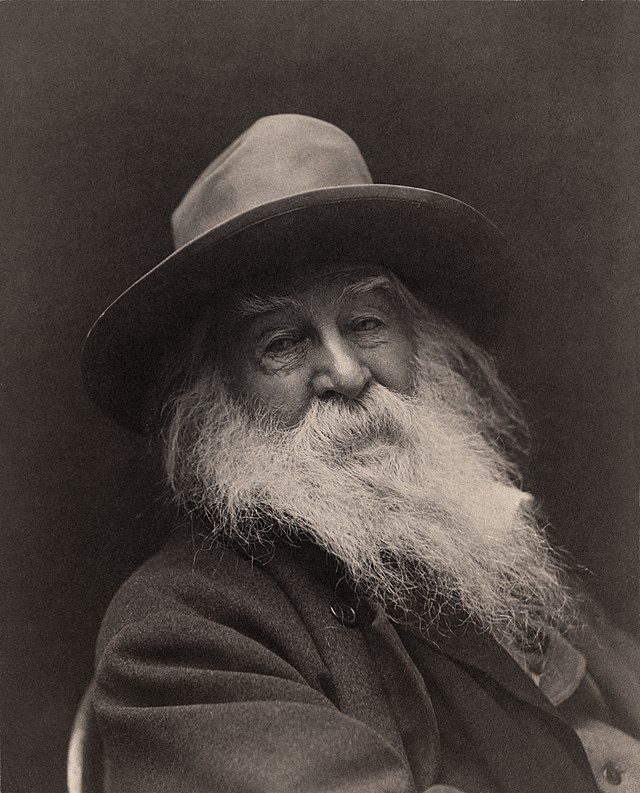
Walt Whitman, whom Bloom considered the greatest American poet
Much else is missing. Where for instance is Wilde, save in apt citation of a quote from ‘The Critic as Artist’ as the book’s epigraph? As for Wilde’s countryman Yeats: is he quite understood? In these summatory pages, how much space does old Bloom accord to a signal figure of his youth? His trajectory now, whatever it was in journeyman days and however much he may remain haunted by Shakespeare and Shelley, is towards fellow Americans – those who, unlike Eliot and Pound, did not “beat out [their] exile” but stayed home to “make [their] pact”, to borrow from the latter, Whitman-as-internationalist, as Bloom resolutely won’t. The god who stands at the head of American poetic tradition is for Bloom the seminal incantor – psalmic “transumptor” – of Leaves of Grass. Whitman the untidy, the vastly inclusive proto-Zarathustran – in him the professor finds a lodestone more congenial than in an Irishman whose attention to craft moved George Moore to depict him coming down to lunch at Coole Park to report to Lady Gregory that his morning’s work had consisted of removing a comma which he later restored[3]. Whitman’s incontinence, like Falstaff’s, if wilder, exposes another facet of “heroic vitalist” genius chez dying Bloom. Might we conclude that, in the light of his disintegration, a coherence strained for in youth seems no longer essential – analogous to how for the late Turner a glimmer of sun through vague clouds became preferable as subject to the detail of ship and sail? One suspects it to be partly the case. Bloom alludes en passant to Yeats’ “Byzantium poems”, but the exactitude of “hammered gold and gold enamelling” is hardly seen as a destiny. Bloom may live on as critic or at least enthuser: penning fifty-odd books suggests aspiration to transcendence beyond mere bodily existence. But if he lives on, Bloom is liable to do so as the critic permissive rather than the critic precise.
Again, why not? The third of four parts of Possessed by Memory begins to judder and creak as it extends Anglo tradition to snippets from the canonical Browning and Meredith; but the fourth part, commencing with its long devotion to Whitman, moves to some eye-opening appreciations, not only of the predictable Stevens, Williams and Crane, but more appealingly of the less obvious Edward Arlington Robinson and Conrad Aiken among others. With Aiken, comparison to his Harvard classmate Eliot leads to a fuller understanding of why Bloom felt antipathy for the most celebrated Anglo-American voice of the past century. That said, Bloom’s account of Aiken’s work falls short of full praise, and his explanation for why Aikens failed to reach “the eminence” of “Robert Frost and Wallace Stevens, Thomas Stearns Eliot and Hart Crane” seems partly to tell against itself – “Associative rhetoric was both Aiken’s mode and, sadly, his weakness. He did not try to make it new but to augment the foundations by relying upon the major poets of the Romantic tradition.” (p393)
Might this not be a description of Bloom’s own approach as critic? Might one even go so far as to see it as either a veil drawn over a latent, counter-canonical preference for poets of Aikens’ pitch or a subconscious admission of Bloom’s own less than supreme rank as critic? These are not idle questions. Somerset Maugham once famously quipped that his status as writer was in the first rank of the second rate. The false modesty hardly strained to disguise a popular novelist’s healthy antipathy for experimental modernists whom a cognoscenti lionized, but the common reader found unreadable: Woolf, Joyce and so on. Bloom, when set alongside the Derrida-ists, Deconstructionists, Structuralists and such fashionable ‘critics’ of his epoch, might strike one analogously as among the first rank of the middle-brow.
John Ashbery, by David Shankbone. Wikimedia Commons
Like Maugham in The Summing Up, Bloom laces his learned observations with recollection. His remarks on one of two women included in a 500-page book, May Swenson, pivot on their meetings at a café in Greenwich Village in the 1960s. His discussion of the original and vitalist ex-soldier Richard Eberhardt stems from a lecture tour at the University of Florida, where Eberhardt frightened him with the campus alligator. Bloom’s account of the master of negation, Weldon Kees, begins with an encounter at a jazz club in Harlem. Longer pieces on lesser-knowns such as Archie Randolph Ammons or Alvin Feinman are founded on yet closer association, as is the inclusion on John Ashbery, with whom Bloom’s “friendship has been continuous these sixty years… I have just phoned him at the Whittier Rehabilitation Center where he is recovering rather slowly from double pneumonia” (p431). Illness and age are constant companions in these last works, not notably cheerful ones, rather ones with whom Bloom struggles manfully to come to terms, never quite achieving reconciliation with, let alone joy in, observation of their processes – intrinsic to life, after all, thus a subset of the “heroic vital”. Bloom resists falling back into angry, non-accepting “rage, rage against the dying of the light”; rather he strives to win from these ultimate confrontations a revitalised urgency and heightened appreciation. He can still read, or be read to, and hear. He can still idealize and recite in the watches of night. Most of all he can remember. Which brings us to the ‘coda’ of the book, Proustianly entitled “In Search of Lost Time”.
Before one arrives there, one must be reconciled with Bloom’s subjectivity. One has to accept that his judgments have often to do with where he could most comfortably locate himself; that his “we” posits a community both transitory and presumptuous; that his lordly opinions, such as that Hart Crane is the great American poet after Whitman and Dickinson, may pass as gospel without being convincingly preached; that he gives himself grace to make errors and to speculate beyond what accords with known facts; that he settles scores on occasion – against Saul Bellow, for instance (p416) – and will not always refrain from resorting to guff.
What, say, is the sense of a sentence such as “His consciousness was a plenum that could have created a heterocosm, where space and sun might have made another world” (p430)? From here it is not far to complain of Bloom’s cherished inventions such as “self-othering” or “transumptive”. But let it pass. Bloom is a character in his literary universe. He is too Shakespearean not to put a high, perhaps excessive, value on personality. That he has a big one has been part of his “body of fate”, to use a Yeats term; Bloom has embraced and cultivated it, and created a space for it to exist in and flourish and suffer. Irritating this may be, but one can also be glad for it. Bloom himself becomes a standard, not just what he says: a brand, an embodiment of forces to reckon with, if not revere – something of a god. Apotheosis may not be a fate he has worked for entirely nakedly, but he has certainly flirted with it often, notwithstanding the trademark baggy garb of being “human, all-too-human”.
God incarnate in Bloom? Will He live on as Holy Ghost? Close to his physical end, Bloom muses: “When we die, our own survival will be the extent to which we have changed the lives of those who come after us… I have to consider how little I know of time to come. Doubtless it is better that way. Foretelling can be destructive.” (p507) His coda to Possessed begins in this way to evince a becoming humility. Before sojourning with Proust, he recalls Saint Augustine’s conversations with his mother about God’s eternal light. The aptness is to what Bloom characterises as Proust’s “sublime lucidity”, which transcends Jewish and Christian roots to be “closer to Hindu philosophy”. While admitting that Proust probably never read the Bhagavad-Gita, Bloom invokes it.
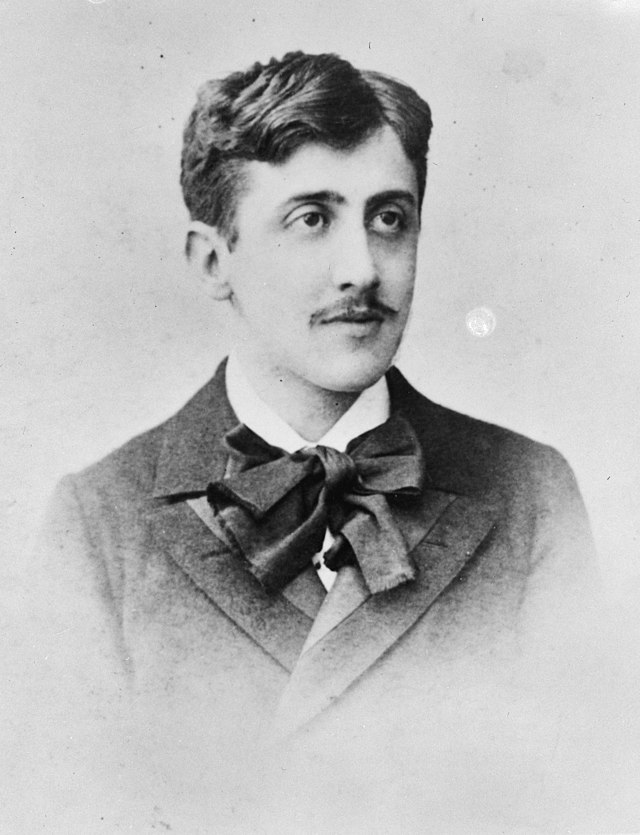
Marcel Proust, for Bloom a kind of Gnostic seeker
Shortly afterwards, he qualifies a roving meditation by confessing, “I have the realisation or fantasy that simultaneously I know everything and nothing” (p481). This precedes recollection of moments of “sudden radiance” in early childhood, which “seem now to be heretical intimations of a lost gnosis” (p487). Proust’s similar epiphanies, Bloom muses, may stem from “worship of an unknown God who is yet knowable” (p492); in any case, the novelist’s truth “is compounded of perception, involuntary memory, impressionism, a search for spiritual meaning, and a kind of aesthetic mysticism” (p497). Is this not Bloom’s “truth” in a mirror? The presiding return of “childlike vision” is for him, as for Proust, “allied to phantasmagoria and to the world of dreams… modified delirium” (p501). Here one might end, or with association of “the survival of the inner self with a world founded upon benignity” (p503), or with a largeness that “could be at once atheist and mystic” (p505). But Bloom actually concludes by reverting to Dr Johnson, whose wisdom allows for ebb as well as a flow that chez Proust is continuous. Bloom has indeed already undercut his paean to In Search of Lost Time by stating that he would choose Richardson’s Clarissa in preference to it. Why? Because the heroine and her rapist lover are “more vital”.
One trusts this no more than one might accept Mozart’s sympathy to be with the survivors rather than with the deposed libertine at the end of Don Giovanni. Bloom’s coda, brave as it is in conveying what remains at the approach of his earthly dissolution, conveys one back towards his penultimate book, which occupies a more preliminary stage in the process and thus may constitute a more reliable summing-up of a career of concentrated literary contemplation.
W B Years in 1908
The book is less given to reminiscence and enthusiasm, though some is ever present. There are no chapters devoted to lesser talents such as John Wheelwright, James Merrill, Jay Macpherson or Amy Clampit, with whom Bloom ends his pre-coda trawl in Possessed. Among those, notably Merrill, Bloom remains ready to deviate back to consideration of his traditional greats: he cites phone calls “in which we explored W. B. Yeats’s A Vision, the Gnostic religion, and the relation of Yeats to Shelley and to Blake” (p449). Reader, take note. Bloom subsumes the Irish poet here to two English Romantics whom he has consistently ranked as the foremost. He glides from A Vision to Scholem’s topic as if Yeats’s mystico-historic text were self-evidently Gnostic. He considers the matter no further except to say “I suspect that Yeats would not have taken to James Merrill’s poetry” (p453), then somewhat conversely he postulates that in Merrrill’s poetry “the Byzantium of William Butler Yeats hovers and is deftly evaded” (p456). Deftly seems a loaded adverb, not least in a context where the Irish poet’s full name is iterated, as it is in most other scattered allusions to him throughout this book. Why? Shelley almost never requires “Percy Bysshe”. Is there some other Yeats that Bloom fears we may think of, or is there some more telling nuance at play??
Looking at this penultimate work, so boldly entitled Take Arms Against a Sea of Troubles: the Power of the Reader’s Mind over a Universe of Death, and among chapters Bloom devotes to the usual titans – Shakespeare, Milton, Blake, Wordsworth, Shelley, Byron, Keats, Browning, Tennyson, Whitman, Frost, Stevens, Crane, Freud (eccentrically) and Dante (again, lone continental) – we find “William Butler Yeats and D. H. Lawrence: Start with the Shadow”. The title seems tricksy – it matters little: tags chez Bloom and others of his generation of academics often do. What does matter is the shadow of doubt that pervades. Bloom invokes an American favourite to contrast “three modes of mastery. In Lawrence it is chthonic. In Yeats it is occult. In Stevens it is massive acceptance of things as they are.” (p474) Proceeding to quote from one of the American’s poems, Bloom wonders if it is not “a critique by Stevens of the endless series of questing wanderers in Yeats” (p476). Endless series? “William Butler Yeats,” we are told (entire name again) “had the good fortune and the vital temperament to refuse any despair of his own quest” (p479). Are we to infer that a less “occult” sensibility should have despaired? Later, in parsing “All Souls” Night”, Bloom informs us that “the magnificence of gesture, metric, diction overcomes what could be judged sheer silliness” (p483); later still, in relation to Yeats’s alleged “pagan purpose”, we are told that “The force of his diction and metric brushes argument aside” (p485). “Devoted readers of Yeats learn that for him God and Death are one,” Bloom states, “a Gnostic formulation” (p486). This is of course arguable and reflects what Bloom is finally obliged to confess: “More than ever I have a mixed response.” (p490). He lauds “Adam’s Curse” in part to question the quality of what comes after; and when he reaches “Under Ben Bulben”, he decries a “farrago… much of it of a badness not to believed” (p497).
Old Bloom clearly had a problem with old Yeats. From a concluding phrase one might take it that he continued to rate or anyway grapple with the Irish master mainly out of an older loyalty: “The daemon in Yeats, as he acknowledged, was Shelley” (p499). This is arguable too and, at best, partial. But then, as I have indicated, partiality is characteristic of critic Bloom, in age as in youth. He is, to repeat his claim, a Nietzschean, as he fancies it: a “provoker”. A windbag like his beloved “Fat Knight”, he is more than a touch averse to fine concision. He is also no dedicated traveller in realms of magic and dream, however insomniac his nights may have been. Baudelaire comments somewhere that it would be impossible for a poet not to contain a critic but it would be prodigious for a critic to contain a poet. Harold Bloom adored poetry: of that there is no doubt. What may be lacking in him – one leaves it to weigh up – is a thoroughgoing sense of the poetic.
Harold Bloom bibliography (partial)
Shelley’s Mythmaking, 1959
The Visionary Company: A Reading of English Romantic Poetry, 1961
Blake’s Apocalypse: A Study in Poetic Argument, 1963
Yeats, 1970
The Ringers in the Tower: Studies in Romantic Tradition, 1971
STODDARD MARTIN is the American-born owner of the London-based publisher Starhaven, a cultural critic who has taught at Harvard, Oxford, Lodz and Warsaw universities, and the author of books including From Wagner to the Wasteland and Monstrous Century
Patrick De Rynck (ed.), KMSKA, 2022, hardback, 256pp, fully illus., €45
KMSKA: The Finest Hundred
Patrick De Rynck (ed.),KMSKA,2022, hardback, 288pp, fully illus., €45
Bruegel and Beyond: Netherlandish Drawings in the Royal Library of Belgium, 1500-1800
Daan van Heesch, Sarah Van Ooteghem, Joris Van Grieken (eds.), Hannibal/KBR, 2022, hardback, 392pp, fully illus., €64.50
ALEXANDER ADAMS loses himself in the Low Countries
When the Royal Museum of Fine Arts, Antwerp (Koninklijk Museum voor Schone Kunsten Antwerpen, KMSKA) reopened on 24 September 2022, it had been closed for 11 years for a massive renovation that involved every part of the building and grounds. Two of three recent books cover the KMSKA as a museum, and highlights from the museum’s collections; the third covers Flemish and Walloon drawings from the Royal National Library of Belgium, in Brussels.
KMSKA: The Finest Museum is an overview of the renovation, including extensive photographs and plans relating the work done, including photographs of the renovated museum complete with art works. The museum was established in 1810; it expanded over the centuries and moved location from the academy to a purpose-built museum in 1890. It now houses 5,882 works, with prints by and after Rubens amounting to 714 prints.
Royal Museum of Fine Arts, Antwerp. Photo: Ad Meskens. Wikimedia Commons
Claus en Kaan Architecten initially expected the work on the museum would take place in stages that would allow the museum to stay open. That changed once a thorough inspection was undertaken. The building was in a much worse condition than had been expected, with large amounts of asbestos to be disposed of, and the climate-control system needing to be replaced completely. In order to provide new gallery space under the old building, a nuclear fallout shelter was dismantled. Care was taken to use as much natural light as possible, even on the new lower-floor galleries. The architects recognised the brilliant perfection of the original design, which had fine sightlines and so much natural light that electric lights were not added until 1976. The later addition of divisions for offices, depot and conservation studio complicated the layout and reduced space for art, so were removed.
The façade was repaired, using stone more frost-resistant than originally used. All the time, the new architects consulted the archives. A major alteration to the museum in the renovation was the use of internal courtyard patios for new galleries. These are starkly contemporary, with the old galleries restored to their 1890 state. Pompeiian-red and olive-green walls with gilded stucco detailing in ceilings and cornices. The minimalist settings for Modernist art are very sterile.
Of more concern is the thematic hanging of art. This new trend places pieces of art of ostensibly similar topics and themes beside one another so that they can permit cross-era comparison. This (initially) seems well meaning and stimulating; actually, it displays indirect hostility. The idea of curatorship as the placing of items of similar periods, places and makers in proximity is one where comparison of closely related items build a cohesive depiction of the attitudes, practices and mediums of the time. It is the bedrock of connoisseurship. That is why modern curators hate it. They seek to disrupt expertise by suggesting such a quality is merely the air of fusty museum denizens and narrowly focused specialists. It is allied to the trend of political programming, globalisation and cross-disciplinary studies – those justifications for disrupting networks of established knowledge and values.
KMSKA Curators here note that the museum cannot display an encyclopaedic story of European art because of the limited range of the collection. This seems insufficient grounds for breaking up a canonical presentation in terms of period, style and geography. In one photograph, a Rubens Holy Family is juxtaposed with a recent painting by Luc Tuymans. The large, richly coloured, emotionally inflected masterpiece next to the tiny painting of a face, drained of emotion, depth and colour, rather points out the futility of the experiment – unless it was done to demonstrate the weakness of today’s art.
I concede I could be wrong about the KMSKA hang but all previous such displays I have encountered have had an air of a curator intrusive buttonholing the visitor to comment ‘Have you noticed?’, in comparisons that are either obtuse or superficial. KMSKA curators seem to have been let off the leash in limited circumstances. Let us hope thematic foolishness – which does a disservice to a specialist and anyone seeking to understand an art work from context – is reversed promptly.
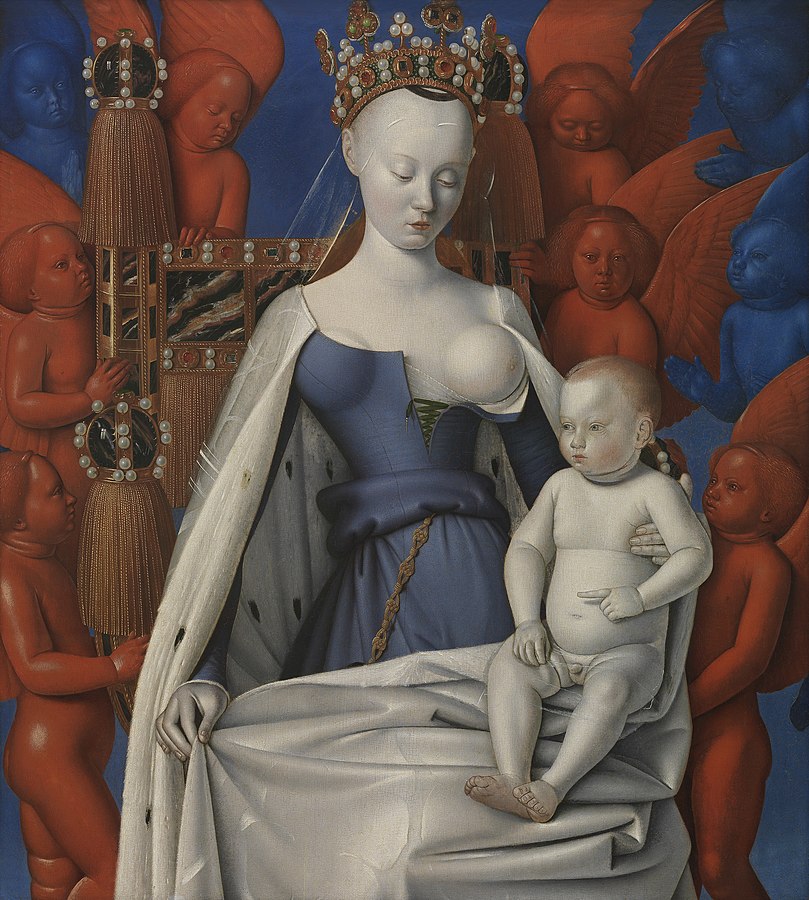
Jean Fouquet: Madonna Surrounded by Seraphim and Cherubim, 1450s
To find out what is in the KMSKA permanent collection, one can consult The Finest Hundred, which offers a selection of highlights, starting in the late Gothic period, with Simone Martini, through the Renaissance and the Golden Age of Low Countries art. Masterpieces of this period include an unfinished Jan Van Eyck panel (that somehow evaded a common tendency to finish or tidy up incomplete paintings), Jean Fouquet’s famed Madonna Surrounded by Seraphim and Cherubim (c. 1452-8) (that chilly classic, part maternity, part erotica), a Cranach nude and a handsome early Titian. Other South Netherlandish paintings are by Van Eyck (again), Rogier van der Weyden, Hans Memling and Quinten Massys. The Fall of the Rebel Angels (1554) by Frans Floris shows Archangel St Michael slaying nightmarish monsters. Naturally, the home city of Rubens houses a fine collection – mainly of large religious works. There are Dutch still-lifes and Flemish religious paintings. Portraits record important figures in Antwerp’s history, including the period under Hapsburg rule.
James Ensor at his easel. Self-portrait, 1890
There is a historical revival painting by Henri de Braekeleer (1840-1888) of a man seated in a seventeenth-century interior, with a fabulously ornate wall hanging behind him, as richly foliated as a forest. The KMSKA’s great collection of 39 paintings and over 600 drawings by the brilliant individualist James Ensor (1860-1949) is represented by six examples, including two of his ground-breaking and influential mask paintings. The museum’s policy of buying good examples of contemporary art from local exhibitions has paid off in the form of a strong collection from the inter-war period of Flemish Expressionism, Fauvism and Post-Cubism. There is a scattering of more foreign art by Ingres, Modigliani, Fontana and others.
The Finest Hundred contains a chapter explaining the renovation project, including some of the same photographs illustrated in the previous book. The book contains full works and some details, with a page of commentary and details for each painting or sculpture. For the average reader wanting to know about KMSKA’s art, The Finest Hundred is the best book; for architects, designers and those in the museum field, The Finest Museum is the best choice.
Bruegel and Beyond: Netherlandish Drawings in the Royal Library of Belgium, 1500-1800 presents 98 drawings by Dutch and Flemish artists born before 1800, now in the collection of the Royal Library of Belgium, Brussels (KBR). (The term ‘Netherlandish’ in art history usually means from the Low Countries, before 1500; after that point, a distinction is usually drawn between Dutch, Flemish, Luxembourgish and Walloon, except when they are referred to as ‘Low Countries’.) Although the catalogue has 98 entries (each with a full-page illustration, facing commentary and data, sometimes with details and comparative figures), it contains many illustrations of related graphics and paintings. Bruegel and Beyond is more of a thorough academic catalogue than The Finest Hundred, with an emphasis on scholarship and detailed description and discussion.
The period opens in 1520, when Bosch was working. One drawing is after (or perhaps even by) Bosch. It is a collection of figure studies of fantastic cripples, beggars and rogues. There are two very detailed ink drawings by Pieter Bruegel the Elder (c. 1526-1569); one is of a Boschian landscape relating to the sin of lust, another depicts an allegory of the virtue of justice. Some of the early drawings are unattributed; a dearth of comparative material and documentation means that authorship, locations and dates are all provisional. Rubens, Jordaens, Adriaen van Ostade, Hans Bols and other major artists are also represented.
The selection provides a great span of techniques: metalpoint (metal stylus on prepared paper), ink, pencil, line and wash, chalk and watercolour. There are not just pieces of artistic interest; the topographical watercolours of Adrien de Montigny border on the artistically naïve, but are good examples of a type of art we do not see much discussed by art historians; such depictions are more the province of historians. There are drawings for anatomy treatises, decoration for book title pages, book illustrations and mural designs. Overall, the high standard of the scholarship, attention to detail, large reproductions and clear production design make Bruegel and Beyond a very suitable book for any extensive library on Old Master drawings and history of art in the Low Countries.
ALEXANDER ADAMS is an artist, art critic, novelist and poet. His most recent book is Artivism: The Battle for Museums in the Era of Postmodernism (Societas/Imprint Academic, 2022)
STUART MILLSON enjoys some neglected gems of British music
Why does the spiritual toll of the Great War seem to have been harsher for Britain than for any of the other European combatants, asks organist, scholar, music-writer Robert James Stove, in commentary for a booklet which accompanies a new CD on the Australian Ars Organi label. His answer is clear and convincing: ‘… the innate stability of British political institutions meant a lack of opportunities for citizens to work off their war-neuroses by revolutionary activism, as agitators did on the Continent.’ Only in a marginal way did iconoclasm and an avant-garde spirit affect Britain, post-Passchendaele: for every Vorticist there was a Vaughan Williams offering benediction, although few realised that the composer’s Pastoral Symphony of 1922 was inspired by his own experiences of service on the Western Front. (Listen more closely to the ghostly, wordless voice in the unsettling final movement…)
The new recording, a superb audio curation of British music made in the magnificent acoustic of Our Lady of Victories Basilica, Camberwell, Victoria, Australia, assembles less-well-known names from the canon of Albion’s musical renascence. Alongside John Ireland and Vaughan Williams, for example, are Thomas F. Dunhill (excerpts from his ThreeChiddingfoldPieces), Sir Walter Galpin Alcock (Westminster Abbey organist at three coronations during the high-tide of Empire) and Alan Gray (successor to Stanford in the organ loft at Trinity College, Cambridge).
All works and composers chosen by the Ars Organi Recordings for this collection have in common a profound attachment to English tonality (although Norman Fulton, at CD track 11, is a Scot). It is as if the music of our islands is a mirror-image of the (physical and psychological) architecture of the very institutions that have long-governed us. The slow-breathing, hushed voices of churchgoers, a ray of wintry light, piercing through a cathedral window like a gimlet; a sense of eyes being drawn toward the pinnacle of a Norman arch – these are some of the feelings and imaginings inspired by many of the works, some of which are ethereally-enhanced by the participation of singers Elizabeth Barrow (soprano), Brigette De Poi and Emily Tam (mezzo-sopranos), Leighton Triplow (tenor) and bass, James Emerson.
John Ireland’s TheHolyBoy and a George Herbert setting (TheCall) from Vaughan Williams’s FiveMysticalSongs are probably the best-known pieces in the entire collection. Peter Warlock’s old English carol, Adamlay Ybounden, also finds an occasional place in concerts and Radio 3 schedules. But who knows the music of the composer, whose work concludes the CD: Geoffrey Turton Shaw? A near-contemporary of Vaughan Williams, he served as a school inspector and was himself schooled by that master of church music, Sir Charles Villiers Stanford. Setting Milton, Ringout, yecrystal spheres/Onceblessourhumanears… Turton Shaw embodies all the virtues of his genre and world, confirming the past, present and future solidity of English music.
The music of a Welshman, Daniel Jones (1912-1993) makes up another important collection of lesser-known music from our shores, in a well-presented four-disc set from Lyrita Recorded Edition. Many will remember the remarkable ground-breaking Lyrita vinyls of old: symphonies by Bax and Rubbra, John Ireland songs, TheMagic Island by William Alwyn, and a record that particularly caught my eye when I first came across it in the record department of Foyles, some 40 years ago – Ireland’s Forgotten Rite, Legend, Mai–Dun and Satyricon – with its strange, haunting cover-artwork; a picture which hinted at the form of a landscape, with dotted colours and distances just out of reach. In fact, if I were to try to find a simple, neat description of Daniel Jones’s music, it would come close to those suggestions inspired by the Ireland graphics – although this enigmatic composer (a code-breaker during World War Two) never really embraced, at least self-consciously, folklore and the symbolism of place. He tended to think of himself as a composer who happened to come from Wales, rather than an artist who had a civic responsibility to proclaim a culture – although he did write a major choral-orchestral piece, TheCountryBeyondthe Stars, which – post-Festival of Britain – seemed to have an ambience of dreamy peninsular coasts, beacons and Black Mountains.
Perhaps the nearest he came to a home-spirit, an imprint of Welshness, was in his DanceFantasy, performed at the 1982 Proms by the (then) BBC Welsh Symphony Orchestra under Bryden Thomson – although the work still seemed somewhat set apart from Welsh dances and Celtic legends by fellow-countrymen Hoddinott, Mathias and Arwel Hughes. And it was at this concert that I briefly met the musician… As I walked around the hall at the end of the evening, making my way back to the tube station and suburbia, I spied the bespectacled composer (this one-time friend of Dylan Thomas) at the Royal Albert Hall Artists’ Entrance. Venturing over, I asked for an autograph, which was cheerfully forthcoming and written in a neat, methodical hand, with a fountain pen. An avuncular, slightly diminutive figure, Daniel Jones seemed very pleased by the performance of his own music at the Proms. (It has to be said, the Proms Planning Department has been less than generous to the composers of Wales.)
Lyrita’s new CD collection puts the music of Jones and Cambria very much on the map. Pianist Martin Jones has spent many hours in the National Library of Wales, painstakingly uncovering an almost Bach-like progression, cycle, abundance of piano works, from a neatly-crafted Capriccio of 1934, to the much more ambitious (“big stride”, was the composer’s own description) Theme, VariationsandFugue in C-sharp minor, dated 1945 – the year of Britten’s PeterGrimes and the advent of the Attlee era. Tonal, but sometimes wandering away from those clear lines; meditative, but never obscurely introverted, Daniel Jones created, it seems, pure music, for its own sake. Rigorous, never arduous, and always making the listener wonder what the next piece will bring.
A great deal of the composer’s character is also suggested by some of the photographic portraits featured in Lyrita’s CD booklet, not least the final black-and-white plate: Dan Jones, with benevolent eyes and a grin, partly concealed by the pint of bitter he is bringing to his lips. A good Welsh brew, no doubt.
CD details
Undertones of War, British Organ and Vocal Music After 1918. Robert James Stove, organ. Ars Organi, AOR004
Daniel Jones, Rediscovered Piano Works, Martin Jones, piano. Lyrita, SRCD.2396
CHRISTOPHER SANDFORD remembers the first time he met Dr. Feelgood’s ace guitarist
It’s a strange thing about biography. No matter how many facts are told, how many details are given or lists are made, the essential thing all too often resists telling. To say that so and so was born here, that he did this and did that, that he wrote this song or painted this picture, that he went around the world and married and had children and grew old and died – none of that tells us very much. What we want is a story.
In that spirit, all I can personally add to the numerous obituaries of the guitarist, sometime actor and raconteur Wilko Johnson, who died on 21 November at the age of 75, is a primordial memory of around December 1974, when I was just up at Cambridge and the Fitzwilliam student union somehow scraped together enough money to hire the band Dr. Feelgood to enliven our college Christmas party. This was the season, let it be remembered, of ubiquitous high heels and loon pants, of crushed velvet jackets with lapels as wide as hang-glider sails, when the charts were full of extravagantly quiffed artists like Rod Stewart and Bryan Ferry, or David Bowie camping it up in his soul-revue phase, with a rather depressing weekly Top of thePops regimen characterised by names like Charlie Rich, the Carpenters, John Denver, Olivia Newton-John and Jasper Carrott doing his ‘Funky Moped’.
Anyway, into the midst of this dross came the Feelgoods, and such was the shock I had to momentarily check the cigarette in my mouth (those were the days) to see if it might possibly have been tipped with something more exotic than Players Number 6. I mean, incredible. Four stony-faced Canvey Island geezers who looked like they might just as soon put the boot in as entertain you: two brooding hulks on drums and bass, both well tasty, and the twitchily charismatic figure of Lee Brilleaux up front singing – snarling, really – in a suit that might once have been white, jabbing his fist around in time to the beat in a way that suggested definite malice rather than some hippy-like state of being transported by the music, banging out a no-frills mix of sweaty rock and rhythm and blues typified by two-minute songs with titles like ‘I’m a Hog for You’ and ‘Stupidity’ and ‘Tequila’. This was not a group you could imagine sitting cross-legged over a communal bowl of brown rice to a backdrop of herbally-tinged joss sticks and the wafted strains of the latest Yes triple-gatefold concept LP.
And then slightly stage left, right there in front of me, Wilko Johnson on guitar. Amazing. Clad totally in black, pudding-bowl haircut, eyes staring out across the audience like searchlights, about twice a song he would suddenly take off like an overwound Energizer Bunny and go lurching across the stage, side to side, back to front, all the while keeping up a stark, percussive rhythm with a chopping right hand interspersed with a few demented solos that seemed to be more the product of a semi-tuned chainsaw than a traditional musical instrument, a routine he varied only by periodically lifting the guitar to his shoulder and peering down it as if to strafe the audience. As I say, stunning. [EDITOR’S NOTE: Johnson’s distinctive guitar style and powerful stage presence can be seen here.]
At the end of the show, Wilko walked right past me. He had little choice in the matter, because there was no backstage area to speak of and the band just had to push their way through the crowd as best they could in order to make it out to the impressively knackered-looking transit van waiting for them at the back gate. Anyway, there he was: sweating, hollow-eyed, carious teeth, funereal two-piece suit that looked like he might have slept in it. ‘Great show,’ I said with that originality of phrase certain critics later so admired in my various rock biographies. And since Wilko apparently still wasn’t going anywhere, I had a further moment of inspiration. ‘Who’s your favourite guitarist?’ I asked, thinking it might be one of the consensus heroes of the day like Clapton or Beck or Page, or even dear Keith Richards, with whom he undoubtedly shared a certain laconic, back-to-basics playing style. But no. ‘Mick Green,’ my new friend informed me, and then to my surprise stuck around long enough, right there in the chaotic aftermath of the gig, ankle deep in spilled beer and stubbed-out fags, as people banged past us, to tell me, a total stranger, all about Green, another great British eccentric, it transpired, and sometime staple of early-60s combos who also liked to chop up his lead and rhythm parts into one percussive wall of sound, and – proving his versatility if nothing else – later went on to rock up albums by everyone from Paul McCartney and Van Morrison up or down to Cliff Bennett and Engelbert Humperdinck. At the end of what became a sort of oral PhD thesis on the whole history of early British R&B, Wilko asked my name, introduced himself – as though he might not already be familiar – shook my hand, and effusively signed the scrap of paper I hurriedly thrust at him. ‘Keep in touch,’ he said. My first interview. Then he was gone.
Speaking of versatile, it later turned out that Johnson himself had been to university, wrote poetry, spoke Old Icelandic among half a dozen other slightly fringe languages, and in later years developed a keen interest in astronomy to the extent that he built an observatory on the roof of his Essex semi. Along the way, he married his childhood sweetheart Irene and they remained together, raising two sons, until her death from cancer 38 years later. As the world knows, Wilko himself was diagnosed with an apparently incurable tumour in 2013. He reacted with notable stoicism, remarking that he had never felt so alive than whilst under an imminent death sentence, continuing to perform every night he could and teaming up with The Who’s Roger Daltrey to make the album Going Back Home. Then the apparent miracle happened, and doctors in Cambridge performed a nine-hour procedure that saved Johnson’s life while relieving him of most of his intestines. Paradoxically, having cheerfully faced death, Wilko fell into one of his recurrent funks once given the all-clear. ‘I knew I was really getting better from the cancer when I started getting depressed again,’ he said wryly.
It seems funny to say this, but for all the bug-eyed stage antics and raucously loud, sweat-soaked nights in dingy rock clubs, there was a quality of innocence – an innate modesty, the eagerness to please, to connect with the audience, never to lose sight of his roots – that distinguished Wilko Johnson throughout his life and career. I doubt we’ll see his like again.
STUART MILLSON is transported to a warmer sound-world
Any sense of malaise, austerity or winter gloom in London was dispelled for two hours (for those fortunate to be in attendance) by the Sinfonia of London’s 2nd December performance of Walton, Ravel, Dutilleux and Gershwin at the Barbican.
Much praised by the critics and always receiving great waves and whoops of adulation even before they have played a note, the Sinfonia’s concerts are an occasion: this mainly young orchestra, handpicked by their enterprising and unpredictable-in-repertoire conductor, John Wilson, playing with much physical joie de vivre and idiomatic interpretation. Confirmation of the latter came in the form of the jazzy trumpet playing – straight from the environs of Tin Pan Alley – in Gershwin’s intoxicating AnAmericaninParis; a score we all know, or thought we knew… True to form, John Wilson, a great fan of the golden age of Hollywood and a musician dedicated to rediscovering lost scores, managed to track down 86 bars of unheard original Gershwin music, reconstituting the piece – turning it from that brilliant, boulevard ballet for Gene Kelly into a symphonic poem of The Great Gatsby era. The cliche, ‘it brought the house down’ certainly applied to this performance, as nuanced as it was bold, as cinematic as a work could ever be.
Yet the Gershwin was not the only work in John Wilson’s line-up that matched the mood of the composer. In Walton’s Scapino overture, the Sinfonia found all the wafting Mediterranean warmth and dry wit for which the English composer (who took himself off, post-war, to the Bay of Naples) is renowned. Similarly in Ravel’s 1903 song-cycle, Sheherazade, whichsets the mysterious oriental poetry of Wagner-attracted ‘Tristan Klingsor’ (otherwise known as Leon Leclere), a heady sense of the exotic and of unattainable sensuous revelation oozed from the Sinfonia strings; complemented by soloist Alice Coote’s equally beguiling articulation and vocal reveries.
Henri Dutilleux, a well-respected French composer who died some ten years ago, was represented by a 1950s’ ballet score, LeLoup, whichsoundedverymuch like a cabaret piece by Milhaud or Satie, turned into a symphonic poem. How authentic the work is as an example of the true musical character of Dutilleux is a matter of debate, but LeLoup – the wolf – had plenty of well-crafted passages for the Sinfonia to enjoy – although the piece, for what it was, did seem rather overblown in length.
Ravel’s Bolero could be considered as another of those works which, despite being very well known, does not entirely represent the best efforts of its creator. Yet in the hands of John Wilson, the audience had a chance to rediscover and re-hear the piece, entirely. From the first side-drum taps, to the strange, slow, disjointed thrums of the harp, Bolero has a curious mystery to it; an odd sense that you can’t break away or get out of a dream – which, before you know it – has sucked in every instrument of the orchestra and is fast propelling you to the edge of a precipice. John Wilson’s arrival at that moment jolted the Barbican audience into a tidal wave of applause.
And there was one additional, non-musical touch to the evening: the concert took place in the presence of Hollywood royalty. Enjoying the Gershwin in particular (no doubt), was none other than Gene Kelly’s widow, a lady of immense grace and style – a living reminder of golden ages which now seem out of reach, but which in fact are still just within our grasp.
STUART MILLSON can hear Restoration London from 21st century Kent
Music@Malling, planned and organised by classical musician and educator, Thomas Kemp, is one of those provincially-based, smaller festivals which succeeds in bringing performers of national and international standing to local and semi-rural settings. So, instead of having to travel to Kings Place, Wigmore Hall, or St. James, Piccadilly for the pleasure of hearing the finest chamber music, discerning audiences in a mid-Kent community need only stroll to their local church, or the modern performance space of the Norman-built Malling Abbey to savour baroque bands such as Fretwork, who gave Music@Malling’s lunchtime concert on Wednesday 28th September. With thoughts of the succession of the modern monarchy still fresh in our minds, Fretwork transported us to the candlelit rooms of Restoration England – to the great, collective release of breath and creativity that followed the crumbling of Cromwell’s Commonwealth and the return of the ‘Merry Monarch’. It was the great Henry Purcell of William and Mary fame, and the sometimes overlooked Matthew Locke (who possibly taught that renowned composer) who together gave voice to this other, long-before-Elgar English musical renascence. Fretwork’s Malling Abbey tribute to them could not have been more all-encompassing, because although only a group numbering five players and performing just sequences of fantasias, the choice of works somehow captured, perfectly, the authentic soul and sound of the composers and their age. If one representative musical fragment of an epoch could survive, the cadences of those intimate Fantasias would suffice. Purcell’s immense creativity, packed into his remarkably short life (1659-1695), was legendary; like an English Mozart, a stream of work flowed, with Fretwork giving us an example of this impossible productivity, in the form of Fantasias 8 (in D minor) and No. 9 (in A minor) written on consecutive days. The trait of English melancholia, which would surface again some three centuries later in Vaughan Williams, Britten and Alexander Goehr (the latter earning a place in Fretwork’s programme) is clearly audible in Purcell’s music, but perhaps less so in Matthew Locke’s Consort of Four Parts No. 3, who allowed more of the spirit of the boisterous bourrée into his music, but still tempering his lighter touch, with the reflection of the sentimental saraband.
Alexander Goehr. Photo: Etan Tal. Wikimedia Commons
In his introduction to the concert, Festival organiser, Thomas Kemp, spoke of Purcell’s music as “harmonically complex for the period in which it was written”. Yet contemporary composer, Alexander Goehr, writing in an age of deliberately difficult atonality, decided to reach back to the general harmonies of Purcell’s time in his own Fantasias, written for Fretwork in 2000. Goehr’s music may be seen as Purcell through a modern prism (like Britten’s absorption of Dowland) and yet the Fantasia No. 2 for Five Viols begins with an abrupt phrase – a jolt, or disturbance in the autumnal English landscape, confirming Goehr as no purveyor of pastiche, but a composer in the continuum stretching back to Purcell and Locke’s time. Ancient and modern were reconciled not just in the music. Fretwork’s music-stands held, not paper scores, but digital devices on whose screens were displayed the staves and notes of the 17th century. It was a fitting touch at this most memorable recital.
Artivism – The Battle for Museums in the Era of Postmodernism
Alexander Adams, Societas – Imprint Academic, pp 215, £14.95
GUY WALKER welcomes a spirited sortie onto the cultural battlefield
One function of placing fine paintings in ornate gold frames or sculptures on marble plinths is to demonstrate the special status accorded to fine art in human affairs. These objects earn this status by virtue of their ability to furnish us with some of the most sophisticated pleasures in the hierarchy of human pleasure. The treatment of the pulling down of statues from their plinths to serve baser ends (rather than for reasons of historical guilt) is, therefore, a cultural matter. As a result, it is in no way demeaning to say that the latest book by artist and art critic, Alexander Adams, fires an impressive salvo in what have become known as ‘Culture Wars’.
‘Artivism’ is the pressing of art and resources for art into the grubbier service of political protest and campaigning. It is also the displacement of fine art by what is no more than political activism. This is antithetical to the uplifting precepts of Emmanuel Kant, whose ‘Categorical Imperative’ made human beings ends in themselves in his ‘Kingdom of Ends’, never to be used as mere means to ends. The ability to produce representative art is a pleasure-giving end of this kind, one which appeals to deep human needs rather than shallow political outlooks. The greatest artists of the past understood this intuitively, and underwent long technical apprenticeships in order to fulfil this role properly.
Adams’ survey of the phenomenon and origins of artivism is comprehensive in its breadth. Although the book begins with the Athenian Parthenon and references Leonardo and Michelangelo, he finds the real philosophical origins of it in the rational Enlightenment begun by Bacon and Descartes. Their mathematical and “scientific method….encouraged the collection of data”. This led directly to Jeremy Bentham’s anti-Kantian, utilitarian approach which emphasised the best mathematically calculated ‘outcomes’ for the largest number above all things; there are echoes here of the impersonal big data approach and equality by outcome or ‘equity’ that plague modernity. Adams underscores an essentially conservative allegiance later, in his conclusion, by writing “….every institution established ( or substantially reshaped) according to Enlightenment liberalism has fallen to progressive subversion.”
Rather than Kant, Adams uses other big guns to underpin his art-for-art’s sake, pro-formalism, pro-connoisseurship, pro-objectivity and pro-canon thesis – first, Benedetto Croce, “[Art] has its own object, the Beautiful, that stands independently on equal terms with the other three (Logic, Economics and Morality). […] true poetry must have no utilitarian, moral, or philosophical agenda.”
Equally weighty support comes from George Orwell: “…many writers about 1939 were discovering that you cannot really sacrifice your intellectual integrity for the sake of a political creed – or at least you cannot do so and remain a writer.”
Goya’s images of war might be “if not a cry for passivism, a call for pity and restraint”, but they only survived to be in the canon (if one remains) in the twenty-first century by placing artistic execution above political executions that could have been recorded by a plethora of lesser artists.
The author studies the aetiology of the disease of ‘cultural entryism’ that demotes fine art and promotes activism, that has colonised our public museums. This occurred in stages. First was the movement, demanded by Enlightenment universalist and utilitarian principles, from private, monastery or university-owned art collections to public libraries, galleries and museums: “The modern state encroached on the functions of monarchy, aristocracy and church, so noblesse oblige was replaced by the duty of an enlightened bourgeoisie, industrialists and landed gentry.”
This inevitably led to a symbiotic relationship between corporate business and the state, incarnated in bodies such as the Arts Council of England (ACE) and the American National Endowment for the Arts (NEA), and the emergence of a variously located ‘managerial elite’ whose progressive, Whiggish ideas involve a desire for “..homogenisation, globalisation, technocracy, atomisation and planned economies…”. To these can be added a desire for increased immigration and anti-capitalism. Once in control this elite effected a “territory grab of resources earmarked for art without any consideration for the wishes of the public…” and it is these resources that are used to commission and fund artivism.
Having explored this historical pathology and its philosophical origins, Adams unpicks economic and psychological strands. The funding of artivism by public bodies and corporations has created an underclass of artistically emasculated ‘artists’ subject to “no aesthetic competency threshold” and reduced to a kind of dependent serfdom. Some are real artists reduced to penury and dependency, others have no talent at all. Adams encourages pity for these latter“…a generation of non-artists (produced by universities) doomed to redundancy, deliberately left unskilled, chockful of abstruse theory and puffed up with self-regard, for whom the art world (and wider society) has no use whatsoever. Where else could these graduates have gravitated to except artivist quasi-social work?”
In the face of this, a return of old-style patronage of artists by wealthy patrons which guaranteed that only the excellent survived and thrived while the untalented withered from the field, might be welcomed, to put this deluded underclass out of the misery of its unrealistic artistic aspirations. It might also remove a “client class” of minorities cynically and exploitatively created by “…corporations wishing to improve their images, pressure groups wishing to make an impact, charities needing to disburse sums periodically and state agencies with annual budgets to be allocated.”
Psychologically, Adams detects a vengeful totalitarian predilection within the ‘managerial elite’ who run the arts show. In a further echo of a modernity where the BBC uses our licence fees to admonish and sermonise us on our lack of virtue, this elite uses tax pounds and dollars extracted from the populace to remind them how despicable they are. This is one of the abounding ironies and paradoxes Adams indicates. He also shows how potentially dangerous activist renegades are tamed by the “ruling class” to the extent that they become establishment “foot soldiers” – and how foreign artivist migration advocates are often in conflict with the wishes of the local populations they visit. The managerial elite use the tactic of making us pay for our own humiliation as a “power play” intended to reinforce and signal the subjugation of the populace, the desire for which may derive from the “Dark Triad (narcissism, Machiavellianism and psychopathy)”. It’s that sombre and that pathological for Adams. As in much climate activism, a profound anti-humanism is in play, as well as a depersonalisation where ‘collectives’ refers to persons as ‘bodies’ and ‘voices.’
This is an excellent publication doing fine work in identifying, naming and recording a phenomenon which Adams describes as “a predatory pike released into a carp pool” and “an invasive species”. If I have any quibbles, they are as follows.
He makes it clear in the body of the book that real “artistic merit” and “artistic endeavour” must trump everything in the art world and complains, for example, that “Feminists state that all art must be political because there is no division between art and politics.” Orwell and Croce seem to back this up. However, the beginning of the book is a little confusing on this point. He writes, “Drawing lines between art, artivism and political action is not always possible. This ambiguity (and precedents set up by art of older eras) allows overt political action cloaked as artivism to enter the area we set aside for public arts, allowing artivism to assume the status and resources of art.”
He illustrates this ambiguity with examples of artistic resources being used in the creation of the “political statement” of the Parthenon and the lending of their talents by Leonardo and Michelangelo to the political projects of their patrons. He also cites the socialist content of Millais’ and Courbet’s work. A writer and critic of Adams’ undoubted firepower should be able to make the fine but real distinctions between the passing contemporary content and the brilliant artistic execution that makes it survive amongst a welter of similar material or between artivism – and also between an artist lending his talent in return for remuneration to projects that aren’t his, and prototype artivism. He seems to make exactly this distinction in the rest of the book.
He raises a very interesting idea early on:
There is more than a touch of the religious rite about artivism. The activist- shaman-priestess prescribes the place and time of communion, her assistants prepare the space and provide necessary materials. The tribe gathers to attend the publicly announced rite, respectfully assisting by witnessing and participating as directed.
My regret is that he didn’t pursue this line later in the book. He writes very well, but there is a strange stylistic tic whereby he frequently omits the definite article as in “…but it is worth bearing in mind that progressive artivism of today is complementary to….” This sometimes gives a clunkiness to the prose.
Stuckist demonstration. Photo: WIkimedia Commons
But excellences by far outweigh the quibbles. I could add to the former a welcome practical prescription for resisting artivism in the chapter of that name, under the headings of “1, Ethics, 2. Exclusion, 3. Defunding, 4. Reduction, 5. Education, 6. Enforcement”, and the pages devoted to the true dissidents known as the ‘Stuckists’ after Tracy Emin’s derogatory term. I also enjoyed the pace-changing of the entertaining and colourful insertion of Case Studies between chapters, especially the swingeing take-down of Banksy.
The book ends on a pessimistic note. Adams feels our arts establishment has an “inherent foundational flaw” deriving from its roots in the Enlightenment’s rationalism. He suggests, root and branch: “…maybe it would be better to lose trust in that system.” One senses, perhaps, a longing for the more Darwinian days of the Renaissance.
PAUL GARNER enjoys a survey of an oddly little-known county
Edge of England is a rich tapestry woven of many threads—history, nature, industry, geography, religion and folklore—all intertwining to create a picture full of interest. It tells the story, or rather multiplexity of stories, of the author’s adopted county of Lincolnshire, an unjustly overlooked and unfashionable part of England, one that is often, as the author reminds us in his opening chapter, the butt of snide jokes and liberal disdain. Turner’s book challenges this snobbery and prejudice, revealing “a county like no other … an England time half-forgot, where you can still find an unabashed past inside an unpretentious present—and freedom and space on a little offshore island”.
Turner delights the reader with captivating tales of eccentric characters, atmospheric places and intriguing events, his wide reading and breadth of knowledge apparent on every page. A thousand and one rabbit trails are laid by the author, any one of which could profitably be followed by an inquisitive reader. We learn about the lives and times of many sons and daughters of the shire, some well-known, others less so. Among the colourful characters that we meet are parliamentarians, scientists, explorers, military men, poets and writers, and religious figures.
The more familiar include John Wesley, the evangelical clergyman whose spirited preaching was the fountainhead of the emerging Methodist movement, Sir Isaac Newton, the scientific prodigy who developed differential calculus while sheltering from the plague at Woolsthorpe in 1665, and Dutch engineer, Cornelius Vermuyden, whose land reclamation work met with fierce opposition from locals, who feared dispossession. But we are also introduced to less familiar personalities, such as the cantankerous nineteenth-century contrarian, Sir Charles Sibthorp, who, as MP for the city of Lincoln, vehemently opposed steam railways, water closets and barrel organs, the polymathic Sir Joseph Banks, who accompanied Captain Cook aboard HMS Endeavour, and amassed important collections of botanical specimens, and the demon-afflicted Saint Guthlac, who, at the end of the seventh century, established a hermitage at Crowland, destined, after his death, to become a monastic centre and place of Christian pilgrimage.
Turner writes with affection of the ordinary people of Lincolnshire. They are kind, practical, helpful and courteous, even to outsiders, and when they get to know you “accord you the ultimate sign of acceptance—telling you about the idiocy of London”. He describes, with wistful melancholia, Lincolnshire’s lost villages, decaying industries and disappearing ways of life, but does not rub salt into the wounds in the fashion of some unkind commentators. Grimsby may be down-at-heel today, with “a depressed town centre, and too much bad housing”, but Turner writes movingly of the skill and bravery of its sailors and fishermen, and the fortitude of their families, ensuring that the reader knows of the town’s epic origins, regal connections, and dogged “tough pride.”
Many absorbing stories are related, ranging from the whimsical and quirky to the ghoulish and macabre. There is the curious tale of the “Stamford Schism”, an ill-fated attempt by a cadre of unhappy students and tutors from Oxford to establish a rival institution at Stamford in 1333. It was a short-lived venture, the brass door knocker the students took with them when they left Oxford now proudly displayed above high table at Brasenose, in the manner of a spoil of war. The Haxey Hood is another oddity, a game played every January in the town of Haxey, during which enthusiastic locals chase a group of costumed “Boggins” around the town in pursuit of a leather bolster, ostensibly re-enacting an incident with a riding hood said to have taken place almost 700 years ago.
Grisly crimes, pogroms and witch trials are also part of the county’s story. For instance, Turner tells of the tragic death of poor Mary Kirkham in 1806, and the execution of her murderer and erstwhile suitor, Tom Otter, whose skull was said to have provided a home for nesting blue tits when he was gibbeted at Saxilby. However, one of the darkest episodes in the county’s history took place in 1255, when an antisemitic rumour began to circulate in Lincoln that a young boy named Hugh had been murdered by a local Jewish man. This led not only to the arrest, torture and execution of the suspect, but the imprisonment of ninety-one others, eighteen of whom were also executed. The boy’s burial place became a shrine, and “Little Saint Hugh” acquired legendary status, becoming the subject of ballads and folk songs.
Those who, like me, appreciate tales of the strange and uncanny will enjoy reading about the ghostly goings-on at Epworth Rectory, home, in the eighteenth century, not only to the Wesleys, but also, it was said, to a noisy and disincarnate spirit called “Old Jeffrey”. We learn of the spectral “Green Lady” who haunts a tree-lined avenue near Thorpe Hall in Louth, and the “Black Lady” of Bradley Woods, still weeping for her lost children. The county also has tales of water sprites, wild men and mysterious big cats, and, although not mentioned by Turner, Black Shuck, the demonic hellhound that patrols the county’s byways, its red eyes flaming like coals through the fen mists.1 Anyone eager to explore the supernatural aspects of Lincolnshire further may want to consult a series of hair-raising articles by Rob Gandy in recent editions of Fortean Times.2
Turner says of the Lincolnshire-born antiquarian, William Stukeley, that he could see “the magic of words”. If so, Stukeley would have appreciated the spellbinding mellifluosity of Turner’s own writing. Almost every page yields memorable examples. Consider, for instance, Turner’s charming distillation of one village’s peculiarities and idiosyncrasies as “a little ampoule of English eccentricity” – his spinetingling description of old gateways as “unquiet, touched by the memories of everyone who has ever gone through them, especially if they never came back” – and his description of a carved stone man, high on the forlorn ruins of Barlings Abbey, abandoned at the time of the Dissolution, “stuck in eternal outrage, his mouth forever open as if howling at all this sacrilege and sky”. Turner sees poetry in the everyday, as when he recalls a dead carrion crow, “lying in a patch of sun beneath trees, intact and gleamingly black, studded with iridescent greenbottles, like a mislaid piece of Visigoth jewellery”, or when he waxes lyrical about the vistas that open up from the Humber bridge, “especially to the west on a warm evening when it has been raining, with the sun going down in splendour, and backlit air and water so full of each other that it is like being inside a pearl”.
The reader is also treated to some wonderfully dry asides, perhaps my favourite being an anecdote about a cringeworthy sermon given by the new Bishop of Lincoln at his enthronement, its low culture references jarring awkwardly with the high pomp of the ceremony that had preceded it. Turner concludes, somewhat archly, “The Order of Service read ‘After the sermon, silence is kept for a few moments,’ and it was, but not necessarily for the right reasons”.
Edge of England is a book to savour and is accompanied by thirty-two colour plates and a rather beautiful, Tolkienesque map in which the Wolds take on something of the aspect of the “misty mountains”.
‘The Ruskington horror,’ Fortean Times 401, 32-38 (January 2021); ‘The Ruskington horror: part 2,’ Fortean Times 402, 38-43 (February 2021); ‘The Ruskington goblin,’ Fortean Times 405, 48-38 (May 2021); ‘Weird wheels of the Wolds,’ Fortean Times 407, 48-51 (July 2021); ‘Scary stories from Scunthorpe,’ Fortean Times 411, 48-52 (November 2021); ‘Not the face,’ Fortean Times 414, 46-47 (January 2022); ‘Lincolnshire’s bevy of the bizarre,’ Fortean Times 416, 44-48 (March 2022); ‘A warning to the Fortean,’ Fortean Times 421, 42-45 (August 2022); ‘A grand fen-ale!’ Fortean Times 423, 42-45 (October 2022)
PAUL GARNER is a researcher, speaker and writer based in the Cambridgeshire Fens. His interests include the natural sciences, Christian theology, classic TV sci-fi and fantasy, British folklore, and the ghost stories of M. R. James. He is also a dancer with the Devil’s Dyke Morris Men
Maxim Peter Griffin, London: Unbound, 132pps, hb., £16.99
DEREK TURNER admires a unique landscape artist
Several years ago, when I was thinking about writing a book about Lincolnshire, I found a strikingly original Twitter account. Almost every day, the seemingly tireless Maximpetergriff posted pictures painted during or after apparently endless walks across Lincolnshire, in all weathers and states of mind, showing the things he had seen in clear and luminous tones – birds, buildings, clouds, dogs, people, planes, planets, plants, pylons, rains, roads, skies, stars and suns.
These things had not just been seen, but looked at – everyday things uplifted by a strong sense of their possibilities, made resplendent in modern hues. Nothing seemed beneath this observer’s notice, nothing predictable in this parallel Lincolnshire, his glowing images intercut with staccato captions about bats overflying, bridges crossed, dogs howling, insects hurrying, litter lying, people overheard, the smell from takeaways, strange stones picked up, waterways running slickly away under moonlight.
The images were small, apparently simple and spontaneous, but in truth were full of thought. This was a county beyond conventional depictions, a painterly psychogeography; here were Englands within England. This walker was no pedestrian, but dashed off little-known vistas with verve, influenced by the likes of Nash and Piper while also being confidently contemporary; as he records, “two older ramblers look on the work with dismay”.
Some of these evanescent images have now been confined within the boundaries of a book, crowdfunded by those who liked this take on this territory. Field Notes’ freeze-frame cover suggests the unusualness of the author’s perspectives, and the élan of his approach. A redder than real sun stands in a yellow-brown sky, silhouetting black grasses. Geese power south from Scandinavia in a sky like a destroyer’s dazzle pattern. Suggestions of cirrus shadows spot Ravilious-reminiscent fields. Cruciform crows angle home over saltmarsh. White pylons overlay lands filled with decayed life-forms. On the inside back cover, where we expect an author photograph, we find a fugitive Everyman in a raincoat, painted from behind on a beach improbably alchemised from greens and blacks – the self-effacing artist as Sebaldian character, stepping out sturdily across the echoing east.
Griffin is sometimes sentimental, but never nostalgic; the book, like many of his Twitter posts, ends on the word “Onwards”. Yet he honours equally the mammoths that stomped drowned Doggerland (whose bones are taken up by trawlers), the antiquarians and eccentrics who discovered or dreamed our ideas of England, and today’s young English, heedlessly in the moment yet standing on the same fossiliferous foundations. Seams of gaseous Kimmeridge, outcrops of chalk, flint hagstones, the slimed tree-roots exposed at the lowest tides and the movements of muntjac are in a continuum with John Aubrey, boys on BMX bikes, exhausted seaside resorts and whooshing wind-turbines, while overhead ley-lines intersect with jet-fighter flight paths.
Field Notes is an account of one closely-noticed, deeply felt year in Lincolnshire, starting for the author (predictably, unpredictably) in October, with a Humbrol-hazed moon announcing the equinox, and the coming of the cold. “Look – the peak of autumn”, he marvels – with anthropophagical arachnids eating each other on barbed wire, RAF Chinooks, leaking boots, geological specimens arriving in the post, and ancient tracks to towerless churches passed over by Pevsner. “Look” again, he urges us, at the waning of the year, the chiaroscuros of clouds, the shadows of fences, the darkness under trees, the unlikely reds of earth, the arsenics and Prussian blues of limitless firmaments.
November brings branches waving against vastness, bleached bones in dunes, beachcombed sealskins and plastic bottles, deserted caravan parks, huge ships hove to off Spurn Point, memories of the drowned. An Airfix-coloured pillbox gives rigidity to the dynamic landscape, and a gun port leads into blacker than blackness. December holds the old names of ditches, mysterious murmurations, Mesolithic mirrors, thoughts of Raymond Briggs and memories of Mablethorpe Carnival Queens, the turning of this twelvemonth accepted as part of the epic, indifferent, unalterable cosmic churn; “The ocean will have us all – good.” Deep Time, East Midlandian history and today meet and mingle, even his cooking over campfires a sensory link with aurochs-eating, the crude charcuterie once carried out in willow-meads ages ago eaten by the waves.
Month by month, step by sometimes blistered step, sketch by swift sketch, we glimpse something of this arcane county’s blend of beauty and bathos, its grand desolations so often made mean by bungalows, car boots, leylandii, phone masts, and the demolition derbies of Skegness. There is grit in this Lincolnshire, some hardness and ugliness – asbestos sheds, chicken concentration-camps with humming extractors and the sharp stink of ammonia, algae-choked dykes, desperate biro notes found on the ground, rat-gnawed rubbish, washed-up whales, a man in an oxygen mask expending too much of his short time selling 1970s cassettes. But the overarching impression is deeply positive – room to breathe and self-realisation under the biggest of big skies, despite the oncoming storm-fronts of life.
Field Notes is filmic, impressionistic, and personal. It also manages to be unpretentious. In Griffinland, knowledge of the exploits of Alexander, Welsh poetry, Kurosawa, or “our pal Pieter Bruegel the Elder” co-exist chummily with pop blasting from cars, addicts passed out in hedges, shops selling tourist tat, and lost footballs floating out to the estuary. Phrases that from others might have been merely gnomic point towards places you’d want to visit. Even those who have some acquaintance with Lincolnshire will not be familiar with all the artist’s itineraries, and are certain to see new sights from his very particular vantage-points.
After long obscurity, Lincolnshire may be rejoining the mainstream of national history, with uncertain effects. This paean to little-known landmarks carries folk-memories forwards, while facing “Onwards” with equanimity. Ultimately, it suggests that whatever happens or is done, Lincolnshire has always been, and will always be, a land of graphic dreams.
DEREK TURNER is the editor of The Brazen Head, as well as a novelist (A Modern Journey, Displacement, and Sea Changes) and widely-published reviewer. His first non-fiction book, Edge of England: Landfall in Lincolnshire, was published June 2022. Some of his writing may be found at www.derek-turner.com He is also on X – @derekturner1964