STUART MILLSON (celebrating his 43rd season) reports from the 2023 Proms
‘Where are the Proms of my youth?’ asked Barrie Hall’s now almost forgotten book, The PromsandtheMenWhoMadeThem – a title that would be unlikely to pass the sensitivity readers of today’s London publishers. When I first attended the Proms, one joined a queue (along with all the other sixth-formers and undergrads) for the Gallery or Arena. You paid your few pounds at a little booking-office-type hole on the south side of the Royal Albert Hall and in you went. For the Last Night, people camped outside on the pavement near the Hall’s South Steps for two weeks, just to ensure a place on the front rail of the Arena, or close to it. Today, Promenaders no longer queue up: you book your Arena or Gallery ticket online. And the Last Night camp was abolished years ago, on health and safety grounds.
There have been changes in the repertoire and in presentation: this season, the BBC Concert Orchestra collaborated in a Northern Soul Prom – something that would have been virtually unheard of in the days of past Controllers of Music and Directors of the Proms (although Soft Machine did manage to creep in under Sir William Glock’s radar in 1971). Have such initiatives opened up the Proms to a younger audience? I am not sure. In 1983, the Arena was composed of 75% youth, 25% oldies. The ratio seems to have reversed. So more work needs to be done – perhaps more classical music, less Northern Soul, or at least another type of soul from the North.
Sir William Walton. Image: NPG (Wikimedia Commons)
For the 3rd August Prom, given by the BBC Philharmonic (formerly, BBC Northern Symphony Orchestra), Oldham-born William Walton (1902-83) provided the centrepiece of the concert, in the form of his Violin Concerto of 1939 – a work inspired by the composer’s abiding love for Italy and its riviera. Tinged with Mediterranean sunsets and shadows, and containing many moments of deep lyrical introspection and unbridled romanticism, the Concerto nevertheless provides some ferociously exciting and incisive sections for both soloist and orchestra. Playing the solo part that night was Manitoba-born James Ehnes – a musician renowned for his interpretation of Walton – and one who finds the true measure of a composer too often seen as something of a steely recluse, but who, in his heyday, was a determined, passionate and often avant-garde figure.
The Violin Concerto (like the stormy First Symphony written some four years earlier) has a surprise up its sleeve for the listener – a break from all the heavy preceding passion via a ‘presto’ movement, laced with a dash of jabbing, smirking, sardonic humour; softened by a waltzy, Neopolitan dance rhythm – the effect, like a generous glug of wine tipped into a glass during a fiesta. The movement, though, also broadens out into a serious nocturne: dreamy, intense; the dissatisfied Englishman abroad sinking into his local surroundings, yet thinking (perhaps) of glimpses of home. But for Walton after the Second World War, ‘home’ ceased to be England; with his new Argentinian wife, the composer turned his back on queues and nationalisation, settling on the little isle of Ischia out in the Bay of Naples. Continuing to compose, he produced such fine pieces as his Cello Concerto and a grand opera, but never quite recapturing the ardour and brilliantly-written soundscape of the Violin Concerto. As author Laurie Lee once observed: “All the great hymns to the sun are written in cold garrets.” When you are in the sun, you just… sit in the sunshine.
Image: Daniel Nyblin (Wikimedia Commons)
Sibelius’s Symphony No. 1 ended the concert. In a lifespan similar to that of Vaughan Williams, Sibelius lived from the era of empires and Grand Duchies, to the atomic age and world order of the United Nations. Yet throughout the changes remained rooted to a vision – and a physical reality – of an unchanging landscape and heritage. In his music, Nordic deities make brief, spectral appearances through endless pine woods; swans in flight sweep like angels across frozen lakes, on corridors of cold air – and at night, bards tell tales of heroes and worlds gone by. The First Symphony comes from 1900 – or rather, it was revised in that year, because it is essentially a late-19th-century piece, influenced by the dense harmonies of Tchaikovsky, but still (in the opening movement) showing signs of the fleeting, sparkling, supernatural Northern Lights that characterise the fully-individual works that would come – the kind of delicate, subliminal Nordic Impressionism of, say, the Sixth Symphony. Conducted by the Finnish maestro, John Storgards, both Walton and Sibelius found a worthy interpreter.
Just a word about the opening piece, Kafka’s Earplugs (a BBC commission for Irish contemporary composer, Gerald Barry, born 1952). Not even the Kafka title and the composer’s self-described “sense of humour, which I obey” could rescue this ten-minute monotony – and mediocrity. As the piece ended, one member of the audience shouted: “Totalrubbish!” Who are we to disagree?
In this year’s Grammy Awards, Nile Rodgers received the rare and prestigious Lifetime Achievement Award. He told us last night (6 July) that whilst very honoured, it implies a career end and he announced: “He ain’t done yet.” On cue, his band launched into ‘Everybody Dance’ – and we did.
The grounds of Rochester Castle saw the latest chapter in Nile’s legendary career. His band, Chic, were drilled, tight and in the groove. The thousands of us sprawled on rugs and mats got to our feet (some with difficulty) and threw shapes in the night air. Chic was always Rodgers and partner Bernard Edwards, but he died in 1996 and the band has become Nile Rodgers and Chic. They play hit after hit of their own and Nile’s other work with Madonna, David Bowie, Diana Ross, Sister Sledge, Peter Gabriel and Daft Punk, with whom he co-wrote the megahit, ‘Get Lucky’.
Rodgers is now a sprightly 70 and has survived, he engagingly told us, two bouts of cancer. He says music has its own way of healing and we all swing into the infectious groove of ‘Lost in Music’. It is a balmy evening and the ruins of Rochester Castle are illuminated behind the crowd of thousands. The cathedral tower shines a vivid blue into the dark night sky. The audience contains young and old, some wearing that old glitter dress or top found at the back of the wardrobe – a gathering, largely, of the well high heeled.
There is little room for extended solos as the band glide one dance floor hit with another, with the subtle moves of musicians complemented by the sinuous choreography and almost gospel-like singing of Audrey Martells and Kimberly Davis. Chic’s music relies on restrained but virtuosic drumming and bass playing. Ralph Rolle looks as if he was born behind a drum kit, and filling the huge gap left by Bernard Edwards is the heavyweight (in all senses) Jerry Barnes who plays some breathtaking bass lines throughout the evening. He keeps the less mobile in the audience literally on their toes.
Rodgers’ career is that on both a survivor and innovator. He was at the forefront of Studio 54-inspired disco music and then moved on swiftly when the tide turned and disco was regarded as mindless or toxic or both. His work with Madonna (‘Like a Virgin’, ‘Material Girl’) and David Bowie (‘Let’s Dance’) put him back on track. Along with his Lifetime Grammy award he has also won this year a Grammy for the best R&B song with Beyoncé. He certainly ain’t done yet.
Rodgers dedicates a song to his old band mate, and the backdrop screens black and white photos of Edwards. Astonishingly, Chic has in some form been on the road for over 50 years. It has to be ‘We Are Family’, and we all shout out the words more or less in tune.
Whilst reminding us of his sackful of Grammys, Rodgers remains a modest stage persona with his precise, jaggling rhythmic guitar playing. He confesses he is not much of a dancer himself but encourages us once again to shake our ‘tushes’. I reflect that there will a variety of aches and pains and sprains in the morning. We wave our arms to his and Bowie’s ‘Let’s Dance’ as the moonlight slips across the River Medway. This is a wonderful setting for an open-air concert. Indeed, this is the first of four concert evenings with the Sugarbabes and Soft Cell entertaining the ancient stones of the castle.
How to close the concert? It has to be the beguiling beat and melody of ‘Good Times’, a song that has been sampled by hip hop artists countless times. It dates from 1979 and is still as fresh and energising as ever.
The song is extended allowing some bass gymnastics that his old partner Bernard Edwards would approve. With a ‘Thank you Rochester’ they are gone, and we bounce and shuffle into the night hoping we can recall where we put that parking ticket. As the song says: “Let’s cut the rug, a little jive and jitterbug. We want the best, we won’t settle for less.” Long may Nile and Chic continue. Get out the Voltarol.
Love in a Time of Hate: Art and Passion in the Shadow of War, 1929-39
Florian Illies, Simon Pare (trans.), Profile Books, June 2023, 336 pages, £20
KEN BELL says Weimar-era Bohemians failed to respond to the Nazi threat
On one level, Florian Illies’ Love in a Time of Hate: Art and Passion in the Shadow of War comes over as yet another lockdown volume produced from the writer’s own resources when trapped in his home. Thus, it draws exclusively on previously published sources, presumably pulled from Illies’ shelves at home, with whatever could be found on the internet added for good measure. I have reviewed quite a few such works over the past year, and I suspect that lockdown works have become almost a niche in their own right. That said, this is a work that transcends its lockdown limitations and presents the reader with a lyrical account of bohemian, intellectual life in the decade that ended with the outbreak of war in 1939.
Love in a Time of Hate is not divided into chapters; instead, the whole work is presented in three sections named Before, 1933 and finally After. Josephine Baker features prominently in the first section as a warning sign of what was to come. As a dancer in the 1920s, this Black-American woman was both famous and popular in Germany, yet when she returned in 1929, the press was outraged when she danced with a White German girl. The Volkischer Beobachter, never one to be outdone in the crude attack stakes, described her as a “half-ape”, and SA men then set off stink bombs at one of her performances. By then, the Jewish producers of the show had come under attack, so Miss Baker cancelled the tour and fled back to Paris in the early summer of 1929.
Others, perhaps the majority, were far more sanguine. Christopher Isherwood travelled to Berlin in his Cambridge tie because he knew that the city “meant boys” whose seductive company he longed for. Ruth Landshoff continued to be the good time that was had by all, and introduced Charlie Chaplin to her favours. Ruth loved swinging both ways and had enjoyed a dalliance with Marlene Dietrich, so spoke with authority when she advised one of her casual lovers: “Go for Dietrich. She has legs you’ll want to run your fingers along all day.”
Looking at this cast of characters, the reader is amazed at just how indifferent they seemed to be to the political events that swirled around them. The hedonism on display in a country where the bulk of the population were struggling to survive, against a backdrop of a state that to many people was only semi-legitimate, was not calculated to make them very popular with the average man in the street or his wife. Unfortunately, the role of the bohemian intellectuals in the rise of the Nazis is not a theme Illies discusses.
Of course, 1933 marked the start of the intellectual exodus from Germany, with George Grosz leading the stampede, leaving for the States even before Hitler came to power on the 30th of January. His satirical drawings – “the fat bellies, the top hats, the naked dancers, the madness and the poverty” – depicted Weimar with searing acuity. As Illies notes, “Someone who kept such a close eye on the age is able to sense when it is over.”
Second only to Grosz in the Nazi hate list was probably Erich Maria Remarque, the author of All Quiet on the Western Front, who drove wildly for the Swiss border on the 29th of January and settled into a comfortable exile in his palatial home. By May of that year, his book had been banned in Germany and all copies in private hands had to be handed in to the authorities. Soon after, Remarque moved to the USA where he spent most of his remaining life bedding film stars and barmaids. The Nazis took vicious revenge in 1943 by beheading his sister.
The exodus that began with Grosz and Remarque continued throughout the 1930s, but it is interesting that very few of these exiles ever got involved in anti-Nazi activities. Some did, such as Marlene Dietrich, but she was quite the exception rather than the rule. Most, such as Remarque, just seem to have settled down into a comfortable exile and lived the same hedonistic lifestyle that they had enjoyed in 1920s Germany. Illies should have made that point. Actually, most of the 1920s bohemians would have made a pretty poor example of a resistance movement, but it says a lot about them, that so few even tried to create one.
Of course, the vast majority of writers, dancers and film makers made their peace with the Nazis, and continued to live and work in Germany. Leni Riefenstahl is the one Illies mentions, which may give the impression that she was exceptional; actually, she was the norm, since most people desire a quiet life and go along with whatever governments want.
Florian Illies has produced a mellifluous account of the final days of post-Great War German bohemianism, without fully analysing just what role hedonistic bohemianism may have played in helping to create the terrible reaction. That seems a pity, in what is otherwise a fine work about a doomed world.
KEN BELL is a Mancunian who fetched up in Mexico, and who now lives in shabby retirement in Edinburgh. He writes as a hobby in his twilight years; a fuller biography can be found at his Amazon author page
CHRISTOPHER SANDFORD looks back at an astonishing and controversial career
Temporal landmarks may be purely arbitrary and exist only in our heads, as Einstein and his crew tell us, but it surely still comes down to a case of tempus fugit in the matter of the Rosemary’s Baby director Roman Polanski. Turning 90 on 18 August 2023, he’s seemingly gone from being cinema’s perpetual enfant terrible to its grand old man, albeit with some significant growth pains along the way.
As often noted, Polanski’s own life has the makings of a Hollywood drama, if one with some distinctly noirish twists. His mother Bula, four months’ pregnant, was killed in the Holocaust, and his father Ryszard survived nearly three years in a German death camp. Polanski himself escaped the Nazis, but then spent the rest of his early life under Stalin’s jackboot. He eventually made it to freedom in the West, only for his wife Sharon Tate, also pregnant, to be brutally murdered in the couple’s Los Angeles home in 1969 by members of the so-called Manson family.
That might seem quite enough shadow for one life, but more was to come. In March 1977, Polanski, who was then 43, took a 13-year-old girl to a house in the Hollywood Hills to take photos of her for a magazine. Once there, he gave her champagne and tranquilizers, had sex with her, drove her home, and the following week was arrested. Polanski absconded from court on the eve of his being sentenced a year later, apparently in the belief that he was about to be locked up for life. As a dual Franco-Polish citizen, he was able to settle in Paris, where he remains at liberty to this day.
Before moving on, just a brief note on the judicial proceedings against Polanski in re. his statutory rape of a minor, which these days is increasingly portrayed – not least by Polanski himself – in almost Kafkaesque terms, and more particularly as a case of a vindictive and senile judge – one Laurence J. Rittenband, then aged 72, who presided over the Superior Court in Santa Monica, California – seeking to make an example of the ferret-faced, foreign-born sex predator standing before him in the dock.
Rittenband, it should be noted in this context, already had a long and not undistinguished legal career spanning some fifty years at the time Polanski first entered his courtroom. Of a modest background in Brooklyn, New York, he’s agreed to have been knowledgeable and personally unassuming – in one account, ‘not one of those judges who always thinks he’s in the movies’ (although by the same token, also not above keeping his own press cuttings file). In his memoirs, Polanski implies that Rittenband was star-struck by the 1977 proceedings, and, after initially exercising due judicial restraint (setting the defendant’s bail at a modest $2,500, and even allowing him to travel outside the country ‘should he so wish’), was ‘clearly over-enjoying his first excursion into the limelight.’
This account is not quite fair. In fact by the time he met Polanski, Rittenband had already presided over a host of high-profile Hollywood cases, including Elvis Presley’s divorce, Marlon Brando’s child-custody battle and a paternity suit against Cary Grant. Nor could it be concluded from these proceedings that the judge was in any way prejudiced against his celebrity defendants. In the case of Grant, for instance, Rittenband had made the eminently sensible suggestion that both the actor and the alleged mother of his child submit to a blood test, ‘after which we will determine what to do.’ When the woman in question had failed to appear for her scheduled test, and for two subsequent appointments, Rittenband curtly dismissed her suit. As well as being a stickler both for the letter and the spirit of the law, regularly advising plaintiffs and defendants alike of the need to be ‘decorous’ and punctual in his court, the judge was impressively well read in a variety of fields, which enabled him to make pertinent and original connections in his rulings. Regarding Elvis, for example, he quoted Jonathan Swift, observing to the charismatic but modestly educated ‘Hound Dog’ singer that ‘Censure is the tax a man pays to the public for being eminent.’ Looking back on the Polanski case years later, Rittenband puckishly told the press, ‘It reminds me of a line from Gilbert and Sullivan: “I’ve got him on my list.”’
Three final things need to be said about the morals rap that has effectively defined the second half of Polanski’s life.
First, there was – and in some quarters, remains – a certain amount of doubt as to whether the then-widowed director had been fully aware of his victim’s age at the time he had sex with her. It’s true to say both that the child in question, Samantha Gailey, looked significantly older than thirteen, and also that she wasn’t perhaps the naïf widely portrayed by her defenders. In her own Grand Jury testimony on the matter, Gailey noted that she had had sex twice in the year before she met Polanski, that she had been drunk, and that “yeah, once I was under the influence of [drugs] when I was real little.”
However, it should also clearly be noted Gailey was still then a seventh-grade schoolgirl who “had a Spider Man poster on the wall and kept pet mice,” as she recalled in a magazine interview. Born on 31 March 1963, she was fully four years under the age of consent then required by the state of California. Polanski was later asked by the prosecuting attorney in the case how old he had believed his victim to be when he met her. “She was 13,” he said.
Next there’s the salient point of whether Polanski had in fact raped the child, or, conversely, whether, as he later insisted, she had been a ‘not unresponsive’ partner in the act. This is what Gailey had to say on the matter when questioned at the time in front of the Grand Jury:
Q: After Polanski first kissed you did he say anything? A: No.
Q: Did you say anything? A: No, besides I was just going, ‘No. Come on, let’s go home.’
Q: What was said after you indicated that you wanted to go home when you were sitting together on the couch?
A: He said, ‘I’ll take you home soon.’
Q: Then what happened? A: Then he went down and he started performing cuddliness.
Q: What does that mean? A: It means he went down on me or he placed his mouth on my vagina.
Gailey was asked whether either party had said anything following that point.
‘No.’
‘Did you resist?’
‘A little, but not really because … ’
‘Because what?’
‘Because I was afraid of him.’
Finally, there’s the belief, still widely in vogue today, that Polanski had been railroaded by a corrupt and/or incompetent judge who was apparently about to renege on a formal commitment not to send the defendant to prison following the completion of a mandatory 90-day diagnostic evaluation sentence. Those who insist the director was somehow misled into believing that his plea bargain in front of Rittenband would preclude the threat of further jail time may be interested in the previously sealed transcript of the critical August 1977 hearing at which Polanski pleaded guilty to a single reduced count of unlawful sex with a minor. As part of the process, the defendant was required to answer 62 separate questions posed by the district attorney in the case, among them the following exchange:
Q: Mr. Polanski, who do you believe will decide what your ultimate sentence will be in this matter? A: The judge.
Q: Who do you think will decide whether or not you will get probation? A: The judge.
Q: Who do you think will determine whether the sentence will be a felony or a misdemeanor? A: The judge.
Q: Do you understand that at this time the court has not made any decision as to what sentence you will receive?
A: Yes.
Now turning from the criminal, or depredatory, to the small matter of whether Polanski’s films are actually any good. The director’s first full-length feature Knife in the Water (1962) is a beautifully crafted, if at times noticeably budget-conscious, thriller that offers the classic Polanskian brew of claustrophobia, latent menace, voyeurism, class antagonisms and sexual tension, in this case set aboard a small yacht. Seen today, it still seems as fresh as the moment it was released more than sixty years ago. Among other charms, Knife has some of the most convincing examples of the kind of pure and honest personal hatred that can pass for conversation in a marriage since Who’s Afraid of Virginia Woolf? All cult black and white Polish films should be shot on a shoestring, in an increasingly mutinous atmosphere among their cast and crew – that way they might be half as good as this one. Perhaps the best sign of the film’s artistic merits came when its distributors arranged a special showing for members of the Polish cabinet in Warsaw, and the state’s hardline communist party boss Wladyslaw Gomulka expressed his reservations about it by hurling an ashtray at the screen.
Following that there was a wonderfully twisted thriller named Repulsion, shot in London, which charts the mental disintegration of a young woman who lives with her sister on the top floor of a seedy South Kensington mansion block. As with Knife, the film occasionally betrays its budget-related shortcomings, but still shows an originality and a lightness of touch well beyond the stock Hammer-horror genre that its producers, a faintly comic-opera pair of East End entrepreneurs named Michael Klinger and Tony Tenser, had in mind. The gradual crack-up of what Polanski calls ‘an angelic-looking girl with a soiled halo’, bereft of any of the sort of state emotional-welfare apparatus we might expect today, is what seems most shocking to modern viewers: both pitiable and ugly.
Repulsion was perhaps the logical curtain-raiser to Polanski’s first significant, and commercially successful, venture, 1968’s Rosemary’s Baby. Essentially, it’s the tale of a young woman whose world, like that of the heroine in Repulsion, spirals into a living hell once she becomes pregnant – inseminated by Beelzebub himself, apparently – with her first child. Things soon take a downward turn. At first the neighbours in the woman’s New York apartment building show an unusual interest in her welfare, and in time weird chanting can be heard through the walls at night. Then another neighbour commits suicide by jumping out of a window. When the new mother finally gives birth, she’s at first told that her child has died on delivery. Hearing its cries from the next room, she locates her infant son, who it appears has highly unusual eyes, causing Rosemary to clap a hand over her mouth to stifle a scream. It’s all just a touch extreme, and the veteran actress Ruth Gordon, playing one of Rosemary’s neighbours, appears to have inadvertently wandered in from the set of a knockabout comedy, but set against this the direction itself is crisp, unpretentious and rarely stoops to cliché. The film brought Polanski both fame and fortune, but perhaps more importantly saddled him with the faintly unsavoury reputation he arguably still enjoys today. To some, it was as though the director himself had sold his soul to the devil, as some real-life equivalent of the Faustian pact seemingly entered into by Rosemary’s neighbours and tormentors. One widely-seen press headline of the time, parodying the advertising for Rosemary’s Baby, ran ‘Pray for Roman Polanski’.
After that came a notably sanguinary Macbeth, which most critics took as a cathartic exercise by Polanski, whose wife had been murdered the previous year, followed by Chinatown, a hard-boiled but gently paced saga of big-city corruption, peopled by Raymond Chandler-style wiseguys and featuring a memorable cameo by the director himself as a knife-wielding thug.
We can perhaps draw a discreet veil over the years from around 1975 to 2002, although the visually sumptuous Tess (1979) – like Macbeth, inviting numerous Freudian, if not overtly autobiographical interpretations, with its central plot of a young girl sexually violated by an older man – had both its admirers and detractors. Perhaps it’s enough to say that Polanski brought a distinct vision to bear in almost all his films, good or bad, and that this included a technical expertise (he remains an acknowledged master of matters such as camera lenses and stage-dressing) not as common in even the most prominent directors as one might think, as well as a tendency to explore the darker side of the human condition: the idea that we’re essentially adrift in a hostile world, the butt of some cosmic jest of unfathomable cruelty. ‘My characters’ destinies [are] the result of apparently meaningless coincidence,’ Polanski once said, which would appear to apply to much of his own career. One of the most pronounced themes, rarely far from the surface in his scripts, is the subject of betrayal, and, by extension, death – of compelling interest to the man whose mother, wife and unborn son were all murdered – and the inevitable survivor’s guilt. When asked about the violence in his films, muted as it may seem by modern standards, Polanski inevitably notes that he does no more than show the world around him, and whatever else he’s surely one of the few directors, living or dead, to have experienced quite as many of the twentieth century’s homicidal monsters at first hand. ‘People talk about the autobiographical aspect of Roman’s work,’ the critic and Polanski collaborator Ken Tynan once observed. ‘But his life’s much more interesting than that. The cliffhangers end with real falls.’
This somehow leads irresistibly to 2002’s The Pianist, the affecting Holocaust drama for which Polanski won his first and as yet only Academy Award. Surely one of the film’s many attractions is that it dares to underplay the obvious horror of the subject matter, never pandering to the audience with the sort of pity-of-it-all approach taken by other directors treating broadly the same material. In Polanski’s world there are no soaring choirs to mark the moments of redemption, and no Jaws-like thudding to signal the perils. The film’s climactic confrontation, when a leather-clad SS officer asks the eponymous musician Wladyslaw Szpilman to prove he can play the piano, the stark implication being that he’ll be shot if he can’t, stands as an exquisite example of the power of understatement. Where another director might have given us close-ups of squinting eyes and sweaty palms, Polanski lets the scene unfold quietly, with just the right balance of tension and release. Instead of the panoramic sweep of a Schindler’s List, The Pianist confines itself to a more modest and specific set of events. In scaling down the action to a single, not invariably heroic figure, it invites the audience members to put themselves in Szpilman’s shoes, and so achieves an impact that Spielberg’s worthy but heavy-going epic had somehow lacked. Taken as a whole, the film remains Polanski’s masterpiece, one that surprises through its understated and irresistible power to move.
It remains only to note that when Polanski won his Oscar for The Pianist, he wisely elected not to personally attend the awards ceremony in Los Angeles. Had he done so, he would presumably have been met not by the traditional Academy limousine but by an armed police detail, which would have executed the outstanding warrant for his arrest and transported him to the nearest jail. Polanski’s friend Harrison Ford collected the trophy on his behalf, and was later able to fly to Paris and present it to him in person. The Oscar ceremony itself took place on 23 March 2003. By a morbid coincidence, it was sixty years to the day since Polanski’s father Ryszard had been marched off to the Mauthausen concentration camp, thus exposing his son to the full horrors of the Nazi occupation of Poland. On at least one level, the whole ordeal now finally seemed to have been brought full circle. ‘I am deeply moved to be rewarded for The Pianist. It relates to the events so close to my own life, the events that led me to comprehend that art can transform pain,’ Polanski said in a statement from his Paris exile.
Peter Davidson, Carcanet, 2022, pb., 72pps. £11.99
DEREK TURNER feels impelled to look to the north
There are poets associated with particular places, or special states of mind, but Peter Davidson has made a geo-poetical genre of his own, as celebrant of a cardinal point. His interests are wide-ranging, but magnetized in one compass direction – towards ‘Norths’ geographical and conceptual, Norths as landscapes and mindscapes, Norths as essences of bleak beauty and soughing melancholy. Auden, Larkin and others celebrated septentrional subjects, but Davidson brings a clarity and suggestiveness all his own to the lonely latitudes that lie above the treeline.
Davidson studied literature and art history at Cambridge, and taught at Warwick and Leiden before spending many years as Professor of Renaissance Studies at Aberdeen. He is now Senior Research Fellow at Campion Hall, University of Oxford. His earliest writings were monographs on Scottish drinking songs, but he has also edited works of the 16th century Catholic martyr St. Robert Southwell and the 17th century Royalist diplomat-poet Sir Richard Fanshawe, and written an opera libretto (part of which features in this book).
A 2005 topographical tour-de-force, The Idea of North, set him undeviatingly on his compass course, and he followed up with Distance and Memory (2013), and The Last of the Light (2015). His 2018 book, The Universal Baroque, was a radical revisioning of cultural history in which national labels were rejected as otiose, and the very word ‘baroque’ released from its period prison. In his latest book, 2021’s The Lighted Window, the illuminated opening is seen in all its symbolical aspects – as sign of warmth and welcome for those out in the darkness, alternately allowing insights into interiors or outlooks onto wide worlds.
He has gazed northwards from different standpoints, but always through a prism (or snow-globe) refracting an English Catholic sense of dislocation and loss. Northern Europe has long been mostly Protestant (or post-Protestant), but he stakes an older claim, of the far North as fiefdom of ‘the Faith’. His Norths seem often empty, yet always echo, with thin ghost-voices wired on winds across gulfs of territory or time.
He is a celebrant of half-light and half-memories, looking out through long library windows onto winter afternoons with the cold coming down hard – of gloaming peregrinations across parklands and along secretive streets – of old houses and of wildness, of solitary ships and wandering stars, snowstorms and woodsmoke, falcons and thorns – bittersweetly aware of sacrifices made, failed schemes, doomed adventures, long exiles, lost expeditions and causes. Like Rose Macaulay, he takes pleasure in ruins; like Jun’ichirō Tanizaki, he finds substance in shadows. The North, he notes in Distance and Memory, can be a place of “grim consolations” and wintry raptures, where dearth and even death can be counterbalanced by pristineness and purity. The lights of the North are conventionally held to be harder than those of the temperate zones – but even under the most unforgiving rays this evocative writer finds ample room for romance and ornate symbology, conveying great meanings in vastly evocative blank verse.
From a British vantage point, Norths are not necessarily polar wastes, but can be Pennine hillsides, Yorkshire towns, or Hebridean isles. Even those motorway signs on the edge of London which read “A1(M) The North” act almost as ambassadorial outposts, indicating richly-imagined places, and suggesting the supposed attitudes, habits, and traits of those who dwell in them – guardedness, practicality, sternness, stubbornness, terseness, thrift, toughness. The folksong phrase ‘North Country’ has long elicited images of lakes left by the Ice Age, broad fells, and drystone walls – and even today’s political term, ‘Northern Powerhouse’, is more romantic than rational, conjuring a domain of latent strengths. Entire Northlands can be evoked immediately in everyday architecture and art – stained railway arches, empty mills, the evenings of J. Atkinson Grimshaw – or even sounds – foghorns, geese, the haunted songs of Joy Division. In other countries, their Norths can be our Souths; an Italian’s idea of North may be Austria, and an African’s Italy. In Australia or New Zealand, vague notions of Northness may be swivelled to the South, with Antarctica taking the Arctic’s place in the cultural imagination.
The English east coast under snow. Image: Derek Turner
One of Davidson’s lost causes is the Stuart succession, with ‘Jacobite Song’ launching this second collection for Carcanet (following 2008’s The Palace of Oblivion). The forces of the pre-Reformation, clannish, chivalric Caledonia that briefly terrified Anglican, mercantile, rationalist England in 1745 are honoured in absentia – “The regiments like snow all overborne / The boat rowed far from the cold shore, long gone. / O blackbird taken in the fowler’s snare / He is now far who will return no more.” His king over the water has now gone over the ice, once-bonnie emblem of a past that has “Faded, flown, taken, frozen, falling, gone.” Later (‘Secret Theatres of Scotland’), under a carving of a stag in 1740s plaster he ponders scratched Scots words of desolate departure, graffiti of the gone – “Lang befor daylicht, he began his flicht”.
We then journey to find the jaded, tired Queen of the Adriatic reflected in Murano-made convexity in ‘Venice Glasses I’, one of three poems inspired by Victoria Crowe’s paintings. We can almost smell the Grand Canal and see gondolas rocking gently at their posts as another frantic day fades out – “When vanished things take shape in the stir of the waters / When glimpses and shadows pass at the edges of glasses”. This is a black and dank prospect, suggesting slimed piles and a faint under-whiff of sewage, mercifully uplifted by ‘Venice Glasses II’, where an overflying aircraft scrapes a bright stripe across the darkening welkin.
Back in the hushed old-maid austerity of Edinburgh, he scans second-hand bookshops well-stocked with the frigidly unsatisfactory productions of the eighteenth century – “A back room full of quarto shelves of Scotland / The August pleasures of dead advocates”, searching for sparks of passion within rows and rows of reason – “These wintry precincts of enlightenment / Which hold out for the moment, just, they hold.”
He hovers above 1845-8 to birds-eye the high-tech, high-hoped, disastrous Sir John Franklin expedition to find the Northwest Passage, which got frozen in forever, where “The ice grows downwards building in the dark”. He soars skua-like back to anxious England, and awaiting Lady Jane, pacing in her garden, seeking psychic aid to link to her too-long absent spouse, and eventually enlisting patriotic public opinion to make the Admiralty send in too-late search. We think of those famous pictures of the frozen corpses discovered long after – the luckier ones who died earlier, and received obsequies, before the rest perished miserably out in the white hell, benighted among bitterness, enmired in allegations of anthropophagy, insanity, lead-poisoning, and uncertainty. Davidson prays for intercession for these expeditionaries still – “Lord of the treasuries of Hail, absolve them now, / Queen of Miraculous Snowfall, lead them home.”
In ‘The Early Christian Monuments of Wales’, a poem titled like a treatise, we find evidence of earliest missionaries in monoliths on hawthorn-studded hills, and crude lettering in eroding inscriptions – the gospellers who gave birth to the monks, and the monks to the Matter of Britain – “Words growing thin in time’s vastness, names themselves breaking” – apostles long unreachable, and yet omnipresent even in today’s physical and psychological landscapes. Some poems are more straightforwardly devotional, like ‘St Edmund Campion meditates on the Passion’, or ‘Sonnet for Trinity Sunday’, but his abstractions are rooted in the natural kingdom of the North – “For we are God’s hands and eyes through each green day / Of dog-rose and elder, plough-furrowed leaf of the hornbeam.” Serenity of God is one with sublimity of scenery.
Faith filters into everything he writes – onto the fretted neck of John Dowland’s lute (‘Mr Dowland’s Midnight’), and into his allusions to Caspar David Friedrich’s hyperborean heroism, (‘Dialogue at Kloster Edelna’), and the works of other painters (‘Pryde’s Ghost’, ‘Rex Whistler’s Blues, August 1938’). The most personal lyrics of all thaw all permafrost to remember old friends, taste again late fruits once eaten in disordered once-elegant rooms (‘Lastness, or Rory’s Apple’), and honour his ages-ago aunt, losing her mind yet still able to remember Rilke (‘September Castles’).
Davidson’s conservative, mordant philosophy feels very far removed from those of most modern poets – indeed, it diverges radically from all modern outlooks – but there are times when he can cut through the deepest coldness, to pierce the most glass-slivered heart. He shows us in Arctic Elegies a land and state of mind both lyrically described and thrillingly delighted in – a land and state of mind both eminently deserving of celebration, and capable of shining suddenly with beauty and transformative warmth.
DEREK TURNER is the editor of The Brazen Head, as well as a novelist (A Modern Journey, Displacement, and Sea Changes) and widely-published reviewer. His first non-fiction book, Edge of England: Landfall in Lincolnshire, was published June 2022. Some of his writing may be found at www.derek-turner.com He is also on X – @derekturner1964
Being a virtuoso musician presents a fresh set of responsibilities. You can play anything at any tempo, and you do. The results are not always, shall we say, rewarding and affecting.
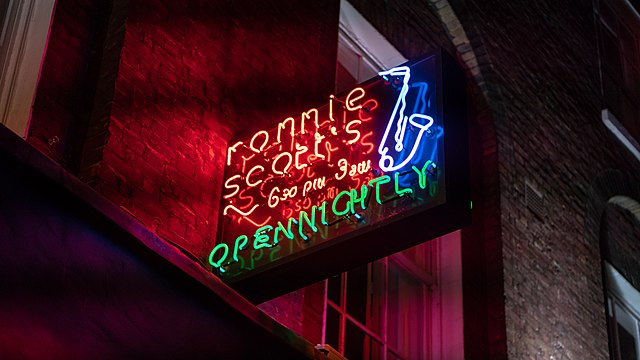
That could not be said for bassist Shri Sriram and his quartet at Ronnie Scott’s. Shri’s fretless bass was accompanied by the keyboards and analogue synthesizers of Bugge Wesseltof, the energetic drums of Gary Husband and the adventurous trombone of Dennis Rollins. Shri’s bass playing is a wonder, combining delicate tones and robust, percussive slapping. The music is taken and transformed from Shri’s recent album The Letter, produced and released by Bugge on his own Jazzland label.
You can hear that Shri is very influenced by German bass legend Eberhard Weber. His compositions are tone poems with unexpected twists and turns. The bass lines are restrained as we journey across empty Arctic landscapes, and then Mumbai at rush hour when the bass almost becomes a tabla.
Shri Sriram performing in 2015. Image: Birgit Fostervold, Wikimedia Commons
Shri announces a “British classic”. Is that Black Sabbath’s ‘Iron Man’ with jazz inflections? It surely is, and we cross from Mumbai to Bromsgove. Rollins seems to be playing an accompanying riff and soloing at the same time. Bugge gets his analogue squeaks and swirls going, and the band lock together. It is as if they are at the end of a lengthy tour, but this is a one-off performance to a packed house. Many more audiences need to see what this unique quartet of gifted and empathetic musicians can do. They close with a lilting, jerky reggae version of a tune already played – clearly, an improvised mash up with some magnificently dexterous bass from Shri.
You leave with a smile. We all did. As my friend observed, there is nothing better than live music in the right place at the right time. Come back soon, Shri.
SELBY WHITTINGHAM takes a Proustian and Ruskinian trip through his and France’s past
Rouen at last, after an interval of more than twenty-five years! Again it was August, and again the rain was sheeting down upon the glass dome of the railway station. The first time, a gawky ‘teenager’, …” So began my mother’s account of her return in 1950 to where she had once stayed with a rich bourgeois family.
Her first visit had been not long after the death of Proust, who once visited Rouen Cathedral in an attempt to find the little figure on the Portail des Libraires which Ruskin had admired. I have never got to the end of Remembrance of Things Past, but have had a number of Proustian friends, among them two who each had a parent who had known the author. One of those helped Proust translate Ruskin’s Bible of Amiens into English.
In addition to the fact of my accompanying my mother, when I was aged just nine, on her return, my becoming a Ruskinian – a bridge between my interests in the Gothic and Turner – encouraged me later to love Rouen, and now to indulge in what is partly my own memory of the past, as Ruskin did in his Praeterita, in which he named Rouen as the first of “the three centres of my life’s thought”.
Rouen Cathedral, c. 1912. Pierre Dumont
My mother, Barbara Whittingham-Jones, would have been sixteen in 1923, the probable date of her holiday. She had spent most of her life in a Lincolnshire rectory, but her father in 1919 transferred to a parish in Liverpool, from where my grandmother came.
The family she was sent to stay with lived at the Château du Grésil between Grand-Couronne, an increasingly industrialised suburb of Rouen, and Moulineaux, from where came the British Molyneux family – to which the famous diarist Thomas Creevey belonged, being almost certainly an illegitimate son of the Earl of Sefton. The château is set back from the Avenue de Caen on Route D3, for some decades now threatened by an encroaching housing estate (named after a Paris Communard), though still backed by the historic Forest of Rouvray, where William the Conqueror is said to have had the idea of invading England.
Had the family acquired the house only recently? An advertisement in Le Gaulois: littéraire et politique on27 August 1920 reads: “PETIT CHATEAU HENRI-IV … GRÉSIL … A GRAND-COURONNE (Seine-Inférieure), avec très jolie vue, chauffage central, eau, l’arc de 4 hectares [=c.10 acres] entouré de murs. Prix 175,000 francs. S’adresser sur place à M. LAURENT VILLÉGIATUR”. The only early record which I have found says: “au château du Grésil, la chapelle Sainte-Catherine bénie le 5 juillet 1734”. The layout of buildings both of the very small château estate (Grand Grésil) and of the even smaller one immediately to the west (Petit Grésil) remained the same as in a map of 1816, but then isolated from other habitations.
Alterations were made over the years, some recorded in the postcards that exist. One in use by 1905 shows the house from the end of the drive, on which stands a horse with its groom, with to the right the old tower of Petit Grésil. That located it in “Environs de Moulineaux”, but another dated 1914, giving a close-up view, places it in Grand-Couronne. Both show tall chimneys which were later removed. A card produced by Shell soon after 1972 (who owned the house by then, using it to accommodate engineers) shows the house covered in creeper, which doubtless had grown since the outbreak of the war in 1939. My vague memory of it in 1950 is of a place that had run wild.
My mother read history (a lifelong love) and law (for practical reasons) at Newnham College, Cambridge, being called to the bar at Gray’s Inn in 1931, aged just 24. She later became a Conservative activist (trying unsuccessfully to get elected as a councillor in a Labour ward of Liverpool) and a prominent anti-appeasement campaigner. She was living in Malaya on the outbreak of war, where she married my father, Henry R. Oppenheim, in 1940. She joined the WAAF, and then became a war correspondent after her return to England. (She and I had escaped from Singapore on the last ship home in 1942; my father later escaped in a small boat with the controversial Australian general Henry Gordon Bennett, whom he portrayed as being in a state of hysteria, while his troops had all become drunk.) Apart from her war reportage, she published on subjects ranging from Indonesia and Malaya to the history of Liverpool. Most of these now are of only specialised interest, but her article about her return trip to the château, which appeared in the January 1951 issue of Blackwood’s Magazine under the title of ‘The Adopted Son’, remains by contrast very fresh and readable.
That ‘Son’ was Benito, an Argentinian by birth. He became a favourite of his adoptive la Mère, and was also adored by my mother. In my mother’s case that may have been due to the contrast with her own mother, who could be critical and satirical. La Mêre had two other contrasting children, the pale Pierre with her first husband, and the swarthier Julietta with her second, a French diplomat at Buenos Aires. The family also consisted of the benign grand-mère, her sister the querulous tante and the second (or third?) husband, who spent weekdays at his office in Paris, avoided mass on Sundays and died soon after. There was no mention of the family in the 1950 telephone directory, but a 1936 census seems to indicate that la Mère was then head of the household, Suzanne Jourjon, born at Lille in 1883. With her were a domestique and a cook and Angelito Rodriguez, born in 1900 at Morón (a district in Buenos Aires), with Argentinian nationality and described as “régisseur” or director. I shall however continue to call the latter Benito – or ‘To, as my mother referred to him.
“We had the run,” wrote my mother, “of the park, the orchard, and the kitchen-garden. The temptations of the orchard were irresistible. Those greengages! Large, lustrous, and yellow-gold … Immediately below the château lay the ‘field’, an unfenced sward girt by the circular drive, where the cows were tethered, tended by the lodge-keeper, Marie. Above the château loomed the forest, with its muted, velvet-carpet, its long green lanes.” The latter included the Route Forestière du Grésil some distance back from the house. The daily life was rural and simple. The local curé, “Le Grosgros”, came for a delicious lunch on Mondays, fondling La Mère’s plump forearm to the annoyance of Julietta. The latter with my mother one cold night walked through the forest to his presbytery, where they were treated to tiny glasses of Benedictine.
The Gros Horloge at Rouen, Normandy c.1832. Joseph Mallord William Turner
On Tuesdays Rouen was visited by train, calling at the fashionable patisserie and salon de thé founded in 1825, Maison Périer, 68 rue du Gros-Horloge – today, the facade little altered, the premises of the Parfumerie Nocibé. The clock tower was painted by a succession of English artists in the 1820s and 30s, mostly from the opposite direction, looking towards the cathedral with the bell tower on the right, the viewpoint taken c.1832 by Turner, who repeatedly visited Rouen, and by most later artists. But there is one by Gustave Henri Marchetti of 1920, with the bell tower on the left and the Maison Périer in the foreground on the right, the street filled by people in the dress of the time – as also in a photograph preserved by my mother on the front page of the Sunday Times of 8 July 1956, before the street was levelled and pedestrianised. At school about the same year my aged classics teacher brought from his stock of postcards one showing the clock tower, asking me if I knew where that was! In blogs about Rouen, people still recall the patisserie as a popular and chic rendezvous up until the 1970s.
The Gros Horloge, c. 1920. Gustave Henri Marchetti
We revisited the patisserie too in 1950, walking from the blackened and closed cathedral. An old assistant had not seen la Mère since before the war. Nothing daunted, we dashed to the modern bus station to catch the autocar, which after breaking down deposited us by the château entrance. The house was in a sorry state, the salon destroyed by a shell, other rooms bare except for the bedroom of la Mère, who had died the previous April, and which Benito had kept untouched during the war. In the neglected orchard Benito gave me the largest apple I have ever seen. Talleyrand once wrote “He who has not lived in the eighteenth century before the Revolution does not know the sweetness of life”. What would he have said on seeing the château, and Rouen, in 1950?
Rouen Cathedral, 1946, W. Carl Berger
Our unannounced visit resulted, after recognition, in warm greetings and exchanges of memories. One was of a struggle over a gun between Pierre and Julietta which caused a bullet to graze my mother’s ear and splinter the panel of a door in the hall. Benito (or ‘To, as my mother called him) pointed to the replacement panel which had been made at the time.
One of the walks Julietta and my mother used to take through the forest was to a clearing with a Franco-Prussian War monument of two or three French soldiers reeling beneath the swords or bayonets of Prussians in spiked helmets. Some years after her visit my mother was at Heidelberg, where she met a handsome and fascist Prussian student, whom she now called Conrad von Hunziker, and who, in a neat ending to her story, brutally occupied the château in 1940.
The Latin charm of Benito, combined with the fact that my mother’s great-uncle and two of his sons had lived in Buenos Aires, then a major trading partner of Britain, may have sparked in her a desire to see that city. According to my grandmother, the invitation to stay with the family was due to a business connection between it and my great-grandfather, a manufacturer and exporter of paint. Again according to my grandmother, who, so my grandfather said, liked sometimes to embroider her stories, my mother, accompanied Randolph Churchill on a trip to South America to report on an upheaval there, but arrived after it had ended (probably the 1932-5 Chaco War between Bolivia and Paraguay). Randolph arrived at Buenos Aires on 7 June, being ordered by his father to return home “forthwith” to deal with a libel case. He got back on 2 July, the day when my mother’s surviving journal begins.
On 23 September, for a meeting at Penny Lane in Liverpool, she borrowed her aunt’s large Austin (both going strong over 35 years later), commenting, “Had she [her aunt] known that the car of a liberal-pacifist-vegetarian was to be used for a Churchill–Tory-platform, how she’d have writhed.” The following year a spoof advertisement, showing such a car with my mother at the wheel and Randolph beside her, heralded the “New Randy-Jones … Two Lung Power – Free Squealing – Double Ball Bearing … any colour except orange.” Orange was both the Labour colour and stood for the ultra-Protestants in the city.
Randolph had split the Tory vote by standing as an independent in a still remembered Liverpool by-election in January 1935. How he and my mother got thrown together was partly due to their joint attacks on the local Conservative caucus, controlled by Sir Thomas White – hence the suit for libel, which had been instigated by White. Both Winston and Randolph occasionally said they were not Conservatives, but Whigs. In her various writings on Liverpool politics, my mother described the seven different political clubs of a century earlier supporting a whole gamut of opinions, the Conservatives opposing their corporation fellows sporting the colour red, as she did. She was drawn to the more liberal end of Conservatism and later may have voted Labour and Liberal in turn, being studiously vague because of her attachment to the historic secrecy of the ballot and a love of mystification. Winston Churchill became a radical Liberal before returning to the Conservative fold with the help of White’s predecessor, Sir Archibald Salvidge, an Orange sympathiser, who established Liverpool as a Conservative city on the foundation of the support of working class Protestants and exclusion of Catholics – which my mother opposed, looking back to the time when Canning was a Liverpool MP supporting Catholic emancipation. Moreover, my Anglican grandfather was damned as “a rather ritualistic local vicar” by the Independent Alderman, Revd Harry Dixon Longbottom, a sort of precursor of the Revd Ian Paisley.
Her teenage holiday additionally made my mother a lifelong Francophile. When I reached the same age as she had been in 1923, she spotted a small advertisement on the front page of The Times. This sought an exchange with the eldest son of the advertiser, a former mayor of Angers, which duly occurred, instilling in me too a deep love of France.
The Chateau today
Twenty-five years later on holiday, I searched in vain, to the exasperation of my wife, the location of the Château du Grésil and the landmarks I had passed en route in the autocar from Rouen in 1950. The château is not named on modern maps, but can be found just to the left of the Rue Eugène Pottier (1816-87, the Communard revolutionary), on a circular drive joined to a straight one from Route D3. In the archives there are online maps one of 1813 and another later, undated one. These show two small estates: Hameau du Grand Grésil and, just to the west, Hameau du Petit Grésil, the latter presumably the one with the tower seen in later photos. The layout of the buildings in each estate was the same and conforms to what exist today. Later maps of 1961 also exist.
Monsieur Benito had died in 1972, fourteen years after my mother’s death. His true identity until now remained hidden, as my mother wanted to respect the family’s privacy and besides, as already remarked, enjoyed occasional mystification. He had told her that he had adopted the grandson of Marie the lodge keeper, born illegitimately in the same year as myself. That boy was one of those who first greeted us in 1950.
Many Britons still visit Rouen, thanks to the persistent hold its history and fabric have on our national imagination – a legacy of Monet, Turner, Ruskin, Proust and less happy wartime memories. But it cannot feel as personal for many of these visitors as it does to me – a place suffused not just with artistic significance, but memories of my own boyhood, and always the powerful presence of my mother. The Cathedral may have been restored, some old town streets can still be seen, and even the Château still stands – but it all feels increasingly distant, a domain as lost as Alain-Fournier’s ‘Les Sablonnières’ – a France, and a Europe, increasingly emptied of an ineffable “sweetness of life”.
Further reading
Ian Warrell, Turner on the Seine, Tate Gallery, pp.162-91
J.Morlent, Voyage Historique et Pittoresque du Havre à Rouen sur la Seine, en Bateau à Vapeur, 1829 (copy owned by Turner)
John Murray, Hand-Book for Travellers in France, being a Guide to Normandy etc., 3rd ed. Revised, John Murray 1848 (copy owned by Ruskin)
The Traveller’s Handbook for Normandy & Brittany, Thos. Cook & Son, 1923
J.G.Links, The Ruskins in Normandy: A Tour in 1848 with Murray’s Hand-book, John Murray 1968
Géraldine Lefebvre, Léon Monet, frère de l’artiste et collectionneur, Musée du Luxembourg, Paris, 15 March-16 July 2023
Churchill Archive, Churchill College, Cambridge
Paul Nuttall, ‘Whiteballed’: Randolph Churchill, The Conservative Union and the Liverpool Conservative Party, 1935, 2020
Josh Ireland, Churchill & Son, 2021
Randolph Churchill, The Young Unpretender. Essays by his friends collected and introduced by Kay Halle, 1971. (Michael Foot recalled attending one of Randolph’s meetings in the Wavertree by-election, when Randolph cried “And who is responsible for putting Liverpool where she is today?” prompting a voice from the back of the hall, “Blackburn Rovers!”)
Anita Leslie [sister of the unconventional Irish baronet, Shane Leslie, 1916-2016, Légion d’honneur 2015], Cousin Randolph: Life of Randolph Churchill, Hutchinson 1985
Arturo Bray (1898-1974), Armas y Letras (Memorias), 3 vols, 1981 etc
Spruille Braden, Diplomats and Demagogues, New York 1971
SELBY WHITTINGHAM is the founder and secretary of the Independent Turner Society, which campaigns to unite all of J M W Turner’s paintings in a special Turner Gallery, in accordance with the painter’s last wishes. He is also the author of numerous books on Turner, and a regular contributor to The Jackdaw
Akhenaten, Nefertiti and their children. Image: Wikimedia Commons
RICHARD DOVE revels in Akhnaten at the ENO
“The thing about Philip Glass is that there’s so much repetition.” A friend pronounces his verdict. Well, yes, but what repetition. The ENO revival in association with LA Opera with the third of Glass’s so-called ‘portrait’ operas, Akhnaten, is entrancing. The set is a multi-level tableau of slow-moving interpretation and quite a bit of juggling. The jugglers are there to symbolise, I think, an imposition of order on the chaotic religious miasma that was ancient Egypt. King Amenhotep IV succeeds his father and declares a monotheistic religion with him, unsurprisingly, at its pinnacle.
The music swoops, swirls and glides across the narrative with the singers seeming to provide accompaniment for the orchestra and vice versa.
Glass had to do shifts as a New York taxi driver alongside regular plumbing jobs to help fund (and subsequently pay for production losses) his first portrait opera, Einstein on the Beach, which he developed with the grandiloquent imagination of Robert Wilson. He began by performing in sparsely attended recitals in New York lofts. Slowly, opera houses around the world caught up with Philip Glass. His second portrait opera on Mahatma Gandhi, Satyagraha, was a resounding and enduring success.
Akhnaten is now almost 40 years old and Glass has moved from the fringe to the mainstream. He is now chauffeur-driven.
American counter tenor Anthony Roth Constanzo has made the role of Akhenaten his own, appearing in productions in 2016, 2019 and now in this revival. He shows no signs of weariness with the role, commanding the huge stage with his soaring voice and subtle, precise gestures. His wife, Nefertiti, is an equally commanding presence, with mezzo soprano Chrystal E Williams delivering power and gravitas.
Phelim McDermott’s production is bold and sometimes a little baffling when images override meaning – a sort of Zoolander moment or two amidst the creative visual excellence.
The Coliseum was packed for the performance – ENO at its very best. The attempt by the Arts Council to shift it out of London is gesture politics at its most egregious. Let’s have more ENOs in Lincoln, Newcastle, Plymouth as well as London. We all need doses of cultural excellence, as bills mount and services decline.
The audience is wonderfully diverse and soundly engaged despite the singing in Egyptian, Hebrew, Akkadian and English. You do not need surtitles to get the gist. We are now well attuned to small dictators marooned in gilded palaces. It was only in the late nineteenth century that the remains were discovered of the city Amarna built by Akhenaten. In 1907 a mummy was unearthed that is most probably Akhenaten. The body was effeminate with womanly hips, elongated skull and fleshy lips, giving rise to speculation that he suffered from rare diseases. His androgynous appearance is cleverly portrayed in the opera. Akhenaten, the Sun King, is variously described as enigmatic, mysterious and revolutionary as well as mad and possibly insane. This production captures all those contradictory passions in a magisterial sweep. It is certainly repetitive but gloriously so. I will let my friend know.
Friedrich Nietzsche, Michael Hulse (trans.), Notting Hill Editions, 2022, pb., 312pps + xiv, £12.99
Unpublished Fragments from the Period of Thus Spoke Zarathustra
Friedrich Nietzsche, Paul S. Loeb, David F. Tinsley (eds., trans.), Stanford University Press, 2022, pb., 576pp + xii, US$30
Nietzsche’s “Thus Spoke Zarathustra”
Keith Ansell-Pearson, Paul S. Loeb (eds.),Cambridge University Press, 2022, hb., 277pps + xiv, £75
ALEXANDER ADAMS sees new sides of Nietzsche
Apparently, at one stage of World War I, every German soldier deployed was given a copy of Nietzsche’s Thus Spake Zarathustra, apparently to fortify their will. It is in some ways an odd choice. Nietzsche subtitled it “A book for all and none”, realising that many readers would be baffled by the messages. Although few would have been perplexed at the presentation of moral-philosophical issues in the form of fables – for what are fables, if not moral-philosophical issues rendered in colourful narrative form? – many would wonder what exactly those messages were. Initially, that was not a problem because there were so few readers. A long, fabulous narrative, featuring a protagonist barely known in modern Europe, split over multiple volumes, written by a little-known retired professor of philology had few takers at the time. It is hard not to think that while it might have been undervalued on first appearance, it was equally overvalued soon afterwards.
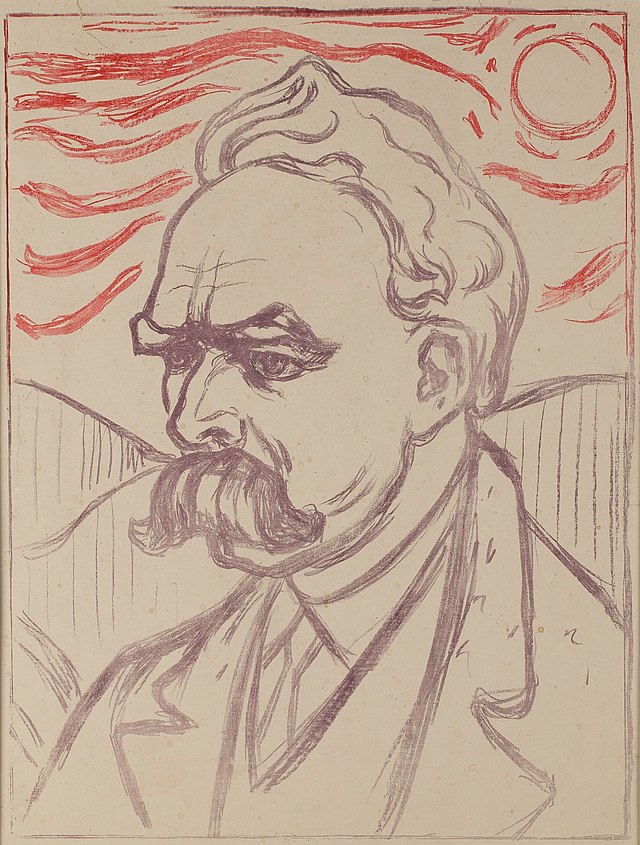
No philosopher had greater influence on the development of modern history and Modernism in the arts than Friedrich Nietzsche (1844-1900). Of his writings, Thus Spake Zarathustra (1883-5) is unique in that it is written from the perspective of a fictionalised character, Zarathustra (or Zoroaster), founder of the Zoroastrian religion. It became the book Nietzsche was most pleased with, even though it has been criticised as verbose and overwritten. His later, aphoristic style, written in the manner of Heraclitus, is easier to follow and considered more effective as prose; as rhetoric, Zarathustra maybe carries more impact. A new translation of this, perhaps Nietzsche’s most popular book, has just been published. It joins two other related books, one a critical analysis of the text and another being a previously unseen fragment written at the same time as Zarathustra not included in other publications. This review will discuss all three.
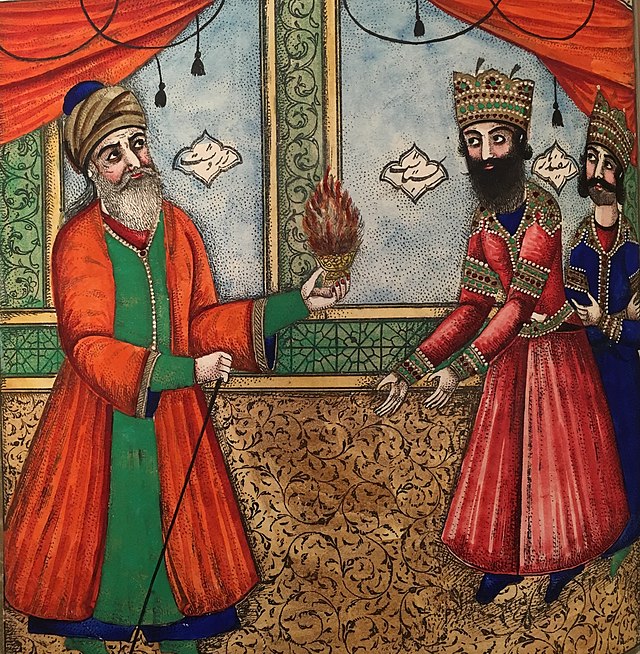
A mid-nineteenth century Indian depiction of Zoroaster/Zarathustra
Nietzsche presents his thoughts through the voice of Zarathustra, acting as religious-philosophical counter to the Gospel narrative of the teaching of Christ. He wanted to bypass scholars and reach readers directly, although he had no pretensions to populism or accessibility (remember – “A Book for All and None”). For those seeking the evidential arguments of The Birth of Tragedy or the late aphorisms written in Heraclitus’s style, Zarathustra will prove a trying book. Not that it is hard to read, but rather its indirectness and intrusive imagery prove an impediment to understanding Nietzsche’s reasoning, even if it is effective rhetoric.
A fifteenth-century Flemish depiction of Zoroaster/Zarathustra
Nietzsche’s book, originally published in four volumes, has been characterised as the resolution to a crisis reached in the preceding book The Gay Science, which included the dramatic passage in which a truth-saying madman declares that God is dead, killed by modern society, one in the throes of scientism and humanism. In Zarathustra Nietzsche explores a way out of this spiritual dead-end. He concluded that the Übermensch (German: superman), the man who embodies truth and will to power were the solution to the derangement of values and the death of trust in religion. The nihilism that consumes deracinated, scientific, rational man can only destroy and cannot produce – at least in the long-term, outside of art as “the sum of destructions” pace Picasso – and must be countered by a conscious transubstantiation of all (received) values. The Übermensch will master first himself and then the world, through the exertion of the will to power, which overcomes fear. Not every man will be capable of that; only the superior man will be capable. The normal man must be led by these self-actualised Übermenschen. This is clearly the part that was meant to stimulate German soldiers in the muddy trenches towards heroism.
Image: Talmoryair. Wikimedia Commons
Nietzsche is scathing of many movements and grand figures of his time. The most striking fable is of socialists (“preachers of equality”) as tarantulas:
Revenge sits within your soul; a black scab grows wherever you bite; your venom makes the soul giddy with revenge! […] ‘What we call justice shall be precisely this: the world shall be filled with the storms of our revenge’ – that is how they talk among themselves. ‘We shall practise revenge and abuse against any who are not as we are’ – that is what the tarantula-hearts pledge to each other. […] Vengefulness sounds from every one of their complaints, and all of their praise is hurtful; and to be judges seems a blessed thing to them.[i]
This is related to Nietzsche’s thoughts on ressentiment, the system of behaviour springing from recognition and reaction against a person’s weakness and inferiority and reacting by projecting anger upon others as a way of evading self-knowledge and self-correction. Self-overcoming is one of the main themes of the book. The mass adoption of mindful self-overcoming will see the rise of the Übermenschen on a civilisational (epochal) level.
The figures who appear in part 4 are often seen as disguised responses to individuals and types. These have been seen as follows: the soothsayer is Schopenhauer, the conscientious man is the scientist (Darwin?), the sorcerer is Wagner, the ugliest man is the atheist, the shadow is the freethinker, the voluntary beggar is Buddha or Tolstoy. This interpretation is omitted from the new translation. Likewise omitted are textual notes on features of the original text, which includes some untranslatable puns and wordplay. The translation of the new edition is by Michael Hulse, former academic at Warwick University and translator of W.G. Sebald, Rilke and Elfriede Jelinek. He is also an acclaimed poet and therefore in an ideal position to capture the sweep and precision of Nietzsche’s mannered style in English – not least the passages of verse. Hulse has chosen to strike a middle path between directness of speech and the language of the King James’s Bible, eschewing the archaic but retaining something of the stiff rhetoric of the ancients. This is effective and never attempts to conceal the deliberately florid style Nietzsche adopted for this book.
In terms of fluency and potency – accuracy is something that I cannot aver – Hulse’s version is excellent. The awkwardness one encounters is deliberate and reflects Nietzsche’s deliberate stylistic choices. Hulse’s version reminds us that Zarathustra is written in a portentous, high-spirited manner, while never favouring fluency over exactness. This translation is slightly less of an easy read than others because it forces you to notice and does not slip into a manner. So, although it might seem paradoxical, the granularity of the Hulse translation directs one’s attention to the meaning rather than (more passively) imbibing the prose style or becoming attached to the atmosphere.
Editors Keith Ansell-Pearson and Paul S. Loeb assert in their introduction to Nietzsche’s “Thus Spake Zarathustra”: A Critical Guide:
…recent philosophical scholarship tends to marginalize TSZ and to downplay its significance in our engagement with Nietzsche’s thought. […] The aim of this volume is to remedy neglect of TSZ by highlighting its importance for a fuller understanding of Nietzsche’s contribution to philosophy…TSZ needs to assume a central role in any informed appreciation of his style of philosophical practice as well as of the fundamental content of his core ideas.[ii]
Ansell-Pearson and Loeb observe that Nietzsche wished to detach himself from professionalised philosophy by taking up a persona and writing in fables:
Nietzsche knew that the philosophical texts he wrote in his own voice could be easily assimilated into this bloodless academic culture, so he deliberately designed a new kind of philosophical text that would resist any such assimilation. His fictional protagonist actually practices philosophy as a way of life and this is shown by the narrative of his transformative travels […][iii]
Nietzsche intended Zarathustra to be a return to the Greek model of lived philosophy.
Benedetta Zavatta discusses the controversy about the composition of the book. The first three parts were published in separate volumes and the author considered them complete. He then published a fourth part, which was part of an intended further three volumes. Whether this last part is a new book, or an extension, is an open question, made all the more pointed by the fact that the author later wanted volume IV retracted. Other essays by specialists consider Zarathustra as ecological warning, because of Nietzsche’s naturalism (contra Schopenhauer’s metaphysics), as well as the book’s treatment of moral philosophy, politics and transhumanism. Ansell-Pearson and Marta Faustino’s essay on the quest to embody philosophy in a text for living is particularly effective at unlocking Nietzsche’s intentions. Christopher Janaway refutes the common correlation between the soothsayer character in Zarathustra with Schopenhauer, going on to argue that Zarathustra’s teachings do indeed reject Schopenhauer’s urge to combat ubiquitous ceaseless will.
Zarathustra is sometimes partitioned from the main body of Nietzsche’s philosophy as fiction. Likewise, the Nachlass (German: estate) papers, currently being published in a critical edition (translations published by Stanford) are considered by some illegitimate, as working materials that were not deemed suitable for publication (or even preservation). As such, some writers will not consider them as part of Nietzsche’s oeuvre.
That is what makes so contentious the Unpublished Fragments from the Period of Thus Spake Zarathustra (Spring 1884-Winter 1884/5), the 15th volume in the series The Complete Works of Friedrich Nietzsche published by Stanford University. Each volume comes with extensive notes and commentary. Summaries guide our general understanding of themes, while translators’ comments on the most important terms allow non-German-speakers to gauge Nietzsche’s text, making us aware of linguistic subtleties, as well as adding extra thoughts regarding Nietzsche’s sources, influences and intentions. An index is included. It comes as a surprise to encounter Nietzsche writing so much on fine art, especially painting, about which he never published. Nietzsche’s view of history is both linear and cyclical, with cycles unable to repeat exactly due to linear characteristics of historical development. He is a pessimist – “The dumbing-down and homogenization of Europe on the rise, / Ever-increasing enmity of the progeny of the nobility toward l’homme supérieur. / […] The lack of any moral practices: feelings instead of principles.”[iv]
In response to the deterioration of Europe following the French Revolution, Nietzsche toys with the idea of selective breeding to counter racial decline.[v] However, once work starts in earnest on Zarathustra, he returns to the nature of morality and moral exemplars. He is insistent on the destruction of Christianity, as an impediment to development.
Most of the fragments are aphorisms only a sentence or two long. The drafts for Zarathustra are the only sections longer than a page. There is a section of verse – verse forms a significant part of Zarathustra – which has more merit as a distillation of thought than as poetry. The lists of images in the notes reach the level of Surrealist poetry inadvertently and top the verse. “– thistle-heads, scrupulous saps – hasty, like jumping spider monkeys – between coffins and sawdust – dizzy dogs and sickly breeds all around me – a cold bath […]”[vi] The Fragments are a terrific read – pithy, cutting, stark, playful, grand. It is like being in the company of the philosopher at his most expansive and garrulous. It is, of course, not the same as a considered conclusion or articulated argument, which is why anyone seeking enlightenment and information about Nietzsche’s philosophy must be extra wary of these seductive writings.
ALEXANDER ADAMS is an artist, art critic, novelist and poet. His most recent book is Artivism: The Battle for Museums in the Era of Postmodernism (Societas/Imprint Academic, 2022)
MICHAEL YOST finds a collection of original religiously-inspired verse rather forced
There are two major traditions pertinent to verse literature that are seldom engaged in, but for all that are the more interesting when an artist does make use of them: the theological and imaginative Christian tradition of faith, and the much more practical tradition of formal verse craft.
In most people’s minds, the two probably go together; one thinks of the Anglican John Keble’s Christian Year, the Roman Catholic James Matthew Wilson, or the American Protestant Longfellow, all of whom reward the interest of their readers. However, the major religious tradition of the West is less often engaged today, and many Christian poets take the outward and visible signs of form as Luther and Zwingli took the outward and visible signs of the Eucharist: conventional, and unessential.
T.S. Eliot suggested in his essay Religion and Literature that what was needed was not religous literature in the obvious, propagandizing manner of a Keble or Chesterton, but rather the unconsciously religious literature of a Dante or a Joyce. As I have suggested in another essay, Eliot’s idea of the relation between religion and literature also is true of any set of first principles, or overarching metaphysics; the reason Eliot sought for an unconsciously religious literature was because he wished religion to inform the bones and marrow, the form and substance of literature, not merely decorate it with the furniture of, say early-mid-twentieth century Anglo-Catholicism. In brief, the law of craft is the law of belief, or philosophical conviction, or more often, the lack of those things.
This is not to say that formal verse is always the work of deists. But it is per se the work of people who have some stake in things as ordered, even if the order is conventional, or merely conservative in character. Here we come to Clarence Caddell’s The True Gods Attend You, a chapbook published by Bonfire Books, the Australian press. What makes Caddell interesting is that his poems do often address religious themes; but in each case they are pitched with a deep and seemingly impenetrable irony. In reading them, I cannot help but place them in the category of consciously religious.
This is largely because the primary concern of the poems is, as in a devotional poem, religion and religious experience. The difference is that the religious poems are counter-propaganda; they are devotional poems in reverse. Not much to their credit, the poems’ engagement with religion largely draws from the fragmentary and derivative gnostic texts of the Church’s early period, as well as two books that each propose a conspiracy-theorist’s account of the origins of Christianity. There are poems of some formal merit, such as Initiations, The Golem, Passover Feasts of the New Covenant, Elegy With an Omen, and A Mobius Wedding Band; as well as a long blank verse narrative poem, The Candidate. These I would single out among the collection as poems whose ideas are engaging, but more importantly, solidly executed. In many of the other poems, there is a distinct lack of metrical control. Cadell’s hand is often shaky as he tries to unpack complex situations, parallels, and resonances within a brief space. Trochees, eye rhymes, weak rhymes, (such as the anachronistically signaled elision “o’er” that exists in order to rhyme with “floor”) and awkward syntax abound, marring an energetic idea, crippling a final stanza, and perhaps most difficult, undermining the authority of Cadell, the poet and speaker. On one or two occasions the concrete situation of the poem is nearly impossible to discern.
There is also a distinct difference between the poems that rely on history, the re-formulated symbolism of the Gnostics, or the tendentious and ludicrous thesis that Christianity was a political invention of the Flavian dynasty, and the poems that seem to draw from Caddell’s own experiences of life, love, and loss. The aforementioned poems can be by turn, difficult, energetic, and reliant upon an imaginative world inherited by Caddell. When they succeed, they succeed because Caddell unlocks their complexity, which pours out in a torrential fashion reminiscent of the metaphysical poems of John Donne. This is the case in the Blakean Initiations. But where they fail, it is because that complexity has failed to materialize in an ordered way. Caddell’s more intimate poems, by contrast, work precisely because that same intricacy is in play, but in a context that is both familiar, tender, and surprising, such as A Mobius Wedding Band. But even here the shield of irony is raised. I wish to turn to that particular poem as a success: an English sonnet that treats of married love; a love that is painful and yet inseparable, desired and feared. It plays with the same themes of distance, suffering, betrayal and desire that another of his poems, Vicar of Christ, engages; but with a more perfect union between form and content, a clearer direction and drive moving through the entire poem, and a perfect complication of the symbolic ring of marriage. Here, the symbol seems to truly mean something, even in its reversal. The Candidate, the longest poem in the collection, details the conversion and reversion of a family man to and from the Roman Catholic Church, or at least, a parodic vision of that church. Throughout the poem, the sincerity of his spiritual search is pushed back against, and ultimately revealed as an expression of his own narcissistic quest for “religious experience.” The heavy-handed moral is that the candidate should avaunt church-shopping and return from its distractions to his wife and family. It is singular insofar as it depicts an often undepicted subculture within Catholicism. But it does not ascend above the level of caricature.
Earlier in the review, I suggested that “the law of craft is the law of belief, or philosophical conviction, or more often, the lack of those things.” How does this apply in Caddell’s case? The True Gods Attend You stands half within the world of traditional religious expression (if ironically so), and half out of it. Likewise, Caddell has difficulty fully achieving coherence and rigor of poetic expression. His poems are indeed “formalist” as the blurb of the chapbook declares. But often the poems are (it seems unintentionally) rumpled. In both cases, it is hard for a Christian reader not to suggest that both constitute a falling away – an imperfect or misunderstood discipline. In sum, there is something to commend the originality and force, as well as the wit behind The True Gods Attend You. Caddell has skill, and an idiosyncratic vision. What remains to be seen is whether both, in time, develop.
MICHAEL YOST is a poet and essayist living in rural New Hampshire with his wife and children. His essays and poems have been published in places like Modern Age, First Things, The University Bookman, Dappled Things, The Brazen Head, and others. He substacks at The Weight of Form