High treasures of the Low Countries

KMSKA: The Finest Museum

The Holy Family by Rubens. KMSKA

Patrick De Rynck (ed.), KMSKA, 2022, hardback, 256pp, fully illus., €45

KMSKA: The Finest Hundred

Patrick De Rynck (ed.),KMSKA,2022, hardback, 288pp, fully illus., €45

Bruegel and Beyond: Netherlandish Drawings in the Royal Library of Belgium, 1500-1800

Daan van Heesch, Sarah Van Ooteghem, Joris Van Grieken (eds.), Hannibal/KBR, 2022, hardback, 392pp, fully illus., €64.50

ALEXANDER ADAMS loses himself in the Low Countries

When the Royal Museum of Fine Arts, Antwerp (Koninklijk Museum voor Schone Kunsten Antwerpen, KMSKA) reopened on 24 September 2022, it had been closed for 11 years for a massive renovation that involved every part of the building and grounds. Two of three recent books cover the KMSKA as a museum, and highlights from the museum’s collections; the third covers Flemish and Walloon drawings from the Royal National Library of Belgium, in Brussels.

KMSKA: The Finest Museum is an overview of the renovation, including extensive photographs and plans relating the work done, including photographs of the renovated museum complete with art works. The museum was established in 1810; it expanded over the centuries and moved location from the academy to a purpose-built museum in 1890. It now houses 5,882 works, with prints by and after Rubens amounting to 714 prints.

Royal Museum of Fine Arts, Antwerp. Photo: Ad Meskens. Wikimedia Commons

Claus en Kaan Architecten initially expected the work on the museum would take place in stages that would allow the museum to stay open. That changed once a thorough inspection was undertaken. The building was in a much worse condition than had been expected, with large amounts of asbestos to be disposed of, and the climate-control system needing to be replaced completely. In order to provide new gallery space under the old building, a nuclear fallout shelter was dismantled. Care was taken to use as much natural light as possible, even on the new lower-floor galleries. The architects recognised the brilliant perfection of the original design, which had fine sightlines and so much natural light that electric lights were not added until 1976. The later addition of divisions for offices, depot and conservation studio complicated the layout and reduced space for art, so were removed.

The façade was repaired, using stone more frost-resistant than originally used. All the time, the new architects consulted the archives. A major alteration to the museum in the renovation was the use of internal courtyard patios for new galleries. These are starkly contemporary, with the old galleries restored to their 1890 state. Pompeiian-red and olive-green walls with gilded stucco detailing in ceilings and cornices. The minimalist settings for Modernist art are very sterile.

Of more concern is the thematic hanging of art. This new trend places pieces of art of ostensibly similar topics and themes beside one another so that they can permit cross-era comparison. This (initially) seems well meaning and stimulating; actually, it displays indirect hostility. The idea of curatorship as the placing of items of similar periods, places and makers in proximity is one where comparison of closely related items build a cohesive depiction of the attitudes, practices and mediums of the time. It is the bedrock of connoisseurship. That is why modern curators hate it. They seek to disrupt expertise by suggesting such a quality is merely the air of fusty museum denizens and narrowly focused specialists. It is allied to the trend of political programming, globalisation and cross-disciplinary studies – those justifications for disrupting networks of established knowledge and values. 

KMSKA Curators here note that the museum cannot display an encyclopaedic story of European art because of the limited range of the collection. This seems insufficient grounds for breaking up a canonical presentation in terms of period, style and geography. In one photograph, a Rubens Holy Family is juxtaposed with a recent painting by Luc Tuymans. The large, richly coloured, emotionally inflected masterpiece next to the tiny painting of a face, drained of emotion, depth and colour, rather points out the futility of the experiment – unless it was done to demonstrate the weakness of today’s art.

I concede I could be wrong about the KMSKA hang but all previous such displays I have encountered have had an air of a curator intrusive buttonholing the visitor to comment ‘Have you noticed?’, in comparisons that are either obtuse or superficial. KMSKA curators seem to have been let off the leash in limited circumstances. Let us hope thematic foolishness – which does a disservice to a specialist and anyone seeking to understand an art work from context – is reversed promptly.

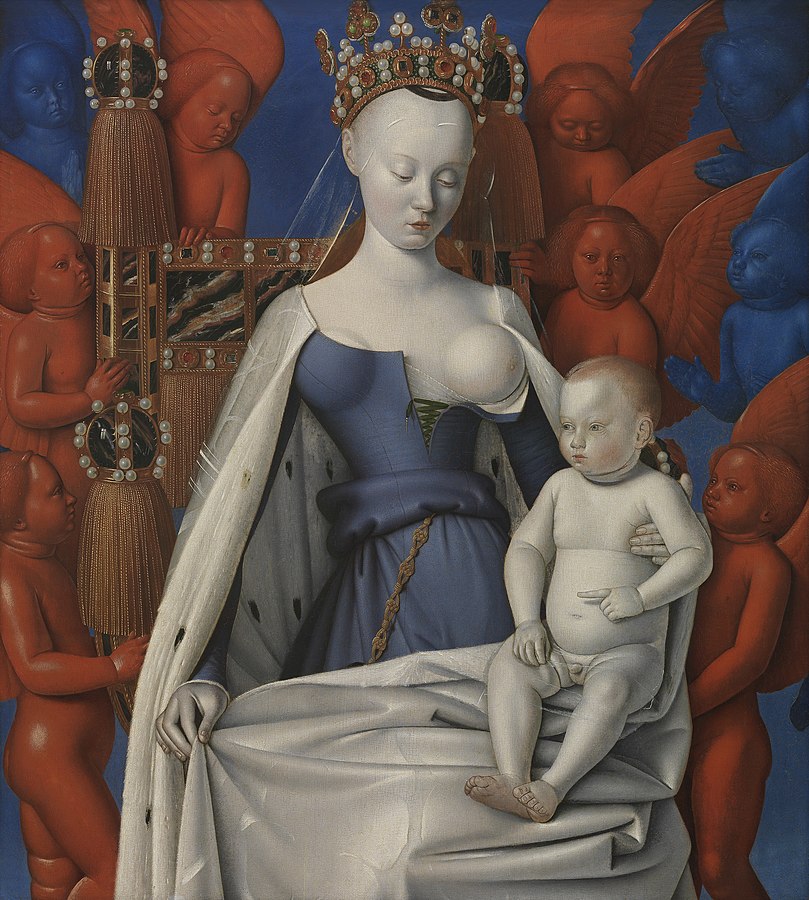
Jean Fouquet: Madonna Surrounded by Seraphim and Cherubim, 1450s

To find out what is in the KMSKA permanent collection, one can consult The Finest Hundred, which offers a selection of highlights, starting in the late Gothic period, with Simone Martini, through the Renaissance and the Golden Age of Low Countries art. Masterpieces of this period include an unfinished Jan Van Eyck panel (that somehow evaded a common tendency to finish or tidy up incomplete paintings), Jean Fouquet’s famed Madonna Surrounded by Seraphim and Cherubim (c. 1452-8) (that chilly classic, part maternity, part erotica), a Cranach nude and a handsome early Titian. Other South Netherlandish paintings are by Van Eyck (again), Rogier van der Weyden, Hans Memling and Quinten Massys. The Fall of the Rebel Angels (1554) by Frans Floris shows Archangel St Michael slaying nightmarish monsters. Naturally, the home city of Rubens houses a fine collection – mainly of large religious works. There are Dutch still-lifes and Flemish religious paintings. Portraits record important figures in Antwerp’s history, including the period under Hapsburg rule.

James Ensor at his easel. Self-portrait, 1890

There is a historical revival painting by Henri de Braekeleer (1840-1888) of a man seated in a seventeenth-century interior, with a fabulously ornate wall hanging behind him, as richly foliated as a forest. The KMSKA’s great collection of 39 paintings and over 600 drawings by the brilliant individualist James Ensor (1860-1949) is represented by six examples, including two of his ground-breaking and influential mask paintings. The museum’s policy of buying good examples of contemporary art from local exhibitions has paid off in the form of a strong collection from the inter-war period of Flemish Expressionism, Fauvism and Post-Cubism. There is a scattering of more foreign art by Ingres, Modigliani, Fontana and others.

The Finest Hundred contains a chapter explaining the renovation project, including some of the same photographs illustrated in the previous book. The book contains full works and some details, with a page of commentary and details for each painting or sculpture. For the average reader wanting to know about KMSKA’s art, The Finest Hundred is the best book; for architects, designers and those in the museum field, The Finest Museum is the best choice.

Bruegel and Beyond: Netherlandish Drawings in the Royal Library of Belgium, 1500-1800 presents 98 drawings by Dutch and Flemish artists born before 1800, now in the collection of the Royal Library of Belgium, Brussels (KBR). (The term ‘Netherlandish’ in art history usually means from the Low Countries, before 1500; after that point, a distinction is usually drawn between Dutch, Flemish, Luxembourgish and Walloon, except when they are referred to as ‘Low Countries’.) Although the catalogue has 98 entries (each with a full-page illustration, facing commentary and data, sometimes with details and comparative figures), it contains many illustrations of related graphics and paintings. Bruegel and Beyond is more of a thorough academic catalogue than The Finest Hundred, with an emphasis on scholarship and detailed description and discussion.

The period opens in 1520, when Bosch was working. One drawing is after (or perhaps even by) Bosch. It is a collection of figure studies of fantastic cripples, beggars and rogues. There are two very detailed ink drawings by Pieter Bruegel the Elder (c. 1526-1569); one is of a Boschian landscape relating to the sin of lust, another depicts an allegory of the virtue of justice. Some of the early drawings are unattributed; a dearth of comparative material and documentation means that authorship, locations and dates are all provisional. Rubens, Jordaens, Adriaen van Ostade, Hans Bols and other major artists are also represented.

The selection provides a great span of techniques: metalpoint (metal stylus on prepared paper), ink, pencil, line and wash, chalk and watercolour. There are not just pieces of artistic interest; the topographical watercolours of Adrien de Montigny border on the artistically naïve, but are good examples of a type of art we do not see much discussed by art historians; such depictions are more the province of historians. There are drawings for anatomy treatises, decoration for book title pages, book illustrations and mural designs. Overall, the high standard of the scholarship, attention to detail, large reproductions and clear production design make Bruegel and Beyond a very suitable book for any extensive library on Old Master drawings and history of art in the Low Countries.

Art-icles of war

Photo: Ivan Radic. Wikimedia Commons
Artivism – The Battle for Museums in the Era of Postmodernism
Alexander Adams, Societas – Imprint Academic, pp 215, £14.95
GUY WALKER welcomes a spirited sortie onto the cultural battlefield

One function of placing fine paintings in ornate gold frames or sculptures on marble plinths is to demonstrate the special status accorded to fine art in human affairs. These objects earn this status by virtue of their ability to furnish us with some of the most sophisticated pleasures in the hierarchy of human pleasure. The treatment of the pulling down of statues from their plinths to serve baser ends (rather than for reasons of historical guilt) is, therefore, a cultural matter. As a result, it is in no way demeaning to say that the latest book by artist and art critic, Alexander Adams, fires an impressive salvo in what have become known as ‘Culture Wars’.

‘Artivism’ is the pressing of art and resources for art into the grubbier service of political protest and campaigning. It is also the displacement of fine art by what is no more than political activism. This is antithetical to the uplifting precepts of Emmanuel Kant, whose ‘Categorical Imperative’ made human beings ends in themselves in his ‘Kingdom of Ends’, never to be used as mere means to ends. The ability to produce representative art is a pleasure-giving end of this kind, one which appeals to deep human needs rather than shallow political outlooks. The greatest artists of the past understood this intuitively, and underwent long technical apprenticeships in order to fulfil this role properly.

Adams’ survey of the phenomenon and origins of artivism is comprehensive in its breadth. Although the book begins with the Athenian Parthenon and references Leonardo and Michelangelo, he finds the real philosophical origins of it in the rational Enlightenment begun by Bacon and Descartes. Their mathematical and “scientific method….encouraged the collection of data”. This led directly to Jeremy Bentham’s anti-Kantian, utilitarian approach which emphasised the best mathematically calculated ‘outcomes’ for the largest number above all things; there are echoes here of the impersonal big data approach and equality by outcome or ‘equity’ that plague modernity. Adams underscores an essentially conservative allegiance later, in his conclusion, by writing “….every institution established ( or substantially reshaped) according to Enlightenment liberalism has fallen to progressive subversion.”

Rather than Kant, Adams uses other big guns to underpin his art-for-art’s sake, pro-formalism, pro-connoisseurship, pro-objectivity and pro-canon thesis – first, Benedetto Croce,
“[Art] has its own object, the Beautiful, that stands independently on equal terms with the other three (Logic, Economics and Morality). […] true poetry must have no utilitarian, moral, or philosophical agenda.”

Equally weighty support comes from George Orwell:
“…many writers about 1939 were discovering that you cannot really sacrifice your intellectual integrity for the sake of a political creed – or at least you cannot do so and remain a writer.”

Goya’s images of war might be “if not a cry for passivism, a call for pity and restraint”, but they only survived to be in the canon (if one remains) in the twenty-first century by placing artistic execution above political executions that could have been recorded by a plethora of lesser artists.

The author studies the aetiology of the disease of ‘cultural entryism’ that demotes fine art and promotes activism, that has colonised our public museums. This occurred in stages. First was the movement, demanded by Enlightenment universalist and utilitarian principles, from private, monastery or university-owned art collections to public libraries, galleries and museums: “The modern state encroached on the functions of monarchy, aristocracy and church, so noblesse oblige was replaced by the duty of an enlightened bourgeoisie, industrialists and landed gentry.”

This inevitably led to a symbiotic relationship between corporate business and the state, incarnated in bodies such as the Arts Council of England (ACE) and the American National Endowment for the Arts (NEA), and the emergence of a variously located ‘managerial elite’ whose progressive, Whiggish ideas involve a desire for “..homogenisation, globalisation, technocracy, atomisation and planned economies…”. To these can be added a desire for increased immigration and anti-capitalism. Once in control this elite effected a “territory grab of resources earmarked for art without any consideration for the wishes of the public…” and it is these resources that are used to commission and fund artivism.

Having explored this historical pathology and its philosophical origins, Adams unpicks economic and psychological strands. The funding of artivism by public bodies and corporations has created an underclass of artistically emasculated ‘artists’ subject to “no aesthetic competency threshold” and reduced to a kind of dependent serfdom. Some are real artists reduced to penury and dependency, others have no talent at all. Adams encourages pity for these latter“…a generation of non-artists (produced by universities) doomed to redundancy, deliberately left unskilled, chockful of abstruse theory and puffed up with self-regard, for whom the art world (and wider society) has no use whatsoever. Where else could these graduates have gravitated to except artivist quasi-social work?”

In the face of this, a return of old-style patronage of artists by wealthy patrons which guaranteed that only the excellent survived and thrived while the untalented withered from the field, might be welcomed, to put this deluded underclass out of the misery of its unrealistic artistic aspirations. It might also remove a “client class” of minorities cynically and exploitatively created by “…corporations wishing to improve their images, pressure groups wishing to make an impact, charities needing to disburse sums periodically and state agencies with annual budgets to be allocated.”

Psychologically, Adams detects a vengeful totalitarian predilection within the ‘managerial elite’ who run the arts show. In a further echo of a modernity where the BBC uses our licence fees to admonish and sermonise us on our lack of virtue, this elite uses tax pounds and dollars extracted from the populace to remind them how despicable they are. This is one of the abounding ironies and paradoxes Adams indicates. He also shows how potentially dangerous activist renegades are tamed by the “ruling class” to the extent that they become establishment “foot soldiers” – and how foreign artivist migration advocates are often in conflict with the wishes of the local populations they visit. The managerial elite use the tactic of making us pay for our own humiliation as a “power play” intended to reinforce and signal the subjugation of the populace, the desire for which may derive from the “Dark Triad (narcissism, Machiavellianism and psychopathy)”. It’s that sombre and that pathological for Adams. As in much climate activism, a profound anti-humanism is in play, as well as a depersonalisation where ‘collectives’ refers to persons as ‘bodies’ and ‘voices.’

This is an excellent publication doing fine work in identifying, naming and recording a phenomenon which Adams describes as “a predatory pike released into a carp pool” and “an invasive species”. If I have any quibbles, they are as follows.

He makes it clear in the body of the book that real “artistic merit” and “artistic endeavour” must trump everything in the art world and complains, for example, that “Feminists state that all art must be political because there is no division between art and politics.” Orwell and Croce seem to back this up. However, the beginning of the book is a little confusing on this point. He writes, “Drawing lines between art, artivism and political action is not always possible. This ambiguity (and precedents set up by art of older eras) allows overt political action cloaked as artivism to enter the area we set aside for public arts, allowing artivism to assume the status and resources of art.”

He illustrates this ambiguity with examples of artistic resources being used in the creation of the “political statement” of the Parthenon and the lending of their talents by Leonardo and Michelangelo to the political projects of their patrons. He also cites the socialist content of Millais’ and Courbet’s work. A writer and critic of Adams’ undoubted firepower should be able to make the fine but real distinctions between the passing contemporary content and the brilliant artistic execution that makes it survive amongst a welter of similar material or between artivism – and also between an artist lending his talent in return for remuneration to projects that aren’t his, and prototype artivism. He seems to make exactly this distinction in the rest of the book.

He raises a very interesting idea early on:

There is more than a touch of the religious rite about artivism. The activist- shaman-priestess prescribes the place and time of communion, her assistants prepare the space and provide necessary materials. The tribe gathers to attend the publicly announced rite, respectfully assisting by witnessing and participating as directed.

My regret is that he didn’t pursue this line later in the book. He writes very well, but there is a strange stylistic tic whereby he frequently omits the definite article as in “…but it is worth bearing in mind that progressive artivism of today is complementary to….” This sometimes gives a clunkiness to the prose.

Stuckist demonstration. Photo: WIkimedia Commons

But excellences by far outweigh the quibbles. I could add to the former a welcome practical prescription for resisting artivism in the chapter of that name, under the headings of “1, Ethics, 2. Exclusion, 3. Defunding, 4. Reduction, 5. Education, 6. Enforcement”, and the pages devoted to the true dissidents known as the ‘Stuckists’ after Tracy Emin’s derogatory term. I also enjoyed the pace-changing of the entertaining and colourful insertion of Case Studies between chapters, especially the swingeing take-down of Banksy.

The book ends on a pessimistic note. Adams feels our arts establishment has an “inherent foundational flaw” deriving from its roots in the Enlightenment’s rationalism. He suggests, root and branch: “…maybe it would be better to lose trust in that system.” One senses, perhaps, a longing for the more Darwinian days of the Renaissance.

Lincolnshire – a land apart

Crowland Abbey. Photo: Derek Turner
Edge of England: Landfall in Lincolnshire
Derek Turner, Hurst & Co., 2022, hb., 446pps, 32 col. Illus. & map, £20
PAUL GARNER enjoys a survey of an oddly little-known county

Edge of England is a rich tapestry woven of many threads—history, nature, industry, geography, religion and folklore—all intertwining to create a picture full of interest. It tells the story, or rather multiplexity of stories, of the author’s adopted county of Lincolnshire, an unjustly overlooked and unfashionable part of England, one that is often, as the author reminds us in his opening chapter, the butt of snide jokes and liberal disdain. Turner’s book challenges this snobbery and prejudice, revealing “a county like no other … an England time half-forgot, where you can still find an unabashed past inside an unpretentious present—and freedom and space on a little offshore island”.

Turner delights the reader with captivating tales of eccentric characters, atmospheric places and intriguing events, his wide reading and breadth of knowledge apparent on every page. A thousand and one rabbit trails are laid by the author, any one of which could profitably be followed by an inquisitive reader. We learn about the lives and times of many sons and daughters of the shire, some well-known, others less so. Among the colourful characters that we meet are parliamentarians, scientists, explorers, military men, poets and writers, and religious figures.

The more familiar include John Wesley, the evangelical clergyman whose spirited preaching was the fountainhead of the emerging Methodist movement, Sir Isaac Newton, the scientific prodigy who developed differential calculus while sheltering from the plague at Woolsthorpe in 1665, and Dutch engineer, Cornelius Vermuyden, whose land reclamation work met with fierce opposition from locals, who feared dispossession. But we are also introduced to less familiar personalities, such as the cantankerous nineteenth-century contrarian, Sir Charles Sibthorp, who, as MP for the city of Lincoln, vehemently opposed steam railways, water closets and barrel organs, the polymathic Sir Joseph Banks, who accompanied Captain Cook aboard HMS Endeavour, and amassed important collections of botanical specimens, and the demon-afflicted Saint Guthlac, who, at the end of the seventh century, established a hermitage at Crowland, destined, after his death, to become a monastic centre and place of Christian pilgrimage.

Turner writes with affection of the ordinary people of Lincolnshire. They are kind, practical, helpful and courteous, even to outsiders, and when they get to know you “accord you the ultimate sign of acceptance—telling you about the idiocy of London”. He describes, with wistful melancholia, Lincolnshire’s lost villages, decaying industries and disappearing ways of life, but does not rub salt into the wounds in the fashion of some unkind commentators. Grimsby may be down-at-heel today, with “a depressed town centre, and too much bad housing”, but Turner writes movingly of the skill and bravery of its sailors and fishermen, and the fortitude of their families, ensuring that the reader knows of the town’s epic origins, regal connections, and dogged “tough pride.”

Many absorbing stories are related, ranging from the whimsical and quirky to the ghoulish and macabre. There is the curious tale of the “Stamford Schism”, an ill-fated attempt by a cadre of unhappy students and tutors from Oxford to establish a rival institution at Stamford in 1333. It was a short-lived venture, the brass door knocker the students took with them when they left Oxford now proudly displayed above high table at Brasenose, in the manner of a spoil of war. The Haxey Hood is another oddity, a game played every January in the town of Haxey, during which enthusiastic locals chase a group of costumed “Boggins” around the town in pursuit of a leather bolster, ostensibly re-enacting an incident with a riding hood said to have taken place almost 700 years ago.

Grisly crimes, pogroms and witch trials are also part of the county’s story. For instance, Turner tells of the tragic death of poor Mary Kirkham in 1806, and the execution of her murderer and erstwhile suitor, Tom Otter, whose skull was said to have provided a home for nesting blue tits when he was gibbeted at Saxilby. However, one of the darkest episodes in the county’s history took place in 1255, when an antisemitic rumour began to circulate in Lincoln that a young boy named Hugh had been murdered by a local Jewish man. This led not only to the arrest, torture and execution of the suspect, but the imprisonment of ninety-one others, eighteen of whom were also executed. The boy’s burial place became a shrine, and “Little Saint Hugh” acquired legendary status, becoming the subject of ballads and folk songs.

Those who, like me, appreciate tales of the strange and uncanny will enjoy reading about the ghostly goings-on at Epworth Rectory, home, in the eighteenth century, not only to the Wesleys, but also, it was said, to a noisy and disincarnate spirit called “Old Jeffrey”. We learn of the spectral “Green Lady” who haunts a tree-lined avenue near Thorpe Hall in Louth, and the “Black Lady” of Bradley Woods, still weeping for her lost children. The county also has tales of water sprites, wild men and mysterious big cats, and, although not mentioned by Turner, Black Shuck, the demonic hellhound that patrols the county’s byways, its red eyes flaming like coals through the fen mists.1 Anyone eager to explore the supernatural aspects of Lincolnshire further may want to consult a series of hair-raising articles by Rob Gandy in recent editions of Fortean Times.2

Turner says of the Lincolnshire-born antiquarian, William Stukeley, that he could see “the magic of words”. If so, Stukeley would have appreciated the spellbinding mellifluosity of Turner’s own writing. Almost every page yields memorable examples. Consider, for instance, Turner’s charming distillation of one village’s peculiarities and idiosyncrasies as “a little ampoule of English eccentricity” – his spinetingling description of old gateways as “unquiet, touched by the memories of everyone who has ever gone through them, especially if they never came back” – and his description of a carved stone man, high on the forlorn ruins of Barlings Abbey, abandoned at the time of the Dissolution, “stuck in eternal outrage, his mouth forever open as if howling at all this sacrilege and sky”. Turner sees poetry in the everyday, as when he recalls a dead carrion crow, “lying in a patch of sun beneath trees, intact and gleamingly black, studded with iridescent greenbottles, like a mislaid piece of Visigoth jewellery”, or when he waxes lyrical about the vistas that open up from the Humber bridge, “especially to the west on a warm evening when it has been raining, with the sun going down in splendour, and backlit air and water so full of each other that it is like being inside a pearl”.

The reader is also treated to some wonderfully dry asides, perhaps my favourite being an anecdote about a cringeworthy sermon given by the new Bishop of Lincoln at his enthronement, its low culture references jarring awkwardly with the high pomp of the ceremony that had preceded it. Turner concludes, somewhat archly, “The Order of Service read ‘After the sermon, silence is kept for a few moments,’ and it was, but not necessarily for the right reasons”.

Edge of England is a book to savour and is accompanied by thirty-two colour plates and a rather beautiful, Tolkienesque map in which the Wolds take on something of the aspect of the “misty mountains”.

Notes

  • Ethel Rudkin, ‘The Black Dog,’ Folklore 49 no. 2, 111-131 (1938).
  • ‘The Ruskington horror,’ Fortean Times 401, 32-38 (January 2021); ‘The Ruskington horror: part 2,’ Fortean Times 402, 38-43 (February 2021); ‘The Ruskington goblin,’ Fortean Times 405, 48-38 (May 2021); ‘Weird wheels of the Wolds,’ Fortean Times 407, 48-51 (July 2021); ‘Scary stories from Scunthorpe,’ Fortean Times 411, 48-52 (November 2021); ‘Not the face,’ Fortean Times 414, 46-47 (January 2022); ‘Lincolnshire’s bevy of the bizarre,’ Fortean Times 416, 44-48 (March 2022); ‘A warning to the Fortean,’ Fortean Times 421, 42-45 (August 2022); ‘A grand fen-ale!’ Fortean Times 423, 42-45 (October 2022)

A painter’s peregrinations

Field Notes: Walking the Territory
Maxim Peter Griffin, London: Unbound, 132pps, hb., £16.99
DEREK TURNER admires a unique landscape artist

Several years ago, when I was thinking about writing a book about Lincolnshire, I found a strikingly original Twitter account. Almost every day, the seemingly tireless Maximpetergriff posted pictures painted during or after apparently endless walks across Lincolnshire, in all weathers and states of mind, showing the things he had seen in clear and luminous tones – birds, buildings, clouds, dogs, people, planes, planets, plants, pylons, rains, roads, skies, stars and suns.

These things had not just been seen, but looked at – everyday things uplifted by a strong sense of their possibilities, made resplendent in modern hues. Nothing seemed beneath this observer’s notice, nothing predictable in this parallel Lincolnshire, his glowing images intercut with staccato captions about bats overflying, bridges crossed, dogs howling, insects hurrying, litter lying, people overheard, the smell from takeaways, strange stones picked up, waterways running slickly away under moonlight.

The images were small, apparently simple and spontaneous, but in truth were full of thought. This was a county beyond conventional depictions, a painterly psychogeography; here were Englands within England. This walker was no pedestrian, but dashed off little-known vistas with verve, influenced by the likes of Nash and Piper while also being confidently contemporary; as he records, “two older ramblers look on the work with dismay”.

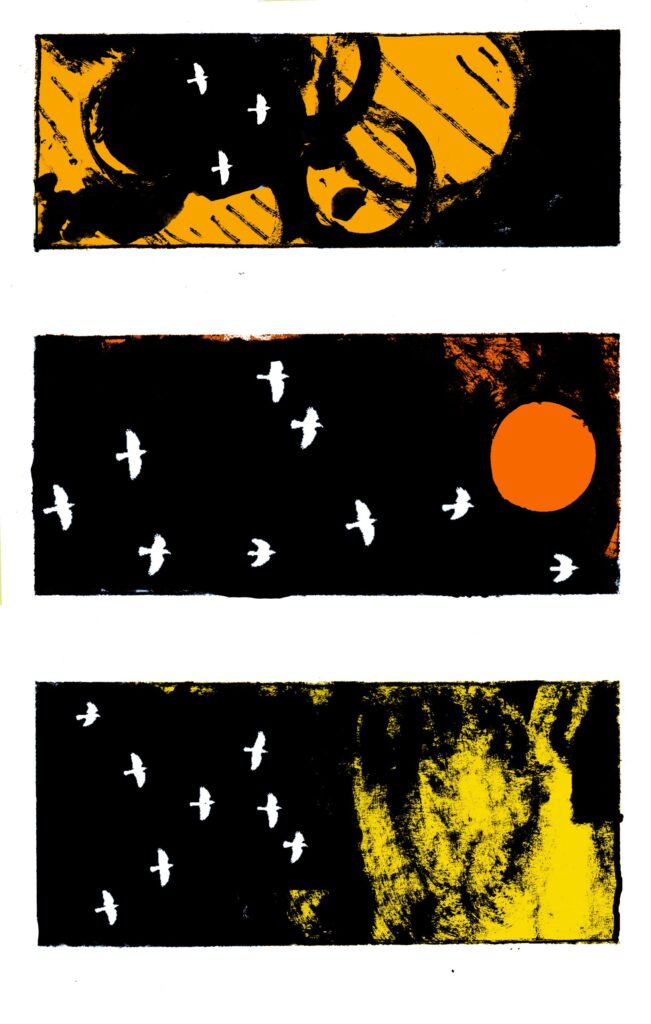
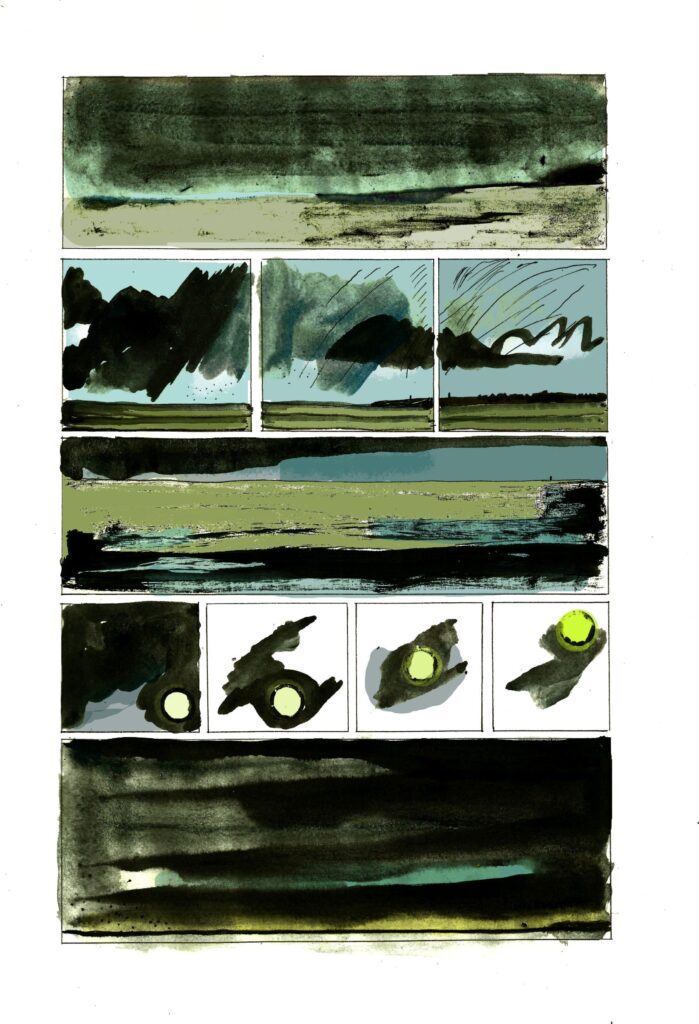
Some of these evanescent images have now been confined within the boundaries of a book, crowdfunded by those who liked this take on this territory. Field Notes’ freeze-frame cover suggests the unusualness of the author’s perspectives, and the élan of his approach. A redder than real sun stands in a yellow-brown sky, silhouetting black grasses. Geese power south from Scandinavia in a sky like a destroyer’s dazzle pattern. Suggestions of cirrus shadows spot Ravilious-reminiscent fields. Cruciform crows angle home over saltmarsh. White pylons overlay lands filled with decayed life-forms. On the inside back cover, where we expect an author photograph, we find a fugitive Everyman in a raincoat, painted from behind on a beach improbably alchemised from greens and blacks – the self-effacing artist as Sebaldian character, stepping out sturdily across the echoing east.

Griffin is sometimes sentimental, but never nostalgic; the book, like many of his Twitter posts, ends on the word “Onwards”. Yet he honours equally the mammoths that stomped drowned Doggerland (whose bones are taken up by trawlers), the antiquarians and eccentrics who discovered or dreamed our ideas of England, and today’s young English, heedlessly in the moment yet standing on the same fossiliferous foundations. Seams of gaseous Kimmeridge, outcrops of chalk, flint hagstones, the slimed tree-roots exposed at the lowest tides and the movements of muntjac are in a continuum with John Aubrey, boys on BMX bikes, exhausted seaside resorts and whooshing wind-turbines, while overhead ley-lines intersect with jet-fighter flight paths.

Field Notes is an account of one closely-noticed, deeply felt year in Lincolnshire, starting for the author (predictably, unpredictably) in October, with a Humbrol-hazed moon announcing the equinox, and the coming of the cold. “Look – the peak of autumn”, he marvels – with anthropophagical arachnids eating each other on barbed wire, RAF Chinooks, leaking boots, geological specimens arriving in the post, and ancient tracks to towerless churches passed over by Pevsner. “Look” again, he urges us, at the waning of the year, the chiaroscuros of clouds, the shadows of fences, the darkness under trees, the unlikely reds of earth, the arsenics and Prussian blues of limitless firmaments.

November brings branches waving against vastness, bleached bones in dunes, beachcombed sealskins and plastic bottles, deserted caravan parks, huge ships hove to off Spurn Point, memories of the drowned. An Airfix-coloured pillbox gives rigidity to the dynamic landscape, and a gun port leads into blacker than blackness. December holds the old names of ditches, mysterious murmurations, Mesolithic mirrors, thoughts of Raymond Briggs and memories of Mablethorpe Carnival Queens, the turning of this twelvemonth accepted as part of the epic, indifferent, unalterable cosmic churn; “The ocean will have us all – good.” Deep Time, East Midlandian history and today meet and mingle, even his cooking over campfires a sensory link with aurochs-eating, the crude charcuterie once carried out in willow-meads ages ago eaten by the waves.

Month by month, step by sometimes blistered step, sketch by swift sketch, we glimpse something of this arcane county’s blend of beauty and bathos, its grand desolations so often made mean by bungalows, car boots, leylandii, phone masts, and the demolition derbies of Skegness. There is grit in this Lincolnshire, some hardness and ugliness – asbestos sheds, chicken concentration-camps with humming extractors and the sharp stink of ammonia, algae-choked dykes, desperate biro notes found on the ground, rat-gnawed rubbish, washed-up whales, a man in an oxygen mask expending too much of his short time selling 1970s cassettes. But the overarching impression is deeply positive – room to breathe and self-realisation under the biggest of big skies, despite the oncoming storm-fronts of life.

Field Notes is filmic, impressionistic, and personal. It also manages to be unpretentious. In Griffinland, knowledge of the exploits of Alexander, Welsh poetry, Kurosawa, or “our pal Pieter Bruegel the Elder” co-exist chummily with pop blasting from cars, addicts passed out in hedges, shops selling tourist tat, and lost footballs floating out to the estuary. Phrases that from others might have been merely gnomic point towards places you’d want to visit. Even those who have some acquaintance with Lincolnshire will not be familiar with all the artist’s itineraries, and are certain to see new sights from his very particular vantage-points.

After long obscurity, Lincolnshire may be rejoining the mainstream of national history, with uncertain effects. This paean to little-known landmarks carries folk-memories forwards, while facing “Onwards” with equanimity. Ultimately, it suggests that whatever happens or is done, Lincolnshire has always been, and will always be, a land of graphic dreams.

Kafka: oracle and artist

Franz Kafka, Der Denker

The Aphorisms of Franz Kafka

Franz Kafka, Reiner Stach (ed.), Shelley Frisch (trans.), Princeton University Press, 2022, hb, 230pp + XXII, 9 mono illus., £20/$24.95

Franz Kafka: The Drawings

Pavel Schmidt, Andreas Kilcher (ed.), Kurt Beals (trans.), Yale University Press, 2022, hb, 368pp, 240 col. illus., £35/$50
ALEXANDER ADAMS sees different sides to an arch-dystopian

While he was writing The Trial, a novel that remained unfinished and unpublished during the author’s lifetime, Franz Kafka would read aloud chapters to his friends. Closest friend and Kafka’s future biographer Max Brod recalled that as Kafka read, he would be convulsed with laughter. The novel commonly considered the epitome of existential despair and implacable authoritarianism, was viewed by its creator as a black comedy. Franz Kafka (1883-1924) is seen as the prophet of the totalitarian modern society operating through a labyrinthine bureaucracy. It is easy to overlook Kafka’s sense of humour, penchant for absurdity and taste for farce. What continues to attract readers is the brilliance of his ideas and the visionary quality of images. Kafka’s fondness for the paradox and ironical gives even his bleakest work a touch of levity.

Two new books present Kafka at his most playful and wry – also at his most oracular and obscure. The Drawings reproduces all surviving drawings by the author. The Aphorisms publishes Kafka’s most impenetrable and oracular pronouncements.  

Kafka’s drawings have been one of the great unknowns of his output. Although a few (showing stylised, simplified single figures) had been reproduced in Brod’s biography and on the cover of a few editions of the 1950s, exactly how extensive and how various his drawings were was unclear. Not least, the obscurity came from the fact Kafka destroyed almost all his own drawings and only a few survived in letters and scraps that Brod preserved from the time they were law students together in Prague. Brod was enthusiastic about the drawings and attempted to interest publishers in hiring his friend as an illustrator, to no avail. After Kafka’s death, Brod published a few drawings then went cold on a proposed exhibition and substantial catalogue. The drawings disappeared into obscurity. Brod had given them to his partner-secretary, Esther Hoffe. After Brod’s death in 1968, the Kafka manuscripts and drawings were shuffled between a Zurich bank vault and Hoffe’s Tel Aviv apartment.

Publishers and scholars were antagonised by Hoffe’s unwillingness to make the manuscripts accessible. (In 1983, she would not let a publisher into her apartment, saying that it would cost him the equivalent of $150,000 even to see the drawings. The publisher demurred and departed. No book was published.) When her daughters continued the obstruction after her death, the Israeli state took legal action to claim possession of Kafka’s manuscripts. The state argued that the sheets were being kept in humid and dirty conditions and in danger of deteriorating; there was the threat of the works disappearing into hands of private collectors. In 2019 the state won, the Hoffe sisters lost possession of the manuscripts, and the National Library of Israel acquired relics of a Jewish titan of culture.

With the newly available originals accessible, plus all the other few Kafka drawings in other collections photographed, The Drawings presents all of Kafka’s surviving drawings. Essays cover aspects of Kafka’s drawing and the history of the manuscripts; a catalogue raisonné documents 163 pages of drawings.

Kafka took art classes, attended lectures on art history and visited museums. He personally knew some artists. Long after his university course on art history, he remained interested in differing art styles, including Renaissance art, Expressionism and Japanese colour wood-block prints. Kafka claimed that art education had ruined his ability to draw and that whatever he had done in terms of drawing had been achieved despite that constraint. Most of Kafka’s drawings are caricatures and fantasy cartoon figures, in exaggerated clothing and adopting parodic positions. On the evidence of comparative illustrations in The Drawings, it seems Kafka was an admirer of cartoons published in the German and Bohemian presses.

Around 1901, when Kafka was 18, he began a small sketchbook. He filled it with drawings, mainly of figures. As many of the personages are walking and seen in profile, they invite the comparison with a parade (or promenade) of eccentrics. There are curving jockeys riding improbable horses, angular men slumped at desks, striding gentlemen with walking sticks. Strong ink lines and solid black bodies are influenced by line-block illustrations, common to journals and books of that era. Kafka seems not have specific plans or projects in mind for his drawings; the figures are drawn at random on the pages, in every orientation, out of order and without accompanying writing.

There are similar ink figures in his letters, also reproduced. Figures appear in diary pages, often relating to the subjects of the day’s entry. On separate sheets of writing paper, portraits (including self-portraits) were drawn in pencil from life and photographs. These reveal Kafka’s art training. They are lightly worked fragments, with no settings indicated, but have realistic shading and the proportions are faithful to life, except where deliberately exaggerated. In artistic terms, they are slight and unfinished but the best of them have a magnetic pull to them – not least a self-portrait with haunted eyes. He did little drawing after 1908, with the majority of surviving drawings dating from his youth.

Kafka, Self-Portrait. Photo: Ardon Bar-Hama. Wikimedia Commons

Did Kafka take his drawings seriously? Fairly so, on this evidence. Although he was self-effacing and reluctant to publish or exhibit them, Kafka took care over making them. He developed forceful images that were crisp and striking. Overall, in The Drawings we find Kafka at his most playful and relaxed; the best of the drawings are really fine and we might wish that more drawings of this type had been saved from Kafka’s wastepaper basket by Brod. Kafka might have been amused at a scholarly cataloguing of his drawings, doodles and elaborate crossings-out.

The Aphorisms collects 108 statements by Kafka, written over the winter of 1917-8, which he copied out into two small exercise books. At the time he was staying with his sister Ottilie in a village called Zürau. On sick leave from his office job, he was attempting to stem the progress of pulmonary tuberculosis by escaping the smoke of Prague, eating well and doing some farm work for exercise.

Part religious parables, part philosophical propositions, part distilled observations, entirely literature, the aphorisms still baffle even the most serious readers of Kafka. “From a certain point on, there is no turning back. This is the point that needs to be reached.” “Like a path in autumn: no sooner has it been swept clean than it is once more covered with dry leaves.” The most famous is, “A cage went in search of a bird.” These are the shortest, but none run longer than half a page. The final sentence of the collection is unusually pungent and vivid. “The world will offer itself to you to be unmasked; it cannot do otherwise; it will writhe before you in ecstasy.”

The aphorisms are gnomic and elusive. The reader gets the impression that he is being told something true and important, but also something unclear, even deliberately obscured. Although these sayings have been published before (sometimes incorporated into collections of short stories), they are the probably the least read of his works. As the editor notes,

In comparison with Kafka’s other writings, his aphorisms have been overlooked by researchers and even more by his general readership. The aphorisms, like everything Kafka wrote, require interpretation, but in contrast to his fictional prose, for example The Trial, they do not reward the reader with the sensory and aesthetic pleasure of a story.

This new edition supplies commentary written by Reiner Stach (author of an excellent recent biography), with English translation by Shelley Frisch, who did a fine job on Stach’s biography. There has been no shortage of complicated interpretations of the aphorisms; wisely, Stach avoids committing himself. Commentaries include Kafka’s original draft, so we can note the revisions and follow the author’s thinking a little. Rather than offer explanations, Stach’s commentaries relate the aphorisms to comparable phrases or ideas from writings by Kafka and mention what he was known to have read at the time.

The aphorisms are as tricky to decipher as anything Kafka wrote. If you fancy giving yourself food for thought, then The Aphorisms are ideal. If you prefer something playful, then The Drawings is for you. Both publications serve to broaden our knowledge of one the greatest authors of European literature. What would expand that knowledge even more would be a first translation of the new German editions of Kafka’s letters, including texts inaccessible to non-German readers. When will Princeton University Press commission Shelley Frisch to translate Kafka’s letters into English?

Sanctions and sanctimony

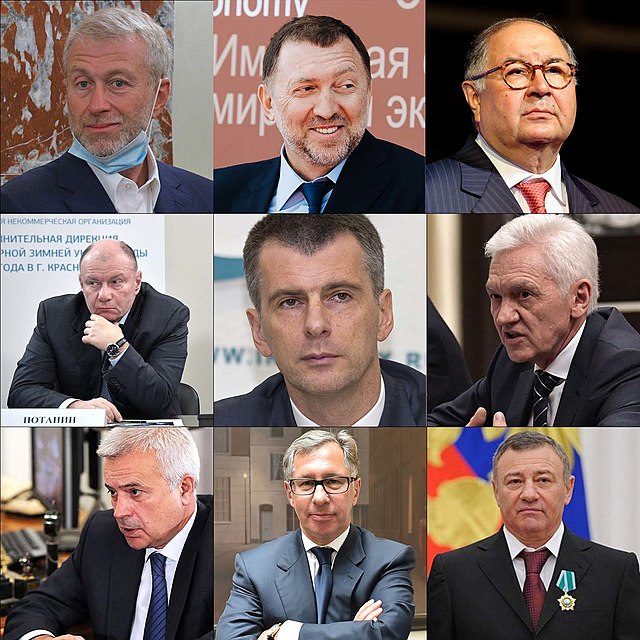
A gallery of Russian oligarchs. Wikimedia Commons
LAURA GASCOIGNE casts an eye on oligarchs and their arts

The Art Newspaper has published its annual museum attendance figures for 2021. The Louvre is top, 5% up on the year before, followed by the State Russian Museum at + 88%. Really? There are four Russian museums in the top ten: the Multimedia Art Museum at no 3 (+42%), the State Hermitage Museum at no 6 (+70%) and the State Tretyakov Gallery at no 9 (+77%). By comparison Tate Modern lags at no 16 (-19), the V&A at no 24 (-2) and the National Gallery at no 30 (-41).

There was a time when British visitor figures needed boosting to attract government funding. No longer. Now galleries hope desperation will loosen the purse strings: the message being sent out is HELP. So are we really supposed to believe that during a pandemic, with the international tourist industry in meltdown, Russian museums beat the British Museum (+4%) into 11th place?

No. No one is actually meant to believe these figures. Like the Ukrainian Nazi regime with its Jewish President and the Special Military Operation to remove it, they’re a pack of obvious lies. For the Kremlin, lying is official government policy. As our own government is discovering, lying works: if it doesn’t convince, it sows alarm and despondency. In fact, the less it convinces, the more alarm and despondency it sows, by loosening the population’s grip on reality.

However much we now gasp and stretch our eyes at the dreadful lies being told by Putin, we were happy to ignore the truth when it suited us. Western liberal democracies accepted arts sponsorship from Russian oligarchs without ever stopping to ask where the money came from. It’s not as if we didn’t know; we knew all along. It’s only now that we’re faced with the brutal reality of what an authoritarian kleptocracy means in practice that our cultural institutions are responding to Russia’s Special Military Operation with a Special Reverse Ferret Operation.

Western museums have rushed to ‘freeze’ relations with their Russian counterparts, at some cost to their exhibition programmes. It’s more than a case of the National Gallery’s being short of the odd Holy Family from the Hermitage for its Raphael show; the Ashmolean has had to put its summer exhibition ‘Russia! Icons and the Avant-Garde’ on indefinite hold and the National Railway and Science Museums have been forced to cancel their joint Trans-Siberian exhibition. The V&A has brazened it out and hung onto all the eggs in its Fabergé exhibition basket, two of which are on loan from the Fabergé Museum in St Petersburg funded by sanctioned oligarch Viktor Vekselberg. Still, no British museum has so much egg on its face as the Fondation Louis Vuitton in Paris, which commissioned Putin to pen the foreword to its recent Morozov Collection show.

Now the art market is feeling the pinch. On 15 March, four days after Arts Council England introduced a moratorium on loans, the government banned exports to Russia of all high-end luxury goods including art and antiques. Russian collectors have been sent to Coventry where they can brush up on their knowledge of another English cathedral, hopefully without poisoning any of its parishioners. Like rats leaving a sinking superyacht, Sotheby’s announced that they were shutting up shop to Russian buyers. A spike in sales of high-end art to Russians was apparently recorded in the run-up to the invasion of Ukraine on 24 February as oligarchs rushed to put money into non-seizable assets they could squirrel away in secretive freeports of the sort our tax-paying chancellor is so keen to open on these shores. Fortunately for Sotheby’s, thanks to the use of intermediaries it’s almost impossible to find out whether buyers are Russian, unless they pay in roubles.

The big hit will be to museum sponsorship. Of the big four oligarchs sanctioned by our government, three have been heavily involved in cultural philanthropy and their beneficiaries are scrambling to dump them. On 1 March it was announced that Petr Aven, a long-term trustee of the Royal Academy and a leading donor to its Bacon exhibition, had ‘stepped down’ before being pushed down the Potemkin steps; with some sense of honour, the RA returned the money before painting out his credit at the exhibition entrance. Roman Abramovich’s name has also vanished, without recompense, from the supporters’ list outside the Holocaust Galleries he helped to fund at the Imperial War Museum and Viktor Vekselberg has forfeited his honorary membership of the Tate Foundation. His contribution to Tate Modern’s extension now consigned to history, it was out with the chisels to chip his name off the donors’ plaque.

It’s harder to write Russian money out of museum history when it’s sunk into bricks and mortar. Vekselberg’s 2016 support of Tate Modern’s extension, then called the Switch House, was not as generous as that of his mate from Moscow college days, Len Blavatnik, whose record-breaking £50m donation to the Tate turned the Switch House into the Blavatnik Building. Though not a Russian citizen – he holds US and UK citizenship (bought for a song in 2010) – Blavatnik is a person of interest. A Ukrainian Jew born in Odessa, he emigrated to America with his family in 1978 aged 21 but that didn’t stop him joining the feeding frenzy that followed the ‘opening up’ of the Russian economy in the 1990s. With Vekselberg as a partner, he laid the foundations of his global business empire by buying up state aluminium and oil companies. Last year he topped the Sunday Times Rich List for the second time with an estimated fortune of £23bn; he raked in an extra £7.2bn during the pandemic.

Blavatnik likes to splash the cash on cultural causes. He has donated to the National Gallery, the National Portrait Gallery and the RA, funded a new Blavatnik Hall at the V&A, financed the Courtauld’s refurbished Blavatnik Fine Rooms and in February – just weeks before the invasion of Ukraine – underwritten new Blavatnik Art, Film and Photography Galleries at the IWM due to open late next year. He was knighted for services to philanthropy in 2017 and in 2020 the Times described him as ‘Britain’s art philanthropist-in-chief’. But in the current mood of sanctimony, with sanctioned friends like Vekselberg and Oleg Deripaska, his position is borderline. How long before the Blavatnik Building is switched back to the Switch House? Watch this space.

When our museums took money from the previous philanthropists-in-chief, the Sacklers, they could at least plead innocence of Oxycontin. It’s not so easy to plead innocence of the crimes perpetrated by Russia’s oligarchs on the Russian people. We all know where the kleptocrats’ money came from; in accepting funding from them, Western museums have been knowingly in receipt of stolen goods. Cabbage soup has been taken from the mouths of ordinary Russians so that museumgoers in rich democracies can enjoy blockbuster exhibitions and swan about in overextended galleries. For years our museum sector has been living beyond its means. Who will we turn to for subsidies next? The Saudis? The music changes, but it’s the same old dance with the devil. We can be sanctimonious after the event, but at some point our museums must face the fact that, in the matter of so-called cultural philanthropy, sanctimoney is the exception, dirty money the rule.

This review first appeared in The Jackdaw, an independent review of the visual arts edited by David Lee, which has been called ‘the Private Eye of the arts world’. To subscribe, please click here.

How time flies – British Art Show 9

DAVID LEE attempts to take an interest in a forty-year old artistic institution

Not that it’s much fun remembering, but can it really have been more than 40 years ago that, like a new comet, the British Art Show (Arts Council prop.) first swam into our ken? It’s been coming back to haunt us every five years since, and now here it is again, ninth time round and laden as ever with empty promises and disappointment. Do we mind? No, not that much, for minding even mildly requires the taking of at least a little serious interest in the first place, which no one really does these days, and small wonder. I most certainly don’t – as the blank space in the index to Moping On – the Collected Works (rejection slip pending) amply testifies. I did see BAS8, or was it number 7, but, whichever, only out of convenient and idle curiosity. Remembering the faintest of anything in it is quite another matter: blur doesn’t come near it.

The pity is that it did seem quite a good idea, back in that Golden Age of Wislon, Sunny Jim and Dolly Scargill, oh, so long ago. It was the brainchild of one Frank Constantine, benign and enterprising director of the Sheffield City Art Galleries at the time – and in his youth, a seriously fast opening bowler, I believe, and a stylish middle-order batsman too: though I may be thinking of someone else – who, feeling that too little of the best and brightest of contemporary British art was ever to be seen north of Hampstead, persuaded the Arts Council to commission a major touring show, every so often, of just such stuff but one which – and this is the nub and very heart of the matter – would never, as it were, be seen in Town.

The guiding premise, as I remember, was that it should offer a generous if idiosyncratic overview of whatever of interest or merit, preferably both, had been produced within the previous two or three years, sought across the full field of current engagement in painting and sculpture and allied trades. Furthermore, there were two defining conditions attached: first, that the selection should be entrusted to a single selector; and second, that practical or logistical constraints apart, the choice was to remain a personally accountable judgement quite free of any policy or pressure on the Council’s part. Independence was the rubric, and, mirabile dictu, so it was: Amen to that, I hear you cry.

In the event, work by just over 100 artists was shown, from unabashed representation to abstraction at its most minimal and austere, with a leavening of conceptualism for good measure. There was of course the usual hullabaloo. ‘My child could do better than that, or would be severely punished if he didn’t’, of course, and ‘what a waste of good wood and canvas’. Sheffield’s steel mills closing down on a daily basis hardly helped. Even the Arts Council’s own General Secretary at the time –  a worthy Yorkshireman from Sheffield called Shaw, which explains a lot – after giving it the honour of a single sentence in his annual report, with due emphasis laid upon how much it had cost, a little later condemned out of hand an exhibition he had never seen.

And so of course the Arts Council lost its nerve. A single selector? Goodness no, far too risky. From BAS2 it has always been a committee job, if only one of two or three. And since no self-respecting committee meets without an agenda, so by grandmother’s footsteps themes and policies, the more correct the better, crept in and for many years now the Arts Council’s cold hand has been firmly on the tiller. Which dire conclusion brings me back to how boring and correct in its self-congratulatory diversity it all now is.

BAS9, selected by Irene Aristizaval and Hammad Nasar, began its tour in Aberdeen last autumn, and, having lately closed at Wolverhampton, is now inflicting itself on Manchester before moving on to Plymouth for the coup de grâce. A brief account of its sojourn amongst the Wolverhamptonians may offer the ever-patient denizens of Manchester some idea of what they’re in for.

Irene, now Head of Curatorial and Public Practice at the BALTIC, Gateshead, was until lately Head of Exhibitions at Nottingham Contemporary; while Hammad is Lead Curator at the Herbert Gallery, Coventry, Senior Research Fellow at the Paul Mellon Foundation, and Principal Research Fellow at the University of the Arts (Central St Martin’s as was), London. You have been warned.

Notable amongst Irene’s recent group shows have been ‘Still I Rise – Feminism, Gender Resistance, and Photography from the Civil Rights Movement to the Reagan Era’. And Hammad is known, you may be intrigued to learn, ‘for collaborative, research-driven and exhibition-led inquiry’ so quite the Renaissance Man. His recent successes include ‘Speech Acts: Reflection-Imagination-Repetition and Structures of Meaning / Architectures of Perception’. There was also ‘Excessive Enthusiasm: Ha Bik Chuen and the Archives of Practice’. And I’m sorry I missed his ‘Lines of Control: Partition as a Productive Space’. You get the picture, or perhaps not as the case may be.

Getting down to brass tacks – for which I believe the town was once renowned – Irene and Hammad said with one voice ‘how thrilled they were to present the second iteration (and how we love that ‘iteration’) of BAS9 in Wolverhampton’, where the focus was to be ‘on an intersectional approach to living with difference’. Their approach would ‘foreground (and here I find myself reaching by reflex for the red pen – Old Beaky would have reached for something else) the contemporary resonance of the Black Lives Matter protests with the historic context of Enoch Powell infamous (notorious?) and divisive “rivers of blood speech”.’ Oh dear: but on we go.

Taken over all, BAS9 ‘explores [of course it does] themes of healing, care and reparative history; tactics for togetherness; and imagining new futures,’ and I can’t wait for the mug of cocoa and a digestive biscuit afterwards, for which I’ve already chipped in my two and six. It ‘showcases [I shall run out of red ink soon] the multidisciplinary work of 47 artists, reflecting a precarious moment in British history, which has brought politics of identity and nation, concerns of social, racial and environmental justice, and questions of agency (??) to the centre of public consciousness.’ Yes, My Dears, so it does, and calm down, as the great Sir Michael might have said: for my part I would remind you this was once, and perhaps still is, supposed to be an art exhibition, not a public meeting in the Islington Oddfellows Hall. Where’s that cocoa, for goodness sake? But there’s no stopping yet.

In Wolverhampton, it seems, the focus was on ‘how we live with and give voice to difference, showcasing [Damn and blast: I’ve now stubbed the nib] only those 34 of the 47 whose work, steely eyed, forensically investigates identity from an intersectional perspective (ouch). By exploring, map and compass at the ready, coexisting identities such as class, [count to ten] ethnicity [slowly] gender [up to 20] and sexuality [now 30], works will be presented in critical dialogue with Wolverhampton’s cultural history shaped by the diverse populations that have arrived since the War.’ Of course they will: but I’m too old for all this. I it is who really must calm down.

This article first appeared in The Jackdaw, an independent review of the visual arts, which has been called ‘the Private Eye of the arts world’. To subscribe, please click here.

Images of Bacon

Francis Bacon, by Reginald Gray. Wikimedia Commons

After/Après Francis Bacon

Alexander Adams, Bristol: Golconda Fine Art Books, 2022, 60 pages, £10. English and French (French translation by Peggy Pancini)

LIAM GUILAR follows an influential artist’s flamboyant trajectory through verse

Some years ago, the Canadian critic, Hugh Kenner, in conversation with Charles Tomlinson, lamented the disappearance of the ‘documentary tradition’ in poetry. He was referring to poetry where the verse functions primarily as a carrier of information. He was not making the false distinction between form and content, but describing a type of poetry that could be read for information the way one would read a newspaper, text book or biography. In Kenner’s view, such poetry had all but disappeared by the mid-nineteenth century, to be replaced by the egocentric poetry of the Romantics, and the poetry emptied of significant content written by those who followed. Alexander Adams’ new book, his seventh, After/Après Francis Bacon, proves the book length documentary poem is still being produced, despite its unfashionable nature.

Adams, an artist as well as a poet, takes as his subject the life of Francis Bacon (1909-1992).  The poems follow the trajectory of Bacon’s life, from his early years in Ireland, via his time in Paris and London, to his death in Madrid. There is a facing page French translation by Peggy Pancini.

The book’s twenty-one numbered but untitled sections read like stills from a documentary film. The sequence begins in Ireland, appropriately with colours:

Surrounded by duns, olives, sages,

grey browns of trampled paddocks

the alcohol blue flame of asphyxia

burns with all the vignetting of unconscious

darkening and diffusing the periphery. (p.4)

Moving to London in the blitz:

Down from the ruin [Sic] ramparts

men grey with dust pass bundles

and expressionlessly scrape up

former people with their shovels. (p.14)

To Tangiers:

Sweet mint tea on the terrace,

hashish smoke wafts over.

Sea is flat as a strip of paper.

Endless warmth, dry air.

Paint dries fast but ideas come slow. (p. 34)

The writing evokes place and time, and like any biography contains snippets of social history: Paris after the Occupation; London rebuilding after the war, later a lost world of dilly boys, when homosexuality was still illegal, and where, in the saloon bar of The Grapes, ‘where men commune’:

The only woman is Marie,

behind the counter, beehive hairdo,

artificial nails, counting shillings,

menthol cigarette at the

corner of painted lips. (pp. 47/48)

The artist’s development is sketched into this trajectory. From his first excitement at seeing Picasso in Paris, which ‘broke you out of Edwardian airs/-dainty portraits, potted ferns-/and shaped you modern’ to an early exhibition where the punters, faced with ‘ostrich bodied, Buchenwald cadavers’, walked out in disgust ‘glad to be out of/their unwholesome presence’. To fame, drink, drugs, and finally death in Madrid.

The danger inherent in a poetry where information is the focus is that the writing can read like notes for a story that hasn’t been written. Details accumulate, but without context or effect and the possibilities of rhythm and sound are sacrificed. Section ten begins:

Men bending, lifting a heavy weight

Paralytic child crawling

Mastiff walking slow

Woman throwing a stick, three quarter view (p.28)

and continues like for this for the rest of the section’s mostly unpunctuated seventeen lines. It could be an exhibition catalogue, a summary of works produced, or it could be a young artist noticing the world around him, or all three. As information it is confusing; as poetry it’s flat.

Adams usually avoids this trap. His clipped declarative style keeps the story moving and creates deft images. The blank canvas is

-a mute mirror to perfect order

refuting the composite imagery

that grows so richly elsewhere.

At night,  the canvas stands unchanging

like a locked door without a handle. (p.48)

The overall experience of reading After/Après Francis Bacon, is very similar to walking through a gallery hung with large pictures. Moving through them in their numbered sequence suggests they are related. However, the connections between the pictures are left unstated, and at times continuity and coherence are suggested solely by the fact that one picture follows the next.

It’s obvious that the Model Reader of this book knows as much about Francis Bacon as Adams does, and for that reader little will be obscure. Leaving aside the question whether the poems offer such a reader any new insight on Bacon’s life, what about the reader who knows nothing about Francis Bacon the artist?

It’s possible to enjoy the poems as poems. Adams provides enough information to suggest a biography. Relationships are hinted at. Names occur: Eric, Peter, George. However, there are sections where a lack of background knowledge makes the writing obscure.

Next day, the apartment was wrecked,

plaster gouged by chair leg at head height,

wine bottle dashed upon the tiles,

a canvas is rent open in a frayed V

lying on its side, cockeyed. (p.36)

Are we witnesses to a raucous drunken night or domestic abuse?

In passages like these, Adams makes no attempt to cater to the visitor to his exhibition who has strolled in out of curiosity. In section XV, if you don’t know who George was, then the seventeen lines listing some of George’s actions are just a list and the writing doesn’t make the list interesting.

George climbing a set of steps.

George cycling, double exposure

George seated on a stool

George seated on a chair, legs crossed (p.38)

However, even if, like me, a reader knew nothing about Francis Bacon before reading After/Après Francis Bacon, there is enough of his life in the poem and enough life in the poems to sustain and reward the reader’s attention. The writing, which is mostly vividly impressionistic, is guaranteed to make you want to know more about Bacon and his art.

The sharpness of Ruskin Spear

Ruskin Spear (1911-1990), Patients waiting outside a first aid post in a factory. Wikimedia Commons

Humankind: Ruskin Spear

Tanya Harrod, Studies in Art, The Estate of Francis Bacon Publishing and Thames & Hudson, 2022, £35

PHILIP WARD-JACKSON remembers an unpretentious but greatly gifted artist

‘This is not a full-scale biography’ apologizes Harrod, lamenting the dearth of diaries and letters left by her subject, but it is the closest approximation to one that you are likely to get for some time. A huge array of oral and other forms of testimony is deployed to formidable effect and a man who was derided in his final years by some of the movers and shakers of the art-world as a populist and a tabloid pet, stands revealed as a brilliant painterly recorder of the London scene. As a portraitist he was ready to accept sedate formal commissions, but was perhaps happiest capturing his subjects in action, as in his Poet Laureate Afloat of 1974, depicting John Betjeman as a boater-wearing oarsman, or his Brightly Shone the Moon that Night, in which Ted Heath conducting Christmas Carols becomes a cosmic event.

Some of us had known that this book was impending. Its appearance was finally announced by the author herself in a puff which appeared in the Spectator of 22 January under the amusing title ‘Bring me my Spear.’ Like the apology already quoted, this puff seemed to hint at an unwarranted diffidence. Only the baffled response to requests for it from some major London bookshops, happy to fill their windows with the latest products of the inexhaustible Francis Bacon industry, testified to the need for such self-promotion.

It was the Spectator editors who came up with that snippet from Jerusalem. After initially thinking it clever, on further thought it began to look like a misnomer. There is a distinct lack of ‘pleasant pastures’ and ‘mountains green’ in Spear’s world, and none of that mystic pantheism which drew contemporary neo-romantics to William Blake and Samuel Palmer. His world is resolutely urban, including seaside breaks.

Spear was born in Hammersmith in 1911, son of a coach painter and a one-time domestic servant. He was affected by polio in early life, which left him with a weakened left leg, but didn’t deter him from painting at the easel without the mahlstick, an article of faith where he was concerned. Only action painters and chimpanzees mucked about on the floor. He studied at Hammersmith School of Arts and Crafts and at the Royal College. In fact Hammersmith and the Royal College, where he was later to teach, are the backdrop to the greater part of his creative activity. 

Spear achieved a degree of public recognition during the 1950s, mainly through his exhibits at the R.A. Summer Show. His son Roger Ruskin Spear, who played in the Bonzo Dog Doo-Dah Band, was one of the people who made London swing. The musical talent was passed down, Spear having been a skilled jazz pianist, but the father’s view of London has a distinctly post-war look. In some details representing London buses, posters, pub brasswork and flowers, and most appositely in the case of one small pub canary who makes multiple appearances, the colours sing out from an overall tonality which is sombre to the point of despondency. The beauty resides in the ways in which the paint is put on, and the variety of Spear’s brush marks is staggering. When it comes to the draughtsmanship, or, as was increasingly the case, drawing in paint, Spear alternates between a strict perspectival rendering of his subjects reminiscent of contemporary Euston Road painters, and a freer, illustrational, at times caricatural style. The latter is much in evidence in the portrayal of his signature cast of seasoned bar-flies of both sexes, street hucksters and assorted Hammersmith denizens.

Harrod gives us more of a look at the pre-War period than an earlier biographer, the painter and writer Mervyn Levy, whose small monograph on Spear appeared in 1986, four years before the subject’s death in 1990. Work as a war artist, carried out in defiance of his own pacifism, seems to have brought Spear out of a domestic shell, most of his earlier work having been centred on the family home. These early figure subjects indicate an awareness of the work of the French intimistes, Bonnard and Vuillard. Not a much travelled man (foreign jaunts seem to have been limited to a Mediterranean stag cruise before marriage, and a trip to Russia in 1957, accompanying the exhibition ‘Looking at People’ to the Pushkin Museum), Spear’s knowledge of the impressionist and post-impressionist scene would have benefited from his apprenticeship at the Royal College with William Rothenstein, who had rubbed shoulders with Degas and Lautrec. All of this rather calls in question the assumption of early commentators that Spear epitomised the Englishness of English art.

Another of the book’s strengths is its situating of Spear in the various social and artistic circles, with which he interacted over the course of a lifetime. Some of these are new and unfamiliar. There is fascinating documentation, for example, concerning early patronage by the well-connected Essex dilettante, Jack Brunner Gold, who organised an exhibition of Spear’s flower paintings in his home, Little Codham Hall in 1935. The combination of Spear’s portrait of the man in country-gentleman pose, and the teasingly de haut en bas quotes from Gold’s letters vividly summon up an all too familiar picture of the connoisseur attempting to shape a young protégé. Then there is the colourful network of relationships, sometimes friendly and symbiotic, at others thorny, with fellow-teachers and students at the Royal College of Art between 1948 and 1975. Spear taught such luminaries of the next generation as Peter Blake, David Hockney, Frank Auerbach and Ron Kitaj. Alongside the happy memories of some, are those of students who remembered Spear as a bullying bastard. A painting by Spear entitled Young Contemporary, which caricaturally represented one of his students sitting looking confused in front of one of his own action paintings, does seem to infringe pedagogical proprieties. On the other hand Spear’s debunking of art-world pretensions must have come as a relief to many outsiders who felt bamboozled by colour field abstracts and piles of bricks.

The panjandrums of the art world do not take kindly to seeing their hot air balloons deflated. Spear had in 1952 and 1954 depicted public bemusement when confronted by works of modern sculpture by Henry Moore and Reg Butler. Other pictures made plain his sentiments with regard to minimalist and painterly forms of abstraction, leading the future director of the Tate, Sir Alan Bowness, to classify his work as ‘vulgar’. In 1984 came what looked like a particularly brutal act of critical cancellation, when Spear was omitted by Richard Morphet, self-appointed high-priest of post-modern figuration, from his Tate exhibition, ‘The Hard Won Image: Traditional Method and Subject in Recent British Art’. Tanya Harrod suggests that Spear’s work was excluded because it gave so little indication of struggle. A lifetime of painting and observation had enabled him to achieve a rare degree of articulacy and pleasurable virtuosity, in which he could express his likes and dislikes with regard to the world around him. There is perhaps one thing that needs clearing up here. Was Spear in fact excluded, or, alive and kicking as he then was, did he decline to have his works shown with that rag-bag of figure painters, even though it included some of his own closest friends and ex-pupils?

This is a most attractive book, whose illustrations and text both call for and repay the closest attention.

This review first appeared in The Jackdaw, an independent review of the visual arts edited by David Lee, which has been called ‘the Private Eye of the arts world’. To subscribe, please click here.

Modernism seen now

RICHARD GERSTL (1883–1908), Self-Portrait in front of a Stove, 1907. Oil on canvas on board. Neue Galerie New York

Modern Worlds: Austrian and German Art, 1890-1940

Renée Price (ed.), Prestel/Neue Galerie, 2021, 656pp, $75/£55

ALEXANDER ADAMS is transported to a thrilling time of artistic experimentation

The Neue Galerie in New York holds one of the world’s greatest collections of German and Austrian Modernist fine and applied art. It was founded by Ronald S. Lauder and conceived of in consultation with his friend Serge Sabarsky, who owned a fine selection of the best of Austrian Expressionism, particularly by Egon Schiele. Sabarsky died in 1996, before the museum opened. When the museum opened in 2001, the intention of Lauder and team of directors and curators was to correct the bias towards French art in the historical surveys of the development of Modernism in the visual arts. Modern Worlds: Austrian and German Art, 1890-1940 is the grand catalogue of an exhibition held to celebrate the first two decades of the gallery. This review is from that catalogue.

Neue Galerie was warmly received when it opened and became highly regarded for its scholarship and the quality of its holdings. The great success of the Neue Galerie, which I have visited several times and consider an essential stop on any tour of New York museums, has made German-Austrian Modernist art now a much better understood part of art history. Among specialists, there was always an appreciation of Expressionism and Secession art, but the condensed selection of masterpieces by the very best artists, housed in a handsome beaux-arts townhouse at 1048 Fifth Avenue (built in 1914) has provided an integrated story of Modernism in Germany and the Austro-Hungarian Empire.  

Modern Worlds has essays on various topics relating the fine art and applied art in the collection. One by Olaf Peters discusses Max Nordau’s book Degeneration (1892), which became (posthumously) his most influential book. We should not see those opposed to degeneracy solely as representatives of traditionalism. Many critics of decadence were liberals, who took a progressive view of society. As a social Darwinist, Nordau saw degeneracy as an aspect of evolution, which would lead to the atrophying and extinction of those urban populations which succumbed to its lure, driven by circumstance and genetics towards behaviour that would not sustain reproduction of healthy individuals. He cited art as a symptom of the degeneration of culture and genetic stock.

Nordau imagined a dramatic result as the consequence of this evolutionary process for art. In his view, art would cease to exist, since those who support it would have to make room for an increasingly rational humanity for whom art would no longer be a relevant form of expression. For Nordau, art would become an atavism, and only women and children – the more intensely emotional members of the population – would still pursue it. He favoured science over art, which he judged to be an irrational symptom of psychological illness. It had to yield to the advancing process of rationalisation.[i]

Another essay by Peters discusses the splintering of arts organisations in Germany and Austria in the Jugendstil/Secession period, as artists sought to gain more control over the selection, exhibition, publication and sale of their art works. A proliferation of artists groups ran alongside the desire to distance the avant-garde from state- and royalty-sanctioned bodies, academies and established professional organisations. Opposing approaches to ornamentation within Modernism are exemplified by architect Adolf Loos (anti-ornamentation) and Gustav Klimt (pro-ornamentation). This shows that there were very different aesthetic criteria supported by members of the avant-garde, just as we find contrary strands within reactionary and traditionalist camps. The influence of collector Karl Ernst Osthaus is appraised (his collection of Expressionist art is housed at a dedicated museum in Hagen, Westphalia).

The various displays and fairs including applied art, decorative art and diorama/installations accelerated the acceptance of Modernism into daily life, as well as high culture. The influence of the Arts & Crafts movement paved the way for patrons and creators. Wiener Werkstätte was founded in 1903 and flourished as a company that produced high-quality, expensive furnishings, clothing and housewares until 1914. The advent of war severely impaired WW’s output. Limited by material and manpower shortages, and the unwillingness of the affluent to invest in luxuries during a period of upheaval, business slowed dramatically. It was revived in the inter-war period but never regained its pre-eminence, closing in 1932. WW is remembered now often in terms of the contribution of female creators and for the influence of female customers, who generally made decisions regarding the decoration of family homes. Interestingly, no less than Adolf Loos gave a lecture called “Das Wiener Weh: Die Wiener Werkstätte” (“The Viennese Woe: Wiener Werkstätte”) in 1927, condemning the decline of WW. The turn to super-luxury goods was attributed to the women who dominated the management and product design of WW in the post-1914 era.

JOSEPH URBAN (1872-1933). Mantelpiece clock for Paul Hopfner Restaurant, 1906. Private collection

The excellent collection of WW in the museum’s collection – surely the best collection outside Vienna – includes works by leading lights of the company. The extensiveness of the Vienna design scene is amply represented by a series of striking designs of silverware, glassware, furniture, clocks, jewellery and ceramics by Dagobert Peche, Josef Hoffmann, Koloman Moser, (Belgian) Henry van de Velde and others. The designs range from the refreshingly simple and starkly unornamented to the ostentatiously impractical. Hoffmann’s cutlery services go beyond function into objets d’art. Geometrical patterns, plain checks, straight lines and elongated or square proportions are constants. Lines that echo Art Nouveau are found mainly in early, pre-war pieces. There is a silver coffer given by Klimt to the young Alma Schindler (later Mahler), when he was courting the young beauty in 1902. Another gift from Klimt is a necklace given to Emilie Flöge the following year. Both were made by Moser. Vintage photographs of other pieces in the collection show the furniture in trade shows or the homes of the original owners.  

One photograph shows the star of the museum’s collection, Klimt’s gilded Portrait of Adele Bloch-Bauer I (1907). The painting was displayed at an exhibition of art and crafts in Mannheim in 1907, and appears to show the painting before the artist made minor modifications to it. The painting is once again displayed flanked by stone statues of kneeling youths made by George Minne, as it was in that Mannheim display. (There is a useful essay on Minne and the Germanic sculptors as precursors to the individualism of Schiele and Kokoschka’s art.) The Neue Galerie has a fine collection of Klimt drawings from all periods of the artist’s output. The square landscapes of Klimt are revolutionary. Not only is the square format (developed by Klimt in the 1890s) anti-traditional, Klimt’s flatness and decorative treatment of foliage was a radical departure from convention. Park at Kammer Castle (1909) is a typical late landscape, disorienting through the presentation of dappled surfaces that only minimally model trees, grass and water; sky is reduced to a few patches at the edges of the picture.

GUSTAV KLIMT (1862–1918), Park at Kammer Castle, 1909. Oil on canvas. Neue Galerie New York. This work is part of the collection of Estée Lauder
and was made available through the generosity of Estée Lauder

The rise of Expressionism is understandable as a reaction against the emphasis on style over substance present in the Secession. The preoccupation with distinctive visual branding – something that reached a high pitch with the opening of WW – and the targeting of the super-affluent by artists (who supposedly disdained the status-conscious administrators and participants of established salons and academies) became anathema to ambitious young artists. The prevarication of the Secession between serving the wealthy and wanting to change the lives of everyday people left little space for the emergence of the exceptional individual – the much-discussed Übermensch of Nietzsche – and the man of heroic will. What was the role of the genius under Secession? Neither designing clothing for rich heiresses nor chairs for factory refectories seemed the calling of the true artist. The development of Art Nouveau in Germany and Austria was just one manifestation with a relentless drive towards Modernist ways of living.

This development was flanked by the Lebensreform (life reform) movement, which along with the housing colony and garden city movement, the land reform movement, vegetarianism, the naturopathy movement, and the Freikörperkultur (free body culture) or nudist movement, was aimed less at the sphere of aesthetics than at everyday lifestyle. Taken together, they formulated a fundamental critique of the scarcely controllable consequences of the rapid industrialization of the German Empire in the last three decades of the nineteenth century.[ii]

In the face of the deracinating effect of modern urban life – identified by nascent social science and criminology – and the increasing artificiality and superficiality of Secession, young artists who formed the Expressionists sought authenticity and rawness. They were inspired by Edvard Munch, whose 1892 exhibition in Berlin was closed as an affront to the professionalism of the artists’ organisation that staged the exhibition. The artists association Brücke (“bridge”) was founded on 7 June 1905 in Dresden, comprising Fritz Bleyl, Erich Heckel, Karl Schmidt-Rottluff and Ernst Ludwig Kirchner. It later included Emil Nolde, Max Pechstein and Otto Mueller. The artists (some of them architecture students) were committed to make an art free of pretension and artifice. Their idols included Munch, Gauguin, Dostoevsky, Freud, Ibsen, Strindberg, Wedekind and Nietzsche. Bearing this in mind, it is not surprising that exponents of Expressionism later found points of commonality with National Socialism. The admiration was reciprocated by some senior Nazis. However, it was the supporters of traditionalism among the Nazis who won out, consigning Expressionism to the category of entartete Kunst (“degenerate art”) when it came to the selection of official art styles after 1933.  

Brücke was dissolved in Berlin in 1913. Blaue Reiter (“blue rider”) functioned as a Munich-based avant-garde group from 1911 to 1914. The Great War shattered the utopian aspirations of these artists; in some cases, the artists were killed in combat. We find in the Neue Galerie collection the proto-abstraction of Franz Marc and the cross-over art of Vasily Kandinsky of the 1910-3, which blends symbolism and abstraction. Blaue Reiter is discussed in the light of theosophy and spiritualism, which would become a lesser-considered strand of art teaching in the Bauhaus, particularly under Johannes Itten. An essay assesses the responses of artists to the Great War. These varied greatly, ranging from absolute pacifism to militaristic chauvinism. The post-war art of George Grosz and Otto Dix blends fierce satire with a seeming appetite for degradation; the impact of their work comes from that combination, which betrays a crucial ambiguity. As more perceptive critics of the time noted, an artist could not lavish so much care and time on art that was wholly condemnatory.      

EGON SCHIELE (1890–1918), Stein on the Danube, Seen from the South (Large), 1913. Oil on canvas. Neue Galerie New York. This work is part of the collection of Estée Lauder and was made available through the generosity of Estée Lauder. Photo: Hulya Kolabas for Neue Galerie New York

Austrian Expressionism – in its best in Schiele, Oskar Kokoschka and Richard Gerstl, all of whom are represented by good examples – are marked by their engagement with the psychology of the subject rather than meditations on urban life or the condition of primitive man. There are few extant paintings by Gerstl, because Gerstl destroyed most of his paintings and drawings before committing suicide. The Neue Galerie owns four canvases by Gerstl, two of which (a self-portrait and a portrait of a seated man) are very fine pieces. We should mourn the loss of an artist, at the age of 25, capable of such work. The multiple nails in the coffin of German Expressionism were the advent of Dada, Neue Sachlichkeit and the scientific abstraction of the Bauhaus. Dada and photo-montage is represented in less depth than other movements in the collection.

It is instructive to compare WW designs with those of the Bauhaus, founded in Germany in 1919. Bauhaus extended the line of stark Modernism but without the influence of Art Nouveau, substituting the influence of strong unmodulated colour forms found in De Stijl abstract art. Bauhaus sacrificed functionality for style sometimes. The seats are often cruelly uncompromising for the human anatomy. Although the director Walter Gropius sought to fuse architecture, fine art and applied art – including clothing – in a manner that would be harmonious and pleasing, the Bauhaus never managed to balance its stated aims. The subsequent director, Hannes Meyer, deliberately steered the Bauhaus towards a more overtly socialist end, citing “the needs of the people rather than the requirements of luxury”. Meyer later moved to the USSR to teach, putting his socialist views into practice. 

There are chapters covering Expressionist cinema, photo-montage, Klee teaching at the Bauhaus, the decline of artistic freedom in Germany and persecution of artists under the Nazis. This last includes the story of Felix Nussbaum, which is becoming better known over recent decades. Nussbaum was an artist of the Neue Sachlichkeit movement, who was imprisoned in France as an enemy alien in 1939. He later left the camp and went into hiding in Brussels, but he was ultimately captured by the occupying Germans and sent to a death camp. His wartime art portrays the artist in the French camp and gives an idea of what Jewish artists might have painted in the concentration camps, had they had access to materials.  

The collection is wonderful but incomplete. Without the work of some traditionalist, National Socialist and Communist artists, we get an uneven view of art of Germany and Austria from 1890 to 1940, even of Modernism. Art of National Socialism and (pre-war) Communism were reactions against Jugendstil and Weimar-era Modernism. The Neue Galerie is a private collection and therefore subject only to the taste of the owner, who determines what is part of his conception of this history, but the story of Germanic Modernism cannot be properly understood without the inclusion of art that has hitherto been dismissed, seemingly without due aesthetic and historical consideration.     

Preconceptions surface in the catalogue essays, mainly to do with the politics of today being applied to a period now a century past. The translation of völkisch as “racist-populist” is not accurate; it means “of the people or kinfolk”. Affinity for the company or culture of one’s own race does not necessarily imply sentiments of racial superiority, contrary to the translator’s assertion. Berating of individuals for sexism (as found in the essays by Janis Staggs) is unhelpful. The history of the operation and circumstances of WW and Bauhaus do have a sex dimension, but Staggs is not the author to apply a dispassionate eye. 

Modern Worlds is an excellent, serious and lavishly illustrated survey of Modernism in Germany and Austria, forming an ideal counterbalance to art histories that prioritise the French lineage of the Impressionism-Pointillism-Fauvism-Cubism line. This book is a fitting tribute to the vision and commitment of Ronald S. Lauder (and Serge Sabarsky) and provides a fascinating slice of cultural history.  


[i] Olaf Peters, “Degeneration and Empire”, p. 33

[ii] Olaf Peters, “Brücke”, p. 235