A well-examined life

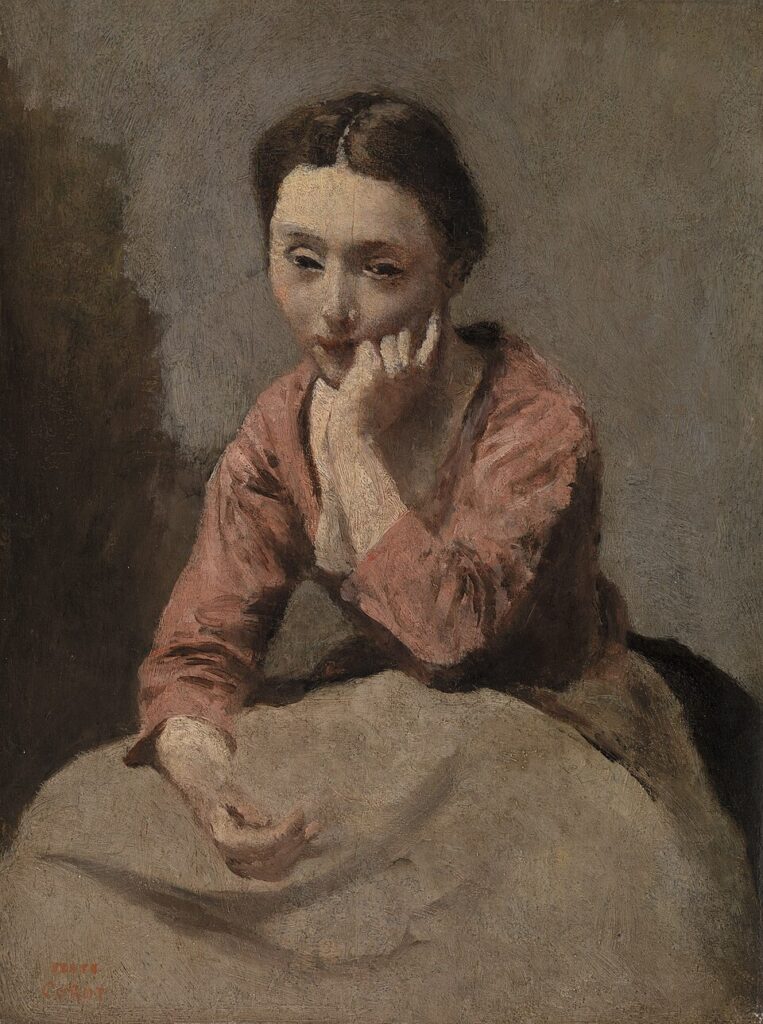
Pensive Woman by Jean-Baptiste-Camille Corot

Time and Other Solvents: A Story of Healing, Told in Poems

Claudia Gary, Sligo Creek, 2026, pb., 96pps., £12.99

Full disclosure: Claudia Gary is my teacher. I mention this upfront, because it shapes my approach to Time and Other Solvents – a poet reading a poet, with the personal connection inevitably influencing the process. Poetry can obscure as easily as it reveals, which is why it takes courage to turn it on your own life. Gary does exactly that, across eighty-plus poems and a whole life, in forms ranging from the villanelle to the sonnet to free verse. It is one of the most honest books I have read in years, and one of the most charged.

The collection is organized as a triptych. Part I traces a childhood in New York and elsewhere, filtered through art, music, a brilliant and damaged mother, and the first intimations of loss; Part II follows the speaker through the joys and pains of adolescence and young adulthood – asserting her space, a marriage and life abroad, another marriage, pregnancy, and an off-and-on background of eating disorder; Part III moves into a hard-won adulthood – grief, recovery, the death of parents, and the return to (and through) art. The title says “A story of healing”, and it is not a marketing phrase. It is a precise description of what the book does and how it works.

I admire Gary’s command of form. The sonnet ‘Perfect Time’ splits cleanly into two numbered sections: the first a subway ride with her mother, the second the mother’s psychiatric hospitalization and ECT, which Gary names in a footnote with clinical plainness: electroconvulsive therapy. The second section opens: “Perfect time’s up. A brittle stick of chalk, / you’re quivering, sobbing, packing for somewhere.” The same rhyme scheme, the same fourteen lines – but the mother who was singing is now shaking and being packed off to a clinic. Gary doesn’t explain the gap. The form does it. It is notable that the first part is an uninterrupted block of text, while the second one is broken into stanzas – somehow adding to the difference between the childishly joyous stream of thought and brittle, uncertain reality of a clinic. The villanelle ‘Getting Lost’ ends: “Patterns of bricks, words, music, inexhaust- / ible in variation, began oozing / out of that childhood dream once double-crossed. / I found myself through fear of getting lost.” That fear becomes the reason to write.

The mother is the centre of the book, and Gary gives us time to understand that relationship. The mother was an artist herself – a maker of mosaics, a repairer of picture frames, a woman who guided her daughter’s hand across the paper. She was also someone whose own mind had been damaged by the very treatments meant to mend it. In ‘Her Memory,’ Gary says: “Mom was a blessing once, / a vibrant tapestry, / until they took away / her woven synergy. / Although her inner strength / turned into cruelty, / her earliest bright stitches / dance through my memory.”

That the mother who could receive half an embrace before pulling back, who could call her clinging child “sticky chewing gum,” who retreated from half an affection, also taught that same child to see the world – this is the contradiction the book is built on.

Part II turns personal. The eating disorder is present from ‘Empathy’ through ‘Bulimia’ and into ‘The Spill’ – shown, named, and examined. A poem addresses Princess Diana directly, noting they shared a hushed disease before it had its public name. ‘Desserted’ is about chocolate the way addiction is about the substance – not really. ‘Wrong-Way Driver’ uses a near-collision on a dark road – a wrong-way car narrowly missed, the baby in the back seat sleeping through it – to ask whether a brush with death is enough, or whether the will to live has to come from somewhere else. ‘The Cure’ takes that question head-on: the speaker has been told real illness demands a real cure, not an imagined one. The final couplet doesn’t argue – it just states what is true: “You have been cured by friendship, words, and song.”

Part III is about losing the people who made you. The father who walked through the Brandenburg Gate just after the Wall fell, who had once been a billboard face for bourbon in cities the daughter never knew; the mother who, near the end, ran her fingers through her daughter’s curls and apologized for straightening them chemically decades before. ‘Barrier Reef’ returns to that childhood subway ride and what the mother tried to teach there – and finds that something the speaker once refused has finally come through. The poem ‘Marathon’ holds the mother’s dying with quiet control – its returning lines carrying the long duration of dementia, until her last words turn out to be about airline ticket prices, and then she is gone. The quietly intense poem called ‘In the Cellar’ gives the collection its name – stories kept in airtight vessels, agitated from time to time, until one day they appear “translucent.” The poet asks: Will I someday grow old / enough to speak of them?” The book itself is the answer, and it took decades to get there.

I come to Gary’s work as a poet myself – someone who has spent years wrestling with formal verse in two languages and knows what it takes to make a form work rather than merely contain. What I find here is something else I aspire to: an image that carries more weight than an argument. ‘Skating Lesson’ ends with one: “Under the frozen surface of a pond / was a baby. I ran to break the crust, / and found the child alive. / From this dream I gathered, / Yes, have children. / The message had a hibernating twin: / Ice will revive you.” It’s the most quietly hopeful image in the book.

I also understand many of the losses Gary writes about – not the same losses, but similar in shape and scope. The distance between a parent’s aspiration and their capacity for presence. The experience of arriving in a foreign country and learning to live inside another language. The way poetry and music are not escape routes so much as load-bearing walls, the things that hold you together while you figure out how to hold yourself together. Reading Time and Other Solvents felt, at many points, like being recognized by a stranger – which is perhaps the best thing a collection of poems can do.

The book ends with ‘Comfort Food,’ a short poem that manages to be funny and devastating in equal measure: lentils, barley, split peas, water, salt – the recipe is simple, almost nothing, and then in the third stanza, with no warning: “Towers have toppled / into the soup.” A poem can do that – fold the catastrophic into the domestic without irony and without sentimentality – only if the poet has earned it by paying attention, poem after poem, to things that hurt. Claudia Gary has earned it.

Six poems by Claudia Gary

CLAUDIA GARY teaches workshops on Villanelle, Sonnet, Meter, Poetry vs. Trauma, etc., at The Writer’s Center (writer.org) and privately, currently via Zoom. Author of Humor Me (2006) and chapbooks including Genetic Revisionism (2019), she is also a health/science writer, visual artist, composer of tonal songs and chamber music, and an advisory editor for New Verse Review. Her 2022 article on setting poems to music is online at https://straightlabyrinth.info/conference.html. See also pw.org/content/claudia_gary

What My Heart Is Saying    

A while ago it spoke up

complaining there’s enough

to process here without 

waves scattering new nacre 

on briny sand


or dredging up seaweed 

to glisten then decay


or sending driftwood planks

to scrape at its incline 


or drawing out its words

with undertow


reminding me a harbor

is subject to erosion

susceptible to tides

but also now and then 

to a starfish.

My Story Has No Villain 

Even the stag that stood before your door

and looked me in the eye—making me stop

and wonder, “Should I be elsewhere?”— was not

a villain, may have been my guardian.

And only when I called out, “Let me through!” 

did he stand down. Does our present create 

the future, or does some idea about

our future block a pathway and create

the present, antlers shuffling warm air?

Legato Notes   

1.

Even a flock

of soot-colored grackles

landing on wires

returning to gray clouds


today even this 

is a moment of peace

2.

Let me dissolve

out of the narrative

into the moment


Delicate and strong

my soul is not leaving

but sheltering in a corner

3.

From unmade bed and plenitude of sighs

to turmeric and lack of peppercorns


melisma to staccato

staccato to melisma


a peppercorn for your thoughts

a murmur for your kiss

Song for Today          

With no time for melisma,

a clear syllabic song

becomes the quiet engine

to move this day along


although the singer slumbers.

Today his peaceful heart

rouses within its rhythmic space

to reason and to start


elaborating newly

a song launched years before

and bring it to fruition

despite a time of war.

Una Corda     

To pull away from sound

precipitates a longing

for greater sound.


I build a house of music.

Its cornerstone is silence.

This soft pedal 


divides each tone’s foundation

in half and lets it settle 

into desire.

Setting 

The room is quiet, warm,

soft voices speaking, sighing,


creating poems and later

music spilling over 


into a performance

that intrigues, overwhelms.


But how to return 

to that quiet room? 


With these words I knock

gently at the door.

Five poems by Claudia Gary


CLAUDIA GARY lives near Washington DC and teaches workshops on Villanelle, Sonnet, Natural Meter, Persona Poems, Poetry vs. Trauma, etc., at The Writer’s Center (writer.org), currently via Zoom. Author of Humor Me (2006) and several chapbooks, most recently Genetic Revisionism (2019), she is also a health science writer, visual artist, and composer of tonal chamber music and art songs. Her chapbooks are available via the email address at pw.org/content/claudia_gary

Her article “Song as Conversation,” on setting poems to music, is online at

https://straightlabyrinth.info/conference.html

@claudiagary

Poet Under Fig Tree 

Some days he cannot choose

between the living and the dead.

The latter want too much of him,

the former want too little.


Talent’s a sticky riddle

whose seeds are strewn at nature’s whim,

whose fruit he heats and stirs to spread

before a mortal muse.

What Would Zeus Do? 

Most likely something with a thunderbolt:

Mistaking lightning for imagination,

he’d make the sky his canvas. Or he’d molt

into a swan, a bison, a dalmatian.


And you? Since I’m not Hera, you’ll keep looking

past me for glimmerings of her and Greece.

Your mouth will always water for her cooking.

It won’t appear, and we will have no peace.


As this land offers less and less to praise,

our beauty may be lost on one another.

Between the sleepless nights, how can the days

bring any comfort?  Here’s where Zeus’ brother

below ground and the one who rules the ocean

need to unroil, unrumble our commotion.

In the Void 

For one who loved Math and Latin

a spiritual Goth moment

became a teenage alias:

Nulla Ultima.


To be nothing, the extreme 

nullity, meant being 

on the inside of everything,

the ultimate persona.


Was it a pose? Did she 

actually know something

for one split-second—or nothing?

If it was only absence


what did she know in her absence?

This was where things could get 

interesting, if only 

for a nothing moment.

Presence               

Cape May, by Andrew Wyeth

http://andrewwyeth.net/artwork/cape_may_1992.html

As skies threatened rain I steered back the boat

to watch dappled clouds from this beach in half light,

frame planted, eyes fixed to the shifting horizon,

away from my flock for longer than planned.


You tell me my headdress appears to take flight?

Either this, or the being within, is disguise.

I don’t have the presence to open my hands.

The joy of the wind is caught in my throat.

On Having Misspoken        

Time set aside for poems I reassign

for wordlessness: to sort collected seashells,

see which of them already have their own

airgaps with room for silk cord, colored beads

on curved and rippled surfaces that cradle

all light, reflect it softly, hold it always 

at the best angle, unlike mistimed words.

Five poems by Claudia Gary

CLAUDIA GARY’s latest chapbook is Genetic Revisionism. She is also author of Humor Me (David Robert Books, 2006) and earlier chapbooks including Bikini Buyer’s Remorse and Epicurigrams. A writing instructor, health journalist, and composer of art songs and chamber music, she lives near Washington D.C. Her workshops at The Writer’s Center (writer.org) on Villanelle, Sonnet, Natural Meter, Poetry vs. Trauma, and other topics are currently worldwide via Zoom. See pw.org/content/claudia_gary; follow @claudiagary

To a Mollusk             

Your life is not defined by an old story

in which, had you remained, you’d surely die.

Nor is it the palatial territory

you crave, create, secure, and occupy.

It’s rather the progression from before

to after, the formation of each new

foyer, parlor, salon, and corridor

in which your predecessor becomes you.

After the briefest stay you labor on,

building a spiral path that winds toward more—

inwardly smooth, pearlescent where you’ve gone

ahead, outwardly rough as ocean’s floor.

You lodge concealed within the earthly mire,

inhabiting your curly multiplier.

Message to Earthlings from Voyagers I and II    

               for Carolyn Porco, Voyager imaging scientist and Cassini imaging leader


Beyond some human lifetimes now, we’ve filled

your minds with data, pictures, dreams. Though twinned, 

our paths diverge, itineraries build.

Reaching the boundary of solar wind,

we rode its termination shock to sail

out into plasma space. While you continue

sorting our childhood photos, they grow stale.          

We bear vital statistics from within you —

your faces, body images and voices —

toward other stars, toward anyone who cares

enough to grasp your golden disk, your choices

of what they’ll see, hear, touch, assuming there’s

contact or empathy. Onward we fly,

your complex way to say hello/goodbye.

Catheter Ablation 

Two hours on the table

his body reclines

arranged as a path

            for cautery’s snake

            to enter his heart.

Clean current stamps

invisible scars

to settle his pulse.

            No longer two steps

            ahead and one back,

blood coursing forward

oxygen-laden

quickens his brain.

            The serpent withdrawn,

            he gathers his wisdom.

Credo-in-Progress 

I. Tough Customer

A stubborn teen, she needed to find out

what life was for, whether it had a point.

“I won’t go on, God, till you let me know.

So tell me now or set me free.”  She waited,

and God did both. “Brilliant!” she said. “You win.

I’ll give you a few years – but I’ll be watching.

You’re going to have to show me every day

that you’re still there”. She heard, or felt, a rumble

that may have been laughter, as if the deal

were sealed.

II. Anything to Declare?        

Presented with the light

at seventeen, she chose

to turn back, stay a while,

having seen that joy

kept an outpost here.  

            And what was hovering there?

            No prophets, true believers,

            or any kind of shadow.

Because her life is made        

of unexpected gifts,

she won’t turn one away

without looking to see

what light it holds. 

III. Her Invocation

Temperamental universe in whose purpose

(known, unknown, unknowable) we are swimming,

safe within your energy and your chaos:

make me your prism.

Becoming Buddhist 

The summer of learning to type 

I also slogged to the river with Siddhartha

and analyzed dreams in the shallows

as Dr. Sigmund dictated the code.

Thinking I knew their source

made dreams seem safe, but Hesse was a puzzle

suffused with Eastern sentiments, ideas

I seldom understood.

So when I awoke at night

with fingers typing “nothing” on the blanket

over and over, I blamed nihilism 

or adolescent darkness. 

But no: I was absorbing 

what to expect in order

to be content.

http://www.pw.org/content/claudia_gary / 

@claudiagary

Three poems by Claudia Gary

CLAUDIA GARY’s latest chapbook is Genetic Revisionism. She is also author of Humor Me (David Robert Books, 2006) and chapbooks including Bikini Buyer’s Remorse, Let’s Get Out of Here, and Epicurigrams, all available from the author. A writing instructor, health journalist, and composer of art songs and chamber music, she lives near Washington D.C. Her workshops at The Writer’s Center (writer.org) on Villanelle, Sonnet, Natural Meter, Poetry vs. Trauma, and other topics are currently accessible worldwide via Zoom. See pw.org/content/claudia_gary; follow @claudiagary

The Mad Scientist’s Subjects


Here in the lab-coat pocket where we ride,
our galaxy between odd scraps of lint
and roughly scribbled theorems, we’re beside
ourselves with astronomic wonderment.
Is this a place where time is relative,
an episodic groove that opens toward
and then away from starlight? Do we live
within a field where each day is a chord,
one moment in an old celestial song?
Our universe diffuses while we listen
and thrive on melody. Drifting along
within our microcosmic trance, we glisten
and spark in recognition of our host,
who floats, euphoric, still undiagnosed.

The Littlest Angel

After we made our sequin-covered halos
from crepe paper, pipe cleaners, wire hangers,
to wear for the First Grade Play, I pulled dried glue film
from every square inch of my palms and fingers.

Our star was perfect for his role, with dark
thick lashes, gleaming eyes, angelic aura.
Years afterward I learned he’d never reached
his forties. Was it suicide? AIDS? War?

He paid a heavy price for coexisting
with brutes and yet avoiding malice,
for peeling off the newest layer of skin
whenever it became a callus.

Tornado

In tonight’s dream I am a funnel cloud
that dips one spinning toe
into the earth

scattering deep-set trees, adjusting brick walls.
You hurry to the middle
of your cottage

and hear my hollow voice as a freight train
that looms, approaches, runs through,
trails away.

The sky no longer green, I turn to vapor
oblivious to wreckage
and to a steel-

girded concrete last-resort saferoom
that has protected you.
You are my heart.