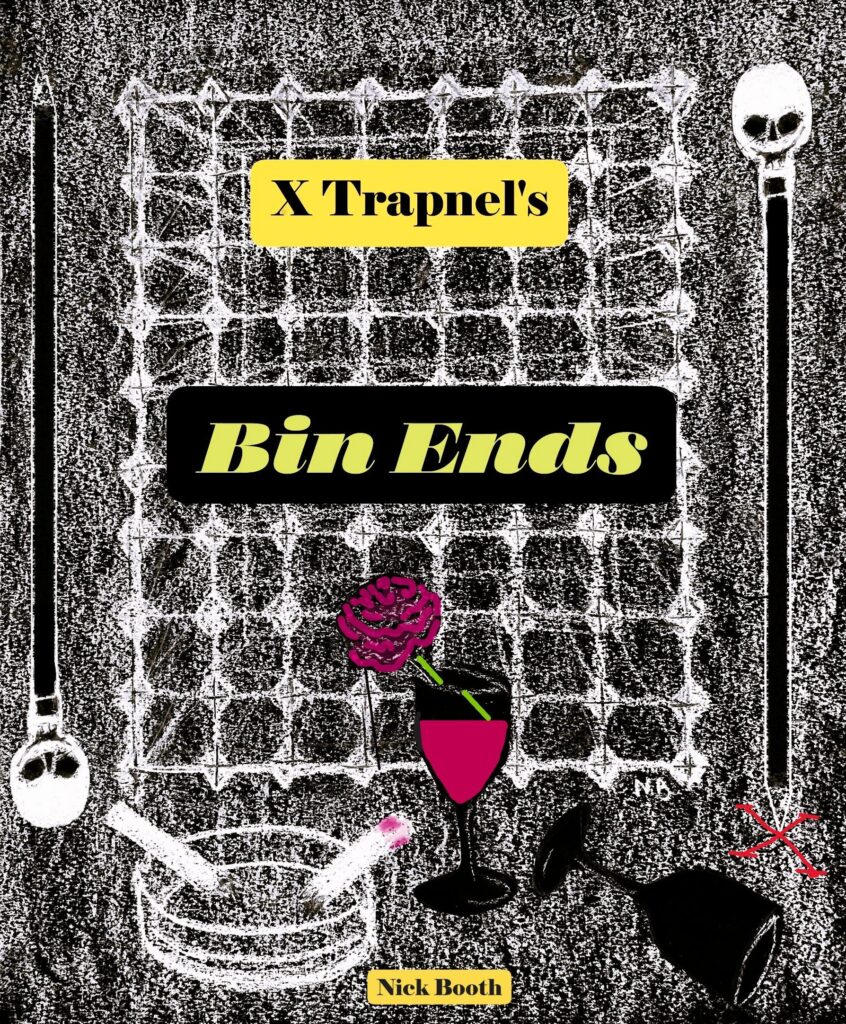
The first in a series of stories from Bin Ends by X. Trapnel, Anthony Powell’s great lost novelist, as found and transcribed by NICK BOOTH
Billy the Tie told me to go and fetch Lavender Ray’s suitcase. ‘Do us a favour,’ he’d said. ‘There’s something in it which will get us all into trouble.’ I’d a hard-edged hangover of the type where you’re not sure of your stomach or your sanity. It was not long after opening time at the Black Dog and I’d just accepted from Billy a verbal promissory note of a tin of fags to be collected that afternoon. He was apt to make gifts and all of us who lived on the straight side of the fence knew not to accept them as a rule. However, the Blitz was on and there were bombs night and day. For most people life was difficult, but Billy had come into easy street: thieving and fiddling in the blackout was, as he put it, ‘extra-easy’. Soho talk had it that Billy had even done people in but the prospect of having a lot of cigarettes to play with was too much in my weakened condition so I gave in. ‘You’ll have fags galore, boy,’ he’d said.
I had not expected a favour to be called in so quickly. My stomach knotted tighter into a ball of acid. The pain in my head flared. The stale beer-and-fags morning scent of the Black Dog, usually rather enjoyable, oppressed me. Gingerly I drank a farty half of Bass. I noticed my hand was shaking slightly. The fear, sadness and regret of the serious hangover bit deep. ‘You don’t mind, do you?’ said Billy.
I said I didn’t mind, of course I didn’t mind. On the contrary, it would be a pleasure, I said.
‘I shouldn’t think it’ll be a pleasure,’ said Vernie wryly. Vernie was Billy’s sidekick. Tall where Billy was slightly under. Both wore pinstripe suits (Billy’s smart dress sense was the reason for his nickname). It seemed their ambition was to look like the cream of society instead of rats: the tribute vice pays to virtue. However, the effect was more suggestive of a variety double-act. Vernie took an ostentatious sip at his double pimple and water, to show off he was drinking one. Pimple-and-blotch: scotch.
‘Come on now, Bill,’ said the landlady, Ada. ‘Neville’s a painter. He’s not part of all your lot.’
‘Ain’t you in the war effort, boy?’ asked Vernie in way that was avuncular yet sinister. I said I was waiting to be called up. That was a lie. I’d been deemed unfit for service.
‘Never mind all that plop,’ said Billy, his voice as coarse as a burglar’s file. ‘You go and fetch me Lavender Ray’s suitcase.’
‘What’s in the suitcase,’ asked a little fish-faced man they called Cod’s Eyes who pushed sack barrows about for his living. ‘It ain’t that tart’s head, is it?’
‘Cheese it,’ said Billy. He fixed me with his blue eyes, cold as winter dusk. ‘It’s easy as wink,’ he said.
‘Is Ray dead, then?’ asked Vernie disinterestedly.
‘Word come to me last night that he’s dying, at death’s door. His landlady had the doctor out to him – who paid I don’t know: Ray’d never cough up for a doctor anyway. ‘Ere Vernie, “cough up”. Did you hear that? Well laugh, then. Tops up the quack says it ain’t no good. Ray’s finished. Lungs or summink.’
I felt finished too, and hurried to the gents where I was violently ill. Why had I agreed to the errand? When I came back I drank off my Bass, cross-eyed for a moment watching the brown river of beer flow into my mouth while Billy wrote Lavender Ray’s address on a strip of the Greyhound Express. ‘There’s a key on a bit of string in the letterbox of the street door. His room’s at the top of the house. There’s two doors on the landing. Ray’s is the first one. Don’t sod about. Bring the suitcase back here,’ he said softly. ‘If I’m not here and neither is Vernie, just wait till we are. On no account leave the suitcase here or anywhere else, got it. That tin of fags will be waiting.’
‘Tart’s head?’ asked Ada rhetorically.
‘Some dead tart was found,’ said Cod’s Eyes. ‘I see it in the paper.’
‘Why would her head be in Lavender Ray’s suitcase,’ said Vernie.
‘Cheese it, will you,’ said Billy. ‘You’ll go frightening the boy here. Now, you run along and them fags is all yours.’
I turned out of the door of the Dog. It closed slowly. I heard Vernie say, ‘You’ve sent a boy on a man’s job there. Look at the state of him. I bet the army told him to fog off.’ There was general laughter. ‘I bet,’ added Vernie, ‘they said come back next year when you’ve got some hair on your chest.’ There was more laughter.
*
Outside I took a deep breath, which didn’t help. Cod’s Eyes came out of the other door and walked over to me. He was grinning. ‘You’ve got that all round yer neck, intcha. Why d’yer do it?’
‘I wanted the fags. I didn’t think – ’
‘You didn’t think,’ interrupted Cod’s Eyes elongating the words with a contemptuous tone. ‘You know, you don’t half look queer.’
‘I feel queer.’
‘Want a fag?’
We lit up Cod’s Eyes’s Players. ‘There could be anything in that suitcase,’ he said. ‘Might be a shooter. There was a bloke shot in the West India Dock Road the other night, right through the heart. Foul murder. If the gun’s in that case you’ll be an accessory, kid. Enough to put a rope round your neck.’ He paused and looked at me searchingly through his murky protuberant eyes. Any friendliness vanished. ‘You mug,’ he said. He chipped his fag and stuck back in its box. ‘Stick to drawing pictures next time.’
He started off across the road but quickly turned back and said: ‘How you make a living doing that?’
‘Once in a while someone buys one,’ I said. My voice sounded forlorn. Cod’s Eyes walked on then turned round once more and yelled: ‘If that’s tart’s head’s in it, you’ll swing for that an’ all.’ Then he seemed to remember he was shouting Billy the Tie’s business in the street. He looked round fearfully and stalked away.
I walked out of Soho feeling weak at the knees. Then I got the Tube east.
*
I emerged not far from the river. The whole district had really copped it in the raids. I entertained a wild hope that Lavender Ray’s lodgings had been bombed flat.
The streets were full of dust. Kids searched for shrapnel and looked well pleased at the new anarchy of war. A broken-down bus was pulled up round one corner. Its driver was sitting on seats at the back. Somehow he had got a mug of tea. As I passed he raised the chipped vessel in an ironic toast and winked. In the distance I could hear falling bricks and the sound of a lot of broken glass being swept. I walked for a few minutes and asked the way more than once. At last I came to an old street with a factory wall on one side and tall knocked-about houses on the other. Outside one a woman with a beaky nose in a housecoat was smoking a cigarette and watching another woman in a hairnet scrub the front step. ‘Raymond?’ she said in answer to my query. ‘Next house, top floor. I hope you ain’t going that way, sonny.’
The woman wearing the hairnet craned her head round from the step. She looked chinny and pompous. ‘We don’t want all that round here,’ she said. I walked on. I heard the woman with the beaky nose say, ‘Ought to be in the bloody army.’
I climbed three steps to Ray’s lodgings and felt in the letterbox for the key on a bit of string. It was there. I turned the key and pushed at the door, which seemed stuck. ‘You have to give it a shove when it’s hot,’ said the woman in the hairnet. She’d come down the street to look at me. ‘Push it, boy. Ain’t you got no strength?’
I duly pushed harder. The door, which was rough and splintered at the bottom from untold coaxing kicks, swung open. A vague smell of cooking and fags came out like a silent belch. My crapulent stomach turned a little. Everything inside was brown: tea brown walls, gravy brown stairs, brown windsor lino. I started up the stairs. The ancient stair-carpet was a dirty old brown. An archaeologist might have found a pattern in it. Each landing was the same brown study but a little smaller each time. All was silent but for the sound of a wireless behind one of the doors playing cheery light music. I looked out of a window and saw a brick wall with a yard below. Some washing was pegged out by a privy. The top staircase wound up to a small landing.
I raised my hand to knock but hesitated. Leave now, I thought. Run. I would, I thought, have to avoid Soho thereafter but even going to ground would not protect me from Billy the Tie if I welshed our arrangement. It was folly to think otherwise. You’re in it now, I thought. I’d a lousy headache and felt sweat on my temples. My stomach seemed to have fallen away like so much bombed brickwork. I knocked. Nothing stirred behind the door. I knocked again. Then the other door opened and a tiny old man in a crumpled too-big suit and a soup-strainer moustache appeared. ‘He’s dead,’ he said. ‘If you’re here to thieve, I doubt there’s any money in there. I expect the quack had all that last night. Mug if he didn’t.’ The old man’s voice was like a hinge in need of oil. ‘Got a fag?’
I shook my head, knocked again and then went in.
It was a tiny servant’s room in which everything seemed grey. Behind a menthol atmosphere there was a vague unpleasant smell. The covers were pulled over a body on the bed. A suit hung on the front of a tallboy. The suitcase stood by the bed. In keeping with the hallways it was brown, with leather corners. I lifted it an inch, then put it down. It was heavyish. ‘Any booze?’ said the little man with the moustache. He was hovering on the threshold. I told him there wasn’t any. At this, the corpse’s hand appeared from under the bedclothes and snatched away the covers. A bony face was revealed. I jumped back. My heart was going like a jazz set. ‘I’m not blinking dead – yet,’ rasped Ray. ‘I was shamming ‘cos I thought you were – ’ He stopped. What little colour that had been in his face drained away. He closed his eyes. I looked out at the old man on the landing, who drew his finger across his throat and sadly shook his head. Ray opened his eyes again. ‘Who are you?’ he said. ‘What you want that suitcase for?’
‘Billy sent me for it,’ I said. ‘Billy the Tie.’ Ray looked furious.
‘You tell Billy to …’ He raised his head to spit out the last words but now it fell back. Ray closed his eyes and opened them. ‘ . . . to mind his own business.’ He seemed to have fallen asleep or have passed out, or died. I looked at my watch. Of course, it had stopped.
‘Don’t sod about,’ I remembered Billy saying. I picked up the suitcase. I noticed there was in fact some booze: half a bottle of scotch on the washstand. I decided not to inform the old man of its existence. On the landing he stood back for me to pass. His eyes were wild. ‘You thieving that suitcase, boy?’
‘No,’ I said. ‘I’m to take it to its owner.’ I started down the stairs. The old boy leant over the banisters and yelled, ‘You’re a tea-leaf!’
I’d done myself no good saying I was taking the suitcase to its owner when its owner was dying in bed upstairs. It was at this point I began to see a courtroom, a trial, a judge, indeed a judge with the black cap on . . . ‘But you took the suitcase,’ the judge said with an echo. ‘You are implicated in a capital offence, my boy.’ He was old; he looked rather like Lavender Ray.
‘You’re a bloody tea-leaf!’ yelled the old man again.
I careered down the stairs and out of the front door. The two women watched me go past. The beaky one said, ‘Where you get that suitcase?’
A window opened above. It was the old boy again bawling through his soup-strainer. ‘Stop thief!’ his whingeing voice cried. I sped up and looked behind me. The two women were chasing me. I wanted to stop and argue but my credentials were hardly convincing.
Now I was in a sort of comedic silent film chase. Up a street and down a street – up a ladder, down a snake, I’d thought – with the two women chasing me. I lost my bearings. Now, I thought, the police will be looking for a young man with a suitcase.
I turned a corner and the broken-down bus was going again. I caught the driver’s eye and, trying to sound calm, asked him where he was going. ‘Central. Jump on chum, if you’re going that way. I’m heading towards Tower Hill.’ I said I’d enjoy the view and so went upstairs. God knows what had happened to the conductor. I looked back at the street corner. At any moment the two harridans would come storming round it shouting the odds. The driver was revving the engine, as if to make sure the bus had the guts to last out the journey. Finally it lurched forward. I kept my eyes back on the corner, but no one came round it. My attention switched to the suitcase. It smelt vile.
*
The hangover had reached a weary late stage. It would quietly stop soon. My head felt old, sore, wooden. I had that woeful inner climate that interprets the sight of a scrap of newspaper blowing down the street as a powerful symbol of the futility and transience of life. On top of that, the suitcase was now a stinky reminder of my foolishness in accepting Billy the Tie’s promise of fags. Then I thought how much I’d like a fag now. I fought back against fear by reminding myself that I’d simply done someone a favour. ‘How was I to know there was the head of a corpse in it,’ I said to the Old Bailey of the mind. The judge spoke again: ‘Do you expect this court to believe you did not know who Billy the Tie was? You, a denizen of Soho pubs, a familiar face? Boozing your days away when better men are fighting for their country?’ Meanwhile, the bad smell came in waves from Lavender Ray’s suitcase. I counted barrage balloons to take my mind off it.
I got off just before the bus terminated at Tower Hill and thanked the driver, who said watch out for Jerry. ‘The Nazzies will have this city to rubble if we’re not careful.’
‘That’s conchie talk,’ I said jokingly. Conchie talk, yes, I thought, like me imagining that picking this old suitcase up could land me in the slammer. But then fearfully I slipped back to thinking of ways that it could.
I walked slowly through the city. By the time I was in Cheapside I was craving a fag. It was a fine day, and for some reason I fell to thinking how wonderful it would be if there wasn’t a war on and if I hadn’t got to lug this suitcase across town. I bought a single fag from a miserly tobacconist who wanted a penny for it and sat down by St Paul’s churchyard to smoke and think. The suitcase stood in front of me. I stared down at it. It didn’t smell so bad in the open air. Should I open it? Should I not? After a while I was lost in thought, staring at the shops in front of me. The courtroom, the judge, the old boy with a soup-strainer, Lavender Ray, Billy the Tie, Vernie, Ada, Cod’s Eyes, they all appeared in my mind. Fear rose in me. Great fear. Then two things happened in short order: I heard the air raid siren start up, that queer bellowing whine, the siren call of a sea monster I’d called it in a poem I hadn’t finished – and someone pinched the suitcase and ran off.
*
The thief was short and wore a cloth cap. I ran after him. I was shouting but pedestrians were coming out of shops and offices and hurrying to shelters. They took no notice of this youngster shouting over the siren. Soon enough I was gaining on him and at the bottom of Ludgate Hill I ran him into a wall via a sort of rugby tackle. ‘All right, all right!’ he shouted. He was in his forties by the look, and now had a rip in his trousers. ‘I thought you was finished with it,’ he said angrily. ‘I mean I didn’t think it was yours: I had one just like that pinched off me yesterday; I bin looking for it ever since.’ I was dusting myself down and listening for bombers.
‘Oh really,’ I said sarcastically.
‘Don’t call in the law,’ he said as he got up. His anger melted away to a pleading appearance. He looked tired, thin and crumpled. Small intelligent brown eyes, rather dog-like, watched me carefully.
‘Don’t worry, I won’t,’ I said. He brightened up at this. Now we were just two people passing the time of day in an air raid.
‘What’s in it?’ he said.
I swore as I picked the suitcase up to walk on. ‘What’s it got to do with you,’ I said. ‘You’re a tea-leaf,’ I said, remembering the old boy’s jibe.
‘I just like to know what I’ve missed out on.’
‘Well,’ I said. ‘I don’t actually know.’
‘Wot!’ he said. He was walking beside me now. I was thinking how stupid I’d been to chase him. Providence had stepped in to my problems; a veritable deus ex machina had dropped from the sky instead of a bomb and now I was saddled with the suitcase again. Mind you, would Billy have accepted that I’d had the case pinched off me? I gave the thief the gist, shouting above the sound of bomb crumps coming from near the river. ‘I’d open that up if I was you,’ he said. I kept on walking. ‘If you don’t want what’s inside, I’ll have it off you.’ I kept on walking.
‘You can tell your mate who sent you that you lost the case in the air raid.’
‘Yeah,’ I said without turning to look at him, ‘and then get razored in an alley.’ But I knew he was right. I felt sweat running down my temples. I knew I couldn’t take that suitcase back to Soho without looking in it and I knew I had to get away from the thief before he had another go at taking it. Now I started to run and he was chasing me.
We were near the river, in an alley at the bottom of some steps when I tripped and fell. The suitcase skidded ahead. The thief dashed past me and picked it up. I yelled at him to open it. ‘What – and finders keepers,’ he said. I grunted agreement. Breathing heavily he squatted and flicked up the suitcase clips. He lifted the lid. I walked over rubbing my throbbing knee. He stared at the open case and rolled his eyes. ‘Gor christ,’ he said. ‘The stink!’
In Lavender Ray’s suitcase was an assortment of meat and a chicken, all going rotten. The thief grinned. ‘They won’t ‘ang you for that,’ he said and walked off. The crumps in the distance had stopped.
I closed the case and carried on walking slowly back to Soho. The hangover, like the air raid, was fading out.
*
‘Well done,’ said Billy the Tie. We were in the yard behind the Black Dog, which had just opened for the evening. He placed the suitcase on a dustbin, opened it and grimaced at the smell. He tipped the rotten meat into another dustbin then he reached into the suitcase, released a catch and pulled out a section of lining. It was a false-bottomed suitcase. He took out an envelope and from this he drew a wad of money. More banknotes than I’d ever seen. There were big five-pound notes, pink and mauve one-pound notes and even ten-shilling notes. He tucked the money back in the envelope without counting it and stowed it in the inside breast pocket of his suit jacket.
The thief had let a great prize go. ‘You haven’t seen any of this have you, boy,’ said Billy without so much as looking at me. I agreed I had not. He threw the suitcase over the wall into an area where barrows were kept overnight. We walked back to the public bar. Business seemed concluded so far as he was concerned. Vernie, leaning on the bar, took a cigarette from a silver case and lit it, eyeing me. ‘That boy looks like he’s sickening for something,’ he said. Billy had a sly smile but then he saw Ada looking indignant on my behalf. ‘Oh yes,’ said Billy. From a voluminous pocket he produced a tin of fags. I took them, almost snatched them, with no thought of law, of coppers, of courts, nor of judges. I looked down at the lid: CRAVEN PLAIN. I felt sad and a little ashamed. Ada gestured to me and I followed her to the other end of the bar. ‘I hope you’ve learned to stay away from them lot,’ she said in a fierce whisper. ‘Join the bloody army too while you’re at it. It’s an honester life than this.’
‘All right, Ada. Give us a Bass please,’ I said. I hugged the cigarette tin. I opened it. It was full. I sniffed the toasty aroma of fresh cut fags. Good old Billy I even thought.
I was about two mouthfuls in to the Bass, which was less farty than the morning’s, when the door opened behind me. ‘Where’s my bloody suitcase,’ yelled a cracked voice. It was Lavender Ray. Lavender Ray bold as brass, as Cod’s Eyes would always say when telling the story.
Vernie laughed. Ray was in the suit that had been hanging on the tallboy and was in a rage. ‘I been burgled,’ he shouted. The smattering of early-doors drinkers turned to look. A naval officer who’d strayed into the public bar looked very disapproving, as if he’d trodden in a dog turd.
‘Calm down, Ray,’ said Billy. ‘You look rough. Cheese it.’
‘You’re supposed to be dead,’ said Vernie affably.
‘Dead drunk more like,’ said Billy. But he looked wary.
‘Dead? I bloody ought to be. I got up,’ said Ray, ‘I drank half a bottle of pimple and I come down here for my suitcase.’
‘Too bad about that suitcase, Ray,’ said Billy carefully. ‘We thought you wouldn’t be needing it like, and well, you’d rather your money went to a good cause and not the policeman’s ball, wouldn’t you.’
There was a tremendous scene at this. Ray said he hadn’t made a will and if he had Billy and Vernie would not be in it. Then he sprang at Billy yelling something about his tie which he savagely tightened to throttle Billy. It was a neat schoolboy trick here executed with demonic brio. Ray might have been at death’s door but he seemed as strong as a lion. Billy was choking when Ray delivered an uppercut that sent him sprawling into the fireplace, which was unlit. Vernie was next, taking a series of punches that left both his nostrils pouring blood over his greasy little pencil moustache. It all happened very quickly. Perhaps Ray had been a boxer. Ada was shouting; two drinkers, market sorts, grabbed at Ray. The naval officer kept saying someone should get a constable. No one took any notice of him. Billy got to his feet, loosened his tie, gasped a few times and gave Ray the envelope he’d taken from the suitcase. No fuss, no whining. The market sorts let go of Ray. Ray opened the envelope and gave its contents a brief look. Turning to leave he caught sight of me. His waxy nostrils flared. ‘The thief,’ he snarled and dragged me outside in an unbreakable grip. I was quite distressed to note that no one tried to stop him.
With whisky breath he harangued me. His face was alarmingly grey and he was slightly boss-eyed with drink. Passers-by looked at us as if we were both undesirables, which I suppose we were. I knew a punch was coming. Right in the kisser Vernie would have said. Maybe a lot of punches were coming. ‘So you think you can burgle my home, do yer! How dare you even think you can steal from a sick man!’ He interspersed each sentence with obscenities and swearwords. I realised that Billy had sent me into a lion’s den to steal, plain and simple thieving, and I’d done it in sweet ignorance: this man was so tough even Billy the Tie was scared of him.
Ray clenched his fist so I gabbled out an apology that did not make a great deal of sense and then I thrust the tin of fags at him by way of a gift (I’d held on to them like grim death). This stopped him. He took the tin of Craven Plain. He looked at it with surprise and something like appreciation. He looked at me. Then he punched me just the same. It felt like a cricket bat had walloped my mouth. I saw stars and tottered into a lamppost on which I steadied myself. I could taste blood. Ray opened the tin and extracted a fag from the tightly packed multitude therein. I was prevailed upon to light it for him. He drew on the fag. This triggered a ghastly coughing fit: he coughed with his head on one side, then on the other. He doubled over to cough. He expectorated violently on to the pavement. He pushed one nostril in and blew battleship grey and sea green snot out of the other. He wheezed horribly: his lungs were an old cracked squeeze-box. He coughed again horribly; he coughed lustily; he giggle-coughed; he guffaw-coughed. He coughed like an angry retort and then like a belch. His eyes watered profusely. He spat again. He turned light green. Then he took another long draw on the fag and walked off. Word came the next day that he was dead. I wondered if the old boy with the soup-strainer moustache thieved my tin of fags when Billy expired. I don’t know who got the money from the suitcase.
*
Billy the Tie hanged himself in 1944. Some said over underworld debt. Vernie also died in the war: choked to death on a black market pickled onion in an army camp somewhere. He was drunk at the time. Ada perished when the Black Dog copped it from a doodlebug. Cod’s Eyes fell in the Thames one night after closing time and drowned. Late in the war I remembered the inside of Lavender Ray’s suitcase when the thief opened it down by the river. I did a painting of an opened suitcase on a bomb-site with a living bird in it. It was exhibited in a West End gallery. A newspaper critic said it was the human spirit coming back after the cataclysm; something like that. I expect it’ll end up in the Tate.

NICK BOOTH works in publishing, and lives in London. He is writing a monograph about the Forties neo-romantics