With a Stranger’s Eyes
Jeremy Hooker, Swindon: Shearsman, 2025, 86pps., £10.95
LIAM GUILAR salutes a wryly observant yet engaged poet
With a Stranger’s Eyes is Jeremy Hooker’s third book of poems since the publication of Selected Poems 1965-2018 (Shearsman 2020) and arguably the best of this later group.[i] The poetry is divided into three sections, with a fourth, short prose ‘Reflections on Two Welsh Words.’ The first two sections record people, places and incidents from his past and present in non-English speaking countries, moving from memories of Holland to Wales, to a final section which looks outwards. The poet moves from being a stranger by nature of nationality and language, to a stranger in the world by reason of being human. The title reflects Hooker’s sense of not belonging. “I am a stranger in the area in which I live, and a stranger to the tragic history of the area. Being a stranger has affected my idea of myself as a poet (p.83).”[ii] This awareness saves the poems from sentimentality and egotism.
If we include 2016’s Ancestral Lines, then these four poetry books are what used to be called ‘a significant and important body of work,’ in their own right, because of the way they explore a maze of writing problems and offer one way out.
Hooker has quoted David Jones’ “one writes with the things at one’s disposal” which seems incontrovertible. However, biography is one of those things, and if biography is what makes writers who they are, then how do they write autobiographically without falling into the trap of producing something that is either private or, perhaps, worse, a lyric poem that begins and ends with the egotistical /I/? Hooker describes the problem: “I distrust the autobiographical impulse with its temptation to egotism and assumptions of finality. […] nostalgia came with a horror of being stuck in an idealised version of the past.” (‘A Note on Autobiographical Poetry,’ Preludes p. 79).”
The danger becomes more pressing for a man in his eighties, who has reached a time in his life when looking back seems inevitable. Ancestral Lines was Hooker’s direct confrontation with the problems of writing autobiographically. In ‘Lyric of Being’ the essay that ends that book, he wrote: “My concept of the poet was that of one who struggled to keep open a channel between self and the world and the living and the dead, as opposed to writing a verse beginning and ending with the self (Ancestral lines p.76).”
Born in 1941, in the south of England, Hooker has acknowledged his earliest literary influence was Richard Jefferies. If Jefferies taught him to pay attention to the world around him, he also gave Hooker his lifelong interest in the idea of ‘Ground’ – a word which has developed in his writing from referring to the significant place for the writer, to the complex relationships that link the individual to community, literature, history and geography. By acknowledging that grounded relationship, the poet can move away from both egotism and sentimentality.
His literary influences include some of the great modernists, particularly T. S. Eliot and David Jones, and his work negotiates the complicated legacy those writers left for those who admired them. Poetry is a serious activity. The poet exists as practitioner of an art that is both contemporary and ancient, both specific to the language spoken and yet open to poetry in all languages. Above all, those writers bequeathed a distrust of the whining Ego and what might loosely be called ‘confessionalism.’ There is an irony here, which should be acknowledged. For so many writers these are not problems. What Hooker is trying to avoid is the only thing they know how to do.
Another irony is that for a man who admires David Jones and George Oppen, he writes like neither of them. Bunting’s praise of Scarlatti describes Hooker’s poems. Initially it might seem strange to link Scarlatti’s sixty-four notes to a bar ripple and rush with Hooker’s uncluttered verse.
It is time to consider how Domenico Scarlatti
condensed so much music into so few bars
with never a crabbed turn or congested cadence
never a boast or a see-here, and stars and lakes
echo him and the copse drums out his measure
snow peaks are lifted up in moonlight and twilight
and the sun rises on an acknowledged land.
(Basil Bunting, Briggflatts)
But in the verse, there is no pyrotechnical ‘see here,’ no pretence to ‘poetic thoughts’ no one ever had except when trying to write a ‘poetic poem’ – no congested cadence of jumbled syntax, no boastful ‘look at the vocabulary I pillaged from the thesaurus’ or ‘be impressed by my references to things you’ve never heard of.’
In ‘Reflections on Two Welsh Words’, Hooker writes: “In tune with the thinking of modernists such as T. S. Eliot, David Jones, and George Oppen, I conceive of the poem as a made object, a thing that stands apart from the poet, an act in a transpersonal ‘conversation’ (p. 84).”
His poems have a conversational tone that only someone who is tone deaf would call artless. However, art as conversation means more than just tone. He has acknowledged his debt to Martin Buber’s I and Thou.[iii] According to Buber, the destructive tendency is to turn every ‘you’ into an ‘it,’ into something that can be instrumentalised, or used, or packaged – in poetic terms, to see oneself, like a Wordsworth, as the centre of the universe. The challenge, simplifying Buber, is to see and celebrate the other in all its specific otherness AND not lose the /I/ that is interacting with it. [iv]
Hooker achieves a balance between the person writing and the subject of the writing. ‘Rowan Tree’ offers the most straightforward example. From Wales, or the Welsh poetic tradition, he took the idea of poetry as a vehicle for praise. ‘Rowan Tree’ is a song of praise but made new by the poet’s refusal to pretend the tree cares about him.
It pleases me
that you are no thing
of words, but indifferent
to all I say or think.
Yet having contemplated the tree in all its seasonal and historical variations, the poem ends.
Rowan tree
that enchants my days
be to me, if only
in imagination,
an old man’s staff.
Let me stand with you
against Atlantic gales.
Allow me to warm myself
with your leaves’ red glow
against the coming cold.
To write about the tree is to acknowledge what the tree means to the writer. The difficulty is to see the subject not as an extension of self, but as something in relation to self. As he writes about people who were important to him, he preserves their essential strangeness while celebrating what they meant to him. In ‘Gwenallt,’ for example:
But I will not insult the man
with elegy, or lessen his ferocity
with emollient words.
Let me see him
as the Jeremiah he was,
prophet
of the death we have dealt a nation,
and the doom we are bringing on our own.
Living and working in Wales exacerbated the problem. Acutely conscious of his strangerhood, in a country whose language he didn’t master, Hooker was an unwilling representative of the race some of the Welsh writers he admired and championed saw justifiably as The Enemy. The pressure of this alterity may not be comfortable for the individual, but it is bracing for the poet. It acts against any tendency to ‘egotism and assumptions of finality.’ It makes nostalgia uncomfortable and reminds the poet of the difference between reality and any ‘idealised version of the past.’
The Welsh poetic tradition also began in commemoration. The poem offers both poet and reader the possibility of learning how to see and different ways of understanding. Hooker’s poems deal with places made memorable by the people he associates with them, or where tragedy happened. The poet commemorates by finding the image to bring events to the reader’s attention and understanding in ways that journalism cannot. In ‘Passing through Aberfan,’ fourteen lines of understatement manage to capture the horror of an event that once reverberated through British culture. ‘On the Road to Senghenydd’ confronts the problem of writing about another, perhaps less well-known disaster.[v]
Do not imagine you can imagine it.
Do not suppose you know
what grief is, or terror, or courage
of men entering an inferno
to rescue their kind. Today
you may think the scene medieval,
like a picture of hell.
But you will know nothing
unless you catch a distant echo
from the very ground, where
a father calls for his son,
and a son cries for his father.
Following Buber’s lead, the poems explore the rich variety of life. There is anger, and sadness, and humour. ‘Haunted House’ begins as any rural ghost story:
Children called it
the haunted house.
It may have been because
an angry man lived here.
But the swerve at the end is both unexpected and highly effective.
Whatever it was, I do not know
why children passed this house
with a tremor of fear.
What I do know are days and nights
when I would have given my life
to feel the touch of a ghostly hand.
It’s easy to confuse ‘serious’ with humourless, but in Hooker’s case that would be a mistake. To be human the poems have to smile occasionally. This is from ‘On the Painting called Peace:’
But the artist’s soul was in it.
It wasn’t his fault
that he was a Victorian.
This is from ‘In Memory of Norman Schwenk:’
An American in Cardiff
you were always a man from Nebraska –
though a follower of Glamorgan cricket,
which in recent years
has been a hopeless pursuit.
I turn a page and read ‘Dialysis: reading Ibn ‘Arabi:’
Love is my creed.
Wherever love’s caravan
turns along the way,
that is my belief.
Briefly, an image
of holiday traffic on the M4
passes through my mind.
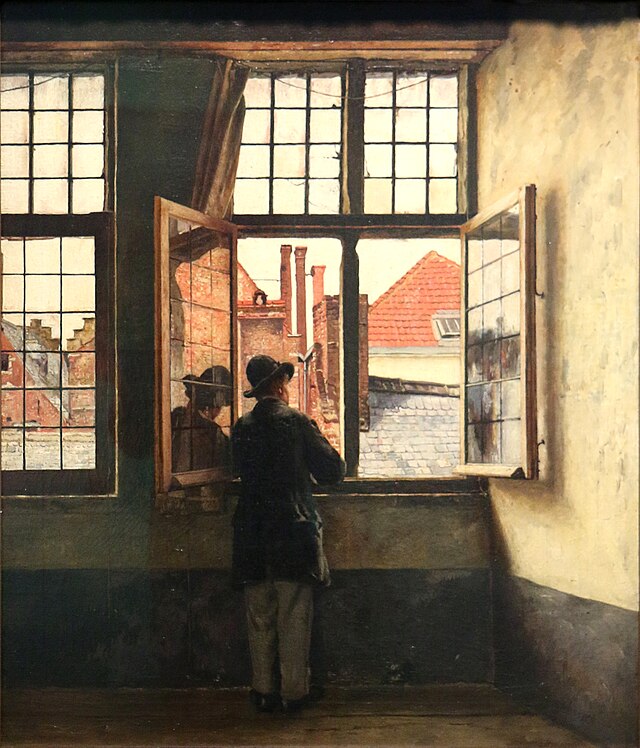
One of the ways out of the problem of the ego, is the figure of the man at the window.[vi] Looking outwards has been a common theme in Hooker’s recent books. Poems frame a space for thinking through and in language, inviting the reader to look and think again. As he writes in ‘David Jones at Capel-y-ffin,’
And yes, it is true
the universal is revealed
through the particular thing.
‘On Gelligaer Common’ begins: “A wild horse with its hoof trapped/in the rusted springs of a mattress.” If the poem is ‘about’ the weight of history, the way it traps and tangles the present, then the ‘about’ is carried in the images rather than in prose-like argument. Nor does poem or poet have to offer a conclusion or preach. ‘On Gelligaer Common’ ends; “The wounded horse strains to free itself/ but the rusted springs hold.”
Seagulls have been the subject of several memorable Hooker poems, and we come across them again in ‘Man at a Window: six observations:’
Gull, gull,
lover of sea
and rubbish dump
devotee of plough
take me with you,
the observer asks,
let me share
a world that is alive,
where sea roughens
with flying spume
under the west wind.
If you live on the coast no poem can make you see seagulls ‘for the first time’. But a poem can colour the way you see them, so the irritating, chip-scavenging noise-makers will never be the same again.
‘Man at a Window: six observations’ ends the book. The sixth poem offers an image that might stand for Hooker and his most recent work. The Man at the Window is alone, separated from what he’s observing, but not trying to conscript what he sees to his own purposes, while celebrating what he sees and what it evokes for him. It begins:
One bright star
solitary, it seems
in the whole night sky.
Not knowing the star’s name it reminds him of
[…] the young poet
who never died, but lives
steadfast,
for the holiness that is love.
You might miss the allusions to Keats; you might think the ‘young poet’ is the poet’s younger self. It could well be, but it’s hard to miss the affirmation of one possible role of poetry. The passage quoted earlier about T.S. Eliot, David Jones and George Oppen continues. “I differ in emphasising its nature as an emotional process. I have finally come to recognize that I am primarily a lyric poem and a love poet.”
Love is a dangerously imprecise word. I’d suggest that for Hooker, ‘love’ is not just the confusion that drives adolescents to attempt poetry but a mature working through of Buber’s ideas about the possibilities of human relationships, and how the self relates to the world’s variety of people, writings, history and places. ‘Love poetry’ describes an open-ended conversation, grounded in what Keats called “the holiness of the Heart’s affections.”[vii]
[i] Word and Stone (2019) and Preludes (2024). In the last five years Hooker has also published a book of essays, and three books of mixed poetry and prose in a genre he has made his own: The Art of Seeing (2020), The Release (2022), Addiction, a Love story (2024) and Presence and Place (2025). All of them have been published by Shearsman. To do it justice, With a Stranger’s Eyes, should be considered in the context of this group of later work, reaching back to include 2016’s Ancestral Lines. But that requires more words than an essay offers.
[ii] Unless otherwise stated quotations and page numbers refer to With a Stranger’s Eyes.
[iii] The Austrian-Israeli philosopher Martin Buber (1878-1965) published Ich und Du in 1923, published in English in 1937 as I and Thou – a meditation on human relationships, and a critique of objectification and over-abstraction.
[iv] ‘Simplifying’ here is an extravagant understatement.
[v] In 1913 an explosion at the pit head killed 439 men and boys. It was the worst mining disaster in British history.
[vi] I’ve written about the man at the window in the context of The Release. https://ladygodivaandme.blogspot.com/2022/02/jeremy-hookers-release-part-three-poems.html I’ve reused the Bunting quote from that essay.
[vii] John Keats, in a letter to Benjamin Bailey dated 22 November 1817.
LIAM GUILAR is Poetry Editor of The Brazen Head, and the author of several poetry collections, including the series A Man of Heart, Presentment of Englishry and The Fabled Third (Shearsman), set in post-Roman Britain. His most recent publication is a translation of the Mabinogion folk-tale How Culhwch Won Olwen (Shearsman, 2026)