Small town nightmares

Twin Peaks: Fire Walk With Me (1992)
Twin Peaks: The Return (2017)

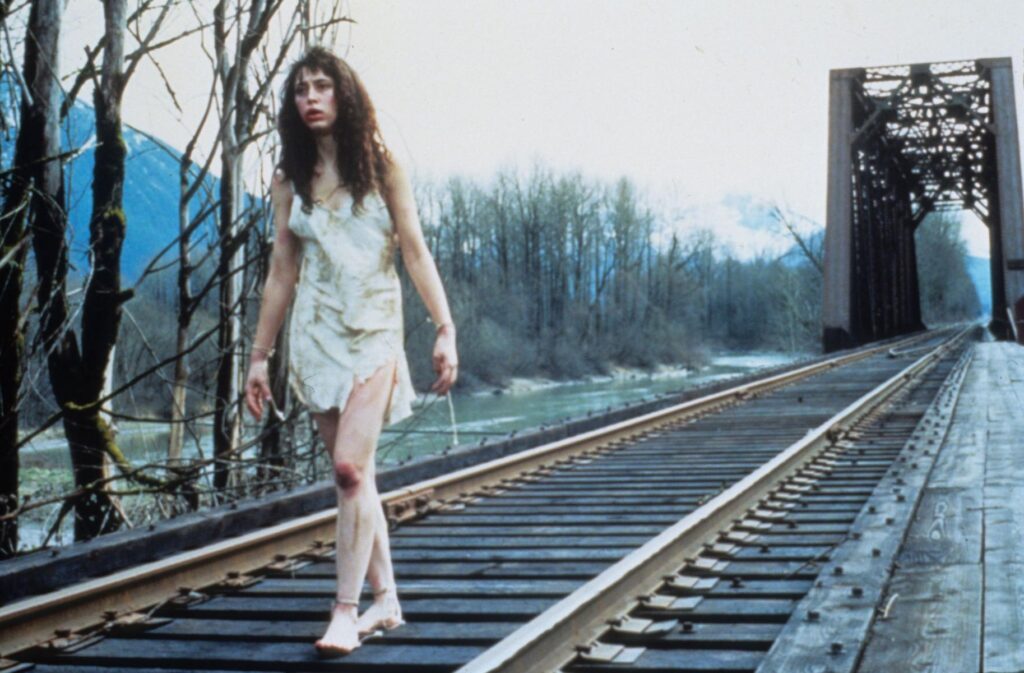
David Lynch’s Twin Peaks: Fire Walk With Me was the moment when the town of Twin Peaks was revealed to be a dark hellhole of occult mystery, sexual abuse, intrigue, murder and underhand business dealings as opposed to simply a cozy backdrop to a strange detective story involving demon possession and sexual intrigue.

Although the first two television series had some shocking episodes, particularly the reveal of the evil spirit Bob and Leland’s death, along with the final episode (produced at short notice under instruction from the TV company), viewers’ memories seemed mostly of a quirky and occasionally surreal soap opera whose characters were fuelled by coffee and doughnuts, had high libidos and were very good looking – not to mention a friendly visiting detective who was prone to visions and intuitive investigation.

It wasn’t all sweetness and light by any means, but the darkness was leavened by humour and friendship, not to mention the haunting soundtrack, but Twin Peaks: Fire Walk With Me was having none of it. Billed as a prequel, the film was also a kind of reveal of what was actually going on, ostensibly before the TV series started but allowing us to project several of the stories into that time frame as well.

Nobody, not even Agent Cooper and his fellow police force members, seemed to come out well. Everybody was conniving with somebody else, had a dodgy deal going on, and seemed complicit in prostitution, smuggling and drug running. There was a lot of looking the other way and a lot of non sequiturs and references to things we’d missed, not been shown or that Lynch felt we should know about. This included more dreams and a meet-up of demons in an upstairs room.

At the time, many of us felt cheated. My friends and I came out of the arts centre where we saw it in shocked silence. I don’t watch or like horror films, but we had just seen one that seemed to take away any pleasure we’d had whilst watching the two TV series. That seemed to be the general public and critical response, and although there was and still is a sustained discussion about Lynch’s work, and a recognition that he had done something amazing for TV, that was Twin Peaks done with.

Twenty-five years later, that turned out not to be the case. Twin Peaks: The Return was even more surreal and fragmented than the original two TV series, and although presented in 18 episodes, Lynch claimed he thought of it as one 18-hour film. Although a few storylines were continued from the 1990s, most weren’t, and the film was full of new character, including three versions of Agent Cooper, those present in one-off scenes, not to mention aliens and godlike beings and a complete blurring of reality and dream states.

In fact Twin Peaks: The Return seemed mostly a kind of return to Lynch’s Eraserhead, a disturbing and unfathomable monochrome nightmare with a deformed baby and a (literally) industrial soundtrack that highlighted Lynch’s love of photography and the fleshy paintings of Francis Bacon. It highlighted and picked up on occult connections and cultivated its own lines of influence and diversion. Whilst it offered a creation story for evil in our world (or at least, the Twin Peaks world), it also opened up an impossible number of possibilities of what was going on and why.

Interest in Twin Peaks had never really gone away, but the announcement of series 3 saw a renewed interest. Discussion forums sprang up online, a number of academic volumes were published (there would be more after The Return ended) and co-writer/director Mark Frost published two hardback volumes – The Secret History, labelled as a novel, and The Final Dossier – which sought to flesh out some of the loose ends but also act as bait for the forthcoming series.

Twin Peaks: The Return was not easy or lighthearted viewing. There were trips into space, out of time, to cities and gangland underworlds – visions, prophecies and dreams – a giant pepper-pot that was David Bowie’s character – and Audrey Horne (Sherilyn Fenn) seemingly trapped in a loveless marriage, or locked up in an asylum. There were doppelgängers, demons, a hybrid frog-insect alien, visiting bands and songwriters, and a new gang of young people forming their own romantic and sexual liaisons whilst taking new, contemporary drugs. Oh, and there was a slow-motion atomic explosion too.

And there was electricity, snaking through, by and over the land, sparking, hissing and humming. And the woodsman, an unwashed and obsessed tramp, who broadcast a poem over the radio once he had killed the DJ. No-one who hears it knows if the poem is a sacred text, a warning or a magical spell; it hypnotizes them and sends them to sleep. And there are mystical beings trying to balance and juggle good and evil, sending spirits and signs to earth to sort things out. One of the beings is the giant from Agent Cooper’s dreams in earlier series, now called the Fireman in the closing credits.  And there is the Experiment, momentarily appearing in a glass box in New York City. And, and, and…

And hundreds of walk-on parts: passers-by or passers-through, and those confined to the background. But no sign of Agent Cooper, and only tantalising glances of the town of Twin Peaks itself. Versions of Cooper are busy out in the world whilst the good/original Cooper remains trapped in the Red Room or White Lodge. Another Cooper squeezes himself through an electrical socket as a doorway from space to Earth, and comes out as a simpleton. Evil Cooper is intent on amassing a fortune and facilitating evil on the world.

The Return seems to refer to Cooper himself, since he takes most of the 18 hours to find his way back, before leaving again. He tries to undo Laura Palmer’s murder, which kicked off the whole Twin Peaks series, by finding a version of Laura and travelling back in time, forgetting all his zen ideas of acceptance and living in the moment. The version of Laura he finds (or creates) does not seem to know him or her own history, is only shocked into realisation at the end of the series, indeed the whole show, which ends with a scream.
David Lynch. Image: Wikimedia Commons

There is no resolution, although fans, critics and film buffs have used up thousands of words trying to find one, contorting ideas and scenes into ridiculously tangled cats-cradles of even more impossible narratives, story lines and time loops. Some of it, of course, makes sense: there are repetitions, similarities and repeats in the plots and filming, there are what seems to be codes and signs on the likes of stray lamp posts and campsite notice boards, and the pylons do look like owls. Nothing is what it seems, but nobody is sure what they seem to be. And nobody seems sure who they are any more either, how to get where they want to be, or why things are happening the way they are.

This time round, however, the deaths and violence, the visitations from the spirit world, the hauntings and occult leanings, all the unexplained mysteries, are once again leavened with humour and wit. Twin Peaks: The Return may not be the return we expected, and is definitely not a return to the Twin Peaks we first enjoyed visiting, but its strangeness and unknowability, its twists and turns, surprises and senseless signposts, leaven it, along with a roster of musical visits to the Roadhouse, some come-uppances and happy endings. By embracing the surreal and the senselessness of our lives and juxtaposing it with chance and the unknown, Lynch reinvented television again, just as he had 25 years earlier, producing an extended film to sit alongside his other career highlights: Eraserhead, Lost Highway and Mulholland Drive.

Questing verse

The Living Law

Jesse Keith Butler, Darkly Bright Press, 2024, 106 pp., £16.08

Jesse Keith Butler’s debut volume The Living Law exhibits an extraordinary mastery and inventiveness of form, comprising poems in traditional metres (with an unusual predominance of the anapaestic), as well as free verse, not to mention prose poetry. The matter spans country and city life, family, travel, work and leisure. Some poems address their themes directly, even polemically.

Religious themes predominate, with poems on a range of subjects depicting and evaluating experiences from the somewhat aloof persona of a man whose faith grants him access to a truth beyond this world. For example, ‘The Boatwright’ contemplates the postmortem fate of the speaker’s unbelieving brother, and cleverly as well as touchingly finds the same wiggle room as many a liberal theologian, granting the minimum and the maximum an orthodox believer may, that “if there’s open water beyond this life […] I know you’ll find your way.”

The overall sensibility is conservative, however. Witness ‘Whatever is Born of Fire’ with its generalised anti-modern nostalgia that evokes Eliot’s ‘Choruses from The Rock.’ Developing out of a vignette of returning to the family home, the aspiration bursts forth:

We can try to turn back—

     We could maybe turn back—

          And seek a strange new trajectory—

But here as elsewhere one is aware of a problem that Butler has not dealt with. Just as a descriptive passage featuring “heavy clouds” filled with “life-giving rain” in a scene that “tears the veil of time” is built upon cliché, so the notion that we might in some sense return to a pre-modern, religiously-based culture lacks authenticity, with what might be ‘strange’ and ‘new’ about this proposed trajectory left unexplored.

At his most glib, Butler is capable of promulgating intellectual clichés like:

Rock on, rock on Voltaire, Rousseau

‘Cause Revolution’s all we know

We’ll line them all up in a row

To build the Kingdom here below

(‘Rock on, Rock on Voltaire, Rousseau’)

Many poems in the volume depict a moment in nature in which a moment of afflatus supervenes in the manner typical of much nature poetry, in which a vision is beheld and, as Wordsworth put it, “we see into the life of things.” This lyric mode is so entrenched that it is hard to practise with any convincing originality. It is, of course, a heritage of the Romantic movement whose poets sought to imbue mundane subjects with the ‘visionary gleam’ of a religious ardour that even then had largely ceased to be evoked by Christian subjects. Thinking over the progress of English verse, it is interesting to note the peculiarity of Butler’s proffered contribution, since the latter often consists of injecting explicitly religious and Biblical imagery into a naturalistic setting, as in the prose poem that begins ‘“Look, he says, the friggin’ Rocky Mountains!”’ and culminates in a vision out of Genesis where

my eyes stream with tears and […] I wish I had a voice big and inhuman enough to sing along. […] It’s the creatures on the ladder that are singing, I know that now, and they’re both ascending and descending on a ladder whose end vanishes between the stars (‘The Ladder’).

There may be antecedents for Butler’s technique here. One thinks of his fellow Catholic Robert Lowell, who in his early work might juxtapose a vision of a Mary who “twists the warlock with her flowers […] her whole body an ecstatic womb” against the narrative of a drowned ancestor. Explicitly religious imagery has never died out, of course. But in Lowell’s case the depiction of Mary dramatises the repressed sexual content of Catholic iconography in a way that renders it uncanny. In Butler’s poem the narrative is delivered with the simplicity of a child reporting a Marian vision.

Butler’s use of form is virtuosic in a way that disdains to hide itself. Although The Living Law contains prose and free verse as well as iambics, the metrical refrain throughout is anapaestic: a metre not to be handled by those afraid of formal obtrusiveness. The cantering rhythm advances past the syntax, so that artifice is foregrounded to a surprising extent. The effect is often strident, as for example in the title poem, in which:

something cuts through the dull resonance

and draws us to join a reciprocal dance

and love the

                          living

                                       law.

The situation is a bus trip on which an old lady loses her glasses and the other passengers pitch in to help find them. But the subject is infused with a numinous light and music that give the weary speaker a sense of his place in the divine order of things – though the notion of him and his fellow passengers ‘dancing’ on a Greyhound is perhaps unintentionally funny.

I have hinted that the religiosity of these poems is sometimes their downfall. I say this not out of any dogmatic hostility to Butler’s religion and in full awareness of the importance of Christian belief to some of the greatest poetry in existence. But successful poetry must offer something new – not necessarily drastically new, but at least individual or peculiar to the speaker, the author, or the context of writing. If it does not, it merely restates, likely in hackneyed language, conventional sentiments derived from an outside source.

In the longish poem ‘The Lawgiver’ Butler re-narrates in truncated form the main incidents of Moses’ career in Exodus. We learn for instance that, “I stayed forty days as your fire filled my mind,” and “I cast your bronze serpent and lifted it up” after “the destroyer turned back at the doorway’s blood-smear.” It is a retelling with little embellishment. One thinks, in contrast, of Pound’s famous poem ‘The Goodly Feere’ with its surprising depiction of Jesus as the tragic hero of a border ballad. Whether one likes the depiction or not, at least Pound adds a fresh dimension to his subject. ‘The Lawgiver’ rather timidly imitates the form of Anglo-Saxon alliterative poetry, suggesting an analogous attempt at resituation. Is Moses to be understood as a Hebrew Beowulf? But the formal exercise seems to have been carried out gratuitously, without significance. And this blandness extends beyond the narrative recapitulation to the equally derivative notions Moses enunciates, which might come from a prayer book of any denomination:

Your grace has brought me to the sabbath of your year

Ground me in sound judgment and knowledge of your law

[…]

Without your correction I’d be wandering still

And so on. The linguistic possibilities of imagery and symbol are foreclosed at the same time as discursive ones. It is very hard, perhaps impossible, to say what the author of the Psalms, for instance, has already said without using either the same or inferior language. It is as if someone out of utter devotion to The Bard were to rewrite Hamlet, more or less in the style of Shakespeare, changing nothing essential in regard to plot or characterisation.

Now, take ‘The Lawgiver’ and place it beside Vigny’s romantic depiction of the same subject in his great poem ‘Moïse.’ Hardly blasphemous or wildly revisionist, Vigny has a clear contribution to make to Moses as a human archetype. We imagine that we learn something new and previously un-adumbrated about God’s representative. Not how faithful and pious and prophetic he is, which we already know, but, for the first time, of his divided nature, half earthly, half heavenly, and the pain and weariness of such eminence, analogous to that of a romantic poet. Vigny’s Moses is an imaginative reinterpretation; Butler’s is merely an homage.

‘The Lawgiver’ is followed by the interesting ‘Villanelle of the Elect.’ If Butler’s use of anapaestic metre, internal rhyme and alliteration are a marching rhythm calling Christian soldiers to spiritual warfare, the repetitious form of the villanelle is serviceable to his ends in an analogous way. Surely that of election is the most puzzling and disturbing of doctrines, and one that requires circumspect treatment by anyone who would sympathetically present it in any of its denominational forms. Yet in what should be his most intellectually and spiritually rigorous exercise, Butler opts for a form highly ill-adapted to discursive development:

If Esau had hope, it was quickly deflated.

The subtle supplanter had him by the heel.

But Jacob was loved, and Esau was hated.

Nothing about the scenario, so puzzling and upsetting to the moral sense, is explained or even explored. Again, we have a simple retelling without augmentation or exegesis. It is cleverly done, but constitutes an overly deferential, and therefore superficial, approach to the material.

At his most accessible (at least, to the reader who lacks his convictions), Butler seems almost to entertain an aporia with regard to the certainties that elsewhere drive his poetry. In the sonnet ‘The Return,’ for example, the speaker addresses the city of Vancouver with the words:

The Hip on FM sing escape’s at hand

For me, the travelling man. Let this last mile

Stretch out to fill a year. Anchor my grand

Illusions to your stubborn facts awhile.

Those ‘grand illusions’ are probably the usual worldly ones: a failed relationship, dreams of wealth and career success or other appurtenances of this world that, 2,000 years later, is still doggedly imagined by some to be ‘passing away,’ as the Apostle Paul assured his followers—but interpretation must have some latitude.

Although I have expressed some reservations about his approach, it is bracing to discover an emerging poet whose sensibility stands provocatively outside the mainstream. Formal poetry is increasingly associated with curmudgeonliness, and Butler does nothing to challenge this perception; on the other hand, he writes with conviction and an evident desire to say something true and permanent. At the same time, there is something quite contemporary about The Living Law. It speaks to a certain subculture for which a necessarily selective rejection of modernity is expressed in a return to traditional forms and subjects, a defiance of writing seminar orthodoxy in favour of a certain literary populism – if it makes sense to speak, as A M Juster does in his blurb, of ‘a broader audience of poetry lovers’ in this day and age.