LAWRENCE FREIESLEBEN revisits Zabriskie Point, 1970, directed by Michelangelo Antonioni
[Caution: plot is of minor concern, either to the filmmakers or the thoughts which follow]
Travelling backwards from the end of the alphabet, three other Z films initially clamoured their alternative directions: the Hammer-esque Dracula adaptation from Pakistan directed by Khwaja Sarfraz, Zinda Lash, 1967[i]; Jake Gyllenhaal in David Fincher’s Zodiac, 2007; and Z, directed by Costa-Gavras in 1969. As if glimpsed on signs or billboards during Zabriskie Point’s early flashing road-journey sequence (00:10:00 – 00:11:56), with its distorted rear-view mirror alternatives, the presence of these other films insisted, reminded, recurred and haunted . . . but eventually fell behind.
“Zabriskie Point lives on as Antonioni’s moody meditation about freedom curdling into emptiness” ends one concise and informative appreciation of the film online[ii], a reasonable, if skin-deep conclusion to an expert precis – for it has reached its principal concern: an article about fashion and style.
How common is the assumption that all lead characters in films exist as centre points to be either identified with or rejected? Can such a generally reasonable idea apply to Zabriskie Point? Even if Antonioni and his collaborators had sought so conventional an objective, their sounds and images would have escaped. There are far more enlivening things to be found here.
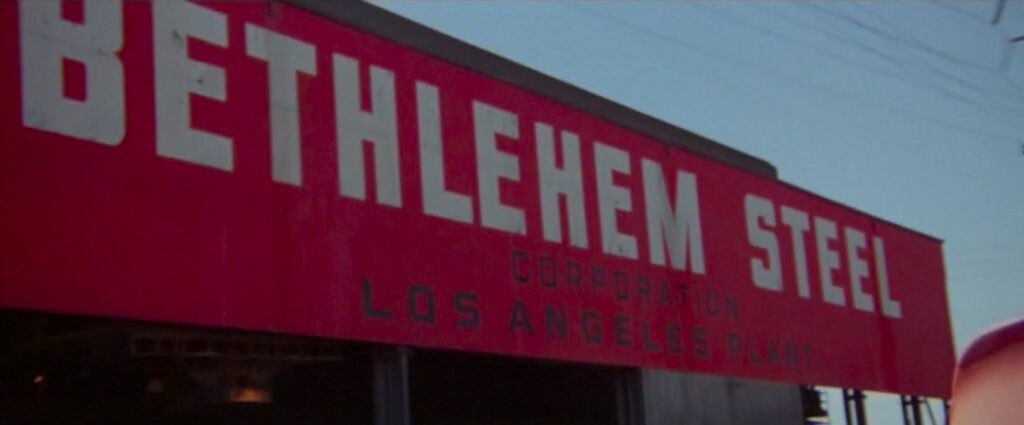
Zabriskie Point at 00:11:01
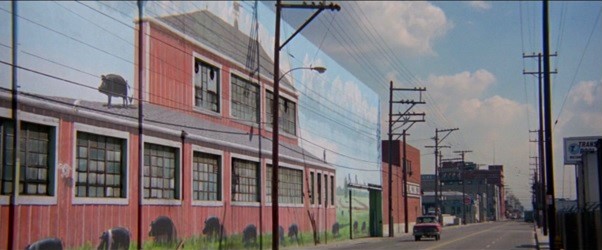
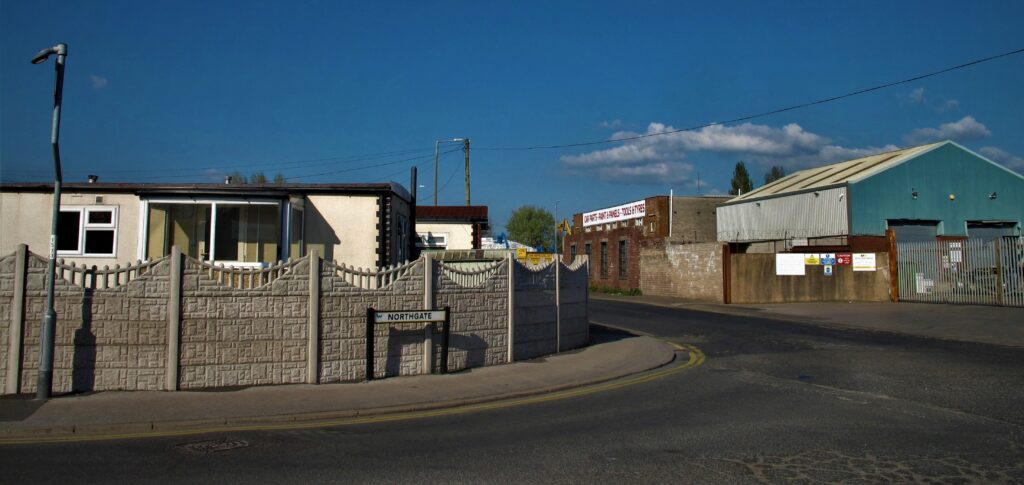
Back to that first road-journey sequence scored to cacophonous noises and experimental music[iii]: all through the LA suburbs of exhilarating colours and forms amongst dusty wires, lampposts and warehouses, eventually to the stroboscopic verticals of Mexican fan palms towering above the vying traffic, Zabriskie Point’s vibrant overwhelm of colours and shapes here make a symphony from the tangible presence of a vanished world. This is common to films and television of the period: it’s there in John Boorman’s outstanding Point Blank (1967), Peter Bogdanovich’s notable debut, Targets (1968) and the rickety Raquel Welch vehicle, Flareup[iv] (1969). It’s there through much of the superior Rockford Files TV series of 1974-1980. It might seem incidental, but it’s rarely accidental. Filmmakers look for such backgrounds tirelessly. The difference is that Antonioni often made foregrounds of the background. Setting becomes as vital as character – and while this is also true of films such as, for example, Edward Scissorhands (1990), I Start Counting (1970) or Rear Window (1954), Antonioni did not limit himself to one or two distinctive places, he tried to use the whole wider landscape and ambience – occasionally allowing its significance to equal or exceed that of the human foreground. This was not a failure to fully realise the characters, nor was it carried out with only the intention of satirising the world depicted – even if that might be as far as some viewers care to look.
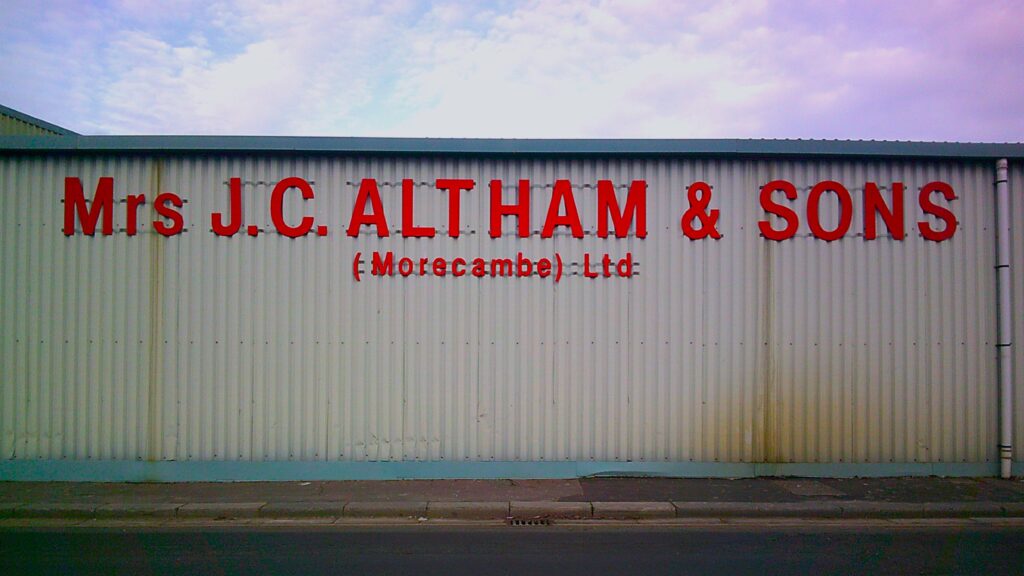
To me, Antonioni’s viewpoint is metaphysical. In films such as L’Avventura (1960) this can feel remote. Watched from a “normal” human angle his films are often regarded as alienating. Yet whatever Antonioni’s personal views on faith or doubt, presence or absence, the films are almost bound to feel alienating if one struggles too hard to identify (positively or negatively) with the characters – which of course is precisely what, as spectators of TV and film, we are expected to do.
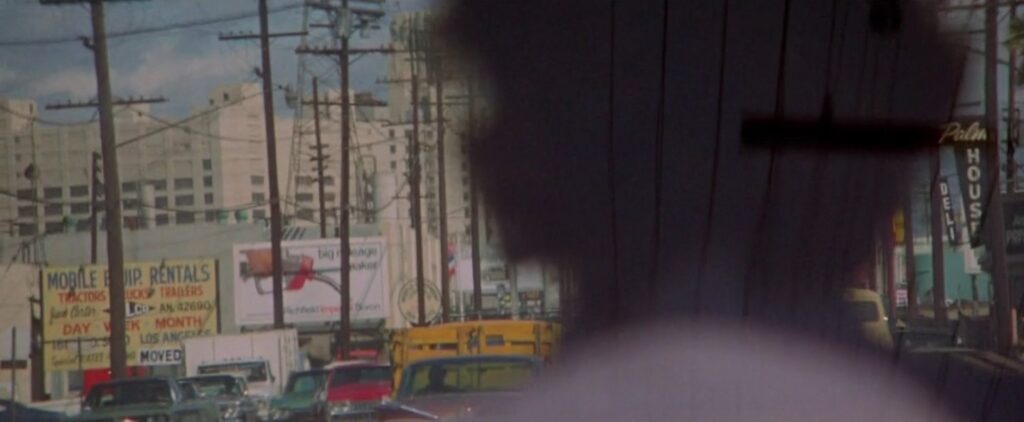
Zabriskie Point at 00:11:37
Heartbreakingly beautiful in retrospect, as with the London of Blow-Up[v](1966), the Los Angeles of Zabriskie Point may be sadly or safely gone, depending on your viewpoint. Delusional rationalisation – both economic and psychological – combined with the reckless notion of constant progress, have created a force towards a future which cannot curb either the blandness or destruction inherent in it. The inadvertent society marches on[vi].
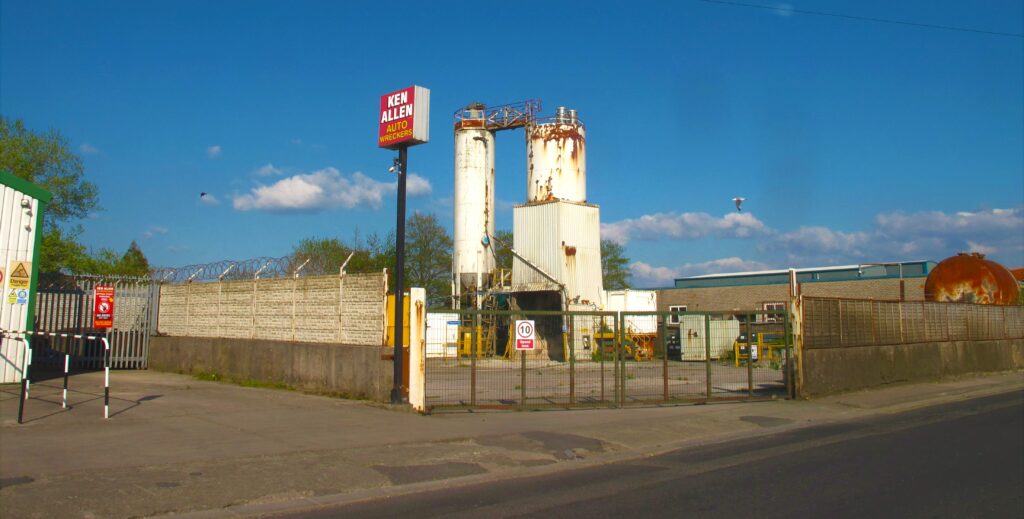
Vanished suburban and industrial backgrounds are like treasure and many artists in different media have richly enshrined and celebrated such visual and auditory fairground rides, but in Zabriskie Point’s first of many journeys – lasting less than two minutes of screen time – as well as throughout the film as a whole, this is more than a time machine visit by an acutely observant[vii] foreigner, it is a sociological and historical document, not just – in passing – for its period, but also for America’s distorted idea of itself . . . yet more relevant today under a dangerously unhinged president[viii]. How dismayed the radical students in the assembly for action at the beginning of Zabriskie Point (00:00:07 – 00:08.46) would be to discover, just how “pell-mell into fascism” (00:04:46) their country has fallen under Trump.
Amongst the joy and sadness, the hurtling traffic and bustle of vanished lives, in search of the overlaps when certain films or experiences strike some kind of well or mineshaft . . .
Aiming for the visionary / Instead, a lead mine has been drilled down inside my neck / to flooded levels I can’t keep clear. / Grid confined, primal force without bearings, craving the sky / Far from meadows or moors / Is there no choice but downward?[ix]…
Then, everything – all the fleeting side-thoughts and impressions triggered by Zabriskie Point, went calm as I remembered Leighton Buzzard sand quarries . . .
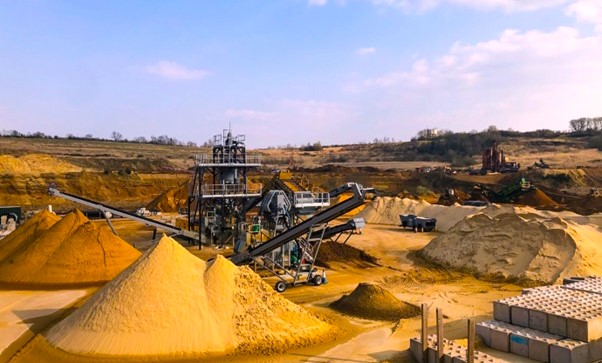
Several illicit Sunday trips to Leighton Buzzard sand quarries in hot summers of the mid and late 70s, deposited vivid geological strata in my mind, a dream of deserts – or even distant planets which remains undimmed. This was both the surface and the inside of the land itself. Climbing over fences and sneaking down into cuttings and pits, following rusting rails alongside the severe blues of ponds and lakes, pushing the small mineral wagons along tracks we chose to believe abandoned, collecting sandstone rocks which were like red-ochre asteroid landscapes in miniature . . . This was one of those moments when a truer sense of priority emerges – to disregard time and the usual human goals. These moments are part of what Antonioni is trying to embody in Zabriskie Point.
Despite later, tamer visits with my children to the narrow-gauge railway (first opened in 1919) that had become a noticeable tourist attraction by the 1990s[x], the archetype was not dislodged. An unearthly place vastly expanded from its dimension in reality. Just how many landscape experiences, direct or second-hand, this archetype has helped intensify is impossible to calculate. Antonioni’s misunderstood Zabriskie Point (1970) is one of them, even though the titular Death Valley desert viewpoint, in yellows browns and whites has little in common with the vibrant reds and oranges of Leighton Buzzard. The temperate Bedfordshire location became a long-running family joke. Scenes in Lawrence of Arabia (1962), Ice Cold in Alex and Sea of Sand (both 1958)would all be met with “Look! Leighton Buzzard sand quarries!” Zabriskie Point (1970) however, was not a family film and what Peter Bradshaw positively describes in The Guardian[xi] as a meeting between a radical student on the run and a “hippy chick” which leads to a “sexual epiphany, psychodramatised as an orgy” would not have gone down well, if indeed it was ever shown on T.V. before my sister and I left home.
In Antonioni’s last full-length feature film, Beyond the Clouds[xii], (1995) John Malkovich as ‘The Director’ serves – largely in voiceover – as the alter ego of Antonioni. Some of his thoughts are rhetorical, others enigmatically intriguing, if whimsically vague[xiii]. Near the beginning of the film comes this self-deprecating statement: “Don’t get me wrong: I’m not a philosopher. On the contrary, I’m someone who is profoundly attached to images.” [Does this rule out the philosophical impulse?] “I only discovered reality when I began photographing it. Photographing and enlarging the surface of things that were around me. I tried to discover what was behind them. I’ve done nothing else in my career.” While it’s hardly true that Antonioni did “nothing else”, this element of exploration is undoubtably true of Zabriskie Point.
If alienation – intended to trigger observation and thought rather than emotional empathy – appears key to almost all mid-career Antonioni’s films, it follows that his characters often dispense with excessive . . . character. Many of them remain partially or severely blank – inscrutable to the point of being elsewhere. This is taken to a constructed extreme within the partial road movie, partial romance, partial thriller of The Passenger, (1975). As Locke, Jack Nicholson – one of the least camouflageable stars that ever grinned! – takes Antonioni’s concept and distancing literally: attempting to lose himself by exchanging identities with an acquaintance who dies unexpectedly in their shared shabby hotel on the edge of the Sahara in Chad.
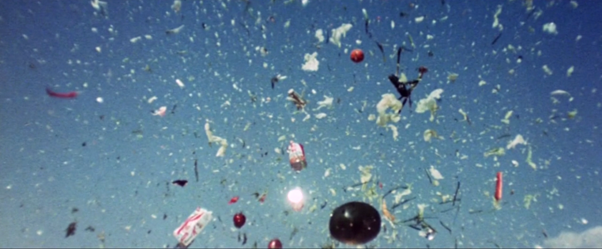
Although they were not professionals and, in some ways, exist in the film on an attitudinal surface, Mark (Mark Frechette – virtually playing himself it would seem[xiv]) and Daria (Daria Halprin) remain increasingly memorable. Towards the end of the film, Mark is predictably martyred by the aggressive trigger-happy cops lurking at the airfield, cops too overcharged or dim to wait until he stops and gets out of the plane. Meanwhile, Daria becomes the projected soul or alternative hope of the film . . . at least in her final, satisfying, explosive daydream. This is a moment we are encouraged to identify with – and carries us with it even when it digresses from repeatedly destroying the building to a series of more abstract, increasingly impossible detonations – sky-blue backdropped[xv] interior spaces conjured from the ether, to blithely destroy consumerism’s unlimited contents, comforts and gadgets.
The clash in so many ways (ideological, physical, temperamental) between Daria and her middle-aged boss, Lee, (good old Rod Taylor) is harsher than either of them seem to realise. Fiercely ambitious and materialistic, Lee seems to be a deliberately jarring, no-nonsense advocate from an older generation, a patient bull who has left Bodega Bay and The Birds (1963)[xvi] far behind. He seems stranded – as if at some point he set his Time Machine[xvii] for 1969, and abandoning it, has swapped his clothes in some trendy boutique for the uniform of a square!
Sometimes, I have the feeling that the best films, indeed the best art, only appears to have faults. Eventually we realise that it’s the imperfections and the sections we can never explain or understand which create “perfection”. Experienced often enough, faults can become serendipities[xviii]. If this doesn’t happen, then it’s the underlying limitations which are revealed: those films which complete themselves in the watching and die; those too well-constructed novels or poems; the over-skilful or over-stylish paintings. Years ago – as well as wishing that Zabriskie Point had used all 23 minutes of The Grateful Dead’s, Dark Star[xix] – I was unhappy with the main cast, now they seem ideal . . . just as Kim Novak’s woodenness in Vertigo (1958) has been widely reappraised[xx].
Having not seen it since 2017, would Zabriskie Point amount to less than the sum of its parts? Another problem with getting older is realising how not only individuals, but more-importantly, the human race, so often dismally fails to achieve what it could[xxi] – our cleverness progressively drained of wisdom, while the summits of art become rarer or more piffling. Also, fewer of the past’s claimed summits look as valid as they once did. The best of everything becomes increasingly elusive, hidden beyond the surface of reality or inside yourself. It is not wholly present in the art (if it ever was) but depends on what the individual’s experience enables them to apply – as Leighton Buzzard’s sand quarries helped me. It’s the interaction that counts, rather than any end product. As our cultural ability to appreciate any form of art declines – dulled or made intolerant in the film world by an over-indulgence of blockbuster or franchise trash (as mobile screen overuse is dimming the capability to concentrate on anything much longer than a moment) – so its past value becomes veiled or lost.
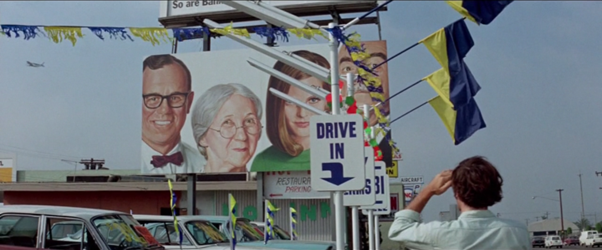
Hopefully, it’s not just on a personal level that Zabriskie Point contradicts this general decline. Although I must’ve seen the film six or seven times, almost everything is better than I remember – the characters more present in their ambiguity, the atmosphere vividly real. Instances of droll humour – such as the policeman writing Carl Marx when Mark states his name upon being arrested (00:16:43) occur quite often. The unforced satire of advertising and billboards showing family, is as clear as crystal, yet the irony is, at this point, forgiving. The same goes for the entire sequence (00:18:18 – 00:19:38) cross-cutting between the Sunny Dunes, Board of Directors, smoking or contemplating, and their absurd promotional film presenting desert development as an innocently offered chance for wealthy customers to receive what they’ve always wanted: “Why be caught up in the rat race of city life when you can enjoy life the Sunny Dunes way? Emerald green tennis lawns beckon beneath red rocks[xxii]. “Drink fresh mountain water from oaken buckets” (00:18:36), “Breathe the unpolluted air of the high desert”. A grinning boy mannequin (00:18:43) who resembles, minus the glasses, that idealistic nerd, Joe 90[xxiii], armed with six-shooters and dreaming of outdrawing a quail or a mountain lion!
Even this fictional real-estate advertisement mocking the ersatz nature of modern consumerism – always more lavish and go-ahead in the US of A – seems forbearing. Perhaps Antonioni was trying hard not to believe that society as a whole could so pathetically fall into such sterile traps? Or that the ludicrous twisting of the idea of freedom fuelling this commercialisation, the corralling of the free spirit of the desert, would be obvious to all intelligent people? “Forge a life of your own, like the pioneers who molded [sic] the West” (00:18:54). Like some gross escalation of Metro-land’s[xxiv] fading echo of the Edwardian period (which from 1919 until the early 1930s, sold a pastoral dream situated in the fields and wooded hills north-west of London) the Sunny Dunes Corporation aims to conquer the desert itself.
At 00:19:39 an impressionistic travelling sequence interrupted by a rear-view mirror’s abstract oblong in space, comes into focus on Lee (Rod Taylor). A radio report records that the total number of US servicemen killed in Vietnam is nearing 50,000. Oblivious, Lee’s almost identical colleague (same clothes, same profile, same haircuts) reads a newspaper article noting that California now has seven “centimillionaires”. An overlapping radio item moves to Mark’s house and his decision to go to the campus “to see for himself” (00:20:47). As he leaves in his battered truck, Lee and identikit colleague arrive at the Sunny Dunes office tower block. Meanwhile, Daria is escaping the city.
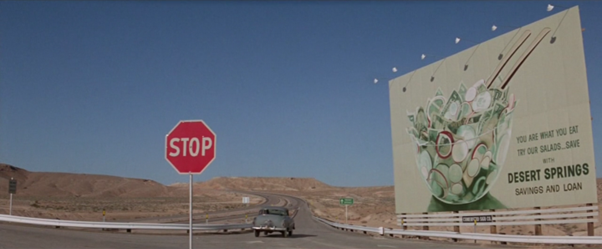
Daria drives into the desert at 00:23:13.
In the late 60s and into the 70s, Hollywood films briefly overlapped with searching art cinema[xxv]. Like other films of the period, Zabriskie Point is so complex and remarkably edited that subsequent mainstream cinema often tastes vacuous.
Fleeing the campus shootings of protester and police officer (00:29:24 – 39) Mark takes a bus to the “end of the line” – the suburb the driver announces, sounds like “Rockway and Kirby,” although no such place or intersection appears to exist. Attempting to cadge a sandwich “if I trusted you, I’d have to trust everybody in the whole world”, he later sits by an Official SMOG Inspection Station. Wandering towards a used car lot, a light aircraft drones over, leaving a billboard of family behind . . . Flags, more planes, a remembered airfield, the chance of escape . . .
The flight from Los Angeles, leaving its traffic-spiraling cloverleaves and dreary grids behind to an excerpt of The Grateful Dead’s Dark Star (00:36.15 – 00:37:14) lowers the stress and melds into a helicopter sweep over Daria’s borrowed and well-weathered 1952 Buick to Pink Floyd’s Crumbling Land (00:37:25).
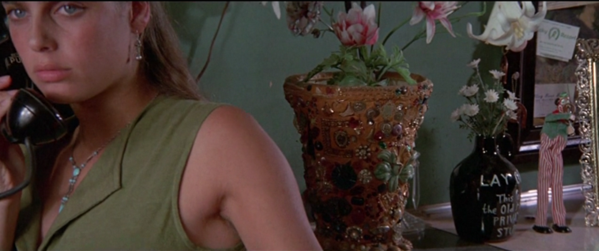
Daria at 00:38:27
A brief story from toddler to youthful soldier is told as the camera begins a short pan across colourful knick-knacks (00:38:24) before Daria’s bar phone connects to Lee’s grey office paraphernalia. The bar from which she rings could be seen as pre-Lynchian, albeit in Wes Anderson palette, but remains distinctly real. The pending ghost town settlement outside is a wasteland outpost with little more than a gas station, short railway platform, a grain silo (or obese ICBM hiding in plain sight?) the remains of an outdoor dance deck[xxvi] and a gaggle of “emotionally sick” children – all boys – who later, unconvincingly set upon her. Slightly reminiscent of the killer dolls sequence in Barbarella[xxvii], she escapes easily enough, never meeting her friend “Jimmy”[xxviii].
Although Mark’s aerial escape was based on a real-life incident[xxix], the whole section of his unlikely meeting with Daria, raises questionable aspects of their backgrounds. As a revolutionary student says at the beginning (00:04:18): “That’s why black people are, like you say, in another bag.” For Daria and Mark, (although not for Mark Frechette in real life[xxx]) their antiestablishment stance is, comparatively, a lifestyle choice, even a “bourgeois individualism” (00:08:39). If only we could all choose “to get off the ground” (00:54:05) when we needed to. If only it were ecologically justifiable.
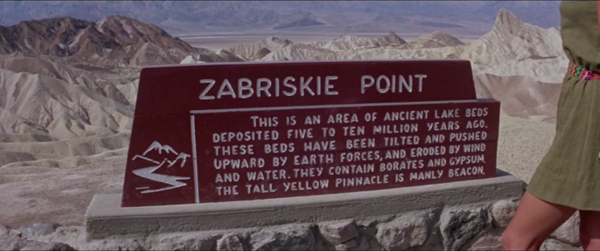
Zabriskie Point at 00:56:17
To Daria the desert is peaceful, to Mark it’s dead (01:02:06). Daria’s idea about planting only good thoughts in people’s head (01:03:45 – 01:04:02) is a clear precursor to Gretchen’s IMG (Infant Memory Generators[xxxi]) in Donnie Darko (2001)[xxxii] but Mark is as sceptical about such an idea as Donnie and Gretchen’s science teacher is in Donnie Darko. Only good thoughts are important to Daria:
Daria: “That’s the point, nothing’s terrible!”
Mark (ironically): “Far out.”
As for the “sexual epiphany, psychodramatised as an orgy[xxxiii]” Peter Bradshaw could be enjoying his exaggeration? I see this long scene (01:06:46 – 01:14:48) as archetypal or symbolic. Correct me if I’m wrong, but you never see Mark or Daria with anyone else, only cross-cut with other wigged and dressed-alike couples. To me it has an idealised people-through-time suggestion. Despite chiming with the counterculture and free-love attitudes of its day, it is more about kissing, choreography and sand play. It ends before the multiple couplings, sunburn and sex gets too serious. The kaleidoscopic crowd disappears leaving Mark and Daria alone and the idyll begins to dissolve when Mark reveals that he is thinking more about the desert than love (01:14:59). It’s finally shattered at 01:15:14 by the crass image of consumer tourism at its worst. A truck roamer-home with boat attached and a satirical family from some suburban hell or perhaps from Billy Bob’s Diner, Preston[xxxiv] take a stroll around the car park: “They should build a drive-in up here. They’d make a mint”. The screech of a plane timed with a left-panning zoom, (01:15:58 – 0 1:16:09) briefly implies that the despoilation of the world by unrestricted jet travel is already well underway.
Zabriskie Point could often be paused as a painting: sometimes figurative, sometimes abstract. The red toilets at 01:16:35, are an instance where Antonioni, with the instincts of both painter and storyteller, switches abruptly from a strong abstract visual primary to figurative human tension with the arrival of the cop. Many will remember the menacing cop who quizzes Marion in Psycho (1960) – hilariously echoed, (along with Kiss Me Deadly, 1956), by Alex Cox in Repo Man[xxxv] 1984. Yet this cop is not so bad after all (01:18:08) and with the influence of Daria – a fairly practical and sensible “hippy chick” – you wonder if things can be made right?
Jumping on to 01:28:18, as Mark nears the airfield where the police cars lie in wait, I have that feeling common towards films watched and admired before, of hoping the ending will be different[xxxvi]. If Mark had not phoned his friend at 00:31:25, would he have stayed in Los Angeles? If the sandwich man had trusted him (00:31:58) would his intuition about human nature have shifted? At 01:32:49, Daria hears the news of his death – effectively an execution without trial – on her car radio. She hesitates, but drives on.
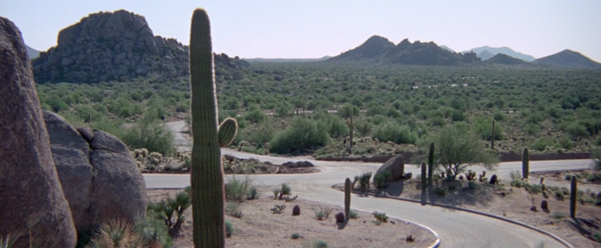
The road junction at 01:35:00 is worthy of a Graham Sutherland[xxxvii] composition. But for the grace of climate, so the bucolic hay fields of West Wales pictured below, might become the desiccated, be-cactused view shown in Zabriskie Point – in which the treacherous wilderness which encircles earlier Westerns such as Yellow Sky (1948), are now laughably ‘controlled’ by roads. Such threads of tarmac are there and yet not there. Sutherland frequently employed lanes in a similar manner, perhaps unconsciously, as more than a structural device, in an attempt to control the primeval, erupting from the past?
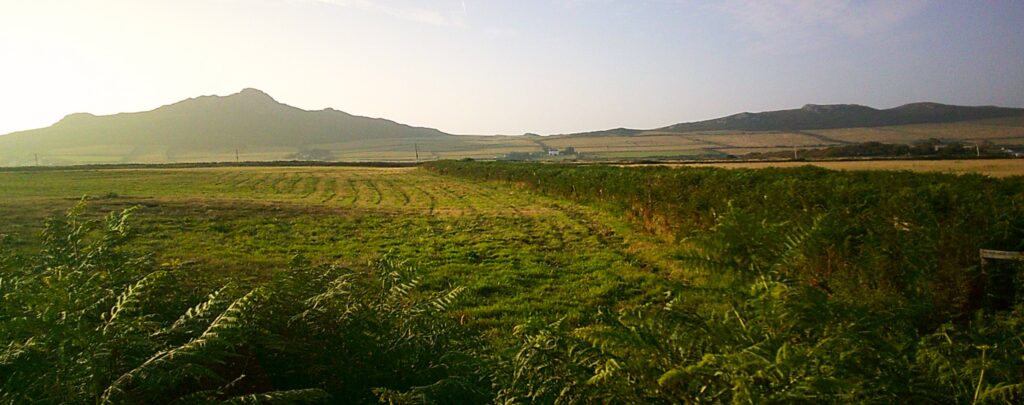
Carn Llidi, north of St. David’s, Pembrokeshire, 24 July 2025
The highly skilled but constricting etching techniques of Sutherland’s early years, were shattered, almost it seems against his will, by his discovery of Pembrokeshire in 1934. What exploded upon him in West Wales, rather than echoing the softer bucolic reality Romantically idealised by Samuel Palmer[xxxviii] – an antecedent he revered – could often be as unsettlingly prehistoric as the desert locations in Zabriskie Point[xxxix]:

Welsh Landscape with Roads by Graham Sutherland (1936)
But while the Sunny Dunes Corporation wishes to suppress the desert, Sutherland knew he could not contain the time fracture which perhaps derailed his nature in Wales[xl]. What is the suggestion of the human figure in Welsh Landscape with Roads (1936) fleeing from or to? Is it a kind of messenger? A Hermes running from history, trying to reach the present? As Daria drives through the desert landscape, there is often a sense of time fracture, as if she crosses both a distant primordial landscape, the near past of the black and white Western, and the approaching future of the colonial crescents and closes projected by the Sunny Dales Corporation – which will only ever float upon the surface of the land. I suspect it was such a fracturing (or dismissal) of time which first struck me as a child at Leighton Buzzard sand quarries.
Back in Arizona, Daria crosses the junction and continues to the heat-struck modernist mansion, visually and psychologically cooled by artificial waterfall and swimming pool and nestled into a collection of huge boulders, as a desert overlook. Despite the human forcing required to live in such places, the landscapes themselves remain beautiful.
The Boulder Reign residence[xli] at Carefree, Arizona, was the pioneer for a real-life Sunny Dunes[xlii]. Here, relaxing by a pool (01:36:14), are housewives slightly more real than the dummies featured in the promotional film. Having parked her car aslant two spaces, as if she knows she will not be staying or as mute protest, Daria passes behind the women without being noticed, as if she is invisible, or taken for one of the servants[xliii] – who appear to be women of Native American descent . . . this Sunny Dunes acquisition being one of the final nails in the coffin of their dispossession. Inside the shadow of the red rocks[xliv], Daria pauses, then painfully reflects (01:37:02), embracing water and rock, almost taking sustenance from them, before finding the will to continue, half-wet, through the boulder corridor.
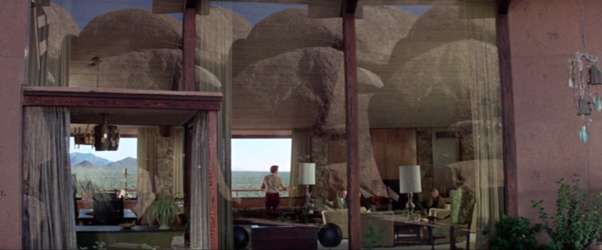
Zabriskie Point at 01:37:44
As often in Antonioni, ellipses can be long and without warning. At one moment Daria, near the film’s start, is a temporary secretary at the Sunny Dunes Corporation tower block, asking permission from an authoritarian receptionist to retrieve a book, from “the roof” (00:09:01). When we next meet her, she has gone AWOL on a road trip through the desert to Phoenix and is presumably Lee’s casual mistress? Although she finally meets Lee (Rod Taylor) at the boulder house, she never answers his questions there, and in fact, throughout the film, is only ever heard talking to him twice: at their first meeting as strangers in the Sunny Dunes office foyer scene above, and then on the phone from the bar on her desert digression. On this second occasion, concerned that if she gives away her location, he’ll send a helicopter to fetch her, she hangs up. Now, at the boulder house, she remains mute. After Lee amusedly directs her to her room, she resentfully heads downstairs. Out of his sight, half-sharing a smile with one of the servants (01:41:52), she reflects again on the situation before hurrying from the house and driving away (01:42:10).
Although perhaps the film’s conscience resides in Daria, does she remain representative of a generational, middle-class American future? It seems unlikely she’ll object to the status quo for long, she is too sensible – and even if she rejects the exploitational upward mobility of Rod Taylor’s Lee, she will be back one day, to take her place in some Sunny Dunes or other, not so different from the women in The Stepford Wives (1975). Or am I being unduly cynical?

Boulders Resort & Spa, Scottsdale: The real Sunny Dales 50 years later. Essence of the free spirit![xlv]
For the ending sequence [xlvi] a prop replica of the Boulder mansion was built on the back lot at Southwestern Studios in Carefree, Arizona for $100,000. The explosions (01:44:40 to 01:49:52 with a premonition at 01:43:49) are the film’s political, social and spiritual climax. Repeated over and over from different angles and distances, the explosion, simultaneously captured by 17 cameras, is reminiscent of those grim films of nuclear detonations and the effects of blast on mock-up towns and structures in the Nevada desert[xlvii] – mostly carried out approximately 70 miles to the east[xlviii] of Zabriskie Point. With explosion, blast damage and the sound of flames fading into Pink Floyd’s Come in Number 51, You’re Time is Up[xlix] this sequence remains gravely, majestically powerful. Deriding the aspirational society, at moments it can appear amusing – when you feel like raging or crying about the state of the world what else can you do but laugh? – and yet it continues to project a wish-fulfilment retribution. Embodying Mark’s rage as well as Daria’s, with the segue into music haunting and ethereal to begin with, sound and image together suggest some kind of everything. The slow-motion shots of things blown apart are reminiscent of protozoa yet often resemble late Kandinsky paintings[l] such as Sky Blue (1940)[li] and Tempered Elan (1944) . . .
through this collision of worlds
and pavement chalk urges us to Be Happy XXXX
how staunchly we must embrace hope
to sustain the mirage of progress[lii].
The later explosions mark a sleight of hand into the abstract, into pale blue. The victims: clothes, furniture, objects of conspicuous consumption as well as food, have lost connection with their natural environments. While remaining a wish-fantasy attack on consumerism, it is more than that. It is an attack on the inadvertent society[liii] itself. The colours have changed it. It is both more humorous – the lobster, the slowly revolving chicken and Wonder bread, the books at 01:49:14 – and yet more profound. A whole library follows. We are nothing but a waste of space to the Earth.
Music and vengeance are abruptly cut off at 01:49:52 as the scene reverts to a sunset desert silence without time or place.
We look at Daria’s face, glad, wistful, satisfied? Then, realistic, she turns away.
“Who really cares to catch the thoughts of another person’s existence, to feel their inner life? To catch the thought of them, or there, or then, instead of the habitual self-interest. To feel what they felt, you need to become possessed. After which feverish infatuation, may come a deeper empathy or identification – perhaps reviving what you once had yourself, your own lost space, your own inner time travel?…How little of what remains enigmatically important inside every individual, means to anyone else.”[liv]
At the end[lv], is the Roy Orbison song intended to reassure or mock departing cinema audiences? Either through the existence of an alternative version of Zabriskie Point without this gratuitous element; poor memory; or having willfully wiped it from said memory, this song was unfamiliar. It mars the finality of the explosion sequence and the unearthly yet beautiful desert sunset; the sense of a peace thankful to be rid of human influence.
Anyplace for those who care, Zabriskie Point is anywhere. . .
I wasted a certain amount of time brooding upon why this song was here. Was its echo of the 50s deliberate? Was it an early instance of the crosscurrent texturing of irony, nostalgia and unease that both Dennis Potter and David Lynch later utilized so effectively[lvi]? Then, I discovered, apparently[lvii], that it was added by MGM during post-production. Unravelling possible influences is often conjectural, yet it is interesting to wonder whether MGM’s clumsy use of Orbison’s song over Antonioni’s sublime atmosphere, might inadvertently have influenced either Potter or Lynch . . . which thereby, thirty or fifty years later, has come to make the added ending song more acceptable to viewers? It might have been appropriate for the song to play (ironically) after a gap, over the closing titles on black, to the bang of folding seats and the muted murmur of conversation as the cinema emptied. Time runs out so fast on love too good to last . . .
But no. The song’s presence panders to the swamping mainstream tradition of embellishing or entombing everything in music. Love is space in life / A place in time a state of mind too late I find . . .
No.
Silence would be preferable.
© Lawrence Freiesleben, Heysham, May 2026
NOTES
[i] Often referred to as The Living Corpse
[ii] bamfstyle.com/2026/02/05/zabriskie-point-mark/
[iii] I was forcefully reminded here, of an abstract interlude in the middle of Night Mail, 1936 (from 00:12:17 to 00:12:05) imdb.com/title/tt0028030/ which despite being in black and white and possessing a strident documentary voiceover, is visually and audibly arresting in a very similar manner – its shattered sounds including a work siren or hooter, echoed by Zabriskie Point 34 years later
[iv] My review from July 2021: “After too much dancing in the first half of Flareup, everything falls apart in the second, leaving only the dramatic immolation of psycho, Alan, to galvanise it. Suffering understandable trauma throughout the film, Raquel recovers remarkably rapidly from incinerating Alan – literally burning him alive. Surely that is not why the film is called Flareup? The finale becomes dreary when, yearning for home and kids, nice-guy Joe Brodnek puts his foot down: It’s me or Mexico. Restless Raquel revs away before U-turning into a happy-ever-after. Please spare us! The best aspects of Flareup are the 60s locales, the signs and neon nightscapes – plus the bar in LA, so aptly named The Losers”
[v] For Blow-Up see: stridemagazine.blogspot.com/2025/12/five-films.html and internationaltimes.it/blow-up-a-london-walk-of-august-2020-and-its-consequences/
[vi] I was interested to read recently, Henry K Miller’s Shoot to Thrill, interview with Kathryn Bigelow in Sight and Sound, December 2025, Volume 35. It struck me that perhaps there was some overlap between the “inadvertent society” (an endlessly revisited old phrase of mine) and Foucault’s image/idea of the panopticon, which he defined in “Schizo-Culture” (in 1975) as a machine “in which everyone is caught, those who exercise the power as well as those who are subjected to it… Power becomes a machinery controlled by no one”
[vii] With input from other writers: Sam Shepard, Franco Rossetti, Clare Peploe and Tonino Guerra
[viii] Donald Trump – referenced in the hope that before long he will be a disgrace lost in history
[ix] Paraphrasing of stanza 15 of No Error, (2022, L W Freiesleben, unpublished)
[xi] theguardian.com/film/2014/oct/23/zabriskie-point-review-michelangelo-antonioni
[x] buzzrail.uk/about-us/ It continues to grow in popularity: livingmags.info/great-start-to- season-for-leighton-buzzard-railway/
[xii] Unlike Zabriskie Point, as a whole, Beyond the Clouds feels redundant. Perhaps this is understandable given that it was made with help from Wim Wenders after Antonioni, disabled by a stroke, was unable to speak. A blend of lesser Antonioni and lesser Wenders, the script and voiceovers, sometimes taken from Antonioni’s writings (see sensesofcinema.com/2002/great-directors/antonioni/ last paragraph) try to say important things and occasionally succeed, but despite its many beautiful images, locations, atmospheres, and actors, the film is undermined by its glib, lightweight style and perhaps by too many celebrity cameos? It’s as if everyone is kindly gathering around Antonioni for an uncensored, off-season Miss Marple adventure.
[xiii] “I believe that one moves forward driven by that vital impulse which is manifest in all things, that which originated in life, created the past and will create the future . . . while we will always remain in the present and keep on deceiving ourselves that we too change along with the world . . . whereas, I fear that we remain irreparably ourselves, as we were when we began to live.”
[xiv] bamfstyle.com/2026/02/05/zabriskie-point-mark/
[xv] Only the poolside furniture is recognizably connected to the house and able to have happened during the repeated detonations of the house. The open wardrobe, the surreal TV with a vase of flowers on top and attendant armchair, the outdoor fridge and food – lobster and chicken etc – the clothes, the Wonder bread, books and library shelves, all blown up against a Graham Sutherland 1950s blue sky of crucifixion: “blue skies are more powerfully horrifying.” See: etsy.com/uk/listing/1669704274/preparatory-sketch-for-christ-carrying or many of the Thorn Cross paintings and earlier studies for the Northampton Crucifixion: stmatthewsnorthampton.org.uk/art-and-history-the_crucifixion.php
[xvi] Is Hitchcock showing his age by The Birds (1963) – which feels a less modern film than Vertigo (1958)?
[xvii] The Time Machine (1960), perhaps the film which along with The Birds, Taylor is most associated?
[xviii] I’m thinking particularly of the wobble in Yehudi Menuhin’s 1969 performance of the Violin Concerto by William Walton, with the composer himself conducting the London Symphony Orchestra. At first, I could not believe my ears: the slight but distinct wobble off-key for a second at the highest romantic climax, would surely have scotched it? I wondered if it was written into the piece or deliberate on Yehudi’s part, but could not hear it on other recordings and realised how much I missed it. It heightened the emotion – as if the violinist himself were overcome. Mind you, perhaps I should have checked it wasn’t a scratch on my L.P.! en.wikipedia.org/wiki/Violin_Concerto_(Walton)
[xix] youtube.com/watch?v=-Xic-CHInek
[xx] rogerebert.com/reviews/great-movie-vertigo-1958
[xxi] Obverse to this, at times it seems miraculous that community exists at all – that we can, for example, organize the orderly collection of rubbish . . .
[xxii] Come in under the shadow of this red rock – line 26 of T.S Eliot’s The Wasteland is most directly invoked by the moment towards the end of the film, 01:36:47, when Daria in the wasteland of the Boulder house, does literally that
[xxiii] en.wikipedia.org/wiki/Joe_90
[xxiv] en.wikipedia.org/wiki/Metro-land
[xxv] en.wikipedia.org/wiki/New_Hollywood
[xxvi] This fascinating piece is about Anna Halprin’s dance deck. Anna Halprin was Daria’s real-life mother. She died at the age of 100 in May 2021
[xxvii] youtube.com/watch?v=AzZr_GRz6kQ
[xxviii] Daria’s friend, James Patterson, is considered to be based on Mel Lyman of the Fort Hill Community near Boston
[xxix] https://www.imdb.com/title/tt0066601/trivia/?item=tr0772643
[xxx] See this tragic piece: madinamerica.com/2025/09/fifty-years-of-grief/
[xxxi] maninbetweenthemoon.wordpress.com/2015/05/11/donnie-darko-and-gretchens- influence/
[xxxii] internationaltimes.it/donnie-darko-a-digression-on-universality-and-inevitable-nostalgia/
[xxxiii] Ibid: theguardian.com/film/2014/oct/23/zabriskie-point-review-michelangelo-antonioni
[xxxiv] billybobsparlour.com/diner/ :
[xxxv] youtube.com/watch?v=HZjZbJuhPAo
[xxxvi] See the Billy Liar (1963) reference and note: internationaltimes.it/things-behind-the-sun-a- digression-on-memory-trauma-and-mystery/
[xxxvii] en.wikipedia.org/wiki/Graham_Sutherland
[xxxviii] theartnewspaper.com/2016/01/08/an-unconventional-pastoralist-on-samuel-palmer
[xxxix] How you see Sutherland’s reimagining of West Wales (or Antonioni’s films), is perhaps down to your own temperament – “with delight or with horror, as with the taste of bittersweet fruit” – a phrase the artist once used about reactions to his work in a TV documentary
[xl] Some commentators view Sutherland’s early Welsh landscapes as by far his best work – when in a sense he was carried away by the genius loci or spirit of the place
[xli] Designed by Hiram Hudson Benedict for Carl Hovgaard and situated 34 miles north of Phoenix
[xlii] To quote an excellent article, sadly not found until I’d virtually finished: “The desert around Phoenix today is filled with one suburb after another, but what Rod Taylor glimpses from the terrace of Boulder Reign is merely a mirage, a memory of the future. Today, a brief virtual tour on Google Earth around these coordinates confirms that this location has turned into just what the Sunny Dunes company had dreamed of.” See zabriskie+point%3a+the+metaphysical+pop+of+michelangelo+antonioni+dr.+joël+mestre- froissard
[xliii] At 01:38:18-19 her reflection briefly merges with the older Native American woman
[xliv] Ibid – see note xxi above
[xlv] hilton.com/en/hotels/phxrsqq-boulders-resort-and-spa-scottsdale/
[xlvi] youtube.com/watch?v=bJsW6ta4X8o
[xlvii] en.wikipedia.org/wiki/Nevada_Test_Site
[xlviii] The Nevada National Security Site (formerly the Nevada Test Site) “is located very close to Death Valley National Park, with the southern boundary of the test site situated less than 50 miles from the park”
[xlix] A rerecording of Careful With That Axe, Eugene youtube.com/watch?v=tMpGdG27K9o
[l] internationaltimes.it/in-her-kingdom-by-the-sea-part-8/
[li] wassilykandinsky.net/work-55.php
[lii] End of A Detour to Avoid Tragedy (2025, L W Freiesleben, unpublished)
[liii] Ibid – see note vi above
[liv] A paraphrasing from pages 41-2 of Maze End (2013, L W Freiesleben, unpublished)
[lv] According to IMDb imdb.com/title/tt0066601/trivia/?item=tr0772643 “Antonini’s original ending was a shot of an airplane sky-writing the phrase “Fuck You, America,” which was cut by MGM president Louis F. Polk.” This seems out of character, unless Antonioni did it as an (expensive) joke?
[lvi] In works such as Pennies from Heaven (TV Mini Series 1978-79) and Blue Velvet (1986)
[lvii] With the internet, so much information is not to be trusted that I hesitate to expand on this. It appears that MGM commissioned Roy Orbison (with Mike Curb and Roger Christian) to write the song for the end credits rather than it being Antonioni’s choice. Since Orbison was under contract to MGM from 1965 to 1973, this would not presumably have been difficult. It was not included on the official soundtrack album

LAWRENCE FREIESLEBEN, Film & Television Editor of The Brazen Head, has been an artist and writer as long as he can remember – cycling away at weekends from the council estate where he grew up, to paint the countryside as an escape from the restrictive tedium of the school week. Leaving home at 16, he has lived in 17 different areas of the UK – from Devonshire to Northumberland – painting and writing, always vigilantly questioning the interior light of landscape, cityscape and wider atmosphere. Living virtually off-grid with his large family, both remote locations and urban visits have formed the backscene to a passion for film which has intertwined with art and writing throughout his career. Films remain a key creative focus since childhood, resulting in encyclopaedic folders and clippings as well as a constant stream of film festivals. He currently lives in a dilapidated Lancashire seaside town