A backwards alphabet of film: X

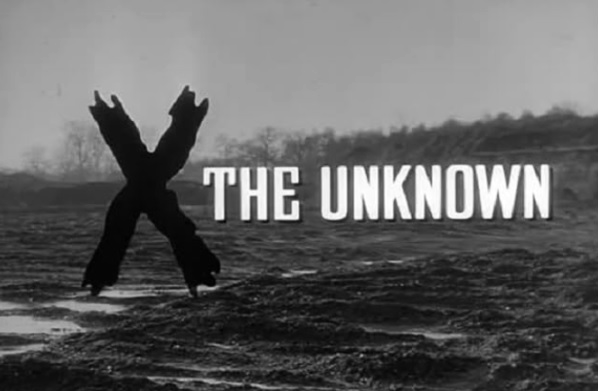
X the Unknown

Directed by Leslie Norman, 1956

X: The Man with the X Ray Eyes

Directed by Roger Corman, 1963

Jeanne Dielman, 23 Commerce Quay, 1080 Brussels

Directed by Chantal Akerman, 1975

Many years ago, when I was a bit younger[i] than the boy, Willie, who trespasses in the marshy woods at 00:17:14[ii] in X the Unknown (1956) and at 00:18:45 meets the (unseen to us) monster (that’s what comes of playing outside when you should be in bed!), the old Welsh Headmaster (who doubled as maths teacher at the local council school), accused me (again) of being “BORN AWK-ARD”. Whether I was questioning the relevance of maths beyond basic shopping calculations, deliberately misunderstanding some unappealing formulaor persisting with wanting to know why X meant whatever, his strong adherance to Chapel teachings, cautions of hellfire and damnation and his hieratic manner of speech, undoubtedly magnified his allegation. At some level, I knew he was right. But whether awkwardness arises from nature or nurture . . . remains, like X, not quite knowable.

Perhaps because the older guard of teachers at Elmhurst Junior had pre-war roots and elements of a military attitude residual in the base of their skulls, it is easy to connect the geiger-counter training that opens X the Unknown (its army personel divided into bigwigs and disposable rabble – or officers and ranks, if you prefer) with the partly black and white school world of the late 1960s. But this world was definitely in transition, and it seems obvious now that the aging headmaster’s awareness of the upcoming generation of teachers (relatively approachable[iii] and dyed by more colourful, Education Through Art[iv] attitudes) pushed him to an obdurateness as long-standing as I now like to believe my awkwardness was whimsical. His frequent, rising claim in school assemblies that God could see us everywhere, might have amused the younger staff, but it angered me. To see this supposed creator as a voyeur or master spy (or in today’s terms, a kind of disembodied CCTV system) was not encouraging. In combination with my natural “awk-ardness”, the Headmaster’s ire (no doubt also triggered by his distrust of late 60s values) only made me come to view his God (or any god) as a kind of Orwellian Big Brother. By extension, as time went on and other would-be authority figures (clothed in seemingly harmless, wishy-washy cardigans or behind pipes[v] or toothy grins[vi]), took to the stage, I came to view not just politicians but the majority of science and technology, in fact, the entire “white heat of this scientific revolution”[vii] as (predominantly, but not exclusively) part of the paternalistic control system driving society (with plenty of heat but not much light) largely in the wrong direction.
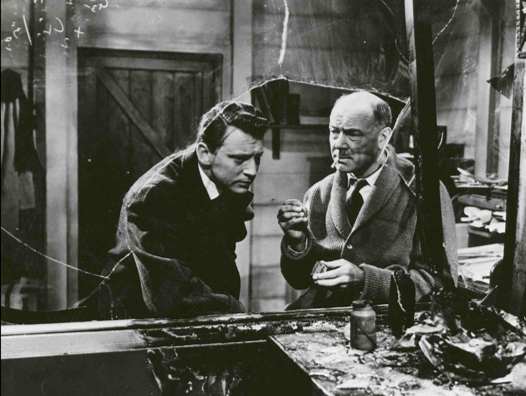
00:25:23 – the devastation of several MeccanoTM sets . . .

Sure enough, in X the Unknown, poor Willie dies of radiation burns, and soon afterwards, his grieving father makes the clear and generally valid distinction (00:31:20): “You’re a Scientist not a Doctor. You don’t care for the sick, you meddle with things that kill . . . letting off bombs you can’t control. You’re not safe! You’re a murderer!” After being subjected to this understandable rant, Dr Adam Royston, (Dean Jagger) walking dejectedly away down a corridor, at 00:31:20 reflects lamely to Inspector McGill (Leo McKern) : “we all try to create not destroy”.

In X the Unknown, Jagger’s character seems a friendly, mild figure, absent-minded in the way professors are often stereotypically humanised. Unfortunately, in reality, whenever science discovers something that can be exploited for war or profit, scientists tend to get pushed aside, their work misrepresented, twisted or ransacked. Alternatively, as the common trope of fiction would have it, they become ambitious or power-crazed.

By contrast, in X the Unknown, Dean Jagger’s Dr Adam Royston, is very sympathetic and shows no sign of megalomania. Since Jagger was also considered amenable in person, it came as a surprise to discover that he held virulently McCarthyite, anti-communist opinions and became adamant that Losey[viii], (who under his blacklist alias of Joseph Walton had begun the pre-production and initial shooting), should be replaced. To cover the later, highly acclaimed[ix], director’s departure, poor health was blamed[x]. He was replaced by a reluctant Leslie Norman[xi].

Post-war idealism may have camouflaged the hubristic dead-end of nuclear power in optimistic science-fiction shapes and colours[xii], offering naïve or deceitful sentiments[xiii] and never-to-be-achieved economic benefits[xiv], yet underlyingly, all the monsters remain, boiling away deep underground – as turns out to be literally the case depicted in X the Unknown. In an internet post about the film from October 2023[xv], Colin McGuigan notes: “While I wouldn’t quite categorize it as an early Eco-thriller, it does raise questions about our symbiotic relationship with the planet itself.”

Considered “vulgar and shocking”[xvi] on its release in 1956, I didn’t remember X the Unknown as a exceptional film, but it was a memorable one, one which tapped into an almost universal distrust of rampant science and technology: science as a kind of witchcraft or Pandora’s Box; science which cannot control the forces it releases. Sadly, applied to nuclear power and weapons, and now more insidiously in the fields of mobile devices, the internet and A.I., this theme of toys or tools out of control, is obviously becoming the massive writing on the wall for all of us. Writing which it seems society is too unimaginative to notice or consider and too exhausted to heed.

In the other ‘X’ film I well-remember, Roger Corman’s X: The Man with the X Ray Eyes, (1963), Doctor Xavier (Ray Milland – whose salary justifiably consumed much of the budget) is irritated that the human eye can see only 10% of the light spectrum[xvii]. Determined to force more from the retina or brain, before long, a lab monkey is sacrificed – Xavier’s miracle compound dripped into the poor creature’s eyes. What does he really want to see? Next, Xavier is, more fairly, experimenting on himself . . . but why not stick to one eye? – then perhaps he might have had the ‘best’ of both worlds?
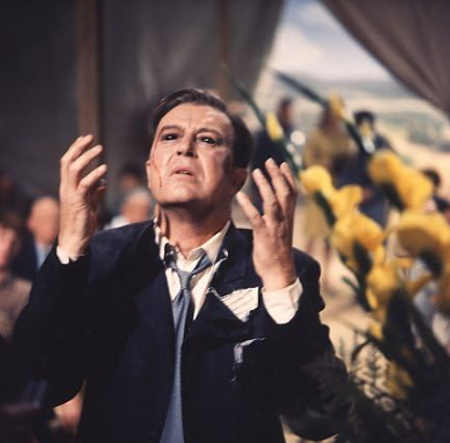
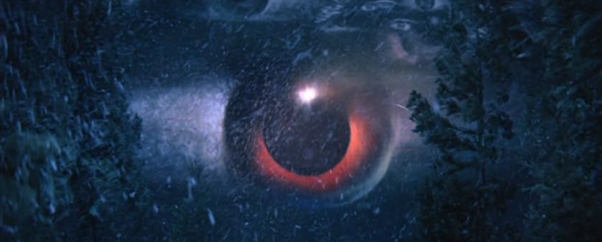
Extremely effective as both an attack on (un)scientific meddling and a parable about hubris[xviii], in prismatic Spectorama[xix], X: The Man with the X Ray Eyes, fractionally anticipated psychedelia and the wider use of LSD. While some of its attitudes have dated, it begins with serious (if absurd) intent, before inevitably lapsing into mild exploitation and action, but returns to a once-shocking denouement in a desert preacher’s tent. Here, rather than staggering up to confess his sins, Xavier says: “I’ve come to tell you what I see. There are great darknesses. Farther than time itself. And beyond the darkness . . . a light that glows, changes . . . and in the centre of the universe . . . the eye that sees us all.”So, after reminding us perhaps of that voyeur God, in an emotionally ecstatic U.S. version of my old Welsh headmaster, the preacher paraphrases Matthew 5:29: “If thine eye offend thee, pluck it out.” Dr Xavier does just that, the image freezing on his black empty sockets[xx].

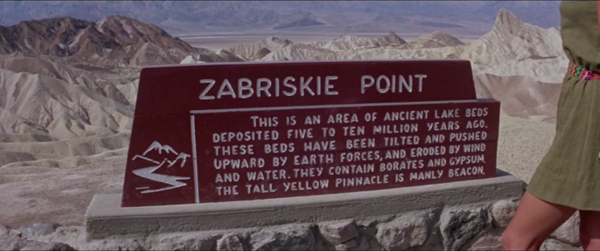
In contrast to Zabriskie Point (1970)[xxi]asthere may be less to say about these two relatively conventional films, am I persisting out of “awk-ardness”?  A friend joked that my fervour for digression will eventually lead me to write something less than a page long accompanied by a encylopedia of references and notes . . . which is an interesting challenge. But escalating attention (obsession?) detail (pedantry?) and subtlety (obscurity or whimsicality?) through notes, forking or parallel pathways, is hardly new. Melville’s Moby Dick (1851) is an indelible monument to a fascinating and complex addiction . . . while in the not-quite-opposite Beckettian[xxii] world of saying a lot about very little, arises perhaps, Don DeLillo’s novella, Point Omega, (2010) in which a character at the beginning and end is obsessed by Douglas Gordon’s real art installation entitled 24 Hour Psycho[xxiii]. Showing at the Museum of Modern art in New York during the summer of 2006, Hitchcock’s notorious film was slowed down to play once every 24hours. Appropriation or homage? Valid conceptual generator of attention, or gimmick?

Even if the supposedly Scottish wasteland[xxiv] adjoining the Atomic Energy Establishment of Lochmouth or the gaping fissure of X The Unknown, would make excellent settings for Waiting for Godot, it seems unlikely that the 1956 film could be mistaken for anything either as potentially complex or inspiring as Moby Dick or as potentially gimmicky as 24 Hour Psycho. But wait! Maybe it could help humanity on an altogether different level? Think of the synopsis! An older lifeforce bursts from the centre of the Earth in the form of a growing, glowing radioactive porridge, to eat particularly anything radioactive. Come back heartless lava – all is forgiven! – save those living on the earth’s crust from their nuclear dead-end nightmare . . . revive our naïve post-war scientist-hero fantasies worthy of cutaways, children’s cereal-boxes and sci-fi annuals . . .
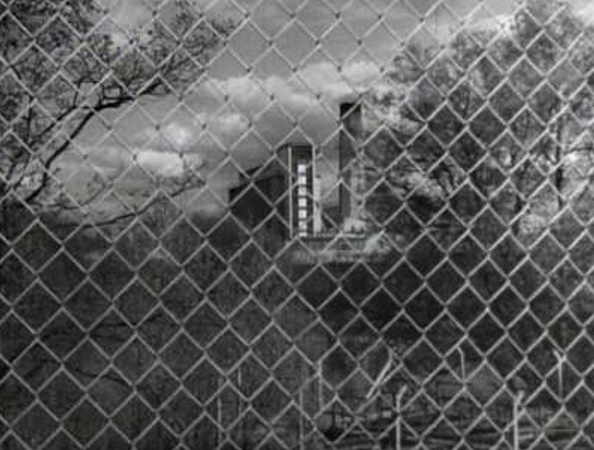
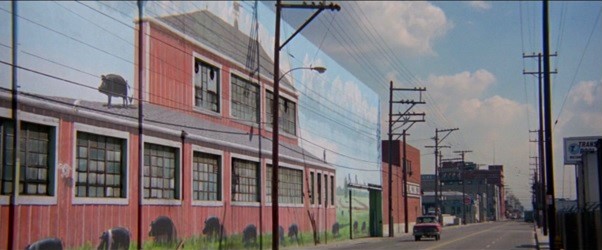
The imaginary Atomic Energy Establishment of Lochmouth at 00:07:20

Close imaginative or speculative observation, observation straining or stretching consciousnessness or attention in the manner of ‘slow cinema’[xxv] (or such as could be stimulated by, for example, the process of watching Psycho slowed to run once every 24 hours), perhaps replicates in essence the hopeful idea behind the opening stanza of Blake’s Auguries of Innoncence[xxvi]: “To see a world in a grain of sand  /  And a heaven in a wild flower, / Hold infinity in the palm of your hand  /  And eternity in an hour.

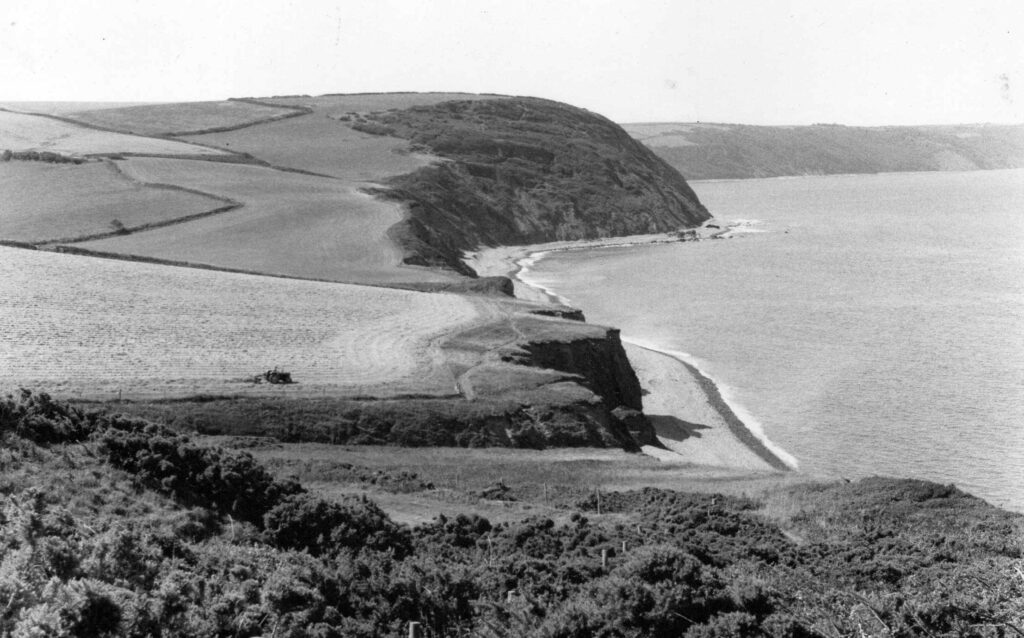
Blake’s lines may seem purely hypothetical to those who live within the claustrophobic confines of our technocracked, supposedly rational society, or within the accepted codes or fantasies of ‘progress’. But to anyone open to the fuller world – anyone who doesn’t have Doctor Xavier’s expectant demands – such transcendent escalation often occurs quite naturally. Even the artist Graham Sutherland’s less exacting echoes of Blake, seeing landscapes in miniature on a Pembrokeshire beach, can have an almost visionary effect on those not used to regularly thinking in such a way.

Going back to the idea of artists falling from art’s vital tightrope into formula and gimmick, more than a few ‘successful’ artists have founded lucrative careers upon stunts and repetition – I won’t name names – but this complacence, despite a concomitant facility which inevitably grows over the years, is not worthy of respect once detached from some wider or deeper quest. Although it may be unfashionable to say that art, music, writing, film and so on should be about enlightenment, I will say it anyway.

X the Unknown is an effective black and white entertainment, but apart from considering fears of the time, does it have any aspects of enlightenment about it? Unease even dread, fills many of its frames. Elemental mystery evoked in ways which we may be used to but remain unsettling: the misty woods and fear through a child’s eyes. Hammer’s usual paranoid music, insidious, unearthly, is always likewise always potent. It scratches at the nuclear trick in a way that is wholly justified, since the essence of nuclear research was always about destruction. The idea of free power (ha ha) only stemmed from the loop of annihilation it still freely offers.
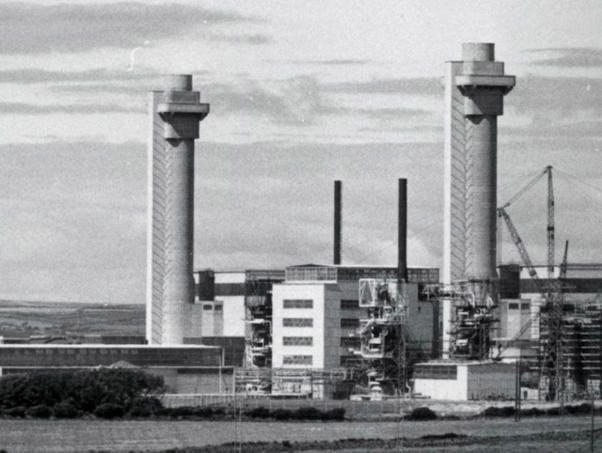
Windscale in 1956, the year X the Unknown was released and a year before the disastrous fire[xxvii]

Lochmouth may be imaginary but Windscale unfortunately was not, and the fire of 10 October 1957 was the worst nuclear accident in UK history. On the International Nuclear Event Scale, it remains one of the worst in the world, in severity ranked at level 5 out of 7. That is when the whole nuclear fantasy should have been terminated.

Despite undercurrents of dissent, X the Unknown probably had little choice but to show the scientists, ultimately, as heroes, leaving the military personel, managers and ministry men to smoulder the torch of that beloved film type, the stock idiot. One officer, comments at 00:48:08, that the “trouble with some of these scientific types is that they can’t see the easy way out of anything. It’s got to be complicated if it’s going to work.” The classic military way of course, is to blast and raze the fissure with high explosves and flame-thowers and then concrete it all up! Leslie Banks as Colonel Holland in Powell and Pressburger’s The Small Back Room (1949) might have been a blimpish caricature intended partly humorously, but underlyingly he was both shrewd and honest.

Predictably, Spider (Anthony Newley), Haggis (Ian MacNaughton) and Private Lansing (Marty Hopkirk of the white suit/Kenneth Cope) all become victims to the as yet unseen monster from the centre of the earth. By his petulant comments and irritation at being bypassed as boss of his “nuclear pile”, manager John Elliott (Edward Chapman) seems, at 00:42:50, to be the next victim in line . . . but miraculously survives, shortly to become the recurring martinet, Mr Grimsdale or equivalent, in five Norman Wisdom comedies[xxviii].

Learning of the approach of the radioactive sludge intent on scoffing the energy source at the dubious establishment, the cast and crew are all frantic to get the cobalt pile, a great big block, presumably radioactive, loaded onto an open flatbed truck. No precautions taken. Radioactivity is fine. Just keep a little distance and brush your hands off. Meanwhile for some baffling reason all the village flock are herded into the church by their vicar – as if the monotonous mass which can melt through solid blocks of lead is going to be put off by a couple of oaken doors or the animosity of a voyeur God who sees eveything. Naturally, a small girl child is left outside and soon runs chuckling and friendly towards the sparkling bread dough pouring over the churchyard wall. Rescued in the nick of time by the vicar, she seems unharmed despite her proximity.

Soon though, the expanding dough is heading towards the “experimental nuclear station”. Darn things are all over the place – even now. Costly misdirections still cooking 70 years later – I chanced upon one back in June just north east of Preston[xxix]. This blot on the landscape one has been “making nuclear fuels since the mid-1940s. The site is notable for being the first nuclear plant in the world to produce Magnox fuel for a commercial power station”.[xxx]
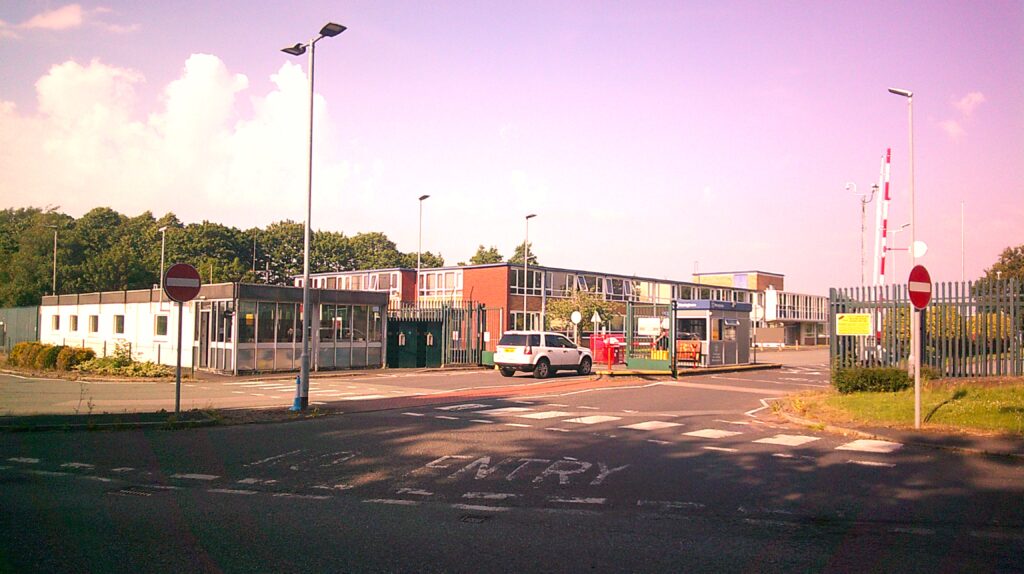
Springfields nuclear fuel production installation, Salwick, Preston, 26th June 2026

The final section of X the Unknown, involes lots of moving about of vehicles and unspecified equipment to recreate Dr. Royston’s unpredictable MeccanoTM experiment. As with the recent epic blockbuster Project Hail Mary (2026), the need for urgency vaults every hurdle, and Wallace and Gromit save the day. Or have they? “You should be proud. It has worked” X says to Y, before another unexpected explosion follows. Royston/Jagger looks baffled and the camera backtracks, implying space for a sequel.

In the excellent 2003 commentary recorded by Marcus Hearn and Jimmy Sangster (1927-2011), Sangster says that the anti-nuclear aspects were accidental, or rather that they were exploiting a common fear of the time. Meanwhile, at the BBFC or censorship office, John Trevelyan was reportedly concerned about X the Unknown’s “dangerous cocktail of sex and horror”. The tryst between radiographer and nurse in the Radiation Room could be seen as an example of this – their potential lust swiftly curtailed by the unsentimental monster at 00:34:00. I’m not sure why the victims of the monster don’t simply run away, like Willie does at the beginning, not that it did him any good. It might be difficult in confined spaces such as the Radiation Room, but some of the soldiers seem inordinately stupid, repeatedly firing their guns into what must have appeared to them as a kind of lava. Primary producer for Hammer, Anthony Hines, told the censorship board that the monster wouldn’t look as nasty as the script described, since they were intending to represent it with “chocolate mousse”.

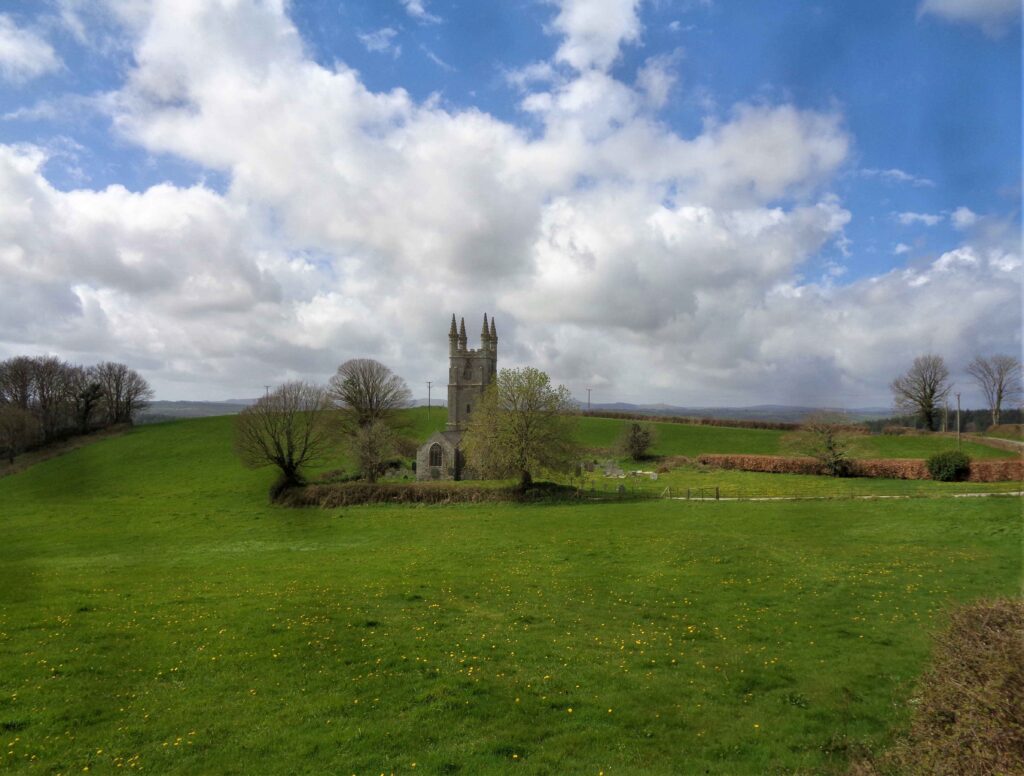
One censor complained that X the Unknown was “scientific hokum and sadism in equal parts; a wretched exploitation of the X certificate”. The script was also described as “the work of an insane but precocious schoolboy!” which writer, Jimmy Sangster, on the commentary, doesn’t seem to mind at all for what he calls his “B and a half movie”. The fairly low budget is illustrated when Dr Royston visits a local church to question Willie’s schoolfriend about what they were doing on the night Willie received his radiation burns. To set the scene, the establishing shot used (below) was taken from Whisky Galore! (1949)[xxxi].

“X the Unknown” wrote Monthly Film Bulletin: “intriguingly suggests a new addition to the science fiction repertoire of Things, but after a series of prolonged climaxes, with its potential victims staring directly into the camera and shaking with fright, the ‘Unknown’ finally emerges as a type of rolling rubber mattress, disappointingly unhorrific in content and appearance.”

                                           *             *             *             *             *             *             *

Perhaps it is only fitting in the days of obvious climate change, of psychopathic omnicidal world leaders, of narcissistic megalomaniac billionaires, of futile weathercasting and forlornly relativist cultural opinion, that the idea of a canon of film has more than somewhat self-destructed. For a decade or two, I maintained a constantly shifting top 100 of films, films largely chosen for their searching depth and quality but also allowing, overall, for enjoyment and entertainment as well as hopeful and inspirational[xxxii] elements. This was a kind of desert island list, indebted therefore to Roy Plomley’s[xxxiii] radio program[xxxiv], imagining 100 films that would stand being watched and watched again if you were shipwrecked but somehow had a projector and 100 films – or a massive TV, DVD player and 100 DVDs (the whole concept would be seriously diminished if the delivery system were smaller). Although I would probably stand by at least half of the films which made it into the more stable top ten[xxxv] of this 100, I began to abandon the overall idea when I realised that I had over 200 films in my top 100.

List-making remains a societal disease; can it have fundamental positives? Despite its prolific passion for lists, the film magazine, Sight and Sound, remains great, thanks perhaps to Mike Williams – an editor with principles. In a world steeply dumbing down, are lists a commercial necessity? One recent specimen: “21st-Century Sci-Fi Cinema,”[xxxvi] chose a film from each year since 2000. Across the page from 2001’s exceptional Donnie Darko (2001), was Sam Wrigley’s choice (presumably, Sam was born “awk-ard”) I.K.U. (2000) a film I struggled to track down and which proved to be of almost no value whatever (though it’s not much worse than Titane, 2021, which won the Palme d’Or at Cannes). Apex of all these short-attention span lists is the once-a-decade “Sight and Sound Greatest Films of all Time”[xxxvii]. Yes, the title is ludicrous. It reminds me of playing a very loose version of cricket with my children around the turn of the Millenium in rural, middle-of-nowhere, North Devon. Increasing in absurdity, The Supreme Universe Cricket Cup, eventually involved 124 invented teams. Some of these merely named the team: e.g. Flash [Gordon] and the Showoffs – a particularly reckless mob who in swashbuckling style tried to turn every ball into a 6 over the house or trees. Other teams were serious and well-characterised. My son’s Star Wars squad, featured carefully inscribed players, all of whom played or failed to play as Star Wars fans (him) might expect (although Yoda was not the best, being too calm and inclined to sitting). I can’t remember how often Darth Vader got into an argument with Han Solo, or whether team loyalty superseded Good and Evil . . . or rather Light and Dark? Perhaps Darth eventually formed a breakaway team to challenge the light side of the Force? I’m not even sure which teams made it to the final – though I have an entire scoresheet somewhere. Possibly, it was Star Wars versus The Artist, Writers and Characters (featuring all-rounders Paul Nash, Graham Sutherland, Herman Melville, Emma Peel and Wolf Solent with Cecil Collins and Orson Welles bowling off breaks – not difficult in a lumpy garden) . . .

For all their atmosphere and entertainment value, neither X the Unknown, nor X: The Man with the X Ray Eyes, would have made my top 100, though they are no better or worse than Sight and Sound’s current “Greatest Film of All Time” Jeanne Dielman, 23 Commerce Quay, 1080 Brussels. (1975). Largely a depressing tableau of interiors – Jeanne Dielman’s unmoving camera provides mesmerizing but tedious focus, observing like a coldly voyeuristic god! A cross between slow cinema’s occasionally valid lean towards transcendence and a kitchen sink (or living-room settee) realism of dreary daily routines, obsessively, neurotically, carried out . . . ultimately, this is a film about futility. For Jeanne Dielman, everything has a place. Dispiriting rather than inspiring, it is intensely claustrophobic. By the long overdue end, you feel like killing yourself. A suddenly fashionable or unfairly despised token of a film, it seems plucked arbitrarily from Chantal Akerman’s valuable oeuvre. It is not her best work and as Andreas Babiolakis points out in his useful filmography[xxxviii], winning the poll did it no favours. Try, Portrait d’une jeune fille de la fin des années 60 à Bruxelles (1994) or Je, Tu, Il, Elle (1974). Or take a look instead at the superior Riddles of the Sphinx[xxxix] written and directed by Laura Mulvey and Peter Woollen.

Jeanne Dielman’s air of joylessness is crushing. “My youth was but a gloomy storm” reads out Jeanne’s 25-year-old son, quoting Baudelaire – and even this brief line conveys a sudden wild cloudscape to dismiss the robotic routine Jeanne Dielman presents. What a relief when the camera or the characters go outside!

The only brief joy for Jeanne appears to be remembering the end of the war . . . and the son never rebels against her rules or routine. At 01:05:16 we are briefly outdoors again: any light, any air, is like an oasis in the desert! Naturally, the period atmosphere is now worth looking at, with an un-poshed-up Brussels, the sometimes slightly misty yet translucent winter streets, the proper cars . . . instead of existing as a film, Jeanne Dielman might work well as a chain of still images of dated rooms, streets and stores.
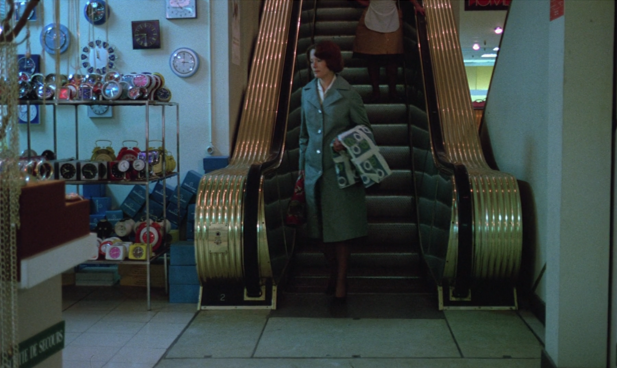
Jeanne shops, cleans and rearranges to a pattern . . . yet does manage, once in a while to smile: in the wool shop (01:29:56), in a café at Giselle (01:30:47) which she misses on her next visit – clearly discomforted by having to sit in a different seat (03:01:46). By this point however, she is starting to visibly crack, albeit in a more measured way than Carol Ledoux (Catherine Deneuve) in Repulsion (1965).

Somehow, even the perfunctory prostitution Jeanne practices, seems part of a general process – which of course may be one of the film’s points: the way we prostitute ourselves to futile modes of life. The way we try to evade alarms and surprises. That respectability is a farce . . .

Occasionally, even the less illuminated sections of Andrei Tarkovsky, can suffer from a form of Jeanne Dielman disease – a drawn-out atmosphere that (charitably) aims to alienate or mind-numb us via demoralising thought into a search for positivity or meaning. Desperate for import, eventually we grow weary, fall into a different zone, or manufacture meaning for ourselves. Which is fine under different circumstances, but Jeanne Dielman can make you long for a mindless Euro-spy thriller[xl] or a Morecambe and Wise feature film such as: The Intelligence Men (1965) or That Riviera Touch (1966)! Jeanne’s mind-suicide of repression can’t last; her life of quiet desperation begins to crumble towards the 3-hour mark as she starts to fumble and drop things . . .

Her suffocation under the final man (above) resembles how you feel all the way through the film – and it ends in a strike for freedom which fails . . .  But perhaps I am forcing my own desire for Jeanne to E S C A P E upon the film? “Jeanne Dielman’s defences had snapped and I wanted to demonstrate that with the strongest sign of her oppression: prostitution… Jeanne Dielman kills to regain her order” Akerman herself said[xli]. Perhaps Jeanne’s repressive order is as close as she can get to the concept of freedom – which may only be a concept anyway, however we interpret or attempt to live or avoid it?

Even if Jeanne Dielman doesn’t justify this much attention as a film (rather than as “the first masterpiece in the feminine in the history of the cinema”[xlii]) Chantal Akerman was undoubtably a worthwhile artist and the film must work on other levels to be so highly rated. Perhaps viewers identify with it as a kind of psychological case history? Is it unfair to know or remember that aspects of Jeanne’s behaviour were based upon Akerman’s mother’s daily routines and that her mother was an Auschwitz survivor? This cannot help but affect both viewer and critic, making Jeanne a martyr by association. A more concise and intense film to which Jeanne Dielman could be very loosely related is Dušan Makavejev’s Love Affair, or The Case of the Missing Switchboard Operator (Ljubavni Slucaj ili Tragedija Sluzbenice P.T.T.) of 1967. But Eva Ras (as Izabela, telefonistkinja or switchboard operator) seems very much alive although dead, while Delphine Seyrig (as Jeanne) is obliged to play dead whilst alive . . .

In the end, however, my intolerance towards Jeanne Dielman, 23, quai du Commerce, 1080 Bruxelles, could be partly physiological. Owing to the tunnels and ventilation shafts the workers have to crawl through in Under Night Streets (1958)[xliii], one of my previously favourite BTF films has become difficult to tolerate. It triggers my claustrophobia. Jeanne Dielman is similarly stifling. Watching it is like being buried alive . . .

I only have to pass under the shadow of a tree in some inconsequential suburb to feel a sudden desire to watch and ponder Vertigo[xliv] again. Yet Vertigo’s overall enigma surpasses its individual scenes and my memory (or mis-memory) of the profoundest passages can be so essential and heightened, that sometimes the actual film itself can be a distraction. Many films have this effect, but Jeanne Dielman does not. In fact, you would have to pay me to watch Jeanne Dielman for a fourth time. Rather than being hauntingly tragic, what Jeanne Dielman perhaps does best, is reflect the increasingly robotised captivity of society – a society far more closely circumscribed by technology now than it was in 1975. Forget rampant lava or psychedelic eye drops, it’s the tools that have taken over. The tools and their android oligarchy of selfish owners. These are the real monsters.

© Lawrence Freiesleben

Notes


[i] At 13 or 14, the actor, Michael Brooke (1942-2014) was older than he looked in the film

[ii] All the timings from X The Unknown come from my 2005 Hammer DVD

[iii]  Though one teacher did lift me up by my ears (not off the ground, and I probably deserved it)          while another used to make wrongdoers do handstands against a wall all through playtimes

[iv] archive.org/details/education-through-art-herbert-read-compressed/page/4/mode/2up

[v] en.wikipedia.org/wiki/Harold_Wilson

[vi] en.wikipedia.org/wiki/Edward_Heath

[vii] theguardian.com/science/political-science/2013/sep/19/harold-wilson-white-heat-technology-speech

[viii] en.wikipedia.org/wiki/Joseph_Losey

[ix] Particularly after the release of The Servant in 1963

[x] bfi.org.uk/features/why-i-love-x-unknown by Vic Pratt: “American star Dean Jagger was signed up to star, and blacklisted Joseph Losey – who would go on to shoot The Damned (1961), another seriously spooky sci-fi film – was enlisted to direct, but there was further trouble ahead. Losey left the production somewhat abruptly – supposedly with pneumonia, but, according to [Jimmy] Sangster, removed from the project owing to star Dean Jagger’s reluctance to work with a ‘red’ director.”

[xi] imdb.com/title/tt0049967/trivia/: “It has also been reported that Losey simply didn’t want to make the film and left the project, to be replaced by Norman, who also didn’t want to make the movie.”

[xii] A false picture that still clings on 70 years later – another corpse inadequately staked!

[xiii] See Atomic Achievement (1956)  youtube.com/watch?v=ToVsb_AhrlM  Observing the scientists and minions featured is like watching toddlers play with broken glass:

              internationaltimes.it/first-principles/

[xiv] Sheer awkwardness or pigheadedness continues to throw good money after bad despite              there being no safe solution to the disposal of waste which remains dangerously hot and highly radioactive for thousands of years.

[xv] livius1.com/2023/10/14/x-the-unknown/

[xvi] Marcus Hearn’s words in an absorbing 2003 commentary to the film with Jimmy Sangster, the writer and production manager.

[xvii] For what it’s worth, this figure has since been scientifically reduced to less than 1%.

[xviii] It was a vivid memory of the end of X: The Man with the X Ray Eyes, that etched the biblical (mis)quote from Matthew 5:29 into my head: “If thine eye offend thee, pluck it out.”         internationaltimes.it/first-principles/

[xix] The Spectorama technique was employed by Cinematographer Floyd Crosby to suggest what Dr. Xavier sees as his vision expands the normal human spectrum.

[xx] In his book Danse Macabre, Stephen King, noted rumours which claimed “the ending originally went further, with Milland crying out “I can still see” after gouging out his eyes. Corman has denied the existence of that ending but expressed enjoyment with the idea, saying “Now it’s interesting. Stephen King saw the picture and wrote a different ending, and I thought, ‘His ending is better than mine.'” See: en.wikipedia.org/wiki/X:_The_Man_with_the_X-ray_Eyes

[xxi] brazen-head.org/?s=zabriskie+point

[xxii] en.wiktionary.org/wiki/Beckettian

[xxiii] theguardian.com/books/2010/feb/27/don-delillo-point-omega

[xxiv] This recurring location was actually filmed (as were other film and TV productions including             episodes of Doctor Who) at Gerrards Cross Sand and Gravel Pits in Bucks which looks, in pictures, though not in the film, to be very similar to the Leighton Buzzard Sand Quarries which so inspired me from the 1970s: brazen-head.org/?s=zabriskie+point  As the film was made in the winter, filming day for night was not considered possible since it requires bright sunlight, necessitating working at night in very cold January and February temperatures.  

[xxv]  en.wikipedia.org/wiki/Slow_cinema

[xxvi] Presumed to have been written in 1803, but not published until 60 years later.

[xxvii] en.wikipedia.org/wiki/Windscale_fire 

[xxviii] www.imdb.com/name/nm0152361/?ref_=tt_cst_t_2 Chapman also remains indelible as a church      deacon in Powell and Pressburger’s Gone To Earth (1950), when at 00:31:46, after the vicar has said Grace: he declares: “I have not received tartlets… I am not thankful!”

[xxix] westinghousenuclear.com/uknuclear/springfields/

[xxx] en.wikipedia.org/wiki/Springfields

[xxxi] As Peter Faizey noted here:  www.reelstreets.com/films/x-the-unknown/ the church, Our Lady Star of the Sea, is on the Isle of Barra, Castlebay, Scotland. The other church used is St Michael’s Church, Bray, which apparently also appears in Paranoiac (1963), Four-Sided Triangle (1953) and There’s a Girl in My Soup (1970).

[xxxii] Even the darkest (and best) film noir: Out of the Past, 1947, (my number 4 film since the late        1980s) has fleeting lights of hope.

[xxxiii] en.wikipedia.org/wiki/Roy_Plomley

[xxxiv] bbc.co.uk/programmes/articles/59YrnYM0Tw8J7WJ0MGKVfh7/the-history-of-desert-island- discs

[xxxv] Although I would “stand by” these films, there would probably be a hundred others I’d now wish to cram into the top ten, since much of the list predated my wider experience of European and world cinema – particularly of Italian and Japanese films. The Japanese New Wave (Nuberu bagu) is every bit as vital as the better-known French Nouvelle Vague

              1)    A Canterbury Tale (1944)

              2)    Solaris (1972)

              3)    The Ghost and Mrs. Muir (1947)

              4)    Out of the Past (U.K. title: Build My Gallows High (1947)

              5)    Stalker (1979)

              6)    Leave Her to Heaven (1945)

              7)    Kiss Me Deadly (1955)

              8)    Vertigo (1958)                        

              9)    Ivan’s Childhood (1962)

              10)  Le Samouraï (1967)

[xxxvi] Sight & Sound, Summer 2026, Volume 36, issue 6

[xxxvii] bfi.org.uk/sight-and-sound/greatest-films-all-time

[xxxviii] filmsfatale.com/blog/2026/3/5/filmography-worship-ranking-every-chantal-akerman-film

[xxxix] www.imdb.com/title/tt0076625/

[xl] en.wikipedia.org/wiki/Eurospy_film

[xli] bfi.org.uk/sight-and-sound/features/keeping-distance-chantal-akermans-jeanne-dielma by Janet Bergstrom – updated 15th October 2015 from the November 1999 magazine.

[xlii]  Le Monde, January 1976

[xliii] imdb.com/title/tt0991286/?ref_=nv_sr_srsg_0_tt_1_nm_1_in_0_q_under%20night%20streets

[xliv] Vertigo preceded Jeanne Dielman… as number one in the Greatest Films of all Time list. Naturally, the critical/appreciative paths around it are thoroughly trodden.

A Backwards Alphabet of Film: W

Woman of the Snow (second segment of Kwaidan)

Directed by Masaki Kobayashi, 1964

The Snow Woman

Directed by Tokuzō Tanaka, 1968

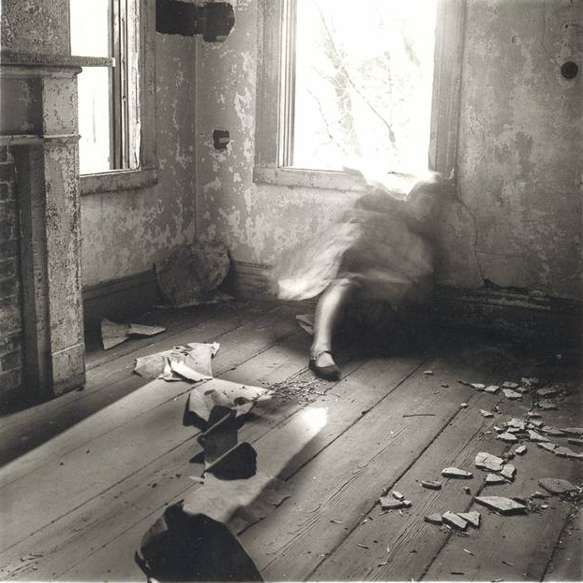
It’s easy to have an escalated memory of certain films, books, music or paintings. In film, this can be particularly evanescent: an image or tone, a line of speech, the fleeting expression of one of the players – or in the case of the 2010 documentary, The Woodmans, (director: Scott Willis) – the expression or gestures of a non-fictional person, maybe self-conscious or recreating a memory, but not fully acting. The Woodmans was the intriguing film I first intended to write about . . . but its incidental display of privilege, wealth and relative success, eventually ground me down. Francesca – the photographer daughter – is the most notable member of the Woodmans family and although her work can be a shade formulaic, it is frequently mysterious and powerful, as seen here.

 House #3, Providence, Rhode Island, 1976, by Francesca Woodman 

After Francesca Woodman leaves the story by suicide in 1981, aged only 22, the other Woodmans are inevitably left with a haunting burden of grief . . . yet remain fortunate as artists – artists with a modicum of talent who could always have lived the art life whether or not they succeeded in sales terms. It is to their credit that they carried on trying hard. They believe in their work and its value, despite that it is often little more than decorative. In other words, second time around, the film did not live up to my empathetic and escalated memory of it. Or perhaps the chords which concealed its faults were no longer binding?

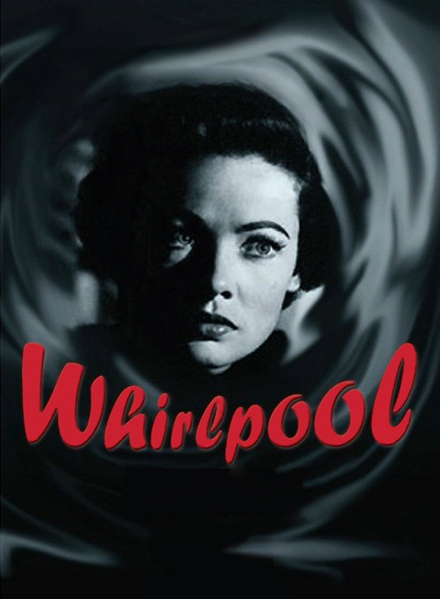
With Whirlpool[i] (1950, director: Otto Preminger) I got further, appropriately spiralling down into its enjoyable hogwash, notwithstanding the difficulty of accepting natural crime kingpin, Richard Conti, as a bowtie-wearing psychoanalyst! Cynical witticisms regularly illuminate the shadowy ruined coastline of Noir, and their serrated architecture can memorably survive long after many of the films’ enveloping, invasive tides have receded. Lines such as “a successful marriage is usually based on what a husband and a wife don’t know about each other” (00:11:32[ii]) are naturally amusing.

Regardless of how plausible or implausible the whole premise of Whirlpool is, especially self-hypnosis (once self-hypnotized against pain, surely, you’d also be hypnotised against a sense of caution and danger?) for me Whirlpool remained enmeshingly tense. It was entertaining as well, to spot the numerous parallels with the much more successful Laura (1944)[iii] – also directed by Preminger and starring Gene Tierney. But all this was not sufficiently enlightening[iv], and while I was very glad to see it again, it’s hard to violently disagree with some of its negative reviewers[v]. I needed to recall a film that could be inhabited. A film as commandingly hypnotic as Vertigo (1958) whose deepest scenes can distort and expand so much from memory or mistaken impression, that the actual film itself can become a distraction[vi]. Plot and sequence, characters and meaning . . . can all seem relatively irrelevant. In such a state, I no longer want the Hitchcock-directed, finished film, only the intensity or visual poetry beyond certain scenes. What stays cloaked just out of reach or can be sensed at the back of the head, is closer to the true source. Perhaps the best films, even much of the best art, draws on sublimated or unconscious archetypes or anomalies, and once these are activated or vaguely felt, the surfaces of the art itself can become an interference, a fading static? With Vertigo, I sometimes want a sense of time and anti-time, the texture of dark forests and the escape from them, the sweep of the high red bridge and a flight without it, the swell of waves (or studio tanks), the feel of old Spanish settlements, the tilt of the streets, distinctive coastal trees such as those at Cypress Point . .

Consequently, I remain very drawn to the idea, in Vertigo’s case, of the San Francisco area[vii], despite that in reality, the locations used are widely dispersed and their relationships with each other, as well as their physical appearance 68 years later, would likely be a disappointment[viii].

Recalling a film I could inhabit, a confusion occurred. Apparently, the Japanese title of The Snow Woman 怪談雪女郎 (Kaidan Yukijorō) can be translated as Tales of the Snow Witch or Ghost Story of the Snow Woman, and I believe I originally watched the 1968 film under the title Woman of the Snow. Since the justifiably famous Kwaidan[ix], directed by Masaki Kobayashi and consisting of four ghost stories[x]  was released four years earlier, and one of its stories was entitled Woman of the Snow, perhaps the later feature film, was at some point, retitled to avoid confusion? Both films, (the 1964 Kwaidan story, at 42 minutes, is about half the length of Tokuzō Tanaka’s 1968 feature), are adaptations of the same Japanese folktale made internationally popular in 1904 by Lafcadio Hearn’s collection, Kwaidan: Stories and Studies of Strange Things. Both films have an atmosphere, at sudden or creeping moments, of breaking through the rushing static of what we like to think of as “reality”. Both films relish the fierce calligraphy of their titles, although with Kwaidan – the complete film – calligraphy becomes almost a character in itself – particularly in The Story of Mimi-nashi-Hōïchi or Hoichi the Earless[xi]. Calligraphy as a weapon. Calligraphy as a stockade.

Poetically concise, the production style and painterly studio backgrounds of Kwaidan’s Woman of the Snow episode (1964), are exquisitely abstracted yet also metaphysically challenging – conjuring a hyper-reality way beyond surrealism. On the other hand, The Snow Woman, of 1968, with the extra space of its longer story – increasing the tension between mortal and immortal, the vulnerability of the elemental in a corporeal world – probably attains a more haunting poignancy, a deeper sense of the tragic? Its Snow Woman feels more torn. Rewatching both films, I find the merits of each too considerable to want to elevate one above the other. They are both unmissable. Their more extreme moments possess a valiant character – the challenge of the wish, the contempt of the supernatural toward the human drone.

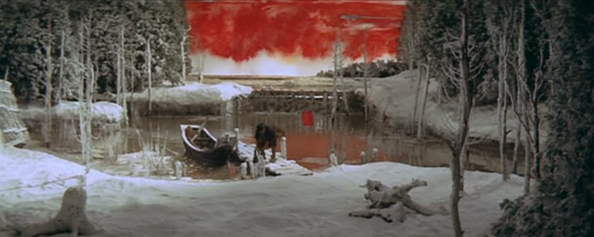
The Woman of the Snow episode, directed by Masaki Kobayashi in 1964, begins within Kwaidan at 00:39:55. Kwaidan’s style as a whole, its drama, lighting and score[xii] are theatrical as well as startlingly innovative. In contrast to The Snow Woman’s frequent use of real landscapes (notably in its opening mountain forest scenes) Kobayashi filmed inside an aircraft hangar, in which, art director Shigemasa Toda, and set decorator Dai Arakawa, created vivid symbolic skies, map-like symmetrical forests and a brimming river – its magical overflow sparkling like silver foil. At first these scenes are buried in drifts and flurries of snow, with only the red flag of the absent ferryman to alarm a wintry palette. This red of danger, signalling the margins of some fever zone, stays imprinted in the mind. Under whited-out or painted skies, impressionistic, clear or churning, from hopeful and spacious to claustrophobic and doomed, the lives of the characters become archetypal.

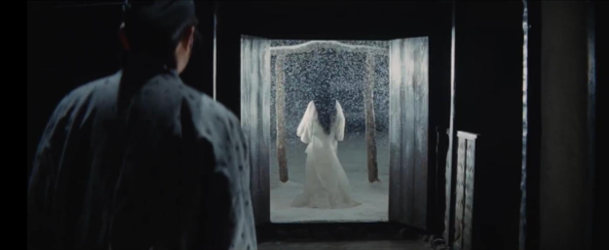
While in the more conventional 1968 film, the old man and his younger apprentice are master and student sculptors, in The Snow Woman they are merely woodcutters. Their highest ambition is to have a useful, contented life. Art doesn’t come into it – unless you count the later crafting of sturdy and attractive sandals. The Snow Woman has few quotidian scenes and little conversation to start with. Its scarce inhabitants live almost entirely in isolation. When the snowstorm overwhelms the two woodcutters as they return from the wilderness, they struggle into the ferryman’s deserted shanty. Its gapped planking reduces the blizzard’s fury. But there is no safety here at the centre or eye or crossroads of the storm. The Woman of the Snow enters . . . and when the old man perishes from the extra cold deployed by her ghostly form, Tatsuya Nakadai, as the younger man, speaks the horror with his eyes. He doesn’t protest against fate as the spirit turns her lethal gaze upon him to slowly approach his recumbent, terror-stricken form. All he can do is tilt his head away – as if this distances her from his wide unblinking gaze. Is it for the sake of his youth that the snow witch spares this “handsome boy”[xiii] – or does she know the future; is she attracted to him? Shuffling towards the door she fades through it . . . but not before extracting a promise which the longer film later echoes:, but here, it is that he mustn’t tell his mother what happened, rather than his parents, children or wife – as if the woman or spirit has some degree of omniscience.

Next morning the storm has abated. At 00:51:49 the ferryman arrives (above) and failing to get in the front door of his shack, enters another way. As mentioned before, the concise adaptation within Kwaidan eschews the sculpting vocation of the main character in the longer story and there any no evil billionaires or despicable Lords either, only a mother, curing her traumatized and half-frozen son with porridge. That all the blood was drained from the old woodcutter implies that the Woman of the Snow is some form of vampire – a hint later strengthened. But the old woman does not pursue with questions. Knowing she must work while her son, hollow and withdrawn in bed, recovers, she staggers away with a basket of sticks[xiv].

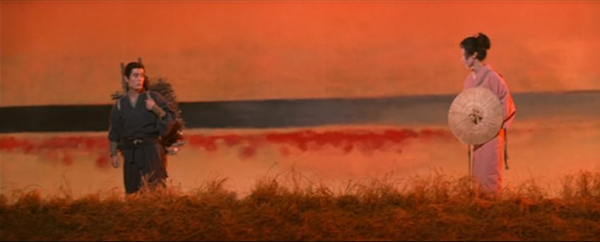
A year later and thankfully recovered, after a long day’s wood harvesting, on his stroll home against the westering skies the son meets a woman going to Yedo. The sky, red and orange, awaits the appearance of those earlier symbols, globes or the beginnings of eyes which could suggest the materialisation of spirits as if from whirlpools in the atmosphere. Despite the eerie music, the setting is serene. Nothing in this gentle yet accelerated alternative to modern dating, insinuates that Yuki[xv] might be the Woman of the Snow in disguise. They continue to walk through sunset-crimsoned woods and pools, as the painted skies turn from white and blue to yellow and black. Swirls like giant marbles, now begin to generate above the horizon. The young man invites Yuki to the lonely house where he lives with his mother. Another cinematic house to envy! Yuki shows no caution, presumably because she knows she cannot be endangered? Is this a planned seduction on her part? Could he resist if he wished? In the house, at 01:01:22, he is clearly stirred by the sight of the traveller washing her feet.

Soon, laughing chases through the rushes and reeds under roseate skies, unwind the formality of the potential lovers. In contradiction to the angry whirlpools of stormier skies, a jewel-like shape forms above nearby, like a sentient sun, to indicate the approach of a happy perfection. Under this glowing symbol, loving embraces follow naturally, with gently bared breasts among the grasses[xvi]. . . before cross dissolving to a baby being bathed. Two other children are soon present[xvii] – the Woman of the Snow has become a perfect wife and mother. Walking with her children, I wonder if the strange song the children voice at 01:03:46, in which “the priest was amazed and fell upside down”, is partially parallelled in the longer, 1968 film, by a scene in which evil Lord Jito, endorsing the established rival sculptor, Gyôkei, (who Jito has employed to usurp the younger sculptor’s commission), says of apprentice sculptor Yosaku at 00:40:23: “there is no way he will win, even if he stands on his head.” This bizarre comment may arise from mistranslation or subtitling, but as with the Snake and Tortoise/Turtle song used in the 1968 film (and brought up below), it creates a reflective pause in the narrative – at least during interrogatory viewings[xviii].

That the children grow older but their mother never ages, is emphasised by a humorous exchange with three village women – they and the ferryman are the only sign of any local community in the entire film. Yuki has taken her children to pay their respects at their grandmother’s grave. They pass the women, busy washing clothes, on their way home. “Most peasant women age early,” but despite giving birth three times, Yuki still looks like a girl. “That woman is a wonder!” the village washerwomen all agree[xix], taking it for granted that the dead grandmother is still able to see and appreciate her grandchildren, as well as their wonderful mother and happy lives.

Evening, and the children are all asleep in a side room. The young woodcutter is no artist but has crafted four pairs of sandals for his wife and children. Yuki admires her pair and returns to sewing. From his lower angle and with the light on her face, the woodman suddenly remembers across the years . . . the light becomes blue and icy and with the change comes, recognition? Then the light turns warm again and he seems about to laugh off his memory. Unfortunately, he rambles on . . . No don’t say it! But he doesn’t stop . . .

For the sake of her sleeping children, the Woman of the Snow forbears from carrying out her strict promise of murder, returning toward the giant eye, leaving a widower grieving over his four pairs of beautiful sandals. Sadly, he puts hers out in the snow. Since they disappear, perhaps there is hope that she might return? Yet the mood is tragic.

The quality of human ambition in The Snow Woman (1968), is something the shorter, more lyrically concise version of 1964, bypassed. In the longer version of the tale, the old wood carver Shigetomo, seems almost punished for his ambition: “My name will be known throughout the mountains of Mino,” he anticipates triumphantly. Conversely, his apprentice Yosaku is frequently undermined by a lack of self-belief. Beginning in real snowy landscapes, prospecting for the ideal tree for a temple commission, master and apprentice fall to their knees to give thanks when they discover a magnificent example – a tree so fine they believe it may even have a soul. As if the thought of felling such a tree to become mere material for religious carving is a crime, the weather abruptly changes. Winds howl and swirling snow snaps branches around them. They struggle on through the tempest. Fortunately, a rough shelter appears, but later, as the young man wakes from under his heaped straw, a ghost slides into their refuge (00:07:30) to kill the fire and summon ice in its place, snow from the stare of its eyes and spirit, frost from the percussive sounds[xx]. Without Kwaidan’s implication of vampirism, the old Shigetomo is simply chilled to death. The Snow Woman turns her attention towards the young apprentice Yosaku, creeping backwards on his elbows, only sparing him because “you are young and beautiful” (00:11:20). In exchange, he must promise never to tell even his dearest, what happened that night. The door of the shack opens of its own volition (00:12:37) before the Snow Woman glides back into the blizzard.

Moving on: in cheerful daylight the felled tree arrives in the village (00:14:54), with or without its soul, no longer exceptional. Propelled on rollers by a crowd of peasants and greeted rapturously by a crowd of villagers, the High Priest’s officials are delivering the section of trunk and request that Yosaku carry out the original commission, since his old master spoke highly of him and the High Priest believed in Shigetomo’s judgement. Feeling unworthy, Yosaku, persuaded by Shigetomo’s widow, reluctantly accepts.

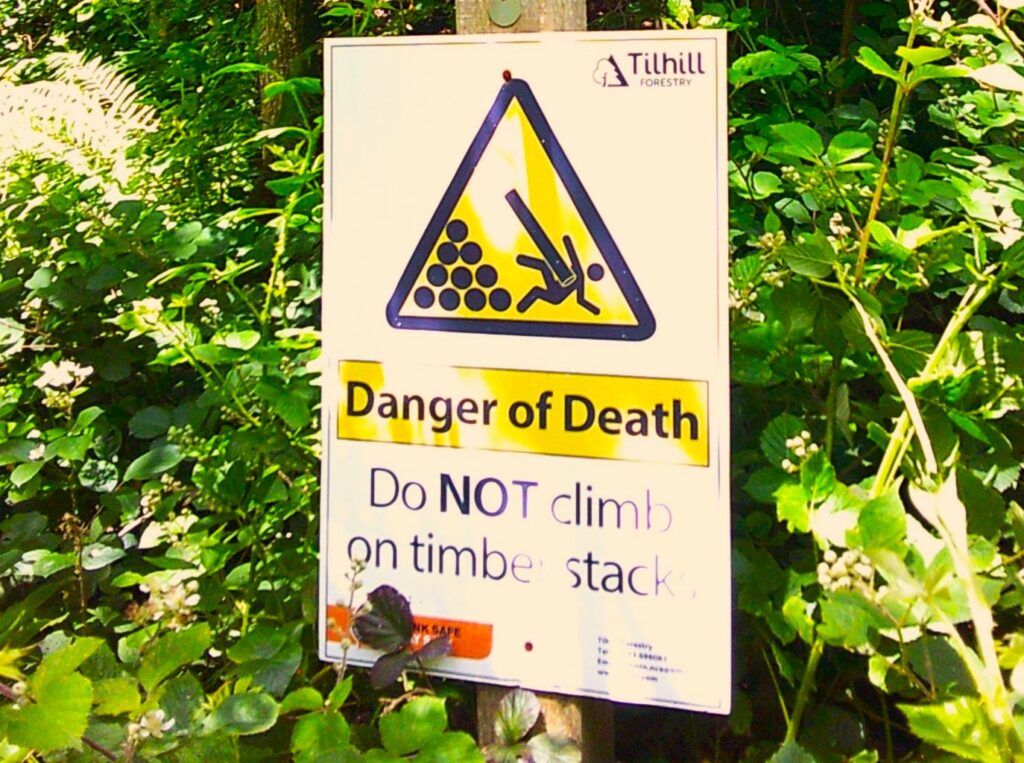
That night, during a rainstorm a beautiful traveller – “young girl” in the widow of the old master sculptor’s eyes – shelters under the eaves of the Yosaku’s workshop (00:17:06). Invited indoors, in a mildly sensual way Yosaku’s surrogate mother supplies dry clothing while remarking on the traveller’s beauty. As the Snow Woman, Shiho Fujimura may be too terrifying for the word beautiful to arise, unless one admires haughty superiority and malevolent elemental force . . . but as Yuki, she is almost unrecognisable. In the Kwaidan story, you can see the similarity between spirit and woman. Here, on a first viewing, perhaps audiences where not expected to notice any connection? After several meaningful admiring glances between Yosaku and Yuki (only slightly distracted by her appreciation and confidence in his sculpting skills, and his dissatisfaction with them) at 00:22:30 they go together to gather herbs which Yuki knows would be good for the old wife’s recurring health problems. At 00:24:09 love reveals itself. Meanwhile, galloping thugs are approaching the village as children circle and lark on a log stack. The children’s reckless behaviour naturally predates the modern health and safety attitude towards timber stacks!

Haverthwaite, 20th June 2026

Thrown from his horse by the fright factor of rolling logs, Lord Jito is furious: “Fools! Children or not, I’ll have your heads”. Hurrying out to protect the children (00:24:38) the wood-carver’s old wife founds herself beaten by Lord Jito for her “impudence”. Returning to the village, Yosaku and Yuki rush to intervene, but it is too late. Nasty Lord Jito, clearly fancying Yuki at first sight, gallops off with the threat that they haven’t “heard the last of this”. Despite encouragements to “hang in there” (!! anachronistic subtitles at 00:22:27: what subtleties might we be missing?) before long the old wife succumbs to her beating[xxi] – using her dying moments to virtually oblige a marriage between Yosaku and Yuki. Although they don’t wish to impose upon each other, they are happy to follow this course.

It seems clear in both versions of the film, that the spirit of the snow has sought out the two young men spared, perhaps because like the Greek gods, the snow women are drawn to mortals by desire? Or for wanting to know what it feels like to be human, to bear children and be a mother? Is it also a vain attempt to escape their chilled immortality, at least for a lifetime? On their first night together, at 00:29:12, Yosaku asks “Yuki, why is your body so cold?”

Another powerful character with sundry titles now emerges to complete the cultural hierarchy. Witch doctor or priestess, she is later referred to, gender-specifically, in the subtitles as a “shamaness”. Cast listing meanwhile, describes her as a “Shrine Maiden”. Divining for the presence of evil at a sacred festival this shamaness immediately perceives Yuki’s supernatural origins – the zealous old hag’s flame darts at 00:30:47, act like ghost-seeking missiles. Maybe this is the point at which, on a first viewing, you are supposed to know with certainty that for all her love and sympathy, Yuki is the Snow Woman?

Five years later and snidey Lord Jito is back from the capital, Kyoto[xxii], interfering in local politics and trying to engineer for an experienced sculptor, Gyôkei, to replace Yosaku for the task of carving an inspiring Buddha for the temple. Having known the old master carver Shigetomo and heard him praise Yosaku, the patient High Priest still wants the unproven apprentice to do the work. Angrily, Jito forces a competition upon the religious authorities – the winner will be granted the commission. By this time Yosaku and Yuki have a young son, Tarô, yet Yuki has not aged in five years. When the family group chance upon Lord Jito (feudal or samurai equivalent of a contemptible billionaire or unscrupulous politician of now) and his corrupt entourage in the woods, Jito confides to a sidekick, (00:37:08) that he “scoured the capital for five years and found none to equal her.”

For a brief relaxed interval, after his classmates taunt Tarô for not knowing a strange song – apparently a traditional children’s rhyme about a turtle that takes over a snake’s yard to cause the disappearance of nine local people – Yosaku watches Yuki teaching it to him. Whether or not this song is thematically connected[xxiii] to the film, it creates an enigmatic frisson of the type which often encourages a fork or splitting point in the pathway of a narrative . . . a pause or glance toward something cloaked or just out of reach, something only sensed at the back of the mind.

At Gyôkei’s workshop, in the contemptuous dialogue between master sculptor and Jito, Jito declares that country people are “like frogs stuck in a well” (00:40:35) and goes on: “Trying to compete with you, he does not know his place.” But it’s not just that Jito considers Yosaku to have ideas above his station: “His wife is far too good for him too” (00:40:50). The plot thickens and when Jito’s henchman come to arrest Yosaku for the theft of the tree, their leader shortly offers the planned way out: Yuki should offer herself to Jito. Yuki is so disgusted that a fine of three ryō or gold coins is imposed – an impossible sum . . . yet Yuki says she will pay. Grudgingly, the gang leaves.

              Yuki: “How can someone be so unscrupulous?”

              Yosaku: “It’s Lord Jito we are talking about.”

To cure a local landowner’s child of a dangerous fever (00:45:33: “Ridiculous! How can a mere woman possibly cure him,” say the doctors who’ve given him up for dead), Yuki repeatedly and exhaustingly becomes the Snow Woman. She snows near the child and cures him with snow parcels, freezing the fever away.

Not only does she have compassion, the Snow Woman believes in art! Yosaku’s “wooden doll” sculpture looks perfect within limits (“I just can’t seem to finish her face”), but like so much “great” art, is somehow dead. Gyôkei’s golden version however, is truly and thoroughly dead. TheHigh Priest is not impressed – “It shines with gold. It is almost too bright for my eyes to bear!” (00:58:01). “Indeed, her beauty is overwhelming . . .” but “Look closely at her face. In her eyes, do you see the light of compassion?”

Despite the High Priest’s support, Yosaku remains unhappy with his work, he cannot get the eyes right and persuades a very unwilling Yuki to come and pray with him at another religious festival. Forced to run from the festival through the dark forest when she realises again that the Shrine Maiden can sense her presence, Yuki is abducted for Lord Jiro. In a nearby shed, Jiro is determined to have her. He lusts after her pale skin . . . pure like snow. “How I’ve longed to strip you bare” (01:03:47). But the rape goes no further than a bared shoulder.

When he tries to tear her kimono off, Yuki begins to change from frightened woman to invincible Snow Woman, (01:05:45): All those who have seen my true form must die”. Jito grovels, pleads and freezes. She freezes all his assets and empties his accounts[xxiv], and when his minions discover his frozen corpse, they too are dealt with. Hurrah!

Back at home, Yosaku and Tarô find an exhausted Yuki, yet Yosaku is still concerned with finishing his statue – a picture of the true artist, sacrificing everyone and everything for Art! An ominous shadow clings to him though, preventing that final miraculous transformation of dead wood. But now the news of Lord Jito’s death is abroad and the Shrine Maiden turns up to accuse Yuki – as if the hag was in league with Jito: corrupt politics hand in glove with corrupt religion . . . surely not! The Shrine Maiden is obviously jealous of “a power beyond this realm” (01:10:09). Calling Yuki a “Monstrous demon!” she is determined to look for the scars of her flame darts. Yosaku finally helps repel the old woman and comforts Yuki: “No one could destroy our happiness.” Now he feels he’s been washed clean and remembers his Art. “I think I can finish the statue” . . . yet the dark shadow remains”. Suddenly, stirred by the accusations of the Shamaness, he remembers the night of the Snow Woman and overrides his promise never to tell anyone, not even his wife. NO DON’T SAY IT!

“I saw the terrifying Snow Woman. She killed my master.” (01:13:42) . . . “Yuki . . .”

“That . . . was me.”

“You?”

“After all this time you have spoken of it. It was all I asked of you. I told you never to speak of it. All these years I prayed you wouldn’t. Because I became your wife, I discovered human happiness . . . (01:14:33) . . . I hoped this happiness would never end . . .”

She becomes the Snow Woman and is about to kill Yosaku when Tarô cries in his sleep. Becoming a mother again for a while, she realises she must leave instead: “Please look after Tarô in my place. And please finish that wonderful statue of yours . . .”

In all this tragic farewell, Yosako is still distracted by his ART . . . and seeing the light of compassion in her face (01:18:22) – compassion for the child and for him – he knows now, how to finish the statue.

© Lawrence Freiesleben, 2026

NOTES


[i] Currently available here: youtube.com/watch?v=SQIZsBED4-0

[ii] Approximate timing for the YouTube version.     

[iii] For a truly weird and distant echo of Laura, seek out Singapore Sling (O Anthropos Pou Agapise Ena Ptoma) 1990  1h 51m  imdb.com/title/tt0100623/?ref_=fn_t_1 which despite a striking and luminous Noir atmosphere is laughably absurd – with Meredyth Herold coming across like Josie Lawrence in an X-rated Mastersons (radio) improvisation!   bbc.co.uk/programmes/b007jsmr

[iv] From A Backwards Alphabet of Films – X: “Although it may be unfashionable to say that art, music, writing, film and so on, should be about enlightenment, I will say it anyway.”

[v]  Such as David Vining, who in 2025 was unengaged by it: “I don’t think it’s a good thriller or mystery or drama. But, it has some charms along the way to make the film not a complete waste”: davidmvining.wordpress.com/2025/11/27/whirlpool/

[vi] As noted in A Backwards Alphabet of Films – X . . .

[vii] See particularly: internationaltimes.it/the-italian-digression-part-8/

[viii] Just as the “unsightly fence” at Cypress Point – a notable Vertigo location – would force one to reverse into imagination: reelsf.com/reelsf/vertigo-at-the-coast

[ix] imdb.com/title/tt0058279/?ref_=nv_sr_srsg_0_tt_3_nm_5_in_0_q_Kwaidan

[x] en.wikipedia.org/wiki/Kwaidan_(film)

[xi] In this story, the blind musician Hōïchi is obliged to perform every night for the ghost court of the Heike clan. To prevent his being torn apart or carried off by spirits, the priest of the temple and his devoted assistant paint the Hannya-Shingyō (Heart Sutra), a holy text, over every part of Hōïchi’s body.

[xii] Toru Takemitsu’s uniquely and sometimes piercingly disquieting score combines traditional          instruments such as the shakuhachi and the biwa with electronic manipulation and tape loops as well as a modified piano: screws, bolts, and soft materials placed on the strings to summon strange percussive effects and assorted unpredictable clangs.

[xiii] In the 1968 film the apprentice is also spared for his youth and beauty.

[xiv] Recently watching the film again, I thought of the cover of the album now known as Led Zeppelin IV, but as this is not helpful, I only include the passing thought to reference this intriguing blog post: wknc.org/2021/04/11/behind-the-cover-led-zeppelin-iv/

[xv] Both the Woman of the Snow and the Snow Woman are named Yuki – but who would expect Robin Hood to switch names with every new adaptation of his folk story?

[xvi] The Kwaidan segment (1964) appears more audacious in this way than The Snow Woman four years later. Surprisingly, both films were originally released under Japan’s ‘G’ rating (General Audiences), equivalent to a U certificate in the UK.

[xvii] The Snow Woman bears only one child as opposed to The Woman of the Snow’s three. In both cases it is the presence of a child or children which prevents the snow women from carrying out their promise to kill their husbands for “betraying” her secret. As they only reveal it to her, the severing of their happy lives together as well as the potential deaths involved, seems a shade severe as punishment – but I suppose marriages between mortal and supernatural beings have to end somewhere . . .

[xviii] To consider the implications of inversion in religious terms is probably fanciful as well as complex. On the one hand there is Peter requesting to be hung (crucified) upside down because he felt unworthy to die in the same way as Jesus. On the other, the inverted cross is linked to being in league with Satan. But Christianity’s influence in feudal Japan has been described as profound: japan-kyushu-tourist.com/history-of-japanese-christianity-2/

[xix] The odd thing about the tone of this encounter is that one can’t be sure it is entirely friendly. As the washerwomen all laugh at the end, are they being sarcastic to a degree? Or do they have some sense of division arising from a buried instinct that Yuki is not quite of the world. Yuki’s return comments could also be seen as partially ironic.

[xx] Akira Ifukube wrote the score for The Snow Woman. He and Toru Takemitsu – composer for Kwaidan – “stand as the two pillars of 20th-century Japanese classical and film music”. Both largely self-taught, the two were rivals and at times were very critical of each other: “Ifukube once famously proclaimed that “Music is not philosophy,” a direct jab at the highly conceptual, philosophical nature of Takemitsu’s avant-garde output”. “Takemitsu looked heavily toward Western modernism (Debussy, Messiaen, and John Cage) to create a style that balanced avant-garde abstraction with traditional Japanese instruments.” Quotes from  Classical Music Forum.

[xxi] Informed of this far away, Lord Jito cares not a jot that the “old bag” has died, he is only feverish to find out about and entrap Yuki.

[xxii] Kyoto, centre of the Imperial Court, served as the capital of Japan from 794 until 1868.

[xxiii] japanonfilm.wordpress.com/2020/02/29/snow-woman-kaidan-yukijuro-1968/#

[xxiv] Just as civilization should treat all parasitic billionaires!

A Z-A of film: Yellow Sky

Both the triumphant and then jolly music of Yellow Sky[i], with its flippant echo of Oh! Susanna[ii] are a complete contradiction to the overall mood of the film. Whatever your definition of noir, Yellow Sky comes stylistically and psychologically close until the end. Purely noir[iii] Westerns that also have negative endings are very rare. Wellman’s later, colour Western, Track of the Cat (1954) starring that fatalistic ‘Tsar of Noir’, Robert Mitchum[iv], though regularly considered one of the bleakest of Westerns, scrapes some hope at the end – albeit not for Mitchum.

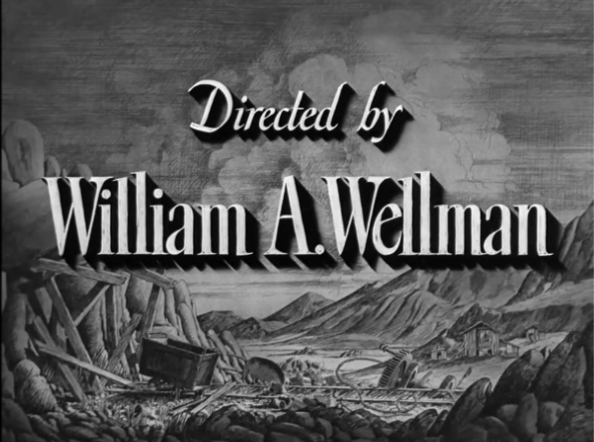
Despite being known as “Wild Bill” for his confrontational personality, womanising and World War 1 exploits as a fighter pilot, Yellow Sky’s director, William A. Wellman[v], is not a household name. A hard-working, cross-genre versatility, valuing story over distinctive personal signature, has limited easy categorisation. Obviously, I didn’t know the man . . . and whenever fashions change, biographical accounts (and lots more besides) habitually shift emphasis to be in tune with them . . . who can you trust?

The frivolous banjo of Oh! Susanna is almost withering on Yellow Sky’s soundtrack as a headline spells out: The West – 1867. When the film was released on Christmas Eve, December 1948, I expect US cinemagoers would have realised the date’s significance. Not having studied American history at school, I needed to hear the characters’ backstories to discover that the American Civil War[vi] is not long over. This setting in time (echoed roughly by the gap between the end of World War 2 and the film’s release) must be intended to partly justify, or at least explain, the wild, egotistical and reckless behaviour likely to occur on the margins of traumatised civilizations.

After the titles conclude, the stock opening music of blaring victory and light-heartedness hits a streak of menace which declines into a thunder-clap over a sunny marshland area. If opening night audiences were looking forward to Christmas, they should postpone such thoughts!

A group of seven weary-looking men, their horses splashing onward in single file, ride slowly across the screen. We are only a minute and 40 seconds into the film – including logos, titles and a fine series[vii] of sketches of ghost towns and mine ruins – and the mood, having swung all over the compass, settles here with the kind of grim certainty one associates with either stoicism or desperation. Yet the landscape looks lushly verdant, flowery and appealing before the youngest of the group spots a skull with an arrow right through it.

“Prospector.” States a man who transmits an air of authority. Since he is portrayed by Gregory Peck, we imagine that if at times he must be brutal, he will usually be fair.

“Skinny little fella. Them bones ain’t hardly as big as my little finger,” opines the portly Walrus (Charles Kemper, who had been a foil to Danny Kaye early in his career and was often to provide an element of comic relief; in Yellow Sky it is faint). Picking the powerful arrow from the two huge holes it has punched in the skull, the youthful Bull Run (Robert Arthur) takes it to the probable leader, who regards its still pristine shaft. With the possibility of vengeful or “crazy Indians” adding to the landscape’s threat, the group survey their immediate surroundings. Dude – played by Richard Widmark, seems to know the area well and starts to lay it out (00:02:48): “up north there are lots of canyons and draws . . . if you know which ones are open.” Intrigued by what a “draw” might be – does it draw you in and then prove to be a fatal dead end? – I discovered a whole chain of words[viii] which construct a hierarchy of depressions and ravines, descending into canyons. Draws are the least significant. Draws drain into arroyos, which drain into coulees, which drain into canyons. As with so many words and word origins this is both fascinating and yet disappointing – disappointing that one imagines additional mysterious meanings. But aren’t such extra implications, to some extent, what poetry and music and the visual arts rely on? How is it that great black and white photography can often suggest more depth, even more colour than colour – can look more real than the reality of colour?

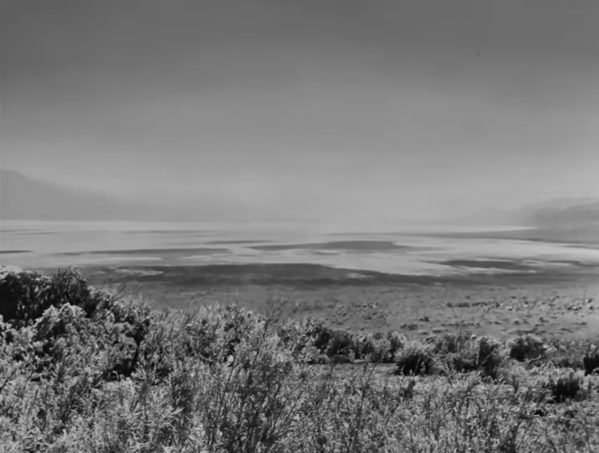
Dude continues to summarise the area’s variety. I’m not sure if such environmental diversity actually exists in such close proximity to Death Valley[ix] – with fertile looking marshes, killing salt flats, canyons, hills, mountains, and a dusty desert town all within a few miles’ radius . . . but if it does, take me there and there I’ll happily live!

Of the salt flats “down south” at 00:03:00, (Death Valley, the hottest place on Earth[x]) Dude chuckles “even a rattlesnake couldn’t get across em”. Is Dude referring to the reptile or to the memorable psychopath, Tommy Udo[xi], who he portrayed so effectively the year before Yellow Sky was releasedin Kiss of Death, (1947), almost stealing the film with his insane intensified chuckle – a chuckle he only slightly revives once (at 00:37:47) in Yellow Sky.

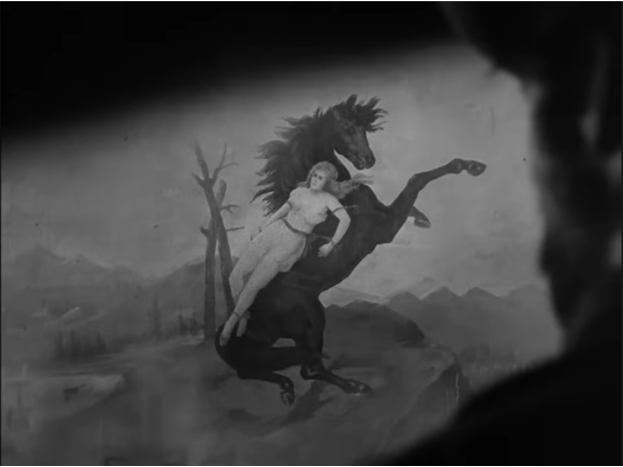
Eventually, in a town saloon, reviving themselves with a drink, the band encounter an extraordinary painting[xii]. A partly naïve, partly delirious, painting. Albert Pinkham Rider[xiii] crossed with Chagall[xiv]. Pale Death on a dark horse![xv]. This large image behind the bar fixates them all.

Lengthy (John Russell) whose awestruck lascivious comment at 00:03:57, harvests lust from the silence and then amusement: “I wonder if she’s got any plans after she gets through ridin’ that horse?” is reprised with more words but less universal staring at 00:05:29 – the camera closer to an image now about 50% larger. The statuesque woman appears to be tied to the rearing horse yet has the posture of someone reclining calmly on a sun lounger. The image is surreal and haunting – and perhaps intended to be subjective? Are the men all seeing it differently? She is not depicted as a victim. Does the horse represent the spirit of the woman? A woman as beyond the pale as Ellen Berent Harland (Gene Tierney) in Leave Her to Heaven (1945). Lengthy wouldn’t stand a chance!

“Yes sir, I sure would like to know what she plans to do after she gets
through ridin’ that horse?” 00:05:29

The hold up (00:05:52) shoot up and escape is all over in less than a minute and by 00:07:52, chased by the cavalry out into a rocky wilderness among amazing tooth-shaped rocks towards the salt flats, they have lost their rear lookout rider. The cavalry captain calls a halt to the chase knowing the gang aren’t likely to survive crossing the sink of Death Valley: “Let ‘em go! Save us the trouble of hanging ‘em!”  (00:08:30)

As Stretch divides the loot, the gang appear on the verge of fragmenting, though it’s hard to imagine they were ever a very cohesive unit. Dude, not caring personally about Jed being shot by the cavalry, is superstitiously fearful that the number of gang members no longer adds up to seven (00:09:21): “This desert’s a mighty unlucky place. A man needs all the odds he can get.” Several of them know it’s crazy not to turn back, “It’s a good 70 miles across this sink, maybe more!”, protests Lengthy, yet Stretch (at 00:09:38) asserts “it’s just a place, a place can be crossed.” At a horse walking speed of four miles an hour it would take 17 and a half hours to cover 70 miles. Wouldn’t travelling by night have been a good idea? Do most cinematic cowboys lack common sense? But since there is no shade to be had, maybe it’s better just to get going? In the end, even Dude, who was thinking of pulling back with the dark, follows Stretch and the gang out into the whiteout heat of the sink.

At minus 86 metres below sea level (or minus 282 feet) the Badwater Basin is one of the lowest places on earth as well as one of the hottest. As the band become dots in the whiteness, the scene conveys the idea that Stretch, like Captain Ahab (whose obssession with Moby Dick – the White Whale – Gregory Peck was to portray with festering intensity in 1956) is resolute and tenacious, yet also perhaps, recklessly self-destructive. At 00:12:16 the crazed crust of salt becomes soft and the horses begin to sink and stumble, obliging the men to walk. The film expertly gives an epic sense of this ordeal, of the heat and dessication, of wrong decisions – the folly of Walrus having filled his canteen with whiskey, the mistake of sleeping at night. To cut short a midnight fight between Walrus and Bull Run, when the former tries to drink from the latter’s water canteen, Stretch hurls a large chunk of salt at Walrus’s head (00:13:57). Stretch’s authority is no longer in doubt – as neither is his compassion the following day when he wets his horse’s mouth with valuable water from his canteen (00:15:15). This could be viewed as enlightened self-interest, except that he follows up by doing the same for Walrus’s horse. “Kinda noble, aren’t ya?” sneers Dude (00:15:45) to which Stretch replies “A horse’s a useful animal, no use letting him suffer just because he belongs to a jackass”. The hostility between the two men increases from here on, with Dude less ironically detached from the possibility of taking charge – although at this juncture, he appears to believe they are all doomed. When Lengthy shoots a lizard (00:16:31), basically for looking chipper and able to survive when he probably won’t. Half Pint (Henry Morgan) protests: “he wasn’t doing you no hurt”. The sink however, has no truck with compassion: it is Half Pint’s horse that soon collapses in sand dunes and has to be shot (00:18:19).

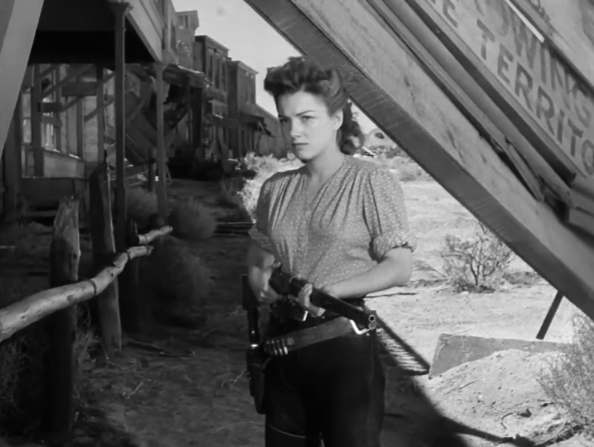
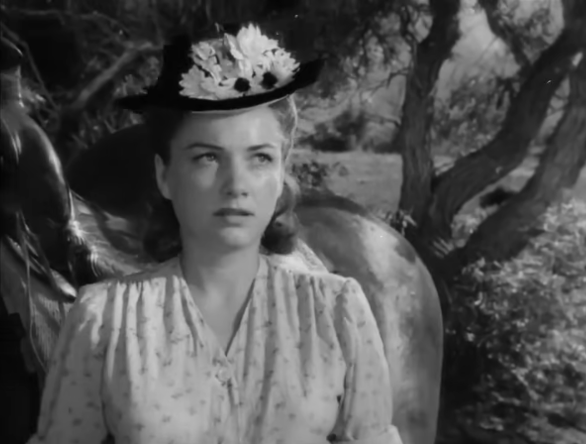
After almost ten minutes (a long time, especially in 1940s cinematic terms) at 00:18:47, Stretch, suspecting mirage, spots what appears to be salvation in the form of a distant town. Hope to cracked lips and dried out voices. They struggle on…to find the town of the title: Yellow Sky. A dehydrated ghost town. Dead. Crumpling up all over the steps of a collapsing saloon, the gang don’t have the energy or sense to even get out of the sun, resigned to becoming skeletons. Then there is the faint click of a rifle hammer being cocked. At 21 minutes, Mike (Anne Baxter, hilariously described in IMDb as a “gun toting tomboy”) at last appears:

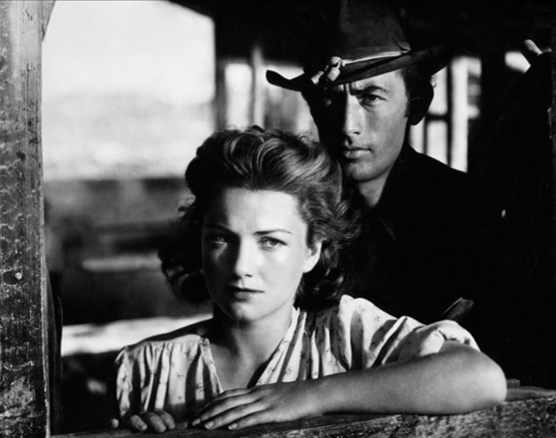
Yellow Sky at 00:21.08 and the first appearance of ‘Mike’

If I could have it to myself – or better still, share it with Anne Baxter – Yellow Sky is another place I wouldn’t mind living. The rock formations around are superb and the dilapidation aesthetically surpasses Heysham and Morecambe, without people to complicate it![xvi]

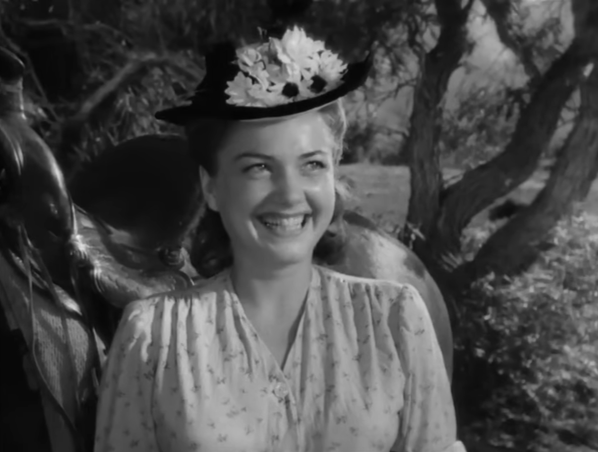
In his wonderfully terse, two-minute recommendation of Yellow Sky[xvii], John Sayles may not overstate Anne Baxter’s impact but does exaggerate what she’s wearing: “tight jeans and a 50s bra that could put your eye out”. The high-contrast noir-etched photography of Baxter is stunning. Without doubt, apart from settings and landscapes, Baxter is the best thing about Yellow Sky, but although frowningly beautiful, its her spirit and character that most impress.

I’ve long had a thing about Anne Baxter, especially in earlier films such as Swamp Water[xviii] (1941) before fashion styled her hair in that increasingly fixed, bouffant power-perm manner which I can no longer bear to see because it unfailingly reminds me of the night and daymare that was Margaret Thatcher![xix] You can see this style creeping in by the time of another of my old screen favourites: 1958’s Chase a Crooked Shadow – although realistically, even in much earlier films, the secure Forties hairstyles aren’t so very different. Perhaps it is her wilder character in both Swamp Water and Yellow Sky that is so appealing?

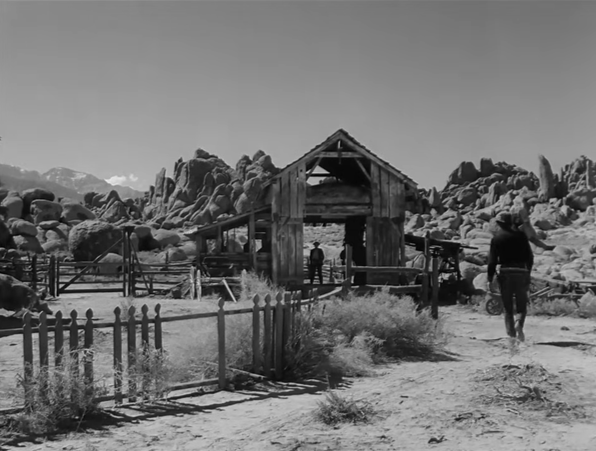
Where matte[xx] shots are interposed into genuine landscape is often hard to tell when watching films in a relaxed way, but the solid ghost town of Yellow Sky, “fastest growing town in the territory” – its appearance and atmosphere – are entirely convincing. Apparently, the filmmakers reused and partly rebuilt or wrecked an old set known as “Last Outpost” in the Alabama Hills[xxi] just to the west of Lone Pine[xxii]. A hundred miles east, the salt flats and desert scenes were shot mostly in the Death Valley National Park[xxiii] with actors and crew staying at the evocatively named Furnace Creek.

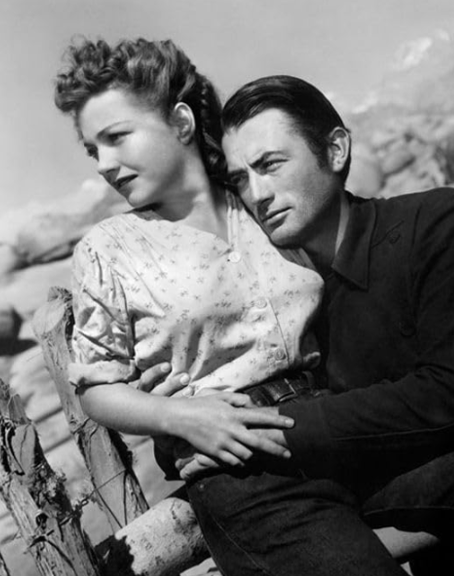
Before the Thatcher-esque look of later years – a colorized, glammed-up publicity shot for Yellow Sky

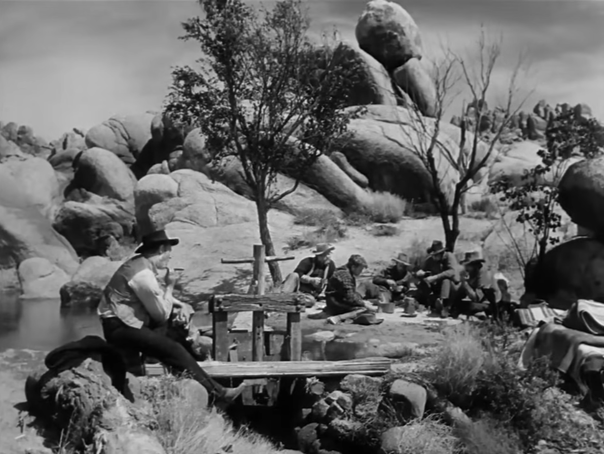
At 00:21:54 Mike tells the exhausted gang where to find the spring “up behind those big rocks, at the head of the street”, suspiciously tracking them, rifle in hand. Later, at 00:23:47 she appears dominantly on a boulder above them, regretting their arrival, poised as they gulp and wallow in the pool.

It has often been repeated that Yellow Sky is loosely based on Shakespeare’s The Tempest,[xxiv] and you can see certain obvious parallels: desert = sea, Stretch/Peck = Ferdinand, Grandpa = Prospero and Mike/Anne Baxter = Miranda . . . but if so, it’s a still looser adaptation than Forbidden Planet (1956), and Mike clearly has no wonderstruck admiration for Stretch:  Miranda in Act 1, Scene 2 of The Tempest: “I might call him / A thing divine, for nothing natural / I ever saw so noble”.

If I had money for every film ‘loosely based’ on Shakespeare (the seventh art tirelessly in quest of respectability?) I would not be poor! In any case, the true value of Shakespeare, is the poetry, not the plots – most of which The Bard lifted from earlier sources. Once the description ‘loosely based’ is applied, most films would begin to resemble one (or several) of the seven – 36 basic plots[xxv] available. One might just as well say that Yellow Sky is ‘loosely based’ on the shipwreck of the Sea Venture off Bermuda in 1609[xxvi]!

No, Mike is not enraptured by this new humanity and if she were less defensive when the now hydrated Stretch first visits her house (00:24:25), could she have falsely conveyed that she was hiding nothing other than herself? With water, food and rest, the gang are bound to remember that weird painting in the saloon and revive their other animal instincts.

At 00:25:05, Mike tells Stretch that “it ‘aint far to Alkali, you could make it easy, if you try”. Alkali is a real place[xxvii] albeit a ghost town now[xxviii] in the inappropriately named Esmerelda County. Or perhaps the name only seems inappropriate because owing to one of those carelessly poetic lateral slips, it makes me think of emerald green grass . . . rather than sand, salt and emeralds[xxix]?

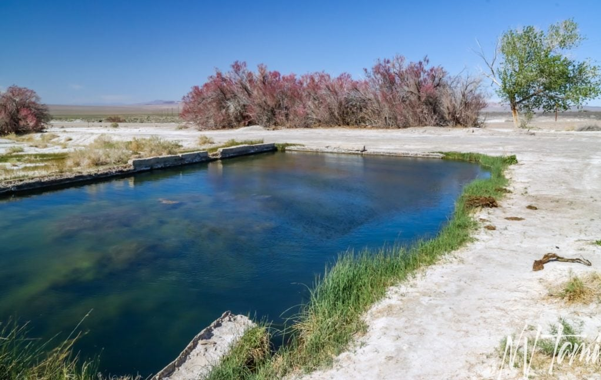
Nevada ghost town – Alkali Springs

I don’t want to venture into the political incorrectness of Stretch and his gang’s attitude towards the Apache[xxx] (though not only was Mike raised “with Apaches”, Grandpa praises them (00:26:11) as “fine people, if you can understand them”) or their lust or chivalry (the latter particularly in Bull Run’s case) regarding Mike/Constance Mae, or the necessity for a 1948 production to reinforce gender stereotypes for its mainstream coda (more on that later). Some of these attitudes are obviously toxic, some just amusingly or irritatingly of their time. Yes, it was inevitable that Mike and Stretch would ‘fall in love’ and probably both of them subconsciously feel this from the first moment they see each other – or so runs the timeless loathing-to-loving story convention, as well as the popular romantic notion. Mike tries to resist, whereas Stretch violently relaxes (!) into it, ceasing to sufficiently lead or control his gang and breaking his own rule to “stay away from those people!” (00:29:03). Eventually, stung by Mike telling him he smells bad (00:33:19), he even washes and shaves.

Mike with a smoothed-out Stretch!

Stretch looks much less appealing once shaved . . . but I’m getting ahead of myself and far ahead of the plot since it is Dude who dolls himself up first, just before Mike first comes to the spring for water (00:27:47). I hope she is going to boil that water before use after the mob has all slurped and wallowed in it! Or maybe, it’s just that I feel like washing after the battery of sexist comments and leering – all of which Mike takes in her stride. Of this and more violent scenes, no less than the BFI seems to have become over-compliantly politically correct[xxxi] proposing to demote a film made in 1948 for not having the worthwhile but somewhat idealised values of 2026. However enlightened we think we are 78 years later, such situations have not gone away. In watered-down fashion they happen in Heysham and Morecambe every day and my 16-year-old daughter prefers not to walk on the prom alone.

With dozens of wrecked buildings to choose from, why do the gang all “bunk down” in the saloon (00:29:50) – I’d chose a building as far away from the others as possible. The characters that “amount to nuthin’ nohow” (to quote Lengthy) seem able to sleep through Walrus snoring like a “wounded buffalo”, but Lengthy is driven outside – to find Stretch contemplating on the veranda of the ruined saloon. After needling Stretch about the whereabouts of Dude he goes back inside.

Is Stretch really looking for Dude, as he claims, when having moved towards the tenebrous homestead Mike emerges from the shadows to challenge him at 00:31:58? Tackling her by surprise, they fight, she head butts him, he does it back harder and forces a kiss on her, before desisting. This is where she tells him twice that he smells, and then taking careful aim, shoots him across the scalp (00:33:39). In another excellent post from 2008[xxxii], the writer highlights the scene which follows with Mike trying to explain to Grandpa why she shot Stretch:

“He made me feel . . . I don’t know.” But she does know. Stretch has made her feel like a woman for the first time in her life. Wellman then cuts to Mike’s room, in which      a picture of an elegantly dressed lady is pinned onto her wall. Seeing it fills her with disgust and causes Mike to angrily tear it into pieces. It’s a great moment of self-loathing – she hates herself for feeling something that she’s been trying so hard to suppress. Although having such a picture on her wall in the first-place clues us into the fact that Mike longs to be as pretty as any other woman out there. In that one short scene, we sense Mike’s vulnerability for the first time.”

More specific than the tragic/Romantic pop songs that are a chart constant, the romances of old films still need last only half an hour or so of screen time – this is why they can be so haunting. Novels and tedious soaps and serials often do them to death. The best romance stories are about potential and hope, not dull, chronological reality. Being fundamentally frustrating, the human condition (in its customary form) cannot fulfil our yearnings for long – yet almost everyone who refuses to let the human state get them down, clings to hopes we project from imagination. Hence good love stories (and happy endings) have a general appeal even if many who have experienced the long-term reality of romantic love, try to reject such unreliable optimism. Romantic love may linger as familiarity and companionship, even flourish and create a sense of safety for decades, but are its deepest feelings of connection and joint projection, always liable to return to being about the other or the elsewhere? To a degree, this could be why I have abstracted my own deepest feelings into landscapes, atmospheres and the most searching art – which doesn’t mean that I can resist a wistful attraction to actresses[xxxiii] usually long dead. In great films none of the characters or landscapes are ever dead!

Bathing his scalp at the spring, Stretch encounters Dude. Could they have once been friends? Could they become friends? Not in Yellow Sky – this, distinctively, is one of its noir aspects. Stretch’s romantic inclinations have prevented him from deducing what Dude has had a hunch about all along – the presence of gold! Dude is greedy for gold and has no interest in romance. He tells Stretch his history and it’s the thought of his betraying ex-woman being made to suffer, that briefly revives Widmark’s insane chuckle from 1947’s Kiss of Death (00:37:47)[xxxiv]: “she lit out with a fella who ended up beating her”.

Above the ghost town the spring looks idyllic – as if the gang are enjoying a picnic. 00:26:57

Shattered the showershields, roofs ruined,

age under-ate them.

                                            And the wielders & wrights?

Earthgrip holds them – gone, long gone,

fast in gravesgrasp while fifty fathers

and sons have passed.[xxxv]

From first encountering the Anglo-Saxon poem The Ruin, as a teenager,the idea of the ghost town, or of ghost areas – such as the ex-lead-mining moors of Northumberland upon which we lived for seven years – may be even more fascinating than the allure of actresses who, while society survives, will never die. Ghost towns represent the flip side to potential, and up to a point, their history becomes fixed in time. Tyneham[xxxvi] in Dorset was one such place explored when we lived in the southwest of England. Appropriated as a training ground for D-Day in 1943, it was never returned to its inhabitants. Mardale in Cumbria[xxxvii] was another valley we knew well, though we never knew its villages, Mardale Green and Measand, only the reservoir which gradually drowned them from the late 1930s. By contrast, the ghost towns of the desert states of Nevada and California largely record a failure to survive at the periphery. Spelling out tales of greed, aspiration or over-ambition, they are gradually destroyed by extreme temperatures and the wind.

Shattered stable in a court of rocks. 00:41:09

Stretch makes no attempt to understand or appease Dude (00:38:16). The increased antagonism between them begins the central section, though at first, Stretch is more interested in smartening himself up. The gang meet to decide on a course of action having voted Dude as new leader (00:41:53). Stretch has no regard for democracy, but before a direct showdown, Mike takes the initiative from the boulders above – with her rifle. The existence of gold can no longer be doubted.

White flag or not, Mike has Stretch in the barrel of her gun – 00:45.09

This was probably not the first time such an idea was used in a film. Since the helical grooving[xxxviii] is clearly shown, was it actually shot through a larger diameter gun barrel or was this a special effect added in post-production?

If you have read this far without knowing Yellow Sky at all, I will leave all the nuances and twists of fate of the film’s second half to your imagination and jump to the perhaps unjustly despised coda which opens at 01:34:37. For long sections of its often nocturnal second half, Yellow Sky looks like a noir, but both the romantic elements and the reformation of Stretch to “James Dawson”, run counter to this. Stretch starts his biography by telling Mike and Grandpa (01:04:42) that “I come from good people. When I give my word, I mean it”.

Long prefaced by Grandpa’s compassion (01:08:02): “Guess the wars upset a lot of those boys and set them off on the wrong foot,” the coda is not just happy but quite comic and begins with the chagrined, contrite surviving bandits returning the stolen money to the bank. As if all crime could be so simply undone!

At 01:37:00 as the three survivors gallop across a beautiful flower-filled water-meadow for a rendezvous with Grandpa and Mike, the film reverts to its framing triumphalism and lightness. However, rather than the exploratory, adventurousness of the opening, the ending quickly becomes jubilant.

Do I want to be a woman some of the time? Can I do this? . . . 01:37:53 

At 01:37:30 Stretch presents Mike with the hat bought from the head of an only temporarily affronted lady at the bank. This might all be “sappy” and “unbelievable”[xxxix], but personally, I enjoy it. Even if it was a studio imposition, it is a humorous, loving, throwaway thing, not worth getting wound up about[xl]. I don’t believe Mike will change because of it.

. . . Yes! At least for a while   01.38.00

Mike dares herself and accepts the hat. Love is in the air, let’s end quickly before the wedding!

© Lawrence Freiesleben, 2026

Notes


[i] Available on YouTube: youtube.com/watch?v=XoSVGw_Ex-Q

[ii]  See songofamerica.net/song/oh-susanna/

[iii] In this outstanding piece by Stark Holborn, starkholborn.com/2020/01/23/review-yellow-sky-           1948/ he claims Yellow Sky as a precursor to the “Acid Western” sub-genre: “Acids, if you haven’t come across them before, are known, and named, for their counterculture tendencies; the desire to kick the western away from the glowy sunset of manifest destiny and into the dark corners of the soul.” 

[iv]  This article by Imogen Sara Smith brightlightsfilm.com/past-sunset-noir-in-the-west/ is so good on Bob Mitchum and others and on Pursued (1947), that I might abandon all future hopes of writing about that particular film!

[v] en.wikipedia.org/wiki/William_A._Wellman

[vi] en.wikipedia.org/wiki/American_Civil_War

[vii] Actually, there are only four different sketches; the dissolves between title changes create      the impression of more.

[viii] youtube.com/watch?v=noxTiJNgmxk  landscape features explained by Randy Newberg

[ix] A location coincidentally carried over from Z’s film in this Z-A: Zabriskie Point (1970). See A Z-A of films: Zabriskie Point – The Brazen Head

[x] en.wikipedia.org/wiki/Highest_temperature_recorded_on_Earth

[xi] crimereads.com/tommy-udo-film-noirs-greatest-homme-fatal/

[xii] I cannot find out who painted this. Presumably an artist employed by the film studio? If Sherlock Holmes were alive now, we need a monograph on bizarre portraits and paintings of old Hollywood A and B pictures – though I’m not sure it would be much help in the field of crime solving. When I’d almost reached the end of this essay, I encountered yet another wonderful post about Yellow Sky jeffarnoldswest.com/2022/03/yellow-sky-fox-1948-2/ which highlighted the similarities between the scene with the strange painting behind the bar and the opening of Wellman’s earlier film, The Ox-bow Incident (1943). The painting in Ox-Bow is not nearly so strange, but Henry Fonda’s comment “that guy’s awful slow getting’ there” sets off an interesting dialogue exchange.

[xiii] en.wikipedia.org/wiki/Albert_Pinkham_Ryder

[xiv] en.wikipedia.org/wiki/Marc_Chagall

[xv]  clevelandart.org/art/1928.8  The Racetrack or Death on a Pale Horse  c. 1896–1908

[xvi] Or perhaps not! According to jeffarnoldswest.com/2022/03/yellow-sky-fox-1948-2/ “In         temperatures topping 120°, with Gila monsters and scorpions everywhere, it wasn’t a comfortable set for the actors.”

[xvii] See: youtube.com/watch?v=SrbtgJTe6ok  00:01:14

[xviii] The first of Jean Renoir’s five films made in Hollywood during the Second World War was produced by 20th Century Fox. Categorised by the Nazis as “Cinematic Public Enemy Number One” Renoir’s left-wing anti-fascist and anti-war stance gave him no choice but to flee.

[xix] en.wikipedia.org/wiki/Margaret_Thatcher  Whom I reference in the hope that time can be reversed and she and her dire legacy can be exorcised from history!

[xx]            thepropgallery.com/painting-in-pictures-the-lost-art-of-the-matte-shot

[xxi]  en.wikipedia.org/wiki/Alabama_Hills – an area famous for its rock shapes and widescreen vistas of the Sierra Nevada  en.wikipedia.org/wiki/Sierra_Nevada

[xxii]  en.wikipedia.org/wiki/Lone_Pine,_California See also:  lonepinechamber.org/sightseeing-in-the-lone-pine-area/movies-filming-in-the-lone-pine-area  In the centre of the movie map at the end of this page you can see ‘Yellow Sky’ (Gregory Peck)

[xxiii]  en.wikipedia.org/wiki/Death_Valley_National_Park

[xxiv] Alex Good goes into this more carefully in another outstanding post on Yellow Sky:    alexonfilm.com/2022/01/25/yellow-sky-1948/

[xxv] en.wikipedia.org/wiki/The_Seven_Basic_Plots ; en.wikipedia.org/wiki/The_Thirty-Six_Dramatic_Situations

[xxvi]  https://www.rsc.org.uk/news/archive/the-ship-that-inspired-shakespeare

[xxvii] https://en.wikipedia.org/wiki/Alkali,_Nevada

[xxviii] Or is it? nvtami.com/2021/05/17/alkali-spring-nevada/

[xxix] en.wikipedia.org/wiki/Esmeralda_County,_Nevada  “Esmeralda is the Spanish and Portuguese word for “emerald”. An early California miner from San Jose, James Manning Cory, named the Esmeralda Mining District after Esmeralda the Romani dancer from The Hunchback of Notre-Dame.”

[xxx]  Ibid, from Alex Good’s post: “At one point I was hoping for the return of the Apache at the end in the role of the cavalry, saving Stretch and Mike and Grandpa from Dude and the gang. That, however, would have been a turn of the screw too far in 1948.”

[xxxi]  bfi.org.uk/lists/william-wellman-10-essential-films see also, reference xxxv below. It is notable that after Yellow Sky, Anne Baxter’s very next film, You’re My Everything (1949), a slight, cringy and often irritating musical drama, insidiously reinforces sexist attitudes as well as racism – Dan Dailey even blacking up for one film-within-the-film. Rightly unacceptable now, this was standard at the time. Unlike the constant threat of the lustful men (a gang of criminal roaming men would be no different nowadays) towards Mike in Yellow Sky, this casual racism is not intrinsic to the contrast, tension or plot. An amusing aspect of You’re My Everything however, are the silent film take-offs – one entitled Flaming Flappers – acted out in believable, satirical fashion by Baxter, whose character is supposedly “patterned” on Clara Bow. She is certainly utterly different to Mike!

[xxxii] theroadshowversion.wordpress.com/2008/02/27/to-save-and-be-saved-yellow-sky-1948/ 

[xxxiii]  It would never have occurred to me to think of an actress as being in any way inferior to an actor. See: theguardian.com/theobserver/2011/sep/25/readers-editor-actor-or-actress

[xxxiv]         Ibid: crimereads.com/tommy-udo-film-noirs-greatest-homme-fatal/

[xxxv]  The Ruin, lines 8-13, translation by Michael Alexander, from The Earliest English Poems, Penguin Classics, first published in 1966, is thought likely to be about Aquae Sulis (Bath).

[xxxvi]         virtual-swanage.co.uk/things-to-do/towns-and-villages/tyneham

[xxxvii]         lakelandwalkingtales.co.uk/haweswater-and-the-lost-kingdom-of-mardale/

[xxxviii]  en.wikipedia.org/wiki/Rifling The wonderful post about Yellow Sky, encountered when I’d    almost reached the end of this essay, jeffarnoldswest.com/2022/03/yellow-sky-fox-1948-2/ said exactly what I was going to suggest: that it “must have inspired the people who did the credits for the James Bond movies.”

[xxxix]  In his splendidly terse, to-the-point, two-minute recommendation of Yellow Sky, John Sayles hates its possibly studio-required end: youtube.com/watch?v=SrbtgJTe6ok saying at 00:01:36 “If I ruled the world, I’d cut the sappy, unbelievable coda off the movie!” But I often like abrupt happy endings, unless they are so bad they make you nauseous. They can be less tiring. I always feel tempted to rewrite bad endings. Every time I watch Out of the Past (1947), for example, I always want Bob Mitchum to survive even though that would defy one    of the rules I consider essential to true noir – a tragic conclusion.

In William A. Wellman: 10 essential films www.bfi.org.uk/lists/william-wellman-10-essential-films the BFI also finds fault with the cheerful ending (and other things): “Were it not for some alarmingly dodgy sexual politics – from Gregory Peck’s assault on Anne Baxter to her final acquiescence (via a bonnet) to his idea of feminine norms – Yellow Sky might rank among Wellman’s best.” I fail to see why depicting things how they simply would have been, counts as “alarmingly dodgy sexual politics”. That is to apply modern attitudes to a film made 78 years ago. The hat incident may or may not have been a studio imposition, but it is a humorous, loving, throwaway thing, neurotic to be wound up about, and absurd that it should affect how we rank the film. We can deplore aspects of the past, but we can’t expect the past to fit in with our current fashions. Personally, I don’t believe Mike/Constance Mae will change all that much because of a silly hat and both Stretch and I would be disappointed if she did. But that’s why films end when they do. In ‘real life’ we are often likely to be disappointed. One of the major problems with long-form TV is that it never ends but merely staggers on into the desert.

Devonshire

LAWRENCE FREIESLEBEN, Film & Television Editor of The Brazen Head, has been an artist and writer as long as he can remember – cycling away at weekends from the council estate where he grew up, to paint the countryside as an escape from the restrictive tedium of the school week. Leaving home at 16, he has lived in 17 different areas of the UK – from Devonshire to Northumberland – painting and writing, always vigilantly questioning the interior light of landscape, cityscape and wider atmosphere. Living virtually off-grid with his large family, both remote locations and urban visits have formed the backscene to a passion for film which has intertwined with art and writing throughout his career. Films remain a key creative focus since childhood, resulting in encyclopaedic folders and clippings as well as a constant stream of film festivals. He currently lives in a dilapidated Lancashire seaside town

Devonshire

Staggering amidst a floodtide                                           Heavitree

of happiness embalmed in memory                              sudden frost children

Impression . . . kaleidoscope . . . slowed                        Chapleton, Umberleigh

of veiled suburb or deep country

part lament, part symphony                                          hands enfolded

To cope or not to cope                                                    bright face, rosy cheeks

Is not the question . . .

Summer bluebells, autumn leaf, the red streets missed    (brickwork and gardens)

the grass-glowing banks of peace turned white

back or forwards                                                       your singing eyes

it all returns                                                                                   Sidmouth, Ottery

to find areas unnoticed or skimmed

certain times become legend                                                           Honiton.

Hail the slowing train for the clatter up Taw’s wooded, meandering river (1981

or else this confession                                                                 under the sun

will get out of hand

match-light flaring in and out                               Hembury, Belstone, Great Mis Tor

of places and times centring by weight                                                       let go

upon Bideford or Exeter . . .

These blind summits can be cold

give me time to intensify or pass . . .

Floating through empty streets where all life has ceased                    

I wonder how to wake or whether

this is the truth                                                   returned to the ether

the shadows rich, the ruins better

than a world we have sold for a molehill of groats

squandered ourselves and scrapped the future

between lonely screens and the social surf                                

all thought swallowed in a fly-tip of chatter

the maya of progress                                                                                        

a ceaseless march . . . Return to the past:

its light and feel, a sandstone red                                    

background of caverns ringing the head

the matches flare, nocturnal semaphore,

signalling Exeter and Dawlish Warren.

A girl I knew when we were both ten,

moved here and was never seen again, a new start or an old ending?

like post-war Sidwell Street’s arcades of idealism               Exeter again

abandoned, due to be demolished

or awaiting restoration                                                        I hope

The train gallops on metals not traversed for 30 years

four old homes passed already . . .

I want to say I love you                                                    Bonehill Down

but just now, you are not here

(and as) the tunnel approaches, the blind end trough

in the mind’s ear, I can still hear beyond the years

past this washed-out, effortless tube,

the blast of Ajax and Achilles                                           Indomitable

even in the 80s there was still an air of splendour

diesels with concentrated power

worthy descendants of the dragons of steam                Seaton Junction

Surging brakes slow the water meadows passing west of Axminster

unchanged it seems since we last alighted:

1989, and a pushchair wheel detached itself to cross the platform and roll slowly off its edge

We watched this filmic omen of tragedy in horror

but as the wheel settled on the sleepers, began to laugh.

All those places where we came and went          Harpford, Ottery, Hembury Fort

recur again in the travelling carriage glass

with different children under different skies       or yet alone

swerving on, fast again, they will not rest,

a devastating parade                 immediacy struck by infinite distance

their atmosphere is porous                                  haze, beauty,

as if a spell could so easily                                  slim slate graves

contradict the years                                            reverse

All these thoughts I would have to avoid (at the lodge)

dismiss every fantasy and whatever remains

every background yearning excuse    (Devon is Hevon, says the mural/graffiti)

accept yet reject getting tired and the gathering gall of a disregarded life

in the sliding anaconda of this declining world

reject the dwindling thread between us    the habit of misunderstanding

Companionship (it seems) is not enough for self-surmounting tunnellers or their aerial quest

impatient with the human form

without extravagant love (and probably with it too) – unreasonable, crushing,

these mimes and twists of frustration

only bring closer the hour of the wolf,

glimmering in uncompromising starkness

in purity or despair

clutch hands, see far behind the yes, feel the warm rounded limbs regardless

such halfway states

between body and soul, not relegated to the past

the idea of completion, of that internal ghost . . .

comes and goes as the train sweeps through and on   Chard Junction

to the sirens of alarms

the striped angry barriers

the crushing ache of life

gone

lift off is here, at last . . .

A Z-A of films: Zabriskie Point

[Caution: plot is of minor concern, either to the filmmakers or the thoughts which follow]

Travelling backwards from the end of the alphabet, three other Z films initially clamoured their alternative directions: the Hammer-esque Dracula adaptation from Pakistan directed by Khwaja Sarfraz, Zinda Lash, 1967[i]; Jake Gyllenhaal in David Fincher’s Zodiac, 2007; and Z, directed by Costa-Gavras in 1969. As if glimpsed on signs or billboards during Zabriskie Point’s early flashing road-journey sequence (00:10:00 – 00:11:56), with its distorted rear-view mirror alternatives, the presence of these other films insisted, reminded, recurred and haunted . . . but eventually fell behind.

“Zabriskie Point lives on as Antonioni’s moody meditation about freedom curdling into emptiness” ends one concise and informative appreciation of the film online[ii], a reasonable, if skin-deep conclusion to an expert precis – for it has reached its principal concern: an article about fashion and style.

White Lund Industrial Estate, Morecambe, April 2022

How common is the assumption that all lead characters in films exist as centre points to be either identified with or rejected? Can such a generally reasonable idea apply to Zabriskie Point? Even if Antonioni and his collaborators had sought so conventional an objective, their sounds and images would have escaped. There are far more enlivening things to be found here.

Zabriskie Point at 00:11:01

Back to that first road-journey sequence scored to cacophonous noises and experimental music[iii]: all through the LA suburbs of exhilarating colours and forms amongst dusty wires, lampposts and warehouses, eventually to the stroboscopic verticals of Mexican fan palms towering above the vying traffic, Zabriskie Point’s vibrant overwhelm of colours and shapes here make a symphony from the tangible presence of a vanished world. This is common to films and television of the period: it’s there in John Boorman’s outstanding Point Blank (1967), Peter Bogdanovich’s notable debut, Targets (1968) and the rickety Raquel Welch vehicle, Flareup[iv] (1969). It’s there through much of the superior Rockford Files TV series of 1974-1980. It might seem incidental, but it’s rarely accidental. Filmmakers look for such backgrounds tirelessly. The difference is that Antonioni often made foregrounds of the background. Setting becomes as vital as character – and while this is also true of films such as, for example, Edward Scissorhands (1990), I Start Counting (1970) or Rear Window (1954), Antonioni did not limit himself to one or two distinctive places, he tried to use the whole wider landscape and ambience – occasionally allowing its significance to equal or exceed that of the human foreground. This was not a failure to fully realise the characters, nor was it carried out with only the intention of satirising the world depicted – even if that might be as far as some viewers care to look.

White Lund Industrial Estate, Morecambe, April 2022

To me, Antonioni’s viewpoint is metaphysical. In films such as L’Avventura (1960) this can feel remote. Watched from a “normal” human angle his films are often regarded as alienating. Yet whatever Antonioni’s personal views on faith or doubt, presence or absence, the films are almost bound to feel alienating if one struggles too hard to identify (positively or negatively) with the characters – which of course is precisely what, as spectators of TV and film, we are expected to do.

Zabriskie Point at 00:11:37

Heartbreakingly beautiful in retrospect, as with the London of Blow-Up[v](1966), the Los Angeles of Zabriskie Point may be sadly or safely gone, depending on your viewpoint. Delusional rationalisation – both economic and psychological – combined with the reckless notion of constant progress, have created a force towards a future which cannot curb either the blandness or destruction inherent in it. The inadvertent society marches on[vi].

White Lund Industrial Estate, Morecambe, April 2022

Vanished suburban and industrial backgrounds are like treasure and many artists in different media have richly enshrined and celebrated such visual and auditory fairground rides, but in Zabriskie Point’s first of many journeys – lasting less than two minutes of screen time – as well as throughout the film as a whole, this is more than a time machine visit by an acutely observant[vii] foreigner, it is a sociological and historical document, not just – in passing – for its period, but also for America’s distorted idea of itself . . . yet more relevant today under a dangerously unhinged president[viii]. How dismayed the radical students in the assembly for action at the beginning of Zabriskie Point (00:00:07 – 00:08.46) would be to discover, just how “pell-mell into fascism” (00:04:46) their country has fallen under Trump.

Amongst the joy and sadness, the hurtling traffic and bustle of vanished lives, in search of the overlaps when certain films or experiences strike some kind of well or mineshaft . . .

Aiming for the visionary / Instead, a lead mine has been drilled down inside my neck / to flooded levels I can’t keep clear. / Grid confined, primal force without bearings, craving the sky / Far from meadows or moors / Is there no choice but downward?[ix]

Then, everything – all the fleeting side-thoughts and impressions triggered by Zabriskie Point, went calm as I remembered Leighton Buzzard sand quarries . . .

Leighton Buzzard Sand Quarries. Stock image: M O’Brien Group

Several illicit Sunday trips to Leighton Buzzard sand quarries in hot summers of the mid and late 70s, deposited vivid geological strata in my mind, a dream of deserts – or even distant planets which remains undimmed. This was both the surface and the inside of the land itself. Climbing over fences and sneaking down into cuttings and pits, following rusting rails alongside the severe blues of ponds and lakes, pushing the small mineral wagons along tracks we chose to believe abandoned, collecting sandstone rocks which were like red-ochre asteroid landscapes in miniature . . . This was one of those moments when a truer sense of priority emerges – to disregard time and the usual human goals. These moments are part of what Antonioni is trying to embody in Zabriskie Point.

Despite later, tamer visits with my children to the narrow-gauge railway (first opened in 1919) that had become a noticeable tourist attraction by the 1990s[x], the archetype was not dislodged. An unearthly place vastly expanded from its dimension in reality. Just how many landscape experiences, direct or second-hand, this archetype has helped intensify is impossible to calculate. Antonioni’s misunderstood Zabriskie Point (1970) is one of them, even though the titular Death Valley desert viewpoint, in yellows browns and whites has little in common with the vibrant reds and oranges of Leighton Buzzard. The temperate Bedfordshire location became a long-running family joke. Scenes in Lawrence of Arabia (1962), Ice Cold in Alex and Sea of Sand (both 1958)would all be met with “Look! Leighton Buzzard sand quarries!”  Zabriskie Point (1970) however, was not a family film and what Peter Bradshaw positively describes in The Guardian[xi] as a meeting between a radical student on the run and a “hippy chick” which leads to a “sexual epiphany, psychodramatised as an orgy” would not have gone down well, if indeed it was ever shown on T.V. before my sister and I left home.

In Antonioni’s last full-length feature film, Beyond the Clouds[xii], (1995) John Malkovich as ‘The Director’ serves – largely in voiceover – as the alter ego of Antonioni. Some of his thoughts are rhetorical, others enigmatically intriguing, if whimsically vague[xiii]. Near the beginning of the film comes this self-deprecating statement: “Don’t get me wrong: I’m not a philosopher. On the contrary, I’m someone who is profoundly attached to images.” [Does this rule out the philosophical impulse?]  “I only discovered reality when I began photographing it. Photographing and enlarging the surface of things that were around me. I tried to discover what was behind them. I’ve done nothing else in my career.” While it’s hardly true that Antonioni did “nothing else”, this element of exploration is undoubtably true of Zabriskie Point.

If alienation – intended to trigger observation and thought rather than emotional empathy – appears key to almost all mid-career Antonioni’s films, it follows that his characters often dispense with excessive . . . character. Many of them remain partially or severely blank – inscrutable to the point of being elsewhere. This is taken to a constructed extreme within the partial road movie, partial romance, partial thriller of The Passenger, (1975). As Locke, Jack Nicholson – one of the least camouflageable stars that ever grinned! – takes Antonioni’s concept and distancing literally: attempting to lose himself by exchanging identities with an acquaintance who dies unexpectedly in their shared shabby hotel on the edge of the Sahara in Chad.

Although they were not professionals and, in some ways, exist in the film on an attitudinal surface, Mark (Mark Frechette – virtually playing himself it would seem[xiv]) and Daria (Daria Halprin) remain increasingly memorable. Towards the end of the film, Mark is predictably martyred by the aggressive trigger-happy cops lurking at the airfield, cops too overcharged or dim to wait until he stops and gets out of the plane. Meanwhile, Daria becomes the projected soul or alternative hope of the film . . . at least in her final, satisfying, explosive daydream. This is a moment we are encouraged to identify with – and carries us with it even when it digresses from repeatedly destroying the building to a series of more abstract, increasingly impossible detonations – sky-blue backdropped[xv] interior spaces conjured from the ether, to blithely destroy consumerism’s unlimited contents, comforts and gadgets.

Blithe destruction at 01:48:02

The clash in so many ways (ideological, physical, temperamental) between Daria and her middle-aged boss, Lee, (good old Rod Taylor) is harsher than either of them seem to realise. Fiercely ambitious and materialistic, Lee seems to be a deliberately jarring, no-nonsense advocate from an older generation, a patient bull who has left Bodega Bay and The Birds (1963)[xvi] far behind. He seems stranded – as if at some point he set his Time Machine[xvii] for 1969, and abandoning it, has swapped his clothes in some trendy boutique for the uniform of a square!  

Sometimes, I have the feeling that the best films, indeed the best art, only appears to have faults. Eventually we realise that it’s the imperfections and the sections we can never explain or understand which create “perfection”. Experienced often enough, faults can become serendipities[xviii]. If this doesn’t happen, then it’s the underlying limitations which are revealed: those films which complete themselves in the watching and die; those too well-constructed novels or poems; the over-skilful or over-stylish paintings. Years ago – as well as wishing that Zabriskie Point had used all 23 minutes of The Grateful Dead’s, Dark Star[xix]  – I was unhappy with the main cast, now they seem ideal . . . just as Kim Novak’s woodenness in Vertigo (1958) has been widely reappraised[xx].

Having not seen it since 2017, would Zabriskie Point amount to less than the sum of its parts? Another problem with getting older is realising how not only individuals, but more-importantly, the human race, so often dismally fails to achieve what it could[xxi] – our cleverness progressively drained of wisdom, while the summits of art become rarer or more piffling. Also, fewer of the past’s claimed summits look as valid as they once did. The best of everything becomes increasingly elusive, hidden beyond the surface of reality or inside yourself. It is not wholly present in the art (if it ever was) but depends on what the individual’s experience enables them to apply – as Leighton Buzzard’s sand quarries helped me. It’s the interaction that counts, rather than any end product. As our cultural ability to appreciate any form of art declines – dulled or made intolerant in the film world by an over-indulgence of blockbuster or franchise trash (as mobile screen overuse is dimming the capability to concentrate on anything much longer than a moment) – so its past value becomes veiled or lost.

Hopefully, it’s not just on a personal level that Zabriskie Point contradicts this general decline. Although I must’ve seen the film six or seven times, almost everything is better than I remember – the characters more present in their ambiguity, the atmosphere vividly real. Instances of droll humour – such as the policeman writing Carl Marx when Mark states his name upon being arrested (00:16:43) occur quite often. The unforced satire of advertising and billboards showing family, is as clear as crystal, yet the irony is, at this point, forgiving. The same goes for the entire sequence (00:18:18 – 00:19:38) cross-cutting between the Sunny Dunes, Board of Directors, smoking or contemplating, and their absurd promotional film presenting desert development as an innocently offered chance for wealthy customers to receive what they’ve always wanted: Why be caught up in the rat race of city life when you can enjoy life the Sunny Dunes way?” Emerald green tennis lawns beckon beneath red rocks[xxii]. “Drink fresh mountain water from oaken buckets” (00:18:36), “Breathe the unpolluted air of the high desert”. A grinning boy mannequin (00:18:43) who resembles, minus the glasses, that idealistic nerd, Joe 90[xxiii], armed with six-shooters and dreaming of outdrawing a quail or a mountain lion!

Even this fictional real-estate advertisement mocking the ersatz nature of modern consumerism – always more lavish and go-ahead in the US of A – seems forbearing. Perhaps Antonioni was trying hard not to believe that society as a whole could so pathetically fall into such sterile traps? Or that the ludicrous twisting of the idea of freedom fuelling this commercialisation, the corralling of the free spirit of the desert, would be obvious to all intelligent people? Forge a life of your own, like the pioneers who molded [sic] the West” (00:18:54). Like some gross escalation of Metro-land’s[xxiv] fading echo of the Edwardian period (which from 1919 until the early 1930s, sold a pastoral dream situated in the fields and wooded hills north-west of London) the Sunny Dunes Corporation aims to conquer the desert itself.

At 00:19:39 an impressionistic travelling sequence interrupted by a rear-view mirror’s abstract oblong in space, comes into focus on Lee (Rod Taylor). A radio report records that the total number of US servicemen killed in Vietnam is nearing 50,000. Oblivious, Lee’s almost identical colleague (same clothes, same profile, same haircuts) reads a newspaper article noting that California now has seven “centimillionaires”.  An overlapping radio item moves to Mark’s house and his decision to go to the campus “to see for himself” (00:20:47). As he leaves in his battered truck, Lee and identikit colleague arrive at the Sunny Dunes office tower block. Meanwhile, Daria is escaping the city.

Daria drives into the desert at 00:23:13.

In the late 60s and into the 70s, Hollywood films briefly overlapped with searching art cinema[xxv]. Like other films of the period, Zabriskie Point is so complex and remarkably edited that subsequent mainstream cinema often tastes vacuous.

Fleeing the campus shootings of protester and police officer (00:29:24 – 39) Mark takes a bus to the “end of the line” – the suburb the driver announces, sounds like “Rockway and Kirby,” although no such place or intersection appears to exist. Attempting to cadge a sandwich “if I trusted you, I’d have to trust everybody in the whole world”, he later sits by an Official SMOG Inspection Station. Wandering towards a used car lot, a light aircraft drones over, leaving a billboard of family behind . . . Flags, more planes, a remembered airfield, the chance of escape . . .

Mark at 00:32:47

The flight from Los Angeles, leaving its traffic-spiraling cloverleaves and dreary grids behind to an excerpt of The Grateful Dead’s Dark Star (00:36.15 – 00:37:14) lowers the stress and melds into a helicopter sweep over Daria’s borrowed and well-weathered 1952 Buick to Pink Floyd’s Crumbling Land (00:37:25).

 Daria at 00:38:27

A brief story from toddler to youthful soldier is told as the camera begins a short pan across colourful knick-knacks (00:38:24) before Daria’s bar phone connects to Lee’s grey office paraphernalia. The bar from which she rings could be seen as pre-Lynchian, albeit in Wes Anderson palette, but remains distinctly real. The pending ghost town settlement outside is a wasteland outpost with little more than a gas station, short railway platform, a grain silo (or obese ICBM hiding in plain sight?) the remains of an outdoor dance deck[xxvi] and a gaggle of “emotionally sick” children – all boys – who later, unconvincingly set upon her. Slightly reminiscent of the killer dolls sequence in Barbarella[xxvii], she escapes easily enough, never meeting her friend “Jimmy”[xxviii].
Although Mark’s aerial escape was based on a real-life incident[xxix], the whole section of his unlikely meeting with Daria, raises questionable aspects of their backgrounds. As a revolutionary student says at the beginning (00:04:18): “That’s why black people are, like you say, in another bag.” For Daria and Mark, (although not for Mark Frechette in real life[xxx]) their antiestablishment stance is, comparatively, a lifestyle choice, even a “bourgeois individualism” (00:08:39). If only we could all choose “to get off the ground” (00:54:05) when we needed to. If only it were ecologically justifiable.

 Zabriskie Point at 00:56:17

To Daria the desert is peaceful, to Mark it’s dead (01:02:06). Daria’s idea about planting only good thoughts in people’s head (01:03:45 – 01:04:02) is a clear precursor to Gretchen’s IMG (Infant Memory Generators[xxxi]) in Donnie Darko (2001)[xxxii] but Mark is as sceptical about such an idea as Donnie and Gretchen’s science teacher is in Donnie Darko. Only good thoughts are important to Daria: 

              Daria: “That’s the point, nothing’s terrible!”

              Mark (ironically): “Far out.”

As for the “sexual epiphany, psychodramatised as an orgy[xxxiii]” Peter Bradshaw could be enjoying his exaggeration? I see this long scene (01:06:46 – 01:14:48) as archetypal or symbolic. Correct me if I’m wrong, but you never see Mark or Daria with anyone else, only cross-cut with other wigged and dressed-alike couples. To me it has an idealised people-through-time suggestion. Despite chiming with the counterculture and free-love attitudes of its day, it is more about kissing, choreography and sand play. It ends before the multiple couplings, sunburn and sex gets too serious. The kaleidoscopic crowd disappears leaving Mark and Daria alone and the idyll begins to dissolve when Mark reveals that he is thinking more about the desert than love (01:14:59). It’s finally shattered at 01:15:14 by the crass image of consumer tourism at its worst. A truck roamer-home with boat attached and a satirical family from some suburban hell or perhaps from Billy Bob’s Diner, Preston[xxxiv] take a stroll around the car park: “They should build a drive-in up here. They’d make a mint”. The screech of a plane timed with a left-panning zoom, (01:15:58 – 0 1:16:09) briefly implies that the despoilation of the world by unrestricted jet travel is already well underway.

Zabriskie Point could often be paused as a painting: sometimes figurative, sometimes abstract. The red toilets at 01:16:35, are an instance where Antonioni, with the instincts of both painter and storyteller, switches abruptly from a strong abstract visual primary to figurative human tension with the arrival of the cop. Many will remember the menacing cop who quizzes Marion in Psycho (1960) – hilariously echoed, (along with Kiss Me Deadly, 1956), by Alex Cox in Repo Man[xxxv] 1984. Yet this cop is not so bad after all (01:18:08) and with the influence of Daria – a fairly practical and sensible “hippy chick” – you wonder if things can be made right?

Jumping on to 01:28:18, as Mark nears the airfield where the police cars lie in wait, I have that feeling common towards films watched and admired before, of hoping the ending will be different[xxxvi]. If Mark had not phoned his friend at 00:31:25, would he have stayed in Los Angeles? If the sandwich man had trusted him (00:31:58) would his intuition about human nature have shifted? At 01:32:49, Daria hears the news of his death – effectively an execution without trial – on her car radio. She hesitates, but drives on.

Zabriskie Point at 01.35.00

The road junction at 01:35:00 is worthy of a Graham Sutherland[xxxvii] composition. But for the grace of climate, so the bucolic hay fields of West Wales pictured below, might become the desiccated, be-cactused view shown in Zabriskie Point – in which the treacherous wilderness which encircles earlier Westerns such as Yellow Sky (1948), are now laughably ‘controlled’ by roads. Such threads of tarmac are there and yet not there. Sutherland frequently employed lanes in a similar manner, perhaps unconsciously, as more than a structural device, in an attempt to control the primeval, erupting from the past?

Carn Llidi, north of St. David’s, Pembrokeshire, 24 July 2025

The highly skilled but constricting etching techniques of Sutherland’s early years, were shattered, almost it seems against his will, by his discovery of Pembrokeshire in 1934. What exploded upon him in West Wales, rather than echoing the softer bucolic reality Romantically idealised by Samuel Palmer[xxxviii] – an antecedent he revered – could often be as unsettlingly prehistoric as the desert locations in Zabriskie Point[xxxix]:

Welsh Landscape with Roads by Graham Sutherland (1936)

But while the Sunny Dunes Corporation wishes to suppress the desert, Sutherland knew he could not contain the time fracture which perhaps derailed his nature in Wales[xl]. What is the suggestion of the human figure in Welsh Landscape with Roads (1936) fleeing from or to? Is it a kind of messenger? A Hermes running from history, trying to reach the present? As Daria drives through the desert landscape, there is often a sense of time fracture, as if she crosses both a distant primordial landscape, the near past of the black and white Western, and the approaching future of the colonial crescents and closes projected by the Sunny Dales Corporation – which will only ever float upon the surface of the land. I suspect it was such a fracturing (or dismissal) of time which first struck me as a child at Leighton Buzzard sand quarries.

Back in Arizona, Daria crosses the junction and continues to the heat-struck modernist mansion, visually and psychologically cooled by artificial waterfall and swimming pool and nestled into a collection of huge boulders, as a desert overlook. Despite the human forcing required to live in such places, the landscapes themselves remain beautiful.

The Boulder Reign residence[xli] at Carefree, Arizona, was the pioneer for a real-life Sunny Dunes[xlii]. Here, relaxing by a pool (01:36:14), are housewives slightly more real than the dummies featured in the promotional film. Having parked her car aslant two spaces, as if she knows she will not be staying or as mute protest, Daria passes behind the women without being noticed, as if she is invisible, or taken for one of the servants[xliii] – who appear to be women of Native American descent . . . this Sunny Dunes acquisition being one of the final nails in the coffin of their dispossession. Inside the shadow of the red rocks[xliv], Daria pauses, then painfully reflects (01:37:02), embracing water and rock, almost taking sustenance from them, before finding the will to continue, half-wet, through the boulder corridor.

Zabriskie Point at 01:37:44

As often in Antonioni, ellipses can be long and without warning. At one moment Daria, near the film’s start, is a temporary secretary at the Sunny Dunes Corporation tower block, asking permission from an authoritarian receptionist to retrieve a book, from “the roof” (00:09:01). When we next meet her, she has gone AWOL on a road trip through the desert to Phoenix and is presumably Lee’s casual mistress? Although she finally meets Lee (Rod Taylor) at the boulder house, she never answers his questions there, and in fact, throughout the film, is only ever heard talking to him twice: at their first meeting as strangers in the Sunny Dunes office foyer scene above, and then on the phone from the bar on her desert digression. On this second occasion, concerned that if she gives away her location, he’ll send a helicopter to fetch her, she hangs up. Now, at the boulder house, she remains mute. After Lee amusedly directs her to her room, she resentfully heads downstairs. Out of his sight, half-sharing a smile with one of the servants (01:41:52), she reflects again on the situation before hurrying from the house and driving away (01:42:10). 

Although perhaps the film’s conscience resides in Daria, does she remain representative of a generational, middle-class American future? It seems unlikely she’ll object to the status quo for long, she is too sensible – and even if she rejects the exploitational upward mobility of Rod Taylor’s Lee, she will be back one day, to take her place in some Sunny Dunes or other, not so different from the women in The Stepford Wives (1975). Or am I being unduly cynical?

Boulders Resort & Spa, Scottsdale: The real Sunny Dales 50 years later.

Essence of the free spirit![xlv]

For the ending sequence [xlvi] a prop replica of the Boulder mansion was built on the back lot at Southwestern Studios in Carefree, Arizona for $100,000. The explosions (01:44:40 to 01:49:52 with a premonition at 01:43:49) are the film’s political, social and spiritual climax. Repeated over and over from different angles and distances, the explosion, simultaneously captured by 17 cameras, is reminiscent of those grim films of nuclear detonations and the effects of blast on mock-up towns and structures in the Nevada desert[xlvii] – mostly carried out approximately 70 miles to the east[xlviii] of Zabriskie Point. With explosion, blast damage and the sound of flames fading into Pink Floyd’s Come in Number 51, You’re Time is Up[xlix] this sequence remains gravely, majestically powerful. Deriding the aspirational society, at moments it can appear amusing – when you feel like raging or crying about the state of the world what else can you do but laugh? – and yet it continues to project a wish-fulfilment retribution. Embodying Mark’s rage as well as Daria’s, with the segue into music haunting and ethereal to begin with, sound and image together suggest some kind of everything. The slow-motion shots of things blown apart are reminiscent of protozoa yet often resemble late Kandinsky paintings[l] such as Sky Blue (1940)[li] and Tempered Elan (1944) . . . 

              through this collision of worlds

              and pavement chalk urges us to Be Happy XXXX

              how staunchly we must embrace hope

              to sustain the mirage of progress[lii].

The later explosions mark a sleight of hand into the abstract, into pale blue. The victims: clothes, furniture, objects of conspicuous consumption as well as food, have lost connection with their natural environments. While remaining a wish-fantasy attack on consumerism, it is more than that. It is an attack on the inadvertent society[liii] itself. The colours have changed it. It is both more humorous – the lobster, the slowly revolving chicken and Wonder bread, the books at 01:49:14 – and yet more profound. A whole library follows. We are nothing but a waste of space to the Earth. 

Music and vengeance are abruptly cut off at 01:49:52 as the scene reverts to a sunset desert silence without time or place.

We look at Daria’s face, glad, wistful, satisfied? Then, realistic, she turns away.

“Who really cares to catch the thoughts of another person’s existence, to feel their inner life? To catch the thought of them, or there, or then, instead of the habitual self-interest. To feel what they felt, you need to become possessed. After which feverish infatuation, may come a deeper empathy or identification – perhaps reviving what you once had yourself, your own lost space, your own inner time travel?How little of what remains enigmatically important inside every individual, means to anyone else.”[liv]  

At the end[lv], is the Roy Orbison song intended to reassure or mock departing cinema audiences? Either through the existence of an alternative version of Zabriskie Point without this gratuitous element; poor memory; or having willfully wiped it from said memory, this song was unfamiliar. It mars the finality of the explosion sequence and the unearthly yet beautiful desert sunset; the sense of a peace thankful to be rid of human influence.

              Anyplace for those who care, Zabriskie Point is anywhere. . .  

I wasted a certain amount of time brooding upon why this song was here. Was its echo of the 50s deliberate? Was it an early instance of the crosscurrent texturing of irony, nostalgia and unease that both Dennis Potter and David Lynch later utilized so effectively[lvi]? Then, I discovered, apparently[lvii], that it was added by MGM during post-production. Unravelling possible influences is often conjectural, yet it is interesting to wonder whether MGM’s clumsy use of Orbison’s song over Antonioni’s sublime atmosphere, might inadvertently have influenced either Potter or Lynch . . . which thereby, thirty or fifty years later, has come to make the added ending song more acceptable to viewers? It might have been appropriate for the song to play (ironically) after a gap, over the closing titles on black, to the bang of folding seats and the muted murmur of conversation as the cinema emptied. Time runs out so fast on love too good to last . . .

But no. The song’s presence panders to the swamping mainstream tradition of embellishing or entombing everything in music. Love is space in life / A place in time a state of mind too late I find . . .

No.

Silence would be preferable.

© Lawrence Freiesleben, Heysham, May 2026

NOTES


[i]  Often referred to as The Living Corpse

[ii]  bamfstyle.com/2026/02/05/zabriskie-point-mark/

[iii] I was forcefully reminded here, of an abstract interlude in the middle of Night Mail, 1936 (from 00:12:17 to 00:12:05) imdb.com/title/tt0028030/ which despite being in black and white and possessing a strident documentary voiceover, is visually and audibly arresting in a very similar manner – its shattered sounds including a work siren or hooter, echoed by Zabriskie Point 34 years later

[iv] My review from July 2021: “After too much dancing in the first half of Flareup, everything falls apart in the second, leaving only the dramatic immolation of psycho, Alan, to galvanise it. Suffering understandable trauma throughout the film, Raquel recovers remarkably rapidly from incinerating Alan – literally burning him alive. Surely that is not why the film is called Flareup? The finale becomes dreary when, yearning for home and kids, nice-guy Joe Brodnek puts his foot down: It’s me or Mexico. Restless Raquel revs away before U-turning into a happy-ever-after. Please spare us! The best aspects of Flareup are the 60s locales, the signs and neon nightscapes – plus the bar in LA, so aptly named The Losers”

[v]  For Blow-Up, see: stridemagazine.blogspot.com/2025/12/five-films.html and internationaltimes.it/blow-up-a-london-walk-of-august-2020-and-its-consequences/

[vi] I was interested to read recently, Henry K Miller’s Shoot to Thrill, interview with Kathryn Bigelow in Sight and Sound, December 2025, Volume 35. It struck me that perhaps there was some overlap between the “inadvertent society” (an endlessly revisited old phrase of mine) and Foucault’s image/idea of the panopticon, which he defined in “Schizo-Culture” (in 1975) as a machine “in which everyone is caught, those who exercise the power as well as those who are subjected to it… Power becomes a machinery controlled by no one”

[vii] With input from other writers: Sam Shepard, Franco Rossetti, Clare Peploe and Tonino Guerra

[viii] Donald Trump – referenced in the hope that before long he will be a disgrace lost in history

[ix] Paraphrasing of stanza 15 of No Error, (2022, L W Freiesleben, unpublished)

[xi] theguardian.com/film/2014/oct/23/zabriskie-point-review-michelangelo-antonioni

[x] buzzrail.uk/about-us/ It continues to grow in popularity: livingmags.info/great-start-to-season-for-leighton-buzzard-railway/

[xii] Unlike Zabriskie Point, as a whole, Beyond the Clouds feels redundant. Perhaps this is understandable given that it was made with help from Wim Wenders after Antonioni, disabled by a stroke, was unable to speak. A blend of lesser Antonioni and lesser Wenders, the script and voiceovers, sometimes taken from Antonioni’s writings (see sensesofcinema.com/2002/great-directors/antonioni/  last paragraph) try to say important things and occasionally succeed, but despite its many beautiful images, locations, atmospheres, and actors, the film is undermined by its glib, lightweight style and perhaps by too many celebrity cameos? It’s as if everyone is kindly gathering around Antonioni for an uncensored, off-season Miss Marple adventure.

[xiii] “I believe that one moves forward driven by that vital impulse which is manifest in all things, that which originated in life, created the past and will create the future . . . while we will always remain in the present and keep on deceiving ourselves that we too change along with the world . . . whereas, I fear that we remain irreparably ourselves, as we were when we began to live.”  

[xiv] bamfstyle.com/2026/02/05/zabriskie-point-mark/  

[xv] Only the poolside furniture is recognizably connected to the house and able to have happened during the repeated detonations of the house. The open wardrobe, the surreal TV with a vase of flowers on top and attendant armchair, the outdoor fridge and food – lobster and chicken etc – the clothes, the Wonder bread, books and library shelves, all blown up against a Graham Sutherland 1950s blue sky of crucifixion: “blue skies are more powerfully horrifying.” See: etsy.com/uk/listing/1669704274/preparatory-sketch-for-christ-carrying or many of the Thorn Cross paintings and earlier studies for the Northampton Crucifixion: stmatthewsnorthampton.org.uk/art-and-history-the_crucifixion.php

[xvi] Is Hitchcock showing his age by The Birds (1963) which feels a less modern film than Vertigo (1958)?

[xvii]  The Time Machine (1960), perhaps the film which along with The Birds, Taylor is most associated?

[xviii] I’m thinking particularly of the wobble in Yehudi Menuhin’s 1969 performance of the Violin Concerto by William Walton, with the composer himself conducting the London Symphony Orchestra. At first, I could not believe my ears: the slight but distinct wobble off-key for a second at the highest romantic climax, would surely have scotched it? I wondered if it was written into the piece or deliberate on Yehudi’s part, but could not hear it on other recordings and realised how much I missed it. It heightened the emotion – as if the violinist himself were overcome. Mind you, perhaps I should have checked it wasn’t a scratch on my L.P.! en.wikipedia.org/wiki/Violin_Concerto_(Walton)

[xix] youtube.com/watch?v=-Xic-CHInek

[xx] rogerebert.com/reviews/great-movie-vertigo-1958

[xxi] Obverse to this, at times it seems miraculous that community exists at all – that we can, for example, organize the orderly collection of rubbish . . .

[xxii] Come in under the shadow of this red rock – line 26 of T.S Eliot’s The Wasteland is most directly invoked by the moment towards the end of the film, 01:36:47, when Daria in the wasteland of the Boulder house, does literally that

[xxiii] en.wikipedia.org/wiki/Joe_90

[xxiv] en.wikipedia.org/wiki/Metro-land

[xxv] en.wikipedia.org/wiki/New_Hollywood

[xxvi] This fascinating piece is about Anna Halprin’s dance deck. Anna Halprin was Daria’s real-life mother. She died at the age of 100 in May 2021. https://flash—art.com/2020/05/anna-   halprins-dance-deck/

[xxvii] youtube.com/watch?v=AzZr_GRz6kQ

[xxviii] Daria’s friend, James Patterson, is considered to be based on Mel Lyman of the Fort Hill Community near Boston

[xxix]  https://www.imdb.com/title/tt0066601/trivia/?item=tr0772643

[xxx]  See this tragic piece: madinamerica.com/2025/09/fifty-years-of-grief/

[xxxi] maninbetweenthemoon.wordpress.com/2015/05/11/donnie-darko-and-gretchens-influence/

[xxxii] internationaltimes.it/donnie-darko-a-digression-on-universality-and-inevitable-nostalgia/

[xxxiii] Ibid: theguardian.com/film/2014/oct/23/zabriskie-point-review-michelangelo-antonioni

[xxxiv] billybobsparlour.com/diner/ 

[xxxv] youtube.com/watch?v=HZjZbJuhPAo

[xxxvi] See the Billy Liar (1963) reference and note: internationaltimes.it/things-behind-the-sun-a-digression-on-memory-trauma-and-mystery/

[xxxvii] en.wikipedia.org/wiki/Graham_Sutherland

[xxxviii] theartnewspaper.com/2016/01/08/an-unconventional-pastoralist-on-samuel-palmer

[xxxix]  How you see Sutherland’s reimagining of West Wales (or Antonioni’s films), is perhaps down to your own temperament – “with delight or with horror, as with the taste of bittersweet fruit” – a phrase the artist once used about reactions to his work in a TV documentary

[xl] Some commentators view Sutherland’s early Welsh landscapes as by far his best work – when in a sense he was carried away by the genius loci or spirit of the place

[xli] Designed by Hiram Hudson Benedict for Carl Hovgaard and situated 34 miles north of Phoenix

[xlii]  To quote an excellent article, sadly not found until I’d virtually finished: “The desert around Phoenix today is filled with one suburb after another, but what Rod Taylor glimpses from the terrace of Boulder Reign is merely a mirage, a memory of the future. Today, a brief virtual tour on Google Earth around these coordinates confirms that this location has turned into just what the Sunny Dunes company had dreamed of.”  See zabriskie+point%3a+the+metaphysical+pop+of+michelangelo+antonioni+dr.+joël+mestre-froissard

[xliii]  At 01:38:18-19 her reflection briefly merges with the older Native American woman

[xliv] Ibid – see note xxi above

[xlv] hilton.com/en/hotels/phxrsqq-boulders-resort-and-spa-scottsdale/

[xlvi] youtube.com/watch?v=bJsW6ta4X8o

[xlvii] en.wikipedia.org/wiki/Nevada_Test_Site

[xlviii]  The Nevada National Security Site (formerly the Nevada Test Site) “is located very close to Death Valley National Park, with the southern boundary of the test site situated less than 50 miles from the park”

[xlix]  A rerecording of Careful With That Axe, Eugene youtube.com/watch?v=tMpGdG27K9o

[l] internationaltimes.it/in-her-kingdom-by-the-sea-part-8/

[li] wassilykandinsky.net/work-55.php

[lii]   End of A Detour to Avoid Tragedy (2025, L W Freiesleben, unpublished)

[liii] Ibid – see note vi above

[liv] A paraphrasing from pages 41-2 of Maze End (2013, L W Freiesleben, unpublished)

[lv] According to IMDb imdb.com/title/tt0066601/trivia/?item=tr0772643 “Antonini’s original ending was a shot of an airplane sky-writing the phrase “Fuck You, America,” which was cut by MGM president Louis F. Polk.” This seems out of character, unless Antonioni did it as an (expensive) joke?

[lvi] In works such as Pennies from Heaven (TV Mini Series 1978-79) and Blue Velvet (1986)

[lvii]  With the internet, so much information is not to be trusted that I hesitate to expand on this. It appears that MGM commissioned Roy Orbison (with Mike Curb and Roger Christian) to write the song for the end credits rather than it being Antonioni’s choice. Since Orbison was under contract to MGM from 1965 to 1973, this would not presumably have been difficult. It was not included on the official soundtrack album

Blackheath

Nobody wanted proper light they want to be in the dark, they liked it, they liked

the little cupboardsTo live a story written in invisible ink, painted in

abstract arcs, but atmospheric, poignant, calm, devastating . . .  Perhaps this

could never happen except in some strange half-apprehension inside?


Hurtling the elevated course[i]

viaducts arching forwards

headlong,

cable-ducting streaming a frantic pulse

while gantries blink at signals vanishing 

gaps before speech

no time to question

twelve tracks in unison, dividing, merging,

aimed reckless

– a geometric exaltation –

at the sharp radius, weed-ragged triangle

of Borough Market Junction

(slow thunder amongst the attics),

braking will have its moment, but now is not it,

now is acceleration,

exploding through the jumbled visual inundation

of miraculous panoramas vaunting the compass

to praise and shun

from slum to gentrification’s skyward balconies

skewed bridges over stalled clutter

horns accusing each other  

St. James’ Bermondsey[ii] – foregrounded – is granted time,

Tower Bridge Road is not.

Scaling steel and dazzle of glass, mirror and kaleidoscope

the solid eras from which they took insolent flight,

splintering visions into the grey-green river’s tidal swell.

Cannon Street or Charing cross . . . default to London Bridge:

this sublime chaos has been overripe for a century,

between the essence of specific words

changing with the hour

the light, the region of Europa, the confident stairways.

Did the bombing try to neaten things or only add another density?

Followed by two or three decades of hopefulness[iii]

(in retrospect overstated, deluded),

soon came the point where things went subtly

yet more incurably wrong. 


More than anything, landscape had always given him freedom. Uninsistent.

It had no care for the human world.

All that dialogue, phrasing, signature, soundwave, all that need and frustration:

it made no impression. It missed almost everything.


Censor the didactic rant to puzzle on the outpourings of runic graffiti

ipton’s Tea, the finest the world produces

disrupting or expanding Deptford Broadway

bloated Arabian Nights or a portal to secret cults

conspiracy conflations overrunning all others

horror sunflowers with erotic intent

Eine Kleine Nachtmusik[iv] is not the genre

nor boombox cars racing their decibels

no wardrobes or courtyards conceal the past

for the hangars of wire are all a-rattle with nothing 

nothing visible

and the indulgence expanding from self-control,

intensifying experience to give a purpose,

rings artificial,

yet undoubtably the ancient and the medieval

exhale through every area of wood or raven black

and transitory 21st century towers alike suggest demise and the diagonal

upon which the air itself will carry their dust

their stone tapes[v] into the clouds and colours

as though history is more than dead structures and the fabrications of books

is rather the ether itself (as some claim love is truth and truth is love)

behind and above all terminal, worn out, buzzing industry

this daily to and fro of mindlessness

the impatient global death-wish.


Take Courage at the Amersham Arms by the double red lines:

I did and I didn’t – no alcohol passed my lips

chalk on the wet wood around the shadow of alphabets

all of these corrections

and all of these failings[vi]

echo from the mesh fence over New Cross station

expectant platforms freed from rush hour below

looking south to Hastings (theoretically),

taste the wash of the tide and the rush of shingle

briefly fade the queue of danger lights shining on bin bags

the pierce of brakes . . .

what first impressions from a precarious pushchair!

boys will be . . . what we teach them to be[vii],

as this mental brass rubbing, struggles corridors into distances

angles waking from the dormant

tries staves to support a cloven harmony.


Obviously, it wasn’t good to have all this contempt. It wasn’t kind.

Even to wish for a magic wand to wave up another life . . .

the lodge house on a disused drive . . .

Only he would ever open the gates between the trees. High ornate gates that would

symbolically exclude or welcome –

if occasionally he felt expansive towards the outside world.


Roadworks now upon the winding hill

funnel the yellow box junction overlooked

by that endless fight of George and Dragon

good versus evil or more complex alchemy?[viii]

From a smile to the left, other soundscapes flow

reducing plastic vehicles to a whispering haze

mind-manacled time zones intersect and cancel

hint forms, images, prospects

even narrative

from tilted rooms fumed with exhaust

from fenced corridors under bamboo screen and radar dish,

stunted palms and arrowslit windows

from country villas stranded in their rowdy future

dilapidated, behind railing and creeper

preceding 40s flats . . . perhaps? (they have a rectilinear austerity).

The projection may be drab 

but climbing Blackheath Hill toward the grass, drought-widening common 

its balconies are not stale,

filled with town and country,
their musics drift above the heavy traffic

the stop and start of hybrid buses

the slant of dreams and aspirations in many languages . . .


“If you can’t satisfy yourself, how can you satisfy anyone else?” runs the wise phrase,

the target of self-knowledge, bow and arrow, individualist parade.

The only trouble being: who but the ignorant, the arrogant or the lucky, can ever

satisfy themselves?


Higher, as the plateau begins to break,

wooded commons buffer zones of peace

where red shuttered bays remember green wartime garages,

until a siren sounds from 80 years past

loud enough to wake Wat Tyler[ix] from his abysmal mooring

reduced to a road sign,

loud enough to date other more recent subjectivities

garnered from artists, writers and characters who preferred art to living,

half-dead or lost, fascinated perhaps 

and wishing to stay that way –

forgetting that at its most vivid, art is life multiplied

or aware that such a level or spiritual leap[x], is too great a risk or challenge

and prudence often worse than a toxin.


Gestures and beauty gone –

You had your chance

and mine is nearly done

there is never finally any way to turn

but take port duty free on the link span[xi].


Is history the attempt of spirit to conquer matter[xii]

or no more than an accretion of grime?

something we should try to learn from but forget,

the circles through which we overlap or not . . .

our one-way flow with no option but to follow

– or a topological map with infinite directions and choice?

Here, the country church[xiii]

invisible tock upon the bookshelves . . .

red bus through the trees and fences that reach backwards and block

all diagonal pursuit

no sleep ever seems just

only a pause between enigmas

unless you switch off to it all and dream of Wales, or a remote coast

or a vineyard in Chile  

as if the dream were all.


That dream could be the dream of the lodge, off the map, disused, forgotten,

but self-sufficient – as in the end we must all become, unless (or even if) we can

rekindle love. Our own fracture is enough, only the landscape or the lover can heal,
not the peer group or the distant friend.

Once it becomes impossible to tolerate life as it is, there is only the light inside. 

The gates opened into woodland sun and shade.

All human drivel died between the avenues

all ambition drowned on the unspoilt riverbanks which followed.

And through the lines, words, shapes, the movement arose,

becoming tastes and notes and colours.


At New Cross station, Sutherland[xiv] asked “Do you think I’ll ever be an artist?”

This was the late 1920s – before the primeval incursion of Pembrokeshire

shattered his mould,

“Or shall I get my father to find me some other kind of work?”

Do such assumptions, signifying class structure, still remain?

Should I have been a meter reader[xv], musing on life’s paradox as I walked my round . . .

never troubling to scrawl any of it down,

never disturb the peace

for anything beyond style or template originality may be too cruel.

Was post-war optimism also when culture began to slither more generally trivial,

relaxed too far?

or can such impressions be blamed on the inevitable drought,

the scrap to maintain one’s personality in the face of the world? . . .

However –

since the developed temperament and will

can banish or dialectically justify all negative reality,

or dissolve material into metaphysical

today’s dull light is more than enough to make us content

avoiding the fairground and the ever-flashing blue lights

of ambulance and fuzz

as we walk, expecting rain, flippant but uplifted,

crossing the parched August space of

Blackheath.

NOTES


[i]    en.wikipedia.org/wiki/London_Bridge_%E2%80%93_Greenwich_Railway_Viaduct

[ii]    Neo-classical. This image seems to exaggerate both the height of the viaducts and the closeness of St. James’ Church to the railway: blackcablondon.net/wp-content/uploads/2013/06/near-bermondsey-church.jpg

[iii]   From 1945 – 1975: arguably the maximum period of post-war hope – during which (for one example) ecological concerns were fully realised but insufficiently acted upon. During which, global corporations became too powerful and greed became a virtue.

[iv]  Both the music and specifically (in the line above this one), Dorothea Tanning’s painting of 1943: https://www.dorotheatanning.org/life-and-work/view/64/

[v] https://www.imdb.com/title/tt0069316/  1972 British television horror drama film written by Nigel Kneale.

[vi] https://genius.com/Songs-ohia-travels-in-constants-lyrics  (paraphrased) lyrics written and performed by Jason Molina: www.youtube.com/watch?v=bTcNpD1YyoI&list=RDbTcNpD1YyoI&start_radio=1  at 12.46 – 13.39

[vii] Slogan on a screen or billboard?  [visible but small in the top right of the roadworks photo –21st August 2025]

[viii] From https://brill.com/view/journals/rt/13/2/article-p195_4.xml  :

“It is the purpose of this paper to interpret the legend of St. George and the Dragon in terms of alchemical symbolism. While the victory of the Christian hero over the Dragon is traditionally interpreted as symbolic of the triumph of good over evil, it is argued that both combatants represent the four alchemical elements: air, water, earth and fire. Instead of a duel of opposites their combat transmutes the coiled-up energy of the dragon into solar light, which manifests as the beautiful princess of the myth. The conclusion is drawn that there is a dialectical movement of force in the battle between St. George and the dragon. The hero releases the antithetical power of the dense, dark matter symbolised by the dragon so that the elements of a polarity do not remain contrasted but are resolved creatively.”


[ix] en.wikipedia.org/wiki/Wat_Tyler

[x] Søren Kierkegaard et al

[xi] Link Span, BTF film of 1956, directed by Michael Clarke. See: www.imdb.com/title/tt1754135/  “This documentary from British Transport Films, follows 24 hours in the life of three British Railways Channel ferry services.”

[xii]  Colin Wilson paraphrasing Arnold Toynbee in Religion and the Rebel (1957) reprinted by Aristeia Press in 2017, page 130.

[xiii] Charlton village is the one here of many.

[xiv] https://en.wikipedia.org/wiki/Graham_Sutherland  While Sutherland’s Pembrokeshire landscapes may not be “realistic”, personally, I wouldn’t think of them generally as “surreal” – which word to me indicates an element of attitude, even a degree of literary willing, more evident in (for example), Paul Nash’s gently surrealist, Landscape from a Dream, or in Dorothea Tanning’s, Eine Kleine Nachtmusik (A Little Night Music) www.tate.org.uk/art/artworks/tanning-eine-kleine-nachtmusik-t07346

Sutherland’s best Pembrokeshire work celebrates the mystery and reveals the hidden power and primeval qualities of the landscape. However, I can see how, given that his landscapes are often ‘more real than reality’, this can easily be associated with surrealism, and at times he does utilize a more surreal approach. In fact, it could be argued that the most relevant aspect of surrealism, is not the exaggerated drama of melting watches and so on, but simply an ability or a moment in which one sees and notices things more vividly. Walking through a suburb of Heysham yesterday, gradually moving into a heightened sense of seeing, I was reminded how ‘surreal’ so many houses and gardens can look in bright daylight, the layout of shrubs and pots, the window surrounds and porches etc – all those aspects of daily life it is so easy to take for granted or disregard. Down on the prom, I was reminded of Paul Nash’s short essay Swanage, or Seaside Surrealism published in The Architectural Review (Volume LXXIX, April 1936, pp. 161-4). Nash himself distinguished between the work of artists belonging to a Surrealist group, distinguishing their work by a capital ‘S’, and “artworks, situations, objects or locations that have a dreamlike character or incongruous settings that evoke disquiet or the uncanny. These, he describes, as surreal with a small ‘s’.” See: www.paulnashdorset.co.uk/timeline/1936#

[xv] https://internationaltimes.it/?s=meter-reader  Obituary for my father, 2024.