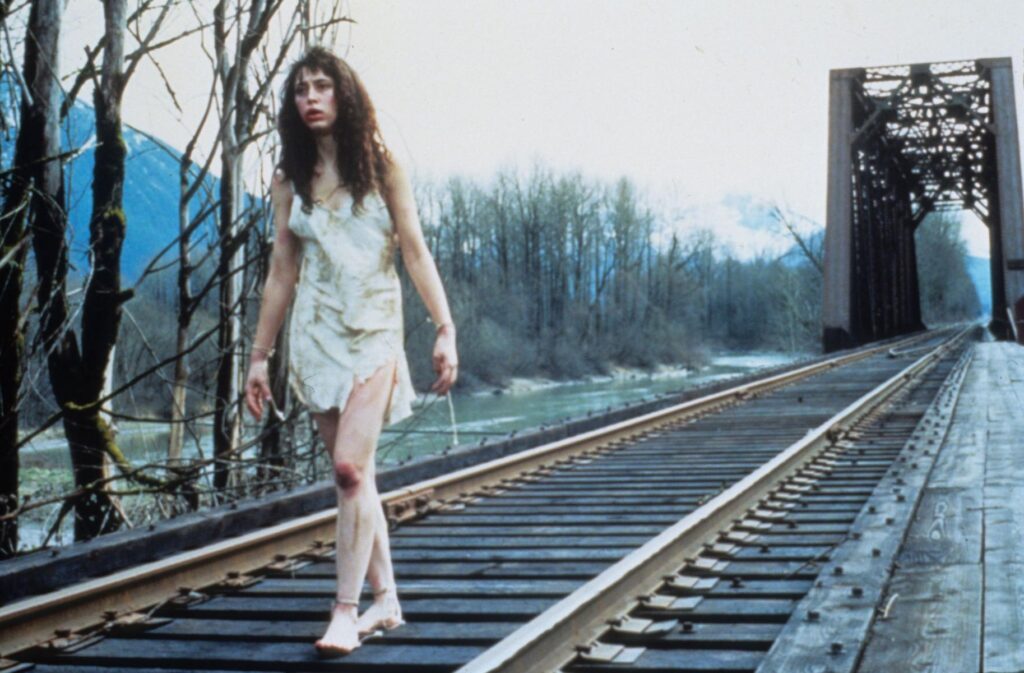
Twin Peaks: Fire Walk With Me (1992)
Twin Peaks: The Return (2017)
RUPERT LOYDELL revisits David Lynch’s unforgettable dystopia
David Lynch’s Twin Peaks: Fire Walk With Me was the moment when the town of Twin Peaks was revealed to be a dark hellhole of occult mystery, sexual abuse, intrigue, murder and underhand business dealings as opposed to simply a cozy backdrop to a strange detective story involving demon possession and sexual intrigue.
Although the first two television series had some shocking episodes, particularly the reveal of the evil spirit Bob and Leland’s death, along with the final episode (produced at short notice under instruction from the TV company), viewers’ memories seemed mostly of a quirky and occasionally surreal soap opera whose characters were fuelled by coffee and doughnuts, had high libidos and were very good looking – not to mention a friendly visiting detective who was prone to visions and intuitive investigation.
It wasn’t all sweetness and light by any means, but the darkness was leavened by humour and friendship, not to mention the haunting soundtrack, but Twin Peaks: Fire Walk With Me was having none of it. Billed as a prequel, the film was also a kind of reveal of what was actually going on, ostensibly before the TV series started but allowing us to project several of the stories into that time frame as well.
Nobody, not even Agent Cooper and his fellow police force members, seemed to come out well. Everybody was conniving with somebody else, had a dodgy deal going on, and seemed complicit in prostitution, smuggling and drug running. There was a lot of looking the other way and a lot of non sequiturs and references to things we’d missed, not been shown or that Lynch felt we should know about. This included more dreams and a meet-up of demons in an upstairs room.
At the time, many of us felt cheated. My friends and I came out of the arts centre where we saw it in shocked silence. I don’t watch or like horror films, but we had just seen one that seemed to take away any pleasure we’d had whilst watching the two TV series. That seemed to be the general public and critical response, and although there was and still is a sustained discussion about Lynch’s work, and a recognition that he had done something amazing for TV, that was Twin Peaks done with.
Twenty-five years later, that turned out not to be the case. Twin Peaks: The Return was even more surreal and fragmented than the original two TV series, and although presented in 18 episodes, Lynch claimed he thought of it as one 18-hour film. Although a few storylines were continued from the 1990s, most weren’t, and the film was full of new character, including three versions of Agent Cooper, those present in one-off scenes, not to mention aliens and godlike beings and a complete blurring of reality and dream states.
In fact Twin Peaks: The Return seemed mostly a kind of return to Lynch’s Eraserhead, a disturbing and unfathomable monochrome nightmare with a deformed baby and a (literally) industrial soundtrack that highlighted Lynch’s love of photography and the fleshy paintings of Francis Bacon. It highlighted and picked up on occult connections and cultivated its own lines of influence and diversion. Whilst it offered a creation story for evil in our world (or at least, the Twin Peaks world), it also opened up an impossible number of possibilities of what was going on and why.
Interest in Twin Peaks had never really gone away, but the announcement of series 3 saw a renewed interest. Discussion forums sprang up online, a number of academic volumes were published (there would be more after The Return ended) and co-writer/director Mark Frost published two hardback volumes – The Secret History, labelled as a novel, and The Final Dossier – which sought to flesh out some of the loose ends but also act as bait for the forthcoming series.
Twin Peaks: The Return was not easy or lighthearted viewing. There were trips into space, out of time, to cities and gangland underworlds – visions, prophecies and dreams – a giant pepper-pot that was David Bowie’s character – and Audrey Horne (Sherilyn Fenn) seemingly trapped in a loveless marriage, or locked up in an asylum. There were doppelgängers, demons, a hybrid frog-insect alien, visiting bands and songwriters, and a new gang of young people forming their own romantic and sexual liaisons whilst taking new, contemporary drugs. Oh, and there was a slow-motion atomic explosion too.
And there was electricity, snaking through, by and over the land, sparking, hissing and humming. And the woodsman, an unwashed and obsessed tramp, who broadcast a poem over the radio once he had killed the DJ. No-one who hears it knows if the poem is a sacred text, a warning or a magical spell; it hypnotizes them and sends them to sleep. And there are mystical beings trying to balance and juggle good and evil, sending spirits and signs to earth to sort things out. One of the beings is the giant from Agent Cooper’s dreams in earlier series, now called the Fireman in the closing credits. And there is the Experiment, momentarily appearing in a glass box in New York City. And, and, and…
And hundreds of walk-on parts: passers-by or passers-through, and those confined to the background. But no sign of Agent Cooper, and only tantalising glances of the town of Twin Peaks itself. Versions of Cooper are busy out in the world whilst the good/original Cooper remains trapped in the Red Room or White Lodge. Another Cooper squeezes himself through an electrical socket as a doorway from space to Earth, and comes out as a simpleton. Evil Cooper is intent on amassing a fortune and facilitating evil on the world.
The Return seems to refer to Cooper himself, since he takes most of the 18 hours to find his way back, before leaving again. He tries to undo Laura Palmer’s murder, which kicked off the whole Twin Peaks series, by finding a version of Laura and travelling back in time, forgetting all his zen ideas of acceptance and living in the moment. The version of Laura he finds (or creates) does not seem to know him or her own history, is only shocked into realisation at the end of the series, indeed the whole show, which ends with a scream.
There is no resolution, although fans, critics and film buffs have used up thousands of words trying to find one, contorting ideas and scenes into ridiculously tangled cats-cradles of even more impossible narratives, story lines and time loops. Some of it, of course, makes sense: there are repetitions, similarities and repeats in the plots and filming, there are what seems to be codes and signs on the likes of stray lamp posts and campsite notice boards, and the pylons do look like owls. Nothing is what it seems, but nobody is sure what they seem to be. And nobody seems sure who they are any more either, how to get where they want to be, or why things are happening the way they are.
This time round, however, the deaths and violence, the visitations from the spirit world, the hauntings and occult leanings, all the unexplained mysteries, are once again leavened with humour and wit. Twin Peaks: The Return may not be the return we expected, and is definitely not a return to the Twin Peaks we first enjoyed visiting, but its strangeness and unknowability, its twists and turns, surprises and senseless signposts, leaven it, along with a roster of musical visits to the Roadhouse, some come-uppances and happy endings. By embracing the surreal and the senselessness of our lives and juxtaposing it with chance and the unknown, Lynch reinvented television again, just as he had 25 years earlier, producing an extended film to sit alongside his other career highlights: Eraserhead, Lost Highway and Mulholland Drive.

RUPERT LOYDELL is the editor of Stride magazine, contributing editor to International Times and a writer and abstract artist. He has many books of poetry and several collaborative publications in print and has edited anthologies for Shearsman, KFS and Salt. His critical writing has appeared in Punk & Post-Punk (he is a member of the journal’s editorial board), Journal of Writing and Creative Practice, New Writing, English, Text, Axon, Short Fiction in Theory and Practice, Musicology Research, Revenant, The Quint: an interdisciplinary journal from the north, and Journal of Visual Art Practice. He has also contributed chapters to Brian Eno. Oblique Music (Bloomsbury, 2016), Critical Essays on Twin Peaks: The Return (Palgrave Macmillan, 2019), Music in Twin Peaks: Listen to the Sounds (Routledge, 2021) and Bodies, Noise and Power in Industrial Music (Palgrave Macmillan, 2022)