Parnassus, and patria

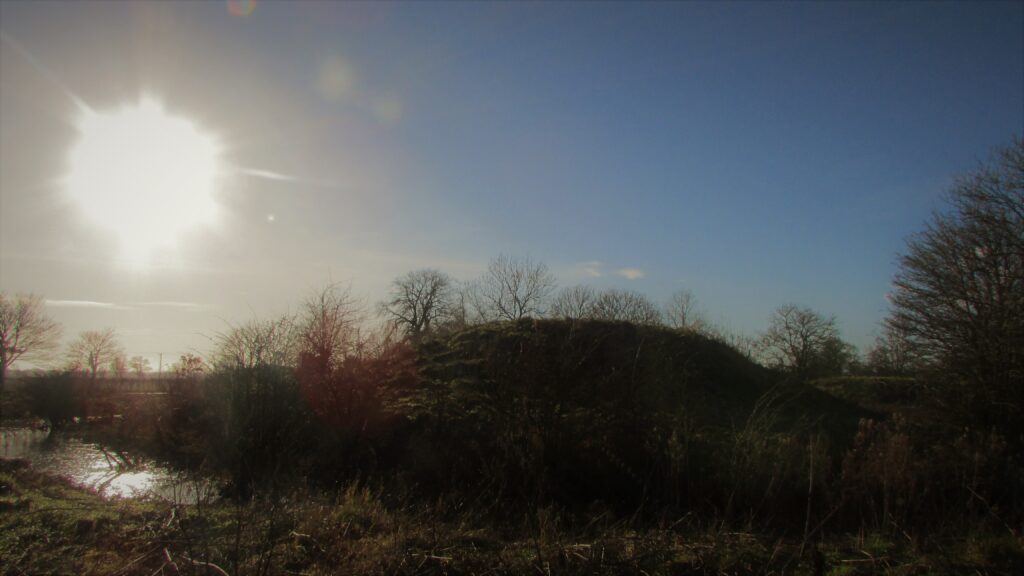
Tumuli at Revesby in Lincolnshire

Sunken Island: An Anthology of British Poetry

Various authors, edited by Alexander Adams, foreword by William Clouston, London: Bournbrook Press, 2022, pb, 55pps, £12.50

Bournbrook Press is an offshoot of Bournbrook Magazine, founded in 2019 to offer a “primarily British audience with traditionalist, socially conservative argument and entertainment”. This venture’s newest publication is something unusual, and unlikely to be financially profitable – an anthology of original poetry put together specifically to appeal to small-c conservatives, a subset of the population not noted for their interest in new verse.

Poetry written for political purposes always runs a risk of being bathetic, just as other arts can easily become ‘artivism’ – a point amply understood by this collection’s editor-contributor, who has written an informative book on this subject. I have a 1900 anthology on my shelves, Heroic and Patriotic Verse, and while much of the verse is excellent (it includes Byron, Goldsmith, Gray and Shakespeare), some has dated less well, including ‘Of old sat Freedom’ (one of Tennyson’s windier effusions) and the frankly indigestible ‘The Roast Beef of Old England’. The verse in Sunken Island is similarly uneven, but when it is good, it is, as Social Democratic Party leader William Clouston notes in his Foreword, “both serious and enjoyable”.

Clouston also points out that this book’s eight contributors are not “blind to the country’s flaws”, and this gives this collection both muscle and a certain wryness of outlook notably absent from some patriotic poets, like Rupert Brooke or Henry Newbolt. There is no bombast to be found in Sunken Island, nor sentimentality, nor Patience Strong-style platitudes. The two prevailing emotions are love, plus loss – an odd echo of Hugh Kenner’s A Sinking Island (1988), which concluded that “there’s no longer an English literature”. 

Kenner’s gloom is to some extent gainsaid by the poets in here, who suggest that a kind of distinctively English literary sensibility may still be discoverable – or at least a British one, because one of the poets included (the pseudonymous ‘Columba’) is Scottish, while another (Rahul Gupta) is a noted exponent of traditional alliterative verse. This does not mean that the other six contributors are stodgily suburban, nor even a hundred percent English. Alexander Adams is a justly well-regarded artist whose work is in the V&A (several of his drawings are used in Sunken Island). Benjamin Afer calls himself an “authentic reactionary”, but authors futuristic novels. Daniel Gustafsson is a bi-lingual (Swedish) doctor of philosophy, as well as a highly-regarded poet. A. Robert Lee taught in America and Japan, and lives in Spain. Nicholas Murray is a biographer of Kafka and Chatwin, and a Fellow of the Welsh Academy. S. D. Wickett is an aficionado of Lovecraft and Phillip K. Dick, and affianced to digital media.

The poems vary greatly in style. Nicholas Murray’s six short contributions feature everyday vexations, from standing on a train station concourse to being bitten by someone else’s dog (for which he apologises, the most stereotypically ‘English’ moment in the book). He notices small things, and honours the 19th century clergyman-diarist Francis Kilvert, who did too – “…the man of God whose fine gift / for seeing things lights the day / As sunshine after sudden rain”. He looks into a painting of a Lancashire landscape, and remembers its departed artist. He is abashed by the force of nature, in the form of a night wind which blew away rooftiles, and “glib proposals”. He then eavesdrops on an imagined conversation between James Joyce and Percy Wyndham Lewis, as verbose Irishman and Vorticist Englishman consider quantity, and the urgent need to stir things up, to dissolve “the solid shell”. 

A Robert Lee’s contribution, ‘From…’, addresses Englishness, coherent but complicated, encapsulated by the “multi-there” and “multi-then” of his own odyssey from 1950s Manchester via London, America, and Japan to 2022’s Spain. “The initial from takes on lengthening distance…” while everything changes and he changes with it, but remains in some ways strangely the same. ‘From…’ is more impressionistic jottings than verse, yet it ably conveys diverse textures and odd connections – between Manchester, Lancashire and Manchester, New Hampshire – between London periods and London postcodes – between the Kents of Chaucer and supermarkets – between the island mentalities of Britain and Japan, and the “inside outsider” status of being a Spanish-speaking Englishman in Spain. In him, national nostalgia seems in permanent tension with what Germans call Fernweh – ‘farsickness’, a wish to see far-off places – and perhaps he needed to get away to understand where he had come from. As Kipling asked, “what should they know of England who only England know”? Lee at least has come “to relish the from and the to: England’s away-day, England’s away-life”.

Adams’ poem ‘Roadside Diner, Shropshire’ is less sanguine, a contrast between the heartbreaking hills of Housman, and the plastic-bottle spotted county Adams and companion view from a bleary café window, downing terrible food while “vital, indifferent” traffic dashes by, heading nowhere purposefully. This England is, he repines, “an absent people, a civilization surrendered”, and sometimes he feels like a “lone journalist remembrancing a defeated land”. Lack of legacy nags and nags at him, as he sees sunning girls arising and going “back to life, leaving nothing of themselves” – fewer traces than even the evanescent, underestimated flowers of May.

Daniel Gustafsson’s ‘Bulbs’ strikes a brighter botanical note, reminding us that even the gnarliest corm in the coldest ground pushes green spears upwards each spring, offering potential for beauty and self-realisation. His work is rhizomed in Yorkshire, a county whose notoriously crumbling Holderness coast offers plentiful metaphors for erosion of substance. “The guards have let us down”, Gustafsson warns, political leaders and opinion-formers mere “architects of entropy”, letting everything slide into the abyss out of sheer carelessness. “We’ve seen our footings fall / to sludge… have seen, through slurred decrees and sleights of hand, / a state of blank forgetfulness / usurp the patterned sand.” Spurn Point at the northern tip of the Humber could be nationally emblematic, a sandy spur soon to be an island, near where the great port of Ravenspur once saw kings land, and monks build monumentally. The East Riding’s erosion is symbolic to him of a country’s “great diminishing”, as a former “common ground” is washed across by shallow sloganeers, who impose their views on others like some postmodern Morality Police.   

Gustafsson’s lyrical wistfulness is given a more combative edge by Benjamin Afer, whose ‘Lines on an English Street’ express feelings of inner exile, the author feeling alienated from his ancestral domain by demographic changes as symbolized by ethnic restaurants – “a surfeit of whiffs”, from an alphabet soup of eateries in High Streets that have somehow become Grand Bazaars. “It’s a solitary walk the Englishman beats / In the swelling crowds of the English streets”, he insists bleakly, notwithstanding possible economic upsides: “The happy ringing of tills and drumming feet / Make a merchant at home on the English street.”

The collection closes on an unexpected crescendo, with four extracts from larger works by Rahul Gupta. The author, who holds a doctorate in alliterative verse, and is undertaking a major translation project from Old Norse, is alive with logophilic intensity, pouring torrents of words onto pages as if upending some wonderfully capacious cornucopia. Familiar words are deployed in unexpected ways, unfamiliar ones summoned from OE word-hoards where they have lain too long asleep, and new ones are smithed – and all are marshalled to striking mythopoeic purpose.

Gupta’s chief area of operations is the post-Roman, pre-English world, when Angles, Celts, Jutes, Saxons and Scandinavians moved across claimable spaces between downfallen towns, where horse-masters could be kings and stones sacred, and ravens battened on bodies at real battles whose locations we have lost, and which we barely now remember even as names. This is ‘Matter of Britain’-territory, Gog Magog-country, the Logres that lies under even the ugliest parts of everyday England, giving the least imaginative modern Englishman some vague sense that he belongs in some continuum. This epic subject – so liable to be conventionalised and sentimentalised – gains vastly in vitality at his hands.

‘A Norse Étude’ is a combat scene condensed from all the hyperboreal epics, from Heimskringla and Orkneyinga to Beowulf and the Battle of Maldon, imagining “horny-nebbed” hooded crows descending on men falling under a hail of “Flanged arrows as flinder- / fledges leapt from edges / over shields, bows shrilling, / when shank-deep was dankness / of gore”.  Poems were – and are – also weapons in these wars of all against all, as tribal minstrels interpret and invent legends, weaving words “from that web of swords”, trying to forge the future by capturing the past.

‘The Turn and Fall of Leaf’ could be a title from Tolkien (to whom Gupta has been likened), a lambent disquisition on autumn, its colours and significances, its glories and sadness, as the glowing greenwood goes glorious, then brown and blighted. Winds pick up and shiver the timbers, and their chlorophyll clothes weep to the far-below floor. Secret glades are shockingly made naked, and rides are mounded deep in dry detritus – “pathways choked, by parched masses: / crinkled chamoisy, crunched underfoot / as shuffling drifts. With shift and ruffle / They enswathe the sward”.

Time for ‘The Onset of Winter’, with clouds and winds as “sky-skirmishers, obscure armies / of ill omen”. The Wild Hunt passes, baying and foaming hounds headed by Herne, antler-masked “wood-warlock of the warrior-band”, in elemental pursuit of white harts from heraldry, while berserkers and whippers-in howl and scream and “chew the shieldedge” in frenzy. And then – the chase passes and the thrumming hoofbeats recede into infinity. Nature exhales, and all is suddenly motionless. Overhead, “Hunter and Hound are hovering still” in a sky diamonded with stars and a moon of mother-of-pearl.

At other times, winter deals harsh hail and sleet to punish the patient earth – “gravel-grain that grows no harvest”. Yet other days, snowfall hushes all noise, subdues all striving; a giant Cold Genius walks the whitening land with his finger to his lips, casting crystals of infinite variety indifferently over the quick and the dead, obliterating boundaries, ivorying all the colour-fields. “All wear his harness: / ironhardened earth” and “The ice tightens / Wonderfetters”.

But there is release at last, as even in winter there is the possibility of warmth. In ‘The Midwinter Sun’, the “all-tending orb” suddenly rides high and reaches down with effortless sensuality. He “…drives the spore: he inspires the bud, / as the twig whitens, to untwist her whorl: / he parts her petals; the pollen to smoulder / from flaunting catkins”. Blinking, yawning animals emerge from hibernation, hungry for the starting grass, conscious of urgent impulses that make the male hen harrier seek out multiple mates, send hares careering across champaigns, adders intertwine Gordianally, and unsettle cattle in crew yards. The poet tracks Phoebus lovingly through his golden ascents, then Wheel of Fortune downturns, as the “traitor-barons…eclipse the glory of his lion’s mane”, as so often before. The uncertain sun sinks into the sea, and troubled men set out in tiny boats, “travailing westward /… on benighted tides, / In search of the dawn.” Like all his others, this is a virtuosic performance, a welcome reminder that there is still blood in the tradition.

The contributors to this volume could all be seen like Gupta’s metaphorical sailors, navigators of unknown waters, seeking Sol-ace in a gathering dark, reaching for verse to reverse eclipse. If sometimes their reach falls short, at other times it does not, and always they are honourably-intentioned. This public-spirited Parnassian project can be judged a success if even a few of the many other anxious among the English are inspired to poetry in their turn.

A painter’s peregrinations

Field Notes: Walking the Territory
Maxim Peter Griffin, London: Unbound, 132pps, hb., £16.99
DEREK TURNER admires a unique landscape artist

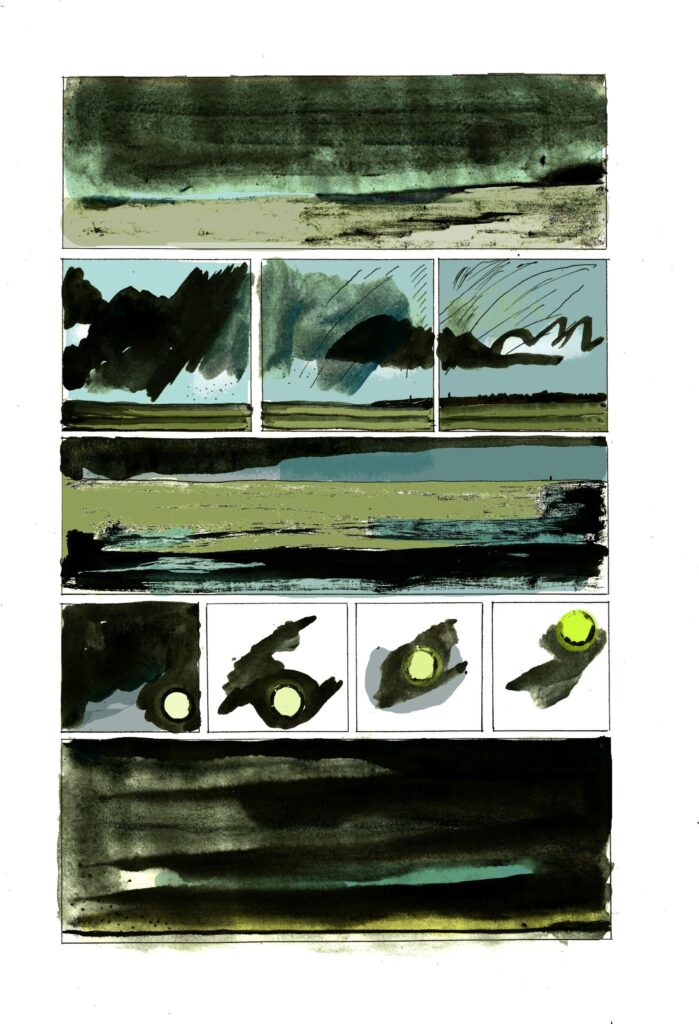
Several years ago, when I was thinking about writing a book about Lincolnshire, I found a strikingly original Twitter account. Almost every day, the seemingly tireless Maximpetergriff posted pictures painted during or after apparently endless walks across Lincolnshire, in all weathers and states of mind, showing the things he had seen in clear and luminous tones – birds, buildings, clouds, dogs, people, planes, planets, plants, pylons, rains, roads, skies, stars and suns.

These things had not just been seen, but looked at – everyday things uplifted by a strong sense of their possibilities, made resplendent in modern hues. Nothing seemed beneath this observer’s notice, nothing predictable in this parallel Lincolnshire, his glowing images intercut with staccato captions about bats overflying, bridges crossed, dogs howling, insects hurrying, litter lying, people overheard, the smell from takeaways, strange stones picked up, waterways running slickly away under moonlight.

The images were small, apparently simple and spontaneous, but in truth were full of thought. This was a county beyond conventional depictions, a painterly psychogeography; here were Englands within England. This walker was no pedestrian, but dashed off little-known vistas with verve, influenced by the likes of Nash and Piper while also being confidently contemporary; as he records, “two older ramblers look on the work with dismay”.

Some of these evanescent images have now been confined within the boundaries of a book, crowdfunded by those who liked this take on this territory. Field Notes’ freeze-frame cover suggests the unusualness of the author’s perspectives, and the élan of his approach. A redder than real sun stands in a yellow-brown sky, silhouetting black grasses. Geese power south from Scandinavia in a sky like a destroyer’s dazzle pattern. Suggestions of cirrus shadows spot Ravilious-reminiscent fields. Cruciform crows angle home over saltmarsh. White pylons overlay lands filled with decayed life-forms. On the inside back cover, where we expect an author photograph, we find a fugitive Everyman in a raincoat, painted from behind on a beach improbably alchemised from greens and blacks – the self-effacing artist as Sebaldian character, stepping out sturdily across the echoing east.

Griffin is sometimes sentimental, but never nostalgic; the book, like many of his Twitter posts, ends on the word “Onwards”. Yet he honours equally the mammoths that stomped drowned Doggerland (whose bones are taken up by trawlers), the antiquarians and eccentrics who discovered or dreamed our ideas of England, and today’s young English, heedlessly in the moment yet standing on the same fossiliferous foundations. Seams of gaseous Kimmeridge, outcrops of chalk, flint hagstones, the slimed tree-roots exposed at the lowest tides and the movements of muntjac are in a continuum with John Aubrey, boys on BMX bikes, exhausted seaside resorts and whooshing wind-turbines, while overhead ley-lines intersect with jet-fighter flight paths.

Field Notes is an account of one closely-noticed, deeply felt year in Lincolnshire, starting for the author (predictably, unpredictably) in October, with a Humbrol-hazed moon announcing the equinox, and the coming of the cold. “Look – the peak of autumn”, he marvels – with anthropophagical arachnids eating each other on barbed wire, RAF Chinooks, leaking boots, geological specimens arriving in the post, and ancient tracks to towerless churches passed over by Pevsner. “Look” again, he urges us, at the waning of the year, the chiaroscuros of clouds, the shadows of fences, the darkness under trees, the unlikely reds of earth, the arsenics and Prussian blues of limitless firmaments.

November brings branches waving against vastness, bleached bones in dunes, beachcombed sealskins and plastic bottles, deserted caravan parks, huge ships hove to off Spurn Point, memories of the drowned. An Airfix-coloured pillbox gives rigidity to the dynamic landscape, and a gun port leads into blacker than blackness. December holds the old names of ditches, mysterious murmurations, Mesolithic mirrors, thoughts of Raymond Briggs and memories of Mablethorpe Carnival Queens, the turning of this twelvemonth accepted as part of the epic, indifferent, unalterable cosmic churn; “The ocean will have us all – good.” Deep Time, East Midlandian history and today meet and mingle, even his cooking over campfires a sensory link with aurochs-eating, the crude charcuterie once carried out in willow-meads ages ago eaten by the waves.

Month by month, step by sometimes blistered step, sketch by swift sketch, we glimpse something of this arcane county’s blend of beauty and bathos, its grand desolations so often made mean by bungalows, car boots, leylandii, phone masts, and the demolition derbies of Skegness. There is grit in this Lincolnshire, some hardness and ugliness – asbestos sheds, chicken concentration-camps with humming extractors and the sharp stink of ammonia, algae-choked dykes, desperate biro notes found on the ground, rat-gnawed rubbish, washed-up whales, a man in an oxygen mask expending too much of his short time selling 1970s cassettes. But the overarching impression is deeply positive – room to breathe and self-realisation under the biggest of big skies, despite the oncoming storm-fronts of life.

Field Notes is filmic, impressionistic, and personal. It also manages to be unpretentious. In Griffinland, knowledge of the exploits of Alexander, Welsh poetry, Kurosawa, or “our pal Pieter Bruegel the Elder” co-exist chummily with pop blasting from cars, addicts passed out in hedges, shops selling tourist tat, and lost footballs floating out to the estuary. Phrases that from others might have been merely gnomic point towards places you’d want to visit. Even those who have some acquaintance with Lincolnshire will not be familiar with all the artist’s itineraries, and are certain to see new sights from his very particular vantage-points.

After long obscurity, Lincolnshire may be rejoining the mainstream of national history, with uncertain effects. This paean to little-known landmarks carries folk-memories forwards, while facing “Onwards” with equanimity. Ultimately, it suggests that whatever happens or is done, Lincolnshire has always been, and will always be, a land of graphic dreams.

The political landscape

Photo: Derek Turner

Green Albion – Restoring Our Green and Pleasant Land

Various authors, Conservative Environment Network, 2022, 101 pages, free download

DEREK TURNER welcomes a practical contribution to often overheated eco-arguments

Environmental protection is conventionally seen as a ‘leftwing’ concern, because its most voluble advocates are often equally vociferous on what are dismissively called ‘woke’ preoccupations, from asylum-seekers to transsexuals, or EU membership to Scottish independence. Yet there has always been a conservative kind of environmentalism – famously represented by the late Duke of Edinburgh, and his son – although at times in postwar history it has faded from view, sidelined by administrations prioritizing the economy over the environment.

If modern Greens often gravitate in leftwing directions, it is at least partly because from the 1950s on, mainstream conservatism developed a brusque, complacent and unimaginative streak, which held that business, ‘freedom’ and ‘growth’ mattered more than the natural world. Influential opinion-formers and politicians chortled at ‘tree-huggers’, and sometimes even said environmental damage was just Darwinism in action. An effect of this almost Randian reductionism was essentially to abandon a hugely important area of concern (and large swathes of university-educated and younger voters) to the ideological left – which whatever its other shortcomings could see that the environment was not only precious, but priceless.

This was ironic, because during the twentieth century socialist countries had a shameful ecological record. Soviet and Maoist economic, industrial and social practices laid waste their respective ecosystems, whilst in America supposedly retrograde conservatives took some difficult long term decisions, often against the wishes of big business backers. Theodore Roosevelt established the United Forest Service, five national parks, and fifty-one bird reserves. Richard Nixon created the Environmental Protection Agency and signed both the Clean Water Act and the Clean Air Act, while Ronald Reagan designated more than ten million acres as wilderness. Whatever their other limitations may have been, these could at least see that conservation and conservatism are adjacent conceptually as well as alphabetically.

The natural world, with its blind instinct, harshness, hierarchy, and territoriality is not an obviously congenial area of interest for ‘progressives’ or ‘radicals’, who are usually more concerned with abstract moral values, and believers in human plasticity. Nature is neither egalitarian nor kindly, and examples from what was tellingly called the ‘Animal Kingdom’ lead logically towards a Hobbesian interpretation of the world. Early environmentalists and organic agriculture advocates were more often ‘right’ than ‘left’, seeing animals and landscapes as contributors to, and symbols of, national characters. Into the 2000s, there was a strand of English conservatism which supported hunting as rooted in national history and human nature, epitomised by writers like Robin Page, R W F Poole and Roger Scruton, and the huge, if ultimately unsuccessful, campaigning of the Countryside Alliance. The fact that in most modern Western countries environmental politics have become a kind of leftist reserve says much about the ‘culture war’ fighting capabilities of the West’s conservative parties.

In Britain, there are precedents for the Johnson government’s notable interest in environmental issues from energy policy via gene-edited crops (to reduce fertiliser and pesticide use) to rewilding. David Cameron’s Green stances earned him considerable scorn within his own party and from some in the Conservative press, but like Johnson he was borrowing from old ruralist Tory tradition, and more recent small-c conservative thinkers like Edward Goldsmith, who founded The Ecologist, and was instrumental in the founding of the Green Party. There were political precursors too. Macmillan’s, Eden’s and Major’s governments passed noise abatement and clean air legislation, while Churchill’s created several new National Parks (following the Labour government’s creation of the first, in 1951).

Although Thatcherite neo-liberal policies entailed a hefty environmental price tag – encouragement of conspicuous consumption, the opening up of ecosystems to rapacious corporations, road building, relaxation of planning laws – sometimes they also meant improved environmental protection, as the new private company executives became suddenly accountable to public opinion. Mrs Thatcher took a perhaps surprising interest in global warming, acid rain and pollution. Her aversion to the British coal industry was based at least partly on her knowledge of coal’s environmental impact. In 2012, former Friends of the Earth leader Jonathan Porritt noted marvellingly, ‘Thatcher…did more than anyone in the last sixty years to put green issues on the national agenda.’

In 1989, she told the UN General Assembly, ‘The environmental challenge that confronts the whole world demands an equivalent response from the whole world. Every country will be affected and no one can opt out… No single generation has a freehold on the earth.’

These were resonant words from a politician not even the most callow Objectivist could accuse of fuzzy sentimentality, or anti-business sentiment, or ‘big government’ instincts. There were contradictions in her outlook, but something in her sensed that governments have an historic and moral responsibility to protect the landscapes and wildlife which help define the character of the nation they govern. She saw that the Green movement, for all its faults, was addressing real problems. She could also see that the Greens would benefit greatly by the involvement of more down-to-earth ‘Blues’ to represent the legitimate interests of agriculture, industry and landowners, and balance frigid universalism with local attachments, and the ideal with the achievable.

Thatcher’s words are emblazoned along the masthead of the Conservative Environment Network’s (CEN) website, because of their insightfulness, but also because her name is likely to disarm anthropogenic climate-change sceptics, who are drawn almost exclusively from the political Right, from libertarian conservatives to populists in the Farage, Trump and Bolsanaro mould.

Environmental problems can seem intractable, the literature is frequently tedious, and ‘activists’ often smugly jejune. Considerable credit ought therefore to be extended to the politicians who have taken the trouble to contribute to this compendium, which nods at national nostalgia (Blake, Wordsworth, Larkin et al) but also offers practical suggestions on a range of interrelated issues. It is about time that Britain’s long-suffering landscapes were afforded less exploitative kinds of treatment – ‘undevelopment opportunities’, to allow it (and us) to recover.

There are contributions by eleven MPs and one peer on wetlands, peatlands, woodlands, maritime habitats, rivers, and some of the possibilities for UK agriculture in the post-Common Agricultural Policy landscape. The essays are topped by a Foreword by the Minister for Farming, Victoria Prentis, and tailed by an Afterword by Ben Goldsmith, Chair of the CEN, representing the public-spirited family which has done so much in recent years to force responsible environmentalism onto a sometimes reluctant party (Ben’s brother, Zac, is Minister of State for the Pacific and International Environment). It offers an ambitious and thoughtful vision for a renewed environment – even if we suspect much of it may never be realised, amid Brexit, Covid and global insecurity, on top of the usual political vicissitudes.

The Minister hails ‘the biggest changes to farming and land management in 50 years,’ using environmental land management schemes (ELMs) to make agriculture more efficient and improve food security, while increasing biodiversity and protecting existing habitats. Stroud MP Siobhan Baillie speaks of incorporating ‘natural capital’ into Treasury thinking, to restore 100,000 hectares of wetlands as carbon sinks, floodwater repositories, and refuges for rare species – and even as a means of improving mental health. Robert Largan calls for the rewetting of lowland peat where possible, new kinds of crops that can be grown on wetter soils, the banning of peat-based fertilisers, and the prohibition of disposable barbecues, often the cause of devastating moorland fires.

Michael Fabricant wants millions more trees to be planted, plus natural regeneration, and better protection from imported diseases by home-growing saplings – with special provisions for threatened temperate rainforest, and an updating of the Forestry Commission’s century-old charter. Hastings and Rye MP Sally-Ann Hart seeks to encourage coastal (especially saltmarsh) and undersea carbon sequestration, ban bottom trawling in Marine Protected Areas, and action on maritime pollution to increase underwater vegetation and boost fish stocks.

Andrew Selous gives a ‘Christian stewardship’ perspective, setting out ideas to improve management of statutory nature reserves as well as Church and National Trust properties, and improving biodiversity through a new land designation of ‘wildbelt’. He also calls for less intensive farming methods to improve soil and reduce flooding, with reduced grazing and tilling pressures, and using fewer chemicals. Craig Williams, whose Montgomeryshire constituency is threaded by the Severn, envisages an holistic riparian management strategy to cover tributaries and whole watersheds, with better waste management, bankside tree planting and channel restoration to reduce pollution, boost wildlife and reduce flooding.

Anthony Mangnall and Jerome Mayhew draw urgent attention to the financial pressures faced by farmers, but discern possible benefits from Brexit. While welcoming organic methods, they acknowledge these are not applicable to all farmland, and generally mean more expensive food. Rewilding, engaging and useful though it is, is not easily compatible with large scale food production, and needs to be tempered with a ‘land sharing’ approach (which Ben Goldsmith terms ‘wilder farming’). Ideally, their contributions would have been balanced by one making the case for rewilding, but they make valuable suggestions, such as less use of high-carbon chemical fertilisers to reduce greenhouse gas emissions and chemical runoff into waterways, and market mechanisms to ensure attempts to contain carbon at home do not lead inadvertently to increased emissions abroad.

Jonathan Djanogly calls arrestingly for expediting cellular meat production – meat grown in laboratories from muscle tissue harvested from living animals. Cellular meat of course entails no animal deaths, far less land use and pollution, and far fewer hormones or other chemicals. This would not replace conventional livestock farming, but could open up huge new markets, especially in Asia, where burgeoning middle classes are demanding ever more meat that at the moment is not always available, or only at great environmental cost.

Baroness Jenkin is concerned with minimising UK food waste – the UK wastes more food than anywhere else in Europe – through better supermarket practices, redistribution of still–edible food to the neediest, more food waste collections by councils (that can then be used to make energy), and – a Thatcherian touch – thriftier household management to simultaneously benefit the planet, and save families money. The government’s ambitious (and hugely controversial) energy policy is scanted in this volume, but Pauline Latham demands an end to the burning of biomass, now known to be not renewable as once thought, in order to lessen air pollution and land use, as well as the carbon released by the removal and burning of trees. Ruth Edwards takes up the bosky theme, with a call for global as well as domestic action on deforestation, building on existing government commitments to bar imports of products like palm oil and soya produced on recently deforested land.

This book overflows with ingenious ideas which, if realised even in part, would go a considerable way towards meeting the objectives of the likes of Extinction Rebellion, without endangering the economy. But there are curious omissions. While it was only to be expected that the huge and complex area of energy policy would need to be treated separately, it is strange to have little or nothing about such matters as plastic pollution, factory farming of animals, the wasteful profligacy of the electronics and fashion industries, eco-building technology, planning laws, or the proper management of parks and verges for wild flowers. One would also have liked some detail on the thinking behind the crop gene-editing legislation presently going through Parliament, and about post-CAP farm finances, especially of smaller farms.

And what about overpopulation? The United Kingdom is already one of the most densely populated countries in Europe, and the Office for National Statistics predicts that the present population, of around 68 million, will increase to some 77 million by 2050, largely attributable to immigration. Whatever mitigations may be in place, or whatever fixes may be found, the truth is that more people equals less nature. The government is taking little or no interest in this subject, partly because busy with other matters, but also, one suspects, out of unwillingness. Yet if they do not start to soon, lovers of the British countryside, whether romantic rewilders, pragmatic farmers, well-meaning MPs or weekend walkers, may all ultimately find that their efforts, ideas and inmost emotions are rendered redundant by sheer pressure of people. ‘Greenness’ and ‘pleasance’, and sense of place, can only be located within quietude and space.

It is to be hoped that this admirable caucus will increase our sense of obligation to them by taking up these subjects in subsequent publications.

The booklet can be downloaded from https://www.cen.uk.com/green-albion

Voyages through vanities

Gulliver’s New Travels: Lemuel Gulliver Collides with the 21st Century

Guy Walker, self-published, 2022, 140pp, £4.99

DEREK TURNER is entertained by a clever updating of a classic

Satire, often thought of today as a liberal genre, can also be a conservative art. Any writing that relies for its comical or scourging effects upon the discrepancies between fantasy and truth, hypocrisy and sincerity, can lend itself easily to a conservative sense of realism, and distrust of fine rhetoric. Cant, dishonesty and foolishness are perennial, and no respecters of parties.

Satire was practised by Aeschylus and Euripides amongst others, who wrote plays as jocular tragedies, wherein the actions and words of serious characters were constantly being undercut by drunken, foul-mouthed, priapic satyrs. Such contrasts have a recurring appeal to a certain type of person, who may be of either ‘Left’ or ‘Right’, depending on who is in power, and how badly they are abusing that trust.

Chaucer belaboured corrupt clerics, not on anti-clerical but on pro-Church grounds. Satire was also deployed by reforming humanists like Sebastian Brant, whose still-read 1494 Das Narrenschiff (‘Ship of Fools’) was just one of many similar salutary works – not to mention Thomas More’s Utopia (1516). Rabelais’ Gargantua and Pantagruel was officially condemned, but 16th century Cardinals kept copies in their cassocks. Juvenal’s withering satires of the Rome of the first and second centuries were of intrinsic appeal to the 18th/19th century writer William Gifford, editor of the Quarterly Review (the journal which coined the term ‘Conservative’), who became one of the poet’s most successful interpreter-translators. The contemporary comedian Andrew Doyle uses his avatar ‘Titania McGrath’ to lampoon the inconsistencies of ‘intersectionalism’, and prick the priggishness and pomposity of over-sensitive orthodoxies. 

Jonathan Swift was first a Whig and then a Tory, whose loathing of the Deist and mercantilist currents of his time led him into morally outraged vituperation, most famously his 1829 Modest Proposal to deal with Irish poverty by advocating anthropophagy, at a time when the English authorities seemed content to let the Irish starve – a phrase which has become shorthand for any straight-faced outrageous suggestion. Most lastingly, of course, he dreamed up the disingenuous Lemuel Gulliver – a supposedly simple mariner cast up by shipwreck into a parallel universe, where the assumptions, institutions and practises are oddly reminiscent of those of early 18th century Europe, with just a wicked twist to emphasise the essential ridiculousness of the originals.

Gulliver epitomises Swift’s ideal of the Englishman – brave, enterprising, inquisitive, resourceful and sturdily commonsensical, with a tincture of Protestant prejudice. Gulliver’s Travels was deservedly successful, even if at times Swift’s touch is too heavy, and the conceit is carried on too long. Two centuries on, the English writer Guy Walker has been inspired to follow this great unflagging example, and apply Swiftian lucidity and smiling scorn to some of the deceits and rodomontade of today.

Walker is notably widely read and a retired teacher of language, attributes made evident by the orthographical exactitude of his text (‘atchieve’, ‘Emmets’, ‘extream’, ‘Fanfaronade’, ‘smoak’), and his familiarity with the atmosphere and state of knowledge of the England of Swift’s time. An unwary reader could easily assume that the ‘real’ Gulliver did indeed visit the fantastical realms of Khiliastika, Obversia and Ypsilosia, especially as these are interponed on this itinerary with Swift’s Houyhnhnms and non-fiction’s St. Helena. The ‘authenticity’ of Walker’s style and vocabulary inescapably entails offensiveness to certain refined members of modern audiences, for whose delicate benefit he includes a prior ‘WARNING’ that is all part of his vigorous joke. But inside all his rumbustious humour, as inside Swift’s, is a swingeing critique of some of our prevailing reductive philosophies, a wonderfully witty appraisal of some of the ways we delude ourselves.

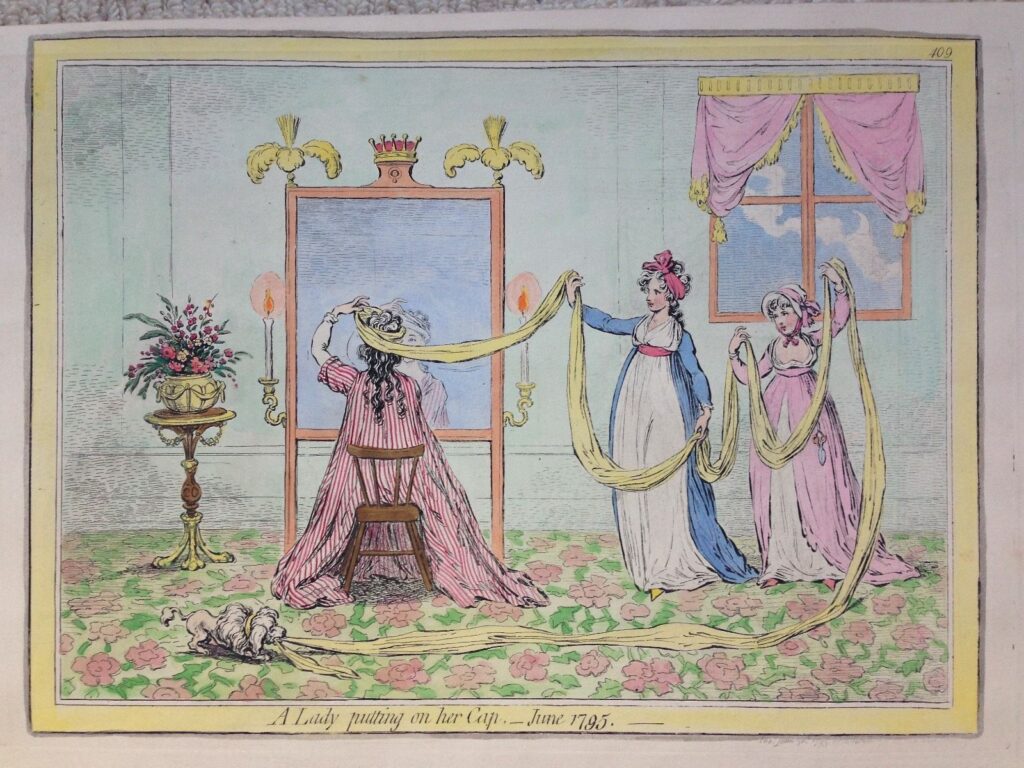
Khiliastika is a land of ostentatious self-abasement, whose inhabitants vie with each other in demonstrations of humility, even publicly classing themselves below animals. Inevitably, this so-public humility is really private pride, a neat inversion of the former worldview, when pride in being part of the hierarchical ‘Great Chain of Being’ had really been a kind of modesty, which acted as restraint. The present Khiliastikan elite is idly rich, existing parasitically on the fruits of former industry and responsibility, with rather too much time to adorn themselves and consider their own reflections in strategically placed mirrors. Domestic servants and other workers on Khiliastika (as elsewhere!) are largely disregarded as irrelevant, even as their masters and mistresses vie with each other in expressing egalitarian and internationalist sentiments, and loudly apologising for their very existence. Parallels with modern middle-class checking of privilege and virtue-signalling (a phrase Swift could almost have coined) hardly need to be adumbrated.

Wealthy Khiliastikans are also subscribers to an apocalyptic philosophy, which holds that the old industries had critically damaged the world through over-heating of the air, exacerbated by the ‘Flatus and Ructations’ of ‘Cattell’, horses, and the islanders themselves. People are ergo expected to abstain from meat-eating and leather- or wool-wearing, and await the coming of a braided young ‘Prophetess’ bearing a not wholly adventitious resemblance to Greta Thunberg.

Prestigious ‘Virtuosi’ and ‘Universal Artists’ are employed to find ways of storing the animals’ involuntary emissions, and even to plug an active volcano. Others are building vehicles powered by magnets, springs or wind, others metal domes to afford protection for when the sky falls in, yet others an Ark for the end of days. Those who diverge from any detail of the orthodoxy are pilloried, ridiculed and excluded even from employment. Even for readers less sceptical of anthropogenic climate-change than this author, the satirical strokes fall fast, and hard.

Onwards to Obversia, a black kingdom whose inhabitants treat the mariners with extraordinary condescension – because amazed ‘at the Miracle of Humans of a white Complexion shewing that they too could make Shift to build and navigate a Merchantman.’ Rich Obversians compete to offer accommodation to the pale barbarians, because they see this as an opportunity to demonstrate their non-racist charitableness. They are haunted by Obversia’s one-time prominence in the slave trade, which had long ago entailed the kidnapping of countless ‘white-Complexioned’ people to boost the economies of Africa.

Obversia’s impressive-looking Grand Academy is staffed by grave intellectuals, determined to upturn all assumptions (such as that men differ from women), and ultimately erase Nature. According to the Academy’s overarching theory, everyone is equal and interchangeable, and everything inherited from the past, including maths and science, is illegitimate. Politicians, including the rather ponderously-named ‘Sir Kirkley Streamer’, when not in power themselves, as a matter of both principle and policy always advocate the opposite of whatever the government is doing, irrespective of its merits. Poor and starving people are kept on a barren offshore island, so they can be inspected and publicly petted by wealthy mainlanders, who have themselves painted in such edifying poses. A whole ‘Œconomy’ has grown up around this practice, and when Gulliver asks why the poor are not allowed off this island, to settle in available fertile land on the mainland, he is laughed at for his simplicity – because they are more valuable to the exchequer (and public morality) where they are.

They leave this island gladly, and are then captured by the airborne ships of the powerful Ypsilosian Navy. All the Ypsilosians’ military might is dedicated ironically to the service of a state which advocates a universal language and ultimately universal peace. The savants and wealthy residents of the capital, Schro Dinga on the River Phrenos, float serenely above the ground, uplifted by the rarefaction of their reasoning, while earth-bound drudges toil below. Beautiful women in elegant salons condemn their Objectifycation and oppression by men, and bewail the squalid necessity of child-bearing. Prominent businessmen call for higher taxes, and condemn the common people for worrying about the price of food and value of their hovels. Senior military men espouse saccharine pacifism, and the country’s leading intellectual urges the severance of all connections to culture and nation – and biology and geography. At the Temple of Transcendence, a gorgeously attired celebrant preaches disbelief in deities, but foresees lifespans of a thousand years and in the meantime, the survival of intelligence by means of electricity.

Gulliver and his companion dislike all this vastly; ‘we had begun to find the Attempt to be and not be the same Thing at the same Time inimical to the Composure of our Brain and the Quietude of our Minds.’ They escape, and make sail to St Helena, a British colony and assumed safe haven – only to find that ideas like those prevailing in his recently-visited dystopias have made their way here too.

Under the rule of a party calling itself the Know-Alls, the common islanders have been discouraged from making up their own minds about anything until ‘This might extend to their not even being able to distinguish confidently between their Posteriors and their Elbows.’ Now called contemptuously Know-Nothings, ordinary people have been fenced out of old land-holdings by Projectors, enclosed out of ‘Common Sense’. Philosophers strive to reduce life on even this tiny outpost to rigid formulae, even trying to mathematize the arts, banning dangerous displays of spontaneity and enjoyment. This abhorrent state of affairs calls for outraged action, and Gulliver is just the kind of Englishman to act. Condign punishments ensue, and ancient arrangements are resumed, to general contentment.

Gulliver sails on eventually, the ever-restless Englishman, an Anglo-Saxon Everyman – but he leaves behind a better island, and real-life readers wishing real-life restorations could be quite so easy, or swift.

Seas within seas

Bucentaur at the Molo, Ascension Day, by Giovanni Antonio Canal (Canaletto)

History of the Adriatic: A Sea and its Civilization

Egidio Ivetic, Cambridge: Polity, 2022, hb., 352 pps, £25

DEREK TURNER wallows in warm world-historical waters

The Mediterranean flows always through European awareness, Homer’s ‘wine-dark-sea’ and the Romans’ Mare Nostrum becoming ‘Our Sea’ too by ancient immersion. But within the world-historical susurrations of those waves can be heard the sounds of smaller waters, whole seas within seas. University of Padua historian Egidio Ivetic draws attentions to the oddly-overlooked Adriatic, a more intimate body of aqua but one with its own identity and importance, which he calls ‘the Mediterranean of the Mediterranean.’

As well as academic insights, Ivetic has personal connections around these shores, criss-crossed the Adriatic frequently while working on ships, and evinces unflagging interest in everything from sixth-century BC amphorae to twenty-first century ephemera. His book is not lushly impressionistic in the style of many northern European writers, but it is deeply affectionate, and his subject intrinsically poetic. It is not free from ‘academese’, but it is vastly informative, helping fill a surprisingly blank space in the expanding area of thalassography – the history of seas, as opposed to history in or on seas.

The Adriatic was historically considered a discrete region of the Mediterranean, a third branch that was neither the Levant (east) nor the Ponent (west). It was where the Latin West encountered the Orthodox East and later Islam, and where numerous empires had their farthest frontiers – the Carolingian, the Byzantine, the Holy Roman, the Hapsburg, the Ottoman, and the Napoleonic. It was strategic too to the Spanish crown, and always a corridor of concern to Popes, especially after the fall of Constantinople allowed the Turks to subjugate much of the Balkans. The area was both recognizably European and exotically Near Eastern; Saracens captured Bari as early as 847, into the 1920s camel caravans travelled as far west as Sarajevo, and Al Jazeera broadcasts in Bosnian-Croat-Serb. Albania, Croatia, Italy, Montenegro and Slovenia are the latest manifestations of infinitely older identities, rooted in both reality and romance. Bosnia-Herzegovina is also Adriatic although it does not have a coastline, because whatever transpired on the sea always made ripples far inland.

Reliable counter-clockwise currents, and the narrowness of the gulf, impelled Archaic then Classical Greeks northwards along the eastern shores then all the way back down the western ones, founding colonies and making myths as they came, alternately encountering transhumant pastoralists or sophisticated Etruscans, Gauls, and Italics.

Many Greek colonies became fought-for Roman provinces and towns – Hannibal prevailed at Cannae (Barletta), and Caesar’s Rubicon flows north of Rimini – then Avar, Frank, Hun and Ostrogoth conquests – and eventually celebrated market- and meeting-places. The twin-sailed bragozzi of fishermen timelessly ploughed the liquid plain between passing triremes, dromons, galleys, cogs and galleons and countless other craft of ambassadors, bishops, corsairs, crusaders, dukes, kings, mercenaries, merchants and pilgrims – constant interchanges often exploding in conflict.

Ancona, Apulia, Brindisi, Calabria, Dalmatia, Epirus, Istria, Picenum, Ragusa, Ravenna, San Marino, Trieste, Urbino, Venice… The names sound down centuries, magnetizing today’s tourists as they magnetized Greeks, Tudor Englishmen (Twelfth Night was set in Illyria), or eighteenth-century Grand Tourists. Later wanderers too were entranced – James Joyce, who decamped to Trieste in 1904, Gabriele D’Annunzio, the flamboyant future Fascist who took Fiume in 1919, or Lawrence Durrell, who joyfully swapped 1930s Bournemouth for balmier Corfu (where Alcinous hosted Odysseus).

Not all who live around the Adriatic have been sailorly, but Venice by herself made up for any regional maritime deficit. Centuries of daring, enterprise and ruthlessness are symbolized by the annual ceremony of ‘Marriage to the Sea’, when the city’s mayor is rowed out into the lagoon to do what Doges did – drop a consecrated ring into the water while intoning ‘Desponsamus te, mare, in signum veri perpetuique domini’ (‘We wed thee, sea, as a sign of true and everlasting domination’). Venice’s Arsenal was probably the largest manufacturing facility in the pre-industrial world, experimenting with secret weapons and turning out ships on something resembling an assembly-line. When Napoleon’s troops took the Most Serene Republic in 1797, it was the shocking end of over 1,100 years of independent existence, but perpetuated the modern legend of the unique ‘Mistress of the Adriatic,’ the enigmatic, imperilled dream-city of commerce and Carnival.

Over the ensuing two centuries, the Adriatic was gradually “transformed from place to geography”, increasingly lined by new nation-states with ‘rational’ constitutions and industries, plied by steamships and overflown by aircraft, studied by scientists, and treated thematically by historians. The old empires imploded, buffeted by ethnic and liberal rebellions, then 1914-18, but leaving vestiges of vassalages that ultimately made Yugoslavia unviable, and still envenom regional relations.

Since the 1990s, bureaucrats have presented the fabled Adriatic as bathetic ‘Euroregion,’ an allegedly integrable socioeconomic zone suited to mass tourism and ‘multicultural’ connections, which perspective brings problems of its own. Ivetic applauds attempts at cooperation, but knows the Homo Adriaticus foreseen by certain fond theorists has yet to be born.For now, at least, he concludes shrewdly, ‘the Adriatic is first and foremost history.’

This review first appeared in issue 31 of Bournbrook Magazine (www.bournbrookmag.com) and is reproduced with permission

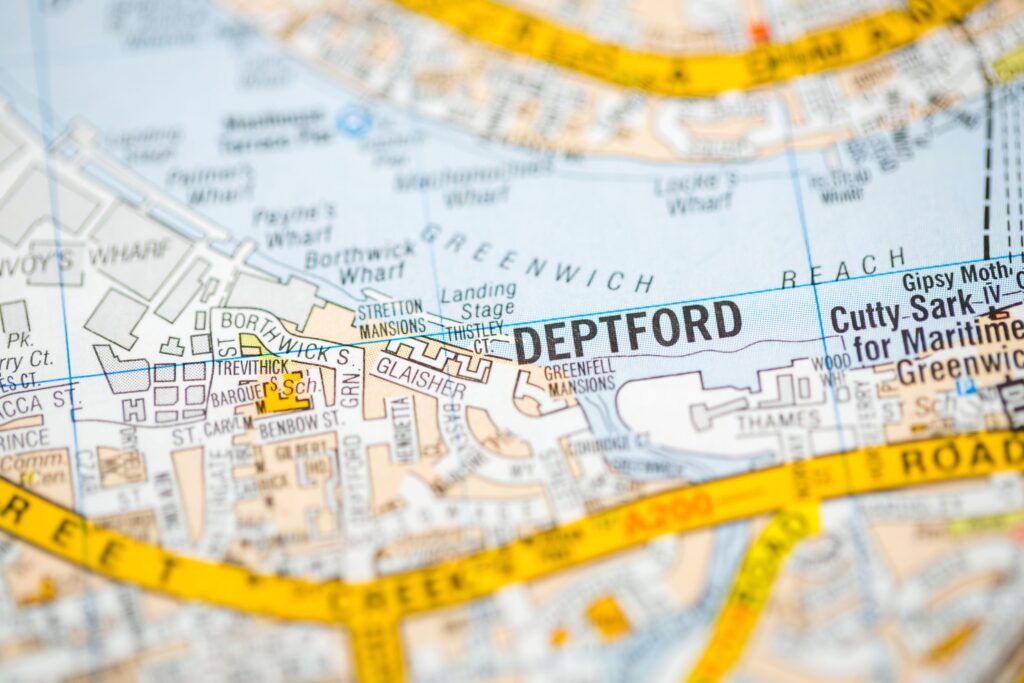
Deptford dreaming

Credit: Shutterstock
DEREK TURNER pays tribute to grittily resilient S.E.8

Aircraft always overhead, trains pulling in and out, traffic backed up along the New Cross Road, pulsating rap from open windows, plastic bottles in the gutter, pigeons with fungus-eaten toes, gang tags on gritty walls, smells of exhaust, fast food, sweat and the shower-gel of the highly made-up, high-heeled woman who just clicked by oblivious, while texting someone worth noticing somewhere worth noticing…

Drake, Blake, and Nelson look not down on us but rather out, over somewhere in the storied past before this unremarkable moment. A gilded galleon glints on the weathervane above them, a naval battle is taking place in the tympanum beneath their feet, and tritons uphold the front door.

Deptford’s Town Hall is a rare outpost of exuberance to find in an inner-suburban sea, a neo-baroque flourish built between 1903 and 1905 for the Metropolitan Borough of Deptford, with iconography reflecting the area’s long maritime history. It was never the most practical of buildings, but it has been increasingly inconvenient since the 1960s, when the Borough was eaten by the new Borough of Lewisham, which eventually sold it to Goldsmiths College. Today, its architecture is even more inconvenient – and the swaggering statues are worse than that, facing calls by ‘activists’ for their removal and erasure. They are too confident role-models for an era in English history that doesn’t much care for confidence – or even Englishness.

Drake could never have imagined such Angst-ridden arguments, as he waited aboard the Golden Hind alongside at Deptford on 4 April 1581, looking out for a very special visitor – Elizabeth I, come to honour his epic circumnavigation. Before evening, he would be Sir Francis, knighted aboard by the French Ambassador rather than the Queen, who however privately proud, could not be seen to endorse Drake’s more dubious activities. He was hitherto ensconced in an island nation’s mythology, an unmissable inclusion for the Town Hall architects seeking English ‘immortals’ to keep permanent watch above the New Cross Road. Blake could not have foreseen all this either, as he kept an anxious eye along the Thames corridor for the Dutch – and Nelson would certainly not have seen that signal.

The Golden Hind lay at Deptford (and stayed there until she fell to pieces) because Elizabeth’s father had established the King’s Yard – later, the Royal Naval Dockyard – there in 1513, on a convenient bend in the Thames, downstream from the crammed Pool of London, in the flatlands of the north Kent/Surrey borders. On 19 June 1549, the young Edward VI toured his father’s Yard, and was shown an after-supper spectacle, a mock-naval battle:

…a fort made upon a great lighter on the Thames … of which Mr. Winter was captain, with forty or fifty other soldiers … To the fort also appertained a galley …  Wherefore there came 4 pinnaces … which … with clods, squibs, canes of fire, darts … and bombards, assaulted the castle; and at length … burst the outer walls of the castle, beating them of the castle into the second ward, who after issued out and drove away the pinnaces, sinking one of them, out of which all the men in it … leaped out, and swam in the Thames. Then came th’ admiral of the navy and three pinnaces, and won the castle by assault, and burst the top of it down, and took the captain…

Deptford seen from Greenwich, early seventeenth century

Between 1513 and the Yard’s closure in 1869, hundreds of ships were built, fitted out or repaired at Deptford, making it an epicentre of English seapower on the edge of otherwise quiet countryside – a teeming townlet of hovels, smithies, stores, taverns and workshops, the headquarters of the navigational guild Trinity House, and grand houses of those who needed to be near to the Navy for reasons of duty or state. There were always secrets, troubles and valuables to be found at Deptford, locked up in statesmen’s offices or shipwrights’ desks, bonded in warehouses, guarded by marines, yarned about or perhaps passed over furtively in pubs, like the one in which Christopher Marlowe was stabbed to death by Francis Frezer in 1593, allegedly in a quarrel over the ‘recknynge’, although some think this was only a pretext, and the gay playwright was there on a secret mission for Elizabeth’s ‘spymaster,’ Sir Francis Walsingham. In 1993, we saw a tablet unveiled to him at St Nicholas Church, after a starry, strange dedication service during which Anthony Sher read from Tamburlaine the Great, Janet Suzman from Dido, Queen of Carthage, and Sam Wanamaker read Edward Blount’s 1598 reflections on his dead friend, while men dressed as nuns distributed leaflets about AIDS.

Christopher Marlowe

The Yard would remain a major strategic asset through the following century, when Blake knew the Yard, and after Restoration, Samuel Pepys and John Evelyn. Pepys came down here often on Admiralty business, busily commuting between here and his house in the City, his head full of practical reforms and quidnunc preoccupations. On 16 April 1661, for example, he diarized ‘Then we put off for Deptford, where we went aboard the Kings pleasure-boat that Commissioner Pett is making; and endeed it will be a most pretty thing.’

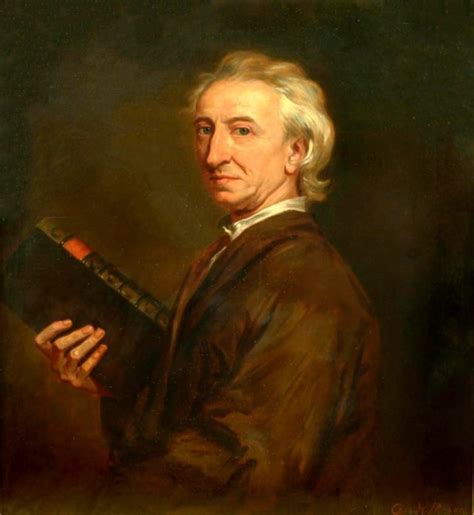
John Evelyn

John Evelyn lived in Deptford for forty years, fertilely for local legend. In 1658, a 58 feet long whale was killed off Deptford Strand, and another almost as big in 1699. In 1671, Evelyn came upon a highly skilled woodcarver in ‘an obscure place’ in Deptford, and was so impressed he introduced him to Christopher Wren and Charles II. Grinling Gibbons would go on to adorn some of the greatest houses of England.

Evelyn’s house was Sayes Court – a rambling brick house with a famous 100-acre garden, an experimental station and pleasure-ground for the romantic but also scientifically-minded author of Sylva (1664), one of the first and most influential books about forestry. Evelyn was devoted to his garden, and wrote copious maintenance and management notes under the title of Directions for the Gardiner at Says-Court, But which may be of Use for Other Gardens. A 1652 plan shows an elegant arrangement of ‘faire gravel walkes,’ fountains, grassy ‘plotts’, ‘long pourmenades’, box-hedged ‘par=terres’, an orchard and an evergreen thicket ‘for Birds private walkes, shades and Cabinetts’ – a haven of ‘choice flowers, and Simples,’ French walnuts and much else.

In 1696, Evelyn leased the house to Admiral Benbow, but found him a careless tenant. Worse came in 1698, when Evelyn, ‘asked’ by William III, allowed Czar Peter the Great and his entourage to rent Sayes Court while Peter was staying in England to study the latest shipbuilding techniques, as part of the modernizing monarch’s opening of a ‘window to the West.’ The towering, twenty-something Czar (he was 6 feet 7 inches tall) was none too careful with other people’s possessions. Evelyn’s servant reported to his master while the Czar was in residence, ‘There is a house full of people, and right nasty.’ Peter and his retinue trashed the house and garden, amongst other damage burning the bedding, using paintings for target practice, and crashing through an ilex hedge in a go-kart, causing the diarist to grumble on 9 June 1698:

To Deptford, to see how miserably the Czar had left my house, after three months making it his Court. I got Sir Christopher Wren, the King’s surveyor, and Mr London his gardener, to go and estimate the repairs, for which they allowed £150 in their report to the Treasury.

Sayes Court, John Evelyn’s house, in the early twentieth century

Evelyn’s painfully repaired paradise has gone, although there is a park on part of the site, with a twisted old mulberry tree on metal crutches (sadly, not one of his). Part of the house survived somehow, latterly as a workhouse, until the 20th century, by which time Deptford had long lost the Dockyard and most of its greenery, and become synonymous with urban deprivation. But other things have survived.

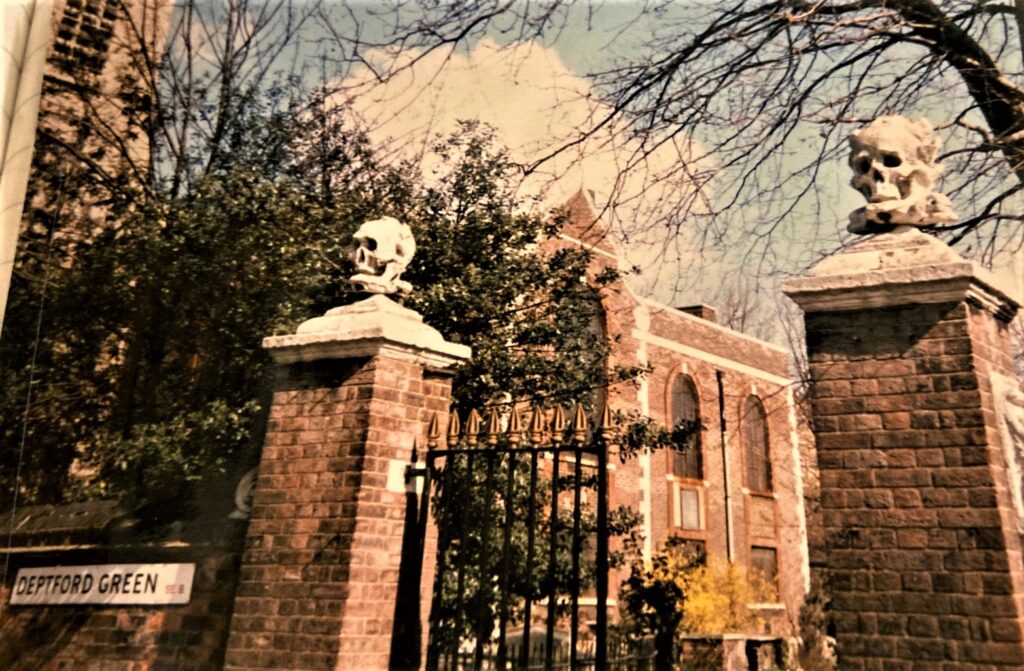
St. Nicholas’ Church – ‘I seemed to stand in a moralizing Georgian aquatint’. Credit: Derek Turner

The first time I saw St Nicholas’ Church, it was snowing, it was dark, and I seemed to be the only soul in all S.E.8. The cast-iron gates in the tall, thin eighteenth century brick walls were closed and locked, and there were no lights on inside the round-windowed church or charnel-house. Looming over, blacker than black, were the chunky medieval tower, the oldest building in Deptford, and overhanging yews – and straight in front, two great stone death’s heads surmounting the gateposts, with snow piled up on their laurel-wreathed craniums, the silence and whiteness accentuating the unfathomableness of their eye-sockets.

I seemed to stand in a moralizing Georgian aquatint, the churchly assemblage a cautionary note in the silent townscape, like a backdrop from The Rake’s Progress, or one of Rowlandson’s illustrations for The English Dance of Death – the ‘Horrid’ caperers that burst in upon the frightened Statesman, silence the Virago, wheel the Sot to his long louche home. Like the skeleton grinning madly in the Porter’s Chair, making that unfortunate operative recoil, the skulls of St Nicholas seemed to represent ‘What watchful Care the Portal keeps / A Porter He, who never sleeps.’

A sombre graveyard lies through those gates, most grass killed off by the yews, mud and mean needles giving acidic emphasis to the monuments to chandlers, merchants, shipwrights and John Evelyn’s beloved son, Richard, who died in January 1657 and is remembered searingly in the Diary:

[A]fter six fits of a quartan ague, with which it pleased God to visit him, dies my dear son, Richard, to our inexpressible grief and affliction, five years and three days only, but at that tender age a prodigy for wit and understanding; for beauty of body, a very angel; for endowment of mind, of incredible and rare hopes.

Evelyn probably hoped to see Richard again, because he was a believer in ghostly miracles, as suggested by a scrap of local lore he gave to the Royal Society, which ended up in John Aubrey’s Miscellanies:

…a Note under Mr. Smyth’s Hand [the Curate of Deptford] that in November 1679, as he was sick in bed of an Ague, came to him the Vision of a Master of Arts, with a white Wand in his Hand: And told him, that, if he did lie on his back three Hours, viz. from ten to one, that he should be rid of his Ague. He lay a good while on his back: but at last being weary he turned, and immediately the Ague attacqued him; afterwards, he strictly followed the Direction, and was perfectly cured. He was awake, and it was in the day-time.

Off-duty sailors too sleep under the yews, like Captain George Shelvocke, whose 1726 memoir A Voyage Round the World by Way of the Great South Sea included an incident that inspired one of English literature’s finest poems:

We all observed that we had not had the sight of one fish of any kind since we were come to the southward of the Straits of Le Maire, nor one sea-bird, except a disconsolate black albatross, who accompanied us for several days, hovering about us as if he had lost himself, till Hatley, my second captain … imagining from his colour that it might be some ill-omen, after some fruitless attempts, at length shot the albatross, not doubting, perhaps, that we should have a fair wind after it.

Instead, they experienced six weeks of constant bad weather – but the senseless killing of the bird did at least have one positive consequence decades later. In 1797, William Wordsworth, who had recently been reading Shelvocke’s book, mentioned the incident to Coleridge, who made it the central motif in Rime of the Ancient Mariner.

Sunset over the Pepys Estate. Credit: Derek Turner

An even ancienter rime connected to Deptford comes from Chaucer – ‘Sey forth thy tale, and tarie nat the tyme; / Lo, Depeford! And it is half-way pryme.’ The New Cross Road was the main medieval road to Canterbury, sometimes as thronged with pilgrims as it is thronged now with the profane. The ‘depe ford’ was not over the Thames, but the Ravensbourne – supposedly named in reference to the raven flags flown by Sweyn Forkbeard’s fleet, which rampaged up here in 1013 – which flows ten miles up from Bromley to debouch into the more famous river.

Deptford Creek, 1988. Credit: Peter Marshall

Deptford Creek is still a tiny port, where Kentish coasters go in under the lifting bridge (disgusting drivers, delighting me) and come alongside to unload aggregates. The river almost empties at ebb tide, revealing shining mud and shopping trollies perched on by herons. Cranbrook Road, that runs along the Ravensbourne higher up, carries the folk-memory of even less likely avifauna – the cranes that once must have danced and nested among reeds beyond fields. Henry Williamson, author of Tarka the Otter, was a local, and wrote an eco-story about the poor polluted bourne (today’s Ravensbourne is greatly improved), linking a human down-and-out living on its slithery banks, with the last lesioned fish gasping in its filthy flood. Old quay walls host unusual species of crabs and plants, and a little upstream a fig tree, legacies of exotica trafficked through here over years. Earlier incarnations of the bridge were long strategically significant for forces advancing on London, like those of Wat Tyler in 1381, Jack Cade in 1450, and Thomas Wyatt in 1554 – and the scene of a battle on 22 June 1497, when Lord Audley and his Cornish rebels were easily defeated by the Earl of Oxford.

Late nineteenth century postcard of Deptford Broadway

Today’s Deptford has been gentrified – it has a Waitrose, even a Dance Studio – but in the early 1990s it was often cruelly distinctive, surrounded by areas with their own pathologies – Bermondsey, Elephant and Castle, Eltham, Kidbrooke, Millwall, Peckham. It was a little bit of East End that had somehow come south of the Thames. My flat had been built on a road that in the 1930s had been occupied by businesses like Brisbane Laboratories, producers of liquid paraffin and hospital disinfectants, and the Floetta Liquid Soap Co. Ltd., suggesting not only the noxious air quality of those times, but maybe the nature of today’s underlying earth. In summer, drunks lay prostrate in the High Street – I once saw a pitiable woman urinating onto the aghast A2 at midday – and there were high levels of crime. A man pulled a knife on me in a park, luckily just swearing and running away when I – instinctively, stupidly – declined to hand over my wallet. More serious criminals featured frequently in the pages of the South London Press, perpetrators of carried-through muggings, ‘steaming’ attacks on the old slam-door commuter trains (gangs would pass through carriages and demand valuables at blade-point, leaping exultantly out and through the ticket barriers at the next station), and even fatal drive-by shootings. This was an area with some terrible memories – desperate poverty and squalor which long after infused the lurid novels of local boy Edgar Wallace, and which in the 1990s was still in evidence – the 1944 V2 bombing of Woolworth’s opposite Deptford Town Hall, in which 168 were killed – the never-explained 1981 New Cross Fire, in which thirteen teenagers died.

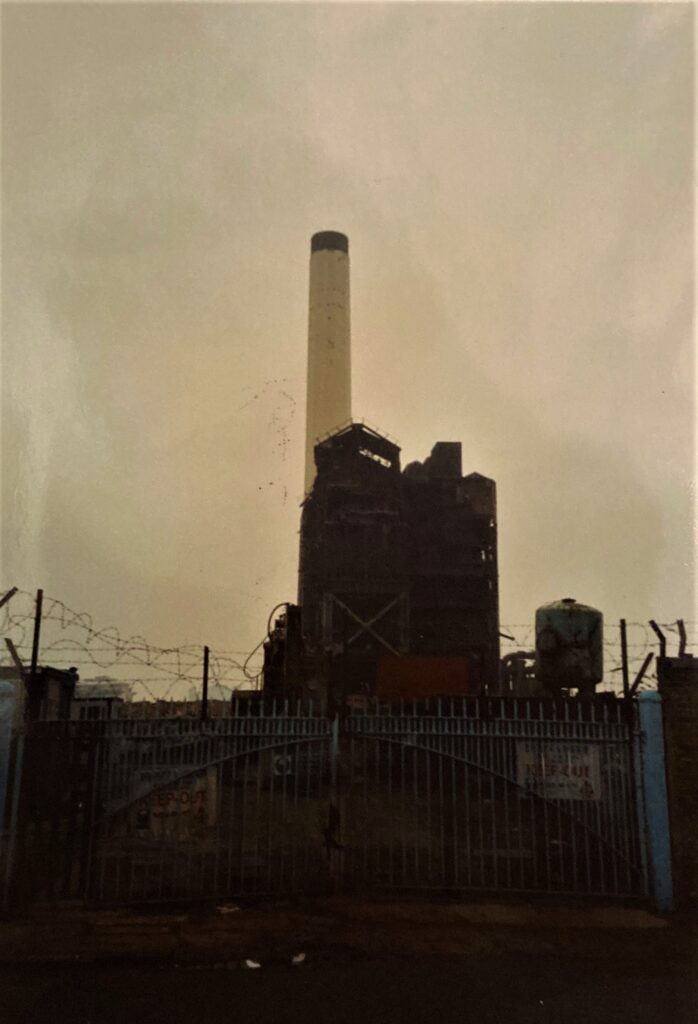
Deptford Power Station, being demolished. Credit: Derek Turner

But there were also striking survivals, like the trilby and tie-wearing rag-and-bone man who surreally drove his pony and trap along the frantic A2, stabling his animal down a cobbled lane just behind Deptford High Street. Another cobbled street called The Stowage led to ‘The Light’ – Deptford Power Station, then recently closed, but whose chimney still stood gaunt landmark above SE8 – between scrap yards patrolled by Alsatian dogs that would throw themselves savagely at the corrugated iron fences when they heard you passing. Staff said the basement of No. 2 Turbine-Generator was haunted by those who had died on the gibbets alongside the dry dock. 

Watergate Street. ‘There were alleyways where you could get right down to the water’s edge.’ Credit: Derek Turner

Not far off were the surviving Georgian gates to the Victualling Yard, with their classical frieze decorated with bucrania (cows’ skulls linked by floral swags), an allusion to Greek and Roman ritual sacrifices. Suitably close was the site of grosser sacrifices, the hugely, horribly busy Foreign Cattle Market of the Victorian and Edwardian periods. In 1907 alone, 184,971 cattle and 49,350 sheep passed through the Market, many to die in the attached slaughterhouses with their notoriously heavy drinking ‘gut girls’ (who could have blamed these women for drinking to forget their days?) There were alleyways where you could get right down to the water’s edge, with cattle (or maybe whale!) bones visible at low tide, amongst dark and viscous sludge. Elements of these animals must have passed across the well-scrubbed surfaces of Wellbeloved’s, a family butcher which had carried on the same business in the same premises since 1828, and only closed in 2021.

St. Paul’s Church, ‘pearl in the heart of Deptford.’ Credit: Shutterstock

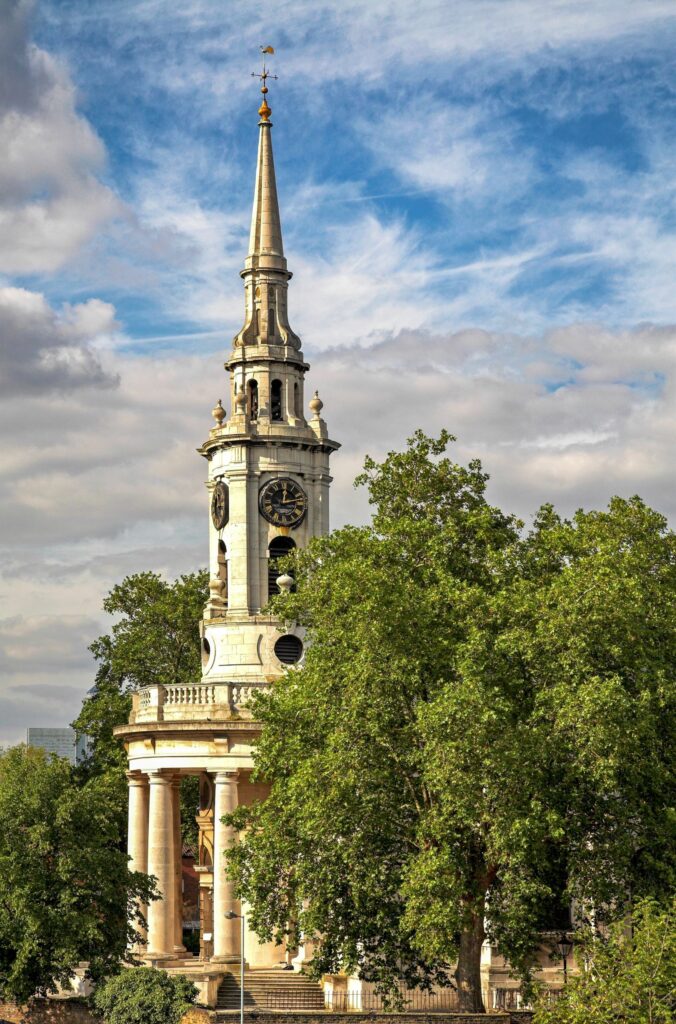
Albury Street had grand Georgian doorcases, plaster cherubim with dimpled knees holding up lead canopies over old sea captains’ houses. Nearby was St Paul’s church, John Betjeman’s ‘pearl in the heart of Deptford,’ an eighteenth century beauty built by Thomas Archer, famous for St John’s, Smith Square. Charles Burney, who was vicar and organist here between 1811 and 1817, was a son of the eponymous and celebrated music historian. He was also brother to James, who travelled with Captain Cook, and Fanny, author of Evelina. He also ran an academy for the sons of local naval officers, so severe that he provoked a rebellion by pupils, who barricaded themselves into the school and beat him with sticks when he burst down the door. In less choleric moments, Burney was a renowned classicist, collector of books and ephemera (who sold his collection to the British Museum for an impressive £13,500), and royal chaplain.

There were some of the oldest surviving shops in London, including a tailor where smirking men made vinegarish comments about the people passing outside as they measured lapels and inside legs, in a 1650s cubbyhole made even darker by racks of tweeds, and 1970s photos of hirsute men wearing flared trousers made of alarming cloths. There was even the last smithy in SE8, where I had burglar bars made by a hatchet-faced and taciturn man in a tiny forge smelling of hand-rolled cigarettes and hot steel. This tiny iron underworld felt at one with all the other outdated crucibles of identity, from shipbuilding and milling to imperial imports and industrial oils – all of them contrasting with, yet also oddly complementing, the elegant churches and stories of Tudor, Stuart and Georgian derring-do.

Outside grand Victorian villas on Lewisham Way stands Deptford’s 1930s war memorial, a stele with a stone flame on top, and a staring-down soldier, his rifle pointing to the ground – an irrelevantly outdated symbol, yet at whose feet every year the red poppies are renewed. All things combine, come together as symbols of a suburb past and present – a place that has changed, is always changing, but where even now old memory has not been entirely erased.

Crises of a confidence-man

The Man Who Conned the World: Victor Lustig

Christopher Sandford, The History Press, 2021, 300pp, £20

DEREK TURNER is forced to admire a brilliant rogue

Christopher Sandford is an acknowledged expert on the cultural history of the twentieth century, who has written to scintillating effect on subjects from the Rolling Stones to Arthur Conan Doyle, and cricket to Roman Polanski. But Victor Lustig may be his favourite subject to date – a man of boundless energy, ingenuity and resource, all of which were unfortunately expended entirely to society’s detriment, and ultimately did not even do him any good. The result is an engrossing, funny and wise account of the wasted (or worse than wasted) life of an extraordinary con-man, and a reflection on the constancy of human credulity.

Lustig was born Robert Miller/Molnar/Mueller in 1891 in Hostinné, presently in the Czech Republic, but historically part of battled-over Bohemia. This seems a suitably indeterminate birthplace for a Mitteleuropaïscher on the make, who during his fifty-six years on earth would use no fewer than forty-five aliases as part of his constant effort to separate marks from their money, and extricate himself from the criminal justice systems of several countries.

If he was frequently fortunate, he also made his own luck, and like the U.S. G-men and T-men who doggedly pursued Lustig during his 1930s and 1940s heyday as arch confidence-trickster (a C-man, perhaps), Sandford is compelled to admire Lustig’s intelligence, resilience and supreme self-belief. So are we, as we read about such exploits as the sale of the Eiffel Tower to a scrap-metal merchant, his elegantly carpentered “Rumanian box” which made hundred dollar notes, and his unique achievement in cheating Al Capone out of US$7,000, and living to brag about it. How can we not marvel at a man who forged a “newly discovered tale” by Mark Twain, and who when belatedly asked about its provenance by the suspicious magazine (that had already published it), not only talked his way out but managed to sell them a handwritten poem by “Walt Whitman”?

Gullibility is perennial in human history, a proposition famously proven by Charles Mackay in his 1841 Extraordinary Popular Delusions and the Madness of Crowds, and encapsulated by the notorious aphorism usually attributed to P. T. Barnum, “There’s a sucker born every minute!” But Lustig was lucky in the period in which he started practising his sociopathic skills – the turbulent, badly-governed and later wounded world of the immediate pre-Great War and then interwar periods, when both Europe and America over-brimmed with charlatans, frauds, hoaxers, hucksters and showmen who knew how to capitalize on crises of civilizational confidence and economic volatility.

Some hoaxes were harmless. Virginia Woolf and several friends embarrassed the Royal Navy in 1910 by donning blackface and dressing gowns, and touring HMS Dreadnought as visiting Ethiopian royals. In 1912 came the fossil ‘Piltdown Man’, a sensational ‘missing link’ between apes and men, a science-upturning skull from Sussex which had in fact been confected from a medieval human, an eighteenth century orang-utan jawbone, and twentieth century baboon teeth. In 1917, two little girls cut out drawings of fairies and took photographs of them in their Yorkshire garden, which convinced Arthur Conan Doyle that there really was another reachable dimension in which fairies (and his war-fallen son) might co-exist. 

Other hoaxes were crueller, rooted in what Wolfgang Schivelbusch calls the ’culture of defeat’, that swept over much of Europe after 1918 – an umbrageous mood characterised by seething class and ethnic resentments, millions of displaced persons, cultural crazes from manic dancing to miracle cures and spiritualism, and desperate navel-searching for meaning, purpose and security. Even the victorious Allies had their Bright Young Things and frantic flappers, possibly overcompensating for the deep sorrows of older generations, whose complacent pre-war universe had been bespattered with the mud and blood of their sons. America, which had come best out of the conflict, and was about to enter the ‘Roaring Twenties’, was filled with restless excitement, and examples of real-life get-rich-quick schemes that many aspired to emulate.

We are introduced to, or reminded of, the existences of John ‘Maundy’ Gregory who sold peerages on behalf of David Lloyd George’s government – Stephane Otto who masqueraded so convincingly as a Belgian royal that she pinned the Order of Leopold onto the officer commanding the American troops on the Rhine – and Jerome Tarbot, a decorated combat veteran and respected lecturer on the Somme, who had in truth spent the war years stealing cars in California. In 1919, the fraudster Arnold Rothstein fixed the baseball World Series between the Chicago White Sox and the Cincinnati Reds. In 1920, came the collapse of Carlo Ponzi’s pyramid-buying scam, entailing an estimated loss to investors of some US$500 million in today’s terms, and giving the world a new, unwelcome word.

‘The world’ of course did not learn from these experiences. Most of us have naïve blind spots, and people can always be found to hearken to hucksters, and give credence to quick-thinking, respectably-dressed people who tell them what they most desire to hear. Some victims of confidence-tricksters become so ensnared that they remain loyal to them even after they are exposed, so reluctant to face up to their initial bad decision they make themselves double gulls.

Lustig was just one of many 1910s-1940s flim-flam merchants who knew how to present themselves convincingly, and proffer tantalizing easy answers, quick fixes and ‘sure-fire’ schemes. But he was almost certainly the most systematic, devising his own conventional morality-mocking ‘Ten Commandments of the Con’, which include such cold-blooded prescriptions as ‘Be a patient listener’, ‘Never look bored’, ‘Never boast’, ‘Never get drunk’, and letting the other person reveal their political or religious views and then agreeing with whatever those happen to be.

Lustig was also the most expert, thanks to his very considerable level of culture. He was able to speak five languages when still at school, and would later be an opera buff, and a competition-level chess player. With such acuity allied to unscrupulousness, he could pass himself off easily as millionaire, sober businessman, leading banker, insurance company executive, senior civil servant, medical expert, medium, art dealer, theatrical impresario, or displaced aristocrat.

Such a man could clearly have succeeded in many legitimate ways, but legitimacy would never be enough for this inveterate seeker after excitement and novelty. He said in later life that he had never wanted ‘a timid but steady progress [towards] the grave,’ and by the age of sixteen he was already cheating at billiards, running horse-race betting scams, hanging out in bars with what German police files called ‘louche and mutant types,’ and in rented-by-the hour rooms with prostitutes. Details of his early escapades are scanty and unreliable, revealed only by such police dossier vignettes and his own fragmentary and self-serving diary, and reminiscences to his daughter Betty, or to US federal agents at the end of his career.

Lustig always emphasised his hardships as a young man living by card-sharping, magical illusions and larceny in Vienna, and frequently portrayed himself as an understandable rebel – a kind of struggler against an unjust system, blaming his criminal transgressions and cynical worldview on abysmal examples set by society. He expressed support for women’s suffrage, and sympathy for black Americans. But all such pretensions to a social conscience were rarely, if ever, given practical effect. If sometimes he swindled people who were themselves swindlers, he never made any Robin Hood-style restitutions. When one of his schemes resulted in many working-class bank account holders in Kansas losing all their life savings, Lustig’s only recorded comment was ‘fools.’ As Sandford notes, ‘…he was really in the business of wealth redistribution for himself.’ He skated through life, largely unheeding of anything outside himself; on a day in October 1915 when the London press were reporting 60,000 British casualties at Loos, the then London-based Lustig’s diary contained three words: ‘Cleared another £400.’

He spent whatever money he accrued almost immediately, hedonistically on women, but also tactically on expensive clothes, luxurious accommodation, cars, chauffeurs, lavish sweeteners, and other appurtenances that allowed him a semblance of sleek respectability to facilitate his next con. He segued un-snobbishly from high society to low, and back again, along the way bumping into extraordinary people. He once gave a generous tip to, and had a pleasant conversation with, a young Indo-Chinese dishwasher working in London’s Carlton Hotel, who would later become Ho Chi Minh. He consulted Carl Jung about his dreams – ‘an odd juxtaposition,’ as the author notes, ‘the one man intent on revealing the inner psyche and the other one equally determined to conceal it.’ There is a story (unfortunately unprovable) from the FBI files that Lustig met his contemporary Adolf Hitler in Vienna, at that time like Lustig a charismatic and restless drifter in search of some kind of opportunity. He admired Lucy LeSueur’s ‘wide, hurt eyes’ and ‘great maternal orbs’ – assets which would prove useful in her later incarnation of Joan Crawford. Rudolph Valentino told him he should try for a Hollywood career.

He was almost always at least one step ahead of the harried Feds, and became an object of obsession for more than one lawman, most notably his eventual nemesis, the remorseless and tough Peter Rubano, a war veteran and mobster-buster of whom it was said ‘when he shook your hand, it stayed shook.’ Lustig’s slipperiness was legendary; he had a fine instinct that always allowed him to leave his hotel at just the right moment, sometimes in a swiftly-donned disguise, or shinning down drainpipes to join his chauffeur waiting out the back, perhaps literally with the engine running. Even when he was apprehended, he always managed to oil his way out, right up until the end of his career – through smooth argumentation, judicious bribes, jumping bail, or by simply promising to leave town immediately to save local blushes. Once, after being questioned for passing fake currency in Connecticut, he persuaded the judge that it was a case of mistaken identity – and was asked by the apologetic local police chief to lecture his officers on how to recognize forged notes. 

Victor Lustig

There is sometimes a tendency to view con-men as almost lovable rogues – “social anarchists”, to use Sandford’s phrase – whose crimes are ‘victimless’ because they prey chiefly on institutions or the rich. But he left a trail of anger, betrayal, disillusionment, embarrassment and financial ruin behind him as he moved from Europe to America, and then endlessly within his unlucky adopted country. His two wives, and daughter, were only the most obvious victims of his peripatetic, selfish and thrill-seeking mode of existence. He was even a victim himself. As the author notes;

At heart, the confidence man really deals in the disintegration of lives, his own as well as his victims.

His daughter said the first words she was taught were ‘Never speak to the police’ – a sad remembrance, which hints at the endless effort and sheer tension involved in a life like Lustig’s, who could never really relax. At times, even he showed signs of tiredness, like in a diary entry for 1935, just before Peter Rubano finally caught up with him:

We struggle. We reach. And what is there at the end? A clod of dirt flung down upon the coffin lid.

Nor could he ever really be himself. Did he even have an ‘himself’’ – any real feelings behind all those masks? Was he more than just a bundle of ingenious stratagems? A Times obituarist noted of another notorious fraudster, Horatio Bottomley, that he was ‘more a set of public attitudes than a person’ – and a similar sense of insubstantiality clings to Lustig. It is possible almost to feel sorry for him, a friendly man without friends, a restless and lonely whirligig whose superlative gifts in the end amounted to less than nothing.

But then we think again of the real victims – and of the irrepressibility of the man himself, who even after his arrest played games with Peter Rubano, and enraged FBI boss Edgar Hoover by his last great exploit – escaping spectacularly in the middle of the day from Manhattan’s maximum security prison, climbing down a rope made of sheets, watched by hundreds of passers-by.

By December 1935, he had been recaptured, and was sentenced to twenty years – fifteen for counterfeiting, and five for the escape. The following March, he was sent to Alcatraz, where he beguiled his ever-restless intellect by making vexatious medical requests (about one every three days). When the war broke out, he began writing long geopolitical screeds, and offered his services as an assassin, saying that if he could be airdropped into Germany he would make his way to Berlin and poison Hitler’s pastries – an offer inexplicably declined.

By the time he died, alone in a prison hospital in March 1947, this ultimate freewheeling individual had been largely forgotten. He had just over $93 in his only known bank account, and a few notebooks as personal possessions. But a strange kind of tribute came at his funeral, when the only mourner other than his daughter were two men from the Prison Bureau, as if the authorities were ensuring that this wasn’t just one last trick. It makes an apposite end to this story, of a man even now an enigma.

A road by any other name…

Shutterstock
DEREK TURNER takes a Brum road-trip

What’s in a name? A great deal – so Birmingham City Council hopes. In December, as part of a £500m redevelopment of the city’s blighted Perry Barr district, it revealed the names of six new roads to “reflect community and Commonwealth sport values”. Diversity Grove, Equality Road, Destiny Road, Inspire Avenue, Respect Way and Humanity Close will shortly be adorning the Birmingham A-Z, and by 2023 residents will be giving their addresses embarrassedly to Deliveroo drivers.

Potential names were submitted by “the public”, and selected by a panel led by local politicians. According to one member of the panel, there was

…an impressive submission of entries that epitomised not just the core values and culture of Perry Barr but encompassed what the area is all about.

Puzzled Brummies immediately took to social media to wonder why none of these had been chosen.

According to the competition criteria,

Street names should ideally have a local connection, which is historically, geographically or culturally relevant.

Yet these names do not obviously have a particular Birmingham connection, and arguably not much “relevance” anywhere. These are not place-names for posterity, but sermons by street-furniture. Another Birmingham thoroughfare comes irresistibly to mind – Needless Alley – and a Lincolnshire road I noticed recently, Labour-in-Vain Drove.

Insofar as Diversity, Equality, Destiny, Inspire, Respect or Humanity do have real-world application, it may not be one all Brummies can embrace unreservedly. Elevated language frequently has less elevated applications; as Tacitus, quoting a subjugated Briton, noted of his own people, “they make a desert and call it peace”.

But then the Handsworth heroine who ‘thought’ of these names is a forward-thinking missionary, and above such earthly considerations. Social media sleuthing unearths wholly expected attitudes, a humdrum hashtaggery – BLM, Corbyn, DecoloniseBrum (and Yorkshire, while she’s on the subject, which is probably quite often), Israeli “apartheid”, race quotas, Tories hating the poor. She nurses an impressive dislike of James Watts’ business partner Matthew Boulton, judging from the many photos of Boulton-related Birmingham place-names onto which some monomaniac has Blu-Tacked typed ‘recontextualisations’. This is a lady who trends. The comical bathos of her toponymy exposes a hole in the heart of 21st century Brum, and Britain. In the land of the bland, the cliché is king. David Brent’s song Equality Street was a cynical ploy, and a good joke; Equality Road is less desirable.

Names have always been surrounded with superstition. As it says in 1 Samuel, “As his name is, so is he”.  Puritans aimed for Elect-ion by giving children hortatory names – Charity, Faith, Goody, Hope, Praise-God. Their Godless heirs try to be ‘Goodies’ in their turn by naming places after equally insubstantial ideals, chasing contemporary chimeræ with the same guilty enjoyment Ranters devoted to Revelations.

The coiner and adopters of these names clearly hope that, in the words of the 1791 ballad, Song on Obtaining the Birmingham and Worcester Canal Bill, “Twill prejudice stifle, and malice strike dumb”. A Conservative councillor who chortled at the new names as “Woke Way” was chided by the panel’s chair –

It is disappointing that Cllr Morrall does not appear to share these values or respect the views of the selection panel.

Behind these primly freezing words stretches a bleakly unwelcoming England, where human nature is to remade every morning, long-standing landmarks are to be levelled, and taken-for-granted things are to be taken. It is the same world, but a different planet – an alien environment with an atmosphere of noxious gases, and governed by platitudinous correctness. This may not be The Road to Serfdom, but it does resemble a Road to Nowhere. To turn around that property market cliche, “No location, no location, no location”.

Street-naming has historically been a form of culture-cleansing, warfare by other means, as incoming regimes impose their moral and social preferences on the losers. Names like Revolution Road, or 5th October Avenue, have frequently been inflicted on harmless highways, although sometimes only temporarily. Russia has reverted to many pre-1917 names – but the Cold War’s ‘winner’ has been convulsing its cultural cartography in response to radical social shifts, frenziedly naming roads after Martin Luther King, and recently even George Floyd. Is this ‘respect’, as is claimed – or is some less edifying emotion? Perhaps even fear? Renamers often seem not quite to know what they are doing, or why.

Romans Latinised England’s infra dig Iron Age trackways, and Normans Frenchified Saxon nomenclature. Socially-uncertain Georgian and Victorian town councillors sanitised suddenly shocking streets, exemplified by the “Grape Lanes” still seen in British cities – a gloss on “Gropecuntlane”, alluding to the ancient presence of prostitutes. They also sought to sweep away what they saw as irrelevant remembrances of the past – thus the 19th century rash of Gas Streets and Station Road (plus some more pious thoroughfares, often echoing religious revivals, like Fortitude Street or Temperance Road). They delivered a shiny new modernity, lavishly bestowing the names of engineers, explorers, generals, industrialists, missionaries, monarchs and planters on newly set-out streets, valorising the villas of the newly-rich and crowning even workmen’s terraces with classical and imperial motifs. Today’s craze for naming streets after Nelson Mandela, Windrush passengers, or Guru Nanak is a case of the Empire striking back.

Birmingham has always been busily Promethean, and has attracted the worst as well as the best kinds of change. Emma’s Mrs Elton expressed a common prejudice – “One has no great hopes from Birmingham. I always say there is something direful in the sound”. Two centuries or so on, the pleasant local accent ranks at the bottom of those unofficial but oddly powerful ‘trustworthiness’ surveys that appear spasmodically in the media, which are subliminally influential on those deciding where to site call centres and other industries. This is to ignore utterly the city’s shining other side – geniuses like Joseph Priestley, the kindness of the Cadburys, the civic pride of Joseph Chamberlain, the excellence of the CBSO, the many thousands of hardworking and respectable people.

The municipality has at times been badly served by its agenda-setters and political leaders, and modern Birmingham still bears the scars of the overlong incumbency (1935-1963) of Herbert Manzoni as City Engineer and Surveyor. Manzoni bequeathed Brummies a brutalist, traffic-blasted landscape at colossal cost, and his Bull Ring and Inner Ring Road are now being superseded at even greater expense. Manzoni’s views on Brum’s old buildings betray an absolute absence of imagination –

I have never been very certain as to the value of tangible links with the past… As for future generations, I think they will be better occupied in applying their thoughts and energies to forging ahead, rather than looking backward.

His epic incomprehension is echoed in the ostentatiously ‘socially concerned’ but secretly ruthless language of ‘decolonisation’ and ‘diversification’. These six roads in question may be new roads, but they are built on the thrown-down past. They are really different kinds of demolition, and their impossibly tangled rationales are the ideological equivalents of Perry Barr’s unsavoury neighbour, Spaghetti Junction. The Brave New Birmingham Manzoni and others brought was obsolete even before it was finished – and their “forging ahead” is now our inconvenient and shameful past, for which we must all undergo a painful and undignified procedure of deconstruction, and decolonic irrigation.

As Perry Barr booms and clangs with the din of earth-movers and pile-drivers, so the British imagination is being constantly razed and rebuilt, our inner and outer landscapes a permanent building site. Perhaps one day even the proud Handsworth heroine’s streets will become embarrassments, banal vestiges of a patronising political tradition and a worn-out West no longer ‘relevant’ to the Brum of 50 years hence.  

Stuff and nonsense

The Culture of My Stuff

Adam Crothers, Carcanet, 2020, 84 pps, £10.99

DEREK TURNER finds a celebrated poet’s latest collection dazzling but lightweight

This slender assemblage comes weighted with prestige – Adam Crothers’ prize-winning history (Shine/Strong and Seamus Heaney Centre in 2017), and endorsements of his latest offering by equally well-regarded contemporaries. But any potential ponderousness is undercut even before opening. These are “political nonsense rhymes”, says the back cover. It is “a joybomb of wit, play, sass and Heideggerian thinginess”, Caoilinn Hughes enthuses – “linguistic pirouetting”, smiles Susannah Dickey – while for Thomas McCarthy, Crowther’s unmistakable Ulsterness has been given “a metallic spray-job in some garage near the English fens” (Crothers lives in Cambridge).

“Sass” has probably never been applied to anything truly substantial, and “linguistic pirouetting” sounds ominously like riddling for riddling’s sake. The terms are therefore unfortunately applicable to this corpus, notwithstanding many excellent qualities. McCarthy’s motoring metaphor may get closest of all, because these poems feel full of restless discontent – and below their pearlescent pigments you can see a running-to-rust cultural chassis. Crothers’ work glisters with novel imagery, unlikely rhymes, and humorous self-awareness, but all these painterly effects take priority over the bits of the vehicle that need to touch the ground.

The poems feel oddly evanescent, although they mask an ostensibly rational materialist philosophy. “Stuff” and “culture” in this worldview are almost-equivalents, as if culture derives ultimately from possessions. Clothes mostly make the man according to this outlook, culture is contextual and life transactional, and poetry is more about musicality than meaningfulness. The most irreducible ideas, identities, and issues are seen through a reductive prism, as if Brexit, colonialism, nationalism, Protestantism, the Troubles, Trump, the ‘male gaze’ and other conventional talking points are mostly traceable to the murky operations of markets, and Western moral bankruptcy. To go back to the back cover, Crothers is “unable to transcend the consumerist violence of the world”.

This is a glittering sports car being driven at speed across broken country; you admire, and sometimes wince, as you watch. And the poet may half-know, in ‘Cernunnos’ lamenting the

vocabularies of being away. 
Vocabularies of an absent god. 

Elsewhere,

Hell is other people having one hell of a year 
Heaven is a half rhyme. God is queer

Is he avaunting the Void with his vast cleverness?

It feels difficult to care about archly-evoked STDs –

“Well excuse me while I feng-shui the universe 
To accommodate your double-parked aura! 
There’s something impolite behind your arras”.

It is tempting to flick past the rhyming dictionary-reminiscent

“dead mirrorballs throwing shades like it’s panties 
Over my ruckus, I can scarcely hear Dante”

or the improbable pairings of blink, skink, mink, kink, stink and plinks in ‘Parrhasius’.

Yet there are fine moments when the playfulness is put away, as in ‘Muntjac’, a cold camera-trap snap of ultra-alertness –

“The night’s stick
Snaps beneath a beautiful frigid hoof. 
Faith, frighted, yields what little ground was gained.”

It feels like genuine tenderness in ‘Goldfinch’ –

“Of the two finches glimpsed in the garden 
I can filch no vocab to farewell the gone one”

But then the showing off comes surging back, like the wit-for-wit’s-sake ‘Deriding a horse’ –

“Slag nag. It’s nigh ridiculous that you’re 
The gal in gallop and the can’t in canter 
The sad in saddle-sores on the Infanta 
Persisting in your grand vainglory. Lor”

To quote his ‘Nugget’, such touches make the reader want to “Make like the sheepdog and get the flock out of there”.

And this is a shame, because behind all the flourishes there is feeling, beyond the artifice a sense of a likeable man astutely alive in our too often nonsensical world.