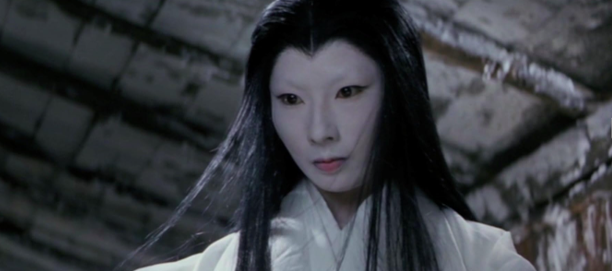
Woman of the Snow (second segment of Kwaidan)
Directed by Masaki Kobayashi, 1964
The Snow Woman
Directed by Tokuzō Tanaka, 1968
LAWRENCE FREIESLEBEN gets to grips with ‘W’
It’s easy to have an escalated memory of certain films, books, music or paintings. In film, this can be particularly evanescent: an image or tone, a line of speech, the fleeting expression of one of the players – or in the case of the 2010 documentary, The Woodmans, (director: Scott Willis) – the expression or gestures of a non-fictional person, maybe self-conscious or recreating a memory, but not fully acting. The Woodmans was the intriguing film I first intended to write about . . . but its incidental display of privilege, wealth and relative success, eventually ground me down. Francesca – the photographer daughter – is the most notable member of the Woodmans family and although her work can be a shade formulaic, it is frequently mysterious and powerful, as seen here.
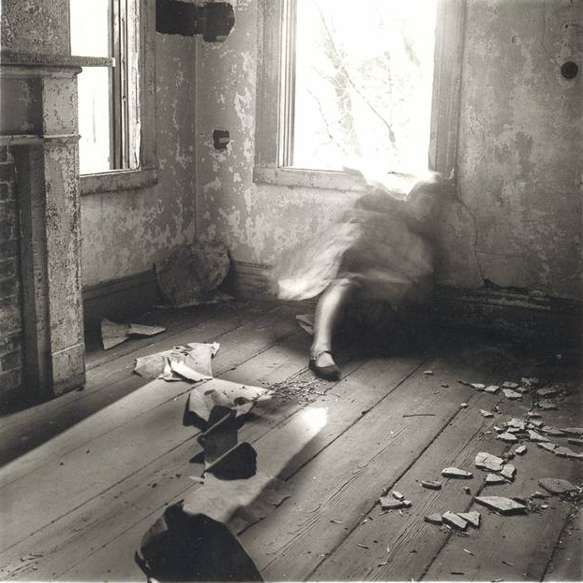
House #3, Providence, Rhode Island, 1976, by Francesca Woodman
After Francesca Woodman leaves the story by suicide in 1981, aged only 22, the other Woodmans are inevitably left with a haunting burden of grief . . . yet remain fortunate as artists – artists with a modicum of talent who could always have lived the art life whether or not they succeeded in sales terms. It is to their credit that they carried on trying hard. They believe in their work and its value, despite that it is often little more than decorative. In other words, second time around, the film did not live up to my empathetic and escalated memory of it. Or perhaps the chords which concealed its faults were no longer binding?
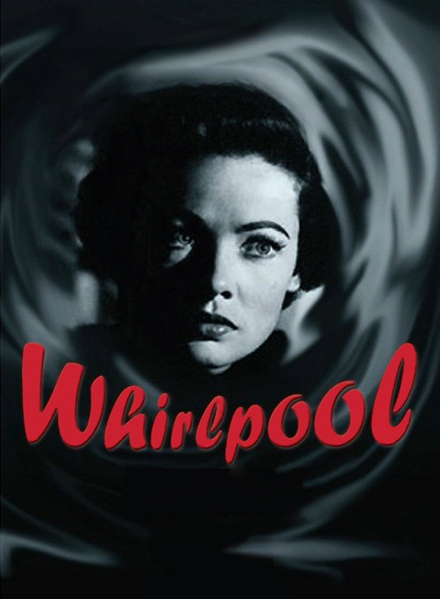
With Whirlpool[i] (1950, director: Otto Preminger) I got further, appropriately spiralling down into its enjoyable hogwash, notwithstanding the difficulty of accepting natural crime kingpin, Richard Conti, as a bowtie-wearing psychoanalyst! Cynical witticisms regularly illuminate the shadowy ruined coastline of Noir, and their serrated architecture can memorably survive long after many of the films’ enveloping, invasive tides have receded. Lines such as “a successful marriage is usually based on what a husband and a wife don’t know about each other” (00:11:32[ii]) are naturally amusing.
Regardless of how plausible or implausible the whole premise of Whirlpool is, especially self-hypnosis (once self-hypnotized against pain, surely, you’d also be hypnotised against a sense of caution and danger?) for me Whirlpool remained enmeshingly tense. It was entertaining as well, to spot the numerous parallels with the much more successful Laura (1944)[iii] – also directed by Preminger and starring Gene Tierney. But all this was not sufficiently enlightening[iv], and while I was very glad to see it again, it’s hard to violently disagree with some of its negative reviewers[v]. I needed to recall a film that could be inhabited. A film as commandingly hypnotic as Vertigo (1958) whose deepest scenes can distort and expand so much from memory or mistaken impression, that the actual film itself can become a distraction[vi]. Plot and sequence, characters and meaning . . . can all seem relatively irrelevant. In such a state, I no longer want the Hitchcock-directed, finished film, only the intensity or visual poetry beyond certain scenes. What stays cloaked just out of reach or can be sensed at the back of the head, is closer to the true source. Perhaps the best films, even much of the best art, draws on sublimated or unconscious archetypes or anomalies, and once these are activated or vaguely felt, the surfaces of the art itself can become an interference, a fading static? With Vertigo, I sometimes want a sense of time and anti-time, the texture of dark forests and the escape from them, the sweep of the high red bridge and a flight without it, the swell of waves (or studio tanks), the feel of old Spanish settlements, the tilt of the streets, distinctive coastal trees such as those at Cypress Point . .
Consequently, I remain very drawn to the idea, in Vertigo’s case, of the San Francisco area[vii], despite that in reality, the locations used are widely dispersed and their relationships with each other, as well as their physical appearance 68 years later, would likely be a disappointment[viii].
Recalling a film I could inhabit, a confusion occurred. Apparently, the Japanese title of The Snow Woman 怪談雪女郎 (Kaidan Yukijorō) can be translated as Tales of the Snow Witch or Ghost Story of the Snow Woman, and I believe I originally watched the 1968 film under the title Woman of the Snow. Since the justifiably famous Kwaidan[ix], directed by Masaki Kobayashi and consisting of four ghost stories[x] was released four years earlier, and one of its stories was entitled Woman of the Snow, perhaps the later feature film, was at some point, retitled to avoid confusion? Both films, (the 1964 Kwaidan story, at 42 minutes, is about half the length of Tokuzō Tanaka’s 1968 feature), are adaptations of the same Japanese folktale made internationally popular in 1904 by Lafcadio Hearn’s collection, Kwaidan: Stories and Studies of Strange Things. Both films have an atmosphere, at sudden or creeping moments, of breaking through the rushing static of what we like to think of as “reality”. Both films relish the fierce calligraphy of their titles, although with Kwaidan – the complete film – calligraphy becomes almost a character in itself – particularly in The Story of Mimi-nashi-Hōïchi or Hoichi the Earless[xi]. Calligraphy as a weapon. Calligraphy as a stockade.
Poetically concise, the production style and painterly studio backgrounds of Kwaidan’s Woman of the Snow episode (1964), are exquisitely abstracted yet also metaphysically challenging – conjuring a hyper-reality way beyond surrealism. On the other hand, The Snow Woman, of 1968, with the extra space of its longer story – increasing the tension between mortal and immortal, the vulnerability of the elemental in a corporeal world – probably attains a more haunting poignancy, a deeper sense of the tragic? Its Snow Woman feels more torn. Rewatching both films, I find the merits of each too considerable to want to elevate one above the other. They are both unmissable. Their more extreme moments possess a valiant character – the challenge of the wish, the contempt of the supernatural toward the human drone.
The Woman of the Snow episode, directed by Masaki Kobayashi in 1964, begins within Kwaidan at 00:39:55. Kwaidan’s style as a whole, its drama, lighting and score[xii] are theatrical as well as startlingly innovative. In contrast to The Snow Woman’s frequent use of real landscapes (notably in its opening mountain forest scenes) Kobayashi filmed inside an aircraft hangar, in which, art director Shigemasa Toda, and set decorator Dai Arakawa, created vivid symbolic skies, map-like symmetrical forests and a brimming river – its magical overflow sparkling like silver foil. At first these scenes are buried in drifts and flurries of snow, with only the red flag of the absent ferryman to alarm a wintry palette. This red of danger, signalling the margins of some fever zone, stays imprinted in the mind. Under whited-out or painted skies, impressionistic, clear or churning, from hopeful and spacious to claustrophobic and doomed, the lives of the characters become archetypal.
While in the more conventional 1968 film, the old man and his younger apprentice are master and student sculptors, in The Snow Woman they are merely woodcutters. Their highest ambition is to have a useful, contented life. Art doesn’t come into it – unless you count the later crafting of sturdy and attractive sandals. The Snow Woman has few quotidian scenes and little conversation to start with. Its scarce inhabitants live almost entirely in isolation. When the snowstorm overwhelms the two woodcutters as they return from the wilderness, they struggle into the ferryman’s deserted shanty. Its gapped planking reduces the blizzard’s fury. But there is no safety here at the centre or eye or crossroads of the storm. The Woman of the Snow enters . . . and when the old man perishes from the extra cold deployed by her ghostly form, Tatsuya Nakadai, as the younger man, speaks the horror with his eyes. He doesn’t protest against fate as the spirit turns her lethal gaze upon him to slowly approach his recumbent, terror-stricken form. All he can do is tilt his head away – as if this distances her from his wide unblinking gaze. Is it for the sake of his youth that the snow witch spares this “handsome boy”[xiii] – or does she know the future; is she attracted to him? Shuffling towards the door she fades through it . . . but not before extracting a promise which the longer film later echoes:, but here, it is that he mustn’t tell his mother what happened, rather than his parents, children or wife – as if the woman or spirit has some degree of omniscience.
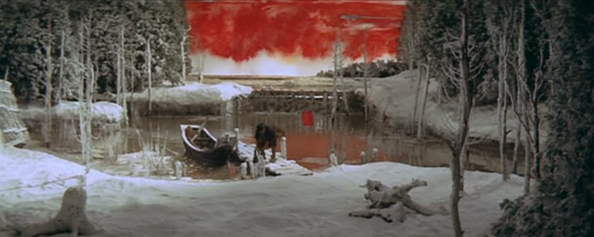
Next morning the storm has abated. At 00:51:49 the ferryman arrives (above) and failing to get in the front door of his shack, enters another way. As mentioned before, the concise adaptation within Kwaidan eschews the sculpting vocation of the main character in the longer story and there any no evil billionaires or despicable Lords either, only a mother, curing her traumatized and half-frozen son with porridge. That all the blood was drained from the old woodcutter implies that the Woman of the Snow is some form of vampire – a hint later strengthened. But the old woman does not pursue with questions. Knowing she must work while her son, hollow and withdrawn in bed, recovers, she staggers away with a basket of sticks[xiv].
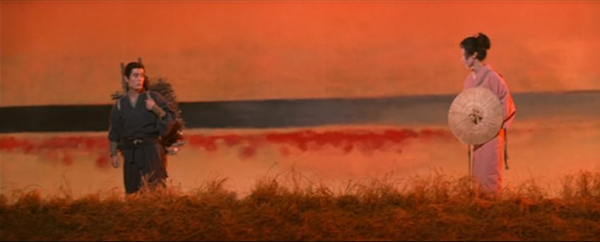
A year later and thankfully recovered, after a long day’s wood harvesting, on his stroll home against the westering skies the son meets a woman going to Yedo. The sky, red and orange, awaits the appearance of those earlier symbols, globes or the beginnings of eyes which could suggest the materialisation of spirits as if from whirlpools in the atmosphere. Despite the eerie music, the setting is serene. Nothing in this gentle yet accelerated alternative to modern dating, insinuates that Yuki[xv] might be the Woman of the Snow in disguise. They continue to walk through sunset-crimsoned woods and pools, as the painted skies turn from white and blue to yellow and black. Swirls like giant marbles, now begin to generate above the horizon. The young man invites Yuki to the lonely house where he lives with his mother. Another cinematic house to envy! Yuki shows no caution, presumably because she knows she cannot be endangered? Is this a planned seduction on her part? Could he resist if he wished? In the house, at 01:01:22, he is clearly stirred by the sight of the traveller washing her feet.
Soon, laughing chases through the rushes and reeds under roseate skies, unwind the formality of the potential lovers. In contradiction to the angry whirlpools of stormier skies, a jewel-like shape forms above nearby, like a sentient sun, to indicate the approach of a happy perfection. Under this glowing symbol, loving embraces follow naturally, with gently bared breasts among the grasses[xvi]. . . before cross dissolving to a baby being bathed. Two other children are soon present[xvii] – the Woman of the Snow has become a perfect wife and mother. Walking with her children, I wonder if the strange song the children voice at 01:03:46, in which “the priest was amazed and fell upside down”, is partially parallelled in the longer, 1968 film, by a scene in which evil Lord Jito, endorsing the established rival sculptor, Gyôkei, (who Jito has employed to usurp the younger sculptor’s commission), says of apprentice sculptor Yosaku at 00:40:23: “there is no way he will win, even if he stands on his head.” This bizarre comment may arise from mistranslation or subtitling, but as with the Snake and Tortoise/Turtle song used in the 1968 film (and brought up below), it creates a reflective pause in the narrative – at least during interrogatory viewings[xviii].
That the children grow older but their mother never ages, is emphasised by a humorous exchange with three village women – they and the ferryman are the only sign of any local community in the entire film. Yuki has taken her children to pay their respects at their grandmother’s grave. They pass the women, busy washing clothes, on their way home. “Most peasant women age early,” but despite giving birth three times, Yuki still looks like a girl. “That woman is a wonder!” the village washerwomen all agree[xix], taking it for granted that the dead grandmother is still able to see and appreciate her grandchildren, as well as their wonderful mother and happy lives.
Evening, and the children are all asleep in a side room. The young woodcutter is no artist but has crafted four pairs of sandals for his wife and children. Yuki admires her pair and returns to sewing. From his lower angle and with the light on her face, the woodman suddenly remembers across the years . . . the light becomes blue and icy and with the change comes, recognition? Then the light turns warm again and he seems about to laugh off his memory. Unfortunately, he rambles on . . . No don’t say it! But he doesn’t stop . . .
For the sake of her sleeping children, the Woman of the Snow forbears from carrying out her strict promise of murder, returning toward the giant eye, leaving a widower grieving over his four pairs of beautiful sandals. Sadly, he puts hers out in the snow. Since they disappear, perhaps there is hope that she might return? Yet the mood is tragic.
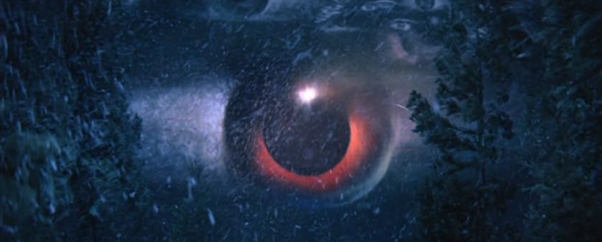
The quality of human ambition in The Snow Woman (1968), is something the shorter, more lyrically concise version of 1964, bypassed. In the longer version of the tale, the old wood carver Shigetomo, seems almost punished for his ambition: “My name will be known throughout the mountains of Mino,” he anticipates triumphantly. Conversely, his apprentice Yosaku is frequently undermined by a lack of self-belief. Beginning in real snowy landscapes, prospecting for the ideal tree for a temple commission, master and apprentice fall to their knees to give thanks when they discover a magnificent example – a tree so fine they believe it may even have a soul. As if the thought of felling such a tree to become mere material for religious carving is a crime, the weather abruptly changes. Winds howl and swirling snow snaps branches around them. They struggle on through the tempest. Fortunately, a rough shelter appears, but later, as the young man wakes from under his heaped straw, a ghost slides into their refuge (00:07:30) to kill the fire and summon ice in its place, snow from the stare of its eyes and spirit, frost from the percussive sounds[xx]. Without Kwaidan’s implication of vampirism, the old Shigetomo is simply chilled to death. The Snow Woman turns her attention towards the young apprentice Yosaku, creeping backwards on his elbows, only sparing him because “you are young and beautiful” (00:11:20). In exchange, he must promise never to tell even his dearest, what happened that night. The door of the shack opens of its own volition (00:12:37) before the Snow Woman glides back into the blizzard.
Moving on: in cheerful daylight the felled tree arrives in the village (00:14:54), with or without its soul, no longer exceptional. Propelled on rollers by a crowd of peasants and greeted rapturously by a crowd of villagers, the High Priest’s officials are delivering the section of trunk and request that Yosaku carry out the original commission, since his old master spoke highly of him and the High Priest believed in Shigetomo’s judgement. Feeling unworthy, Yosaku, persuaded by Shigetomo’s widow, reluctantly accepts.
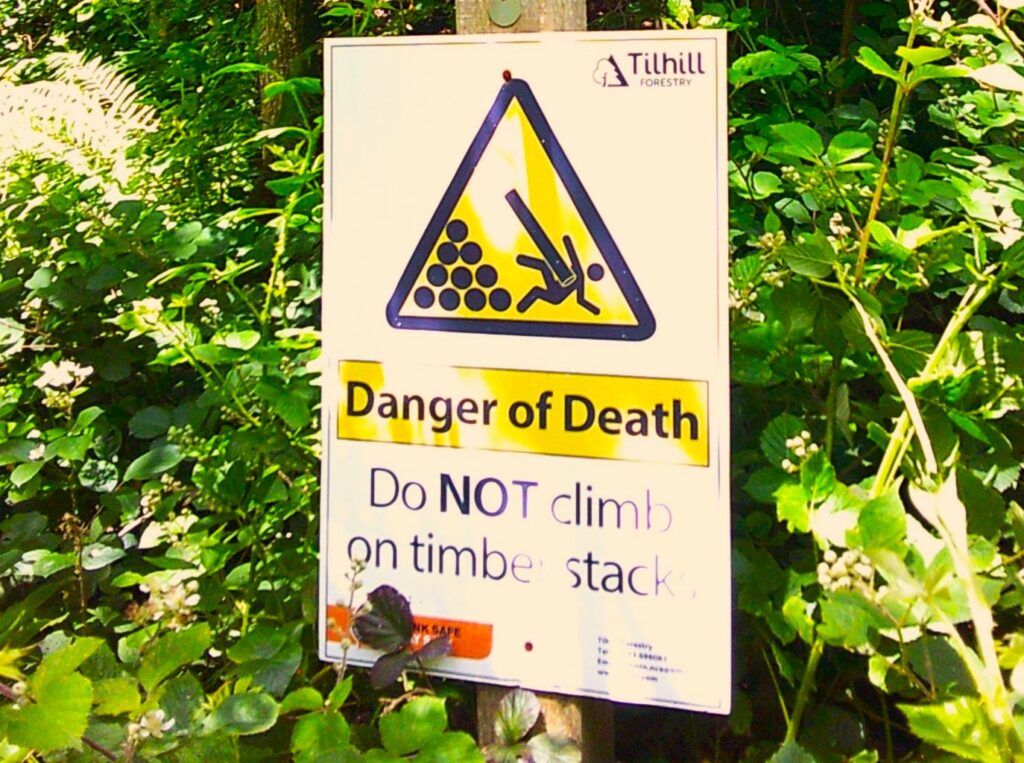
That night, during a rainstorm a beautiful traveller – “young girl” in the widow of the old master sculptor’s eyes – shelters under the eaves of the Yosaku’s workshop (00:17:06). Invited indoors, in a mildly sensual way Yosaku’s surrogate mother supplies dry clothing while remarking on the traveller’s beauty. As the Snow Woman, Shiho Fujimura may be too terrifying for the word beautiful to arise, unless one admires haughty superiority and malevolent elemental force . . . but as Yuki, she is almost unrecognisable. In the Kwaidan story, you can see the similarity between spirit and woman. Here, on a first viewing, perhaps audiences where not expected to notice any connection? After several meaningful admiring glances between Yosaku and Yuki (only slightly distracted by her appreciation and confidence in his sculpting skills, and his dissatisfaction with them) at 00:22:30 they go together to gather herbs which Yuki knows would be good for the old wife’s recurring health problems. At 00:24:09 love reveals itself. Meanwhile, galloping thugs are approaching the village as children circle and lark on a log stack. The children’s reckless behaviour naturally predates the modern health and safety attitude towards timber stacks!
Thrown from his horse by the fright factor of rolling logs, Lord Jito is furious: “Fools! Children or not, I’ll have your heads”. Hurrying out to protect the children (00:24:38) the wood-carver’s old wife founds herself beaten by Lord Jito for her “impudence”. Returning to the village, Yosaku and Yuki rush to intervene, but it is too late. Nasty Lord Jito, clearly fancying Yuki at first sight, gallops off with the threat that they haven’t “heard the last of this”. Despite encouragements to “hang in there” (!! anachronistic subtitles at 00:22:27: what subtleties might we be missing?) before long the old wife succumbs to her beating[xxi] – using her dying moments to virtually oblige a marriage between Yosaku and Yuki. Although they don’t wish to impose upon each other, they are happy to follow this course.
It seems clear in both versions of the film, that the spirit of the snow has sought out the two young men spared, perhaps because like the Greek gods, the snow women are drawn to mortals by desire? Or for wanting to know what it feels like to be human, to bear children and be a mother? Is it also a vain attempt to escape their chilled immortality, at least for a lifetime? On their first night together, at 00:29:12, Yosaku asks “Yuki, why is your body so cold?”
Another powerful character with sundry titles now emerges to complete the cultural hierarchy. Witch doctor or priestess, she is later referred to, gender-specifically, in the subtitles as a “shamaness”. Cast listing meanwhile, describes her as a “Shrine Maiden”. Divining for the presence of evil at a sacred festival this shamaness immediately perceives Yuki’s supernatural origins – the zealous old hag’s flame darts at 00:30:47, act like ghost-seeking missiles. Maybe this is the point at which, on a first viewing, you are supposed to know with certainty that for all her love and sympathy, Yuki is the Snow Woman?
Five years later and snidey Lord Jito is back from the capital, Kyoto[xxii], interfering in local politics and trying to engineer for an experienced sculptor, Gyôkei, to replace Yosaku for the task of carving an inspiring Buddha for the temple. Having known the old master carver Shigetomo and heard him praise Yosaku, the patient High Priest still wants the unproven apprentice to do the work. Angrily, Jito forces a competition upon the religious authorities – the winner will be granted the commission. By this time Yosaku and Yuki have a young son, Tarô, yet Yuki has not aged in five years. When the family group chance upon Lord Jito (feudal or samurai equivalent of a contemptible billionaire or unscrupulous politician of now) and his corrupt entourage in the woods, Jito confides to a sidekick, (00:37:08) that he “scoured the capital for five years and found none to equal her.”
For a brief relaxed interval, after his classmates taunt Tarô for not knowing a strange song – apparently a traditional children’s rhyme about a turtle that takes over a snake’s yard to cause the disappearance of nine local people – Yosaku watches Yuki teaching it to him. Whether or not this song is thematically connected[xxiii] to the film, it creates an enigmatic frisson of the type which often encourages a fork or splitting point in the pathway of a narrative . . . a pause or glance toward something cloaked or just out of reach, something only sensed at the back of the mind.
At Gyôkei’s workshop, in the contemptuous dialogue between master sculptor and Jito, Jito declares that country people are “like frogs stuck in a well” (00:40:35) and goes on: “Trying to compete with you, he does not know his place.” But it’s not just that Jito considers Yosaku to have ideas above his station: “His wife is far too good for him too” (00:40:50). The plot thickens and when Jito’s henchman come to arrest Yosaku for the theft of the tree, their leader shortly offers the planned way out: Yuki should offer herself to Jito. Yuki is so disgusted that a fine of three ryō or gold coins is imposed – an impossible sum . . . yet Yuki says she will pay. Grudgingly, the gang leaves.
Yuki: “How can someone be so unscrupulous?”
Yosaku: “It’s Lord Jito we are talking about.”
To cure a local landowner’s child of a dangerous fever (00:45:33: “Ridiculous! How can a mere woman possibly cure him,” say the doctors who’ve given him up for dead), Yuki repeatedly and exhaustingly becomes the Snow Woman. She snows near the child and cures him with snow parcels, freezing the fever away.
Not only does she have compassion, the Snow Woman believes in art! Yosaku’s “wooden doll” sculpture looks perfect within limits (“I just can’t seem to finish her face”), but like so much “great” art, is somehow dead. Gyôkei’s golden version however, is truly and thoroughly dead. TheHigh Priest is not impressed – “It shines with gold. It is almost too bright for my eyes to bear!” (00:58:01). “Indeed, her beauty is overwhelming . . .” but “Look closely at her face. In her eyes, do you see the light of compassion?”
Despite the High Priest’s support, Yosaku remains unhappy with his work, he cannot get the eyes right and persuades a very unwilling Yuki to come and pray with him at another religious festival. Forced to run from the festival through the dark forest when she realises again that the Shrine Maiden can sense her presence, Yuki is abducted for Lord Jiro. In a nearby shed, Jiro is determined to have her. He lusts after her pale skin . . . pure like snow. “How I’ve longed to strip you bare” (01:03:47). But the rape goes no further than a bared shoulder.
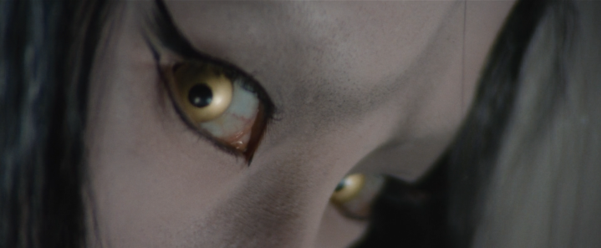
When he tries to tear her kimono off, Yuki begins to change from frightened woman to invincible Snow Woman, (01:05:45): “All those who have seen my true form must die”. Jito grovels, pleads and freezes. She freezes all his assets and empties his accounts[xxiv], and when his minions discover his frozen corpse, they too are dealt with. Hurrah!
Back at home, Yosaku and Tarô find an exhausted Yuki, yet Yosaku is still concerned with finishing his statue – a picture of the true artist, sacrificing everyone and everything for Art! An ominous shadow clings to him though, preventing that final miraculous transformation of dead wood. But now the news of Lord Jito’s death is abroad and the Shrine Maiden turns up to accuse Yuki – as if the hag was in league with Jito: corrupt politics hand in glove with corrupt religion . . . surely not! The Shrine Maiden is obviously jealous of “a power beyond this realm” (01:10:09). Calling Yuki a “Monstrous demon!” she is determined to look for the scars of her flame darts. Yosaku finally helps repel the old woman and comforts Yuki: “No one could destroy our happiness.” Now he feels he’s been washed clean and remembers his Art. “I think I can finish the statue” . . . yet the dark shadow remains”. Suddenly, stirred by the accusations of the Shamaness, he remembers the night of the Snow Woman and overrides his promise never to tell anyone, not even his wife. NO DON’T SAY IT!
“I saw the terrifying Snow Woman. She killed my master.” (01:13:42) . . . “Yuki . . .”
“That . . . was me.”
“You?”
“After all this time you have spoken of it. It was all I asked of you. I told you never to speak of it. All these years I prayed you wouldn’t. Because I became your wife, I discovered human happiness . . . (01:14:33) . . . I hoped this happiness would never end . . .”
She becomes the Snow Woman and is about to kill Yosaku when Tarô cries in his sleep. Becoming a mother again for a while, she realises she must leave instead: “Please look after Tarô in my place. And please finish that wonderful statue of yours . . .”
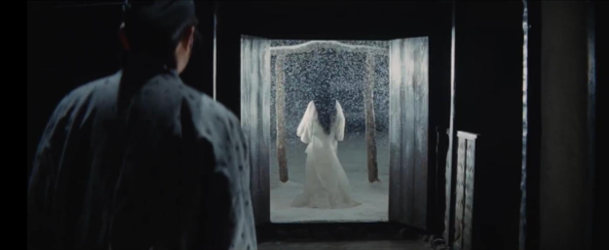
In all this tragic farewell, Yosako is still distracted by his ART . . . and seeing the light of compassion in her face (01:18:22) – compassion for the child and for him – he knows now, how to finish the statue.
© Lawrence Freiesleben, 2026
NOTES
[i] Currently available here: youtube.com/watch?v=SQIZsBED4-0
[ii] Approximate timing for the YouTube version.
[iii] For a truly weird and distant echo of Laura, seek out Singapore Sling (O Anthropos Pou Agapise Ena Ptoma) 1990 1h 51m imdb.com/title/tt0100623/?ref_=fn_t_1 which despite a striking and luminous Noir atmosphere is laughably absurd – with Meredyth Herold coming across like Josie Lawrence in an X-rated Mastersons (radio) improvisation! bbc.co.uk/programmes/b007jsmr
[iv] From A Backwards Alphabet of Films – X: “Although it may be unfashionable to say that art, music, writing, film and so on, should be about enlightenment, I will say it anyway.”
[v] Such as David Vining, who in 2025 was unengaged by it: “I don’t think it’s a good thriller or mystery or drama. But, it has some charms along the way to make the film not a complete waste”: davidmvining.wordpress.com/2025/11/27/whirlpool/
[vi] As noted in A Backwards Alphabet of Films – X . . .
[vii] See particularly: internationaltimes.it/the-italian-digression-part-8/
[viii] Just as the “unsightly fence” at Cypress Point – a notable Vertigo location – would force one to reverse into imagination: reelsf.com/reelsf/vertigo-at-the-coast
[ix] imdb.com/title/tt0058279/?ref_=nv_sr_srsg_0_tt_3_nm_5_in_0_q_Kwaidan
[x] en.wikipedia.org/wiki/Kwaidan_(film)
[xi] In this story, the blind musician Hōïchi is obliged to perform every night for the ghost court of the Heike clan. To prevent his being torn apart or carried off by spirits, the priest of the temple and his devoted assistant paint the Hannya-Shingyō (Heart Sutra), a holy text, over every part of Hōïchi’s body.
[xii] Toru Takemitsu’s uniquely and sometimes piercingly disquieting score combines traditional instruments such as the shakuhachi and the biwa with electronic manipulation and tape loops as well as a modified piano: screws, bolts, and soft materials placed on the strings to summon strange percussive effects and assorted unpredictable clangs.
[xiii] In the 1968 film the apprentice is also spared for his youth and beauty.
[xiv] Recently watching the film again, I thought of the cover of the album now known as Led Zeppelin IV, but as this is not helpful, I only include the passing thought to reference this intriguing blog post: wknc.org/2021/04/11/behind-the-cover-led-zeppelin-iv/
[xv] Both the Woman of the Snow and the Snow Woman are named Yuki – but who would expect Robin Hood to switch names with every new adaptation of his folk story?
[xvi] The Kwaidan segment (1964) appears more audacious in this way than The Snow Woman four years later. Surprisingly, both films were originally released under Japan’s ‘G’ rating (General Audiences), equivalent to a U certificate in the UK.
[xvii] The Snow Woman bears only one child as opposed to The Woman of the Snow’s three. In both cases it is the presence of a child or children which prevents the snow women from carrying out their promise to kill their husbands for “betraying” her secret. As they only reveal it to her, the severing of their happy lives together as well as the potential deaths involved, seems a shade severe as punishment – but I suppose marriages between mortal and supernatural beings have to end somewhere . . .
[xviii] To consider the implications of inversion in religious terms is probably fanciful as well as complex. On the one hand there is Peter requesting to be hung (crucified) upside down because he felt unworthy to die in the same way as Jesus. On the other, the inverted cross is linked to being in league with Satan. But Christianity’s influence in feudal Japan has been described as profound: japan-kyushu-tourist.com/history-of-japanese-christianity-2/
[xix] The odd thing about the tone of this encounter is that one can’t be sure it is entirely friendly. As the washerwomen all laugh at the end, are they being sarcastic to a degree? Or do they have some sense of division arising from a buried instinct that Yuki is not quite of the world. Yuki’s return comments could also be seen as partially ironic.
[xx] Akira Ifukube wrote the score for The Snow Woman. He and Toru Takemitsu – composer for Kwaidan – “stand as the two pillars of 20th-century Japanese classical and film music”. Both largely self-taught, the two were rivals and at times were very critical of each other: “Ifukube once famously proclaimed that “Music is not philosophy,” a direct jab at the highly conceptual, philosophical nature of Takemitsu’s avant-garde output”. “Takemitsu looked heavily toward Western modernism (Debussy, Messiaen, and John Cage) to create a style that balanced avant-garde abstraction with traditional Japanese instruments.” Quotes from Classical Music Forum.
[xxi] Informed of this far away, Lord Jito cares not a jot that the “old bag” has died, he is only feverish to find out about and entrap Yuki.
[xxii] Kyoto, centre of the Imperial Court, served as the capital of Japan from 794 until 1868.
[xxiii] japanonfilm.wordpress.com/2020/02/29/snow-woman-kaidan-yukijuro-1968/#
[xxiv] Just as civilization should treat all parasitic billionaires!

LAWRENCE FREIESLEBEN, Film & Television Editor of The Brazen Head, has been an artist and writer as long as he can remember – cycling away at weekends from the council estate where he grew up, to paint the countryside as an escape from the restrictive tedium of the school week. Leaving home at 16, he has lived in 17 different areas of the UK – from Devonshire to Northumberland – painting and writing, always vigilantly questioning the interior light of landscape, cityscape and wider atmosphere. Living virtually off-grid with his large family, both remote locations and urban visits have formed the backscene to a passion for film which has intertwined with art and writing throughout his career. Films remain a key creative focus since childhood, resulting in encyclopaedic folders and clippings as well as a constant stream of home-made film festivals. He currently lives in a dilapidated Lancashire seaside town