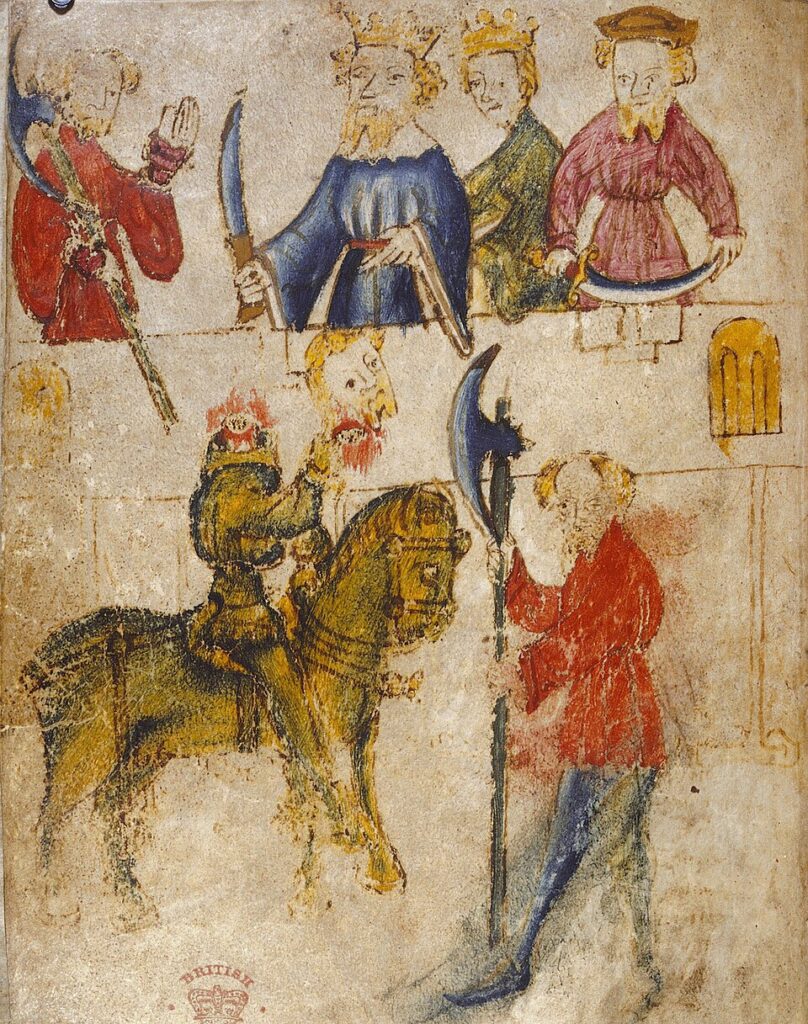
What follows is an extract from J. Simon Harris’s new translation of Sir Gawain and the Green Knight. You can read an interview with Josh about his translation in this issue
Excerpt from Fitt IV (lines 1998-2090)
NOW the New Year draws nigh, and the night passes,
and the day drives into the dark, as the Lord commands.
But the wild weather of the world awakened outside:
clouds had cast the cold keenly down to the earth,
with enough of the nip of the north to sting the naked skin;
the snow fell sullen and bitter, biting the beasts of the wild;
the whistling wind whipped down from on high
and filled every valley with vast snowdrifts.
The knight was listening close as he lay in his bed—
though his lids are closed, he sleeps little.
By each cock that crowed, he knew the hour.
Suddenly he sat up, before the day had dawned,
for the light of a lamp still gleamed in his chamber.
He called to his chamberlain, who quickly answered,
and he bid him to bring him his byrnie and saddle his steed.
The servant bustles about and brings him his outfit,
and he gets Sir Gawain geared up in splendid style.
First he clad him in his clothes to keep out the cold,
and then his equipment, which was carefully kept—
his paunce and his breastplate brightly polished,
the rings of his rich chainmail rocked of rust—
and all was as fresh as it was at first, and his gratitude was
quite keen.
He’d donned each sparkling piece,
wiped to a shimmering sheen;
the most gallant from here to Greece,
he bade him bring his steed.
As he threw the finest threads on himself—
his surcoat with the sign of shining achievements
emblazoned on velvet, and virtuous stones
embedded all over the borders, and embroidered seams,
and a lining of fair fur from the finest pelts—
yet he did not leave the lace, the lady’s gift:
that Gawain did not forget, for his own good.
When he’d belted his blade on his bulging haunches,
he twined his true-love token twice about himself,
sweetly swaddled around his waist, that knight.
The girdle of green silk well suited that gallant hero,
such a rich display upon that royal red cloth.
But the warrior wasn’t wearing the girdle for its wealth,
nor for the pride of its pendants, polished though they were,
and though the glittering gold glinted upon the ends—
but rather to save himself, when it comes time to suffer,
to abide, without debate, the baleful blow of sword
or knife.
The bold knight, fully clad,
comes swaggering outside,
and thanks the noble lads
profusely with delight.
Then Gringolet was geared up, that great big horse;
and having stayed in the stable, safe and sound,
that proud horse pined for the spur to gallop.
The man approaches his mount and inspects his face,
and he solemnly said, and swore by his oath,
“There are men in this castle with a mind for character!
May the prince who supports these people rejoice!
May the lovely lady be loved in the fullness of life!
When they cherish a guest out of goodness and charity,
when they hold honor in their hand, may the good Lord
of heaven on high reward them, as well as all of you!
And if I lead my life on earth for long enough,
I’ll compensate you somehow, if I can.”
Then he steps into the stirrup and saddles up.
His servant hands him his shield, which he slings on his shoulder.
He spurs Gringolet with his gilded heels,
and he starts over the stones, standing no longer
to prance.
His man was next to ride,
bearing his spear and lance.
“I trust this castle to Christ—
may He give it fair chance.”
The bridge was drawn down, and the broad gates
unbarred and borne open on both sides.
He blessed himself quickly, and crossed the boards.
He praises the porter, who knelt before the prince
and gave him God and good day, that Gawain be saved.
And he went on his way with his one man
who would teach him the path to that perilous place
where he’s meant to receive the mournful stroke.
They passed by peaks where the boughs are bare;
they climbed by cliffs where the cold clings.
The heavens were high, but ugly and ominous.
Mist moistened the moors and melted on mountains;
each hill had a hat, a huge mantle of mist.
Brooks bubbled and broke on the banks about them,
cascading through cracks and crevices, shimmering down.
The way through the wood was wild and devious,
until it was soon time that the sun rises in that season
DEREK TURNER is the editor of The Brazen Head, as well as a novelist (A Modern Journey, Displacement, and Sea Changes) and widely-published reviewer. His first non-fiction book, Edge of England: Landfall in Lincolnshire, was published June 2022. Some of his writing may be found at www.derek-turner.com He is also on X – @derekturner1964
JOSH SIMON HARRIS has recently completed a translation of the Middle English Sir Gawain and the Green Knight. Brazen Head poetry editor LIAM GUILAR asked him about it.
Tell us a little about your language background and your day job. What brings a scientist to translation? Which other texts have you translated, are translating?
I’ve always been interested in language and poetry; I wrote my first poems in third grade (I would have been about eight or nine years old), inspired by the great poets of my childhood like Dr. Seuss and Shel Silverstein. At the same time, I was always good at math as a kid, and when I took my first Physics classes in high school, I was blown away at how precisely the natural world can be described by mathematical models. In college, I kept up both interests; I was a double major in English and Materials Science and Engineering. It was there that I first fell into translation. I had taken a bit of Spanish, and I really liked Pablo Neruda’s poem, “Puedo escribir” (Poem 20 in his collection, Twenty Love Poems and a Song of Despair). I had heard it in Spanish without fully understanding all the words, and I was struck by how much better it sounded in Spanish than in translation. I wrote my own translation of it (which likewise doesn’t hold a candle to the Spanish original), and eventually translated the whole collection over the course of a summer (I wasn’t able to publish it until a few years later when it entered the public domain, and even now, it is only available in the United States due to copyright).
At some point in college, I also took a World Literature class where we read Homer and Dante, among other authors. I’ve had a fascination with Greek and Roman mythology ever since I was a kid (I used to love this book, D’Aulaires’ Book of Greek Myths, which is more or less Ovid for children; I’ve been reading it again with my son recently), so of course Homer and Dante pulled me right into the deep end. We talked in class about terza rima, the rhyme scheme of Dante’s Commedia, but the translation we were using didn’t rhyme at all. I thought it would be fun to write a translation in the original rhyme scheme, and my professor agreed to let me try my hand at the first canto instead of writing a final essay. I ended up translating the first five cantos. I didn’t know any Italian at the time, but I knew a little Spanish; and with a combination of online resources like Wiktionary and existing translations, I was able to pick it up readily enough. From there, I just got sucked in.
I had no idea what I was getting into, of course. To translate Dante, I essentially had to become an amateur Dante scholar. While translating, I read countless commentaries, essays, biographies, and translations of Dante’s other works and primary sources. It took me about ten years to finish the Inferno. During that time, I graduated college, wrote a novel based on the Greek tragedy Philoctetes (which probably about a dozen people have read), went to grad school for Computational Materials Science, met my ex-wife, had a kid, got married, got my PhD and got accepted for a postdoc position. Dante shadowed me through all these major milestones of my life; as Virgil guided Dante through the Inferno, so Dante guided me in my journey to become a better poet, translator and human being.
I can’t even explain how it felt when I finished the Inferno. It was like a breath of fresh air that is still somehow suffocating—relief and regret at the same time. I was about halfway through translating Dante’s Vita Nuova, a shorter, earlier work of prose and lyric poetry; but I had to get away from Dante for a while. I started translating Homer because I wanted to try writing in the epic hexameter (and became convinced that I could after reading Longfellow’s Evangeline). But the problem with the Iliad is that it is very, very long, and I also wanted a project that I could finish on a reasonable timeline. That, plus an interest in alliterative verse, is what led me to Sir Gawain and the Green Knight, and here we are. Along the way, I have also translated a lot of shorter poems from various languages and poets (Sappho, Bertran de Born, an anonymous Old English poet). I even translated a Norwegian short story for a contest (I didn’t win, but the translation that won was better than mine anyway). Now that I’m done with Gawain, I’ll get back to translating the Iliad, and I will eventually make my way back to Dante. I’m also working on a second novel, which is a science fiction story with inspiration from biblical mythology (sounds a bit like Dune when I put it that way, but it’s not).
Today, I’m still a scientist for my day job; I work at a small pharmaceutical company using AI and machine learning for drug discovery and toxicology (essentially making models to predict whether a molecule might be toxic or might have therapeutic effects). I remain intensely interested in science and mathematics, and for now it pays the bills better than poetry. But creative writing and science are both deeply ingrained in my soul. I’ll always do both.
Why alliterative verse? And while we’re here were you ever tempted to translate Sir Gawain or Saint Erkenwald into another, perhaps more modern verse form?
Verse form is one of my favorite things about poetry. Even in free verse, form is what distinguishes poetry from prose. Part of the fun of translation, for me, is the challenge of translating a poem into a new language while keeping the verse form intact. With Dante, it was terza rima; with Homer, it’s dactylic hexameter; and with Gawain, it’s alliterative verse (and the “bob and wheel” at the end of each stanza, of course). I became interested in alliterative verse purely for this reason. I translated a short Old English alliterative poem, “The Wanderer,” and I really enjoyed it; alliteration requires a different kind of mindset from meter and rhyme. After writing a lot of alliterative verse, I also noticed how prevalent alliteration is in our language and in a lot of my favorite books (Tolkien is a great example).
I haven’t really been tempted to translate Gawain or Erkenwald into another verse form, but I think it’s a really interesting idea. This is essentially what Pope did with Homer (he translated Homer into heroic couplets). Likewise, Dante translated the Lord’s Prayer into Italian in terza rima in order to fit it into the Comedy. There are a couple of Sappho poems that I’ve translated into a different form than the original, essentially because there is no good English equivalent of their original meter; it is kind of fun to try to fit a poem into a new box in that way. So I think it’s worth considering.
Why Sir Gawain? From your Introduction it seems you hadn’t read the poem before you started translating it? Is that correct? And how did you feel about the poem when you’d finished? Impressed? Disappointed?
That’s right. I had heard of Sir Gawain, and I knew other people who had read it, but I had never read it myself before I started translating it. As I mentioned, I had already done an alliterative verse translation of “The Wanderer,” and I really wanted to try a longer alliterative poem. The obvious choice in Old English would be Beowulf, but I was never a big fan of Beowulf, so I wasn’t thrilled at the prospect of devoting a chunk of my life to it. Besides, Seamus Heaney’s translation of Beowulf is pretty much as good as it is ever going to get, in my opinion (I really love the poetry in his version, even though I find the narrative kind of dull). So Old English was out. What about Middle English? I did a bit of research into alliterative poetry, and the general consensus seemed to be that Sir Gawain and the Green Knight was the best alliterative poem in Middle English. I didn’t read the poem first, I just took a leap of faith and started translating. I was kind of looking for something quick and easy after working with Dante and Homer, and I thought a Middle English Arthurian romance would be sort of a light and fun adventure. I wasn’t expecting great depth and complexity—man, was I surprised. The poem was way, way more impressive than I thought it would be; it exceeded my expectations in almost every way. The Gawain poet is deeply concerned with form and symmetry, and it comes across in each line, each stanza, the structure of the poem as a whole, and the structure of the narrative. On top of that, his characters (particularly Gawain and the lady of the castle, whom he meets) have rich inner minds in a way that is unusual for old Arthurian tales; the poet explores emotion and psychology in surprisingly modern ways. So I think it’s fair to say I was impressed.
How do you translate? What’s your process? Is translating Gawain different from how you might approach Homer?
My translation process has evolved over time, and it is definitely different depending on the text. With Dante and Homer, I first translate the original text word by word into a kind of pidgin language with English words but the original syntax; the pidgin language reads like a kind of code, with symbols indicating certain things to me about the original language. To do this, I use a combination of online dictionaries (Wiktionary is a good general resource with etymologies, etc.; and there are specific dictionaries for Ancient Greek and Middle English), plus other resources if there is a unique word or context that is unclear or perplexing. With Dante, I’m also reading Singleton’s commentary while writing the pidgin translation, keeping notes on anything relevant (e.g. if Dante’s word choice alludes to something famous, I want my word choice to do the same). With Homer, I’m checking for repetition, because I want to make sure that if Homer repeats a phrase verbatim, I do the same (repetition is very important in Homer, since it derives from semi-improvised oral poetry). After completing the pidgin-language version, I go through and write my translation in verse (still referring to the original text as well as the pidgin text, and often consulting other translations and commentaries).
With Gawain, because the original language is Middle English, I don’t bother with writing the pidgin text first. When you get the hang of it, you can more or less read big chunks of the Middle English text without a dictionary; I still look up most of the words, since the meaning of several words has changed over the centuries, but it is easier for me to scan through than Italian or Ancient Greek. As I write, I also consult other translations and commentaries to make sure I’m getting the correct meaning (and not missing any subtext or anything). So the common thread of my translation process is that I am essentially close-reading the text as I write, looking up each word individually while considering the passage as a whole.
Were there parts of the story that gave you problems, were more difficult to translate, made you wish you could do a little editing?
Oh, there were many. Sometimes, especially with Middle English (where the words can often be quite close to Modern English), you find yourself just rolling along without any problems. But when you bump into a challenging passage, you might be stuck for a day or longer trying to find a solution. It’s hard for me to think of specific examples after the fact, though. I ended up happy with most of the alliterative lines, because there is a lot of freedom to render them in different ways. If there are some rough edges on the translation, they would probably be in the “bob and wheel” sections, the five lines of rhyming verse at the end of each stanza. Those lines can be very difficult to translate, given the short lines combined with the tight rhyme scheme. As always, translation is a compromise between several conflicting ideals.
Were there any parts of the original that I wished were different? Of course. While the poem is surprisingly modern, the medieval sensibilities of its author often show up in unexpected ways. But it’s not my job as a translator to edit the original, it is my job to bring it into Modern English. So I stayed as faithful as I could to the original text.
Gordon and Tolkien in their introduction to their edition of the poem thought the story was almost perfect but the three hunting episodes were excessive. What do you think of them?
On my first reading, I might have agreed that the three hunting scenes were excessive—after all, the same sequence of five scenes is essentially repeated three times in a row: the lord goes hunting, the lady tries to seduce Gawain, the lord’s men carve up their quarry, Gawain and the lord exchange spoils, and finally, Gawain and the lord renew the terms of their game. But when I was working on the notes, I realized that this repetition of five scenes mimics the shape of the pentagram (a five-pointed star): to draw a pentagram, you draw a sequence of five overlapping lines, and the fifth line brings you back to the start. The pentagram is thematically important to the narrative—it is represented on Gawain’s coat of arms, and the poet links it explicitly to Gawain’s virtues (he calls it a “token of truth”). The poet very cleverly mirrors the structure of the pentagram in the structure of his verse. But the thrice-repeated sequence of scenes is not exactly the same each time; there is a progression in which Gawain’s virtue slowly breaks down, and at the end of it the structure of the pentagram is broken too. I talk about this in more detail in the notes, of course.
What is your take on the ending? Gawain is mortified and thinks he’s failed. The people at Arthur’s court reject this and insist on wearing what he thinks is a badge of shame as a badge in his honour. What do you think?
I love the ending. I think it is an uplifting reminder of the importance of being part of a supportive community. In the first half of the poem, Gawain does not grow as a character—he is presented as a knight already at the peak of perfection (in terms of chivalric virtue, anyway). He readily trades his own life for his king’s, he bravely goes on a quest that will almost certainly end in peril for him, and he defeats ogres and dragons along the way as if they were a mere inconvenience. But nobody is perfect. The poet puts Gawain in a situation where even his chivalric virtues cannot sustain him, and Gawain fails. It is a small failure, really, but he takes it hard. When he comes home, he confesses everything to Arthur and his courtiers; but instead of shaming him, they completely turn it on its head. His imperfection is not shameful, it is only human; his shame is excused by the mere fact that he is ashamed, that he continues to strive to be virtuous. Perfection may be the ideal of knighthood, but no knight is perfect in practice.
How would you sell your translation to a possible buyer? What will they get from your translation they can’t get from any of the existing ones?
Probably the biggest thing that distinguishes my translation from others is that I adhere to the original form of the poem using natural-sounding language (not using awkward diction, syntax inversions, etc.), while still staying true to the meaning of the text. The verse form of the Middle English original is really interesting: each stanza consists of (on average) twenty lines of alliterative verse, capped off by a short five-line rhyming section. Other translators have certainly carried this verse form into Modern English; but often they sacrifice clarity, or a good word choice, or (worse) the mood of the poem in order to pull it off (I certainly don’t want to judge too harshly; there are a number of good translations already out there). Not that I never make any sacrifices; translation is all about making choices to balance the meaning, form, and emotion of the original text. But I like to think that my translation strikes a pretty good balance.
Additionally, I have included lots of goodies besides the poem itself. Instead of line-by-line notes (which are common enough in translations of classic poetry), I opted to write commentary in the form of a conversational essay in which I’m walking through the poem along with the reader. I analyze the text of course, but also provide some historical background, discussion of the poetics, etc., in relevant places as I go along; I think readers who enjoy the poem will find the commentary interesting and worthwhile. I also have a bibliography intended more for readers and enthusiasts than scholars; a pronunciation glossary with names, places, and medieval titles, arms and armor; King Arthur’s family tree; a timeline of the narrative; a historical timeline of events relevant to the poem; and several hand-drawn images (a map of Gawain’s journey through England and Wales, a drawing showing the armor of a medieval knight, and more). Finally, I’ve capped off the book with an original poem which has a rather interesting verse structure (it’s complicated, but it is based on the shape of the pentagram, which is central to the themes of the narrative). There’s also a link in the back of the book to a project I’m working on, which is a “choose your own adventure”-style version of Sir Gawain and the Green Knight (I’m putting it online as I write it; it is not nearly complete yet).
Your book has an extensive section of commentary and notes. What do you think a reader will learn from them that is new?
Most works of classic literature have editions with notes or commentary, but I’ve found that the commentary is sometimes rather dry and uninteresting to anyone but scholars (this is certainly not always the case, but it is common enough). I wanted to keep my own commentary engaging throughout. When I’m out driving or doing chores, I like to listen to podcasts that walk through narrative poems, films and video games while providing commentary and analysis along the way. Inspired by that format, I wrote my notes in something of a conversational style; I basically walk through the narrative discussing everything I find interesting along the way. I consulted the notes of several different Gawain translations as well as online resources to ensure I didn’t miss anything important. My commentary is designed so that it can be read on its own after reading the poem, without flipping back and forth to see what lines I’m referring to. In this way, I get to do a close reading of the poem with the reader. I’m not familiar enough with the full body of Gawain scholarship to know how novel my commentary really is, but it isn’t meant to be a work of rigorous scholarship anyway. I can say with confidence that there’s a lot that you won’t find in the notes of other translations. Above all, I think (I hope) readers will find it interesting and thought-provoking.
The poet is anonymous but generally regarded as one of the great poets of Middle English. You’ve spent a long time in his company. Do you have a sense of ‘The Gawain Poet’?
The Gawain poet lived in the late fourteenth century in the northwest part of the English Midlands (scholars deduce this from his dialect). He has a strong voice and occasionally inserts himself into the narrative, providing a little clarification or observation in first person. He’s obviously intelligent and well-read, and he seems to have a good deal of familiarity with matters of both church and court. On the one hand, he is learned in Latin, theology, and ecclesiastical rites, suggesting an education in the Church; on the other, he displays an intimate knowledge of chivalry and courtly affairs, suggesting some role in the English court. And yet, he doesn’t seem like a man tied too tightly to the cloth or the crown; he doesn’t shy away from low language and bawdy humor, and he seems unusually attuned to the inner minds and outward concerns of people from many different backgrounds. As a historical person, he is an enigmatic figure; and yet, his personality often shines through in his writing. He is passionate, curious, fair-minded, empathetic, intelligent, and a deep thinker in all sorts of subject areas. He’s funny when he wants to be, and somber when he needs to be. Overall, he’s just a fantastic writer. So yes, I feel like I do have a sense of who the Gawain poet is—even if, paradoxically, we may never know his true identity.
I just want to say thank you for giving me the opportunity to discuss my translation of Sir Gawain and the Green Knight. I spent a lot of time working on this in solitude, so it’s wonderful to finally share it with other people. Thank you!
Publication information
Sir Gawain and the Green Knight
Anonymous, J. Simon Harris (translation and commentary)
LIAM GUILAR is Poetry Editor of The Brazen Head, and the author of several poetry collections, including the series A Man of Heart, Presentment of Englishry and The Fabled Third (Shearsman), set in post-Roman Britain. His most recent publication is a translation of the Mabinogion folk-tale How Culhwch Won Olwen (Shearsman, 2026)
ALISTAIR NOON’s recent publications include Paradise Takeaway (Two Rivers, 2023 https://tworiverspress.com/shop/paradise-takeaway/) and two further volumes of his translations from the Russian of Osip Mandelstam (The Voronezh Workbooks and Occasional and Joke Poems, Shearsman, 2022). His poems, reviews and translations have appeared in Poetry Wales, Poetry Review, the Guardian and New Statesman, and he’s published essays on translocality and poetry, Wuhan Punk and the fall of the Berlin Wall. Two Verse Essays available from Longbarrow Press https://longbarrowpress.com/current-publications/alistair-noon/ He lives in Berlin.
In 1930, Politburo member Nikolai Bukharin arranged for the Russian poet OSIP MANDELSTAM (1891-1938) to take a trip of several months to the Soviet Caucasus, most of which was spent in Armenia. The trip kickstarted Mandelstam’s poetry again, which had been in hiatus for five years, not least due to political pressure and the narrowing of publication opportunities. A number of poems Mandelstam wrote during or after the trip were not included in the “Armenia” cycle itself but retained in the manuscripts he and his wife, Nadezhda, kept for possible future publication. These are translated here.
Translations from Mandelstam
Scratching out words from the Ararat valley, Armenian’s like a wild cat, a clawlike language of mudbrick cities, the speech of hungering bricks.
The sky is shah, but the shah’s short-sighted, its turquoise blind from birth: it still can’t read that hollowed volume of clay baked hard with dark blood.
October 1930
I love this land that strains to give birth, that dozes and cries, this nation nailed to its terrain, the centuries mere years in its eyes.
How beautiful everything sounds in your ear that patrols the frontier, where the stinking ragwort surrounds the mustard hush that reigns here…
October 1930
That feral cat, Armenian speech, plays with me, scratches my ears till they’ve bled, gives me a fever. You evil creature! Let me doze off on this humpbacked bed!
Down from the ceiling tumble the glow-worms. Flies crawl over the sodden terrain of the sheet. Battalions of long-legged birds march in platoons over yellowing plains.
Fearsome inspector, face like a mattress, truly pathetic and superrepellent, short of a pass and yet they dispatched you into Armenian steppes – what the hell?
They told you to kindly remove your butt: “No one needs your sort round here! Get lost!” Head of a Desk, you’d taken your cut, were once with the Guards, but the spit washed off.
“Look who’s here!” you boom at the door. But like two girls out hunting mushrooms, we won’t have to wait too long before we find good coffins to put in our tombs…
Once we were people. Now we talk piffle – what would you say is our service grade? – condemned to a final stitch in the ribs and a poet’s bunch of Erzurum grapes.
October 1930
Where pifflers howl like beasts in the wild, and beasts are like people, unleashing their tricks, short of a pass, dispatched like an exile bound to a cart, in a sorceror’s power, the inspector headed for Erzurum sips Chernomor’s wine at a tavern gone sour.
October 1930
As we crossed the mountain pass up high on the Muslim side, Death topped up our glasses. We’d cantered out of a nightmare
in the hands of a charioteer the sun had baked like a plum, a local devil for hire and monosyllabically glum:
“Tso!” As we gathered pace, he croaked on down the road, a Bedouin hiding his face like a rose perhaps, or a toad.
His hideous features concealed in a leather mask, he forced the ponies pulling our wheels onwards until he was hoarse.
We felt his haste, felt the jolts, and every roadside stop spun like the passing chariots. No road led down from the top.
“Damn it!” I cried, wide awake, “Stop here!” I screamed at the back of this chairman mad with the plague and headed down the wrong track!
With a whoop, he cracked the wire reins, that noseless horseman: we felt the sweet and sour terrain turn like a carousel.
These were the terrors that found their way right into my soul in Shusha, the fortress town that wolves and vultures controlled –
a cocoon no human sound rang through, a grave in the mountains. Dead windows all around were visible by the thousand,
the houses’ soft pink walls standing shamelessly naked. And over them hung the pall of the sky, as blue as the plague.
ALISTAIR NOON’s recent publications include Paradise Takeaway (Two Rivers, 2023) and two further volumes of his translations from the Russian of Osip Mandelstam (The Voronezh Workbooks and Occasional and Joke Poems, Shearsman, 2022). His poems, reviews and translations have appeared in Poetry Wales, Poetry Review, the Guardian and New Statesman, and he’s published essays on translocality and poetry, Wuhan Punk and the fall of the Berlin Wall. He lives in Berlin.
JULIE STEINER is the pseudonym of a recovering classicist in San Diego, California. Her recent work appears in The Classical Outlook, The Ekphrastic Review, Snakeskin, Light, Lighten Up Online, and The Asses of Parnassus. See more on her Substack ‘Off-Piste on Mount Parnassus’ (offpisteonmountp.substack.com).
SINE ULLA QUERELLA — “without any complaint whatsoever”
Phrase on a 1590 memorial plaque mounted next to the door into the Hall of Confessions, adjoining the Basilica of St. Anthony of Padua.
While waiting for an English-speaking priest
to come and comprehend what Mom confessed,
I passed the hours by trying to digest
a stone. The man it honored was deceased,
but buried elsewhere — praised, not rest-in-peaced.
The Latin called this personage the best
of lords (as most such cenotaphs attest),
but also hailed his lady as the least
of battle-axes (as I paraphrased):
with no complaint at all in twenty-five
years of marriage, testified the stone.
“A miracle,” my mom agreed, amazed
that both had somehow managed to survive
so long, if his decisions ruled alone.
Online, I checked my on-the-fly translation,
having learned the hard way to be wary
of Englishing without a dictionary.
As I had feared, my quick interpretation
was flawed, and needed hasty emendation:
“I goofed. It’s true that this obituary
was placed here by his wife, but not to carry
a boast about her silent subjugation:
her non-complaint was evidence of his
attentiveness. Incomparable spouse,
she also wrote of him. That’s very sweet.
And still miraculous.” Mom laughed, “It is,
but I prefer the autocrat-and-mouse
scenario, so that’s what I’ll repeat.”
I bite my rodent tongue. I know the drill:
when inconvenient data is revealed,
my mom’s reality-distortion field
allows her to believe, by force of will,
whatever she would like to. It’s a skill —
a superpower — I’ve often heard her wield.
The version of events that’s most appealed
to her has always been her gospel. Still,
I’m five years old again, and flabbergasted,
whenever Mom deliberately lies.
And now she’ll use my own mistake to shatter
this touching limestone tribute, which has lasted
since 1590. I apologize
to Truth, in case my penitence might matter.
NOTE
“The expression sine (ulla) querella is well attested in sepulchral inscriptions so that one might suspect that it had become a hackneyed formula devoid of real meaning.”
—R.E.A. Palmer in the Bryn Mawr Classical Review (http://bmcr.brynmawr.edu/1994/94.03.06.html)
Below is the translator’s transcription of the limestone cenotaph that is mounted on the west wall of the Magnolia Cloister, to the right of the door into the Hall of Confessions, adjoining the Basilica of St. Anthony of Padua.
·D· ·O· ·M·
[Deo optimo maximo, “to the god [that is] most good and most great”,is the standard Classical dedication to Jove/Jupiter. This abbreviation begins many Christian inscriptions in Italy.]
RENATO · VALLIO · STORSII · DOMINO ·
ILLVSTRI · APVD · GALLOS · LOCO · NATO ·
HENRICI · III · GALLIARVM · ET · POLONIAE ·
REGIS · A · CONSILIIS · OECONOMO · ATQ[VE] · APVD ·
KAROLVM · EMANVELEM · SABAVDIAE · DVCEM ·
QVADRIENNIVM · INTERNVNCIO · VIRO · PROBO ·
ET · PRVDENTI · QVI · POST · REGIS · NECEM · VT ·
BELLORVM · CIVILIVM · PATRIAM · DEVASTANTIVM ·
MISERRIMVM · SPECTACVLVM EVITARET ·
AVGVSTA · TAVRINORVM · PATAVIVM · CVM ·
SECESSISSET · ARDENTI · FEBRE · CORREPTVS ·
LIIII · AETATIS · SVAE · ANNO · VITAM · CVM · MORTE ·
COMMVTAVIT · MAGDALENA ALBASPINEA
CONIVGI · INCOMPARABILI · CVM · QVO · VIXIT ·
ANNOS · XXV · SINE VLLA · QVERELLA ·
PRO · TEMPORE · P · C · [poni curavit = “caused (this memorial) to be placed”—
another standard formula in dedicatory inscriptions; sometimes refers to the building,
not just the plaque]
OBIIT · DIE · XIII · MARTII · ANN[O] · M · D · XC ·
To God, the most good, the most great: on behalf of René Duval, of Stors [in the Oise Valley, close to Paris], an illustrious lord among the French in his birthplace; chief advisor of Henry III, King of the French and of Poland [1551-1589], and for four years his diplomatic agent at the house of Charles Emmanuel, Duke of Savoy [1562-1630, first cousin of Henry III, based in Turin]; [Duval was] a virtuous man, and a prudent one, who, when he had retired from Turin to Padua after the assassination of the king [August 2, 1589], in order to avoid the civil wars—an extremely lamentable scene, devastating his homeland—was seized by a burning fever. In the 54th year of his life, he exchanged life for death. Madeleine de L’Albépine erected this monument for her incomparable spouse, with whom she had lived for 25 years without any complaint whatsoever during that time.
JULIE STEINER is the pseudonym of a recovering classicist in San Diego, California. Her recent work appears in The Classical Outlook, The Ekphrastic Review, Snakeskin, Light, Lighten Up Online, and The Asses of Parnassus. See more on her Substack ‘Off-Piste on Mount Parnassus’ (offpisteonmountp.substack.com).
TIM MILLER’s latest book of poetry, Time and the River: From Columbine to the Invention of Fire, was just published by S4N Books. His poetry has appeared in Crannóg, Southword, Londongrip, Forgotten Ground Regained, and others across the US and UK. He is online at wordandsilence.com and can be heard on the poetry podcast Human Voices Wake Us.
London, 1943
She grew plants in her room all through the war,
she moved her books into the sitting room
and surrounded herself with plants that shook
during the Blitz as they climbed their trellises,
shook in their pots or smoothed themselves between
her fingers on nights when she wrote to him,
fingering philodendron after each
sentence and sometimes the entire night,
when there was nothing or too much to say.
She wrote about slicing matches in half
to conserve them, and the bombed cricket pitch,
of running out of cooking fat and eggs
and how proud she was of her dirty hands
and the days she spent at the factory.
She promised him that when the war was done
she would wrap herself in his overcoat,
the coat that was the war to him, the coat
that carried him across the continent.
She knew that if she found some real silk hose
it would drive him mad, that and a midnight blue
Rayon dress – but to touch his olive coat,
belted behind, and tug at his loose tie,
wide and patterned beneath his graying beard –
that would mean the end of the war for her.
Their letters to each other ended with
the same verses from Billie Holiday’s
“Solitude,” and if one of them was killed
they promised to hide in each instrument –
buried in the bass and in Billie’s voice,
buried in the trumpet and piano –
for the other to find and listen to.
But somehow she knew they would both survive
to dance to that song together, surrounded
in this room by her wide leaves, the full moon
no longer a danger and his body
gone so long from her life – and now just there.
So she also knew that by then the song
wouldn’t be about them anymore but
all the war dead they hadn’t acknowledged,
all buried in the inflection of the
tenor saxophone, and the soft mercy
in the drums, finally mercy and rest,
the kind of rest neither of them would know
until the memory of an old song
made them wonder what it was all about,
they had been so busy living again.
Shtetl, 1803
This siddur is for travelers, it’s tiny,
and I still use it when I return home
since even there I am passing through.
I carry this book the same way I bring
bread – by horseback, train, or on the river –
I lug around these crumbs with my warm book
and after a morning selling hand mills
and tableware, boots and chess sets and combs,
I find a corner table in Frankfurt,
I find a window wherever I am,
and that’s my only chance to pray. I can’t
bow or sing or gesture in such a place,
but I do read and I do sway slightly,
and since I was made to leave yeshiva
it must be enough. It’s not where I rest
but it’s when I can stop, still unsettled,
and I have this siddur, I have my bread.
In the morning, people buy what I have,
or they don’t – silks, shoelaces, paper, scarves –
and then I steal some minutes in Breslau,
steal the vivid and true habits of life
in Warsaw or Brody, bits of regret
wrestled away and handed over to
bread and prayer and companionless silence,
thick bread and a thick book carried for miles,
the only order I can hope to keep.
Notes to ‘Shetl 1803’
Shtetl: Yiddish for a market town in Eastern Europe
Siddur: A Jewish prayerbook
Yeshiva: While this a general term for a Jewish school, in the context of the poem (Eastern Europe, late 18th/early 19th century), it refers specifically to those schools started by members of Hasidism, itself a new (and beleaguered) movement within Judaism at the time
Cleveland, 1988
I remember him in his Celtics coat,
one of the other dads at Saturday
morning basketball games. I seem to see
him in the hall near the gymnasium,
back by the kitchen where the old women
sold popcorn and soda and snacks, or with
the crowd around the court – parents, siblings,
or the look of new kids from across town
that often came with the visiting team.
He was tall and he always wore that green coat,
and he looked so much like Kevin McHale –
that’s the name I want to use now – and if
you wanted you could follow his green shape
all the way from the snowy entrance off
the parking lot, past the ticket-taker,
around the court of maybe a hundred
adults and kids all gathered for the squeals
of sneakers on the floor, the ref’s whistle
and the drama of what mattered so much:
grade school, late eighties, Saturday morning.
The more I write about him in this way
the more I seem to see him as a ghost,
and it was only twenty years later
that I heard he was a narcotics cop,
that he’d been under investigation
and had shot himself in front of the chief.
I instantly remembered those mornings
and wondered if anyone else did, too,
his shape heavy and loitering in our
memories like the restless dead, regret
somewhere back there, some decision the snow
or hallways or hunched walk of a tall man
gave no hint of. Was guilt on his shoulders
even then? I don’t know, I was caught up
playing myself, and never very good,
proud of my first pair of Nikes and the
scuff marks, like this ink, that they left behind.
TIM MILLER’s latest book of poetry, Time and the River: From Columbine to the Invention of Fire, was just published by S4N Books. His poetry has appeared in Crannóg, Southword, Londongrip, Forgotten Ground Regained, and others across the US and UK. He is online at wordandsilence.com and can be heard on the poetry podcast Human Voices Wake Us.
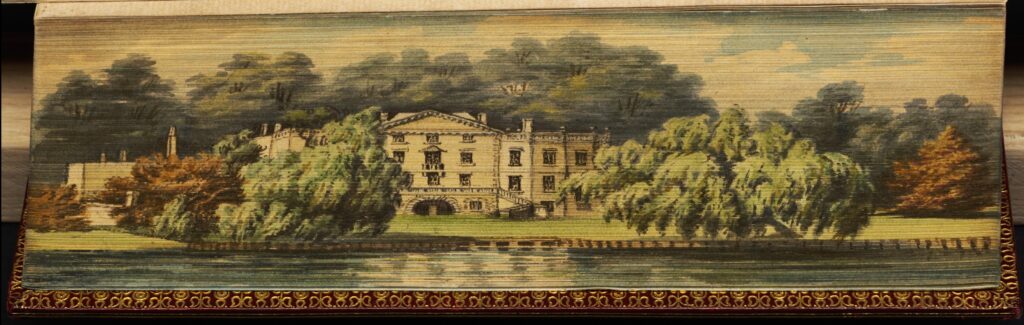
1863 book fore-edge painting of Pope’s Villa at Twickenham
The Twitnam Summer: Friendship, Satire and the Writing of Gulliver’s Travels
Hester Grant, London: William Collins, 2026, hb., 336pps., £25
DEREK TURNER reads about an extraordinarily productive summer
Early in the eighteenth century, the Middlesex village of Twickenham began to be noticed by Londoners wearying of the metropolis, drawn by the attractiveness of its Thames-side setting. One admirer was Alexander Pope, a poet of waspish reputation and socially problematic Catholic background, who in 1720 built a riverside villa in the latest Palladian style on a five-acre plot set between a malthouse and a tanner’s yard.
Pope was widely considered England’s preeminent poet, thanks to works like Essay on Criticism (1711), from which we get the phrases “A little learning is a dang’rous thing” and “Fools rush in where angels fear to tread”. He had also written The Rape of the Lock (1712), a mock-epic about the cutting of a hank of hair belonging to a society beauty, and Windsor Forest (1712/3), a lyrical example of loco-descriptive poetry. He had translated the Iliad, and knew Joseph Addison, Richard Steele and William Wycherley.
He was friends, too, with Jonathan Swift and John Gay – and between May and August 1726 played host to both at his house in what was then commonly called ‘Twitnam’, at a pivotal time in all three men’s creative lives. The works associated with that season have ever since been regarded as among the brightest ornaments of English letters.
Pope had known Swift since Windsor Forest, which as well as evoking that history-haunted tract, was also a commentary on contemporary politics. Pope’s poem was adopted by the Tories as useful agitprop, and the poet annexed by Swift, twenty-one years older, the Dean of St Patrick’s Cathedral in Dublin, and a highly effective veteran of political pamphleteering at an especially turbulent time. Dichotomies and discontents left over from the Civil Wars had found new expressions in vitriolic battles between Whigs – mostly Dissenters, anti-Stuart, and allied to mercantilism and finance – and Tories – mostly Anglicans, pro-Stuart, and associated with the landed gentry – with all the writers of the age enthusiastically taking sides.
Swift was famous for Tale of a Tub (1704), a satire on denominational disagreements between Christians, and the clash of old and new learning, and the Bickerstaff Papers (1708-9), a still funny extended lampoon of the Whig astrologer-propagandist John Partridge. After the Whigs took power in 1715, and began purging Tories at all levels, Swift’s writings waxed increasingly incandescent, sometimes forcing changes in government policy, infuriating Prime Minister Robert Walpole.
Walpole’s period of political dominance, between 1721 and 1742 – nicknamed the ‘Robinocracy’ – was notorious for its corruption and partisanship, and the generally unwanted extension of state power through patronage and preferment. Swift took courageous stances against such practices, frequently risking his liberty, and became a folk hero in Ireland, his writings uniquely able to unite Catholics and Presbyterians against exploitative London policies. Swift was held in such awe in Ireland that on one occasion he was able to disperse a crowd which had assembled to watch an eclipse by telling them it had been put off on his orders. Ironically, Swift saw himself as English, and didn’t much approve of the Irish, but any reservations about his adopted country were outweighed by his desire for social stability, and moral outrage at abuses by the rich and powerful.
Swift brought to Twickenham the militantly ironic manuscript which would make him immortal – Travels into several remote Nations of the World. In four parts. By Lemuel Gulliver. Gulliver’s Travels is one of the great books of the eighteenth, or any, century – a masterpiece of surreal invention and sustained invective which gave the language ‘Lilliputian’ and ‘Yahoo’, and held up the perfect Houyhnhnms to shame humans into better behaviour. Its exposure of cant, folly, gullibility and human weakness is still resonant; Gulliver is, wrote Morris Golden in his 1972 study The Self Observed, “more painfully ourselves than any other creation of his century.” Swift made his last tweaks during his time at Twickenham, and on the 8th of August packed it off to the printer, and posterity.
Almost as sensational in their day, if perhaps less read now, were Pope’s Dunciad (1728) and Gay’s Beggar’s Opera (first staged in 1728), both influenced by Gulliver and prodded into being by Gulliver’s author. Swift reputedly snatched a first sketch of the Dunciad out of the fire into which Pope had cast it. Years before, he had given Gay an idea for a “Newgate pastoral, among the whores and thieves”, and now made Gay bring it forward.
Pope penned the Dunciad to poke fun at bad or sycophantic writers, some of whom had recklessly assailed him in print, ironically giving them a more lasting fame than they would ever have attained otherwise. The poem’s portentous closing lines are still cited – “Lo! thy dread Empire, Chaos! is restor’d; / Light dies before thy uncreating word: / Thy hand, great Anarch! lets the curtain fall; / And Universal Darkness buries All” – but no stylistic fineness can conceal the essential redundancy of his squibs against such ignes minores as his former publisher Barnaby Lintot, and the malignant Irish cleric-poetaster Jonathan Smedley. The only target who could be called well known is the dramatist Colley Cibber, who in 1730 became one of the least distinguished versifiers ever to occupy the post of Poet Laureate. The Dunciad nevertheless contributed greatly to contemporary Whig discomfiture, and Pope’s then and future fame.
Gay had written unusually empathetic poetic conjurations of rural life, and finally following up on Swift’s old idea, completed his musical play TheBeggar’s Opera, which introduced the characters of Polly Peachum and her highwayman beau Captain Macheath to enthralled London playgoers. Gay supposedly made £800 from the play, leading to a joke that it had made Gay rich, and Rich (the surname of the producer) gay. The strength of the satire is evident from the outset, the first song sung by Polly’s father, a receiver of stolen goods and underworld informer, which runs in part “The Priest calls the Lawyer a Cheat, / The Lawyer be-knaves the Divine: / And the Statesman, because he’s so great, / Thinks his Trade as honest as mine.” Delighted-scandalised audiences saw shades of Walpole in Mr Peachum, Macheath and a gang-member, “Bob Booty”.
Gay’s spin-off, Polly, was accordingly banned by the Lord Chamberlain, which naturally excited frenetic interest. The Duchess of Marlborough paid £100 for a copy, and the Duchess of Queensberry was banished from court for soliciting money for Gay within the precincts of the Palace. The Opera had become a powerful weapon in the Tories’ intellectual armoury. It is ironic to recall that Gay’s most famous modern emulator was the Marxist playwright, Berthold Brecht.
The conversations of that summer must have been as sparkling as the Thames, and they were occasionally joined by guests like William Congreve, the politician-philosopher Henry St. John (1st Viscount Bolingbroke), and the polymathic physician Dr John Arbuthnot, who invented the bluff English archetype, ‘John Bull’. As well as agreeing in morals and tastes, the three were also united in bachelorhood. Gay’s innate indolence appears to have extended to his relations with the opposite sex. Swift was platonically devoted to two women – Esther Vanhomrigh (“Vanessa”) and Esther Johnson (“Stella”) – whose correspondence with him reveals the literary lion’s private humanity and humour. The unluckily diminutive and deformed Pope – he was 1.3 metres tall, and suffered from Pott’s disease, which twisted his spine and gave bladder and bowel problems, joint pains, headaches and eye inflammation – seems to have been celibate much against his will.
Hester Grant conjures this dazzling company deftly, memorably conveying the flavour and likely routines of that sunlit season, as the trio conversed, read or wrote, wandered in the celebrated gardens, or sat in the shell- and mirror-encrusted grotto called the Nymphæum in search of shade and classical inspiration. She also offers excellently observed wider vistas of these extraordinary artists in full, the politics and literature of their period, and a capital city full of corruption and disquiet, but also abounding creativity and vitality, where wits traded brilliant insults and speculative builders raised elegant edifices above stinking streets.
That London is lost, and Pope’s villa has gone, with just the Nymphæum to mark where once a great poet walked with great friends, and all imagined a world less unclean. Three hundred years on from that remarkable meeting of minds, this is a poignant portrait of an England that once was, or maybe could have been – and a satisfying reminder of the power and possibilities of literature.
DEREK TURNER is the editor of The Brazen Head, as well as a novelist (A Modern Journey, Displacement, and Sea Changes) and widely-published reviewer. His first non-fiction book, Edge of England: Landfall in Lincolnshire, was published June 2022. Some of his writing may be found at www.derek-turner.com He is also on X – @derekturner1964
PAUL J. PASTOR is an Executive Editor for Nelson Books, a widely-published poet, and the winner of the 2025 J.F. Powers Prize in Fiction. He is the author of several books, most recently TheLocust Years: Poems and The Crystal Hand: Poem. He lives in Oregon.
PAUL J. PASTOR is an Executive Editor for Nelson Books, a widely-published poet, and the winner of the 2025 J.F. Powers Prize in Fiction. He is the author of several books, most recently The Locust Years: Poems and The Crystal Hand: Poem. He lives in Oregon.
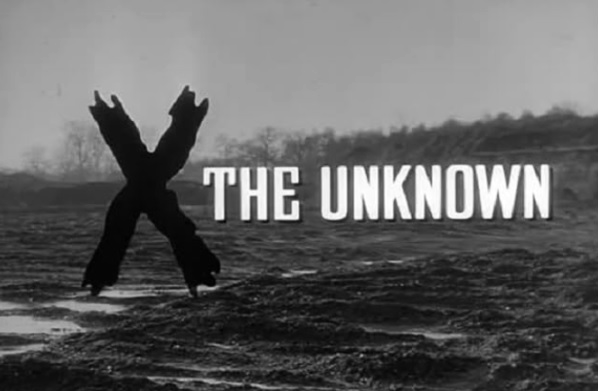
Many years ago, when I was a bit younger[i] than the boy, Willie, who trespasses in the marshy woods at 00:17:14[ii] in X the Unknown (1956) and at 00:18:45 meets the (unseen to us) monster (that’s what comes of playing outside when you should be in bed!), the old Welsh Headmaster (who doubled as maths teacher at the local council school), accused me (again) of being “BORN AWK-ARD”. Whether I was questioning the relevance of maths beyond basic shopping calculations, deliberately misunderstanding some unappealing formulaor persisting with wanting to know why X meant whatever, his strong adherance to Chapel teachings, cautions of hellfire and damnation and his hieratic manner of speech, undoubtedly magnified his allegation. At some level, I knew he was right. But whether awkwardness arises from nature or nurture . . . remains, like X, not quite knowable.
Perhaps because the older guard of teachers at Elmhurst Junior had pre-war roots and elements of a military attitude residual in the base of their skulls, it is easy to connect the geiger-counter training that opens X the Unknown (its army personel divided into bigwigs and disposable rabble – or officers and ranks, if you prefer) with the partly black and white school world of the late 1960s. But this world was definitely in transition, and it seems obvious now that the aging headmaster’s awareness of the upcoming generation of teachers (relatively approachable[iii] and dyed by more colourful, Education Through Art[iv] attitudes) pushed him to an obdurateness as long-standing as I now like to believe my awkwardness was whimsical. His frequent, rising claim in school assemblies that God could see us everywhere, might have amused the younger staff, but it angered me. To see this supposed creator as a voyeur or master spy (or in today’s terms, a kind of disembodied CCTV system) was not encouraging. In combination with my natural “awk-ardness”, the Headmaster’s ire (no doubt also triggered by his distrust of late 60s values) only made me come to view his God (or any god) as a kind of Orwellian Big Brother. By extension, as time went on and other would-be authority figures (clothed in seemingly harmless, wishy-washy cardigans or behind pipes[v] or toothy grins[vi]), took to the stage, I came to view not just politicians but the majority of science and technology, in fact, the entire “white heat of this scientific revolution”[vii] as (predominantly, but not exclusively) part of the paternalistic control system driving society (with plenty of heat but not much light) largely in the wrong direction.
00:25:23 – the devastation of several MeccanoTM sets . . .
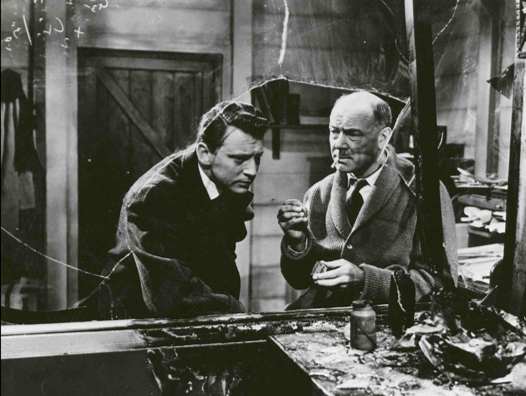
Sure enough, in X the Unknown, poor Willie dies of radiation burns, and soon afterwards, his grieving father makes the clear and generally valid distinction (00:31:20): “You’re a Scientist not a Doctor. You don’t care for the sick, you meddle with things that kill . . . letting off bombs you can’t control. You’re not safe! You’re a murderer!” After being subjected to this understandable rant, Dr Adam Royston, (Dean Jagger) walking dejectedly away down a corridor, at 00:31:20 reflects lamely to Inspector McGill (Leo McKern) : “we all try to create not destroy”.
In X the Unknown, Jagger’s character seems a friendly, mild figure, absent-minded in the way professors are often stereotypically humanised. Unfortunately, in reality, whenever science discovers something that can be exploited for war or profit, scientists tend to get pushed aside, their work misrepresented, twisted or ransacked. Alternatively, as the common trope of fiction would have it, they become ambitious or power-crazed.
By contrast, in X the Unknown, Dean Jagger’s Dr Adam Royston, is very sympathetic and shows no sign of megalomania. Since Jagger was also considered amenable in person, it came as a surprise to discover that he held virulently McCarthyite, anti-communist opinions and became adamant that Losey[viii], (who under his blacklist alias of Joseph Walton had begun the pre-production and initial shooting), should be replaced. To cover the later, highly acclaimed[ix], director’s departure, poor health was blamed[x]. He was replaced by a reluctant Leslie Norman[xi].
Post-war idealism may have camouflaged the hubristic dead-end of nuclear power in optimistic science-fiction shapes and colours[xii], offering naïve or deceitful sentiments[xiii] and never-to-be-achieved economic benefits[xiv], yet underlyingly, all the monsters remain, boiling away deep underground – as turns out to be literally the case depicted in X the Unknown. In an internet post about the film from October 2023[xv], Colin McGuigan notes: “While I wouldn’t quite categorize it as an early Eco-thriller, it does raise questions about our symbiotic relationship with the planet itself.”
Considered “vulgar and shocking”[xvi] on its release in 1956, I didn’t remember X the Unknown as a exceptional film, but it was a memorable one, one which tapped into an almost universal distrust of rampant science and technology: science as a kind of witchcraft or Pandora’s Box; science which cannot control the forces it releases. Sadly, applied to nuclear power and weapons, and now more insidiously in the fields of mobile devices, the internet and A.I., this theme of toys or tools out of control, is obviously becoming the massive writing on the wall for all of us. Writing which it seems society is too unimaginative to notice or consider and too exhausted to heed.
In the other ‘X’ film I well-remember, Roger Corman’s X: The Man with the X Ray Eyes, (1963), Doctor Xavier (Ray Milland – whose salary justifiably consumed much of the budget) is irritated that the human eye can see only 10% of the light spectrum[xvii]. Determined to force more from the retina or brain, before long, a lab monkey is sacrificed – Xavier’s miracle compound dripped into the poor creature’s eyes. What does he really want to see? Next, Xavier is, more fairly, experimenting on himself . . . but why not stick to one eye? – then perhaps he might have had the ‘best’ of both worlds?
Extremely effective as both an attack on (un)scientific meddling and a parable about hubris[xviii], in prismatic Spectorama[xix], X: The Man with the X Ray Eyes, fractionally anticipated psychedelia and the wider use of LSD. While some of its attitudes have dated, it begins with serious (if absurd) intent, before inevitably lapsing into mild exploitation and action, but returns to a once-shocking denouement in a desert preacher’s tent. Here, rather than staggering up to confess his sins, Xavier says: “I’ve come to tell you what I see. There are great darknesses. Farther than time itself. And beyond the darkness . . . a light that glows, changes . . . and in the centre of the universe . . . the eye that sees us all.”So, after reminding us perhaps of that voyeur God, in an emotionally ecstatic U.S. version of my old Welsh headmaster, the preacher paraphrases Matthew 5:29: “If thine eye offend thee, pluck it out.” Dr Xavier does just that, the image freezing on his black empty sockets[xx].
In contrast to Zabriskie Point (1970)[xxi]asthere may be less to say about these two relatively conventional films, am I persisting out of “awk-ardness”? A friend joked that my fervour for digression will eventually lead me to write something less than a page long accompanied by a encylopedia of references and notes . . . which is an interesting challenge. But escalating attention (obsession?) detail (pedantry?) and subtlety (obscurity or whimsicality?) through notes, forking or parallel pathways, is hardly new. Melville’s Moby Dick (1851) is an indelible monument to a fascinating and complex addiction . . . while in the not-quite-opposite Beckettian[xxii] world of saying a lot about very little, arises perhaps, Don DeLillo’s novella, Point Omega, (2010) in which a character at the beginning and end is obsessed by Douglas Gordon’s real art installation entitled 24 Hour Psycho[xxiii]. Showing at the Museum of Modern art in New York during the summer of 2006, Hitchcock’s notorious film was slowed down to play once every 24hours. Appropriation or homage? Valid conceptual generator of attention, or gimmick?
Even if the supposedly Scottish wasteland[xxiv] adjoining the Atomic Energy Establishment of Lochmouth or the gaping fissure of X The Unknown, would make excellent settings for Waiting for Godot, it seems unlikely that the 1956 film could be mistaken for anything either as potentially complex or inspiring as Moby Dick or as potentially gimmicky as 24 Hour Psycho. But wait! Maybe it could help humanity on an altogether different level? Think of the synopsis! An older lifeforce bursts from the centre of the Earth in the form of a growing, glowing radioactive porridge, to eat particularly anything radioactive. Come back heartless lava – all is forgiven! – save those living on the earth’s crust from their nuclear dead-end nightmare . . . revive our naïve post-war scientist-hero fantasies worthy of cutaways, children’s cereal-boxes and sci-fi annuals . . .
The imaginary Atomic Energy Establishment of Lochmouth at 00:07:20
Close imaginative or speculative observation, observation straining or stretching consciousnessness or attention in the manner of ‘slow cinema’[xxv] (or such as could be stimulated by, for example, the process of watching Psycho slowed to run once every 24 hours), perhaps replicates in essence the hopeful idea behind the opening stanza of Blake’s Auguries of Innoncence[xxvi]: “To see a world in a grain of sand / And a heaven in a wild flower, / Hold infinity in the palm of your hand / And eternity in an hour.”
Blake’s lines may seem purely hypothetical to those who live within the claustrophobic confines of our technocracked, supposedly rational society, or within the accepted codes or fantasies of ‘progress’. But to anyone open to the fuller world – anyone who doesn’t have Doctor Xavier’s expectant demands – such transcendent escalation often occurs quite naturally. Even the artist Graham Sutherland’s less exacting echoes of Blake, seeing landscapes in miniature on a Pembrokeshire beach, can have an almost visionary effect on those not used to regularly thinking in such a way.
Going back to the idea of artists falling from art’s vital tightrope into formula and gimmick, more than a few ‘successful’ artists have founded lucrative careers upon stunts and repetition – I won’t name names – but this complacence, despite a concomitant facility which inevitably grows over the years, is not worthy of respect once detached from some wider or deeper quest. Although it may be unfashionable to say that art, music, writing, film and so on should be about enlightenment, I will say it anyway.
X the Unknown is an effective black and white entertainment, but apart from considering fears of the time, does it have any aspects of enlightenment about it? Unease even dread, fills many of its frames. Elemental mystery evoked in ways which we may be used to but remain unsettling: the misty woods and fear through a child’s eyes. Hammer’s usual paranoid music, insidious, unearthly, is always likewise always potent. It scratches at the nuclear trick in a way that is wholly justified, since the essence of nuclear research was always about destruction. The idea of free power (ha ha) only stemmed from the loop of annihilation it still freely offers.
Windscale in 1956, the year X the Unknown was released and a year before the disastrous fire[xxvii]
Lochmouth may be imaginary but Windscale unfortunately was not, and the fire of 10 October 1957 was the worst nuclear accident in UK history. On the International Nuclear Event Scale, it remains one of the worst in the world, in severity ranked at level 5 out of 7. That is when the whole nuclear fantasy should have been terminated.
Despite undercurrents of dissent, X the Unknown probably had little choice but to show the scientists, ultimately, as heroes, leaving the military personel, managers and ministry men to smoulder the torch of that beloved film type, the stock idiot. One officer, comments at 00:48:08, that the “trouble with some of these scientific types is that they can’t see the easy way out of anything. It’s got to be complicated if it’s going to work.” The classic military way of course, is to blast and raze the fissure with high explosves and flame-thowers and then concrete it all up! Leslie Banks as Colonel Holland in Powell and Pressburger’s The Small Back Room (1949) might have been a blimpish caricature intended partly humorously, but underlyingly he was both shrewd and honest.
Predictably, Spider (Anthony Newley), Haggis (Ian MacNaughton) and Private Lansing (Marty Hopkirk of the white suit/Kenneth Cope) all become victims to the as yet unseen monster from the centre of the earth. By his petulant comments and irritation at being bypassed as boss of his “nuclear pile”, manager John Elliott (Edward Chapman) seems, at 00:42:50, to be the next victim in line . . . but miraculously survives, shortly to become the recurring martinet, Mr Grimsdale or equivalent, in five Norman Wisdom comedies[xxviii].
Learning of the approach of the radioactive sludge intent on scoffing the energy source at the dubious establishment, the cast and crew are all frantic to get the cobalt pile, a great big block, presumably radioactive, loaded onto an open flatbed truck. No precautions taken. Radioactivity is fine. Just keep a little distance and brush your hands off. Meanwhile for some baffling reason all the village flock are herded into the church by their vicar – as if the monotonous mass which can melt through solid blocks of lead is going to be put off by a couple of oaken doors or the animosity of a voyeur God who sees eveything. Naturally, a small girl child is left outside and soon runs chuckling and friendly towards the sparkling bread dough pouring over the churchyard wall. Rescued in the nick of time by the vicar, she seems unharmed despite her proximity.
Soon though, the expanding dough is heading towards the “experimental nuclear station”. Darn things are all over the place – even now. Costly misdirections still cooking 70 years later – I chanced upon one back in June just north east of Preston[xxix]. This blot on the landscape one has been “making nuclear fuels since the mid-1940s. The site is notable for being the first nuclear plant in the world to produce Magnox fuel for a commercial power station”.[xxx]
Springfields nuclear fuel production installation, Salwick, Preston, 26th June 2026
The final section of X the Unknown, involes lots of moving about of vehicles and unspecified equipment to recreate Dr. Royston’s unpredictable MeccanoTM experiment. As with the recent epic blockbuster Project Hail Mary (2026), the need for urgency vaults every hurdle, and Wallace and Gromit save the day. Or have they? “You should be proud. It has worked” X says to Y, before another unexpected explosion follows. Royston/Jagger looks baffled and the camera backtracks, implying space for a sequel.
In the excellent 2003 commentary recorded by Marcus Hearn and Jimmy Sangster (1927-2011), Sangster says that the anti-nuclear aspects were accidental, or rather that they were exploiting a common fear of the time. Meanwhile, at the BBFC or censorship office, John Trevelyan was reportedly concerned about X the Unknown’s “dangerous cocktail of sex and horror”. The tryst between radiographer and nurse in the Radiation Room could be seen as an example of this – their potential lust swiftly curtailed by the unsentimental monster at 00:34:00. I’m not sure why the victims of the monster don’t simply run away, like Willie does at the beginning, not that it did him any good. It might be difficult in confined spaces such as the Radiation Room, but some of the soldiers seem inordinately stupid, repeatedly firing their guns into what must have appeared to them as a kind of lava. Primary producer for Hammer, Anthony Hines, told the censorship board that the monster wouldn’t look as nasty as the script described, since they were intending to represent it with “chocolate mousse”.
One censor complained that X the Unknown was “scientific hokum and sadism in equal parts; a wretched exploitation of the X certificate”. The script was also described as “the work of an insane but precocious schoolboy!” which writer, Jimmy Sangster, on the commentary, doesn’t seem to mind at all for what he calls his “B and a half movie”. The fairly low budget is illustrated when Dr Royston visits a local church to question Willie’s schoolfriend about what they were doing on the night Willie received his radiation burns. To set the scene, the establishing shot used (below) was taken from Whisky Galore! (1949)[xxxi].
“X the Unknown” wrote Monthly Film Bulletin: “intriguingly suggests a new addition to the science fiction repertoire of Things, but after a series of prolonged climaxes, with its potential victims staring directly into the camera and shaking with fright, the ‘Unknown’ finally emerges as a type of rolling rubber mattress, disappointingly unhorrific in content and appearance.”
* * * * * * *
Perhaps it is only fitting in the days of obvious climate change, of psychopathic omnicidal world leaders, of narcissistic megalomaniac billionaires, of futile weathercasting and forlornly relativist cultural opinion, that the idea of a canon of film has more than somewhat self-destructed. For a decade or two, I maintained a constantly shifting top 100 of films, films largely chosen for their searching depth and quality but also allowing, overall, for enjoyment and entertainment as well as hopeful and inspirational[xxxii] elements. This was a kind of desert island list, indebted therefore to Roy Plomley’s[xxxiii] radio program[xxxiv], imagining 100 films that would stand being watched and watched again if you were shipwrecked but somehow had a projector and 100 films – or a massive TV, DVD player and 100 DVDs (the whole concept would be seriously diminished if the delivery system were smaller). Although I would probably stand by at least half of the films which made it into the more stable top ten[xxxv] of this 100, I began to abandon the overall idea when I realised that I had over 200 films in my top 100.
List-making remains a societal disease; can it have fundamental positives? Despite its prolific passion for lists, the film magazine, Sight and Sound, remains great, thanks perhaps to Mike Williams – an editor with principles. In a world steeply dumbing down, are lists a commercial necessity? One recent specimen: “21st-Century Sci-Fi Cinema,”[xxxvi] chose a film from each year since 2000. Across the page from 2001’s exceptional Donnie Darko (2001), was Sam Wrigley’s choice (presumably, Sam was born “awk-ard”) I.K.U. (2000) a film I struggled to track down and which proved to be of almost no value whatever (though it’s not much worse than Titane, 2021, which won the Palme d’Or at Cannes). Apex of all these short-attention span lists is the once-a-decade “Sight and Sound Greatest Films of all Time”[xxxvii]. Yes, the title is ludicrous. It reminds me of playing a very loose version of cricket with my children around the turn of the Millenium in rural, middle-of-nowhere, North Devon. Increasing in absurdity, The Supreme Universe Cricket Cup, eventually involved 124 invented teams. Some of these merely named the team: e.g. Flash [Gordon] and the Showoffs – a particularly reckless mob who in swashbuckling style tried to turn every ball into a 6 over the house or trees. Other teams were serious and well-characterised. My son’s Star Wars squad, featured carefully inscribed players, all of whom played or failed to play as Star Wars fans (him) might expect (although Yoda was not the best, being too calm and inclined to sitting). I can’t remember how often Darth Vader got into an argument with Han Solo, or whether team loyalty superseded Good and Evil . . . or rather Light and Dark? Perhaps Darth eventually formed a breakaway team to challenge the light side of the Force? I’m not even sure which teams made it to the final – though I have an entire scoresheet somewhere. Possibly, it was Star Wars versus The Artist, Writers and Characters (featuring all-rounders Paul Nash, Graham Sutherland, Herman Melville, Emma Peel and Wolf Solent with Cecil Collins and Orson Welles bowling off breaks – not difficult in a lumpy garden) . . .
For all their atmosphere and entertainment value, neither X the Unknown, nor X: The Man with the X Ray Eyes, would have made my top 100, though they are no better or worse than Sight and Sound’s current “Greatest Film of All Time” Jeanne Dielman, 23 Commerce Quay, 1080 Brussels. (1975). Largely a depressing tableau of interiors – Jeanne Dielman’s unmoving camera provides mesmerizing but tedious focus, observing like a coldly voyeuristic god! A cross between slow cinema’s occasionally valid lean towards transcendence and a kitchen sink (or living-room settee) realism of dreary daily routines, obsessively, neurotically, carried out . . . ultimately, this is a film about futility. For Jeanne Dielman, everything has a place. Dispiriting rather than inspiring, it is intensely claustrophobic. By the long overdue end, you feel like killing yourself. A suddenly fashionable or unfairly despised token of a film, it seems plucked arbitrarily from Chantal Akerman’s valuable oeuvre. It is not her best work and as Andreas Babiolakis points out in his useful filmography[xxxviii], winning the poll did it no favours. Try, Portrait d’une jeune fille de la fin des années 60 à Bruxelles (1994) or Je, Tu, Il, Elle (1974). Or take a look instead at the superior Riddles of the Sphinx[xxxix] written and directed by Laura Mulvey and Peter Woollen.
Jeanne Dielman’s air of joylessness is crushing. “My youth was but a gloomy storm” reads out Jeanne’s 25-year-old son, quoting Baudelaire – and even this brief line conveys a sudden wild cloudscape to dismiss the robotic routine Jeanne Dielman presents. What a relief when the camera or the characters go outside!
The only brief joy for Jeanne appears to be remembering the end of the war . . . and the son never rebels against her rules or routine. At 01:05:16 we are briefly outdoors again: any light, any air, is like an oasis in the desert! Naturally, the period atmosphere is now worth looking at, with an un-poshed-up Brussels, the sometimes slightly misty yet translucent winter streets, the proper cars . . . instead of existing as a film, Jeanne Dielman might work well as a chain of still images of dated rooms, streets and stores.
Jeanne shops, cleans and rearranges to a pattern . . . yet does manage, once in a while to smile: in the wool shop (01:29:56), in a café at Giselle (01:30:47) which she misses on her next visit – clearly discomforted by having to sit in a different seat (03:01:46). By this point however, she is starting to visibly crack, albeit in a more measured way than Carol Ledoux (Catherine Deneuve) in Repulsion (1965).
Somehow, even the perfunctory prostitution Jeanne practices, seems part of a general process – which of course may be one of the film’s points: the way we prostitute ourselves to futile modes of life. The way we try to evade alarms and surprises. That respectability is a farce . . .
Occasionally, even the less illuminated sections of Andrei Tarkovsky, can suffer from a form of Jeanne Dielman disease – a drawn-out atmosphere that (charitably) aims to alienate or mind-numb us via demoralising thought into a search for positivity or meaning. Desperate for import, eventually we grow weary, fall into a different zone, or manufacture meaning for ourselves. Which is fine under different circumstances, but Jeanne Dielman can make you long for a mindless Euro-spy thriller[xl] or a Morecambe and Wise feature film such as: The Intelligence Men (1965) or That Riviera Touch (1966)! Jeanne’s mind-suicide of repression can’t last; her life of quiet desperation begins to crumble towards the 3-hour mark as she starts to fumble and drop things . . .
Her suffocation under the final man (above) resembles how you feel all the way through the film – and it ends in a strike for freedom which fails . . . But perhaps I am forcing my own desire for Jeanne to E S C A P E upon the film? “Jeanne Dielman’s defences had snapped and I wanted to demonstrate that with the strongest sign of her oppression: prostitution… Jeanne Dielman kills to regain her order” Akerman herself said[xli]. Perhaps Jeanne’s repressive order is as close as she can get to the concept of freedom – which may only be a concept anyway, however we interpret or attempt to live or avoid it?
Even if Jeanne Dielman doesn’t justify this much attention as a film (rather than as “the first masterpiece in the feminine in the history of the cinema”[xlii]) Chantal Akerman was undoubtably a worthwhile artist and the film must work on other levels to be so highly rated. Perhaps viewers identify with it as a kind of psychological case history? Is it unfair to know or remember that aspects of Jeanne’s behaviour were based upon Akerman’s mother’s daily routines and that her mother was an Auschwitz survivor? This cannot help but affect both viewer and critic, making Jeanne a martyr by association. A more concise and intense film to which Jeanne Dielman could be very loosely related is Dušan Makavejev’s Love Affair, or The Case of the Missing Switchboard Operator (Ljubavni Slucaj ili Tragedija Sluzbenice P.T.T.) of 1967. But Eva Ras (as Izabela, telefonistkinja or switchboard operator) seems very much alive although dead, while Delphine Seyrig (as Jeanne) is obliged to play dead whilst alive . . .
In the end, however, my intolerance towards Jeanne Dielman, 23, quai du Commerce, 1080 Bruxelles, could be partly physiological. Owing to the tunnels and ventilation shafts the workers have to crawl through in Under Night Streets (1958)[xliii], one of my previously favourite BTF films has become difficult to tolerate. It triggers my claustrophobia. Jeanne Dielman is similarly stifling. Watching it is like being buried alive . . .
I only have to pass under the shadow of a tree in some inconsequential suburb to feel a sudden desire to watch and ponder Vertigo[xliv] again. Yet Vertigo’s overall enigma surpasses its individual scenes and my memory (or mis-memory) of the profoundest passages can be so essential and heightened, that sometimes the actual filmitself can be a distraction. Many films have this effect, but Jeanne Dielman does not. In fact, you would have to pay me to watch Jeanne Dielman for a fourth time. Rather than being hauntingly tragic, what Jeanne Dielman perhaps does best, is reflect the increasingly robotised captivity of society – a society far more closely circumscribed by technology now than it was in 1975. Forget rampant lava or psychedelic eye drops, it’s the tools that have taken over. The tools and their android oligarchy of selfish owners. These are the real monsters.
[i] At 13 or 14, the actor, Michael Brooke (1942-2014) was older than he looked in the film
[ii] All the timings from X The Unknown come from my 2005 Hammer DVD
[iii] Though one teacher did lift me up by my ears (not off the ground, and I probably deserved it) while another used to make wrongdoers do handstands against a wall all through playtimes
[ix] Particularly after the release of The Servant in 1963
[x]bfi.org.uk/features/why-i-love-x-unknown by Vic Pratt: “American star Dean Jagger was signed up to star, and blacklisted Joseph Losey – who would go on to shoot The Damned (1961), another seriously spooky sci-fi film – was enlisted to direct, but there was further trouble ahead. Losey left the production somewhat abruptly – supposedly with pneumonia, but, according to [Jimmy] Sangster, removed from the project owing to star Dean Jagger’s reluctance to work with a ‘red’ director.”
[xi]imdb.com/title/tt0049967/trivia/: “It has also been reported that Losey simply didn’t want to make the film and left the project, to be replaced by Norman, who also didn’t want to make the movie.”
[xii] A false picture that still clings on 70 years later – another corpse inadequately staked!
[xiii] See Atomic Achievement (1956) youtube.com/watch?v=ToVsb_AhrlMObserving the scientists and minions featured is like watching toddlers play with broken glass:
[xiv] Sheer awkwardness or pigheadedness continues to throw good money after bad despite there being no safe solution to the disposal of waste which remains dangerously hot and highly radioactive for thousands of years.
[xvi] Marcus Hearn’s words in an absorbing 2003 commentary to the film with Jimmy Sangster, the writer and production manager.
[xvii] For what it’s worth, this figure has since been scientifically reduced to less than 1%.
[xviii] It was a vivid memory of the end of X: The Man with the X Ray Eyes, that etched the biblical (mis)quote from Matthew 5:29 into my head: “If thine eye offend thee, pluck it out.” internationaltimes.it/first-principles/
[xix] The Spectorama technique was employed by Cinematographer Floyd Crosby to suggest what Dr. Xavier sees as his vision expands the normal human spectrum.
[xx] In his book Danse Macabre, Stephen King, noted rumours which claimed “the ending originally went further, with Milland crying out “I can still see” after gouging out his eyes. Corman has denied the existence of that ending but expressed enjoyment with the idea, saying “Now it’s interesting. Stephen King saw the picture and wrote a different ending, and I thought, ‘His ending is better than mine.'” See: en.wikipedia.org/wiki/X:_The_Man_with_the_X-ray_Eyes
[xxiv] This recurring location was actually filmed (as were other film and TV productions including episodes of Doctor Who) at Gerrards Cross Sand and Gravel Pits in Bucks which looks, in pictures, though not in the film, to be very similar to the Leighton Buzzard Sand Quarries which so inspired me from the 1970s: brazen-head.org/?s=zabriskie+point As the film was made in the winter, filming day for night was not considered possible since it requires bright sunlight, necessitating working at night in very cold January and February temperatures.
[xxviii]www.imdb.com/name/nm0152361/?ref_=tt_cst_t_2 Chapman also remains indelible as a church deacon in Powell and Pressburger’s Gone To Earth (1950), when at 00:31:46, after the vicar has said Grace: he declares: “I have not received tartlets… I am not thankful!”
[xxxi] As Peter Faizey noted here: www.reelstreets.com/films/x-the-unknown/ the church, Our Lady Star of the Sea, is on the Isle of Barra, Castlebay, Scotland. The other church used is St Michael’s Church, Bray, which apparently also appears in Paranoiac (1963), Four-Sided Triangle (1953) and There’s a Girl in My Soup (1970).
[xxxii] Even the darkest (and best) film noir: Out of the Past, 1947, (my number 4 film since the late 1980s) has fleeting lights of hope.
[xxxv] Although I would “stand by” these films, there would probably be a hundred others I’d now wish to cram into the top ten, since much of the list predated my wider experience of European and world cinema – particularly of Italian and Japanese films. The Japanese New Wave (Nuberu bagu) is every bit as vital as the better-known French Nouvelle Vague
1) A Canterbury Tale (1944)
2) Solaris (1972)
3) The Ghost and Mrs. Muir (1947)
4) Out of the Past (U.K. title: Build My Gallows High (1947)
[xliv] Vertigo preceded Jeanne Dielman… as number one in the Greatest Films of all Time list. Naturally, the critical/appreciative paths around it are thoroughly trodden.
LAWRENCE FREIESLEBEN, Film & Television Editor of The Brazen Head, has beenan artist and writer as long as he can remember – cycling away at weekends from the council estate where he grew up, to paint the countryside as an escape from the restrictive tedium of the school week. Leaving home at 16, he has lived in 17 different areas of the UK – from Devonshire to Northumberland – painting and writing, always vigilantly questioning the interior light of landscape, cityscape and wider atmosphere. Living virtually off-grid with his large family, both remote locations and urban visits have formed the backscene to a passion for film which has intertwined with art and writing throughout his career. Films remain a key creative focus since childhood, resulting in encyclopaedic folders and clippings as well as a constant stream of home-made film festivals. He currently lives in a dilapidated Lancashire seaside town
GARY BILLS was born at Wordsley, near Stourbridge, UK. He gained his MA in Creative Writing at Birmingham City University, with a distinction. He has been nominated three times for a Pushcart Prize, and he has three full collections to his name. His work has been translated into German, Romanian and Italian.
Black Sea
Those dead ships in abysmal sleep
where time and shipworm cannot bite
and even snows of flesh and slime
which elsewhere ghost it down from light
can never reach this other deep
where oil-less lamps on Punic prows
are waiting for the taper’s touch,
though all the crews are sift by now
or swimming in the eyeless mind.
But when Man’s dreams are kindled bright
the fish is startled in its flight,
to glimpse the ports he left behind.
Moments at an English Church
Time preserves its monuments of quiet –
the marble baby, wailing from her crib
in perfect silence – rumpling up her face
And pudgy cherubs flutter round a name
with virgin crants for James, who died a teen,
white ribbons for his purity and grace.
A bishop waves his devils’ book and frowns –
(his bald head’s like a marble on a ruff…)
but after all, this was his solemn place.
Outside the seeds are spinning from the limes –
past saints who float in frames of staining glass,
GARY BILLS was born at Wordsley, near Stourbridge, UK. He gained his MA in Creative Writing at Birmingham City University, with a distinction. He has been nominated three times for a Pushcart Prize, and he has three full collections to his name. His work has been translated into German, Romanian and Italian.
ANDREW SHIELDS lives in Basel, Switzerland. His collection of poems Thomas Hardy Listens to Louis Armstrong was published by Eyewear in June 2015. His band Human Shields released the album Somebody’s Hometown in 2015 and the EP Défense de jouer in 2016. His poems have recently appeared online in Talking About Strawberries, Delta Poetry Review, London Grip, and Oddball Magazine.
ANDREW SHIELDS lives in Basel, Switzerland. His collection of poems Thomas Hardy Listens to Louis Armstrong was published by Eyewear in June 2015. His band Human Shields released the album Somebody’s Hometown in 2015 and the EP Défense de jouer in 2016. His poems have recently appeared online in Talking About Strawberries, Delta Poetry Review, London Grip, and Oddball Magazine.