Alexander Ffinch, the organ of Cheltenham College Chapel, Divine Art Recordings. DDX 21112
RICHARD DOVE is transported by a new album of organ music
My father adored church organ music. At the weekend, I would often wake to the grand noise of Nôtre Dame, Rouen, or the three manual, 44 stop organ at Freiburg Cathedral (a particular favourite). I was constantly reminded of him as I listened to Parallels, a new CD by Alexander Ffinch.
Ffinch is the organist at Cheltenham College and oversaw a complete rebuild of the organ in 2017. There is an intimacy between player and instrument which is both rare and wonderful. There is also a refreshing boldness in the selection of compositions. Where else could one find Gustav Holst alongside Coldplay’s Chris Martin? As Ffinch explains in the sleevenotes:
Today, one of my daily duties is to play to 700 students at the start of their working day. I am facing a generation with the power to instantly access the music they want at any time and trust me, it’s not likely to be original organ music. So to capture their attention, I have enjoyed turning to classical some pop/rock arrangements to present music they hear elsewhere.
The Coldplay song ‘Paradise’ soars around the college chapel, stirring even the most indolent student.
There are other surprises on the recording – a Suite by Florence Price, an African-American composer who combines her classical training with Southern black American culture. Her ‘Symphony No 1 in E Minor’ was premiered at the Chicago World’s Fair by the Chicago Symphony Orchestra in 1933. The concert was the first performance of a composition by a black woman by a major orchestra in the US. The ‘Suite’ is jaunty, mellifluous and immediately engaging, with jazz phrasing and gospel singing inspiration.
There is a wonderfully atmospheric, gently-paced interpretation of Elgar’s ‘Nimrod,’ benefiting from the resonance of the chapel’s ancient stones.
Dan Locklair’s ‘Rubrics’ is another surprise, and requires Ffinch’s masterful dexterity. After a tumultuous first movement, we move to a gentle second movement using silence as a sort of leitmotif. As the composer explains in the excellent accompanying booklet: “To be sure, it is impossible to have true silence when music is sounded. But the illusion of silence can be suggested.”
The recording closes with Leon Boellman’s ‘Suite Gothique.’ It was early morning when I listened to the Suite and its third movement ‘Prière a Nôtre-Dame.’ My father was almost with me in the room as the melody floated and swirled. Nôtre Dame was his first port of call on any visit to Paris. From this embracing reverie we launch into the thunderous final movement, the Toccata. It awakened the household as Dad was prone to do. Time to put the kettle on.
STUART MILLSON is appalled to find Mid Wales Opera facing closure
Founded 35 years ago to bring the finest music and drama to rural towns and communities, Mid Wales Opera is a company specialising in bringing pared-down versions of the greatest music-dramas to far-flung parts of the country.
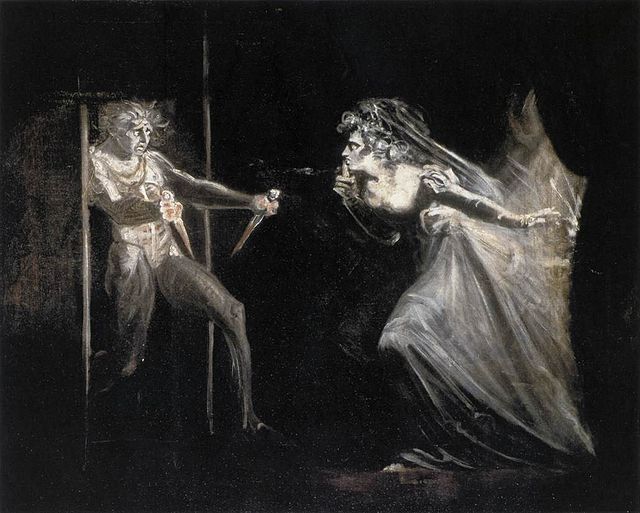
On Saturday 23rd March, their run of Verdi’s Macbeth came to an end at the c. 500-seat Brecon Theatre (Theatr Brycheiniog), with a capacity audience enjoying Jeremy Sams’s English version of the score. Directed by Richard Studer – and full marks here for the stage lighting and ‘recycling’ of roles among the chorus – Mid Wales’s own glorious opera company succeeded in generating a dramatic effect, just as overwhelming as anything you might hear at Welsh or English National Opera.
How was it possible for an orchestra-pit ensemble, just 15-strong, to conjure much of Verdi’s lush orchestration? Under conductor Jonathan Lyness the resident chamber orchestra, Ensemble Cymru, achieved this miracle – the timpanist also playing the side-drum, and their splendid cellist generating a rich, resonant sound in those dark moments of the drama.
On stage, meanwhile, Macbeth’s court, began its disintegration: soldiers with a Fascistic air, reminiscent of Richard Loncraine’s film of Richardlll, marched up and down, Lady Macbeth – the brilliant stage presence of Mari Wyn Williams unleashing her amoral powers, and Macbeth himself, sung by Jean-Kristof Bouton, descending into his ‘feverish visions’ as the apparition of the murdered Banquo appears at a castle feast.
The witches, dressed as 1950s’ office secretaries, but with demonic eye make-up reminiscent of Kathleen Byron’s unsettling appearance in the 1947 film, Black Narcissus, deserve great praise for their unsettling performance. Finally, the end comes for Macbeth as a forest supernaturally advances upon his fortress – actually, the English army in camouflage, although on stage at Mid Wales Opera only the Scottish saltire was raised. (Surely a major omission that the Cross of St. George did not appear?!)
What next for Mid Wales Opera? A real-life dramatic crisis, no less: the shocking removal of one hundred per cent of their grant from the Arts Council of Wales, casting doubt over whether productions of this kind could ever be staged again. Is this a dagger they see before them? It would seem so. But the story is the same, everywhere. Last year, the BBC tried to disband its own elite choir, the famous BBC Singers, and cut its symphonic strength across three ensembles. Meanwhile, the length and breadth of these islands, from Birmingham to Bournemouth, our orchestras and theatres struggle to convince those in power of the vital need for the arts.
Quite simply, Britain now has a choice: do we just become a TV/consumer society, turning our backs on the splendour and enrichment of music and the arts? Or do we challenge the Arts Council and those in political office for a change in direction? As the wise Hans Sachs in Wagner’s DieMeistersinger put it: “Neglect the civilised arts at your peril…”
To support the appeal for Mid Wales Opera, write to Bryn Wgan, Caersws, Powys, Wales, SY17 5QU
The not-so-new castle at Newcastle Emlyn. Image: Derek Turner
STUART MILLSON finds folklore and old industry in west Wales
Beyond the high watershed to the north of Carmarthenshire, which separates the Rivers Gwili and Teifi, lies the countryside where the three counties of west Wales converge: Carmarthenshire, with Carmarthen town, steeped in legends of Merlin the wizard and Dylan the poet – Pembrokeshire, once called ‘Little England Beyond Wales’ – and Cardiganshire, its wilder, ragged character, wind-bent coastal trees and moor-like appearance, so well captured by the illustrators of the old Shell Guides.
The counties’ confluence is more or less pinpointed at Cenarth Falls, a rocky, densely-wooded gorge hewn out of the land by the Teifi. Known for its former culture of coracles and fishermen’s tall-tales, the Teifi is one of the country’s great salmon and sea-trout (sewin, in Welsh) water-courses, although ironically in our age of supposed greater environmental awareness, the river has never suffered from so much pollution.
Nearby, the smaller River Cych flows through woodland straight from the pages of the Mabinogion, or Gerald of Wales’s ecclesiastical tour of Cambria. After heavy rainfall, dozens of tiny streams and springs bubble from the hilly embankment by the lane that winds through the valley; rooks and the occasional red kite seem to brush the tree-tops. Gerald, or Giraldus he styled himself, knew this district – crossing the Teifi with Baldwin, Archbishop of Canterbury, in their quest to rally men to the Cross and to the Crusades.
The Teifi in spate at Cenarth. Image: Derek Turner
In their travels, the churchmen unearthed many oddities of folklore, not least the tale of a young man who discovered the entrance to a fairy world, but who enraged its inhabitants by stealing treasure from their subterranean kingdom. In fury, the fairies pursued him, retrieving what was theirs, but when he tried to return to the crevice in the earth – the gateway to the hidden realm – all traces of it had disappeared. But, after all these centuries, does another entrance exist? Close to the Teifi, a curious pool may offer an answer…
The home of the Tylwyth Teg? Image: Stuart Millson
Said to be fathomless, the pool (on private land) looks to be the result of floodwater that has spilled over into a small dip of the land by the riverbank. For folklorists, it is a place inhabited by the Cambrian fairy-race, the Tylwyth Teg – the beautiful ones. To this day, some fishermen doff their caps in the direction of the pool, or even offer a libation to the invisible inhabitants. Even unbelievers have spoken of experiencing a peculiar sensation here, of being watched, of someone lurking at the very extremes of their peripheral vision. A few fruit trees stand nearby – the land’s previous owner trimming their branches on a sunny afternoon, remarking how he felt his every move being studied, but not another human soul in sight.
A much more tangible lost world exists on the northerly bank of the river. Like an industrial leyline, threading through woods and knotted thickets long since rewilded by the hand of Nature, runs the trackbed of the old Great Western Railway. Occasionally, from the road (perhaps only a temporary victor over the railway?) the once-neat embankment comes into view, on which the freight of milk churns, coal, and the county solicitor on his rounds, would all trundle by. And if you look carefully into woodland, the bridges which upheld the single track over difficult dips in the terrain are still visible. Weeds and vegetation drip from the stonework – forlorn remnants of steam and country branchlines, ‘henges’ of the railway age, dotted through Cambria.
Forlorn viaduct of the Great Western Railway. Image: Stuart Millson
The district was also known for its many waterside mills, now as silent as the Cornish coastal tin mines, or the colliery wheels of south Wales. One village, Drefach Felindre, was even likened to Huddersfield, so impressive was its industry and wool-making. Some 12 miles away, Cardigan’s quayside, once banked up by trading vessels, still retains some sense of old importance as the Teifi estuary’s commercial port.
Here in Wales, unlike in south-east England, structures of old industry still stand, symbols of an age long gone, but not beyond recall – an age you somehow feel could be reclaimed. So enduring are the foundations of everything, in this land of long memories.
Alex Kurtagic, London: Spradabach, 2023, hb., 997pps.
DEREK TURNER finds mordant fun in a tale of modern alienation
In 2009, Alex Kurtagic published Mister, his novel of a highly-cultured IT consultant operating within what he saw as the hellscape of contemporary Europe – a man too intelligent for an age suspicious of intellectual distinctions, and too independent-minded for a continent in thrall to neurotic pettifoggery. In Angel, we meet a similarly misfitting man, but one with even less adaptive ability – indeed, a man almost without agency. This is a behemoth of a book about a midget of a man, wandering solitarily in the drab wasteland of these times.
Angel is a student of 17th Century literature at an English university, whose unhappy fate it is to combine refined tastes and fastidiousness with an inability to impose these on even his immediate surroundings. He is physically slight and correspondingly cowardly, chronically short of money, and not even compensatingly articulate. Traditionally, angels enunciate glad tidings, but this one (aspiring poet though he may be) can barely sustain a basic conversation. He is announced to, rather than an annunciator. His most obvious resemblance to Biblical or Hebrew angels lies in his essential insubstantiality.
Angel is surrounded by people infinitely more impressive than he is – especially women, from his formidable mother and sister, and brilliantly inductive fellow-students to the mothering Amelia who (for some incomprehensible reason) pants to enfold Angel in her ample embonpoint. He is an incel, but unlike some incels, not potentially dangerous. He is not even angry – although the debased nature of his university, and society, deserves almost unlimited contempt. Kurtagic’s front-cover oil of his Van Dyck-bearded subject excellently conveys the nervy nature of his character, his twitching worriedness and state of blinking surprise at the awfulness of almost everything.
We do not lose sympathy for Angel as the tale unfolds, because we never really develop any. Even if somehow we could, he would haemorrhage it with his every action, or more precisely inaction. It is only at the very end that we start to feel sorry for him, but we can never feel respect. He is epically inept and wholly dependent on others, unable to perform the simplest task without mishap. He gets a menial job, but can’t manage the hours. He is given expensive things, and loses them. He is given excellent advice, and makes no attempt to follow it. He gets blamed even for things that aren’t his fault – and we are neither surprised, nor particularly perturbed. The reason he has no money is that he burned through a generous grant from his wealthy and influential parents in pursuit of an American woman (Madison) so obviously unworthy that people who have never met her instantly smell the gold-digger.
Huge events unfold around him, which culminate in unexpectedly dramatic style, but he is so busy mooning about his love-interest (and feeling sorry for himself) that he misses all the portents. And yet this over-specialised evolutionary aberration ends up as one of his cohort’s rare survivors. His near-invisibility ensures that he is mercifully overlooked by the most malign influencers, except when he accidentally offends à la mode ‘activists’ of one kind or another. He does encounter real rebels, but (probably luckily for him) never capitalizes on these encounters, through distractedness or pusillanimity.
But if we cannot admire Angel, we can smile at some of his pratfalls and predicaments. The author’s mordant sense of humour is abundantly in evidence, as his protagonist lurches from one petty indignity to the next – building up debts, humiliations and resentments, borrowing money he can’t repay, exasperating his family, failing his few friends, irritating his tutors, losing all his clothes at the launderette (and all his illusions about Madison), and vomiting all over the fragrant front of the only woman in the world who wants anything to do with him. Angel’s phobias are Ruskinian in their rarefaction, as he registers disgust with bad table manners, dirt, drunkenness, earrings, oxter hair (on women), tobacco and tattoos.
This is however not just a novel of amusing incidents, but also of serious ideas. The author is a determined logophile, and even those with above-average vocabularies may encounter words that are new to them, or that they have forgotten. These pleasing encounters contrast with sometimes over-long staccato dialogue sections when Angel is trying to attract the attention of barmen or shopkeepers, or, yet again, failing to explain himself to his supposed intellectual peers.
Sophisticated sociopolitical arguments are seeded through this book – about sex differences, elitism, the nature and purpose of universities, and freedom of conscience – but none of these viewpoints are expressed by Angel, although we infer that he generally agrees with their conservative-reactionary tenor. There are shrewd observations of today’s cry-bully tendencies, with their manic oscillations between psychological extremes, attacks on easy Aunt Sally targets, and protesting-too-much parading – and excellent evocations of cityscapes in all their Bladerunner alienness, or broken-down decrepitude. Strewn names of books, films, and paintings betoken authorial wide interests, and the book’s production values hint at his awareness of the importance of aesthetics in shaping worlds. Kurtagic is certain there is such a thing as ‘good taste’, and that it is at root a moral choice. This is weighty literature, in more than just a physical sense.
We eventually leave Angel all alone, contemplating the ruins of all his hopes and with no obvious avenue of escape, with even his once-powerful parents implicated in his downfall. It is a desolate outcome indeed even to so inglorious an odyssey, and even for someone not obviously deserving of respect – because behind his seriocomic unfolding can be seen substantive insights into 21st century society, and in his deeply-grained disappointment something of ourselves.
This review first appeared in The Miskatonian (Home page – The Miskatonian) and is reproduced with permission
DEREK TURNER is the editor of The Brazen Head, as well as a novelist (A Modern Journey, Displacement, and Sea Changes) and widely-published reviewer. His first non-fiction book, Edge of England: Landfall in Lincolnshire, was published June 2022. Some of his writing may be found at www.derek-turner.com He is also on X – @derekturner1964
GOMERY KIMBER introduces Justin Martello, “a new kind of hero”
‘No,’ I said.
Saul Ruzo opened the cell door.
‘Abandon all hope, ye who enter here,’ said Ruzo. ‘Strip.’
‘No.’
At knifepoint, Ruzo’s thugs stripped me naked and bundled me inside.
‘You like it, Martello?’ Ruzo asked. ‘I call it the torture cell. It’s based on a design by Alphonse Laurentic. You heard of him? He fought for the good guys in the Spanish Civil War. Only we’ve made a couple of improvements, bring it into the twenty-first century.’
‘American progress – where would the world be without it?’
Smirking, Ruzo slammed the door shut on my remark.
The torture cell.
It was impossible to rest. The concrete bed sloped at an angle of twenty degrees. It was impossible to sit comfortably on it either. And exercise was out of the question because the floor of the cell was an obstacle course of house bricks fixed haphazardly into concrete.
Painted on the cell walls were surrealistic patterns designed to disorientate the prisoner. The clock above the cell door ran either too slow or too fast, and there was no window, making it impossible to know whether it was night or day.
Air con and cameras were two of Ruzo’s improvements, the lighting effects also.
Sometimes the cell was tolerably warm, sometimes freezing, and sometimes so hot that the sweat ran down my bare legs. And at any moment, the space might be bathed in lurid green light, or pitch suddenly black, followed by strobe lights, daylight, dusk, dawn, then back again to green, or crimson, or puce.
And all the time the phantasmagoria was accompanied by repetitive music and noisy sound effects: death metal, advertising jingles, vicious dogs barking, babies screaming, women weeping. Over and over and over again.
‘It’s designed to send you crazy,’ Saul Ruzo confided when his men returned me to the chamber after the first mock execution.
And it had.
With a start, I opened my eyes and looked at my visitor.
‘Lieutenant Mbweha is very pleased with the progress you’ve made, Justin,’ said Piers Wyvern. ‘She says you might be well enough to be discharged in a day or two.’
I was seated in the uncomfortable armchair beside the hospital bed. Piers Wyvern glanced at me to gauge my reaction, but I was so full of sedatives that I barely reacted at all. I wondered where I would go, now that my house had been sold.
‘Pity about the rain,’ he said. ‘We might have had our picnic in the grounds.’
Piers opened the wicker basket that he’d brought to the military hospital where I was being held. He claimed he’d just returned from a week in Venice where he’d lost heavily at the casino but enjoyed some wonderful food. He was certainly plumper than the last time I’d seen him. His sandy hair was sun-bleached and his florid face tanned. He wore a reddish-brown suit, and not for the first time he put me in mind of a well-fed fox.
‘Still,’ he said, spreading out the picnic blanket on the hospital bed, ‘cosy little room they’ve given you. We can have a nice chat.’
I made an effort to stir myself.
‘Chat?’ I said. ‘About what?’
‘Why, the future, of course. Now, what would you say to a glass of wine?’
I didn’t respond. I sat slumped in the chair wearing military issue pyjamas and dressing gown feeling nothing at all, apart from the draught from the window. So far as I could see I had no future.
Piers removed the bottle of Gambellara from the wine cooler sleeve and poured two drinks. As I put my glass down on the wooden bedside locker, I spilled some wine. Piers produced a paper napkin and fussily mopped up the drops. He needn’t have bothered. The stained old locker was defaced with many a scratch and cigarette burn.
‘There’s roast beef with watercress and horseradish,’ said Piers, trying to tempt me. ‘And antipasto, kalamata olives – or one of these delicious miniature scotch eggs.’
His voice was thick with anticipation, for Piers was a greedy man, at his happiest when there was the prospect of not just three, but four meals a day.
‘Pour me some water,’ I said.
Reluctantly, Piers did so, from the two-litre plastic jug that stood on the locker. The medication made my mouth dry and I drained the plastic tumbler as soon as he handed it to me. Piers looked disappointed. I was spoiling a treat.
‘I don’t wish to appear rude,’ I said.
‘Not at all, Justin. They’ve got you doped, haven’t they? Silly of me. I thought you might be fed up with hospital fare, it’s always ghastly. But perhaps you’d have been happier with a bowl of clear soup and a soft bread roll.’
Disappointed, Piers popped one of the miniature scotch eggs into his mouth and devoured it with relish.
I looked away. Summer rain ran down the dirty windowpane, and outside in the gardens a gusty south wind whipped the rhododendrons. I didn’t care for Piers Wyvern, just as I didn’t care for the Royal Navy psychiatrist, Lieutenant Missy Mbweha. Before diagnosing me, she’d gone and fetched the official manual of psychiatric disorders and consulted it for some minutes before pronouncing her verdict.
‘Do you believe in ghosts?’ she’d asked at one point. The question had made me burst out laughing.
I looked at Piers. He was a confirmed materialist as well. As far as Wyvern was concerned, pleasure was the only thing of undoubted value, and it was around pleasure that he arranged his life. I watched as he decided what to devour next.
‘Won’t you have something?’
‘Have you been discussing my health with Mbweha, Piers?’
‘Of course not. Patient confidentiality, and all that,’ said Wyvern, looking up sharply from the delicacies. He softened his tone. ‘The thing is, everyone’s concerned about dear old Justin, who’s come through a very rough time, who in fact has had a rough old life, all told.’
‘A very rough time,’ I repeated. ‘A rough old life.’
‘Your parents and everything,’ explained Piers with great kindness. ‘That sort of traumatic event in childhood, it’s bound to affect one in later life.’
The comment angered me. I wasn’t ‘traumatised.’ So far as I could see, the psychiatric profession pathologised any deviation from ‘normality.’ The only people considered ‘normal’ were those who posed no threat to the possessors of power.
‘This has nothing to do with my parents’ murder, Piers.’
‘We just want what’s best for you,’ he went on, blithely. ‘I mean, you don’t want to be stuck in one of these places for the rest of your life, do you?’
So that was it. I suppose I would have realised sooner if I hadn’t been doped.
‘Yes, that’s what they told me, and I said I’d never heard of a military hospital of that name.’
‘Well, neither had I for that matter.’
‘It’s off the books.’
‘Now now,’ Piers chided me. ‘Don’t get upset. Why not try that wine? It’s Giovanni Menti.’
‘So, what is your plan for me?’ I asked.
‘We thought you might like to do us the occasional service,’ Wyvern said, choosing one of the roast beef sandwiches. ‘Nothing too onerous, and nothing that will trouble your conscience, either.’
He bit into the finger sandwich.
‘No.’
Hurriedly, Piers chewed so that he might respond. ‘There’s no need to decide right away. Have a think about it over the next few days.’
‘The answer is no, Piers.’
‘It will do you the power of good. The nine-to-five, there’s something to be said for it. Reason not to get hammered in the evening for one thing, or at lunchtime.’ With a smile, he raised his glass to me. It was a thin smile and not entirely pleasant. ‘Ordinary life, more or less, keeps one grounded.’
Mounting anger was rousing me from my sedation.
‘I flew too close to the sun, you mean.’
Piers regarded me sceptically.
‘I intend to speak of forms changed into new entities,’ he quoted.
Piers had no time for metaphysics, which was surprising given his ancestry (the Wyvern family had produced many an occultist and alchemist). I’d known him twenty years. As a green lieutenant, I’d been assigned to act as his bodyguard while on secret service in Iraq, and Piers had been delighted to learn I’d attended what he allowed was a fairly decent school and knew Latin and Greek.
I intend to speak of forms changed into new entities.
It was from Ovid, the opening line of The Metamorphoses. The poet’s unifying theme of transformation, I recalled, involved the hunter and the hunted, and more often than not, violence inflicted on the victim, as well.
‘Come home, Justin,’ Piers said. ‘All is forgiven.’
I was feeling emotional.
‘That’s right, drink your wine, there’s a good chap. Remember Thorne, your old Staff Sergeant? We thought he might act as liaison.’
I almost choked.
‘What do you mean? I run my own ship.’
Piers frowned. ‘Not any longer, I’m afraid,’ he said. ‘Theresa thought it better you step down. After all, it was only on an interim basis, wasn’t it? And you’re not really a businessman, are you?’
I took the comment personally. True, I wasn’t a businessman, but I was a leader, and it was on that basis that I’d agreed to run the Seton-Glennie operation.
‘Theresa spoke to you?’ I said.
‘Mrs Seton-Glennie did indeed speak to me, icily admittedly, but she told me she wanted you to step down. I’m sure you’ll speak to her, in due course.’
‘Get out.’
‘Steady, Justin, steady.’
‘Leave me alone, you bastard.’
‘Now that’s quite enough! Need I remind you I was the one who rode to the bloody rescue after you were shanghaied by Ruzo?’
‘Shanghaied?’ I repeated. ‘Abducted, you mean, from the most secure police station in London, Paddington Green. Do you really think I believe you people didn’t have a hand in it?’
We did not, asserted Piers, red in the face. Handing one of our own to the Yanks so that they could torment you? Absolute rubbish!’
I bit my lip and looked away. I was absolutely certain that the powers that be had indeed handed me over to Ruzo and his loathsome ‘gators, but saying so, even to my ears, sounded like paranoia.
Piers regarded me as though with great concern.
‘Justin,’ he said softly, ‘you’re my friend and I have your best interests at heart. What has to be has to be. You’ll come back to work for us, and that’s that.’
‘Never.’
Wyvern was about to remonstrate but when he saw the murderous look on my face he decided that discretion was the better part of valour. I watched the smooth-talking cynic struggle to stand.
‘I shall leave the picnic,’ he said, breathing hard, ‘for you to enjoy. Goodbye, Justin.’
After Wyvern left, it took me some time to calm down, and by then I was hungry. I stood up unsteadily and examined the picnic hamper. Amongst the food I discovered presents – Italian coffee and biscuits, a pack of Marlboro cigarettes (the brand we’d smoked in Iraq), a lighter, and a little box of Baci chocolates. On the back of a picture postcard Piers had written in his florid hand: ‘Dear Justin, trusting you’ll be on parade again very soon, much love from your DQ.’
DQ, Delta Quebec. That had been Wyvern’s call-sign in Baghdad, until the Americans learnt what DQ referred to, that is.
I turned the postcard over and looked at the picture, not surprised to see the Botticelli self-portrait. When Piers first saw me in shorts he told me I had ‘Botticelli legs.’
Rejecting the nostalgia and the feeling I’d behaved discourteously to an old friend, I flicked the postcard aside, and helped myself to a sandwich.
That was when I discovered the phone, in amongst the food. It was of a special design, the kind issued to MI6 officers in the field overseas. It contained only one contact number: Thorne’s.
There was something else – my passport. But when I opened it I discovered it had been stamped ‘WITHDRAWN’ in red ink and the top corners of the pages clipped off. I supposed it meant I’d be working for 6 in the UK, MI5 territory, and therefore supposedly forbidden. I swallowed the food in my mouth, but without appetite.
I remembered the time when I had dominated life, but for some time now life had been dominating me.
Cutting the grass.
That was the phrase Saul Ruzo had used.
‘You got above your station, Martello, you need to be reminded who’s boss. You loused up my operation, Operation Eagle’s Nest! Well, now you’re gonna pay.’
Hands trembling, I cleared the picnic away, got into bed and tried to go back to sleep.
GOMERY KIMBER’s novel London Lies Bleeding, the first in a trilogy featuring Justin Martello, is published on Amazon on 22nd December. A free review copy can be downloaded here, or the book can be purchased here. Martello returns in Assassin of London at the end of February 2024. The third book of the trilogy, Live Not By Lies, is in the planning stage
BENJAMIN AFER outlines an extraordinarily prolific and versatile author
Some weeks ago, I was offered a small commission by a respectable new journal to contribute a few thousand words on Marcel Proust’s À la recherche du temps perdu, but reluctantly deferred owing to considerable concern that a short essay composed under the duress of manic end-of-year busyness would result an inadequate treatment of such a monumental work. But when I was offered some column inches in this journal on the subject of Anthony Burgess, I accepted without hesitation. After all, Burgess has long been one of my most-admired authors, and I have more than a casual familiarity with his work, having read and re-read a good deal of his fiction many times over.
This cheerful attitude quickly fell into a tense anxiety when I realised, sitting down to write, that the great scope of Burgess’s œuvre would make this a more complicated and technically demanding matter than any essay on Proust. For even if Marcel still has Anthony pipped on word-count (and that’s not entirely certain), the latter’s ability to write masterful works in so many genres, in so many different styles, on endlessly varying subjects, in both fiction, non-fiction, symphonic music and poetry means that there is ample material for several lifetimes worth of Burgess-study. Both authors can be poked in the ribs, so to speak, with that infamous jibe given by a member of the royal family upon the presentation of yet another volume of Decline and Fall – “Another damn’d thick, square book! Always scribble, scribble, scribble! Eh, Mr. Gibbon?”
Even Burgess’s socially mobile origin story is so uniquely mid-century that it requires hefty contextual explanation, and the subsequent biographical aspects seem to go on twisting and turning forever. We have Burgess the precocious Catholic schoolboy, Burgess the soldier, Burgess the lover, Burgess the adulterous scoundrel, Burgess the schoolmaster, Burgess the august television intellectual, Burgess the tax-dodging expatriate, Burgess the linguist, Burgess the Joyce expert, Burgess the librettist, Burgess the avant-garde composer, satirist and poet. At least Proust remained mercifully confined to his bed, doing little else but huffing Escouflaire [Ed. Anti-asthmatic medicines] and “scribble, scribble scribble.”
Indeed, this systematic under-appreciation of Anthony Burgess seems to be less a consequence of any mediocrity on his part and more a consequence of sheer befuddlement on the part of lazy critics, academics, and other taste-making ne’er-do-wells. There is no adjectival hole into which the man or his work can be easily pigeoned. As G.K. Chesterton said of the Christian ideal, Burgess has not been tried and found wanting. He has been found difficult, and left untried.
John Burgess Wilson (later confirmed into the Catholic Church with the middle name Anthony) was born in Manchester, in February 1917. His mother, Elizabeth Burgess, died less than two years later of the Spanish Flu, and his father Joseph took up with Margaret Dwyer, the landlady of the pub in which he played the piano as an evening job. Though Joseph Wilson was by trade a shopkeeper dealing mainly in tobacco and alcohol (which kept the family out of poverty during the long depression years – “the poor always found money to drink”) Burgess always recalled his father as a frustrated composer, skilled enough to play all the favourite pub tunes and provide spontaneous accompaniment to silent films in the local picture house, but otherwise an archetypical mute inglorious. His self-description was always that of a composer who wrote books rather than a writer who dabbled in music.
Despite his father’s apparent gifts, Burgess remained ignorant to music as a whole until hearing a prelude by Debussy on his home-built radio. The attitude among lower-middle class Mancunians of the interwar years, both at home and at the Xaverian College to which the bookish young man had earned a scholarship, held against teaching music to young people – there was no realistic prospect of any money in it – so, undeterred and with characteristic bullheadedness, Burgess taught himself to play the piano at the age of 14.
Moreso than the solitariness of his schoolyears and the often-warlike relationship between himself and his stepmother (later given brilliantly repulsive illustration in the Enderby novels), Burgess was always quick to recall the Catholic, and particularly Irish, aspect of his background. At least one journalist joked that to hear Burgess talk of his home city, one would suppose that Manchester was a suburb of Dublin. With echoes of the late-century “Troubles literature” that familiarised many British and American readers with the largely self-generated Cagot-apartheid between denominations in Northern Ireland, Burgess recalled in print and on television interviews the automatic jeering and separation between “Cat-licks” and “Proddy-dogs” in Jazz Age Manchester, long before the children on either side of the dispute had any rational grounds to do so. Burgess’s father often took him aside and cautioned “Son, don’t give allegiance to any Hanoverian Protestant monarch. Your last monarch was James II.” It was taken both as a sort of nostalgic joke and as a deadly serious reminder of where the lines lay in the Britain of that era.
Once again hobbled in his ambitions to become a composer when the music department at Victoria University [Ed. Now part of the University of Manchester] turned down his application, he was instead taken in by the literature department in 1937, and a female economics student called Llewela “Lynne” Isherwood. Burgess was able to finish his degree before the inevitable call-up for National Service.
To put it plainly, the army did not suit him. He was constantly being arraigned for disciplinary offences and, most commonly, for overstaying his married leave. Despite his best efforts, the army promoted him to sergeant and found a place for him in the Educational Corps. Burgess’s flair for language earned him a posting in Gibraltar, working as a debriefer on behalf of stranded Dutch and French expatriates. A brief lock-up on the other side of Spanish border following an ill-advised tirade on the diminutive height and not-so-diminutive portliness of General Franco would be given its vicious counterpoint in an incident made famous by a disturbing quasi-literation in A Clockwork Orange: Lynne, still back in England and pregnant with the Burgess’s first child, was beaten and raped by a gang of marauding American deserters under the cover of the blackout, losing the baby as a consequence. Burgess, for reasons unknown, was denied home leave to see her. The horrifying inability to protect his wife or even comprehend the reasons for such an act seems to have given succour to Burgess’s mystical-Catholic belief in the existence of a pure evil that stalks out potential in every human being. Try to find any trace of rational-choice doctrine or liberal social-excuse theory in the following passage:
All right, Dim,’ I said. ‘Now for the other veshch, Bog help us all.’ So he did the strong-man on the devotchka, who was still creech creech creeching away in very horrorshow four-in-a-bar, locking her rookers from the back, while I ripped away at this and that and the other, the others going haw haw haw still, and real good horrorshow groodies they were that then exhibited their pink glazzies, O my brothers, while I untrussed and got ready for the plunge. Plunging, I could slooshy cries of agony and this writer bleeding veck that Georgie and Pete held on to nearly got loose howling bezoomny with the filthiest of slovos that I already knew and others he was making up. Then after me it was right old Dim should have his turn, which he did in a beasty snorty howly sort of a way with his Peebee Shelley maskie taking no notice, while I held on to her. Then there was a changeover, Dim and me grabbing the slobbering writer veck who was past struggling really, only just coming out with slack sort of slovos like he was in the land in a milk plus bar, and Pete and Georgie had theirs.
These are not horrors to be explained away by some bunk about absentee fathers or inadequate youth-group opportunities. The bucking refutation of modern sociological ideas in A Clockwork Orange is, in my view, the true cause of the furore later kicked up around the hitherto modestly known book when the Stanley Kubrick film appeared. As Burgess himself noted, the Russell-esque socially liberal literati, who normally kept their safe, snobbish distance from those poor working-class underdogs whom they supposedly championed, took great personal offence at the character of Alex – an obviously intelligent, strategically minded-young man with two loving parents and an orgasmic appreciation for “lovely Ludwig van.” They were forced to see, not as they usually did a violent, irrational sub-species in need of a good Pygmalion-job, but instead a character they themselves identified with.
A Clockwork Orange takes the territory explored by Dostoyevsky via Raskolnikov to a logical end by removing even the pretence of a reason for what Alex does. Unlike the would-be Übermensch Raskolnikov, there are no delusions of grandeur to Alex. His material needs are well-satisfied, and he delights in the pleasure of violence itself rather than violence as a means to an end like robbery or survival. He indulges in evil acts more or less for their own sake. He knows the difference between right and wrong, but simply fails to consider why such a contrast should impede him. More chillingly to the modern progressive mind, Burgess takes a firm stand on the human necessity that Alex be able to choose to live in such a way. A further insult is levelled at the intelligentsia by the way in which their “Ludovico Treatment” gives us a stronger feeling of nausea and repulsion than any of the crimes committed by young Alex, because the former is a hideous restriction on any moral choice that renders the victim an eponymous clockwork orange – only superficially organic and alive. By contrast, the ultra-violence and juvenile thuggery of the Droogs is all-too-human. Their lives are an expression of forces that cannot be created or destroyed; merely redirected; a fact so wonderfully illustrated by Burgess when a wretched, suffering, “reformed” Alex is torturously worked over by two policemen, whom he suddenly recognises as former members of his gang.
Although A Clockwork Orange is the title most people will conjure in their minds when they hear the author’s name, for Burgess, the success and media frenzy around the book became a case-study in the ancient artist’s headache: the inability to choose which of your works becomes a public ‘favourite.’ Though the creation of Alex’s “Nadsat” argot is a deservedly acclaimed feat, Burgess was always quick to point out that he considered the work a minor one of his own canon, a jeu d’esprit knocked off in a couple of weeks. From the release of the film to his last days, he was continually badgered by obnoxious phone calls from tabloid papers and crusading members of the public asking if he felt personally responsible for that week’s nondescript heinous act of violence, particularly if the act in question involved sexual extremism.
But Burgess, ever our dogged professional, was never one to pass up the opportunity to turn a unique life experience into fine prose. Picture a corpulent, dyspeptic middle-aged English poet-cum-lecturer staggering around a New York apartment borrowed from some ten-a-penny feminist academic on sabbatical. He’s naked. He’s staggering towards a telephone which, when answered, usually delivers a barrage of ranting phone calls from angry citizens who are eager to denounce him for what began as a film adaption of Hopkins’ poem The Wreck of the Deutschland, which has evolved to become a salacious piece of exploitation. The poor chap did not produce, write, or contribute to the project in any meaningful sense, but nevertheless his name has appeared all over the credits. A talk show has phoned asking him for an appearance that night:
[…] Some boys have been attacking some nuns. In Manhattanville. I’m shocked you didn’t know. I assumed–
“Nuns are always being attacked. Their purity is an affront to the dirty world.”
“Remember that. Remember to say that. But the point is that they said they wouldn’t have done it if they hadn’t seen the movie. That’s why we’re—”
I see. I see. Always blame art, eh? Not original sin but art. I’ll have my say, never fear.”
“You have the address?”
“You ignore art as so much unnecessary garbage or you blame it for your own crimes. That’s the way of it. I’ll get the bastards, all of them. I’m not having this sort of nonsense, do you hear?” There was silence at the other end. “You never take art for what it is – beauty, ultimate meaning, form for its own sake, self-subsisting, oh no. It’s always got to be either sneered at or attacked as evil. I’ll have my bloody say. What’s the name of the show again?” But she had rung off, silly bitch.
Enderby went snorting back to his poem. The stupid bastards.
Enter Francis Xavier Enderby. On the back cover of my copy of the excellent Vintage Classics edition of ‘The Complete Enderby,’ is a snippet of praise from Gore Vidal, who pronounces the Enderby series to be “even finer comedies than those by Evelyn Waugh.” I cannot really disagree with this, devotee of Messrs Pennyfeather and Boot though I am, but my first point of comparison would not be to anything by Waugh, but rather to the borborygmically-challenged elephantine Catholic Ignatius J. Reilly in John Kennedy Toole’s A Confederacy of Dunces.
The Enderby novels (Inside Mr Enderby, Enderby Outside, The Clockwork Testament and Enderby’s Dark Lady) belong to that august class of comedic books which can be called, without hyperbole or cliche, achingly funny. Concerning the declines and falls of a minor poet who writes in his filthy lavatory and lives off a small annuity left him by his detested stepmother (Burgess leaves little speculation room for biographical critics), Enderby appears to us as a kind of innocent shrew of self-supported masculinity, unsociable and fragile as he may be. His livings, though squalid, are secure, and his muse is to be reliably found in the WC whenever he wishes to call upon her. Any aspiring writer or artist will know what a screamingly enviable position this is to be in.
But alas, the forces of polite society, modernity, Ludovico-toting medical-establishment quacks and (shudder) females and marriage all conspire to destroy what precious little Enderby has in life. Like any master of the picaresque, Burgess knew that the plot is wholly superficial; what keeps the humour alive and glowing is the flavour of each situation the protagonist finds themselves in, and how they go about the inevitable extrication into the next one. Enderby’s numerous literary and menial vocations, alternate personalities, disconcerting love interests, expatriate nationalities and endless personal problems are navigated deftly enough by Burgess, though with a little slowing and self-indulgence at various points.
It feels a little wrong to reserve so little space for the “serious” masterpieces. Like everything Burgess wrote other than A Clockwork Orange, the major novels remain ignored and little-read. NapoleonSymphony is a controversial, rather Freudian portrait of l’Empereur composed along the lines of Beethoven’s Third Symphony, which in itself might be the only work of art famous for who it isn’t dedicated to. Earthly Powers deserves its own treatment entirely, but suffice to say it is a heroic send-up of a man Burgess fervently envied for his wealth and literary celebrity – the repressed homosexual author, intelligence agent and fellow Riviera-expatriate W Somerset Maugham. Christopher Hitchens pointed out that the novel’s famous first line (“It was the afternoon of my eighty-first birthday, and I was in bed with my catamite when Ali announced that the archbishop had come to see me.”) is such savagely accurate parody because it is so much better than anything “poor old Willie” ever wrote in his life.
There is so much more to Burgess than can be covered in a small essay such as this. He began his career, for example, with the superb Malayan trilogy, concocted when he was a colonial civil servant in the 1950s with a terminal diagnosis (obviously proved to be wrong) and a moody, alcoholic wife to support as best he could. The switch from “John Burgess Wilson” to “Anthony Burgess” was to accommodate the fact that in those days, it simply wasn’t on for respectable government men to write funny novels. But Burgess knew which career beckoned most.
What I admire most about him was the sheer professionalism he brought to the craft of writing. There is nothing bohemian or “artsy” or, God forbid, “Bloomsbury” about his character or life. This is borne out in his habits – come rain, come shine, come hangover, he would swing his way to the writing room at nine o’clock each morning to set down his 2,000 words. Other writers chided him for this (“written your weekly novel yet, Burgess?”) but this was so obviously spurred by shame and jealously. There really never is any excuse for the loose manner in which so many scribblers comport themselves; writing is not some gentlemanly pastime but a profession, with all the great and grim caveats that label entails. When encouraged by his publishers to try a word processor, Burgess rejected it not for any romantic attachment to typewriters or pen-and-ink, but because the keys could be pressed all to easily – “the slam of key against platen is like the hammer to the anvil, you can hear that work is being done.” Ite, missa est, Mr Burgess.
[ii] When the English army finally broke and ran at the Battle of Hastings, a small group turned and savaged the pursuing Normans at a place the Normans called The Malfosse.
[iii] Fulford Gate, Stamford bridge, Senlac, the three battles fought by the English in 1066. Many of the victors at Stamford Bridge died at Senlac (Hastings).
LIAM GUILAR is Poetry Editor of The Brazen Head, and the author of several poetry collections, including the series A Man of Heart, Presentment of Englishry and The Fabled Third (Shearsman), set in post-Roman Britain. His most recent publication is a translation of the Mabinogion folk-tale How Culhwch Won Olwen (Shearsman, 2026)
Wenceslaus Hollar, Coronation Procession of Charles II Through London, 1662
STUART MILLSON visits one of Kent’s great houses – and savours a perfect choice of music
On the eve of his royal return and progress from Dover to London in 1660, the heir to the throne, the second Charles Stuart, paused for rest at the City of Rochester on the River Medway. He stayed in an Elizabethan mansion built in 1587, on a gradient just above Rochester’s main thoroughfare – a stately town abode that took the name, Restoration House, in honour of the great event that would soon be formally confirmed by the English state
Today, some 360 years since that first visit, Restoration House continues to project and transmit an aura of history to its many visitors, thanks to the care, custodianship and ownership of patrons of the arts, Jonathan Wilmot and Robert Tucker. On Saturday 7th October, these renaissance and restoration gentlemen hosted a recital by the emerging eminence that is harpsichordist, Nathaniel Mander – a young musician already distinguished by a recording of J.S. Bach’s monumental GoldbergVariations, and performances with the celebrated Les Musicians du Louvre and Marc Minkowski.
In a grand, yet intimate candlelit room, accessed by an ascent of a wooden staircase (upon which a ghost must surely walk past midnight), Mr. Mander performed a recital of harpsichord pieces, from Frescobaldi and Froberger in the middle of the 17th century, to Bach and Handel, a century later. But at the centre of the concert, echoes of Tudor and Elizabethan England abounded, in the form of Grounds, Almans and Fantasias by the masters of that first English musical renascence, Byrd and Gibbons.
The audience was particularly delighted by the soloist’s engaging introductory mini-talk before each work, a sometimes humorous, neat lacing-up of the historical context of the music – none so remarkable as Johan Jakob Froberger’s travels to England, during which he was not only robbed on a European highway, but intercepted by pirates at sea, thus arriving at the royal court in little more than rags donated by sailors. Froberger had to play some music before his Royal hosts believed who he was.
Historical authenticity was very much the lodestar of the evening – Nathaniel performing on Restoration House’s Zenti Harpsichord of 1658, an instrument once in the possession of and adapted to the needs of Queen Christina of Sweden (r.1632-1654). The craftsmanship which created the instrument remains a thing of wonder – a work of art itself, a piece of furniture so delicate, it seemed almost dangerous to walk near it. Yet Nathaniel Mander drew from the elegantly-turned casket on its delicate, spindly legs sounds of such antique quality, that audience members – judging from their closed eyes and expressions of sheer peace – seemed transported to the candlelit past.
For me, two of the highlights were the Ground by Thomas Tomkins and Nathaniel’s first encore to the evening’s proceedings, the Aria to Bach’s Goldberg Variations ~ the five-minute meditation that forms the beginning and end to the piece. For Thomas Tomkins (1572-1656) church music was a lifelong calling. From his early days at St. Davids, Pembrokeshire, to his life in the service of Worcester Cathedral (during which time he endured the ravages of the Civil War), Tomkins came to signify all that we understand by the English ecclesiastical choral tradition – anthems, pieces for services, which rely so much on great spans of sound (the imprint of Tallis and Byrd) and which, centuries later, would continue through Parry, Elgar, Vaughan Williams and Howells. Yet we discovered from Nathaniel that following the destruction of the Tomkins home in a Civil War bombardment, the composer – taken in by kind friends – sought solace in the writing of dozens of pieces for harpsichord. An English melancholy was certainly conjured by our soloist in the Tomkins Ground.
However, happier thoughts were prompted by the inclusion of Byrd’s folk-based airs, The WoodsSoWilde and Selingers Round; music which, along with a spirited Allegro by a gourmandising Handel, provided an uplifting, animating spirit to a memorable oak-brown October evening.
Nathaniel Mander is artist-in-residence at Restoration House. His recording of Bach’s Goldberg Vatiations is available on the ICSM label
Simon Heffer, London: Hutchinson Heinemann, 2023, 960pps., £35
KEN BELL finds much of interest in an account of the interwar years, but wishes it was less Tory
Simon Heffer’s Sing As We Go: Britain Between the Wars is the final part of a three-volume work which takes the country from the accession of Queen Victoria in 1837 to the outbreak of the Second World War in 1939. Heffer belongs to the Tory school of historiography, so the reader who expects a social historian’s account of poverty in south Wales is going to be disappointed. History for those of that school is made by statesmen who sit in magnificent drawing rooms where they decide the fate of nations over maps. Sing As We Go is a quintessential account written in that style.
A sizeable chunk of Sing As We Go is taken up with a reappraisal of Neville Chamberlain, a man condemned in the popular mind as Hitler’s dupe. As Heffer makes clear, appeasement was a policy that began before Hitler even came to power, with the word itself being first honoured with a place in the Oxford English Dictionary in 1933. The British, ever the fans of balancing the great powers off against each other, had been siding quietly with Germany against France since the 1920s. So, appeasement until the Munich Agreement was the policy of a confident British state that did not want France to become too dominant in the years after the Great War. As Heffer writes it was not about “surrender, capitulation or humiliation by or of the appeaser.”
Leaving foreign policy aside, and to be fair to the statesmen of the era, for the first time in British history they had to engage in the “economic management” of the country. It is no wonder that they did not know how to manage a modern state and economy, as nobody had ever had to do that before. So as Chancellor, Neville Chamberlain was not ashamed to admit privately that he was “very frightened at the financial part,” which is pretty much the central aspect of any chancellor’s role. He certainly seemed to make a better fist of the office than Winston Churchill, who admitted that whilst he understood the words of the generals, the economists “all talk Persian.”
Neville Chamberlain (second from left) visiting Newcastle slums in 1925. Image: Tyne & Wear Archives & Museums
As Chancellor, Chamberlain helped grow the economy during the Great Depression by spending large sums on rearmament, a fact that was much criticised at the time and is often forgotten today. As Prime Minister the output increased, leading Stafford Cripps, that most cadaverous of vegetarians, to comment that “every possible effort” had to be made to stop military recruitment. He even went on to tell a group of future aircraft builders that they should “refuse to make armaments.” It is hard to believe that Cripps would later be appointed as Minister of Aircraft Production in the Churchill government. Such things can only happen in Britain. Nevertheless, Britain was better prepared for war in 1939 than she would otherwise have been had Chamberlain not spent so many millions on the armed forces throughout his time as Chancellor and then Prime Minister.
The economy by 1937 was booming, but not in the heavy industrial areas of south Wales, northern England and the Scottish central belt. Heffer refers in passing to the distress in such areas, but it is not really the concern of his school of historiography to consider people who live below the elite level, so Heffer asks us to concentrate on the economy as a whole where output and prosperity increased.
Heffer deals with the Irish War of Independence very well indeed, with an even-handedness that surprised me. He is no fan of Eamon de Valera, but few of today’s Irish historians are; the reappraisal of de Valera has been very harsh on the man and his record. That said, he is clearly impressed with Michael Collins, a man who was probably one of the finest guerrilla commanders of the twentieth century. It was Collins who ordered the killing of the ‘Cairo Gang’, a high-level squad of British counter intelligence officers, an action that was carried out with brutal efficiency one Sunday morning. Many were still in bed when the IRA squads burst in and killed them, some in front of their wives or mistresses.
Heffer makes much of the shock and outrage that this action had in the USA and does rather play down the fact that the killings destroyed the British counter-intelligence operation in Dublin. The countryside was largely controlled by the IRA, and the Sunday morning operation in Dublin meant the capital city was also largely controlled by Collins’ men. I suspect that General Collins was happy to take that outcome, and could live with a few outraged headlines from across the Atlantic.
Simon Heffer is on firmer ground when he considers the London negotiations between the British government and the Irish plenipotentiaries to end the war. We are back to the world that Heffer loves the most, that of statesmen in drawing rooms, passing the port and taking momentous decisions. We are given some interesting vignettes of the negotiations, with Collins, the guerrilla leader, complaining to the arch-imperialist Winston Churchill that the British had put a £5,000 reward on his head. Churchill showed Collins a £25 reward poster that the Boers had put on his head two decades earlier. “Collins laughed and the air cleared,” when Churchill pointed out the disparity between the rewards offered that was clearly in Collins’ favour.
The negotiations were conducted on both sides by men who acted in good faith and who wanted a settlement, so compromises were possible. The Irish agreed to take over the Royal Irish Constabulary, change the name and keep the officers. The British accepted that their paramilitary unit of former British officers known as the ‘Auxiliaries’ or ‘Black and Tans’, who mainly guarded fixed locations such as police stations, were a British problem and cost that was not to be charged to Ireland. The British quickly withdrew both units from Ireland, paid them their outstanding wages and discharged them from service.
This level of reasonableness leads us to the final third of the book which is concerned with Chamberlain’s negotiations with Hitler. Heffer makes clear that it is a failure of Chamberlain that he did not cotton onto Hitler’s nature sooner than he did. As Heffer points out, Chamberlain’s supreme self-confidence led him to believe “that he was right” in just about everything, and it took him until early 1939 before he was forced to conclude that Hitler was “half mad”. However, Chamberlain’s reputation will need more than this volume to repair it from the charge that he was Hitler’s stooge, but it is a fair start to the process. Few people realised just what a chancer Hitler was, but at least when that realisation finally dawned, Neville Chamberlain, more than any other, was the man who ensured that Britain had modernised armed forces that could enter the lists against the rearmed Germany.
Viewed overall, Sing As We Go is a solid account of how Neville Chamberlain and others struggled to come to terms with the Britain that emerged from the Great War as the country groped, almost blindly at times, towards the next one. The Britain of Victoria’s era would have dealt with Ireland as she dealt with the Indian Mutiny of 1857. Indeed, it is not too much of a stretch to argue that historically the British treated the Indians and Catholic Irish as if both were dodgy natives who needed a firm hand. By 1921, the British seem to have been pleasantly surprised that Michael Collins and his men were not the dubious natives of the popular imagination, but actually reasonable chaps with reasonable demands. That changed attitude would stand the British in good stead a generation later when it came time to negotiate the end of the Raj.
KEN BELL is a Mancunian who fetched up in Mexico, and who now lives in shabby retirement in Edinburgh. He writes as a hobby in his twilight years; a fuller biography can be found at his Amazon author page
BENJAMIN AFER welcomes a book about neglected thinkers, but wishes it was more systematic
The self-styled ‘reactionary’ Colombian philosopher Nicolás Gómez ‘Don Colacho’ Dávila once characterised periods of civilisational greatness as “the summer noise of insects between two winters” – an especially apt comparison when we realise that there is no set guidebook or sure path to making a civilisation great, or even to making or maintaining a civilisation at all.
‘Golden ages’ are mostly noticed only in comparison to a seemingly inferior present, long after they have ended, which makes every reactionary or conservative action a rear-guard one in defiance of overpowering forces. In his new book The Prophets of Doom, Dr. Neema Parvini (known better online as ‘Academic Agent’ – the name of his YouTube Channel – or ‘A.A.’, gives us eleven such rear-guardists, perhaps more accurately termed ‘seers’ than prophets. Their gift is the ability to get a complete understanding of not just their own societies and times, but the very concept of civilisation and the entropic forces that affect it.
The story of how Dr. Parvini came to discourse on such a topic could itself be a multi-volume book. What began as a series of YouTube videos and livestreams in 2017, dealing mostly with libertarian economics but also partly with the week’s headlines, took a dramatic turn in 2020 when Dr. Parvini found himself suspended from his day-job as an English lecturer at the University of Surrey – apparently as part of a hit-job by left-wing students and faculty. Since then, his focus has been increasingly on the decline of Western power, prestige and self-confidence under the rule of a simultaneously negligent, incompetent and malicious internationalist elite. This book marks the beginning of what we might call the ‘mature’ phase of that trajectory. Despite my reservations about the content of this book (dealt with below), there is no doubt that Dr. Parvini is among the best-read living academics on the subject of civilisational decline.
That breadth of reading is apparent with a mere glance at the cover (a quality edition thanks to Imprint Academic). The thinkers proffered here are pleasingly diverse and idiosyncratic – a necessity when dealing with a topic as broad and monumental as the decline of civilisations. The roster is made up of Giambattista Vico, Thomas Carlyle, Arthur de Gobineau, Brooks Adams, Oswald Spengler, Pitirim Sorokin, Arnold Toynbee, Julius Evola, John Bagot Glubb, Joseph Tainter and Peter Turchin. From this book alone a relative newcomer to reactionary ideas can gather that there are moral, metaphysical, economic, racial, mystical, religious and purely entropic aspects to the process, and as such, Prophets of Doom shows us that the thinkers of a yet-to-be-assembled reactionary canon are among the most sophisticate and keen-eyed of men to have ever undergone the intense intellectual disquiet that comes with witnessing decline.
That sense of genteel panic is evident throughout the work of all eleven thinkers and conveyed in miniature, but without loss of effect, by Dr. Parvini. The brief biographies provided are, for the most part, both interesting and useful, without straying as so many such books do into mere historical clutter. There is pathos to be found in some of these simple revelations about a particular ‘prophet’or his work, such as the fact that Brooks Adams awoke each morning and sang a tune of his own making to the words “God damn it, God damn it, God damn it,” or that Count de Gobineau’s work was always basically an attempt to find out why the French aristocracy had been reduced to the lamentable status of bourgeois clerks with titles. The reactionary is always a man driven by his instincts and investigations to warn everybody else, but whose words seem (to borrow again from Gómez Dávila) “absurd when he says them and obvious in retrospect.”
As is to be expected, many of the figures of the book are either ignored by the mainstream Western academies (Adams, Glubb, Evola) or dealt with reluctantly as unfashionable but necessary curiosities of the past (Carlyle, Spengler). It is a genuine delight then, to see Giambattista Vico, a central figure of Renaissance humanist literature, given proper due as a man far ahead of his own time, and in this way perhaps the most literally prophetic figure the book has to offer. Quoting an American thinker, Parvini tells us that Vico:
[M]akes it possible to give a rationalist defence of man’s basic irrationality. He gives a non-religious defence of religion. He gives a non-traditional defence of tradition, and an unconventional defence of convention. He’s a non-historical defender of historical life, particularity, and identity.
Indeed, Vico has been too much ignored by intellectuals. Many reactionaries would date the most general entropic decline to have begun around 1789, but inversion and subversion of hierarchies and the rise of the cult of Man have roots in the absolutist trends of the early 1600s, which coincided with the popularity of scientific humanism and the growing domination of Europe by its merchant class.
Dr. Parvini deserves great praise for his condensing of Oswald Spengler’s central thesis of decline into what stands out as the finest chapter of the book – albeit one heavy on first-hand quotation to do a lot of the legwork. Though his name is famous, Spengler remains broadly ignored by the English-speaking academies; at least, his thesis is not given anything like as much attention as it ought to be. This is of course because Spengler is not an author that flatters the liberal-bourgeois delusions of many academics, and as such is indigestible.
There are both formalist and anti-formalist traditions in reactionary writing. The formalist would generally balk at comparisons to politics du jour, but as someone usually more sympathetic to the formalist side of things, I must break ranks and praise the deftness with which Dr. Parvini takes us from the considerations of, say, fin-de-siècle East Coast elites to the general stupidities of our own internationalist masters. It is a sobering moment when, having given the conclusion of Henry Adams’ summation of his brother’s Law (“The world tends to economic centralisation. Therefore Asia tends to survive, and Europe tends to perish.”) Dr. Parvini remarks:
At the present time, when many political commentators track the machinations of ‘globalist’ elites who gather at the World Economic Forum at Davos to plan new and ingenuous ways to ration our energy consumption during an ‘energy crisis’, while rising powers such as Russia, China, and India become ever more non-compliant to the increasingly absurd demands of a West that has lost all moral authority, these prophetic lines will not provide much comfort.
It is a shame then, that aside from the odd comparative remark to highlight the more obvious shared fixations, Dr. Parvini has done very little to give a sense of continuum between these men. A “world class scholar,” as he calls himself, should see the metapolitical necessity of building up a shared wisdom between these names, to build up a cohesive corpus of thought.
I feel bound to remark that this is a strikingly dispassionate work, perhaps a consequence of the author’s rather managerial insistence on value-free analysis. None of the authors featured in Prophets produced great work because they were stolidly neutral and ‘value-free’, and this would be a more spectacular book had Dr. Parvini understood this at the outset. Wherever his talent for droll comparative humour does appear (“Won’t someone think of the curry houses?”) it does a remarkable job of hammering home the lessons to be learned, but always leaves us wishing for more.
Most readers would expect The Academic Agent to have given this work the full force of his rather unique rhetorical powers, especially so if they followed his Twitter account (@OGRolandRat) during the period of composition. A great wealth of literature by and about most of the Prophets was being consumed in what looked like a fit of scholarly passion – as evidenced by the impressive bulk of endnotes at the conclusion of each chapter. The rather brief nature of those chapters though, leaves us wondering if this was not actually something like a fit of deadline anxiety. In any case, the summations of each figure are engaging, and helpful to the newcomer in that they spell out exactly what should make the subject of interest to the reader.
Perhaps the best rule of thumb for this kind of reading is that the more pregnant the silence of the mainstream academies when it comes to a certain author, the sharper and more troublesome their analysis. Names like Carlyle and Spengler are obviously too grand to be ignored, even if the attention they get is mainly of a dismissive nature, but it quickly becomes apparent why the weakly dogmatic, gelatinous minds of some present-day lecturers and intellectuals are incapable of grasping the analysis given to us by some of the Prophets.
How on earth could a progressive ideologue, convinced that we are only a few less racists away from world utopia, comprehend Lt. Gen. Glubb’s End of Empires thesis (publicly available online)? John Bagot Glubb (1897-1986) or ‘Glubb Pasha’, as he was known to his Jordanian colonial soldiery whom he trained and led into the 1948 Arab-Israeli War, compared the average lifespans of great empires and discovered that they usually last for no more than 250 years. In such a thesis, our own times are merely the confused, decadent and foolish coda to a cycle all peoples are doomed to repeat ad nauseam, as opposed to the overture to a liberal-progressive stasis-world.
Brooks Adams (1848-1927), a cyclical thinker like Glubb, but one far more concerned with economy and the laws of mercantilism, offers little to sate the progressive ego, which always demands self-confirmation. His excellent and resonant criticism of industrial capitalism might be well received, but his preoccupation with Asiatic races as a looming threat to Western civilisation would surely condemn him as political undesirable. Indeed, I think it is because his warnings about the rise of Asia as a more-than-unfriendly power towards the west seems so terrifyingly prescient that he remains forgotten as “the last and least worthy of the captious Adams tribe.”
The thinker least familiar to me was Pitirim Sorokin, a Russian émigré sociologist who spent much of his life as a professor in Minnesota. Sorokin takes a highly complex and nuanced view of Western civilisation as a whole, developing a theory of “cultural mentality,” in which he described modern western nations as “sensate” – lacking in absolute truth and living in a state of chaotic flux.
It is never wholly fair to critique something for not being something else, but one does wish that Prophets took a more ambitious approach to its subject matter. I was put in mind of the Very Short Introductions series by the Oxford University Press, books of which unusually hover around the 200-page mark, as Prophets does; but the Very Short Introductions typically concern one author, school or concept. If a clear brevity was the aim of Prophets then it has been well achieved, but when we use the term brevity as a positive descriptor we do so in the context that a good poem or aphorism is brief, i.e. that it feels no longer or shorter than it needs to be. Packed with detail though each chapter is, the length and depth to which the ideas are discussed seems arbitrarily limited. I felt the jarring lurch of a sudden stop every time the vast lattice of endnotes came hauling into view. A subject such as this, addressed by a man as capable as Dr Parvini, could have led to a truly remarkable book. Prophets of Doom is in many ways an admirable work with memorable moments, but ultimately only serves as the briefest beginner’s guide to the decline of civilisations.
Nevertheless, if one remains unfamiliar with the theories of cyclical history but would stop short of diving straight into Spengler, then this book is most worthwhile. Even an initiate will doubtless find something new in the discourses on little-known writers like Glubb and Adams. Personally speaking, Prophets of Doom was worth reading purely for the chapter on Vico. If there is one lesson to be learned from The Prophets of Doom, it is the root of ‘Don Colacho’s’ remark that being a reactionary is not about believing in certain solutions, but about having an acute sense of the complexity of the problems.