ANDREW SHIELDS lives in Basel, Switzerland. His collection of poems Thomas Hardy Listens to Louis Armstrong was published by Eyewear in June 2015. His band Human Shields released the album Somebody’s Hometown in 2015 and the EP Défense de jouer in 2016. His poems have recently appeared online in Talking About Strawberries, Delta Poetry Review, London Grip, and Oddball Magazine.
ANDREW SHIELDS lives in Basel, Switzerland. His collection of poems Thomas Hardy Listens to Louis Armstrong was published by Eyewear in June 2015. His band Human Shields released the album Somebody’s Hometown in 2015 and the EP Défense de jouer in 2016. His poems have recently appeared online in Talking About Strawberries, Delta Poetry Review, London Grip, and Oddball Magazine.
ANDREW BRENZA is the author of the hybrid novel WRYTHM (Montag) and the visual poetry collections Colorways (Anhinga) and Smear (BlazeVOX). His speculative, formal poetry has appeared in or is forthcoming from Strange Horizons, The Lyric, The Orchards, Blue Unicorn, Spectral Realms, Space & Time Magazine, Bewildering Stories, Dark Horses, The Dawntreader and Altered Reality.
The Presence
Venus, Auriga and the crescent moon
Westward jeweled horizon’s sinking crown.
But earthshine haunted like an ancient rune
The filmy darkness of an eye so bound,
And bade the draping shadows’ lightless dance
That quickened clement blood to wild storm,
Whose conjured stillness from an eyeless glance
Tempted formless presence to the verge of form.
A Crowded Wood
Beneath a grate of autumn clouds, I stood
Breathless as a stone, in a crowded wood,
Among the dusty litter of the leaves
That blanketed the roots of barren trees.
And still I sang of winter’s coming pall
As though the dead could sing themselves to sleep;
ANDREW BRENZA is the author of the hybrid novel WRYTHM (Montag) and the visual poetry collections Colorways (Anhinga) and Smear (BlazeVOX). His speculative, formal poetry has appeared in or is forthcoming from Strange Horizons, The Lyric, The Orchards, Blue Unicorn, Spectral Realms, Space & Time Magazine, Bewildering Stories, Dark Horses, The Dawntreader and Altered Reality.
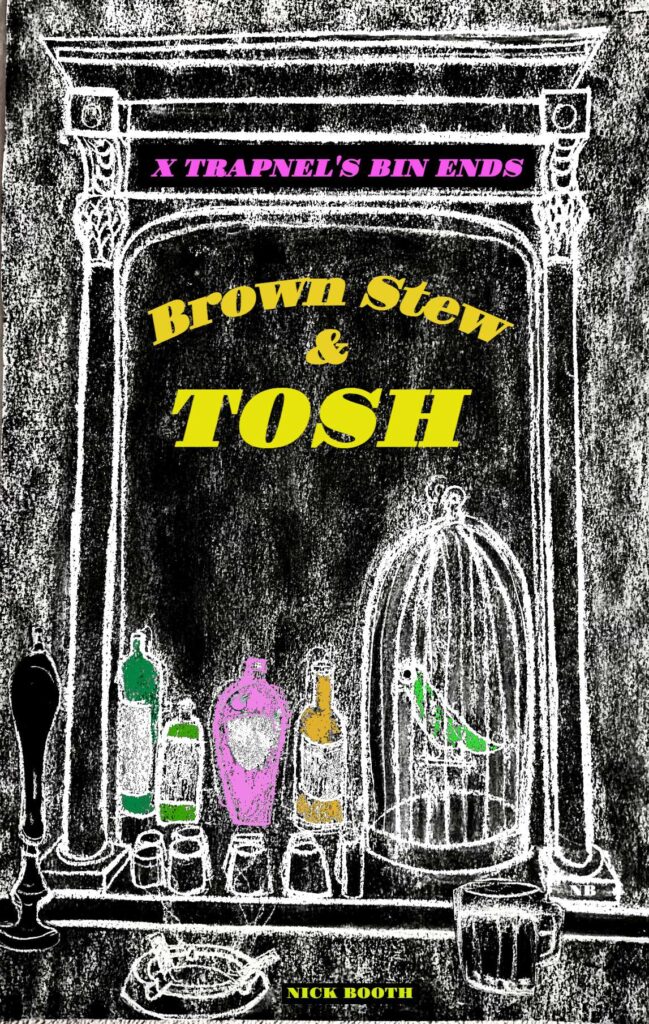
NICHOLAS BOOTH offers the second exclusive extract from X Trapnel’s legendary short story collection, Bin Ends
I never thought I’d see Maltbeam again. Assumed he was dead. We’d been pals round the pubs very early in the war then he said he was being posted overseas and I’d more or less forgotten about him, as one forgot many people encountered and mislaid in those days. “We’ll meet up after this lot’s over” was a common motto. Often enough it came off.
It was easiest to track down people like me who stuck to a beat of watering holes around the Tottenham Court Road end of Oxford Street. North Soho, all that. So it was that Maltbeam found me again, in the public bar of the Lion and in a good mood. I’d had a double come up at Taunton the day before: Notoriety and Boveridge.
Maltbeam said he’d had a devil of a time of it fighting for king and country. That caused me to reflect that my great struggles in history’s largest conflict, apart from dodging bombs and doodlebugs, was finding coins for the gas fire and trying to get poems published in Penguin New Writing.
Maltbeam seemed to have put quite a bit of chub on. I mentioned this as food was hardly plentiful that first winter after the war. “Oh, I had a good landlady in Dover,” he said. He didn’t say what he was doing in Dover. I didn’t pry into his war service but after a few drinks he came out with a catalogue of close-run-things with death: North Africa, Italy, Germany, the whole show as he put it. “I’ll tell you,” he said. “It was hell.” He certainly seemed lucky to make it back.
“When I killed a Jerry,” he said, “believe me I thought, one up for us. I know a bloke who got a little crooked cross tattooed on his back for every Nazzy he did in. I can’t believe I came back. Never thought I’d see London again I can tell you. Anyway, I’ve found a bed-sitting room now and I need a job – I’ve got enough for beer and fags till Sunday. Hero’s welcome, what.”
Behind the bar the landlord, Teddy, was shuffling about in carpet slippers and an ancient cardigan, feeding his caged parrot, Tosh. Teddy’s green cardigan was complementary to his crimson grogblossom, making both a bit richer. He congratulated me on the double. I wished he had not. In fact knowing old Teddy he may have done it on purpose. I knew what was coming.
“Lend us two quid will you, chum?” Maltbeam said. “I’ll pay you back next week.”
Of course, this was a bit much. Teddy winked at me.
As Maltbeam made his request Tosh sidled rapidly along his perch, inclined his head and stared at Maltbeam. “You fat ___,” said the parrot tartly. Maltbeam laughed – we all did. “He’s on the scrounge,” shrieked Tosh.
“You want to watch that bird, Teddy,” said Maltbeam. “He could get you into trouble. What if he says a word like that to some old girl who’s well-to-do?”
“Don’t get that sort of customer in here,” said Teddy. “He only talks to people he takes a dislike to.”
I lent Maltbeam the two quid, and he bored on again about his war. Now and again he’d look across at Tosh, who stared right back at him.
*
Of course Maltbeam didn’t pay me back the following week. About a month later on a Sunday evening at the Lion I was still nursing a rotten hangover from the morning. The place was deserted except for two young BBC types along the bar from me. One was tall in an old brown suit and had a toothbrush moustache, and the other a dumpy type in tweeds with rosy cheeks from beer. I knew them both as regulars at the Lion, which in those days attracted a thirsty clientele from the national broadcaster. I was content to stay out of their talk, which was usually on an arcane political or cultural theme.
“Well, we’re a socialist country now,” Clive, the dumpy one, said. “You’ve got to admit that.” He was misty-eyed at this. “They didn’t achieve that in Spain.”
Rollo, the tall one, sipped his beer. “Quite,” he said. “But Lewis is of the opinion that it could all go horribly wrong.”
“Who’s Lewis?”
“My pal, the professor.”
“Yes but he’s a professor of corners or something, isn’t he?”
“Rectangles, I think. Something like that. I wanted him to give a talk on the Third Programme about it but when I saw his script it was quite impossible. Completely impenetrable. If I couldn’t understand a word of it what chance did listeners have? It went on about things such as continuous function and topological space. I thought, I’ll get TS Eliot instead because it made his stuff look like the Beano.”
“The intolerable shirt of flame, eh,” I quoted, butting into their conversation. Well, you would butt rudely into the conversation of someone called Rollo, wouldn’t you.
“Yes, that’s right,” said Rollo.
“I’ve always hoped to find an intolerable shirt of flame in a 15½ inch neck in the summer sales,” I said. Clive snorted but stopped when he saw Rollo was not amused.
“Lewis takes a strong line,” said Rollo to Clive. “A very strong line. He thinks the people should rise now. Storm the citadels of power. We’re still up to our necks in filthy capitalism.” Rollo gave a disagreeable glance at me as he said that. “Up to our necks in it. I’d arm the people.”
I had a vile headache born of mixed drinks consumed injudiciously at lunchtime. I took a long draught of bitter and hoped it would help. That’s when the Lion’s old mock-medieval door creaked open and Maltbeam appeared in his British Warm, for it was a cold night. His big red face cracked a grin as he moved down the bar.
It was deliciously warm for once as Teddy had grudgingly banked the fire up. Maltbeam caught the end of another speech by Rollo about violent revolution and looked askance. “We’ve just had a dose of violence, chum,” he said loudly. “Six years of it. Of course – you may not have seen much of it.” This was ignored.
“Thank God for heat,” said Maltbeam. “My gas fire’s broken.”
Rollo and Clive were onto whether they could execute someone. “If the cause is right and just then you must,” said Rollo. He drank some more beer. “It’s your duty.”
“But supposing it’s the King, or some other royal person,” said Clive.
“Shoot the King?” said Rollo wonderingly.
“Oi,” said Teddy as he placed a pint in front of Maltbeam. “That’s enough of that. Just you behave yourselves. We won’t have talk like that in here.”
As Teddy went to the till Tosh, who had noted the arrival of Maltbeam, scraped along his perch. He looked rather seedy. He turned his head and peered at Maltbeam out of a sinister eye. “You’re a ____,” said the parrot. His high-pitched rasping voice was horrible and comic, like a ventriloquist’s dummy. The worst of all words hung in the air. It was ironic given Teddy’s warning to the BBC pair. They laughed, no doubt seeing Tosh’s remark as a sort of vengeance for what Maltbeam had said.
Maltbeam raised his eyebrows, then his pint and said cheerio.
We started talking about money, women and prospects. I noticed that Tosh was moving his head from side to side but his attention remained fixed on Maltbeam.
“D’you know,” said Maltbeam. “I wonder what it was all for, the war I mean. I risked life and limb time and time again and when I got home I found my wife was shacked up with an Italian PoW, my old job had vanished and now I’m in a pub listening to bolshies talking about killing the King.”
Before I could offer any remarks Tosh said: “I’ve told you once, you’re a fat ____. Kindly leave my pub.”
Teddy, perched on a high stool, chuckled round his pipe. Maltbeam was discomfited. “You think that’s funny, do you?” he asked Teddy.
“I didn’t say it, did I?” said Teddy, his low voice muffled by his moustache and lack of teeth.
“He’s merely laughing at the surrealism of the moment,” ventured Rollo.
Maltbeam did not even turn round to remonstrate. He just said: “You keep out of this, Mary.”
Then to me: “Do you know what, chum, I’m going to have a scotch. It seems like the whole bloody world is against me.”
So Maltbeam did; and another, and another. As we talked and drank he looked at the birdcage warily. Tosh stared back at him. Clearly Maltbeam had money but I did not think it politic to raise the two quid owed.
With all five of us smoking, the bar was wreathed in a fine grey mist. My headache had eased right off. Rollo and Clive were now tipsy and talking about some variety programme on the wireless. Thanks to the ale and scotch Maltbeam, who never had much of a head for drink, was boozed up. Inevitably we’d got on to his war days. Restless energy flowed through him. Now he was on his feet acting out the storming of a machine gun nest. “…I came over the top and went in for the kill with the bayonet,” he said. He mimed holding a Lee-Enfield at just that angle. “I pulled back the gun for the final irremediable plunge…”At this point Tosh’s querulous voice cut across Maltbeam: “Oh for Christ’s sake shut up, you boring ____” the parrot said.
Maltbeam looked round. His wet blue eyes glittered madly. “One more word, one more word and I’ll do that bloody bird,” Maltbeam snarled. “So help me, I’ll do that bloody bird.”
“I told you to shut up,” said Tosh. “You’ve had too much for one night. So shut up.”
“You shut up,” said Maltbeam.
“You’re a big fat ____, why don’t you just ____ off out of it,” said Tosh. This last bit of cheek seemed to almost stupefy Maltbeam with shock. He was of choleric colouring by nature but now he reddened deeply as his surprise added to his rage. “Take that bird out of this bar, landlord, or else I’ll do it,” he yelled at Teddy.
“Can’t do that,” said Teddy in an amused voice; “can’t take Tosh out of the bar. He likes it in here. If I put him out the back he starts singing Nearer My God to Thee. It gives me the willies. It’s only a bird, mate.”
“Look,” said Maltbeam to me in a rather rattled voice, “why don’t we go round the Tartan? You fancy the landlady and – ”
“Ain’t you got a home to go to?” said Tosh. “Where’s yer missus?”
At this, Rollo and Clive squealed with amusement. By God Maltbeam looked mad. He reached into his greatcoat and produced a revolver.
“Win that throwing coconuts?” Teddy said.
“It fires a stick of Brighton rock,” said Rollo with mock authority.
Maltbeam swore horribly. “One more word out of anyone, especially that parrot, and things’ll get very lively.”
“Shut up, you _____,” said Tosh. “I won’t tell you again.”
Rollo and Clive laughed. Before anyone could say a word Maltbeam raised his arm, took aim at the cage and fired.
There was a split second of great confusion: a big crack, a spark and a puff of smoke in the tobacco fug, then another. For a moment I could see nothing. All I could hear was the shrieks of Rollo and Clive. Maltbeam pointed the gun at them and said: “Want some?”
Rollo had the sort of unfortunate accident more associated with children than adults. Clive had his hands up as if in a Western.
“You ____”, said Tosh. “Call the police, Ted!” I suppose it was a phrase he’d heard Teddy’s missus use.
Maltbeam aimed the revolver at the parrot. I knocked it out of his hand then grabbed it from the floor. Maltbeam went to take it off me but I pushed him away. As I did I expected to hear Teddy deliver a volley of remonstrance but all I could hear was his wife shouting down the stairs asking what was going on. “Look at Teddy,” shouted Clive. Teddy lay on the floor behind the bar. My headache was back with a vengeance.
*
Teddy was quite dead. One of the bullets had bounced off something and hit him. The other one went through a mirror behind the bar. Seven years’
bad luck, I’d said. Maltbeam looked a bit green. Much of the above had to be given out by me from the witness box at the Old Bailey.
Maltbeam had dashed out of the pub and spent a day or two on the run before being found staring into the middle distance on a bench in Regent’s Park.
He was not an especially contrite defendant. It came out that he’d tried to strangle his landlady in Dover but she had not reported it until after Teddy’s shooting made headlines.
Along with his threat to shoot the two BBC men, who also gave evidence, there were a good deal of other unsavoury incidents to be taken into consideration. Maltbeam was a rogue, a thief, a strangler manqué as well as a lethal looser-off of revolvers in public houses, the court was told. The prosecution introduced the idea that he might have drunkenly been out to settle Teddy’s hash rather than Tosh’s. They’d dredged up some row he’d had with the landlord long ago. There was, they said, no getting away from the fact that Teddy’s death had been caused by reckless shooting with a Webley bought on the black market.
Somehow they stood up a murder charge. Another aggravating element for Maltbeam was that the incident at the Lion occurred not long after an armed robbery that resulted in the killing of an innocent bystander had made headlines. A hard mood had emerged in the judiciary. The upshot was that once the guilty verdict was in, the judge put the black cap on, and an expected reprieve did not come.
*
I visited Maltbeam while he was in the condemned cell. It was a day of dreary fog when I took the tube to Caledonian Road and thence to Pentonville. Two warders brought him to the visiting room. He looked a bit slimmer and less choleric.
I did not have the first idea what to say. It seemed a most awful moment. Maltbeam had been looking down at a packet of fags I’d brought him. Now he looked up. His mad blue eyes had turned a little bit grey. I had feared he would burst into tears but not a bit of it. Maltbeam launched into a diatribe.
“I dare say you have seen in the papers that the home secretary has dismissed my appeal. You’d think he’d have a sense of humour. As the Daily Sketch had it, I set out to murder a parrot and ended up killing a man. Mind you, the home secretary’s a Unitarian, isn’t he?” He was lisping, and explained he’d broken his false teeth. “Obviously, given my predicament I’ve been boning up on religion: you want half an idea of what you might be getting into on the other side. These nonconformist types see God and heaven like one of their endless bloody squabbles about county councils. I mean, doesn’t my war record count, I ask myself? I blame Attlee and co. It’s like having the country run by a pipsqueak from Mac Fisheries. I might write him a letter now I think about it. Give him a piece of my mind.” He lit a fag and went on in the sort of aggrieved tone that housewives use when complaining about the price of everything in the shops. “I was clearly aiming for the bird. Can I help it if the bullet bounces off and into Teddy? I feel bad about Teddy, but for heaven’s sake it was an accident.” He went on in this way for quite a while. When the time was up and he stood to be led away by the warders he said: “Well, see you on the other side, old boy – with any luck.” Then as he walked away he turned and said: “Sorry I didn’t pay you back that two quid.”
One morning a few days later a dinner-suited voice on the wireless announced Maltbeam had been hanged.
*
One evening not long afterwards I turned in at the Lion late on. The barmaid was a girl I’d once had a fling with. Like everything after the war she looked a bit older and in need of a clean. Tosh was in his cage – he’d become something of a celebrity: a few local bohemians had formed a sort of fan club. The broken mirror was still in situ and was also a cult object. Rollo and Clive were dining out on the story.
I bought a half and took my usual place. The barmaid chucked an evening paper on the bar. “They’ve given your pal a write-up in there,” she said.
So had they. The headline was “Rage of landlord killer” or something like it. The piece concentrated on trying to spice up his wife’s affair with the PoW but it also mentioned his war career. Ronald Maltbeam, it said, was a fantasist as well as a killer.
He had spent the entirety of his war service as a cook in the Army Catering Corps at a camp in North Wales. They’d even found a few colleagues for quotes. “Old Ronnie was a dab-hand at Brown Stew No1,” said one of them. “He was so good at it we nicknamed him Brown Stew. No word of a lie, I never thought old Brown Stew would turn out to do something like that.”
I folded the paper over and dropped it back on the bar. It had not occurred to me to wonder why the defence had not made anything of his heroic war service. It had not occurred to me to ask about decorations.
I heard a little scraping noise: it was Tosh sidling to the end of his perch. His newfound celebrity had not made him any less scruffy. He turned his head and fixed me with a rather diabolical eye. He stared at me for a while. I declined to meet his gaze.
Tosh began to sing in an awful falsetto.
“Or if, on joyful wing cleaving the sky, Sun, moon, and stars forgot, upward I fly, Still all my song shall be, Nearer, my God, to thee.”
I was very thirsty but left my half untouched and started walking towards the door.
“Lend us two quid will you, chum,” I heard Tosh say as I walked out. “We’re closing. Get out. Time gentlemen, please. Drink up.” The parrot’s voice got louder. “You’ve had your time. Ain’t you got homes to go to?”
As I came out of the Lion Rollo was hurrying in. I had not seen him since the trial. As he passed me he said: “Your pal got an intolerable shirt of flame, eh.”
“Right neck size an’ all,” I shot back, but Rollo was through the Lion’s mouth.
David Dumouriez, Liverpool: erbacce-press, 90pps., £10
VADIM KAGAN finds a poet who is better than he pretends to be
The third poem in David Dumouriez’s collection is titled ‘POETRY IS WANK.’ It’s printed in capitals, runs two pages, and closes on the line “POETRY WILL NEVER NOT BE WANK.” Provocation or confession, it sets the terms for the book: eighty-odd pages from a poet who refuses, on the surface, to take poetry seriously, and who is, all the same, very good at it.
Talking to Skeletons ranges from English childhood to Istanbul, and the mixture is as eclectic as that suggests. There are elegies and satires, love poems, a walking tour of a childhood town, political rants, an ode to Cary Grant’s suit in North by Northwest, and a two-line poem about a curry. The voice is colloquial (sometimes too much so), sardonic, and almost religiously allergic to pretension. Rather than the elevated register, Dumouriez reaches for the pub, the bus stop, the snooker club. He is suspicious of anyone who takes themselves too seriously — himself included.
For me the collection’s finest moment is ‘51° 30′ N, 0° 25′ E,’ a long walking tour of a small English town that slowly turns into an elegy for a vanished self. Dumouriez takes us past polling stations, dog walks, rusted goalposts, a toyshop run by a Polish man, a church where he and a friend once tried to summon a thunderbolt by swearing at the threshold. The imagery is specific and unhurried: “Another postbox. Focal point back then. / Not sure now.” The accumulation of observed detail makes the place feel at once ordinary and irreplaceable. Memory, class and mortality converge without any of them being announced. And somehow the combination works.
‘Reading Kipling by Candlelight’ is one of the more personal poems in the book, and the one I found easiest to climb inside. Set during the 1999 Istanbul earthquake, it follows the speaker through a night of confusion. He mistakes the tremor for a burglar, goes back to sleep while the parks fill with frightened residents, and only in the morning grasps the scale of what he slept through. It’s funny and quietly unsettling at once. Dumouriez has an instinct for the exact detail that lifts an anecdote into something more: “Myself and one old woman, two floors up, / remained at home. My flaws you’ll find described. / As for her, perhaps she’d given up on life.” That last line does something the earlier stanzas don’t prepare you for. Death has entered what had been, up to that point, largely a comic story. And then life shrugs and moves on.
Talking to Skeletons is at its strongest when the humor and the grief run in parallel. ‘An Anglican Event’ opens with “My mother lies before us in a box, / to put it blunt,” and proceeds to take a funeral apart with deadpan precision: the vicar who “styles himself as ‘Father Tim,’” the embarrassed congregants working through hymns they haven’t sung since school, the curtain that makes it real. ‘Ex of England’ pulls off something similar with a grandfather’s hoarded possessions and an unidentified Victorian portrait heading for a bonfire. The joke in these poems does not push the grief aside; it comes out of the same material.
Dumouriez is most interesting when he runs into something that resists him: a death, a memory, a place, the stubborn survival of affection. When the sardonic voice has something to push against, the friction produces complexity. He is less interesting when he already knows what he thinks before the poem starts.
The smaller provocations don’t all land. The opening of ‘Sonnets from the Portuguese, 43 (revised)’ – “How can I fuck thee? Let me count the ways” – is genuinely funny and technically competent parody. But some of the shorter satirical pieces (‘Addendum,’ ‘Laid Back, Laid Under,’ ‘The Poetry is in the Potty’) read more like social-media wit than poems. Set beside ‘51° 30′ N, 0° 25′ E’ and ‘Reading Kipling,’ they sound a dissonant note. Dumouriez knows the difference between a poem and a punchline. He just prints the punchline anyway from time to time.
The unevenness points to a larger issue. Across the eighty-odd pages, subjects and attitudes recur – death, aging, literary pretension, cultural irritation – and a handful of the lighter pieces work against the stronger ones nearby rather than for them. A shorter book might have been a stronger one. That said, the excess is clearly a part of how Dumouriez writes, forever spotting something else that seems to want a joke or an elegy.
I come to the book as a poet who works mainly in formal verse and in two languages – about as far from Dumouriez’s aesthetic as one can reasonably get. What I hadn’t expected was how little the distance ended up mattering. Talking to Skeletons isn’t really asking to be identified with; it’s asking for a reader willing to be amused, provoked, and every so often caught off guard – the anecdote that opens onto mortality, the joke that turns without warning into grief.
Which is also, I think, why the opening declaration eventually defeats itself. For all the mockery of poetry and poets and gatekeepers (and his own reasons for writing), Dumouriez’s best poems rely on the one thing “POETRY IS WANK” pretends to distrust: the idea that arranging words carefully might preserve something that would otherwise vanish. That a poet who opens with “POETRY IS WANK” also writes “51° 30′ N, 0° 25′ E” is, in the end, the strongest argument against his own thesis.
VADIM KAGAN writes poetry and prose in English and Russian. His work ranges from metered verse rooted in Russian and English traditions to contemporary free verse inspired by current events. His poems have been published in The Lyric, Founders Favorites, The Road Not Taken and the Ink Blots collections, and his poem ‘How Often’ was featured in the Maryland Bard Review 2025. He lives in Bethesda, MD, where he runs an AI company
(Monday). It is like coming home but not. New Fences, benches and fittings but same pink and orange dusk as the warm light disappears.
It is early in the season. So early that the pool is not ready for use and the grass is still rich green.
The effort to travel increases. What to select, what to leave behind, how to reassure myself that it will all be OK.
Family dynamics are weird, the ebb and flow of love and cynicism, rudeness and shared memories. We dip bread into oil for supper, with a glass of homemade wine. We should have asked for cheese.
(Tuesday)
At five o’clock it is cool but already bright. The windows are wide open and the air rushes in. Breakfast is late and makeshift: bread and oil again, melon slices, cups of tea.
We are going shopping at Hypercoop. It is not as fascinating or different as it once was but there is cheap wine and good olives, cheeses and bread. A big gluten-free section too.
•
Everything is now still. The sun overhead is not moving, shadows are crisp and defined. I try painting through the shutters but the stripes of colour do not work. In a moment I will hook the shutters back whilst everybody else is asleep.
•
Watching the sun go down. Blue, purple, grey. Flecks of orange, white. Trails of car lights across the valley. A dog barks, a bat flies by.
•
That feeling of being abroad but not doing anything. Apart from the hear and the view you might as well be at home. I am waiting to go out, waiting to see art, to eat different food.
The heat increases, the doors and windows are shut. The house goes dark. We are heading out.
(Wednesday)
In the Arezzo museum, weatherworn statues and paintings no longer required for worship are arranged in empty rooms, numbers that refer you to a notice board.
Awkward English versions, rough cut stone and carved folds. Decontextualized crucifixes and empty reliquaries.
Cold tiles, polished wooden doors, grids of light from ancient windows.
•
Rows of pillars, grey against cream. Badly lit paintings containing dwarves, rabbits, angels; the drowned and saved; Mary in her glory, Jesus as a child.
Pale memories of stories handed down as pictures, threatening lessons to be learned. Abuse of power. Hell awaits.
I cannot see. The varnish is gloss and cracked, the colours dark and chipped. Frescoes have been torn from walls and hung again in empty rooms.
Traffic and pedestrians pass by, we have the place to ourselves apart from the guard on her laptop and the old lady who knits. Both say hello, watch carefully as we look around the museum.
•
worn paving stones
courtyard striations
layers of time
(Thursday)
Montevarchi, the local town, feels worn out. The weekly market has moved out of the centre to the park we used to frequent when the children were younger, and there are empty shops for sale. The newsagent’s kiosk has gone, the main square where we saw a Gypsy band perform and Patti Smith once played is desolate.
The fascist tower at the end of the main street glowers with power over nothing. The café we have been to before is closed but we did discover a chaotic secondhand shop full of dusty books, unwanted china and old postcards, some of which we bought.
•
We are hanging around in San Giovanni Valdarno because Italians do not take time seriously. We are sitting in the square waiting for the museum to open. A backpacker is asleep in the ‘cave’ where miracles happened under the church, two men are mending phone lines, everyone else is at home.
The outdoor colours are sun-faded, it is cooler today. Earlier, the manageress of the restaurant we had lunch in, poured us glasses of limoncello by way of an apology for delays and a malfunctioning toilet door. She offered us more but we moved on.
Slowly, people appear. Shop shutters slide up, the museum guard pedals into view. Inside, the angel will still be telling Mary she is pregnant or about to be. Gold and white light. Intervention. Angelic appearance. Annunciation.
•
The fact that one of Fra Angelico’s three Annunciation altarpieces is in this small town still seems like a secret, although each time we visit there are more people. Even so, I get a quarter of an hour to sit alone with the painting.
The angel is brighter than we remember. The Virgin is veiled, the dove projected down from Heaven.
Blue and reds: human and holy. The angel holds Mary in his gaze to tell her his news.
Adam and Eve flee Paradise, are sent into exile. Gabriel hovers uneasily over weightless colour.
Does everything mean something? Mean anything? Time is interrupted, past and future changed.
Stories persist.
Everything is symbolic, has a specific meaning but if you put all that aside you are left with an angel facing a woman. There is lots of gold, red and blue; the angel is clothed in pink.
The frame is newer than the painting, so there are strips of flat colour each side to make up for what might be missing. And much of the floor, along with the view from the window, is insubstantial, an abstract palette to help the perspective work.
Saturated colour, spirituality, theology, metaphor and symbolism. The remnants of a story that used to power the world.
(Friday)
This morning the sun is back. No mist, no rain, a breeze and a view all the way to the horizon becomes a day of waiting. For the others and for the forecast thunder and rain, which duly arrives late afternoon, causing tourists in Florence to shelter in cafés whilst locals stride on or unfurl small umbrellas. It is big, splodgy summer rain, the sort we do not often get in England.
The science/zoological/anatomical museum is as haphazard as it sounds. A floor of gorgeous minerals, a locked hall of skeletons, and a vast collection of preserved animals and drawings with views into other rooms full of waxwork body parts and medical dissections.
Schoolboys run through the displays as the guards get visibly irritated. The entrance courtyard is shaded and worn, paving stones cracked and polished in equal parts.
We drove, due to a train strike, and caught one of the new trams from a park-and-ride. The city is as busy as ever but we skirted the centre and crossed the river.
For lunch, salads and meat, special pesto with pistachios added, circles of grilled aubergine. The air conditioning provided a backbeat to the busker who could not sing, a pulse of cool air and engine noise, a relentless human hum.
•
In Santo Spirito there is a Giotto or School of Giotto crucifix (depending which information board you read) above the altar, and a Donatello annunciation I have only every known in reproduction.
It is one of those vast empty churches built like a barn, which would be quiet but for the recorded command for Silence!, which is by far the loudest thing.
In the sacristy, a room at the side, hangs an early work by Michelangelo, only displayed because of its maker’s name. If you pay to visit you can also enter the cloisters.
(Saturday)
Fireflies or glowbugs in the bushes after dark. Like fairy lights or fairies themselves, like fading traces on the screens of old televisions shutting down. Pale fluorescent, green white light. There but not there, somewhere else.
‘You can see,’ says my daughter, ‘why people believe in magic creatures. I would if I had seen these when I was younger. Well, I believed in them anyway.’
An unexpected surprise, one of the week’s highlights. Soft interruptions blinking on and off in the warm night.
(Sunday)
In Arezzo’s main square, ‘Hotel California’ is being played on a squeaky violin; the drums and guitar never arrive. The restaurants which overcharge are overcrowded with no locals to be seen. It is hot again and now the music is popular classical although you can hear the diners’ chatter from where we stand.
Mid-afternoon, swifts diving and soaring. Dry heat, lazy lunch, warm wine and blurry vision. Crap versions of well-known songs. Tuscan towers and churches. Deep shadows and burnt stone. Sunshine and architecture as time travel.
•
The church is now a museum and you cannot go in at all unless you pay. There is a glass panel behind the doorway which tends to reflect the light back, and most of the piazza has been cordoned off, although I found a shady corner where I could sit.
The posh café we visited only once remains closed. If you peer through the shutters the art deco chairs are still in place but there is more dust. The town has not changed for the better, is dirtier and emptier. Only the heat remains the same, even though it should be cooler now. Spring has become summer, summer may disappear or simply become a month or two of absolute heat.
The woman who stuck her fingers in her ears on the tram in Florence is now visiting Arezzo. There is also a squeaky dog in attendance, which sounds like a soft toy, not an actual animal. Earlier, I met Fred (short for Alfredo) outside the cathedral. He was somewhat hairy and did not squeak but barked.
•
On the way back to the car there were sirens behind us, which turned out to be police motorbikes preceding and escorting a procession of classic cars up to the cathedral square, where speeches were made and prizes awarded. I sent photos to my cousin and told him how we all cheered when the oldest car just made it up the hill on its second attempt.
•
Half a book I am struggling with left to read, only what is left in the cupboard to eat. A glass of wine left in the bottle.
Tonight, aerobatics by a pair of bats, a silent owl’s descent, and the gradual flickering arrival of fireflies again as dusk becomes night.
More bites and itching, a knocked-off blister top and a mosquito bite up my nose – these insects are keen!
(Monday)
The prickly pear plants in Gropina have been cut back but what seems to be the same dog guards the track they grow on.
The church lit by light bleeding through thin alabaster windows is cool and empty. It is devoid of any ornamentation apart from an ornate pulpit which seems to show Celtic figures, animals and patterns.
There is no concession to tourism beyond the same few postcards there have always been. The church simply waits, squat cracked grey, damp patches throughout.
RUPERT LOYDELL is the editor of Stride magazine, contributing editor to International Times and a writer and abstract artist. He has many books of poetry and several collaborative publications in print and has edited anthologies for Shearsman, KFS and Salt. His critical writing has appeared in Punk & Post-Punk (he is a member of the journal’s editorial board), JournalofWriting and Creative Practice, New Writing, English, Text, Axon, Short Fiction in Theory and Practice, Musicology Research, Revenant, The Quint: an interdisciplinary journal from the north, and Journal of Visual Art Practice. He has also contributed chapters to Brian Eno. Oblique Music (Bloomsbury, 2016), Critical Essays on Twin Peaks: The Return (Palgrave Macmillan, 2019), Music in Twin Peaks: Listen to the Sounds (Routledge, 2021) and Bodies, Noise and Power in Industrial Music (Palgrave Macmillan, 2022)
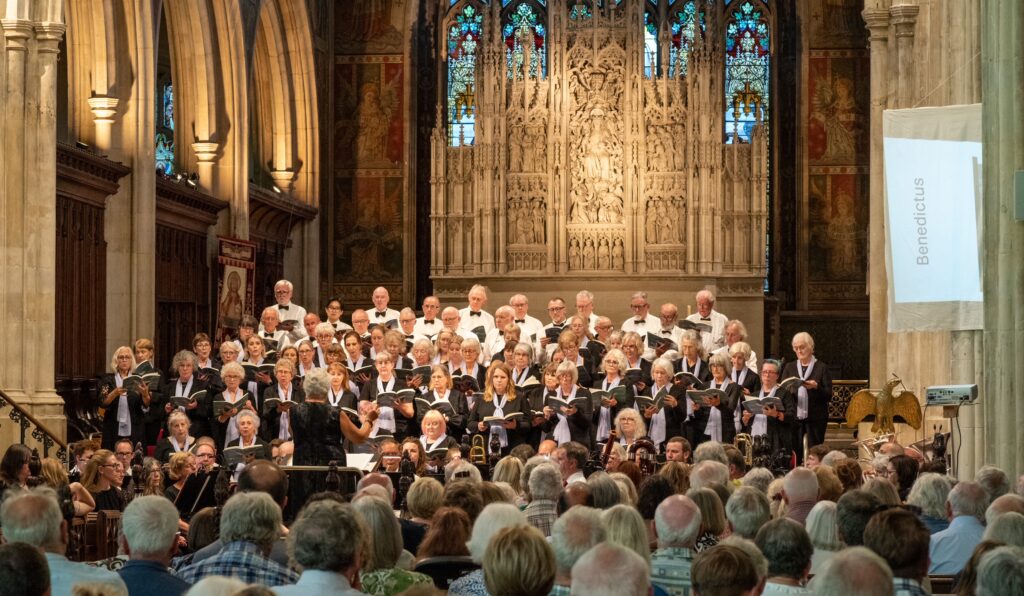
Our current fractious world needs – indeed, yearns – for more harmony, more togetherness, more joy. On the 20th of June, at All Saints Church in Maidstone, we had all those qualities in abundance. Our spirits were encouraged to soar in a concert by Maidstone Wind Symphony and The Maidstone Singers Extended Choir on a gloriously balmy evening.
A Buddhist meditation by David Maslanka opened the concert sensitively conducted by Roger Graham with the Maidstone Wind Symphony (all talented amateur musicians) drawing us into a state of calm reflection as the music drifted around this stunning grand church. This piece, entitled ‘Give Us This Day’, set the spiritual tone for the evening.
‘O Magnum Mysterium’ by Morton Lauridsen is a “quiet song of profound inner joy”. The Wind Symphony was led gently and precisely by Roger Graham through this popular piece.
The first half closed with the surging, uplifting ‘Alleluia Laudamus Te’ by Alfred Reed, raising spirits to the ornate gilded roof – a triumphant recitation leaving us in need of interval refreshment to feed the body after the soul had been sated.
And what a second half! Karl Jenkins’ ‘The Armed Man’ was sung with passion by The Maidstone Singers. The piece is almost a musical documentary which traces both the bravery of soldiers and the utter futility of war. The choir marching on the spot set the tone. It is not simply an anti-war diatribe. It is much more subtle and, therefore, persuasive. Jenkins composed the piece as he daily watched the unfolding genocide in Kosovo. This Muslim-majority now independent country no doubt inspired him to include ‘The Call to Prayers’. This was a particularly poignant moment as Adi Usmani took to the pulpit to sing the Call in Arabic. A Call to Prayers in an Anglican church – what better message of tolerance, mutual understanding could there be rather than blind, ignorant hatred? Fly a flag for that alone.
The ‘Kyrie eleison’ was sung with great feeling by the Maidstone Singers with all eyes on their conductor, Kathryn Ridgeway, who did seem to live every nuance, every twist and turn. Her direction of the percussionists as they created an ambience of hope and horror was masterful.
We are then with the soldiers (helped by war images projected on a screen) as they prepare to go over the top almost certainty to their deaths. This is the slow, brutal horror of All Quiet on the Western Front as in the film a twisted bloodied hand in the mud slowly stills of life.
The ‘Agnus Dei’ was sensitively sung with strident dignity and we are with the soldiers who have survived staring at their dead mates. Has there ever been a more beautifully composed cor anglais solo for the Benedictus? Jenkins was himself a skilled oboist (listen to Soft Machine Six) and this solo is played beautifully.
A panoply for peace closes ‘The Armed Man’ with Tennyson’s words “Ring out the thousand wars of old, ring in the thousand years of peace”. As we all headed home in the warm evening air with hope renewed by this performance maybe we could see a new light in these dark times. Music matters more than ever. Thank you to all the performers.
The idea that the universe has an underlying sonic structure is as old as philosophy, and as perennial. Ancient observations of planetary orbits encouraged Pythagoras to hypothesize that just as the pitch of musical notes was determined by the rapidity of vibrations, so planets which orbited at different speeds must also make unique sounds, which harmonised as a majestic “music of the spheres”. Classical world-influenced Christian thinkers dreamed up trumpets toppling the walls of Jericho or signalling the End of Days, and the allegorical Instruments of St. Jerome, whose tuba had three mouthpieces, symbolising the Trinity, and four openings, to symbolize the Four Evangelists. Since its invention in the third century BC, the organ has been seen as much more than a machine – rather, with its air currents and complexity of construction, a metaphor of a breathing grand design.
Sir Thomas Browne called God “the First Composer” in Religio Medici, and saw music as key to universal understanding; he would have known the already old proverb “Music is the eye of the ear.” In 1921, 64 years-old Edward Elgar would write wistfully to his friend, the critic Sir Sidney Colin, “I am still at heart the dreamy child who used to be found in the reeds by Severn side, with a sheet of paper trying to fix the sounds and longing for something very great.” The music of the spheres seems inseparable from the music for our ears.
But while music can express emotions not easily conveyable in words, it can have limitations of its own, because of the imperfections of the instruments we use to “fix” the music we hear in our heads. Even the most advanced instruments are really reminders of music rather than music in themselves. In this diverting and handsomely illustrated book – an offshoot of their project www.imaginaryinstruments.org – two American organologists examine how musical visionaries have always sought to supersede the shortcomings of the tools of their trade, and surpass previous sounds.
Instruments, according to the authors’ expansive definition, are not necessarily contrivances of metal, wood and catgut, but can be wholly conceptual – a “constellation of forms, at once material and intellectual.” A radio, to these authors, can be an instrument – so too a piece of software. Instruments may not even be intended to make what we would consider musical sounds, but can be used to convey visual and even olfactory ‘music’ – colours or odours obtained by pressing keys. Conventional organologists categorise instruments according to their primary sound-producing mechanisms – for example, idiophones have vibrating bodies, and aerophones vibrating air columns – to which these authors now add ‘fictophones’, instruments which either never existed or progressed no further than prototype, yet inspired actual instruments, or otherwise resound in our imaginations. This is a highly entertaining account of artistic playfulness from ancient times to today; it also constitutes a serious study of the natures and meanings of music.
Inventive musicians in all ages have sought to make instruments that are larger, louder, sweeter or more versatile, or that can render audible otherwise undetectable sounds. While many of these experimentations led to colourful dead ends, others eventually sparked off calculus, computing, medical audiology, recording and streaming, science-fiction, and psychological concepts like synaesthesia.
Renaissance anatomical discoveries encouraged musicians in search of amplification to try and replicate the inner ear in cochlear whorls of brass. The polymath Giambattista della Porta thought it possible to trap sounds in pipes to be listened to later, a reiteration of older traditions that sounds could be frozen in mid-air, or that one of the biblical Joseph’s exhalations had been preserved in a jar held at the Vatican. Leonardo filled notebooks with ideas for instruments from kettledrums with instantaneously tuneable skins to a concept of coaxing musical correspondences from different-sized waterfalls.
Isaac Newton analogised his colour spectrum with the musical scale, which encouraged experimenters to try and make music with colours. Voltaire was dismissive of the ‘optical harpsichords’ thus envisaged, but even he allowed there might be “hidden rapports”. The early twentieth century American artist Thomas Wilfred invented the ‘Clavilux’, a silent instrument where colours were conjured by keys – a service less to music as we think of it than to the emerging genre of ‘lumia’ or light art.
Even people could almost become instruments, as seen for example in the origin story of the Arabian oud – supposedly modelled on a dead boy’s bones by his grieving luthier father – or the Austrian author-composer Johann Beer’s 1701 satire Bellum musicum, in which the forces of musical conservatism are assailed by demotic ‘bunglers’ (village fiddlers and the like) led by an ‘ambassador’ whose body is confected of musical notations and parts of instruments. So, too, could animals – at least according to the sadistic invention known as the ‘cat piano’, in which cats were allegedly fastened in rows and made to issue different yowls by being jabbed with pins. Mercifully, the cat piano seems mostly myth, but Peter the Great of Russia really did commission one in 1716, which was apparently used occasionally as late as 1803.
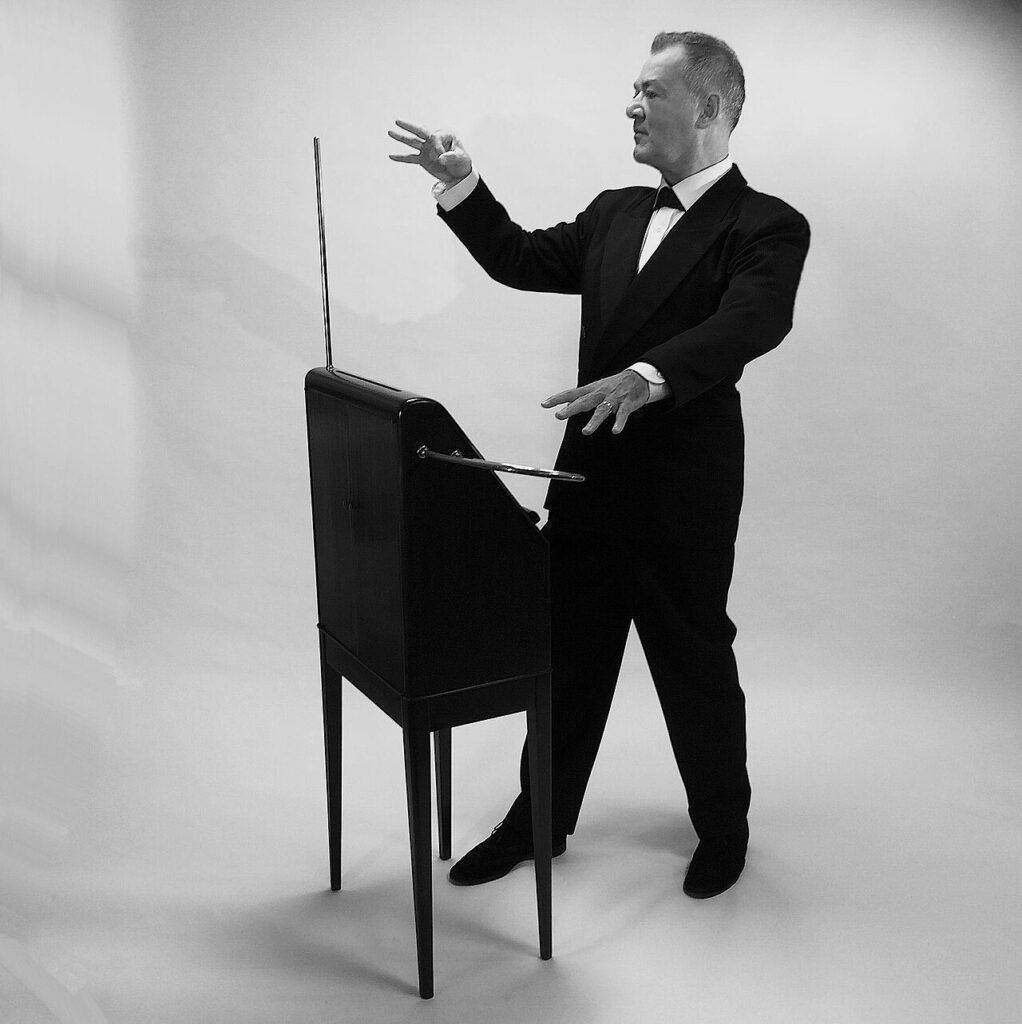
The Greek Aeolian harp, in which music is made by the wind passing over untouched strings, is distant ancestor to the equally unhandled theremin (invented in 1928), whose ethereal tones in turn inspired the Moog synthesiser (invented in 1964). The prophetic ‘speaking heads’ of medieval legend prefigure today’s (and tomorrow’s) robots. In 1739, the German-Danish music theorist Johann Adolf Schiebe conceived of a musikalische wunder-Maschine – a device that could not only create music but appraise its artistic worth – a satire, but a forerunner of today’s AI music generators. The Panharmonicon “mechanical orchestra” invented by Johann Nepomuk Maelzel inspired his friend Beethoven’s 1813 symphony Wellington’s Victory, and can be seen as an antecedent to today’s electronic keyboards.
Adolphe Sax envisaged gigantic steam-powered organs and an array of other impossible instruments, including a thirteen-bell trumpet, but he also gave us the saxophone. Francis Bacon’s 1526 utopian novel New Atlantis, in which his hero visits an island off Brazil where the inhabitants operate official sound-houses to “practice and demonstrate all sounds and their generation” inspired Daphne Oram to co-found the BBC’s world-famous Radiophonic Workshop in 1958. Musical Prometheans still look backwards in order to look forwards, like Brian Eno whose insights into medieval bells are informing his ideas of the sounds of thousands of years hence, when bells may be built of very different materials and ring with radically different tones. Whatever that far off world might sound like, it seems certain some of us will always be straining our ears to hear yet farther.
This review first appeared in Café Americain, and is reproduced with permission
DEREK TURNER is the editor of The Brazen Head, as well as a novelist (A Modern Journey, Displacement, and Sea Changes) and widely-published reviewer. His first non-fiction book, Edge of England: Landfall in Lincolnshire, was published June 2022. Some of his writing may be found at www.derek-turner.com He is also on X – @derekturner1964
LAWRENCE FREIESLEBEN revisits Yellow Sky, 1948, directed by William A. Wellman
Both the triumphant and then jolly music of Yellow Sky[i], with its flippant echo of Oh! Susanna[ii] are a complete contradiction to the overall mood of the film. Whatever your definition of noir, Yellow Sky comes stylistically and psychologically close until the end. Purely noir[iii] Westerns that also have negative endings are very rare. Wellman’s later, colour Western, Track of the Cat (1954) starring that fatalistic ‘Tsar of Noir’, Robert Mitchum[iv], though regularly considered one of the bleakest of Westerns, scrapes some hope at the end – albeit not for Mitchum.
Despite being known as “Wild Bill” for his confrontational personality, womanising and World War 1 exploits as a fighter pilot, Yellow Sky’s director, William A. Wellman[v], is not a household name. A hard-working, cross-genre versatility, valuing story over distinctive personal signature, has limited easy categorisation. Obviously, I didn’t know the man . . . and whenever fashions change, biographical accounts (and lots more besides) habitually shift emphasis to be in tune with them . . . who can you trust?
The frivolous banjo of Oh! Susanna is almost withering on Yellow Sky’s soundtrack as a headline spells out: The West – 1867. When the film was released on Christmas Eve, December 1948, I expect US cinemagoers would have realised the date’s significance. Not having studied American history at school, I needed to hear the characters’ backstories to discover that the American Civil War[vi] is not long over. This setting in time (echoed roughly by the gap between the end of World War 2 and the film’s release) must be intended to partly justify, or at least explain, the wild, egotistical and reckless behaviour likely to occur on the margins of traumatised civilizations.
After the titles conclude, the stock opening music of blaring victory and light-heartedness hits a streak of menace which declines into a thunder-clap over a sunny marshland area. If opening night audiences were looking forward to Christmas, they should postpone such thoughts!
A group of seven weary-looking men, their horses splashing onward in single file, ride slowly across the screen. We are only a minute and 40 seconds into the film – including logos, titles and a fine series[vii] of sketches of ghost towns and mine ruins – and the mood, having swung all over the compass, settles here with the kind of grim certainty one associates with either stoicism or desperation. Yet the landscape looks lushly verdant, flowery and appealing before the youngest of the group spots a skull with an arrow right through it.
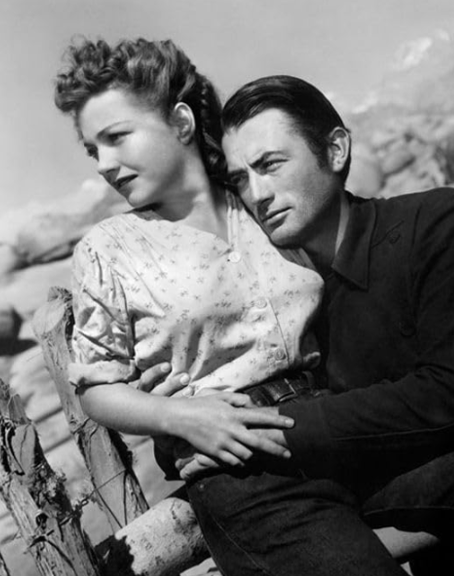
“Prospector.” States a man who transmits an air of authority. Since he is portrayed by Gregory Peck, we imagine that if at times he must be brutal, he will usually be fair.
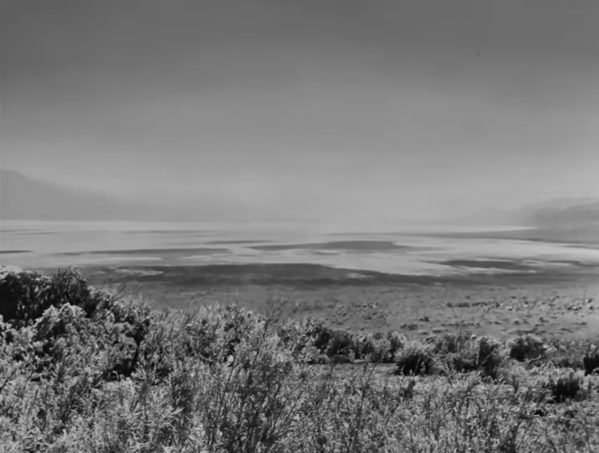
“Skinny little fella. Them bones ain’t hardly as big as my little finger,” opines the portly Walrus (Charles Kemper, who had been a foil to Danny Kaye early in his career and was often to provide an element of comic relief; in Yellow Sky it is faint). Picking the powerful arrow from the two huge holes it has punched in the skull, the youthful Bull Run (Robert Arthur) takes it to the probable leader, who regards its still pristine shaft. With the possibility of vengeful or “crazy Indians” adding to the landscape’s threat, the group survey their immediate surroundings. Dude – played by Richard Widmark, seems to know the area well and starts to lay it out (00:02:48): “up north there are lots of canyons and draws . . . if you know which ones are open.” Intrigued by what a “draw” might be – does it draw you in and then prove to be a fatal dead end? – I discovered a whole chain of words[viii] which construct a hierarchy of depressions and ravines, descending into canyons. Draws are the least significant. Draws drain into arroyos, which drain into coulees, which drain into canyons. As with so many words and word origins this is both fascinating and yet disappointing – disappointing that one imagines additional mysterious meanings. But aren’t such extra implications, to some extent, what poetry and music and the visual arts rely on? How is it that great black and white photography can often suggest more depth, even more colour than colour – can look more real than the reality of colour?
Dude continues to summarise the area’s variety. I’m not sure if such environmental diversity actually exists in such close proximity to Death Valley[ix] – with fertile looking marshes, killing salt flats, canyons, hills, mountains, and a dusty desert town all within a few miles’ radius . . . but if it does, take me there and there I’ll happily live!
Of the salt flats “down south” at 00:03:00, (Death Valley, the hottest place on Earth[x]) Dude chuckles “even a rattlesnake couldn’t get across em”. Is Dude referring to the reptile or to the memorable psychopath, Tommy Udo[xi], who he portrayed so effectively the year before Yellow Sky was releasedin Kiss of Death, (1947), almost stealing the film with his insane intensified chuckle – a chuckle he only slightly revives once (at 00:37:47) in Yellow Sky.
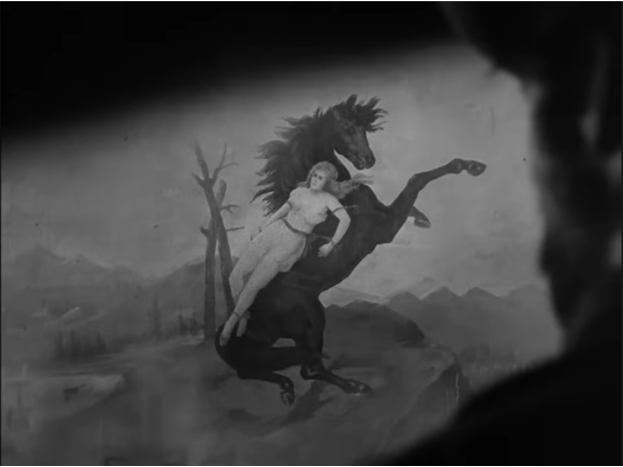
Eventually, in a town saloon, reviving themselves with a drink, the band encounter an extraordinary painting[xii]. A partly naïve, partly delirious, painting. Albert Pinkham Rider[xiii] crossed with Chagall[xiv]. Pale Death on a dark horse![xv]. This large image behind the bar fixates them all.
Lengthy (John Russell) whose awestruck lascivious comment at 00:03:57, harvests lust from the silence and then amusement: “I wonder if she’s got any plans after she gets through ridin’ that horse?” is reprised with more words but less universal staring at 00:05:29 – the camera closer to an image now about 50% larger. The statuesque woman appears to be tied to the rearing horse yet has the posture of someone reclining calmly on a sun lounger. The image is surreal and haunting – and perhaps intended to be subjective? Are the men all seeing it differently? She is not depicted as a victim. Does the horse represent the spirit of the woman? A woman as beyond the pale as Ellen Berent Harland (Gene Tierney) in Leave Her to Heaven (1945). Lengthy wouldn’t stand a chance!
“Yes sir, I sure would like to know what she plans to do after she gets through ridin’ that horse?” 00:05:29
The hold up (00:05:52) shoot up and escape is all over in less than a minute and by 00:07:52, chased by the cavalry out into a rocky wilderness among amazing tooth-shaped rocks towards the salt flats, they have lost their rear lookout rider. The cavalry captain calls a halt to the chase knowing the gang aren’t likely to survive crossing the sink of Death Valley: “Let ‘em go! Save us the trouble of hanging ‘em!”(00:08:30)
As Stretch divides the loot, the gang appear on the verge of fragmenting, though it’s hard to imagine they were ever a very cohesive unit. Dude, not caring personally about Jed being shot by the cavalry, is superstitiously fearful that the number of gang members no longer adds up to seven (00:09:21): “This desert’s a mighty unlucky place. A man needs all the odds he can get.” Several of them know it’s crazy not to turn back, “It’s a good 70 miles across this sink, maybe more!”, protests Lengthy, yet Stretch (at 00:09:38) asserts “it’s just a place, a place can be crossed.” At a horse walking speed of four miles an hour it would take 17 and a half hours to cover 70 miles. Wouldn’t travelling by night have been a good idea? Do most cinematic cowboys lack common sense? But since there is no shade to be had, maybe it’s better just to get going? In the end, even Dude, who was thinking of pulling back with the dark, follows Stretch and the gang out into the whiteout heat of the sink.
At minus 86 metres below sea level (or minus 282 feet) the Badwater Basin is one of the lowest places on earth as well as one of the hottest. As the band become dots in the whiteness, the scene conveys the idea that Stretch, like Captain Ahab (whose obssession with Moby Dick – the White Whale – Gregory Peck was to portray with festering intensity in 1956) is resolute and tenacious, yet also perhaps, recklessly self-destructive. At 00:12:16 the crazed crust of salt becomes soft and the horses begin to sink and stumble, obliging the men to walk. The film expertly gives an epic sense of this ordeal, of the heat and dessication, of wrong decisions – the folly of Walrus having filled his canteen with whiskey, the mistake of sleeping at night. To cut short a midnight fight between Walrus and Bull Run, when the former tries to drink from the latter’s water canteen, Stretch hurls a large chunk of salt at Walrus’s head (00:13:57). Stretch’s authority is no longer in doubt – as neither is his compassion the following day when he wets his horse’s mouth with valuable water from his canteen (00:15:15). This could be viewed as enlightened self-interest, except that he follows up by doing the same for Walrus’s horse. “Kinda noble, aren’t ya?” sneers Dude (00:15:45) to which Stretch replies “A horse’s a useful animal, no use letting him suffer just because he belongs to a jackass”. The hostility between the two men increases from here on, with Dude less ironically detached from the possibility of taking charge – although at this juncture, he appears to believe they are all doomed. When Lengthy shoots a lizard (00:16:31), basically for looking chipper and able to survive when he probably won’t. Half Pint (Henry Morgan) protests: “he wasn’t doing you no hurt”. The sink however, has no truck with compassion: it is Half Pint’s horse that soon collapses in sand dunes and has to be shot (00:18:19).
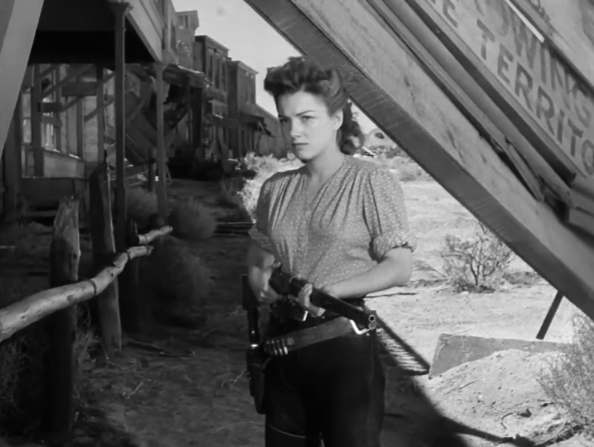
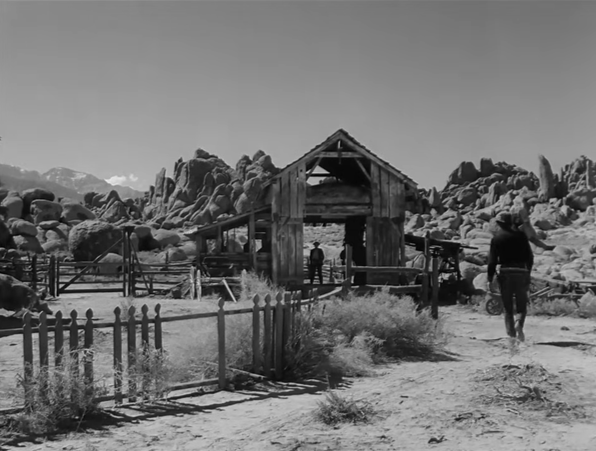
After almost ten minutes (a long time, especially in 1940s cinematic terms) at 00:18:47, Stretch, suspecting mirage, spots what appears to be salvation in the form of a distant town. Hope to cracked lips and dried out voices. They struggle on…to find the town of the title: Yellow Sky. A dehydrated ghost town. Dead. Crumpling up all over the steps of a collapsing saloon, the gang don’t have the energy or sense to even get out of the sun, resigned to becoming skeletons. Then there is the faint click of a rifle hammer being cocked. At 21 minutes, Mike (Anne Baxter, hilariously described in IMDb as a “gun toting tomboy”) at last appears:
Yellow Sky at 00:21.08 and the first appearance of ‘Mike’
If I could have it to myself – or better still, share it with Anne Baxter – Yellow Sky is another place I wouldn’t mind living. The rock formations around are superb and the dilapidation aesthetically surpasses Heysham and Morecambe, without people to complicate it![xvi]
In his wonderfully terse, two-minute recommendation of Yellow Sky[xvii], John Sayles may not overstate Anne Baxter’s impact but does exaggerate what she’s wearing: “tight jeans and a 50s bra that could put your eye out”. The high-contrast noir-etched photography of Baxter is stunning. Without doubt, apart from settings and landscapes, Baxter is the best thing about Yellow Sky, but although frowningly beautiful, its her spirit and character that most impress.
I’ve long had a thing about Anne Baxter, especially in earlier films such as Swamp Water[xviii] (1941) before fashion styled her hair in that increasingly fixed, bouffant power-perm manner which I can no longer bear to see because it unfailingly reminds me of the night and daymare that was Margaret Thatcher![xix] You can see this style creeping in by the time of another of my old screen favourites: 1958’s Chase a Crooked Shadow – although realistically, even in much earlier films, the secure Forties hairstyles aren’t so very different. Perhaps it is her wilder character in both Swamp Water and Yellow Sky that is so appealing?
Where matte[xx] shots are interposed into genuine landscape is often hard to tell when watching films in a relaxed way, but the solid ghost town of Yellow Sky, “fastest growing town in the territory” – its appearance and atmosphere – are entirely convincing. Apparently, the filmmakers reused and partly rebuilt or wrecked an old set known as “Last Outpost” in the Alabama Hills[xxi] just to the west of Lone Pine[xxii]. A hundred miles east, the salt flats and desert scenes were shot mostly in the Death Valley National Park[xxiii] with actors and crew staying at the evocatively named Furnace Creek.
Before the Thatcher-esque look of later years – a colorized, glammed-up publicity shot for Yellow Sky
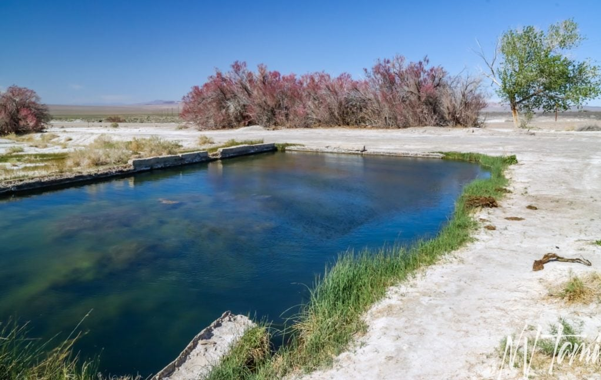
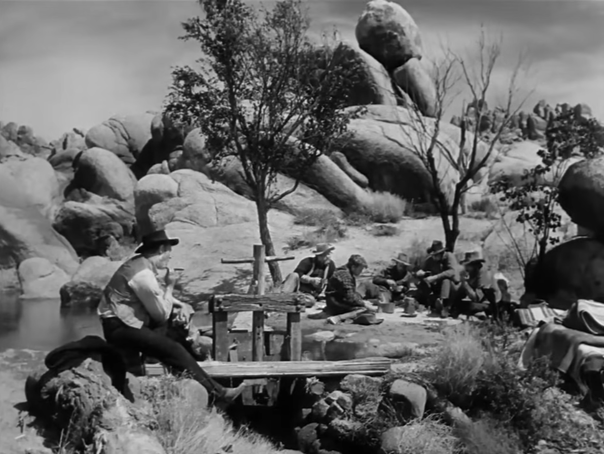
At 00:21:54 Mike tells the exhausted gang where to find the spring “up behind those big rocks, at the head of the street”, suspiciously tracking them, rifle in hand. Later, at 00:23:47 she appears dominantly on a boulder above them, regretting their arrival, poised as they gulp and wallow in the pool.
It has often been repeated that Yellow Sky is loosely based on Shakespeare’s The Tempest,[xxiv] and you can see certain obvious parallels: desert = sea, Stretch/Peck = Ferdinand, Grandpa = Prospero and Mike/Anne Baxter = Miranda . . . but if so, it’s a still looser adaptation than Forbidden Planet (1956), and Mike clearly has no wonderstruck admiration for Stretch: Miranda in Act 1, Scene 2 of The Tempest: “I might call him / A thing divine, for nothing natural / I ever saw so noble”.
If I had money for every film ‘loosely based’ on Shakespeare (the seventh art tirelessly in quest of respectability?) I would not be poor! In any case, the true value of Shakespeare, is the poetry, not the plots – most of which The Bard lifted from earlier sources. Once the description ‘loosely based’ is applied, most films would begin to resemble one (or several) of the seven – 36 basic plots[xxv] available. One might just as well say that Yellow Sky is ‘loosely based’ on the shipwreck of the Sea Venture off Bermuda in 1609[xxvi]!
No, Mike is not enraptured by this new humanity and if she were less defensive when the now hydrated Stretch first visits her house (00:24:25), could she have falsely conveyed that she was hiding nothing other than herself? With water, food and rest, the gang are bound to remember that weird painting in the saloon and revive their other animal instincts.
At 00:25:05, Mike tells Stretch that “it ‘aint far to Alkali, you could make it easy, if you try”. Alkali is a real place[xxvii] albeit a ghost town now[xxviii] in the inappropriately named Esmerelda County. Or perhaps the name only seems inappropriate because owing to one of those carelessly poetic lateral slips, it makes me think of emerald green grass . . . rather than sand, salt and emeralds[xxix]?
Nevada ghost town – Alkali Springs
I don’t want to venture into the political incorrectness of Stretch and his gang’s attitude towards the Apache[xxx] (though not only was Mike raised “with Apaches”, Grandpa praises them (00:26:11) as “fine people, if you can understand them”) or their lust or chivalry (the latter particularly in Bull Run’s case) regarding Mike/Constance Mae, or the necessity for a 1948 production to reinforce gender stereotypes for its mainstream coda (more on that later). Some of these attitudes are obviously toxic, some just amusingly or irritatingly of their time. Yes, it was inevitable that Mike and Stretch would ‘fall in love’ and probably both of them subconsciously feel this from the first moment they see each other – or so runs the timeless loathing-to-loving story convention, as well as the popular romantic notion. Mike tries to resist, whereas Stretch violently relaxes (!) into it, ceasing to sufficiently lead or control his gang and breaking his own rule to “stay away from those people!” (00:29:03). Eventually, stung by Mike telling him he smells bad (00:33:19), he even washes and shaves.
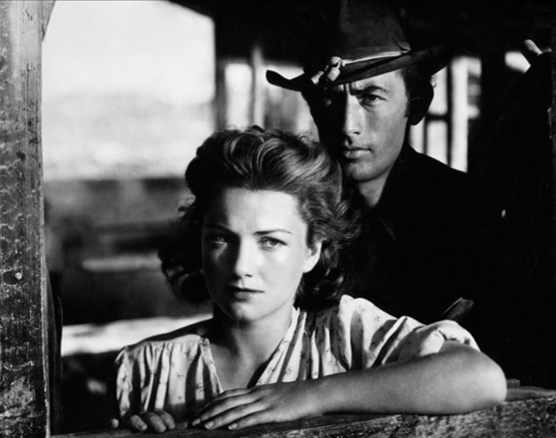
Mike with a smoothed-out Stretch!
Stretch looks much less appealing once shaved . . . but I’m getting ahead of myself and far ahead of the plot since it is Dude who dolls himself up first, just before Mike first comes to the spring for water (00:27:47). I hope she is going to boil that water before use after the mob has all slurped and wallowed in it! Or maybe, it’s just that I feel like washing after the battery of sexist comments and leering – all of which Mike takes in her stride. Of this and more violent scenes, no less than the BFI seems to have become over-compliantly politically correct[xxxi] proposing to demote a film made in 1948 for not having the worthwhile but somewhat idealised values of 2026. However enlightened we think we are 78 years later, such situations have not gone away. In watered-down fashion they happen in Heysham and Morecambe every day and my 16-year-old daughter prefers not to walk on the prom alone.
With dozens of wrecked buildings to choose from, why do the gang all “bunk down” in the saloon (00:29:50) – I’d chose a building as far away from the others as possible. The characters that “amount to nuthin’ nohow” (to quote Lengthy) seem able to sleep through Walrus snoring like a “wounded buffalo”, but Lengthy is driven outside – to find Stretch contemplating on the veranda of the ruined saloon. After needling Stretch about the whereabouts of Dude he goes back inside.
Is Stretch really looking for Dude, as he claims, when having moved towards the tenebrous homestead Mike emerges from the shadows to challenge him at 00:31:58? Tackling her by surprise, they fight, she head butts him, he does it back harder and forces a kiss on her, before desisting. This is where she tells him twice that he smells, and then taking careful aim, shoots him across the scalp (00:33:39). In another excellent post from 2008[xxxii], the writer highlights the scene which follows with Mike trying to explain to Grandpa why she shot Stretch:
“He made me feel . . . I don’t know.” But she does know. Stretch has made her feel like a woman for the first time in her life. Wellman then cuts to Mike’s room, in which a picture of an elegantly dressed lady is pinned onto her wall. Seeing it fills her with disgust and causes Mike to angrily tear it into pieces. It’s a great moment of self-loathing – she hates herself for feeling something that she’s been trying so hard to suppress. Although having such a picture on her wall in the first-place clues us into the fact that Mike longs to be as pretty as any other woman out there. In that one short scene, we sense Mike’s vulnerability for the first time.”
More specific than the tragic/Romantic pop songs that are a chart constant, the romances of old films still need last only half an hour or so of screen time – this is why they can be so haunting. Novels and tedious soaps and serials often do them to death. The best romance stories are about potential and hope, not dull, chronological reality. Being fundamentally frustrating, the human condition (in its customary form) cannot fulfil our yearnings for long – yet almost everyone who refuses to let the human state get them down, clings to hopes we project from imagination. Hence good love stories (and happy endings) have a general appeal even if many who have experienced the long-term reality of romantic love, try to reject such unreliable optimism. Romantic love may linger as familiarity and companionship, even flourish and create a sense of safety for decades, but are its deepest feelings of connection and joint projection, always liable to return to being about the other or the elsewhere? To a degree, this could be why I have abstracted my own deepest feelings into landscapes, atmospheres and the most searching art – which doesn’t mean that I can resist a wistful attraction to actresses[xxxiii] usually long dead. In great films none of the characters or landscapes are ever dead!
Bathing his scalp at the spring, Stretch encounters Dude. Could they have once been friends? Could they become friends? Not in Yellow Sky – this, distinctively, is one of its noir aspects. Stretch’s romantic inclinations have prevented him from deducing what Dude has had a hunch about all along – the presence of gold! Dude is greedy for gold and has no interest in romance. He tells Stretch his history and it’s the thought of his betraying ex-woman being made to suffer, that briefly revives Widmark’s insane chuckle from 1947’s Kiss of Death (00:37:47)[xxxiv]: “she lit out with a fella who ended up beating her”.
Above the ghost town the spring looks idyllic – as if the gang are enjoying a picnic. 00:26:57
From first encountering the Anglo-Saxon poem The Ruin, as a teenager,the idea of the ghost town, or of ghost areas – such as the ex-lead-mining moors of Northumberland upon which we lived for seven years – may be even more fascinating than the allure of actresses who, while society survives, will never die. Ghost towns represent the flip side to potential, and up to a point, their history becomes fixed in time. Tyneham[xxxvi] in Dorset was one such place explored when we lived in the southwest of England. Appropriated as a training ground for D-Day in 1943, it was never returned to its inhabitants. Mardale in Cumbria[xxxvii] was another valley we knew well, though we never knew its villages, Mardale Green and Measand, only the reservoir which gradually drowned them from the late 1930s. By contrast, the ghost towns of the desert states of Nevada and California largely record a failure to survive at the periphery. Spelling out tales of greed, aspiration or over-ambition, they are gradually destroyed by extreme temperatures and the wind.
Shattered stable in a court of rocks. 00:41:09
Stretch makes no attempt to understand or appease Dude (00:38:16). The increased antagonism between them begins the central section, though at first, Stretch is more interested in smartening himself up. The gang meet to decide on a course of action having voted Dude as new leader (00:41:53). Stretch has no regard for democracy, but before a direct showdown, Mike takes the initiative from the boulders above – with her rifle. The existence of gold can no longer be doubted.
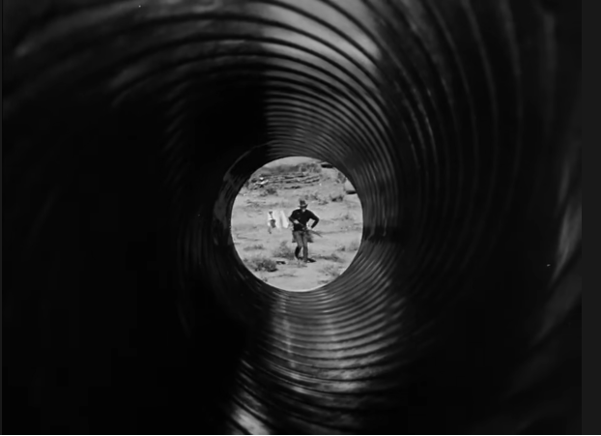
White flag or not, Mike has Stretch in the barrel of her gun – 00:45.09
This was probably not the first time such an idea was used in a film. Since the helical grooving[xxxviii] is clearly shown, was it actually shot through a larger diameter gun barrel or was this a special effect added in post-production?
If you have read this far without knowing Yellow Sky at all, I will leave all the nuances and twists of fate of the film’s second half to your imagination and jump to the perhaps unjustly despised coda which opens at 01:34:37. For long sections of its often nocturnal second half, Yellow Sky looks like a noir, but both the romantic elements and the reformation of Stretch to “James Dawson”, run counter to this. Stretch starts his biography by telling Mike and Grandpa (01:04:42) that “I come from good people. When I give my word, I mean it”.
Long prefaced by Grandpa’s compassion (01:08:02): “Guess the wars upset a lot of those boys and set them off on the wrong foot,” the coda is not just happy but quite comic and begins with the chagrined, contrite surviving bandits returning the stolen money to the bank. As if all crime could be so simply undone!
At 01:37:00 as the three survivors gallop across a beautiful flower-filled water-meadow for a rendezvous with Grandpa and Mike, the film reverts to its framing triumphalism and lightness. However, rather than the exploratory, adventurousness of the opening, the ending quickly becomes jubilant.
Do I want to be a woman some of the time? Can I do this? . . . 01:37:53
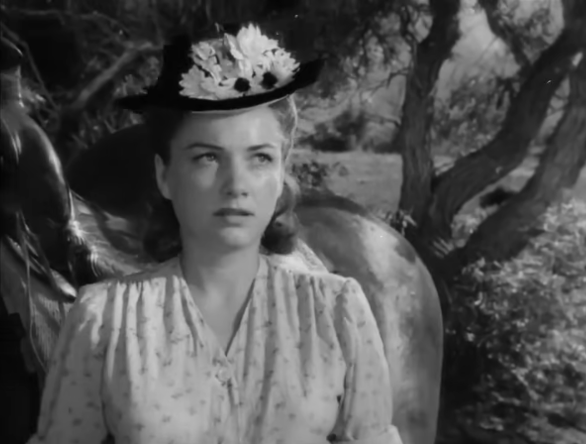
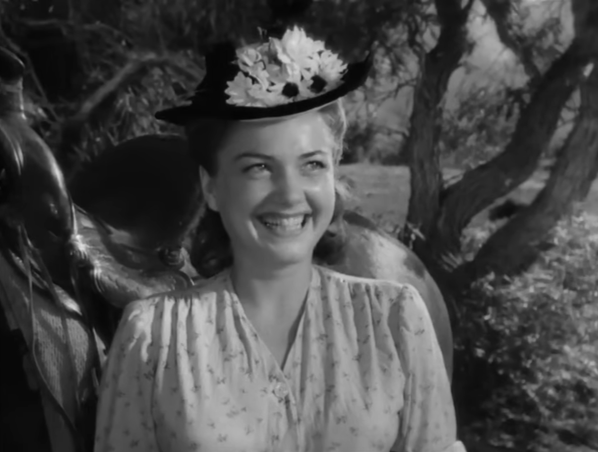
At 01:37:30 Stretch presents Mike with the hat bought from the head of an only temporarily affronted lady at the bank. This might all be “sappy” and “unbelievable”[xxxix], but personally, I enjoy it. Even if it was a studio imposition, it is a humorous, loving, throwaway thing, not worth getting wound up about[xl]. I don’t believe Mike will change because of it.
. . . Yes! At least for a while 01.38.00
Mike dares herself and accepts the hat. Love is in the air, let’s end quickly before the wedding!
[iii] In this outstanding piece by Stark Holborn, starkholborn.com/2020/01/23/review-yellow-sky- 1948/ he claims Yellow Sky as a precursor to the “Acid Western” sub-genre: “Acids, if you haven’t come across them before, are known, and named, for their counterculture tendencies; the desire to kick the western away from the glowy sunset of manifest destiny and into the dark corners of the soul.”
[iv] This article by Imogen Sara Smith brightlightsfilm.com/past-sunset-noir-in-the-west/ is so good on Bob Mitchum and others and on Pursued (1947), that I might abandon all future hopes of writing about that particular film!
[xii] I cannot find out who painted this. Presumably an artist employed by the film studio? If Sherlock Holmes were alive now, we need a monograph on bizarre portraits and paintings of old Hollywood A and B pictures – though I’m not sure it would be much help in the field of crime solving. When I’d almost reached the end of this essay, I encountered yet another wonderful post about Yellow Skyjeffarnoldswest.com/2022/03/yellow-sky-fox-1948-2/ which highlighted the similarities between the scene with the strange painting behind the bar and the opening of Wellman’s earlier film, The Ox-bow Incident (1943). The painting in Ox-Bow is not nearly so strange, but Henry Fonda’s comment “that guy’s awful slow getting’ there” sets off an interesting dialogue exchange.
[xviii] The first of Jean Renoir’s five films made in Hollywood during the Second World War was produced by 20th Century Fox. Categorised by the Nazis as “Cinematic Public Enemy Number One” Renoir’s left-wing anti-fascist and anti-war stance gave him no choice but to flee.
[xxix]en.wikipedia.org/wiki/Esmeralda_County,_Nevada “Esmeralda is the Spanish and Portuguese word for “emerald”. An early California miner from San Jose, James Manning Cory, named the Esmeralda Mining District after Esmeralda the Romani dancer from The Hunchback of Notre-Dame.”
[xxx] Ibid, from Alex Good’s post: “At one point I was hoping for the return of the Apache at the end in the role of the cavalry, saving Stretch and Mike and Grandpa from Dude and the gang. That, however, would have been a turn of the screw too far in 1948.”
[xxxi]bfi.org.uk/lists/william-wellman-10-essential-films see also, reference xxxv below. It is notable that after Yellow Sky, Anne Baxter’s very next film, You’re My Everything (1949), a slight, cringy and often irritating musical drama, insidiously reinforces sexist attitudes as well as racism – Dan Dailey even blacking up for one film-within-the-film. Rightly unacceptable now, this was standard at the time. Unlike the constant threat of the lustful men (a gang of criminal roaming men would be no different nowadays) towards Mike in Yellow Sky, this casual racism is not intrinsic to the contrast, tension or plot. An amusing aspect of You’re My Everything however, are the silent film take-offs – one entitled Flaming Flappers – acted out in believable, satirical fashion by Baxter, whose character is supposedly “patterned” on Clara Bow. She is certainly utterly different to Mike!
[xxxv]The Ruin, lines 8-13, translation by Michael Alexander, from The Earliest English Poems, Penguin Classics, first published in 1966, is thought likely to be about Aquae Sulis (Bath).
[xxxix] In his splendidly terse, to-the-point, two-minute recommendation of Yellow Sky, John Sayles hates its possibly studio-required end: youtube.com/watch?v=SrbtgJTe6ok saying at 00:01:36 “If I ruled the world, I’d cut the sappy, unbelievable coda off the movie!” But I often like abrupt happy endings, unless they are so bad they make you nauseous. They can be less tiring. I always feel tempted to rewrite bad endings. Every time I watch Out of the Past (1947), for example, I always want Bob Mitchum to survive even though that would defy one of the rules I consider essential to true noir – a tragic conclusion.
In William A. Wellman: 10 essential filmswww.bfi.org.uk/lists/william-wellman-10-essential-films the BFI also finds fault with the cheerful ending (and other things): “Were it not for some alarmingly dodgy sexual politics – from Gregory Peck’s assault on Anne Baxter to her final acquiescence (via a bonnet) to his idea of feminine norms – Yellow Sky might rank among Wellman’s best.” I fail to see why depicting things how they simply would have been, counts as “alarmingly dodgy sexual politics”. That is to apply modern attitudes to a film made 78 years ago. The hat incident may or may not have been a studio imposition, but it is a humorous, loving, throwaway thing, neurotic to be wound up about, and absurd that it should affect how we rank the film. We can deplore aspects of the past, but we can’t expect the past to fit in with our current fashions. Personally, I don’t believe Mike/Constance Mae will change all that much because of a silly hat and both Stretch and I would be disappointed if she did. But that’s why films end when they do. In ‘real life’ we are often likely to be disappointed. One of the major problems with long-form TV is that it never ends but merely staggers on into the desert.
LAWRENCE FREIESLEBEN, Film & Television Editor of The Brazen Head, has beenan artist and writer as long as he can remember – cycling away at weekends from the council estate where he grew up, to paint the countryside as an escape from the restrictive tedium of the school week. Leaving home at 16, he has lived in 17 different areas of the UK – from Devonshire to Northumberland – painting and writing, always vigilantly questioning the interior light of landscape, cityscape and wider atmosphere. Living virtually off-grid with his large family, both remote locations and urban visits have formed the backscene to a passion for film which has intertwined with art and writing throughout his career. Films remain a key creative focus since childhood, resulting in encyclopaedic folders and clippings as well as a constant stream of home-made film festivals. He currently lives in a dilapidated Lancashire seaside town
LAWRENCE FREIESLEBEN, Film & Television Editor of The Brazen Head, has been an artist and writer as long as he can remember – cycling away at weekends from the council estate where he grew up, to paint the countryside as an escape from the restrictive tedium of the school week. Leaving home at 16, he has lived in 17 different areas of the UK – from Devonshire to Northumberland – painting and writing, always vigilantly questioning the interior light of landscape, cityscape and wider atmosphere. Living virtually off-grid with his large family, both remote locations and urban visits have formed the backscene to a passion for film which has intertwined with art and writing throughout his career. Films remain a key creative focus since childhood, resulting in encyclopaedic folders and clippings as well as a constant stream of film festivals. He currently lives in a dilapidated Lancashire seaside town
Devonshire
Staggering amidst a floodtide Heavitree
of happiness embalmed in memory sudden frost children
LAWRENCE FREIESLEBEN, Film & Television Editor of The Brazen Head, has beenan artist and writer as long as he can remember – cycling away at weekends from the council estate where he grew up, to paint the countryside as an escape from the restrictive tedium of the school week. Leaving home at 16, he has lived in 17 different areas of the UK – from Devonshire to Northumberland – painting and writing, always vigilantly questioning the interior light of landscape, cityscape and wider atmosphere. Living virtually off-grid with his large family, both remote locations and urban visits have formed the backscene to a passion for film which has intertwined with art and writing throughout his career. Films remain a key creative focus since childhood, resulting in encyclopaedic folders and clippings as well as a constant stream of home-made film festivals. He currently lives in a dilapidated Lancashire seaside town
ROSS COGAN studied philosophy, gaining a Ph.D. He has published three poetry collections, Stalin’s Desk (2005) and The Book I Never Wrote (2012), with Oversteps, and Bragr (2018) with Seren. Ross received a Gregory Award in 1999, and has won the Exeter, Frogmore, Cannon Sonnet and Staple prizes, and been placed in others including second in the Troubadour. His poetry has been published in the Guardian, Poetry Ireland Review, Poetry Wales, Poetry London, PN Review, New Welsh Review, Rialto, Acumen, Stand, Orbis and other magazines. A writer and editor, he was Creative Director of the Cheltenham Poetry Festival from 2010 to 2019
The world as will and idea
“L’histoire conte que le terrible Schopenhauer en était fort amateur de bière. Il jouait aussi de la clarinette, mais c’était peut-être pour embêter ses voisins.” (Jean Verdenal)
Schopenhauer, we’re told, had a great love
of beer. The man who let his mind
slip slyly under the stage curtain, behind
the painted backdrop of ideas,
to where the great undifferentiated ‘all’,
hungry and fierce and cruel,
pulls the levers and unties the ropes
from in the shadows that it also is;
the man who walked at night down certain half-
deserted streets to stand alone in
the blasted wasteland where the grim
indifferent wind whirls and one feels the frozen
hub of the world’s fever; this man
was not above
quenching his resulting thirst
in a long, cool glass of beer.
I like to picture him in a neat,
dark frockcoat, buttoned high,
a crisp, cambric shirt, a sumptuous tie,
surmounted by a simple pin,
reclining in a corner seat
in a favourite bierkeller, his face a lion’s, his thin
ROSS COGAN studied philosophy, gaining a Ph.D. He has published three poetry collections, Stalin’s Desk (2005) and The Book I Never Wrote (2012), with Oversteps, and Bragr (2018) with Seren. Ross received a Gregory Award in 1999, and has won the Exeter, Frogmore, Cannon Sonnet and Staple prizes, and been placed in others including second in the Troubadour. His poetry has been published in the Guardian, Poetry Ireland Review, Poetry Wales, Poetry London, PN Review, New Welsh Review, Rialto, Acumen, Stand, Orbis and other magazines. A writer and editor, he was Creative Director of the Cheltenham Poetry Festival from 2010 to 2019