Parnassus, and patria

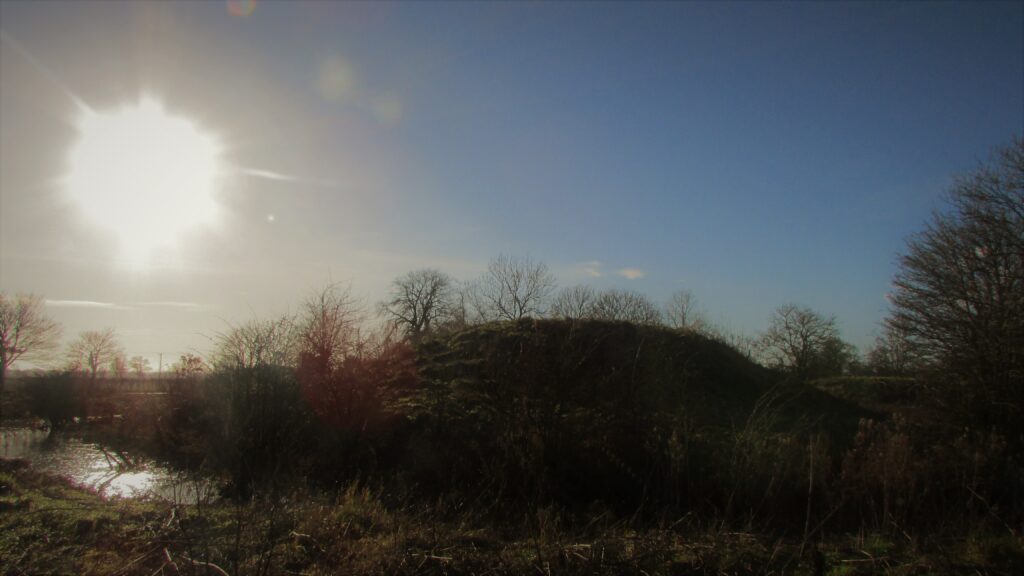
Tumuli at Revesby in Lincolnshire

Sunken Island: An Anthology of British Poetry

Various authors, edited by Alexander Adams, foreword by William Clouston, London: Bournbrook Press, 2022, pb, 55pps, £12.50

Bournbrook Press is an offshoot of Bournbrook Magazine, founded in 2019 to offer a “primarily British audience with traditionalist, socially conservative argument and entertainment”. This venture’s newest publication is something unusual, and unlikely to be financially profitable – an anthology of original poetry put together specifically to appeal to small-c conservatives, a subset of the population not noted for their interest in new verse.

Poetry written for political purposes always runs a risk of being bathetic, just as other arts can easily become ‘artivism’ – a point amply understood by this collection’s editor-contributor, who has written an informative book on this subject. I have a 1900 anthology on my shelves, Heroic and Patriotic Verse, and while much of the verse is excellent (it includes Byron, Goldsmith, Gray and Shakespeare), some has dated less well, including ‘Of old sat Freedom’ (one of Tennyson’s windier effusions) and the frankly indigestible ‘The Roast Beef of Old England’. The verse in Sunken Island is similarly uneven, but when it is good, it is, as Social Democratic Party leader William Clouston notes in his Foreword, “both serious and enjoyable”.

Clouston also points out that this book’s eight contributors are not “blind to the country’s flaws”, and this gives this collection both muscle and a certain wryness of outlook notably absent from some patriotic poets, like Rupert Brooke or Henry Newbolt. There is no bombast to be found in Sunken Island, nor sentimentality, nor Patience Strong-style platitudes. The two prevailing emotions are love, plus loss – an odd echo of Hugh Kenner’s A Sinking Island (1988), which concluded that “there’s no longer an English literature”. 

Kenner’s gloom is to some extent gainsaid by the poets in here, who suggest that a kind of distinctively English literary sensibility may still be discoverable – or at least a British one, because one of the poets included (the pseudonymous ‘Columba’) is Scottish, while another (Rahul Gupta) is a noted exponent of traditional alliterative verse. This does not mean that the other six contributors are stodgily suburban, nor even a hundred percent English. Alexander Adams is a justly well-regarded artist whose work is in the V&A (several of his drawings are used in Sunken Island). Benjamin Afer calls himself an “authentic reactionary”, but authors futuristic novels. Daniel Gustafsson is a bi-lingual (Swedish) doctor of philosophy, as well as a highly-regarded poet. A. Robert Lee taught in America and Japan, and lives in Spain. Nicholas Murray is a biographer of Kafka and Chatwin, and a Fellow of the Welsh Academy. S. D. Wickett is an aficionado of Lovecraft and Phillip K. Dick, and affianced to digital media.

The poems vary greatly in style. Nicholas Murray’s six short contributions feature everyday vexations, from standing on a train station concourse to being bitten by someone else’s dog (for which he apologises, the most stereotypically ‘English’ moment in the book). He notices small things, and honours the 19th century clergyman-diarist Francis Kilvert, who did too – “…the man of God whose fine gift / for seeing things lights the day / As sunshine after sudden rain”. He looks into a painting of a Lancashire landscape, and remembers its departed artist. He is abashed by the force of nature, in the form of a night wind which blew away rooftiles, and “glib proposals”. He then eavesdrops on an imagined conversation between James Joyce and Percy Wyndham Lewis, as verbose Irishman and Vorticist Englishman consider quantity, and the urgent need to stir things up, to dissolve “the solid shell”. 

A Robert Lee’s contribution, ‘From…’, addresses Englishness, coherent but complicated, encapsulated by the “multi-there” and “multi-then” of his own odyssey from 1950s Manchester via London, America, and Japan to 2022’s Spain. “The initial from takes on lengthening distance…” while everything changes and he changes with it, but remains in some ways strangely the same. ‘From…’ is more impressionistic jottings than verse, yet it ably conveys diverse textures and odd connections – between Manchester, Lancashire and Manchester, New Hampshire – between London periods and London postcodes – between the Kents of Chaucer and supermarkets – between the island mentalities of Britain and Japan, and the “inside outsider” status of being a Spanish-speaking Englishman in Spain. In him, national nostalgia seems in permanent tension with what Germans call Fernweh – ‘farsickness’, a wish to see far-off places – and perhaps he needed to get away to understand where he had come from. As Kipling asked, “what should they know of England who only England know”? Lee at least has come “to relish the from and the to: England’s away-day, England’s away-life”.

Adams’ poem ‘Roadside Diner, Shropshire’ is less sanguine, a contrast between the heartbreaking hills of Housman, and the plastic-bottle spotted county Adams and companion view from a bleary café window, downing terrible food while “vital, indifferent” traffic dashes by, heading nowhere purposefully. This England is, he repines, “an absent people, a civilization surrendered”, and sometimes he feels like a “lone journalist remembrancing a defeated land”. Lack of legacy nags and nags at him, as he sees sunning girls arising and going “back to life, leaving nothing of themselves” – fewer traces than even the evanescent, underestimated flowers of May.

Daniel Gustafsson’s ‘Bulbs’ strikes a brighter botanical note, reminding us that even the gnarliest corm in the coldest ground pushes green spears upwards each spring, offering potential for beauty and self-realisation. His work is rhizomed in Yorkshire, a county whose notoriously crumbling Holderness coast offers plentiful metaphors for erosion of substance. “The guards have let us down”, Gustafsson warns, political leaders and opinion-formers mere “architects of entropy”, letting everything slide into the abyss out of sheer carelessness. “We’ve seen our footings fall / to sludge… have seen, through slurred decrees and sleights of hand, / a state of blank forgetfulness / usurp the patterned sand.” Spurn Point at the northern tip of the Humber could be nationally emblematic, a sandy spur soon to be an island, near where the great port of Ravenspur once saw kings land, and monks build monumentally. The East Riding’s erosion is symbolic to him of a country’s “great diminishing”, as a former “common ground” is washed across by shallow sloganeers, who impose their views on others like some postmodern Morality Police.   

Gustafsson’s lyrical wistfulness is given a more combative edge by Benjamin Afer, whose ‘Lines on an English Street’ express feelings of inner exile, the author feeling alienated from his ancestral domain by demographic changes as symbolized by ethnic restaurants – “a surfeit of whiffs”, from an alphabet soup of eateries in High Streets that have somehow become Grand Bazaars. “It’s a solitary walk the Englishman beats / In the swelling crowds of the English streets”, he insists bleakly, notwithstanding possible economic upsides: “The happy ringing of tills and drumming feet / Make a merchant at home on the English street.”

The collection closes on an unexpected crescendo, with four extracts from larger works by Rahul Gupta. The author, who holds a doctorate in alliterative verse, and is undertaking a major translation project from Old Norse, is alive with logophilic intensity, pouring torrents of words onto pages as if upending some wonderfully capacious cornucopia. Familiar words are deployed in unexpected ways, unfamiliar ones summoned from OE word-hoards where they have lain too long asleep, and new ones are smithed – and all are marshalled to striking mythopoeic purpose.

Gupta’s chief area of operations is the post-Roman, pre-English world, when Angles, Celts, Jutes, Saxons and Scandinavians moved across claimable spaces between downfallen towns, where horse-masters could be kings and stones sacred, and ravens battened on bodies at real battles whose locations we have lost, and which we barely now remember even as names. This is ‘Matter of Britain’-territory, Gog Magog-country, the Logres that lies under even the ugliest parts of everyday England, giving the least imaginative modern Englishman some vague sense that he belongs in some continuum. This epic subject – so liable to be conventionalised and sentimentalised – gains vastly in vitality at his hands.

‘A Norse Étude’ is a combat scene condensed from all the hyperboreal epics, from Heimskringla and Orkneyinga to Beowulf and the Battle of Maldon, imagining “horny-nebbed” hooded crows descending on men falling under a hail of “Flanged arrows as flinder- / fledges leapt from edges / over shields, bows shrilling, / when shank-deep was dankness / of gore”.  Poems were – and are – also weapons in these wars of all against all, as tribal minstrels interpret and invent legends, weaving words “from that web of swords”, trying to forge the future by capturing the past.

‘The Turn and Fall of Leaf’ could be a title from Tolkien (to whom Gupta has been likened), a lambent disquisition on autumn, its colours and significances, its glories and sadness, as the glowing greenwood goes glorious, then brown and blighted. Winds pick up and shiver the timbers, and their chlorophyll clothes weep to the far-below floor. Secret glades are shockingly made naked, and rides are mounded deep in dry detritus – “pathways choked, by parched masses: / crinkled chamoisy, crunched underfoot / as shuffling drifts. With shift and ruffle / They enswathe the sward”.

Time for ‘The Onset of Winter’, with clouds and winds as “sky-skirmishers, obscure armies / of ill omen”. The Wild Hunt passes, baying and foaming hounds headed by Herne, antler-masked “wood-warlock of the warrior-band”, in elemental pursuit of white harts from heraldry, while berserkers and whippers-in howl and scream and “chew the shieldedge” in frenzy. And then – the chase passes and the thrumming hoofbeats recede into infinity. Nature exhales, and all is suddenly motionless. Overhead, “Hunter and Hound are hovering still” in a sky diamonded with stars and a moon of mother-of-pearl.

At other times, winter deals harsh hail and sleet to punish the patient earth – “gravel-grain that grows no harvest”. Yet other days, snowfall hushes all noise, subdues all striving; a giant Cold Genius walks the whitening land with his finger to his lips, casting crystals of infinite variety indifferently over the quick and the dead, obliterating boundaries, ivorying all the colour-fields. “All wear his harness: / ironhardened earth” and “The ice tightens / Wonderfetters”.

But there is release at last, as even in winter there is the possibility of warmth. In ‘The Midwinter Sun’, the “all-tending orb” suddenly rides high and reaches down with effortless sensuality. He “…drives the spore: he inspires the bud, / as the twig whitens, to untwist her whorl: / he parts her petals; the pollen to smoulder / from flaunting catkins”. Blinking, yawning animals emerge from hibernation, hungry for the starting grass, conscious of urgent impulses that make the male hen harrier seek out multiple mates, send hares careering across champaigns, adders intertwine Gordianally, and unsettle cattle in crew yards. The poet tracks Phoebus lovingly through his golden ascents, then Wheel of Fortune downturns, as the “traitor-barons…eclipse the glory of his lion’s mane”, as so often before. The uncertain sun sinks into the sea, and troubled men set out in tiny boats, “travailing westward /… on benighted tides, / In search of the dawn.” Like all his others, this is a virtuosic performance, a welcome reminder that there is still blood in the tradition.

The contributors to this volume could all be seen like Gupta’s metaphorical sailors, navigators of unknown waters, seeking Sol-ace in a gathering dark, reaching for verse to reverse eclipse. If sometimes their reach falls short, at other times it does not, and always they are honourably-intentioned. This public-spirited Parnassian project can be judged a success if even a few of the many other anxious among the English are inspired to poetry in their turn.

Another American empire

Corpse of Emperor Maximilian of Mexico

The Last Emperor of Mexico: A Disaster in the New World

Edward Shawcross, Faber & Faber, January 2022, 336 pages, £20

KEN BELL reflects on a Mexico that might have been

Mexico has only ever had one ruler who cared about the Indians and he was shot by order of an Indian. Mexican humour always has a deadpan kick. How that ruler, an Austrian, ended up in Mexico only to die there is the subject of Edward Shawcross’ book, and a very good account it is of the whole ludicrously tragic event.

This disaster came in three acts, with the first being set in Mexico and created by the local politicians. The country became independent of Spain in 1821 and within 20 years had gone through 11 presidents, only one of whom had completed his term in office. Mexico had also managed to have an emperor who didn’t last long, either, before being shot [EDITOR’S NOTE: Agustín of Mexico, reigned 1822-3]. In the 1840s a lost war with the United States had stripped the country of its northern territories, and a decade later a civil war had added to the nation’s woes.

The author overstates his case by putting most of the blame on the United States, and ignoring the role of Mexicans as the authors of their own misfortunes. For instance, Mexico could probably have fended off America’s ambitions in the 1840s by recognising the independence of Texas, which they had lost in 1836. Britain quite liked having a free trade republic that bought British goods and sold cotton to Lancashire, and with a bit of prodding from Mexico would probably have guaranteed the independence of the Republic of Texas, thus giving Mexico a buffer state. Mexico was not prepared to do that as politicians outdid each other in their bombastic determination to promise that Texas would be restored to la patria. It is perhaps not surprising Texan politicians preferred the embrace of the United States, but with a bit more Mexican astuteness it might have been averted.

At root, Mexico’s problems came about because of the internal divisions in the country, divisions intensified by the fact that political factions organised themselves within the secrecy of Masonic lodges. Thus politics became a kind of conspiracy, fought out by factions behind closed doors. Politicians outdid themselves in promising to rain hellfire down on the United States and those who would betray the nation by compromising with Washington, before trotting off to the American embassy to try and negotiate some backroom deal. Shawcross shows that out of this chaos, two political factions emerged. The first was the conservative-monarchists who had managed to lose the War of Reform in the 1850s and were gagging for revenge. The others were the liberal-republicans who wanted a federal republic in Mexico based upon the example of the United States.

For the second act, Shawcross looks at events in Europe, a factor often overlooked, especially by Mexican historians who often seem to treat the French intervention as just another act of colonialism when actually it was far more. Catholic Europe by the 1850s had become afraid of the rising power of the Protestant United States. Napoleon III was an autocrat, but of a very modern kind, who believed in constitutions and science. He was a great fan of the newly developed science of statistics and his statisticians told him that the two million people in the USA in 1763 had become ‘32 million in 1863 and calculated that in 1963 it would be 512 million.’

It was fear of the growing USA that led the French to conjure up the notion of Latin America, with themselves as the head of a Pan-Latin movement to connect Catholic Europe to Catholic America and fend off the rising USA. Thus, Mexican conservatives who wanted an empire in Mexico found a very sympathetic listener in Napoleon III and the French intelligentsia and military. Having settled on the Austrian Archduke Maximilian, it only needed a small French army to land at Veracruz, move inland to Mexico City and hang around until the new Emperor arrived to take charge in the interest of France. What could possibly go wrong?

The final act showed just how badly things could. The Mexican republicans managed to defeat the French at the Battle of Puebla in 1862. Actually, the French were only a part of the army as much of it was made up of Mexican conservatives, a fact which Mexican historians tend to overlook. Another factor in the defeat was that the bulk of the French officers and men were suffering from the affliction known as the ‘MexicanRevenge. It is very difficult to load and fire a musket when squatting down because your bowels have turned to jelly.

Eventually, the French did manage to install Maximilian in Mexico City, which was when the Mexican conservatives discovered that they had been lumbered with a liberal who was not willing to turn the full, reactionary forces of Catholicism against Protestant heresy. Maximilian often wore traditional Mexican dress, learned some of the native languages and was quite happy to promote American-Indians to high office, with General Tomas Mejia commanding his light cavalry. Mejia was actually a brilliant cavalryman who saved Maximilian’s fortunes on several occasions before dying next to him in front of the same firing squad in 1867, but for those ultra-conservatives who wanted a reactionary empire he was an example that Maximilian was rather too modern for their tastes.

Having alienated the conservatives, Maximilian was unable to reach an understanding with his liberal enemies, headed by Benito Juarez, who was also an American-Indian, because they did not need to compromise. Divisions grew in the conservatives’ ranks and having an Austrian on the throne meant the liberals could crank up Mexican xenophobia to its fullest extent. Juarez orated about freeing the country from all foreigners while at the same time negotiating with the United States for arms and supplies. As soon as the American Civil War ended, Washington was only too happy to keep its side of the bargain, leaving unspoken the fact that Mexicans were dying to get the French out of their country only for American business to move in.

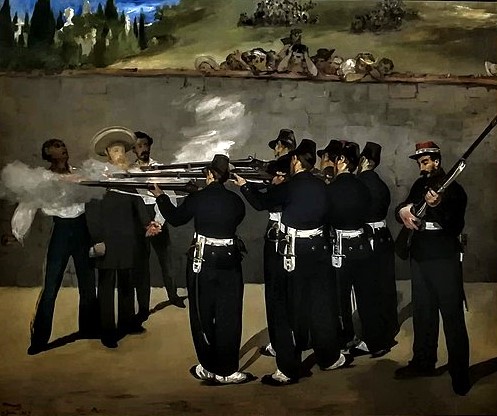
The French abandoned Maximilian for the same reasons that the American would abandon South Vietnam: it was costing them far too many men and far too much money to continue the contest. Maximilian hung on for longer than anyone expected, until eventually one of his most trusted generals crossed the lines and betrayed him for $30,000, which admittedly was rather a lot of money in those days.

Edouard Manet: Execution of Emperor Maximilian I of Mexico

During his time on the throne, a tomb began to be constructed for Maximilian, but after his death, the body was returned to Austria and the tomb was then completed and used for the body of Benito Juarez in 1872. About 25 yards away from Juarez’s tomb, is the grave of General Tomas Mejia, who died with his Emperor in 1867. After all the slaughter that had taken place, it is perhaps fitting that those two mortal enemies became neighbours in death: they were both Mexicans when all is said and done. It fell to Porferio Diaz, a liberal general, to seize Mexico by the throat following the death of Juarez and install the ‘liberal dictatorship’ that Maximilian should have created. His 35-year rule lasted until 1910, when everything fell apart again.

Shawcross has given us a solid account of this turbulent part of Mexico’s past, that surely merits a place on the bookshelves of anyone interested in the history of the Americas.

Cuba six decades later

Abyss: The Cuban Missile Crisis 1962

Max Hastings, William Collins, September 2022, 576 pages, £30

KEN BELL recalls the Cold War’s most dangerous moment

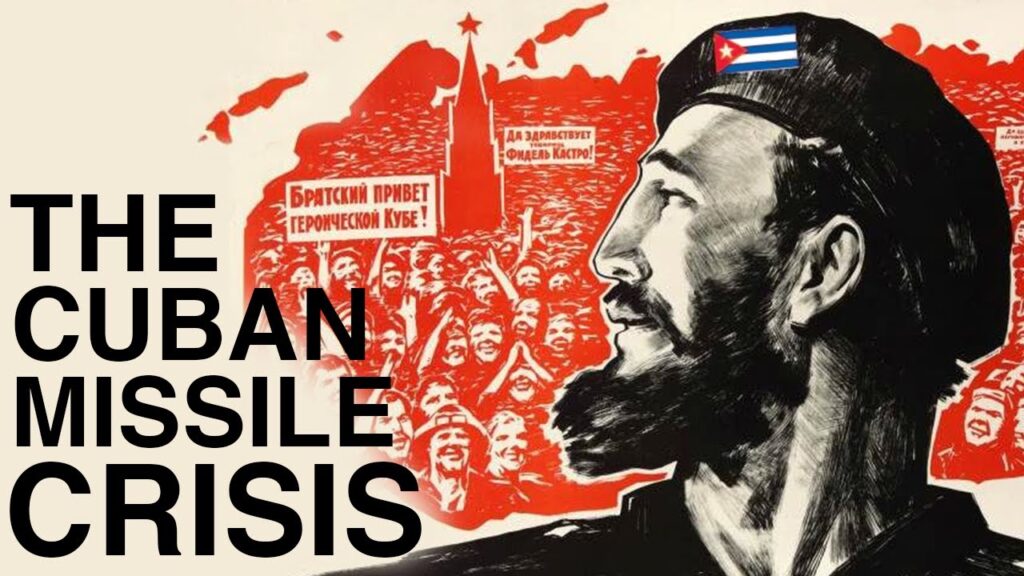
2022 has been the sixtieth anniversary year of the Cuban Missile Crisis so a lot has been written about the event, with Max Hastings’ Abyss: The Cuban Missile Crisis 1962 being the year’s final offering. It is also one of the better works, especially since it is aimed, as Hastings notes, for ‘the general reader’. Thus the work assumes no prior knowledge of the events, so the first three chapters consist of an explanation of the interaction between Havana, Moscow and Washington in the decades leading to the Missile Crisis. I confess I found that a little tedious, but I suspect that I am not one of the target readers. That said, the work is footnoted throughout and comes with a very decent bibliography, so it will feature on a lot of student reading lists.

As the KGB archives were opened fairly recently in Ukraine and Serhii Plokhy mined them assiduously in 2021 to produce Nuclear Folly: A New History of the Cuban Missile Crisis there may not be much new material that is awaiting discovery. Given that, Hastings has produced a synthesis of the existing knowledge in a wonderfully readable form. Good historian that he is, he also manages to put new interpretations on much of this material.

For instance, Cuba managed to liberate herself from the American informal empire in 1959, and then went on without any outside help to destroy the American-sponsored attempt to bring the country back into Washington’s orbit at the Bay of Pigs. The USSR sent a delegation, headed by Deputy Premier Anastas Mikoyan to investigate what was going on, and Fidel Castro whispered to him that he ‘had been a closet Marxist since his student days’. As Hastings points out, ‘this fragment of autobiography’ was really nothing more than a ploy for Soviet support against the USA, but Mikoyan took the bait and returned to Moscow in a state of euphoria. The USSR had waited for a country to free itself from capitalism without the Soviet army forcing it on them, and here was Cuba doing just that. As Mikoyan later exulted to Dean Rusk, Cuba made the Soviet leadership ‘feel like boys again’ with the glory days of 1917 returning in a hot climate.

In other words, Havana made the running in the relationship with Moscow and Castro had the Soviet government exactly where he wanted it, doing his bidding. That, more than anything kept Cuban independence alive down the following decades as together the USA and USSR gave Cuba ‘the right friends and the best enemies’ that she could ever hope for.

The Soviet Union could probably have signed an agreement with Cuba that would have led to the former openly placing her missiles in Cuba, just as the USA had done with Turkey. The American reaction would have been the same, but it is possible that western Europe would have shrugged and a serious division might have been created between the United States and its European clients. That did not happen because of the mercurial personality of Nikita Khrushchev, who was a born gambler, not to say outright chancer.

Khrushchev was probably the worst man to put in charge of any foreign policy, because he invariably neglected to plan for contingencies. He thought that if the missiles could be installed in Cuba then the Americans would accept the situation just as they had accepted the Berlin Wall. When Washington refused to play along, Khrushchev was caught in a bind and had to find a way to get out of the situation that his failed gamble had created.

John F. Kennedy was willing to negotiate, but he was faced with a military that seemed to be basically insane as it egged him on to war. As one such lunatic said, if there were two Americans left standing at the end and only one Russian, then America had won. It is a tribute to his patrician sense of self-belief that he was able to ignore such madness and keep the negotiations with Moscow going until the other side finally blinked.

One wonders what would have happened had America been led by a Ronald Reagan or George W. Bush during that time, instead of a man who could take time out from looming Armageddon to order an underling to smuggle a young typist who couldn’t actually type into the White House to provide him with an evening’s entertainment. Say what you like about JFK; this was the era of the Imperial Presidency, he reigned at the height of the Pax Americana and he knew how to prioritise and ensure the obedience of those around him as well as any emperor during the Pax Romana.

The world came through the crisis in 1962, which is why I am able to write this in 2022. For the reader who wants to understand the sequence of events that led to that near catastrophe I cannot praise Max Hastings’ work too highly.

Overlooked Orpheans

STUART MILLSON enjoys some neglected gems of British music

Why does the spiritual toll of the Great War seem to have been harsher for Britain than for any of the other European combatants, asks organist, scholar, music-writer Robert James Stove, in commentary for a booklet which accompanies a new CD on the Australian Ars Organi label. His answer is clear and convincing: ‘… the innate stability of British political institutions meant a lack of opportunities for citizens to work off their war-neuroses by revolutionary activism, as agitators did on the Continent.’ Only in a marginal way did iconoclasm and an avant-garde spirit affect Britain, post-Passchendaele: for every Vorticist there was a Vaughan Williams offering benediction, although few realised that the composer’s Pastoral Symphony of 1922 was inspired by his own experiences of service on the Western Front. (Listen more closely to the ghostly, wordless voice in the unsettling final movement…)

The new recording, a superb audio curation of British music made in the magnificent acoustic of Our Lady of Victories Basilica, Camberwell, Victoria, Australia, assembles less-well-known names from the canon of Albion’s musical renascence. Alongside John Ireland and Vaughan Williams, for example, are Thomas F. Dunhill (excerpts from his Three Chiddingfold Pieces), Sir Walter Galpin Alcock (Westminster Abbey organist at three coronations during the high-tide of Empire) and Alan Gray (successor to Stanford in the organ loft at Trinity College, Cambridge).

All works and composers chosen by the Ars Organi Recordings for this collection have in common a profound attachment to English tonality (although Norman Fulton, at CD track 11, is a Scot). It is as if the music of our islands is a mirror-image of the (physical and psychological) architecture of the very institutions that have long-governed us. The slow-breathing, hushed voices of churchgoers, a ray of wintry light, piercing through a cathedral window like a gimlet; a sense of eyes being drawn toward the pinnacle of a Norman arch – these are some of the feelings and imaginings inspired by many of the works, some of which are ethereally-enhanced by the participation of singers Elizabeth Barrow (soprano), Brigette De Poi and Emily Tam (mezzo-sopranos), Leighton Triplow (tenor) and bass, James Emerson.

John Ireland’s The Holy Boy and a George Herbert setting (The Call) from Vaughan Williams’s Five Mystical Songs are probably the best-known pieces in the entire collection. Peter Warlock’s old English carol, Adam lay Ybounden, also finds an occasional place in concerts and Radio 3 schedules. But who knows the music of the composer, whose work concludes the CD: Geoffrey Turton Shaw? A near-contemporary of Vaughan Williams, he served as a school inspector and was himself schooled by that master of church music, Sir Charles Villiers Stanford. Setting Milton, Ring outye crystal spheres/Once bless our human ears… Turton Shaw embodies all the virtues of his genre and world, confirming the past, present and future solidity of English music.

The music of a Welshman, Daniel Jones (1912-1993) makes up another important collection of lesser-known music from our shores, in a well-presented four-disc set from Lyrita Recorded Edition. Many will remember the remarkable ground-breaking Lyrita vinyls of old: symphonies by Bax and Rubbra, John Ireland songs, The Magic Island by William Alwyn, and a record that particularly caught my eye when I first came across it in the record department of Foyles, some 40 years ago – Ireland’s Forgotten RiteLegendMaiDun and Satyricon – with its strange, haunting cover-artwork; a picture which hinted at the form of a landscape, with dotted colours and distances just out of reach. In fact, if I were to try to find a simple, neat description of Daniel Jones’s music, it would come close to those suggestions inspired by the Ireland graphics – although this enigmatic composer (a code-breaker during World War Two) never really embraced, at least self-consciously, folklore and the symbolism of place. He tended to think of himself as a composer who happened to come from Wales, rather than an artist who had a civic responsibility to proclaim a culture – although he did write a major choral-orchestral piece, The Country Beyond the Stars, which – post-Festival of Britain – seemed to have an ambience of dreamy peninsular coasts, beacons and Black Mountains.

Perhaps the nearest he came to a home-spirit, an imprint of Welshness, was in his Dance Fantasy, performed at the 1982 Proms by the (then) BBC Welsh Symphony Orchestra under Bryden Thomson – although the work still seemed somewhat set apart from Welsh dances and Celtic legends by fellow-countrymen Hoddinott, Mathias and Arwel Hughes. And it was at this concert that I briefly met the musician… As I walked around the hall at the end of the evening, making my way back to the tube station and suburbia, I spied the bespectacled composer (this one-time friend of Dylan Thomas) at the Royal Albert Hall Artists’ Entrance. Venturing over, I asked for an autograph, which was cheerfully forthcoming and written in a neat, methodical hand, with a fountain pen. An avuncular, slightly diminutive figure, Daniel Jones seemed very pleased by the performance of his own music at the Proms. (It has to be said, the Proms Planning Department has been less than generous to the composers of Wales.)

Lyrita’s new CD collection puts the music of Jones and Cambria very much on the map. Pianist Martin Jones has spent many hours in the National Library of Wales, painstakingly uncovering an almost Bach-like progression, cycle, abundance of piano works, from a neatly-crafted Capriccio of 1934, to the much more ambitious (“big stride”, was the composer’s own description) ThemeVariations and Fugue in C-sharp minor, dated 1945 – the year of Britten’s Peter Grimes and the advent of the Attlee era. Tonal, but sometimes wandering away from those clear lines; meditative, but never obscurely introverted, Daniel Jones created, it seems, pure music, for its own sake. Rigorous, never arduous, and always making the listener wonder what the next piece will bring.

A great deal of the composer’s character is also suggested by some of the photographic portraits featured in Lyrita’s CD booklet, not least the final black-and-white plate: Dan Jones, with benevolent eyes and a grin, partly concealed by the pint of bitter he is bringing to his lips. A good Welsh brew, no doubt.

CD details

Undertones of War, British Organ and Vocal Music After 1918. Robert James Stove, organ. Ars Organi, AOR004

Daniel Jones, Rediscovered Piano Works, Martin Jones, piano. Lyrita, SRCD.2396

“A tune beyond us, yet ourselves”: the mystic heart of sport

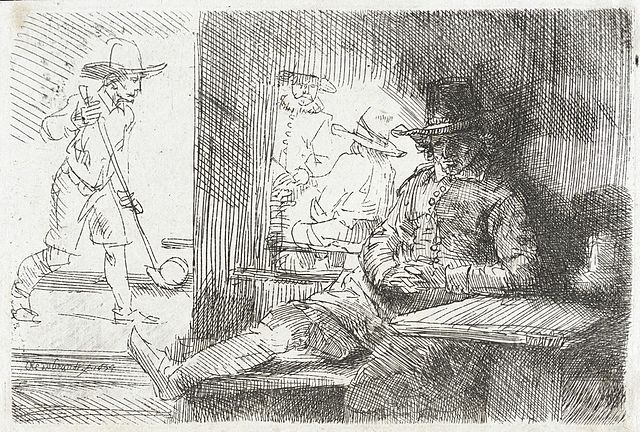
Rembrandt, “The Golf Player”, 1654
BRENDAN MCNAMEE finds uplift in athleticism

In The Hitchhiker’s Guide to the Galaxy Arthur Dent makes the startling discovery that white mice, rather than being the objects of experiments carried out by humans, were in fact carrying out an experiment on humans. I wonder if a similar principle might be applied to sport.

Take premiership football as an example. Passions run high. The passion, on the parts of both players and spectators, is primarily for victory. The players receive a huge ego (and cash) boost, and from the fans’ point of view, a win for their team is, by some mysterious process of osmosis, a win for themselves. This lust for victory is so intense that the other source of sporting joy, the quality of the game itself, is often relegated to a secondary position – acknowledged, of course, but seen essentially as a means to an end. This, I would contend, is topsy-turvy. The lust for victory should serve the game, and not the other way around – and this order of things reflects a wider truth about life itself.

“Eternity,” wrote William Blake, “is in love with the productions of time” (eternity here being understood as a state of timelessness, rather than an endless expanse of time). A game of football is a production of time, painstakingly worked out and evolved. But for what purpose?

Two teams are pitched in combat. Naturally, each wants to best the other. This ego-based desire is an intense drive, the need to control which necessitates strict rules which the participants, in their lust for conquest, forever strain against. But from the tension created by this drive and this straining (provided the leash is not broken) can come something that transcends the desires of individuals to achieve personal glory, and this something is what inspires that small and secret part of the sports fan which doesn’t really care who comes out on top. These are moments that justify sport, at its best, being called ‘poetry in motion’ – moments of sheer grace that stop the breath and remain forever etched in the memory, long after the identity of the victor has been forgotten.

These moments are the white mice in the equation, Blake’s glimpses of eternity. The participants imagine that they hone their skills and put in punishing hours of practice and follow rigidly prescribed dietary regimes in order to emerge victorious from the contest. They imagine that those sublime moments of grace (which come, if they come at all, only after such gruelling preparation) are simply a means to victory. And seen from their own personal points of view, they are. Their dreams, we may be sure, are of the glory and adulation that will follow victory. Avid young fans may be enthralled by the skills their heroes display, but they too dream of one day holding aloft the Cup at the end of the contest.  

But there is one crucial difference between the dreams of glory that spur on a team and its fans, and those so memorable moments of grace. It is a difference that, I hope, justifies the use of such a lofty and ethereal term as ‘eternity’ in such a down-to-earth context.

The difference is this: the dreams of glory can be trained for, planned for, worked towards; the moments of grace are spontaneous eruptions, deaf and blind to the plans and schemes of ordinary mortals. To employ the mystical phraseology of Meister Eckhart, it is the difference between attachment and detachment. Eckhart establishes a link between attachment and temporality: “A man attached to things is stretched between a ‘before’ and an ‘after’, or between past and future. He lives in duration, while detachment dwells in ‘this present now.’ A detached man lives in the instant” (Schürmann).

George Best in 1976. Photo: Wikimedia Commons

A footballer lives mostly in duration, in the world of plans and projects. The scheme is: project, realise, possess: train for the game, play the game, win the game. If this plan is adhered to, all the way to the end, few tears will be shed if it is achieved without poetry.

But some will. Despite our saturation in the egoism of winning, there is still a quiet voice that longs for what Wallace Stevens calls in ‘The Blue Guitar,’ “a tune beyond us, yet ourselves.” For magic, in effect. We imagine that we invent these conflicts in order to win at them and so stroke our egos, but perhaps they are really invented to allow that magic into the world. Pragmatism is of course vital. In a football match, a player has to be fit and ready for the contest. Such readiness is no guarantee that a sublime moment of genius will emerge, but it more than likely won’t if he is not. And the ego is equally important. Both teams must desperately want to win, otherwise you end up with, at best, a high-class kickabout.

So why refer to these moments as detachment when they so clearly cannot be detached from the time-bound structures through which they come into being? Are they not serving the ultimate purpose of winning the match in the same way as all the other elements of the game such as training, tactics, effort, will, etc? True, they can end up serving it, but seen from the true sports lover’s point of view, this is merely accidental, a by-product. Winning in sport is one kind of joy that needs the corresponding sorrow of losing simply to exist. You can’t have winners without losers; they are two sides of the same coin. Heraclitus’s intriguing aphorism, “Gods and mortals, dying each other’s life, living each other’s death” (Yeats) can find some traction here. The conflict on one level, the time-bound level, is between two teams, but on another, the detached level, it is between gods and mortals. And this conflict is both necessary and creative because the two levels are inextricably intertwined. The gods need the mortals because it is only through media – the game – constructed by mortals that their magic can take form. When that magic occurs, there is a sense in which mortals, as time-bound ego-driven creatures, momentarily cease to exist. Mortals need the gods because without them, they would die of tedium. And indeed, it may be said that, when immersed in our time-bound ego-driven selves, the gods are dead. The gods within us are dead.

In today’s world this vital balance between soul and ego is in danger of collapse, and modern professional football provides a stark demonstration of this. A telling instance of this disruption can be seen in the changing perceptions of the Premiership versus the FA Cup. There was a time when the FA Cup Final was the sporting highlight of the year. Now, it is generally accepted that the Premiership is paramount. This is a significant shift. In the FA Cup, everything rode on one game. There were no second chances (I hear echoes of Robert De Niro’s character in The Deer Hunter with his rather mystic insistence that, in hunting deer, you get only “one shot”). Such an arrangement facilitates a level of concentration and will needed to bring out the best in players, and thus possibly bring about that eclipsing of time that extreme heights of tension can facilitate. In the Premiership, by contrast, a team could conceivably crawl through the season playing pretty dismal football, ‘parking the bus’ at every opportunity (as indeed, one recent Premiership manager was frequently accused of doing), and still come out on top. (For non-fans, ‘parking the bus’ means scoring a goal and immediately throwing everything back into defence, effectively putting up a wall in front of your own goal.)

Imagine a situation where, say, Chelsea and Manchester City reach the final game in the Premiership and Chelsea are one point ahead of City at the top of the table. On the final day, they are playing on different grounds. Being a point ahead, Chelsea can afford to lose their match, but only provided City also lose theirs. Let’s say they have an off-day and play a rubbish game, and lose. Naturally, the fans are devastated. But wait! News come through on their phones that City have also lost, thereby granting Chelsea the title. The fans immediately erupt in joy – having just watched their team play a rubbish game and lose. Are they football fans or accountants?

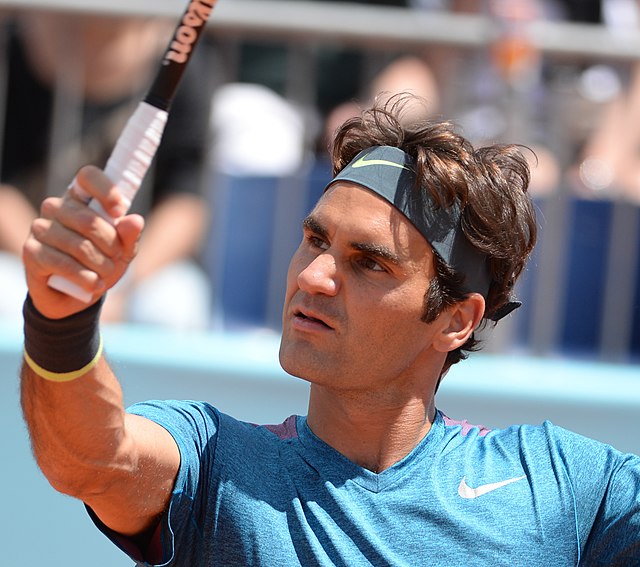
Roger Federer. Photo: Wikimedia Commons

Accountancy appears also to be playing a part in the debate currently raging in the tennis world about who is the GOAT (Greatest Of All Time): Roger Federer, Raphael Nadal or Novak Djokovic. Nadal has streaked ahead in the numbers game with twenty-two Grand Slam titles, as opposed to a mere (mere?) twenty to Federer and twenty-one to Djokovic. Djokovic, being the youngest of the three, will no doubt catch up (Federer has just retired from professional tennis), but for the view of sport that I’m putting forward here, such numbers are irrelevant (although not to the players themselves, I’m sure). From that angle Federer is the clear winner in this contest, as anyone who has seen him in his glory days would surely agree. Even this writer, with only a spectator’s interest in actual sport (as opposed to philosophically musing about it), could sense something unearthly about his play. David Foster Wallace once wrote an essay called ‘Roger Federer as a Religious Experience.’ I doubt you’ll ever find essays like that being written about Nadal or Djokovic, well-oiled and highly efficient tennis machines that they are.

Mention of The Deer Hunter above calls to mind some other echoes of this idea in the field of the Hollywood movie. Robert Rossen’s 1962 film, The Hustler, features a pool shark called “Fast” Eddie Felson. At one point in the film he tries to explain to his girlfriend the true nature of his passion. It has nothing to do with the money, or with being seen to be the best. These are quantifiable objectives, un-transformable phenomena of the everyday world. What really inspires him, he says, are those rare moments when the pool cue seems to become an extension of his arm, when he can do no wrong, when everything – himself, the game, the world – simply become one, indivisible process, a living work of art.

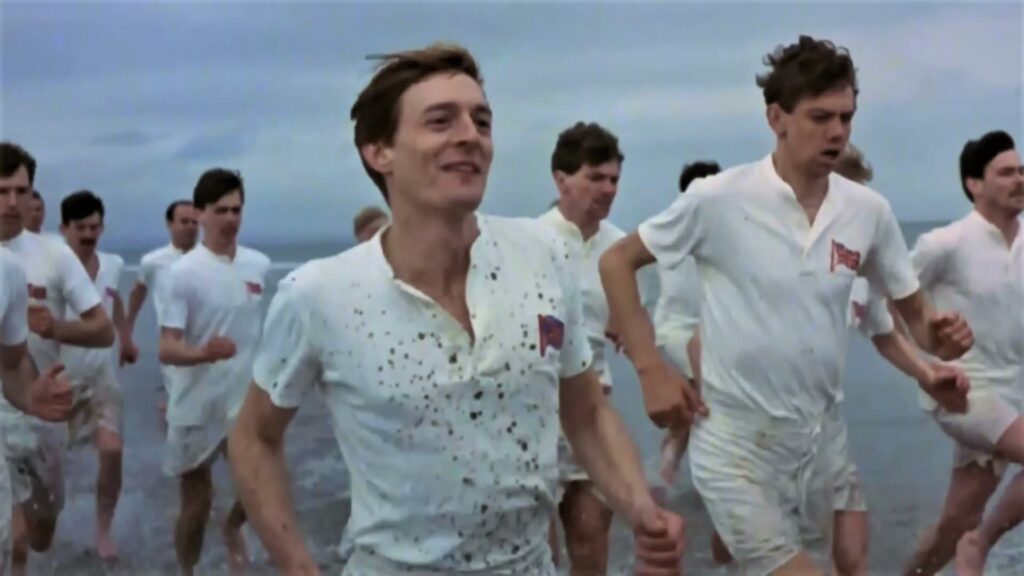
Bringing religious terminology to the matter, there is the 1981 film about Olympic runners, Chariots of Fire. One of the athletes is a devout Christian who postpones a trip to the Far East, where he is to work as a missionary, in order to take part in the games. When his equally devout wife chides him for this selfish, unchristian attitude, he replies, “God made me fast, and when I run, I feel his pleasure”.  Eternity opens a chink in the armour of time, and Blake’s “love” is made manifest. Or, to put it in more down-to-earth terms, skill and spontaneity join hands and, momentarily, dancer and dance are one.

But these are ‘mere’ fictional examples, you might say. (I put ‘mere’ in quotation marks to highlight an idea best expressed by Alan Watts and directly relevant to this essay: “There is no more telling symptom of the confusion of modern thought than the very suggestion that poetry or mythology can be ‘mere’”.)  Do real athletes feel anything similar? Actually, if a googling of inspirational quotes from top athletes is any yardstick, they mostly don’t. A trawl of over a hundred such quotes threw up less than half a dozen that gave any hint at all of an awareness that something in sport might possibly be more valuable than winning. The vast bulk are on the theme of never giving up, striving, first is everything, second is nowhere, etc, etc. Even when they extol losing it’s only to harden you up for future successes. And I recall a televised interview with Andy Murray some years ago when he was asked if he enjoyed his tennis. After some hesitation, he replied: “I enjoy winning.” (I’ve since heard him say that he does enjoy his tennis but I suspect the PR people have got to him: “Never be negative, Andy! Never be negative!”)  

But not all athletes share this acquisitive mania. The racing driver, Mario Andretti, has a comment that echoes to some extent the line from Chariots of Fire quoted above, though shorn of any religious connotations: “If you have everything under control, you’re not moving fast enough.” The tennis player, Arthur Ashe, is hovering around the heart of the matter with this comment: “You are never really playing an opponent. You are playing yourself, your own highest standards, and when you reach your limits, that is real joy.” And the American gymnast, Mary Lou Retton, has gifted us this pithy comment: “A trophy carries dust. Memories last forever.” (Incidentally, the fact that such remarks are so rare only bolsters my argument that this way of looking at sport is sadly, and increasingly, undervalued.)

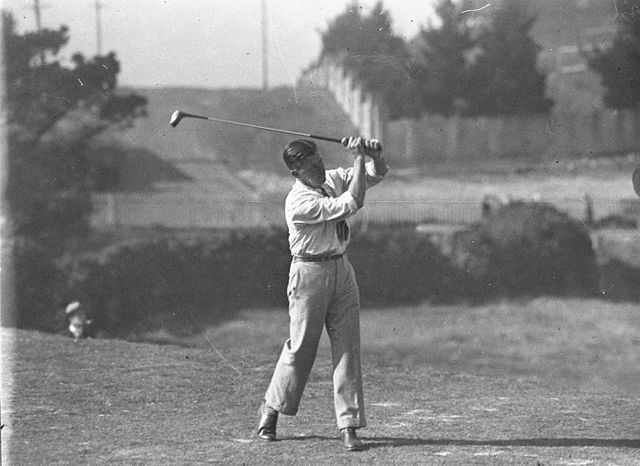
It’s intriguing, I think, that the quote approaching closest to a sense of the mystic heart of sport should come from a gymnast. Gymnastics shares with my two fictional examples of pool and running the distinction of being one of the rare sports that one effectively plays alone. There are competitions, of course, but that horizontal element of the game is thoroughly earthbound – egos competing with one another (as Arthur Ashe recognises). The other, vertical, element is where the player’s mind, the player’s body and the sport itself come together like three notes forming a chord. It’s as if the gods had a committee meeting one day and said, “This rough-and-tumble of contact sports allows the ego too much dominance. Our voices are rarely heard. We need to finesse the idea.” And so they came up with pool and running and gymnastics – all sports requiring deep levels of silence, deep enough for, now and then, the music of the spheres to be heard. And, in a moment of true inspiration, they also came up with golf.

Golf! do I hear you say? That symbol of suburban complacency and silly jumpers? But that’s to see it only from the outside. In a wonderful essay on golf, ‘Tips on a Trip,’ John Updike, having run through and dismissed all the secondary definitions and purposes of golf – a hobby, a profession, a pleasure, a walk in the country – finally reveals it to be “a trip”:

 A non-chemical hallucinogen, golf breaks the human body into components so strangely elongated and so tenuously linked, yet with anxious little bunches of hyper-consciousness and undue effort bulging here and there, along with rotating blind patches and a sort of cartilaginous euphoria – golf so transforms one’s somatic sense, in short, that truth itself seems about to break through the exacerbated and as it were debunked fabric of mundane reality.

That final phrase – “truth itself seems about to break through the exacerbated and as it were debunked fabric of mundane reality” – catches the essence of what I’m calling here the mystic heart of sport. And it’s by no means confined to professionals.

Updike tells two intriguing golf stories in his essay. The first is of how he went to a professional coach one time in order to improve his play. The coach gave him some simple advice about the placing of his feet. “That’s all?” Updike asks. “That’s all,” the coach says. Sceptical, but determined to try it out, Updike follows the coach’s instruction – and finds that his game improves immensely. But here’s the intriguing part: he feels thoroughly dissatisfied. The game seems now to be confined to his feet and it’s as if the rest of his body has been anaesthetised: “I couldn’t internalise it . . . All richness had fled the game”. And so he returns to his old losing ways, but feels better for it. I would have found this story baffling had it not reminded me of a poker player I once knew who told me that he could spend a night playing poker and come out with a loss, but still feel better than on many another night when he’d emerge a winner. The result is not the point. The point is what happens within.

Updike’s second story is of how he once accidentally hit a perfect shot. He goes on to explain: “In this mystical experience, some deep golf revelation was doubtless offered me, but I have never been able to grasp it, or to duplicate the shot”. And that’s the point: such magical moments cannot be replicated. They cannot be quantified and put into manuals. They happen. They are gifts, moments when “the tyranny of causality is suspended, and men are free”. “If I knew where poems come from” the Irish poet Michael Longley once said, “I’d go there.” Sports people must often feel much the same.

The scientifically-minded might be inclined to dismiss any such airy talk of mystical experience by pointing to the correlations of such phenomena with various activities going on within the brain. It’s all got to do with jumping neurons and synapses, they’ll say. But this kind of “nothing buttery,” as the philosopher Mary Midgely calls it, in which we declare emergent realities to be “nothing but” the things in which we perceive them (a painting is “nothing but” smears of pigment on a canvas; music is “nothing but” differently pitched vibrations in the air), can be just as easily turned on its head so that instead of saying, “nothing but,” we can say, “not only but also.” A painting is not only smears of pigment on a canvas, but also a deeply enriching and mysterious experience. The experience may correlate with certain neural activities which can be quantified, but that fact alone does nothing to give you any sense of the experience itself.

This “dipsomania for the factual,” as Robert Musil calls it, echoes the conflict being discussed in this essay. You can’t blame science, of course, for devoting itself to the factual – that’s its job – but scientism, the conviction that only the factual can give us any real truth, is the malignant growth of a useful tool into a dogma. When it comes to permeate society, as it does today, something valuable is lost. In sport, this loss is disguised by the fact that such overwhelming concentration on winning – fuelled by ego and greed, both quantifiable entities – improve sporting standards immeasurably, but what becomes ever rarer in this over-heated atmosphere is the “eerie effortlessness of a good shot” (Updike), to put it at its simplest. Roger Federer making top class opponents appear lead-footed, David Gower hitting a boundary with the careless grace of a man brushing off a fly, George Best weaving through five defenders as if he was bodiless – there’s a hint of immortality in such moments. “There is a certain part of all of us that lives outside of time,” Milan Kundera’s narrator says in his novel, Immortality (4), when he is startled by the sight of a timeless girlish gesture emerging from the body of a timeworn elderly woman. It is that part, I believe, that is reflected back to us in moments of sporting genius, and sounds a deep resonant bell within.

Robert Musil tried to knit together these two elements of the phenomenon – the ethereal and the down-to-earth, the mystical and the scientific. Ulrich, the hero of The Man Without Qualities, gets set upon by three thugs in the street one night. As an ex-solder himself, he responds vigorously, but they get the better of him in the end. As he picks himself up, he is rescued by a woman in a passing coach, to whom he proceeds to expound upon the experience in his usual forensic fashion.

Of course he now launched into a lively defence of his experience, which was not, as he explained to the motherly beauty, to be judged solely by its outcome. The fascination of such a fight, he said, was the rare chance it offered in civilian life to perform so many varied, vigorous, yet precisely coordinated movements in response to barely perceptible signals at a speed that made conscious control quite impossible. Which is why, as every athlete knows, training must stop several days before a contest, for no other reason than that the muscles and nerves must be given time to work out the final coordination among themselves, leaving the will, purpose and consciousness out of it and without any say in the matter. . . If by some unlucky chance the merest ray of reflection hits this darkness, the whole effort is invariably doomed.

So far, so rational, you might say, and nothing there that any sports psychologist would find fault with. They call it being ‘in the zone.’ But Ulrich, as much a mystic as he is a scientist, goes on:

Basically, he now maintained, this experience of almost total ecstasy or transcendence of the conscious mind is akin to experiences now lost but known in the past to the mystics of all religions, which makes it a kind of contemporary substitution for an eternal human need. Even if it is not a very good substitute it is better than nothing, and boxing or similar kinds of sport that organise this principle into a rational system are therefore a species of theology. . .

Broadening the idea out to include spectators as well as participants, it may be no accident that the words ‘happen’ and ‘happy’ have the same root: ‘hap’. A great sporting event is a happening, an event, because of its anticipated elements of spontaneity, its vibrant potentiality, the anticipated, longed-for lifting of the soul out of the mundane treadmill of linear time. For many, these are moments of the greatest, most intense happiness, when life is lived – if only by proxy – on the edge. It’s why people climb mountains and skydive. But the exhilaration that follows success comes at the price of risking the hollow emptiness of defeat, and winners and losers alike might do well to heed Ulrich’s words in the passage quoted above: the experience is “not to be judged solely by its outcome.” The Yorkshire writer John Braine once compared success to strawberries: enjoy them while they’re in season, he said, but don’t imagine you can live on them (trophies carry dust).

What you can live on (what all sports fans live on, in fact) is the anticipation of success, the hope. Whether it’s anticipation of the outcome of a single game or a broader anticipation stretching over a whole season (and containing a host of smaller anticipations along the way), that tension is like a taut string creating a music all its own. But unless you’re some kind of Zen master, the problem is that you can’t really separate wanting to win from actually winning. Or losing. The pleasure of all that anticipation hinges on the actual outcome, though the outcome is really not the point; the real point (from the gods’ point of view) is the anticipation itself, the tension, the thrill of following all those “varied, vigorous and precisely coordinated movements in response to barely perceptible signals.” The gods don’t care a whit about us as individuals. We’re expendable, mere channels for what Yeats called “the passions,” and sports are what he called “forms created by passion to unite us to ourselves”. It’s an irresolvable paradox (except perhaps in fiction): in order for the passions to reach their height, the carriers of the passion have to remain unaware of their true source, and be conned into believing that the momentary egoistic thrill of winning is what it’s really all about.

Richard Attenborough, playing the commander who organises the mass break-out in The Great Escape, intuits a similar truth at the end of the film, after being captured by the Germans. Talking to his friend (minutes before they are both machined-gunned to death), and not sounding at all downbeat about the capture, he says, “D’you know, Andy, all this, Tom, Dick, Harry [the three tunnels they’d spent months secretly digging], it’s kept me alive.” He realises that getting re-captured (and hence failing to win the match, as it were) matters less than the steady throb of hope and anticipation that filled up all the time leading to the escape. And if the escape had been successful, or if the Germans had not been so unsporting as to kill him, and he’d lived to tell the story to his grandchildren, it would surely be the planning, the tactics, the secrecy, the tension of the escape preparations that would fill his memory, rather than the fact the attempt itself resulted in either success or failure, those “two imposters,” as Rudyard Kipling has famously called them.

Hermann Broch’s complex modernist novel, The Death of Virgil, dealing with a poet from two thousand years ago, is about as far from modern sport as you could hope to get. Yet Virgil’s central dilemma echoes the tension I’ve been speaking of here between the timebound (quantifiable results) and the eternal (spontaneous happenings, potentiality), or between the professional and the inspired amateur.

On the eve of his death, Virgil wants to burn his greatest work, The Aeneid, because he believes he has betrayed the essence of his gift, which was not so much the actual manuscript of the work as the dynamic creativity that brought it into being. He calls the actual work, an artefact that belongs to the world of time, “un-art”: “Oh, in his own life, in his own work, he had known the seduction of un-art, the seduction of all substitution which put the thing created in the place of that which creates, the game in the place of communion, the fixed thing in the place of the ever-vital principle, beauty in the place of truth” (italics added).

Virgil’s “un-art” is the statistics-obsessed nature of modern professional sport where winning is all, and this attitude is, I would contend, a betrayal of the soul of sport, even though, paradoxically, that very betrayal is largely responsible for the incredibly high standard that much modern sport exhibits. But the high standards themselves can be something of a red herring, from the participants’ point of view, if not the spectators. Spontaneity is too unpredictable and there is too much money at stake. A certain minimum standard is, of course, necessary, but magic was as likely to appear on a mud-caked football field of the seventies, when players happily juxtaposed professional games with copious amounts of beer and burgers, as on today’s pristine green carpets, when they are all slaves to strict dietary regimes. George Best was no ascetic! And to return for a moment to the tennis world, any future contenders for the number of Grand Slams won by Nadal and Djokovic will have to follow similarly rigid training and finely-tuned technical regimes, most likely at the cost of any natural spontaneity that they may have had to begin with. Future Federers will have no hope of competing, though I’m guessing that they would be the spectators’ favourites.

Echoes of this inner conflict can be found even beyond the confines of sport and art. If we call the necessary treadmill of linear time ‘order’ (in sport, tactics, set pieces, rigid team formations etc) and sublime moments of rapture ‘chaos’ (sport’s unpredictable ‘poetry in motion’), then the essential creative tension between the two might be summed up in an elegant formula: order minus chaos equals death; chaos minus order equals madness. Imagine a high-stakes football match with no rules! And if Virgil had got his way about burning The Aeneid, no echo of that creative genius would ever inspire another soul. The physicist David Bohm put the idea like this: “If you had absolute creativity – absolute novelty with no past – then nothing would ever exist because it would all vanish at the very moment of creation” (Weber). Modern science sees this creative tension, or something vaguely similar to it, as constituting the very source of the universe’s existence. Richard Holloway provides a succinct encapsulation of the idea:

It is the precise balance of two great forces that creates the right conditions for life to exist. The expansive force of the Big Bang spreads the universe out, while the contractive force of gravity pulls it back together. If the gravitational force [order] were too high, the universe would appear, but in a microsecond gravity would pull everything back into a Big Crunch. If the expansion rate were too high [chaos], then the universe would stretch at such a rate that gravity would be unable to form the stars and galaxies from whose dust carbon-based life evolved. [. . .] These delicate adjustments do not only refer to the earliest instance, but to the continuing history of the world and its detailed processes.

One of those detailed processes is the phenomenon of sport.

The philosopher E.M. Cioran has written, “History divides itself in two: a former time when people felt pulled towards the vibrant nothingness of divinity and now, when the nothingness of the world is empty of divine spirit”. It may be that in our ultra-secular, numbers-obsessed Western world, whose oppressive nothingness the advertisers keep us distracted from, sport occasionally affords one opportunity to touch, or to witness, the sublime heights that were once the province of religion. But it appears to be a losing battle. The white mice may have to think up another concept.

References

Blake, William. Complete Writings. Ed. Geoffrey Keynes. Oxford: OUP, 1966.

Broch, Hermann. The Death of Virgil. Trans. Jean Starr Untermeyer. 1945. Oxford: Oxford University Press, 1983.

Cioran, E. M. Tears and Saints. Trans. Ilinca Zarifopol-Johnston. Chicago: University of Chicago Press, 1995.

Holloway, Richard. Looking in the Distance: The Human Search for Meaning. Edinburgh: Canongate, 2004.

Hudson, Hugh. Chariots of Fire. Screenplay by Colin Welland. 20th Century Fox, 2004.

Kundera, Milan. Immortality. London: Faber and Faber, 1991.

Musil, Robert. The Man Without Qualities. Trans. Sophie Wilkins. London: Picador, 1997.

Schürmann, Reiner. Wandering Joy: Meister Eckhart’s Mystical Philosophy. Great Barrington, MA: Lindisfarne Books, 2001.

Stevens, Wallace. Selected Poems. London: Faber and Faber, 1953.

Sturges, John. The Great Escape. Screenplay by James Clavell and W. R. Burnett. The Mirisch Company, 1963.

Updike, John. Picked Up Pieces. 1977. New York: Ballantine Books, 1986.

Watts, Alan. Myth and Ritual in Christianity. 1954. London: Thames and Hudson, 1981.

Weber, Renee. Dialogues With Scientists and Sages: The Search for Unity. London: Routledge & Kegan Paul, 1986.

Yeats, W. B. A Vision. 1937. Rev. ed. 1962. London: Macmillan, 1962.

“Once upon a time I was a poet”

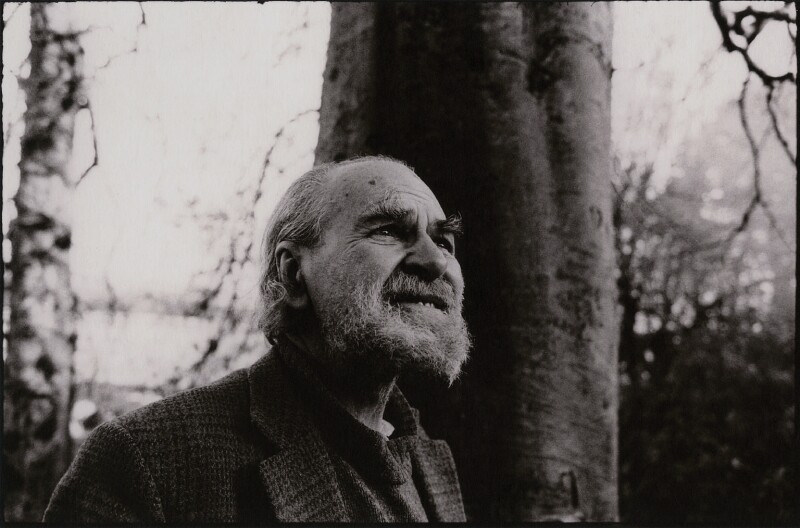
Basil Bunting. Photo: National Portrait Gallery, Creative Commons licence
Letters of Basil Bunting
Selected and edited by Alex Niven, Oxford University Press, 2022, £35
LIAM GUILAR welcomes new insights into a little-studied modernist’s mind

Basil Bunting died in 1985. Despite having been praised as one of the twentieth century’s ‘greatest poets’ critical attention to his work has been rare. A reliable biography didn’t appear until the publication of Richard Burton’s A Strong Song Tows Us in2013; an annotated collected poems, edited by Don Share, not until 2016. Now, with the publication of Alex Niven’s much anticipated edition of Bunting’s correspondence, it’s possible to eavesdrop on one of the twentieth century’s most interesting conversations about poetry[i].

In his eighties, Bunting looked back on his life:

Once upon a time I was a poet; not a very industrious one, not at all an influential one; unread and almost unheard of, but good enough in a small way to interest my friends, whose names have become familiar: Pound and Zukofsky first, Carlos-Williams, Hugh MacDairmid, David Jones, few indeed, but enough to make me think my work was not wasted.[ii]

If you recognise the names of his friends, that ‘good enough in a small way’ is an excellent example of the English art of understatement. But it’s not a popular list and despite the excellence of his poems, Bunting remains a marginal figure. No one reviewing the letters of T. S. Eliot needs to explain who T. S. Eliot was, or why he is of interest. 

The life

Born in 1900, Bunting was imprisoned as a conscientious objector immediately after leaving his Quaker school in 1918. He studied economics before drifting to Paris where he met Ezra Pound and worked, alongside Ernest Hemingway, for Ford Madox Ford. Following Pound to Italy, he met W.B. Yeats and Louis Zukofsky in Rapallo and began a life-long and life altering affair with Persian literature.

His first published poem, Villon, is one of the finest long poems of the 1920s[iii], but by the end of the 1930s Bunting’s career as a poet had stalled: his first marriage had failed, he was out of work and separated from his children. The war rescued him. He discovered he had skills that others valued. He rose through the ranks to Squadron Leader, worked for British Intelligence, then after the war, returned to Persia, first as a diplomat, before resigning to marry a Persian and becoming the Persian correspondent for The Times.

Expelled from Persia and then unceremoniously dumped by The Times, he struggled to find work in post war Britain.

Despite the excellence of his poems, the story could have ended here, with Bunting as a footnote in histories of literary modernism, remembered as one of Pound’s ‘more savage disciples’[iv], but in his sixties, spurred on by his meeting with a young Tom Pickard, he wrote Briggflatts; at 700 lines a short long poem, praised as the ‘finest’, ‘greatest’ or ‘most important’ long poem either of the twentieth century or ‘since The Wasteland’. He enjoyed a brief period as ‘Britain’s greatest living poet’ before fading away in a series of university jobs and poetry readings.

Poetry

From such a long and varied, life Niven estimates only about 800 letters have survived, of which approximately 600 relate to Briggflatts and the period after its publication. He has selected almost two hundred and thankfully decided to print complete letters rather than extracts.

Divided into three sections, the bulk of the book is devoted to the 1960s and afterwards. For anyone interested in poetry, rather than Bunting’s biography, the core of the book may be the pre-1960s letters to Pound and Zukofsky.

Briggflatts was praised by critics of the stature of Hugh Kenner and Donald Davie and poets as diverse as Thom Gunn, Allen Ginsberg and George Oppen, but Bunting’s status in the critical hierarchy has never been secure.

Perhaps his version of poetry is too austere to be popular. In a letter to Poetry Chicago (not printed by Niven), he wrote:

We are experts on nothing but arrangements and patterns of vowels and consonants, and every time we shout about something else we increase the contempt the public has for us. We are entitled to the same voice as anybody else with the vote. To claim more is arrogant.[v]

Throughout these letters and in later interviews he repeatedly stated the belief that politics, philosophy and theory harm poetry. The poet’s job is to write good poems.

What I have tried to do is to make something that can stand by itself and last a little while without having to be propped by metaphysics or ideology or anything from outside itself, something that might give people pleasure without nagging them to pay their dues to the party or say their prayers, without implying the stifling deference so many people in this country still show to a Cambridge degree or a Kensington accent. [vi]

It’s possible to go through these letters and compile a list of quotations to show he had little time for academics or literary criticism. He was publicly dismissive of creative writing courses and poetry competitions, while working on the former and once, memorably, judging the latter. He didn’t think poems should be explained; if a poem requires footnotes it’s a failure and tying the poem to the poet is a fundamental mistake.

What characterised Bunting and his correspondents was the intense seriousness with which they applied themselves to writing. Poetry was a craft and writing it involved ‘sharp study and long toil’. The ‘study’ involved arguing into existence a standard of excellence selected from poems going back to Homer. Once tentatively established, they attempted to excel their models, supporting each other through stringent criticism.

Bunting’s criticism, shown here in his letters to Zukofsky, was not for the faint hearted, but it was driven by the belief that some poets, Pound and Zukofsky explicitly, were ‘entered without handicap against Dante and Lucretius, against Villon and Horace.’ In the same letter, he explains: ‘At least for my part, I’d rather have somebody who is thinking of Horace call my poems bloody bad than to hear them praised by somebody who is thinking of-who-Dylan Thomas?’ (p.194).

Two other reasons for Bunting’s odd position in the critical hierarchy stand out. In some quarters he is tainted by his association with Pound, especially where Pound is only known, vaguely, for his political and racial opinions. The other is the insistence that ‘All Roads lead to Briggflatts[vii] which condemns him to the role of a minor poet who pulled off one great poem and consistently ignores the quality of the rest of his work.   

The letters qualify the first of these, while Niven’s editing and commentary seem driven by the second. If there ever was a tribe of Ezra to match the tribe of Ben, with Rapallo replacing the London taverns, Bunting was always too obdurate an individual to be anyone’s acolyte. [viii].

The explosive end of the pre-war correspondence with Pound is well-known, though the full text of the letter hasn’t been available until now. What becomes obvious is that from the late 1920s and through the 1930s the letters show Bunting becoming increasingly resistant to Pound’s politics. Bunting’s repeated statements that poetry is hampered when it tangles itself in philosophy and politics became focussed in his insistence to Pound that banging on about ill-informed economic theory was a waste of Pound’s time and literary talent, although Bunting himself isn’t adverse to sharing his ‘theories’ with Pound.

Initially refusing to believe Ezra was writing for the British fascist movement, he finally reached the limits of his patience when he learnt that Pound was ‘spilling racist bile’ in his letters to Zukofsky. His angry letter to Pound ends:

I suppose if you devote yourself long enough to licking the arses of blackguards you stand a good chance of becoming a blackguard yourself. Anyway, it is hard to see how you are going to stop the rot of your mind and heart without a pretty thoroughgoing repudiation of what you have spent a lot of work on. You ought to have the courage for that; but I confess I don’t expect to see it. (p.136)[ix]

It says a lot about the robust nature of their friendship that despite this, Pound would continue attempting to promote Bunting’s poetry, and Bunting would continue to acknowledge his debts to Pound. After the war, when Pound was incarcerated in Saint Elizabeth’s hospital for the mentally ill, Bunting picked up the correspondence, encouraged by the news that a letter from Basil brightened up Ezra’s week. Pound’s letters to Bunting, by turns abusive and incoherent, didn’t put him off.

As he wrote to Zukofsky: ‘The difficulty is how to avoid being involved in the network of fallacies while profiting from his illuminate faculty for verse and enjoying his energy and kindness.’

The same problem faces everyone today: how to see beyond the politics and racism to profit from what any poet in the past had to say about poetry and learn from what he or she achieved as a poet. Bunting managed it with his two closest friends, one a communist, one a fascist. It seems an important precedent.

Anyone interested in Basil Bunting or twentieth century poetry owes Alex Niven a great debt for the time and work that must have gone into this project.

How different the picture would be if this were a complete edition of the letters, only he knows. When Jonathon Williams published a selection of his letters from Bunting, he wrote: “What a stern, serious, funny, extraordinary ‘literary’ (LETS HEAR IT FOR LITERARY) North of England person he was’ (Williams, p.252).[x]  The Bunting of those letters, watching the birds and wild life in his garden, is absent from Niven’s collection, as are the descriptions of Persia that suggested to Burton that Britain lost a major travel writer to the Official Secrets Act.

The book’s sense of its reader is uneven. Niven explicitly describes a model reader who knows the outline of Bunting’s life and is not put off by occasional difficulties (p.xxvii). This model reader has a positive effect on his annotations, but seems to have been forgotten when he came to write his commentaries.

Why Niven thinks such a reader needs to be told what to think about the letters and how to interpret them, is a mystery. You buy an edition of a poet’s letters, wanting to read the poet’s words, and find a portion of the book contains the editor’s personal opinions and interpretations which you will never reread.   

Based on his model reader, Niven’s annotations are usually deft and show a shrewd judgement of what this reader could be expected to know. He assumes that anyone reading these letters won’t need a gloss on Dante, Swift, Winston Churchill, or others. He is also unwilling to overload the letters with commentary, assuming, (rightly), that anyone who wants to follow Bunting’s detailed responses to Pound’s books; ABC of Reading, Guide to Kulchure, will have a copy.

In his letters, Bunting could be crudely dismissive of poets he didn’t like. It’s disappointing to see his editor join in: ‘Philip Larkin (1922-1985) hard right British poetaster and trad jazz critic.’ (n.277 p.384).

Sometimes the annotation strays a long way from objective facts: ‘It must be said that Briggflatts faintly resembles certain of [Dylan]Thomas’ work in form, subject and (marginal sense of) place’ (p.194). Briggflatts probably ‘faintly resembles’ a lot of things, but it also must be said it’s hard to imagine Bunting admiring Thomas enough to be influenced by him.

The introduction includes a clear and necessary discussion of editing methods. Whether an introduction to a selection of letters needs a dramatic retelling of the first reading of Briggflatts, or is an appropriate place for a summary and critique of existing criticism, depends on the individual reader. As I don’t agree with his evaluation of Don Share’s edition of the Collected Poems, unless ‘the book’s only major limitation’ is intended ironically, or his criticisms of Burton’s biography, and I think he misreads the Pound-Bunting disagreement over Bunting’s translations of the Shahnemeh, I’m suspicious of his statements about literary matters where he strays from simply providing factual biographical context.

He uses his introduction to stake out his version of Bunting’s life, at times in explicit opposition to other published versions. I’m not convinced this is the right place for it. His dissent from Burton’s views of the significance of Bunting’s Quakerism is pointed, but his dismissal of Burton’s biography as ‘relatively light on critical explication’ is baffling. Eager to point out that book’s ‘shortcomings’, he seems to be criticising Burton’s biography for being a biography while temporarily forgetting just how problematic and limited letters are as biographical evidence.

The trust in the reader, obvious in the annotations, is not evident in the editorial commentary running between the letters. I think there’s too much. Rather than let the letters speak for themselves, he interprets the evidence and intrudes his opinions, unnecessarily:  

For all that his language and actions often fell a long way short of today’s ethical standards, Bunting certainly thought of himself as a determined anti-racist-and this letter would seem to support that view. In the context of his historical moment, Bunting’s basic philosophical views about race were, to put it mildly, considerably more progressive than Pound’s. (p. 134-135)

Comments such as this one and less lengthy interventions like ‘even if the age difference of over thirty years was problematic in more ways than one (p.140)’ seem to miss the point that adult readers are capable of coming to their own conclusions.

Sometimes the comments have nothing to do with the content of the letters: ‘There is a pressing need to apply more and deeper scrutiny to Bunting’s colonial phase than has been evident in previous scholarly and biographical treatments. But whatever its unexamined moral and political complications’ […]. (p.139)

Superfluous in terms of contextualising a letter, this manages to suggest something sinister without being informative. Even for a reader who knows the biography it’s not clear what the unexamined ‘complications’ are, or how ‘scrutinising’ them would add to the enjoyment of the poems or why or to whom such a need is ‘pressing’.

Letters encourage the tendency to tether the poems to the poet. The results of failing to distinguish between the two is a depressing characteristic of contemporary discussions of poetry, obvious in attitudes towards writers as diverse as Ezra Pound, Phillip Larkin (see above) and most recently, Dorothy Hewett[xi].

As Bunting wrote to Zukofsky:

Letters are meant to be written to affect one bloke, not a public. What is true in the context of sender and recipient may be a bloody lie in the context of author and public…secondly: the bane of the bloody age is running after remnants and fragments and rubbish heaps to avoid having to face what a man has made with deliberation and all his skill for the public’. (June 1953 qtd in Burton, page 354 Ellipsis in Burton.)

There’s nothing anyone can do to prevent that, it’s still the bane of this age, but its sad inevitability is outweighed by the opportunity to eavesdrop on one of the century’s most interesting conversations about poetry. Hopefully, Niven‘s suggestion that a complete collection of the Pound Bunting correspondence should be published will be taken up sometime soon (preferably with the letters to Zukofsky). What they had to say about poetry transcends their time, politics and personalities.  

‘Long awaited’, ‘much anticipated’ and ‘ground-breaking’ are cliches of the blurb writer.  For once they can all be applied honestly and accurately to Niven’s work in making these letters available. The good news is that the long wait and the anticipation have been generously rewarded.   


[i] Page numbers are to Niven’s book. Richard Burton’s Biography, A Strong Song Tows Us is referred to throughout as Burton.

[ii] I transcribed this from Peter Bell’s film, Basil Bunting: An introduction to the work of a poet (1982). He seems to say something after ‘David Jones’ but I can’t understand it.

[iii] The poem was written sometime in the 1920s but first published in 1930. As Niven explains, the letters cast doubt on the standard dating and chronology of some of the poems.

[iv] The description belongs to W.B. Yeats. He surprised Bunting by reciting one of Bunting’s poems from memory when they met.

[v] Poetry, Vol. 120, No. 6 (Sep. 1972), pp. 361-365 http://www.jstor.org/stable/20595781

[vi] Another transcription, this time from a talk Bunting gave in London, in Keats’ house, in 1979.  From ‘The Recordings of Basil Bunting’ with thanks to the late Richard Swigg who looked after ‘The Bunting tapes’.

[vii] Julian Stannard. Basil Bunting Writers and their work.  p.88

[viii] Consigning Bunting to the role of ‘Pound’s disciple’ is to misrepresent him as badly as Tom Pickard is misrepresented when his own excellent poetic output is ignored and he’s remembered simply as the boy who midwifed Briggflatts.

[ix]  Zukofsky’s response to this letter and whatever Pound had written that offended Bunting so much, can be read in Pound/Zukofsky Selected letters of Ezra Pound and Louis Zukofsky ed Barry Ahearn.  

[x] Williams, Joanthan, ‘Some Jazz from the Bazz: The Bunting-Williams Letters’ in The Star you Steer By. Ed, McGonigal and Price.

[xi] For Hewett and a recent example of this problem of confusing poet and poem see the remarks in https://www.theguardian.com/books/2021/apr/04/the-whole-canon-is-being-reappraised-how-the-metoo-movement-upended-australian-poetry

Highwire poetry

Wildcat Dreams in the Death Light
Reagan M. Sova, First to Knock, 2022, 265 pages, US$17
LIAM GUILAR takes a ringside seat for a dazzling extravaganza

‘Wildcat Dreams in the Death Light is an incantatory work of narrative poetry. Infused with hobo melancholy, Jewish lore, bloodshed and hilarity…’.

It’s rare for a blurb to be so accurate. For the price of the book, Reagan M. Sova will perform as ring master, troubadour, high wire artist and magician to entertain and dazzle the awestruck crowd.

Set in the first decades of the twentieth century, the story is told by Mort Sloman, who leaves home at thirteen. He falls in with a circus, and in love with a Gypsy trapeze artist, discovers friendship across the barriers of race and difference, witnesses institutionalised racism, violent death and corruption, joins the Wobblies (Industrial Workers of the World, IWW) and unionizes his circus, travels through Europe during the First World War to Egypt, returns to America to help the union cause and finally performs the Festival of Light for his dead relatives.

A lot happens.

At the beginning, the narrator sets out on a quest, mounted on a mule rather than a white charger:

i/consecrated unto myself the sacred mission

the ceremony of light to honor Frank and Aunt J

i had the song in hand but i

could not do it without the right guitar

nor the Locksmith keys

not even the rabbis have them

While this quest gives the story a beginning and end, the ‘sacred mission’ fades into the background, replaced first by Sloman’s devoted pursuit of the gypsy acrobat, then by his experiences with the travelling circus, and his involvement in the IWW. Although set in a world anchored in the familiar by historical names – Ringling Brothers, Big Bill Hayward, Eugene V. Debs – and recognisable conditions and historical events, the story moves in a liminal space that shifts Sloman’s journey into the realm of legend.

The circus, which Sloman calls ‘The Kingdom’, is a ready-made symbol of America, with its outcast others, unusual characters labelled as freaks, and self-confident, exploitative hucksters and frauds. His is an American Dream where the poor boy escapes the bullies, finds love and wealth, and good guys find friendship and love, and win despite the odds stacked against them.

The poem exploits its own intertextuality in a cheerfully unembarrassed way. There are echoes of Whitman and the Ginsberg of Howl. But the influences are taken and adapted. A rambling man bound for glory with guitar on his back, writing songs and supporting the union, evokes Woody Guthrie, but the verbal inventiveness of Sloman’s songs is a world away from Woody’s. Like Sloman’s parade, which begins with himself and his friend and grows throughout the story, Wildcat Dreams in the Death Light is robust and generous enough to accommodate whatever resonance the individual reader brings.

The dominant stylistic presence, however, is Frank Stanford and The Battlefield Where the Moon Says I Love You. Of all Sova’s many magic tricks, the most impressive is the way he has managed to take Stanford’s instantly recognisable style, make it his own and adapt it to his own purposes.

By shortening Stanford’s line, leaving it unpunctuated and rarely end stopped, Sova has given the poem a rhythm which carries the reader through Sloman’s adventures. Stanford’s distinctive incantatory eruptions are present, but kept under control so they never take over the story the way they do in The Battlefield. They are a major factor in producing the slightly hallucinatory effect that keeps shifting the story from its factual, historical setting into the dream realm.  

When Alf, the circus master, asks the thirteen years-old Sloman what he could have seen ‘with so few years under your cap’, he replies:

i have seen the elderly monk gored by the falling icicle

i have seen the family of elk sleeping next to me in the moonlight

i have seen bob’s jar of brandy

i have seen the vial of goof dust I used to trick the trickster

i have seen the blood trickling

from my grandfather’s ear when he died roller-skating

i have seen good luck without grace invite darkness

i have seen the Gypsy’s vision of my death by the mountain

This early list is typical of the many that follow. They can include everything from the factual to the surreal, as Alf’s reply does. Sometimes it is not obvious how the items coalesce into coherence. Their exuberance often seems an enjoyable end in itself.

As well as contributing to the tone of the story, they serve another function. A long narrative poem needs variety in pace. A relentlessly onward rush becomes as boring as a story that goes nowhere. Part of Sova’s balancing act is to know when to allow the voice to narrate action without interruption, and know when to pause the narration and use the incantatory to add variety.

In the circus, the emperor’s armless great granddaughter plays the violin with her toes. As an image it’s simultaneously pitiful and ridiculous. Like the circus performers, the story risks absurdity. In the wrong hands, much of it would be silly. But the final magic trick, and perhaps the most subtle, is to make Sloman’s voice and story believable on its own terms and hold a reader’s attention for 250 pages. Stylistically assured, inventive, entertaining, Wildcat Dreams in the Death Light is that rare thing, a well-written narrative poem with a distinctive style creating an unforgettable story world.

One last portion of ‘Chips’

Chips Channon. Photo: National Portrait Gallery, Creative Commons licence
The Diaries 1943-1957
Henry ‘Chips’ Channon and Simon Heffer, Hutchinson, 896pp, £35
KEN BELL closes the book on the celebrated diarist

This third volume of the Channon diaries concludes the publication of all the surviving diaries that have come down to us, and as with the previous two volumes it is a hernia-inducing doorstopper of a book. Chips really saw fit to include just about everything that he did in his diary and by 1943, with his ministerial career over, an awful lot of what went on involved Channon lounging in bed, making long telephone calls to snipe about others and planning his social engagements.

Although the war still had two years to run, it hardly impinged on Channon or his set, so there are few references to world events in this volume. Instead, we are treated to a series of engaging vignettes involving Channon and any number of other men getting it on, as the young people say. In previous volumes, Channon often seemed to want to do little more than allow women to see him naked and dream about young men, but by 1943 he is giving us chapter and verse on his sexual life.

Peter Coates (“Petticoats”), to whom we were introduced to in the second volume of the diaries, was still Channon’s great love, but as he was in India with the army that left Chips with plenty of free time. The House of Commons, according to Chips, was a sort of glorified molly house and Channon was quite happy to bed members from both sides, in a spirit of bipartisanship. Thus he had a fling with Labour’s Raymond Blackburn, an alcoholic who would later be imprisoned for fraud, and ended his days as an assistant to Lord Longford in the latter’s entertaining anti-porn campaign. Nigel Davies was a Tory MP who was also being bedded by Selwyn Lloyd, a future foreign secretary who ended up as Speaker of the Commons. That did not stop him from finding the time to have a foursome with Chips, the playwright Terence Rattigan and Lord Montagu of Beaulieu.

As if there was not enough excitement in Parliament, Chips had the energy to enjoy a four-year fling with a corporal in the Life Guards, until 1955, when the soldier married a woman named Brenda. One likes to think that the money that Chips paid him gave the happy couple a good start to their new life. Channon was generous to all his bed mates, especially Rattigan who took over while Petticoats was away on military service. When Channon’s mother (whom he loathed) died and her final legacy of just over £1,000 arrived in Chips’ account, he spent most of the money on a gift for the playwright.

Channon’s often obtuse comments about the people around him are much in evidence in this volume. Upon seeing the images of starved corpses of concentration camp victims, he wrote: “The rows of dead emaciated bodies all looked like Margot Asquith naked!” At the end of his life, he was still as incapable of predicting the future as he had always been. Thus, in 1952, he predicted that “The new Queen is determined, humourless, serious and will be a success but not loved – after her youth and novelty wear off.”

He wasn’t too keen on the rest of the Royal Family, either. Chips avoided the Princess Margaret and Peter Townsend affair, “as I don’t like either of them”. He blamed it on the “fat Queen Mother” for being too lazy to stop the affair becoming a public scandal, and fulminated that Margaret was “a silly, selfish, ill mannered sensationalist”. Townsend he dismissed with his greatest insult of being “middle-class”. Chips, of course, loathed the middle-class with a passion: “How I detest the middle classes! Two from Southend proposed themselves to tea at the House and stayed two hours, never knowing when to leave!!”

We read Channon for his waspish descriptions of events. Thus, at the coronation of Queen Elizabeth II in 1953, we learn that the four Garter knights carrying the Queen’s canopy managed to bungle the operation, and that Lady Carnock “was so drunk that she had to be removed forcibly from the abbey.” For his part, Channon nipped outside several times during the service onto the parapet for a cigarette and a chat with others having their own smoke breaks.

It is a pity Channon only commented on events in which he was directly involved, so there is no analysis of the Suez Crisis of 1956. Simon Heffer thinks charitably that this may be because Channon was in the last year of his life, but it seems more likely that Chips just didn’t care, because he wasn’t at the centre.

Channon in later life. Photo: National Portrait Gallery, Creative Commons licence

Nevertheless, he is a great chronicler of events during the first half of the last century. Even his failure to understand them gives us an insight into how men of his time and class thought; thus he gives us a window into the world of the upper-class Tory grandee, still at the height of his power. As an individual, I suspect that an evening with Channon would be an engaging night to remember.

It is to be hoped that a single volume of the diaries will be produced. This smaller portion of Chips is needed for the general reader who may not wish to plod through endless accounts of conversations with titled people and minor royalty. However, for the serious student of Britain in the inter-war and post-war period, these three volumes taken together are an essential primary source.

Five poems by Colin James

COLIN JAMES has had a couple of chapbooks of poetry published – Dreams Of The Really Annoying (Writing Knights Press) and A Thoroughness Not Deprived of Absurdity (Piski’s Porch Press), and a book of poems, Resisting Probability (Sagging Meniscus Press).

A talent for legitimacy

Episodically craved by adolescents,

Prometheus displays his tats

behind The Dollar Store in Bonita.

The one with the plastic pillars.

Chained willingly to a picnic table,

he effuses in atmospheric cigarette smoke

shiftlessness his apparent esthetic.

Peers immersed in forsake-me-not hygiene

crouched in even more uncomfortable positions,

strain to catch a glimpse of his epithelial gland

visible through tiny filaments of foliage

like a conceptual umbrella or soluble shade tree.

Decadence owed

It rained during the night,

my accountant was unavailable.

His secretary referred me to

a descendant of that Hungarian actress

who played the werewolf’s mother

in all those old horror films.

I took the coastal highway

which was pleasantly diverting.

Her caravan stood adjacent to

an erosion affected cliff.

A horse was grazing in a shaded copse.

Colored streamers fluttered in the wind.

She was selling, the sign said.

Her psychological item deduction

had become a thing of legend.

There was a green carpet

on the wooden steps. Strings

of drying herbs, garlic and whatnot.

The claw marks on the door

attempts of an Oedipus fatalist

to check off the right box.

Confederation of knife-throwing sailors

The brass plaque has been damaged
from several attempts
at forceable removal.
Most of the lads are a-sea,
security less than languishing.
There is only old Pythias,
he of the steel braided hair, beard.
Stows his blades in there.
Hear that Tricuspid Regurgitation?
Fortunately the wind has died down a bit
improving his accuracy
pending verdigris.

Call off your goons and I will call off my undisciplined transgressives

For the Int in impotent,
one of those Soho basement flats
dedicated to surviving a wet spring.
There is an old iron rail
I could have tied my bumboat to,
having neglected to bring some oats
which I get on the cheap.
Soon to be renting with options,
a quite large town green.
Copulist, just like a control mechanism.
I have no pen or magic marker
to leave a not so concise note with.
Something nice and sticky
blood or starship cola.

Drake-gasm after Ficlet

Heating pads warm the lower
extremities, arms held straight up.
The UFO lecturer makes eye contact
after every “now this” click.
I see a frisbee
hovering over Mendocino.
Late arrivals bring their bustle
and throat clearing.
I wasted my life reading
about the politics of possibility,
elements like Kryptonite,
undiscovered deference.

A Queen in the Wilderness

LIAM GUILAR‘s epic of post-Roman Britain enters its eighth chapter

The Story So Far (Chapters 2-7 inclusive have all previously been published on this site, starting here). The complete poem will be published as A Man of Heart in 2023, by Shearsman.

Mid Fifth Century Britain. After the legions have withdrawn, the island is facing civil war, a growing number of external enemies and a steady tide of pagan migrants looking for land.

Vortigern has been appointed to protect what’s left of Roman Britain. Following standard imperial practice, he has employed Saxon mercenaries led by Hengist. Together they have defeated the immediate threat of an army of Picts and a Northern rebellion and stabilised the province. Vortigern has married Hengist’s daughter.

Part two begins with Vortigern leading the Field Army towards a meeting of the Northern Lords, hoping to convince them that a unified province is in their best interests. The precarious balance of power he has established is about to be destroyed.

1

Damp woollen clothes,

the itch and stink of them,

never dried, except when smoked

acrid by the heat of a fire.

Rain falls, drifts, batters,

the wind skins the rocks

or drags mist from the hollows

while the clouds smother the hill tops.


Ragged local guides thread

the mounted column

through unmapped valleys.

Occasionally the mountain wall

greyer than the clouds

curves the northern horizon.


Riders keeping below the ridge,

following the main party.

Like guilt, thought Vortigern,

not enough to stop his progress;

a persistent qualification

intent on being noticed.


Confrontation seemed inevitable.

He rode towards it.


The lead rider, Hengist’s latimer,

dismounted, knelt and greeted him.

The second removed the gilded helmet

shook out her hair and said:

‘Wæs hæilVortigern Cyning.’[ii]


The drab hillsides patched with torn cloud,

the finest of drizzle-intensified colours,

the brown horse, the green, rain darkened cape.

Her hair, like dull gold, shaking loose.


Hengist’s delighted chuckle.

A sound so rare,

he turned to see who was behind him.


Dull gold of her hair.

Finger tipping an impossible softness.

He claws for his mind but undressing

            a marvel

                        green eyes

            watch

like a diver

assessing the risk

before

committing herself to gravity.

Fingertipping, soft

            a marvel but

it’s cold here and the escort is waiting.

                        Green eyes

wide open, watching?

Lauerd king wæs hæil;

For þine kime ich æm uæin.


It’s cold here and the escort is waiting.


‘This is no place for a Queen.

I left you safe, with your uncle.

We ride towards a confrontation.

Go home.’


‘My home is with my husband.

I have come to see the lands you gave me.

You are riding I think to a council,

a gathering of the northern tribes.’


‘Go home, lady.

This is no fit place for a Queen.’


He turns back to the valley floor.

The riders follow,

keeping just below the ridge line.

Like guilt, he thinks.


The column camped beside dark water.

He approved the choice of ground,

checked there were skirmishers along the heights,

made sure the baggage train was safely in,

waited for the rear guard to arrive.

See him talking with his officers,

noticing their discipline

making time to hear their stories,

in the bustle of the camp,

where behaviour is defined

as clearly as the perimeter

he rides out to inspect,

ignoring the presence

dragging at his attention.


Tents pitched, guards posted,

before the light began to fade

he wandered through the lines,

through the susurration

of tired conversations

stopping to talk to weary riders

commending them on the care

they gave each other, their arms and horses.

His world, where he was most at home,

contaminated by their shadow,

stopped on higher ground,

erecting simple shelters.


She sits beside the latimer

watching the busy camp below.


‘I stopped counting things I’d never seen before.’


‘There were too many?’


‘Yes. The way

water spills from the cliff top and wavers as it falls.

Clouds and birds below us, in the valley.

My uncle hates mountains,

says they remind him of a heaving sea.

What is the best word to describe

how stray clouds drift across the hillside?’


‘Drift is good.’


‘They remind me of assassins.’


‘In daylight?’


‘Not all assassins wait for darkness.’


Small figures

scrambling towards them,

become Vortigern

and his guard

slithering in the scree.

Keredic removed himself.


A man can turn a hill into a mountain;

an evening stroll into an epic climb.

From the valley floor

he could see a band of rock,

her tethered horse cropping the grass,

the shadow of a cave.

Then the damp fog became the world.

Smooth stones skittering behind him,

stalled in a dreamlike lack of progress.


She was sitting inside the cave.

She did not rise or greet him.


‘Lady. This is not wise or safe.’


‘Not safe? Here?

In the green world, in the wind and rain.

There are no dangers here that can’t be faced.

But stranded in a hut, hedged

by brutal threats and body parts?

No reason to greet the day

or welcome the night?

This is not safety but burial,

alive, behind locked doors

until the stallion calls to rut. 

I am not ‘Hengist’s daughter’

live bait to trap a wary fox.

I am myself. And I chose you.’


When he had finished,

she waited for him to leave

but he lay beside her,

on one side of the causeway

looking to the mythic landfall

on the other side.


He had heard the stories

of the cottage in the woods.

A stand of body parts

and heads that shrieked

if anyone approached.


What had she recognised in him?

He had done nothing to earn

this devotion.

2.

The rain intensifies.

A man is speaking quietly,

someone laughs.

Keredic is singing.

His song sounds older than the rocks.


She is no longer Hengist’s daughter.

Or the wife of Vortigern the King.

She is like rock, tree or river,

as certain as the mountains

and as patient, waiting

for his act of recognition.


Half way across, and no more stones. 

He can go back, he’s always done before.

Rise, fumble for his clothes.

Or he can brave the distance to the other side.


If it’s a choice?


A man stands in the cathedral ruins

looking at the sky.

The bombed reality softened by a memory

of upright walls, unbroken roof.

Even if ghosts and stray dogs

scuffle in the garbage

he can remember people in the pews,

the drift of sacred music,

the certainties of ritual.

Easier to live here,

where the shattered past

still feels like home than leap into a world

that’s blank and waiting to be born?


No maps, no rules, no precedent.

When a Queen rides, armed, in the wilderness

this is an unimagined world.


‘Lady, may I stay with you tonight?

And tomorrow, would you ride with me?’

They say: her smile is like the sunrise;

the slow spread of light and promise

after the horrors of the night,

but she never smiled at ‘them’ like this.

And later, she says, ‘But tomorrow night

we find a bed with fewer stones?’

3

Teetering over the river

the complex was scattered,

across the flat hill top

like bad teeth in a jawbone; 

great hall like a strange squat wooden tent

with a scattering of huts

surrounded by a ditch and palisade.


A growth on the land,

like hanging smoke,

beside a barrow

where the ancestors slept.


A chaos of temporary shelters

festering down the slope;

banners and stacked spears,

horses, mules, carts.

Men clustered around small fires,

watching as they pass.


After days in the dripping quiet of the hills,

they were ambushed by noise and movement

crashing the private space she had begun to craft. 


The bellowing of slaughtered cattle.

Carpenters hammering and sawing

as huts went up to hold guests;

the smiths at work. Everyone

with a job to do and a place to be

swirling them into public routines.


She watched the Lords accumulate to greet him.

Then he was gone, as though the sea had surged

and dragged him off the beach into the rip

that sped him out towards the sky line

leaving her bereft and stranded.

Wives and daughters came to greet her,

took the bridle, set off in procession,

leading her towards an isolated hut.


Slaves brought silver bowls

with steaming water,

sweet smelling oils;

the women bobbed and fussed,

admired how beautiful she was,

then left and closed the door.


Next day, in the great hall,

Vortigern accepted homage,

dispensed gifts, discussed plans,

handed down judgements.


Alone in a hut that smelt

of smoke and fresh cut timber,

she was prowling from wall to wall.

Dressed in the finest silk

provided by their hosts,

hair dressed, jewels shining,

a predatory goddess

no slaughter could appease.


The silver dishes

scattered to the corners,

fine white towels thrown across the room,

the servants fled in terror.


She was waiting for the horns

that would summon her to the feast

when Keredic entered

to escort her to the hall.

Wall hangings flicking the firelight.

A tripod burning something fragrant.


No loom, no Mother Gothel.

I will hone my knife and hunt him down.


‘If I am Queen: this is my country?

Should I not be there when they discuss its future?’


Impossible to explain,

not one man in ten thousand

would have taken her to the gathering

and of that number, not one in a million

would have listened to a word she said.


‘Twenty four paces from hut to hall?

The door shut and guards all round.

Twenty four paces from where I should be.

I might as well be stranded on an island

staring at the cliffs and cut off by the tide,

locked here until he wants to fuck

his princess titznkuntnhair.’

4

If you were listening,

you could hear Dame Fortune

spin her wheel

and smile.


‘Chieftain,’ said his host,

‘God smiles on you.

Lords of the North,

retinues like honed blades

ready for war,

secure in their indifference

came here to talk.


Bishops and book-learned men

recording their agreements.

3 weeks, and not one death.

You have sold them an idea:

the priest safe with his flock,

the famer will go to his field,

the merchant to the market.

Ships bringing goods to our ports

and our roads busy with trade.


Chieftain, you are truly blest.

3 weeks we’ve feasted.

The bards of the north

have come to compete

for praise and honeyed mead.

Magnificent stories,

music to gladden the heart

and the last three nights

your wife as my companion at the table.

On God’s wide earth she has no match

for wit and wisdom. She knows

more stories than my poet.

Tells them better too.

No wonder men will follow you.’


Commotion at the gate.


First the messengers. Then the refugees.

Confusion, contradiction, disbelief.

Vortimer had slaughtered Hengist’s men.

Britons had crowned him King.

Horsa was dead. Vortimer this,

Vortimer that, massacre and murder.

Saxons hunted like wild pigs.

A bounty of ten silver coins for every Saxon head.

Its weight in gold for Hengist or his daughter’s.

            Slack mouthed the heads still speak:

            This will be our second child…on a stick;

            We were desperate, we were lucky…on a stick;

            He’d go off to work, and then come back…on a stick;

            If a man steers clear of strife, his children have a chance….on a stick.


Those considered loyal had died.

            You’re the best man for the job.

            The house smashed, the bodies…on a stick.


Pogroms and purges and a rising body count.


Vortigern thinking he had underestimated his son

until the name of Gloucester or his men

were noticed in every successful action.

But what was he doing? Vortimer, upright Christian boy,

exasperated by the heathens, wanting to protect his church,

deluded, predictable. But Gloucester

had both eyes open and could see

this was a war he couldn’t win.


The last messenger to arrive knelt before his King.

‘Speak up man, we do not punish the messenger for the message.’

But he muttered on, so Vortigern leant forward

and they all heard the oath,

saw the blade, saw him lunging for the King.

The host leapt between them.

Hengist’s seax stabbing the assassin’s throat.

Both men fell; Vortigern unhurt.

Rowena entering, breathless,

as the corpse was dragged away.

The assassin’s knife had skidded

off the King’s mail shirt

and pricked the host’s arm.

‘The knife is poisoned,’ said Rowena,

who knew about such things.

‘Lord,’ she said, ‘you have my gratitude

but find a priest and come to terms

with whatever God you worship.

You will be dead before the sun sets.’


Saxons preparing to ride, grim and resolute.

Experts in the rules that govern vengeance.

Rowena standing by her father, dressed to travel.

Despite the foul weather, there are ships beating north,

to risk the crossing and take them home.


As his world unravels.


Hengist making plans, seeing the scale of the disaster.

‘I will return with fifty ships of first rate fighters.

I will avenge my people and this insult to your rule.’


Vortigern walks the perimeter.

The short day is coming to an end.

His men are waiting his instructions.

The northern lords are waiting for instructions,

already wondering if they can be ignored.


There are no answers in the landscape.

It is as dull and littered as his mind.

As blank as the coin he’s turning in his hand.


All year watching Vortimer, Gloucester and their friends.

Sifting rumours of revolt, looking for sinew under insolence.

But the rebellion should have happened late in summer

or in the early spring next year. When the summer faded

they’d left Horsa on the coast, in striking distance

of any army mustering in the south. How could

he have been so wrong? He walks amongst the details,

picking over the pieces, asking why the building fell.


Since he was old enough to understand

he knew one day would find him:

Shipwrecked, broken and alone.


But that was not today.

This was another problem he could solve.

He had stumbled to the clarity beyond,

like the survivor of a shipwreck,

washed overboard,

surprised by solid ground,

looks back to see the surf that trashed him,

doesn’t break the skyline

and his tattered ship’s still floating in the bay.


He still had the field army.

They had no need of Hengist

to trash a mob of lordlings

and their reluctant, ill-armed tenants.


And he hadn’t been alone.

Trust someone because he can,

not because he has to?

In what language do those words make sense?


Dixit Dominus Deus

non est bonum

esse hominem solum

faciamus ei

adiutorium similem sui.[iii]


The sentry on the wall

will swear he heard the Thin One

repeat a Latin phrase

then laugh.


He lies of course, there was no laughter.

‘And I will make an help meet for him.’

It is easier to say ‘he laughed’

than accurately describe the small sound

a stranger made acknowledging

that understanding is redundant

when it’s delivered past its use by date.

5

Rowena sitting straight backed

staring at her fire.

We see her from behind.

Then her face in profile

as the sound she’s waiting for

breaks.

Vortigern straightens,

entering the room.

Stalled. Baffled. Wondering.

She rises. ‘Oh foolish man,’

she says, seeing his surprise,

‘when will you ever learn?’


The sound of a door being closed.

Perhaps he managed,

‘I watched you leave’

or, ‘I’m so sorry.’


An awkward blur of mouths,

hands, her hands, his hands, hard to tell.


Nose to nose,

he asks the golden lady,

‘What would you do?’


She had waited for this door to open.

But now the gate’s swung wide,

invited in, she pauses on the threshold;

‘I can taste winter; smell it on the wind.

Ice darkens the edges of puddles,

the thick mud hardens into rut and fold

and the wind tests the walls.

Outdoors everyone has begun to hurry.

The space from dwelling to hall becomes an ordeal.

Soon only the numbed sentry,

counting the cursed hours of his watch,

will stay squinting into the hazed light,

knowing no army moves in winter.’


‘Gloucester knows the northern winter.

He was trapped here on The Wall,

searching for his legion.

We’ve all heard his snowbound stories;

roads they had to swim across,

mud so deep men drowned in it.’


‘They were impatient,

their timing is inept.

Why are you smiling?’


‘Because incompetence is unpredictable.

They went too late or far too early.

The gods look down,

indifferent to our careful planning

and give their blessings to stupidity.’


‘I would go deep into the hills,

find a place we can defend

with half the men we have.

Then wait for Hengist to return.

And if I couldn’t find that place,

I’d build it, quickly.’


‘They‘ll expect us to go north.

We will go south and west and then

prey upon those who have betrayed us.’


‘We’ll plague the sleeping lords,

drunk by their cosy fires.

Burn their homes, steal their cattle,

kill their friends and families

and then come spring,

with Hengist’s help,

brush the remnants off the map.’


Vortigern called his officers together,

explained the friends and places lost,

named those who stood beside them.


‘You have been loyal. Now,

we travel to high country,

hard travelling, constant vigil.

From the mountains in the west,

we will fall upon the rebel lords,

we will reprimand their insolence.

They will learn the price of disobedience.’


The northern lords knelt before him.

‘Send for us when you are ready:

we will ride beside you.

Take our sons as hostages and guides.’


Local guides thread the column

through unmapped valleys.

The mountain wall

greyer than the clouds

leans forward to embrace them. 


[i] Old English Cwēn meant both ‘woman’ and ‘queen’.

[ii] Cyning, Old English for King, is pronounced ku-ning.

[iii] From The Vulgate. Genesis 2:18: ‘The Lord God said, It is not good that the man should be alone; I will make him an help meet for him’