Art-icles of war

Photo: Ivan Radic. Wikimedia Commons
Artivism – The Battle for Museums in the Era of Postmodernism
Alexander Adams, Societas – Imprint Academic, pp 215, £14.95
GUY WALKER welcomes a spirited sortie onto the cultural battlefield

One function of placing fine paintings in ornate gold frames or sculptures on marble plinths is to demonstrate the special status accorded to fine art in human affairs. These objects earn this status by virtue of their ability to furnish us with some of the most sophisticated pleasures in the hierarchy of human pleasure. The treatment of the pulling down of statues from their plinths to serve baser ends (rather than for reasons of historical guilt) is, therefore, a cultural matter. As a result, it is in no way demeaning to say that the latest book by artist and art critic, Alexander Adams, fires an impressive salvo in what have become known as ‘Culture Wars’.

‘Artivism’ is the pressing of art and resources for art into the grubbier service of political protest and campaigning. It is also the displacement of fine art by what is no more than political activism. This is antithetical to the uplifting precepts of Emmanuel Kant, whose ‘Categorical Imperative’ made human beings ends in themselves in his ‘Kingdom of Ends’, never to be used as mere means to ends. The ability to produce representative art is a pleasure-giving end of this kind, one which appeals to deep human needs rather than shallow political outlooks. The greatest artists of the past understood this intuitively, and underwent long technical apprenticeships in order to fulfil this role properly.

Adams’ survey of the phenomenon and origins of artivism is comprehensive in its breadth. Although the book begins with the Athenian Parthenon and references Leonardo and Michelangelo, he finds the real philosophical origins of it in the rational Enlightenment begun by Bacon and Descartes. Their mathematical and “scientific method….encouraged the collection of data”. This led directly to Jeremy Bentham’s anti-Kantian, utilitarian approach which emphasised the best mathematically calculated ‘outcomes’ for the largest number above all things; there are echoes here of the impersonal big data approach and equality by outcome or ‘equity’ that plague modernity. Adams underscores an essentially conservative allegiance later, in his conclusion, by writing “….every institution established ( or substantially reshaped) according to Enlightenment liberalism has fallen to progressive subversion.”

Rather than Kant, Adams uses other big guns to underpin his art-for-art’s sake, pro-formalism, pro-connoisseurship, pro-objectivity and pro-canon thesis – first, Benedetto Croce,
“[Art] has its own object, the Beautiful, that stands independently on equal terms with the other three (Logic, Economics and Morality). […] true poetry must have no utilitarian, moral, or philosophical agenda.”

Equally weighty support comes from George Orwell:
“…many writers about 1939 were discovering that you cannot really sacrifice your intellectual integrity for the sake of a political creed – or at least you cannot do so and remain a writer.”

Goya’s images of war might be “if not a cry for passivism, a call for pity and restraint”, but they only survived to be in the canon (if one remains) in the twenty-first century by placing artistic execution above political executions that could have been recorded by a plethora of lesser artists.

The author studies the aetiology of the disease of ‘cultural entryism’ that demotes fine art and promotes activism, that has colonised our public museums. This occurred in stages. First was the movement, demanded by Enlightenment universalist and utilitarian principles, from private, monastery or university-owned art collections to public libraries, galleries and museums: “The modern state encroached on the functions of monarchy, aristocracy and church, so noblesse oblige was replaced by the duty of an enlightened bourgeoisie, industrialists and landed gentry.”

This inevitably led to a symbiotic relationship between corporate business and the state, incarnated in bodies such as the Arts Council of England (ACE) and the American National Endowment for the Arts (NEA), and the emergence of a variously located ‘managerial elite’ whose progressive, Whiggish ideas involve a desire for “..homogenisation, globalisation, technocracy, atomisation and planned economies…”. To these can be added a desire for increased immigration and anti-capitalism. Once in control this elite effected a “territory grab of resources earmarked for art without any consideration for the wishes of the public…” and it is these resources that are used to commission and fund artivism.

Having explored this historical pathology and its philosophical origins, Adams unpicks economic and psychological strands. The funding of artivism by public bodies and corporations has created an underclass of artistically emasculated ‘artists’ subject to “no aesthetic competency threshold” and reduced to a kind of dependent serfdom. Some are real artists reduced to penury and dependency, others have no talent at all. Adams encourages pity for these latter“…a generation of non-artists (produced by universities) doomed to redundancy, deliberately left unskilled, chockful of abstruse theory and puffed up with self-regard, for whom the art world (and wider society) has no use whatsoever. Where else could these graduates have gravitated to except artivist quasi-social work?”

In the face of this, a return of old-style patronage of artists by wealthy patrons which guaranteed that only the excellent survived and thrived while the untalented withered from the field, might be welcomed, to put this deluded underclass out of the misery of its unrealistic artistic aspirations. It might also remove a “client class” of minorities cynically and exploitatively created by “…corporations wishing to improve their images, pressure groups wishing to make an impact, charities needing to disburse sums periodically and state agencies with annual budgets to be allocated.”

Psychologically, Adams detects a vengeful totalitarian predilection within the ‘managerial elite’ who run the arts show. In a further echo of a modernity where the BBC uses our licence fees to admonish and sermonise us on our lack of virtue, this elite uses tax pounds and dollars extracted from the populace to remind them how despicable they are. This is one of the abounding ironies and paradoxes Adams indicates. He also shows how potentially dangerous activist renegades are tamed by the “ruling class” to the extent that they become establishment “foot soldiers” – and how foreign artivist migration advocates are often in conflict with the wishes of the local populations they visit. The managerial elite use the tactic of making us pay for our own humiliation as a “power play” intended to reinforce and signal the subjugation of the populace, the desire for which may derive from the “Dark Triad (narcissism, Machiavellianism and psychopathy)”. It’s that sombre and that pathological for Adams. As in much climate activism, a profound anti-humanism is in play, as well as a depersonalisation where ‘collectives’ refers to persons as ‘bodies’ and ‘voices.’

This is an excellent publication doing fine work in identifying, naming and recording a phenomenon which Adams describes as “a predatory pike released into a carp pool” and “an invasive species”. If I have any quibbles, they are as follows.

He makes it clear in the body of the book that real “artistic merit” and “artistic endeavour” must trump everything in the art world and complains, for example, that “Feminists state that all art must be political because there is no division between art and politics.” Orwell and Croce seem to back this up. However, the beginning of the book is a little confusing on this point. He writes, “Drawing lines between art, artivism and political action is not always possible. This ambiguity (and precedents set up by art of older eras) allows overt political action cloaked as artivism to enter the area we set aside for public arts, allowing artivism to assume the status and resources of art.”

He illustrates this ambiguity with examples of artistic resources being used in the creation of the “political statement” of the Parthenon and the lending of their talents by Leonardo and Michelangelo to the political projects of their patrons. He also cites the socialist content of Millais’ and Courbet’s work. A writer and critic of Adams’ undoubted firepower should be able to make the fine but real distinctions between the passing contemporary content and the brilliant artistic execution that makes it survive amongst a welter of similar material or between artivism – and also between an artist lending his talent in return for remuneration to projects that aren’t his, and prototype artivism. He seems to make exactly this distinction in the rest of the book.

He raises a very interesting idea early on:

There is more than a touch of the religious rite about artivism. The activist- shaman-priestess prescribes the place and time of communion, her assistants prepare the space and provide necessary materials. The tribe gathers to attend the publicly announced rite, respectfully assisting by witnessing and participating as directed.

My regret is that he didn’t pursue this line later in the book. He writes very well, but there is a strange stylistic tic whereby he frequently omits the definite article as in “…but it is worth bearing in mind that progressive artivism of today is complementary to….” This sometimes gives a clunkiness to the prose.

Stuckist demonstration. Photo: WIkimedia Commons

But excellences by far outweigh the quibbles. I could add to the former a welcome practical prescription for resisting artivism in the chapter of that name, under the headings of “1, Ethics, 2. Exclusion, 3. Defunding, 4. Reduction, 5. Education, 6. Enforcement”, and the pages devoted to the true dissidents known as the ‘Stuckists’ after Tracy Emin’s derogatory term. I also enjoyed the pace-changing of the entertaining and colourful insertion of Case Studies between chapters, especially the swingeing take-down of Banksy.

The book ends on a pessimistic note. Adams feels our arts establishment has an “inherent foundational flaw” deriving from its roots in the Enlightenment’s rationalism. He suggests, root and branch: “…maybe it would be better to lose trust in that system.” One senses, perhaps, a longing for the more Darwinian days of the Renaissance.

Lincolnshire – a land apart

Crowland Abbey. Photo: Derek Turner
Edge of England: Landfall in Lincolnshire
Derek Turner, Hurst & Co., 2022, hb., 446pps, 32 col. Illus. & map, £20
PAUL GARNER enjoys a survey of an oddly little-known county

Edge of England is a rich tapestry woven of many threads—history, nature, industry, geography, religion and folklore—all intertwining to create a picture full of interest. It tells the story, or rather multiplexity of stories, of the author’s adopted county of Lincolnshire, an unjustly overlooked and unfashionable part of England, one that is often, as the author reminds us in his opening chapter, the butt of snide jokes and liberal disdain. Turner’s book challenges this snobbery and prejudice, revealing “a county like no other … an England time half-forgot, where you can still find an unabashed past inside an unpretentious present—and freedom and space on a little offshore island”.

Turner delights the reader with captivating tales of eccentric characters, atmospheric places and intriguing events, his wide reading and breadth of knowledge apparent on every page. A thousand and one rabbit trails are laid by the author, any one of which could profitably be followed by an inquisitive reader. We learn about the lives and times of many sons and daughters of the shire, some well-known, others less so. Among the colourful characters that we meet are parliamentarians, scientists, explorers, military men, poets and writers, and religious figures.

The more familiar include John Wesley, the evangelical clergyman whose spirited preaching was the fountainhead of the emerging Methodist movement, Sir Isaac Newton, the scientific prodigy who developed differential calculus while sheltering from the plague at Woolsthorpe in 1665, and Dutch engineer, Cornelius Vermuyden, whose land reclamation work met with fierce opposition from locals, who feared dispossession. But we are also introduced to less familiar personalities, such as the cantankerous nineteenth-century contrarian, Sir Charles Sibthorp, who, as MP for the city of Lincoln, vehemently opposed steam railways, water closets and barrel organs, the polymathic Sir Joseph Banks, who accompanied Captain Cook aboard HMS Endeavour, and amassed important collections of botanical specimens, and the demon-afflicted Saint Guthlac, who, at the end of the seventh century, established a hermitage at Crowland, destined, after his death, to become a monastic centre and place of Christian pilgrimage.

Turner writes with affection of the ordinary people of Lincolnshire. They are kind, practical, helpful and courteous, even to outsiders, and when they get to know you “accord you the ultimate sign of acceptance—telling you about the idiocy of London”. He describes, with wistful melancholia, Lincolnshire’s lost villages, decaying industries and disappearing ways of life, but does not rub salt into the wounds in the fashion of some unkind commentators. Grimsby may be down-at-heel today, with “a depressed town centre, and too much bad housing”, but Turner writes movingly of the skill and bravery of its sailors and fishermen, and the fortitude of their families, ensuring that the reader knows of the town’s epic origins, regal connections, and dogged “tough pride.”

Many absorbing stories are related, ranging from the whimsical and quirky to the ghoulish and macabre. There is the curious tale of the “Stamford Schism”, an ill-fated attempt by a cadre of unhappy students and tutors from Oxford to establish a rival institution at Stamford in 1333. It was a short-lived venture, the brass door knocker the students took with them when they left Oxford now proudly displayed above high table at Brasenose, in the manner of a spoil of war. The Haxey Hood is another oddity, a game played every January in the town of Haxey, during which enthusiastic locals chase a group of costumed “Boggins” around the town in pursuit of a leather bolster, ostensibly re-enacting an incident with a riding hood said to have taken place almost 700 years ago.

Grisly crimes, pogroms and witch trials are also part of the county’s story. For instance, Turner tells of the tragic death of poor Mary Kirkham in 1806, and the execution of her murderer and erstwhile suitor, Tom Otter, whose skull was said to have provided a home for nesting blue tits when he was gibbeted at Saxilby. However, one of the darkest episodes in the county’s history took place in 1255, when an antisemitic rumour began to circulate in Lincoln that a young boy named Hugh had been murdered by a local Jewish man. This led not only to the arrest, torture and execution of the suspect, but the imprisonment of ninety-one others, eighteen of whom were also executed. The boy’s burial place became a shrine, and “Little Saint Hugh” acquired legendary status, becoming the subject of ballads and folk songs.

Those who, like me, appreciate tales of the strange and uncanny will enjoy reading about the ghostly goings-on at Epworth Rectory, home, in the eighteenth century, not only to the Wesleys, but also, it was said, to a noisy and disincarnate spirit called “Old Jeffrey”. We learn of the spectral “Green Lady” who haunts a tree-lined avenue near Thorpe Hall in Louth, and the “Black Lady” of Bradley Woods, still weeping for her lost children. The county also has tales of water sprites, wild men and mysterious big cats, and, although not mentioned by Turner, Black Shuck, the demonic hellhound that patrols the county’s byways, its red eyes flaming like coals through the fen mists.1 Anyone eager to explore the supernatural aspects of Lincolnshire further may want to consult a series of hair-raising articles by Rob Gandy in recent editions of Fortean Times.2

Turner says of the Lincolnshire-born antiquarian, William Stukeley, that he could see “the magic of words”. If so, Stukeley would have appreciated the spellbinding mellifluosity of Turner’s own writing. Almost every page yields memorable examples. Consider, for instance, Turner’s charming distillation of one village’s peculiarities and idiosyncrasies as “a little ampoule of English eccentricity” – his spinetingling description of old gateways as “unquiet, touched by the memories of everyone who has ever gone through them, especially if they never came back” – and his description of a carved stone man, high on the forlorn ruins of Barlings Abbey, abandoned at the time of the Dissolution, “stuck in eternal outrage, his mouth forever open as if howling at all this sacrilege and sky”. Turner sees poetry in the everyday, as when he recalls a dead carrion crow, “lying in a patch of sun beneath trees, intact and gleamingly black, studded with iridescent greenbottles, like a mislaid piece of Visigoth jewellery”, or when he waxes lyrical about the vistas that open up from the Humber bridge, “especially to the west on a warm evening when it has been raining, with the sun going down in splendour, and backlit air and water so full of each other that it is like being inside a pearl”.

The reader is also treated to some wonderfully dry asides, perhaps my favourite being an anecdote about a cringeworthy sermon given by the new Bishop of Lincoln at his enthronement, its low culture references jarring awkwardly with the high pomp of the ceremony that had preceded it. Turner concludes, somewhat archly, “The Order of Service read ‘After the sermon, silence is kept for a few moments,’ and it was, but not necessarily for the right reasons”.

Edge of England is a book to savour and is accompanied by thirty-two colour plates and a rather beautiful, Tolkienesque map in which the Wolds take on something of the aspect of the “misty mountains”.

Notes

  • Ethel Rudkin, ‘The Black Dog,’ Folklore 49 no. 2, 111-131 (1938).
  • ‘The Ruskington horror,’ Fortean Times 401, 32-38 (January 2021); ‘The Ruskington horror: part 2,’ Fortean Times 402, 38-43 (February 2021); ‘The Ruskington goblin,’ Fortean Times 405, 48-38 (May 2021); ‘Weird wheels of the Wolds,’ Fortean Times 407, 48-51 (July 2021); ‘Scary stories from Scunthorpe,’ Fortean Times 411, 48-52 (November 2021); ‘Not the face,’ Fortean Times 414, 46-47 (January 2022); ‘Lincolnshire’s bevy of the bizarre,’ Fortean Times 416, 44-48 (March 2022); ‘A warning to the Fortean,’ Fortean Times 421, 42-45 (August 2022); ‘A grand fen-ale!’ Fortean Times 423, 42-45 (October 2022)

A painter’s peregrinations

Field Notes: Walking the Territory
Maxim Peter Griffin, London: Unbound, 132pps, hb., £16.99
DEREK TURNER admires a unique landscape artist

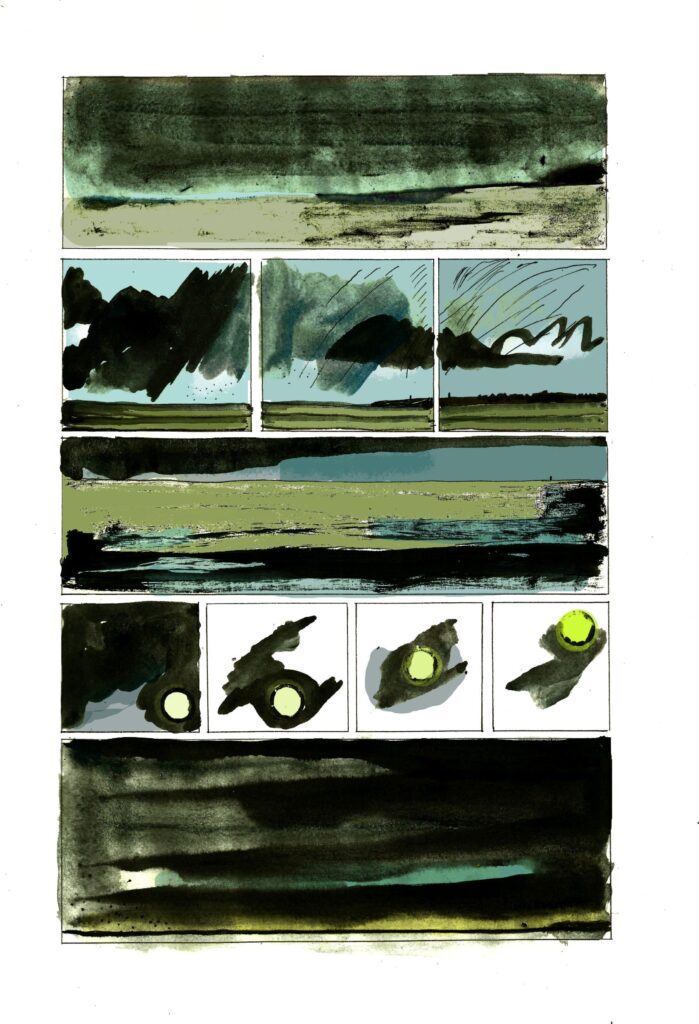
Several years ago, when I was thinking about writing a book about Lincolnshire, I found a strikingly original Twitter account. Almost every day, the seemingly tireless Maximpetergriff posted pictures painted during or after apparently endless walks across Lincolnshire, in all weathers and states of mind, showing the things he had seen in clear and luminous tones – birds, buildings, clouds, dogs, people, planes, planets, plants, pylons, rains, roads, skies, stars and suns.

These things had not just been seen, but looked at – everyday things uplifted by a strong sense of their possibilities, made resplendent in modern hues. Nothing seemed beneath this observer’s notice, nothing predictable in this parallel Lincolnshire, his glowing images intercut with staccato captions about bats overflying, bridges crossed, dogs howling, insects hurrying, litter lying, people overheard, the smell from takeaways, strange stones picked up, waterways running slickly away under moonlight.

The images were small, apparently simple and spontaneous, but in truth were full of thought. This was a county beyond conventional depictions, a painterly psychogeography; here were Englands within England. This walker was no pedestrian, but dashed off little-known vistas with verve, influenced by the likes of Nash and Piper while also being confidently contemporary; as he records, “two older ramblers look on the work with dismay”.

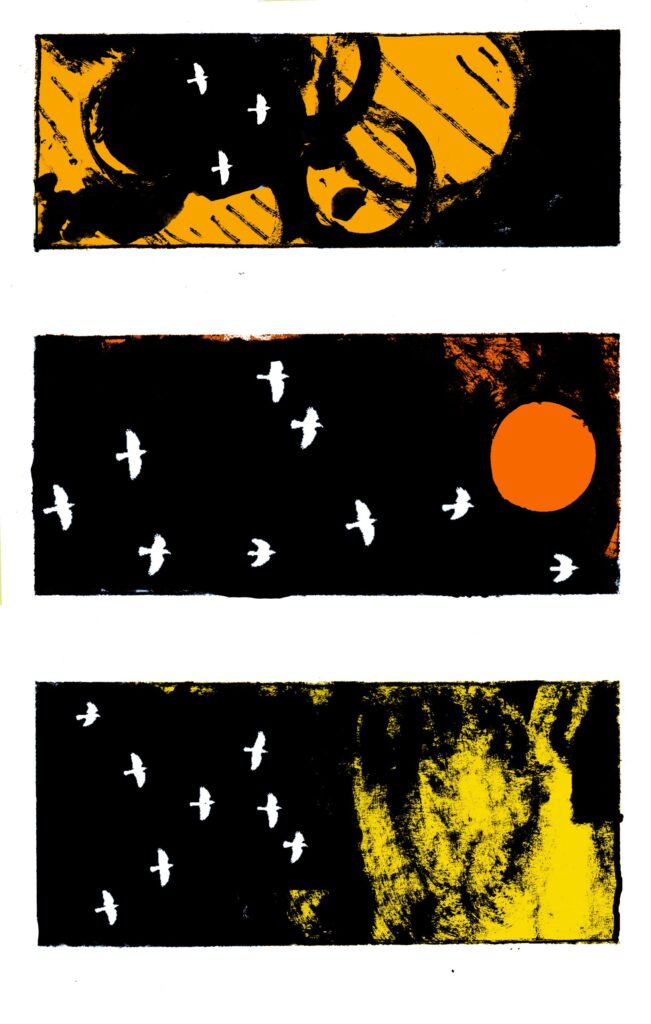
Some of these evanescent images have now been confined within the boundaries of a book, crowdfunded by those who liked this take on this territory. Field Notes’ freeze-frame cover suggests the unusualness of the author’s perspectives, and the élan of his approach. A redder than real sun stands in a yellow-brown sky, silhouetting black grasses. Geese power south from Scandinavia in a sky like a destroyer’s dazzle pattern. Suggestions of cirrus shadows spot Ravilious-reminiscent fields. Cruciform crows angle home over saltmarsh. White pylons overlay lands filled with decayed life-forms. On the inside back cover, where we expect an author photograph, we find a fugitive Everyman in a raincoat, painted from behind on a beach improbably alchemised from greens and blacks – the self-effacing artist as Sebaldian character, stepping out sturdily across the echoing east.

Griffin is sometimes sentimental, but never nostalgic; the book, like many of his Twitter posts, ends on the word “Onwards”. Yet he honours equally the mammoths that stomped drowned Doggerland (whose bones are taken up by trawlers), the antiquarians and eccentrics who discovered or dreamed our ideas of England, and today’s young English, heedlessly in the moment yet standing on the same fossiliferous foundations. Seams of gaseous Kimmeridge, outcrops of chalk, flint hagstones, the slimed tree-roots exposed at the lowest tides and the movements of muntjac are in a continuum with John Aubrey, boys on BMX bikes, exhausted seaside resorts and whooshing wind-turbines, while overhead ley-lines intersect with jet-fighter flight paths.

Field Notes is an account of one closely-noticed, deeply felt year in Lincolnshire, starting for the author (predictably, unpredictably) in October, with a Humbrol-hazed moon announcing the equinox, and the coming of the cold. “Look – the peak of autumn”, he marvels – with anthropophagical arachnids eating each other on barbed wire, RAF Chinooks, leaking boots, geological specimens arriving in the post, and ancient tracks to towerless churches passed over by Pevsner. “Look” again, he urges us, at the waning of the year, the chiaroscuros of clouds, the shadows of fences, the darkness under trees, the unlikely reds of earth, the arsenics and Prussian blues of limitless firmaments.

November brings branches waving against vastness, bleached bones in dunes, beachcombed sealskins and plastic bottles, deserted caravan parks, huge ships hove to off Spurn Point, memories of the drowned. An Airfix-coloured pillbox gives rigidity to the dynamic landscape, and a gun port leads into blacker than blackness. December holds the old names of ditches, mysterious murmurations, Mesolithic mirrors, thoughts of Raymond Briggs and memories of Mablethorpe Carnival Queens, the turning of this twelvemonth accepted as part of the epic, indifferent, unalterable cosmic churn; “The ocean will have us all – good.” Deep Time, East Midlandian history and today meet and mingle, even his cooking over campfires a sensory link with aurochs-eating, the crude charcuterie once carried out in willow-meads ages ago eaten by the waves.

Month by month, step by sometimes blistered step, sketch by swift sketch, we glimpse something of this arcane county’s blend of beauty and bathos, its grand desolations so often made mean by bungalows, car boots, leylandii, phone masts, and the demolition derbies of Skegness. There is grit in this Lincolnshire, some hardness and ugliness – asbestos sheds, chicken concentration-camps with humming extractors and the sharp stink of ammonia, algae-choked dykes, desperate biro notes found on the ground, rat-gnawed rubbish, washed-up whales, a man in an oxygen mask expending too much of his short time selling 1970s cassettes. But the overarching impression is deeply positive – room to breathe and self-realisation under the biggest of big skies, despite the oncoming storm-fronts of life.

Field Notes is filmic, impressionistic, and personal. It also manages to be unpretentious. In Griffinland, knowledge of the exploits of Alexander, Welsh poetry, Kurosawa, or “our pal Pieter Bruegel the Elder” co-exist chummily with pop blasting from cars, addicts passed out in hedges, shops selling tourist tat, and lost footballs floating out to the estuary. Phrases that from others might have been merely gnomic point towards places you’d want to visit. Even those who have some acquaintance with Lincolnshire will not be familiar with all the artist’s itineraries, and are certain to see new sights from his very particular vantage-points.

After long obscurity, Lincolnshire may be rejoining the mainstream of national history, with uncertain effects. This paean to little-known landmarks carries folk-memories forwards, while facing “Onwards” with equanimity. Ultimately, it suggests that whatever happens or is done, Lincolnshire has always been, and will always be, a land of graphic dreams.

Kafka: oracle and artist

Franz Kafka, Der Denker

The Aphorisms of Franz Kafka

Franz Kafka, Reiner Stach (ed.), Shelley Frisch (trans.), Princeton University Press, 2022, hb, 230pp + XXII, 9 mono illus., £20/$24.95

Franz Kafka: The Drawings

Pavel Schmidt, Andreas Kilcher (ed.), Kurt Beals (trans.), Yale University Press, 2022, hb, 368pp, 240 col. illus., £35/$50
ALEXANDER ADAMS sees different sides to an arch-dystopian

While he was writing The Trial, a novel that remained unfinished and unpublished during the author’s lifetime, Franz Kafka would read aloud chapters to his friends. Closest friend and Kafka’s future biographer Max Brod recalled that as Kafka read, he would be convulsed with laughter. The novel commonly considered the epitome of existential despair and implacable authoritarianism, was viewed by its creator as a black comedy. Franz Kafka (1883-1924) is seen as the prophet of the totalitarian modern society operating through a labyrinthine bureaucracy. It is easy to overlook Kafka’s sense of humour, penchant for absurdity and taste for farce. What continues to attract readers is the brilliance of his ideas and the visionary quality of images. Kafka’s fondness for the paradox and ironical gives even his bleakest work a touch of levity.

Two new books present Kafka at his most playful and wry – also at his most oracular and obscure. The Drawings reproduces all surviving drawings by the author. The Aphorisms publishes Kafka’s most impenetrable and oracular pronouncements.  

Kafka’s drawings have been one of the great unknowns of his output. Although a few (showing stylised, simplified single figures) had been reproduced in Brod’s biography and on the cover of a few editions of the 1950s, exactly how extensive and how various his drawings were was unclear. Not least, the obscurity came from the fact Kafka destroyed almost all his own drawings and only a few survived in letters and scraps that Brod preserved from the time they were law students together in Prague. Brod was enthusiastic about the drawings and attempted to interest publishers in hiring his friend as an illustrator, to no avail. After Kafka’s death, Brod published a few drawings then went cold on a proposed exhibition and substantial catalogue. The drawings disappeared into obscurity. Brod had given them to his partner-secretary, Esther Hoffe. After Brod’s death in 1968, the Kafka manuscripts and drawings were shuffled between a Zurich bank vault and Hoffe’s Tel Aviv apartment.

Publishers and scholars were antagonised by Hoffe’s unwillingness to make the manuscripts accessible. (In 1983, she would not let a publisher into her apartment, saying that it would cost him the equivalent of $150,000 even to see the drawings. The publisher demurred and departed. No book was published.) When her daughters continued the obstruction after her death, the Israeli state took legal action to claim possession of Kafka’s manuscripts. The state argued that the sheets were being kept in humid and dirty conditions and in danger of deteriorating; there was the threat of the works disappearing into hands of private collectors. In 2019 the state won, the Hoffe sisters lost possession of the manuscripts, and the National Library of Israel acquired relics of a Jewish titan of culture.

With the newly available originals accessible, plus all the other few Kafka drawings in other collections photographed, The Drawings presents all of Kafka’s surviving drawings. Essays cover aspects of Kafka’s drawing and the history of the manuscripts; a catalogue raisonné documents 163 pages of drawings.

Kafka took art classes, attended lectures on art history and visited museums. He personally knew some artists. Long after his university course on art history, he remained interested in differing art styles, including Renaissance art, Expressionism and Japanese colour wood-block prints. Kafka claimed that art education had ruined his ability to draw and that whatever he had done in terms of drawing had been achieved despite that constraint. Most of Kafka’s drawings are caricatures and fantasy cartoon figures, in exaggerated clothing and adopting parodic positions. On the evidence of comparative illustrations in The Drawings, it seems Kafka was an admirer of cartoons published in the German and Bohemian presses.

Around 1901, when Kafka was 18, he began a small sketchbook. He filled it with drawings, mainly of figures. As many of the personages are walking and seen in profile, they invite the comparison with a parade (or promenade) of eccentrics. There are curving jockeys riding improbable horses, angular men slumped at desks, striding gentlemen with walking sticks. Strong ink lines and solid black bodies are influenced by line-block illustrations, common to journals and books of that era. Kafka seems not have specific plans or projects in mind for his drawings; the figures are drawn at random on the pages, in every orientation, out of order and without accompanying writing.

There are similar ink figures in his letters, also reproduced. Figures appear in diary pages, often relating to the subjects of the day’s entry. On separate sheets of writing paper, portraits (including self-portraits) were drawn in pencil from life and photographs. These reveal Kafka’s art training. They are lightly worked fragments, with no settings indicated, but have realistic shading and the proportions are faithful to life, except where deliberately exaggerated. In artistic terms, they are slight and unfinished but the best of them have a magnetic pull to them – not least a self-portrait with haunted eyes. He did little drawing after 1908, with the majority of surviving drawings dating from his youth.

Kafka, Self-Portrait. Photo: Ardon Bar-Hama. Wikimedia Commons

Did Kafka take his drawings seriously? Fairly so, on this evidence. Although he was self-effacing and reluctant to publish or exhibit them, Kafka took care over making them. He developed forceful images that were crisp and striking. Overall, in The Drawings we find Kafka at his most playful and relaxed; the best of the drawings are really fine and we might wish that more drawings of this type had been saved from Kafka’s wastepaper basket by Brod. Kafka might have been amused at a scholarly cataloguing of his drawings, doodles and elaborate crossings-out.

The Aphorisms collects 108 statements by Kafka, written over the winter of 1917-8, which he copied out into two small exercise books. At the time he was staying with his sister Ottilie in a village called Zürau. On sick leave from his office job, he was attempting to stem the progress of pulmonary tuberculosis by escaping the smoke of Prague, eating well and doing some farm work for exercise.

Part religious parables, part philosophical propositions, part distilled observations, entirely literature, the aphorisms still baffle even the most serious readers of Kafka. “From a certain point on, there is no turning back. This is the point that needs to be reached.” “Like a path in autumn: no sooner has it been swept clean than it is once more covered with dry leaves.” The most famous is, “A cage went in search of a bird.” These are the shortest, but none run longer than half a page. The final sentence of the collection is unusually pungent and vivid. “The world will offer itself to you to be unmasked; it cannot do otherwise; it will writhe before you in ecstasy.”

The aphorisms are gnomic and elusive. The reader gets the impression that he is being told something true and important, but also something unclear, even deliberately obscured. Although these sayings have been published before (sometimes incorporated into collections of short stories), they are the probably the least read of his works. As the editor notes,

In comparison with Kafka’s other writings, his aphorisms have been overlooked by researchers and even more by his general readership. The aphorisms, like everything Kafka wrote, require interpretation, but in contrast to his fictional prose, for example The Trial, they do not reward the reader with the sensory and aesthetic pleasure of a story.

This new edition supplies commentary written by Reiner Stach (author of an excellent recent biography), with English translation by Shelley Frisch, who did a fine job on Stach’s biography. There has been no shortage of complicated interpretations of the aphorisms; wisely, Stach avoids committing himself. Commentaries include Kafka’s original draft, so we can note the revisions and follow the author’s thinking a little. Rather than offer explanations, Stach’s commentaries relate the aphorisms to comparable phrases or ideas from writings by Kafka and mention what he was known to have read at the time.

The aphorisms are as tricky to decipher as anything Kafka wrote. If you fancy giving yourself food for thought, then The Aphorisms are ideal. If you prefer something playful, then The Drawings is for you. Both publications serve to broaden our knowledge of one the greatest authors of European literature. What would expand that knowledge even more would be a first translation of the new German editions of Kafka’s letters, including texts inaccessible to non-German readers. When will Princeton University Press commission Shelley Frisch to translate Kafka’s letters into English?

The Deadlift & Towards the Pebbled Shore

MICHAEL YOST is an essayist and poet living in rural New Hampshire with his wife and children. His essays and poems can be read at Crisis Magazine, Dappled Things, the St. Austin Review and Hearth and Field, as well as at his website, poetryofmichaelyost.com.  

The Deadlift

The name rings hollow: pig-iron

In gravity’s deep wallow.

The unpoetic callus 

On each palm’s pad too hard 

To feel the microscopic knurl

Packed white with chalk, the burnished steel

Bar like some eel of river shining

Yet stippled still with the pock of rust. 

The body, braced against itself feels fear

For its own softness, singing for sweet rest. 

The plates all packed like brothers on the bar, 

Their edges sharp from the white hot lip of the mold. 

Then suddenly, the mind resolves itself to mass,

White pylons of tense bone, and round well fatted muscle, 

Presses itself in feet and shin through concrete ground

And grinning, pulls through gravity like broken glass. 

And there they hang, the bar and plate, all clattering in air, 

Yet shaking violently as if they cannot stay, like leaves

or bells quite badly made, to ring the chimes and iron hours

Of body’s powers, pains, and passing finally away. 

Towards the Pebbled Shore

My Papa took me out the day before

to sit outside the ancient red barn’s door, 

All painted black, and sliding back to shut. 

He told me I was helping him out, but 

I couldn’t help but feel he wanted me 

To witness something. I was there to see. 


The barn’s inside was dim, and cellar-cool. 

Its walls were lined with seed-bag, wire and tool;

The floorboards wide, unvarnished, roofbeams barked.

One long swift century had weathered, marked

It for its own. The sun outside showed all 

The colors of the world there were. The ball

I played with sat still in the north field’s green

Long blades, bright rubber blue. The sheen

Of light struck firmly off each branch and stone

And gave each thing a presence all its own, 

And lit the rock wall flaming low with moss,

As coals flame low and heavy in the loss

Of fire in evening. Papa loped out, took

The cockerel by his claws, and with a look

Of concentration laid him down upon 

A stump, quite still. A stroke: the head was gone. 


It fell down flat, heraldic, violently;

Beak parted, tongue out, crowing silently. 

One eye looked up; alone, to watch the sky, 

The other gazed at earth. The pool and dye 

Of blood, much brighter red than you would think

Dripped down the empty ruff, in squib and plink

Into the metal bucket, drops of jewels 

Upon a field. Invert, above these pools, 

The bag of muscles twitched just where it was. 

The dead bird’s gray pin feathers and gray fuzz

Soon littered all the lawn. The entrails out, 

The feet off, Papa turned the bird about

And carved at each distinct and white-pink joint. 

I stood and shuffled, looking at one point

At ground and sky, and back again as well,

Made nervous by the casual, wholesome smell

Of cockerel’s blood and feathers in the air. 


I grabbed a quill, and put it in my hair.

At that age, I could barely think or talk;

But still some thing as round and firm as rock,

And yet as broad and moving as the gust

Of wind that blew that day came as it must;

Yet everything retained its form and color

And multiplied its mass; no shade was duller.

I knew myself as something with a shore, 

Where water laps and freely spills. Before

I thought myself the world, some kind of all

Without circumference, gravity, or fall. 

Summer with the Sinfonia

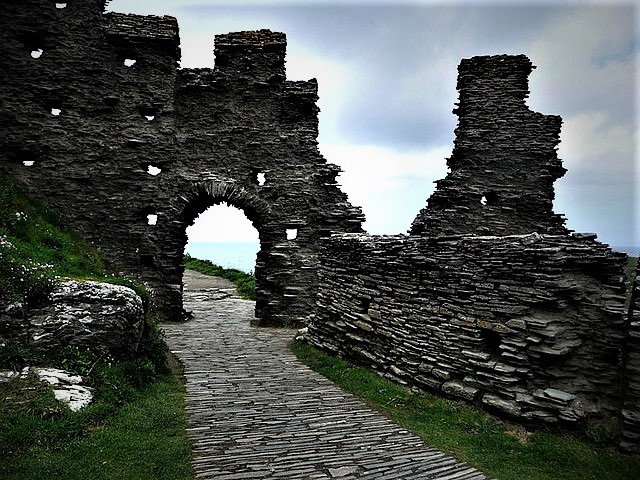
Tintagel. Photo: Chris Gunn. Wikimedia Commons
STUART MILLSON enjoys a super-orchestra’s seasonal offerings

The re-formed Sinfonia of London (a recording and film-score orchestra of the 1960s) appeared at the Proms on Saturday 16th July under the baton of the ever-popular John Wilson, for a concert of music by British composers. The programme was made up of Vaughan Williams’ 1910 Fantasia on a Theme by Thomas Tallis, Welsh composer, Huw Watkins’s new Flute Concerto, the Partita by Walton, Bax’s 1917 Arthurian tone-poem, Tintagel, and Elgar’s ‘Enigma Variations’ of 1899.

The Sinfonia is a handpicked, super-orchestra – a superior “scratch-band” of top freelancers, players drawn from existing orchestras and even members of string quartets and chamber groups, dedicated to reviving the idea of “demonstration sound quality”, i.e. dazzling, virtuoso performance, chiefly in a studio setting. A previous example of this type of ensemble was the old National Philharmonic Orchestra, which appeared on the RCA label and notched up some notable recordings, often under conductors such as the suave American, Charles Gerhardt. But to have real life and vigour, an orchestra must play in public, so what better arena for publicising the dynamic stage presence of your orchestra than at the Proms on a Saturday evening, right at the beginning of the season?

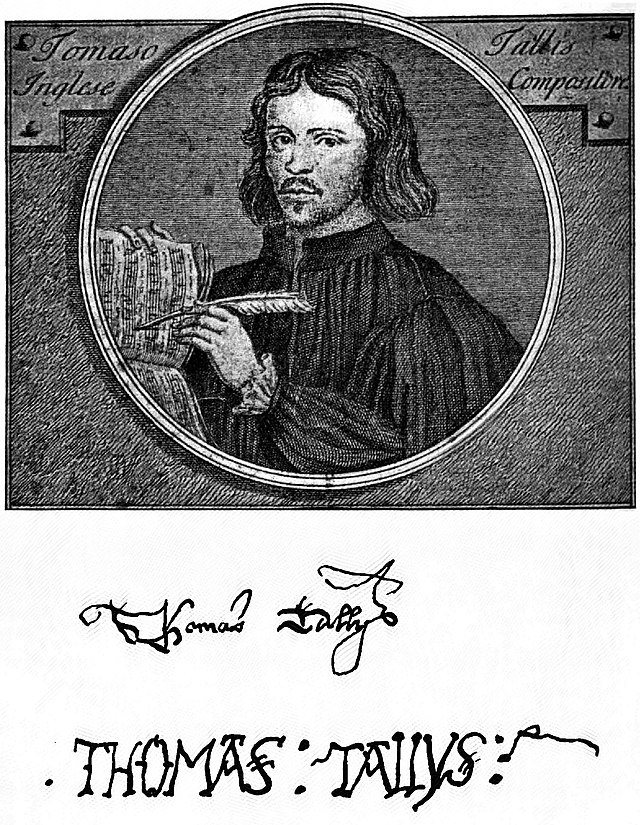
Thomas Tallis

And what finer non-ecclesiastical setting for a cathedral-inspired piece, such as the Tallis Fantasia, than the Royal Albert Hall, in which John Wilson cleverly created antiphonal special effects by placing part of his string band in a line, high on the right at the rear of the platform? The two bodies of strings answered each other: the music moving across the centuries, from Tallis’s Elizabethan sound-world of church voices, to the well-upholstered, romantic early 20th-century string writing of Vaughan Williams. 

Ralph Vaughan Williams in 1898. British Library. Wikimedia Commons

The one new work in the programme, the Huw Watkins Flute Concerto also suited the hall’s great acoustic – a beautifully air-borne thing and (for this reviewer) strangely reminiscent of a scene from the Ken Loach film, Kes, about a boy from a deprived background, spiritually rescued by a chance ownership of a hawk. In the film, there is a moving scene where the boy takes his kestrel to a field at the edge of the northern town in which he little more than exists, and flies him with all the skill of a mediaeval falconer. The bird takes to the wing, accompanied by flute music, neither tuneful nor atonal, which seems to represent freedom, air, longing, space. All of those qualities were to be found in the Huw Watkins piece, played by distinguished soloist, Adam Walker.

The great (literally) landmark work of the evening was the 1917 tone-poem by Englishman and also Celtic enthusiast, Arnold Bax, Tintagel. The composer visited the dreamy north Cornwall coast with his mistress, fellow musician Harriet Cohen, and found deep escapism and solace in the ancient surroundings of rocky coast and the ever-present gentle, heaving breast of the sleepy Atlantic. The work begins in pure, clear-blue summertime, but as Bax pointed out in an explanation of the piece, not a windless day.

John Wilson’s orchestra began their evocation with gentle, dreamy woodwind conjuring a feeling of sea-birds and distances. The growing swell of the sea against the rocky sentinels of Cornwall’s headlands was beautifully executed in the surging, strong, cohesive orchestral tide of sound created by the Sinfonia. But just as quickly as the physical setting of Cornwall has been established, Bax then begins to dissolve it all, with the supernatural drama of the ancient kings, Arthur and Mark, and the destructive, legendary love of Tristan and Isolde – the latter, a symbol of Bax’s own romantic entanglement. The composer wrote several Celtic-folklore-inspired pieces and seven impressive, well-orchestrated symphonies (the Fourth being the most radiant and most-often played, although an outing for a Bax symphony is still a rare occasion). 

What Tintagel represents is a (nearly) fifteen minutes-long condensed symphony – a clear, concise distillation of some of the more long-winded ideas which all long symphonic structures have, but which in the case of this piece are assembled with utterly persuasive and spellbinding cohesion and power. Not a note is wasted in Tintagel: there is a beginning, middle and an end, and like Sibelius’s The Oceanides (a tone-poem of some ten minutes), a listener or concertgoer can instantly know the composer just from this one calling-card piece.

With instantly recognisable pieces in mind, the concert concluded with Walton’s shimmering, Italianate Partita, written in the Mediterranean sun and siesta of the late 1950s – and Elgar’s Variations on an Original Theme, (‘Enigma’), penned at the end of the 19th century, but looking forward with masterful confidence to a new century and (for Elgar) new successes and untold honours. Again, the Sinfonia of London matched the mood, its players responding with great physical commitment to the scores of these British giants; men whose music, in different ways, captured the spirit of our native music.

Skara Brae on the Orkneys. Photo: Daniel Bordeleau. Wikimedia Commons

Yet what really is our native music? – as BBC Radio 3’s Tom Service (a Scot) asked in the evening’s programme notes. Slightly dismissive of the insularity of the land “sandwiched between Hadrian’s Wall and the South Coast” (his words), the writer nevertheless correctly noted the way in which our music has transcended the country’s physical boundaries. However, metropolitan observers should not be so quick to dismiss country cottages and “folky-wolky melodies”. As Vaughan Williams pointed out, all great universal art is rooted in a place, whether Bach’s Lutheran northern Germany, or the Spain of Velazquez. And as Tom Service should know, modern composer Peter Maxwell Davies, who settled in the Orkney Islands, immersed himself in a Scottish island identity, garnering, like a beachcomber, every conceivable Orcadian cadence, myth into his music, showing just how powerful “insularity” can be as a creative inspiration.

The capacity audience at the Royal Albert Hall, not a bit dissuaded by the Met. Office’s red-alert, heat-wave weather warnings, gave the performers a typical Proms ovation. And John Wilson gave them in return, one more piece – an encore from Eric Coates’s Summer Days suite, a nostalgic, innocent waltz. Judging by the overflowing applause, it is a world that still means something to so many.

Abducted in Argentina

Memorial to the “Disappeared” at the Naval Mechanics Institute, Buenos Aires. Source: Wikimedia Commons

Kidnapped by the Junta: Inside Argentina’s Wars with Britain and Itself

Julian Manyon, Icon Books, 336 pages, 2022, £20

KEN BELL is gripped by a ripping yarn of kidnap and high politics

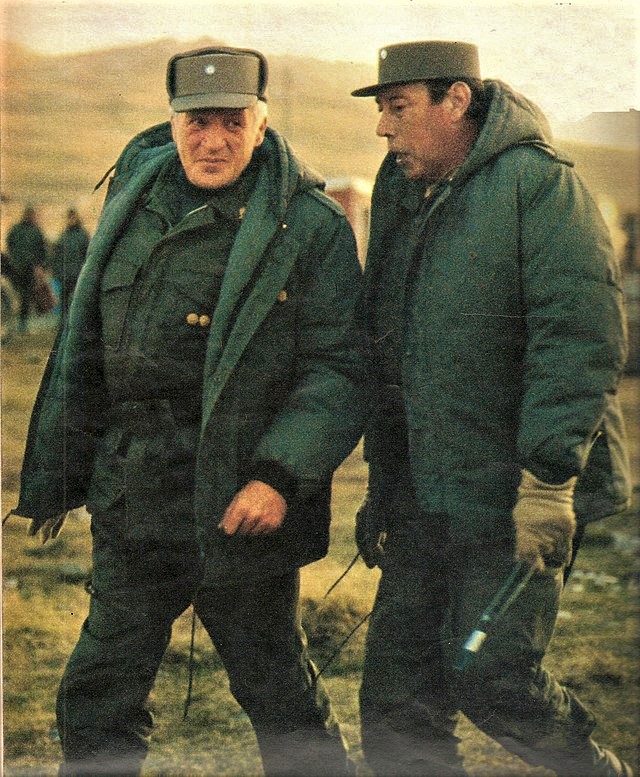
Julian Manyon’s book is not a history of the Falklands War, but a gut-wrenching, highly personal account of one journalist who found himself being kidnapped by an Argentinean death squad against that background. Years later, the Americans released their CIA and diplomatic reports from the Argentina of the time, and Manyon synthesises these with his own experiences to analyse the Argentinean mindset that led to the war and their subsequent defeat.

Mexicans tell jokes about the Argies, with one of them going that the quickest way to get rich in Mexico is to buy an Argentinean at his true value and then sell him for the price he thinks that he is worth. When Mexicans regard a country as an international joke there is something clearly wrong with that country, but the Argentineans never seem to learn.

The kidnapping of Manyon shows just how surreal Argentina is, with an added dose of incompetence that makes the rest of Latin America look like a model of efficiency. Manyon and his friends were seized by a state kidnapping, torture and murder gang head by a certain Aníbal Gordon, an Argentine of Scottish descent who when he wasn’t pulling people’s fingernails out with pliers was a collector of fine art. The kidnapping began in the usual way when the boys in the Ford Falcons drew up and threw the group into the nice, four-door saloons with the ample boots that were ideal for driving the dead away to be dumped out of sight and out of mind.

An Argentine-built Ford Falcon, popular with death squads. Wikimedia Commons

Manyon offered a $800 bribe to Gordon, which should have been more than enough to ensure a speedy release, but Gordon just stole the money and continued with the kidnapping. Towards the end of his book, Manyon described his attempt to buy of Gordon as ‘pathetic’, but it was nothing of the sort: it was the normal way to sort out any problem with anyone wearing a uniform in Latin America. I was shocked when I read that Gordon had stolen the money, because how can you trust anyone you have bribed not to stay bought off? Unless everyone keeps to their side of the bargain, then the whole system would collapse. I was once pulled over in Mexico City on some spurious charge or other and as soon as the cops heard my accent they became rather uncertain as to how to deal with me. I had visions of being taken to the town hall under arrest and spending hours there sorting out the situation, so I hastened to assure them that I lived in the country and understood the rules very well. Their relief was palpable, because, as one of them explained it, you can never be too careful with dammed foreigners who don’t understand things, can you? Anyway, I paid my bribe and was given la clave del dia, or day’s code, which is a few numbers on a piece of paper. Thus if another patrol had pulled me over I could show them the code and they would not try to shake me down for more money.

Manyon’s group was taken to Gordon’s torture centre, and then thrown into yet another set of Ford Falcons and driven out into the countryside. There they were dumped almost naked at the side of the road as the cars roared off. They made their way to a small town police station where nobody was particularly interested in them, until one senior policeman was prevailed up to call Buenos Aires for information. According to Manyon, when the policeman heard the voice of the very senior figure on the other end of the line he jumped to attention and saluted the telephone. The group was then hastily returned to Buenos Aires and ended up having drinks with the Argentinean Foreign Minister. Luis Buñuel, who was still alive at this time, really should have made a film about that day in Manyon’s life.

Argentina’s President, General Leopold Galtieri (left), in 1982. Wikimedia Commons

The Americans had a good understanding of what was going on in Argentina during this period, and were fully aware of the death squads, but ignored them so long as the ruling junta remained onside in Reagan’s Cold War adventures. But puppets occasionally cut their strings, as the Argentinean ones did in 1982. Reagan tried to call Leopold Galtieri, Argentina’s president, but could not get him on the telephone. The Americans assumed that Galtieri was probably too drunk to pick up the handset, but when he finally did so it was on an old Bakelite phone both he and his interpreter had to use at the same time. Someone had connected the telephone to a tape recorder, and when Galtieri heard Reagan’s translated words he insisted that the recording be played back to him after the call had ended. Unfortunately, the tape recorder had not been properly connected to the telephone and all they heard was static.

Luckily for the Falkland Islanders, Argentina is as madly incompetent today as it was then, so they can live their lives in peace. Mexico and the rest of Latin America have a country they can crack jokes about, and Julian Manyon has a story that he can dine out on for the rest of his life. We are lucky he has chosen to share it with us.

The life (and luck) of Nigel

Photo: Gage Skidmore. Wikimedia Commons

One Party After Another: The Disruptive Life of Nigel Farage

Michael Crick, Simon & Schuster, 2022, 606 pages, £25

KEN BELL reflects on the career of Brexit’s cheeky chappie

Many of the people involved in the Brexit debate will merit footnotes in the histories of the period that have yet to be written. Nigel Farage, on the other hand, will have whole volumes dedicated to him, and Michael Crick’s biographymarks a worthy first contribution to the many that will arrive down the decades to come.

Farage is without doubt the most successful politician of our times. He did more than virtually anyone else to get the United Kingdom out of the European Union, and so has succeeded in all his political aims. He is also the luckiest. How much his success owes to pure chance is something for future historians to debate, but reading Crick’s work it is hard to argue with the notion that Farage was incredibly lucky with the opponents that he was given.

UKIP, the party he came to dominate, was founded in 1993 and would have probably remained a fringe outfit that would have been lucky if it had ever won a clutch of council seats. But then Tony Blair and Paddy Ashdown came together, to provide the party, and Farage, with their first big break.

Prior to the 1997 general election, both Blair and Ashdown had discussed ‘The Project’, a plan to combine Blair’s Labour with Ashdown’s Liberal Democrats. But once Blair won his massive majority in 1997, he reneged on most of that, which left his erstwhile partner desperate to avoid being left completely out in the cold. Crick notes, ‘Ashdown fought to ensure that as a kind of consolation prize he at least got Blair to stick to his public pledge of PR [proportional representation] for the European elections of 1999.’ Blair tossed him that particular bone, but this also meant that minor parties now had a chance to gain seats.

UKIP took three seats in 1999, and came close in a clutch of others. It must be chastening for a Liberal Democrat to realise that had that election not been fought with PR, then the party would not have won any seats, and would probably have contented itself with another one of its internal rows that activists loved and real people hated. UKIP could quite possibly have split into its various factions, and the whole EU debate would have been held back for another generation.

One of the newly minted MEPs was Nigel Farage and given that UKIP had now gone from being a fringe outfit to a serious political party, invitations to appear on television came thick and fast. Farage could be relied upon to get his party’s supporters cheering at the TV, and at the same time enrage his party’s opponents. It made for perfect television, so Farage became almost overnight the household name he remains today. Again, luck played its part as the ‘Cavalier’ Farage was surrounded in UKIP by some pretty gruesome ‘Roundheads’ whom nobody sane would want anywhere near a television studio, representing the party or anything else.

Farage’s womanising activities are awarded a chapter all to themselves, which they deserve as Farage is an enthusiastic swordsman. However, I was struck with just how disapproving his ‘Kipper’ colleagues were with his women, and his carousing in general. Farage clearly enjoyed himself hugely in Brussels and that left his opponents looking even more gammon-like than usual. As he left to take up his seat in Brussels, a journalist asked if he was worried that he might become corrupted by the ‘lunches, dinners, champagne receptions’ and the like, to which Farage replied: ‘No, I’ve always lived like that.’

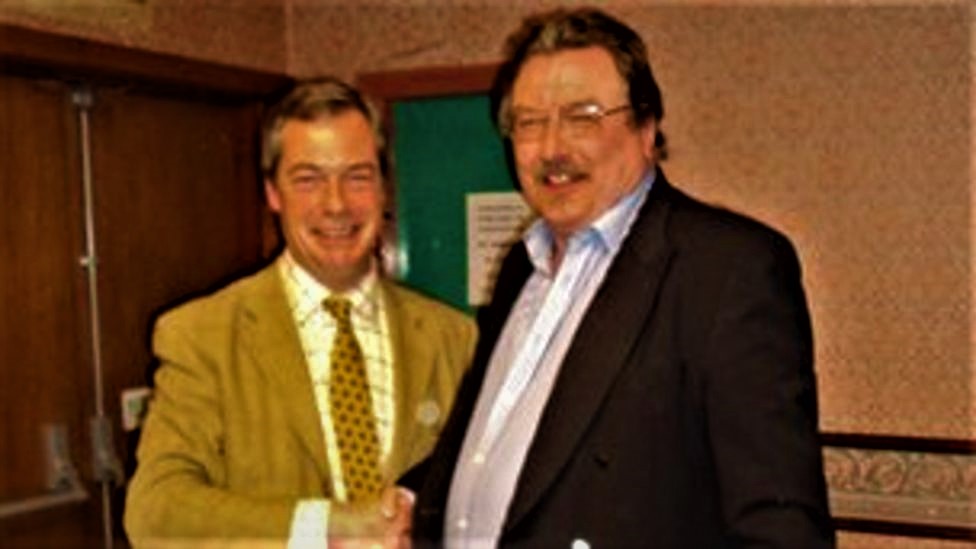
Anyone who has met Farage will recognise at once that he is very introverted. I met him once in 2013 after he had raised the roof at a rally. I asked him to agree to have his photo taken with me and he quite grumpily replied, ‘Yes, alright,’ before taking my hand and going into full grin-mode for the camera. As soon as it was over he scampered off before anyone else he didn’t know could talk to him. As an introvert myself, I knew immediately how difficult it must be for Farage to interact with strangers in any un-staged environment.

The author and Nigel Farage in 2013

Fast forward to 2019. In the run-up to the European elections, Farage came to address a monster rally in Edinburgh. I was one of the activists who were told to hang around after the event to go backstage and meet Farage. The idea was a bit of ego-stroking for us from the leader, with a few photos to show to our friends and handshakes all round. Instead, Farage left as soon as he walked off stage, which left a group of about a dozen people feeling very miffed indeed. Politicians know that a short pep talk to their senior activists is a big ingredient of any campaign dish. The politician tells the activists how important they are, mentions a few by name, before having the photos taken and then scampering off to the next campaign stop.

Farage broke that rule as he broke so many other rules of the political game. He got away with it partly because of his incredible luck, but also because for us it was always about campaigning to get Britain out of the EU, and nothing more. Nigel Farage, with his beer, his cigarettes, his women and cheeky grin, was the symbol of that but never its organiser.

The epistolary Eliot

The Letters of T.S. Eliot. Volume 8: 1936-1938

T.S. Eliot, Valerie Eliot, John Haffenden (eds.), Faber & Faber, 2019, 1,100pp + li, illus., £50

The Letters of T.S. Eliot. Volume 9: 1939-1941

T.S. Eliot, Valerie Eliot, John Haffenden (eds.), Faber & Faber, 2021, 1,072pp + lxix, illus., £60

ALEXANDER ADAMS loses himself in a great litterateur’s letters

In the ongoing Faber & Faber publication of T.S. Eliot’s letters, the project has reached the late 1930s and the wartime years. These were years in which Eliot was involved in writing Four Quartets (1936-42), Old Possum’s Book of Practical Cats (1939) and The Family Reunion (1939); this was in addition to his work as a director of Faber & Faber. Devotion played an important part in Eliot’s life, never less than in the dark years when his wife was confined to an asylum. The confinement was something for which Vivienne’s family were responsible and with which Eliot acquiesced, and that weighed on Eliot’s conscience. The punishing routine of work between early-morning prayer and late-night fire-watching during the Blitz seem at least in part a form of penance. Eliot’s engagement with the place of Christianity in a secular society is frequently the prompt for letters and solicitations for book reviews.  

These letters cover Eliot’s private life, professional correspondence and publishing business. We get his letters to James Joyce, W.B. Yeats, Wyndham Lewis, Virginia Woolf, Henry Miller, Djuna Barnes, Louis MacNeice, Lawrence Durrell, Stephen Spender, W.H. Auden, Dylan Thomas, Herbert Read and John Betjeman. Most are cordial and unrevealing. His long-standing correspondent Ezra Pound is ever present, mainly writing about publication matters. Eliot approves of a critical review of a collection of Pound essays, anticipating Pound’s reaction: ‘a furious letter, which I shall have to suppress in his own interest.’[i] In these volumes, Eliot seems wearied by Pound’s relentless passion, quixotic changes and prickliness.

A more regular correspondent was John Hayward, the brilliant and difficult English-literature scholar and editor, who would play a significant part in Eliot’s life. Hayward would become a housemate of Eliot’s in the 1940s and 1950s, an arrangement that lasted until Eliot’s second marriage. Hayward was assiduous in collecting letters, books and other Eliot material, which he later bequeathed to King’s College, Cambridge. In that case, Eliot was aware that his playful badinage was being preserved and would be read by others. Hayward consulted Eliot about bibliographical rarities and letters that appeared in booksellers’ catalogues.

Among numerous letters tactfully declining volumes of poetry by obscure writers and evading explaining ‘The Waste Land’, there are some more weighty letters. He declines publishing Céline’s anti-Semitic Bagatelles, while appreciating the inventiveness of the prose. An internal memorandum from Eliot to fellow Faber director Geoffrey Faber puts the case for publishing Djuna Barnes’s Nightwood.

Lesbianism merely happens to be the variety of the dis-ease that Barnes knows the best, so it is through that form that she has to get at something universal (she has obviously a great deal of the male in her composition). […] And as for her style, it has what is for me the authentic evidence of power, in that I find myself having to struggle, directly after reading, not to ape it myself: and very few writers exercise that pull.[ii]

There are numerous letters displaying Eliot’s tireless support for poet George Barker. ‘[…] I believe in your genius, so far as one is ever justified in believing in genius except in retrospect, and I believe that it is genius if anything and not talent.’[iii]

There are flashes of wit and acerbic commentary. ‘[…] what horrifies me is that your young people should actually be set to study contemporary verse in qualification for the degree of B.A. They ought to be reading Aristophanes.’[iv] He includes general rules for poets. ‘Nobody ought to attempt free rhythms until he has served an apprenticeship in strict ones.’[v] Eliot states that poets must continually develop. Unlike a novelist, who can produce books that conform to a successful formula, a poet ought not to publish books too similar to previous ones, lest he bore his readership. His pragmatic business side took over when he recommended winding up the quarterly journal The Criterion, which he had edited for sixteen years. Facing a drop in subscriptions and the storm clouds of war, the journal was closed in 1939.

We get a few insights into Eliot’s verse writing during a period when he was moving to verse plays. He posted sections of Old Possum’s Book of Practical Cats to the children of the family he stayed with in the countryside. Eliot never had children, and these children – and the children of his fellow director Geoffrey Faber – became his surrogate offspring. Enclosed is a pre-publication report from one reader of the manuscript of Practical Cats, damning it as ‘Personally, I find them pretentious, and cannot recommend publication.’[vi] There are mentions of visits to Little Gidding, East Coker and Burnt Norton, but these are arrangements rather than reflections. Even if he enclosed verses and composed nonsense verse to amuse recipients, Eliot was not given to poetic flights in his letters.

By and large, politics and current events go undiscussed in Volume 8. The abdication is mentioned but the events in central Europe cause barely a ripple in the volume. During the war, Eliot lived a peripatetic lifestyle, staying with Geoffrey and Enid Faber and others. He often travelled by train and bus, laden down by manuscripts and reference books, as he worked on the last of the Four Quartets. He joined the A.R.P. as a fire warden, seeing relatively little action in his allotted sector. We encounter little description of the impact of the Blitz, outside of the ways in which it disconcerted people and disrupted daily life.

The introduction of Volume 9 approaches discussion of the poet’s anti-Semitism. While it is true that Eliot published poems with disagreeable portrayals of Jewish characters and wrote in 1934 ‘reasons of race and religion combine to make any large number of free-thinking Jews undesirable’, Eliot was solicitous of the safety of Jews he knew personally. The volumes contain many letters of recommendation supporting the candidacies of Jews (including refugees) for employment positions. He also was unable to allow Pound’s anti-Semitic screeds being included in Faber’s editions of the Cantos. Eliot preferred for Pound to rewrite the parts but Pound made a point of leaving the censorship apparent. The intensity of Jewish condemnation of Eliot seems to be due to the potency and prominence of his negative depictions of Jews. Eliot’s dislike of Jewish material success and cultural influence seemed a strong instinctive aversion rather than malevolence.   

We get a few retrospective glimpses of the poet in earlier years. Eliot wrote to his brother Henry of his early life in London:

I was of course too much engrossed in the horrors of my private life to notice much outside; and I was suffering from (1) a feeling of guilt in having married a woman I detested, and consequently a feeling that I must put up with anything (2) perpetually being told, in the most plausible way, that I was a clodhopper and a dunce. Gradually, through making friends, I came to find that English people of the sort that I found congenial were prepared to take me quite as an ordinary human being, and that I had merely married into a rather common suburban family with a streak of abnormality which in the case of my wife had reached the point of liking to give people pain.[viii]

He goes on to comment that the only blasphemous poem that he ever wrote was ‘The Hollow Men’. ‘[…] this is blasphemy because it is despair, it stands for the lowest point I ever reached in my sordid domestic affairs.’[ix]

The shadow of Vivienne’s instability looms large in Volume 8. Eliot apologises to Henry for her sending a Christmas card from her and her husband. He notes that (even though long separated) she has put his residence as hers, in the telephone directory.[x] Her letters are included here. She wrote to the Faber office about her husband’s health and offered herself as an illustrator for one of his poems. Her communications are odd and inappropriate, mainly. Sometimes there are glimpses of darker thoughts, such as when she announces to a Faber employee that she is being followed. 

Printed in full is a letter from Vivienne’s brother, dated 14 July 1938.

V. had apparently been wandering about for two nights, afraid to go anywhere. She is full of the most fantastic suspicions & ideas. She asked me if it was true that you had been beheaded. She says she has been in hiding from various mysterious people, & so on. It would be deplorable if she were again to be found wandering in the early hours & taken into custody.[xi]

As a result of a pattern of alarming behaviour, Vivienne was committed to a secure residential home, Northumberland House. Eliot did his best to punctiliously sort out her financial and legal affairs, as discretely as possible. Even though he did not visit her – such an encounter would have been too distressing and destabilising – Vivienne was never too far from Eliot’s conscience.

This review is written in the shadow of the impending publication of Eliot’s letters to Emily Hale (on 1 June 2023, by Faber & Faber), which seems set to be a publishing sensation. That collection of 1,131 letters was deposited by Hale at Princeton University and was only unsealed on 2 January 2020. That book promises to show the most intimate side of Eliot, that which was so carefully hidden by the poet. It was during the late 1930s, while Eliot was living in London and Hale was teaching in Massachusetts, that they corresponded most often. In a rather defensive statement of 1960, Eliot wrote of the difficulty of marriage for him as a poet. After explaining that his marriage to the unstable Vivienne would inevitably seem inexplicable, he conceded that the tensions of an unhappy marriage provided inspiration for poetry.

Emily Hale would have killed the poet in me; Viviennene nearly was the death of me, but she kept the poet alive. In retrospect, the nightmare agony of my seventeen years with Viviennene seems to me preferable to the dull misery of the mediocre teacher of philosophy which would have been the alternative.

He went on the state that Hale did not understand or love his poetry, even though it seems they discussed his poetry at length and that ‘Burnt Norton’ (1936) of Four Quartets was written as a coded love poem to her. It should be noted that when Eliot wrote this statement he was defending his decision to marry his second wife, Valerie, and aiming to downplay his commitment to Hale and hers to him. Hale does appear indirectly in the letters in Volume 8. She visited Eliot in England and there are comments from him about her arrival, departure and activities during her time with him. In his statement of 1960, Eliot affirmed that he had never had sexual relations with Hale.

The publication of this separate volume will be significant in its revelations about the life and ideas of a great poet, showing him at his most unguarded. The ethics of publishing such letters is redundant. As the letters were deposited at Princeton University and due to be the subject of study, it is the correct decision to publish them in full, annotated, rather than allowing salacious snippets from circulating out of context.

The preceding review does not do full justice to the pleasure of having to hand such first-hand testimony of such a major figure. Being presented with such a huge body of letters – not even all of them, apparently – is a sort of treasure store, one unavailable for most cultural figures. One is impressed at Eliot’s indefatigable diligence; writing to colleagues and strangers, editing, reading, publishing, serving his church, not to mention finding time for his own writing, Eliot’s work rate is formidable.

We get an understanding of Eliot the man – driven by a moral core of Christianity, passionate about culture (especially literature), a loving godfather, cautious in his romantic attachments. Being such a prominent figure – author, publisher, cultural commentator, public intellectual – Eliot knew that his most private and informal communications would be bought, sold and scrutinised. Although Eliot bore the burden relatively lightly, there remains the suspicion that Eliot was curbing his most cutting comments for the sake of his posthumous legacy.   

The editing is exemplary. I spotted only one error (in footnote numbering, on p. 626) in over 2,000 pages. There are notes on recipients, context provided and often extensive quotes. These quotes are of letters that Eliot was replying to or extracts of books and journals. The editors have dug through archives of journals and newspapers and long-forgotten books. Letter text not in English is translated and many passing references tracked down. The only failing is omitting to indicate the place of writing. That sort of information seems more pertinent than the location of the letter manuscript. Unfortunately, this seems Faber policy regarding letter publication, so there seems no hope of the publisher revising its practice. Great care has been taken in the printing and binding. This series provides an unparalleled view of multiple aspects of the greatest poet in the English language of the Modernist era and gives us a glimpse of history as it was being made.


[i] Vol. 8, p. 585

[ii] Vol. 8, pp. 151-2

[iii] Vol. 8, p. 665

[iv] Vol. 8, p. 83

[v] Vol. 8, p. 676

[vi] Vol. 8, p. 871

[vii] Vol. 9, pp. 517-8

[viii] Vol. 8, P. 10

[ix] Vol. 8, P. 11

[x] Vol. 8, P. 52

[xi] Vol. 8, p. 91

The good old days?

This is chapter Seven of LIAM GUILAR’s almost completed epic of Britain. Chapter One was published in Long Poem Magazine #25 Spring 2021, and Chapters TwoThreeFour,  Five and Six in The Brazen Head. For more information about Hengist, Vortigern and the Legendary History, see www.liamguilar.com

The story so far. Mid Fifth Century Britain. After the legions have withdrawn, the island is facing civil war and a growing number of external enemies. It is also experiencing a steady tide of pagan, Germanic migrants looking for land.

Vortigern has been appointed to protect what’s left of Roman Britain. Following standard imperial practice, he has employed Saxon mercenaries led by Hengist. Together they have defeated the immediate threat of an army of Picts and a Northern rebellion and stabilised the province. Vortigern has married Hengist’s daughter.

A united province could withstand any invader, but Vortigern faces growing resistance from his own people, potential betrayal by his own officers, and a simmering threat to his leadership from the exiled sons of Constantine. Before travelling to a meeting with the Northern Lords, he has to ensure the South West is safe. He uses his travels to gather information about his province. 

This brief chapter ends part one of the book.

The Britons object

‘Now listen to us, our lord the King,

listen to the advice of your councillors,

Bishops and book learned men,

chieftains and their men at arms.

You have bought disaster and evil upon yourself.

You have favoured heathens, abandoned God’s laws,

and fornicated with a foreign, pagan woman.

We beg you, for the sake of peace,

and God’s favour to your people,

cast them off, drive them out.

If you will not do so, we will drive them from the land

and cut them down, or die in the attempt.’[i]

Vortigern took the speaker’s sleeve,

gently between his thumb and finger.

‘Such fine brocaded silk.

Boots of finest Cordovan.

I see your wealth: I see no scars.

How will you fight with Hengist and his people?

You could not stop the rabble

who plundered your homes,

stole your wives and daughters,

dragged your sons to slavery.

You ran away and hid,

then crawled back on your bellies,

sniveling round your huts

as though your tears could put the fires out.

How will you fight these people,

when you could not fight without them?

No raider dares come south.

The crops are in, the cattle fed.

Where there was famine we have brought relief.

The traders bring the wine you drink,

the silk you wear. Men go to sleep

expecting they will see the morning.

What else do you require?’

‘We want them gone. They are a plague

corrupting everything they touch,

a filth that should be scoured from our land. 

When they exhaust their pigs, they chase our women.

Their women whore themselves for pleasure,

leading our young men to perversion and damnation.

Their grunting language hurts our ears.

Their disgusting customs foul our country.’

Keredic helps Vortigern to collect stories

Wondering what atrocity I’d be forced to witness,

I followed the Thin Man at Hengist’s insistence.

A slave does not demand an explanation.

Nor does he ask what’s in the cart

that slows armed riders to a painful crawl.

A scattering of huts,

angular and box like,

not the usual beehives.

There was no ditch or palisade.

They did not run away.

A tall blonde man, an axe in hand

strode towards us; Wes Þu hal.

He hadn’t heard of Vortigern

or was a brave man who didn’t flinch.

The cart is brought forward.

Inside there’s the carcass of a pig

and jars of wine and mead.

‘Tell him, if he cooks this,

I will share it with him.’

The man is impressed.

‘What does he want?’

Vortigern replies: ‘Stories’.

The pregnant girl

This was my family’s land, but my brother went with Constantine.

We never heard from him again. Mam died soon after.

One day this old man and his two sons appeared.

Tad was glad to have some help about the place

even if we couldn’t understand a word they said.

The boys worked hard. The old man knew his stuff

where sheep and pigs and cattle were concerned.

When the coughing sickness took their father,

tad asked the boys to stay. When he was dying,

he left our land to them. This bump will be our second child.

Their cousins are arriving soon. More workers in the fields.

More arms when neighbors try to filch our cows. 

The wife

We were desperate.

First year we grew nothing.

The rain was late, the frost came early.

Scrabbling on marginal land

I’d have whored my starving bones

for the leavings from their table

to feed the children.

But the local big man gave us food,

suggested we move here.

Fed us through the winter.

We’ll repay him with a pig this year.

And when it comes to fighting

my man’s arm will pay our debt.

We were lucky.

My sister and her daughter went begging at another villa’s door.

They stripped them both and beat them to the boundary.

She died soon after, but not before

they burnt her house, enslaved her children,

killed her man then went down on their knees

to thank their loving god.[ii]

At first I couldn’t understand

I jumped at any sudden noise.

At night it was so quiet

I couldn’t sleep.

He’d go off to work

and he’d come back!

Days, then weeks and months,

when no one died.

Vortigern asks questions

Inside their well-built house,

Vortigern admires the skill

of the woman’s weaving;

the well-made cloth.

He touches the solid jointed wood,

admires the functional designs

sees that an age of wood

might have its own attractions.

Curiosity is an appetite he can’t appease,

like the golden lady,

asking questions about everything.

Nothing is beyond his interest.

‘What is his name?’

It is not a slave’s place to disobey,

but I do say If I ask him that

he will recite his genealogy all the way to Woden

and the pig will be burnt before he’s finished.

‘Call him hlāford, it is an honorary title.’

‘And the woman?’ ‘Hlǽfdige.’

‘Ask him why he came to Britain?’

‘He says, my children.’

But he knows that’s not enough.

‘There was only so much land;

bad for crops and worse for cattle.

We’d heard the ground is fertile here

and if a man stays clear of strife

his children have a future.’

We left them to their pigs and fields.

The Thin Man paused on the hill,

overlooking the farm. Now, I thought.

Now they all die. But he said,

to me, to the slave,

to the less than nothing;

‘You can teach a soldier to be brave.

Train him well, he’ll stand his ground

when his drinking partner from the night before,

is split open and his guts are tangling his feet.

But you can’t teach the heroism of parents

faced with a sick child or a failed crop,

or the courage of migrant families.

Why should these people be my enemies?’

The broken work of giants[iii]

Vortigern moves around the country,

listening, making others listen.

Heading west after the wedding,

with Hengist and Rowena,

to visit his estates.

Her reaction to his villa.

How easily she was lost indoors;

hesitation entering any room,

hand reaching for her knife.

The way she was confused by corridors.

He heads off track towards

the largest building he had ever seen.

But the portico, with its broken columns,

its neck-wrecking upward reach,

was an immediate affront.

He overheard her muttering with her father:

‘Wrætlic is þes wealstan’

‘Wyrde gebræcon’

‘Burgstede burston’

‘brosnað enta geweorc.’[iv]

Hengist had remained outside.

She crept into the building, dwarfed and daunted.

Her escort, Hengist’s hand-picked, finest killers,

like frightened dogs nosing into a bad place.

Where the walls had fallen,

they left the escort and went on alone

over rubble and shadows,

hearing the scrabbling echoes of startled beasts

in the rattling echoes of their footsteps

‘till they emerged into the great pool;

the vast chambered emptiness of it.

Steam rising from the dark grey waters,

ribboned silver where the sunlight,

streaming through the broken ceiling

fifty feet above their heads,

patterned the water’s surface, flicking the walls.

He heard her muttering ‘giants’ and ‘magic’.

Ignore the memory of her body,

and the knowledge she had used that knife

to carve more than her meals.

He saw that he had frightened her and was ashamed.

Sit on the steps that lead down to the water,

explain, the way your grandfather explained,

how Baldud King, doomed by the rotting of his flesh,

came here, and bathed, and was made beautiful and whole.

How Romans came and bult a temple to Minerva

and prayed to her then let their slaves

scrape, pummel and then massage them clean.

Take her hand, explain the building and its functions.

Evoke the voices and the rituals,

memories from your granddad’s childhood,

and learn your explanation is another fairytale

no more credible than her mutterings

of vanished giants and sorcery.

He wanted to take her in the pool,

watch her wide-eyed wonder at its warmth,

but there was no time for self-indulgence.

Stepping into daylight, Saxons standing upright,

shaking away the shadows,

Hengist’s hand-picked killers once again.

They parted ways, Rowena, for her safety,

returning to her uncle in the east,

while Vortigern and Hengist headed west

to meet the man who had united

Dumnoni and Durotriges

and was now acknowledged as their leader.

Enter Gorlois[v]

Clean upright walls, no tiles missing on the roof,

memory made real in the present,

the strangeness of it lost in its familiarity.

The floors had been repaired, the garden tended.

The water feature was still working.

The room he waited in was someone’s library.

His hands hovered near the scrolls

but he resisted the urge to take one out,

drift on the beauty of carefully chosen words.

God save all bookish men, thinks Vortigern,

perhaps their time will come again.

A time for Latin poetry and dinners,

evenings in the garden, making plans,

knowing talk of literary sinners.

Gwendolin mustered Cornwall,

trashed her husband and his army

then ruled Britannia with an iron fist

disguised as women’s hands.

Has he fallen for the story?

Is he looking to the west

for a saviour who will rise?

So enter Gorlois.

A neat man, a tidy man.

A pious, praying man.

Gloucester said he looks so young

he could be taken for the 12 year old

he’d married to secure his future. Now

the western tribes acknowledge him as leader.

But the western tribes are so much landfill

if Vortigern decides they need to be subdued.

Given small commands, he’s been methodical,

imaginative and ruthless. Trustworthy,

obvious, but vague around the edges.

Impatient with stupidity. Often tactless.

Ambitious. Capable. But Loyal? Possibly.

Gorlois waits, doing his version of inscrutability.

Impassive as a figure painted on a wall:

‘Loyal soldier waiting for his orders.’

‘You can read? Good.’

Vortigern hands him two sealed scrolls.

‘Not now. Later. That one first.’

‘We head towards a gathering of the northern lords.

I’m giving you the land south of the Severn’s Mouth.

All forces west of Tamar are under your command.

You are to fortify the land and keep the raiders out.

Make sure the trade routes to the continent

stay open.’ He stops. There’s nothing else to say.

If Gorlois is intelligent he knows what needs be done.

If not, then telling him just wastes the time.

But the wall painting doesn’t speak.

Vortigern can hear the small unhurried sounds,

the breathing of his guards,

knows he cannot laugh, not now.

God save me from these amateur theatricals.

Gorlois kneels. And he could say;

Screw you, the West’s already mine;

Thank you, I’m honoured;

I am too young. I am not worthy;

I will repay your trust. Instead, he says

‘I accept.’ As though he had a choice.

Gloucester to his messenger

Take this to The Boys.

You will find them in Gaul,

where rivers flow uphill, springs geyser blood,

the dead walk home from battle fields

and mad dogs gambol in their wake.

Take my message. Tell them: soon.

End of Part One


[i] This first section is a close version of Laȝamon’s lines. He doesn’t identify the speaker. Vortigern’s reply is not Laȝamon’s.

[ii] See ‘The Landowner’ in A Presentment of Englishry. 

[iii] The idea that Roman ruins were the work of Giants, ‘enta geweorc’, occurs in Old English poetry.

[iv] The first two lines of ‘The Ruin’. Literally: This stone work is wonderful/ fate broke it/the fortified place is broken open/ the work of giants, decaying. (A less literal translation would do justice to the music of the lines.)

[v] Gorlois’ story is told in part three of A Presentment of Englishry.