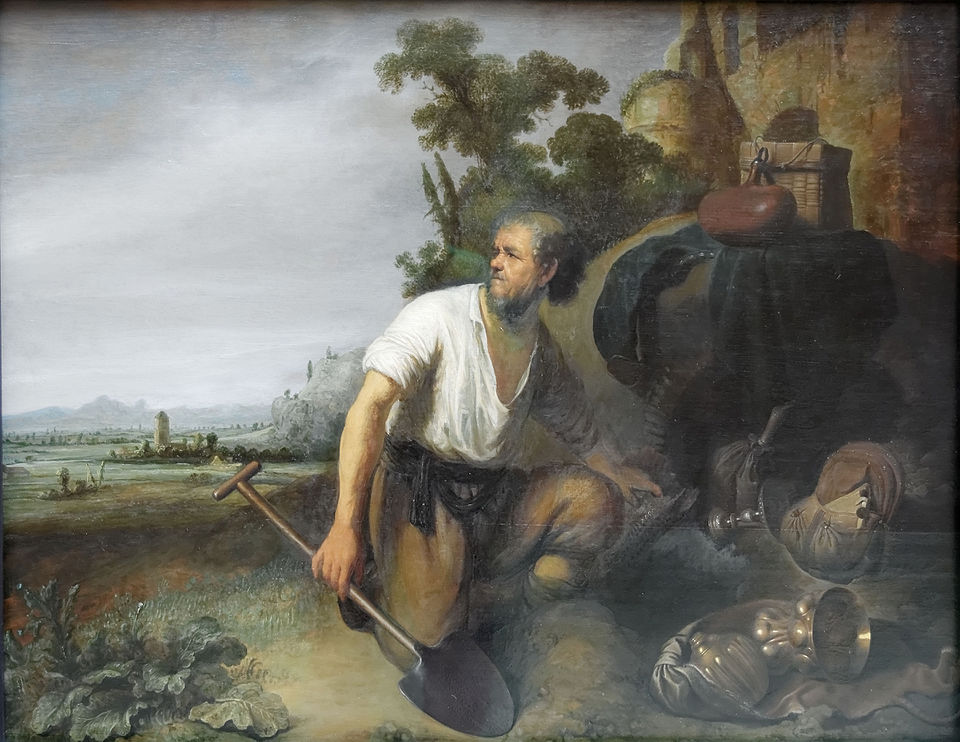
Treasure island

The Parable of the Hidden Treasure by Gerard Dou

Treasures on Earth – Buried Wealth in Landscape and Legend

Jeremy Harte, London: Reaktion, 2026, 292pps., £15

In his Anatomy of Melancholy, Robert Burton offers some sensible advice as one of his ‘Remedies against discontents’ – “Seek that which may be found.” Jeremy Harte’s subtle and finely written new book examines the countless Britons who have taken exactly the opposite approach.

Harte is a romantic and an indefatigable follower of tantalising trails, having written to excellent effect on the Devil in England, and the history of gypsies – and so feels empathy with the delvers and dreamers who from earliest history have hankered after treasures that are occasionally wonderfully real but much more usually imaginary. Rumours of hidden hoards speak to some of our deepest psychological requirements.

Treasure can be found, or visualised, in many places – burial mounds, castles, caves, churches, old houses, tunnels and under landmark stones. The Honours of Scotland were even concealed in a bed. Hoards have been envisioned as spectral specie guarded by demons, dragons (there are some 30 British placenames containing the root-word draca, dragon), fairies or monsters, only accessible to astrologers and ‘mystical sciencers’ – like the Elizabethan polymath John Dee, who tried to persuade the Lord High Treasurer to grant him a royal licence to hunt for caches guarded by such fearsome ‘kepars’. Traditionary treasure hunts almost always take place by night, tense events whose codified procedures are usually derailed by unnatural storms, strange lights or panic attacks, or when some searcher emits an excited oath just as the hoard hoves into view.

Hoards have also been seen as traces of vanished races, or mythologized individuals from King Arthur to the North Country bogeyman ‘Long Lankin’ – or more prosaically as the left-behind legacies of real-life despoliations and downfalls. The Dissolution of the monasteries and the Civil Wars left in their respective aftermaths countless rumours of secreted wealth, suggesting long-persisting sociocultural trauma. Buried treasures have also often been imagined in border areas, relatively plausible because of such regions’ turbulent pasts – suitably liminal locales for things themselves evanescent and uncertain.

Treasure’s potential presence in a landscape attests not just to a desire for actual wealth, but also our habit of investing hard earth with pleasant fictions. A fabulous hidden hoard can constitute a source of local pride, like the golden stag concealed somewhere near Llantwit Major which when found would allow the modest Glamorgan town to regain its early medieval eminence as Celtic Christian cultural powerhouse.

Hoards can also be symbols of non-temporal power. Treasure tales cluster in historically poorer or more remote districts, and in many of these stories ghostly guardians wishing to unburden themselves of guiltily got gains that are tying them to the earth select the virtuous poor as recipients of their eerie instructions, phantasms offering a chance of advancement in return for absolution. Treasure-tales have frequently been cautionary parables, affording moralisers agreeable opportunities to expound on the greed, gullibility or unscrupulousness of their fellow humans. Wealth has always been regarded as sniffily suspect, especially when its origins are opaque. It is hardly surprising that some troves were supposed to have been cursed. Treasure, Harte observes, “can never quite be cleansed from the blood and sweat that laid it in the ground.”

Treasures are sensationally unearthed – Mildenhall, Snettisham, Sutton Hoo – but much more often they are not, even when searched for systematically (or obsessively). This is hardly surprising, as most traditions are extremely vague, such as the Selkirkshire saying that the fabled “gowd” of Tamleuchar would be found “atween the wat grund and the dry”. Such discoveries as there have been have almost always happened accidentally.

Harte opens with one such incident in 1840, when the Cuerdale Hoard of silver was uncovered by workmen working on flood defences along the Ribble near Preston – 7,500 coins, 350 ingots and 1,000 fragments of buckles and jewellery – buried by retreating Vikings around 911, the largest early medieval hoard ever discovered in England. That part of Lancashire already had legends of buried treasure; there had been previous unsuccessful searches in and around Cuerdale (where Roman remains had been found), and there would be several more after 1840. Nearby Ribchester had famously disgorged an ornate Roman helmet in 1796 (now in the British Museum), which had seemed to bear out a local saying William Camden had recorded as long before as 1586 – “It is written upon a wall in Rome Ribchester was as rich as any town in Christendom”.

Many antiquarians saw such discoveries as suggesting that traditions about local hoards must have at least some basis in fact, although in many cases these ‘traditions’ were post-hoc confabulations. One example comes from Wales. The prehistoric gold peytral that was discovered in Mold in 1833 came from a hill whose Welsh name, Bryn-yr-Ellyllon, can be translated as ‘Hill of Goblins’, where it was said there had long been tales of golden ghosts glimpsed at night. But these traditions were not recorded until after 1833.

For obvious reasons, hoarding is usually carried out in secret, so it is difficult to see how it could lead to any tradition in the first place – whereas the excitement of finding treasure encourages people to see prefiguring patterns. If people really knew where treasure was stashed, they would almost certainly obtain it for themselves rather than talking about it to others. Almost all attempts at ostension – when traditions are subjected to tests – end in failure. Yet the allure never dims.

Treasure-hunting goes back a long way, and everywhere is fraught with contradictions. There was supposedly once a wayside stone near Damascus which bore the legend, “If you dig here, you will be sorry; if you do not dig you will be sorry also.” In Britain, there are eighth century runic inscriptions about hidden treasure in the Orkneys, and the contemporaneous Vita of Lincolnshire’s St. Guthlac records the traces of hopeful fossicks in the Fens. Gold glitters with the greatest lustre because of its scarcity. It was not used to make everyday currency – the Edward III noble, introduced in 1344, was the first relatively widely circulated gold coin – so was always associated with display, nobility, royalty and sacrality. Lost gold crowns are an especial leitmotif of lore, from King John’s crown allegedly lost in the Wash by way of the Crown of King Edward which vanished in 1649 to M R. James’s celebrated 1925 story A Warning to the Curious, about a legendary lost diadem of the Angles and its deadly custodian. Local saints were often imagined as sleeping in golden coffins, and the Holy Grail as a golden chalice. Buried gold is rarely seen as realisable riches, but more as a talisman and means of transmutation, all the brighter for being ultimately unobtainable.

For many treasure-hunters, the riches they seek often seem less important than their itch to search. Actually finding something could even prove anticlimactic. Anatomy of Melancholy to the contrary, seeking things which cannot be found may be a better ‘remedy against discontent’. As Charles R. Beard notes in his 1933 survey The Romance of Treasure Trove, “Treasure-hunting is like virtue; it is generally its own reward.” There are things hidden in the human psyche, we conclude, that surpass the wildest dreams of avarice.

This review first appeared in Country Squire, and is reproduced with permission

Gardens of earthly delights

My Auntie Audrey used to cut the edges of her lawn with scissors. The grass was bowling green standard and a source of great pride, labour and constant concern. Her garden reflected her personality – meticulous attention to detail and a capacity to work endlessly to maintain her own high standards. I cannot remember her actually sitting in her garden, taking in the scents and views.  The esteemed editor of this magazine takes a different view. Let nature do its magnificent work whilst I lounge with a glass of something refreshing. Both approaches to gardening were to some extent on display at this year’s Chelsea Flower Show. The event has become a high societal event akin to strawberries at Wimbledon and flags at the Proms.

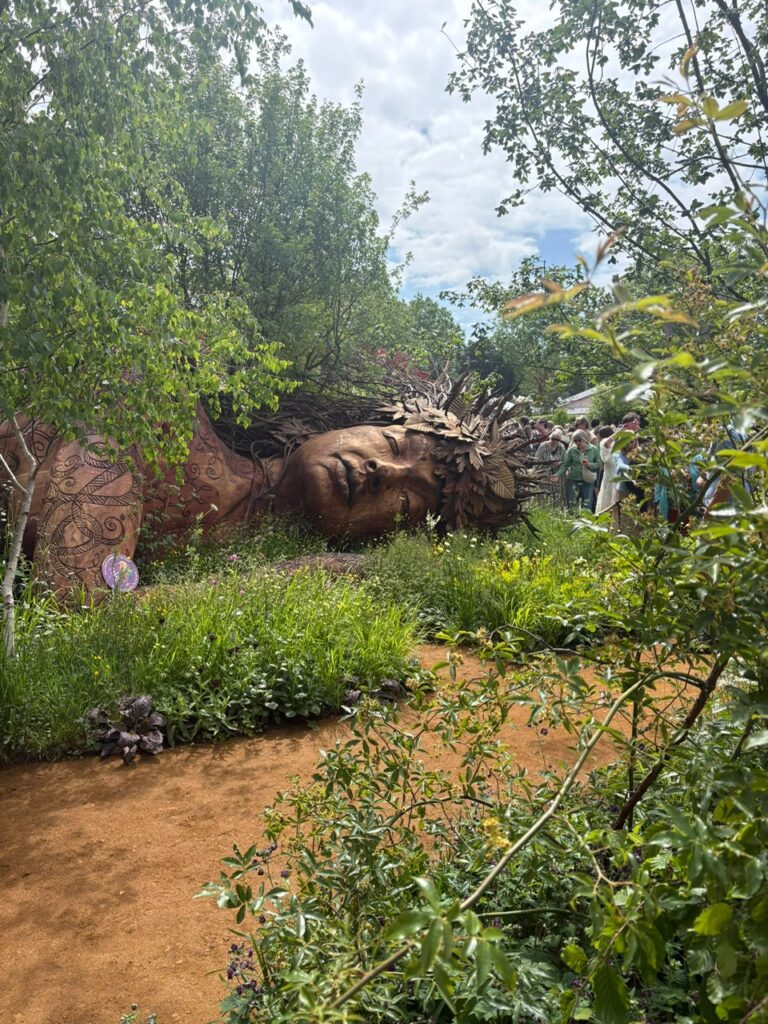
The best show garden this year was judged to be Sarah Eberle’s ‘On the Edge’ garden for the Council for the Protection of Rural England (see picture above). “Some of the best landscapes are where people and nature coexist in harmony…It’s about how it makes you feel. It’s almost a homecoming, an embrace, a hug.”  A central feature of this extraordinary garden is a fallen tree sculpted into the guardian figure of Gaia or Mother Nature. Her willow hair forms the top of a dry- stonewall that weaves through the copious, verdant planting. Weeds are reimagined celebrating our native flowing plants. There is a rusty corrugated tin fence suggesting a barn or tumbling warehouse where the countryside and development meet. Sarah Eberle’s guiding philosophy is for all gardeners to work with what they have. A boulder or tree stump can become a feature rather than a problem. She advises that we browse second-hand shops for weathered metal or wooden furniture. Beauty, she reminds us, can exist in the ordinary. The design encourages us to sit and ponder and do nothing.

The Tokonoma Garden

Contrast all this with the Tokonoma Garden designed by Kazuyuki Ishihara where Auntie Audrey’s scissors would definitely come in handy.  Everything is finely honed, brushed, choreographed. Everything has its defined and delicate space. It is the garden almost as a film set guided by well-defined Japanese traditions of harmony and beauty.  Weeds and corrugated iron are not welcome here. Nature has been squeezed and shaped into exquisite arrangements. The effect is stunning for very different reasons. In the CPRE garden you take off your shoes and socks and stretch out languorously. In the Tokonoma Garden you straighten your tie or adjust your fascinator. Two styles, two approaches, two designs that are different in almost every aspect in that one embraces nature and the other shapes it. 

The Garden for Every Parkinson’s Journey

There are also show gardens with an explicit narrative, a message to convey. Such as the Garden for Every Parkinson’s Journey. We will ignore the overuse of the word ‘journey’ in current human experience. This garden is wonderful. A smoothly carved handrail weaves through the planting, offering stability and sensory experience for those afflicted by Parkinson’s. Its designer, Arit Anderson, has a sister who lives with the disease.  The garden offers a safe space to relax for a moment or two away from the constant challenges of living with Parkinson’s. It is also a soothing night garden as many people with the disease have difficulty sleeping.  One can see so clearly that Arit Anderson has designed the space for her sister. It is personal, empathetic, emotional. It underlines the immense beneficial impact that our gardens can have on both our mental and physical health. This has become a common topic for discussion: our garden ‘journey’ for mental wellbeing. And whilst being sometimes overblown, it is not new. For centuries we have known that being in nature is good for us even if it is well trimmed and intensely weeded.

My own garden journey was interrupted by an overheard remark: “Well, I must say that is the neatest lady garden I have ever seen.” Gardens never fail to surprise. I was now in front of the Lady Garden Foundation show garden. The information leaflet informed me that 21 women die every day from gynaecological cancers most people cannot even name. This ‘Silent No More’ garden was designed, somewhat disappointedly, by a man, Darren Hughes. It contains five sculptures to signify the different cancers – ovarian, uterine, cervical, vaginal and vulval. It is an unashamedly propaganda garden with a clear, vital message. At first, I was a little uneasy with the idea but slowly as I took in the planting and the message, I understood. Two ladies were chatting about a hysterectomy one had and the discovery of an undiagnosed cancer. It had got people to talk although its underlying message was skipped over by the BBC in their filming of their evening show. The idea for the garden came from Lady Garden Foundation ambassador Emily Plane who was diagnosed with ovarian cancer at the age of 23 and died five years later. A highlight for me was the contrasting ideas of planting to encourage both private and group conversations. The garden will be dismantled and rebuilt across multiple sites in Jersey and Cornwall.

With an equally therapeutic ambition is the Breathing Space Garden from Asthma + Lung UK. The design of the garden by Angus Thompson draws on the Japanese aesthetic of yohaku no bi – the beauty of empty space and ma – the beauty of empty time. He was giving an impromptu talk as I arrived. The aim was to create a tranquil woodland-edge retreat to help visitors to slow down, breathe more deeply and reconnect with the restorative qualities of nature. Despite visiting on a day when 30,000 others crowded across the site, I stared at the space and felt transported to a quieter place.

That is the power of gardens. Ultimately it is not about skilled design, strong messaging, striking architecture but discovering a space where you can breathe deeply and relax profoundly. And if you are lucky enough to have Gaia carved out of a fallen tree then all the better. One hopes that given these circumstances even my industrious Auntie Audrey (who now gardens in a higher place) would put down her scissors.

All photos by Richard Dove

“The North for greatness”

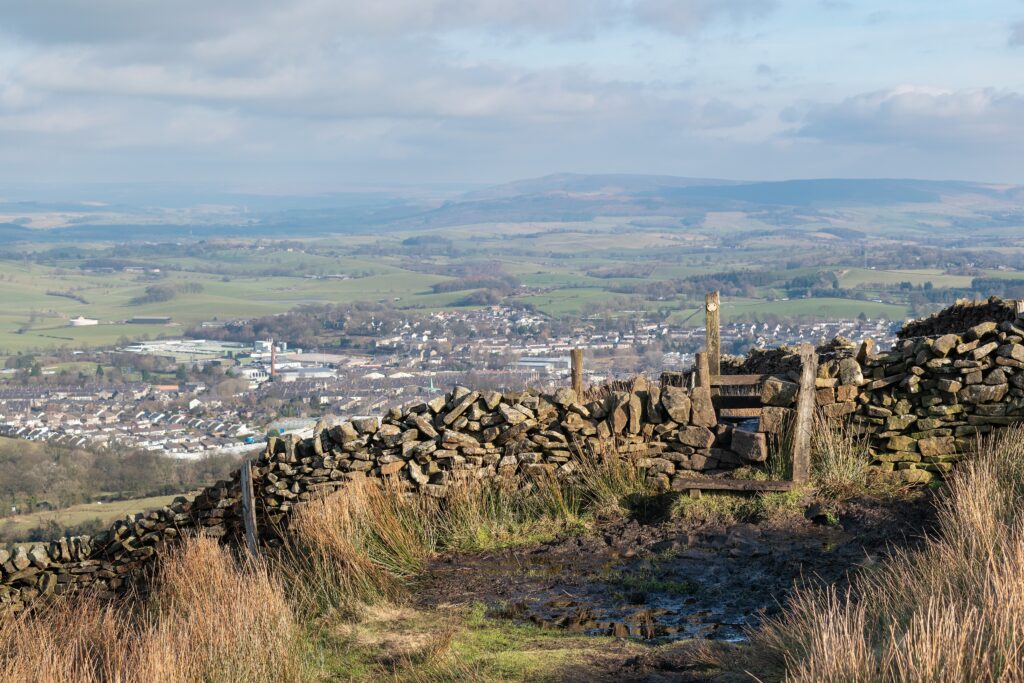
Barnoldswick and nearby Yorkshire from Weets Hill by Dominic Nelson. Image: Wikimedia Commons

Lancashire: Exploring the Historic County that made the Modern World

Chris Moss, London: Old Street, 2026, hb., 364pps., £25

In his classic 1902-1904 Collecteana, folklorist Vincent Stuckey Lean cites a proverb which has since passed into cliché – “Lancashire thinks today what all England will think tomorrow”. Travel writer Chris Moss’s task in this highly personal book is to show how his home county helped make modern England – and so the wider world.

Until late medieval times, much of the future Red Rose County was remote and sparsely inhabited, its moors and uplands unsuited to agriculture, and too near Scotland for safety. In the Domesday Book, the county was referred to as merely the land “inter Ripam et Mersam” (between Ribble and Mersey), and accounted under Cheshire; it was not named until 1182. But the Dukedom of Lancaster, first created in 1351, became increasingly powerful and was ultimately merged in the Crown in 1413. There was even a folk-tradition that King Arthur had been Lancastrian, Lancashire supposedly a corruption of ‘Lancelotshire’. The combative nature of the inhabitants is suggested by an anonymous fifteenth century poem ‘The Shires’, listing the supposed characteristics of each county, which describes Lancashire as “a fair archer”.

By Tudor times, the county was increasingly integrated into the national mainstream, despite a reputation for Roman Catholic recusancy. The mother of William Camden, author of the nation-shaping 1586 chorography Britannia, came from Poulton. Alexander Nowell of Read was Dean of St Paul’s during Elizabeth’s reign – and the inventor of bottled beer! As Archbishop of Canterbury, Farnworth’s Richard Bancroft oversaw production of the King James Bible.

Michael Drayton hymned Lancashire in his 1612 loco-descriptive poem Poly-Olbion for its cattle, the “deepest mouth’d” of hunting hounds, silvery rivers, and women “who beare away the Bell” for beauty. There were seventeenth-century sayings alluding to regional power – “The North for greatness” – and cleverness – “He’s too far North for me”. The county was nevertheless rent by the Civil Wars, its north and west for the King, the rest for Parliament. The 1648 battles of Preston and Winwick were the last of the Second Civil War, and Preston would also be the locale of the last battle on English soil, during the 1715 Jacobite rebellion.

But Lancashire’s most important days began with the Industrial Revolution. Indeed, the Industrial Revolution was largely a Lancastrian creation. County inventors, speculators and visionaries yoked steam power to an array of new technologies and new thinking that would galvanise the globe, and give rise to vast questions which even now remain unanswered.

The world knows of Liverpool, Manchester, the Pendle witches, Stephenson’s Rocket, Lancashire cotton, St Helens glass, the Peterloo Massacre, Frederick Engels, the footballers of Everton, Liverpool, Manchester City and United, the Beatles and the Smiths. There was, or sometimes still is, also steel at Nelson, paint-making at Burnley, brickmaking at Accrington, wire at Warrington, beer at Blackburn, aerospace at Samlesbury (where Donald Campbell’s Bluebird K7 was constructed), submarine-building at Barrow-in-Furness, and fishing at Fleetwood. Peter Paul Roget compiled his Thesaurus at Manchester’s Portico Library.

Within the UK, Lancashire also conjures images of L. S. Lowry, Blackpool Tower, George Formby, Liverpool’s “Three Graces”, black pudding and pies, Eccles cakes, treacherous but magnificent Morecambe Bay, Coronation Street, Boys from the Blackstuff, Anthony Gormley’s Another Place, Bernard Manning, Les Dawson, Peter Kay, and a host of other bands, from Gerry and the Pacemakers to Joy Division.

It also connotes decline, division, ugliness, motorways (England’s first motorway was the Preston Bypass), harsh weather and a proverbial dourness of temperament. The author acknowledges that the county is often not conventionally beautiful, with exceptions like the Forest of Bowland, but even its least prepossessing locales “engage the mind”.

He is acutely aware of the hardness of life for many Lancastrians both during the Industrial Revolution – famously fictionalised in Hard Times – and in its wake – as documented in Orwell’s The Road to Wigan Pier. As he observes, “Lancashire was the first to turn the engines on, and the lights out.” Dickensian-style Gradgrinds, grasping though they were, at least sometimes gave back to their communities, leaving many magnificent public buildings, museums, schools, charitable bequests and a bittersweet memory of gritty civic pride. Later neoliberals merely shuttered still viable industries, hollowed out communities, and filled characterful quarters with soulless glass and steel.

Social suffering accounts for local traditions of radicalism – from seventeenth century Dissenters and Enlightenment intellectuals like Joseph Priestley via the Luddites and Chartists to the beginnings of Mass Observation (in 1930s Bolton), the first meeting of the Campaign for Homosexual Equality (in 1971, in Burnley) and contemporary anti-racism. Moss sees radicalism as a key county characteristic, although perhaps not every reader will share his admiration of the decor of Roughlees Clarion House, a country hostelry furnished with photographs of Labour MPs, copies of the Morning Star, and a banner exhorting “Workers of the World Unite”. But unlike some enthusiasts he realises the impossibility of erasing inconvenient facts (like slave-trading legacies) from cultural memory. He is open to all, but never uncritical.

The book is filled with little-known facts – such as that the American Civil War really ended on 6 November 1865, when the sole remaining Confederate Navy vessel, CSS Shenandoah, surrendered at Liverpool Pier Head. He also honours now unjustly forgotten local dialect poets. The Lancashire dialect was the first English dialect to be treated with cultural seriousness, thanks to writers like John Collier (‘Tim Bobbin’) whose 1746 comic tale View of the Lancashire Dialect, by way of Dialogue between Tummus o’ William’s o’ Margit’s o’ Roaf’s and Meary o’ Dick’s o’ Tummus o’ Peggy’s was one of the first books of its kind. Another was “the Lancashire Burns” Edwin Waugh, who sold shoes on Rochdale market and resided in a cellar, but whose 1855 Sketches of Lancashire Life and Localities impelled Thomas Carlyle to pronounce him “a man of decided mark”.

Moss greatly regrets the brutal truncation of 1974, when two-fifths of the historic county was reallocated arbitrarily to Cheshire, ‘Cumbria’, ‘Greater Manchester’ and ‘Merseyside’. The rump became a backwater, notwithstanding a richly suggestive – even sacral – heritage. Gawain sought the Green Knight in nearby Wirral Forest. An early seventeenth century sect called the Grindletonians was sure the Ark of the Covenant was hidden in Grindleton Chapel. George Fox, founder of the Quakers, climbed Pendle Hill in 1652 and was enraptured, writing in his journal: “When I was come to the Top of this Hill, I saw the Sea bordering upon Lancashire: and from the Top of this Hill the Lord let me see, in what places he had a Great People to be gathered”. The 1961 film Whistle Down the Wind, in which children mistake an escaped convict for Jesus, was shot in the Ribble valley. The ghosts of Scottish Royalists killed in 1651 have been ‘seen’ on the M6.

So long a stranger to his shire, the author ‘finally’ wanders closer to home and his heart – finding his own past amid landscape irreducibility and a septentrional poetry of placenames – Fair Snape, Goosnargh, Hail Storm Hill, Oswaldtwistle, Prickshaw Slack. He closes with conflicting feelings – “Lancashire lets me down, but I can’t compare it with anywhere else”. This is not just an overdue survey, but an unusually enquiring one – an admirable examination of an incomparably important county.

This review first appeared in Country Squire, and is reproduced with permission

Vernal verve

Puccini orchestral works, Chandos, CHSA 5385

Strauss and Beethoven, SOMM-Beecham33

Elgar from the Archives, SOMM Ariadne 5046

Vaughan Williams. Albion Records, ALBCD070

Sumptuous sound – yet with pin-sharp detail – is the order of the day in the new Chandos issue of orchestral works by Puccini. Scaling the heights of dazzling audio-demonstration-level engineering, the Chandos engineers bring John Wilson’s Sinfonia of London into sharp focus – highlighting the brilliant solo playing of sections and section leaders (musicians all handpicked by the conductor) and the sheer unanimity of a sound that truly gels and sparkles. Puccini is just the right choice of composer for artists who set out to re-create what is, possibly, a lost style of orchestral playing – or at least, that resonant richness associated with the large London ensembles of the 1970s and ‘80s.

Listen out for the immaculate, tenderness of the woodwind at the opening of the Act II Prelude to Manon Lescaut, with graceful violins leading us on to the emotional blaze at the height of the piece. Likewise, a soft breeze from the Italian coast wafts through the Prelude to Act III of Edgar, a Puccini opera we hear very little. An old-world charm, reminiscent of Grieg’s Holberg Suite, is to be found in the Tre Minuetti (from about 1881, revised seven years later). This gem of a sequence started life in string quartet form, but John Wilson saw its potential for larger forces and so duly orchestrated it. From the thrilling, orchestral ‘attack’ in the short Scherzo (18812-83) to the famous, nostalgic, sepia, bittersweet Crisantemi, the Puccini collection will greatly appeal even to those who are not naturally followers of opera, but who nonetheless relish a tug of the heartstrings.

In a different era of recording, yet with an equally striking sound, but finely remastered, is SOMM Records’ Sir Thomas Beecham archive. Sir Thomas was one of a group of great inter- and post-war British conductor-knights, often known for their biting wit and somewhat authoritarian presence on the podium. At one rehearsal with the Royal Philharmonic, the position of the chair and music-stand on the conductor’s rostrum was not to Sir Thomas’s liking, and he became a little irritated by the arrangement. “Do you think I’m Samson?” he remarked, as he tried to adjust the heavy podium apparatus. “Sometimes, we do wonder, sir?” replied a brave member of the orchestra. Beecham saw the funny side, fortunately. Yet the conductor was a musical titan, as can be heard in Richard Strauss’s grand symphonic odyssey and autobiography, Ein Heldenleben.

For Strauss, his music rooted in Wagnerian willpower, the ‘Hero’s Life’ of the title referred not to a sword-wielding Siegfried, but to the German artist himself – fighting battles for recognition, for artistic truth, against sniping and snarling critics (Das Helden Widersacher – The Hero’s Adversaries). Heldenleben is, perhaps, Strauss’s version of Beethoven’s Eroica Symphony, although the work ends not in exultation, but in the sense of the artist having satisfied many of his desires. Sir Thomas Beecham revels in the almost operatic texture of the music – the grand sound of French horns and martial trumpets; the music striding on as if accompanying both Zarathustra and Don Juan, all in one. Once again with SOMM, Lani Spahr’s audio restoration leaves us in no doubt as to the mission of this record label: to establish for all-time, one of the most remarkable conductors’ and composers’ sound archives to be found anywhere in the catalogue. Also on the CD is Beethoven’s Eighth, a work of beauty, lightness, diversion – a recapitulation of all the good things we find in the Symphony No. 1 – and just the prelude needed before the mighty Ninth, the Choral Symphony. Lovers of vintage records will enjoy the mid-1950s sound, and it is truly enriching for us to be able to reconsider and re-assess the legendary musicians of 70 years ago.

But SOMM’s musical exploration of the past goes even further back in time: their first volume of Elgar from the Archives presenting two recordings from the 1920s of the Enigma Variations – one conducted by the composer himself; the other by the founder-conductor of the Proms, Sir Henry Wood. Given that the recording techniques here involved the Royal Albert Hall Orchestra – and Wood’s own Queen’s Hall Orchestra – performing in front of what looks like a large Trinity House foghorn, the sound quality is remarkably clear. Again, sound-supremo, Lani Spahr has done a wonderful job of “French-polishing” this (English) music, and because of it, we can enjoy the glorious playing of the orchestras’ woodwind and string principals in this most famous symphonic warhorse.

The Elgar disc is completed by delicate and sensitive recordings of the Violin Sonata and String Quartet, both works the products of Elgar’s stay in the woodland of West Sussex at the end of the First World War. For Lady Elgar, the slow movement of the Quartet captured the essence of sunshine; and Sir Edward’s chamber music from this southern sojourn was often generally referred to as showing a mysterious “wood magic”. Marjorie Hayward, violin, and Una Bourne, piano, are the soloists in this 1919 acoustic recording, while the String Quartet in E minor recorded two years later, shows the virtuosity and understated English emotion of the London String Quartet.

Finally, again from our own land, the words and music of Easter, and poet, George Herbert, set by Ralph Vaughan Williams. In Five Mystical Songs we sense the growth of flowers, of the daffodil – the Lent lily – and experience the quiet revelations of resurrection and renewal, although not through the usual choral and orchestral forces associated with the work, but in the composer’s own arrangement for baritone, piano and string quartet. The songs were first performed in Worcester at the 1911 Three Choirs Festival, that gathering so associated with such masters of our musical renascence as Howells, Elgar and ‘RVW’ himself. On a new recording from Albion Records and the Vaughan Williams Society, Roderick Williams, baritone, gives a warm-hearted, clearly-articulated interpretation of the songs, accompanied by the Sacconi Quartet – a performance of intimacy and reflection, reminding the listener a little of the atmosphere of Butterworth’s song-cycle A Shropshire Lad. Here, England at Easter-time lies before us: “Rise heart, thy Lord is risen. Sing his praise without delays, / Who takes thee by the hand, that thou likewise, / With him may’st rise…”

Home Front horrors – and beauties

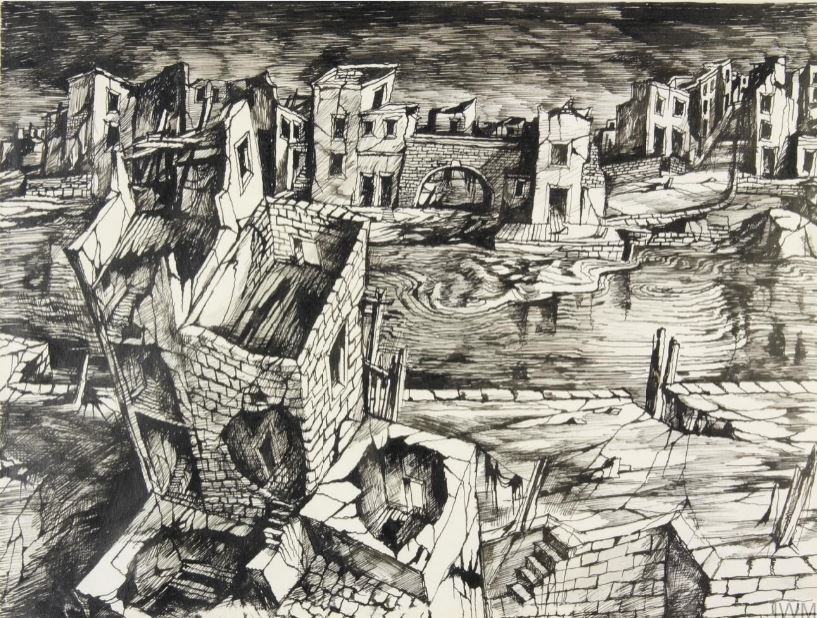
A Town Destroyed, Poplar 1941, by John Minton. Art.IWM ART 15910

Beauty and Destruction: Wartime London in Art

Imperial War Museum, March 20 – November 1

Critics tend to rush by British art of the Second World War: for them there is no contest with the art of the First World War, which was revolutionary and packed with their favoured ‘isms’ – futurism, vorticism, cubism, the aesthetic fallout from Roger Fry’s post-impressionist movement in the years before Western civilisation’s headlong dégringolade to slaughter in 1914.

The art of the 1939-45 war has been judged unambitious and even, in the case of Edward Ardizzone’s work, ‘cosy’. This is unfair. This rather too small exhibition at the Imperial War Museum makes no effort to mount a counter-argument but nonetheless contains many good and affecting things. Probably there wasn’t space to lay out key conversions away from abstractionism and surrealism in the interwar period: that having hymned the world of machinery and progress some artists recoiled from the realisation that technological advances could have very nasty side effects. Thus the world of humans and nature came back into focus.

Then the war cut off Britain from the Continent, and her artists inevitably fell back towards an English tradition for the particular and the romantic. Beauty and Destruction: Wartime London in Art settles for paintings as record, sometimes almost as journalism – but many of the works operate on a much higher level. The show is worked up from Suzanne Bardgett’s excellent Wartime London in Paintings, which came out a few years ago and which is worth getting hold of if you are interested in this subject.

Two beautiful John Minton ink drawings appear early, A Town Destroyed, Poplar, and Looking Down on a Bombed Building by the Thames, Poplar 1941, are small and dreamlike, taking blitzed London and turning it into an inner landscape of melancholy emotion, a sort of visual analogue to Elizabeth Bowen’s wartime stories such as Mysterious Kôr, in which wrecked London ‘is drenched in moonlight’ and looks like ‘the moon’s capital, shallow, cratered, extinct’, and The Demon Lover, in which the evil ghost of a soldier – symbolic stand-in for the malign spirit of war visiting twice in a life – terrorises a woman in her closed-up London home.

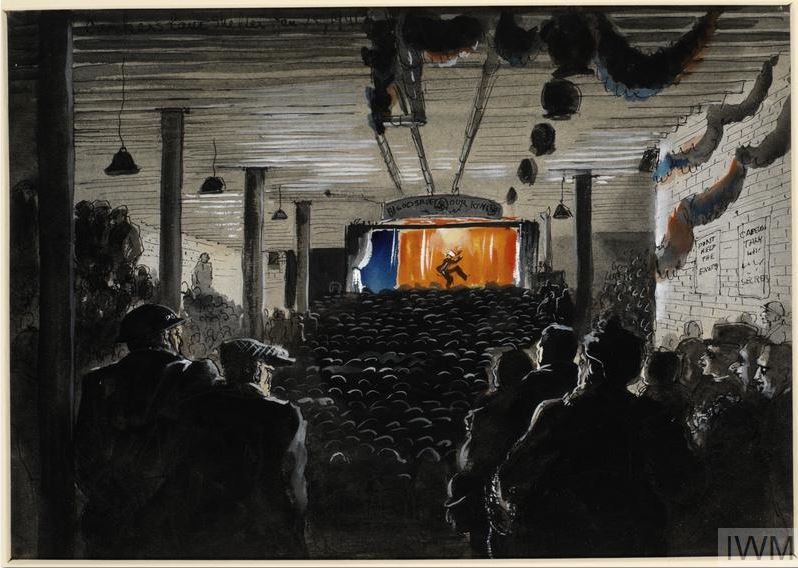
A Concert in a Shelter, St. Pancras Borough (1941) by Olga Lehmann. Art.IWM ART LD 1900
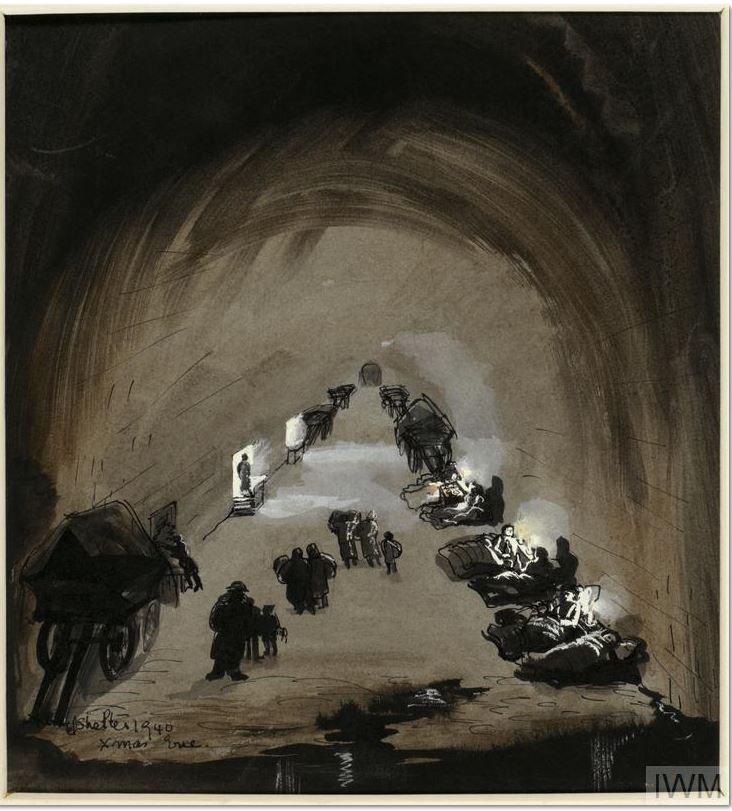
A Shelter in Camden Town under a Brewery: Christmas Eve, 1940 by Olga Lehmann. Art.IWM ART LD 1899

Two ink-and-wash paintings by Olga Lehmann portray the subterranean experience of sheltering from air raids. In the swift, brilliantly realised A Concert in a Shelter, St Pancras Borough (1941), the distant stage is a flash of colour in dark, overcrowded cellar. You can almost hear the ‘shelter cough’. Lehmann’s A Shelter in Camden Town under a Brewery: Christmas Eve, 1940, evokes the dingy grimness and looming terror endured under the streets.

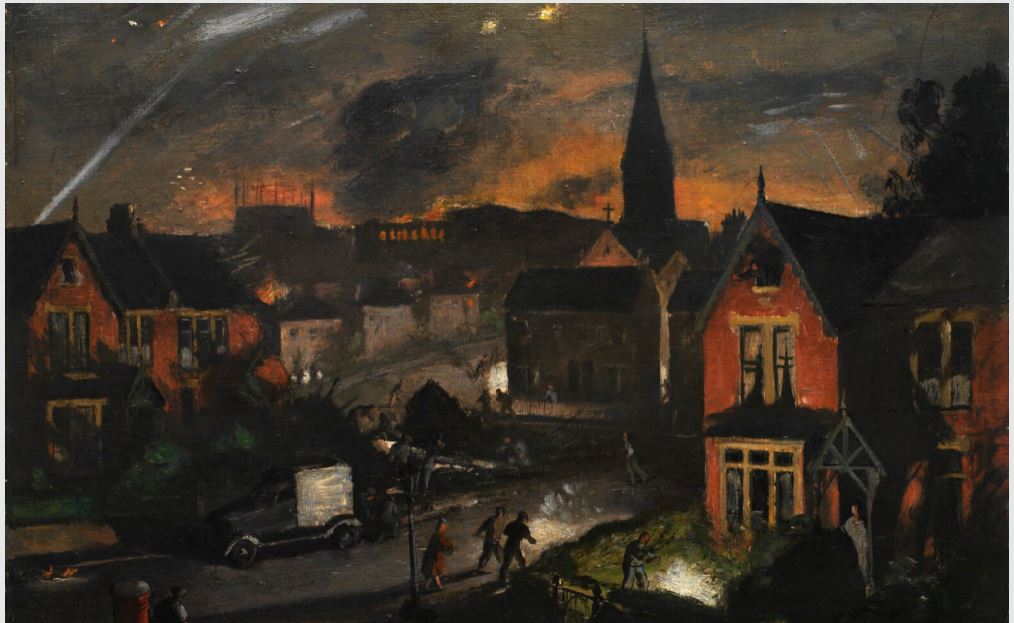
Incendiaries in a Suburb (1941) by Henry Carr. Art.IWM ART LD 1518

The prolific, technically brilliant and now largely forgotten Henry Carr gets a good showing.  St Clement Dane’s Church on Fire after being Bombed crackles away – Carr lights up the Aldwych with the eerie glow of a big blaze. The newspaper publisher Cecil King saw the church burning on the night of May 10, 1941, and said the flames and sparks shooting from its spire was “an odd and rather beautiful spectacle”. Familiar Silhouettes shows squaddies lighting up fags in Piccadilly Tube; A Railway Terminus, a tour de force rendering of St Pancras Station vast and dimmed for the blackout, is blown up to wall size; and Incendiaries in a Suburb conveys the horrific surrealism of war without recourse to actual surrealism. There are the silent, blacked-out, deeply usual London homes but the horizon is orange with a demonic inferno, a searchlight roams the sky in which snarls AA fire, a church and its crucifix stands in silhouette, and piercingly bright alien incendiaries land in gardens, the UFOs of 1941. Humans scramble in the gloom. It is more strange and affecting than Magritte’s Empire of Light.

Priscilla Thorneycroft’s tiny ink drawing from the London Underground, Soldier with Child in the Tube (1940-1941), shows the weariness and strain of the Blitz in the soldier’s face. Kenneth Rowntree’s CEMA Canteen Concert, Isle of Dogs, London, E14 (1941), memorably records the tea-and-sandwiches collectivism of wartime entertainment. Graham Sutherland’s The City: A Fallen Lift Shaft (1941) is more fascinating in the flesh than it ever is on the page. When he saw the broken shaft in a ruin near St Paul’s Cathedral Sutherland said it “suggested a wounded tiger in a painting by Delacroix”.

With a collection as large as the IWM’s it seems strange the show is quite modestly sized. Space should have been found for Charles Mozley’s vivid The Thames Embankment (1940) a favourite of mine. Through misty blue winter London light, we see the view from the Savoy above Embankment Gardens with the National Liberal Club and Parliament in the distance underneath insect-like barrage balloons. A tram whirrs up the road, in the gardens below another barrage balloon is tethered, and to the right looms the ghostly dome of the National Gallery. This was London at the start of her agonies. The pre-war city would take many terrible blows and sustain heavy losses in every sense of the word. Mozley’s ‘monument to a moment’ in time, to use the great David Bomberg’s phrase, is the beginning of the end of the old capital, the city that was so brilliantly brought to life in Vaughan Williams’s London Symphony. The absence of Mozley’s painting is a glaring omission. You can see it here: https://www.iwm.org.uk/collections/item/object/19851

Ardizzone’s large Shelter Scenes, Tilbury, is on show but a few of his pictures from blitzed Silvertown, in the East End, would not have gone amiss. You can see them here: https://www.iwm.org.uk/search/global?query=Ardizzone+Silvertown

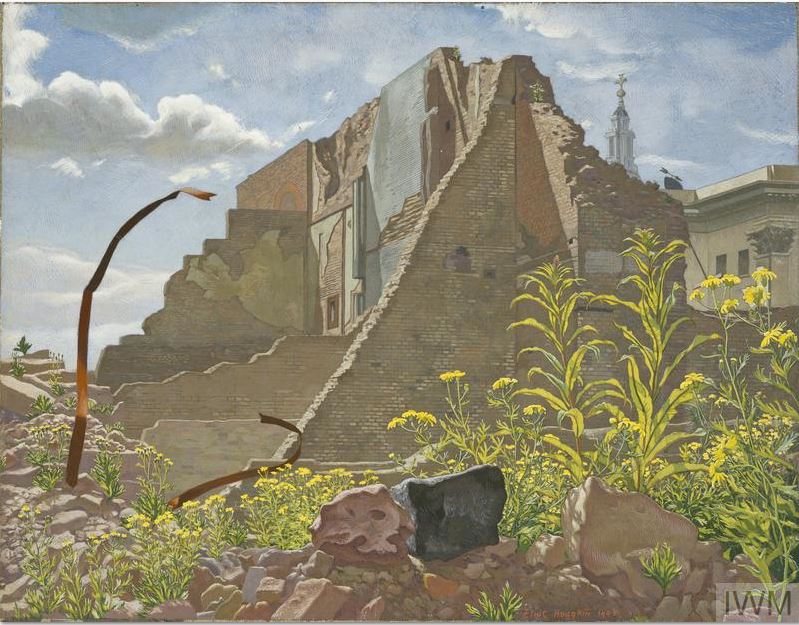
The Haberdashers Hall, 8th May 1945, by C. Eliot Hodgkin. Art.IWM ART LD 5311

Eliot Hodgkin’s wonderful The Haberdashers’ Hall, 8th May 1945, appears, though not at the end of the exhibition where logically it should be. This quiet, almost ironic view of the ruins of the hall with the lantern of St Paul’s rising behind is a sort of understated companion to Paul Nash’s 1918 We Are Making a New World. In Hodgkin’s painting here is the end of the European war, the last day; overgrown with weeds and littered with rubble and bent iron; huge and terrible things have happened; nothing will ever be the same again; meanwhile there is silence save for, perhaps, the faint merry singing of VE Day celebrants in the distance. The future will be along in due course.

On that point it’s a shame the IWM does not possess Carl Giles’s prophetic cartoon from the Sunday Express, August 5, 1945, (the uranium atom bomb ‘Little Boy’ was dropped on Hiroshima the next morning) called It’s Quicker By Rail showing the first appearance of his soon-to-be-famous Family trudging towards or back from their first peacetime holiday along a trainless railway track. https://blogs.kent.ac.uk/specialcollections/files/2020/08/ga5447.jpg The British were moving out of the ruins and into new challenges.

Tang poems in my greenhouse

Inked echoes: Tang verse for young readers

Wenguang Shao, Newsstand, distributed by 300tangpoems.newsstand.co.uk

Maybe it was the gentle splutter of rain on the greenhouse roof and the weak rays of sunlight squeezing through the clouds that focused my attention on the Tang poetry book.  Perched on a stool that had probably never seen better days, I took a break from gardening to read Inked Echoes:  Tang verse for Young Readers by Wenguang Shao.  This beautifully produced large format book seemed, at first, to be a little out of place in my well worn greenhouse.  But the poetry did not.

“On a quiet night, with no neighbour in sight.

A yellow-leafed tree in the cold steady rain,

Or a lamp’s dying glow, with grey hairs that remain.”

Tang poetry is widely regarded as China’s golden age of cultural achievement.  The poems were composed during the Tang Dynasty (619-907 AD) when poets were revered and occupied lofty status. In this time of immense political and artistic endeavour, we could do with poets in Parliament now more than ever, I reflected. I had been listening to Radio 4 and needed to escape from Epstein and Mandelson: “Human affairs endure vicissitudes, with turns and twists: / Events, betwixt centuries, emerge like sudden mists. / On sites of history, words of insight are soberly chiselled.”

We need far more words of insight in these turbulent times.  This poem by Men Haoran tells me that “fierce winds take their toll”.  Clearly, politically and physically – Prime Minister Keir Starmer facing calls for his resignation, and this greenhouse has been reassembled two or three times after fierce winds.

Tang poetry embraces what nature offers us and more generally, our emotional response to the world around us.  Being both a Mandarin and English scholar, Dr. Shao captures the nuances in the translation.  A flock of noisy Canadian geese has just flown overhead and what do I read: “Falling leaves compel wild geese to southward flight; / The rivers chill beneath the northern wind’s bite.”

A van pulls up in a lane near the greenhouse and I hear pop music blaring and shouted greetings.  I read on: “The music dances, echoing on tranquil streams, / Carried by sad winds across the Lake of Light. / The final strains dissolve, the player gone in a dream, / Only a few green peaks remain, spellbound in sight.”

Am I reading an account of the here and now?  Tang poetry is clearly both ancient and modern.  It whispers great truths across the centuries. This book is written primarily for young readers but the young at heart should not feel excluded.  I loiter over the elegant calligraphy of the poems (Dr. Shao’s own hand here) and the gardening is set aside for another day.  This is a book for regular dipping and diving.  Take in two or three poems every day and the world will shift a little into the light.

I will leave the last words with Liu Changqing: “The dying sun descends, and dazzles men’s pride. / Birds roam unaware of hills and vales estranged, / Returning at dawn and dusk o’er streams unchanged.”

I close up the greenhouse and head down the garden path.  The garden can wait, the poet told me so.

Six for 2026

Image: Ralf Roletschek, Wikimedia Commons

As I write this it’s the tail end of January, and I sit at home on the edge of a Pacific Northwest rainforest, which means that it’s one of those times when the miseries of the world threaten to engulf us and the precariousness of the human condition, far from appearing a worthwhile and even noble struggle, seems an infinite rebuke.

Meanwhile, we’ve collectively at least survived the traditional blizzard of Christmas review roundups, and no doubt – unless we’re all blown to smithereens in the meantime – we’ll soon have the inevitable Easter reading recommendations and summer beach-book lists in our sights, until before long the season of mists and mellow fruitfulness rolls around once more, and with it yet more critical effusions, and so on, ad infinitum.

If for no other reason than to get a head start on the whole craze, I offer here a brazenly subjective midwinter lineup of half-a-dozen worthy candidates culled from among the many thousands of our publishers’ new or forthcoming titles, any one of which is guaranteed to warm the reader’s heart in these otherwise unremittingly bleak days and nights.

Matt Haig, The Midnight Train

Like several million others around the world, you may know the basic outline of Haig’s breakthrough 2020 novel The Midnight Library. In short: the book’s protagonist, Nora Seed (even great writers sometimes struggle with names), in her mid-thirties, single and childless, feels useless. Her cat is dead, she’s alone, and she’s been fired. Late one night, she tries to kill herself. Unpromising, I know, but this is where Haig lifts the whole thing out of itself and into the sort of energetically sustained parallel universe that C.S. Lewis might not have disowned. Instead of death, what Nora finds is a library in which each volume represents a version of her life where she made different choices. All she has to do to step into that life is to open the book. You may possibly recognise some of the plot ingredients of the 1998 film Sliding Doors, itself a product of the so-called many-worlds theory in which a new universe beckons from our every choice and decision.

The whole enterprise possibly sounds a bit strained, but in Haig’s hands it delivers the goods as a serviceable get-away-from-it-all novel that works both on the level of a good yarn and a speculative rumination on what we’re really doing during our brief tenancy of the planet. What’s the best that can happen in your life, and what’s the worst? Those are the questions. Without spoiling the treat, The Midnight Train is broadly speaking in the same vein as its predecessor, only – as the title rather implies – translated from a library onto, well, a train. I’ve slightly furtively read about three-quarters of the new book in what publishers like to call uncorrected proof form, and I can confirm it’s well up to par with its distinguished prototype; both have interesting things to say about how hard it sometimes is for any of us to completely accept ourselves for what we are – and, like the eponymous train itself, it all rattles along at a brisk clip.

Canongate Books, April 2026, £20

Malcolm Galfe, Near Horizons

The author here knows his technology and he knows his psychology, and the two combine in seven wonderfully engrossing stories which themselves incorporate elements of horror, sci-fi, mystery, dystopia and good old-fashioned (it never seems to go out of style) human drama.

That said, I’m pleased to report that we’re not exactly in Stephen King, let alone Stranger Things country in Near Horizons. Without exception, Galfe’s tales have a rich, understated texture to them, weaving together a patchwork of tropes and allusions to create something that feels consistently exciting and new. He achieves his effects by tweaking our anxieties and using the suggestive power of good dialogue, not by the sudden arrival of a race of invading pod-people or their like. It’s the literary equivalent of the way in which the best Hitchcock films play with cinematic techniques to tease and torment us, and in its way just as delectable.

As a matter of fact, it’s not entirely illogical to review this title in close physical proximity to the aforementioned Matt Haig; both are neatly crafted, elegantly written, sharp, shocking and often mordantly funny. What raises Near Horizons above the pack of lesser tech-themed morality stories is Galfe’s wise and pitch-perfect ear for dialogue, his grasp of the elements of suspense, and the way he weaves fictional characters into recognisably true-to-life crises in consistently gripping ways.

But if Haig’s book stands as a just slightly over-manicured front lawn, complete with reassuringly familiar garden gnomes and even a fluffy household pet or two on hand, Galfe’s has an authentic touch of the jungle to it: it feels exotic and a little dangerous, often disarming the reader with a page or two of seemingly casual exposition before blindsiding them with a sudden plot twist. Or put another way: these are the sort of stories tailor-made for those of us who like to be both entertained and shocked, and perhaps also secretly comforted by the fact that it’s the characters in Near Horizons, not themselves, being manipulated in this way. There’s something inherently reassuring in the notion that nothing here could ever, surely, happen to us – an almost physically soothing sensation, like a welcome descent into a warm bath when the door is firmly locked and bolted against a storm raging outside. I confidently predict that we will be hearing much more of this supremely assured author in the future.

Woodbridge Publishers, November 2025, hardcover £16.12, paperback £13.05

Cheryl Hines. Image: David Torcivia, Wikimedia Commons

Cheryl Hines, Unscripted: A Memoir

This book shouldn’t work. A memoir written by a 60-year-old actress, who, frankly, has never threatened to become a major film star – you may know her best as Larry David’s foil on the TV series Curb Your Enthusiasm – hardly sounds promising. Then there’s the author’s personal baggage. Since 2014, Cheryl Hines has been married to Robert F. Kennedy Jr., the raspy-voiced US cabinet minister who served as one of Donald Trump’s chief surrogates during his last presidential campaign. Rarely has a book been written that straddles the worlds of Hollywood and conservative politics, let alone those as embodied by the current administration in Washington DC. Yet, against the odds, Unscripted turns out to be an enthralling read.

Essentially, what’s on offer here is a well-told and often deftly comic account of a working-class Florida girl with dreams of doing something in life other than following in her father’s footsteps as the manager of a local Burger King outlet. In time, Hines goes on to catch the acting bug, makes her way to the Universal Studios in Orlando, and promptly finds herself staffing a sex chatline. Next she’s offered a part in a cable-TV show called Swamp Thing, where the script calls on her to do little more than emerge from a large manmade puddle on the studio floor and stand there for a while, topless. Another time she appears on an episode of American TV’s The Dating Game, but isn’t chosen to go on a date.

Life was a bit like that for Hines in the 1990s. This may have been her nadir as a working actress, but it’s the high point of her book, which passes over the serial rebuffs and setbacks in breezy, vernacular fashion, with none of the professional biographer’s tendency to choke the pages with a flat-footed account of names and dates. Things slow down a bit once we settle into the groove of Hines’s long and apparently blissfully untroubled run on Curb, and her equally happy marriage to RFK Jr., but the first act of the show is itself worth the price of admission.

Skyhorse, March 2026, £21.59

Sir Anthony Hopkins. Image: Elena Torre, Wikimedia Commons

Anthony Hopkins, We Did OK, Kid: A Memoir

According to its publisher, this book is a ‘raw, honest and moving account’ by one of our foremost living actors. It’s certainly raw. Hopkins lays out his early life in unsparing detail, as the son of a tough, hard-headed Port Talbot baker who didn’t have much time or sympathy for a son with an alarming tendency to slap on makeup and hang out with the local amateur dramatics society. ‘My mother and father were both prone to depression and black moods,’ we learn. ‘They fought and wept. My father drank heavily, which only fueled his heightened emotionality.’ Anthony Hopkins himself liked a drop in later life, to put it no stronger than that, and proved a less than stellar National Service recruit as a result, often brought up on charges of brawling with his fellow soldiers. The fractious reputation followed him back into civvy street, first in the world of semi-professional provincial theatre, and then the more refined halls of RADA in London.

Hopkins assesses his talent in these days modestly. ‘I could barely speak, and had the posture of a camel,’ he writes. But he worked hard, and never turned down a job. In time he came to the notice of Laurence Olivier, who made him his understudy in a production of Strindberg’s The Dance of Death. After standing in for the great man one night, Olivier complimented him for having ‘walked away with the part like a cat with a mouse between his teeth.’ Even so, the young Hopkins was soon bored by the repetition of the stage, one of those people who always seem to want to be elsewhere, doing something else. ‘I began to feel that acting was just a by-product,’ he writes. ‘I wanted to find value in the rest of my life.’

As with the aforementioned Cheryl Hines memoir, this book most comes alive when charting the uphill struggles of the author’s early career, and rather settles into a holding pattern once we come to see him triumph in The Silence of the Lambs and all the rest. Anyone hoping for rollicking Hollywood scandal à la Bette Davis or David Niven may be disappointed, although Hopkins does allow himself a few disobliging remarks on the late actor Paul Sorvino, with whom he worked unhappily on Oliver Stone’s Nixon. In the absence of gossip, there’s a good deal of what’s-it-all-about rumination on the author’s part, some bits of it more compelling than others. The takeaway message of the book is of the essential strangeness of the acting profession, which, like any intelligent observer, the author sometimes struggles to take entirely seriously. For all the money and awards, I grew to feel quite sorry for Anthony Hopkins as I finished We Did OK, Kid. But that’s because he knows how to tell a story.

Simon & Schuster, November 2025, £25

Bob Spitz, The Rolling Stones: The Biography

Ah, the Stones. By now there have been almost as many books on the old devils as records and concerts by the lads themselves over the course of their sixty-plus year career. In no particular order, we’ve had the late Stanley Booth’s fly-on-the-wall account of the band’s notorious 1969 tour of the United States, ending with their disastrous concert at Altamont; an enjoyably gossipy romp through the narcotic days of the 70s by their factotum and sometime heroin dealer ‘Spanish’ Tony Sanchez; formidably brainy group biographies by the likes of the journalists Stephen Davis and Philip Norman; and, not least, the necessarily sanitised but still quite lively first-hand accounts by Keith Richards, Bill Wyman and Ronnie Wood themselves, all of them estimable enough in their own right, if perhaps betraying the hand of a ghostwriter. Back in the dark ages, there were even biographies of both Richards and Mick Jagger, and a third book (a glutton for punishment, that author) on the band collectively by a character named Sandford, but we needn’t linger on them.

Now Bob Spitz, an American journalist known for his previous works on pop-cultural figures like the Beatles and several lesser groups, as well as his juvenile nonfiction books (in so far as there can truly be said to be a difference between the two genres), brings us this ‘definitive’ account of rock’s bad boys, which he stretches out to the gatefold triple-album length of 700-plus pages. Does it actually say anything new? Yes and no. The basic story is present and largely correct: an initial eighteen months of struggle, followed by ten years of inspired music and personal debauchery – and in turn by five decades of meticulous decline management – might sum it up. Spitz is at his most engaging when he abandons the weary chronological plod, and instead follows the template of Ian Leslie’s triumphant recent dual-biography John & Paul in putting the Jagger-Richards relationship under the microscope. The author takes on the tired polarities – Mick as the uptight details guy, Keith the agreeably wrecked one – by reframing the story as a volatile bromance: ‘passionate, tender and tempestuous, full of love, riven by jealousy.’ However much they were at odds, seems to be the message, Mick ’n Keef were, or are, still an indivisible twosome, the driving force of the Stones, with the others, even the band’s original wayward genius Brian Jones, mere talented add-ons. The cast and basic plot may be familiar, but Spitz has at least succeeded in giving a recognisably human face to the whole star-crossed saga.

Penguin Press, April 2026, £26.14

1918 – Children play on a captured German field artillery gun exhibited in the Mall, London. Image: Wikimedia Commons

Alwyn Turner, A Shellshocked Nation: Britain Between the Wars

It’s always good to find a readable and well-researched variant on the standard schoolroom account of events, which in this case would have had us see the UK of the years 1918-39 as a uniformly grim place, grey, soupily lit and generally austere, somewhere the Great Depression set in like a chill Channel fog and lifted again just in time for the arrival of the Luftwaffe. What’s most striking about Alwyn Turner’s new book, by contrast, are the similarities between those sepia-toned times, seemingly out of some vanished Jurassic social order, and our own. Consider that, in 1922-24, Britain managed to get through four prime ministers; that politicians as a class were said to be ‘uniquely unpopular’, occupying a place in the nation’s affections only slightly more elevated than that of child molesters; that London itself was a soiled, sad place whose inhabitants habitually murdered, stole, lied and cheated as they slithered around in a sea of immorality; that the UK was drowning in debt while simultaneously undergoing the Spanish Flu epidemic that killed an estimated 40-50 million people worldwide, roughly three times more than Covid; and that ‘tariff reform’ divided the nation much as Brexit did a century later.

For that matter, many of the products and institutions of our current daily lives entered service in the 1920s or early 30s. Among other goodies, Turner lovingly catalogues the new confectionery brands manufactured in Britain: ‘Aero, Black Magic, Chocolate Digestive, Chocolate Orange, Crunchie, Fruit and Nut, Kit-Kat, Maltesers, Mars Bars, Quality Street, Rolos, Roses and Smarties.’ That’s not to mention such establishments as the BBC, Butlin’s holiday camps, British Home Stores, NAAFIs, Wembley Stadium and London Transport, or the last’s iconic diagrammatic tube map and double-decker buses.

Maybe the book as a whole tends to be long on lists of this sort, as opposed to locating the human narrative that generally makes a social history come alive on the page, but, that minor cavil aside, A Shellshocked Nation is still a bracing and well-paced read, set against the ever-louder ticking clock of international events, which reminds us why the author’s devoted fans admiringly refer to him as ‘Page’ Turner. You could do much worse than to treat yourself to a copy this winter.

Profile Books, January 2026, £17.99

From the sunbaked south to Nordic shores

The Spanish vega from Caceres. Image: Derek Turner

New from the ever-exploring divine art label comes a collection of often sultry songs by a group of 20th-century Latin composers, beginning with a name that is, perhaps, not at all well-known: Fernando Obradors (1897-1945) a Catalan conductor who, in his relatively short life, does not seem to have strayed far from his native Barcelona.

Six of his short songs, from a large-scale collection – Canciones clásicas españolas – launch the CD, and we are at once in a world of captive hearts, “kisses as unaccountable as the number of hairs on my head”, passionate beating hearts, “rash and painful love”. This is music to mirror a landscape, a climate, a temperament, but also demonstrates the desire of a Spanish national – or nationalist? – composer to establish a lieder/songbook tradition for his country. However, without an equally passionate interpretation of the work, the stories distilled into these intriguing songs would probably not communicate quite as well. That is why we would do well to celebrate the CD’s artists, two US West Coast-based musicians: Esther Rayo, a dramatic soprano voice, accompanied by Sydney-born pianist, Peter Grunberg, who clearly holds the piano part here to be a voice in its own right. Sometimes shimmering, as if in the world of Ravel, or at other times with all the ease of a cabaret song, the piano emerges on this album as belonging to the centre of the stage.

Yet it is Esther Rayo’s voice which leads this CD of seduction – a voice known in the world of opera (Tosca and La Bohème in Italy) and sacred oratorio – an instrument able to switch between the sighs of the song, El majo celeso (“From the lovely person I’m falling for”) to the painful, fatal love of La maja dolorosa (The Sorrowful Woman) by Enrique Granados (1876-1916) – a composer fascinated by the Spain of Francisco Goya. A more modernist vitality informs the music of Xavier Montsalvatge (1912-2022) and two of the South American composers who are also featured on the album, Mexico’s Consuela Velazquez (1916-2005) and Argentina’s Alberto Ginastera (1916-1983) – the latter composer actually having heard the young Peter Grunberg toward the start of his career performing Gershwin’s Rhapsody in Blue.

The spirit of Spanish folk-poetry is again to the fore in six songs by Manuel de Falla, possibly the best-known of the composers featured here – a figure often spoken of in the same breath as Stravinsky, Ravel and Debussy, whose earthy ballet suites combine all the energy of The Rite of Spring, yet mixed with the dances and raw emotions of the rural folk of Iberia – at least, the folk who live in our and the composer’s imagination. This journey through a culture and people ends with the song from which the CD takes its name: Estrellita – Little Star – by Mexico’s Manuel Ponce (1883-1948) – in which the singer implores the light shining in the heavens to: “Come down and tell me if he loves me a little, because I cannot live without his love”.

I listened to these works and wrote this review as the snow settled in early January, the weather service announcing the movement of a “cold front across the country”. But closing one’s eyes and sinking into the warm hillsides and dusty village streets of Spain, Mexico, Argentina, it was as if music had the power to take me to another dimension. The CD, a firm recommendation.

Image: Derek Turner

Yet the cold front did come, musically, too, in the form of a release by Chandos Records of the Gothenburg Symphony Orchestra under the baton of Neeme Jarvi, summoning us on a sleigh ride to the cold Baltic/Nordic coastal areas of Einojuhani Rautavaara’s Cantus arcticus, written in 1972, and involving slow-moving clouds of orchestral sound, occasionally interrupted by the flight of flocks of birds – their calls, recorded, and played over the sound of the Gothenburg orchestra. The composer helpfully demarcates the score with headings such as: The Bog (Think of autumn and of Tchaikovsky) and Swans migrating. Rautavaara seems to bridge the time-span between the world of Sibelius and our own era, responding to the powerful imagery and sounds of Nature in a way which suggests the contemporary preoccupation with ecology, conservation, and an attempt – not to imitate birds – but to make them a living part of music.

Rautavaara’s drifting rhapsody and meditation, though, seems slightly out of place alongside the other two pieces presented by Chandos: the much more 19th-century-sounding ceremonial music of Hugo Alfvén’s Festpel (Festival Play) – all trumpets and courtly pride – and a score to historic derring-do at the time of the Thirty Years War, the Suite to a theatrical production from 1932 of Gustav II Adolf. A sense of national destiny flutters like a battle-standard throughout this telling of the story of the heroism and death of Sweden’s great monarch. The Gothenburg players rise to the occasion, with fervour and brassy pride – but also with some of the clouds and laments of men facing death the next day on the battlefield, but still able to fortify themselves with a tankard and a lively folk-dance.

With orchestral colour and a definite sense of place – and with a cover picture of Northern snows, migrating swans and forests of fire trees – no lover of rich orchestral music would want to be without this excellent Chandos recording.

CD details

Estrellita, Esther Rayo and Peter Grunberg, piano, divine art, ddx 21145

Alfvén, Festpel, Suite from Gustav II Adolf; Rautavaara, Cantus Arcticus, Gothenburg Symphony Orchestra, conducted by Neeme Jarvi. Chandos Super Audio CD: CHSA 5386

The importance of ephemera

The Lost Folk

Lally MacBeth, London: Faber & Faber, 2025, hardback, 340pps., £20

Britain’s folk culture is world-famous, and perennially popular – the Abbot’s Bromley Horn Dance, Padstow’s ‘Obby ‘Oss, Lewes’s Bonfire Night, and Lincolnshire’s Haxey Hood Game, to name just some of the rituals that even in a digital age help anchor the English to their earth. In recent decades, a young generation of “new countryphiles” have become involved in folk culture, joining in with traditional festivities and activities like Morris dancing and well-dressing, yet also exploring new ways of expressing identity and strengthening community.

Lally MacBeth is a representative figure among these countryphiles, as founder of the Folk Archive to foster interest in new forms of folk culture, and co-founder of the Stone Club, which celebrates Britain’s Megalithic monuments. In this, her first book, she builds on her Folk Archive work to call for greater recognition of folk objects that too often go unnoticed, and to help formulate a folk culture fit for the future. She is herself a Morris dancer, and an apparently indefatigable collector of curiosities – trawling charity shops and car boot sales in search of whatever is autochthonous, personal and locally distinctive, from church hassocks to horse brasses, pieces of old costume to tourist ware tea-towels, and shop fittings to pub signs.

Her own interest was sparked when she came across a photograph of her great-great aunt, taking part in a 1934 Ludlow pageant of Milton’s Comus – such pageants a form of folk culture now extinguished, and not even generally considered as being aspects of folk culture. She has concluded that folk culture, as conventionally defined, is too categorically confining – the filtered choices of a particular class at a particular period, now become stale and tired.

Folk culture builds community by formulating folk memory and repeating rituals that can link classes and generations to each other, and all classes and generations to particular places. MacBeth is right to aver that folk culture can be fostered by institutions as well as by individuals; churches can be repositories of folk beliefs and folkish items, and county councils can be custodians of local character. The author pays overdue tribute to many different kinds of people – dance teachers, event organisers, gravestone carvers, preservers of vernacular buildings, signwriters, topiarists, and yet others – whose largely unsung activities have helped perpetuate local distinctiveness.

Folk items can be reassuringly solid – like the eleventh century reindeer antlers used at Abbot’s Bromley, shell grottoes, ships’ figureheads, or model villages like Buckinghamshire’s Bekonscot. But they can also be disconcertingly ephemeral – badges, costumes, posters, or even sandcastles that only stand for a day. They can even be ideas – like the piquant folk-memory that a statue of Pan was once carried in church processions in the Gloucestershire town of Painswick.

The only locally distinctive items she wants to exclude from her ethnographic catalogue are “problematic and offensive historical language.” She accuses the folksong collector Cecil Sharp of recording “incredibly racist dance practices,” and creating “a folk world that suited him: sanitised, classist, racist and very, very male.” She loathes the blackface traditionally used by some Morris sides, for reasons that until the 1970s were considered more or less innocent (albeit infra dig). She expends anguished paragraphs on one solitary Morris side which has so far resisted pressure to whiten up its act. One can understand why such things make the author uneasy; yet is this not ‘sanitisation’ of the kind of which she accuses Sharp? Sharp, it should be noted, was a Liberal and a progressive, who for several years collaborated productively with the socialist collector-dancer Mary Neal (although they later fell out).

Morris dancer at Rochester Sweeps’ Fair. Image: Derek Turner

The author’s well-intentioned wish to embrace folk objects of all kinds from all kinds of marginalised or newly-arrived communities carries the obvious risk of ultimately overwhelming globally unique native objects. Folk culture allows communities to define and defend themselves – as the author says, to “feel a sense of home, and a sense of belonging.” But if everyone is to ‘feel at home,’ can anyone actually be at home? Authentic folkish manifestations are spontaneous responses to specific situations in space and time, as ‘instinctive’ and enjoyable as treading the measures of a Morris; should they also be objects of anthropological Angst?

The author is on easier ground when she asks us to honour undeservedly overlooked figures like Florence Elsie Matley Moore, who devoted much of the 1930s to painting, photographing and restoring Worcestershire antiquities and popularising country dances. Somerset’s Ruth Tongue emerges engagingly as eccentric fabulist-folklorist, who alienated more serious-minded students of folklore by toying with traditions, and claiming to speak with fairies. So too do Pamela Colman Smith, folktale-teller, occultist and Tarot card illustrator – and poor, paralysed Nellie Sloggett, who forged a successful writing career from her bedroom in Padstow, regaling readers with lively tales of ‘piskies’ and other Cornubian conceits.

Raconteurs help perpetuate folk-memory as much as scholars like the 1930s writers Dorothy Hartley and Florence White, who recorded country cooking and other crafts, or the oral historian George Ewart Evans, whose classics Ask the Fellows Who Cut the Hay (1956) and Pattern Under the Plough (1966) recorded authentic voices of rural Suffolk that were soon to be stilled. Fond fantasies as much as facts help underpin rescue and restoration efforts like those carried out by the too little known “Ferguson Gang” – five admirable women who between 1927 and 1957 helped raise huge amounts of money to save areas of the West Country threatened with development.

Whatever reservations we may have about some of the author’s political stances, she deserves commendation for calling such people to mind. She also deserves credit for raising important questions about the nature and future of ‘folk’ in an age of mass movement and social media shallowness. Yet in the end folk culture may not be amenable to even the most earnest analyses, and will evolve in its own way. As the author herself observes, folk culture is “…inexplicable, something that just is.”

Musical winter warmers

Silver buckthorn under snow. Image: Derek Turner

Samuel Coleridge-Taylor, orchestral works, SOMM CD 0713

E.J. Moeran, Symphony and Violin Concerto, SOMM ARIADNE 5045

Arlene Sierra, Birds and Insects, BRIDGE 9599

Vaughan Williams, Mantegna, ALBCD067

Samuel Coleridge-Taylor (1875-1912) was a man of half-English and African descent, a composer in a monocultural Britain who was championed by those quintessential musical knights, Sirs Edward Elgar and Malcolm Sargent, and who was thought to represent a vital new generation in our cultural life. Yet Samuel died in poverty – and still in the prime of life. Who knows where his musical star might have guided us?

But on a new recording from the ever-adventurous SOMM label, we are able to savour an orchestral march – championed by Sir Henry Wood – that could easily slot in alongside Elgar’s famous contribution to the military oeuvre. In Coleridge-Taylor’s Ethiopia Saluting the Colours, we find – not a piece about mystical African Emperors, their cult and country’s ability to defeat European outsiders – but a touching story-in-music about a slave in the Carolinas – named Ethiopia – giving thanks to the Stars and Stripes, as flown by the Union Army in the latter stages of the American Civil War. Of course, there are many Southerners who have not forgotten the scorched earth policy of General Sherman as he ‘liberated’ the country known as Dixie, but historical controversies aside, listeners have the chance to savour Coleridge-Taylor’s semi-Elgarian style – not to mention the rich tone of the Ulster Orchestra, under the baton of Charles Peebles.

Other works on the disc also capture the Victorian-Edwardian period feel of the music, with Rebecca Murphy, soprano, the soloist in Zara’s Earrings, Op. 7 – A Moorish Ballad, with text by John Gibson Lockhart (Walter Scott’s son-in-law, and biographer). Ioana Petcu-Colan relishes the solo part the quarter-of-an-hour in length Ballade for Violin and Orchestra in D minor. A Brahmsian lyricism, but somehow sweeter than the original tones of the great Johannes, is never far from the surface. Lovers of the music of the English Musical Renascence will enjoy this collection enormously.

E.J. Moeran, who died during a storm on the coast of Eire in 1950, was a symphonist and tone-poem writer, able to establish an immediate atmosphere of landscape and folklore in his music. Of Irish descent, Moeran was born in England, and absorbed all the loneliness of the East Anglian coastal marshes and sands, earning the praise of fellow composer, Lowestoft-born Benjamin Britten. Yet despite Moeran’s Englishness of fen and meadow, and a beery period of mugs of ale and madrigals in the North-West Kent village of Eynsford with characterful composer, Peter Warlock, it was to an almost imaginary Ireland that E.J. – or ‘Jolly Jack’ – was drawn. His Violin Concerto, completed in 1938 and inspired by Kenmare Bay, seems to assemble every part of his character, and it is the one major work of Moeran which concert-programmers turn to on the rare occasions that the composer is even thought of these days. On a new CD from SOMM Recordings, founder and director, Siva Oke (with painstaking audio restoration from Lani Spahr) brings a 1946 live broadcast from St. Andrew’s Hall, Norwich, into the sound-world of 2025 – with the BBC Symphony Orchestra and soloist, Albert Sammons, conducted by Sir Adrian Boult.

Longer than the concerto by some 15 minutes, the CD also features the Symphony in G minor, a piece that is filled with lyricism and impetuous outbursts of energy – again, mirroring the composer’s stormy and unpredictable character. Those familiar with Bax’s Celtic twilight symphonic output will relish the Moeran, enjoying along the way the muscular playing of the BBC Symphony Orchestra of 1949 (again, under Boult) and a finale every bit as exciting as that found in Sibelius Fifth and Walton’s First symphonies.

Sarus Crane, Cornish Bantam, Thermometer Cricket, Lovely Fairywren – these are the magical titles of short pieces which comprise Books 1, 2 and 3 of Arlene Sierra’s collection devoted to Birds and Insects. A walk through a modern Natural History Museum, or a contemporary-music, natural-history sound-installation, Arlene’s music casts a strange spell – as if you were about to disappear into a fantasy of Nature. Arlene is an American composer, but London-based and has enjoyed many collaborations with leading orchestras in Britain, Japan and America. Although very much her own, distinctive, modern yet approachable style, the music seems to stand alongside similar evocations of birds by, for example, Messiaen or Ravel; and a feeling created for the listener, very much like the Japanese composer, Takemitsu, in A Flock Descends into the Pentagonal Garden. As complex and miraculous as the delicate bodies of the creatures it represents – the music wafts from the trees, canopies and cover of the forests and woods where its inspirations live their lives. In the hands of pianists Steven Beck and Sarah Cahill, I can think of no better album of contemporary music this wintertime.

Finally, great hymn tunes abound in a CD from Albion Records – Mantegna – so named because of the 15th-century artist, painter of The Agony in the Garden. The atmosphere of Passiontide and Gethsemane is very much to the fore, in Vaughan Williams’s setting of Sidney Lanier – an American author and poet who served in the Confederate Army in the Civil War: “Into the woods my master went,/Clean forspent, forspent;/Into the woods my master came,/Forspent with love and shame… ‘Twas on the tree they slew him, last,/When out of the woods he came.’

All People That on Earth Do Dwell (the ‘Old Hundredth’) – RVW’s famous arrangement, used at the Coronation of Elizabeth II – and the tune King’s Lynn make for inspiring listening, with the words of G.K. Chesterton: “O God of earth and altar,/Bow down and hear our cry,/Our earthly rules falter,/Our people drift and die…’ Although the son of a Gloucestershire clergyman, Vaughan Williams – though inspired by Christian culture and belief – remained an English agnostic for all his days, yet even in his deep, harmonic hymnody, misty mornings near coastal East of England churches, the Norfolk Rhapsodies and the horizons of Wenlock Edge are never far away. William Vann, the Dulwich Choral Society and the London Mozart Players (the ensemble due to open the 2026 English Music Festival) give a full-bodied and well-recorded performance.