For some it is all about vexillology. For some the study of the flags being waved defined the evening. For the Daily Mail, the plentiful EU flags were a clear and obvious betrayal of Brexit. But they chose not to notice the quite resplendent union jack blazer on display in a plush box or the St George flag shirt (mine) on display in the stalls.
I had to look up another dominant flag being waved in the hot, sweltering arena. It was the flag of Norway to honour the statuesque mezzo soprano Lise Davidsen. Her voice soared around the Royal Albert Hall as she embraced arias by Wagner, Mascagni and Verdi. She stands tall – indeed, the same height as conductor Marin Alsop even as she is perched on the conductor’s podium. Lise’s dresses (three changes) were wonderfully theatrical and created for her for the evening by Norwegian designer Carejanni.
The programme was diverse, adventurous and traditional. The perfect mix. Max Bruch’s Kol Nidrei was played with great sensitivity by star cellist Sheku Kanneh-Mason, who for one piece took up a solo location in the centre of the arena, giving the ardent Promenaders, many of whom had queued since early that morning, a privileged view.
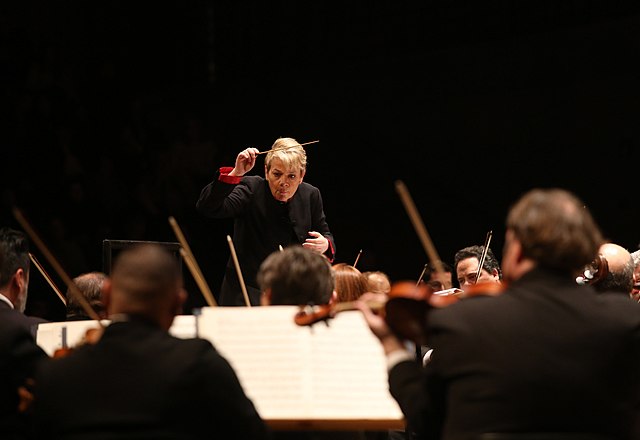
Marin Alsop in action in 2017. Image: Mastrangelo Reino /A2img. Wikimedia Commons
We had three world premieres with the composers present and spotlighted after the performances – James Wilson’s 1922, Roxanna Panufnik’s Coronation Sanctus and Laura Karpman’s Higher Further Faster Together. You felt the strong guiding hand of Alsop in these choices. She is a pioneer of new music and, as she said in her closing speech, gender equality in classical music. She was even brave enough to mention Aberystwyth as a location of a Proms concert next year. She admitted she had been practicing the pronunciation all day. I imagined the maestro stalking the back rooms of the RAH not with a Verdi score but a guide to Welsh place names. Let’s hope Llanfairpwllgwyngyllgogerychwyrndrobwllllantysiligogogoch puts a bid to host one year. Marin will certainly earn her fee.
It was a party atmosphere but tempered by reverence for the performers. The BBC Symphony Orchestra played their hearts out, and the loudest sustained cheers were for the BBC Singers, once threatened with extinction but now sort of reprieved (we must remain vigilant to keep them a going concern). The BBC Chorus was full of gusto for Jerusalem and Land of Hope and Glory and the concluding Auld Lang Syne when our collective voices drowned out the orchestra. Marin turned to conduct us all as balloons were sent soaring and crackers were set off almost in time to the music. This was a profound, passionate celebration of classical music with the barriers of elitism and traditions dissolved into pure joy. In one evening we had the soaring wonders of William Walton’s Coronation Te Deum for the coronation of Queen Elizabeth II and the festive and glittering Coronation Sanctus of Roxanna Panufnik composed for King Charles III’s coronation service and the theme from the upcoming film The Marvels by flamboyant US composer Laura Karpman with Marvel Comics celebrating super heroines; very appropriate given Marin Alsop’s absolute control over the proceedings. Super Marin, perhaps.
MARTIN GODLEMAN witnesses Sir Simon Rattle’s LSO swansong
Sir Simon Rattle. Image: Monika Rittershaus. Wikimedia Commons
I should have had a more pronounced focus on advanced ticket sales of Prom 56 when I casually noticed that Simon Rattle would not only be present at the eight week festival of music, but there to conduct Mahler’s Symphony No.9 [27 August, but available until 9 October on BBC Sounds].
Rattle, himself British-German, was born in Liverpool in 1955, the same year that the International Gustav Mahler Society was established. Needless to say, the concert had sold out almost immediately by the time I had become aware of it. Fortunately, thanks to a generous and industrious benefactor, I managed miraculously to procure a seat for myself just a week before the event.
Mahler, an Austro-Bohemian, actually earned his living at the turn of the 20th century as a conductor of opera, interpreting the stage works of, amongst others, Mozart, Tchaikovsky and Wagner. His was a career that led to his post as director of New York’s Metropolitan Opera. On his days off, most of which he must have spent travelling across the world from concert to concert, he managed to somehow find time to attend to his other passion as a composer, one that brought him little financial success in his own lifetime, but one which, thankfully for us, he never abandoned.
Perfect then that Rattle, whose lifespan covers the years over which Mahler’s reputation as a composer has been established, should conduct him. Equally sublime that Rattle, for whom this is a final UK outing as Music Director of the London Symphony Orchestra, should choose to conduct Mahler’s farewell symphony, the ninth. Rattle himself was knighted in 1994, eight years before becoming principal conductor and artistic director of the Berlin Philharmonic, then taking on the challenge of Mahler’s Symphony No. 5 at his opening performance in September 2002, almost exactly 21 years ago.
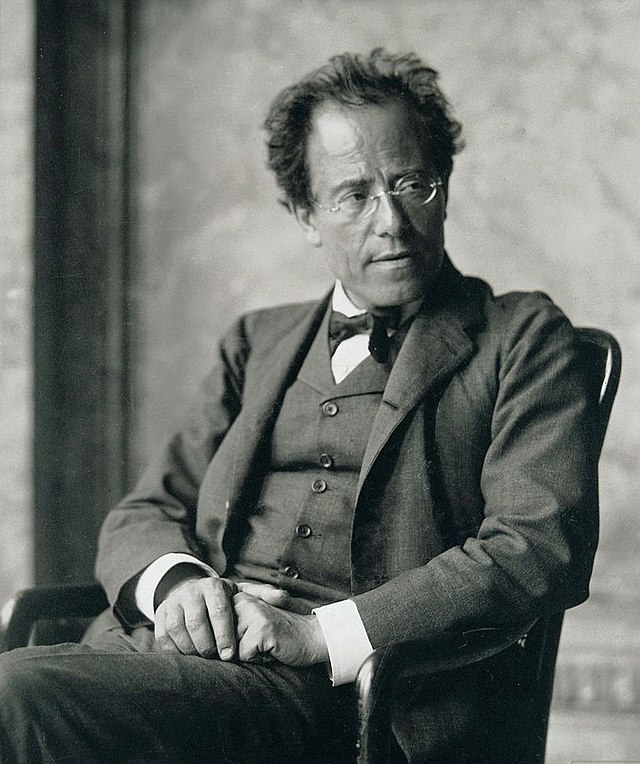
Gustav Mahler
I had been fortunate enough to attend Mahler’s ninth at the Proms before in July 2011, when Sir Roger Norrington conducted the Stuttgart Radio Symphony Orchestra in his final concert with them. The appeal of this piece of music to orchestrate a professional farewell from one’s role as principal conductor of a world-renowned orchestra was therefore not lost on me, or indeed Rattle. Few conductors are recognisable from outer space, but I’d wager that any alien with a penchant for classical music would immediately recognise the white, crimped locks of Rattle, monochromous tonight against his smart black livery.
Rattle takes initially to the podium to conduct the BBC Singers performing Poulenc’s Figure Humaine, a cantata, a hymn to freedom, dedicated to Picasso and composed in 1943 during the Nazi occupation of France. The BBC Singers were also behind its premiere in London, in English, on Palm Sunday, 25th March 1945 – the score having been smuggled over to the UK five months before the war ended. A beautiful and intense choral work, chosen specially by Rattle who has described it as ‘profoundly moving; one of the greatest masterpieces that people don’t know.’
It was tonight the perfect appetiser for the evening’s main course, radiant in energy and harmonic, a choral masterpiece against tyranny. Rattle makes a point of leading out Sofi Jeannin, the Swedish chief conductor of the BBC Singers, to share the applause she has paid a central part in promoting. Then, after a short rehydration break, the conductor faces his ‘farewell’ challenge with the LSO, a group of people he has on more than one occasion described as his ‘family’. There is something religious about the falling silent of audience, orchestra and conductor before the onset of a final performance, whether it be of the night, a concert series, or of a career in post.
The ninth is, I would argue, the most self-consciously reflective of all of Mahler’s works, its tone set by the ponderous and lugubrious opening to the symphony, so alien to any of Mahler’s other, bolder dramatic initiations. I am gripped in anticipation by that silence. What a man is Rattle that he can let the whole of this majestic, mysterious and magnificent piece of music inhabit him as he hangs over that silence, ready to conduct.
Through Rattle, Mahler’s work tonight occupies a landscape of sound, narrating a man’s pain as cuckolded husband, unrecognised composer, dying… a man who was intimately aware of his own fate. James Joyce once said that for anyone to be serious about the study of his writing, they would have to be prepared to dedicate a lifetime to the task. For me, this single piece of music cries out for the same attention.
I find myself drawn to the horn section, and tonight the emotion of the opening movement is cradled by the subtlety of their handling of its many hanging moments. With his back to me, I cannot see Rattle’s cheek puffing, his teasing out of the connect between the players and the piece, but I can see them looking up at him, their eyes smiling. His family. The tiny mallets skilfully tap out the ringing of the tubular bells at the edge of that first movement; the climbing and scaling of the players across the terrain that Mahler has challenged them to cove. From the roof of the piccolo to the floor of the contrabassoon, Rattle weaves them in and out of the musical foliage.
It is a wondrous performance, and like the knowledge of death that Mahler hints at across the piece, the experience tonight is ultimately mortal. At the end of the first movement, Rattle nods knowingly in judgement of what we have all experienced, players and audience alike. I wonder at how effective my ears are tonight. Like reading a book at 18 and again at 65, the words, the notes, are static on the page, only ever brought to life by the human experience. As the orchestra move gently, urgently, left and right, I contemplate the cold fact that Mahler never heard or directed this piece himself. It only ever moved in his head, as he wrote it. What would he think about all of this? This performance 114 years on from the writing of it, conducted by someone whose love of the work has given us all this sublime evening. The thought is worthy of something with which to underpin tonight’s unforgettable experience.
STUART MILLSON (celebrating his 43rd season) reports from the 2023 Proms
‘Where are the Proms of my youth?’ asked Barrie Hall’s now almost forgotten book, The PromsandtheMenWhoMadeThem – a title that would be unlikely to pass the sensitivity readers of today’s London publishers. When I first attended the Proms, one joined a queue (along with all the other sixth-formers and undergrads) for the Gallery or Arena. You paid your few pounds at a little booking-office-type hole on the south side of the Royal Albert Hall and in you went. For the Last Night, people camped outside on the pavement near the Hall’s South Steps for two weeks, just to ensure a place on the front rail of the Arena, or close to it. Today, Promenaders no longer queue up: you book your Arena or Gallery ticket online. And the Last Night camp was abolished years ago, on health and safety grounds.
There have been changes in the repertoire and in presentation: this season, the BBC Concert Orchestra collaborated in a Northern Soul Prom – something that would have been virtually unheard of in the days of past Controllers of Music and Directors of the Proms (although Soft Machine did manage to creep in under Sir William Glock’s radar in 1971). Have such initiatives opened up the Proms to a younger audience? I am not sure. In 1983, the Arena was composed of 75% youth, 25% oldies. The ratio seems to have reversed. So more work needs to be done – perhaps more classical music, less Northern Soul, or at least another type of soul from the North.
Sir William Walton. Image: NPG (Wikimedia Commons)
For the 3rd August Prom, given by the BBC Philharmonic (formerly, BBC Northern Symphony Orchestra), Oldham-born William Walton (1902-83) provided the centrepiece of the concert, in the form of his Violin Concerto of 1939 – a work inspired by the composer’s abiding love for Italy and its riviera. Tinged with Mediterranean sunsets and shadows, and containing many moments of deep lyrical introspection and unbridled romanticism, the Concerto nevertheless provides some ferociously exciting and incisive sections for both soloist and orchestra. Playing the solo part that night was Manitoba-born James Ehnes – a musician renowned for his interpretation of Walton – and one who finds the true measure of a composer too often seen as something of a steely recluse, but who, in his heyday, was a determined, passionate and often avant-garde figure.
The Violin Concerto (like the stormy First Symphony written some four years earlier) has a surprise up its sleeve for the listener – a break from all the heavy preceding passion via a ‘presto’ movement, laced with a dash of jabbing, smirking, sardonic humour; softened by a waltzy, Neopolitan dance rhythm – the effect, like a generous glug of wine tipped into a glass during a fiesta. The movement, though, also broadens out into a serious nocturne: dreamy, intense; the dissatisfied Englishman abroad sinking into his local surroundings, yet thinking (perhaps) of glimpses of home. But for Walton after the Second World War, ‘home’ ceased to be England; with his new Argentinian wife, the composer turned his back on queues and nationalisation, settling on the little isle of Ischia out in the Bay of Naples. Continuing to compose, he produced such fine pieces as his Cello Concerto and a grand opera, but never quite recapturing the ardour and brilliantly-written soundscape of the Violin Concerto. As author Laurie Lee once observed: “All the great hymns to the sun are written in cold garrets.” When you are in the sun, you just… sit in the sunshine.
Image: Daniel Nyblin (Wikimedia Commons)
Sibelius’s Symphony No. 1 ended the concert. In a lifespan similar to that of Vaughan Williams, Sibelius lived from the era of empires and Grand Duchies, to the atomic age and world order of the United Nations. Yet throughout the changes remained rooted to a vision – and a physical reality – of an unchanging landscape and heritage. In his music, Nordic deities make brief, spectral appearances through endless pine woods; swans in flight sweep like angels across frozen lakes, on corridors of cold air – and at night, bards tell tales of heroes and worlds gone by. The First Symphony comes from 1900 – or rather, it was revised in that year, because it is essentially a late-19th-century piece, influenced by the dense harmonies of Tchaikovsky, but still (in the opening movement) showing signs of the fleeting, sparkling, supernatural Northern Lights that characterise the fully-individual works that would come – the kind of delicate, subliminal Nordic Impressionism of, say, the Sixth Symphony. Conducted by the Finnish maestro, John Storgards, both Walton and Sibelius found a worthy interpreter.
Just a word about the opening piece, Kafka’s Earplugs (a BBC commission for Irish contemporary composer, Gerald Barry, born 1952). Not even the Kafka title and the composer’s self-described “sense of humour, which I obey” could rescue this ten-minute monotony – and mediocrity. As the piece ended, one member of the audience shouted: “Totalrubbish!” Who are we to disagree?
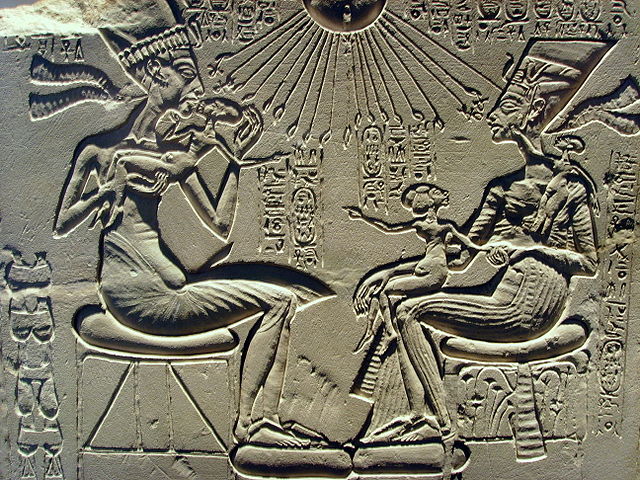
Akhenaten, Nefertiti and their children. Image: Wikimedia Commons
RICHARD DOVE revels in Akhnaten at the ENO
“The thing about Philip Glass is that there’s so much repetition.” A friend pronounces his verdict. Well, yes, but what repetition. The ENO revival in association with LA Opera with the third of Glass’s so-called ‘portrait’ operas, Akhnaten, is entrancing. The set is a multi-level tableau of slow-moving interpretation and quite a bit of juggling. The jugglers are there to symbolise, I think, an imposition of order on the chaotic religious miasma that was ancient Egypt. King Amenhotep IV succeeds his father and declares a monotheistic religion with him, unsurprisingly, at its pinnacle.
The music swoops, swirls and glides across the narrative with the singers seeming to provide accompaniment for the orchestra and vice versa.
Glass had to do shifts as a New York taxi driver alongside regular plumbing jobs to help fund (and subsequently pay for production losses) his first portrait opera, Einstein on the Beach, which he developed with the grandiloquent imagination of Robert Wilson. He began by performing in sparsely attended recitals in New York lofts. Slowly, opera houses around the world caught up with Philip Glass. His second portrait opera on Mahatma Gandhi, Satyagraha, was a resounding and enduring success.
Akhnaten is now almost 40 years old and Glass has moved from the fringe to the mainstream. He is now chauffeur-driven.
American counter tenor Anthony Roth Constanzo has made the role of Akhenaten his own, appearing in productions in 2016, 2019 and now in this revival. He shows no signs of weariness with the role, commanding the huge stage with his soaring voice and subtle, precise gestures. His wife, Nefertiti, is an equally commanding presence, with mezzo soprano Chrystal E Williams delivering power and gravitas.
Phelim McDermott’s production is bold and sometimes a little baffling when images override meaning – a sort of Zoolander moment or two amidst the creative visual excellence.
The Coliseum was packed for the performance – ENO at its very best. The attempt by the Arts Council to shift it out of London is gesture politics at its most egregious. Let’s have more ENOs in Lincoln, Newcastle, Plymouth as well as London. We all need doses of cultural excellence, as bills mount and services decline.
The audience is wonderfully diverse and soundly engaged despite the singing in Egyptian, Hebrew, Akkadian and English. You do not need surtitles to get the gist. We are now well attuned to small dictators marooned in gilded palaces. It was only in the late nineteenth century that the remains were discovered of the city Amarna built by Akhenaten. In 1907 a mummy was unearthed that is most probably Akhenaten. The body was effeminate with womanly hips, elongated skull and fleshy lips, giving rise to speculation that he suffered from rare diseases. His androgynous appearance is cleverly portrayed in the opera. Akhenaten, the Sun King, is variously described as enigmatic, mysterious and revolutionary as well as mad and possibly insane. This production captures all those contradictory passions in a magisterial sweep. It is certainly repetitive but gloriously so. I will let my friend know.
STUART MILLSON enjoys some neglected gems of British music
Why does the spiritual toll of the Great War seem to have been harsher for Britain than for any of the other European combatants, asks organist, scholar, music-writer Robert James Stove, in commentary for a booklet which accompanies a new CD on the Australian Ars Organi label. His answer is clear and convincing: ‘… the innate stability of British political institutions meant a lack of opportunities for citizens to work off their war-neuroses by revolutionary activism, as agitators did on the Continent.’ Only in a marginal way did iconoclasm and an avant-garde spirit affect Britain, post-Passchendaele: for every Vorticist there was a Vaughan Williams offering benediction, although few realised that the composer’s Pastoral Symphony of 1922 was inspired by his own experiences of service on the Western Front. (Listen more closely to the ghostly, wordless voice in the unsettling final movement…)
The new recording, a superb audio curation of British music made in the magnificent acoustic of Our Lady of Victories Basilica, Camberwell, Victoria, Australia, assembles less-well-known names from the canon of Albion’s musical renascence. Alongside John Ireland and Vaughan Williams, for example, are Thomas F. Dunhill (excerpts from his ThreeChiddingfoldPieces), Sir Walter Galpin Alcock (Westminster Abbey organist at three coronations during the high-tide of Empire) and Alan Gray (successor to Stanford in the organ loft at Trinity College, Cambridge).
All works and composers chosen by the Ars Organi Recordings for this collection have in common a profound attachment to English tonality (although Norman Fulton, at CD track 11, is a Scot). It is as if the music of our islands is a mirror-image of the (physical and psychological) architecture of the very institutions that have long-governed us. The slow-breathing, hushed voices of churchgoers, a ray of wintry light, piercing through a cathedral window like a gimlet; a sense of eyes being drawn toward the pinnacle of a Norman arch – these are some of the feelings and imaginings inspired by many of the works, some of which are ethereally-enhanced by the participation of singers Elizabeth Barrow (soprano), Brigette De Poi and Emily Tam (mezzo-sopranos), Leighton Triplow (tenor) and bass, James Emerson.
John Ireland’s TheHolyBoy and a George Herbert setting (TheCall) from Vaughan Williams’s FiveMysticalSongs are probably the best-known pieces in the entire collection. Peter Warlock’s old English carol, Adamlay Ybounden, also finds an occasional place in concerts and Radio 3 schedules. But who knows the music of the composer, whose work concludes the CD: Geoffrey Turton Shaw? A near-contemporary of Vaughan Williams, he served as a school inspector and was himself schooled by that master of church music, Sir Charles Villiers Stanford. Setting Milton, Ringout, yecrystal spheres/Onceblessourhumanears… Turton Shaw embodies all the virtues of his genre and world, confirming the past, present and future solidity of English music.
The music of a Welshman, Daniel Jones (1912-1993) makes up another important collection of lesser-known music from our shores, in a well-presented four-disc set from Lyrita Recorded Edition. Many will remember the remarkable ground-breaking Lyrita vinyls of old: symphonies by Bax and Rubbra, John Ireland songs, TheMagic Island by William Alwyn, and a record that particularly caught my eye when I first came across it in the record department of Foyles, some 40 years ago – Ireland’s Forgotten Rite, Legend, Mai–Dun and Satyricon – with its strange, haunting cover-artwork; a picture which hinted at the form of a landscape, with dotted colours and distances just out of reach. In fact, if I were to try to find a simple, neat description of Daniel Jones’s music, it would come close to those suggestions inspired by the Ireland graphics – although this enigmatic composer (a code-breaker during World War Two) never really embraced, at least self-consciously, folklore and the symbolism of place. He tended to think of himself as a composer who happened to come from Wales, rather than an artist who had a civic responsibility to proclaim a culture – although he did write a major choral-orchestral piece, TheCountryBeyondthe Stars, which – post-Festival of Britain – seemed to have an ambience of dreamy peninsular coasts, beacons and Black Mountains.
Perhaps the nearest he came to a home-spirit, an imprint of Welshness, was in his DanceFantasy, performed at the 1982 Proms by the (then) BBC Welsh Symphony Orchestra under Bryden Thomson – although the work still seemed somewhat set apart from Welsh dances and Celtic legends by fellow-countrymen Hoddinott, Mathias and Arwel Hughes. And it was at this concert that I briefly met the musician… As I walked around the hall at the end of the evening, making my way back to the tube station and suburbia, I spied the bespectacled composer (this one-time friend of Dylan Thomas) at the Royal Albert Hall Artists’ Entrance. Venturing over, I asked for an autograph, which was cheerfully forthcoming and written in a neat, methodical hand, with a fountain pen. An avuncular, slightly diminutive figure, Daniel Jones seemed very pleased by the performance of his own music at the Proms. (It has to be said, the Proms Planning Department has been less than generous to the composers of Wales.)
Lyrita’s new CD collection puts the music of Jones and Cambria very much on the map. Pianist Martin Jones has spent many hours in the National Library of Wales, painstakingly uncovering an almost Bach-like progression, cycle, abundance of piano works, from a neatly-crafted Capriccio of 1934, to the much more ambitious (“big stride”, was the composer’s own description) Theme, VariationsandFugue in C-sharp minor, dated 1945 – the year of Britten’s PeterGrimes and the advent of the Attlee era. Tonal, but sometimes wandering away from those clear lines; meditative, but never obscurely introverted, Daniel Jones created, it seems, pure music, for its own sake. Rigorous, never arduous, and always making the listener wonder what the next piece will bring.
A great deal of the composer’s character is also suggested by some of the photographic portraits featured in Lyrita’s CD booklet, not least the final black-and-white plate: Dan Jones, with benevolent eyes and a grin, partly concealed by the pint of bitter he is bringing to his lips. A good Welsh brew, no doubt.
CD details
Undertones of War, British Organ and Vocal Music After 1918. Robert James Stove, organ. Ars Organi, AOR004
Daniel Jones, Rediscovered Piano Works, Martin Jones, piano. Lyrita, SRCD.2396
STUART MILLSON is transported to a warmer sound-world
Any sense of malaise, austerity or winter gloom in London was dispelled for two hours (for those fortunate to be in attendance) by the Sinfonia of London’s 2nd December performance of Walton, Ravel, Dutilleux and Gershwin at the Barbican.
Much praised by the critics and always receiving great waves and whoops of adulation even before they have played a note, the Sinfonia’s concerts are an occasion: this mainly young orchestra, handpicked by their enterprising and unpredictable-in-repertoire conductor, John Wilson, playing with much physical joie de vivre and idiomatic interpretation. Confirmation of the latter came in the form of the jazzy trumpet playing – straight from the environs of Tin Pan Alley – in Gershwin’s intoxicating AnAmericaninParis; a score we all know, or thought we knew… True to form, John Wilson, a great fan of the golden age of Hollywood and a musician dedicated to rediscovering lost scores, managed to track down 86 bars of unheard original Gershwin music, reconstituting the piece – turning it from that brilliant, boulevard ballet for Gene Kelly into a symphonic poem of The Great Gatsby era. The cliche, ‘it brought the house down’ certainly applied to this performance, as nuanced as it was bold, as cinematic as a work could ever be.
Yet the Gershwin was not the only work in John Wilson’s line-up that matched the mood of the composer. In Walton’s Scapino overture, the Sinfonia found all the wafting Mediterranean warmth and dry wit for which the English composer (who took himself off, post-war, to the Bay of Naples) is renowned. Similarly in Ravel’s 1903 song-cycle, Sheherazade, whichsets the mysterious oriental poetry of Wagner-attracted ‘Tristan Klingsor’ (otherwise known as Leon Leclere), a heady sense of the exotic and of unattainable sensuous revelation oozed from the Sinfonia strings; complemented by soloist Alice Coote’s equally beguiling articulation and vocal reveries.
Henri Dutilleux, a well-respected French composer who died some ten years ago, was represented by a 1950s’ ballet score, LeLoup, whichsoundedverymuch like a cabaret piece by Milhaud or Satie, turned into a symphonic poem. How authentic the work is as an example of the true musical character of Dutilleux is a matter of debate, but LeLoup – the wolf – had plenty of well-crafted passages for the Sinfonia to enjoy – although the piece, for what it was, did seem rather overblown in length.
Ravel’s Bolero could be considered as another of those works which, despite being very well known, does not entirely represent the best efforts of its creator. Yet in the hands of John Wilson, the audience had a chance to rediscover and re-hear the piece, entirely. From the first side-drum taps, to the strange, slow, disjointed thrums of the harp, Bolero has a curious mystery to it; an odd sense that you can’t break away or get out of a dream – which, before you know it – has sucked in every instrument of the orchestra and is fast propelling you to the edge of a precipice. John Wilson’s arrival at that moment jolted the Barbican audience into a tidal wave of applause.
And there was one additional, non-musical touch to the evening: the concert took place in the presence of Hollywood royalty. Enjoying the Gershwin in particular (no doubt), was none other than Gene Kelly’s widow, a lady of immense grace and style – a living reminder of golden ages which now seem out of reach, but which in fact are still just within our grasp.
STUART MILLSON can hear Restoration London from 21st century Kent
Music@Malling, planned and organised by classical musician and educator, Thomas Kemp, is one of those provincially-based, smaller festivals which succeeds in bringing performers of national and international standing to local and semi-rural settings. So, instead of having to travel to Kings Place, Wigmore Hall, or St. James, Piccadilly for the pleasure of hearing the finest chamber music, discerning audiences in a mid-Kent community need only stroll to their local church, or the modern performance space of the Norman-built Malling Abbey to savour baroque bands such as Fretwork, who gave Music@Malling’s lunchtime concert on Wednesday 28th September. With thoughts of the succession of the modern monarchy still fresh in our minds, Fretwork transported us to the candlelit rooms of Restoration England – to the great, collective release of breath and creativity that followed the crumbling of Cromwell’s Commonwealth and the return of the ‘Merry Monarch’. It was the great Henry Purcell of William and Mary fame, and the sometimes overlooked Matthew Locke (who possibly taught that renowned composer) who together gave voice to this other, long-before-Elgar English musical renascence. Fretwork’s Malling Abbey tribute to them could not have been more all-encompassing, because although only a group numbering five players and performing just sequences of fantasias, the choice of works somehow captured, perfectly, the authentic soul and sound of the composers and their age. If one representative musical fragment of an epoch could survive, the cadences of those intimate Fantasias would suffice. Purcell’s immense creativity, packed into his remarkably short life (1659-1695), was legendary; like an English Mozart, a stream of work flowed, with Fretwork giving us an example of this impossible productivity, in the form of Fantasias 8 (in D minor) and No. 9 (in A minor) written on consecutive days. The trait of English melancholia, which would surface again some three centuries later in Vaughan Williams, Britten and Alexander Goehr (the latter earning a place in Fretwork’s programme) is clearly audible in Purcell’s music, but perhaps less so in Matthew Locke’s Consort of Four Parts No. 3, who allowed more of the spirit of the boisterous bourrée into his music, but still tempering his lighter touch, with the reflection of the sentimental saraband.
Alexander Goehr. Photo: Etan Tal. Wikimedia Commons
In his introduction to the concert, Festival organiser, Thomas Kemp, spoke of Purcell’s music as “harmonically complex for the period in which it was written”. Yet contemporary composer, Alexander Goehr, writing in an age of deliberately difficult atonality, decided to reach back to the general harmonies of Purcell’s time in his own Fantasias, written for Fretwork in 2000. Goehr’s music may be seen as Purcell through a modern prism (like Britten’s absorption of Dowland) and yet the Fantasia No. 2 for Five Viols begins with an abrupt phrase – a jolt, or disturbance in the autumnal English landscape, confirming Goehr as no purveyor of pastiche, but a composer in the continuum stretching back to Purcell and Locke’s time. Ancient and modern were reconciled not just in the music. Fretwork’s music-stands held, not paper scores, but digital devices on whose screens were displayed the staves and notes of the 17th century. It was a fitting touch at this most memorable recital.
STUART MILLSONenjoys a super-orchestra’s seasonal offerings
The re-formed Sinfonia of London (a recording and film-score orchestra of the 1960s) appeared at the Proms on Saturday 16th July under the baton of the ever-popular John Wilson, for a concert of music by British composers. The programme was made up of Vaughan Williams’ 1910 Fantasia on a Theme by Thomas Tallis, Welsh composer, Huw Watkins’s new Flute Concerto, the Partita by Walton, Bax’s 1917 Arthurian tone-poem, Tintagel, and Elgar’s ‘Enigma Variations’ of 1899.
The Sinfonia is a handpicked, super-orchestra – a superior “scratch-band” of top freelancers, players drawn from existing orchestras and even members of string quartets and chamber groups, dedicated to reviving the idea of “demonstration sound quality”, i.e. dazzling, virtuoso performance, chiefly in a studio setting. A previous example of this type of ensemble was the old National Philharmonic Orchestra, which appeared on the RCA label and notched up some notable recordings, often under conductors such as the suave American, Charles Gerhardt. But to have real life and vigour, an orchestra must play in public, so what better arena for publicising the dynamic stage presence of your orchestra than at the Proms on a Saturday evening, right at the beginning of the season?
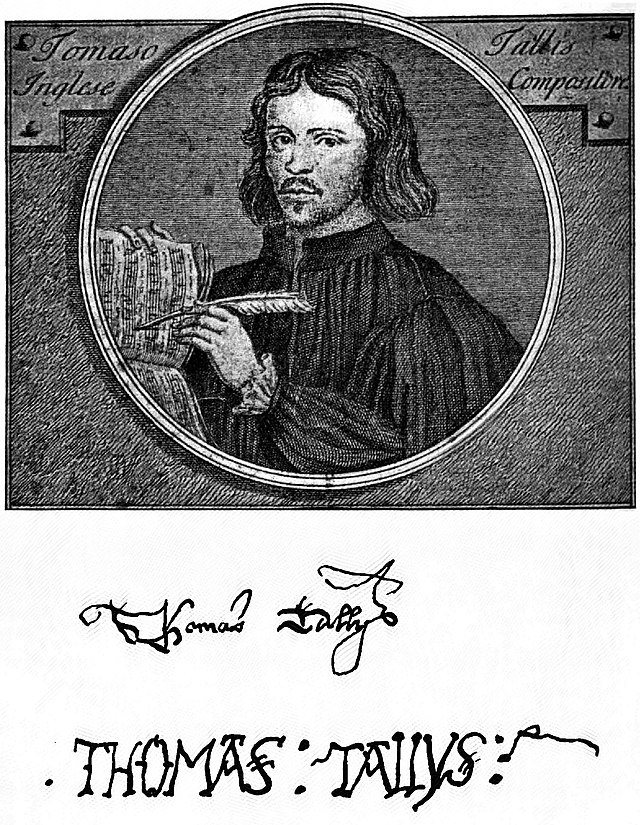
Thomas Tallis
And what finer non-ecclesiastical setting for a cathedral-inspired piece, such as the Tallis Fantasia, than the Royal Albert Hall, in which John Wilson cleverly created antiphonal special effects by placing part of his string band in a line, high on the right at the rear of the platform? The two bodies of strings answered each other: the music moving across the centuries, from Tallis’s Elizabethan sound-world of church voices, to the well-upholstered, romantic early 20th-century string writing of Vaughan Williams.
Ralph Vaughan Williams in 1898. British Library. Wikimedia Commons
The one new work in the programme, the Huw Watkins Flute Concerto also suited the hall’s great acoustic – a beautifully air-borne thing and (for this reviewer) strangely reminiscent of a scene from the Ken Loach film, Kes, about a boy from a deprived background, spiritually rescued by a chance ownership of a hawk. In the film, there is a moving scene where the boy takes his kestrel to a field at the edge of the northern town in which he little more than exists, and flies him with all the skill of a mediaeval falconer. The bird takes to the wing, accompanied by flute music, neither tuneful nor atonal, which seems to represent freedom, air, longing, space. All of those qualities were to be found in the Huw Watkins piece, played by distinguished soloist, Adam Walker.
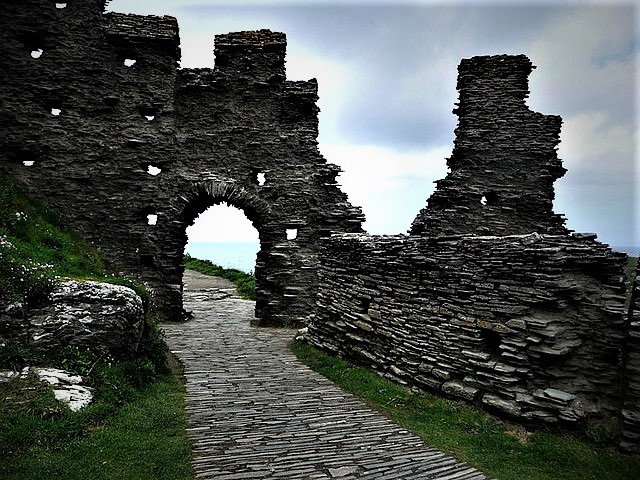
The great (literally) landmark work of the evening was the 1917 tone-poem by Englishman and also Celtic enthusiast, Arnold Bax, Tintagel. The composer visited the dreamy north Cornwall coast with his mistress, fellow musician Harriet Cohen, and found deep escapism and solace in the ancient surroundings of rocky coast and the ever-present gentle, heaving breast of the sleepy Atlantic. The work begins in pure, clear-blue summertime, but as Bax pointed out in an explanation of the piece, not a windless day.
John Wilson’s orchestra began their evocation with gentle, dreamy woodwind conjuring a feeling of sea-birds and distances. The growing swell of the sea against the rocky sentinels of Cornwall’s headlands was beautifully executed in the surging, strong, cohesive orchestral tide of sound created by the Sinfonia. But just as quickly as the physical setting of Cornwall has been established, Bax then begins to dissolve it all, with the supernatural drama of the ancient kings, Arthur and Mark, and the destructive, legendary love of Tristan and Isolde – the latter, a symbol of Bax’s own romantic entanglement. The composer wrote several Celtic-folklore-inspired pieces and seven impressive, well-orchestrated symphonies (the Fourth being the most radiant and most-often played, although an outing for a Bax symphony is still a rare occasion).
What Tintagel represents is a (nearly) fifteen minutes-long condensed symphony – a clear, concise distillation of some of the more long-winded ideas which all long symphonic structures have, but which in the case of this piece are assembled with utterly persuasive and spellbinding cohesion and power. Not a note is wasted in Tintagel: there is a beginning, middle and an end, and like Sibelius’s The Oceanides (a tone-poem of some ten minutes), a listener or concertgoer can instantly know the composer just from this one calling-card piece.
With instantly recognisable pieces in mind, the concert concluded with Walton’s shimmering, Italianate Partita, written in the Mediterranean sun and siesta of the late 1950s – and Elgar’s Variations on an Original Theme, (‘Enigma’), penned at the end of the 19th century, but looking forward with masterful confidence to a new century and (for Elgar) new successes and untold honours. Again, the Sinfonia of London matched the mood, its players responding with great physical commitment to the scores of these British giants; men whose music, in different ways, captured the spirit of our native music.
Skara Brae on the Orkneys. Photo: Daniel Bordeleau. Wikimedia Commons
Yet what really is our native music? – as BBC Radio 3’s Tom Service (a Scot) asked in the evening’s programme notes. Slightly dismissive of the insularity of the land “sandwiched between Hadrian’s Wall and the South Coast” (his words), the writer nevertheless correctly noted the way in which our music has transcended the country’s physical boundaries. However, metropolitan observers should not be so quick to dismiss country cottages and “folky-wolky melodies”. As Vaughan Williams pointed out, all great universal art is rooted in a place, whether Bach’s Lutheran northern Germany, or the Spain of Velazquez. And as Tom Service should know, modern composer Peter Maxwell Davies, who settled in the Orkney Islands, immersed himself in a Scottish island identity, garnering, like a beachcomber, every conceivable Orcadian cadence, myth into his music, showing just how powerful “insularity” can be as a creative inspiration.
The capacity audience at the Royal Albert Hall, not a bit dissuaded by the Met. Office’s red-alert, heat-wave weather warnings, gave the performers a typical Proms ovation. And John Wilson gave them in return, one more piece – an encore from Eric Coates’s Summer Days suite, a nostalgic, innocent waltz. Judging by the overflowing applause, it is a world that still means something to so many.
JACOB RIYEFF (@riyeff) is a translator, teacher, and poet. His work focuses on the Western contemplative tradition and the natural world. Jacob lives in the Upper Midwestern U.S. with his wife and three growing children.
”A man’s attitude to life.” (Feb 20, 2022)
O Edward Elgar, did you see our faces rapt in darkness, hearts attuned to your cello As you lay upon your deathbed, traces Of joy accompanying the low and mellow Tones the strings invite our ears to hear Amid glissando runs to keep the mind And body clear? You cursed its weak premiere But here a hundred years past you find A willing crowd to celebrate your movements As you lay in Worcester gasping for air‚ From lyric to rondo, fulfillment In sonic pattern, virtuosic fare. Could you see, in your final agony, Our festival of superfluity?
JACOB RIYEFF (@riyeff) is a translator, teacher, and poet. His work focuses on the western contemplative tradition and the natural world. Jacob lives in the Upper Midwestern U.S. with his wife and three growing children.
R. J. STOVE reflects on life as an antipodean performer on the King of Instruments
‘“What?”, said [piano manufacturer] Herr Stein. “A man like you … wants to play on an instrument which has no sweetness, no expression, no piano, no forte, but is always the same?” “That does not matter,” I replied. “In my eyes and ears, the organ is the King of Instruments”.’ (Mozart)
Disheartening to report, Bismarck never uttered the epigram so often attributed to him: ‘Laws are like sausages: it is better not to see them being made.’ But each time I undertake a commercial recording – and I have undertaken three such now, all devoted to organ music – I am painfully reminded of this misattributed quotation.
Because if you contemplate classical music in recorded form (as the vast majority of journalists discussing it do contemplate it) through a haze of aestheticism, assuming that nothing ever happens in front of the microphone without the loftiest and most disinterested of motives, then the best cure for such kumbaya soft-headedness is actually to make recordings yourself. The procedure is death to entitlement culture, death to the near-enough-is-good-enough mindset, and death to all romanticist whimsies about artistic ‘inspiration.’
Among didactic processes, only an obligatory course in obstetrics would strip away more illusions from the novice, and strip them away faster, than recording production does. I cannot help musing over how much polysyllabic Marxist verbiage Walter Benjamin and Theodor Adorno would have spared us – how much Teutonic vamping about ‘the aura of mechanical reproduction’ and ‘bourgeois commodification of ritual’ they would have eschewed – if they had experienced for themselves, which they did not, the perils of needing to perform as flawlessly as possible within seconds of a producer turning a red light on. Not to mention the still greater perils of needing to keep one’s temper each time a producer is obliged to halt a take because of extraneous noise issuing from (i) seagulls overhead, (ii) a helicopter overhead, (iii) a passing ambulance siren, (iv) revving-up from a motorcyclist, or most frequently (v) all of the above.
A producer of classical recordings, if he (and, whether we like it or not, it remains a male-dominated profession) wishes to survive, has to be part surgeon, part electronic engineer, part Cecil B. De Mille, part Grand Inquisitor, part concierge, part therapist, and all musician. His role entails some of the attributes perceptible in the great symphonic conductors: notably an X-ray ear which can descry faults in even the most imposing wash of sound. When an orchestra gives its all in the mightiest of Respighian climaxes, the producer must be able to detect the third oboist who, amid the hubbub, mistakenly played an F sharp instead of the score’s indicated F natural: and to call out that oboist – politely, one trusts; rudely, if trust be impossible – over the error.
Yet that is almost the least of what the producer needs to do. He requires a retentive memory not for various takes’ musical contents alone, but for various takes’ volume levels. Should consecutive takes differ from each other in this regard, or in regard to the venue’s atmosphere (known among the cognoscenti as ‘atmos’ for short), he has to minimise those differences. No surprise that, even before the compulsory post-production chores, his copies of the sheet-music will have become so scribbled-over in red Texta as to resemble Jackson Pollock’s action-paintings.
Physical strength is a prerequisite as well. Especially if confronted with an unfamiliar site, he will be expected to lug prodigious quantities of cords, plugs, microphones, power sockets, monitor speakers, and computer hardware from his vehicle, before he assembles them: only to carry out the whole boring process in reverse when the session concludes. In this assembling and disassembling, he cannot and must not be rushed. It is hard for even the most arrogant performer to demand, with a clear conscience, additional haste from someone who can accidentally electrocute the entire dramatis personae if an exposed cable proves insufficiently earthed or a wire has worn through its sheath.
Therefore it is understandable that for every thousand good classical musicians out there, scarcely a single good classical recording producer can be traced. The best ones – they have included Walter Legge, Brian Culverhouse, and John Culshaw among the dead, and my own brilliant producer Thomas Grubb among the living – can charge whatever fees they like. Although COVID might have decluttered their timetables, it has not reduced (nor should it reduce) their invoices. Sir George Martin, at a period when the Beatles’ fame had yet to transcend Liverpudlian city limits, produced many a classical recording for EMI. He entertainingly recounted this function’s more bizarre aspects in his 1977 memoir All You Need Is Ears.
Nevertheless, whilst the good classical recording producer is as rare a bird as a left-handed red-headed Christadelphian, the good classical recording producer who can skilfully capture organ music is analogous to a left-handed red-headed Christadelphian who can do five hundred consecutive push-ups. With an orchestra or a chamber ensemble, after all, a producer has the luxury of operating in a more or less conventional studio. The designers of that studio will have taken some pains to soundproof it. In that studio he will be visible, albeit behind his desk, for at least some of the time to at least some of the musicians involved. He can rely on none of these advantages when recording organ music.
For as all organists – but all too few non-organists – know, pipe organs are not just musical instruments. They are, by definition, musical instruments ensconced in particular buildings, and habitually irremovable therefrom through any methods less radical than Semtex.
Many church instruments are installed in such a way as to force the organist to play with his back turned not only to the altar, but to the producer. Rear-view mirrors at the organ console possess limited efficacy. (During my own most recent sessions – cooped up as I unavoidably was in the loft – the worst thing which I could have done was the thing which all halfway decent musicians, by default, do: constantly listening to fellow performers. Instead, I needed as a deliberate procedure to play well ahead of the beat, purely so the final product’s hearers would have the aural impression of my keeping time with the five singers. All five, for balance-mandated rather than COVID-mandated reasons, remained invisible to me in the nave below. It took a crucial half-second for the organ sound to reach them from the loft’s phalanx of pipes.)
Whether a pipe organ be sacred or secular, its tuning will be always expensive. Rapid tuning is downright impossible. In a climate as manic as Melbourne’s, where two consecutive days will often enough be respectively 32 degrees or 14 degrees (not to mention vice versa), even the best-built instrument can unexpectedly acquire several out-of-tune pipes: without fail, the pipes most suitable to the music’s content. Ten times more worrying is the organist’s greatest dread: a cipher, whereby a particular keyboard note or pedal-board note sounds and cannot be switched off. Imagine the most persistent ambulance or police-car ululation which you have ever heard; then imagine such an ululation in an ecclesiastical context, when the nearest organ-tuner is unavailable through being hospitalized, or on holidays, or repairing an instrument in a different church, or simply drunk.
But you have not yet supped full on organ-related horrors. The 1970s Anglo-Saxon mania for carpeting what had been perfectly acceptable wooden or stone floors ruins many a church’s acoustics. Beautifully manufactured though a pipe organ might be, ubiquitous carpet will frequently make it sound like a Casio burp-box vended below cost price on eBay. Even churches free from carpets are apt to be located on main roads, their architecture dating from an epoch where internal combustion engines were largely unimaginable. However impressive their stonework, they offer almost no insulation from modern traffic noise. Factor in the tendency of churches to support church schools, and the aural complications are aggravated threefold. If you have never attempted to record a beautifully soft, French impressionist organ prelude while shrieking infants gallivant in the playground during their lunch break, your personal acquaintance with existential anguish is automatically limited.
Given these and other nuisances, you could be pardoned for asking why anyone would wish to record organ music in the first place: let alone to record three CDs’ worth of it, as I have done, with a fourth CD currently awaiting issue. Speaking as a middle-rank Melbourne organist with twenty-one years of remunerated public playing behind me – neither enjoying the rarely-conferred benefits of sustained cathedral employment, nor suffering the griefs of the overworked tyro frantically having to pad out an exiguous résumé – I find myself caught in not one but three perfect storms.
First of these storms is, naturally, COVID. Useless, and redundant, for me to expatiate here upon the damage which Wuhan’s most renowned export has done to live classical music performance in general; live classical music performance in Australia especially; and live classical music performance in Melbourne above all.
The second among these storms is one which foreigners will be able to predict with a little thought: Australian churches’ continuing sex abuse crisis, primarily (though not exclusively) afflicting Catholicism. Every dollar which dioceses are ordered to spend upon paying off an abuse victim’s lawyer, is a dollar which dioceses cannot spend upon professional musicians. Australia’s Catholic parishes were in demographic free-fall long before front-page headlines screamed about the pandemic.
As far back as 2011 – in other words, not solely pre-COVID but pre-abuse scandals too – 87% of Australia’s Catholics could not bestir themselves to attend Sunday Mass. We all know the only branches of Australian Christianity where the churches are full: the Pentecostal brigades, of which Hillsong is the most celebrated. Anyone gullible enough to believe that Pentecostal jamborees are likely to include organ-playing, or any musical contributions whatever except those supplied by sub-Hendrix guitarists and gyrating Taylor Swift wannabes needs (to borrow a felicitous, long-ago phrase from Esquire) not merely his head but his entire anatomy examined.
One much-loved hymn tells us: ‘There is a happy land, far, far away.’ There are in fact several such happy lands where university posts can, and do, recompense organists for the uncertainties of ecclesiastical occupations. Unfortunately, these happy lands do not include my own. In any analysis of today’s antipodean academe, the third perfect storm afflicting organists can be at once recognised. Australia’s ever more shambolic federal government has added, to its widely-shared record of COVID-related ineptitude, a malice all its own when it comes to higher education.
The most vituperative surviving Khmer Rouge commissar, and the most frenziedly anti-intellectual Mississippi Klansman, might well blanch at the overt hatred towards humanities departments that routinely emanates from Scott Morrison and his Canberra colleagues. These legislators expend their hatred not specifically on left-wing and/or spendthrift humanities departments, but on humanities departments per se. For all their mismanagement when it comes to public health, they have demonstrated impressive populist cynicism on pedagogical issues. They discern the absolute monetary dependence upon the welfare state which has characterised Australian academe from its beginning; which is certain to characterise it until Judgement Day; and which has resisted four decades’ worth of libertarian think-tanks’ harangues about the private sector’s alleged enthusiasm for acting as Maecenas. More and more, the very concept of private universities for Australia is proving as mythical (indeed, in its bogus promises, almost as pernicious) as those other nostrums propounded by fantasising savants: The Classless Society; Sex With No Strings Attached; Exporting Democracy To The Third World; No-Fault Divorce; and – who can doubt the essential illegitimacy of this doctrine likewise? – COVID Zero.
Last year I had the privilege of an academic post, necessarily casual in nature, under Sydney University’s auspices. Having written earlier about the pleasure which I took in this post (and about how gratified I would be if the post continued into 2022, which perhaps it will), I obviously must not repeat myself here. But I would be crazy to nourish sanguine hopes that Australia will permit for me an academic – dare I even employ so ‘elitist’ a noun as the following? – ‘career.’ My sixtieth birthday fell shortly before last Christmas; and quite apart from my innate lack of youthful cred, it is hard to envisage any status less welcome to modish Human Resources departments than my own Google-aided identifiability as a white straight male Catholic.
No individual, therefore, will be more delighted than I to gain further academic emolument. Equally, no individual is less prone than I to take any such emolument for granted. My research background has been the opposite of fashionable: last year I completed my doctoral thesis on Sir Charles Villiers Stanford’s organ output. In any contest between a candidate who has specialised in Sir Charles Villiers Stanford, versus a candidate who has specialised in transgendered rappers from Bali, no prizes are offered for guessing the probable victor.
This all explains, ultimately, why I find myself investing greater and greater sunk costs in the project – which is, I concede, a First World problem – of capturing my organ-playing on record. By so doing, I might (I repeat: might) convince university employment’s arbiters to overlook my chronological, ethnic, and religious disadvantages.
Going to the effort and expense of issuing no fewer than four CDs indicates, at least, exceptional dedication and single-mindedness. So, of course, does becoming a kamikaze pilot. Time will pronounce whether the former occupational choice supplies any better long-term prospects than did the latter.
Meanwhile, in defending my own gramophonic incontinence, I am tempted to quote Maurice Chevalier’s brusque retort to a question about how much happiness he experienced in old age. What (the straw-hatted Gallic divo inquired) is the alternative?
R. J. STOVE’s organ recordings are available via the website www.arsorgani.com, and via the main streaming services (Spotify, Deezer, Apple, Tidal, YouTube).